

Submitted:
11 September 2023
Posted:
12 September 2023
You are already at the latest version
Abstract
The public administrations (PAs) that have joined the Covenant of Mayors must now complete their adaptation plans with the climate chapter (SECAP). At the same time, the previous Plan for sustainable energy (SEAP) was mainly dedicated to mitigation actions (sustainable energy). It was often managed directly by municipalities' in-house energy companies or agencies. The WMO1234 Recommendation (Guidance on Integrated Urban Hydrometeorological, Climate and Environmental Services) is a fundamental Guidance to allow PAs to make policies and decisions regarding city regeneration and population health prevention. The purpose of this manuscript is to describe a process undertaken in the Emilia-Romagna region to build a coherent frame from the individuation of local environmental vulnerabilities and adopt specific policies. This frame was created by the contribution of various Institutions, including the Regional Authority, which furnished the main directives and tools for the mitigation and adaptation, the Municipality of Bologna, which prepared the first Adaptation Plan following the SECAP guidance, the Emilia-Romagna branch of Italian Association of Municipalities (ANCI), which took in charge the approach to harmonize different urban contexts and to communicate with stakeholders and population, and Research Institutes and Scientific Associations to explore, with specific studies and modeling application, the outcomes produced by a joint support to the new urban directives, such as the General Urban Planning Plan (PUG). To achieve this result, the WMO Guidance 1234 has been assumed as a reference methodology to ensure the best utilization of available data and widespread a common science-based methodological approach to other municipalities.
Keywords:
adaptation
; climate change
; urban vulnerabilities
; population health
; resilience
; urban regeneration
; social acceptance
1. Introduction
The proactive involvement of policy makers in addressing climate change adaptation in urban environments is substantial. Covenant of Mayors [1] is the forefront actor in driving such complex actions as, in alignment with the top-down processes by international organizations, it is the democratic representative of the local aspirations and expectancies to reach social resiliency. The pact of Mayors, in 2008, had mitigation processes as the initial objective, addressing towards the reduction of CO2 concentration at the global scale [2].
In 2014 the European Commission launched the Mayors Adapt initiative, based on the same principles of the Covenant of Mayors, enlarging its focus on climate change adaptation. Mayors Adapt invited local governments to demonstrate their leadership in developing and implementing local adaptation strategies. In June 2016, the process entered into a new phase, joining forces with another city initiative, the pact of Mayors, or C40 Initiative [3]. The resulting "Global Covenant of Mayors for Climate and Energy" initiative become the most important commitment of local governments to go beyond national climate and energy objectives, entirely aligning to UN Sustainable Development Goals and climate justice principles. Three key issues are tackled: climate change mitigation, adaptation to climate change adverse effects incorporated into the municipalities’ policies, and universal access to secure, clean and affordable energy. Currently, 60 countries with 10,212 signatories joined the pact covering about 323 million inhabitants.
The transition from a pact simply addressed to sustainable energy to a joint enlarged purpose based on climate underlies the urgent logic to combine mitigation and adaptation to construct a sustainable and resilient future.
In the last ten years, Public Administrations (PAs) have been equipped with specific tools, such as energy agencies, able to very effectively develop plans as SEAPs (Sustainable Energy Action Plan). However, the inclusion of climate action in the new agreement (SECAP: Sustainable Energy and Climate Action Plan) was not matched by parallel skills, as locally developed competencies did no longer correspond to the process expectations.
Furthermore, plans addressed to adaptation require the development of a cognitive framework of territorial vulnerability and the identification of indicators for monitoring the actions progress [4,5,6,7,8,9]. From the operational point of view, municipalities characterized by scarce economic and human resources face the most critical issues in developing the Adaptation Plans included in the agreement.
It becomes essential to equip municipal technicians with the necessary tools and examples enabling the setup of the climate chapter of the Plan, by addressing data sources and appropriate methods. As examples are difficultly exhaustive and not directly applicable due the diversity and complexity of each territory, a conceptual effort is always needed to grasp the similarities [10,11], supported by the Climate Adapt website, sharing experiences in Europe [12].
In specific, adaptation is urgent nowadays to face immediate sustainability problems [13,14]. Pandemic and climate extremes highlighted the fragility of the structure of territories and services on the social level [15,16,17,18,19,20]. Europe addressed its Adaptation Strategy, supporting the municipalities with a specific package [21], sharing the main tools able to enhance the resilience of territories and cities. The package represents an entry-level for any administration and the basis to approach to the adaptation chapter and draft the strategies to be included in SECAP. Three main strategies are foreseen: the promotion of actions by the Member States, a better-informed decision-making and the link to vital vulnerable sectors. As an example, the Italian Ministry for the Ecological Transition promoted a list of actions [22], including eight major implementations: to encourage the adoption of strategies, provide funds, introduce the adaptation in the Covenant of Majors (SECAP), bridge the knowledge gap, access to information and develop interaction between Climate-ADAPT and other relevant platforms, including national and local adaptation portals, facilitate the climate-proofing of Common Agricultural Policy (CAP), the Cohesion Policy, and the Common Fisheries Policy (CFP), ensure more resilient infrastructures, promote insurance and other financial products for resilient investment and business decisions.
1.1. The WMO1234 Guidance and other International and National Schemes
WMO (World Meteorological Organization) set on place the GFCS (Global Framework for Climate Services) to improve co-production, tailoring, delivery and use of science-based climate scenarios and services focused on the main priorities -agriculture and food security, disaster risk reduction, energy, health and water [23]. The aim was to empower stakeholders, including PAs, with a prompt extensive database providing the information to assess vulnerabilities and identify adaptation options to implement their adaptation plans. National Frameworks for Climate Services (NFCS) are the multi-stakeholder user interface platforms enabling the development and delivery of climate services at the country level [24], and PAs are providers of data themselves via the Nationally Determined Contributions. (NDCs).
Recently, WMO recognized the importance of providing PAs with specifically devoted to the urban environments, to practically direct them towards a clear understanding of the problems and the fundamental actions to be undertaken to implement adequate adaptation plans [25]. An inter-programme working group was created to ensure a full coverage of the different urban adaptation actions worldwide. The necessity to adequately put on place urban-tailored actions are mostly stressed as in a few decades most of the world population will live in cities (more than 68% by 2050 [26]). WMO consequently encouraged national meteorological services to establish active working relationships with municipal authorities, recommending that both actors jointly agree on the priorities and identify the resources required for sustaining service delivery and improvement. Considering the global importance of urbanization and the growing megacities, WMO analyzed this phenomenon as a high-level priority [25].
Specifically, the Guidance indicates to municipalities how to monitor the local problems and follow paths to resilience (Table 1).
More indication about reaching Adaptation comes from the National Adaptation Plans (NAPs) [27]. Each NAP should provide a vision of the impacts of climate change in multiple socio-economic sectors and natural systems, identifying a set of actions and guidelines to cope with these impacts. Accordingly, and by implementing the indicated actions and guidelines it will be possible to minimize the risks deriving from climate change, maintain or improve the adaptability of natural, social and economic systems, and take advantage of any arising opportunities.
The Italian Ministry of Environment in 2015 finalized the first National Strategy to Climate Change Adaptation (SNACC) [22], which indicates a path of adaptation through the analysis of national general impact issues, from water resources, hydrogeology, agriculture forests and ecosystems, costal and marginal areas, infrastructures, health, up to tourism and urban settlements).
It should be noted that the two terms, National Strategy and National Plan, are used indistinctly. The experiences gained in countries that have adopted a Social Network Analysis [28] and are implementing a NAP show that these are different tools. While a SNA is typically a strategic "vision" of country-level adaptation, a NAP is a way in which it is pursued.
PAs can use these tools to recognize their specificities, identify the potential impacts and the possibility of inter-sectoral adaptation, and proceed to harmonize national indications to solve local issues.
A crucial priority to develop each local Adaptation Plan is to individuate the specific vulnerabilities of the territory, with an inclusive approach pragmatically considering the territory's potential impacts not exclusively on the landscape and environment but also on the social and economic components. Related policies and adaptation actions must be contextualized: this mostly means that elaboration and sustainable planning must be tailored on a case-by-case basis accordingly to different needs and regional and local situations.
1.2. The meteorological-climate approach for the Public Administration: the Italian case study
The National Plan for Adaptation to Climate Change (PNACC) and the general Strategy for Adaptation to Climate Change (SNACC) [22] developed in Italy are intended as an indication to PAs to locally achieve objectives of sustainability and resilience and contributing to the whole national economy.
PNACC individuated 361 sectorial adaptation actions for the territory and 21 relevant actions. As a consequence, the general Guidance has been adequately depicted to allow PAs to create a coherent frame for adaptation. However, even if PAs widely accepted the new indications, an “old-time style” in landscape and urban planning still resists. The emerging issues linked to climate change are forcing PAs to react, but it is not easy for them to apply the national directives because of a lack of technical and human resources to be devoted to the change.
Climate change manifests itself on different temporal and spatial scales, and threats natural systems as well as sectors of human activities, some of which are particularly sensitive, as in the case of urban settlements. In order to reduce the impacts of potential adverse change on urban areas, their infrastructure and surroundings, as well as on the people and other living species, the establishment of long-term climate adaptation policies at the local level is becoming more and more critical [29].
A profitable approach is based on performing an appropriate analyses of landscape sensitivity [30,31,32,33]. The first point to be addressed in the design process of a climate adaptation plan needs in fact the identification of the potential magnitudes of climate impacts and assessment risks compared to the baseline. The relative territorial sensitivity, the capacity of spontaneous adaptation of the flora and fauna in ecosystems depends on climatic variations, as the possibility for decision makers to implement further, where and if necessary, adequate and consequent strategic adaptation measures from short to long term. For cities, it is a critical to consider the problem in a complex manner as the interaction with climate hazards are strongly linked with the internal texture, arrangement and organization of the city itself [31,34].
2. Methodology: Planning process from Regional, National to Local level
The recent publication of the EEA (European Environmental Agency) [35] growth briefing unfolds an institutional and regulatory metabolization process of concepts that, until now, it was considered as a prerogative of ecologist associations. The growing mass of scientific and empirical evidence brings the urgency of a step change of paradigm to be not anymore postponed, coupled to and the reinterpretation of the growth model on which our economic systems are based. The local climate conditions and their effects on the environment and the population are, in fact, closely linked to the economy of the territory and are integral parts of the policies of small and large municipalities [36,37]. To better understand how this reflects today on local administrative actions and how it should influence the strategic logic of the municipalities some key cultural passages dictated by the current historical phase has to be recognized. The reorganization towards sustainability and resilience will necessary move from being a virtuous accessory to become a transversal constant functional to all administrative actions. This process requires the involvement of all levels of political thought and an active operational role of the municipal systems (Table 2), to be often carried in the absence or in a severe shortage of the human resources necessary for the reorganization.
Although in recent years a multiplication of roles specifically oriented towards sustainability objectives occurred, as for example a growing number of dedicated departments, and the cultural awareness was growing up, the effective presence of sustainability aspects as fundamental and substantial in operational terms is still scarce.
The formulation of a regulatory context that favors and unifies the economic and political aspects is fundamental to ensure that climate change adaptation actions occur at all levels of territorial and urban planning.
The list of the salient regulatory and implementation steps concerning urban adaptation to climate change, from the global to the local level (global, European, national, regional, local) to give operational continuity to the implementation of more resilient cities is reported in Figure 1.
In specific, Emilia Romagna Region and the Municipality of Bologna have considered priority since the very beginning and, accompanied by partners from the scientific and associative sectors have developed an integrated design approach supported by scientific methodologies that respond to the transformation needs of the context.
When comparing the timelines of the various regulatory levels, it come evident that Emilia Romagna has equipped itself an integrated approach aligned with the urgencies of climate change, as well as to accommodate the directives of the superordinate regulatory levels.
To support synergy and awareness between citizen, professionals, businesses and PAs, Emilia-Romagna approved its first law on participation in 2010. In 2016, the process of revising the law began, envisaged by the so-called "Evaluation Clause". The Region has decided to support the institutional review process with a participatory listening process of the territory, which has been called "Let's have our say". At the end of the meetings, a bill was presented for a new law on participation, approved in 2018 (Regional Law n. 15 "Law on participation in the formulation of public policies” [38]).
Co-creation process with citizens and awareness creation are specific and irreplaceable tasks assigned to the PAs. New encouraging tools for the democratic management of participatory processes are emerging. However, such tools are still slowly spreading due to the lack of solid capacity building processes of the professional figures. New professionals must be able to facilitate jointly shared paths with competence, decisive in producing the necessary evolutionary changes and enabling local administrators to act more effectively and incisively. These professionals will have to act as natural, cultural mediators on the climate issue between administrations and citizens in a logic of expectations and solutions exchanges. Awareness of the ecosystem values must also be strengthened to overcome potential reluctances in decisions. To best match this issue and provide competence and security to participatory courses Emilia Romagna established a specific dedicated yearly funding, allocated exclusively to the participatory process, eventually co-financed by larger projects.
There are several successful examples of such knowledge processes of adaptation and mitigation to climate change, as for example the REBUS project (REnovation of public Buildings and Urban Spaces) [39], and a series of seminars in collaboration with Italian Association of Municipalities Emilia Romagna (ANCI-ER) [40].
These actions have been reinforced in 2020 when Emilia Romagna signed the Pact for Work and the Climate together with local authorities, trade unions, businesses, schools, universities, environmental associations, the third sector and the voluntary sector, professions, chambers of commerce and banks.
The process of the region towards for the revitalization and development based on environmental, economic and social sustainability, complete decarbonization by 2050 and 100% renewable energy by 2035, 3% of regional GDP in research and NEET (young people who do not study and work) below 10% [43,44] is an “ongoing process”. As a support to the network of professional figures on the issue of urban regeneration for adaptation to climate change, several learning activities have been planned. (SBAM [45]) Emilia Romagna has developed its strategy based on the territory's structure coupled with the National one [46], but examining precisely specific local aspects. Furthermore, the Regional Observatory on Climate Change [47], was able to provide all the PAs with the climatic scenarios in 2050 relative to seven principal indicators of climate change: average annual temperature; maximum summer temperature; minimum winter temperature, summer tropical nights, wave duration of heat, annual precipitation, dry summer days. This work created a unified strategy to combat climate change [48] on the regional territory, also supporting small municipalities where resources to conduct their own analyses are insufficient. The test-site was provided by the Municipality of Bologna.
3. Outcomes of the Bologna case study
In 2018, the drafting of Bologna city General Urban Planning Plan (PUG) integrated microclimate studies with a high level of detail trough an active collaboration between researchers and various sector offices of the Municipality. This opportunity was important as it allowed to couple knowledge of the local vulnerabilities with desired objectives, making it possible to identify the scientific methodologies compatible with the political needs [41,42].
The Adaptation Plan of Bologna, developed being first between the Italian cities (Blue AP [49]), is now experiencing the new ambition to couple with the urban planning tools (PUG) included in the Law n°24/2017 [50]. This further step aims to correctly applicate the adaptation tools to transform the city into an entirely resilient system. Thus, the PA could be enabled to represent in detail the totality of its territory urgencies, including the physiological level of well-being in the city at the neighborhood scale.
Even if the integration of the whole adaptation aspects into the city fabric represents a complex and enormous effort, its realization implies a responsible collective action and a strict collaboration between the different sectors of the Municipality, leaving aside excuses of direct responsibilities.
However, all cities, including those of small dimensions, face the absence of a defined methodology suitable to drive the use of available data and tools to reach the needed outcomes. Even though the request from the policy is clear, it might not have been equally clear to science how to find a unifying methodology, usable in the recurrence of other climatic-environmental challenges in the territory.
In this paper, we show how an opportunity offered by Bologna to merge policy-making with science institutions brought to new outcomes, promising to be transformed into a general territorial approach towards mitigation and resilience.
The WMO 1234, as the outcome of the experience gained at the level of various cities as a basis for development, was therefore used exactly as a guideline, introducing specific tools during this process capable to answer the main questions of the PA, such as, for example, the well-being of the population [41,51]. By applying these concepts, Bologna's administration and IBE-CNR [42,52] performed this current study, utilizing the massive amount of available data.
In this current study, we utilized a fluid dynamic model (ENVI-met), a three-dimensional non-hydrostatic microclimatic model with a spatial resolution of 0.5-10 m and a temporal resolution of 10 sec [53]. ENVI-met is capable to simulate various variables, including the anemological flow around and between buildings, the processes of heat and vapor exchange both at the surface of the ground and on the walls, turbulent exchanges, some parameters of the existing vegetation, bioclimatology and the dispersion of particles. It is, therefore, flexible to be used to study and understand different aspects of urban canyons, such as the effects of orientation and buildings / green ratio on outdoor urban comfort and the role of vegetation in mitigating the island of urban heat.
A representative portion of the city area has been chosen, also taking as a priority a simulation on a particularly recognized critical vulnerability of those areas where the percentage of green available is low and at the same time, the percentage of the population above 65 and younger than 4 is higher. The comprehension of the occurrence, related threats due to extreme events, namely summer heat islands, has been called as a priority to prepare adaptation and mitigation tools.
Once the representative Bologna’s areas of the descriptive urban fabric typologies of the city were defined, for each one (Corticella, Bologna, Masi, Barca, and Roveri), the model run with the same initial weather conditions. The simulation of the microclimatic conditions was carried out for the day in which, during the heat wave of summer 2017, the maximum temperature was recorded (August 4th). Meteorological data from ARPAE Emilia Romagna were provided by the urban weather station located in the very center of the city.
We then defined a methodology to select the priority actions among those identified by the Adaptation Plan. Considering the defined vulnerability focus, we gave priority to the public areas of exclusive municipal competence in which the Municipality can make direct interventions, and/ or areas on which private subjects may intervene after an agreement with which the Municipality. This study therefore highlighted opportunities deriving from the proximity of natural/environmental elements that could be enhanced through the actions identified, and possible risks or existing problems.
In the historical and consolidated areas of the Bologna urbanized territory, it is evident a deficient availability of greenery per in-habitant (even less than 5 square meters). The Adaptation Plan, therefore, identifies a broad scope for action in the short and long term in public areas (gardens, streets, squares, public buildings schools, etc.) (Table 3)
In the areas of services and aggregation points (pharmacies, social centres for the elderly, parishes, URP, clinics, and voluntary associations), the Plan contemplates points of dissemination of information and assistance on heat waves. At an operational level, these places can be good starting points for setting up concrete actions to reduce vulnerabilities at the places usually frequented by the weaker groups and the rest of the population.
We started from the assumption that structuring actions by ensuring that the weaker groups live in microclimatic/physiological safety conditions guarantees all citizens' general safety.
For this reason, we defined vulnerability by the occurrence of a high temperature nearby buildings most frequented by the weaker groups (pharmacies, clinics, social centers, schools, gardens, neighborhood squares, etc.).
Basing on that vulnerability analysis, taking into account the specific objectives of the Adaptation Plan relating to heat waves, local adaptation strategies and actions have been declined and listed below:
- Increase green trees in historically consolidated areas (structured urban territory);
- Increase the number of trees on streets, squares, and parking lots;
- Enhance the contribution of urban agriculture for adaptation and mitigation;
- Greening interventions on public buildings;
- Extend the information/assistance system on heat waves (weak bands).
In this regard, it strongly emerges that the creation of safety and security routes for refreshment is an important a new adaptation strategy. By safety routes, we mean paths that allow population and particularly weaker groups may reach the necessary spaces and services in conditions of good physiological well-being. Along the same conceptual line, refreshments areas meant those more or less circumscribed spaces that guarantee weaker groups to stop in comfort conditions close to thermal neutrality. To enabling the creation of refreshment paths, it is possible to introduce into the urban components (streets, squares, green and water system, buildings and materials) material capable to influence the exchange of temperature and matter near the surfaces. A choice of Nature Based Solutions (NBSs) as vegetation, materials characterized by high reflectivity, and water permeability of the surfaces to guarantee the evapotranspiration processes is available at this purpose.
NBSs, as shown in Table 1, stand out for their peculiar multifunctionality, as they can solve multiple problems in a single solution for a cost equal, if not lower, to the cost to be sustained individually addressing each priority. Moreover, services provided by NBSs are tools in the hands of technicians, designers, and companies perfectly in line at a conceptual level with the integrated and multisectoral approach on which Adaptation Plan is based.
4. Result and Discussion
Based on the methodology explained above, the following results are summarized for each area analyzed:
- Identification of places’ and public areas’ vulnerabilities in which aggregation of weaker groups occurs.
- Detection of natural/environmental elements or particular conditions (including risk) in the weaker groups' aggregation areas and, more generally, in the whole area.
- Selection of actions able to mitigate the physiological/climatic threats in the identified vulnerable places.
- Verification of the microclimatic effects of the selected scenarios using microclimatic modelling tools (ex-post simulations with EnviMet software) regarding the specific objectives of each strategy.
- The implementation of the selected actions and periodic monitoring (surveys with citizens/instruments).
Aware of the fact that a functional and integrated methodology requires a verification based on the set objectives, we considered essential to follow a monitoring of the actions proposed. This at the purpose to validate or review/modify the actions themselves depending on unexpected outcomes, especially in terms of worsening conditions.
The results (Figure 2) have been adopted and are now part of the Discipline of the General Urban Plan [54], which regulates the building interventions, introducing the obligation for building enterprises to respect or ameliorate the microclimate conditions of the work areas.
Figure 3 summarize this paragraph and its results integrated in the PUG Discipline.
Identifying risks and vulnerabilities is a methodological process that must necessarily be placed in the context of each territory, and operationally involves several professional figures. Once risk identification has been processed, the next step to prepare the SECAP is identifying the contextual actions. This step implies a political choice taking into account the priorities of decision-makers’ strategic vision in the short and longer terms. The national and international planning and the resulting city movements (e.g. C40) of the last decades are based on the sustainable integrated approach that guarantees a vision of the territory characterized by the possibility of grasping the transversality of each sector compared to the others. SECAP follows this approach and places itself in a direct dialogue with all the other operational plans and urban planning instruments which determine the city's development. In addition to the climatic aspect alongside the energy one, the primary operational tools with which the actions are implemented, namely NBS, favor the transversality of SECAP. Their multifunctionality encourages a simultaneous facing of multiple problems, thus obtaining solutions that addresses multiple challenges (climatic and otherwise) by providing interaction between urban components and technological innovations.
The application of a wide microclimatic characterization of the city allowed a better protection of fragile population. Guolo et al. [51] reports the results of a study, based on the previous characterization of the city of Bologna, to evaluate the association between summer temperatures and emergency department visits (EDVs) and assess whether this association varies across areas with different socioeconomic and microclimatic characteristics. It appeared very clearly that the policies implemented by the Public Administration to protect the health of the most vulnerable categories, have likely acted as a barrier against the impacts of climate change and have likely helped residents cope with poor microclimates, at least in most parts of the town.
Results show clearly how a continuous dialogue between politics and science may concrete structure the actions necessary for change. On a practical level, the classic functions of "command and control" that the public institution exercise show their limits: innovation needs science, inspiration, support and facilitation. The concept of experimentation and, therefore, the possibility of doing, failing and then learning to correct the shot and start again must be accepted, and pushed. Municipalities are the actors called to play a key role in spreading this awareness because of their natural proximity to citizens in daily processes and are the institutional subjects committed to a necessary relational and social transformation. PAs are then forced to make the transition from adopting symptomatic solutions often dictated by the emergency, to implementing deep systemic ones moving towards real sustainability, protection of resources and environmental quality models.
New awareness requires adaptations to changing scenarios, sometimes sudden and forced, as during the rise of a pandemic, to adapt to the European objectives for 2030 and to answer to the challenges of an era of radical transformations [56]. There is the urgency to open a window on broader and more articulated arguments, increasingly urgent. The invitation is to perceive the profound meaning of this moment, grasping what positive and regenerative actions can bring if faced with a logic of preparation and programming, open to organizational innovation. When accepting this, the decision-making mechanisms may courageously and successfully experiment new ideas and routes.
Policymakers must therefore make a responsible selection of the focus objectives as, for example:
A- weaker groups (under 4 years and over 65) and fragile subjects (diseases such as heart disease, diabetes, allergies to pollen or air pollutants), with the awareness that by securing these categories of citizens [57,58,59,60], all other segments of the population will also automatically benefit from the microclimatic comfort.
B- urban morphology and surface material composition of the city, favoring the implementation tools regarding the reduction of soil consumption, de-sealing operations (urban drainage and better urban soil ecosystem services), direct and indirect interventions on the urban and building heritage towards solutions with low environmental impacts [61]. This will mean to pay particular attention to physical and optical parameters of the city materials, selecting those with a higher reflective properties (albedo). The theme of de-sealing and urban drainage must be seen in a double perspective, either securing the city from extreme rainfall and offering opportunities for the recovery and reuse of water, ensuring the management of so-called flash floods avoiding flooding, allowing rebalancing the hydrological balance and reducing the polluting load of water bodies, as well as the reuse of water for anthropic uses. Also, in this sense, there are now techniques widely tested in the field of soft engineering (Sustainable Urban Drainage System - SUDS) [62,63].
By pursuing this political direction, decision-makers could overcome the concept of sustainable development strategy and will enable “Smart Cities” to evolve and become “Healthy Cities” [64].
5. Conclusions
The methodologies developed here and the consequent results, integrated into the PUG discipline, are becoming operational tools of urban planning in Bologna municipality. Several PAs -of large, medium or small cities- and Unions of Municipalities are taking them as a reference for a best practice, including the method for identifying vulnerabilities in places frequented by disadvantaged groups.
Science must produce easy-to-use tool and provide all available knowledge to allow policy makers to make the correct choices. If single experiments or results show the potentiality to become fundamental to solve a problem, it will become necessary that some paths are standardized to transform them into good practices.
The two objectives of political strategy (A and B) described above can contribute to transforming cities in places where gentrification will progressively disappear, where every part of the city can guarantee paths and niches of microclimatic comfort for anyone, where each intervention will be oriented to the well-being of the community as well as to that of the individual. The WMO 1234 Guidance is a powerful tool to document and share the best available practices to improve the resilience of urban areas to a great variety of natural and other hazards, and to meet the needs of municipalities and stakeholders.
Under a practical point of view, the development of appropriate and effective policies for the adaptation to climate change will be relatively easier for large cities, with higher economic and human resources. For small cities, the scarce resources and the absence of clear indications of guidance makes PAs’ effective actions more difficult.
This study also wants to be an invitation for small PAs to review the fundamental contents of their databases, to reorganize them in terms of cross-fertilization of the problems, so that knowledge of the territory is not fragmented in different offices, often unable to interact and communicate each other.
Mitigation actions have both economic and social costs. The support of a clear, shared, Guidance may allow PAs to be able to communicate without misunderstandings. The process of communication to the population is today a fundamental element of acceptance of change, and is the instrument to promote sustainable attitudes towards climate policies. The city is based in fact on the community: this means the right of choice on how to reach common goals, not on the satisfaction of exclusively personal well-being and happiness. Paradigm changes of this magnitude significantly impact everyone's life, with apparent risks for social cohesion on the one hand and the emergence of many new opportunities on the other.
Consequently, approach strategies to these changes, social technologies, specially developed to effectively accompany the transformation paths of the social body, minimizing the adverse effects of factional polarizations and favoring inclusion, equity and positive planning of the future, are appearing all over the world.
In the case tested here, it has been shown that the use of a Guidance together with the use of an articulated municipal database made it possible not only to categorize the territory in microclimatic terms but has also to issue directives with a strong economic content and with widespread social effects on the territory [65].
The work carried out on the city of Bologna represents a good practice of cooperation between the PA and scientific institutions and provides, based on a scientific text produced by WMO, operational indications about how to approach the problems of adaptation aimed to the population well-being.
The authors are convinced that the adoption of politics supported by scientific methodologies are a keystone for producing an acceleration in the indispensable for change processes.
Author Contributions
Conceptualization, L.C., T.G., F.R., M.N. and A.R.; methodology, L.C., T.G., M.N. and A.R.; software, L.C. and M.N.; validation, L.C.; formal analysis, M.N., T.G., G.P. and M. F.; investigation, L.C., T.G. and M.N.; resources, L.C., T.G. and G.P.; data curation, L.C. and G.P.; writing—original draft preparation, L.C., T.G., A.R. and M.F.; writing—review and editing, L.C., T.G. and M.N.; visualization, L.C., T.G. and M.N.; supervision, T.G.; project administration, T.G. and A.R.; funding acquisition, none. All authors have read and agreed to the published version of the manuscript.
Funding
This study was funded by ECOSYSTEM FOR SUSTAINABLE TRANSITION IN EMILIA-ROMAGNA (ECOSISTER). PROGETTO PNRR Programma di Ricerca e Innovazione - codice ECS0000003 NextGenerationEU, Piano Nazionale di Ripresa e Resilienza (PNRR) –MISSIONE 4 COMPONENTE 2.
Conflicts of Interest
The authors declare no conflict of interest.
References
- Covenant of Mayors– Europe, EU Cities Save Energy. Available online: https://eu-mayors.ec.europa.eu/en/home (accessed on 4 August 2023).
- Climate Action, Climate Strategies & Targets. Available online: https://ec.europa.eu/clima/policies/strategies_en (accessed on 4 August 2023).
- The Compact of Mayors – C40 Cities Climate Leadership Group. Available online: https://www.c40.org/researches/compact-of-mayors (accessed on 4 August 2023).
- Russo, A.; Cirella, G.T. Urban Ecosystem Services: New Findings for Landscape Architects, Urban Planners, and Policymakers. Land (Basel) 2021, 10, 88. [Google Scholar] [CrossRef]
- Ouyang, X.; Luo, X. Models for Assessing Urban Ecosystem Services: Status and Outlooks. Sustainability 2022, 14, 4725. [Google Scholar] [CrossRef]
- Colavitti, A.M.; Floris, A.; Serra, S. Urban Standards and Ecosystem Services: The Evolution of the Services Planning in Italy from Theory to Practice. Sustainability 2020, 12, 2434. [Google Scholar] [CrossRef]
- Haase, D.; Frantzeskaki, N.; Elmqvist, T. Ecosystem Services in Urban Landscapes: Practical Applications and Governance Implications. Ambio 2014, 43, 407–412. [Google Scholar] [CrossRef]
- Pantaloni, M.; Marinelli, G.; Santilocchi, R.; Minelli, A.; Neri, D. Sustainable Management Practices for Urban Green Spaces to Support Green Infrastructure: An Italian Case Study. Sustainability 2022, 14, 4243. [Google Scholar] [CrossRef]
- Felice, E.; Vignoli, V.; Fiorani, F.; Corradini, E.; Minelli, A. Urban Trees Felling and Failures: Preliminary Results from an Investigation on an Urban Green Infrastructure – Locating the Most Sensitive Species and Defining the Causes. Acta Hortic 2022, 209–214. [Google Scholar] [CrossRef]
- Grimmond, S.; Bouchet, V.; Molina, L.T.; Baklanov, A.; Tan, J.; Schlünzen, K.H.; Mills, G.; Golding, B.; Masson, V.; Ren, C.; et al. Integrated Urban Hydrometeorological, Climate and Environmental Services: Concept, Methodology and Key Messages. Urban Clim 2020, 33, 100623. [Google Scholar] [CrossRef]
- WMO. Guidance on Integrated Urban Hydrometeorological, Climate and Environmental Services—Volume I: Concept and Methodology; 2019. [Google Scholar]
- Climate Adapt – Sharing Adaptation Information across Europe, Urban Adaptation Support Tool, 5. Implementing Adaptation. Available online: https://climate-adapt.eea.europa.eu/knowledge/tools/urban-ast/step-5-2 (accessed on 4 August 2023).
- Ferrini, F.; Gori, A. How Trees and Green Infrastructures Can Help Shaping a Sustainable Future. Ri-Vista 2020, 19, 182–191. [Google Scholar]
- Morabito, M.; Crisci, A.; Gioli, B.; Gualtieri, G.; Toscano, P.; di Stefano, V.; Orlandini, S.; Gensini, G.F. Urban-Hazard Risk Analysis: Mapping of Heat-Related Risks in the Elderly in Major Italian Cities. PLoS One 2015, 10, e0127277. [Google Scholar] [CrossRef]
- Cheval, S.; Mihai Adamescu, C.; Georgiadis, T.; Herrnegger, M.; Piticar, A.; Legates, D.R. Observed and Potential Impacts of the COVID-19 Pandemic on the Environment. Int J Environ Res Public Health 2020, 17, 4140. [Google Scholar] [CrossRef] [PubMed]
- Moraci, F.; Errigo, M.F.; Fazia, C.; Campisi, T.; Castelli, F. Cities under Pressure: Strategies and Tools to Face Climate Change and Pandemic. Sustainability 2020, 12, 7743. [Google Scholar] [CrossRef]
- Sousa, P.M.; Trigo, R.M.; Russo, A.; Geirinhas, J.L.; Rodrigues, A.; Silva, S.; Torres, A. Heat-Related Mortality Amplified during the COVID-19 Pandemic. Int J Biometeorol 2022, 66, 457–468. [Google Scholar] [CrossRef] [PubMed]
- 18. WHO. Social Isolation and Loneliness among Older People: Advocacy Brief, Geneva, Switzerland. 2021.
- Bose-O’Reilly, S.; Daanen, H.; Deering, K.; Gerrett, N.; Huynen, M.M.T.E.; Lee, J.; Karrasch, S.; Matthies-Wiesler, F.; Mertes, H.; Schoierer, J.; et al. COVID-19 and Heat Waves: New Challenges for Healthcare Systems. Environ Res 2021, 198, 111153. [Google Scholar] [CrossRef] [PubMed]
- Ferrini, F.; Gori, A. How Trees and Green Infrastructures Can Help Shaping a Sustainable Future. Ri-Vista 2020, 19, 182–191. [Google Scholar]
- EU Adaptation Strategy. Available online: https://climate.ec.europa.eu/eu-action/adaptation-climate-change/eu-adaptation-strategy_en#tab-0-1 (accessed on 4 August 2023).
- Ministry for the Environment, - Strategia Nazionale Di Adattamento Ai Cambiamenti Climatici. Available Online. Available online: https://www.mite.gov.it/notizie/strategia-nazionale-di-adattamento-ai-cambiamenti-climatici-0 (accessed on 4 August 2023).
- GFCS – National Framework for Climate Services. Available online: https://gfcs.wmo.int/national-frameworks-for-climate-services (accessed on 4 August 2023).
- NDCs (Nationally Determined Contributions) – The Paris Agreement and NDCs. Available online: https://unfccc.int/process-and-meetings/the-paris-agreement/the-paris-agreement/nationally-determined-contributions-ndcs (accessed on 4 August 2023).
- WMO. Guidance on Integrated Urban Hydrometeorological, Climate and Environmental Services—Volume I: Concept and Methodology; 2019. [Google Scholar]
- United Nations Department of Economic and Social Affairs, 68% of the World Population Projected to Live in Urban Areas by 2050, Says UN, New York. Available online: https://www.un.org/development/desa/en/news/population/2018-revision-of-world-urbanization-prospects.html (accessed on 4 August 2023).
- UNFCCC, National Adaptation Plans. Available online: https://unfccc.int/topics/adaptation-and-resilience/workstreams/national-adaptation-plans (accessed on 4 August 2023).
- WeADAPT. SNA Review: A Summary. Available online: https://www.weadapt.org/knowledge-base/adaptation-decision-making/sna-review-summary (accessed on 4 August 2023).
- Mullenbach, L.E.; Baker, B.L.; Mowen, A.J. Does Public Support of Urban Park Development Stem from Gentrification Beliefs and Attitudes? Landsc Urban Plan 2021, 211, 104097. [Google Scholar] [CrossRef]
- Ahmadi Venhari, A.; Tenpierik, M.; Mahdizadeh Hakak, A. Heat Mitigation by Greening the Cities, a Review Study. Environment, Earth and Ecology 2017, 1, 5–32. [Google Scholar] [CrossRef]
- SOS4LIFE Project. Freeing the Soil 20 Case Studies for Urban Resilience Adaptation Projects and Processes in Regeneration Interventions; 2020. Available online: https://www.sos4life.it/wp-content/uploads/SOS4LIFE_lineeguida_02_ENG_v12_LR.pdf (accessed on 2 November 2022).
- Mahmoud, I.H.; Morello, E.; Vona, C.; Benciolini, M.; Sejdullahu, I.; Trentin, M.; Pascual, K.H. Setting the Social Monitoring Framework for Nature-Based Solutions Impact: Methodological Approach and Pre-Greening Measurements in the Case Study from CLEVER Cities Milan. Sustainability 2021, 13, 9672. [Google Scholar] [CrossRef]
- Pearsall, H.; Eller, J.K. Locating the Green Space Paradox: A Study of Gentrification and Public Green Space Accessibility in Philadelphia, Pennsylvania. Landsc Urban Plan 2020, 195, 103708. [Google Scholar] [CrossRef]
- SOS4LIFE Project. Freeing the Guidelines for Improving Resilience to Climate Change in Urban Regeneration Processes; 2020. Available online: https://www.sos4life.it/wp-content/uploads/SOS4LIFE_ lineeguida_EN_01_1.pdf (accessed on 2 November 2022).
- EEA (European Environmental Agency). Growth without Economic Growth. Available online: https://www.eea.europa.eu/publications/growth-without-economic-growth (accessed on 4 August 2023).
- Mitić-Radulović, A.; Lalović, K. Multi-Level Perspective on Sustainability Transition towards Nature-Based Solutions and Co-Creation in Urban Planning of Belgrade, Serbia. Sustainability 2021, 13, 7576. [Google Scholar] [CrossRef]
- Ekström, M.; Grose, M.; Heady, C.; Turner, S.; Teng, J. The Method of Producing Climate Change Datasets Impacts the Resulting Policy Guidance and Chance of Mal-Adaptation. Clim Serv 2016, 4, 13–29. [Google Scholar] [CrossRef]
- Emilia Romagna Region, Legge Regionale Sulla Partecipazione. Available online: https://partecipazione.regione.emilia-romagna.it/la-legge-e-il-bando/legge-regionale-partecipazione (accessed on 4 August 2023).
- Emilia Romagna Region, REBUS, Territorio – Qualità Urbana. Available online: https://territorio.regione.emilia-romagna.it/qualita-urbana/sostenibilita/rebus (accessed on 4 August 2023).
- Emilia Romagna ANCI. Available online: https://www.anci.emilia-romagna.it/ (accessed on 4 August 2023).
- Cremonini, L.; Nardino, M.; Georgiadis, T. The Utilization of the WMO-1234 Guidance to Improve Citizen’s Wellness and Health: An Italian Perspective. Int J Environ Res Public Health 2022, 19, 15056. [Google Scholar] [CrossRef] [PubMed]
- Nardino, M.; Cremonini, L.; Crisci, A.; Georgiadis, T.; Guerri, G.; Morabito, M.; Fiorillo, E. Mapping Daytime Thermal Patterns of Bologna Municipality (Italy) during a Heatwave: A New Methodology for Cities Adaptation to Global Climate Change. Urban Clim 2022, 46, 101317. [Google Scholar] [CrossRef]
- Patto per Il Lavoro e per Il Clima. Available online: https://www.regione.emilia-romagna.it/pattolavoroeclima (accessed on 4 August 2023).
- Emilia Romagna Region, Patto per Il Lavoro e per Il Clima: Anche Il CNR Nell’intesa Dell’Emilia-Romagna. Available online: https://fesr.regione.emilia-romagna.it/notizie/2021/ottobre/patto-per-il-lavoro-e-per-il-clima-anche-il-cnr-nellintesa-dellemilia-romagna-1 (accessed on 4 August 2023).
- SBAM – Scuola Di Progettazione Bioclimatica per l’Adattamento e La Mitigazione. Available online: https://ambiente.regione.emilia-romagna.it/it/notizie/attualita/2022/settembre/sbam-2013-scuola-di-progettazione-bioclimatica-per-l2019adattamento-e-la-mitigazione (accessed on 4 August 2023).
- Emilia Romagna Region, La Regione per Il Clima. Available online: https://ambiente.regione.emilia-romagna.it/it/cambiamenti-climatici/temi/la-regione-per-il-clima/strategia-regionale-per-i-cambiamenti-climatici/la-regione-per-il-clima-la-strategia-di-mitigazione-e-adattamento-per-i-cambiamenti-climatici (accessed on 4 August 2023).
- Emilia Romagna Region, Ambiente - Osservatorio Regionale Degli Scenari Di Cambiamento Climatico. Available online: https://ambiente.regione.emilia-romagna.it/it/cambiamenti-climatici/temi/la-regione-per-il-clima/old/osservatorio-regionale-scenari-climatici/osservatorio-regionale-scenari-climatici (accessed on 4 August 2023).
- Emilia Romagna Region, Sintesi Non Tecnica Del Rapporto Ambientale. Piano Triennale Di Attuazione Del PER 2022-2024 Della Regione Emilia-Romagna. Available online: https://ambiente.regione.emilia-romagna.it/it/cambiamenti-climatici/gli-strumenti/forum-regionale-cambiamenti-climatici/scenari-climatici-regionali-per-aree-omogenee-1/schede (accessed on 4 August 2023).
- Bologna Blue, AP. Available online:. Available online: https://climate-adapt.eea.europa.eu/en/metadata/projects/bologna-local-urban-environment-adaptation-plan (accessed on 4 August 2023).
- Emilia Romagna Region, Legge Regionale n.24. Available online: https://territorio.regione.emilia-romagna.it/codice-territorio/pianif-territoriale/legge-regionale-21-dicembre-2017-n-24 (accessed on 4 August 2023).
- Guolo, F.; Stivanello, E.; Pizzi, L.; Georgiadis, T.; Cremonini, L.; Musti, M.A.; Nardino, M.; Ferretti, F.; Marzaroli, P.; Perlangeli, V.; et al. Emergency Department Visits and Summer Temperatures in Bologna, Northern Italy, 2010–2019: A Case-Crossover Study and Geographically Weighted Regression Methods. Int J Environ Res Public Health 2022, 19, 15592. [Google Scholar] [CrossRef] [PubMed]
- Nardino, M.; Cremonini, L.; Georgiadis, T.; Mandanici, E.; Bitelli, G. Microclimate Classification of Bologna (Italy) as a Support Tool for Urban Services and Regeneration. Int J Environ Res Public Health 2021, 18, 4898. [Google Scholar] [CrossRef]
- Bruse, M.; Fleer, H. Simulating Surface–Plant–Air Interactions inside Urban Environments with a Three Dimensional Numerical Model. Environmental Modelling & Software 1998, 13, 373–384. [Google Scholar] [CrossRef]
- Municipality of Bologna, Discipline of the General Urban Plan of the Municipality of Bologna. Available online: http://sit.comune.bologna.it/alfresco/d/d/workspace/SpacesStore/17a5f006-62e2-4364-8cec-bedc075ca833/DisciplinaDelPiano_APPRweb.pdf (accessed on 4 August 2023).
- Municipality of Bologna, Territorial Information System. Available online: https://sit.comune.bologna.it/alfresco/d/d/workspace/SpacesStore/a45d9c92-90cb-4bc0-bc1b-3ce6f943ac8c/Fragilita_microclimatica.pdf (accessed on 4 August 2023).
- Zaccagni, L.; Toselli, S.; Barbieri, D. Physical Activity during COVID-19 Lockdown in Italy: A Systematic Review. Int. J. Environ. Res. Public Health 2021, 18, 6416. [Google Scholar] [CrossRef]
- Grigoletto, A.; Mauro, M.; Campa, F.; Loi, A.; Zambon, M.C.; Bettocchi, M.; Nieuwenhuijsen, M.; Bragonzoni, L.; Maietta Latessa, P.; Toselli, S. Attitudes towards Green Urban Space: A Case Study of Two Italian Regions. Int. J. Environ. Res. Public Health 2021, 18, 6442. [Google Scholar] [CrossRef] [PubMed]
- Bohannon RW, Crouch R. Minimal clinically important difference for change in 6-minute walk test distance of adults with pathology: a systematic review. Journal of Evaluation in Clinical Practice. 2017, 23, 377–381. [CrossRef]
- Chetta A, Zanini A, Pisi G, Aiello M, Tzani P, Neri M, Olivieri D. Reference values for the 6-min walk test in healthy subjects 20-50 years old. Respir Med. 2006, 100, 1573–8. [CrossRef]
- Halliday SJ, Wang L, Yu C, Vickers BP, Newman JH, Fremont RD, Huerta LE, Brittain EL, Hemnes AR. Six-minute walk distance in healthy young adults. Respir Med. 2020 Apr-May;165:105933. [CrossRef]
- Martoni, A., Georgiadis, T., Nardino, M., Cremonini, L., Saraceni, S. (2023). Renewable Energy Communities as Leverage for The Energy Transition and The Fight Against Energy Poverty: the Situation in Italy. J Eco Res & Rev, 3(3), 98-113.
- Oral, H.V.; Radinja, M.; Rizzo, A.; Kearney, K.; Andersen, T.R. Krzeminski, P; Buttiglieri, G.; Ayral-Cinar, D.; Comas, J.; Gajewska, M.; et al. Management of Urban Waters with Nature-Based Solutions in Circular Cities—Exemplified through Seven Urban Circularity Challenges. Water 2021, 13, 3334. [Google Scholar] [CrossRef]
- Pantaloni, M., Marinelli, G., Santilocchi, R., Minelli, A., & Neri, D. (2022). Sustainable management practices for urban green spaces to support green infrastructure: An italian case study. Sustainability (Switzerland), 14(7). [CrossRef]
- Pazzini, M.; Corticelli, R.; Lantieri, C.; Mazzoli, C. Multi-Criteria Analysis and Decision-Making Approach for the Urban Regeneration: The Application to the Rimini Canal Port (Italy). Sustainability 2023, 15, 772. [Google Scholar] [CrossRef]
- Tonks, E.; Lockie, S. Urban Transformation: From Single-Point Solutions to Systems Innovation. Climate 2020, 8, 17. [Google Scholar] [CrossRef]
Figure 1.
Salient regulatory and implementation steps concerning urban adaptation to climate change, from the global level to the local level. Acronyms in order of appearance: SEAP (Sustainable Energy Action Plan); CC (Climate Change); SECAP (Sustainable Energy and Climate Action Plan); SNACC (National Adaptation Strategy to Climate Change); PNACC (National Adaptation Plan to Climate Change); REBUS (REnovation of public Buildings and Urban Spaces). In red the steps where author was directly engaged.
Figure 1.
Salient regulatory and implementation steps concerning urban adaptation to climate change, from the global level to the local level. Acronyms in order of appearance: SEAP (Sustainable Energy Action Plan); CC (Climate Change); SECAP (Sustainable Energy and Climate Action Plan); SNACC (National Adaptation Strategy to Climate Change); PNACC (National Adaptation Plan to Climate Change); REBUS (REnovation of public Buildings and Urban Spaces). In red the steps where author was directly engaged.
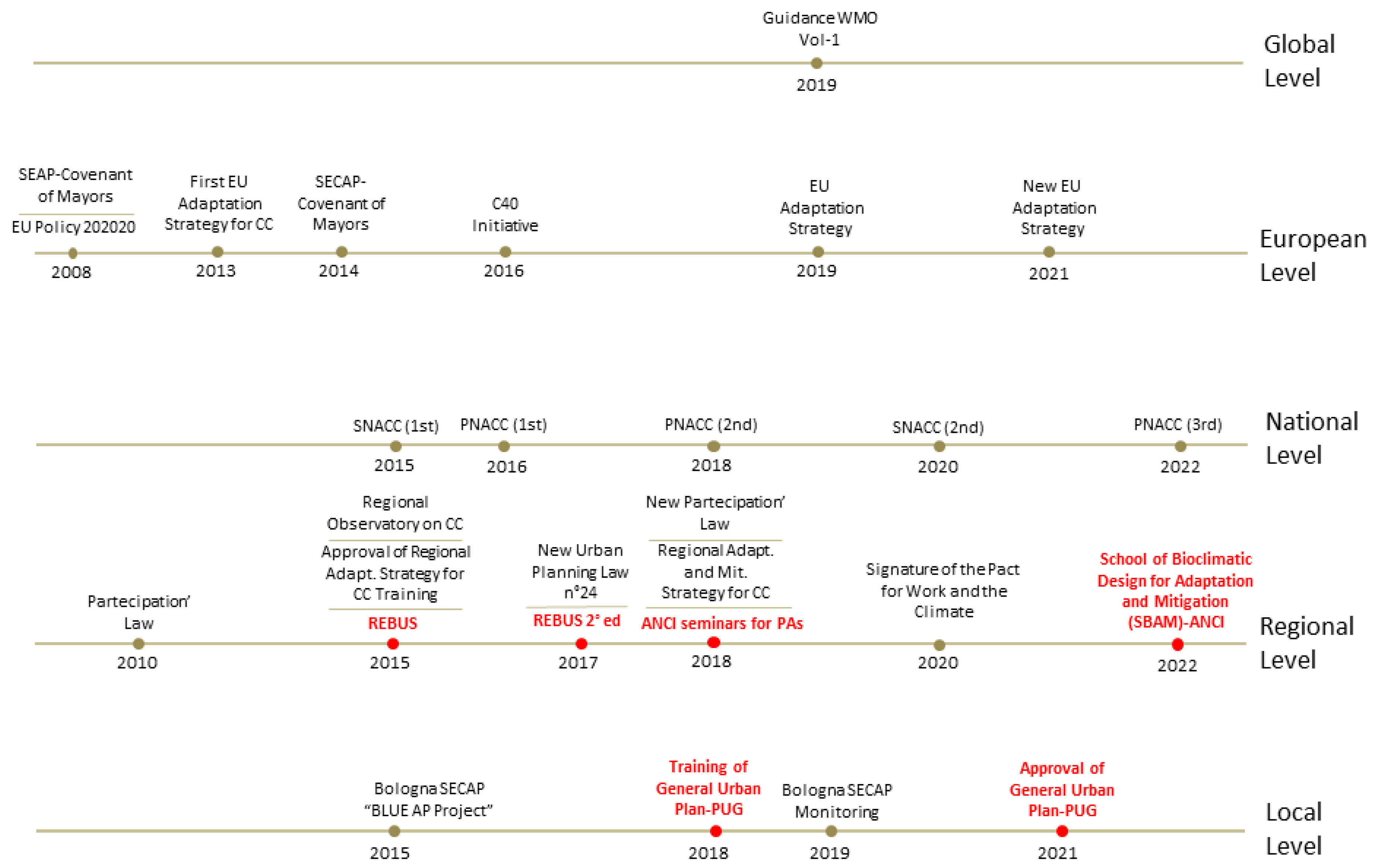
Figure 2.
Map of microclimatic vulnerability indicating the elements to which Action 1.3C of the Plan must be applied, which has as its focus: Mitigating the heat island effect in urban areas and introducing measures aimed at climate adaptation of buildings. The map and the action are part of the "Urban Strategy 1.3 - Prevent and mitigate environmental risks" [55].
Figure 2.
Map of microclimatic vulnerability indicating the elements to which Action 1.3C of the Plan must be applied, which has as its focus: Mitigating the heat island effect in urban areas and introducing measures aimed at climate adaptation of buildings. The map and the action are part of the "Urban Strategy 1.3 - Prevent and mitigate environmental risks" [55].
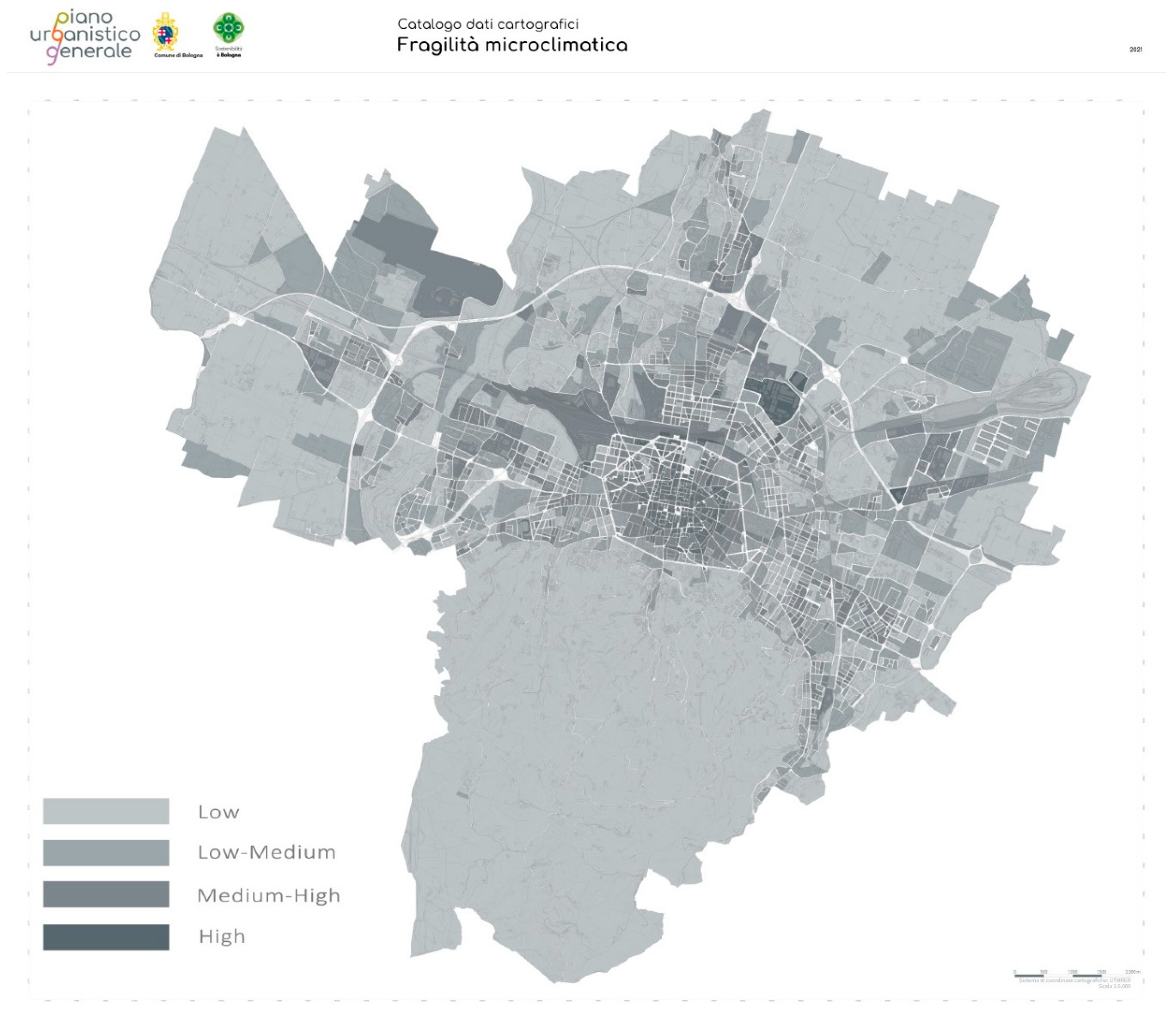
Figure 3.
Summary of the methodologies applied in the context of the PUG, which have been approved and included in the regulatory framework of the PUG. For each methodology, please refer to the respective published article.
Figure 3.
Summary of the methodologies applied in the context of the PUG, which have been approved and included in the regulatory framework of the PUG. For each methodology, please refer to the respective published article.
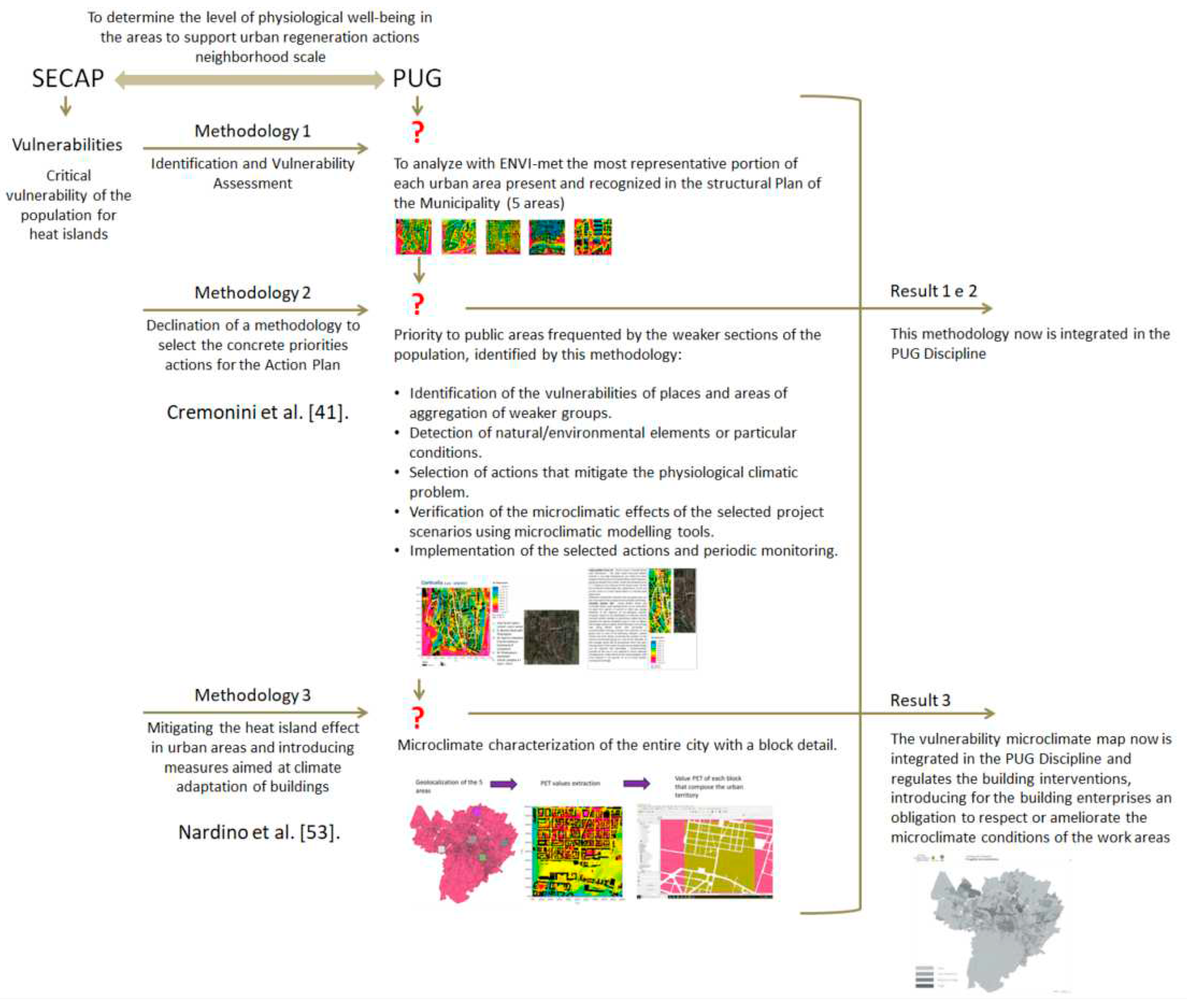

Table 1.
Urban services and the NBS approach, WMO Guidance [25]..
Table 1.
Urban services and the NBS approach, WMO Guidance [25]..
| Box 2. Urban Services | |
|---|---|
| “Urban Services”, in the traditional sense and in the context of the city management (by mayors and other city agencies), refer to transportation, housing, water management, waste management, snow clearance and so forth. The report “Integrated Urban Services” refers to the provision to WMO Member of weather, climate, hydrology and air quality infrastructures (data, observations and predictions) that may be used to support traditional (and new) urban services. These services may be provided directly through Member operations or indirectly through stakeholders or partners in public and private agencies. Services include weather forecasts, due thunderstorms, typhoons, costal inundation, flooding, air quality and health-related stress, as well as climate services for building codes, zoning, planning and design. Integrated Urban Services are inherently high resolution and are provided at roughly the spatial scale of the urban footprint and at smaller scales. However, they are highly dependent on the application, requirements, and local and regional factors. The urban domain is defined by local governments and may include nearby cities, the areas and road in between cities, rural watersheds and locations of industries, in order to capture their impacts. Urban planners may include surrounding areas, as planning in major metropolitan areas will affect housing, transportation and recreation in those areas. | |
| Box 4. Nature-based solutions | |
| Nature-based solutions are the best solutions for cities Blue and green solutions – an ecosystems approach for urban design (blue refers to adding water elements, and green to adding trees and parks) – need weather, climate, hydrological and air quality information for their design and management at the suburban scale. Sharing basic knowledge on urban processes, models and existing solutions with user community is fundamental for successful implementation of the Integrated Urban Services. Therefore, capacity-building is a basic step for the adoption of the Integrated Urban Services concepts by different professionals (for example, architects, engineers, urbanists, and policymakers) concerned about the resilience of cities. The understanding of tools provided by the scientific community is also crucial and must be included as part of academic curricula for urban designers. Databases and existing models should be organized in such a way that they can be easily accessible and useful to professionals. Knowledge of the repository of data and models on existing examples of applications is needed and should be organized to promote direct access to such tools. |
|
|
Urban services and city design Water: forecast of water resources availability (in terms of flow and precipitation) is fundamental in managing the functioning of blue solutions and to activate them during dangerous occurrences. Knowledge of the amount and location of water, its pathway and urban floodplains is needed for integrated flood management (WMO/Global Water Partnership Associated Programme on Flood Management, 2006; World Wildlife Fund, 2017). Heat: it is important to foster green design over a city to activate secure pathway for fragile populations, to furnish warnings (including climate watch advisories) and to design a proper texture of the city itself (for example, where to place hospitals, schools or commercial centers). Ecology: ecological pathways within cities are not simply a biological issue – for example, interactions between the air flow and the urban environment affect the transport of biological materials such as pollens, spores and small insects. City texture and materials: during the design phase, weather and climate information is fundamental importance to properly design and plan future city structures (open spaces and living spaces). The increased quality of permeable surfaces has to be considered to improve water retention and therefore decrease runoff and floods peaks. |
Table 2.
New ways of making decisions - as defined by the administrative policies of municipalities, beyond the administrative mandate. The ellipsis in each identified sector indicates that the list is not exhaustive; therefore, the issues and stakeholders involved may change based on interests and presence in each territory...
Table 2.
New ways of making decisions - as defined by the administrative policies of municipalities, beyond the administrative mandate. The ellipsis in each identified sector indicates that the list is not exhaustive; therefore, the issues and stakeholders involved may change based on interests and presence in each territory...
| Internal organization | Regulations |
|---|---|
| .Reinforced urban centers .Areas/sectors dedicated to the involvement of the community .Urban marketing . … |
.Civic volunteering (single/associative) .Citizenship workshops .Partecipatory processes .Collaboration agreements . … |
| Dedicated facilities | Hybridization of representative democracy |
| .Foundations .Agencies .In-house company . … |
.Partecipatory budgets .Deliberative assemblies . … |
Table 3.
Solutions identified by the Adaptation Plan, and Good practices” reported in general classes.
Table 3.
Solutions identified by the Adaptation Plan, and Good practices” reported in general classes.
| Solutions |
|---|
|
|
|
|
|
|
|
|
Disclaimer/Publisher’s Note: The statements, opinions and data contained in all publications are solely those of the individual author(s) and contributor(s) and not of MDPI and/or the editor(s). MDPI and/or the editor(s) disclaim responsibility for any injury to people or property resulting from any ideas, methods, instructions or products referred to in the content. |
© 2023 by the authors. Licensee MDPI, Basel, Switzerland. This article is an open access article distributed under the terms and conditions of the Creative Commons Attribution (CC BY) license (http://creativecommons.org/licenses/by/4.0/).
Copyright: This open access article is published under a Creative Commons CC BY 4.0 license, which permit the free download, distribution, and reuse, provided that the author and preprint are cited in any reuse.


