

Submitted:
07 September 2023
Posted:
11 September 2023
You are already at the latest version
Abstract
Crossbreeding in dairy cattle with exotic breeds continues to be an appealing practice to the dairy farmers of Bangladesh. However, there is limited knowledge regarding the impact of crossbreeding on both the physical attributes and milk quality traits of crossbred cattle in Bangladesh. Therefore, the primary objective of this study was to evaluate the impact of crossbreeding Bangladeshi local cattle with the exotic Holstein breed on their body characteristics and milk quality. To achieve the goal, data pertaining to body traits and milk samples were gathered from a total of 981 cows from 19 dairy farms located in the northwestern region of Bangladesh. A trained evaluator measured body condition score (BCS), udder score, locomotion score, and body conformation traits. Milk yield information was acquired from official records, while milk composition details were determined through milk analysis. The average measurements for body traits were as follows: wither height (WH) at 138 cm, body length (BL) at 155 cm, and heart girth (HG) at 203 cm. Notably, crossbred cows (Holstein x Local cattle) exhibited greater values for WH, BL, HG, BCS, and udder score than their Bangladeshi local counterparts. Furthermore, the average daily milk yield of sampled cows was recorded at 8.7 kg, with fat and protein contents of 3.78% and 3.67%, respectively. It is worth noting that crossbred cows produced a higher volume of milk compared to Bangladeshi local cattle. However, milk from crossbred cows displayed lower fat and protein content, although their somatic cell score (SCS) remained similar. Additionally, milk from crossbred cows exhibited a longer coagulation time when compared to that of Bangladeshi local cattle. A more comprehensive assessment of the crossbreeding scheme, particularly in comparison to Holstein, would necessitate further research, including an examination of its impact on cheese yield traits, health, fertility, and longevity.
Keywords:
crossbreeding
; Holstein
; Bangladeshi local cattle
; body size
; milk traits
1. Introduction
Dairy farming remains an important subsector of the agricultural sector in Bangladesh, providing a vital source of income and nutrition for rural communities while contributing to the national economy [1]. As the demand for dairy products continues to rise, assessing the conditions under which dairy cows are raised and managed becomes imperative. Dairy cows hold importance due to their contributions to milk production, calf breeding, and the enhancement of local breeds through crossbreeding. Crossbreeding in dairy cattle has gained momentum in developed and developing countries over the past few decades, primarily due to its positive effects on milk production, improved health, and fertility [2]. In developed nations like New Zealand, crossbreeding accounts for approximately 59.2% of the dairy cow population [3], while in Denmark and Sweden, crossbred cattle constitute 12% and 8% of the total cattle population, respectively [4]. Similarly, in developing countries such as India and Bangladesh, crossbred dairy cows comprise 26.5% and 8% of the overall cattle population, respectively [5,6].
Holstein stands out as the predominant dairy breed globally, owing to its remarkable capacity to produce high volumes of milk and its substantial body size [7]. Consequently, Holstein has become a preferred choice for crossbreeding initiatives to enhance milk yield and cattle size. The interest in crossbreeding Holstein cows with other breeds has surged, leading to numerous studies comparing the milk production and quality of crossbred cows with Holstein in diverse environmental conditions [2,6,8,9,10,11,12]. However, many of these studies have focused on crossbreeding Holstein with various recognized cattle breeds, often emphasizing milk production, quality, cheese yield, and the like.
A staggering 92% of the dairy cattle population in Bangladesh comprises non-descriptive local cattle, characterized by low milk production and fertility rates [13]. Consequently, there is a growing interest among Bangladeshi farmers in crossbreeding Holstein cows with local breeds to enhance milk production and cattle size. To our knowledge, there is a shortage of reports on body conformation and milk composition traits for crossbred (Holstein × Local cattle) cows in Bangladesh. Most dairy producers in the region primarily focus on aspects such as body conformation, milk yield, and composition. Hence, the objective of this research was to compare crossbred (Holstein × Local cattle) cows with Bangladeshi local cattle in terms of their body characteristics and milk quality traits.
2. Materials and Methods
A total of 981 cows were included in this study from 19 commercial dairy farms located in the northwestern region of Bangladesh. These farms have been implementing a crossbreeding program for several years, utilizing Holstein sire semen for the breeding process. The dataset consisted of information collected from 384 Bangladeshi local cattle and 597 F1 crossbred (Holstein × Local cattle) cows. The management practices across these herds were highly consistent, with all cows being nourished through a total mixed ration. This ration was meticulously prepared by blending concentrate mixtures, green grass, and rice straw, ensuring that all experimental diets adhered to the recommendations outlined in the National Research Council (NRC) [14] guidelines 2001. Additionally, the cows were accommodated in a tie-stall barn and subjected to uniform management procedures throughout the entire duration of the experiment.
The evaluation of cow body condition score (BCS) was conducted by a trained evaluator, following a scale ranging from 1 (indicating very thin) to 5 (indicating very fat), with increments of 0.25. This assessment method aligns with the technique established by Edmonson et al. in 1989 [15].
Additionally, measurements for withers height (HW) and body length (BL) were acquired using a measuring stick. HW was determined from the floor to the highest point of the withers, while BL was measured from the scapular joint to the pin bone (as illustrated in Figure 1). Furthermore, heart girth (HG) measurements were taken using a tape measure positioned behind the front legs and shoulder blades.
The evaluator recorded the locomotion score using a five-point scale (Manson and Leaver, 1988) [16], where 1=no unevenness in gait or tenderness, and 5=difficulty in walking and adverse effects on behavior pattern.
Udder score was noted by the same evaluator and recorded udder scores from 1 to 5 according to the guidelines described by Beard et al. (2019) [17]. The udder score combines udder conformation and a teat scoring system. An udder score of 1 or 2 consisted of pendulous udders and large teats, whereas 3 to 5 consisted of tight udders and small, symmetrical teats.
Milk yield data was retrieved from the official milk recording system. Additionally, a 100 ml milk sample was collected on the same day as the measurement of body conformation traits. These samples were promptly refrigerated at 4°C and transported to the Department of Dairy Science, Sylhet Agricultural University laboratory. Within 12 hours of collection, the samples were subjected to thorough analysis. Various milk components, including fat, protein, and lactose content, were meticulously analyzed using a Milkoscan FT2 infrared analyzer (Foss Electric A/S, Hillerød, Denmark), as outlined in detail by Saha et al. in their 2019 publication [18]. Milk pH was determined using a digital pH meter from Horiba Scientific (Kyoto, Japan). For the assessment of milk somatic cell count (SCC), a Fossomatic Minor FC counter (Foss Electric A/S) was employed, with subsequent transformation to Somatic Cell Score (SCS) facilitated by a log-transformation process as proposed by Ali and Shook in 1980 [19]. Furthermore, the measurement of milk coagulation time followed a technique described by Ikonen et al. in 2004 [20], with minor modifications. In brief, 5 ml of milk was poured into a teaspoon, to which 100 μl of clotting enzyme (rennet) was added. The aggregation process was then observed until its commencement.
Statistical Analysis
Before statistical analysis, cows were categorized within parity (primiparous and multiparous) and days in milk (5 classes of 60-d each from 240 DIM). Then, data were analyzed using one-way ANOVA of General Linear Model of Minitab 19 where days in milk, parity, breed, and herd were the fixed effects. Significant differences between means for each main effect were compared by using the Tukeys test for their significance at P < 0.05.
3. Results and Discussion
The least squares means for body traits of Bangladeshi local cattle and F1 crossbred (Holstein × Local cattle) are summarized in Table 1. The average BCS was 3.5, as shown in Table 1. Notably, crossbred cows exhibited higher BCS values compared to the local cattle, aligning with the observations made by Mapiye et al. in 2010 [21]. Mapiye et al. (2010) [21] similarly reported that crossbreed cows displayed greater BCS than indigenous Nguni cattle. Likewise, other studies involving crossbred cows, such as Montbeliarde × Holstein and Viking Red × Holstein, have also shown higher BCS values compared to pure Holstein cows [22]. Furthermore, Saha et al. (2018) [12] noted that three-way rotational crossbred cows had elevated BCS in comparison to pure Holstein cows. It's important to note that Mushtaq et al. (2012) [23] observed a significant influence of breed on BCS, suggesting that crossbreeding may impact BCS due to the heterosis effect in cows [24].
In this research, we observed that crossbred cows exhibited higher udder scores when compared to Bangladeshi local cattle. This finding aligns with the results reported by Pandit et al. in 2004 [25], which indicated that crossbred cows tend to have standard to high udder scores in comparison to native indigenous cattle. This difference may be attributed to the adoption of crossbreeding practices involving native indigenous cattle. It's worth noting that Holstein cows are recognized for their larger udders and are considered a superior dairy breed in terms of milk yield, as highlighted by Blöttner et al. in 2011 [9]. Consequently, crossing with Holstein cows may contribute to the improvement in udder size due to the heterosis effect. Interestingly, our study found that locomotion scores were comparable between local cattle and crossbred cows. This finding contrasts with the observations made by Singh et al. in 2018 [26], who noted that crossbred cows tend to be more susceptible to lameness, resulting in lower locomotion scores. It is important to consider that cow locomotion is closely related to the nutritional status of the cow and the conditions within the household environment, as indicated by Oehm et al. in 2022 [27].
On average, the measurements of WH, HG, and BL for the sampled cows in our study closely resembled the values reported for Holstein cows and their crossbreeds, as documented by Hazel et al. in 2017 [22]. It's worth noting that Holstein and Ayrshire breeds are known for their larger body size in comparison to indigenous cows in Kenya, as highlighted by Lukuyu et al. in 2016 [28]. These larger-bodied animals possess a significant proportion of exotic genes, which, when introduced through crossbreeding, can enhance the body size of zebu cows. Our findings underscore the clear potential of crossbreeding to enhance the body size of local cattle. In fact, all body conformation traits, including WH, HG, and BL, were notably greater in crossbred cows when compared to their local counterparts.
The summary of least squares means for milk yield and quality traits between Bangladeshi local cattle and F1 crossbred (Holstein × Local cattle) is presented in Table 2. On average, the sampled cows produced milk at a rate of 8.7 kg per day, with fat and protein contents measuring 3.78% and 3.67%, respectively. In this study, crossbred cows (Holstein × Local cattle) demonstrated a remarkable 30% increase in milk yield compared to Bangladeshi local cattle. This finding aligns with the observations made by Garwe in 2001 [29], who reported that crossbred cows (Tuli × Jersey and Nkone × Jersey) yielded significantly higher volumes of milk than indigenous cows (Tuli and Nkone) in Zimbabwe. Similarly, other researchers have noted the positive impact of crossbreeding non-descriptive zebu cows with the semen of exotic dairy cattle on the milk productivity of these non-descriptive cows [5,30]. This increase in productivity may be attributed to the heterosis effects observed in crossbreeding studies for milk production in tropical countries. However, it's important to note that milk from the crossbred cows exhibited lower fat and protein content when compared to Bangladeshi local cattle, although the levels of lactose and SCS remained similar. This aligns with the findings of Islam et al. in 2008 [31], who reported that indigenous cattle had higher fat and protein content than Holstein-crossed indigenous cows.
Additionally, our results indicated that milk from Bangladeshi local cattle tended to have a higher pH than that from crossbred cows. Furthermore, milk coagulation time was significantly lower (P < 0.05) for Bangladeshi local cattle than crossbred cows. The coagulation time of milk is a crucial factor in cheese-making properties. Saha et al. in 2017 [2] found that milk from crossbred (Montéliarde × Holstein) cows had a shorter coagulation time than pure Holstein. Similarly, Teter et al. 2019 [32] reported that local Polish cattle exhibited a more favorable coagulation time than Holstein-Friesian cattle. In general, milk from Holstein cows tends to have a longer coagulation time [11,33], possibly due to 50% Holstein blood in crossbred cows.
4. Conclusions
Crossbreeding is appealing for enhancing livestock in Bangladesh due to its potential advantages for farmers. Nonetheless, it is essential to conduct a more comprehensive examination of the effects of crossbreeding programs on both body traits and milk characteristics, particularly in tropical regions like Bangladesh, where there is a need to improve both milk and meat production. In our study, we employed a crossbreeding approach by mating Bangladeshi local cattle with Holstein cows. The results revealed that the resulting crossbred (Holstein × Local cattle) cows exhibited larger body sizes and higher body condition scores. Additionally, they produced significantly greater volumes of milk. However, it's worth noting that the milk from crossbred cows contained lower fat and protein levels, although lactose and somatic cell count remained similar. Despite the extended coagulation time observed in the milk from crossbred cows, there is a potential for higher cheese yield due to their increased milk production compared to Bangladeshi local cattle. To provide a comprehensive comparison of the crossbreeding scheme with pure Holstein cows, further studies are necessary. These studies should investigate the effects on cheese yield traits, health, fertility, and longevity.
Author Contributions
Conceptualization, S.S. and H.K.; methodology, M.N.H. and S.S.; software, S.S.U.A., M.M.H.K. and S.S; validation, S.S., B.N.M.R. and H.K.; formal analysis, M.M.H.K., M.N.U.; investigation, S.S., H.K.; resources, S.S.; data curation, M.N.H., M.N.U.; writing—original draft preparation, S.S.; writing—review and editing, S.S.U.A., H.K. and M.N.H.K.; visualization, H.K.; supervision, S.S. and S.S.U.A.; project administration, S.S.; funding acquisition, S.S. All authors have read and agreed to the published version of the manuscript.
Funding
This research received no external funding.
Acknowledgments
The authors are thankful to the owners and managers of the herds for their cooperation and support during data and sample collection.
Conflicts of Interest
The authors declare no conflict of interest.
References
- Islam, M.S; Hossain, M.E.; Bekun, F.V.; Sujan, M.H.K. Impact od COVID-19 on Bangladesh’s agriculture sector and the ways forward to recover: An overview. J. Public Aff. 2023, 23, e2862. [Google Scholar] [CrossRef]
- Saha, S.; Malchiodi, F.; Cipolat-Gotet, C.; Bittante, G.; Gallo, L. Effects of crossbreeding of Holsteins cows with Montbéliarde and Swedish Red in first and second generation on cheese yield traits. Agric. Conspec. Sci. 2017, 82, 241–244. [Google Scholar]
- New Zealand Dairy Statistics. Livestock Improvement Corp, Dairy NZ. 2021. Available online: https://www.dairynz.co.nz/publications/dairy-industry/new-zealand-dairy-statistics-2021-22/ (accessed on 12 June, 2023).
- Clasen, J.B.; Fogh, A.; Kargo, M. Differences between performance of F1 crossbreds and Holsteins at different production levels. J. Dairy Sci. 2019, 102, 436–441. [Google Scholar] [CrossRef]
- Singh, C.V. Crossbreeding in cattle for milk production: Achievements, challenges and opportunities in India-A review. Adv. Dairy Res. 2016, 4, 158. [Google Scholar]
- Famous, M.; Aditya, A.C.; Ahmed, S.; Sutradhar, S. Productive and reproductive performance of different crossbred dairy cattle at Kishoreganj, Bangladesh. Vet. Sci. Res. Rev. 2021, 7, 69–76. [Google Scholar] [CrossRef]
- VanRaden, P.M.; Sanders, A.H. Economic merit of crossbred and purebred US dairy cattle. J. Dairy Sci. 2003, 86, 1036–1044. [Google Scholar] [CrossRef] [PubMed]
- Heins, B.J.; Hansen, L.B.; Seykora, A.J. Production of pure Holsteins versus crossbreds of Holstein with Normande, Montbeliarde, and Scandinavian Red. J.Dairy Sci. 2006, 89, 2799–2804. [Google Scholar] [CrossRef] [PubMed]
- Blöttner, S.; Heins, B.J.; Wensch-Dorendorf, M.; Hansen, L.B.; Swalve, H.H. Short communication: A comparison between purebred Holstein and Brown Swiss Holstein cows for milk production, somatic cell score, milking speed, and udder measurements in the first 3 lactations. J. Dairy Sci. 2011, 94, 5212–5216. [Google Scholar] [CrossRef]
- Hazel, A.R.; Heins, B.J.; Hansen, L.B. Production and calving traits of Montbéliarde× Holstein and Viking Red× Holstein cows compared with pure Holstein cows during first lactation in 8 commercial dairy herds. J. Dairy Sci. 2017a, 100, 4139–4149. [Google Scholar] [CrossRef]
- Saha, S.; Amalfitano, N.; Bittante, G.; Gallo, L. Milk coagulation traits and cheese yields of purebred Holsteins and 4 generations of 3-breed rotational crossbred cows from Viking Red, Montbéliarde, and Holstein bulls. J. Dairy Sci. 2020, 103, 3349–3362. [Google Scholar] [CrossRef]
- Saha, S.; Carraro, L.; Bittante, G.; Gallo, G. Body and milk quality traits of purebred Holstein and three-generation crossbred cows from Viking Red, Montbéliarde, and Holstein sires. J. Cent. Eur. Agric. 2018, 19 (4), 760–765. [Google Scholar] [CrossRef]
- Islam, M.S.; Kundu, S.K.; Sarder, J.U. Productive Attributes of Dairy Cattle From Some Areas of Bangladesh. LAP Lambert Academic Publishing, Germany, 2021.
- National Research Council. Nutrient requirements of dairy cattle: 2001. National Academies Press. 2001.
- Edmonson, A.J.; Lean, I.J.; Weaver, L.D.; Farver, T.; Webster, G. A body condition scoring chart for Holstein dairy cows. J. Dairy Sci. 1989, 72, 68–78. [Google Scholar] [CrossRef]
- Manson, F.; Leaver, J. The influence of concentrate amount on locomotion and clinical lameness in dairy cattle. Anim. Prod. 1988, 47, 185–190. [Google Scholar] [CrossRef]
- Beard, J.K.; Musgrave, J.A.; Funston, R.N.; Mulliniks, J.T. The effect of cow udder score on cow/calf performance in the Nebraska Sandhills. Transl. Anim. Sci. 2019, 3, 14–19. [Google Scholar] [CrossRef]
- Saha, S.; Amalfitano, N.; Sturaro, E.; Schiavon, S.; Tagliapietra, F.; Bittante, G.; Carafa, I.; Franciosi, E.; Gallo, L. Effects of summer transhumance of dairy cows to alpine pastures on body condition, milk yield and composition, and cheese making efficiency. Animals, 2019, 9, 192. [Google Scholar] [CrossRef]
- Ali, A.K.A.; Shook, G.E. An optimum transformation for somatic cell concentration in milk. J. Dairy Sci. 1980, 63, 487–490. [Google Scholar] [CrossRef]
- Ikonen, T.; Morri, S.; Tyrisevä, A. M.; Ruottinen, O.; Ojala, M. Genetic and phenotypic correlations between milk coagulation properties, milk production traits, somatic cell count, casein content, and pH of milk. J. Dairy Sci. 2004, 87, 458–467. [Google Scholar] [CrossRef]
- Mapiye, C.; Chimonyo, M.; Dzama, K.; Marufu, M.C. Seasonal changes in energy-related blood metabolites and mineral profiles of Nguni and crossbred cattle on communal rangelands in the Eastern Cape, South Africa. Asian-Australas. J. Anim. Sci. 2010, 23, 708–718. [Google Scholar] [CrossRef]
- Hazel, A.R.; Heins, B. J.; Hansen, L.B. Fertility, survival, and conformation of Montbéliarde× Holstein and Viking Red× Holstein crossbred cows compared with pure Holstein cows during first lactation in 8 commercial dairy herds. J. Dairy Sci. 2017b, 100, 9447–9458. [Google Scholar] [CrossRef]
- Mushtaq, A.; Qureshi, M.; Khan, S.; Habib, G.; Swati, Z.A.; Rahman, S.U. Body condition score as a marker of milk yield and composition in dairy animals. J. Anim. Plant Sci. 2012, 169–173. [Google Scholar]
- Ribeiro, A.M.F.; Sanglard, L.P.; Snelling, W.M.; Thallman, R.M.; Kuehn, L.A. Spangler, M.L. Genetic parameters, heterosis, and breed effects for body condition score and mature cow weight in beef cattle. J. Anim. Sci. 2022, 100, skac017. [Google Scholar] [CrossRef]
- Pandit, A.; Dhaka, J.P.; Sirohi, S. Factors affecting market price of dairy cows: A study of central alluvial plains of West Bengal. Agri. Econ. Res. Rev. 2004, 17, 219–228. [Google Scholar]
- Singh, A.; Singh, S.; Gupta, D.K.; Bansal, B.K. Relationship of lameness to body condition score, udder health and milk quality in crossbred dairy cattle. Vet. Arh, 2018, 88, 179–190. [Google Scholar] [CrossRef]
- Oehm, A.W.; Merle, R.; Tautenhahn, A.; Jensen, K.C.; Mueller, K.E.; Feist, M.; Zablotski, Y. Identifying cow–level factors and farm characteristics associated with locomotion scores in dairy cows using cumulative link mixed models. PloS one, 2022, 17 (1), e0263294. [Google Scholar] [CrossRef] [PubMed]
- Lukuyu, M.N.; Gibson, J.P.; Savage, D.B.; Duncan, A.J.; Mujibi, F.D.N.; Okeyo, A.M. Use of body linear measurements to estimate liveweight of crossbred dairy cattle in smallholder farms in Kenya. SpringerPlus, 2016, 5, 1–14. [Google Scholar] [CrossRef] [PubMed]
- Garwe, E.C. Reproductive performance of crossbred cattle developed for milk production in the semi arid tropics and the effect of feed supplementation. PhD thesis, University of Zimbabwe, Zimbabwe, 2001.
- Galukande, E.; Mulindwa, H.; Wurzinger, M.; Roschinsky, R.; Mwai, A.O.; Sölkner, J. Crossbreeding cattle for milk production in the tropics: achievements, challenges and opportunities. Animal Genetic Resources/Resources génétiques animales/Recursos genéticos animales, 2013, 52, 111–125. [Google Scholar] [CrossRef]
- Islam, M.R.; Hassan, M.N.; Siddiki, M.S.R.; Khan, M.A.S.; Islam, M.A. (2008). Determination of quality of milk from different genotype of dairy cows. Bangladesh J. Anim. Sci. 2008, 37, 52–56. [Google Scholar] [CrossRef]
- Teter, A.; Barłowska, J.; Florek, M.; Kędzierska-Matysek, M.; Król, J.; Brodziak, A.; Litwińczuk, Z. Coagulation capacity of milk of local Polish and Holstein-Friesian cattle breeds. Anim. Sci. Pap. Rep. 2019, 37, 259–268. [Google Scholar]
- De Marchi, M.; Dal Zotto, R.; Cassandro, M.; Bittante, G. Milk coagulation ability of five dairy cattle breeds. J. Dairy Sci. 2007, 90, 3986–3992. [Google Scholar] [CrossRef]
Figure 1.
Scheme of body measurements for body length (a), withers height (b), and heart girth (c) of cow.
Figure 1.
Scheme of body measurements for body length (a), withers height (b), and heart girth (c) of cow.
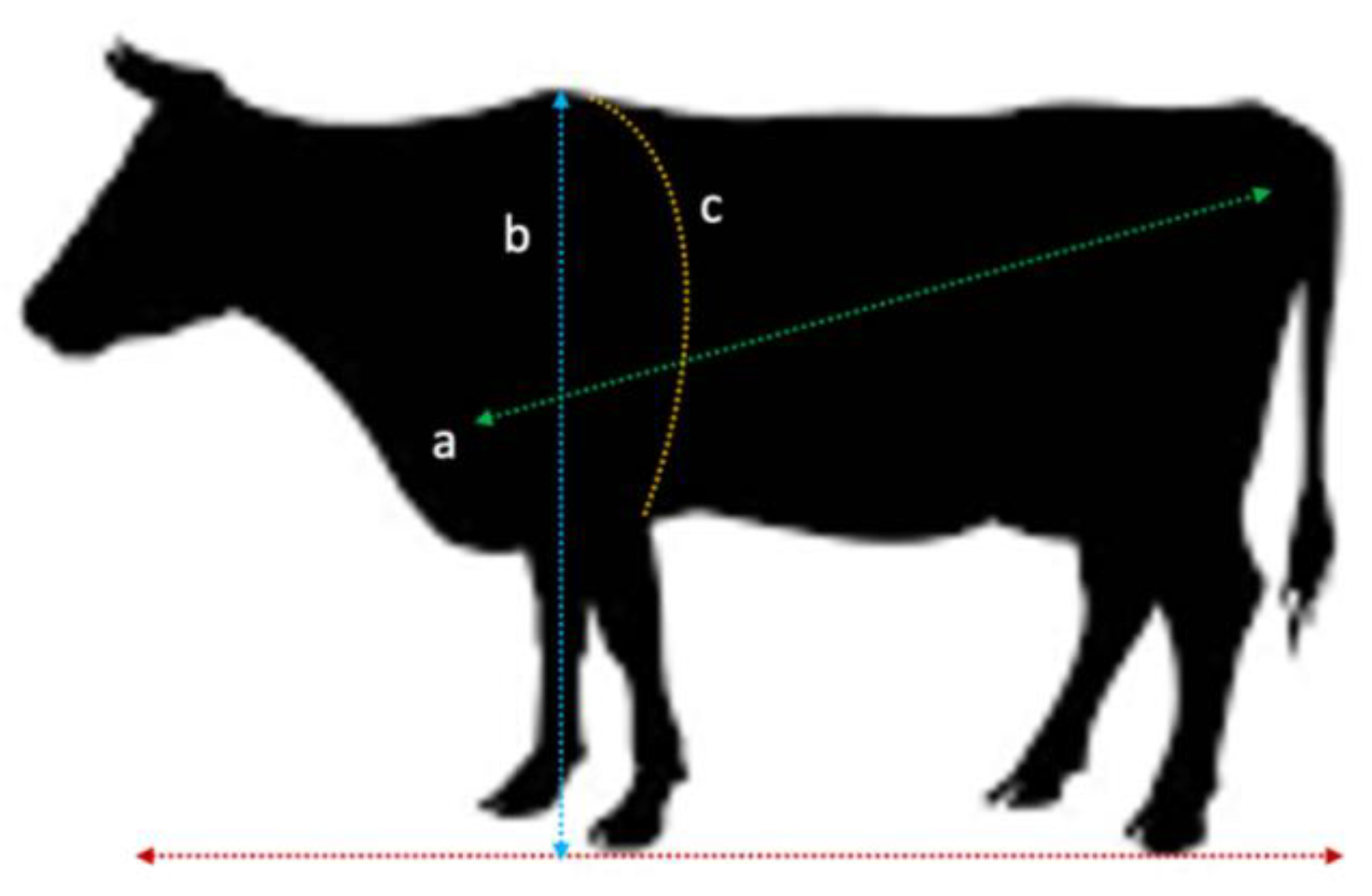

Table 1.
Lest squares mean and standard error of BCS, locomotion score, udder score and body conformation traits of Bangladeshi local cattle and F1 crossbred (Holstein × Local cattle) cows.
Table 1.
Lest squares mean and standard error of BCS, locomotion score, udder score and body conformation traits of Bangladeshi local cattle and F1 crossbred (Holstein × Local cattle) cows.
| Traits | Bangladeshi local cattle | Crossbred (Holstein × Local cattle) | P value |
| BCS1 | 3.32±0.02 | 3.70±0.05 | < 0.001 |
| Udder score | 2.07±0.33 | 3.31±0.28 | 0.03 |
| Locomotion score | 1.35±0.36 | 1.27±0.41 | 0.82 |
| Withers height, cm | 135±0.53 | 141±0.69 | < 0.001 |
| Body length, cm | 152±0.68 | 157±0.91 | < 0.001 |
| Heart girth, cm | 205±1.23 | 211±1.04 | < 0.001 |
1BCS=Body condition score.
Table 2.
Lest squares mean and standard error of milk yield and quality of Bangladeshi local cattle and and F1 crossbred (Holstein × Local cattle) cows.
Table 2.
Lest squares mean and standard error of milk yield and quality of Bangladeshi local cattle and and F1 crossbred (Holstein × Local cattle) cows.
| Traits | Bangladeshi local cattle | Crossbred (Holstein × Local cattle) | P value |
| Milk yield, kg | 7.62±0.74 | 10.85±0.51 | < 0.001 |
| Fat, % | 3.90±0.07 | 3.66±0.11 | 0.02 |
| Protein, % | 3.73±0.03 | 3.62±0.04 | 0.05 |
| Lactose, % | 5.00±0.05 | 4.97±0.03 | 0.51 |
| Milk pH | 6.47±0.09 | 6.45±0.02 | 0.06 |
| SCS1 | 2.12±0.27 | 2.36±0.43 | 0.97 |
| Coagulation time, min | 10.81±0.12 | 13.21±0.90 | 0.04 |
1SCS = 3 + log2 (SCC/100,000).
Disclaimer/Publisher’s Note: The statements, opinions and data contained in all publications are solely those of the individual author(s) and contributor(s) and not of MDPI and/or the editor(s). MDPI and/or the editor(s) disclaim responsibility for any injury to people or property resulting from any ideas, methods, instructions or products referred to in the content. |
© 2023 by the authors. Licensee MDPI, Basel, Switzerland. This article is an open access article distributed under the terms and conditions of the Creative Commons Attribution (CC BY) license (http://creativecommons.org/licenses/by/4.0/).
Copyright: This open access article is published under a Creative Commons CC BY 4.0 license, which permit the free download, distribution, and reuse, provided that the author and preprint are cited in any reuse.


