

Submitted:
05 September 2023
Posted:
07 September 2023
You are already at the latest version
Abstract
Rising consumer demand for more safety, healthy and fresh-like food has given new concepts for food packaging. Besides, the growing concern with environmental issues has increased the search for materials from non-petroleum sources and biodegradable ones. Thus, active films based on biopolymers loaded with natural active compounds have potential to be used as food packaging. However, there are a lot of lipophilic active compounds that are a problem to incorporate in hydrophilic matrices, such as polysaccharides and proteins. One way to overcome these challenges is adding these compounds encapsulated in O/W emulsions. The incorporation of emulsion in biopolymeric matrix has influence in the film properties, such as mechanical, barrier, optical, among other. In this way, this review aims to point out the main characteristics of the emulsions systems encapsulating active compounds and its influence in the film properties and to present and discus critically the recent advances in the area.
Keywords:
actives films
; proteins
; polysaccharides
; lipophilic compounds
1. Introduction
Food packaging is used to maintain the safety and quality of food products during storage and transportation, protecting them against undesirable external factors. Consumer demand for convenient, safer, healthier, and fresh-like food with improved shelf life and environmental concerns has given new concepts and functions to food packaging [1]. In addition to the usual inert passive containment and protective properties, these novel food packaging should have active compounds to enhance the performance of the package system and should preferably be produced with biodegradable ingredients from renewable sources [2,3,4]. As a result, there is a growing request for biopolymer-based active packaging, which has stimulated studies in search of new strategies, boosting the development of a novel generation of food packaging.
Active packaging systems are produced by incorporating active ingredients into the packaging material or the package's headspace, which can release or absorb substances into or from the packaged food or from the environment surrounding the food, extending its shelf life without compromising its quality and safety [5]. The active packaging systems can perform diverse functions: i) absorbing/scavenging of substances such as carbon dioxide, oxygen, ethylene, and moisture; ii) releasing/emitting of compounds, such as ethanol, antioxidants, preservatives, flavors; iii) food component removal property (e.g., lactose, cholesterol); and iv) microbial and quality control [6].
Active films based on biopolymers are promising materials for active packaging design. In addition to the functional properties promoted by the incorporation of active compounds, such as antimicrobial and antioxidant compounds, these film types are an alternative to synthetic packaging materials, as they produced from biodegradable, renewable, and environmentally friendly materials [7,8]. The most common biopolymers used in the production of active films are polysaccharides (e.g., starch, chitosan, pectin, cellulose derivatives, gums) and proteins (e.g., gelatin, whey protein, caseinate, soy protein, zein) [9].
Regarding functionality, a wide range of active compounds have been added to the biopolymeric matrix of the active films [6,10], such as extracts from herbs and spices [11,12] or from agricultural by-products [13,14], essential oils (EO) [15,16], and lipophilic compounds [17,18,19]. Antimicrobial and antioxidant agents are the most studied active components since the growth of pathogenic and/or spoilage microorganisms and the oxidative degradation are the main cause of food spoilage [6].
In recent decades, interest in adding lipophilic bioactive components in films has increased, as they are powerful antimicrobial and antioxidant agents [20,21]. There are several studies incorporating directly lipophilic compounds into filmogenic matrices, however, chemical and physical stability of these films is limited [22,23]. Furthermore, these bioactive compounds have low solubility in water, due their high hydrophobicity, and are susceptible to oxygen, temperature, pH and ionic strength. These characteristics hinder the incorporation of hydrophobic functional compounds in hydrophilic matrices and can reduce their bioavailability [24,25].
One strategy to overcome these challenges is to encapsulate lipophilic bioactive compounds in the oil phase of oil-in-water (O/W) emulsions prior to their incorporation into a filmogenic solution. The use of O/W emulsions allows the dispersion of a hydrophobic bioactive compound and an oil phase in a hydrophilic matrix [17,19,26,27,28]. Furthermore, emulsions can protect lipophilic active ingredients against external factors and promote their controlled release [29,30,31,32].
In this context, the aim of this review is to present and discuss critically the recent advances in the design of active films incorporated with bioactive compound-loaded emulsions and to highlight how the characteristics of the emulsions can affect the film properties and their performance as active packaging. Active compound retention, active film stability, and release behavior in food simulants were also pointed out.
2. Emulsions
Emulsions are colloidal systems consisting of two or more completely or partially immiscible phases, such as oil and water. For a liquid system, one of the liquids is dispersed as droplets (dispersed phase) in another liquid continuous phase forming the single oil-in-water (O/W) or water-in-oil (W/O) emulsions [33]. More complex systems, such as water-in-oil-in-water (W/O/W) or oil-in-water-in-oil (O/W/O) emulsions, can also be produced from single emulsions. In W/O/W double emulsion, smaller water droplets are dispersed in an oil phase (W/O) [34,35], which is subsequently dispersed in an external aqueous phase (W) [36]. The double emulsions can concurrently encapsulate hydrophilic and hydrophobic bioactive molecules, however the stabilization of two different interfaces during the emulsion processing and storage is still a challenge [37,38,39]. Figure 1 shows a schematic view of the main emulsion designs.
The emulsions are thermodynamically unstable and tend to separate into an oil and an aqueous phase because the free energy of the separated phases is lower than the emulsified system [40]. However, a great kinetic stability can be reached by adding stabilizers, such as emulsifiers (surfactants, proteins, and carbohydrates) or solid particles [41,42]. These compounds can improve the stability of systems over time by retarding or preventing destabilization mechanisms such as creaming/sedimentation, flocculation, coalescence, and Ostwald ripening [43]. Differently from traditional emulsions, microemulsions are thermodynamically stable systems composed of nanometer-sized particles (formed by oil, surfactant/co-surfactant) dispersed in an aqueous phase [44] (Figure 2).
Emulsions can be classified according to droplet size in emulsions or nanoemulsions. Usually, nanoemulsions present droplets ranging between 20 and 200 nm, while colloidal dispersions with droplet diameters larger than 200 nm are namely emulsions [40,45]. However, different average droplet diameters are frequently used as the demarcation point between nanoemulsions and emulsions, which can range between 20 and 200nm [45,46,47]. Although both colloidal systems are thermodynamically unstable, a reduction in droplet size can enhance the kinetic stability and increase the specific surface area, improving the bioactivity of lipophilic active compounds vehiculated in nanoemulsions [45].
Stabilization by solid particles is another approach to improve the kinetic stability of emulsions, which are called Pickering emulsions. Compared to conventional emulsions, Pickering emulsions can be stable for a longer period, as micro- or nanometer sized particles irreversibly adsorb at interfaces [48]. Furthermore, this type of stabilization offers distinct advantages, especially in the field of delivery of bioactive compounds, such as good long-term kinetic stability, low cytotoxicity, controlled release under specific conditions (such as temperature, pH, light intensity, ionic strength) and targeted of the bioactive for enhanced functionality in food [49,50,51,52].
Overall, emulsified systems have been used to encapsulate various hydrophobic active compounds, such as hesperidin [24,53], curcumin [54,55], resveratrol [56], β-carotene [57], pepper oil [58] and a wide range of essential oils (e.g., oregano, lemongrass, cinnamon, clove, American mint and pectinata) [59,60,61], among others. The use of emulsions as encapsulating system of the bioactive compounds can prevent their degradation, preserve their bioactivity and improve their performance in different ways: i) the continuous phase and the interfacial layer of the emulsion can protect the bioactive compounds from prooxidant molecules and environmental conditions that could degrade them [55,62]; ii) allowing the incorporation and uniform distribution of hydrophobic molecules and oil phase in hydrophilic biopolymeric matrices [63,64] iii) masking undesirable flavors [65,66]; and iv) promoting controlled release of active compounds [67,68].
So, because of these advantages emulsified system such as Pickering emulsions [69,70,71], nanoemulsions [19,64,72] and emulsions [73,74] have been widely used to incorporate hydrophobic compounds in biopolymeric matrices. Although most active compounds encapsulated in O/W emulsions and incorporated into biopolymer matrix are hydrophobic, recently, double emulsions (W/O/W) charged with hydrophilic active compounds in the inner aqueous phase were successfully used to produce active films [75,76]. A similar W/O/W system was also used to encapsulate simultaneously hydrophilic (nisin) and hydrophobic (carvacrol) active compounds and fabricate chitosan-based films to preserve the salmon fillets [77].
3. Films incorporated with bioactive compound-charged emulsions
Figure 3 shows a schematic representation of the production system of active films incorporated with emulsions. First, the emulsion is produced with the active compound in the oil phase. After that, the emulsion is added to a biopolymeric solution and the mixture is carefully homogenized forming a homogeneous film-forming solution (FFS). The film is usually produced by casting method, in which the FFS is poured on a plate support and dried until solvent evaporation [78]. When active films are applied as food packaging, they can offer protection against light, moisture, and gas migration from/to the external environment of the packaging. Besides, they can release the active ingredients in the internal space of the package promoting an antioxidant and/or antimicrobial effect that can extend the food product’s shelf life.
For the best of author’s knowledge, the first works on development of active films by incorporation of encapsulated active compounds in nanoemulsions were carried out by Bilbao-Sáinz et al. (2010), which studied the incorporation of nanoemulsions protecting essential oil in isolated soybean protein-based films [80], and Otoni et al. (2014a) with a study of incorporation of nanoemulsion encapsulating cinnamaldehyde in pectin/papaya puree films [81]. Previously, some articles studying emulsified-films were published, nevertheless, in these cases, the emulsifying process occurred in the film-forming solution. The oil phase (containing active compounds) and emulsifier were directly added in the biopolymeric film-forming solution [82,83,84,85]. However, it is not the purpose of this review to approach this type of studies.
In the last five years, the number of published articles on emulsion-incorporated active films has increased, considering all the emulsion types (nanoemulsions, emulsions, double emulsions and Pickering emulsions (Figure 4). A search on Web of Science Core Collection using “emulsion” and “active film” as the topic and selecting the “Food Science & Technology” category led to 161 results, of which 117 were published from 2018. When other terms such as “nanoemulsion”, “microemulsion”, “Pickering emulsion” or “double emulsion” were added to the search it was possible to note that this research area has a significant potential to grow since the influence of emulsion (emulsion type, droplet size and nature of the emulsifier or solid particle) on the film structure is not fully understood.
Recent studies on encapsulation of lipophilic bioactive compounds into emulsions to design of active films are presented in Table 1. The most used biopolymers for producing active films loaded with bioactive compounds encapsulated in emulsions are starch from different sources, gelatin from various sources, and chitosan, among others less common. Blends composed of two or more biopolymers have also been widely studied (Table 1).
Essential oils (EOs) are the more commonly used bioactive compounds for developing biopolymer-based active films due to their natural origin, and excellent antimicrobial and antioxidant properties [10]. Among the EOs, cinnamon and clove essential oils are the mainly studied compounds (Table 1).
3.1. Emulsion-encapsulated bioactive compound versus bioactive compound in native form
Some authors have evaluated the advantages of producing active films with emulsified active compounds [22,23,118]. One way to assess this is by comparing the addition of native form of the active compound versus its emulsified form.
The comparison of adding bergamot oil directly into the WPI matrix and in nanoemulsioned form was evaluated by Sogut (2020). The films with bergamot oil nanoemulsions stabilized by nanocellulose presented higher tensile strength and elastic modulus, and lower elongation at break than those directly incorporated with bergamot oil. Moreover, nanoemulsion-charged films had lower WVP than systems incorporated with bergamot oil at the same oil concentration. The addition of nanodroplets increased the tortuosity of films, consequently reducing the mass diffusivity. The nanoemulsions decreased the UV-Vis light transmittance and increased the opacity of the films compared with control (pure WPI film) and oil direct incorporation systems. These results suggest that films with nanoemulsion can be used as light barrier. In addition, the presence of nanoemulsions stabilized by nanocellulose delayed the release of the bioactive compound in food simulant fluid (ethanol 50%). This behavior was associated with the closer structure formed by the interaction between WPI and bergamot oil in the presence of nanocellulose [23].
Curcumin-loaded Pickering emulsions and curcumin solution were incorporated in corn starch/PVA blend films [22]. Curcumin solution-film was more stretchable and resistant compared to control and Pickering emulsion systems, and a considerable decrease in tensile strength and elongation at break was observed in Pickering emulsion-films. Moreover, WVP and oxygen permeability decreased in films with the presence of Pickering emulsions. Regarding the functionality, active film with curcumin solution showed lower antioxidant activity than those with curcumin protected by Pickering emulsions. During the production process of films, the curcumin added directly into the biopolymeric matrix was more easily degraded when exposed to heating, cavitation, and drying. On the other hand, the thick interfacial layer of Pickering emulsions protected the curcumin from oxidation during the production films, preserving its bioactivity. Furthermore, Pickering emulsions also reduced the rate of curcumin degradation by light during storage, while curcumin-loaded films showed a rapid decrease in antioxidant activity over time. For the same reason, the emulsified films presented higher antimicrobial activity than the free curcumin-loaded one [22].
Xanthan gum-based FFS containing EOs (clove, cinnamon, and oregano) and nanoemulsified EOs were evaluated in relation to their in vitro antimicrobial activity [118]. In the same concentrations of essential oils, the active FFS with free active compounds was more effective in reducing microbial growth than FFS with nanoemulsified oils. This behavior may be associated with components such as crodamol (saturated triacylglycerol) and surfactant, which form additional barriers to the diffusion the EOs, controlling their release [118]. It is important to point out that the active compounds were not heated during the FFS production, and were not subjected to drying. Thus, the protective effect of emulsions from heating and during storage was not evaluated in this case.
4. Influence of emulsion characteristics in active film properties
There are many advantages to using emulsified bioactive compounds in producing active films as seen in the previous item. However, the incorporation of emulsions affects the physicochemical and functional properties of films, such as mechanical and barrier properties and antimicrobial and antioxidant activities. It is interesting to highlight that characteristics of the emulsified systems, such as emulsion type, droplet size, and emulsifier nature, can also influence the structure and biofunctionality active films, as well their performance as active packaging, as discussed in more detail below (Figure 5) [26,69,94,95].
4.1. Effect of emulsion type
Different types of emulsions can be designed like emulsions, nanoemulsions, Pickering emulsions and double emulsions. These systems are produced using different homogenization techniques and stabilizers resulting in systems with distinct structures, stabilization mechanisms, and kinetic stabilities that can influence the properties of active films, such as morphology, moisture, water vapor permeability, mechanical properties.
J. Liu, Song, et al. (2022) studied chitosan films loaded with O/W emulsion or Pickering emulsions carrying cinnamon essential oil. Films loaded with O/W emulsion presented a lower water vapor permeability (WVP) than the control films; however, Pickering emulsions increased the WVP in relation to control film and film added O/W emulsion [69]. Otherwise, nanoemulsions and Pickering emulsions encapsulating clove EO reduced WVP of pullulan/gelatin-based films, but the lowest values were observed in the films containing Pickering emulsions [79]. Similar behavior was observed in pectin films added with nanoemulsion or Pickering emulsion carrying marjoram (Origanum majorana L.) EO. The decrease in the WVP was related to the hydrophobic nature of systems due to the oil phase presence, however, Pickering emulsion was more effective than nanoemulsions in reducing the WVP. Both emulsified systems increased the cross-linking between pectin chains due to filling free spaces in the pectin matrix, reducing the mobility of the pectin chains and, therefore, the migration rate of water vapor molecules [102]. Recently, double emulsion (W/O/W) has been also applied in biopolymeric films. Double emulsion carrying “Pitanga” leaf hydroethanolic extract reduced the WVP of chitosan, gelatin and chitosan-gelatin blended films [76].
Different emulsion types can affect other water related properties. For example, moisture content decreased with the addition of Pickering emulsion carrying clove EO in pullulan/gelatin-based films when addition of nanoemulsion did not affect this property [79]. Whereas moisture absorption increased with incorporation of nanoemulsions but decreased when Pickering emulsions [79]. The same behavior in moisture absorption was observed in pectin-based films charged with nanoemulsions and Pickering emulsions encapsulating marjoram EO [102]. Instead, double emulsion encapsulating “Pitanga” leaf extract, did not affect the moisture content of chitosan and gelatin films, however, solubility in water was reduced [76]. Water contact angle were improved with incorporation of emulsion and Pickering emulsion in relation to control film, but did not show difference between both, which can be attributed to an increase in oil content in the film and rougher surface of the films [69]. On the other hand, double emulsion provoked a decrease in the water contact angle of gelatin and gelatin-chitosan blended films. Authors attributed this behavior to the non-polar substances present in the hydroethanolic extract [76]. In the same way, Pickering and nanoemulsion carrying clove EO affected surface morphology of pullulan/gelatin-based films. Pickering emulsions improved the irregularity and the roughness of film’s surface and the nanoemulsion reduced the roughness, which was attributed to the use of Tween 80 [79]. Double emulsion also improved the surface roughness of chitosan, gelatin and chitosan-gelatin blended films [76].
Tensile strength of Pickering emulsion-loaded chitosan films was higher than that incorporated with O/W emulsion, in addition to presenting a greater elongation at break. The cellulose nanocrystals (CNC) used as stabilizers adsorbed on the oil-water interface of Pickering's emulsions acted as reinforcement fillers for the films, mitigating the effect of breaking the continuous structure of the films promoted by the addition of cinnamon essential oil. However, both emulsions types reduced the tensile strength and elongation at break in relation to control film [69]. On the other hand, Pickering emulsions enhanced tensile strength of pullulan/gelatin-based films. However, films were less stretchable than control and films with nanoemulsions. Besides, nanoemulsions incorporation caused a reduction in tensile strength and an increase in the elongation at break of films compared to control one [79]. Nanoemulsions also provoked a decrease in films’ Young modulus and tensile strength (except for sample with 2.5% of nanoemulsion) in pectin films, but it did not affect the elongation at break. Differently, Pickering emulsions increased the Young modulus and tensile strength of the films with 5 and 7.5% of emulsion. However, the elongation at break decreased in the sample with 7.5% of Pickering emulsion and increased in the sample with 5%, which showed higher elongation at break than control sample [102]. When double emulsion was added in gelatin-based films, the incorporation improved tensile strength and elongation at break, however, in chitosan films, the addition did not affect the elongation at break [76]. On the contrary, double emulsion increased the tensile strength and decrease the elongation at break of chitosan films in relation to control films. Though increasing emulsion concentration caused a reduce in tensile strength [77].
The incorporation of emulsions encapsulating cinnamon EO in chitosan films decreased the films’ transparency. However, Pickering emulsion-charged films showed lower film transparency than that with O/W emulsion. This behavior was justified by CNCs used as stabilizers in Pickering emulsions, which promoted higher light scattering [69]. The same behavior was observed in gelatin, chitosan and gelatin-chitosan films charged with double emulsion [76]. Pullulan/gelatin-based films loaded with Pickering emulsions carrying clove EO exhibited higher barrier to light than films loaded with nanoemulsions [79]. The inclusion of Pickering emulsions decreased the light transmittance probably due to a shadow effect by stabilizing particles [17].
Active properties of films, such as antioxidant and antimicrobial activity, are also influenced by emulsion type. Pullulan/gelatin-based films incorporated with nanoemulsions carrying clove EO showed higher antioxidant activity, measured by DPPH (2,2-Diphenyl-1-picrylhydrazyl) and ABTS (2,2′-azino-bis(3-ethyl-benzothiazoline-6-sulfonic acid) radical scavenging, than those incorporated with Pickering ones. This can be explained by the fact that the EO release in films charged with Pickering's emulsion was lower than in films with nanoemulsions. WPI-inulin complex used to stabilize the Pickering emulsion, adsorbed in the oil-water interface may have reduced the release of the active compound [79]. Also comparing the addition of nanoemulsion and Pickering emulsion encapsulating marjoram (Origanum majorana L.) EO in pectin-based films, Almasi et al. (2020) reported that antioxidant activity assessed by DPPH was higher in films containing nanoemulsions than films containing Pickering ones. This phenomenon can be caused by the decrease in the mobility of the loaded active compounds through the matrix in the films incorporated with Pickering emulsions [102]. Double emulsion encapsulating “Pitanga” hydroethanolic leaf extract improved the antioxidant activity, asssed by ABTS, DPPH and FCRC (Folin-Ciocalteau reducing capacity) of gelatin, chitosan and chitosan-gelatin blends. However, gelatin films presented the highest antioxidant activity compared to other matrices, which could be explained by the higher protective effect of gelatin compared to the other biopolymer during processing [76].
In addition to emulsion type, active properties can be affected by the emulsion concentration incorporated in biopolymeric matrix. Indeed, to define the concentration of active compounds into film-forming solutions is an important challenge. For example, in pullulan/gelatin-based films, raising the concentration of nanoemulsion and Pickering emulsions enhanced the ABTS and DPPH radical scavenging [79]. The same occurred in pectin films for both emulsions types incorporation [102]. Increasing concentration of double emulsion carrying carvacrol improved the antioxidant capacity of chitosan films measured by DPPH method [77]. This same behavior has been reported by several authors [70,93,98,107].
Other active property of interest is antimicrobial activity. Chitosan films incorporated with emulsions encapsulating cinnamon EO did not presented significantly inhibitions zone against E. coli and S. aureus in relation to control film. However, Pickering emulsion improved the inhibition zone against these bacteria. The difference behaviors between emulsions types was attributed to the limited release of the active compound from the emulsions [69]. On the contrary, there was no significant difference between Pickering and nanoemulsion carrying marjoram EO in antibacterial activity of pectin-based films [102].
4.2. Effect of emulsion droplet size
Emulsions can be produced with a wide range of droplet sizes, ranging from a few nanometers (<50 nm) to micrometers (>500 μm), depending upon the ingredients and the homogenization methods utilized to produce them. Droplet size influences important emulsion properties, such as chemical and physical stability, optical properties, rheology, and release rate. In addition, the droplet size of emulsions also affects the characteristics of active films charged with emulsions.
Different homogenization conditions in production of emulsions-loaded licorice EO changed the mean diameter of the droplets from 235.34-355.36 nm to 52.53–73.41 nm. When these emulsions were incorporated in CMC films, the roughness of the films increased with emulsions with larger particle sizes while smaller one did not affect the film roughness [26]. On the contrary, roughness parameters decreased in konjac glucomannan films with the increase in a mean diameter of Pickering emulsion droplets incorporated. Authors attributed that to the smaller number of bigger droplets in the biopolymeric matrix [119].
Water related properties, such as moisture content and water solubility were not affected by droplet sizes in starch films [74]. Unlike in konjac glucomann films the moisture content and water solubility decreased with larger droplet sizes (42.86 ± 15.27 μm) of Pickering emulsions. This effect can be attribute to hydrophobicity of oil droplets and interactions between them and the matrix that could replace partially the interactions matrix-water [119]. Evaluating the water contact angle of the films’ surface, konjac glucomannan films charged with Pickering emulsions with larger droplets (42.86 ± 15.27 μm) presented higher values of water contact angle, which can be related to the increase in the oil phase of the emulsions [119]. Nevertheless, droplet size did not affect the water contact angle of starch films comparing the same oil concentration added in carnauba wax emulsions [74].
Comparing the influence of droplet size in WVP of carboxymethyl cellulose (CMC) film properties charged with emulsions encapsulating licorice EO, Fattahi and Seyedain-Ardabili (2021) reported that emulsions with bigger droplet sizes (235.34-355.36 nm) increased the WVP compared to the control film while smaller ones (52.53–73.41 nm) provoked a decrease in WVP [26]. Likewise, Oliveira Filho et al. (2020) observed lower WVP with addition of emulsions with nanometric droplets than micrometric droplets in starch-based films [74]. Also, Zhao et al. (2022) observed a reduction in WVP values when Pickering emulsions with smaller droplets were incorporated in chitosan/anthocyanidin films [87]. On the contrary, Z. Liu et al. (2021) reported that larger droplet sizes of Pickering emulsions decreased the WVP values of konjac glucomannan films [119].
Various emulsion droplets sizes caused a plasticizing effect was observed in CMC matrix. Emulsions with mean diameter droplets smaller than 100 nm produced films with lower tensile strength and higher elongation at break than those with bigger droplet sizes (230 to 355 nm). This change in the plasticizing may be caused by the increasing surface area of interaction in the smaller droplets with CMC matrix, weakening the CMC-CMC interactions [26]. The same effect was observed in konjac glucomannan films charged with Pickering emulsions, being that smallest droplet size (32.18 ± 30.99 μm) implied in lower film tensile strength. Elongation at break enhanced with increasing droplet size and reduced again for the biggest droplet size (42.86 ± 15.27 μm). The researchers attributed this behavior to the reorganization of emulsion droplets, as observed by confocal laser scanning microscopy [119]. Although, nanosized droplets (39.3 ± 0.7 nm) caused starch films with higher tensile strength and elongation at break and smoother microstructure than films incorporated with microsized ones (138.1 ± 0.5 nm) [74]. In contrast, tensile strength and elongation at break decreased with incorporation of Pickering emulsion with larger droplet sizes (140.5 ± 1.450 nm) in chitosan/anthocyanidin films, which can be related to the internal structure rougher and looser [87].
Changes in optical properties, such as transparency and UV-vis light barrier, can influence the application of active films. Micrometric droplets of carnauba wax emulsion raised the opacity of starch films in relation to nanometric droplets. It can be explained by the higher capacity of disperse light of larger droplets. Moreover, films charged with nanoemulsions were less opaque even than control film, which is a surprising outcome according to the authors [74]. About UV-Vis light barrier, films containing micrometric droplets presented higher barrier than the nanometric ones corroborating the opacity results [74]. Similarly, larger droplets of Pickering emulsions caused the highest opacity and UV-vis light barrier of chitosan/anthocyanidin films [87]. On the contrary, decreasing droplet sizes of Pickering emulsions reduced the light transmission of konjac glucomannan films due to greater number of smaller droplets that can promote light blocking or scattering [119].
In active properties, chitosan/anthocyanidin films charged with the smallest droplets (11.84 ± 0.130 and 13.50 ± 0.240 nm) of Pickering emulsions carrying cinnamon-perilla EO exhibited the highest antioxidant activity, assessed by DPPH. This can be due to the greater stability of these droplets that prevented the evaporation of the EO during the production of the emulsion [87]. About antibacterial effect against Gram-negative and Gram-positive bacteria, CMC-based films charged with emulsions encapsulating licorice EO with smaller droplets were more effective than the emulsion with bigger droplets. It might be caused by the higher surface-to-volume ratio of smaller droplets and the evaporation of the EO during the production of the film charged with emulsion with bigger droplets [26].
4.3. Effect of emulsifier type
The oil droplets of the emulsions can be coated by different types of emulsifiers (proteins, carbohydrates, low molecular weight surfactants) and solid particles (e.g., nano/microgels from different sources of proteins, cellulose and chitosan particles). These compounds influence interfacial layer properties, (such as charge, hydrophobicity, surface activity, and thickness) and, therefore the interaction of emulsions with the components of the film-forming solutions resulting in active films with distinct properties [89,94]. There are few studies comparing different kind of emulsifiers for emulsion production in the film properties.
Using different compounds to stabilize nanoemulsions carrying cinnamon EO, such as ethyl-Nα-lauroyl-L-arginate hydrochloride (LA) alone or co-stabilized by ethyl-Nα-lauroyl-L-arginate hydrochloride and hydroxypropyl-β-cyclodextrin (LH), Y. Xu et al. (2021) observed that WVP was lower for chitosan-based films with the addition of co-stabilized nanoemulsions which can be associated with the uniform distribution through chitosan matrix [89].
In tensile strength, the incorporation of LA-stabilized nanoemulsion provoking a decreasing in chitosan matrix, besides causing a reduce in the elongation at break. This stabilizer caused a disruption in the crystalline regions of chitosan matrix. However, when LH was used as co-stabilizer, films presented slightly higher tensile strength and higher crystallinity. Furthermore elongation at break was lower than the control film but higher than when LA-stabilized nanoemulsion was used [89]. Changing emulsifier also had influence in mechanical properties of gelatin-based films. Nanoemulsions encapsulating eugenol stabilized by sodium caseinate caused higher tensile strength, higher stiffness and lower stretchability as compared with nanoemulsions stabilized by soy lecithin. Furthermore, sodium caseinate implied lower surface roughness of film than with soy lecithin [94].
Emulsifier type can also affect the active properties of biopolymeric films. Higher antioxidant activity, measured by ABTS method, was observed in gelatin films incorporated with sodium caseinate-stabilized nanoemulsion in comparison with lecithin-stabilized ones. Authors attributed this fact to a better retention of eugenol in oil droplets when sodium caseinate was used as stabilizer [94]. Antimicrobial effect of active chitosan-based films against E. coli was more effective when nanoemulsion encapsulating cinnamon EO co-stabilized with LH was incorporated. LH enhanced the uniformity of EO distribution through chitosan matrix and presented a protective effect on EO and LA stabilizer. Similar behavior was observed against S. aureus, but the antibacterial effect was higher than against E.coli [89].
Table 2 summarizes the main properties that were influenced by emulsion characteristics.
5. Active film stability and bioactive compound retention
Some active compounds, like EO, could evaporate from the film during the drying process or storage due to its high volatility [120]. Active compounds can be lose by diffusion from the film interior to its surface and by convection from film surface to environmental surrounding [92]. Therefore, retention of these compounds in the film matrix and its stability over time need to be evaluated. Evidently, the loss of active compounds imply that active films can lose their antibacterial and antioxidant activity over time.
Chu et al. (2020) reported significant EO losses during film drying process and during 6-days of storage of pullulan-based films loaded with nanoemulsions carrying cinnamon EO. Decreasing droplet size of the nanoemulsion caused less loss of EO, which could be related to the homogeneous internal structures of these films, as observed by scanning electron microscopy (SEM) and other physical properties. Pullulan matrix was not able to entrap the high amount of oil droplets, which caused its flocculation during film formation, leading to porous structure and faster release rate of active compound [120]. Contrarily to these results, Gahruie et al. (2017) observed that for higher initial concentration of Zataria multiflora EO encapsulated into nanoemulsions incorporated in basil seed gum films, lower was its loss during storage at room temperature. Nevertheless, they also observed that 50% of the active compound was lost in the first day of storage [109]. Ma et al. (2016) produced chitosan films loaded with emulsified cinnamon bark oil and kept them for 7 days at room temperature. During this period, films incorporated with microemulsion were more efficient in retaining the active compound than the control one [92].
Comparing the influence of different stabilizers for nanoemulsion, Y. Xu et al. (2021) observed that chitosan matrix charged with nanoemulsion co-stabilized with LH showed higher retention of cinnamon EO than when it was used only one stabilizer (LA) in the nanoemulsion. So, addition of LH to stabilize nanocmulsion promoted a encapsulation of the EO [89]. On another work, retention rate of cinnamon EO in chitosan films was higher when EO was added in conventional emulsion form than Pickering emulsion form [69]. These authors attributed this fact to larger sizes of Pickering emulsion droplets, which caused a bigger pathway for EO which could increase its volatilization [69].
It is worth noting that retention capacity of an active compound in a biopolymer matrix during film production and storage generally depends on matrix structure, composition and interactions [121]. Furthermore, emulsion type, droplet size and concentration of active compound in the matrix can influence in retention properties and stability of the films, as can be seen in the examples cited above.
6. Release properties in food simulants
Release process of an active compound from a biopolymeric matrix occur in three steps, which starts with the solvent penetration into the matrix, provoking a relaxation and swelling of the biopolymeric chains, facilitating the active compound diffusion to the surrounding medium [111]. A quick release occurs in the first hours followed by a deceleration in the release rate and, in the final, almost a constant rate is reached [19]. The fastest release in the first phase can be related to encapsulated compounds that are in or near the film surface. The second phase is associated with the molecules inside the matrix, which show a slow diffusion through the film caused by specific interactions with the biopolymeric chains [122].
For packaging application, active films will be in contact with food products. So, it is important to understand how active molecules are released and their migration process from the film to different kinds of foods [123]. For this purpose, release studies have been performed in food simulants [68,104,105,111,114].
Evaluating the release profile of nanoemulsified curcumin from banana starch matrix, Sanchez et al. (2022) reported a maximum release value in simulant for lipophilic foods (50% ethanol w/v). This fact could be explained by hydrophobic character of curcumin [19]. There are a lot of factors that could influence the oil release from a biopolymeric matrix as film structure and composition, presence of hydrogen bonds and solvent type [124].
Zhang et al. (2022) studied the release properties of oregano EO encapsulated in Pickering emulsion from konjac glucomannan films in different food simulants, considering standard food simulants for fatty foods (95% aqueous ethanol), oil-in-water emulsions and alcoholic food (50% aqueous ethanol) and aqueous-based food (distilled water). They observed that the release rate of EO reduced with increasing ethanol concentration in the simulant. At the higher ethanol concentration, the solvent was not capable of diffuse easily into the biopolymeric matrix, what slowed the release rate. Furthermore, the solvent polarity decreased with the increment in ethanol concentration [125]. Xu et al. (2020) observed a significant decrease in the release in glycerol solution (60%) with the increasing Pickering emulsion concentration carrying cinnamon EO loaded in chitosan films. It can be attributed to the enhancement in the interaction between biopolymeric matrix and OSA-modified gum Arabic, which was used as stabilizer for the Pickering emulsion [91]. Dammak et al. (2017) reported release rate was faster in lower concentrations of nanoemulsions encapsulating rutin from gelatin films [95].
Shen et al. (2021) evaluated the release rates of nano and Pickering emulsions encapsulating clove EO loaded in pullulan-gelatin films in fatty foodstuff simulant (ethanol 95%) and observed that EO concentration was insignificant in the release rate but emulsion type showed significant effect. Films incorporated with nanoemulsion had higher release rates than the films with Pickering emulsions [79]. A similar behavior with pectin-based films loaded with Pickering and nanoemulsions encapsulating marjoran EO was observed by Almasi et al. (2020) at the same conditions. However, in this case EO concentration was significant and the release was faster at higher concentrations for both type of emulsions [102]. On the contrary, Hua et al. (2021) reported a decreasing in the release of clove EO encapsulated in Pickering emulsions with the increase in nanoparticles concentrations in chitosan matrix in ethanol 95% as simulant [88]. Chitosan-based films incorporating conventional emulsion encapsulating cinnamon EO presented slower release than similar films with Pickering emulsion [69].
As can be seen there are several factors that affect the release of active compounds in the medium in these films. Emulsion type, food simulant, biopolymeric matrix, interaction between emulsion and matrix are some of them. Besides studying the release in food simulants, it is very important to verify the performance of these films in real systems.
7. Applications of active films incorporated with emulsions
In addition to study the influence of emulsions incorporation into de biopolymeric matrix, active film performance as food packaging or coating is very important. Therefore, some researches have been applying these films in some foodstuffs [87,90,93,98,126,127].
Dini et al. (2020) studied an edible coating composed of chitosan solution loaded with nanoemulsion carrying cumin EO and observed that combinations of active coatings extended 8 days of beef loins shelf life compared to control group while the combination of active coating and gamma irradiation extended 15 days of shelf life under refrigerated storage [90]. Pérez-Córdoba et al. (2022) applied gelatin/chitosan-based film activated with nanoemulsified garlic EO and α-tocopherol for mortadella conservation. Results showed that active film was effect against bacteria growth [127]. Yuan et al. (2022) applied chitosan solution loaded with double emulsion (W/O/W) carrying nisin in the inner aqueous phase and carvacrol in oil phase as coating for salmon fillets. During storage in a refrigerator (4°C), coated fillets showed the lowest values of pH, water loss, total viable counts, total volatile basic nitrogen and TBARS values, meaning increased shelf life of the salmon fillets [77].
Sun et al. (2021) evaluated the effects of gelatin films incorporated with nanoemulsions encapsulating lavender EO for preservation of cherry tomatoes. They reported an antioxidant activity and antibacterial properties of the active films against E. coli, S. aureus and Listeria monocytogenes, sustained release characteristic and a good heat-sealing performance, which is important to produce food packaging bags. These active films were effective in reducing weight loss, inhibiting microorganisms’ growth and delaying the titratable acids and phenolic compounds degradation of cherry tomatoes, extending its storage time [93]. Zhao et al. (2022) studied the preservation of red sea bream wrapped with anthocyanidin/chitosan films charged with cinnamon-perilla EO encapsulated in Pickering emulsions. They observed that active films with emulsions and anthocyanidin were capable of maintaining the concentration limit of total volatile basic nitrogen until 12 days of storage while control reached this limit in 6th day. Besides, these packages maintained low thiobarbituric acid values after 14 days of refrigerated stored, enhancing the shelf life of fish fillets in 6-8 days [87].
Ghoshal and Shivani (2022) applied tamarind starch/whey protein concentrate blended films charged with nanoemulsion encapsulating thyme EO as tomato packaging. In 14 days of storage, total acidity and total soluble solids were higher in control fruits, and the active packaging retarded the weight loss in tomato fruits. In sensory evaluation, there were significant high scores in appearance, firmness, flavor and overall appearance detected by panelists for packaged tomatoes. Active films were able to delay the ripening process and provide better quality to the tomatoes fruits [116]. J. Liu, Li, et al. (2022) produced a gelatin/chitosan matrix charged with Pickering emulsion carrying cinnamon EO and free curcumin and applied it for pork meat preservation and monitoring freshness. The color of the film changed according with the variation of pH of the meat, due to the presence of curcumin. Besides, the total volatile basic nitrogen was lower than control film when the film containing Pickering emulsion carrying cinnamon EO. Thus, this film has potential to be applied as active packaging and freshness indicator for pork meat [110]. J. Liu, Song, et al. (2022) also applied chitosan film charged with Pickering emulsion encapsulating cinnamon EO for pork meat preservation. Active film kept the freshness of the meat and was capable of maintain structural integrity during the storage time comparing to control film [69].
These examples demonstrate the potential of biopolymeric active films incorporated with emulsions charged with active compounds in preservation and extending shelf life of foodstuffs. However, more application studies need to be performed in others food systems.
8. Final remarks
Active films based on biopolymers have attracted a lot of attention from researchers in recent years, due to be an eco-friendly material and to minimize the use of chemical additives in the food. The focus of the recent studies is on lipophilic active compounds, such as essential oils, in the emulsified forms, because the difficulties of its incorporation in hydrophilic biopolymeric matrices. However more recently some authors have evaluated some hydrophilic compounds in the emulsified form to incorporate into active films.
Emulsion-based systems, in addition to further the incorporation of non-polar compounds, act as a protector for these compounds. The comparison between the active compound in natural form and in emulsified form have shown this effect in the compound concentration, antioxidant and antimicrobial properties of the films and in its stability during storage.
There are several kinds of emulsions, but the most loaded in active films are common emulsions, nanoemulsions and Pickering emulsions. This review reports that the emulsion type has influence in the film properties, such as mechanical, barrier and optical ones. In addition, droplet sizes and emulsifier used to stabilize the emulsion can interfere in the film properties. The effect of emulsifier type need to be studied more because currently there are only few researches evaluating its influence.
Emulsion characteristics affects the antimicrobial and antioxidant activities of the active films and its release to the surround media. So, it is important to highlight the objective of the use of these active films to choose the better emulsion type and production parameters to produce the active packaging.
The application of these films in real systems need to be more studied. This review reports that some applications were effective in extend the shelf life of some food stuffs. However, more studies of migration and the interference in the taste and flavor need to be done.
Despite of bipolymeric matrices incorporated with emulsions encapsulating active compounds present potential to be used as a food packaging, there are a few concerns to be point out to be applied in commercial scale. One of these problems are its high water vapor permeability rate and high solubility in water. Moreover, the effects of compound migration and biodegradability of these system must be studied.
Author Contributions
C. A. R: Conceptualization, Writing – original draft; A.G.: Conceptualization, Writing— Review and Editing; P.J.A.S.: Conceptualization, Funding acquisition, Supervision, Writing—Review and Editing. All authors have read and agreed to the published version of the manuscript.
Funding
This study was financed in part by the Coordenação de Aperfeiçoamento de Pessoal de Nível Superior - Brasil (CAPES) - Finance Code 001; by FAPESP with grant (2013/07914-8) and Post-doc fellowship of A.G. (2019/26348-0), and by CNPq with grant (40.3746/2021-3) and Research fellowship of P.J.A.S. (30.2482/2022-9).
Conflicts of Interest
The authors declare no conflict of interest.
References
- Rhim, J.W.; Park, H.M.; Ha, C.S. Bio-Nanocomposites for Food Packaging Applications. Prog. Polym. Sci. 2013, 38, 1629–1652. [Google Scholar] [CrossRef]
- Abdollahzadeh, E.; Nematollahi, A.; Hosseini, H. Composition of Antimicrobial Edible Films and Methods for Assessing Their Antimicrobial Activity: A Review. Trends Food Sci. Technol. 2021, 110, 291–303. [Google Scholar] [CrossRef]
- Hanani, Z.A.N.; Yee, F.C.; Nor-Khaizura, M.A.R. Effect of Pomegranate (Punica Granatum L.) Peel Powder on the Antioxidant and Antimicrobial Properties of Fish Gelatin Films as Active Packaging. Food Hydrocoll. 2019, 89, 253–259. [Google Scholar] [CrossRef]
- Gonçalves, R.F.S.; Martins, J.T.; Duarte, C.M.M.; Vicente, A.A.; Pinheiro, A.C. Advances in Nutraceutical Delivery Systems: From Formulation Design for Bioavailability Enhancement to Efficacy and Safety Evaluation. Trends Food Sci. Technol. 2018, 78, 270–291. [Google Scholar] [CrossRef]
- Dainelli, D.; Gontard, N.; Spyropoulos, D.; Zondervan-van den Beuken, E.; Tobback, P. Active and Intelligent Food Packaging: Legal Aspects and Safety Concerns. Trends Food Sci. Technol. 2008, 19, S103–S112. [Google Scholar] [CrossRef]
- Vilela, C.; Kurek, M.; Hayouka, Z.; Röcker, B.; Yildirim, S.; Antunes, M.D.C.; Nilsen-Nygaard, J.; Pettersen, M.K.; Freire, C.S.R. A Concise Guide to Active Agents for Active Food Packaging. Trends Food Sci. Technol. 2018, 80, 212–222. [Google Scholar] [CrossRef]
- Hassan, B.; Chatha, S.A.S.; Hussain, A.I.; Zia, K.M.; Akhtar, N. Recent Advances on Polysaccharides, Lipids and Protein Based Edible Films and Coatings: A Review. Int. J. Biol. Macromol. 2018, 109, 1095–1107. [Google Scholar] [CrossRef]
- Mohamed, S.A.A.; El-Sakhawy, M.; El-Sakhawy, M.A.M. Polysaccharides, Protein and Lipid -Based Natural Edible Films in Food Packaging: A Review. Carbohydr. Polym. 2020, 238, 116178. [Google Scholar] [CrossRef]
- Dammak, I.; Luciano, C.G.; Pérez-Córdoba, L.J.; Monteiro, M.L.; Conte-Junior, C.A.; do Sobral, P.J.A. Advances in Biopolymeric Active Films Incorporated with Emulsified Lipophilic Compounds: A Review. RSC Adv. 2021, 11, 28148–28168. [Google Scholar] [CrossRef]
- Ganiari, S.; Choulitoudi, E.; Oreopoulou, V. Edible and Active Films and Coatings as Carriers of Natural Antioxidants for Lipid Food. Trends Food Sci. Technol. 2017, 68, 70–82. [Google Scholar] [CrossRef]
- Bigi, F.; Haghighi, H.; Siesler, H.W.; Licciardello, F.; Pulvirenti, A. Characterization of Chitosan-Hydroxypropyl Methylcellulose Blend Films Enriched with Nettle or Sage Leaf Extract for Active Food Packaging Applications. Food Hydrocoll. 2021, 120, 106979. [Google Scholar] [CrossRef]
- Liu, T.; Liu, L.; Gong, X.; Chi, F.; Ma, Z. Fabrication and Comparison of Active Films from Chitosan Incorporating Different Spice Extracts for Shelf Life Extension of Refrigerated Pork. LWT 2021, 135, 110181. [Google Scholar] [CrossRef]
- Vidal, O.L.; Barros Santos, M.C.; Batista, A.P.; Andrigo, F.F.; Baréa, B.; Lecomte, J.; Figueroa-Espinoza, M.C.; Gontard, N.; Villeneuve, P.; Guillard, V.; et al. Active Packaging Films Containing Antioxidant Extracts from Green Coffee Oil By-Products to Prevent Lipid Oxidation. J. Food Eng. 2022, 312, 110744. [Google Scholar] [CrossRef]
- Ribeiro, A.C.B.; Cunha, A.P.; da Silva, L.M.R.; Mattos, A.L.A.; de Brito, E.S.; de Souza Filho, M. de S.M.; de Azeredo, H.M.C.; Ricardo, N.M.P.S. From Mango By-Product to Food Packaging: Pectin-Phenolic Antioxidant Films from Mango Peels. Int. J. Biol. Macromol. 2021. [Google Scholar] [CrossRef]
- Wang, D.; Dong, Y.; Chen, X.; Liu, Y.; Wang, J.; Wang, X.; Wang, C.; Song, H. Incorporation of Apricot (Prunus Armeniaca) Kernel Essential Oil into Chitosan Films Displaying Antimicrobial Effect against Listeria Monocytogenes and Improving Quality Indices of Spiced Beef. Int. J. Biol. Macromol. 2020, 162, 838–844. [Google Scholar] [CrossRef]
- Talebi, F.; Misaghi, A.; Khanjari, A.; Kamkar, A.; Gandomi, H.; Rezaeigolestani, M. Incorporation of Spice Essential Oils into Poly-Lactic Acid Film Matrix with the Aim of Extending Microbiological and Sensorial Shelf Life of Ground Beef. LWT 2018, 96, 482–490. [Google Scholar] [CrossRef]
- Dammak, I.; Lourenço, R.V.; do Sobral, P.J.A. Active Gelatin Films Incorporated with Pickering Emulsions Encapsulating Hesperidin: Preparation and Physicochemical Characterization. J. Food Eng. 2019, 240, 9–20. [Google Scholar] [CrossRef]
- Tastan, Ö.; Ferrari, G.; Baysal, T.; Donsì, F. Understanding the Effect of Formulation on Functionality of Modified Chitosan Films Containing Carvacrol Nanoemulsions. Food Hydrocoll. 2016, 61, 756–771. [Google Scholar] [CrossRef]
- Sanchez, L.T.; Pinzon, M.I.; Villa, C.C. Development of Active Edible Films Made from Banana Starch and Curcumin-Loaded Nanoemulsions. Food Chem. 2022, 371, 131121. [Google Scholar] [CrossRef]
- Wang, W.; Sun, C.; Mao, L.; Ma, P.; Liu, F.; Yang, J.; Gao, Y. The Biological Activities, Chemical Stability, Metabolism and Delivery Systems of Quercetin: A Review. Trends Food Sci. Technol. 2016, 56, 21–38. [Google Scholar] [CrossRef]
- Sessa, M.; Tsao, R.; Liu, R.; Ferrari, G.; Donsì, F. Evaluation of the Stability and Antioxidant Activity of Nanoencapsulated Resveratrol during in Vitro Digestion. J. Agric. Food Chem. 2011, 59, 12352–12360. [Google Scholar] [CrossRef] [PubMed]
- Liu, D.; Dang, S.; Zhang, L.; Munsop, K.; Li, X. Corn Starch/Polyvinyl Alcohol Based Films Incorporated with Curcumin-Loaded Pickering Emulsion for Application in Intelligent Packaging. Int. J. Biol. Macromol. 2021, 188, 974–982. [Google Scholar] [CrossRef] [PubMed]
- Sogut, E. Active Whey Protein Isolate Films Including Bergamot Oil Emulsion Stabilized by Nanocellulose. Food Packag. Shelf Life 2020, 23, 100430. [Google Scholar] [CrossRef]
- Dammak, I.; do Sobral, P.J.A. Effect of Different Biopolymers on the Stability of Hesperidin-Encapsulating O/W Emulsions. J. Food Eng. 2018, 237, 33–43. [Google Scholar] [CrossRef]
- Sun-Waterhouse, D.; Wadhwa, S.S. Industry-Relevant Approaches for Minimising the Bitterness of Bioactive Compounds in Functional Foods: A Review. Food Bioprocess Technol. 2013, 6, 607–627. [Google Scholar] [CrossRef]
- Fattahi, R.; Seyedain-Ardabili, M. A Comparative Study on the Effect of Homogenization Conditions on the Properties of the Film-Forming Emulsions and the Resultant Films. Food Chem. 2021, 352, 129319. [Google Scholar] [CrossRef]
- Kong, R.; Wang, J.; Cheng, M.; Lu, W.; Chen, M.; Zhang, R.; Wang, X. Development and Characterization of Corn Starch/PVA Active Films Incorporated with Carvacrol Nanoemulsions. Int. J. Biol. Macromol. 2020, 164, 1631–1639. [Google Scholar] [CrossRef]
- Pérez-Córdoba, L.J.; Norton, I.T.; Batchelor, H.K.; Gkatzionis, K.; Spyropoulos, F.; Sobral, P.J.A. Physico-Chemical, Antimicrobial and Antioxidant Properties of Gelatin-Chitosan Based Films Loaded with Nanoemulsions Encapsulating Active Compounds. Food Hydrocoll. 2018, 79, 544–559. [Google Scholar] [CrossRef]
- Mehmood, T.; Ahmed, A.; Ahmed, Z.; Ahmad, M.S. Optimization of Soya Lecithin and Tween 80 Based Novel Vitamin D Nanoemulsions Prepared by Ultrasonication Using Response Surface Methodology. Food Chem. 2019, 289, 664–670. [Google Scholar] [CrossRef]
- Kaci, M.; Belhaffef, A.; Meziane, S.; Dostert, G.; Menu, P.; Velot; Desobry, S.; Arab-Tehrany, E. Nanoemulsions and Topical Creams for the Safe and Effective Delivery of Lipophilic Antioxidant Coenzyme Q10. Colloids Surfaces B Biointerfaces 2018, 167, 165–175. [Google Scholar] [CrossRef]
- Shah, B.R.; Xu, W.; Mráz, J. Fabrication, Stability and Rheological Properties of Zein/Chitosan Particles Stabilized Pickering Emulsions with Antioxidant Activities of the Encapsulated Vit-D3. Int. J. Biol. Macromol. 2021, 191, 803–810. [Google Scholar] [CrossRef] [PubMed]
- Shi, Y.; Zhang, M.; Chen, K.; Wang, M. Nano-Emulsion Prepared by High Pressure Homogenization Method as a Good Carrier for Sichuan Pepper Essential Oil: Preparation, Stability, and Bioactivity. LWT 2022, 154, 112779. [Google Scholar] [CrossRef]
- McClements, D.J. Food Emulsions: Principles, Practices, and Techniques; 2nd ed.; Boca Raton : CRC Press, 2005. [Google Scholar]
- Tessaro, L.; Martelli-Tosi, M.; Sobral, P.J.D.A. Development of W/O Emulsion for Encapsulation of “Pitanga” (Eugenia Uniflora L.) Leaf Hydroethanolic Extract: Droplet Size, Physical Stability and Rheology. Food Sci. Technol. 2022, 42, e65320. [Google Scholar] [CrossRef]
- Chevalier, R.C.; Gomes, A.; Cunha, R.L. Tailoring W/O Emulsions for Application as Inner Phase of W/O/W Emulsions: Modulation of the Aqueous Phase Composition. J. Food Eng. 2021, 297, 110482. [Google Scholar] [CrossRef]
- Tessaro, L.; Luciano, C.G.; Martins, M.F.L.; Ramos, A.P.; Martelli-Tosi, M.; do Amaral Sobral, P.J. Stable and Bioactive W/O/W Emulsion Loaded with “Pitanga” (Eugenia Uniflora L.) Leaf Hydroethanolic Extract. J. Dispers. Sci. Technol. 2022, 43, 1890–1900. [Google Scholar] [CrossRef]
- Chen, X.; Mcclements, D.J.; Wang, J.; Zou, L.; Deng, S.; Liu, W.; Yan, C.; Zhu, Y.; Cheng, C.; Liu, C. Coencapsulation of (−)-Epigallocatechin-3-Gallate and Quercetin in Particle-Stabilized W/O/W Emulsion Gels: Controlled Release and Bioaccessibility. J. Agric. Food Chem. 2018, 66, 3691–3699. [Google Scholar] [CrossRef]
- Han, L.; Lu, K.; Zhou, S.; Qi, B.; Li, Y. Co-Delivery of Insulin and Quercetin in W/O/W Double Emulsions Stabilized by Different Hydrophilic Emulsifiers. Food Chem. 2022, 369, 130918. [Google Scholar] [CrossRef]
- Chevalier, R.C.; Gomes, A.; Cunha, R.L. Role of Aqueous Phase Composition and Hydrophilic Emulsifier Type on the Stability of W/O/W Emulsions. Food Res. Int. 2022, 156, 111123. [Google Scholar] [CrossRef]
- McClements, D.J. Advances in Edible Nanoemulsions: Digestion, Bioavailability, and Potential Toxicity. Prog. Lipid Res. 2021, 81, 101081. [Google Scholar] [CrossRef]
- Dammak, I.; do Sobral, P.J.A. Curcumin Nanoemulsions Stabilized with Natural Plant-Based Emulsifiers. Food Biosci. 2021, 43, 101335. [Google Scholar] [CrossRef]
- Dammak, I.; do Sobral, P.J.A.; Aquino, A.; Neves, M.A. das; Conte-Junior, C.A. Nanoemulsions: Using Emulsifiers from Natural Sources Replacing Synthetic Ones—A Review. Compr. Rev. Food Sci. Food Saf. 2020, 19, 2721–2746. [Google Scholar] [CrossRef] [PubMed]
- McClements, D.J.; Decker, E.A.; Weiss, J. Emulsion-Based Delivery Systems for Lipophilic Bioactive Components. J. Food Sci. 2007, 72, R109–R124. [Google Scholar] [CrossRef] [PubMed]
- McClements, D.J. Nanoemulsions versus Microemulsions: Terminology, Differences, and Similarities. Soft Matter 2012, 8, 1719–1729. [Google Scholar] [CrossRef]
- McClements, D.J.; Rao, J. Food-Grade Nanoemulsions: Formulation, Fabrication, Properties, Performance, Biological Fate, and Potential Toxicity. Crit. Rev. Food Sci. Nutr. 2011, 51, 285–330. [Google Scholar] [CrossRef] [PubMed]
- Artiga-Artigas, M.; Guerra-Rosas, M.I.; Morales-Castro, J.; Salvia-Trujillo, L.; Martín-Belloso, O. Influence of Essential Oils and Pectin on Nanoemulsion Formulation: A Ternary Phase Experimental Approach. Food Hydrocoll. 2018, 81, 209–219. [Google Scholar] [CrossRef]
- Otoni, C.G.; Avena-Bustillos, R.J.; Olsen, C.W.; Bilbao-Sáinz, C.; McHugh, T.H. Mechanical and Water Barrier Properties of Isolated Soy Protein Composite Edible Films as Affected by Carvacrol and Cinnamaldehyde Micro and Nanoemulsions. Food Hydrocoll. 2016, 57, 72–79. [Google Scholar] [CrossRef]
- Zhai, X.; Lin, D.; Liu, D.; Yang, X. Emulsions Stabilized by Nanofibers from Bacterial Cellulose: New Potential Food-Grade Pickering Emulsions. Food Res. Int. 2018, 103, 12–20. [Google Scholar] [CrossRef]
- Xiao, J.; Li, Y.; Huang, Q. Recent Advances on Food-Grade Particles Stabilized Pickering Emulsions: Fabrication, Characterization and Research Trends. Trends Food Sci. Technol. 2016, 55, 48–60. [Google Scholar] [CrossRef]
- Tang, J.; Quinlan, P.J.; Tam, K.C. Stimuli-Responsive Pickering Emulsions: Recent Advances and Potential Applications. Soft Matter 2015, 11, 3512–3529. [Google Scholar] [CrossRef]
- Peito, S.; Peixoto, D.; Ferreira-Faria, I.; Margarida Martins, A.; Margarida Ribeiro, H.; Veiga, F.; Marto, J.; Cláudia Paiva-Santos, A. Nano- and Microparticle-Stabilized Pickering Emulsions Designed for Topical Therapeutics and Cosmetic Applications. Int. J. Pharm. 2022, 615, 121455. [Google Scholar] [CrossRef]
- Dai, L.; Li, Y.; Kong, F.; Liu, K.; Si, C.; Ni, Y. Lignin-Based Nanoparticles Stabilized Pickering Emulsion for Stability Improvement and Thermal-Controlled Release of Trans-Resveratrol. ACS Sustain. Chem. Eng. 2019, 7, 13497–13504. [Google Scholar] [CrossRef]
- Dammak, I.; do Sobral, P.J.A. Formulation Optimization of Lecithin-Enhanced Pickering Emulsions Stabilized by Chitosan Nanoparticles for Hesperidin Encapsulation. J. Food Eng. 2018, 229, 2–11. [Google Scholar] [CrossRef]
- Jiang, T.; Charcosset, C. Encapsulation of Curcumin within Oil-in-Water Emulsions Prepared by Premix Membrane Emulsification: Impact of Droplet Size and Carrier Oil Type on Physicochemical Stability and in Vitro Bioaccessibility. Food Chem. 2022, 375, 131825. [Google Scholar] [CrossRef] [PubMed]
- Aw, Y.Z.; Lim, H.P.; Low, L.E.; Surjit Singh, C.K.; Chan, E.S.; Tey, B.T. Cellulose Nanocrystal (CNC)-Stabilized Pickering Emulsion for Improved Curcumin Storage Stability. LWT - Food Sci. Technol. 2022, 159, 113249. [Google Scholar] [CrossRef]
- Ren, Z.; Chen, Z.; Zhang, Y.; Lin, X.; Weng, W.; Li, B. Characteristics and in Vitro Digestion of Resveratrol Encapsulated in Pickering Emulsions Stabilized by Tea Water-Insoluble Protein Nanoparticles. Food Chem. X 2023, 18, 100642. [Google Scholar] [CrossRef]
- Mozafarpour, R.; Koocheki, A. Fabrication of Emulsion Gels Based on Sonicated Grass Pea (Lathyrus Sativus L.) Protein as a Delivery System for β-Carotene: Kinetic Modeling and Release Behavior. LWT - Food Sci. Technol. 2023, 184, 115020. [Google Scholar] [CrossRef]
- Galvão, K.C.S.; Vicente, A.A.; Sobral, P.J.A. Development, Characterization, and Stability of O/W Pepper Nanoemulsions Produced by High-Pressure Homogenization. Food Bioprocess Technol. 2018, 11, 355–367. [Google Scholar] [CrossRef]
- Arellano, S.; Law, B.; Friedman, M.; Ravishankar, S. Essential Oil Microemulsions Inactivate Antibiotic-Resistant Salmonella Newport and Spoilage Bacterium Lactobacillus Casei on Iceberg Lettuce during 28-Day Storage at 4°C. Food Control 2021, 130, 108209. [Google Scholar] [CrossRef]
- Hu, J.; Zhu, H.; Feng, Y.; Yu, M.; Xu, Y.; Zhao, Y.; Zheng, B.; Lin, J.; Miao, W.; Zhou, R.; et al. Emulsions Containing Composite (Clove, Oregano, and Cinnamon) Essential Oils: Phase Inversion Preparation, Physicochemical Properties and Antibacterial Mechanism. Food Chem. 2023, 421, 136201. [Google Scholar] [CrossRef]
- Song, C.; Ding, G.; Dai, J.; Wang, Y.; Liu, Y.; Zhang, Y.; Zhang, Q.; Yang, J.; Qin, J. Anti-Aflatoxigenic Nano-Emulsions Based on Monarda Didyma and Neopallasia Pectinata Essential Oils as Novel Green Agent for Food Preservation. Ind. Crops Prod. 2022, 180, 114777. [Google Scholar] [CrossRef]
- Gomes, A.; Costa, A.L.R.; Cardoso, D.D.; Náthia-Neves, G.; Meireles, M.A.A.; Cunha, R.L. Interactions of β-Carotene with WPI/Tween 80 Mixture and Oil Phase: Effect on the Behavior of O/W Emulsions during in Vitro Digestion. Food Chem. 2021, 341, 128155. [Google Scholar] [CrossRef] [PubMed]
- Pérez-Córdoba, L.J.; Sobral, P.J.A. Physical and Antioxidant Properties of Films Based on Gelatin, Gelatin-Chitosan or Gelatin-Sodium Caseinate Blends Loaded with Nanoemulsified Active Compounds. J. Food Eng. 2017, 213, 47–53. [Google Scholar] [CrossRef]
- Norcino, L.B.; Mendes, J.F.; Natarelli, C.V.L.; Manrich, A.; Oliveira, J.E.; Mattoso, L.H.C. Pectin Films Loaded with Copaiba Oil Nanoemulsions for Potential Use as Bio-Based Active Packaging. Food Hydrocoll. 2020, 106, 105862. [Google Scholar] [CrossRef]
- Cerqueira, M.A.; Pinheiro, A.C.; Silva, H.D.; Ramos, P.E.; Azevedo, M.A.; Flores-López, M.L.; Rivera, M.C.; Bourbon, A.I.; Ramos, Ó.L.; Vicente, A.A. Design of Bio-Nanosystems for Oral Delivery of Functional Compounds. Food Eng. Rev. 2013, 6, 1–19. [Google Scholar] [CrossRef]
- Garti, N.; McClements, D.J. Encapsulation Technologies and Delivery Systems for Food Ingredients and Nutraceuticals; First.; Woodhead Publishing Limited, 2012. [Google Scholar]
- Jiménez-Saelices, C.; Trongsatitkul, T.; Lourdin, D.; Capron, I. Chitin Pickering Emulsion for Oil Inclusion in Composite Films. Carbohydr. Polym. 2020, 242, 116366. [Google Scholar] [CrossRef]
- Tonyali, B.; McDaniel, A.; Amamcharla, J.; Trinetta, V.; Yucel, U. Release Kinetics of Cinnamaldehyde, Eugenol, and Thymol from Sustainable and Biodegradable Active Packaging Films. Food Packag. Shelf Life 2020, 24, 100484. [Google Scholar] [CrossRef]
- Liu, J.; Song, F.; Chen, R.; Deng, G.; Cao, Y.; Yang, Z.; Wu, H.; Bai, M.; Zhang, P.; Hu, Y. Effect of Cellulose Nanocrystal-Stabilized Cinnamon Essential Oil Pickering Emulsions on Structure and Properties of Chitosan Composite Films. Carbohydr. Polym. 2022, 275, 118704. [Google Scholar] [CrossRef]
- Roy, S.; Rhim, J.W. Gelatin/Agar-Based Functional Film Integrated with Pickering Emulsion of Clove Essential Oil Stabilized with Nanocellulose for Active Packaging Applications. Colloids Surfaces A Physicochem. Eng. Asp. 2021, 627, 127220. [Google Scholar] [CrossRef]
- Xu, Y.; Chu, Y.; Feng, X.; Gao, C.; Wu, D.; Cheng, W.; Meng, L.; Zhang, Y.; Tang, X. Effects of Zein Stabilized Clove Essential Oil Pickering Emulsion on the Structure and Properties of Chitosan-Based Edible Films. Int. J. Biol. Macromol. 2020, 156, 111–119. [Google Scholar] [CrossRef]
- Ji, M.; Wu, J.; Sun, X.; Guo, X.; Zhu, W.; Li, Q.; Shi, X.; Tian, Y.; Wang, S. Physical Properties and Bioactivities of Fish Gelatin Films Incorporated with Cinnamaldehyde-Loaded Nanoemulsions and Vitamin C. LWT-Food Sci. Technol. 2021, 135, 110103. [Google Scholar] [CrossRef]
- Mendes, J.F.; Norcino, L.B.; Martins, H.H.A.; Manrich, A.; Otoni, C.G.; Carvalho, E.E.N.; Piccoli, R.H.; Oliveira, J.E.; Pinheiro, A.C.M.; Mattoso, L.H.C. Correlating Emulsion Characteristics with the Properties of Active Starch Films Loaded with Lemongrass Essential Oil. Food Hydrocoll. 2020, 100, 105428. [Google Scholar] [CrossRef]
- Oliveira Filho, J.G. de; Bezerra, C.C. de O.N.; Albiero, B.R.; Oldoni, F.C.A.; Miranda, M.; Egea, M.B.; Azeredo, H.M.C. de; Ferreira, M.D. New Approach in the Development of Edible Films: The Use of Carnauba Wax Micro- or Nanoemulsions in Arrowroot Starch-Based Films. Food Packag. Shelf Life 2020, 26, 100589. [CrossRef]
- Tessaro, L.; Lourenço, R.V.; Martelli-Tosi, M.; do Amaral Sobral, P.J. Gelatin/Chitosan Based Films Loaded with Nanocellulose from Soybean Straw and Activated with “Pitanga” (Eugenia Uniflora L.) Leaf Hydroethanolic Extract in W/O/W Emulsion. Int. J. Biol. Macromol. 2021, 186, 328–340. [Google Scholar] [CrossRef]
- Tessaro, L.; Luciano, C.G.; Quinta Barbosa Bittante, A.M.; Lourenço, R.V.; Martelli-Tosi, M.; José do Amaral Sobral, P. Gelatin and/or Chitosan-Based Films Activated with “Pitanga” (Eugenia Uniflora L.) Leaf Hydroethanolic Extract Encapsulated in Double Emulsion. Food Hydrocoll. 2021, 113, 106523. [Google Scholar] [CrossRef]
- Yuan, D.; Hao, X.; Liu, G.; Yue, Y.; Duan, J. A Novel Composite Edible Film Fabricated by Incorporating W/O/W Emulsion into a Chitosan Film to Improve the Protection of Fresh Fish Meat. Food Chem. 2022, 385, 132647. [Google Scholar] [CrossRef] [PubMed]
- Debeaufort, F.; Quezada-Gallo, J.-A.; Voilley, A. Edible Films and Coatings: Tomorrow’s Packagings: A Review. Critcal Rev. Food Sci. 1998, 38, 299–313. [Google Scholar] [CrossRef] [PubMed]
- Shen, Y.; Ni, Z.J.; Thakur, K.; Zhang, J.G.; Hu, F.; Wei, Z.J. Preparation and Characterization of Clove Essential Oil Loaded Nanoemulsion and Pickering Emulsion Activated Pullulan-Gelatin Based Edible Film. Int. J. Biol. Macromol. 2021, 181, 528–539. [Google Scholar] [CrossRef]
- Bilbao-Sáinz, C.; Avena-Bustillos, R.J.; Wood, D.F.; Williams, T.G.; McHugh, T.H. Nanoemulsions Prepared by a Low-Energy Emulsification Method Applied to Edible Films. J. Agric. Food Chem. 2010, 58, 11932–11938. [Google Scholar] [CrossRef]
- Otoni, C.G.; Moura, M.R. d.; Aouada, F.A.; Camilloto, G.P.; Cruz, R.S.; Lorevice, M. V.; de Soares, N.F.F.; Mattoso, L.H.C. Antimicrobial and Physical-Mechanical Properties of Pectin/Papaya Puree/Cinnamaldehyde Nanoemulsion Edible Composite Films. Food Hydrocoll. 2014, 41, 188–194. [Google Scholar] [CrossRef]
- Hambleton, A.; Debeaufort, F.; Bonnotte, A.; Voilley, A. Influence of Alginate Emulsion-Based Films Structure on Its Barrier Properties and on the Protection of Microencapsulated Aroma Compound. Food Hydrocoll. 2009, 23, 2116–2124. [Google Scholar] [CrossRef]
- Phan The, D.; Debeaufort, F.; Voilley, A.; Luu, D. Influence of Hydrocolloid Nature on the Structure and Functional Properties of Emulsified Edible Films. Food Hydrocoll. 2009, 23, 691–699. [Google Scholar] [CrossRef]
- Karbowiak, T.; Debeaufort, F.; Voilley, A. Influence of Thermal Process on Structure and Functional Properties of Emulsion-Based Edible Films. Food Hydrocoll. 2007, 21, 879–888. [Google Scholar] [CrossRef]
- Reyes, L.M.; Landgraf, M.; Sobral, P.J.A. Gelatin-Based Films Activated with Red Propolis Ethanolic Extract and Essential Oils. Food Packag. Shelf Life 2021, 27, 100607. [Google Scholar] [CrossRef]
- Web of Science Web of Science. Available online: https://www.webofscience.com/wos/woscc/basic-search.
- Zhao, R.; Guan, W.; Zhou, X.; Lao, M.; Cai, L. The Physiochemical and Preservation Properties of Anthocyanidin/Chitosan Nanocomposite-Based Edible Films Containing Cinnamon-Perilla Essential Oil Pickering Nanoemulsions. LWT - Food Sci. Technol. 2022, 153, 112506. [Google Scholar] [CrossRef]
- Hua, L.; Deng, J.; Wang, Z.; Wang, Y.; Chen, B.; Ma, Y.; Li, X.; Xu, B. Improving the Functionality of Chitosan-Based Packaging Films by Crosslinking with Nanoencapsulated Clove Essential Oil. Int. J. Biol. Macromol. 2021, 192, 627–634. [Google Scholar] [CrossRef] [PubMed]
- Xu, Y.; Hou, K.; Gao, C.; Feng, X.; Cheng, W.; Wu, D.; Meng, L.; Yang, Y.; Shen, X.; Zhang, Y.; et al. Characterization of Chitosan Film with Cinnamon Essential Oil Emulsion Co-Stabilized by Ethyl-Nα-Lauroyl-l-Arginate Hydrochloride and Hydroxypropyl-β-Cyclodextrin. Int. J. Biol. Macromol. 2021, 188, 24–31. [Google Scholar] [CrossRef]
- Dini, H.; Fallah, A.A.; Bonyadian, M.; Abbasvali, M.; Soleimani, M. Effect of Edible Composite Film Based on Chitosan and Cumin Essential Oil-Loaded Nanoemulsion Combined with Low-Dose Gamma Irradiation on Microbiological Safety and Quality of Beef Loins during Refrigerated Storage. Int. J. Biol. Macromol. 2020, 164, 1501–1509. [Google Scholar] [CrossRef]
- Xu, T.; Gao, C.C.; Feng, X.; Wu, D.; Meng, L.; Cheng, W.; Zhang, Y.; Tang, X. Characterization of Chitosan Based Polyelectrolyte Films Incorporated with OSA-Modified Gum Arabic-Stabilized Cinnamon Essential Oil Emulsions. Int. J. Biol. Macromol. 2020, 150, 362–370. [Google Scholar] [CrossRef]
- Ma, Q.; Zhang, Y.; Critzer, F.; Davidson, P.M.; Zivanovic, S.; Zhong, Q. Physical, Mechanical, and Antimicrobial Properties of Chitosan Films with Microemulsions of Cinnamon Bark Oil and Soybean Oil. Food Hydrocoll. 2016, 52, 533–542. [Google Scholar] [CrossRef]
- Sun, X.; Wang, J.; Zhang, H.; Dong, M.; Li, L.; Jia, P.; Bu, T.; Wang, X.; Wang, L. Development of Functional Gelatin-Based Composite Films Incorporating Oil-in-Water Lavender Essential Oil Nano-Emulsions: Effects on Physicochemical Properties and Cherry Tomatoes Preservation. LWT 2021, 142, 110987. [Google Scholar] [CrossRef]
- Dammak, I.; do Sobral, P.J.A. Active Gelatin Films Incorporated with Eugenol Nanoemulsions: Effect of Emulsifier Type on Films Properties. Int. J. Food Sci. Technol. 2019, 54, 2725–2735. [Google Scholar] [CrossRef]
- Dammak, I.; Carvalho, R.A. de; Trindade, C.S.F.; Lourenço, R.V.; do Sobral, P.J.A. Properties of Active Gelatin Films Incorporated with Rutin-Loaded Nanoemulsions. Int. J. Biol. Macromol. 2017, 98, 39–49. [Google Scholar] [CrossRef] [PubMed]
- Alexandre, E.M.C.; Lourenço, R.V.; Bittante, A.M.Q.B.; Moraes, I.C.F.; do Sobral, P.J.A. Gelatin-Based Films Reinforced with Montmorillonite and Activated with Nanoemulsion of Ginger Essential Oil for Food Packaging Applications. Food Packag. Shelf Life 2016, 10, 87–96. [Google Scholar] [CrossRef]
- Souza, A.G.; Ferreira, R.R.; Paula, L.C.; Mitra, S.K.; Rosa, D.S. Starch-Based Films Enriched with Nanocellulose-Stabilized Pickering Emulsions Containing Different Essential Oils for Possible Applications in Food Packaging. Food Packag. Shelf Life 2021, 27, 100615. [Google Scholar] [CrossRef]
- Sun, H.; Li, S.; Chen, S.; Wang, C.; Liu, D.; Li, X. Antibacterial and Antioxidant Activities of Sodium Starch Octenylsuccinate-Based Pickering Emulsion Films Incorporated with Cinnamon Essential Oil. Int. J. Biol. Macromol. 2020, 159, 696–703. [Google Scholar] [CrossRef]
- Agudelo-Cuartas, C.; Granda-Restrepo, D.; Sobral, P.J.A.; Hernandez, H.; Castro, W. Characterization of Whey Protein-Based Films Incorporated with Natamycin and Nanoemulsion of α-Tocopherol. Heliyon 2020, 6, e03809. [Google Scholar] [CrossRef]
- Ghadetaj, A.; Almasi, H.; Mehryar, L. Development and Characterization of Whey Protein Isolate Active Films Containing Nanoemulsions of Grammosciadium Ptrocarpum Bioss. Essential Oil. Food Packag. Shelf Life 2018, 16, 31–40. [Google Scholar] [CrossRef]
- Jahromi, M.; Niakousari, M.; Golmakani, M.T. Fabrication and Characterization of Pectin Films Incorporated with Clove Essential Oil Emulsions Stabilized by Modified Sodium Caseinate. Food Packag. Shelf Life 2022, 32, 100835. [Google Scholar] [CrossRef]
- Almasi, H.; Azizi, S.; Amjadi, S. Development and Characterization of Pectin Films Activated by Nanoemulsion and Pickering Emulsion Stabilized Marjoram (Origanum Majorana L.) Essential Oil. Food Hydrocoll. 2020, 99, 105338. [Google Scholar] [CrossRef]
- Zhang, K.; Ren, T.; Harper, D.; Li, M. Development of Antimicrobial Films with Cinnamaldehyde Stabilized by Ethyl Lauroyl Arginate and Cellulose Nanocrystals. Food Packag. Shelf Life 2022, 33, 100886. [Google Scholar] [CrossRef]
- Ranjbaryan, S.; Pourfathi, B.; Almasi, H. Reinforcing and Release Controlling Effect of Cellulose Nanofiber in Sodium Caseinate Films Activated by Nanoemulsified Cinnamon Essential Oil. Food Packag. Shelf Life 2019, 21, 100341. [Google Scholar] [CrossRef]
- Chen, X.; Lu, L. xin; Qiu, X.; Tang, Y. Controlled Release Mechanism of Complex Bio-Polymeric Emulsifiers Made Microspheres Embedded in Sodium Alginate Based Films. Food Control 2017, 73, 1275–1284. [Google Scholar] [CrossRef]
- Wu, M.; Zhou, Z.; Yang, J.; Zhang, M.; Cai, F.; Lu, P. ZnO Nanoparticles Stabilized Oregano Essential Oil Pickering Emulsion for Functional Cellulose Nanofibrils Packaging Films with Antimicrobial and Antioxidant Activity. Int. J. Biol. Macromol. 2021, 190, 433–440. [Google Scholar] [CrossRef]
- Zhang, S.; He, Z.; Xu, F.; Cheng, Y.; Waterhouse, G.I.N.; Sun-Waterhouse, D.; Wu, P. Enhancing the Performance of Konjac Glucomannan Films through Incorporating Zein–Pectin Nanoparticle-Stabilized Oregano Essential Oil Pickering Emulsions. Food Hydrocoll. 2022, 124, 107222. [Google Scholar] [CrossRef]
- Feng, X.; Wang, W.; Chu, Y.; Gao, C.; Liu, Q.; Tang, X. Effect of Cinnamon Essential Oil Nanoemulsion Emulsified by OSA Modified Starch on the Structure and Properties of Pullulan Based Films. LWT 2020, 134, 110123. [Google Scholar] [CrossRef]
- Gahruie, H.H.; Ziaee, E.; Eskandari, M.H.; Hosseini, S.M.H. Characterization of Basil Seed Gum-Based Edible Films Incorporated with Zataria Multiflora Essential Oil Nanoemulsion. Carbohydr. Polym. 2017, 166, 93–103. [Google Scholar] [CrossRef]
- Liu, J.; Li, K.; Chen, Y.; Ding, H.; Wu, H.; Gao, Y.; Huang, S.; Wu, H.; Kong, D.; Yang, Z.; et al. Active and Smart Biomass Film Containing Cinnamon Oil and Curcumin for Meat Preservation and Freshness Indicator. Food Hydrocoll. 2022, 133, 107979. [Google Scholar] [CrossRef]
- Zhu, J.Y.; Tang, C.H.; Yin, S.W.; Yang, X.Q. Development and Characterization of Novel Antimicrobial Bilayer Films Based on Polylactic Acid (PLA)/Pickering Emulsions. Carbohydr. Polym. 2018, 181, 727–735. [Google Scholar] [CrossRef]
- Roy, S.; Priyadarshi, R.; Rhim, J.-W. Gelatin/Agar-Based Multifunctional Film Integrated with Copper-Doped Zinc Oxide Nanoparticles and Clove Essential Oil Pickering Emulsion for Enhancing the Shelf Life of Pork Meat. Food Res. Int. 2022, 160, 111690. [Google Scholar] [CrossRef]
- Cheng, M.; Kong, R.; Zhang, R.; Wang, X.; Wang, J.; Chen, M. Effect of Glyoxal Concentration on the Properties of Corn Starch/Poly(Vinyl Alcohol)/Carvacrol Nanoemulsion Active Films. Ind. Crops Prod. 2021, 171, 113864. [Google Scholar] [CrossRef]
- McDaniel, A.; Tonyali, B.; Yucel, U.; Trinetta, V. Formulation and Development of Lipid Nanoparticle Antifungal Packaging Films to Control Postharvest Disease. J. Agric. Food Res. 2019, 1, 100013. [Google Scholar] [CrossRef]
- Roy, S.; Rhim, J.W. Carrageenan/Agar-Based Functional Film Integrated with Zinc Sulfide Nanoparticles and Pickering Emulsion of Tea Tree Essential Oil for Active Packaging Applications. Int. J. Biol. Macromol. 2021, 193, 2038–2046. [Google Scholar] [CrossRef] [PubMed]
- Ghoshal, G. Shivani Thyme Essential Oil Nano-Emulsion/Tamarind Starch/Whey Protein Concentrate Novel Edible Films for Tomato Packaging. Food Control 2022, 138, 108990. [Google Scholar] [CrossRef]
- Bu, N.; Huang, L.; Cao, G.; Lin, H.; Pang, J.; Mu, R.; Wang, L. Konjac Glucomannan/Pullulan Films Incorporated with Cellulose Nanofibrils-Stabilized Tea Tree Essential Oil Pickering Emulsions. Colloids Surfaces A Physicochem. Eng. Asp. 2022, 650, 129553. [Google Scholar] [CrossRef]
- Barreiros, Y.; Meneses, A.C. de; Alves, J.L.F.; Mumbach, G.D.; Ferreira, F.A.; Machado, R.A.F.; Bolzan, A.; Araujo, P.H.H. de Xanthan Gum-Based Film-Forming Suspension Containing Essential Oils: Production and in Vitro Antimicrobial Activity Evaluation against Mastitis-Causing Microorganisms. LWT 2022, 153, 112470. [Google Scholar] [CrossRef]
- Liu, Z.; Shen, R.; Yang, X.; Lin, D. Characterization of a Novel Konjac Glucomannan Film Incorporated with Pickering Emulsions: Effect of the Emulsion Particle Sizes. Int. J. Biol. Macromol. 2021, 179, 377–387. [Google Scholar] [CrossRef]
- Chu, Y.; Cheng, W.; Feng, X.; Gao, C.; Wu, D.; Meng, L.; Zhang, Y.; Tang, X. Fabrication, Structure and Properties of Pullulan-Based Active Films Incorporated with Ultrasound-Assisted Cinnamon Essential Oil Nanoemulsions. Food Packag. Shelf Life 2020, 25, 100547. [Google Scholar] [CrossRef]
- Kurek, M.; Moundanga, S.; Favier, C.; Galić, K.; Debeaufort, F. Antimicrobial Efficiency of Carvacrol Vapour Related to Mass Partition Coefficient When Incorporated in Chitosan Based Films Aimed for Active Packaging. Food Control 2013, 32, 168–175. [Google Scholar] [CrossRef]
- Boostani, S.; Jafari, S.M. A Comprehensive Review on the Controlled Release of Encapsulated Food Ingredients; Fundamental Concepts to Design and Applications. Trends Food Sci. Technol. 2021, 109, 303–321. [Google Scholar] [CrossRef]
- Nieto-Suaza, L.; Acevedo-Guevara, L.; Sánchez, L.T.; Pinzón, M.I.; Villa, C.C. Characterization of Aloe Vera-Banana Starch Composite Films Reinforced with Curcumin-Loaded Starch Nanoparticles. Food Struct. 2019, 22, 100131. [Google Scholar] [CrossRef]
- Lian, H.; Peng, Y.; Shi, J.; Wang, Q. Effect of Emulsifier Hydrophilic-Lipophilic Balance (HLB) on the Release of Thyme Essential Oil from Chitosan Films. Food Hydrocoll. 2019, 97, 105213. [Google Scholar] [CrossRef]
- Zhang, W.; Jiang, H.; Rhim, J.W.; Cao, J.; Jiang, W. Effective Strategies of Sustained Release and Retention Enhancement of Essential Oils in Active Food Packaging Films/Coatings. Food Chem. 2022, 367, 130671. [Google Scholar] [CrossRef] [PubMed]
- Otoni, C.G.; Pontes, S.F.O.; Medeiros, E.A.A.; de Soares, N.F.F. Edible Films from Methylcellulose and Nanoemulsions of Clove Bud (Syzygium Aromaticum) and Oregano (Origanum Vulgare) Essential Oils as Shelf Life Extenders for Sliced Bread. J. Agric. Food Chem. 2014, 62, 5214–5219. [Google Scholar] [CrossRef] [PubMed]
- Pérez-Córdoba, L.J.; Pinheiro, A.C.; de Núñez de Villavicencio-Ferrer, M.; Trindade, M.A.; Sobral, P.J.A. Applying Gelatine:Chitosan Film Loaded with Nanoemulsified Garlic Essential Oil/α-Tocopherol as Active Packaging of Sliced Omega-3-Rich Mortadella. Int. J. Food Sci. Technol. 2022, 57, 6378–6388. [Google Scholar] [CrossRef]
Figure 1.
Different emulsion types utilized to encapsulate and protect bioactive compounds to produce biopolymer-based action films (Source: Authors).
Figure 1.
Different emulsion types utilized to encapsulate and protect bioactive compounds to produce biopolymer-based action films (Source: Authors).
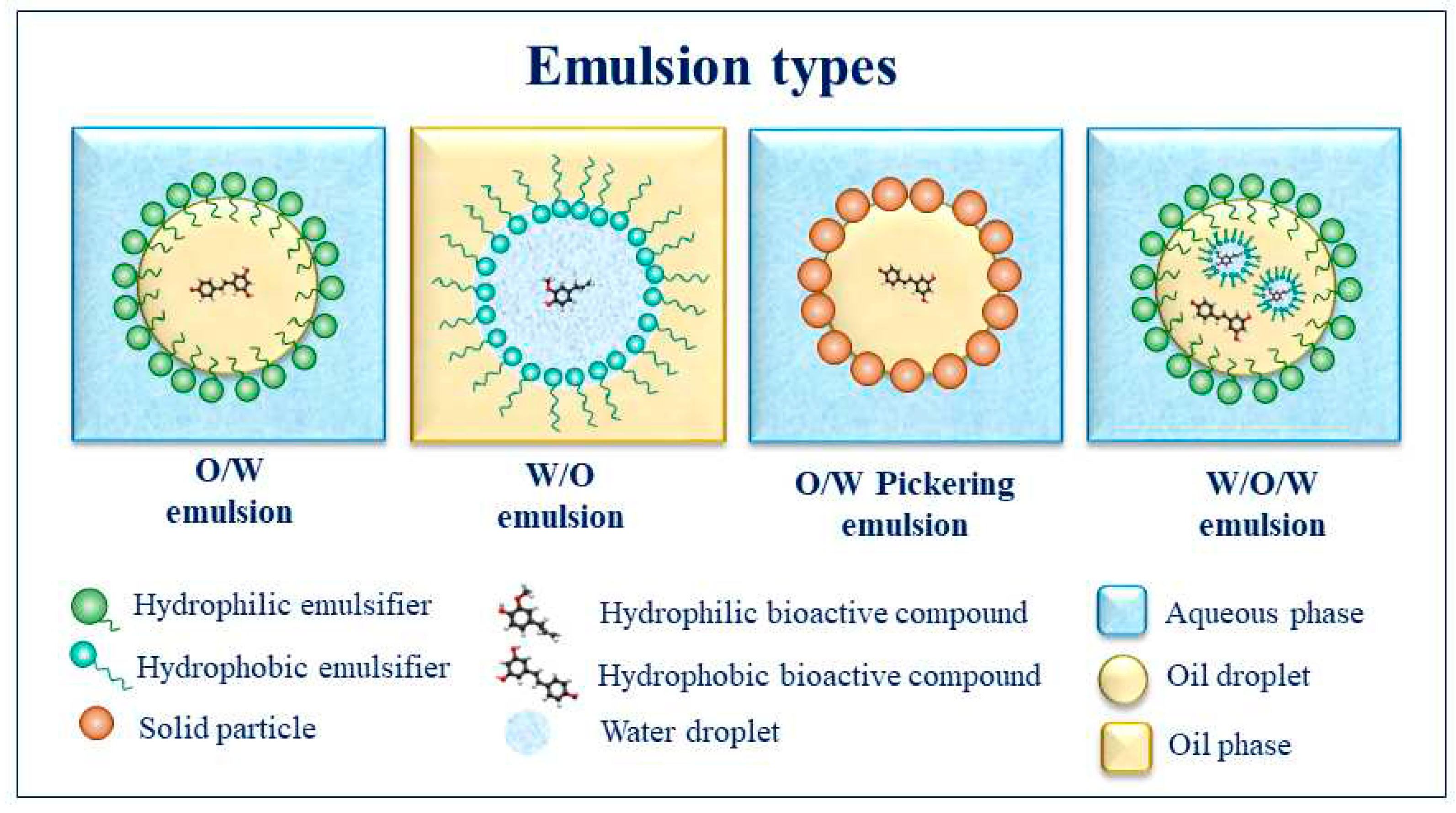
Figure 2.
Classification of emulsions according to thermodynamic stability and droplet size (Source: Authors).
Figure 2.
Classification of emulsions according to thermodynamic stability and droplet size (Source: Authors).
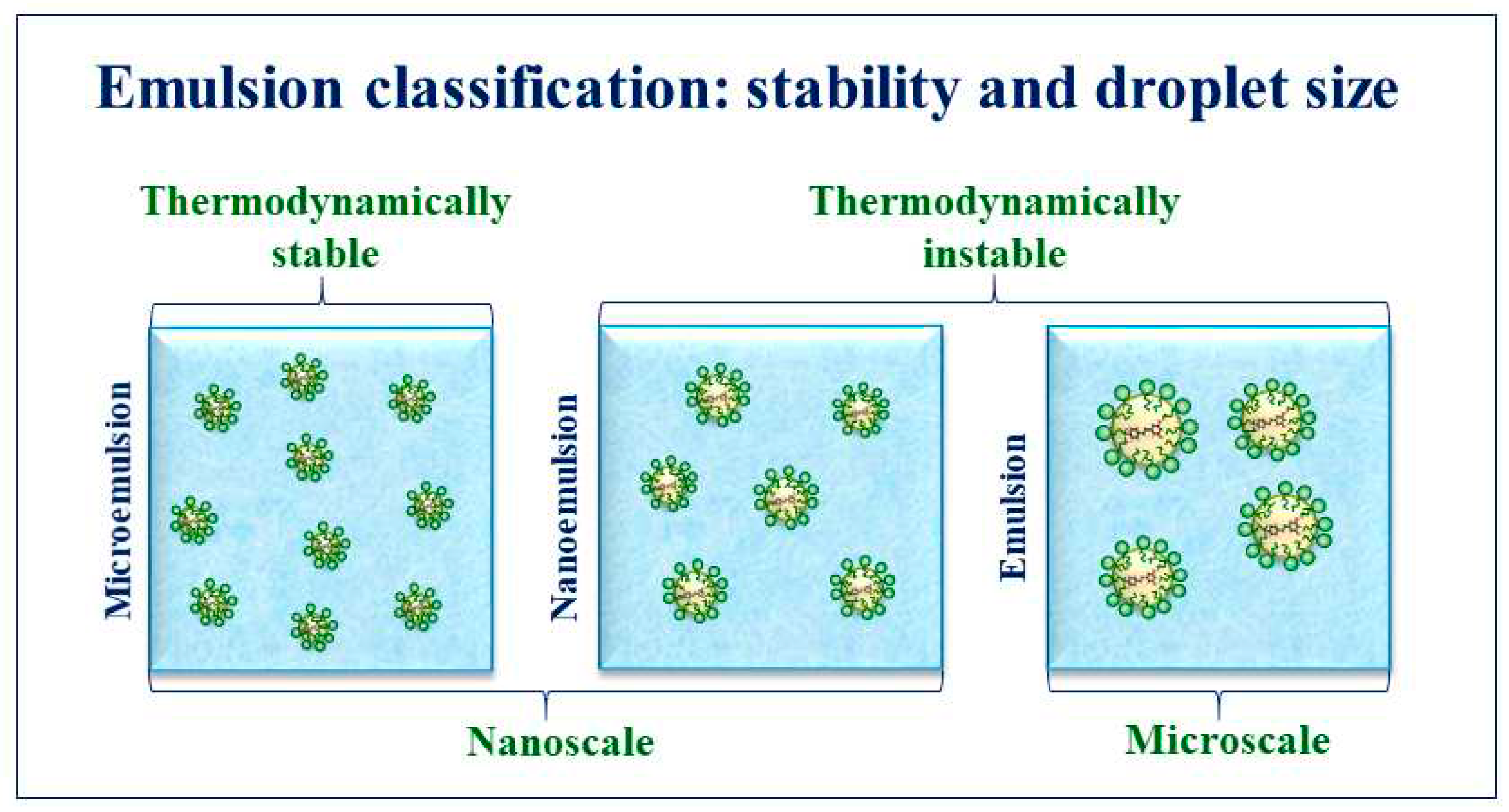
Figure 3.
Scheme of the production of active packaging incorporated with emulsified systems and application simulation. (Source: [79] with modifications).
Figure 3.
Scheme of the production of active packaging incorporated with emulsified systems and application simulation. (Source: [79] with modifications).
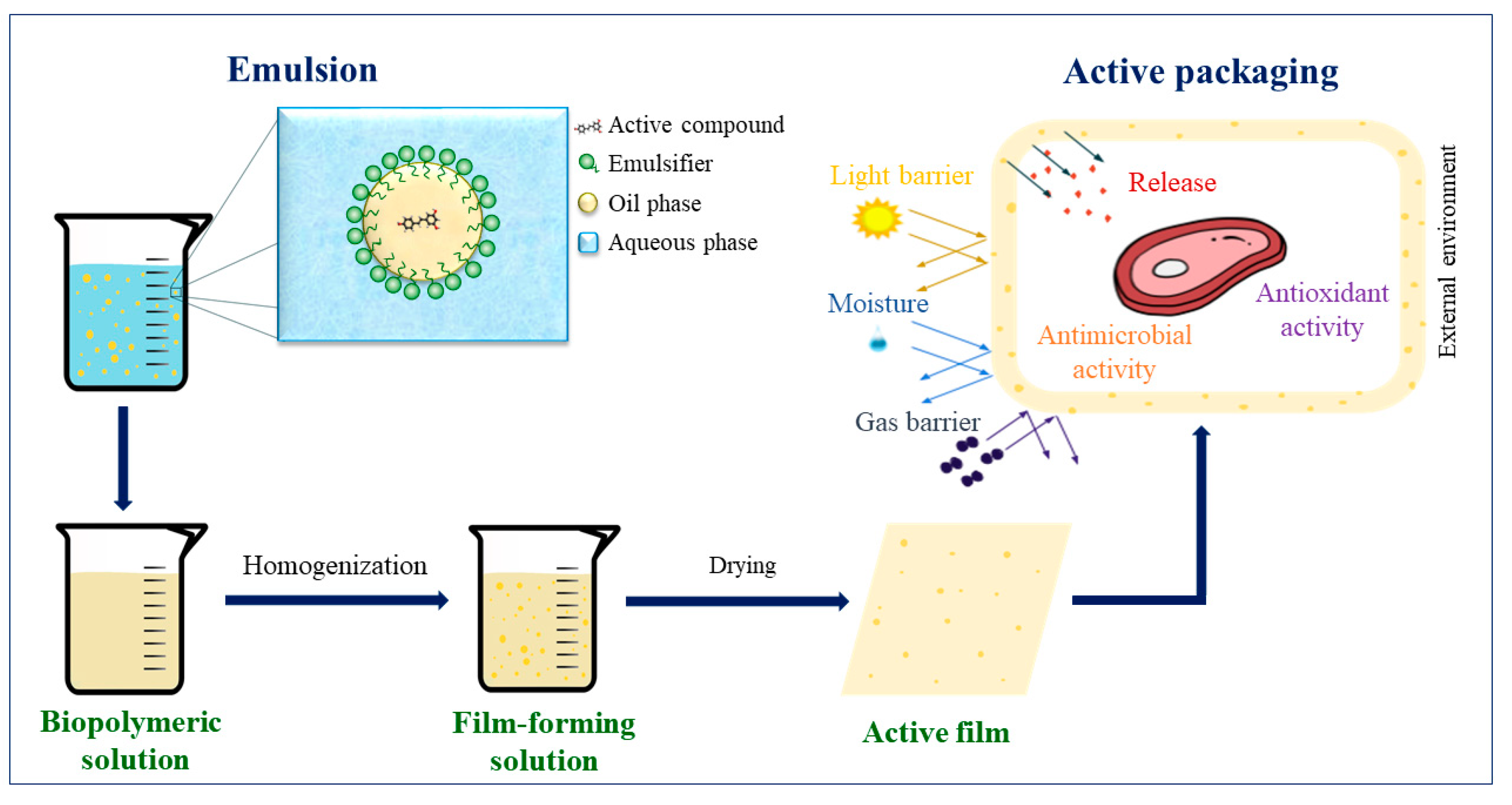
Figure 4.
Number of publications using terms “emulsion” and “active film” added to the keywords “nanoemulsion”, “microemulsion”, “Pickering emulsion” or “double emulsion” in the “Food Science Technology” category in Web of Science Core Collection [86].
Figure 4.
Number of publications using terms “emulsion” and “active film” added to the keywords “nanoemulsion”, “microemulsion”, “Pickering emulsion” or “double emulsion” in the “Food Science Technology” category in Web of Science Core Collection [86].
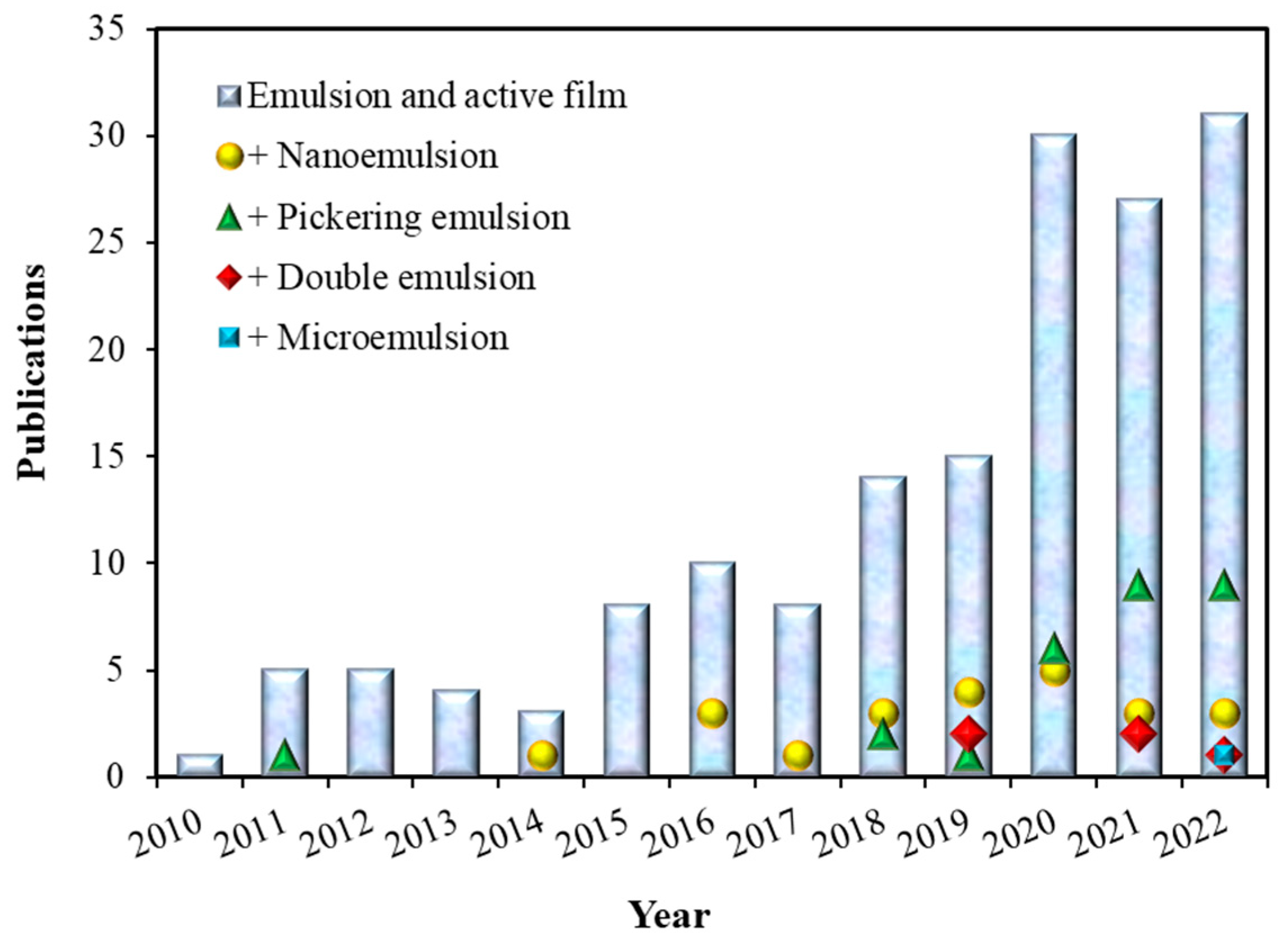
Figure 5.
Characteristics of emulsified systems (emulsion type, droplet size and emulsifier nature) and their effects on structure and properties of emulsion-loaded active films (Source: Authors).
Figure 5.
Characteristics of emulsified systems (emulsion type, droplet size and emulsifier nature) and their effects on structure and properties of emulsion-loaded active films (Source: Authors).
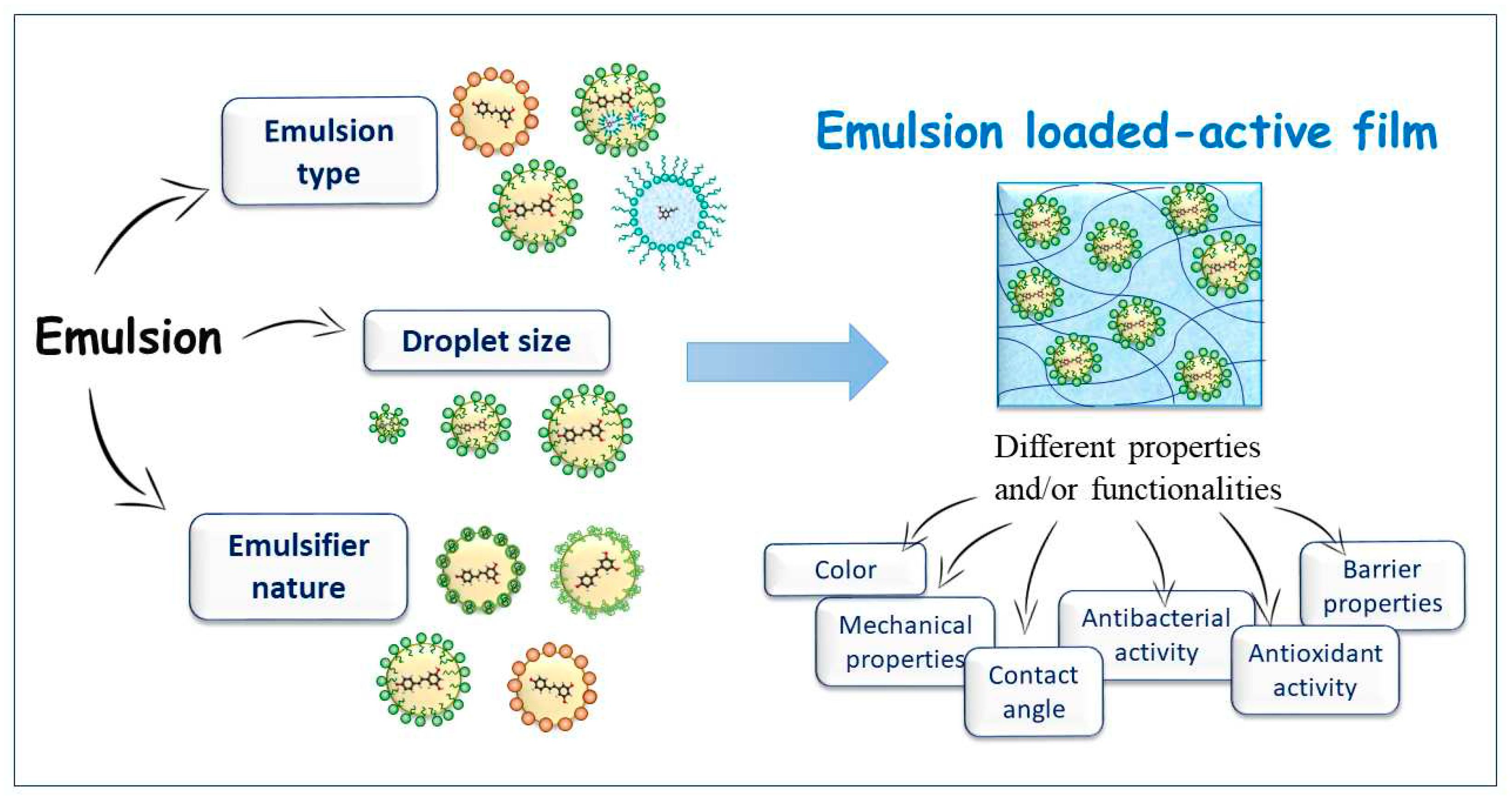

Table 1.
Summarizes some of the most recent studies that used different emulsion types to encapsulate a range bioactive compound before their incorporation into film-forming solutions.
Table 1.
Summarizes some of the most recent studies that used different emulsion types to encapsulate a range bioactive compound before their incorporation into film-forming solutions.
| Biopolymer | Emulsion type | Active compound | Reference |
|---|---|---|---|
| Chitosan | Pickering | Cinnamon EO | [69] |
| Double emulsion | Nisin/carvacrol | [77] | |
| Pickering | Cinnamon and perilla EO | [87] | |
| Double emulsion | “Pitanga” leaf extract | [76] | |
| Pickering | Clove EO | [88] | |
| Nanoemulsion | Cinnamon EO | [89] | |
| Nanoemulsion | Cumin EO | [90] | |
| Pickering | Clove EO | [71] | |
| Emulsion | Cinnamon EO | [91] | |
| Microemulsion | Cinnamon bark oil | [92] | |
| Nanoemulsion | Carvacrol | [18] | |
| Gelatin | Nanoemulsion | Lavender EO | [93] |
| Double emulsion | “Pitanga” leaf extract | [76] | |
| Nanoemulsion | Cinnamaldehyde | [72] | |
| Pickering | Hesperidin | [17] | |
| Nanoemulsion | Eugenol | [94] | |
| Nanoemulsion | α-tocopherol, garlic essential oil and cinnamaldehyde | [63] | |
| Gelatin | Nanoemulsion | Rutin | [95] |
| Nanoemulsion | Ginger EO | [96] | |
| Starch | Nanoemulsion | Curcumin | [19] |
| Pickering | Ho wood, cardamom, and cinnamon EO | [97] | |
| Emulsion | Lemongrass EO | [73] | |
| Micro and nanoemulsion | Carnauba wax | [74] | |
| Pickering | Cinnamon EO | [98] | |
| Whey protein (WPI) | Nanoemulsion | Bergamot oil | [23] |
| Nanoemulsion | α-tocopherol | [99] | |
| Nanoemulsion | Grammosciadium ptrocarpum Bioss. EO | [100] | |
| Pectin | Emulsion | Clove EO | [101] |
| Nanoemulsion and Pickering | Marjoram EO | [102] | |
| Nanoemulsion | Copaiba oil | [64] | |
| Pickering | Cinnamaldehyde | [103] | |
| Sodium caseinate | Nanoemulsion | Cinnamon EO | [104] |
| Sodium alginate | Emulsion | Cinamon EO | [105] |
| Soy protein isolate | Micro and nanoemulsion | Carvacrol and cinnamaldehyde | [47] |
| Carboxymethyl cellulose (CMC) | Emulsion | Licorice EO | [26] |
| Cellulose nanofibrils | Pickering | Oregano EO | [106] |
| Konjac glucomannan | Pickering | Oregano EO | [107] |
| Pullulan | Nanoemulsion | Cinnamon EO | [108] |
| Emulsion | Cinnamaldehyde, thymol and eugenol | [68] | |
| Basil seed gum | Nanoemulsion | Zataria multiflora EO | [109] |
| Chitosan/gelatin | Pickering | Cinnamon EO and curcumin | [110] |
| Double emulsion | “Pitanga” leaf extract | [76] | |
| Nanoemulsion | a-tocopherol, cin- namaldehyde and garlic EO | [28] | |
| Nanoemulsion | α-tocopherol, garlic EO and cinnamaldehyde | [63] | |
| Chitosan/Sodium caseinate blend | Nanoemulsion | α-tocopherol, garlic EO and cinnamaldehyde | [63] |
| Chitosan/Polylactic acid bilayer | Pickering | Thymol | [111] |
| Gelatin/agar | Pickering | Clove EO | [70] |
| Pickering | Clove EO | [112] | |
| Gelatin/pullulan | Nanoemulsion and Pickering | Clove EO | [79] |
| Starch/PVA | Pickering | Curcumin | [22] |
| Nanoemulsion | Carvacrol | [113] | |
| Nanoemulsion | Carvacrol | [27] | |
| Pectin/Papaya puree | Nanoemulsion | Cinnamaldehyde | [81] |
| Pullulan/xanthan gum/locust bean gum | Nanoemulsion | Cinnamaldehyde, thymol and eugenol | [114] |
| Carrageenan/agar | Pickering | Tea tree oil | [115] |
| Tamarind starch/WPI | Nanoemulsion | Thyme EO | [116] |
| Konjac glucomannan/pullulan | Pickering | Tea tree EO | [117] |
Table 2.
Summarizes the influence of emulsion characteristics in biopolymeric films properties in relation to a control film.
Table 2.
Summarizes the influence of emulsion characteristics in biopolymeric films properties in relation to a control film.
| Property | Emulsion type | Droplet size | Emulsifier | Reference | |||
|---|---|---|---|---|---|---|---|
| Emulsion | Nanoemulsion | Pickering | Smaller | Bigger | |||
| WVP | Decreased | - | Increased | - | - | - | [69] |
| - | Decreased | Decreased | - | - | - | [79] | |
| - | Decreased | Decreased | - | - | - | [102] | |
| - | - | - | Decreased | Increased | - | [26] | |
| - | - | - | Decreased² | Decreased | - | [74] | |
| - | - | - | Decreased | Increased | - | [87] | |
| - | - | - | Decreased | Decreased² | - | [119] | |
| - | - | - | Decreased³ | [89] | |||
| Moisture absorption/ content | - | Increased | Decreased | - | - | - | [79] |
| - | - | - | No effect | No effect | - | [74] | |
| - | - | - | No effect | Decreased² | - | [119] | |
| - | Increased | Decreased | - | - | - | [102] | |
| Water contact angle | Increased | - | Increased | - | - | - | [69] |
| - | - | - | Increased | Increased | - | [119] | |
| - | - | - | No effect | No effect | - | [74] | |
| Surface roughness | - | Decreased | Increased | - | - | - | [79] |
| - | - | - | No effect | Increased | - | [26] | |
| - | - | - | Increased | Decreased² | - | [119] | |
| Tensile strength | Decreased | - | Decreased | - | - | - | [69] |
| - | Decreased | Increased | - | - | - | [79] | |
| - | Decreased | Increased | - | - | - | [102] | |
| - | - | - | Decreased² | Decreased | - | [26] | |
| - | - | - | No effect | Decreased | - | [87] | |
| - | - | - | Decreased² | Decreased | - | [119] | |
| - | - | - | Decreased² | Decreased | - | [74] | |
| - | - | - | - | - | Increased³ | [89] | |
| - | - | - | - | - | Increased4 | [94] | |
| Elongation at break | Decreased | - | Decreased | - | - | - | [69] |
| - | Increased | Decreased | - | - | - | [79] | |
| - | No effect | Increased/ decreased* | - | - | - | [102] | |
| - | - | - | Increased | Increased² | - | [26] | |
| - | - | - | Increased | Decreased | - | [87] | |
| - | - | - | Increased | Increased | - | [74] | |
| - | - | - | - | - | Decreased³ | [89] | |
| - | - | - | - | - | Decreased4 | [94] | |
| UV-vis light barrier | Decreased | - | Decreased | - | - | - | [69] |
| - | - | - | Increased | Increased² | - | [74] | |
| - | - | - | Increased | Increased² | - | [87] | |
| - | - | - | Increased² | Increased | - | [119] | |
| Antioxidant activity1 | - | Highest | Lowest | - | - | - | [79] |
| - | Highest | Lowest | - | - | - | [102] | |
| - | - | - | Highest | Lowest | - | [87] | |
| - | - | - | - | - | Highest4 | [94] | |
| Antimicrobial activity1 | No effect | - | Effect | - | - | - | [69] |
| No effect | No effect | - | - | - | [102] | ||
| - | - | - | Higher effect | Lower effect | - | [26] | |
| - | - | - | - | - | Higher effect³ | [89] | |
*Depending of emulsion concentration; 1 In comparison to film with emulsion; ² In comparison with smaller droplets addition; ³ LH addition; 4 Sodium caseinate.
Disclaimer/Publisher’s Note: The statements, opinions and data contained in all publications are solely those of the individual author(s) and contributor(s) and not of MDPI and/or the editor(s). MDPI and/or the editor(s) disclaim responsibility for any injury to people or property resulting from any ideas, methods, instructions or products referred to in the content. |
© 2023 by the authors. Licensee MDPI, Basel, Switzerland. This article is an open access article distributed under the terms and conditions of the Creative Commons Attribution (CC BY) license (https://creativecommons.org/licenses/by/4.0/).
Copyright: This open access article is published under a Creative Commons CC BY 4.0 license, which permit the free download, distribution, and reuse, provided that the author and preprint are cited in any reuse.


