

Submitted:
12 March 2024
Posted:
14 March 2024
You are already at the latest version
Abstract
Persons high in the manipulative, misanthropic trait Machiavellianism make use of various forms of deception to attain their goals. A recent study demonstrated that different facets of Machiavellianism account for different kinds of deception (Blötner & Bergold, 2023; https://doi.org/10.1111/bjso.12559). Intelligence could be another predictor of deception production. This research examined the interactions between different facets of Machiavellianism and verbal reasoning to predict the production of empty, vague pseudo-information that is supposed to help achieve desired states or prevent undesired ones (co-called “bullshit”). In a sample of 525 participants, and consistent with the hypotheses, individuals with high scores in the goal-oriented facet of Machiavellianism produced “bullshit” more frequently to achieve certain goals if they also scored high in verbal reasoning. Thus, and opposing common assumptions, Machiavellianism is not sufficient to explain engagement in deceptive behavior as it only reflects the motivation to do so. Especially in the case of verbally expressed deception, verbal skills are also required to be successful.
Keywords:
Dark Triad
; deception
; cognitive ability
; pseudo-information
; bullshitting
1. Introduction
During the last years, we have been permanently surrounded by (pseudo-)information about COVID-19, its origin, assumed ways of infection, presumed ways of effective protection, and information about the utility of quarantine. In many cases, the pseudo-information turned out to be pointless. Consider, for example, Donald Trump’s recommendation to cure infected individuals by having them gargle bleach. However, the spread of misinformation that was not reflected in terms of accuracy, meaning, or truth did not only occur during the COVID-19 pandemic. Even before, we were confronted with a host of false information in our daily lives and it can be assumed that certain individuals are more likely to produce misinformation (Michels et al., 2020; Turi et al., 2022).
Across numerous everyday situations, certain individuals are typically more likely to try to deceive others or to capitalize on interpersonal and societal ambiguities. They do so to acquire advantages at the expense of others or to escape from undesired situations. Notably, the motivation and the ability to cheat do not necessarily match. The present research, thus, dealt with the distinction between motivational and ability-related constituents of engaging in deception. In concrete terms, I examined individual differences in the dissemination of so-called “bullshit”, that is, the strategic production of misinformation that helps attain antisocial goals and escape inconvenient situations (cf. Littrell et al., 2021).
1.1. Machiavellianism
Inspired by the treatises on political reasoning and moral issues published by Niccolò Machiavelli, Christie and Geis (1970) derived the personality trait Machiavellianism. It is characterized by a strategic attitude according to which the end justifies the means (i.e., any interpersonal strategy should be used to achieve desired ends) as well as a pessimistic view of human nature. The latter manifests itself in the belief that humankind is driven by egotistic motives and by projecting one’s own deceptive intentions onto other people (Blötner & Bergold, 2022; Christie & Geis, 1970). Blötner and Bergold (2022) addressed the lack of a theoretically and empirically sound theoretical foundation of Machiavellianism and derived a motivationally oriented conceptualization. Their model captures the strategic and planful acquisition of resources of any kind even at others’ expense (Machiavellian approach) and the distrustful, skeptical prevention of any kind of harm (Machiavellian avoidance). Approach and avoidance facets are theoretically and empirically connected by disagreeableness, dishonesty, and cynicism, which all serve the pursuance of the respective motives. Furthermore, these shared elements are viewed as prototypically Machiavellian characteristics (Blötner & Bergold, 2022; Christie & Geis, 1970). Following the selfish and ruthless nature of Machiavellianism, Machiavellianism is positively related to the engagement in a host of deceptive behaviors (Turi et al., 2022). Blötner and Bergold (2023) used their conceptualization of Machiavellianism to model relations with the dissemination of empty, misleading pseudo-information with indifference for truth, clarity, and/or meaning that is produced to make favorable impressions, to avert potential disadvantages, or to deceive in other ways. This sort of empty, misleading pseudo-information is called “bullshit”, and its production is called “bullshitting” (Pennycook et al., 2015; Littrell & Fugelsang, 2023; Littrell et al., 2021). The present research aims to extend the knowledge gained from this study by examining verbal reasoning as a moderator of the relations between Machiavellianism and production of “bullshit”.
1.2. “Bullshit” and “Bullshitting”
Pennycook et al. (2015) coined the term “bullshit” to refer to empty, misleading statements with indifference for truth, clarity, and/or meaning. It is often produced to make favorable impressions, to avert potential disadvantages, or to deceive in other ways. To provide an everyday example of “bullshitting”, Turpin et al. (2021) referred to being gifted an ugly sweater. If asked whether one likes the sweater, a person could escape the unpleasant situation by expressing gratitude and stating how kind and thoughtful the present was. This exemplary situation corresponds to evasive “bullshitting”, that is, the expression of unclear or meaningless statements to prevent oneself and/or others from harm (Littrell et al., 2021) such that an actual response to the question is avoided. On the other hand, “bullshit” produced to appear more competent or to achieve desirable goals is called persuasive “bullshitting” (Littrell et al., 2021). Consistent with the resource-acquiring and harm-avoiding conceptualizations of the facets of Machiavellianism and “bullshitting”, Machiavellian approach was associated with higher engagement in persuasive “bullshitting”. Likewise, Machiavellian avoidance was associated with higher engagement in evasive “bullshitting” (Blötner & Bergold, 2023).
1.3. Moderation by Verbal Reasoning
Machiavellianism embodies the motivation to cheat, but not necessarily the ability to do well in this regard (Blötner & Bergold, 2022, 2023; Turi et al., 2022). Although extant theories of intelligence do not explicitly mention engagement in fraud, it stands to reason that individuals scoring high in cognitive abilities are equipped with better reflective skills than those scoring low in cognitive abilities (Pennycook et al., 2015; Sarzyńska et al., 2017). This helps them adapt to their surroundings, to learn from experiences, and to engage in various forms of reasoning for the sake of problem solving (Neisser et al., 1996; Sarzyńska et al., 2017). Cognitive models on deception emphasize the need to craft and maintain successful deception, whereby cognitive abilities are a resource to fulfill the cognitive demands related to monitoring verbal expressions and establishing a net of more or less irrefutable, deceptive statements (Sarzyńska et al., 2017; Turpin et al., 2021). Consistent with this, Sarzyńska-Wawer et al. (2023) argued that cognitive abilities foster the production of more credible lies when these lies were produced spontaneously. Similarly, individuals high in psychopathy (which is strongly related to Machiavellianism; Blötner & Bergold, 2022) are less likely to be convicted of crime if they also possess high verbal intelligence (Boccio et al., 2018). Employing Sarzyńska-Wawer et al.’s (2023) reasoning to the present study, those high in cognitive abilities tend to think more strongly about what they are about to say. Indeed, the ability to produce better “bullshit” requires high cognitive abilities (Littrell & Fugelsang, 2023). This might be due to higher executive control such that higher cognitive abilities help retain information that the originator aims to disguise (Elaad et al., 2020; Debey et al., 2015; Sarzyńska-Wawer et al., 2023). Given the linguistic nature of “bullshit”, I argue that verbal reasoning abilities in particular help produce “bullshit”. More specifically, I argue that those with better verbal reasoning skills possess a richer vocabulary, they are better at reflecting the statements they aim to express, they are more likely to detect logical inconsistencies in their arguments, it is less taxing for them to produce deception, and they have higher processing speed (Sarzyńska et al., 2017; Sarzyńska-Wawer et al., 2023; Sutin et al., 2022; Vrij et al., 2010). Volbert et al. (2010), thus, proposed that higher intellect helps generate non-factual statements that are less likely to be recognized as such.
It is reasonable to assume that (cognitive) ability alone does not suffice to engage in deception if there is no motivation to do so. In this vein, Vrij et al. (2010) proposed that the combination of verbal skills and low feelings of remorse goes along with the production of better deception (see also Turpin et al., 2021). The combination proposed by Vrij et al. (2010) is especially true of individuals scoring high in both Machiavellianism and verbal reasoning skills. People high in Machiavellianism are exploitative, interpersonally cold, and are willing to sacrifice moral standards for their egotistic goals if it helps them achieve these goals. Furthermore, Machiavellianism is linked to a plethora of deceptive behaviors (Blötner & Bergold, 2022; Christie & Geis, 1970; Michels et al., 2020; Turi et al., 2022). Due to being equipped with a richer vocabulary and more knowledge about verbal relations and meanings (Elaad et al., 2020; Sutin et al., 2022), I expected verbal reasoning to foster the production of more eloquent “bullshit” by individuals high in Machiavellianism.
Michels et al. (2020) brought forward a similar reasoning but could not establish the interaction between Machiavellianism and intelligence in predicting lying ability. This, however, can be explained in several ways: First, the estimate of reliability of the scale used to measure Machiavellianism was relatively poor (Cronbach’s α = .52), potentially accounting for a false-negative finding. Second, the employed measure is conceptualized as a single-factor model, whereby Machiavellianism was found to be multidimensional. Entangling different contents of the construct in a single score might have obscured differential effects among facets of Machiavellianism (Blötner & Bergold, 2022, 2023). Third, their sample was relatively small, limiting the statistical power of their conclusions.
1.4. Current Research and Hypotheses
The stated considerations as well as extant studies point to independent contributions of Machiavellianism and verbal reasoning skills in modeling “bullshit” production. Thus, I hypothesized that verbal reasoning skills serves as a moderator in the relations between facets of Machiavellianism and “bullshit” production. I hypothesized the positive link between Machiavellian approach and persuasive “bullshitting” frequency to be stronger if verbal abilities are also high (compared to average and low; Hypothesis 1). Likewise, I expected the positive link between Machiavellian avoidance and evasive “bullshitting” frequency to be stronger for those with high (as compared to average and low) verbal abilities (Hypothesis 2).
2. Methods
2.1. Sample
I adopted the data from Blötner and Bergold’s (2023) study on the main effects of Machiavellianism in “bullshit” production and reception. The interaction effects proposed in the current study have not yet been examined. The sample comprises 525 participants (Mage = 24.40, SDage = 6.60; 380 self-identifying as female, 143 self-identifying as male, and two self-identifying as diverse). The data was predominantly collected in universities and university groups on social media. Informed consent was obtained. The study was originally approved by the Institutional Review Board of the TU Dortmund University.
2.2. Measures
2.2.1. Verbal Reasoning
Verbal reasoning was measured with the same-named four-item subscale from the International Cognitive Ability Resource (see Condon & Revelle, 2014, for the development and evidence of construct validity). Respondents are provided with hypothetical situations and are asked to identify the conclusion that best aligns with the scenario (fictitious scenario: A is taller than B and B is taller than C., correct response: A is taller than C.), Cronbach’s α = .48.
2.2.2. Machiavellianism
The Machiavellian Approach and Avoidance Questionnaire (Blötner & Bergold, 2022) was used to measure the Machiavellian approach and Machiavellian avoidance (Cronbach’s αs = .80 and .77) with four items each, 1 = strongly disagree, 2 = disagree, 3 = neither agree nor disagree, 4 = agree, 5 = strongly agree. Despite high overall similarities of the nomological networks of Machiavellian approach and subclinical psychopathy, Machiavellian approach is comparatively more strongly associated with hope for power and less strongly associated with impulsivity and aggression (Blötner & Bergold, 2022), supporting construct validity.
2.2.3. “Bullshitting” Frequency
The frequency of engaging in persuasive and evasive “bullshitting” was assessed with the Bullshitting Frequency Scale (eight and four items, Cronbach’s αs = .87 and .73, respectively; Littrell et al., 2021), 1 = never, 2 = rarely, 3 = occasionally/sometimes, 4 = frequently, 5 = a lot/all the time. Littrell et al. (2021) reported findings in favor of construct validity.
2.3. Analytical Strategy
I computed a confirmatory factor analysis with the items of the five constructs of interest to assess the quality of the respective assessments. Afterwards, the hypotheses were evaluated through structural equation modeling with the R packages lavaan (version 0.6–15; Rosseel, 2012) and semTools (version 0.5–6; Jorgensen et al., 2022). To reduce multicollinearity between the substantial factors and the interaction term, I applied residual centering to the product term (Little et al., 2006). To test the robustness of the findings, I also applied double-mean centering. Since the p-value of the χ2-test is oversensitive to negligible deviations, I based model evaluations on descriptive fit indices and concluded good (sufficient) fit of the structural equation models if the Comparative Fit Index (CFI) exceeded .95 (.90), if the Root Mean Square Error of Approximation (RMSEA) fell short of .06 (.10), and if the Square Root Mean Residual (SRMR) fell short of .08. (Hu & Bentler, 1999). The Open Science Framework Directory of this study provides the data and the analysis script: https://osf.io/m6zbc/.
3. Results
Table 1 contains bivariate correlations among all involved constructs. As can be seen, the facets of Machiavellianism and “bullshitting” frequency were positively correlated among each other, .15 ≤ rs ≤ .47, all ps < .001. Verbal reasoning was unrelated to all other constructs (|rs| ≤ .08, ps ≥ .07), but this can be attributed to unreliability.
3.1. Overall Fit of the Latent Models
The common confirmatory factor analysis of all constructs revealed acceptable fit. Verbal reasoning was unrelated to all other factors, -.07 ≤ ρ ≤ .13, all ps ≥ .07. All remaining factors were positively correlated, .21 ≤ ρ ≤ .57, all ps < .001 (see the Markdown file in the Open Science Framework supplement for details). Furthermore, all structural equation models that served the testing of the above hypotheses exhibited sufficient model fit (see Table 2 for an overview).
3.2. Hypothesis Testing
Table 3 provides the path coefficients of the structural equation models with and without the interaction effects. As can be seen, across models, facets of Machiavellianism elicited positive main effects onto “bullshitting” facets (.25 ≤ β ≤ .44, all ps < .001), but the main effects of verbal reasoning were not significant, .10 ≤ β ≤ .11, all ps ≥ .10. The Machiavellianism facets themselves were unrelated to verbal reasoning, all ρs = .05, all ps ≥ .50. The main effects of Machiavellian approach and verbal reasoning accounted for 20.3% of the observed variance of persuasive “bullshitting”, which could by extended by an additional 5% by adding the interaction effect. Verbal reasoning emerged as a significant moderator of the relation between Machiavellian approach and persuasive “bullshitting” frequency, β = .22, z = 2.86, p = .004. Simple slope analyses revealed that the interaction was significant at moderate (b = 0.49, SE = .06, z = 7.88, p < .001) and high levels of verbal reasoning skills (b = 1.35, SE = .42, z = 3.19, p = .001), but not at low levels of verbal reasoning skills, b = -0.36, SE = .42, z = -0. 86, p = .39. Figure 1 illustrates the moderation.
The main effects of Machiavellian avoidance and verbal reasoning accounted for 8.0% of the observed variance of evasive “bullshitting”, which could by extended by an additional 0.9% by adding the interaction effect. Therefore, verbal reasoning did not emerge as a moderator of the relation between Machiavellian avoidance and evasive “bullshitting” frequency, β = .10, z = 1.35, p = .18. A post hoc power analysis conducted with the R package simsem (version 0.5–16; Pornprasertmanit et al., 2021) revealed that the statistical power did not suffice to reliably detect the interaction, 1-β = .25. All these findings were virtually identical when using double-mean centering instead of residual centering and when controlling for gender or age (see supplement; see also the small correlations between study variables and these suggested control variables in Table 1).
4. Discussion
4.1. Summary of the Present Study
To address and to challenge the naïve idea according to which Machiavellianism goes along with deceptive success, the present study examined the moderating effect of verbal skills in the relations between facets of Machiavellianism (Blötner & Bergold, 2022) and facets of “bullshitting” (Littrell et al., 2021). Thus, the study followed the claim according to which personality and actual abilities interact in predicting deception (Sarzyńska et al., 2017). Therefore, I hypothesized that high scores on the agentic, planful facet Machiavellian approach and the misanthropic, harm-avoiding facet Machiavellian avoidance go along with more frequent engagement in persuasive and evasive “bullshitting”, respectively, if a person also possesses high verbal reasoning skills. The hypothesis concerning Machiavellian approach was supported, whereas the hypothesis on Machiavellian avoidance was not.
Drouvelis and Pearce (2023) found that high general intelligence was helpful to persuade other individuals. This lends support to the present findings on the interaction between Machiavellian approach and verbal reasoning in predicting persuasive “bullshitting”. Although it appears intuitive to assume that verbal skills foster the ability to deceive others, only little is known from a research perspective about this link. Cognitive capacities are needed to craft and maintain deceptive acts and to react spontaneously to unforeseen queries (Michels et al., 2020). Consistent with recent considerations (Elaad et al., 2020; Michels et al., 2020; Vrij et al., 2010), the combination of high levels of both Machiavellianism and verbal skills equips people with the motivation and the ability, respectively, to produce “bullshit” more frequently. Therefore, the findings extend and differentiate evidence on deceptive effects of Machiavellianism (Turi et al., 2022). For instance, Palomäki et al. (2016) found Machiavellianism to be related to bluffing in poker games and Gunnthorsdottir et al. (2002) found Machiavellianism to be related to defecting in bargaining situations. These studies, however, did not take cognitive abilities into account. To the best of my knowledge, only two studies tested interactions between Machiavellianism and cognitive abilities (in the broadest sense) in modeling pertinent outcomes. Touhey (1973) found high scores in Machiavellianism and intelligence to be associated with higher social mobility, that is, acquisition of status and other socially desired advantages. This is consistent with the findings of the present study because persuasive “bullshitting” is intended to warrant status and a positive reputation (Littrell et al., 2021). Likewise, Machiavellianism is strongly related to impression management techniques (Hart et al., 2022). Recent research failed to detect the interaction between Machiavellianism and cognitive abilities to predict lying ability (Michels et al., 2020; Touhey, 1973). However, they had comparatively small samples — impairing statistical power — and they used Machiavellianism measures that suffer from poor estimates of reliability and structural shortcomings (see Blötner & Bergold, 2022, for a discussion of different Machiavellianism scales). Furthermore, Michels et al.’s (2020) participants had time to prepare their lies, whereby intelligence seems to be more vital for spontaneous deception (Sarzyńska-Wawer et al., 2023).
4.2. Limitations and Future Directions
This study was not without limitations. Besides insufficient power to establish the second hypothesis, the ratios of variance explained by the models were comparatively small. One obvious reason for this might be that verbal reasoning was measured with only four items (Condon & Revelle, 2014) and that most of the participants of the study from which I adopted the data were university students. Although structural equation modeling corrects for unreliability of the measure, the conciseness of the measure and the narrow range of the sample accounted for variance restrictions in the observed intelligence distribution. This might have led to diminished relations of verbal reasoning. To address this, future research should utilize more extensive scales to measure verbal reasoning and recruit participants from a wider range of populations that differ more strongly in terms of verbal skills (i.e., higher observable variability). Second (but relatedly), besides the specific source of recruiting (i.e., universities), the sample was imbalanced in terms of gender. Blötner and Bergold (2023) summarized earlier research according to which behavioral outcomes of Machiavellianism manifest differently in men and women. Combining both limitations, the links found in the present study do not necessarily generalize to populations with broader ranges of education and a balanced gender ratio. Given gender-specific expressions of Machiavellianism, it is reasonable to posit gender as another moderator. The present data, however, might not be suitable to ensure sufficient statistical power to model this three-way interaction. Third, although verbal reasoning appears to be an obvious and strong determinant of linguistic deception such as “bullshitting”, alternative moderators could be tested that focus more strongly on interpersonal functioning, such as social or emotional intelligence. Thus, I assume that those who understand others’ emotions but are willing to exploit them are more likely to engage in such behaviors. Additionally, it stands to reason that they are also more successful at it. Relatedly, and reflecting the fourth limitation, the present study assessed the frequency with which individuals engaged in “bullshitting”, but this is not to say that respective endeavors were successful. Therefore, future studies acknowledging ecological validity should assess the (expected) success of deceptive behaviors besides the mere frequency.
4.3. Conclusion
Some scholars believe that intelligence was inherent to Machiavellianism, but this assumption had to be rejected. Quite contrary, cognitive abilities are not predictive of Machiavellianism and vice versa (cf. Michels, 2022). Thus, like success or failure in getting away with criminal conduct by individuals high in psychopathy (Boccio et al., 2018), Machiavellianism itself does not inevitably lead to success if ability-related features are not considered. The present study pointed this out for the strategic/planful facet of Machiavellianism, in particular. However, “intelligent Machiavellians” presumably possess the motivation and the ability to keep their deception undetected, thus equipping them with the knowledge of how to get away with it. This makes it difficult to convict them of deception. On the other hand, the findings imply that those with low scores in Machiavellian approach in particular who also possess lower verbal reasoning skills rather refrain from “bullshitting” because they might lack the required articulatory abilities. Given that getting away with deception and the involved processes were beyond the scope of this study, further systematic research is needed to elucidate this.
References
- Blötner, C.; Bergold, S. To be fooled or not to be fooled. Approach and avoidance facets of Machiavellianism. Psychol. Assess. 2022, 34, 147–158. [Google Scholar] [CrossRef] [PubMed]
- Blötner, C.; Bergold, S. It is double pleasure to deceive the deceiver: Machiavellianism is associated with producing but not necessarily with falling for bullshit. Br. J. Soc. Psychol. 2023, 62, 467–485. [Google Scholar] [CrossRef] [PubMed]
- Boccio, C.M.; Beaver, K.M.; Schwartz, J.A. The role of verbal intelligence in becoming a successful criminal: Results from a longitudinal sample. Intelligence 2018, 66, 24–31. [Google Scholar] [CrossRef]
- Christie, R.; Geis, F.L. Studies in Machiavellianism; Academic Press: Cambridge, MA, USA, 1970. [Google Scholar]
- Condon, D.M.; Revelle, W. The international cognitive ability resource: Development and initial validation of a public-domain measure. Intelligence 2014, 43, 52–64. [Google Scholar] [CrossRef]
- Debey, E.; Ridderinkhof, R.K.; De Houwer, J.; De Schryver, M.; Verschuere, B. Suppressing the truth as a mechanism of deception: Delta plots reveal the role of response inhibition in lying. Conscious. Cogn. 2015, 37, 148–159. [Google Scholar] [CrossRef]
- Drouvelis, M.; Pearce, G. Is there a link between intelligence and lying? J. Econ. Behav. Organ. 2023, 206, 182–203. [Google Scholar] [CrossRef]
- Elaad, E.; Hanania, S.B.; Mazor, S.; Zvi, L. The relations between deception, narcissism and self-assessed lie- and truth-related abilities. Psychiatry Psychol. Law 2020, 27, 880–893. [Google Scholar] [CrossRef]
- Gunnthorsdottir, A.; McCabe, K.; Smith, V. Using the Machiavellianism instrument to predict trustworthiness in a bargaining game. J. Econ. Psychol. 2002, 23, 49–66. [Google Scholar] [CrossRef]
- Hart, W.; Breeden, C.J.; Lambert, J.; Kinrade, C. Dark Triad constructs blend facets with heterogenous self-presentation tactic use profiles. Personal. Individ. Differ. 2022, 184, 111193. [Google Scholar] [CrossRef]
- Hu, L.-T.; Bentler, P.M. Cutoff criteria for fit indexes in covariance structure analysis: Conventional criteria versus new alternatives. Struct. Equ. Model. 1999, 6, 1–55. [Google Scholar] [CrossRef]
- Jorgensen, T.D.; Pornprasertmanit, S.; Schoemann, A.M.; Rosseel, Y.; Miller, P.; Quick, C.; Garnier-Villarreal, M.; Selig, J.; Boulton, A.; Preacher, K.; Coffman, D.; Rhemtulla, M.; Robitzsch, A.; Enders, C.; Arslan, R.; Clinton, B.; Panko, P.; Merkle, E.; Chesnut, S.; Byrnes, J.; Johnson, A.R. semTools: Useful tools for structural equation modeling; R package version 0.5–6; CRAN: 2022. https://CRAN.R-project.org/package=semTools.
- Little, T.D.; Bovaird, J.A.; Widaman, K.F. On the merits of orthogonalizing powered and product terms: Implications for modeling interactions among latent variables. Struct. Equ. Model. 2006, 13, 497–519. [Google Scholar] [CrossRef]
- Littrell, S.; Fugelsang, J.A. Bullshit blind spots: The roles of miscalibration and information processing in bullshit detection. Thinking and Reasoning. [CrossRef]
- Littrell, S.; Risko, E.F.; Fugelsang, J.A. The Bullshitting Frequency Scale: Development and psychometric properties. Br. J. Soc. Psychol. 2021, 60, 248–270. [Google Scholar] [CrossRef]
- Michels, M. General intelligence and the Dark Triad: A meta-analysis. J. Individ. Differ. 2022, 43, 35–46. [Google Scholar] [CrossRef]
- Michels, M.; Molz, G.; Maas genannt Bermpohl, F. The ability to lie and its relations to the Dark Triad and general intelligence. Personal. Individ. Differ. 2020, 166, 110195. [Google Scholar] [CrossRef]
- Neisser, U.; Boodoo, G.; Bouchard, T.J.; Jr Boykin, A.W.; Brody, N.; Ceci, S.J.; Halpern, D.F.; Loehlin, J.C.; Perloff, R.; Sternberg, R.J.; Urbina, S. Intelligence: Knowns and unknowns. Am. Psychol. 1996, 51, 77–101. [Google Scholar] [CrossRef]
- Palomäki, J.; Yan, J.; Laakasuo, M. Machiavelli as a poker mate–A naturalistic behavioural study on strategic deception. Personal. Individ. Differ. 2016, 98, 266–271. [Google Scholar] [CrossRef]
- Pennycook, G.; Cheyne, J.A.; Barr, N.; Koehler, D.J.; Fugelsang, J.A. On the reception and detection of pseudo-profound bullshit. Judgm. Decis. Mak. 2015, 10, 549–563, Pornprasertmanit, S., Miller, P., Schoemann, A., Jorgensen, T. D. (2021). simsem: SIMulated Structural Equation Modeling (R package version 0.5–16). CRAN. https://CRAN.R-project.org/package=simsem.. [Google Scholar] [CrossRef]
- Rosseel, Y. lavaan: An R package for structural equation modeling. J. Stat. Softw. 2012, 48, 1–36. [Google Scholar] [CrossRef]
- Sarzyńska, J.; Falkiewicz, M.; Riegel, M.; Babula, J.; Margulies, D.S.; Nęcka, E.; Grabowska, A.; Szatkowska, I. More intelligent extraverts are more likely to deceive. PLoS ONE 2017, 12, e0176591. [Google Scholar] [CrossRef]
- Sarzyńska-Wawer, J.; Hanusz, K.; Pawlak, A.; Szymanowska, J.; Wawer, A. Are intelligent people better liars? Relationships between cognitive abilities and credible lying. J. Intell. 2023, 11, 69. [Google Scholar] [CrossRef]
- Sutin, A.R.; Stephan, Y.; Luchetti, M.; Strickhouser, J.E.; Aschwanden, D.; Terracciano, A. The association between Five Factor model personality traits and verbal and numeric reasoning. Neuropsychol. Dev. Cognition. Sect. B Aging Neuropsychol. Cogn. 2022, 29, 297–317. [Google Scholar] [CrossRef] [PubMed]
- Touhey, J.C. Intelligence, Machiavellianism and social mobility. Br. J. Soc. Clin. Psychol. 1973, 12, 34–37. [Google Scholar] [CrossRef]
- Turi, A.; Rebeleș, M.-R.; Visu-Petra, L. The tangled webs they weave: A scoping review of deception detection and production in relation to Dark Triad traits. Acta Psychol. 2022, 226, 103574. [Google Scholar] [CrossRef]
- Turpin, M.H.; Kara-Yakoubian, M.; Walker, A.C.; Walker HE, K.; Fugelsang, J.A.; Stolz, J.A. Bullshit ability as an honest signal of intelligence. Evol. Psychol. 2021, 19, 14747049211000317. [Google Scholar] [CrossRef] [PubMed]
- Volbert, R.; Steller, M.; Galow, A. Das Glaubhaftigkeitsgutachten [Credibility assessment] In Handbuch der Forensischen Psychiatrie. Band 2: Psychopathologische Grundlagen und Praxis der Forensischen Psychiatrie im Strafrecht [Handbook of forensic psychiatry. Volume 2: Psychopathological basics and practice of forensic psychiatry in criminal justice]; Kröber, H.-L., Dölling, D., Leygraf, N., Sass, H., Eds.; Darmstadt, 2010; pp. 623–689.
- Vrij, A.; Granhag, P.A.; Mann, S. Good liars. J. Psychiatry Law 2010, 38, 77–98. [Google Scholar] [CrossRef]
- Wissing, B.G.; Reinhard, M.A. The Dark Triad and deception perceptions. Frontiers in Psychology, 1811. [Google Scholar] [CrossRef]
Figure 1.
Machiavellian Approach-Verbal Reasoning Interaction in Modeling Persuasive “Bullshitting”. Note. All variables were standardized. Solid, dashed, and dotted lines indicate the trajectories for individuals scoring one standard deviation below average, at average level, and one standard deviation above average in verbal reasoning, respectively. ** p < .001. * p < .01.
Figure 1.
Machiavellian Approach-Verbal Reasoning Interaction in Modeling Persuasive “Bullshitting”. Note. All variables were standardized. Solid, dashed, and dotted lines indicate the trajectories for individuals scoring one standard deviation below average, at average level, and one standard deviation above average in verbal reasoning, respectively. ** p < .001. * p < .01.
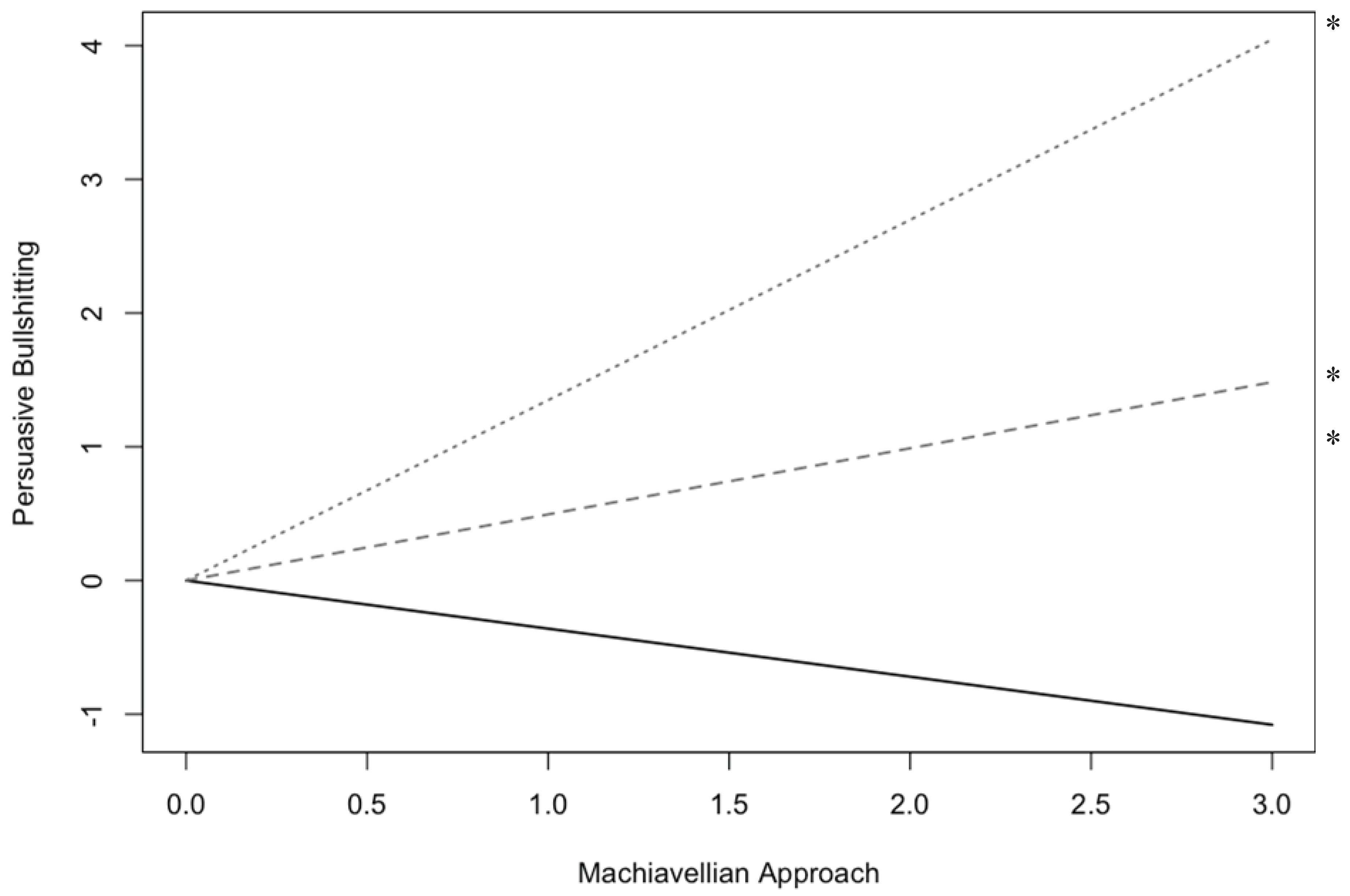

Table 1.
Relations Among the Constructs Involved in the Study as well as Control Variables.
| Approach | Avoidance | Persuasive BS | Evasive BS | VR | Age | |
|---|---|---|---|---|---|---|
| Avoidance | .43 | — | ||||
| Persuasive BS | .39 | .28 | — | |||
| Evasive BS | .15 | .17 | .47 | — | ||
| VR | .02 | .02 | -.05 | .08 | ||
| Age | -.04 | -.04 | -.14 | -.20 | -.03 | |
| Gender | .02† | .02† | .002† | .006† | .02† | .005† |
Note. BS = “Bullshitting”. VR = Verbal reasoning. † = Partial η2. Bolded coefficients were significant at p < .001.
Table 2.
Fit Characteristics of the Tested Latent Models.
| Model | χ2 | df | CFI | RMSEA [95% CI] | SRMR |
|---|---|---|---|---|---|
| Confirmatory factor analysis of all items | 548.48 | 242 | .92 | .05 [.04, .06] | .05 |
| Approach x Verbal Reasoning — Persuasive “Bullshitting” | |||||
| Main effects | 244.14 | 101 | .94 | .05 [.04, .06] | .04 |
| Main effects plus interaction effect | 303.43 | 164 | .95 | .04 [.03, .05] | .04 |
| Avoidance x Verbal Reasoning — Evasive “Bullshitting” | |||||
| Main effects | 119.22 | 51 | .94 | .05 [.04, .06] | .05 |
| Main effects plus interaction effect | 149.21 | 98 | .96 | .03 [.02, .04] | .04 |
| Note. df = Degrees of freedom. CFI = Comparative fit index. RMSEA = Root mean square error of approximation. SRMR = Square root mean residual. All models included verbal reasoning as a moderator. | |||||
Table 3.
Parameter Estimates from the Main Effect and Interaction Effect Structural Equation Models.
Table 3.
Parameter Estimates from the Main Effect and Interaction Effect Structural Equation Models.
| Persuasive “Bullshitting” | Evasive “Bullshitting” | |||
|---|---|---|---|---|
| Variable | Main effects | Main effects plus interaction | Main effects | Main effects plus interaction |
| Approach | .44 [.36, .53] | .44 [.36, .53] | — | — |
| Avoidance | — | — | .25 [.15, .36] | .26 [.15, .36] |
| Verbal Reasoning | -.10 [-.22, .02] | -.10 [-.22, .02] | .11 [-.02, .24] | .11 [-.02, .25] |
| Interaction | — | .22 [.07, .38] | — | .10 [-.04, .24] |
| ρMach-VR | .05 [-.08 , .18] | .05 [-.08, .18] | .05 [-.09, .18] | .05 [-.09, .18] |
| R2 | .203 | .253 | .080 | .089 |
Note. All parameters are standardized. Numbers in square brackets reflect 95% confidence intervals. ρMach-VR reflects the latent correlation between the respective facet of Machiavellianism and verbal reasoning. R2 reflects the percentage of variance of the criterion accounted for by the model.
Disclaimer/Publisher’s Note: The statements, opinions and data contained in all publications are solely those of the individual author(s) and contributor(s) and not of MDPI and/or the editor(s). MDPI and/or the editor(s) disclaim responsibility for any injury to people or property resulting from any ideas, methods, instructions or products referred to in the content. |
© 2024 by the authors. Licensee MDPI, Basel, Switzerland. This article is an open access article distributed under the terms and conditions of the Creative Commons Attribution (CC BY) license (http://creativecommons.org/licenses/by/4.0/).
Copyright: This open access article is published under a Creative Commons CC BY 4.0 license, which permit the free download, distribution, and reuse, provided that the author and preprint are cited in any reuse.


