

Submitted:
25 August 2023
Posted:
28 August 2023
You are already at the latest version
Abstract
Supermarkets in Port Harcourt (PH) city, Nigeria, predominantly rely on diesel electricity generation due to grid instability, leading to high cost of electricity prices. Although solar photovoltaic (PV) systems have been proposed as an alternative, these supermarkets have yet to adopt them, mainly due to high investment costs and a lack of awareness of the long-term financial and environmental benefits. This paper examines the technical and economic practicality of a PV system for these supermarkets using the PVsyst software and a spreadsheet model. Solar resources showed that PH has a daily average solar radiation and temperature of 4.21 kWh/m2/day and 25.73℃, respectively. Market Square, the supermarket with the highest peak power demand of 59.8 kW, and a 561 kWh/day load profile, was chosen as a case study. A proposed PV system with a power capacity of 232 kW, battery storage capacity of 34,021 Ah, a charge controller size of 100 A/560V, and an inverter with a power rating of 60V/75 kW has been designed to meet the load demand. The economic analysis showed a $266,936 life cycle cost, $0.12 per kWh levelized cost of electricity (LCOE), 4-year simple payback time, and a 20.5% internal rate of return (IRR). The PV system is feasible due to its positive net present value (NPV) of $165,322 and carbon savings of 582 tCO2/year.
Keywords:
PV design
; solar energy
; feasibility analysis
; life cycle cost
; levelized cost of electricity
; net present value
; simple payback time
; internal rate of return
; economic assessment
; environmental assessment.
1. Introduction
Energy is a basic human need, and its scarcity can significantly impact how we live. When electricity is needed for daily activities ranging from homes to businesses, ensuring its availability and affordability is critical for human survival. Global debates have focused on sustainable energy production and climate change. The International Energy Agency (IEA) predicts that global primary energy demand will rise by 36% from 2008 to 2035, with fossil fuels continuing to dominate the world’s fuel mix, leading to a significant rise in greenhouse gas (GHG) emissions [1].
Nigeria, the African continent’s most populous country and one of its most prosperous economies, has a sizable electricity installed capacity of about 12,522 MW (from hydro, gas, wind, solar, diesel, and other sources)[2], with an average daily peak generation of 4,022 MW and off-peak average generation of 3,521 MW. The national power grid provides only 3,941 MW of the generated electricity supplied to the user [3], which accounts for just 52% of the available generated power, with the deficit being made up by diesel generators. Nonetheless, the nation has a respective transmission and distribution capacity of 7000 MW and 5800 MW, respectively, and is only able to dispatch around 4000 MW most days to users [3]. Due to the poor generation of available electricity, the country has about 60% electricity access rate (86% in urban areas, and 34% in rural areas) [4]. Based on the Nigerian Electricity Regulatory Commission (NERC) report, only 8,000 MW of electricity capacity (about 64% of the installed capacity) was available in 2022 [3], and the national electrification covered only 39% of the nation’s population of more than 200 million people [5]. Although the Nigerian government plans to add 3,863 MW of additional electricity over the next 24 months, primarily through hydroelectric, solar, and coal plants, the grid’s power supply is still insufficient to meet the nation’s 19,798 MW peak load demand [6].
Port Harcourt City is in the South-South region of Nigeria at latitude 4.78° N and longitude 7.01°E. It is Nigeria’s fifth most populated city, with about 3.3 million people [7,8]. Commercial centers are the largest electricity consumers in the city, and due to the grid’s instability, business centers rely entirely on diesel generators for energy generation to maintain supply. Due to the high cost of a liter of diesel compared with the low grid electricity tariff [6], the cost of power has risen by 23%. This cost is likely going to increase with the Nigerian Federal Government’s removal of fuel subsidies [9]. The carbon footprint of running these generators, of about 2700 g of CO2-eq per kWh[10], is relatively high compared to other forms of electricity generation, even coal is at around 1000 g of CO2-eq per kWh [11]. There are calls for developing clean and cost-effective alternative sources of electricity generation, thereby compensating for the national grid’s shortfall [12,13]. Standalone solar photovoltaic (PV) systems have been proposed [14]. Nonetheless, these supermarkets have not taken advantage of this alternative due to the high cost of investment and a lack of awareness of the long-term financial and environmental advantages.
Nigeria, which has tropical and semi-arid weather and is located just a few degrees north of the equator, is endowed with excellent solar energy resources dispersed across the entire country. The daily solar radiation level fluctuates between 4 and 6 kWh/m2. The yearly sunshine length spans from 1800 to 3000 hours (about 4 months), providing a tremendous opportunity for solar PV systems in grid-connected and off-grid applications [15]. PV systems can play an essential role in mini-grids and commercial electricity generation plants [16]. They can boost economic growth, upscale industrial and academic research [17], reduce carbon emissions, and increase electricity upscaling in off-grid locations.
Several studies in Nigeria have evaluated the installation of grid-tied and off-grid solar PV systems for generating electrical energy. Adaramola [18] used the HOMER software [19] to test the potential of an on-grid solar PV system for electrical generation to supply 80 kW in Jos, Nigeria. The author assessed the following parameters: average global (diffuse and direct) solar radiation, annual electricity generation, and levelized cost of electricity (LCOE), with results showing the feasibility of a grid-connected PV system to power 40% of the electricity requirement. The study assumed 6.0 kW/h/m2/day solar radiation, and the expected annual electricity generation and LCOE were 331,538 kWh and $0.10 per kWh, respectively. Nonetheless, the author did not consider how to reduce the excess energy produced by the system and its resulting impact on the system’s performance ratio and LCOE.
Oladeji et al [20] designed an off-grid PV system for a commercial building in northwest Nigeria also using the HOMER software. The authors divided the study into two categories focused on the most common electrical appliances. Category 1, comprised essential load demand, including fluorescent lighting, ceiling fan, computer set, printing machine, fridge, television, and satellite decoder with an average load of 36.34 kWh/day. Category 2, was all load from Category 1 plus the air conditioner system, with an average demand of 198.1 kWh/day. Results indicated that Category 1 was more cost-effective, with a system cost of $92,450 and LCOE of $0.53 per kWh, compared with Category 2, which had a system cost of $505,920 and LCOE of $0.54 per kWh. However, the authors did not analyze the carbon savings from the system or the variability in the maintenance and operation cost of PV systems in the region.
Using the RETScreen software [21], Akpan et al., 2013 [22] used the life cycle cost to evaluate the viability of deploying an off-grid PV system in northeastern Nigeria. The researchers compared the life cycle cost of an off-grid PV system with the price of a modern grid. They concluded that the viability of a standalone PV system depended on the subsidy program and regulatory structures. However, the off-grid PV unit price information or the system’s environmental impact was not provided.
Tijani et al. [23] used HOMER software to conduct a techno-economic analysis of a hybrid PV-diesel-battery off-grid system for an international college in Northern Nigeria. The authors evaluated four scenarios: a standalone diesel system, a standalone PV system with battery storage, and a hybrid PV-diesel system both with and without battery storage. The results were $0.54 per kWh for the standalone diesel system, $0.57 per kWh for the standalone PV system, $0.63 for hybrid PV-diesel without battery, and $0.57 per kWh for hybrid PV-diesel with battery. The author recommended that the standalone PV system with battery was the winning configuration because of the emission reduction and uncertainty in the price of diesel. The carbon emissions of the standalone PV system were 8477 kg/year, with a standalone-diesel and a hybrid PV-diesel generator system emitting 141,354 kg/yr. and 144,10 kg/yr. of carbon, respectively. The findings showed that the PV system had a peak power of 120 kW and required 972 m2 of panels and two batteries (1156 Ah, 12 V).
Using the HOMER software, Modu et al.[24] conducted a techno-economic analysis of four systems; (1) off-grid PV, (2) standalone diesel, (3) PV-diesel, and (4) PV-diesel-batteries; in Kastina, Northern Nigeria. The PV-diesel battery system had the lowest LCOE when compared to the other three systems. The researchers didn’t specify the amount of carbon dioxide saved by installing an off-grid PV system.
Olusola et al. [25] analyzed an off-grid residential solar PV system in Jos, Nigeria. The study showed that ten PV modules, each with 275 Wp rating, five 100 Ah batteries, 24/120A charge controller, and 2.5 kW inverter capacity, have the potential to deliver 3132 kWh of electricity annually. Also, the economic assessment showed that the life cycle cost (LCC), annualized LCC, and LCOE were $10,111, $594, and $0.18 per kWh, respectively. The authors concluded that the amount of electricity generated, and the unit cost of electricity are appropriate to support residential household electricity consumption. However, the authors did not calculate the environmental impact of the PV system, or any potential performance losses due to shading. Despite prior studies demonstrating the practicality of grid-connected PV systems and the possibility of PV hybrid systems, research institutes still need to evaluate the feasibility of creating PV systems for off-grid power for commercial uses in Nigeria’s South-South region, specifically, Port Harcourt (PH) city.
This study aims to improve the situation by conducting a techno-economic and environmental assessment of commercial solar PV systems in PH City, Nigeria. The objectives are to conduct a resource assessment, develop a load profile, design a PV system, carry-out an economic assessment, and report on the potential carbon savings [26]. An energy audit was conducted, PVsyst software [27] was utilized for PV system modeling, a financial model was developed, and carbon savings were determined using the Tier 1 international panel on climate change (IPCC) GHG emission guidelines, 2006 [28,29]. The study was restricted to only supermarkets in Port Harcourt, Nigeria.
2. Materials and Methods
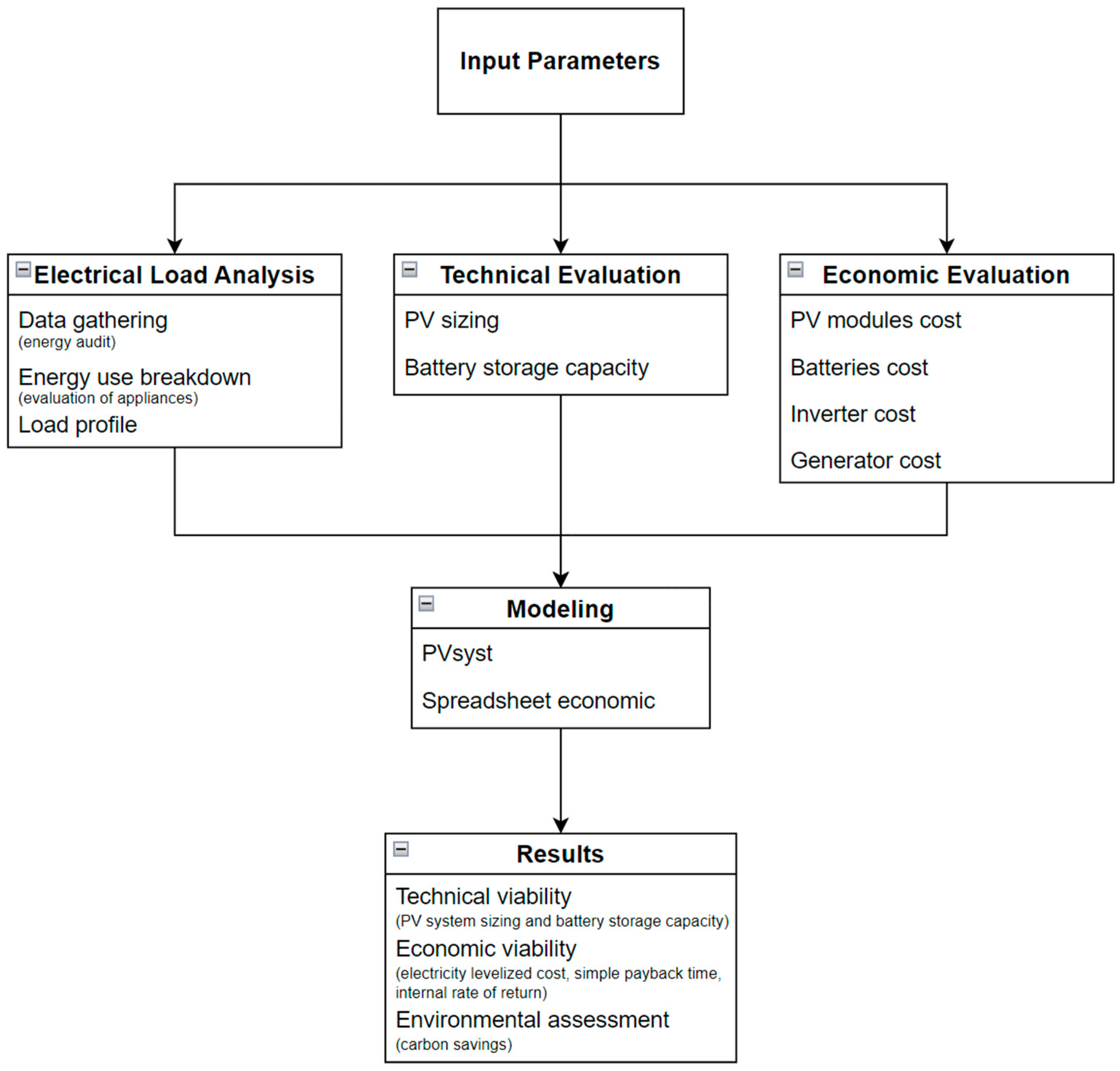
The procedure for performing the techno-economic and environmental assessment is shown in Figure 1. The process involves conducting an energy audit at the supermarkets to determine their daily electrical load demand, followed by the design of a solar photovoltaic technical system to meet the daily load demand, then assessing the economic and environmental viability of the designed system [30].
Figure 1.
Techno-economic procedures for the solar PV system [31].
Figure 1.
Techno-economic procedures for the solar PV system [31].
2.1. Load Profile Analysis
This load profile analysis focused on conducting an energy audit at different supermarkets in PH City. The analysis only considered supermarkets that provided complete data based on the data gathering sheet. The load assessment involved data gathering using a survey on the electrical appliances used in the supermarket, conducting a power use breakdown of each of these appliances indicating their function, wattage, and operational time in a day, and applying statistical analysis to determine the total load from each supermarket. The power rating of each of the supermarkets is shown in Table 1 based on their appliance categories. The building energy use focused on the building’s opening hours and the building-installed appliances, especially the building envelopes and HVAC system. The power consumption of the appliance category for every supermarket was determined by adding the power rating of the total appliances in that category. The power use breakdown of each of the supermarkets was determined according to the following appliance shown in Table 1, and Figure 2 depicts the overall average contribution of each appliance to the various supermarkets considered. The total power consumed by each supermarket was calculated by summing the wattage of each appliance category for a given supermarket. The supermarket with the highest power rating (Market Square) was selected for the case study.

Table 1.
Power ratings of the supermarkets in PH City.
| Appliance Category | Next Time supermarket | Chanrais Supermarket | Welcome You Supermarket | Livinchin Supermarket | Market Square | Everyday Supermarket | Nextime Supermarket |
| Refrigeration (W) | 25,650 | 23,050 | 25,450 | 18,025 | 27,050 | 35,425 | 26,800 |
| Lighting (W) | 3,520 | 4,800 | 6,720 | 7,200 | 4,960 | 6,036 | 8,000 |
| Air Conditioning (W) | 12,000 | 9,143 | 4,644 | 5,500 | 22,500 | 7,815 | 9,800 |
| Cooking (W) | 1,782 | 1,782 | 1,782 | 1,782 | 1,782 | 1,782 | 1,782 |
| Water Heating (W) | 1,100 | 1,100 | 1,100 | 1,100 | 1,100 | 1,100 | 1,100 |
| ICT (W) | 2,016 | 2,174 | 4,644 | 1,816 | 2,374 | 3,032 | 4,290 |
| Total (kW) | 46.1 | 42.1 | 44.3 | 35.4 | 59.8 | 55.2 | 50.1 |
Figure 2.
Peak power demand of each supermarket in PH city with the contribution of different appliances.
Figure 2.
Peak power demand of each supermarket in PH city with the contribution of different appliances.
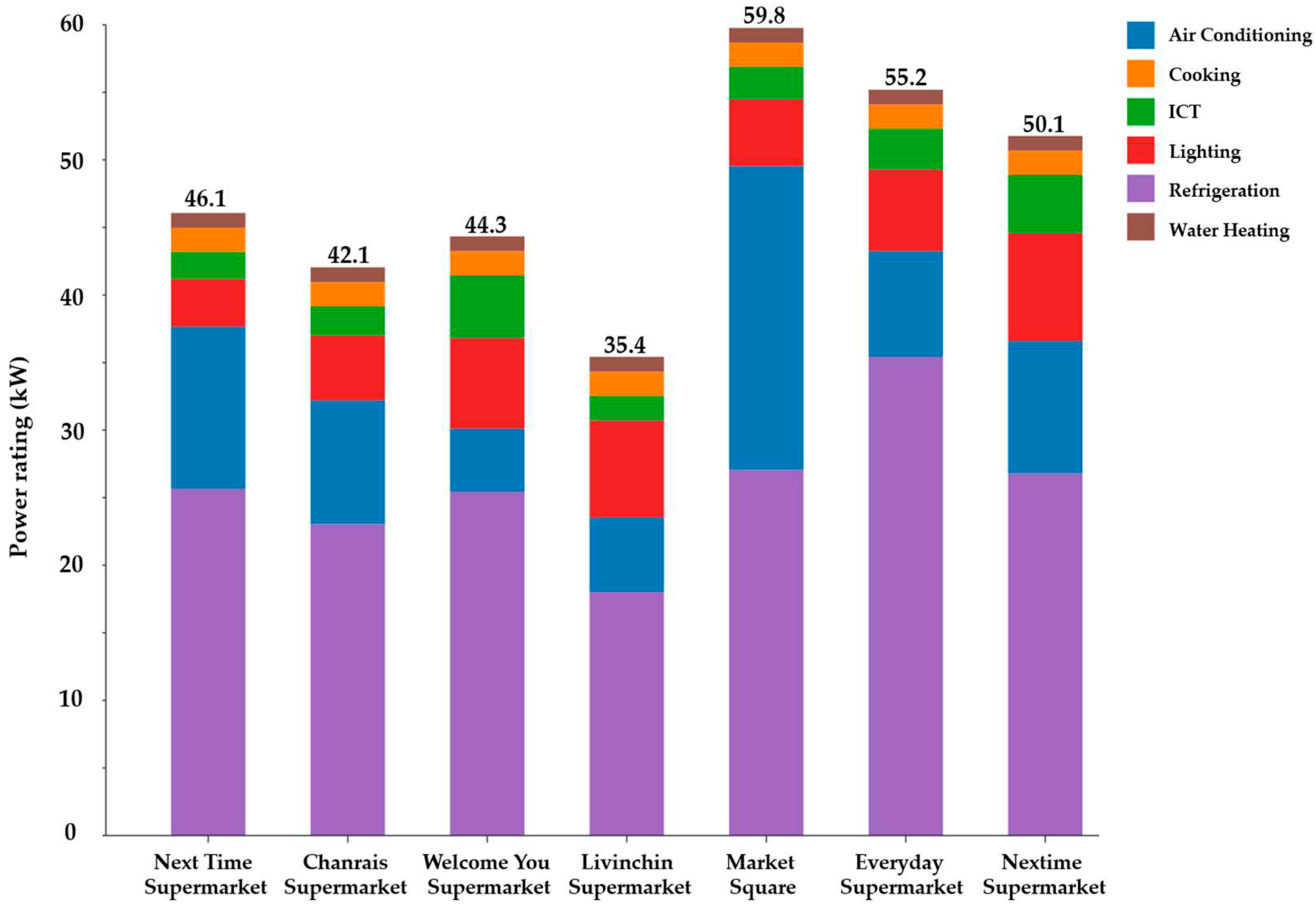
From Table 1 and Figure 2, Market Square had the highest power rating among the seven supermarkets analyzed in the study and was used as the case study for the techno-economic analysis. It had a daily peak load of 59.8 kW. It also shows that air conditioning is the highest contributor to the overall energy requirement of the building.
Total Energy Demand (TED) = ∑ E
Where E is the sum of the energy from each of the appliances in Table 2.
Table 2.
Electrical load of Market Square Supermarket.
| Appliance | Rating (W) | Quantity | Total Power Rating (kW) | Daily Usage (h/day) | Energy (E) (kWh/day) |
|---|---|---|---|---|---|
| Refrigeration – back freezer | 1125 | 2 | 2.25 | 24 | 54.0 |
| Refrigeration – back cooler | 1100 | 2 | 2.20 | 24 | 52.8 |
| Refrigeration – store freezer closed | 1100 | 8 | 8.80 | 2 | 35.2 |
| Refrigeration – store freezer open | 1300 | 3 | 3.90 | 2 | 15.6 |
| Refrigeration – store cooler closed | 1100 | 9 | 9.90 | 2 | 39.6 |
| Lighting – Fluorescent | 32 | 155 | 4.96 | 12 | 59.8 |
| Air Conditioning | 22,500 | 22,500 | 12 | 270 | |
| Cooking machine | 1782 | 1.78 | 2 | 3.6 | |
| Water Heater | 1100 | 1.10 | 2 | 2.2 | |
| ICT – ATM Machine | 700 | 1 | 0.70 | 12 | 8.4 |
| ICT – Computer, Printer | 158 | 3 | 0.47 | 12 | 5.7 |
| ICT – Register | 200 | 6 | 1.20 | 12 | 14.4 |
| TOTAL | 59.8 | 561 |
From Equation 1 [32], the supermarket’s daily total energy demand was 561 kWh/day, as shown in Table 2.
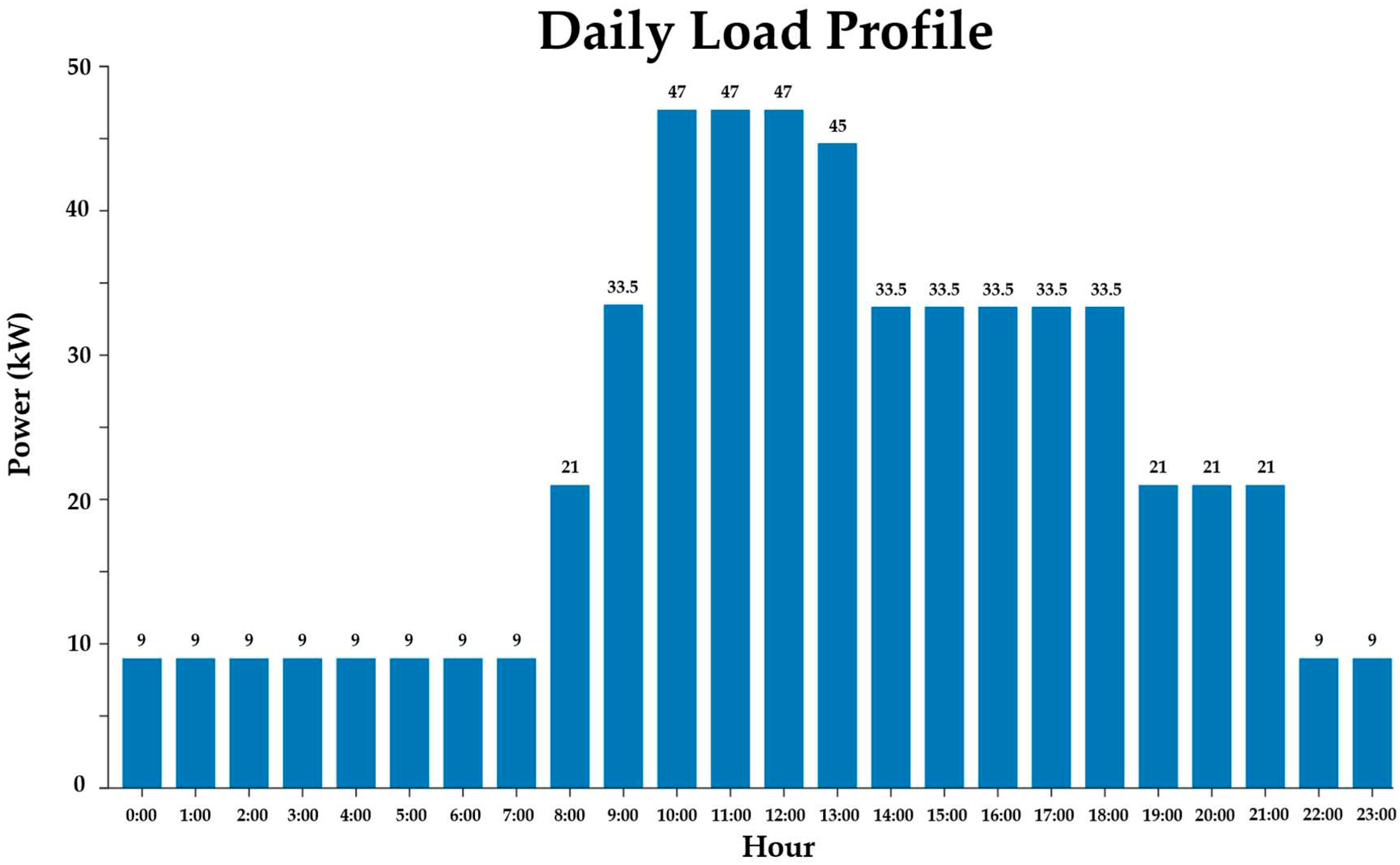
Using the PVsyst software, detailed user requirements and an hourly distribution model have been defined over the course of a year. The hour distribution was derived from imputing the required load demand in the supermarket at every hour in the PVsyst software. Table 3 demonstrates that the supermarket’s daily load demand of 561 kWh/m2/day remains constant throughout the year. The simulation and analysis employed these parameters. Because the supermarket is closed between 11 p.m. and 8 a.m. and many appliances are turned off, Figure 3 demonstrates that the load is at a minimum, constant level due to refrigeration. When the supermarket opens at 9 a.m., the load demand increases as many devices are turned on. The hourly distribution reveals that the peak load occurs between 10 a.m. and 1 p.m., typically during lunch breaks, and gradually decreases as the day progresses. This pattern is consistent throughout the week, with weekend demand slightly higher. It is crucial for supermarkets to manage their energy consumption during peak hours to avoid possible power outages.
Table 3.
Daily User’s needs defined in PVsyst.
| Daily household consumers, constant over the year, average = 561 kWh/day | ||||
|---|---|---|---|---|
| Annual values | ||||
| Nb. | Power (W) | Use (hr/day) | Energy (Wh/day) | |
| Lamps (LED or flu) | 155 | 32/lamp | 12 | 59,520 |
| ICT | 30 | 80/app | 12 | 28,800 |
| Coolers Open/Closed | 20 | 1,130/app | 2 | 45,200 |
| Fridge/Deep-freeze | 2 | 24 | 151,699 | |
| Air Conditioning | 1 | 22,500 tot | 12 | 270,000 |
| Water Heating/Cooking | 1 | 2,882 tot | 2 | 5,764 |
| Standby-by consumers | 24 | 24 | ||
| Total daily energy | 561,007 | |||
Figure 3.
Daily hourly distribution of load defined in PVsyst.
2.2. Solar Resources Assessment
The solar resources assessment was carried out using the U.S. National Aeronautics and Space Administration (NASA) Metrology database [33] and the Global Solar Atlas [8]. These databases have been fully integrated into the PVsyst software. According to NASA, the average daily horizontal solar irradiation (Hc) on a plane of array (POA) in PH city was 4.21 kWh/m2/day, with an average ambient temperature of 25.3°C. Table 4 shows the solar irradiance and temperature of the site, and these resource assessments were retrieved from the PVsyst energy modeling software. To ensure sufficient solar energy availability throughout the year, the baseline system was designed using data from July, the month with the lowest daily horizontal solar irradiance of 3.24 kWh/m2/day.
Table 4.
PVsyst average monthly solar irradiance and temperature of PH city from PVsyst.
| Month | Global Irradiance - Hc (kWh/m2/day) | Temperature (oC) |
|---|---|---|
| January | 5.20 | 25.7 |
| February | 5.24 | 26.0 |
| March | 4.80 | 26.1 |
| April | 4.60 | 26.2 |
| May | 4.23 | 26.0 |
| June | 3.54 | 25.3 |
| July | 3.24 | 24.6 |
| August | 3.42 | 24.3 |
| September | 3.43 | 24.5 |
| October | 3.68 | 24.8 |
| November | 4.21 | 25.1 |
| December | 4.95 | 25.4 |
| Average | 4.21 | 25.3 |
2.3. PV System Architecture
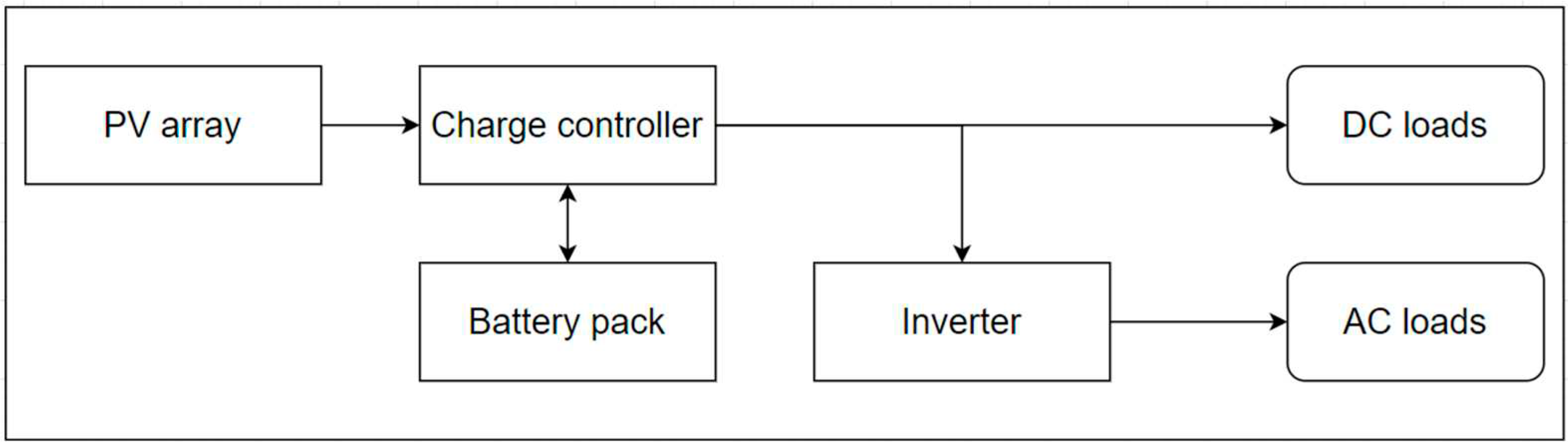
According to the design architecture depicted in Figure 4, as the sun’s energy strikes the PV solar cells, it creates electricity. This electricity is then managed by a maximum power point tracking charge controller, which regulates the current and voltage that flows out of the PV array [34]. When the PV system fails to produce electricity or energy demand increases, the battery system acts as a backup energy storage system to ensure reliable performance [35]. An inverter (DC/AC) converts direct current to alternating current from the PV array and batteries to meet the load demand.
Figure 4.
Standalone PV system configuration.
2.4. Sizing of PV components
The components specified in the PV system architecture in Figure 3 are sized based on the load demand of the case study location.
2.4.1. PV Array Capacity (PAC) Sizing
The PV array capacity is determined by the average solar radiation available at the design location, which requires daily energy demand, and derating factors because of losses due to wiring, dust particles, and other environmental factors. This ensures a margin of safety between PV module limits and applied stresses. The PAC can be determined from Equation 2.
Where Edaily is the daily energy consumption, fd is the derating factor assumed, and Sh (also known as peak sunshine hour) is the number of hours the sun must shine at its peak (1000 W/m2) to deliver the same amount of energy received throughout the day [36]. The system derating factor is estimated to be 75% - 85% [37]. The peak sunshine hour can be determined using Equation 3 and the number of modules required by the system can be determined using Equation 4.
Where Hc is the daily horizontal solar irradiation on a plane of array (POA).
Where N(mod) is the total number of modules required, and Pmod (rated) is the rated capacity of one module [36]
2.4.2. Inverter Sizing
The inverter helps convert the DC current from the PV cells to AC current to be delivered to the load. The inverter size can be determined by dividing the direct current (DC) of the PV array by the inverter’s maximum alternating current (AC). The inverter rating must fulfill Equation 5 [38].
Where 1.25 is a safety factor.
2.4.3. Battery Bank Capacity
The battery storage acts as a backup for energy storage, supplying power when the PV system is not available. The size of the battery size was determined using Equation 6.
To size the battery bank, the following data are needed; daily electricity consumption Edaily (kWh), battery efficiency (Beff), battery nominal voltage Vbat, depth of discharge (DOD), number of days of autonomy (DA), design margin (DM), where 10% of the energy has been taken as the margin of safety [36]. DA determines how long the battery will be available to meet the load demand, however, the longer the DA, the more battery will be required by the system. It is a function of the desired level of availability and site solar radiation. DOD determines the life output of the battery; Tc helps to regulate the temperature of the battery to improve its performance; the DM, which is also known as the safety factor, accounts for sudden changes in electrical load requirements.
2.4.4. Charge Controller Sizing
In a battery-based system, the charge controller attached to the PV array must be large enough to manage all the power produced by the array [39]. The capacity of the maximum power-pointing tracking (MPPT) charge controller was calculated using Equation 7 and Equation 8.
Where Vc-volt is the MPPT maximum output voltage, 1.10 is the safety factor, Nmod/s is the number of modules per string, and Voc is the open-circuit voltage of each module. Ic-input is the minimum charge controller input current, Isc is the short circuit current, 1.25 is the safety factor, and Nstrings is the total number of strings [40]. The MPPT’s are usually rated by their output voltage and current capacity.
2.5. Economic Analysis
The economic assessment considered the following indicators include life cycle cost, simple payback time, levelized cost of electricity, internal rate of return, and carbon savings energy model [31,41,42].
2.5.1. Life cycle cost (LCC)
The overall cost across its life cycle, including startup capital, maintenance, operating, and the asset’s resale value at the end of its life, is calculated using the life cycle cost (LCC) method. The price includes the PV array, storage batteries, charge controller, inverters, and operation and maintenance. Below is how they were determined.
- PV Cost, CPV = PV unit cost × number of modules.
- Battery Cost, CB = Unit cost of battery × Number of batteries.
- Charge Controller Cost, CCC = Unit cost of a charge controller.
- Inverter Cost, CINV = Unit Price of Inverter size.
- Cost of Installation was assumed to be 10% of the PV array’s initial cost.
- Operation and maintenance (O&M) cost was assumed to be 5% of the initial investment cost.
The installation cost assumption of 10% of the PV array’s initial cost and the O&M cost deduction of 5% of the initial investment were based on interactions with PV system installation companies in Port Harcourt and a lack of cohesive empirical data regarding the installation and operation of the system in the city. These assumptions were made to estimate the installation and O&M costs of the PV system in Port Harcourt. However, it is essential to note that these numbers can vary based on factors such as project scale, location, and specific needs. Additional research and data collection are necessary to ascertain the actual costs associated with the installation and operation of a PV system in the city.
2.5.2. Net Present Value (NPV)
The net present value determines the current worth of all future cash flows generated by a project, including the initial capital expenditure. It is the present value of all future cash flows discounted at the rate of interest [43]. The NPV can be determined from Equation 9 and Equation 10.
Where is the energy generated, r is the interest rate, Unit Cost is the tariff rate, is the operation and maintenance cost, is the cost of replacement, and n is the discounted cash flow year.
2.5.3. Simple Payback Time (SPBT)
The payback period is the length of time required to repay the cost of an investment. SPBT can be determined from Equation 11.
Shorter payback times indicate more attractive investments, while more extended payback periods indicate less desired assets [44].
2.5.4. Levelized cost of electricity (LCOE)
The LCOE is used to determine the project’s lifetime energy cost. It is a function of the life cycle cost of the project and the energy generated over its lifetime. The LCOE enables comparison with other energy resources. The LCOE can be determined from Equation 12.
The Levelized Cost of electricity estimates a producing plant’s average net present price of electricity generation during its lifespan [45].
2.5.5. Internal Rate of Return (IRR)
The internal rate of return (IRR) is the project’s yearly rate of growth from an investment. IRR is calculated such that NPV is set t zero. IRR was calculated using Equation 13.
2.6. Environmental Assessment (Carbon Savings)
The carbon savings were calculated using the Tier 1 International Panel on Climate Change (IPCC GHG Emission Guideline, 2006) method of computing carbon footprint where the emission factor is country specific (these guidelines were refined in 2019). This additional model assists in calculating the yearly decrease in greenhouse gas emissions caused by utilizing the suggested technology (diesel generator) emission factor [46,47]. The carbon savings could be determined using Equation 14.
Where is the projected annual energy generated (kWh), is the carbon dioxide (CO2) emission factor of diesel fuel in the country (kg/kWh), and t is the project lifetime.
2.7. Existing and Proposed Energy Generation Systems
This section covers the existing diesel generator system at the supermarket and the proposed solar PV system with battery design. In addition, the economic input parameters for the systems.
2.7.1. Existing Diesel Generator System at the Supermarket
A 100-kW diesel generator was currently meeting this TED [48]. The characteristics of this diesel generator are shown in Table 5.
Table 5.
Characteristics of the diesel generator.
| Parameters | Value | Unit | Comment/Reference |
|---|---|---|---|
| Capacity Rating | 100 | kW | Mantrac CAT |
| Nameplate Efficiency | 30 | % | Mantrac CAT |
| Lifetime | 5 | Year’s | Mantrac CAT |
| Heating Rate | 10285.7 | KJ/kWh | Mantrac CAT |
| Diesel Fuel Cost | 0.673 | $/Litre | PowerGen Eng. |
| Diesel Fuel Consumption Rate | 0.4 | Liter/kWh | PowerGen Eng. |
| Daily Energy Demand | 561 | kWh/day | TED |
In Nigeria, minor services on a diesel generator usually cost 41,115 naira (US $100) [49,50]. The current market price of a liter of diesel in Nigeria is N277.83 ($0.673) [51]. The study used the current cost of diesel fuel, which is $0.673 per liter. A general rule of thumb states that a diesel generator uses 0.4 liters of diesel per kWh produced [51]. The cost value of all gathered data was in Nigerian naira and converted to US dollars at the rate of 1 USD to NGN 411.15 [50]. The exchange rate used in the Xe platform US dollar rate values at the end of 2022. However, the Nigerian economy is unstable and the rate exchange rate changes frequently. A typical diesel engine can run for 30,000 hours or more [52]. According to the diesel fuel consumption rate of 0.4 kWh/litre and daily energy demand shown in Table 5, the generator system will require a minimum of 224.4 liters of diesel per day to generate the 561 kWh daily load demand.
Table 6 shows the operation and maintenance cost of the diesel generator. As discussed in the Introduction, the cost of diesel is expected to increase due to the Nigerian Government’s removal of fuel subsidies. As a result, the operational cost for diesel generators will increase [9].
Table 6.
Operation and Maintenance Cost for Diesel Generator.
| Maintenance | Intervals (hours) | Cost - $ | Number of times/years | Total cost/year - $ |
| Short Service | 250 | 100 | 36 | 3600 |
| Operational | Diesel Cost ($/Liter) | Diesel/day | Days/Year | Diesel cost/Year-$ |
| 0.673 | 222.4 | 365 | 55,123 |
2.7.2. Proposed Solar PV System
We propose replacing the diesel generator with a standalone solar PV system with battery storage. The PVsyst software was utilized to evaluate the PV system using a Jinko solar panel. The panel specifications are depicted in Table 7.
Table 7.
Panel Characteristics (Jinko JKM 585M-7RL4-V).
| Characteristics | Value | Unit |
|---|---|---|
| STC Power Rating | 585 | Watt peak (Wp) |
| Maximum Current (Imp) | 13.23 | Ampere (A) |
| Maximum Voltage (Vmp) | 44.22 | Voltage (V) |
| Short Circuit Current (Isc) | 13.91 | Ampere (A) |
| Open Circuit Voltage (Voc) | 53.42 | Voltage (V) |
| Module NOCT | 45 | Degree Celsius |
| Temperature Coefficient of Power | -0.344 | %/Degree Celsius |
| Temperature Coefficient of Voc | -0.28 | %/Degree Celsius |
| Efficiency | 21.4 | % |
*STC is for standard test conditions, and NOCT is the nominal operating cell temperature.
To ensure that sufficient energy was available at all times of the year, the baseline system was designed using the month with the lowest daily horizontal solar irradiance Table 2 of 3.24 kWh/m2/day in July [8,33].
The technical parameters of the standalone solar PV system were determined using Equation 1 to Equation 14. The results of the PV system design are shown in Table 8. The design parameters are used as inputs for the system modeling in PVsyst software.
Table 8.
Solar PV system design.
| Parameter | Value | Unit | Remarks/Reference | |
|---|---|---|---|---|
| Load Profile | Daily Energy Demand | 561 | kWh/day | Minimum daily energy required at the supermarket |
| PV Array | PV capacity | 231 | kW | Calculated capacity |
| PV lifetime | 25 | Year’s | Typical PV system lifecycle | |
| Array Type | Roof Mount | n/a | Authors assumption | |
| Array Tilt Angle | 5 | Degree | Latitude at the site | |
| Orientation | Due South | n/a | The site is in the northern hemisphere | |
| Charge Controller (MPPT) | Nominal power | 294.4 | kW | Universal MPPT 60V controller |
| Maximum discharge current | 3089 | A | Current from the module at STC | |
| Array Voltage | 679 | V | Maximum array voltage | |
| 3-Phase Hybrid Inverter | Rated Power | 80 | kW | 1.25% of the system-rated power |
| Inverter efficiency | 99 | % | PVsyst | |
| Battery System | Battery type | Lead acid | n/a | PVsyst |
| System Voltage | 60 | V | PVsyst and Calculation | |
| Nominal voltage | 2 | V | Voltage of a single battery | |
| Battery capacity | 34021 | Ah | Required battery size | |
| Battery Efficiency | 85 | % | PVsyst | |
| DOD | 80 | % | PVsyst | |
| DA | 1 | Day | Authors assumption | |
| Battery life Output | 33000*0.8*1500 | Ah | PVsyst and Calculation |
**Ah Ampere hour, *V means voltage, and *kW means kilowatt-hour.
With the supermarket requiring a 561 kWh/day energy demand, we propose a 232 kW PV system with battery storage of 1 autonomy. Based on the need to replace the diesel generator because of the ever-increasing diesel price of diesel and the environmental footprint of the generator, we aim to achieve at least 99% of the energy demand. To achieve 99% of daily energy demand, the baseline system was designed with the month with the lowest irradiance. The PVsyst model general parameters and PV array characteristics are shown in Table 9 and Table 10.
Table 9.
PVsyst General Parameters.
| General Parameters | ||||
|---|---|---|---|---|
| Standalone system with batteries | ||||
| Standalone system | Shed configuration | Models used | ||
| PV Field Orientation | No 3D scene defined | Transposition | Perez | |
| Fixed plane | Diffuse | Perez_Meteonorm | ||
| Tilt/Azimuth | 5/0° | Circumsolar | separate | |
| User’s needs | ||||
| Daily household consumers | ||||
| Constant over the year | ||||
| Average | 561 kWh/Day | |||
Table 10.
PVsyst PV Array Characteristics.
| PV Array Characteristics | |||
|---|---|---|---|
| PV Module | Battery | ||
| Manufacturer | Generic | Manufacturer | Generic |
| Model | JKL585M-7RL4-V | Model | EosG 3000 |
| (Original PVsyst database) | Technology | Lead-acid, sealed, Gel | |
| Unit Nom. Power | 585 Wp | Nb. Of units | 11 in parallel * 30 in series |
| Number of PV modules | 396 units | Discharging min. SOC | 20.00% |
| Nominal (STC) | 232 kW | Stored energy | 1587.8 kWh |
| Modules | 33 strings * 12 in series | Battery Pack Characteristics | |
| At operating cond. (50°C) | Voltage | 60 V | |
| Pmpp | 211 kWp | Nominal Capacity | 33000 Ah (C10) |
| Vmpp | 483 V | Temperature | Fixed 20°C |
| Impp | 437 A | ||
| Controller | Battery Management Control | ||
| Universal controller | Threshold commands as | SOC calculation | |
| Technology | MPPT converter | Charging | SOC = 0.92/0.75 |
| Temp coeff. | -5.0 mV/°C/Elem. | approx. | 68.5/62.7 V |
| Converter | Discharging | SOC = 0.20/0.45 | |
| Maxi and EURO efficiencies | 97.0/95.0% | approx. | 58.9/61.1 V |
| Total PV power | |||
| Nominal (STC) | 232 kWp | ||
| Total | 396 units | ||
| Module area | 1083 m3 | ||
As a rule of thumb, the azimuth angle of the project was set at 0 because the project is in the northern hemisphere, and the tilt angle was set to the latitude of the site, which was 5 degrees. A fixed plane orientation was set because of the size of the project, and using a tracking system will not significantly improve the energy yield of the plant, however, it will increase the cost of the project [53]. For the PVsyst model, 396 panels, each with a capacity of 585 Wp with an efficiency of 21.4 percent, were required to produce 232 kW, which is sufficient to meet the supermarket’s required peak power capacity per day. The PV models would be arranged into 33 parallel strings, each of which will include 12 series panels.
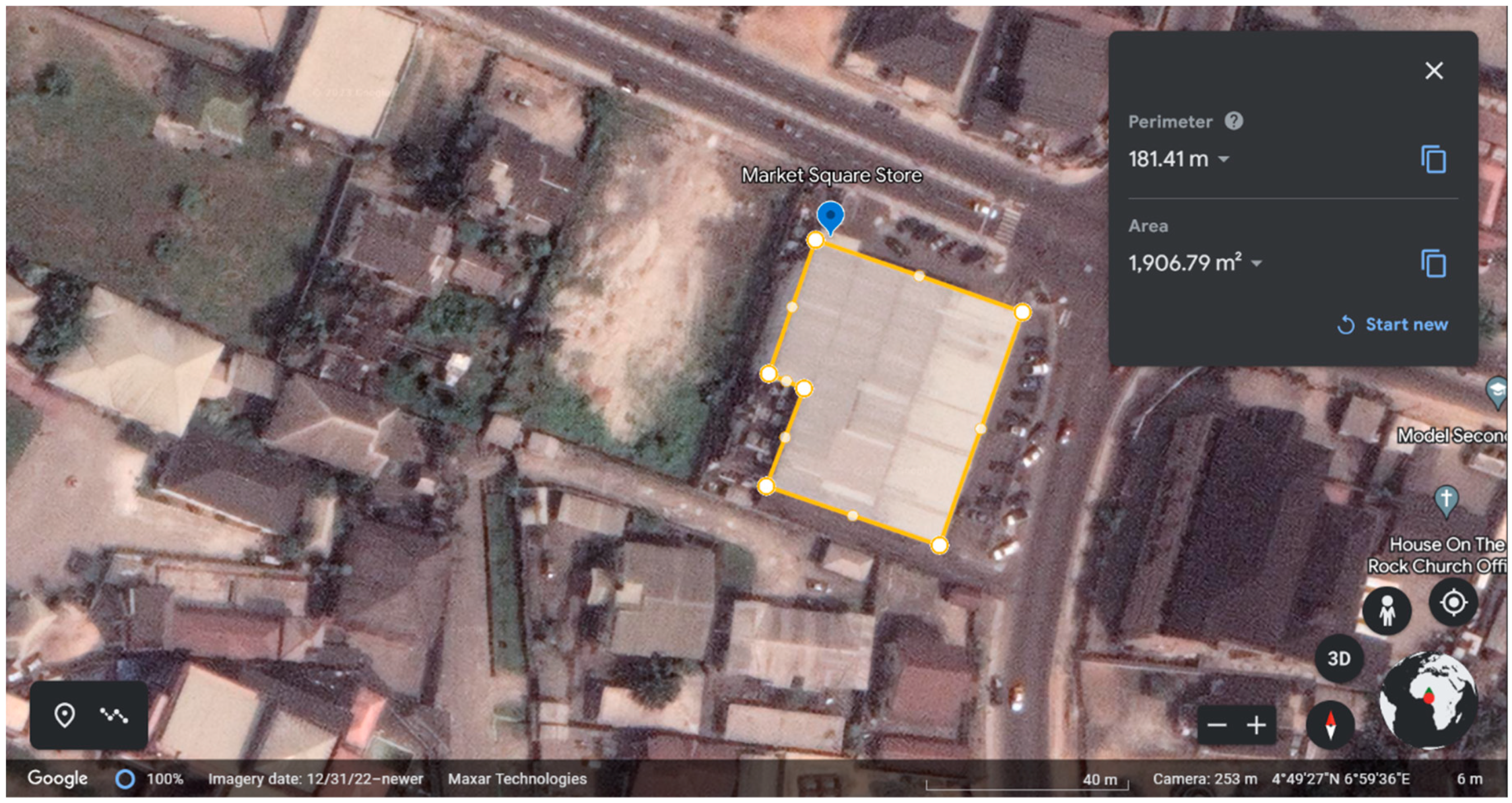
The battery capacity was calculated to be 34,021 Ah with a one-day autonomy. The one-day autonomy will allow the battery system to provide the required energy to meet the supermarket load demand for up to a day when the PV system is not available, which is the number of days the battery is expected to last without recharging itself. The battery system had an 80 percent depth of discharge with 1588 kWh stored energy. The system required a total of 330 2V/3000Ah lead-acid battery storage connected in 11 parallel – 30 series configurations, having a nominal capacity of 3300 Ah, which was slightly lower than the calculated battery capacity. The difference is due to PVsyst software optimization of the size of the battery to meet the one-day required autonomy. The charge controller’s nominal current was ascertained to be more than or equal to the total load Imp current of 437 A, and the Vmp output system voltage was determined to be 483 V. A 60V/560VDC with a maximum array voltage of 679 V Maximum power point tracking (MPPT) was selected and used for the study. This shows that MPPT is large enough to handle the maximum current and voltage provided by the PV array. The study used a 60 V off-grid inverter to provide a minimum of 75 kW and a maximum of 80 kW of pure sine wave power, thereby meeting the condition of 1.25 percent larger than the total power of all appliances of 59.8 kW. The PVsyst software does not allow you to select an inverter for an off-grid system, but the system was sized with the surge power in mind. The panels will be installed on the roof of the Market Square supermarket, shown in Figure 5. The supermarket has enough area space to accommodate the required PV panels. The panels will be mounted in fixed frames because roof-mounted panels are more sensitive to shade.
Figure 5.
Satellite image of Market Square in New GRA, Port Harcourt, Nigeria.
2.7.3. Existing and Proposed System Economic Assessment Parameters
This section covers the economic analysis of the existing energy generation system at the supermarket and the proposed solar PV system based on different indicators stipulated in section 2.5. Equations (8,9,10,11,12) and the input parameters shown in Table 11 and Table 12, were used to design the financial model to determine the economic indicator in Section 2.5.
Table 11.
Existing system input parameters (100-kW Diesel Generator).
| Parameters | Values | Units | Comments |
|---|---|---|---|
| Generator (Gen) cost | 53000 | $/Unit | Mantrac CAT/Nigerian Market |
| Discount rate | 11.5 | % | Central Bank of Nigeria rates |
| Tariff rate | 0.2692 | $ | At the rate of 0.4 liters/kWh |
| Installation Cost | 10 | % | 10% of the cost of the generator |
| O&M cost | 10 | % | 10% of the total initial investment |
| Gen Repl. cost | 58300 | $/Unit | Cost of generator and installation |
*O&M is operation and maintenance, Repl. is replacement, $ for USD. *Instead of a significant overhaul, the analysis anticipated replacing the diesel generator after 35,000 hours or five (5) years, whichever comes first.
Table 12.
Proposed solar PV input parameters.
| Parameters | Values | Units | Comments |
|---|---|---|---|
| Discount rate | 11.5 | % | Central Bank of Nigeria rate |
| Tariff rate | 0.094 | $ | Grid Tariff in Nigeria |
| Panel cost | 105.3 | $/Unit | Alibaba [54] |
| Battery cost | 300 | $/Unit | Alibaba [55] |
| Inverter cost | 6985 | $/Unit | Alibaba [56] |
| Charge Controller Cost | 202 | $/Unit | Alibaba [57] |
| Installation Cost | 10 | % | 10% of the total PV cost (Assumption) |
| O&M cost | 5 | % | 5% of the total initial investment cost |
*$ for USD, O&M is operations and maintenance. Wp is watt peak, Amp is ampere, kW is kilowatt, and kWh is kilowatt hour. *The inverter and batteries are assumed to be replaced after 15 years.
4. Results and Discussion
The result for the designed off-grid PV system shown in Table 13 and Figure 6 (Top) indicates that the system generates 308,736 kWh/year of available energy, more than enough to meet 100% of the 204,756 kWh/year electrical load of the supermarket at 99% solar fraction and an annual performance ratio (PR) of 56.4%. However, the system only delivered 202467 kWh/year of useful energy to the user; of this amount, 96,678 kWh was delivered from the PV to the user, and 105,789 kWh was delivered to the user after storage in the battery, with missing energy (i.e., unmet load demand) of 2299 kWh/year. The inability of the system to supply the entire available solar energy was the result of losses in the system.
Figure 6.
(Top) PVsyst Simulation Results (Bottom) Nominalized Production and Systems Losses from PVsyst [26].
Figure 6.
(Top) PVsyst Simulation Results (Bottom) Nominalized Production and Systems Losses from PVsyst [26].
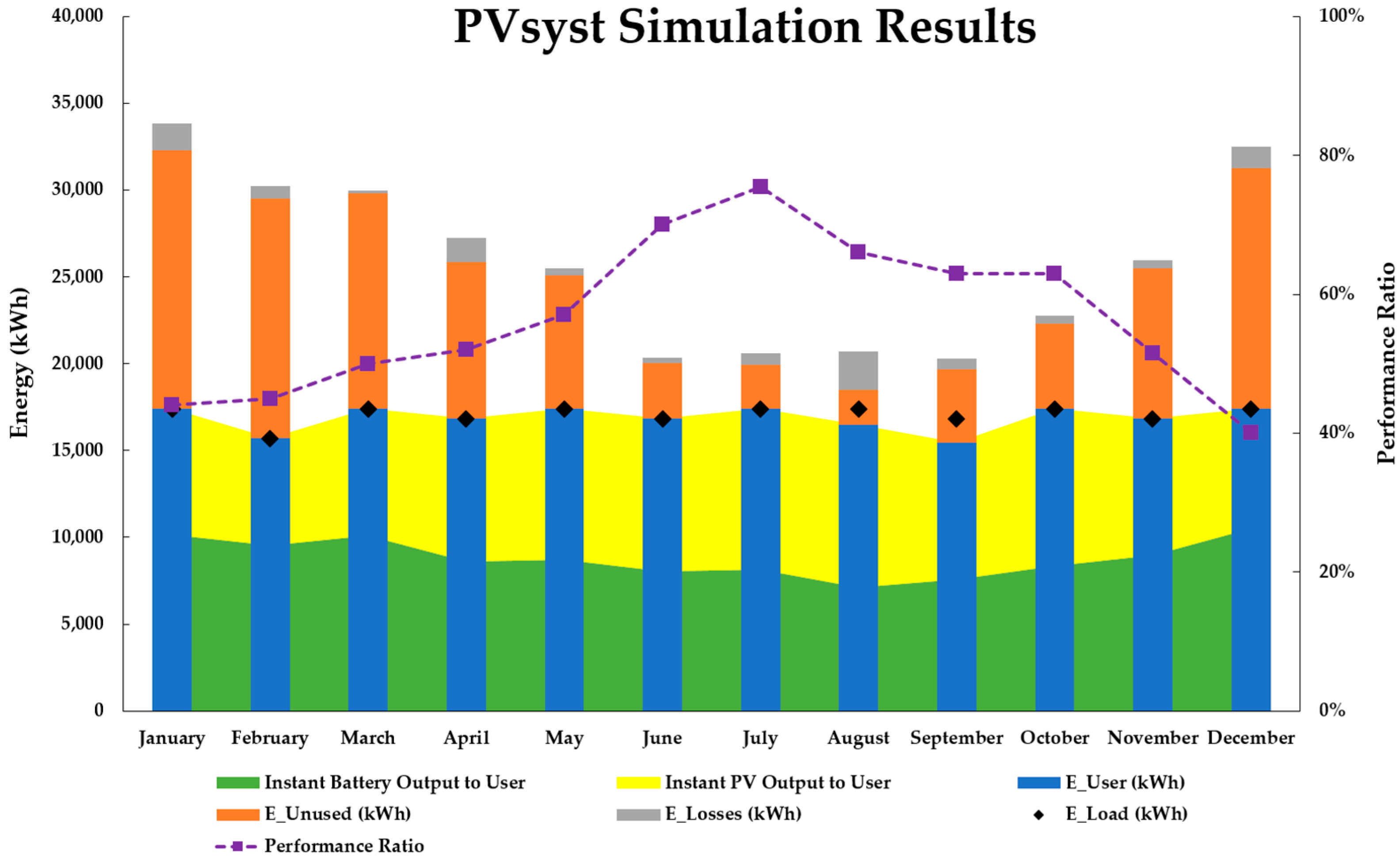
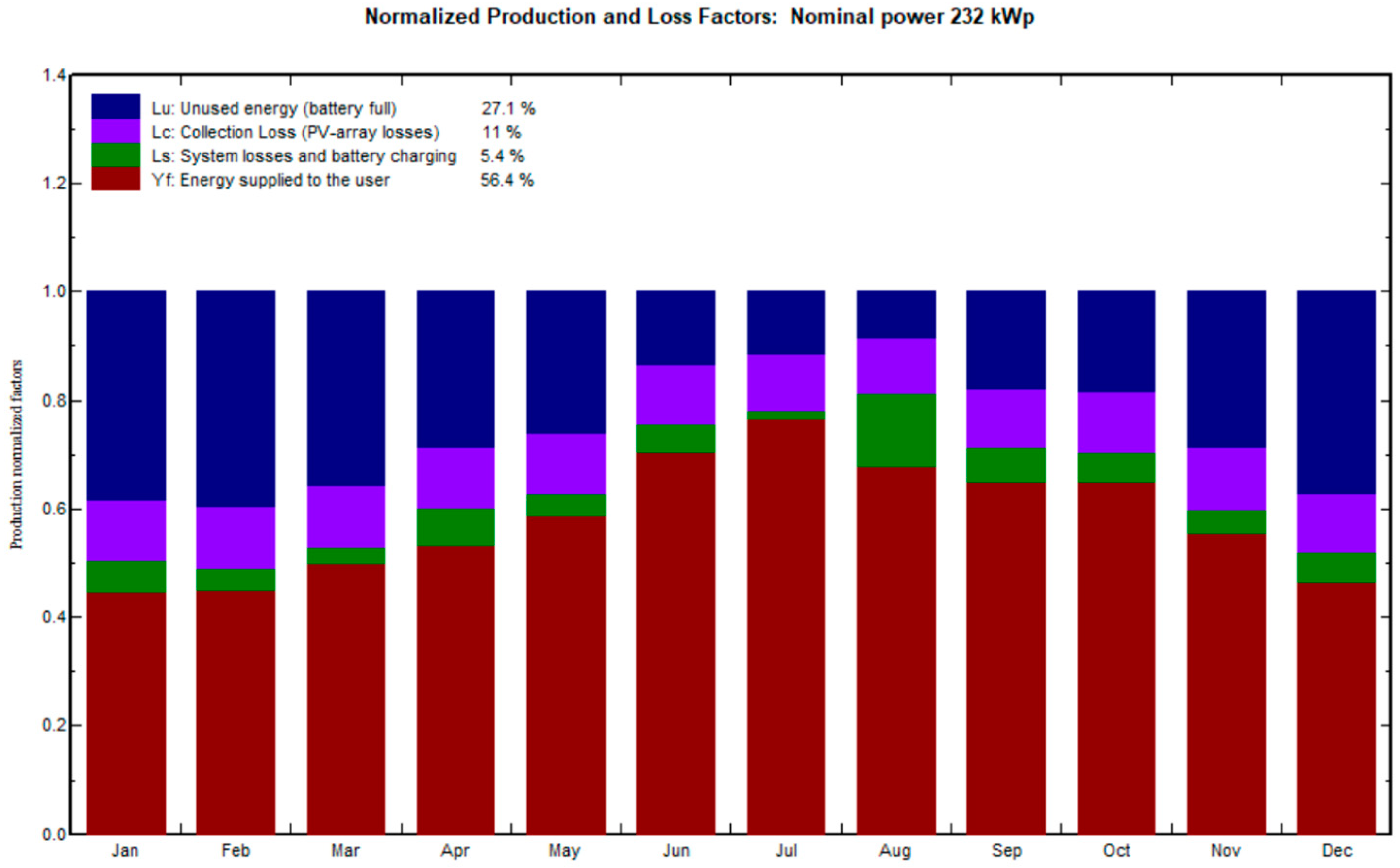
Table 13.
PVsyst Simulation Result.
| Month | E_Available (kWh) | E_User (kWh) | E_Unused (kWh) | E_Losses (kWh) | E_Missing (kWh) | Instant Energy from Battery to User (kWh) | Instant Energy from PV to User (kWh) |
|---|---|---|---|---|---|---|---|
| January | 33,852 | 17,391 | 14,884 | 1,577 | 0 | 10,172 | 7,219 |
| February | 30,233 | 15,708 | 13,820 | 705 | 0 | 9,513 | 6,195 |
| March | 29,995 | 17,391 | 12,434 | 170 | 0 | 10,084 | 7,307 |
| April | 27,249 | 16,830 | 9,047 | 1,372 | 0 | 8,626 | 8,204 |
| May | 25,516 | 17,391 | 7,697 | 428 | 0 | 8,691 | 8,700 |
| June | 20,371 | 16,830 | 3,210 | 331 | 0 | 8,025 | 8,805 |
| July | 19,274 | 17,391 | 2,549 | 666 | 0 | 8,159 | 9,232 |
| August | 20,714 | 16,466 | 2,049 | 1,274 | 925 | 7,132 | 9,334 |
| September | 20,318 | 15,457 | 4,226 | 739 | 1,374 | 7,593 | 7,864 |
| October | 22,744 | 17,391 | 4,887 | 466 | 0 | 8,348 | 9,043 |
| November | 25,955 | 16,830 | 8,688 | 437 | 0 | 8,967 | 7,863 |
| December | 32,517 | 17,391 | 13,890 | 1,236 | 0 | 10,522 | 6,869 |
| Year (kWh/yr.) | 308,738 | 202,467 | 97,381 | 6,591 | 2,299 | 105,789 | 96,678 |
*E_Available stands for available solar energy, *E_User stands for energy supplied to the user, *E_Unused stands for unused energy (battery full), *E_Loss stands for PV-array, system, and battery losses, *E_Missing stands for the energy required by the user, but not unavailable, *Instant battery Output to User is the instantaneous monthly energy coming direct from the battery to the user, *Instant PV Output to User is the instantaneous monthly energy directly from the PV to the user.
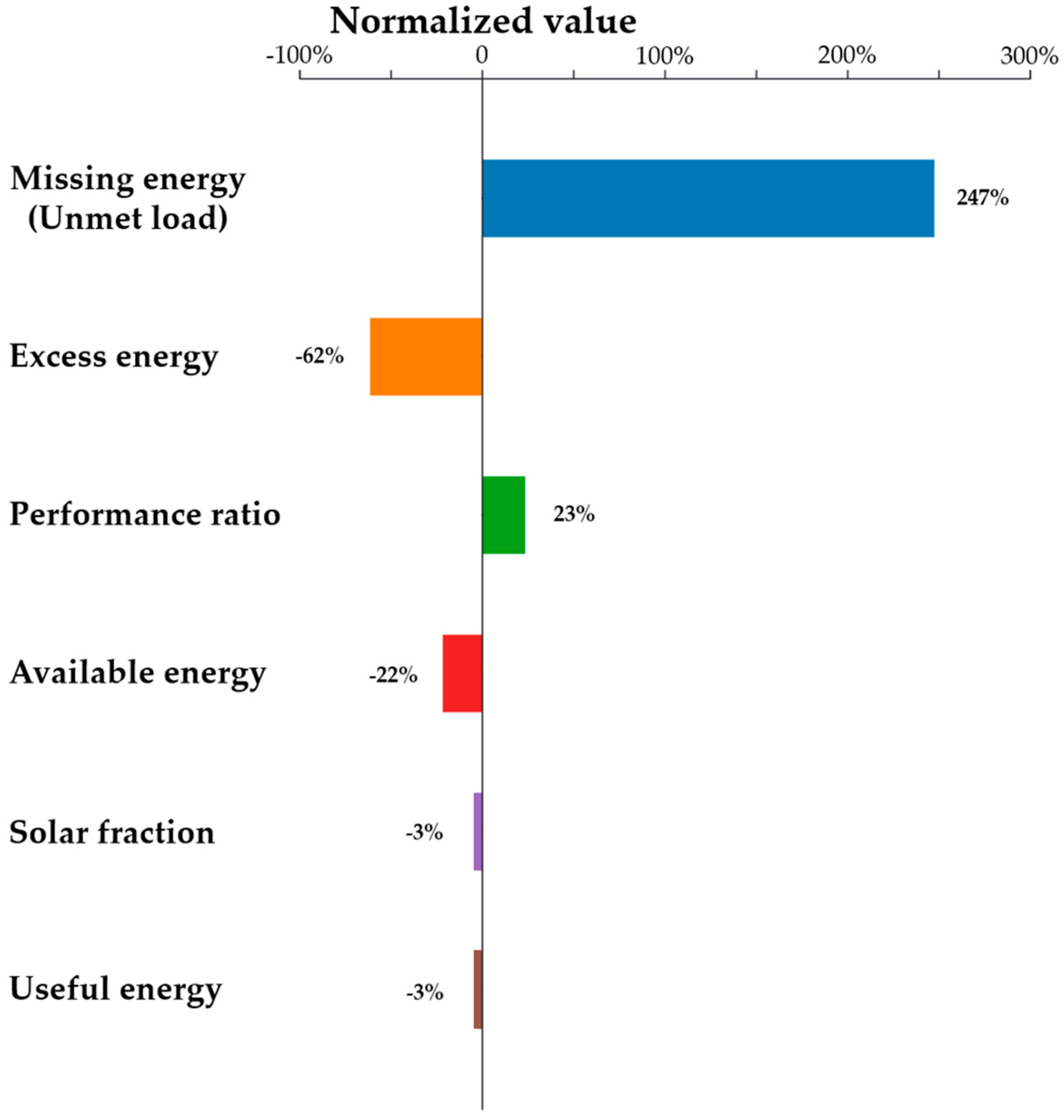
Figure 6 (Bottom) illustrates the PV system’s normalized production and system losses. At 100% of the PV system’s total energy output, the user received 56.4% of the total energy available; 27.1% of the energy was stored in the battery and remained unused at battery full capacity; 11% of the energy produced was lost at the collector (PV-array loss); and the remaining 5.5% of the energy was lost in the system and during battery discharge. These losses originate from irradiance level, temperature, module and string mismatch, converter and battery efficiencies, and wiring. Furthermore, the system yielded 97,381 kWh/year of excess (unused) energy, affecting the system’s PR negatively. The low annual PR was caused by using the month with the minimum peak sunshine hours as the design point to ensure that enough energy was available throughout the year. To improve the performance ratio measures such as optimizing the system design and upgrading components were considered. This unused energy from the baseline system design could be sold back to the grid for additional revenue, which in turn improves the overall PR of the baseline system. As shown in Figure 7 and Table 14, it was observed through sensitivity analysis that by using the average peak sunshine hour of the global irradiance to model the system, the available energy was reduced by 22%, the excess energy produced was reduced by over 62%; the PR increased by 23%, the missing energy in this case also increased by 247%, the solar fraction and useful energy reduced by 3% respectively. Thus, even though the PR has increased, the useful energy of 196,780 kWh/year produced by the optimized system is not enough to meet the user load demand of 204,765 kWh/year. Thus, the optimized system will require a backup generator (or other methods) to provide an additional 7985 kWh/year of energy to meet user load demand.
Table 14.
Baseline and Sensitivity Analysis Results Comparison.
| Parameter/Variable | Baseline | Optimized | Unit |
| Sh | 3.21 | 4.21 | h |
| PV Capacity | 231 | 178 | kW |
| Total Panel | 395 | 304 | - |
| User Energy Need | 204,765 | 204,765 | kWh/year |
| Available Energy | 308,736 | 241,630 | kWh/year |
| Useful Energy | 202,467S | 196,780 | kWh/year |
| Excess Energy | 97,355 | 37,436 | kWh/year |
| Missing Energy | 2,299 | 7,987 | kWh/year |
| Performance Ratio | 56 | 70 | % |
| Solar Fraction | 99 | 96 | % |
Figure 7.
Percentage difference between the baseline result over the sensitivity analysis parameters.
Figure 7.
Percentage difference between the baseline result over the sensitivity analysis parameters.
Our results align with Akinsipe et al. [25], who conducted the design and economic analysis of an off-grid solar PV system in Jos, Nigeria. Their study determined that a 2.75 kW PV module and a 500 Ah battery can meet an annual load demand of 31,322 kWh. Our analysis was comparable because Jos is in northern Nigeria, where the average daily horizontal solar radiation is higher [57], and the difference in values was a result of the difference in the required load demand.
Figure 8 depicts how the operating and maintenance (O&M) rate affects the system’s LCOE. It illustrates that the LCOE will rise in direct proportion to O&M expenditures. This finding suggests a clear relationship between the O&M rate and the system’s LCOE. The rise in the cost of O&M substantially influences the system’s overall cost-effectiveness, potentially reducing the system’s financial viability.
Figure 8.
Effect of O&M on the System’s LCOE.
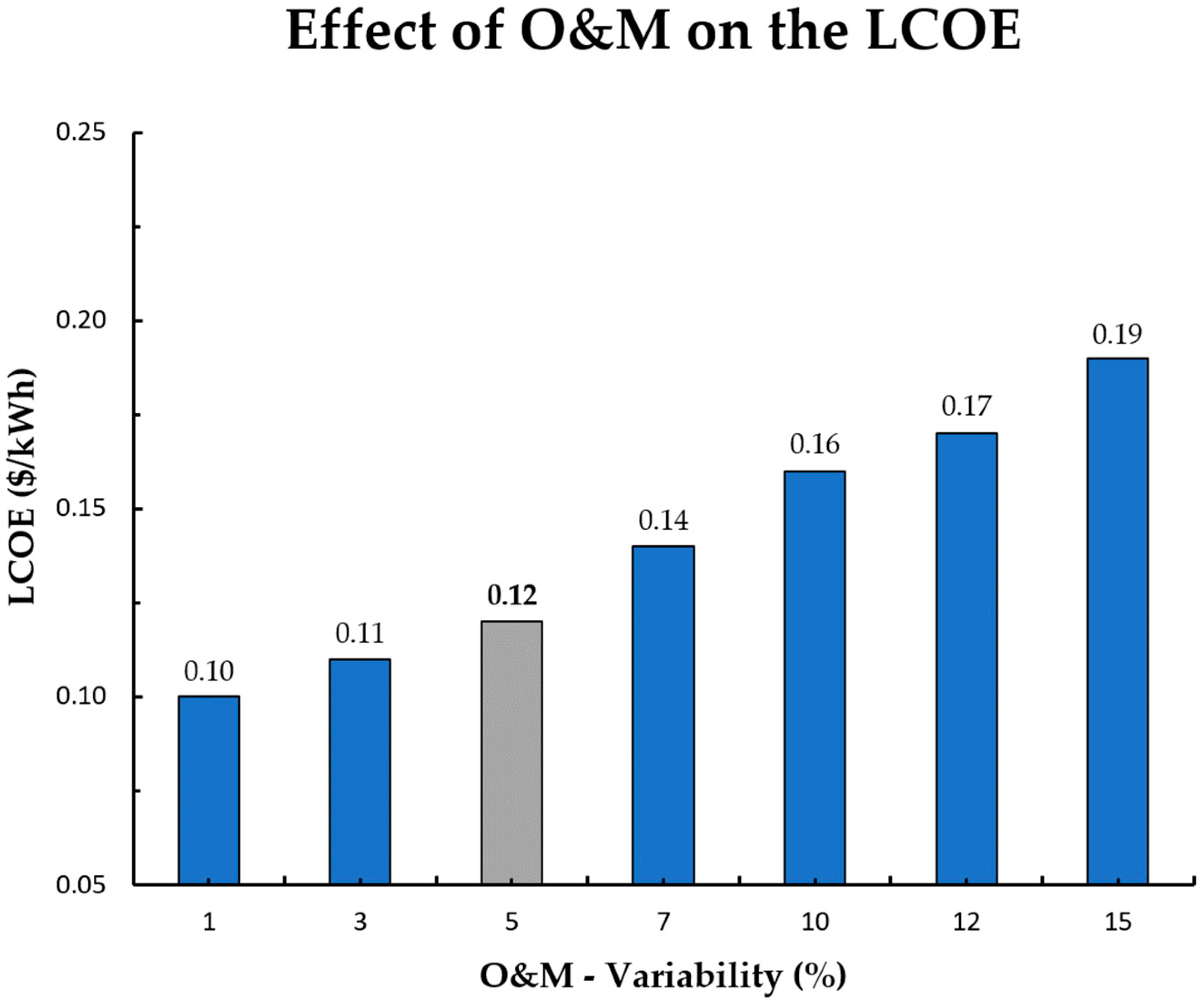
The values in Figure 8 represent the LCOE values with respect to the PV system’s baseline O&M values of 5% of the initial investment cost It further explains how the LCOE reduces when the O&M is decreased and vice versa.
The amount of energy supplied from the PV array each day changes according to seasonal variations, as shown in Figure 9. In Figure 9 (b), daily array output energy depicts that the production energy is even for most of the year as the system was sized with the month with lower horizontal solar irradiance to cover rainfall losses during the rainy season. Furthermore, the array power distribution depicted in Figure 9 (a) produced a "curve" with high quantities of power generated between 145kW and 160 kW.
Figure 9.
Solar PV system PVsyst output parameters: (a) array power distribution, (b) daily array output energy, (c) array temperature vs effective irradiance [26].
Figure 9.
Solar PV system PVsyst output parameters: (a) array power distribution, (b) daily array output energy, (c) array temperature vs effective irradiance [26].
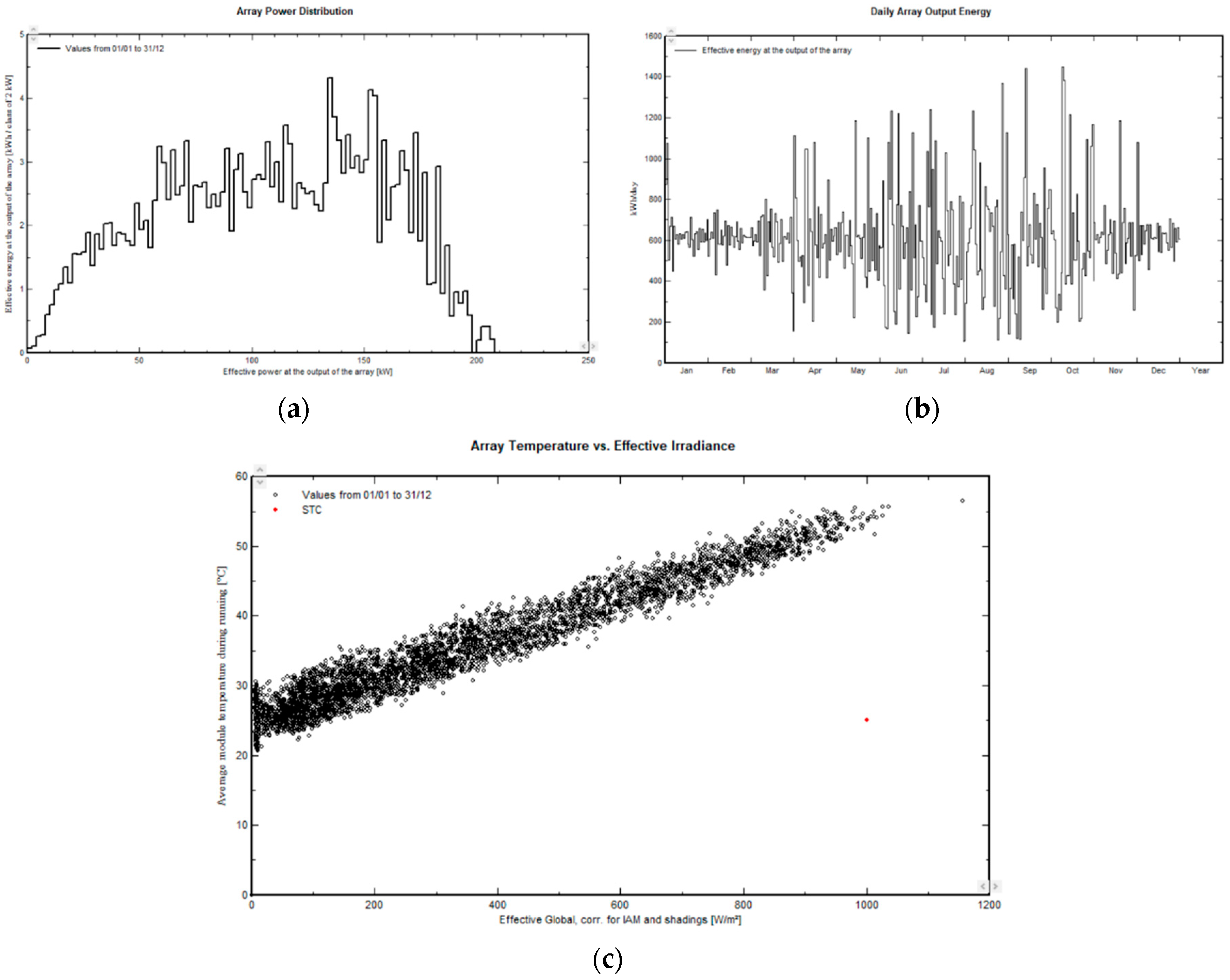
The hottest month in Port Harcourt is in April, according to Table 4, with an average temperature of 25.3°C; this impacts the working temperatures of the PV array throughout the year, as shown in Figure 9 (c). High temperatures are predicted to considerably impact the open-circuit voltage and, as a result, the amount of power that the PV array can supply. The PVsyst model resulted in no loss when the horizontal irradiation was converted to the global irradiation incidence. The temperature derating effect (hot and sunny weather) was responsible for the significant loss of 5.8 percent, with converter losses of 4.6 percent, battery roundtrip efficiency loss of 3.6 percent, and 10.6 percent unused energy losses at battery full. The incidence angle modifier (IAM) is responsible for 2.3% losses, including modules and strings mismatch losses of 2.1 percent and cable losses of 1.1 percent. Low irradiance and high STC irradiance levels result in 3.4 percent irradiance level losses. The system loss diagram is shown in Appendix (A).
Table 15 shows the economic assessment of the diesel generator and the proposed solar PV system. The PV-battery system has a higher initial investment cost of $152864, compared with the existing diesel generation at the cost of $64,130. The life cycle cost for existing and proposed systems was $599,794 and $266,936, respectively. The PV economic model computed the internal rate of return at 20.5%, indicating the rate at which the proposed project will be profitable for investors. The levelized cost of electricity was $0.12 per kWh, which is comparable to other work done in the region and an improvement on the $0.36 per kWh existing system cost of electricity for the diesel generator system. The simple payback period for the solar PV system was 4 years; this means it will pay back its cost long before its end-of-life in savings compared with the existing diesel generator system. The solar PV system had a positive net present value (NPV) of $165,322, indicating its viability. The result is comparable to the off-grid solar application study for residential homes conducted by Okoye et al. in Gusau, Nigeria, where the COE for that system was $0.40 per kWh [41]. Ukoima et al. [54], in their analysis of a solar hybrid electricity generation system for a rural community in Rivers State, considered COE export rates of $0.10 per kWh and $0.20 per kWh, which is comparable with this project tariff rate of $0.20 per kWh used in our financial model analysis.
Table 15.
Economic assessment results.
| Systems | Initial Investment Cost $USD |
Net Present Value (NPV) $USD |
Life Cycle Cost (LCC) $USD |
Levelized Cost of Electricity (LCOE) $USD/kWh | Simple Payback Time (SPBT) Years |
Internal Rate of Return (IRR) % |
| Diesel Generation | 64,130 | -217,205 | 599,794 | 0.36 | - | - |
| Proposed solar PV | 152,864 | 165,322 | 266,936 | 0.12 | 4 | 20.5 |
The improvement in the LCOE of this system is a result of improved PV efficiency, system efficiency using the PVsyst software and the change in the interest rate, and the lower cost of solar panels in the Nigerian Market. Similarly, the solar PV off-grid analysis for an office facility in the University of Port Harcourt, Nigeria, by Oko et al. indicated that the cost of electricity was 0.60 $/kWh [31]. Our study has a lower LCOE even though both studies were conducted in the same city because of the lower cost of solar panels in 2022 compared to 2012 and the improved efficiency of the panels.
The PV-Battery system produced 97,381 kWh/yr. of excess energy, as shown in Table 13. They are no established wholesale markets in Nigeria. In the absence of that, the state-owned Nigerian Bulk Electricity Trading (NBET) facilitates transactions between energy generators and distributors. The NBET regulation permits bulk purchases of electricity directly from generators at a negotiated Power Purchase Agreement (PPAs). In 2018, BlombergNEF conducted a comprehensive study on on-site solar in Nigeria and determined that solar on commercial and industrial properties can cost between $0.10 to $0.20 per kWh [59]. Also, in 2021, Nigeria’s average urban and rural household spent up to $0.23 per kWh on petrol generators. According to the State of Global State Minigrids, 2020 report by BlombergNEF, the levelized cost of electricity for mini-grids in Nigeria ranges from $0.51 to $1.46 per kWh for solar hybrid residential mini-grids [59]. Assuming the excess energy produced by the PV-Battery system was sold at $0.20 per kWh based on the BlombergNEF report, the supermarket will be able to generate an additional net present value income of $96,360 per year. This will further improve the performance ratio of the system, and at the same time, reduce the LCOE and simple payback time and increase the return on investment.
The emission factor for a diesel generator in terms of carbon footprint ranges from 1.22 kgCO2/kWh to 1.94 kgCO2/kWh depending on the rated power (2kW to 5kW) of the diesel generator, according to Alsema et al. [46] and Jakhrani et al. [60]. For this study, it is assumed that the emission factor of the diesel generator was 1.94 kgCO2/kWh, and thus taken as the country-specific emission factor for Nigeria. The proposed solar PV generated 7,496,200 kWh of energy over its lifespan.
Carbon Savings = 7,496,200 kWh × 1.94 kgCO2/kWh = 14,542,628 kgCO2
The proposed solar PV is going to save 14,542,628 kg (about 32,060,969 Ib) of carbon dioxide. Thus, by replacing the diesel generator, 14,543 tonnes of CO2 are avoided throughout its life span, comparable to 108,488 barrels of diesel fuel that will not be burned for 25 years of the lifespan of the system [61].
5. Conclusion
A PVsyst software simulation technique was used to execute and assess the feasibility of a solar photovoltaic system to establish the techno-economic and environmental viability for the commercial center’s electricity generation in Port Harcourt, Nigeria. Port Harcourt facility established a daily average solar radiation of 4.21 kWh/m2/day, and a yearly average temperature of 25.73°C. A typical commercial center (Supermarket) in Port Harcourt, Nigeria, requires annual energy demand of 277.74 MWh/year and uses a 100-kW diesel generator to generate its energy. The study shows the feasibility of replacing the diesel generator with a standalone 232-kW solar PV system. The total annual electricity generated and delivered to the facility by the solar PV system was 332.40 MWh compared with the existing diesel generator system. The proposed PV-battery energy system as a clean energy source will reduce carbon emission by 581.70 tons of CO2 each year and 14,543 tonnes of CO2 throughout the project’s 25-year life span. For the economic assessment, The LCOE of the proposed standalone solar PV system was $0.12 per kWh, while the LCOE of using the existing diesel generator as an electricity source was $0.36 per kWh. This will result in total savings of $244,124 over the project’s 25-year life span, with a simple payback time of 4 years and a 20.5% internal rate of return. The excess (unused) energy produced by the PV system can be sold to the grid for extra income, which will reduce the payback time and monetary savings.
The results show that there is great potential for standalone solar PV systems for commercial application in Port Harcourt, Nigeria. Thus, supermarkets in Port Harcourt, Nigeria, are recommended to install stand-alone PV systems, specifically for stores with significant energy consumption, rather than relying entirely on diesel generators. Also, research should be conducted using other clean energy software such as HOMER, RETScreen, PVsol, etc., to establish the technical and economic viability of the project as an alternative to PVsyst for comparative analysis. As fossil fuel prices grow, so will the operational cost increase. The cost of power provided by the diesel generator is rapidly rising. The high amount of carbon emissions from diesel generators is harmful to the environment. Using stand-alone PV systems to supply electricity to supermarkets has shown to be feasible and cost-effective in the long run. This method will help Port Harcourt retail centers decrease fuel costs and minimize carbon emissions produced by generators. Selecting appropriate-sized components is critical since it affects longevity, dependability, and startup costs.
Author Contributions
“Conceptualization, M.W.I; methodology, M.W.I, M.C-D, and R.O.Y; software, M.W.I, M.C-D; validation, M.C-D.; formal analysis, M.W.I; investigation, M.W.I.; resources, M.C-D.; data curation, M.W.I; writing—original draft preparation, M.W.I; writing—review and editing, M.C-D., H.C., R.O.Y.; visualization, M.W.I., H.C; supervision, M.C-D and R.O.Y; project administration, M.W.I. All authors have read and agreed to the published version of the manuscript.”.
Funding
Please add: “This research received no external funding.”.
Data Availability Statement
Data is available on request.
Acknowledgments
I would like to acknowledge Patcares Global Services and KNUST Engineering Education Project (KEEP) for their assistance with the data collection and verification.
Conflicts of Interest
The author declares no conflict of interest.
References
- International Energy Agency, “Recent policy moves a start, but much stronger action is needed to accelerate the transformation of the global energy system, says the latest IEA World Energy Outlook - News - IEA,” 2020. https://www.iea.org/news/recent-policy-moves-a-start-but-much-stronger-action-is-needed-to-accelerate-the-transformation-of-the-global-energy-system-says-the-latest-iea-world-energy-outlook (accessed May 10, 2023).
- International Trade Administration, “Electricity. Power Systems and Renewable Energy,” 2023. https://www.trade.gov/country-commercial-guides/electricity-power-systems-and-renewable-energy (accessed Jul. 28, 2023).
- Okechukwu Nnodim, “FG plans 3,863mw to boost power grid – Report,” 2022. https://punchng.com/fg-plans-3863mw-to-boost-power-grid-report/ (accessed Oct. 30, 2022).
- U.S. Agency for International Development (USAID), “Power Africa in Nigeria,” 2019. https://www.usaid.gov/powerafrica/nigeria (accessed Jul. 28, 2023).
- Statistical Times, “Nigeria population,” 2021. https://statisticstimes.com/demographics/country/nigeria-population.php (accessed Nov. 01, 2022).
- O. M. Babatunde, C. O. Ayegbusi, D. E. Babatunde, P. O. Oluseyi, and T. E. Somefun, “Electricity supply in Nigeria: Cost comparison between grid power tariff and fossil-powered generator,” International Journal of Energy Economics and Policy, vol. 10, no. 2, pp. 160–164, 2020, doi: 10.32479/ijeep.8590. [CrossRef]
- Macrotrends, “Port Harcourt, Nigeria Metro Area Population 1950-2022 | MacroTrends,” 2019. https://www.macrotrends.net/cities/22018/port-harcourt/population (accessed Oct. 30, 2022).
- Global Solar Atlas. 2019. https://globalsolaratlas.info/download/nigeria (accessed May 07, 2023).
- Amnesty International, “Nigeria: Removal of fuel subsidy must not exacerbate poverty - Amnesty International,” 2023. https://www.amnesty.org/en/latest/news/2023/06/nigeria-remove-fuel-subsidy-exacerbate-po/ (accessed Jul. 18, 2023).
- Natural Resources Canada, 2014. “Learn the facts: Horsepower’s effect on fuel consumption.”.
- US Energy Information Administration (EIA), “Frequently Asked Questions (FAQs),” 2022. https://www.eia.gov/tools/faqs/faq.php?id=74&t=11 (accessed Jul. 30, 2023).
- Energy Sector - GET.invest, “Mobilizing Investment in Renewable Energy.” https://www.get-invest.eu/market-information/nigeria/energy-sector/ (accessed May 07, 2023).
- W. Arowolo, P. Blechinger, C. Cader, and Y. Perez, “Seeking workable solutions to the electrification challenge in Nigeria: Minigrid, reverse auctions and institutional adaptation,” Energy Strategy Reviews, vol. 23, pp. 114–141, Jan. 2019, doi: 10.1016/j.esr.2018.12.007. [CrossRef]
- Nigeria Renewable Energy Master Plan – Policies - IEA.” https://www.iea.org/policies/4974-nigeria-renewable-energy-master-plan (accessed Jun. 13, 2023).
- U. K. Okoro and T. C. Chineke, “Whistleblowing on photovoltaic operations in Nigeria: panacea for sustainable development,” Bull Natl Res Cent, vol. 45, no. 1, Dec. 2021, doi: 10.1186/s42269-021-00598-8. [CrossRef]
- J. Page, “The Role of Solar-Radiation Climatology in the Design of Photovoltaic Systems,” Practical Handbook of Photovoltaics, pp. 573–643, 2012, doi: 10.1016/B978-0-12-385934-1.00017-9. [CrossRef]
- I. W. Muzan, T. Faisal, H. M. A. A. Al-Assadi, and M. Iwan, “Implementation of industrial robot for painting applications,” in Procedia Engineering, 2012. doi: 10.1016/j.proeng.2012.07.318. [CrossRef]
- M. S. Adaramola, “Viability of grid-connected solar PV energy system in Jos, Nigeria,” International Journal of Electrical Power and Energy Systems, vol. 61, pp. 64–69, 2014, doi: 10.1016/j.ijepes.2014.03.015. [CrossRef]
- HOMER “Hybrid Renewable and Distributed Generation System Design Software.” https://www.homerenergy.com/ (accessed Jun. 13, 2023).
- A. S. Oladeji, O. S. Balogun, and S. O. Aliyu, “Use of standalone photovoltaic system for office building: the case study of national centre for hydropower research and development, Nigeria,” Nigerian Journal of Technology, vol. 36, no. 4, p. 1208, Jan. 2018, doi: 10.4314/njt.v36i4.30. [CrossRef]
- RETScreen. 2023 https://natural-resources.canada.ca/maps-tools-and-publications/tools/modelling-tools/retscreen/7465 (accessed Jun. 14, 2023).
- U. S. Akpan, S. R. Isihak, and Y. O. N. Udoakah, “Electricity access in Nigeria: Viability of off-grid photovoltaic system,” in IEEE AFRICON Conference, Institute of Electrical and Electronics Engineers Inc., 2013. doi: 10.1109/AFRCON.2013.6757778. [CrossRef]
- H. O. Tijani, C. Wei Tan, and N. Bashir, “Techno-economic analysis of hybrid photovoltaic/diesel/battery off-grid system in northern Nigeria,” Journal of Renewable and Sustainable Energy, vol. 6, no. 3, p. 033103, May 2014, doi: 10.1063/1.4873122. [CrossRef]
- B. Modu, A. K. Aliyu, A. L. Bukar, M. Abdulkadir, Z. M. Gwoma, and M. Mustapha, “Techno-Economic Analysis of Off-Grid Hybrid PV-Diesel-Battery System in Katsina State, Nigeria,” 2018. [Online]. Available: www.azojete.com.ng.
- O. C. Akinsipe, D. Moya, and P. Kaparaju, “Design and economic analysis of off-grid solar PV system in Jos-Nigeria,” J Clean Prod, vol. 287, Mar. 2021, doi: 10.1016/j.jclepro.2020.125055. [CrossRef]
- I. Williams. January 2021. Techno-economic Assessment of the Viability of Commercial Solar PV Systems in Port Harcourt, Nigeria. Master’s Thesis, Kwame Nkrumah University of Science and Technology, Kumasi, Ghana.
- PVsyst, “PVsyst – Logiciel Photovoltaïque,” 2023. https://www.pvsyst.com/ (accessed Jun. 14, 2023).
- Intergovernmental Panel on Climate Change (IPCC) 2019. “2019 Refinement to the 2006 IPCC Guidelines for National Greenhouse Gas Inventories.” https://www.ipcc.ch/report/2019-refinement-to-the-2006-ipcc-guidelines-for-national-greenhouse-gas-inventories/ (accessed Jun. 14, 2023).
- E. Calvo Buendia; Peru, S. Guendehou, and K. Tanabe, “Review Editors.” 2006 IPCC Guidelines for National Greenhouse Gas Inventories.
- S. Shujauddin, M. Muffakham Muntajib Uddin, S. Faisal Uddin, and S. Mujahed Hussaini, “Designing of On-Grid Solar PV System in an Institutional Campus at Hyderabad,” International Research Journal of Engineering and Technology, 2020, [Online]. Available: www.irjet.net.
- C. O. C. Oko, E. O. Diemuodeke, N. F. Omunakwe, and E. Nnamdi, “Design and economic analysis of a photovoltaic system: A case study,” International Journal of Renewable Energy Development, vol. 1, no. 3, pp. 65–73, Oct. 2012, doi: 10.14710/ijred.1.3.65-73. [CrossRef]
- K. N. Ukoima, A. B. Owolabi, A. O. Yakub, N. N. Same, D. Suh, and J. S. Huh, “Analysis of a Solar Hybrid Electricity Generation System for a Rural Community in River State, Nigeria,” Energies (Basel), vol. 16, no. 8, Apr. 2023, doi: 10.3390/en16083431. [CrossRef]
- National Aeroneutic and Space Administration (NASA), “NASA POWER | Prediction of Worldwide Energy Resources.” https://power.larc.nasa.gov/ (accessed May 07, 2023).
- A. Kumar Behura, A. Kumar, D. Kumar Rajak, C. I. Pruncu, and L. Lamberti, “Towards better performances for a novel rooftop solar PV system,” Solar Energy, vol. 216, pp. 518–529, Mar. 2021, doi: 10.1016/j.solener.2021.01.045. [CrossRef]
- International Renewable Energy Agency (IRENA), “Battery storage paves way for a renewable-powered future.” https://www.irena.org/news/articles/2020/Mar/Battery-storage-paves-way-for-a-renewable-powered-future (accessed May 07, 2023).
- A. Joseph and M. Shahidehpour, “Battery storage systems in electric power systems,” in 2006 IEEE Power Engineering Society General Meeting, PES, IEEE Computer Society, 2006. doi: 10.1109/pes.2006.1709235. [CrossRef]
- Mermoud and B. Wittmer, “PVsyst User’s Manual Pvsyst SA-Route du,” 2014. [Online]. Available: www.pvsyst.com.
- HIES Renewable Energy, “Solar Inverter - What it is and how to choose the right one.” https://www.hiesscheme.org.uk/renewable-energy/solar-inverters/ (accessed May 07, 2023).
- S. Harrington, “Battery Charge Controller Characteristics in Photovoltaic Systems,” IEEE Aerospace and Electronic Systems Magazine, vol. 7, no. 8, pp. 15–21, 1992, doi: 10.1109/62.151141. [CrossRef]
- D. Mayer’ and M. Heidenreich’, “Performance Analysis of Stand-Alone PV Systems from a Rational Use of Energy Point of View,” 2003.
- O. Okoye and B. C. Oranekwu-Okoye, “Economic feasibility of solar PV system for rural electrification in Sub-Sahara Africa,” Renewable and Sustainable Energy Reviews, vol. 82. Elsevier Ltd, pp. 2537–2547, Feb. 01, 2018. doi: 10.1016/j.rser.2017.09.054. [CrossRef]
- R. Khatri, “Design and assessment of solar PV plant for girls hostel (GARGI) of MNIT University, Jaipur city: A case study,” Energy Reports, vol. 2, pp. 89–98, Nov. 2016, doi: 10.1016/j.egyr.2016.05.002. [CrossRef]
- N. Yimen et al., “Optimal sizing and techno-economic analysis of hybrid renewable energy systems—a case study of a photovoltaic/wind/battery/diesel system in Fanisau, Northern Nigeria,” Processes, vol. 8, no. 11, pp. 1–25, Nov. 2020, doi: 10.3390/pr8111381. [CrossRef]
- L. Olatomiwa, S. Mekhilef, A. S. N. Huda, and O. S. Ohunakin, “Economic evaluation of hybrid energy systems for rural electrification in six geo-political zones of Nigeria,” Renew Energy, vol. 83, pp. 435–446, 2015, doi: 10.1016/j.renene.2015.04.057. [CrossRef]
- A. Bruce, M. Thwaites, M. Tuckwell, L. Frearson, and P. Rodden, “Cost-Benefit Assessment Framework for PV Mini-Grids. PhD: Data-driven assessment of aggregate distributed photovoltaic generation and its impacts on electricity network planning View project. PhD: Capability Building for the Manufacture of PV System Components in Developing Countries View project Cost-Benefit Assessment Framework for PV Mini-Grids,” 2014. [Online]. Available: https://www.researchgate.net/publication/273945854.
- E. A. Alsema, “Environmental life cycle assessment of solar home systems,” 2000. [Online]. Available: http://www.chem.uu.nl/nws.
- A. Q. Jakhrani, A. R. H. Rigit, A. K. Othman, S. R. Samo, and S. A. Kamboh, “Estimation of carbon footprints from diesel generator emissions,” in Proceedings of the 2012 International Conference in Green and Ubiquitous Technology, GUT 2012, 2012, pp. 78–81. doi: 10.1109/GUT.2012.6344193. [CrossRef]
- Mantrac CAT, “80 kW to 100 kW Diesel Generators C4.4 | Toromont Cat Power Systems.” https://www.toromontpowersystems.com/electric-power/products/diesel-generators/80-kw-to-100-kw-diesel-generators-c4.4 (accessed Mar. 09, 2022).
- Kpakpakpa “Your diesel generator - what does it truly cost your business?.” https://kpakpakpa.com/diesel-generator-cost-business-nigeria/ (accessed May 09, 2023).
- XE, “1 USD to NGN - US Dollars to Nigerian Nairas Exchange Rate.” https://www.xe.com/currencyconverter/convert/?Amount=1&From=USD&To=NGN (accessed Feb. 09, 2022).
- Energy Education “Diesel generator.” 2018. https://energyeducation.ca/encyclopedia/Diesel_generator (accessed May 07, 2023).
- Global Petrol Prices “Gasoline and diesel prices by country.” 2022. https://www.globalpetrolprices.com/ (accessed May 07, 2023).
- K. Ukoima, “Drives for Tracking the Suns’ Movement - A Review,” 2019. [Online]. Available: https://www.researchgate.net/publication/335654127.
- Jinko Solar Panels “Jinko Tiger Neo N-type Solar Panel, Warehouse Price Product on Alibaba.com.” https://www.alibaba.com/product-detail/Jinko-Tiger-Neo-N-type-Solar_1600686533834.html?spm=a2700.7735675.0.0.34b5ZryYZryY6h&s=p (accessed Jun. 01, 2023).
- Agm Vrla Battery “Maintenance Free Sealed Lead Acid 2v2000ah Agm Gel Long Life Battery, Energy Storage For Home Solar Power Product on Alibaba.com.” https://www.alibaba.com/product-detail/Big-Capacity-Battery-2V-2000Ah-2500AH_1600750514766.html?spm=a2700.galleryofferlist.0.0.3903d9c1UeUo8i (accessed Jun. 01, 2023).
- Griwatt Hybrid Solar Inverter, “Hybrid Solar Inverter on Off Grid For Project Application - Product on Alibaba.com.” https://www.alibaba.com/product-detail/Growatt-100Kw-200Kw-300Kw-500Kw-Hybrid_1600763410507.html?spm=a2700.galleryofferlist.0.0.f8aced02pJDHei (accessed Jun. 01, 2023).
- MPPT Solar Charge Controller “The Largest Current 50a 60a 80a 100a Solar Charge Controller Product on Alibaba.com.” https://www.alibaba.com/product-detail/The-Largest-Charge-Controller-50A-60A_1600692583784.html?spm=a2700.galleryofferlist.0.0.1f15686dR8En89&s=p (accessed Jun. 01, 2023).
- T. C. Chineke, J. I. Aina, and S. S. Jagtap, “Solar Radiation Data Base for Nigeria,” Discov Innov, vol. 11, no. 3–4, pp. 207–210, 1999, doi: 10.4314/dai.v11i3.15556. [CrossRef]
- BlombergNEF, “Climatescope 2022 | Nigeria,” 2022. https://www.global-climatescope.org/markets/ng/ (accessed Jul. 16, 2023).
- Abdul Qayoom Jakhrani, “Estimation of Carbon Footprints from Diesel Generator Emissions,” 2012.
- BP, “Approximate conversion factors Statistical Review of World Energy,” 2021.
Disclaimer/Publisher’s Note: The statements, opinions and data contained in all publications are solely those of the individual author(s) and contributor(s) and not of MDPI and/or the editor(s). MDPI and/or the editor(s) disclaim responsibility for any injury to people or property resulting from any ideas, methods, instructions or products referred to in the content. |
© 2023 by the authors. Licensee MDPI, Basel, Switzerland. This article is an open access article distributed under the terms and conditions of the Creative Commons Attribution (CC BY) license (http://creativecommons.org/licenses/by/4.0/).
Copyright: This open access article is published under a Creative Commons CC BY 4.0 license, which permit the free download, distribution, and reuse, provided that the author and preprint are cited in any reuse.


