

Submitted:
23 August 2023
Posted:
24 August 2023
You are already at the latest version
Abstract
The potency and challenges of sorghum development in tidal swamplands in Indonesia have yet to be well studied. Our research was the first to evaluate land suitability, economic performance, and strategies for developing sorghum in tidal swamplands in Central Kalimantan. The assessment methods for the potency and utilization of sorghum used the land suitability evaluation method, gross margin and profit analysis, break-even, and competitive analysis. As a tool for decision-making, we used SWOT followed by the quantitative strategic planning matrix (QSPM) analysis. The results showed that the potency of arable land suitable for sorghum development was 578,511 ha. Economically, sorghum farming can generate an IDR 12,894,000 per ha with a revenue-cost ratio of 1.72; the break-even price was IDR 2,447 per kg, around 42% lower than the current market price. Sorghum was also more competitive than cassava, sweet potato, and soybeans (Q values of 0.76, 0.58, and 0.61, respectively) and less competitive than maize (Q = 1.33). Based on the QSPM, there were five alternative strategies for developing sorghum in tidal swamplands, i.e., (1) Optimization of productivity, (2) Improving the quality of human resources of farmers, (3) Facilitation of partnership cooperation, (4) Application of site-specific technology, and (5) Optimization of waste utilization. Those strategies show the potential expansion of sorghum planting in the tidal swamplands and the economic value enhancement for the community.
Keywords:
tides
; spatial analysis
; economic feasibility
; competitive analysis
; Quantitative Strategy Planning Matrix
1. Introduction
In many countries, including Indonesia, performance toward the achievement of Sustainable Development Goals (SDG), i.e., SDG 1 (no poverty) and SDG 2 (no hunger), is still below pre-pandemic levels [1]. With an estimated 275.8 million people in 2021 and a projected 305 million by 2035, Indonesia is the fourth most populated country in the world [2]. For its expanding population, Indonesia needs treble production to provide enough food, feed, fuel, and fiber. Extreme weather events and climate change pose an increasing threat to this demand [3]. The severity of the weather, as seen by the numerous floods and droughts, increased the frequency of natural disasters that affected agricultural land.
The Indonesian government aims to boost production through greater farm output diversification, intensification, and extensification. Indonesia is now experimenting with various methods to boost food production generally due to the limited amount of irrigated land and the population growth rate (1.5% per year) higher than the rate of building new irrigated rice fields. The planting index should be increased, especially outside of Java [4], production factors should be varied [5], and food estates, including those for rice and sorghum, should be opened in various provinces [6,7,8]. The potential exists for domestic sorghum development to replace imported wheat partially. By 2020, wheat grain and flour imports will have climbed by over 10 million tons [2].
Sorghum (Sorghum bicolor L. Moench) is known for its broad adaptability in sub-optimal lands due to tolerance to drought [9], aluminum toxicity [10], and inundation [11,12]. Sorghum cultivation and seed production techniques are more manageable than maize. It does not require high input and can be ratooned several times. It has much higher biomass production than sugarcane and maize [13]. As potential cereal plants, all parts of which have economic value. As a food source, the seeds have a very high nutritional content as a substitute for wheat flour for various processed bread and cake products [14]. Leaves and stems as a source of feed function to increase livestock weight and milk production. Sweet stems as a source of bioethanol, liquid sugar, crystal sugar, and other products depending on the type of business to be developed.
Tidal swamplands are one agroecosystem type with significant potential for agricultural growth, notably for food crops. Due to the reduction in arable land, the rise in population, and changes in land use, swamplands are chosen for agricultural development in the present and the future. Swamp property, however, has inherently difficult-to-control water and barren ground features [15]. In Indonesia, there is approximately 8.92 million ha of tidal swamplands whose location is spread over the east and north coasts of Sumatra, the west, south, and east coasts of Kalimantan, the west and east coasts of Sulawesi, and the south coast of Papua. In Kalimantan, there is around 2.99 million ha of tidal swamplands [16]. The tidal swamps have great potential for various food crops, including sorghum, which has almost the same characteristics and growing conditions as maize. In Central Kalimantan, sorghum development can be directed at tidal swamplands overgrown with shrubs or temporarily not utilized and ecologically ideal for agricultural cultivation with an area of approximately 1.465 million ha [17]. They are characterized by having >2000 mm year–1 rainfall and several wet months, i.e., > seven months with a rain of >150 mm month–1 and thus have longer growing seasons. Due to a longer growing season, the potential advantage of combining maize–sorghum or sorghum–legume intercropping provides greater scope for minimizing the adverse impact of moisture and nutrient stress and improving system productivity. The more important one is that the cropping index in swamplands in Central Kalimantan is only 0.8 [18], which means that some of the lands are only planted less than once a year, so the development of sorghum can increase the cropping index of small farmers income without the need to replace the existing plant area.
For these reasons, we analyze the strengths and weaknesses of sorghum development in the tidal swamplands of Indonesia. The assessment areas of the potency and suitability of sorghum in tidal swamplands used the land capability evaluation method [19] and spatial analysis. To evaluate the economic efficiency assessment, we used the gross margin and profit analysis, break-even, competitive and sensitivity analysis [20,21]. As a tool for decision-making, the strengths, weaknesses, opportunities, and threats (SWOT) analysis aims to identify key internal and external factors important for choosing several sorghum development strategies in tidal swamplands. Due to these factors, this study is the first to evaluate the land capability [19], and spatial analysis was used to analyze the potential and suitability of sorghum in marshy locations. We employed break-even, competitive, sensitivity, gross margin, and profit analysis and break-even and profit analysis to examine the economic efficiency assessment [20,21]. The strengths, weaknesses, opportunities, and threats (SWOT) analysis is a tool for decision-making that seeks to uncover significant internal and external aspects crucial for selecting various sorghum growth options in tidal swamplands.
Due to the limitation of organizational resources, sometimes policymakers need to prioritize implementing their plan. Then, the strategic development of sorghum in the tidal swamplands of Central Kalimantan was prioritized using the quantitative strategic planning matrix (QSPM) analysis [22,23]. However, studies have yet to use these three approaches to determine the sorghum development under tidal swamplands agroecosystems. Therefore, we aimed 1) to explore the spatial distribution of the potential land suitability and the availability of resources supporting sorghum plant development, 2) to assess the economic performance of sorghum farming in tidal swamplands, and 3) to analyze and choose the strategy for developing sorghum in the tidal swamplands of Central Kalimantan, Indonesia.
Implementing a policymaker's strategy may need to take precedence occasionally due to organizational resource constraints. The quantitative strategic planning matrix (QSPM) analysis was then used to prioritize the strategic development of sorghum in the tidal swamplands of Central Kalimantan [22,23]. These three methods have not yet been used in investigations to ascertain how sorghum develops in tidal swamplands agroecosystems. Therefore, our goals were to 1) evaluate the economic performance of sorghum farming in tidal swamp-land, 2) assess the spatial distribution of the potential land suitability, and 3) analyze and select the strategy for sorghum development in the tidal swamplands of Central Kalimantan, Indonesia. The findings of this study will be helpful to policymakers and researchers interested in exploring the potential and constraints of sorghum production in rural regions, enhancing food security and self-sufficiency, and fostering future sustainable sorghum production.
2. Materials and Methods
2.1. Location and Time of Research
Central Kalimantan Province hosted the study from August 2022 to April 2023. Since the tidal swamplands in Central Kalimantan are the largest in Indonesia, covering 3,208,269 hectares or 21.49% of the province's total area, it was chosen as the study region. It has not, however, been used to its full potential, despite having great potential for the growth of food crops, particularly sorghum. The research focused on Kapuas Regency to identify the current biophysical characteristics of tidal swamplands in Central Kalimantan (Figure 1). Kapuas Regency contains the most tidal swamplands and is thought to represent the bio-physical characteristics of tidal swamplands in Central Kalimantan, it was specifically chosen (purposive sample).
2.2. Research Method
2.2.1. The Suitability and Spatial Analysis
The assessment was conducted through deskwork study, and field verification focused on Central Kalimantan Province in Indonesia. At a landscape scale, the spatial concept of agricultural land regions developed through land capability evaluation [24]. Several mainland characteristics essential for land evaluation include landforms represented as slope, erosion conditions, drainage, adequate depth, texture, flood conditions, and the presence of rocks on the ground surface [25]. Several land resource information used in this study as base digital maps at reconnaissance includes the maps of the land system, soil types, agroclimatic, topographic, administrative, and other relevant data.
The land evaluation was used to identify land suitability for sorghum growth at the study site based on the biophysical conditions of the environment. The land system approach was used based on recurring patterns to determine other areas with similar biophysical aspects of the environment in conformity with the conditions of the study site. Spatial analysis was used to integrate information obtained through observation, as well as identification of maps of suitability and availability of land resources and other resources into geographic information systems (GIS), which are then poured into spatial formats for land use planning concept and the potential of swamplands for sorghum development in other areas in Central Kalimantan [26,27,28,29,30].
2.2.2. Economic Performance
The economic analysis consisted of feasibility analysis, competitive advantage, and sensitivity analysis of farming. Agricultural feasibility analysis was used to determine the feasibility level of sorghum farming in tidal swamps. Meanwhile, competitive advantage analysis was used to determine the competitive advantage of sorghum plants against other food crops that developed in swamplands in Central Kalimantan. Sensitivity analysis is used to identify key sources of variability and uncertainty for the variation of an expected result to make the best decisions considering future scenarios.
The feasibility of a type of farming can be measured with several parameters or eligibility criteria, namely from the results of cost analysis, revenue, benefit, revenue-cost ratio, benefit-cost ratio, and break-even point (BEP) )[31,32,33].
The competitive advantage of a particular type of crop (A) compared to other types of crops (B) can be determined by calculating the F value, which is higher than the productivity of crop A used as a benchmark [34,35,36]. The F value is calculated as follows:
The FB is the equivalence of crop B's productivity to crop A's productivity in the price level of crop A.
To facilitate the assessment of the competition between crop A and crop B, we can calculate the QB value using the following formula:
The QB indicates how much crop B's productivity is compared to crop A's productivity at the price level of crop A. If QB > 1, crop B has a competitive advantage over crop A.
The sensitivity is computed to explore the effect of assumptions regarding the changes of these determinant factors on the gross margin by using the principle of "what if" scenarios [37]. The fertilizers' sales and yield prices can influence gross Margin (GM). To determine the stability of profitability of sorghum production effect on GM and profit, we compared four scenarios: (1) using subsidized fertilizer prices while yields and grain prices are fixed; (2) using non-subsidized fertilizer prices while grain yields and prices are fixed; (3) using subsidized fertilizer prices while yields are fixed, and grain prices fall by 20%; and (4) using non-subsidized fertilizer prices, while yields are fixed, and grain prices fall by 20%.
2.2.3. Sorghum Development Strategy
The research used a survey method with interview techniques using questionnaires, field observations, and Focus Group Discussion (FGD). Interviews were conducted to obtain data and information about the potentials, problems, strengths, weaknesses, opportunities, challenges, and threats of developing food crops in tidal swamps in Central Kalimantan. Field observations were carried out to clarify data and information obtained from interviews with direct observation of the research object. The results of observations and in-depth interviews were then discussed through FGD [38], which aimed to formulate data and information on the strengths, weaknesses, opportunities, and threats of developing sorghum in tidal swamps in Central Kalimantan. The number of FGD participants was chosen deliberately based on specific considerations, with 35 participants consisting of local governments, agricultural extension workers, research institutions, academics, agricultural practitioners, private companies, and farmer representatives.
SWOT analysis is used to identify internal and external factors that are strengths, weaknesses, opportunities, and threats and to formulate alternative strategies for the development of sorghum cultivation in tidal swamplandsareas in Central Kalimantan. The analysis tools used included the Internal Factor Evaluation (IFE) Matrix, External Factor Evaluation (EFE) Matrix, SWOT Matrix, Internal-External (IE) Matrix, Space Analysis Matrix, Grand Strategy Matrix, and QSPM Analysis. The QSPM analysis is the final stage of the strategy formulation analysis, involving the selection of the best alternatives [39,40].
3. Results
3.1. The Suitability and Spatial Analysis
The compiled information from the map indicates that Central Kalimantan, with a total area of 15,451,287 hectares, can be classified into two types of land, i.e., wetland and dryland. Geographically, due to its topographical conditions, the dryland is primarily located in the northern part of Central Kalimantan Province, also known as the uplands. On the other hand, the permanent wetlands are predominantly composed of tidal swamplands characterized by the main soil types of Entisols, Inceptisols, and Histosols, primarily found in the southern region, totaling 5,237,019 hectares or 33.90% of the total area of Central Kalimantan.
Type A represents areas that experience inundation during both high and low tides. These areas include coastal areas, coastal zones, and riverbanks. Type B represents areas that only experience inundation during high tides. These areas include back swamps extending more than 50 km inland from the river edges. Type C represents areas that do not experience direct tidal inundation but are influenced by tidal seepage, with groundwater levels below 50 cm. Type D is similar to Type C but with less influence from tidal seepage, as the groundwater level is more profound, exceeding 50 cm. Type D areas are often likened to rain-fed agricultural lands (Figure 2) [41].
The agroclimatic conditions depict that this region falls under the wet equatorial climate due to its proximity to the equator, with an average temperature range of 26.40 to 27.20 degrees Celsius. It indicates that the region experiences a hot weather climate with an average daily sunshine duration of 53.92%. By the end of 2021, based on the records of the past ten years, the monthly rainfall in this area amounted to 207.57 mm per month. The high rainfall results from the temperature influence, leading to high evaporation intensity, subsequently causing saturated air conditions and active cloud formations that can bring rain (eight climate stations in Kapuas District).
The result of the land evaluation showed that the land suitability class for sorghum cultivation in the study location is moderately suitable. The main limiting factors resulting from the land evaluation include soil acidity and nutrient availability. The relatively high soil acidity, with a pH of 4.17, can suppress nutrient absorption capacity. In Kapuas Regency, where this study was conducted, the arable land that was suitable for sorghum cultivation was located in the southern part where stream rivers and water networks existed (Figure 3).
Further spatial analysis in the regional province, the arable land that is suitable for sorghum development is also found in the southern parts of the tidal swamplands of Central Kalimantan province, with a total area of 578,511 hectares or 3.74% of Central Kalimantan's total area. In these areas, agricultural fields, plantations, and human settlements are already prevalent.
3.2. Economic Performance
3.2.1. The Feasibility of Sorghum Farming
The feasibility analysis of sorghum farming based on the research conducted in the tidal swamplands of Central Kalimantan is currently limited to its primary potential, which is grain. Other potential aspects, such as the stalk, leaves, roots, and other parts of the plant that can be utilized for animal feed and compost have not been explored yet. It is because the main focus of the undertaken steps is the development of sorghum in tidal swamplands, primarily aimed at seed production as a source of planting material and ensuring plant resilience in challenging swamp conditions (Table 1).
Based on the break-even value for the price of sorghum and the break-even value for sorghum products, sorghum farming in the tidal swamplands of Central Kalimantan provides an additional production value of USD 0.09 per kg and an additional price value of USD 0.16 per kg compared to actual production and prices. Based on these additional values, sorghum farming in the tidal swamplands of Central Kalimantan is considered sufficiently efficient, with a value of 41.75%.
3.2.2. Competitive Advantage of Sorghum Farming
The cultivation of sorghum as a commodity in the tidal swamplands of Central Kalimantan has not been widely practiced yet. However, it holds promising prospects if it can be developed based on the potential of the vast land resources available. The analysis of the competitive advantages of sorghum compared to other food crops grown in the same agroecosystem, such as maize, sweet potatoes, and soybeans, during the Dry Season of 2022 is presented in Table 2.
3.2.3. Sensitivity of Sorghum Farming
The results of sensitivity analysis to determine the impact of changes in input prices (fertilizers) and changes in output prices on sorghum farming income in tidal swamplands in Central Kalimantan Province in 2023 with four scenarios based on data on financing structure and sorghum farming income in Table 1, can be seen in Table 3.
3.3. Sorghum Development Strategy
3.3.1. SWOT (Strengths-Weaknesses-Opportunities-Threats)
According to the information obtained from the survey and interview methods guided by direct questionnaires in the field, four main strengths, weaknesses, opportunities, and threats of SWOT of the sorghum development in the tidal swamplands of Central Kalimantan were finalized in Table 4.
The influence of various internal and external factors has been challenged during the consequent meetings. Ultimately, the internal and external factors list has been finalized and evaluated during FGD. The results of internal and external factors are presented in Table 5 and Table 6. In these two tables, as mentioned, in addition to a list of internal and external influential factors, there are columns for scoring and the importance of the factors.
Analysis of Internal Factor Analysis Summary (IFAS) and External Factor Analysis Summary (EFAS) is the next stage after the identification stage to obtain the total score resulting from the total weight multiplied by the rating of each strategic factor indicator. The weighting was done by classifying each variable according to the importance or rating based on the results of the FGD to obtain the weight of each internal (strengths and weaknesses) and external (opportunities and threats) strategic indicator, which are then presented in the form of an IFAS and EFAS matrix.
Regarding IFAS and EFAS matrices in the input stage, we extracted the Internal External Matrix (IEM). Both IFAS and EFAS matrices were used to compile the SWOT table.
Table 5 shows that the most suitable strategy for developing sorghum in tidal swamps in Central Kalimantan is the SO strategy, which is a strategy that uses internal strengths to take advantage of external opportunities.
Subsequently, matrix space analysis was performed to sharpen the analysis. The purpose of the analysis space matrix is to see the position of the sorghum plant in the swamps in Central Kalimantan and the direction of its further development. In the analysis space matrix, rating values for positive factors, i.e., strengths and opportunities, are marked (+), while negative factors, i.e., weaknesses and threats, are marked (-). The analysis space matrix for the development of sorghum plants in swamps in Central Kalimantan is presented in Table 8.
The average strength is 9,000 while the average weakness is -5,500, which means that in the development of sorghum in swamps in Central Kalimantan, internally, the strengths are more dominant than the weaknesses. Externally, the opportunity factor is more prevalent than the threat factor, with an average opportunity of 8,000, while the average threat is -4,750. In the grand strategy matrix diagram, the x-axis value is obtained by adding up the average rating of internal factors (strengths and weaknesses). In contrast, the y-axis value is obtained by adding up the average rating of external factors (opportunities and threats) in the analysis space matrix. The grand strategy matrix diagram for developing sorghum plants in swamps in Central Kalimantan is presented in Figure 4.
It shows that the grand strategy matrix in position (x, y) in quadrant I is an aggressive strategy. It is because opportunities and strengths have a dominant influence compared to weaknesses and threats. These results are the following calculations in the SWOT analysis, where internal strategic factors value strengths > weaknesses (5,931 > 3,579) and external strategic factors value opportunities > threats (5,216 > 1,491). Thus, developing sorghum plants in tidal swamplands in Central Kalimantan is favorable. If the sorghum crop program is to be developed, it has the strength to take advantage of the current opportunities.
The SWOT matrix clearly illustrates how external opportunities and threats can be combined with internal strengths and weaknesses resulting from the input stage (IFAS and EFAS Matrix) to formulate a strategy for the development of sorghum cultivation in the tidal swamps of Central Kalimantan. Matching critical internal and external factors is the key to effectively generating feasible strategic alternatives. This matrix produces four possible alternative strategy cells: the S-O strategy, W-O strategy, S-T strategy, and W-T strategy. The strategy resulting from a combination of internal factors (strengths and weaknesses) and external factors (opportunities and threats) through the SWOT matrix consists of ten alternative strategies, as shown in Table 9.
The strategy was chosen based on the SWOT analysis, namely an aggressive approach (SO strategy) as follows:
- (1)
- Increase production by optimally utilizing available swamp tidal land resources, technological innovation, human resources, and market potential
- (2)
- Optimize the utilization of sorghum plant waste as animal feed.
- (3)
- Increase and maintain production continuity by utilizing the potential of land, technology, and human resources of farmers.
- (4)
- Increase productivity and processed products by optimizing land resources, technological developments, and government policies to reduce wheat imports.
3.3.2. Quantitative Strategic Planning Matrix (QSPM)
Due to the limitation of organizational resources, policymakers often need to prioritize implementing their strategies. When the number of identified strategies is considerable, prioritizing the strategy cannot be done by the SWOT method. Therefore, the strategic development of sorghum in the tidal swamplandss of Central Kalimantan was prioritized using the QSPM. The QSPM matrix will describe the best alternative strategies that can be used by looking at the Attractive Score (AS) and Total Attractive Score (TAS). From the calculation of the QSPM matrix, we determined five alternative strategies based on the highest TAS value. From the calculation of the QSPM matrix (Table 10), the best strategy based on the highest TAS value is to increase production by utilizing existing land resources, technological developments, human resources, and production facility resources to optimally utilize market potential.
4. Discussion
4.1. Tidal Swamplands Potential for Sorghum Development
Government policies have fostered the development of tidal swamplands areas to develop agriculture, notably for food crops [7,16,42]. In Central Kalimantan, the growth of crop commodities, particularly sorghum, is aided by the potential enormous land area and the application of site-specific technologies. According to a prior study, sorghum can be grown in wetlands, although it has been noted that production levels in Asia are still relatively low, at about 1 ton per hectare (t ha-1). However, this can be enhanced by employing sensible land management [43,44,45].
Similar results were seen in studies in the Central Kalimantan tidal wetland regions. Sorghum seeds can be produced on land adjacent to bare primary water channels at a rate of 3.07 t ha-1. Due to the removal of many constraints present in the swamp areas, including soil acidity, low soil fertility, pyrite presence, soil toxicity, and flood threats during the rainy season, the productivity level is higher than in earlier research [6,46]. The application of amelioration agents like lime and organic fertilizers and the management of other inputs, including water management, are examples of land improvement technologies and agricultural methods. It demonstrates that tidal swamplands can be developed for agriculture through wise land and water management. Consequently, these locations could be recommended for food crop commodities [6,47].
The productivity of sorghum farming in tidal swamplands areas is comparable, if not promising, and can be on par with productivity in the other regions. Sorghum productivity in dry lands ranges from 3.0 to 4.0 t ha-1. Tidal waters do not inundate the area, according to observations of the hydrological system at the research site, which is heavily influenced by tidal movements. It belongs to Type C of water overflow, meaning that the groundwater levels are below 50 cm and the area does not directly receive tidal overflow but is nonetheless impacted by tidal impacts. Geographically, as depicted in Figure 2, water is still accessible even though the region is considered dry.
The peat layer formerly atop the mineral soil has generally been removed from the Type C lands in the research area through reclamation. Due to this, acid sulfate could potentially arise, increasing soil acidity as indicated by a pH of less than 5. According to basic soil information maps and land system techniques, the research region mainly comprises organic soil, with associations such as haplo-hemists, haplosaprists, and endoaquepts. Through changes in the water table, tides indirectly impact the land. Tidal flows fluctuate in tertiary channels rather than flooding the land's surface. The acid sulfate soils with significant acid damage were predominant in the Type C zone's soil. These restrictions may be considered in land management efforts for seasonal crop agriculture [48,49].
Furthermore, effective water management can maximize land use. Water control is used in tertiary canals to keep the cultivated land's water level high enough. Given that the research was done on unproductive land, the initial stage of land management entails enhancing the soil's physical characteristics, including its texture, structure, moisture content, drainage, and porosity. Technically, soil cultivation with agricultural equipment attempts to loosen the soil so roots can enter the top soil layer and enable plant roots to absorb nutrients.
The study's intriguing discovery is that small groups inhabit the productive lands along river channels. It suggests that one of the variables promoting sorghum development can be considered the availability of human resources. These farmed lands are mainly distributed in concentrated locations due to their geographic dispersion. Specific location agriculture policies might be developed to increase agricultural competitiveness [50].
4.2. Economic Aspects of Sorghum in Tidal Swamplands
4.2.1. Feasibility Analysis of Sorghum Farming in Tidal Swamplands
The research findings explain that sorghum cultivation in tidal swamplands is economically feasible, with an R/C (Return on Cost) ratio of 1.73 and a B/C (Benefit-Cost) ratio of 0.73. Based on the R/C ratio, sorghum cultivation in Central Kalimantan's tidal swamplands is considered efficient as the R/C value is more significant than one, indicating that the returns from total farming costs exceed the investment. Similarly, based on the B/C ratio, for every IDR 1 spent by farmers in sorghum cultivation, there is a return of IDR 0.73, indicating a 73% return on investment.
The cash income from sorghum farming increases when labor costs involve family labor. The profitability of sorghum farming also improves when the sorghum crop residues are utilized as animal feed during the dry season. Sorghum farming combined with the production of sorghum residues, using a planting distance of 60x10 cm, provided the highest profit of USD 1233.8 per hectare (R/C: 2.86), while the lowest profit was obtained with a planting distance of 70x20 cm, amounting to USD 305.53 per hectare (R/C: 1.51). Sorghum residues can be ensiled through fermentation to enhance nutrition, economic value, and storage stability, thus providing animal feed during the dry season and increasing farmers' income [51].
Although the R/C ratio indicates the efficiency of sorghum farming in tidal swamplands, the B/C ratio being less than one indicates that the economic benefits are still relatively low or not optimal. Therefore, more effective measures are needed to improve sorghum productivity towards optimal levels.
Sorghum farming with a B/C ratio greater than one is generally observed in dryland sorghum farming [52], in their analysis of sorghum farming feasibility in Pleret sub-district, Bantul Regency in 2019, where the B/C ratio was 1.43, and the R/C ratio was even higher, reaching 4.55 in sorghum farming in Kebun Pedes sub-district, Sukabumi Regency [53].
The Break Even Point (BEP) for sorghum price is reported to be USD 0.16 kg-1, which is lower than the actual price (USD 0.28 kg-1), indicating that sorghum farming in tidal swamplands has an added value of USD 0.11 kg-1. The BEP for sorghum production is 1,778 kg ha-1, which is lower than the actual production (3,070 kg ha-1), indicating an additional production value of 1,282 kg ha-1. Based on the added value of price and production, the tolerance value for changes in sorghum price and production in tidal swamplands in Central Kalimantan is considered efficient, with a value of 41.75%. Higher the percentage of tolerance value, the more efficient the farming practice [54].
4.2.2. Competitive Advantages of Sorghum in Tidal Swamplands
The competitive analysis results indicate that sorghum, with technological innovation (the use of new varieties), can achieve similar profits to other crops (sweet potato and soybean) cultivated by farmers using traditional methods at a minimum production level of 2,421.64 kg ha-1 and 2,568.67 kg ha-1, respectively. It means that with sorghum production reaching 76% of the actual production, it can compete with sweet potato (84%) of the actual production and with soybean. However, in the case of maize, sorghum farming with some new, improved varieties cannot compete if the minimum production achieved is 4,083.55 kg ha-1, 133% of the actual production.
Sorghum cultivation during the 2022 dry season is more competitive than other food commodities or competitors (sweet potato and soybean), except for maize (with a Q value of 1.33). The adaptation of sorghum in Central Kalimantan's tidal swamplands has a competitive advantage over several other food crops (cassava, peanuts, and soybean), the region's second most essential commodities after rice. It indicates that sorghum farming in tidal swamplands has economic potential for development, aiming to increase income and provide a food source for families. Sorghum has not been widely cultivated in Central Kalimantan's tidal swamplands, but it has a promising prospect for development. The available land area is extensive, and other studies have shown that sorghum can thrive in less fertile and low pH conditions, typical of swamplands [55].
Farmers in tidal swamplands not only face internal challenges, such as land conditions and limited farming capital, but also external challenges, including the lack of supporting factors such as infrastructure, rural economic institutions (financing and marketing), extension intensity, and necessary government policies to encourage agricultural development and improve farmers' access. Farmers are also hesitant to develop sorghum farming in tidal swamplands due to the absence of a market, which needs to be addressed to establish competitive sorghum farming that produces high-quality and sustainable products. One approach could be encouraging farmers to collectively manage their businesses through cooperatives to achieve more advanced and competitive agriculture. Placing farmer cooperatives as economic drivers in the region is the key to achieving advanced, independent, and modern agriculture in Indonesia [56]. Incorporating farmers into cooperatives can be achieved by increasing the scale of farming operations, enhancing competitiveness, and implementing upstream-to-downstream industrialization while optimizing existing resources and community institutions.
4.2.3. Sensitivity of Sorghum Farming in Tidal Swamplands
The results of sensitivity analysis on sorghum farming in tidal swamplands in Central Kalimantan to the utilization of subsidized fertilizers led to a reduction in input prices and an increase in income from 41.75% to 51.15% or an increase of 9.40% even though crop yields and sorghum prices are fixed (scenario 1). Similarly, it can be seen from the increased R/C value. In scenario 2, the use of non-subsidized fertilizers while crop yields and sorghum prices remain fixed on sorghum farming in tidal swamplands causes increased input prices, resulting in a decreased income from 41.75% to 21.72% or a decrease of 20.03%. When the R/C value is still more than 1, farming is still feasible or providing benefits to farmers even though it is small. In scenario 3, the use of subsidized fertilizer in sorghum farming causes a reduction in input prices. However, sorghum prices decreased by 20% despite the fixed yields. As a result, income decreased from 41.75% to 38.94%, or a decrease of 2.81%. Based on the R/C value, that is still more than 1, meaning that it still benefits farmers, although there is a price reduction in sorghum by 20%. In scenario 4, using non-subsidized fertilizers while crop yields remain fixed and sorghum prices decrease by 20% causes increased input prices. As a result, there is a decrease in income from 41.75% to 97.85% or a reduction of 39.60%. The R/C value on sorghum farming shows break-even (no profit or loss) due to an increase in input value accompanied by a decrease in output value by 20%, even though the value of other output (production) remains fixed.
Based on sensitivity analysis of sorghum farming in tidal swamplands in Central Kalimantan on the increased fertilizer prices and the decreased sorghum prices by 20% from the actual price, it can be concluded that: (1) Sorghum farming in tidal swamplands provides better profits for farmers and can be developed sustainably by using subsidized fertilizers, but it should not be a decrease in product and a reduction of sorghum prices above 20% compared to current conditions (existing). (2) Farmers can continue sorghum farming in tidal swamplands utilizing non-subsidized fertilizers. However, the production has to remain the same and not let sorghum prices decrease above 20% compared to the current conditions (existing). The results of this study are in line with the last study, which states that based on the results of sensitivity analysis to the increase in farming input costs (increase in fertilizer prices by 20%) and the decrease in Arabica coffee selling price in Simalungun Regency, it is still feasible to pursue [57].
4.3. Development Strategies for Sorghum in Tidal Swamplands
The strengths, weaknesses, opportunities, and threats (SWOT) analysis is performed to determine the strengths of sorghum development in tidal swamplands of Central Kalimantan and provide guidelines for minimizing weaknesses and risks and improving sorghum development. Examples of studies on sorghum development using SWOT analysis were those undertaken [8,22,23]. We used a combination of the SWOT and QSPM methods in our research. As a result, the strategic priorities have been formulated based on the highest TAS value to the last sequence with the lowest TAS value.
The first strategy is to increase production by optimally utilizing available swamplands resources, technological innovation, human resources, and market potential, with a final TAS score of 3.98. The availability of land resources is an essential factor for developing agricultural commodities because land is the main production factor. Therefore, the program to expand the planting area through developing sorghum plants in tidal wetlands is a strategic program considering the significant potential of tidal swamplands in Central Kalimantan. The potential for swamplands that has yet to be utilized in Central Kalimantan is more than half a million ha, while the planting index is still below one, so there is no need to replace the existing plant area. Sorghum can be used in crop rotation on suboptimal lands, such as soil conditions that are less fertile, high acidity, salinity, or flooded. The cultivation technique is almost the same as maize, it is already familiar to farmers. Cultivation and processing of sorghum can be carried out on a small scale to become an option for small farmers and contribute to food security at the household level.
The development of adaptive types, significantly tolerant to high acidity and iron toxicity, will reduce production costs such as ameliorants and fertilizer application. Breeding efforts in this direction must continue to be improved along with innovations in various cultivation technologies to increase sorghum production for tidal swamplands conditions.
The strength of sorghum products lies in their nutritional content, which can be compared to rice, wheat, and maize in terms of carbohydrates, protein, fat, and vitamins. In addition, it does not contain gluten (gluten-free), contains antioxidants, and has a low glycemic index, making it the best solution for consumers allergic to gluten, especially children. It can be used for various industrial products such as sorghum sugar, soy sauce, noodles, and pastries. However, the market is new and growing. Sorghum-based entrepreneurial opportunities in the future are vast, starting from planting cultivars whose products match market demand. The central government must make it a national movement, socialize its nutritional content and health benefits, and provide digital marketing training to open new markets for sorghum products as an alternative food.
The next strategy is to increase productivity and processed products by optimizing land resources, technological developments, and government policies to reduce wheat imports, with a final TAS score of 3.88. Sorghum productivity has the potential to be increased because sorghum has wide adaptability [58,59], and sorghum cultivation technology innovations in Indonesia also continue to develop. The average world sorghum productivity is 2.7 t ha-1, and the highest is in the Americas, 3.7 t ha-1 [60]. In Indonesia, with organic fertilizer 5 t ha-1, Urea fertilizer 100 kg ha-1, SP36 50 kg ha-1, and KCl 20 kg ha-1, sorghum productivity can reach 4.12 t ha-1 [61]. Processed products made from sorghum as the primary raw material provide opportunities for food diversification and increase added value for farmers. This success allowed the government to issue policies to suppress wheat imports.
The third strategy is to increase and maintain production continuity by utilizing farmers' potential for land, technology, and human resources, with a final TAS score of 3.61. There are several strategies that can be used, i.e., (1) conducting intensification and extensification of agricultural land to meet the needs of raw materials, (2) conduct thorough soil and climate assessments to determine optimal planting times and suitable sorghum varieties for each region, (3) collaborate with agricultural research institutions to develop and distribute high-yielding and disease-resistant sorghum varieties, (4) introduce precision agriculture techniques, such as GPS-guided planting and data-driven irrigation management, to optimize resource usage, (5) promoting technological innovation and institutional innovation to accelerate the delivery and adoption secondary product sorghum (i.e. bioethanol), (6) developing secondary product industry cluster that is supported by the infrastructure cluster, (7) organize workshops, field demonstrations, and training sessions on modern sorghum cultivation techniques, (8) empower farmers with knowledge about sustainable practices, pest management, and post-harvest handling, (9) establish partnerships with financial institutions to provide affordable credit for purchasing quality seeds, fertilizers, and technology, (10) create partnerships with local markets, food processors, and value-added product manufacturers to ensure a consistent demand for sorghum, (11) Promote soil conservation techniques, such as cover cropping and minimal tillage, to maintain soil fertility and structure, and (12) Encourage the use of organic matter and compost to enrich the soil [62].
The last strategy is to optimize the utilization of sorghum plant waste as animal feed. Sorghum has the potential to be used as ruminant animal feed because it produces forage and grain with a final TAS score of 3.45. Sorghum stems and leaves can be silage-based ruminant feed [63]. For example, heifers fed 65% sorghum silage were able to produce rumen fermentation, VFA, rumen pH, digestibility and feed efficiency which were higher than 55, 75 and 85% [64]. Meanwhile, goats fed sorghum silage can increase production by up to 30% [65]. Thus the opportunity to use sorghum as animal feed is very wide open because the nutritional content in the stems and leaves of sorghum is almost equivalent to elephant grass, which was previously famous as a ruminant feed ingredient [66]. Sorghum seeds can be used as a poultry feed ingredient by paying attention to their tannin content, and can even substitute the use of maize in feed rations for chickens, ducks, goats, cattle, and pigs without causing side effects [66]. The addition of sorghum seeds to feed effectively increases feed consumption and feed digestibility in cattle [67,68].
5. Conclusion
The tidal swamplands in the Central Kalimantan province are relatively large (3.5 million ha) and need to be optimally used. About 578,511 ha of land is suitable for sorghum development. Sorghum farming in the tidal swamplands is feasible and efficient, as it can generate an income of IDR 12,894,000 ha-1 with an R/C ratio of 1.72. The break-even price for sorghum is IDR 2,447 kg-1, which is lower than the current market price of IDR 4,200 ha-1, representing the tolerance for changes (42%) in the current sorghum price, which is considered efficient. Sorghum is also more competitive than cassava, sweet potato, and soybeans (with Q values of 0.76, 0.58, and 0.61, respectively) but less competitive than maize (Q value – 1.33).
There are four priority alternative strategies for developing sorghum in tidal swamplands: (1) Increase production by optimally utilizing available swamplands resources, technological innovation, human resources, and market potential (TAS score of 3.98); (2) Optimize the utilization of sorghum plant waste as animal feed (TAS score of 3.88); (3) Increase and maintain production continuity by utilizing the potential of land, technology, and human resources of farmers (TAS score of 3.61); (4) Increase productivity and processed products by optimizing land resources, technological developments, and government policies to reduce wheat imports (TAS score of 3.45). The findings of this study can assist policymakers in promoting sustainable sorghum production and guide researchers to focus on specific improvements in swamp-tolerant sorghum cultivars.
Author Contributions
Conceptualization S.S. (Susilawati Susilawati) Y.S.,E.E.,A.B.,T.L, A.A., M.H.,D.P.W R.Q.,S.L., and Y.R.D.; Methodology S.S. (Susilawati Susilawati) Y.S.,E.E.,A.B.,T.L.,S.Y.F.,A.A.,W.A.N.,M.H.,D.P.W.,N.S.,B.B.,B.S.,M.S.,K.S.,R.Q.,Y.R.D.,S.L.,and E.N.T.; Software W.A.N (Wahyu A. Nugroho) D.P.W.,M.S. and S.L.; Validation S.S. (Susilawati Susilawati) Y.S., E.E., A.B., S.Y.F., M.H.,N.S.,B.B.,M.S.,S.L., and E.N.T.; Formal Analysis Y.S. (Yanto Surdianto) E.E.,A.B.,T.L.,S.Y.F.,A.A.,W.A.N., D.P.W.,N.S.,B.B.,B.S., M.S.,K.S.,R.Q.,Y.R.D., and E.N.T.; Investigation Y.S (Yanto Surdianto) E.E.,S.Y.F., N.S., M.S., and Y.R.D.; Resources S.S. (Susilawati Susilawati) Y.R.D.; Data Curation S.S. (Susilawati Susilawati) Y.S.,A.B.,T.L.,S.Y.F., A.A.,W.A.N.,M.H., N.S.,B.B.,B.S.,R.Q., Y.R.D., and E.N.T; Writing – original draft S.S. (Susilawati Susilawati) A.B.,T.L.,A.A.,D.P.W.,R.Q. and S.L.; Writing – review & editing S.S. (Susilawati Susilawati) Y.S.,E.E., S.Y.F., W.A.N., M.H.,N.S.,B.B.,B.S.,M.S.,K.S.,Y.R.D., and E.N.T; Visualization A.B. (Andy Bhermana) M.H., and K.S.; Supervision S.S (Susilawati Susilawati) E.E.,S.Y.F., M.H.,N.S., B.B.,B.S., M.S.,K.S.,R.Q.,S.L and E.N.T.; Project administration T.L. (Twenty Liana) D.P.W.,B.B.,R.Q., and E.N.T.; Funding Acquisition S.S. (Susilawati Susilawati) Y.S.,E.E.,A.B., T.L.,S.Y.F.,A.A.,W.A.N.,M.H.,D.P.W.,N.S.,B.B., B.S.,M.S.,K.S., R.Q., Y.R.D., S.L. and E.N.T. All authors have read and agreed to the published version of the manuscript.
Funding
"This research was funded by The National Research and Innovation Agency of Indonesia through the Research Organization for Agriculture and Food through a research project entitled Adaptation Test and Biomass Yield of Several Varieties of Sorghum on Unproductive Land Along the Primary Canal of the Food Estate Area. Grant number B-3973/III.11/HK.01.01/10/2022.
Data Availability Statement
Data available from the authors. The data presented in this study are available on request from the corresponding author.
Conflicts of Interest
The authors declare no conflict of interest
References
- Sachs, J.; Kroll, C.; Lafortune, G.; Fuller, G.; Woelm, F. Sustainable Development Report 2022; Cambridge University Press, 2022; ISBN 9781009210058. [Google Scholar]
- Central Bureau of Statistics Indonesia. Statistical Yearbook of Indonesia 2023; 2023. [Google Scholar]
- Förster, H.; Sterzel, T.; Pape, C.A.; Moneo-Lain, M.; Niemeyer, I.; Boer, R.; Kropp, J.P. Sea-Level Rise in Indonesia: On Adaptation Priorities in the Agricultural Sector. Reg. Environ. Chang. 2011, 11, 893–904. [Google Scholar] [CrossRef]
- Erythrina, E.; Anshori, A.; Bora, C.Y.; Dewi, D.O.; Lestari, M.S.; Mustaha, M.A.; Ramija, K.E.; Rauf, A.W.; Mikasari, W.; Surdianto, Y.; et al. Assessing Opportunities to Increase Yield and Profit in Rainfed Lowland Rice Systems in Indonesia. Agronomy 2021, 11, 1–15. [Google Scholar] [CrossRef]
- Erythrina, E.; Susilawati, S.; Slameto, S.; Resiani, N.M.D.; Arianti, F.D.; Jumakir, J.; Fahri, A.; Bhermana, A.; Jannah, A.; Sembiring, H. Yield Advantage and Economic Performance of Rice–Maize, Rice–Soybean, and Maize–Soybean Intercropping in Rainfed Areas of Western Indonesia with a Wet Climate. Agronomy 2022, 12. [Google Scholar] [CrossRef]
- Fahmid, I.M.; Wahyudi; Agustian, A.; Aldillah, R.; Gunawan, E. The Potential Swamp Land Development to Support Food Estates Programmes in Central Kalimantan, Indonesia. Environ. Urban. ASIA 2022, 13, 44–55. [Google Scholar] [CrossRef]
- Hatta, M.; Sulakhudin; Burhansyah, R.; Kifli, G.C.; Dewi, D.O.; Kilmanun, J.C.; Permana, D.; Supriadi, K.; Warman, R.; Azis, H.; et al. Food Self-Sufficiency: Managing the Newly-Opened Tidal Paddy Fields for Rice Farming in Indonesia (A Case Study in West Kalimantan, Indonesia). Heliyon 2023, 9, e13839. [Google Scholar] [CrossRef] [PubMed]
- Widodo, S.; Triastono, J.; Sahara, D.; Pustika, A.B.; Kristamtini; Purwaningsih, H.; Arianti, F.D.; Praptana, R.H.; Romdon, A.S.; Sutardi; et al. Economic Value, Farmers Perception, and Strategic Development of Sorghum in Central Java and Yogyakarta, Indonesia. Agric. 2023, 13. [Google Scholar] [CrossRef]
- Abreha, K.B.; Enyew, M.; Carlsson, A.S.; Vetukuri, R.R.; Feyissa, T.; Motlhaodi, T.; Ng’uni, D.; Geleta, M. Sorghum in Dryland: Morphological, Physiological, and Molecular Responses of Sorghum under Drought Stress. Planta 2021, 255, 20. [Google Scholar] [CrossRef]
- Bernardino, K.C.; de Menezes, C.B.; de Sousa, S.M.; Guimarães, C.T.; Carneiro, P.C.S.; Schaffert, R.E.; Kochian, L. V; Hufnagel, B.; Pastina, M.M.; Magalhaes, J. V Association Mapping and Genomic Selection for Sorghum Adaptation to Tropical Soils of Brazil in a Sorghum Multiparental Random Mating Population. Theor. Appl. Genet. 2021, 134, 295–312. [Google Scholar] [CrossRef]
- Chadalavada, K.; Kumari, B.D.R.; Kumar, T.S. Sorghum Mitigates Climate Variability and Change on Crop Yield and Quality. Planta 2021, 253, 113. [Google Scholar] [CrossRef]
- Chadalavada, K.; Gummadi, S.; Kundeti, K.R.; Kadiyala, D.M.; Deevi, K.C.; Dakhore, K.K.; Bollipo Diana, R.K.; Thiruppathi, S.K. Simulating Potential Impacts of Future Climate Change on Post-Rainy Season Sorghum Yields in India. Sustainability 2022, 14. [Google Scholar] [CrossRef]
- Appiah-Nkansah, N.B.; Li, J.; Rooney, W.; Wang, D. A Review of Sweet Sorghum as a Viable Renewable Bioenergy Crop and Its Techno-Economic Analysis. Renew. Energy 2019, 143, 1121–1132. [Google Scholar] [CrossRef]
- Xiong, Y.; Zhang, P.; Warner, R.D.; Fang, Z. Sorghum Grain: From Genotype, Nutrition, and Phenolic Profile to Its Health Benefits and Food Applications. Compr. Rev. Food Sci. Food Saf. 2019, 18, 2025–2046. [Google Scholar] [CrossRef] [PubMed]
- Irianto Kebijakan Pengembangan Lahan Rawa Dalam Mendukung Ketahanan Pangan Nasional. In Proceedings of the Seminar Nasional Pertanian Lahan Rawa; 2006.
- Sulaiman, A.A.; Sulaeman, Y.; Minasny, B. A Framework for the Development of Wetland for Agricultural Use in Indonesia. Resources 2019, 8, 1–16. [Google Scholar] [CrossRef]
- Statistics of Central Kalimantan Province Central Kalimantan Province in Figures; 2023; Vol. 6.
- BPS KALTENG, S. Central Kalimantan Province in Figures; 2023; Vol. 6.
- NRCS, U. Natural Resources Conservation Service, United States Department of Agriculture. 2015. [Google Scholar]
- Aboah, J.; Setsoafia, E.D. Examining the Synergistic Effect of Cocoa-Plantain Intercropping System on Gross Margin: A System Dynamics Modelling Approach. Agric. Syst. 2022, 195, 103301. [Google Scholar] [CrossRef]
- Wake, R.D.; Oumer, A.M.; Alemu, D. A Comparative Assessment of the Profitability of Improved Sorghum Varieties in Western Ethiopia. Ethiop. J. Agric.Sci 2022, 32, 132–147. [Google Scholar]
- Ali, E.B.; Agyekum, E.B.; Adadi, P. Agriculture for Sustainable Development: A SWOT-AHP Assessment of Ghana’s Planting for Food and Jobs Initiative. Sustainability 2021, 13. [Google Scholar] [CrossRef]
- Paschalidou, A.; Tsatiris, M. SWOT Analysis of Perennial vs Annual Energy Crops: A Case Study in Greece. New Approaches Eng. Res. Vol. 3 2021, 16–48. [Google Scholar] [CrossRef]
- Montgomery, B.; Dragićević, S.; Dujmović, J.; Schmidt, M. A GIS-Based Logic Scoring of Preference Method for Evaluation of Land Capability and Suitability for Agriculture. Comput. Electron. Agric. 2016, 124, 340–353. [Google Scholar] [CrossRef]
- Feizizadeh, B.; Blaschke, T.; Akinci, H.; Özalp, A.Y.; Turgut, B.; Malczewski, J. Land Suitability Analysis for Tabriz County, Iran : A Multi-Criteria Evaluation Approach Using GIS. J. Environ. Plan. Manag 2013, 97. [Google Scholar] [CrossRef]
- Ritung, S.; Kusumo, N.; Mulyani, A.; Suryani, E. Petunjuk Teknis Evaluasi Lahan Untuk Komoditas Pertanian; Suryani, E. , Tarma, I., Eds.; Revisi 201.; BBSDLP - Badan Litbang Pertanian. 2011; ISBN 9786028977470. [Google Scholar]
- Panhalkar, S. Land Capability Classification for Integrated Watershed Development by Applying Remote Sensing and GIS Techniques. J. Agric. Biol. Sci. 2011, 6, 46–55. [Google Scholar]
- Bhermana, A.; Suparman, S.; Tunisa, H.; Hendro Sunarminto, B. Identification of Land Resource Potential for Agricultural Landscape Planning Using Land Capability Evaluation Approach and GIS Application (a Case in Central Kalimantan Province, Indonesia). J. Lahan Suboptimal J. Suboptimal Lands 2021, 10, 170–177. [Google Scholar] [CrossRef]
- Václavík, T.; Lautenbach, S.; Kuemmerle, T.; Seppelt, R. Mapping Global Land System Archetypes. Glob. Environ. Chang. 2013, 23, 1637–1647. [Google Scholar] [CrossRef]
- Suharta, N. Sistem Lahan Barongtongkok Di Kalimantan : Potensi, Kendala Dan Perkembangannya Untuk Pertanian Lahan Kering. J. Litbang Pertan. 2007, 26, 1–8. [Google Scholar]
- Lee, H.; Bogner, C.; Lee, S.; Koellner, T. Crop Selection under Price and Yield Fluctuation: Analysis of Agro-Economic Time Series from South Korea. Agric. Syst. 2016, 148, 1–11. [Google Scholar] [CrossRef]
- Jezeer, R.E.; Santos, M.J.; Boot, R.G.A.; Junginger, M.; Verweij, P.A. Effects of Shade and Input Management on Economic Performance of Small-Scale Peruvian Coffee Systems. Agric. Syst. 2018, 162, 179–190. [Google Scholar] [CrossRef]
- Akinseye, F.M.; Birhanu, B.Z.; Ajeigbe, H.A.; Diancoumba, M.; Sanogo, K.; Tabo, R. Impacts of Fertilization Management Strategies on Improved Sorghums Varieties in Smallholder Farming Systems in Mali: Productivity and Profitability Differences. Heliyon 2023, 9, e14497. [Google Scholar] [CrossRef]
- Ramli, R.; Swastika, K.S. Analisis Keunggulan Kompetitif Beberapa Tanaman Palawija Di Lahan Pasang Surut Kalimantan Tengah. J. Pengkaj. dan Pengemb. Teknol. Pertan. 2005, 8, 67–77. [Google Scholar]
- Sukmawani, R.; Haeruman, M.K.; Sulistiyowati, L.; Perdana, T. Determining Agricultural Superior Commodity in the District of Sukabumi through a Combination Method of LQ, Description Scoring, and Competitive Analysis. Res. J. Agric. Environ. Manag. 2014, 3, 599–604. [Google Scholar]
- Hardiyanto, T.; Pardani, C. Analisis Keunggulan Kompetitif Beberapa Tanaman Pangan Utama Di Kabupaten Ciamis. Mimb. AGRIBISNIS J. Pemikir. Masy. Ilm. Berwawasan Agribisnis 2017, 3, 73. [Google Scholar] [CrossRef]
- Dachin, A.; Ursu, A. Sensitivity of Gross Margin for Field Crops. Agrar. Econ. Rural Dev. REALITIES Perspect. Rom. 2016. [Google Scholar]
- Sim, J.; Waterfield, J. Focus Group Methodology: Some Ethical Challenges. Qual. Quant. 2019, 53, 3003–3022. [Google Scholar] [CrossRef]
- Indriarti, R.; Chaidir, N.R. Penerapan Quantitative Strategic Planning Matrix (Qpsm) Untuk Merumuskan Strategi Bisnis. J. Manajerial 2021, 20, 159–170. [Google Scholar] [CrossRef]
- Taslimi, M.S.; Omeyr, A.K.; Arabkooshar, S. Formulating a Strategy through Quantitative Strategic Planning Matrix (QSPM) Based on SWOT Framework (Case Study : Industrial Group of Barez Tires). Int. J. Econ. Manag. Soc. Sci. 2014, 3, 451–457. [Google Scholar]
- Noor, M. Lahan Rawa : Sifat Dan Pengelolaan Tanah Bermasalah Sulfat Masam; Soedarsono, J., Ed.; PT. RAJAGRAFINDO PERSADA: Jakarta, 2004. [Google Scholar]
- Slameto, S.; Jannah, E.; Meidaliyantisyah, M.; Wibawa, W. Analysis of Rice Farming in Tidal Swampland, Tulang Bawang Regency, Lampung Province. In Proceedings of the International Conference on Agriculture and Applied Science; 2020; pp. 100–108. [Google Scholar]
- Kurniasari, R.; Suwarto; Sulistyono, E. Growth and Production of Sorghum (Sorghum Bicolor (L.) Moench) Varieties of Numbu with Different Organic Fertilization. Bul. Agrohorti 2023, 11, 69–78. [Google Scholar] [CrossRef]
- Murdaningsih, M.; Uran, A.F.G. Kajian Agronomi Potensi Pengembangan Tanaman Sorgum Varietas Numbu Di Kabupaten Ende. J. Budid. Pertan. 2021, 17, 23–27. [Google Scholar] [CrossRef]
- Susilo, E. ; Fahrurrozi; Sumardi Extensification of Sorghum in Swamp Land: Reviews on Utilization Allelopathy as Bioherbicide. J. Agroqua 2020, 18, 75–107. [Google Scholar] [CrossRef]
- Imanudin, M.S.; Madjid, A.; Armanto, E. ; Miftahul The Study of Limiting Factor and Land Improvment Recomendation for Corn Cultivation in Tidal Lowland C Thypologi. J. Ilmu Tanah dan Lingkung. 2020, 22, 46–55. [Google Scholar] [CrossRef]
- Masganti Inovasi Teknologi Lahan Rawa Mendukung Kedaulatan, Pangan; Masganti; Simatupang, R.S.; Alwi, M.; Maftu’ah, E.; Noor, M.; Mukhlis; Sosiawan, H.; Susanti, M.A. (Eds.) PT. RAJAGRAFINDO PERSADA: Depok. 2018; ISBN 9786024256579. [Google Scholar]
- Las, I.; S, D.A.; (Indonesia), B.B.L.S.L.P. Karakteristik Dan Pengelolaan Lahan Rawa; Balai Besar Penelitian dan Pengembangan Sumberdaya Lahan Pertanian, Badan Penelitian dan Pengembangan Pertanian, Departemen Pertanian. 2006; ISBN 9789799474520. [Google Scholar]
- Fahmi, A.; Wakhid, N. Karakteristik Lahan Rawa. In Agroekologi Rawa; PT. RAJAGRAFINDO PERSADA, 2018; pp. 91–118.
- Dabukke, F.B.M.; Iqbal, M. Kebijakan Pembangunan Pertanian Thailand, India, Dan Jepang Serta Implikasinya Bagi Indonesia. Anal. Kebijak. Pertan. 2014, 12, 87. [Google Scholar] [CrossRef]
- Syuryawati; Lalu, M.S.; Pabendon, M.B. Syuryawati; Lalu, M.S.; Pabendon, M.B. Peningkatan Produksi Brangkasan Sorgum Mendukung Ketersediaan Pakan Dan Peningkatan Pendapatan Petani. In Proceedings of the Prosiding Seminar Nasional Teknologi Peternakan dan Veteriner 2017, 2017, 566–574. [Google Scholar]
- Nurcholis, M.; Puspitaningrum, D.A. Pengembangan Sorgum (Sorghum Bicolor L.) Sebagai Produk Potensi Penyangga Pangan Dan Energi; UPN “VETERAN” Yogyakarta: Yogyakarta, 2020; ISBN 0020217722. [Google Scholar]
- Nugraha, M.R.; Milla, A.N.; Rini, N.K. Feasibility Analysis of Sorghum Farming (Sorghum.L) (Case Study in Women Farmers Group (KWT) PANTES Kebonpedes Village, Sukabumi Regency). J. Ilm. Pertan. 2022, 10, 163–167. [Google Scholar]
- Hendayana, R. Analisis Data Pengkajian, 1st ed.; Ananto, E.E., Ed.; IAARD Press: Jakarta, 2016; ISBN 9786021280966. [Google Scholar]
- Suarni, S. Role of Sorghum Physicochemical Properties in Food Diversification and Industry and Its Development Prospect. J. Penelit. dan Pengemb. Pertan. 2016, 35, 99–110. [Google Scholar] [CrossRef]
- Gultom, I.A.; Puspa, A.K.; Dharmawan, Y.Y.; Subing, A. Analisis Perencanaan Sektor Pertanian Berbasis Korporasi. J. Manaj. VISIONIST 2020, 9, 16–20. [Google Scholar] [CrossRef]
- Siadari, U.; Batubara, H.D.A.; Pane, P.Y.A.; Shanty, A.M.M. Analisis Kelayakan Usaha Tani Kopi Arabika Di Kabupaten Simalungun. SOSIOHUMANIORA J. Ilm. Ilmu Sos. Dan Hum. 2022, 8, 225–232. [Google Scholar] [CrossRef]
- Rifai, H.; Ashari, S. Damanhuri Keragaan 36 Aksesi Sorgum (Sorghum Bicolor L.). J. Produksi Tanam. 2015, 3, 330–337. [Google Scholar]
- Karimuna, S.R.; Wahab, A. ; Warda; Baharudin The Effectiveness of Fertilizing to Increase Growth and Productivity Sorghum on Dry Land and Marginal in Southeast Sulawesi. IOP Conf. Ser. Earth Environ. Sci. 2020, 484. [Google Scholar] [CrossRef]
- FAO Animal Feed Resources Information System. Available online: https://www.feedipedia.org/content/feeds?category=13588.
- Sutrisna, N.; Sunandar, N.; Zubair, A. The Adaptation of Several Varieties Sorghum (Sorghum Bicolor L.) on Dry Land in the District Ciamis, West Java. J. Lahan Suboptimal 2013, 2, 137–143. [Google Scholar]
- Hasibuan, S.; Nazir, N. The Development Strategy of Sustainable Bioethanol Industry on Iconic Sumba Island, Eastern Indonesia. Int. J. Adv. Sci. Eng. Inf. Technol. 2017, 7, 276–283. [Google Scholar] [CrossRef]
- Koten, B.B.; Soetrisno, R.D.; Ngadiyono, N.; Suwignyo, B. Production of Sorghum Plant (Sorghum Bicolor (L.) Moench) of Rote Local Variety As Forage For Ruminant Feed At Different of Harvest Time and Urea Level. Bul. Peternak. 2012, 36, 150. [Google Scholar] [CrossRef]
- Pino, F.; Heinrichs, A.J. Sorghum Forage in Precision-Fed Dairy Heifer Diets. J. Dairy Sci. 2017, 100, 224–235. [Google Scholar] [CrossRef]
- Anandan, S.; Zoltan, H.; Khan, A.A.; Ravi, D.; Blümmel, M. Feeding Value of Sweet Sorghum Bagasse and Leaf Residues after Juice Extraction for Bio-Ethanol Production Fed to Sheep as Complete Rations in Diverse Physical Forms. Anim. Feed Sci. Technol. 2012, 175, 131–136. [Google Scholar] [CrossRef]
- Irawan, B.; Sutrisna, N. Prospect of Sorghum Development in West Java to Support Food Diversification. Forum Penelit. Agro Ekon. 2011, 29, 99–113. [Google Scholar] [CrossRef]
- Geleta, N.; Labuschagne, M.T.; Osthoff, G.; Hugo, A.; Bothma, C. Physical and Chemical Properties Associated with Food Quality in Sorghum. South African J. Plant Soil 2005, 22, 175–179. [Google Scholar] [CrossRef]
- Aguerre, M.; Cajarville, C.; Kozloski, G. V; Repetto, J.L. Intake and Digestive Responses by Ruminants Fed Fresh Temperate Pasture Supplemented with Increased Levels of Sorghum Grain: A Comparison between Cattle and Sheep. Anim. Feed Sci. Technol. 2013, 186, 12–19. [Google Scholar] [CrossRef]
Figure 1.
The map shows the location of the study in Kapuas Regency, Central Kalimantan.
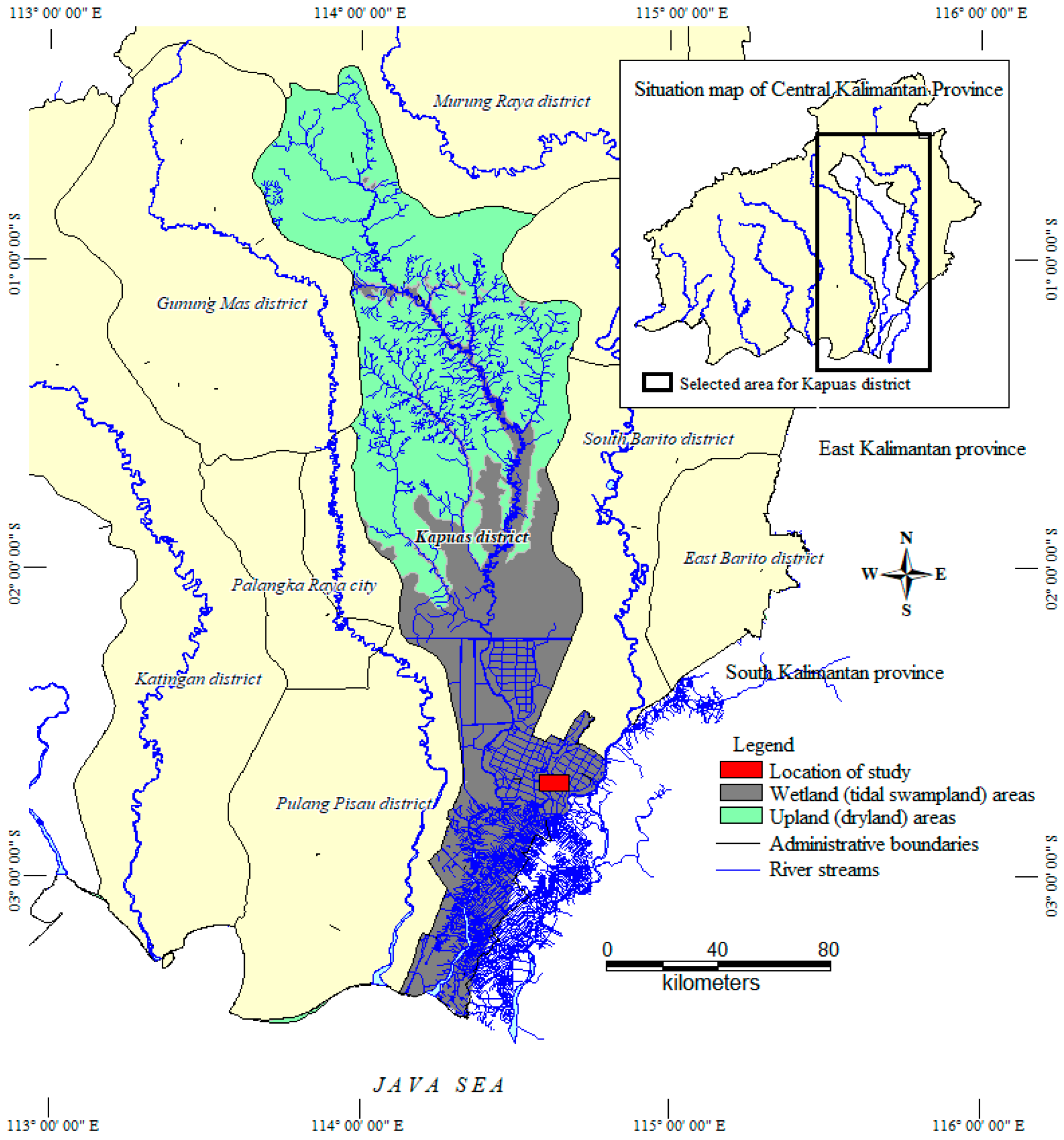
Figure 2.
Classification of tidal swamplands based on flooding types [41].
Figure 2.
Classification of tidal swamplands based on flooding types [41].
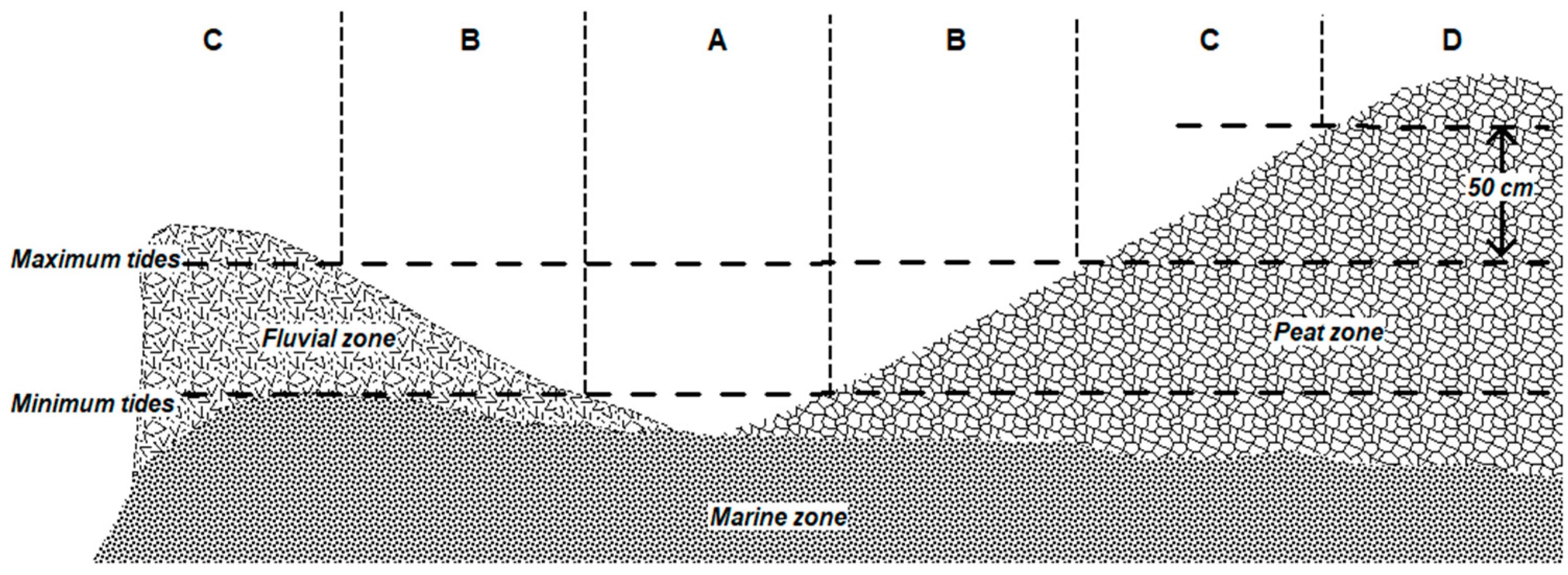
Figure 3.
The arable tidal swamplands areas for sorghum development in Central Kalimantan Province.
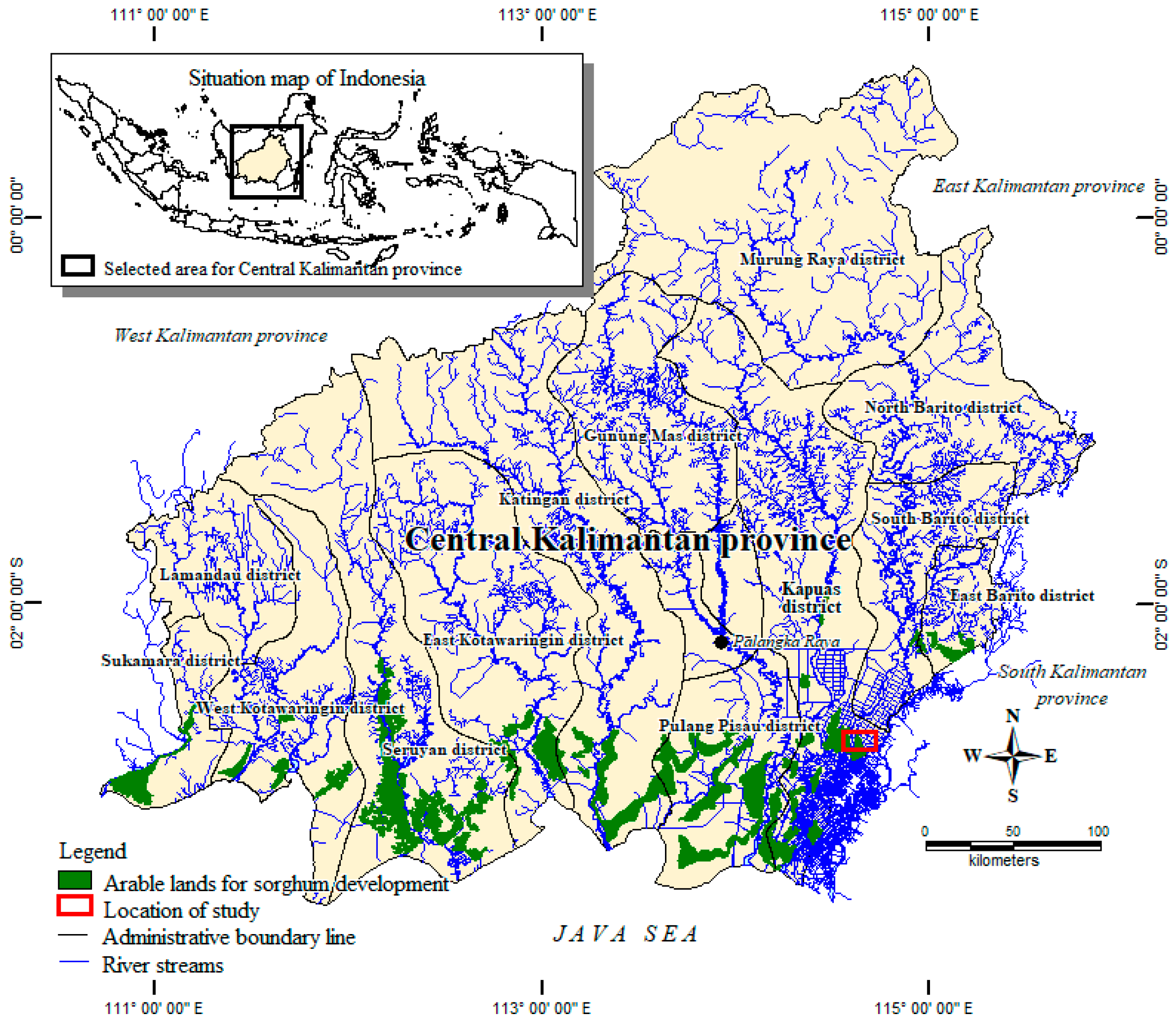
Figure 4.
Grand strategy matrix diagram for sorghum development in tidal swamps in Central Kalimantan (the x-axis value = S + (-W) = 9.000 – (-5.500) = 3.500; the y-axis value = O + (-T) = 8.000 + (-4.750) = 3.250.
Figure 4.
Grand strategy matrix diagram for sorghum development in tidal swamps in Central Kalimantan (the x-axis value = S + (-W) = 9.000 – (-5.500) = 3.500; the y-axis value = O + (-T) = 8.000 + (-4.750) = 3.250.
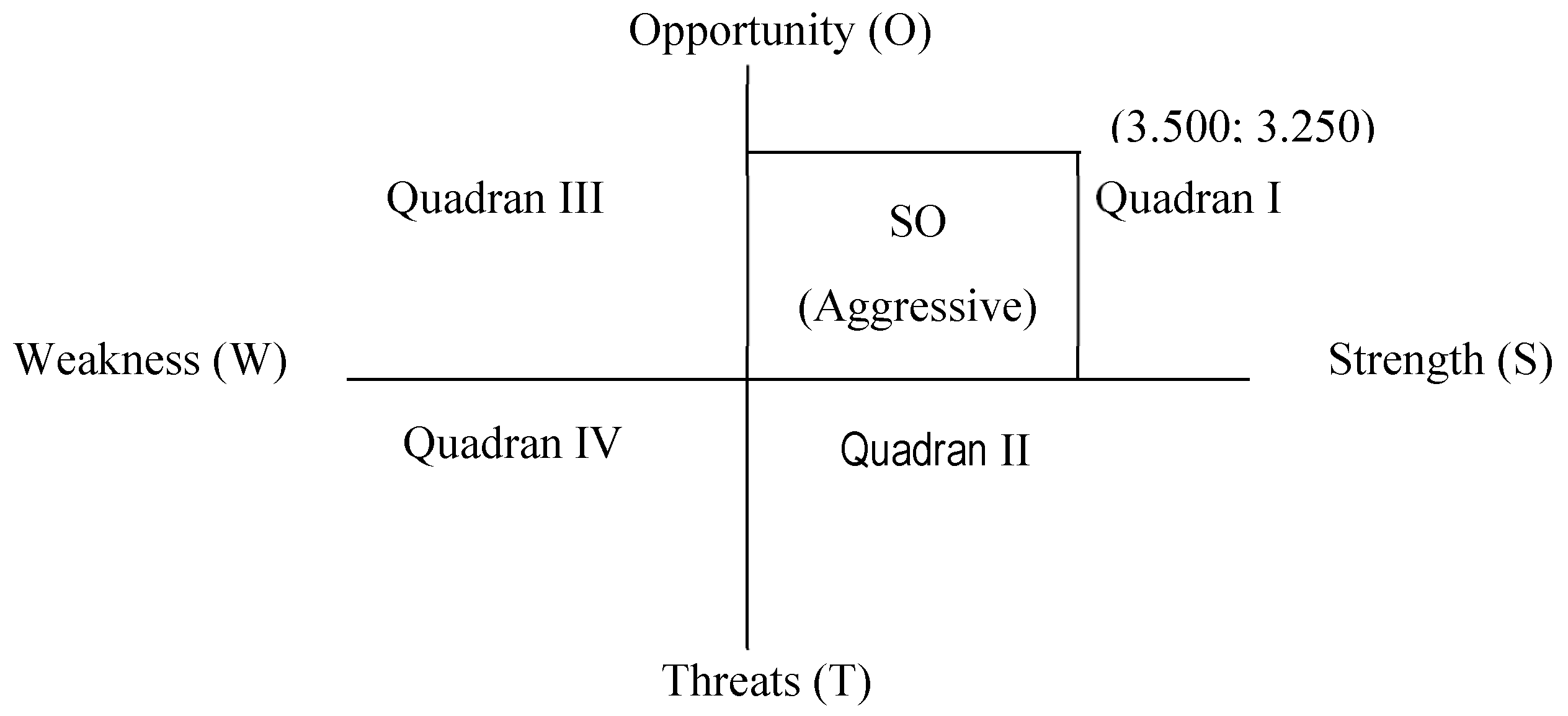

Table 1.
The feasibility analysis of sorghum farming in tidal swamplands in Central Kalimantan, 2022.
Table 1.
The feasibility analysis of sorghum farming in tidal swamplands in Central Kalimantan, 2022.
| No | Description | Volume | Unit | Price (USD)* | Cost (USD) |
|---|---|---|---|---|---|
| 1. |
Production facilities Sorghum seeds Herbicides Insecticides Dolomites Urea Manures KCl SP36 Rodenticides Depreciation of equipment |
5 1 2 8 50 1,000 50 50 1 |
kg liter kg sack kg kg kg kg kg |
3.17 13.36 3.68 6.33 1 46.67 1 1 4 |
15.85 13.36 7.36 50.64 50 40.67 50 50 4 10.33 |
| Total | 281.88 | ||||
| 2. | Labor Land preparation Land processing Planting Fertilization Weed removal Harvesting |
5 15 5 5 5 5 |
Working day Working day Working day Working day Working day Working day |
5.33 5.33 5.33 5.33 5.33 5.33 |
26.65 79.95 26.65 26.65 26.65 65.65 |
| Total | 213.2 | ||||
| 3. | Total Cost | 495.08 | |||
| 4. | Production | 3,070 | kg | ||
| 5. | Revenue | 3,070 | kg | 0.28 | 859.6 |
| 6. | Profit | 364.52 | |||
| 7. | R/C | 1.73 | |||
| 8. | B/C | 0.73 | |||
| 9. | BEP of sorghum price | 0.16 | |||
| 10. | BEP of sorghum unit | 1,788 | kg |
*Market price.
Table 2.
Analysis of the competitive advantage of sorghum farming compared to other food crops farming in Kapuas Regency, 2022.
Table 2.
Analysis of the competitive advantage of sorghum farming compared to other food crops farming in Kapuas Regency, 2022.
| Commodity | Production (kg ha-1) | Price (USD kg-1) | Total Cost (USD ha-1) | Profit (USD ha-1) | F Value | Q Value |
|---|---|---|---|---|---|---|
| Sorghum1 | 3,070 | 0.28 | 859.6 | 354.52 | ||
| Sweet potato2 | 900 | 1 | 722.67 | 177.33 | 2,421.64 | 0.79 |
| Maize2 | 5,200 | 0.36 | 1,229.33 | 642.67 | 4,083.55 | 1.33 |
| Soybean2 | 1,200 | 0.07 | 821.50 | 218.50 | 2,568.67 | 0.84 |
Source: Primary data, processed. 1) Research technology 2) Farmer model.
Table 3.
Results of sensitivity analysis of sorghum farming in tidal swamplands in Central Kalimantan Province in 2023.
Table 3.
Results of sensitivity analysis of sorghum farming in tidal swamplands in Central Kalimantan Province in 2023.
| Description | Existing | Changes in Financing and Revenue Structures | |||
|---|---|---|---|---|---|
| Scenario 1 | Scenario 2 | Scenario 3 | Scenario 4 | ||
| Input: Sorghum seeds Herbicides Insecticides Liming (dolomite) Urea Manure NPK KCl SP-36 Rodenticides Other expenses Labor Total cost Output: Revenue Income R/C B/C |
1.84 1.55 0.86 5.89 4.94 5.43 0.00 5.62 5.62 0.47 1.20 24.82 58.25 100 41.75 1.73 0.73 |
1.84 1.55 0.86 5.89 0.89 6.20 5.12 0.00 0.00 0.47 1.20 24.82 48.85 100 51.15 2.05 1.05 |
1.84 1.55 0.86 5.89 2.17 21.33 18.15 0.00 0.00 0.47 1.20 24.82 48.85 100 21.72 1.28 0.28 |
2.30 1.94 1.07 7.37 1.11 7.76 6.40 0.00 0.00 0.58 1.50 31.02 61.06 100 38.94 1.64 0.64 |
2.30 1.94 1.07 7.37 2.71 26.66 22.68 0.00 0.00 0.58 1.50 31.02 97.85 100 2.15 1.02 0.02 |
Notes: Scenario 1 used subsidized fertilizer prices while crop yields and sorghum prices were fixed; Scenario 2 used non-subsidized fertilizer prices while crop yields and sorghum prices were fixed; Scenario 3 used subsidized fertilizer prices while crop yields were fixed, and sorghum prices fell by 20%; and Scenario 4 used non-subsidized fertilizer prices, while crop yields were fixed, and sorghum prices fell by 20%.
Table 4.
SWOT of the sorghum development in tidal swamplands of Central Kalimantan.
| Factors | Description |
|---|---|
| Internal Factors | |
|
Strengths (S) |
S1- Sorghum is more adaptive to the environment than maize. S2- The stover can be used as animal feed. S3- The potential of swamplands that has not been utilized is relatively wide. S4- Motivation and availability of agricultural human resources. |
| Weaknesses (W) | W1- Lack of knowledge and experience of farmers on sorghum cultivation. W2- Land biophysical constraints and requires well-drained soils. W3- Difficult to get quality seeds. W4- Limited number and capacity of agricultural tools and machinery. |
| External Factors | |
| Opportunities (O) | O1- To substitute part of wheat imports with domestic sorghum. O2- Sorghum products present choices of domestic and foreign markets. O3- The development of adaptive varieties reduces production costs. O4- Policies on fertilizer subsidizing and rural development to support small-scale cultivation. |
|
Threats (T) |
T1- Extreme weather causes the risk of inundated or dry plants T2- Specific sorghum variety for tidal swamplands is not yet available. T3- Continuity of production for industrial needs. T4 - Uncertainty about the selling price. |
Table 5.
IFAS matrix (strengths and weaknesses).
| Internal Factors | Significance Factor (0-1) |
Weight | Score (Rank Coefficient) (1-4) |
|---|---|---|---|
| S1- Sorghum is more adaptive to the environment than maize | 0.172 | 10 | 1.720 (2) |
| S2- The stover can be used as animal feed. | 0.103 | 6 | 0.618 (4) |
| S3- The potential of tidal swamplands that has not been utilized is relatively wide. | 0.207 |
12 | 2.484 (1) |
| S4- Motivation and availability of agricultural human resources. | 0.138 | 8 | 1.104 (3) |
| Sub total | 0.621 | 5.926 | |
| W1- Lack of knowledge and experience of farmers on sorghum cultivation. | 0.086 | –5 | -0.430 (3) |
| W2- Land biophysical constraints and requires well-drained soils. | 0.069 | –4 | -0.845 (4) |
| W3- Difficult to get quality seeds. | 0.121 | –7 | -0.847 (1) |
| W4- Limited number and capacity of agricultural tools and machinery. | 0.103 | –6 | -0.618 (2) |
| Sub total | 0.379 | -2.171 | |
| Total score | 1.000 | 3.755 |
Table 6.
EFAS matrix (opportunities and threats).
| External Factors | Significance Factor (0-1) |
Weight | Score (Rank Coefficient) (1-4) |
|---|---|---|---|
| O1- To substitute part of wheat imports with domestic sorghum. | 0.196 | 10 | 1.960 (1) |
| O2- Sorghum products present choices of domestic and foreign markets. | 0.137 | 7 | 0.959 (3) |
| O3- The development of adaptive varieties reduces production costs. | 0.118 | 6 | 0.708 (4) |
| O4- Policies on rural development support small-scale cultivation. | 0.176 | 9 | 1.584 (2) |
| Sub total | 0.627 | 5.211 | |
| T1- Extreme weather causes the risk of inundated or dry plants. | 0.078 | –4 | –0.312 (3) |
| T2- Specific sorghum variety for tidal swamplands is not available. | 0.098 | –5 | –0.490 (2) |
| T3- Continuity of production for industrial needs. | 0.059 | –3 | –0.177 (4) |
| T4- Uncertainty about the selling price. | 0.137 | –7 | –0.959 (1) |
| Sub total | 0.373 | –1.941 | |
| Total score | 1.000 | 3.273 |
Table 7.
Internal-External Matrix to compile the SWOT table of sorghum development strategies in tidal swamplands in Central Kalimantan.
Table 7.
Internal-External Matrix to compile the SWOT table of sorghum development strategies in tidal swamplands in Central Kalimantan.
| IFAS | Strength Strategy | Weakness Strategy | |
|---|---|---|---|
| EFAS | |||
|
Opportunity Strategy |
Strategi SO 5.926 + 5.211 = 11.137 |
Strategi WO -2.171 + 5.211 = 3.040 |
|
|
Threat Strategy |
Strategi ST 5.926 + (– 1.938) = 3.988 |
Strategi WT -2.171 + (-1.938) = -4.109 |
|
Table 8.
Space Matrix Analysis of sorghum development in tidal swamplands in Central Kalimantan.
| Internal Factors | Rating | External Factors | Rating |
|---|---|---|---|
| S3- The potential of swamplands that has not been utilized is relatively wide. | 12 | O1- To substitute part of wheat imports with domestic sorghum. | 10 |
| S1- Sorghum is more adaptive to the environment than maize | 10 | O2- Sorghum products present choices for domestic and foreign markets. | 7 |
| S2- The stover can be used as animal feed. | 6 | O3 – The development of adaptive varieties reduces production costs. | 7 |
| S4- Motivation and availability of agricultural human resources. | 7 | O4- Policies on rural development sup-port small-scale cultivation. | 9 |
| Total | 35 | Total | 33 |
| W1- Lack of knowledge and experience of farmers on sorghum cultivation. | –5 | T1- Extreme weather causes the risk of inundated or dry plants. | –4 |
| W2- Land biophysical constraints and requires well-drained soils. | –4 | T2- Specific sorghum variety for tidal swamplands is not available. | –5 |
| W3- Difficult to get quality seeds. | –7 | T3- Continuity of production for industrial needs. | –3 |
| W4- Limited number and capacity of agricultural tools and machinery. | –6 | T4- Uncertainty about the selling price. | –7 |
| Total | –22 | Total | –19 |
| Average S | 9.000 | Average O | 8.000 |
| Average W | –5.500 | Average T | –4.750 |
| Value on the X axis = S + (–W) | 3.500 | Value on the Y axis = O + (–T) | 3.250 |
Table 9.
SWOT matrix of sorghum cultivation strategies in tidal swamps of Central Kalimantan.
|
Internal Factors |
Strength (S) S1- Sorghum is more adaptive to the environment than maize plants. S2 - The stover can be used as animal feed. S3- The potential of swamplands that has not been utilized is relatively wide. S4- Motivation and availability of agricultural human resources. |
Weakness (W) W1- Lack of knowledge and experience of farmers in sorghum cultivation W2- Land biophysical constraints and requires well-drained soils. W3- Difficult to get quality seeds. W4- Limited number and capacity of agricultural tools and machinery |
|
|
External Factors |
|||
|
Opportunity (O) O1- To substitute part of wheat imports with domestic sorghum. O2- Sorghum products present choices of domestic and foreign markets. O3- The development of adaptive varieties re-duces production costs. O4- Policies on fertilizer subsidizing and rural development to support small-scale cultivation. |
S-O strategy Increase production by optimally utilizing available swamplands resources, technological innovation, human resources, and market potential (S1, S2, S3, S4, O1, O2, O3, O4). Optimize the utilization of sorghum plant waste as animal feed. (S1, S2, S3, S4, O1, O2, O3, O4). Increase and maintain production continuity by utilizing the potential of land, technology, and human resources of farmers (S1, S4, O3, O4) Increase productivity and processed products by optimizing land resources, technological developments, and government policies to reduce wheat imports (S1, S2, S3, S4, O4) |
W – O strategy Increasing farmers' knowledge and skills regarding cultivation, land management, and sorghum seed production technology (W1, W2, W3, W4, O1, O2, O3, O4, O5). Facilitate farmer/farmer group collaboration with sorghum seed breeders (W4, O1, O2, O4, O5). |
|
|
Threats (T) T1- Extreme weather causes the risk of inundated or dry plants. T2- Specific sorghum variety for tidal swamplands is not available. T4- Uncertainty about the selling price. T3- Continuity of production for industrial needs. |
S-T strategy Increase production by optimally utilizing available swamplands resources, technological innovation, human resources, and market potential (S1, S2, S3, S4, O1, O2, O3, O4). Optimize the utilization of sorghum plant waste as animal feed. (S1, S2, S3, S4, O1, O2, O3, O4). Increase and maintain production continuity by utilizing the potential of land, technology, and human resources of farmers (S1, S4, O3, O4) Increase productivity and processed products by optimizing land resources, technological developments, and government policies to reduce wheat imports (S1, S2, S3, S4, O4) |
W – T strategy Improve the quality of human resources by providing training in land management, climate and weather, production, and marketing management (W1, W2, W3, W4, T2, T3, T4). Machine tool facilitation |
|
Table 10.
QSPM matrix of sorghum development strategy in tidal swamplands in Central Kalimantan.
| Key Factors | Alternative Strategy | ||||||||
|---|---|---|---|---|---|---|---|---|---|
| Weight | 1 | 2 | 3 | 4 | |||||
| AS | TAS | AS | TAS | AS | TAS | AS | TAS | ||
| Strength | |||||||||
| 1. The potential of swamplands that has not been utilized is relatively wide | 0.207 | 4 | 0,828 | 3 | 0,621 | 4 | 0,828 | 4 | 0,828 |
| 2. More adaptive to the environment than maize plants. | 0.172 | 4 | 0,688 | 3 | 0,516 | 4 | 0,688 | 4 | 0,688 |
| 3. The stover can be used as animal feed | 0.103 | 2 | 0,206 | 4 | 0,412 | 3 | 0,309 | 2 | 0,206 |
| 4. Motivation and availability of agri-cultural human resources | 0.138 | 3 | 0,414 | 3 | 0,414 | 3 | 0,414 | 3 | 0,414 |
| Weakness | |||||||||
| 1. Lack of knowledge and experience of farmers in sorghum cultivation | 0.086 | ||||||||
| 2. Land biophysical constraints and requires well-drained soils. | 0.069 | ||||||||
| 3. Difficult to get quality seeds. | 0.121 | ||||||||
| 4. Limited number and capacity of agricultural tools and machinery. | 0.103 | ||||||||
| Opportunity | |||||||||
| 1. To substitute part of wheat imports with domestic sorghum. | 0.196 | 3 | 0,588 | 2 | 0,392 | 2 | 0,392 | 3 | 0,588 |
| 2. Policies on rural development support small-scale cultivation. | 0.176 | 2 | 0,352 | 2 | 0,352 | 2 | 0,352 | 3 | 0,528 |
| 3. Sorghum products present choices for domestic and foreign markets. | 0.137 | 4 | 0,548 | 2 | 0,274 | 2 | 0,274 | 2 | 0,274 |
| 4. The development of adaptive varieties reduces production costs. | 0.118 | 3 | 0,354 | 4 | 0,472 | 3 | 0,354 | 3 | 0,354 |
| Threat | |||||||||
| 1. Specific sorghum variety for tidal swamplands is not available (bird-resistance) | 0.098 | ||||||||
| 2. Extreme weather conditions cause the risk of inundated or dry plants. | 0.078 | ||||||||
| 3. Uncertainty about the selling price. | 0.137 | ||||||||
| 4. Continuity of production for industrial needs | 0.059 | ||||||||
| Total Attraction Value (TAS) | 3,98 | 3,45 | 3,61 | 3,88 | |||||
| Rank | 1 | 4 | 3 | 2 | |||||
Notes: AS 1 = Not important or weakly impacts the strategy; AS 2 = Moderately important or has a moderate impact on the strategy; AS 3 = Important or has a significant impact on the strategy; AS 4 = Very important or has a strong impact on the strategy.
Disclaimer/Publisher’s Note: The statements, opinions and data contained in all publications are solely those of the individual author(s) and contributor(s) and not of MDPI and/or the editor(s). MDPI and/or the editor(s) disclaim responsibility for any injury to people or property resulting from any ideas, methods, instructions or products referred to in the content. |
© 2023 by the authors. Licensee MDPI, Basel, Switzerland. This article is an open access article distributed under the terms and conditions of the Creative Commons Attribution (CC BY) license (https://creativecommons.org/licenses/by/4.0/).
Copyright: This open access article is published under a Creative Commons CC BY 4.0 license, which permit the free download, distribution, and reuse, provided that the author and preprint are cited in any reuse.


