
Submitted:
21 August 2023
Posted:
23 August 2023
You are already at the latest version
Abstract
Strandings are one of the most worrying issues in relation to the conservation of cetacean species, and in the case of Chile, due to its geography and large extension of the coastline, monitoring and access to these events is difficult, making their study more complex. Chile has a shortage of specialized scientific forensic research facilities for cetacean; however, for this study it was able to collect data recorded from official institutions and sporadic scientific biological sampling oriented to investigate the causes of death or stranding. According to the Chilean government official database, we described that the main causes of unusual mortality events (UME) and mass strandings from year 2015 and 2016 were acute poisoning by biotoxin and trauma to the auditory complex, respectively, while individual strandings would have their causes in anthropogenic activities such as entanglements in fishing an aquaculture gear and collisions with vessels. The predominant species in mass strandings was the sei whale (Balaenoptera borealis). The geographical area of greatest prominence in mass strandings was the Aysén Region in the Central Patagonia of Chile, while the species mostly involved in individual strandings along the south-central, central, and northern coast of Chile was the small porpoise (Phocoena spinipinnis). The most common gross pathological findings were advance decay of the carcasses and nonspecific wounds of different nature, difficult to associate with possible causes of death without further histopathological studies.
Keywords:
cetaceans
; misticeti
; odontoceti
; strandings
; pathology
; Chile
1. Introduction
Interest in researching cetaceans as conservation targets has increased markedly, due to their particular features and charisma (Isasi Catalá, 2011), their fundamental role in the context of oceanic food chains as top predators and fertilizers of the sea, (Lavery et al., 2014), as providers of ecosystem services (Quaggiotto et al., 2022), as bio-indicators of the ocean´s health due to their great longevity and for the relevance of their population abundance as a biological tool in carbon sequestration to face climate change (Perrin et al., 2002). However, years of investigation of these events have led to a broader and more detailed understanding that includes animals found dead on shore, cetaceans found alive on shore, pinnipeds found sick or injured on shore, and animals that are ¨out of habitat¨. In some cases, marine mammals found entangled in fishing gear or debris, and carcasses found floating in the sea are also considered as strandings (Moore et al., 2018). There are basically 4 types of stranding events: 1) individual stranding (of a single individual or a mother with calf, alive of dead); 2) mass stranding (more than one (Würsig et al., 2018) According to the nature of the event and in generic terms, they are divided into 2 categories: a) natural strandings (old age, malnutrition, abandonment of offspring, diseases of various etiologies, poisoning by biotoxins, scape from predators, environmental causes (tides, volcanic eruptions, earthquakes), geographical causes (coast with low slope, local anomalies of the earth´s magnetic field) and b) anthropogenic strandings (noise pollution, plastic pollution, hydrocarbon spills, climate change, entanglements in fishing and aquaculture gear and collisions with boats (Brownell et al., 2009). With increasing stress and anthropogenic pressures on the marine environment, the impacts on marine mammals are growing. The sustained expansion in the number of annual cases, whether entangled in fishing gear or victims of collisions with large vessels because of intense maritime traffic (Colpaert et al., 2016), added to the inherent difficulties for the implementation of mitigation measures in highly migratory populations, it is imperative to quantify and understand the mechanisms by which these interactions occur. The objective, systematic and coherent examination of the stranded specimens, alive or dead, offers the only and opportune instance to carry out a few studies, however, a combination of medical-forensic training and field experience is necessary to reliably evaluate the specimens and search for signs that guide the diagnosis towards its causality (AMEVEFAS, 2017). Added to the above, in the Chilean case, due to the geography and great extension of its coastline, monitoring and access to these events is even more complex, preventing the timely arrival of scientific research that helps to clarify the possible causes that generate these events(Alvarado-Rybak, Toro, Abarca et al., 2020). In Chile the diversity of cetacean species is abundant, a total of 8 species of mysticetes and 32 species of toothed whales have been recorded (Aguayo et al., 1998) (Table 1), reaching 43% of the global number of species described (IWC, 2022). All these species have been declared a Natural Monument by the Chilean regulation (Decree 230/2008). In addition, the maritime areas of national sovereignty and jurisdiction have been declared a free zone for cetacean hunting (Law 20.293). Despite all regulations and instruments designed to protect this group of species there are still threats that affect them (MERI Foundation, undated).
According to the data obtained in Chile, mass strandings probably had their origin in an acute natural cause such as poisoning by biotoxins such as Domoic Acid and Saxitoxin (Häussermann et al., 2017) and possibly brevetoxin (Ulloa, unpublished) present in the food source, or traumas to the auditory complex possibly of anthropogenic origin (external and internal fractures in the periotic-tympanic complexes due to exposure to an underwater explosion) (Alvarado-Rybak, Toro, Abarca et al., 2020). However, the greatest number of individual events is caused by entanglement in fishing gear and collisions with boats, both of which are of anthropogenic origin (Arata and Hucke-Gaete, 2005). Despite the above, in most cases the probable cause of the stranding is undetermined, the description of injuries is not sufficiently studied, and the percentage of necropsies performed is low, requiring greater training, inter-institutional coordination and diagnostic infrastructure to correct these shortcomings. Therefore, the main objectives of this article are, a) Description and analysis of strandings occurred in Chile between 2015 and 2020, b) Description of the occurrence of strandings in Chile between 2015 and 2020, considering their respective geographic location, seasonality, origin, and characteristics of the registered specimen(s), c) Identification of the most common gross pathological findings recorded in cetacean strandings in Chile between 2015 and 2020, d) Comparison of the information on the occurrence of the pathological findings and the probable causes of strandings and/or death of cetaceans registered during the period 2015-2020 in Chile. All the above using the official stranding database of the Chilean National Fisheries and Aquaculture Service (SERNAPESCA) and pathological information from some isolated scientific studies.
Traditionally speaking, a marine mammal stranding is defined as an individual "hobbling ashore sick, weak, or simply lost." However, years of research into this topic have led to a broader and more detailed understanding that includes animals that are found dead on shore, cetaceans found alive on shore, pinnipeds found sick or injured on shore, and animals that are “out of habitat.” In some cases, marine mammals found entangled in fishing nets or debris, and marine carcasses found floating in the sea are also considered stranded (Würsig et al., 2018). In the case of cetaceans, low adult survival or massive mortality can have negative consequences for their population abundance. Cetacean mass strandings (excluding mother-calf cases) cause the death of up to hundreds of individuals in a single event, they occur in species of mysticetes and odontocetes, being the latter due to their own biological characteristics the most numerous (Hamilton, 2018). Recent research suggests that environmental factors, such as seasonal fluctuations or geographic location, would influence the increase in mass strandings. Despite this, while there have been numerous advanced theories, few are backed by concrete evidence. There is no single conclusive explanation for all individual and mass strandings around the world (Williams, 2018). According to a study of 50 years of cetacean strandings in Chile, which used the spatiotemporal permutation model using the space–time scan statistic for the cetacean strandings between January 1968 and August 2018, in Chile the occurrence of these events is estimated to be 80% more than the global average(Alvarado-Rybak et al., 2019). Some authors point out that there is a trend towards an increase in these events since 2015 on the country's coasts, plus the difficulty in collecting data in Chile, the dispersion of the information obtained, with various agencies both state and private institutions that have registered the strandings (Alvarado-Rybak et al., 2019) provide the appropriate context for the generation of improvement initiatives in the collection and review of data and information as well as the need to develop histopathological diagnostic techniques that will help to clarify the causes responsible for the current state of the strandings in Chile.
1.1. Probable Causes of Strandings in Chile
1.1.1. Anthropic Factors.
a) Fishing and aquaculture activities. There are mainly two types of interactions with marine mammals associated with fishing and aquaculture activities. On the one hand, those of the direct type (also known as operational or technical) in which the animals usually come into physical contact with the fishing gear or fish-capturing devices, which generates negative effects for both cetaceans and the targeted species of the fishery. On the other hand, indirect interactions (also known as biological or ecological) are those in which both marine mammals and the fishing industry compete for fish species (Obusan et al., 2016). Because cetacean populations and fishing activities coincide in the same geographic areas, interactions between the two are inevitable; removal of fish from the gear during the fishing activity by marine mammals increases the chances of being injured or even killed due to bycatch (Cáceres, 2016) "Ghost fishing," referring to gill nets or traps that have been lost or abandoned, represents an ongoing problem due to the continuous entanglement of marine animals that get stuck in them and die. In recent years, this has worsened due to the introduction of highly durable synthetic equipment. Although it is very difficult to have a precise global number, estimates suggest that lost or abandoned fishing gear constitutes approximately 10% (640,000 tons) of marine litter (Campoy & Beiras, 2019) . It is estimated that more than 300,000 cetaceans (whales, dolphins, and porpoises) die annually entangled in fishing gear, that is, more than 800 specimens per day (Moazzam, 2013) In Chile, bycatch of dolphins, killer whales, and sperm whales has been reported. Due to these rooted habits, these species currently suffer a deplorable reputation in most fisheries, and in response generating very drastic solutions or measures to repel mammals, threatening their survival, not only those species that interact with fishing activity, but also with those that do not, generally due to ignorance (Arata and Hucke-Gaete, 2005). Therefore, it is quite necessary to implement educational plans for fishermen regarding the diversity of marine mammals, their biology, and their importance for the abundance of species for fisheries. In addition to conducting dedicated and detailed research to mitigate the problem through innocuous procedures for both parties involved (Moreno et al., 2003). The most common form of anthropogenic trauma in small cetaceans is death by submersion due to bycatch, according to a study through pathological findings at necropsy, carried out in 2020, the majority of small and medium size cetacean species were affected by drowning when interacting with the fishing activity. Diagnosis of this condition is difficult in carcasses with moderate or advanced autolysis; therefore, the real magnitude of this problem is difficult to assess when access to fresh stranded carcasses is limited. However, another in situ study carried out in south-central and southern Chile highlighted that the most common species affected by bycatch are Commerson's dolphin (Cephalorhynchus commersonii), Chilean dolphin (Cephalorhynchus eutropia), bottlenose dolphin (Tursiops truncatus) and the porpoise of Burmeister (Phocoena spinipinnis) (Alvarado-Rybak et al., 2019). On the other hand, based on an investigation by the Fisheries Development Institute (IFOP), during 2018 and 2019 small cetaceans of the Delphinidae family were incidentally caught (orca, bottlenose dolphin, dusky dolphin, common dolphin, and an unidentified dolphin). The total number of small cetaceans captured was 102, where 39 of them were killed. The species with the highest capture was the common dolphin with 56 individuals, while the dusky dolphin was the species with the highest mortality, registering 19 dead individuals (IFOP, 2020). Regarding aquaculture, the interaction of marine mammals with this activity is usually negative, animals are affected by loss of habitat and by the application of erratic mitigation measures, such as nets and acoustic artifacts that prevent the approach but causes the abandonment of the areas or even the death of the animals. Although there are no empirical data on whether the presence of salmon cages directly influences or alters movement patterns or habitat use by dolphins, Chilean dolphins have been observed avoiding salmon farms in fjords (Hucke-Gaete, 2006).
b) Whale watching tourism. Whale watching can provide many socioeconomic benefits and could also aid conservation. However, this has many direct and indirect impacts on this group of species (Parsons, 2012). In the short term, drastic changes in immersion times, group cohesion or changes in speed and direction of movement can be observed in mysticetes (Christiansen et al., 2013). Various behavioral changes were observed in humpback whales in Peru, while groups with calves avoid boats by increasing immersion time, course changes and decreasing their number of breaths, groups without calves increase travel speed, time in surface and the number of breaths (Garcia-Cegarra et al., 2020)
The presence and proximity of tourist boats would be the main cause of the decrease in the abundance of dolphins in periods of greater exposure. Thus, the size of the vessel can constitute a source of disturbance, and it is probable that these are more intrusive than those of research. On the other hand, factors such as engine noise can also be a source of disturbance, given the acoustic dependence of cetaceans for communication, orientation, and predator/prey detection; whale watching tourism causes short-term effects on the behavior of the animals, increasing their movement and the proportion of active dives (Bejder et al., 2006). Finally, females were shown to travel more frequently in the presence of tourist boats, and it is speculated that these short-term changes could lead to long-term changes in habitat use by lactating females (Christiansen et al., 2010) and/or lead to decreased reproductive success of cetacean species or decreased abundance of their populations (Bedjer et. al. 2006).
Chile has not been immune to this phenomenon either, due to the great diversity of species that visit Chilean sea. Although there is the "General Regulations for the Observation of Hydrobiological Mammals, Reptiles and Birds and the Cetacean Watching Registry" (D.S. Nº38-2011), this is little known by tourists and the public. According to an investigation in the Isla Chañaral Marine Reserve, by observing whales through a theodolite, an alteration in the behavior of the fin whale was observed during tourist activity, particularly in reorientation (greater during post-tourism) and linearity (lower with and post tourism), and for resting behavior (higher during post tourism). These changes would be related to an evasive response in the presence of tourist boats, however, it is important to note that the intensity of tourism in the study area is moderate, since most of the observations had between one and two boats of tourism, and in a smaller proportion more than three boats, with a maximum of five (Sepulveda et al., 2017). Therefore, more studies are suggested within the Isla Chañaral Marine Reserve or others where whale watching activities are carried out to evaluate the intensity and time in which tourism can be carried out without affecting the behavior of cetaceans.
c) Collisions. Ship collisions with cetaceans are a major concern in the context of the conservation of these group of species, whose incidence has increased rapidly due to the increase in global maritime traffic, increase of speed and fleet size. Necessary measures to lessen this threat include more reliable definitive diagnostics for reporting the number of collisions and the incidence of ship-strike fatalities (Sierra et al., 2014). On the other hand, collisions with ships constitute a threat to large whales, which has been recorded in various reports, however, many of these are probably not detected or reported (Bezamat et al., 2015). This is particularly serious in populations of mysticetes since the groups facing the greater risk of collisions are the most hunted during the last century, specifically during the whaling season, due to which several of them still have not been recovered (Jackson et al., 2016). Ship collisions can cause acute trauma, with severe cuts to the skin, often compromising subcutaneous tissue and skeletal musculature, as well as limb amputation and/or evisceration. However, it is difficult to determine the pre- or post-nature of these findings. Improvement in the methodology to recognize injuries indicative of boating collisions is urgently required. Several publications have established various criteria for injuries and mortality caused by ship impacts in cetaceans and pinnipeds, of which the following stand out: one or several cuts, verification of bone fractures ante mortem, bruises and/or hemorrhages (Sierra et al., 2014).
Regarding marine transit in Chile, according to what was observed in the Mejillones Bay, region of Tarapaca, Chile, one of the main whale aggregation areas, it is very close (less than 1000 m) to one of the main routes used by large cargo ships (Pacheco et al., 2015) and, added to this, the navigation routes of fishing vessels coincide with the distribution of small cetaceans. Another issue in addition to the above is the speed of merchant ships which usually exceeds the maximum limit (Garcia-Cegarra et al., 2020). In Chile there are published records of three possible collisions between ships and whales. During 2009, the first confirmed collision of a large whale was reported in Chile, which was identified as a female sei whale (Brownell et al., 2009). The second collision report corresponds to the stranding of a blue whale during the year 2014, in the bay of Puerto Montt, region of Los Lagos, which would have arrived dead or dying a few meters from the waterfront of that city; the specimen had an exposed fracture in its right pectoral fin, which could probably be attributed to a collision with a large vessel (CCC, 2014). Later in 2019, a complaint was registered for a collision of a blue whale specimen in the Tarapacá region (SERNAPESCA, 2020). According to what was observed in an analysis of pathological findings of some strandings occurred in Chile between 2010 and 2020, two subadult whales with severe trauma were identified, highly likely due to a collision with a large vessel. These animals were found near two ports with high maritime traffic, which could have increased the chances of collision with a ship (Alvarado-Rybak, Toro, Abarca et al., 2020)
During the Alfaguara blue whale conservation program lead by the Cetacean Conservation Center (CCC), carried out in 2008 on the Island of Chiloé, region of Los Lagos, it was demonstrated according to the feeding and defecation behavior of humpback and blue whales, that such area on the northwest of Chiloé Island and north of the Los Lagos region are one of the most important feeding areas in the southern hemisphere for Balaenoptera musculus (CCC, 2008). Whale watching carried out in 2007 and 2009 revealed that over 100 animals are found in the feeding area of southern Chile, thus this high number of large vessels and the high concentration of blue whales become a major concern. As a proof of the risk of collision, in this area, In January 2009, a tourist cruise ship arrived in Puerto Montt with a dead sei whale on the bow (CCC, 2009). For the prevention of these events, the CCC had already delivered some recommendations, among which the following stand out: speed reductions of vessels in areas with a high concentration of whales, seasonal changes in navigation routes according to the presence of whales, and reduction of coastal pollution generated by the intensive salmon farming industry (CCC, 2008).
In November of 2018, the Maritime Government of Castro, Chiloé, Los Lagos region, Chile issued an official letter recognizing maritime traffic and its consequent risk of collision with cetaceans, as one of the factors that can cause injuries and / or the death of these individuals. In addition, the Chiloé area and the Pacific Ocean coast are important feeding and breeding areas not only for the blue whale, but also for other endangered species such as the sei whale and the southern right whale of the eastern South Pacific. It is also recognized that there have already been deaths of cetaceans associated with collisions in the area and that the impact may also pose a risk to the crew, increasing this risk at night due to the feeding behavior of this group of species. For this reason, a series of measures were delivered to mitigate or prevent collisions in Chile. However, even though these recommendations represent a progress, they do not constitute a regulation, but only a recommendation and there is no penalty associated with regards to collisions with cetaceans.
d) Contamination. Another anthropogenic threat for these mammals is the exposure to high levels of pollutants, both acoustic and due to pollution from industrial activities or fishing (Avila et al., 2018). For cetaceans, the threats posed by marine debris are manifold and range from direct impacts on health and mortality to possible secondary effects because of habitat degradation, transference of chemical pollutants, and effects on prey populations (Baulch and Perry, 2014). 80% of marine pollution by plastics derives from terrestrial sources. Even in the case of countries like Chile, far from the large centers of production and consumption, there is evidence of an incipient contamination by plastic (Elías, 2015). The most common impacts are associated with the ingestion of debris or entanglement, causing injuries or death of many specimens (Poeta et al., 2017). Ingestion of macroplastics can cause suffocation or an artificial sensation of being full, which can lead to death by starvation. Other negative effects are malnutrition and internal injuries such as perforation or obstruction of the digestive tract and the formation of ulcers (Campoy and Beiras, 2019). The latter occurs when the waste elements are consumed intentionally or accidentally, through the ingestion of contaminated organisms during the filter feeding process (mysticetes) (Poeta et al., 2017). On the other hand, entanglement can cause external injuries or alter the swimming ability of the animals, affecting feeding and escape from predators. Added to this, calves of several marine species can be especially affected due to strangulation, as the animal grows (Campoy and Beiras, 2019).
d) Persistent organic pollutants (POPs) such as, chlorinated aromatic compounds (organochlorine pesticides and PCBs), heavy metals and organometallic compounds are substances with hormonal activity. Marine mammals are among the groups of wild animals showing symptoms of endocrine and reproductive damage, as reflected in significant declines in some populations. They persist in excessively high concentrations in some cetaceans (Jepson and Law, 2016), and due to their lipophilic nature they can biomagnify in the food chain, reaching very high levels among top predators (Pinzone et al., 2015). However, few studies have been able to unequivocally demonstrate the effect of pollutants on the endocrine system (Starrantino, 2018).
e) Heavy metals, non-essential metals such as, mercury, cadmium and lead are very toxic even in small concentrations. Chronic or sub chronic exposure to concentrations lower than those producing toxic effects can alter the composition and/or functionality of the immune system (Cámara et al., 2003). According to studies carried out in Chile, the concentrations of both trace elements and persistent organic pollutants, measured in pilot whales stranded on the Chilean coast, are lower than those reported for the same species from Australia or New Zealand (García, 2020). However, the presence of Thallium ion (Tl+) was detected, a residue from the metallurgical industry, which can produce toxic effects in mammals due to its competition with Potassium ion (K+) in metabolic processes. Given their characteristic longevity and their quality as predators at the highest levels of the food chain in the marine environment, the order Odontoceti is most exposed, and although the toxic effects that this trace element can cause, the effects in marine mammals are unknown, the fact that it was found in remote ecosystems may indicate its persistence in the environment, and a greater vulnerability of these species to suffering mass mortality (Garcia-Cegarra et al., 2020).
f) Oil, cetaceans can be exposed to oil and hydrocarbons through direct contact and through inhalation of volatile fractions, direct ingestion, or through contaminated prey. However, it is known that cetaceans have a low vulnerability to oil due to a series of characteristics: oil does not easily penetrate the skin of cetaceans due to its thickness, absence of hair and frequent desquamation. The low vulnerability is also based on the fact that cetaceans seem to be able to detect oil, however, this depends on whether they can visually discriminate the spill and its size. They can also modify their behavior, decreasing respiration rates, and increasing the duration of dives together with course changes to minimize contact with surface oil (Helm et al., 2015).
g) Noise pollution, anthropogenic underwater noise is currently recognized as a global problem, and recent studies have shown a wide range of negative effects on a variety of taxa (R. Williams et al., 2015), it can be generated by a variety of activities, such as commercial transportation, oil and its subsea exploration, pipeline development and construction, naval operations (eg, military sonars), fishing (eg, acoustic deterrent and harassment devices), research using air guns, constructions, icebreakers and recreational boating (Colpaert et al., 2016). Activities such as naval and fishing boat sonar, and oil drilling can lead to death and stranding of some species (Brakes and Simmonds, 2011). In many ocean areas, the predominant source of human-generated low-frequency noise (20-200 Hz) is from the propellers and engines of commercial shipping vessels. These sound frequencies can propagate efficiently over long distances in the deep-sea marine environment (Starrantino, 2018). On the other hand, marine renewable energy devices can produce lower noise levels than many other anthropogenic sources (R. Williams et al., 2015). Because commercial shipping noise occurs in the same frequency range as baleen whale vocalizations, baleen whales are particularly vulnerable to masking effects due to the large volumes of noise produced by a ship (Colpaert et al., 2016). The effects, lethal and sublethal, can occur as direct or indirect consequences of noise exposure, due to its behavioral responses. This can cause stranding, disorientation, reduced foraging efficiency, and alteration of other important biological functions for their homeostasis (Starrantino, 2018). There is evidence that some deep-dive toothed whales, such as sperm whales or beaked whales, can pick up low frequencies and therefore would be more susceptible to these sound sources, and in these cetaceans, a fast escape from a sound source can lead them to an area closer to the sound source (Farré, 2005), or as a result of a modified diving behavior causing nitrogen supersaturation above a threshold value normally tolerated by tissues (as occurs in decompression sickness) they can develop gas and fat embolic syndrome resulting in death (Fernández et al., 2005).
1.1.2. Natural Factors
a) Biological agents, that can lead to the death and/or stranding can be viral, fungal, parasitic and bacterial infections (Starrantino, 2018). It is also important to include stranding events associated with biotoxin poisoning (eg: mass stranding in Golfo de Penas, Chile in 2015). Although the assessment of the health status of wild cetaceans is difficult to carry out without handling and capture, the observation of skin lesions allows the identification of diseases such as lobomycosis caused by Lacazia loboi, dermatitis caused by herpesviruses, and rhomboid lesions caused by Erysipelothrix rhusiopathiae, a disease potentially lethal (Powell et al., 2018). However, the lesions observed in carcasses could also be a source of data for their population extrapolation (Geraci and Lounsbury, 2005). In the case of Chile, around the year 2006, the presence of wounds on the skin of Chilean dolphins (Cephalorhynchus eutropia) and bottlenose dolphins (Tursiops truncatus) was detected for the first time, which could have been related to environmental degradation, as an effect of pollution or exotics diseases probably associated with aquaculture. However, more research is needed to test this hypotheses (Hucke-Gaete, 2006). Regarding parasitic infections, according to necropsies carried out on 15 specimens stranded between 2010 and 2019, parasitism and diseases derived from this were observed in some toothed whales, including verminous pneumonia and vasculitis due to Pseudalius inflexus in Burmesteir's porpoises. This nematode is a parasite that can cause direct mortality or cause a secondary bacterial pneumonia with fatal consequences. In the case of respiratory and periotic sinus nematodes within the genus Stenurus, it has been suggested that they can potentially affect hearing and echolocation, and although the lesions observed in the study were significant, there is no evidence that they have complicated the escape from entanglement or increased the risk due to echolocation failures, since to assess the real impact of parasites of Stenurus spp. in Burmesteir porpoises, a histopathological examination was necessary, which could not be performe (Alvarado-Rybak, Toro, Escobar-Dodero et al., 2020)
b) Climatic and seasonal factors: El Niño and Harmful Algal Blooms (HABs), domoic acid (DA) is a neurotoxin that can cause amnesic shellfish poisoning in humans, with symptoms including vomiting, seizures, memory loss, and disorientation. In the case of marine mammals such as sea lions and seals, they have shown neurological dysfunction due to brain lesions especially in the hippocampus, which could lead to maladaptive navigation behavior and consequent mortality in the wild (Bengston, 2016). Although biotoxin poisoning is a biological agent, the reason why it was decided to address it in this item is due to its possible relationship with climate change. During 2015 in the Golfo de Penas, an unusual mass mortality episode (UME) was reported, which produced by far the largest ever recorded unusual mortality event of baleen whales at one time and place, with the death of 369 individuals in the span of a few weeks, and most probably the number of individuals killed in that event probably exceeded 400 individuals, since those that die on the high seas tend to sink and not refloat (Smith et al., 2015). In five of the specimens analyzed by necropsy, no signs of human interaction were determined in the death of these animals. Also, due to the position of the whales on the shore (skull resting on their dorsal part), it was postulated that the animals apparently died while they were still in the water and the sea currents and the winds dragged them to shore, therefore, some authors referred to this event as mass mortality rather than multiple stranding. Traces of toxin were found in the vectors Sprattus fuegensis and Munida spp. and in the stomach contents of 2 necropsied specimens. Added to this remains of Pseudonitzschia spp. cells in their intestinal content was also found. All this is supported by the high presence of Pseudonitzschia during February and March 2015, measured at the stations of the Chilean Red Tide Monitoring Program (Ulloa et al., 2016). Due to this and to the ruling out of other natural or anthropogenic causes, the most solid and probable hypothesis was that of intoxication by biotoxins from harmful algae blooms (HAB), and although this would have been possibly related to the phenomenon of El Niño (Häussermann et al., 2017) it is relevant to stress the increase in HABs, whether associated with climatic phenomena or the contribution of nitrogen or other nutrients to the sea and its impact as a possible cause of mass strandings.
c) Geographic factors, the hypothesis on 'coastal morphology' indicates that shallow closed bays with wide intertidal differences act as traps for pelagic cetaceans (Gresson 1968, Perrin & Geraci 2002). On the other hand, there is evidence that 'geomagnetic anomalies' of the earth are directly related to stranding zones (Mazzariol et al., 2011), in which animals tend to become disoriented, becoming stressed and escaping to strand on nearby coasts.
2. Materials and Methods
The material used for this work comes from the official database of SERNAPESCA (www.sernapesca.cl), complemented with personal communications from the stranding team of the same institution and from some published scientific studies. Species belonging to the cetacean order, odontoceti and misticeti suborders, identified in strandings that occurred between 2015 and 2020 in Chile, will be used as the animal unit. Subsequently, the information collected from SERNAPESCA stranding database Excel spreadsheet was revised for possible duplications or inconsistencies and from the observations tab, reviewing all cases one by one, it was possible to obtain details about each stranding to then classify each event on a given category. The criteria used to select each case of stranding was based on the definition of strandings (Würsig et al., 2018).
3. Results
3.1. Strandings between Years 2015 and 2020. The Number of Stranding Events Has Remained Relatively Stable (Figure 1), Showing a Gradual Increase between the years 2015 and 2019, counting 36, 37, 42, 45 and 46 Stranding Events, for Each Year Respectively. However, during the Year 2020 There Was a Slight Drop (43 Registered Events), and There May be a Bias in the Number of Records, Associated with Less Vigilance due to Movement Restrictions during the COVID-19 Pandemic. On the Other Hand, the Number of Stranded Animals Were by far Higher than the Number of Events, Being the Largest Number in the Summer of Year 2015, Counting 402 Specimens of sei Whale (Balaenoptera Borealis) due to the Contribution of the Massive, Unusual Mortality Event (UME) of Mysticetes Occurred in the Golfo de Penas, Aysén Region, in the Central Patagonia of Chile (Ulloa et al., 2016)
3.2. Strandings by Species, Sex and Age
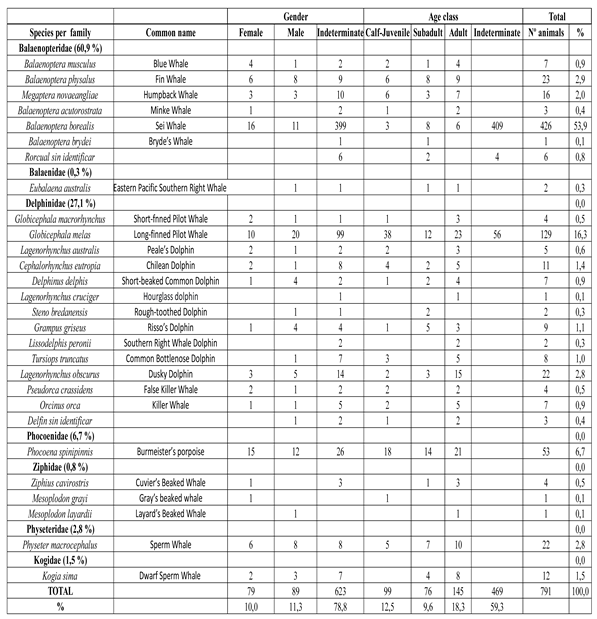
Out of 791 stranded animals (Table 2) the species with the largest number of individuals recorded, ordered from highest to lowest, corresponded to: sei whale 426 individuals, long-finned pilot whale 129 individuals and Burmeister’s porpoise 53 individuals. The first two most affected species are related to mass strandings in 2015 and 2016 respectively. In the case of the Burmeister’s porpoise, they mostly correspond to individual strandings, with the later registering the highest number of stranding events in the period.
3.3. Strandings by Geographic Location
The largest number of stranded individuals was recorded in southern Chile, in the Aysén region, central Patagonia, followed by the Valparaíso and Coquimbo regions in the north-central zone of the country. The high number of stranded specimens in the Aysén region is not related to the number of recorded events, which is explained by the massive mortality and stranding of sei whales and long-finned pilot whales, both of which occurred in Aysén. It is followed by the Bio Bio region with a greater number of specimens in relation to the number of events, a figure, however, strongly influenced by the stranding of a group of 5 orcas that were released from a gillnet. In the case of the regions of Valparaíso and Coquimbo, there is an equivalence between the number of events and the number of specimens, which accounts for a greater number of individual events. On the other hand, if we refer to the number of events, the highest numbers were registered in the regions of Coquimbo and Valparaíso.
3.4. Strandings according to Vital Status
According to the initial or vital state of the animals at strandings, 5.3% (42 individuals) in 35 events were reported as alive, while the other 94.7% (749 individuals) in 218 events were reported as dead. Of the 42 live animals, 7 were refloated and released with human intervention, and one of them was refloated spontaneously and self-reinserted into the sea by its own means. The rest of the animals stranded alive died shortly after beaching.
3.5. Strandings by Sex of Animals
A proportion of 11.3% of the animals (89) corresponds to males, 10% of the individuals (79) to females and 78.7% (623) of the animals was indeterminate in terms of sex. The literature indicates that the generic structure in cetaceans favors females (Ottensmeyer and Whitehead, 2003) but these partial results show that the difference is slightly favorable to males, however the number of indeterminate individuals is too large to support this difference.
3.6. Strandings by Age of Animals
Registration of animals´ ages was possible only in a small part (33.1%) of the total stranded individuals. Within this figure out of 262 individuals classified by age, the largest number corresponds to 123 adults, followed by 65 juveniles and calves, 53 subadults and 21 indeterminate. There is no information on age estimation in the remaining 529 individuals, which comes mainly from two mass strandings occurred in the Aysén region in 2015 and 2016.
3.7. Necropsies or Biological Sampling
According to the records of necropsies performed, only in 17.4% (44) of the total number of events (253) a necropsy or biological sampling was performed on one or more animals, while in 82.6% (209) it was not performed due to factors such as, advanced state of decay of the carcasses, difficulties in accessing to the site due to geography, coordination problems, lack of appropriate logistics and also lack of expertise to carry out a proper necropsy procedure. A low number of necropsies performed is reported, these were performed both in the field and in institutions.
Advance state of decay was recorded in 57 events, also other findings associated with this natural process such as, exposed bones (2), loss of skin coloration (1), absence of the eyeball (8), deep holes (1), destroyed carcass (1) and the presence of skeleton (2). In the case of superficial lesions we found: lesions in the epidermis (34), lacerations (2) and skin detachment (5). Without considering the findings associated with advance state of decay, gathering superficial lesions in a single item and performing the same action in relation to internal organs, 19% of the events recorded wounds without specific affected area or depth. 15% of the lesions are superficial and in 13% of the records no marks or wounds were observed. However, injuries such as severed muscles or fins (6%) or cuts (9%) are relevant in terms of human attacks or post-mortem slaughter, evisceration (2%) and dismemberment are also included as signs of anthropogenic intervention.
Findings of fishing gear or ulcerations on the tail caused by entanglement in nets or debris, they reach up to 8%, a percentage similar to the results obtained regarding entanglement as a cause of stranding. Other types of findings such as fractures or dislocation of the mandible or fins (3%), absence of the mandible or maxilla (1%), evisceration (2%), tears (1%), bruises or contusions (3%), are relevant when determining whether the stranding was caused by a collision with a boat. Regarding suffocation or submersion, the presence of foam in the blowhole or trachea was the external criteria considered for this class (asphyxia by submersion, 1%). Predation as a cause of injuries was associated with sharks or other cetaceans such as killer whales, 2 of 5 records of this item are described as a cause of stranding or death. In terms of slaughter (killing and cutting a live stranded specimen and using the meat for other purposes), all correspond to toothed cetaceans: Burmeister’s porpoise (8), dwarf sperm whale (1), sperm whale (1), Chilean dolphin (2), Peale’s Dolphin (1) and Risso´s dolphin (1). 57% of the slaughters correspond to Burmeister’s porpoises. Most of the superficial lesions observed were related to tidal trawling and scavenger birds, and 153 records do not have information regarding the cause of the lesions.
3.8. Probable Causes of Strandings 2015-2020
The species registered in strandings with the identification of a possible cause were:
- Asphyxiation by submersion: Burmeister’s porpoise (4). Total 4
- Collision with vessels: fin whale (5), blue whale (2), minke whale (1), Chilean dolphin (1), Burmeister’s porpoise (2), humpback whale (2), sperm whale (1), dusky dolphin (1), short- beaked common dolphin (1), and unidentified whale (2). Total 18
- Predation: sei whale (2) and Burmeister’s porpoise (1). Total 3
- Disorientation by geography: long finned pilot whale (1). Total 1
- Disorientation associated with acoustic trauma: long finned pilot whale (124). Total 124
- Entanglement: fin whale (3), humpback whale (5), southern right whale (2), sei whale (2), sperm whale (2), dwarf sperm whale (2), Chilean dolphin (5), short-beaked common dolphin (1), southern right whale dolphin (1), Burmeister’s porpoise (5), killer whale (5), Blue whale (1). Total 33
- Biotoxin poisoning: sei whale (367). Total 367
The stranding event in which the most probable cause was identified and had the highest number of stranded specimens, was that of sei whales, related to poisoning by biotoxins from harmful algal blooms (HAB) ((Ulloa et al., 2016); Haussermann et. al. 2017), followed by the stranding of long finned pilot whales, associated with disorientation after acoustic trauma (Alvarado-Rybak et al., 2019). The third cause identified, which brings together the largest number of individuals is entanglement, either in fishing gear or in debris from this activity. The fourth most common cause was collision with vessels, where 13 out of 18 cases correspond to big whales. Both the entanglement and the collisions have an anthropic origin, although the number of individuals is lower than in the two previously mentioned factors, the number of events increases. While poisoning by biotoxins or acoustic trauma represent less than 1% of the stranding events, entanglement corresponds to 11%, followed by collisions with 13% of the number of events recorded, the majority being individual stranding cases.
3.9. Probable Causes of Death
From 11% of stranding events caused by entanglement, it finally went down to 7.9% due to some animals were released. In the case of collisions, they all were fatal. Mortality caused by predation, suffocation, acoustic trauma, or intoxication by FAN had low numbers of events, in which cases the stranded individuals were found dead and even in advance state of decay. However, in the case of 124 beaked whales stranded by acoustic trauma as a cause of stranding, it is quite possible that the actual cause of death was the stranding syndrome characterized by cardiovascular collapse during beaching (Fernández et al., 2005). Regarding the records of suffocation, 3 of 4 individuals were found dead, possibly by submersion due to entanglements and in one of the cases, the individual beached alive, but died of asphyxia by submersion, due to handling by the public.
Finally, 83% of the registered events do not report a probable or specific cause of death, in most cases remaining inconclusive. With respect to the live specimens, 8 were released from entanglement and 12 reinserted after beaching ashore.
4. Discussion
In 71% of the stranded individuals, determination of sex was not possible, mainly due to mass strandings where it was not possible to have access to all the carcasses to get skin samples for sexing by DNA tests which is the standard method used by SERNAPESCA. From recorded age ranges it indicates that strandings occurred mainly in adult animals. For this reason, it is theorized that probably the greatest mortality of young individuals is offshore. It is also inferred that disorientation that leads to mass strandings is much more common in families, even of healthy individuals, that have a high level of cohesion, as is the case of long finned beaked whales (Alvarado-Rybak et al., 2019) (Alvarado-Rybak et al., 2019). On the other hand, referring to the low number of autopsies performed and that in many cases their performance is mentioned in the data base, but without including major conclusions or relevant information, since no histopathological studies were performed. According to the later it is estimated that there could be a significant bias both in the pathological findings and in the possible causes of stranding or death.
Regarding the geographical location of the stranding events, the greater number of stranded animals was recorded in the southern region of Aysén due to mass strandings of more than one hundred individuals, while Coquimbo and Valparaíso regions at central Chile, the largest number of stranding events was recorded. The differences between these 2 observations (number of events vs number of specimens) could be related to factors such as geography, climate, and the number of observers, since Chile has one of the longest coastlines in the world and its population is disproportionately distributed (Chile - Población 2021). Due to these factors, the largest number of events in Coquimbo and Valparaíso can be related to better surveillance due to a higher population density, where Valparaíso region has the highest number of inhabitant per square kilometer (km2), with a density of 111.27 persons/km2, followed by Coquimbo with 18.67 inhabitant/km2. Aysén region, on the other hand, has only 0.96 inhabitants per km2 (INE, 2017). The greater number of animals recorded in the Aysén and Biobío regions is explained by the greater number of cetacean individuals frequenting the southern coasts, looking for their feeding areas (Centro de conservación cetácea, 2008).
The gross pathological findings recorded are very imprecise and in most cases are registered by unqualified personnel, making a lot of records to appear totally disconnected from the possible causes of stranding or death. A high number of registered lesions corresponds to signs associated with advance state of decay or the action of scavengers. On the other hand, superficial injuries can also be caused by rubbing against rocks or sand when beaching. Predation as a cause of injuries was associated through the observation of tears or bites, occurring by the action of sharks or other cetaceans such as killer whales, and not in all cases led to stranding and/or death. In contrast, in the slaughter records, the removal of fins or musculature, evisceration and clean cuts associated with a knife were the main findings to support direct anthropogenic damage.
Both predation and slaughter as findings to support causes of death require an adequate description and identification of the lesions, especially about slaughter, given the large percentage of Burmeister’s porpoise individuals with traits of anthropic action, which was reported as postmortem finding in most cases.
A study made by De Siqueira et al., 2016 that includes the observation of injuries present in stranding events, out of 660 registered cases, including carcasses and live stranded cetaceans, 13% were due to entanglements, deep injuries from propellers and hits with boats, and 5 % were sharp wounds due to stabbing and harpooning.
Events causing mortality such as predation, suffocation, or intoxication with HABs, register a low number of events and most of the individuals were found in an advance state of decay. On the other hand, causes such as predation or suffocation have a lower impact on individual populations due to fewer affected animals, versus the numbers of cases of probable intoxication with HABs or acoustic trauma which are larger thus of great importance in terms of population conservation.
Comparatively speaking from the perspective of probable causes of stranding, events of an acute and occasional nature, such as intoxication with HABs or disorientation due to trauma of the auditory region, although they have a small number of occurrences, can lead to the stranding of hundreds of individuals, being important, on the one hand, the monitoring of the FANs and their effect on the local fauna, and on the other hand, in the case of trauma due to intense noise, to develop the technical competences to be scientifically able to prove the damage caused by the use of sonars in fisheries, military exercises, archaeology, etc., among others. And in a second stage to develop adequate protocols for the use of this devises in the ocean to avoid damage to marine animals.
Regarding the registered collisions, 8 out of 9 correspond to mysticetes, therefore, as previously mentioned, it is confirmed that the group of species with the highest risk of collision are the great whales (Jackson et al., 2016) and among them, the fin whale is the one that registered the highest number of collisions (4/9), which has also been pointed out by other authors, as one of the most vulnerable species due to its surface behavior (Alvarado-Rybak et al., 2019).
With respect to entanglements, the data obtained showed that the species found entangled range from small, toothed cetaceans (14/33) to large, toothed whales and mysticetes (19/33), which makes both figures quite similar, nevertheless most of the entangled animals die in the open sea and no more than 10% beaches ashore so this proportion may have an important bias. It remains to be analyzed what is the risks involved in certain types of nets, such as snook nets or lines for cod capture (Cáceres, 2016), for mysticetes and large toothed whales such as sperm whales.
Another study that considered the strandings between 1970 and 2005, reported through the RAMMC (Chilean Whale Watching Network), mentions that out of the total causes of death, 55% correspond to undetermined, 18% to entanglement, 13% to direct capture with a firearm or harpoon, 7 % to non-anthropogenic causes, 4% to collision with boats and 3% to possible noise pollution or loss of habitat (Galletti and Cabrera, 2007).
If these data are compared with those obtained in this study, it can be concluded that the percentages in terms of entanglement and collisions are similar, however, based on SERNAPESCA records, the percentage of strandings with undetermined causes reaches 83% of the events.
The difficulty in timely attention to stranding events, associated with poor accessibility due to geography, especially in southern areas of Chile, results in a reduced number of necropsies and biological sampling. In this context it is important to bear in mind new ways to detect stranding events in remote areas of southern Chile, by the use of remote sensing to detect whale strandings (Fretwell et al., 2019). Added to the reduced number of sampling, there are also some errors on the records or insufficient information, many of the results of the necropsies or biological samplings remain pending or not recorded in the SERNAPESCA´s database. The disconnection between institutions causes incomplete data as well.
Finally, the probable causes of strandings that could be identified and that constitute a greater number of events, draw attention to their anthropic origin, and although in most cases they correspond to individual strandings, given their origin, measures could be established for the mitigation of events such as bycatch or collisions.
5. Conclusions
Despite the fact that in some probable causes of stranding or death such as suffocation, entanglement, collision and human attacks, the necropsy provides interesting data and allows the injuries to be associated with the cause of the stranding and/or death, in most cases this information is insufficient, so it is necessary to take samples for other analyzes and thus determine the probable cause of stranding and/or death of the specimen, since the findings by themselves are not in all cases related to the causality of the event. The determination of the origin of the lesions and the time elapsed, the methodical performance of necropsies, as well as the adequate description of the findings, would provide much clearer and more precise information regarding strandings.
Development of histopathological expertise for cetaceans should be considered. Adequate coordination between SERNAPESCA, the Chilean Navy, associations of veterinarians, different NGOs, research institutions and laboratories would allow for better surveillance and recording of these events, as well as greater data collection, sampling, necropsies, and subsequent studies through which to better understand the causes of strandings to design adequate conservation plans to prevent or mitigate anthropic factors as much as possible.
References
- Aguayo, A., D. Torres, and J. Acevedo, 1998: Los mamíferos de Chile: I. Cetacea. 48, 19–169.
- Alvarado-Rybak, M., D. Haro, P.A. Oyarzún, C. Dougnac, J. Gutierrez, N. Toledo, N. Leiva, C. Peña, C. Cifuentes, N. Muñoz, E. Montti, D. Casado, F. Toro, C. Soto-Azat, and B. Pincheira, 2019: A Mass Stranding Event of Long-Finned Pilot Whales (Globicephala melas) in Southern Chile. Aquat Mamm 45, 447–455. [CrossRef]
- Alvarado-Rybak, M., F. Toro, P. Abarca, E. Paredes, S. Español-Jiménez, and M. Seguel, 2020: Pathological Findings in Cetaceans Sporadically Stranded Along the Chilean Coast. Front. Mar. Sci. 7, 684. [CrossRef]
- Alvarado-Rybak, M., F. Toro, J. Escobar-Dodero, A.C. Kinsley, M.A. Sepúlveda, J. Capella, C. Azat, G. Cortés-Hinojosa, N. Zimin-Veselkoff, and F.O. Mardones, 2020: 50 Years of Cetacean Strandings Reveal a Concerning Rise in Chilean Patagonia. Sci Rep 10, 9511. [CrossRef]
- AMEVEFAS, 2017: Manual de necropsia de odontoceto.
- Arata, J., and R. Hucke-Gaete, 2005: Pesca Incidental de Aves y Mamíferos Marinos.
- Avila, I.C., K. Kaschner, and C.F. Dormann, 2018: Current global risks to marine mammals: Taking stock of the threats. Biological Conservation 221, 44–58. [CrossRef]
- Baulch, S., and C. Perry, 2014: Evaluating the impacts of marine debris on cetaceans. Mar Pollut Bull 80, 210–221. [CrossRef]
- Bejder, L., A. Samuels, H. Whitehead, N. Gales, J. Mann, R. Connor, M. Heithaus, J. Watson-Capps, C. Flaherty, and M. Krützen, 2006: Decline in Relative Abundance of Bottlenose Dolphins Exposed to Long-Term Disturbance. Conservation Biology 20, 1791–1798. [CrossRef]
- Bengston, D.N., 2016: The Futures Wheel: A Method for Exploring the Implications of Social–Ecological Change. Society & Natural Resources 29, 374–379. [CrossRef]
- Bezamat, C., L.L. Wedekin, and P.C. Simões-Lopes, 2015: Potential ship strikes and density of humpback whales in the Abrolhos Bank breeding ground, Brazil: POTENTIAL SHIP STRIKES OF HUMPBACK WHALES OFF BRAZIL. Aquatic Conserv: Mar. Freshw. Ecosyst. 25, 712–725. [CrossRef]
- Brakes, P., and M.P. Simmonds (Eds.), 2011: Whales and Dolphins: Cognition, Culture, Conservation and Human Perceptions. London: Earthscan.
- Brownell, R.L., B.G. Vernazzani, and C.A. Carlson, 2009: Vessel collision with a large whale off southern Chile.
- Cáceres, B., 2016: Interaccion entre la pesquería del bacalao de profundidad, Dissostichus eleginoides (Nototheniidae), con el cachalote y la orca en el sur de Chile. Anaes intituto patagonia 44, 21–38. [CrossRef]
- Cámara, S., F. Esperón, A. De la Torre, M. Carballo, S. Aguayo, M. Muñoz, and M.J. Sanchez-Vizcaino, 2003: Inmunotoxicidad en cetáceos. Parte I: metales pesados. Revista cararia de las ciencias veterinarias16.
- Campoy, P., and R. Beiras, 2019: Revisión: efectos ecológicos de macro. meso y microplásticos.
- CCC, 2008: Informe anual 2008.
- CCC, 2009: Informe anual 2009. Centro de conservación cetacea.
- Centro de conservación cetácea, 2008: Informe anual 2009.
- Christiansen, F., D. Lusseau, E. Stensland, and P. Berggren, 2010: Effects of tourist boats on the behaviour of Indo-Pacific bottlenose dolphins off the south coast of Zanzibar. Endang. Species. Res. 11, 91–99. [CrossRef]
- Christiansen, F., M. Rasmussen, and D. Lusseau, 2013: Whale watching disrupts feeding activities of minke whales on a feeding ground. Mar. Ecol. Prog. Ser. 478, 239–251. [CrossRef]
- Colpaert, W., R.L. Briones, G. Chiang, and L. Sayigh, 2016: Blue whales of the Chiloé-Corcovado region, Chile: Potential for anthropogenic noise impacts. p. 040009. Presented at the Fourth International Conference on the Effects of Noise on Aquatic Life, Dublin, Ireland.
- De Siqueira, A., S.E.C. Cuevas, F.A. Salvagni, and P.C. Maiorka, 2016: Forensic Veterinary Pathology: Sharp Injuries in Animals. Vet Pathol 53, 979–987. [CrossRef]
- Elías, R., 2015: Mar del plástico: una revisión del plástico en el mar. Rev. Invest. Dessar. Pesq.83–105.
- Farré, J., 2005: Protocolos especiales de las redes de varamiento y centros de recuperación, para la monitorización de los efectos de las prospecciones sísmicas en la fauna marina, especialmente en los cetáceos.
- Fernández, A., J.F. Edwards, F. Rodríguez, A.E. De Los Monteros, P. Herráez, P. Castro, J.R. Jaber, V. Martín, and M. Arbelo, 2005: “Gas and Fat Embolic Syndrome” Involving a Mass Stranding of Beaked Whales (Family Ziphiidae) Exposed to Anthropogenic Sonar Signals. Vet Pathol 42, 446–457. [CrossRef]
- Fretwell, P.T., J.A. Jackson, M.J. Ulloa Encina, V. Häussermann, M.J. Perez Alvarez, C. Olavarría, and C.S. Gutstein, 2019: Using remote sensing to detect whale strandings in remote areas: The case of sei whales mass mortality in Chilean Patagonia. (Atsushi Fujimura, Ed.)PLoS ONE 14, e0222498. [CrossRef]
- Galletti, B., and E. Cabrera, 2007: Varamiento de cetáceos en Chile 1970-2005 y su relación con impactos antropogénicos.
- Garcia-Cegarra, A.M., J. De A. Padilha, B.F. Braz, R. Ricciardi, W. Espejo, G. Chiang, and P. Bahamonde, 2020: Concentration of trace elements in long-finned pilot whales stranded in northern Patagonia, Chile. Marine Pollution Bulletin 151, 110822. [CrossRef]
- Geraci, J., and V.J. Lounsbury, 2005: Marine Mammals Ashore: A Field Guide for Strandings. National Aquarium in Baltimore.
- Hamilton, L.J., 2018: Large mass strandings of selected odontocete species: statistics, locations, and relation to earth processes. J. Cetacean Res. Manage. 19, 57–78. [CrossRef]
- Häussermann, V., C.S. Gutstein, M. Beddington, D. Cassis, C. Olavarria, A.C. Dale, A.M. Valenzuela-Toro, M.J. Perez-Alvarez, H.H. Sepúlveda, K.M. McConnell, F.E. Horwitz, and G. Försterra, 2017: Largest baleen whale mass mortality during strong El Niño event is likely related to harmful toxic algal bloom. PeerJ 5, e3123. [CrossRef]
- Helm, R.C., D.P. Costa, T.D. DeBruyn, T.J. O’Shea, R.S. Wells, and T.M. Williams, 2015: Overview of Effects of Oil Spills on Marine Mammals, pp. 455–475. In: Fingas, Merv (ed), Handbook of Oil Spill Science and Technology. Hoboken, NJ: John Wiley & Sons, Inc.
- Hucke-Gaete, R., 2006: Conservación Marina En El Sur de Chile.
- IFOP, 2020: Informe final. Programa de observadores cientificos: programa de investigación y monitoreo del descarte y la captura de pesca incidental en pesquerias pelágicas 2019-2020.
- INE, 2017: Informe anual 2017. Instituto nacional de estadística.
- Isasi Catalá, E., 2011: Los conceptos de especies indicadoras, paraguas, banderas y claves: su uso y abuso en ecología de la conservación. Interciencia 36, 31–38.
- Jackson, J.A., E.L. Carroll, T.D. Smith, A.N. Zerbini, N.J. Patenaude, and C.S. Baker, 2016: An integrated approach to historical population assessment of the great whales: case of the New Zealand southern right whale. R. Soc. open sci. 3, 150669. [CrossRef]
- Jepson, P.D., and R.J. Law, 2016: Persistent pollutants, persistent threats. Science 352, 1388–1389. [CrossRef]
- Lavery, T.J., B. Roudnew, J. Seymour, J.G. Mitchell, V. Smetacek, and S. Nicol, 2014: Whales sustain fisheries: Blue whales stimulate primary production in the Southern Ocean. Mar Mam Sci 30, 888–904. [CrossRef]
- Mazzariol, S., G. Di Guardo, A. Petrella, L. Marsili, C.M. Fossi, C. Leonzio, N. Zizzo, S. Vizzini, S. Gaspari, G. Pavan, M. Podestà, F. Garibaldi, M. Ferrante, C. Copat, D. Traversa, F. Marcer, S. Airoldi, A. Frantzis, Y. De Bernaldo Quirós, B. Cozzi, and A. Fernández, 2011: Sometimes Sperm Whales (Physeter macrocephalus) Cannot Find Their Way Back to the High Seas: A Multidisciplinary Study on a Mass Stranding. (Dirk Steinke, Ed.)PLoS ONE 6, e19417. [CrossRef]
- Moazzam, M., 2013: An assessment of the cetacean mortality in the gillnet fishery of the northen arabian sea p. 89. Karachi, Pakistán.
- Moore, T.J., J.V. Redfern, M. Carver, S. Hastings, J.D. Adams, and G.K. Silber, 2018: Exploring ship traffic variability off California. Ocean & Coastal Management 163, 515–527. [CrossRef]
- Moreno, C., R. Hucke-Gaete, and J. Arata, 2003: Interacción de la pesquería del bacalao de profundidad con mamíferos y aves marinas.
- Obusan, M.C.M., W.L. Rivera, M.A.T. Siringan, and L.V. Aragones, 2016: Stranding events in the Philippines provide evidence for impacts of human interactions on cetaceans. Ocean & Coastal Management 134, 41–51. [CrossRef]
- Ottensmeyer, C.A., and H. Whitehead, 2003: Behavioural evidence for social units in long-finned pilot whales. Can. J. Zool. 81, 1327–1338. [CrossRef]
- Pacheco, A.S., V.K. Villegas, J.M. Riascos, and K. Van Waerebeek, 2015: Presence of fin whales (Balaenoptera physalus) in Mejillones Bay, a major seaport area in northern Chile. Rev. biol. mar. oceanogr. 50, 383–389. [CrossRef]
- Parsons, E.C.M., 2012: The Negative Impacts of Whale-Watching. Journal of Marine Biology 2012, 1–9. [CrossRef]
- Perrin, W.F., B.G. Würsig, and J.G.M. Thewissen (Eds.), 2002: Encyclopedia of Marine Mammals. San Diego: Academic Press.
- Pinzone, M., H. Budzinski, A. Tasciotti, D. Ody, G. Lepoint, J. Schnitzler, G. Scholl, J.-P. Thomé, N. Tapie, G. Eppe, and K. Das, 2015: POPs in free-ranging pilot whales, sperm whales and fin whales from the Mediterranean Sea: Influence of biological and ecological factors. Environmental Research 142, 185–196. [CrossRef]
- Poeta, G., E. Staffieri, A.T.R. Acosta, and C. Battisti, 2017: Ecological effects of anthropogenic litter on marine mammals: A global review with a “black-list” of impacted taxa. Hystrix It. J. Mamm. 28, 253–264. [CrossRef]
- Powell, S.N., M.M. Wallen, S. Bansal, and J. Mann, 2018: Epidemiological investigation of tattoo-like skin lesions among bottlenose dolphins in Shark Bay, Australia. Science of The Total Environment 630, 774–780. [CrossRef]
- Quaggiotto, M.-M., J.A. Sánchez-Zapata, D.M. Bailey, A. Payo-Payo, J. Navarro, A. Brownlow, R. Deaville, S.A. Lambertucci, N. Selva, A. Cortés-Avizanda, F. Hiraldo, J.A. Donázar, and M. Moleón, 2022: Past, present and future of the ecosystem services provided by cetacean carcasses. Ecosystem Services 54, 101406. [CrossRef]
- Sepulveda, M., M. Santos-Carvallo, and G. Pavez, 2017: Whale-Watching En La Reserva Marina Isla Chañaral: Manejo y Planificación Para Una Actividad Sustentable.
- SERNAPESCA, 2020: Rescates y varamientos de fauna marina 2019.
- Sierra, E., A. Fernández, A. Espinosa De Los Monteros, M. Arbelo, J. Díaz-Delgado, M. Andrada, and P. Herráez, 2014: Histopathological Muscle Findings May Be Essential for a Definitive Diagnosis of Suspected Sharp Trauma Associated with Ship Strikes in Stranded Cetaceans. (Andreas Fahlman, Ed.)PLoS ONE 9, e88780. [CrossRef]
- Smith, C.R., A.G. Glover, T. Treude, N.D. Higgs, and D.J. Amon, 2015: Whale-Fall Ecosystems: Recent Insights into Ecology, Paleoecology, and Evolution. Annu. Rev. Mar. Sci. 7, 571–596. [CrossRef]
- Starrantino, C., 2018: Effects of pollutants on the immune system of cetaceans. PhD thesis, Universidad de La Laguna.
- Ulloa, M.J., R. Hucke-Gaete, L. Bedriñana-Romano, V. Häussermann, C. Simon-Gutstein, M.J. Perez-Alvarez, D. Cassis, G. Garrido, B. Cáceres, C. Calderon, and A. Aguayo, 2016: Unusual mass mortality event of rorqual whales in de Gulf of Penas, Chile, during 2015.
- Williams, O., 2018: Biological and Abiotic Factors Influencing Cetacean Mass Strandings in the Northeastern United States. HCNSO Student Capstones.
- Williams, R., A.J. Wright, E. Ashe, L.K. Blight, R. Bruintjes, R. Canessa, C.W. Clark, S. Cullis-Suzuki, D.T. Dakin, C. Erbe, P.S. Hammond, N.D. Merchant, P.D. O’Hara, J. Purser, A.N. Radford, S.D. Simpson, L. Thomas, and M.A. Wale, 2015: Impacts of anthropogenic noise on marine life: Publication patterns, new discoveries, and future directions in research and management. Ocean & Coastal Management 115, 17–24. [CrossRef]
- Würsig, B.G., J.G.M. Thewissen, and K.M. Kovacs (Eds.), 2018: Encyclopedia of Marine MammalsThird edition. London, United Kingdom ; San Diego, CA, United States: Academic Press, an imprint of Elsevier.
Figure 1.
Strandings between the years 2015-2020.
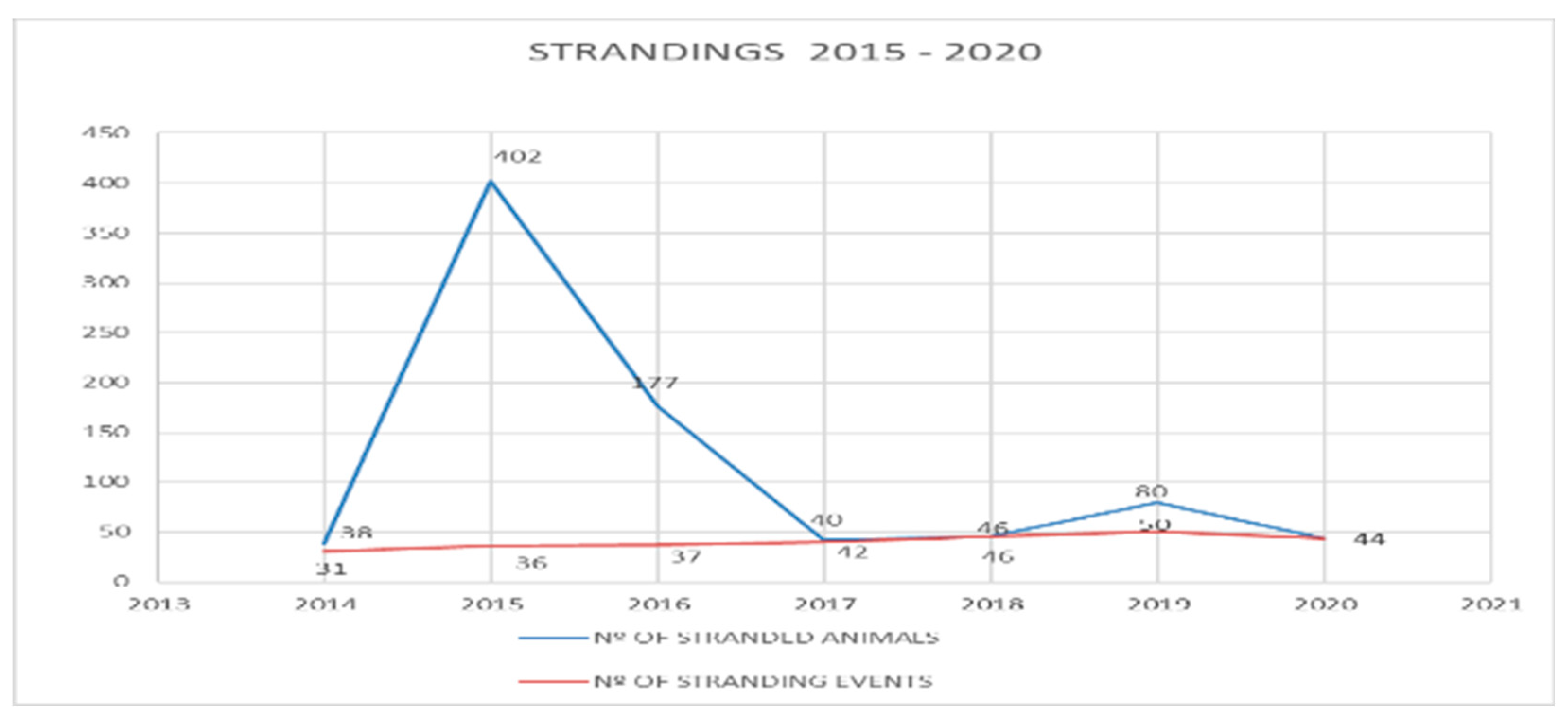

Table 1.
Habitual cetacean species recorded in the Chilean sea. (Aguayo, 1998).
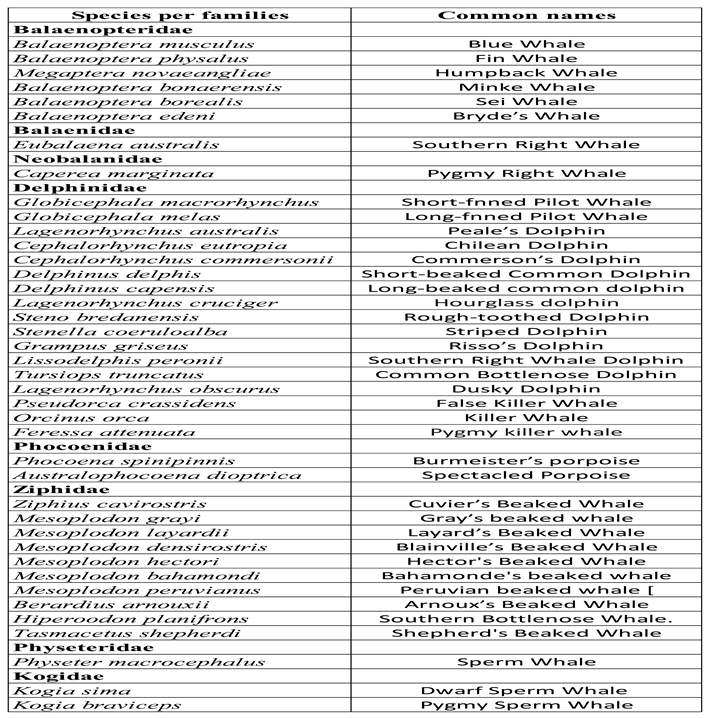 |
Table 2.
Cetacean species recorded in strandings in Chile, grouped.by taxonomic family, sex and age group years 2015 to 2020.
Table 2.
Cetacean species recorded in strandings in Chile, grouped.by taxonomic family, sex and age group years 2015 to 2020.
 |
Disclaimer/Publisher’s Note: The statements, opinions and data contained in all publications are solely those of the individual author(s) and contributor(s) and not of MDPI and/or the editor(s). MDPI and/or the editor(s) disclaim responsibility for any injury to people or property resulting from any ideas, methods, instructions or products referred to in the content. |
© 2023 by the authors. Licensee MDPI, Basel, Switzerland. This article is an open access article distributed under the terms and conditions of the Creative Commons Attribution (CC BY) license (http://creativecommons.org/licenses/by/4.0/).
Copyright: This open access article is published under a Creative Commons CC BY 4.0 license, which permit the free download, distribution, and reuse, provided that the author and preprint are cited in any reuse.


