

Submitted:
16 August 2023
Posted:
18 August 2023
You are already at the latest version
Abstract
Hay and straw are commonly used materials in agriculture. They are organic materials and therefore flammable. This article examines the behaviour of hay and straw when exposed to radiant heat. The objective of this study is to experimentally determine the ignition temperature of hay and straw under the influence of radiant heat. The research investigates the effects of sample type (hay and straw) and sample quantity on the thermal degradation process, temperature increase within the samples, and ignition temperature of the samples as a function of time. The ignition temperature of hay was determined to be higher (407°C) compared to straw (380°C). The results did not demonstrate a significant correlation between sample type and the thermal degradation process or the ignition temperature of hay and straw.
Keywords:
hay
; straw
; radiant heat
; ignition temperature
1. Introduction
Biomass as a renewable energy source is used as fuel [1,2,3,4,5], as a progressive natural insulation material in construction [6,7,8], and as animal feed and bedding in agriculture [9,10]. Hay and straw, which belong to the biomass group, are primarily utilized in agriculture [11,12]. For a cow weighing about 500 kilograms (look example Figure 1), more than 3 tons of hay will be required during the stay in the stable (from October to April) [13]. They are natural materials that are also used as natural thermal insulators [14,15,16]. However, it is necessary to acknowledge that these materials are flammable and not resistant to heat [17,18,19].
Their basis is the dried animal feed, which has a precise technological processing sequence, followed by packaging and storage [17]. The essence of the processing lies in drying and is based on the given moisture content (Table 1). The temperature increase is a consequence of the raw material processing by bacteria (fermentation) or the occurrence of decay. They both pose a fire hazard [18].
Hay is green forage preserved through natural drying or supplemental drying. In addition to fresh green forage - grass, hay is the most natural and suitable feed for all types of livestock [11,21]. Hay represents the dried stems of plants, preserved through drying and partial fermentation. Hay serves as a long-term supply of high-quality dry bulk feed if appropriately stored according to regulations [12]. It is a dried form of plant food, with water content ranging from 10-12% [22]. Once dried, the water content in hay decreases to 9-10% [11,12]. It is stored in hay lofts, which typically have a slatted floor with tunnels where heated ventilators blow air to expedite the drying process.
Straw is the dried stalk of cereal crops, obtained after the threshing. Straw typically consists of dried stalks of a single cereal crop. In Slovakia, barley, oat, wheat, and rye straw are commonly used [17]. Straw is most frequently used as bedding for livestock [9], as a substrate for mushroom cultivation [18], or as an insulating material [23,24]. All these types of straw have a tendency to self-ignite thermally and microbiologically [18]. The literature [22] states that straw is a flammable material that is easily ignited by sparks and hot surfaces.
Statistical data on fire incidents obtained from the Fire Technology and Expertise Institute of the Ministry of Interior of the Slovak Republic confirm the occurrence of fires in agriculture [25]. Although the number of fires shows a declining trend, agricultural fires maintain a relevant percentage share (11-5%) of the total annual fire incidents in the Slovak Republic [16].
The risk of fire in agricultural crops was considered when developing the Slovak standard [20]. Solid flammable substances (Table 1) include fodder, hay, straw, and other dry, mowed stem plants, solid fuels, extracted woody biomass, and woody biomass processed into various product assortments (timber, wood chips, sawdust, cellulose-based pellets and briquettes) (§2 of Decree 258/2007 Coll.) [20]. The potential ignition of hay and straw is dependent on external conditions. The critical parameter is the ignition temperature at which ignition occurs depending on the duration of the heat source's activity. Hot surfaces are part of technological elements used in agriculture. Their surface temperature can exceed the minimum ignition temperature and pose a risk of fire ignition.
The aim of the article is to experimentally determine the ignition temperature of hay and straw due to radiant heat. The influence of the sample type (hay and straw) and the selected sample mass (1, 2, and 3 g) on the course of the thermal degradation, temperature increase inside the sample, and ignition temperature over time were observed. Significant differences in thermal degradation and ignition temperature based on the type of fuel (hay and straw) were sought.
2. Materials and Methods
2.1. Experimental samples
For the purposes of the experiment, samples of hay and straw obtained from an agricultural farm were used (Table 2) [20].
The samples were stored in bales and used for the operation of the cattle barn.
2.2. Experimental methods
The methodology consisted of two steps:
- Monitoring the thermal degradation of samples based on gradual heating of the sample by radiant heat and tracking degradation points with identification of temperature and time during the degradation processes.
- Determination of the minimum ignition temperature using isothermal testing using a hot-plate according to EN 50281-2-1:1998 [26].
In both cases, measurements were repeated 3 times.
2.2.1. Methodology for monitoring the thermal degradation of hay and straw
The experiment was carried out using a technical device called a hot-plate (Figure 2). Samples of hay and straw were subjected to gradual heating. The temperature of the heated plate and its increase over time were determined following the methodology described by Marková [16]. The obtained temperature-time curve [16] also served as the basis for measuring the ignition temperature according to EN 50281-2-1:1998 [26].
2.2.2. Determination of the minimum ignition temperature by isothermal heating using a hot-plate according to EN 50281-2-1:1998 [26]
The minimum ignition temperature of the organic layer was determined by isothermal heating of the sample placed on an electrically heated metal plate (Figure 2a, b). The minimum ignition temperature is defined as the lowest temperature of the heated plate's surface at which at least one of the following phenomena can be observed during the test:
- Glowing, smouldering, or flaming combustion,
- The temperature-time curve recorded by the thermocouple, which is placed at the centre of the sample layer, continuously rises with comparison to the temperature of the isothermally heated plate,
- The temperature measured in the sample layer is 250°C higher than the temperature of the heated plate.
The experiment verified the occurrence of the first two phenomena described earlier. The minimum ignition temperature was determined for all samples (Figure 2 and Table 3).
A detailed description of individual steps of the experiment is provided by Balog et al. [27].
The experimental results were obtained using installed thermocouples which measured:
The weight (1, 2, and 3 g) and hence the thickness of the sample in the testing device hot-plate were gradually increased. The results identify changes in the sample by determining the temperature inside the sample, the temperature of the plate that caused the change, and the chronological sequence of events (Table 3).
3. Results and Discussion
The conducted experiments provide interesting results. Description of the behaviour of the hay and straw layers during their thermal exposure to a radiant heat source is presented in Table 3. The moment of ignition is recorded as Tignition and Thot in Table 4. The temperature values inside the samples are recorded as Thay and Tstraw. The data is supplemented with photographic documentation. The sample weight was continuously increased by 1g. The change in sample weight did not affect the course of the experiments, confirming the findings presented in Marková et al. [10,16]. Based on the repeated experiments, specific stages of the sample's behaviour during its thermal degradation were identified. These stages include the development of odour, smoking, carbonization of the bottom layer touching the hot-plate, carbonization of the sample edges, and ignition (Table 3, Table 4, and Table 5).
The course of thermal degradation of straw was more pronounced in identified stages compared to hay (Table 3).
The course of thermal degradation of hay and straw is significantly comparable. Differences arise in the thermal-time evaluation of their degradation (Table 3 and Table 4). The comparison is based on the generated temperature-time curves, i.e., the dependence of experimentally determined temperature (Thay and Tstraw) (Table 4) on time (Figure 3).
The ignition temperatures of hay and straw determined by two different procedures are significantly comparable (Table 4).
Experts are still debating which of the materials (hay & straw) poses a higher risk of fire ignition [28]. The results show an overall delayed process of thermal degradation for hay compared to straw at higher temperatures. The first phase of degradation (labelled as 1 hay and 1 straw in Figure 3) is characterized by odour. The odour of burning hay and straw starts at temperatures above 60°C, but with a 30-second delay for straw (Figure 3). The findings are consistent with the measures implemented in practice [17,28] and with regulation 258/2007 Coll [20]. Literature [17,28] presents a temperature of 65°C as the beginning of the dangerous thermal zone. The unpleasant odour intensified with increasing temperature in both types of samples.
Smoke production was recorded at a temperature of 100°C inside the samples. The smoke had a white color. In terms of time, straw started smoking earlier, at 450 seconds. Hay started smoking at 505 seconds. As the surface and sample temperature increased, the smoking intensified (Figure 3).
In the straw sample, carbonization of the bottom layer of straw stems occurred on average at a temperature of 169.4°C (Table 4) at 800 seconds. The carbonization process of the bottom layer of hay sample occurred at an average temperature of 150.2°C at 780 seconds (14 minutes) at a hot-plate temperature of 330.2°C. The carbonization process occurred in the edges of the straw sample at an average temperature of 175.6°C at 960 seconds (16 minutes) with the hot-plate temperature ranging from 360-400 °C. The 4th process begins earlier in straw (400-410 seconds) at a temperature of 179.4°C and a hot-plate temperature of 400-430 °C (Figure 4).
With the gradual increase in surface and sample temperature, the smoke intensified until the ignition point was reached, resulting in ignition in the tested straw sample. Subsequently, the smoke intensity decreased until it completely disappeared, leaving only glowing charred residues and stems of the tested samples (Figure 5), positioned 10 mm above the hot surface. here (Figure 4 and Table 2).
Throughout the entire degradation process, the critical temperatures of hay and straw were comparable, with hay showing degradation at an earlier stage and at lower temperatures compared to straw. Subsequent events occurred earlier in straw and at lower temperatures than in hay. The risk of fire cannot be considered higher for hay or straw, in terms of the time-related development of thermal degradation or temperatures of thermal degradation in partial processes (Figure 3, Table 4).
The literature [22] states a critical temperature of 80°C at which the spontaneous combustion process of hay and straw occurs. Several authors [3,7] report a higher risk of fire for hay compared to straw. The authors [17] attribute this to the increase in the internal temperature of the hay bale, which does not decrease but, on the contrary, creates an ideal environment for the proliferation of thermophilic bacteria. Consequently, the temperature of the hay bale rises up to 77°C (reported as the temperature of spontaneous combustion) [17].
The determined experimental results of ignition temperatures are higher for straw. Flachbart and Svetlík [29] also present higher ignition temperature values for straw (Table 5). The ignition temperatures of hay and straw samples (Table 2) show differences in values.

Table 5.
Mutual comparison Ignition temperatures of hay and straw
| Ignition temperature | Hay | Straw |
|---|---|---|
| Experimentally determined temperature (°C) | 406.6±5.1 | 385.33±13.2 |
| Temperature experimentally determined according to EN 50281-2-1:1998 [26] (°C) | 407 | 380 |
| Temperature according by [18] | 310 | 330 |
| Temperature according to [29] | 230 | 310 |
The search for a significant effect was performed using the statistical program Qplot. Produced histograms (box plots) did not confirm a significant influence of weight and sample type on the minimum ignition temperature of hay and straw (Figure 5a), as well as on the time-related development of thermal degradation of the samples (Figure 5b).
Box plots (Fig.5) show faster straw degradation at lower temperatures than hay.
4. Conclusions
Based on the obtained experimental results:
- The minimum ignition temperature of hay according to EN 50281-2-1:1998 [26] is 407°C.
- During exposure to radiant heat, the critical temperatures of hay and straw were comparable, except for the initial phase, where hay degradation started earlier at a lower temperature and in a shorter time interval compared to straw.
- It is not possible to unequivocally determine which of the mentioned materials poses a greater risk of fire.
- The significant effect of weight and sample type on the minimum ignition temperature of hay and straw, as well as on the time-related development of thermal degradation of the samples, was not confirmed.
Author Contributions
Conceptualization, I.M. and I.T.; methodology, Z.G.; software, I.M.; validation, I.T., I.M. and Z.G.; formal analysis, J.J.; investigation, Z.G. and M.I.; resources, I.T., J.J. and M.I.; data cu-ration, I.M, J.J.; writing—original draft preparation, I.M.; writing—review and editing, J.J.; I.T.; project administration, J.J.; funding acquisition, I.M. All authors have read and agreed to the published version of the manuscript.
Funding
This article was supported by Institute Grant of University of Žilina No 12716
Data Availability Statement
Not applicable for studies not involving humans or animals.
Acknowledgments
This article was supported by the Institute Grant of University of Žilina No 12716.
Conflicts of Interest
The authors declare no conflict of interest.
References
- Čajová, K. N.; Holubčík, M.; Trnka, J.; Čaja, A. Analysis of Ash Melting Temperatures of Agricultural Pellets Detected during Different Conditions. Fire 2023, 6, 88. [CrossRef]
- Štulajter, M., Lieskovský, M., Messingerová, V. Energy properties of pellets, briquettes and charcoal produced in Slovakia. Acta Facultatis Forestalis 2015, 57, 133-144. (in Slovak).
- Martiník, L.; Drastichová, V.; Horák, J.; Jankovská, Z.; Krpec, K.; Kubesa, P.; Hopan, F.; Kaličáková, Z. Combustion of waste biomass in small facilities. Chemické listy. 2014,108, 156-162. (in Czech).
- Mullerová, J.; Hloch, S.; Valíček, J. Reducing Emissions from the Incineration of Biomass in the Boiler. Chemické listy 2010, 104, 9.
- Baláš, M.; Lisý, M.; Lisá, H.; Vavříková, P., Milcháček, P.; Elbl, P. Spalné teplo a složení biopaliv a bioodpadů. Energie z biomasy XX. Vysoké učení technické, Fakulta strojního inženýrství, Lednice, 17th-19th September 2019. Available online: https://eu.fme.vutbr.cz/file/Sbornik-EnBio/2019/Sborn%C3%ADk_Enbio_2019.pdf (accessed on 04 August 2023). (in Czech).
- Daňková, D.D.; Hejhálek, J. Tepelné izolácie – prehľad, materiály, druhy, spôsoby použitia. https://www.istavebnictvo.sk/clanky/tepelne-izolace-prehled-materialy-druhy-zpusoby-po (accessed on 04 December 2009). (in Slovak).
- Tobias, R., Writer, R. Building With Straw Bales: A Comprehensive Guide. Available online: https://www.buildwithrise.com/stories/how-to-build-a-home-using-straw-bale (accessed on 10 July 2021).
- Cascone, S.; Rapisarda, R., Cascone, D. Physical Properties of Straw Bales as a Construction. Material: A Review. Sustainability 2019, 11, 3388. [CrossRef]
- Giertlová, Z. Rettung von Großvieh bei Brandereignissen landwirtschaftlicher Gebäude in Holzbauweise. TV3: Brandschutztechnische Maßnahmen: Zwischenbericht, Berichtzeitraum 1.4.2021-30.6.2022, Förderkennzeichen 2220HV008C. Final Report. Bearbeitung Präventionsingenieure e:V., Planegg, 2023. (not publish).
- Marková, I.; Giertlová, Z.; Hutár, M. Stanovenie teploty vznietenia sena pre účely posudzovania rizík v stredných a malých poľnohospodárskych podnikoch. Krízový manažment 2022, 21,50-56. (in Slovak).
- Kováč, M.; Čupka, V.; Kacerovský, O. Výživa a kŕmenie hospodárskych zvierat (Nutrition and feeding of farm animals). 1st ed.; Publisher: Príroda, Bratislava, Slovak Republic, 1989, 536 pp. (in Slovak).
- Sraková, E.; Suchý, P.; Herzig, I.; Suchý, P.; Tvrzník, P. 2008. Výživa a dietetika. I. diel –všeobecná výživa (Nutrition and dietetics. Part I – general nutrition). 1st ed.; Publisher: VFU, Brno, Czech Republic, 2008. pp. 75-76. (in Czech).
- Zarechny M.V. Koľko sena potrebuje krava na rok, deň a zimu (How much hay does a cow need for a year, day and winter). Available online: https://garden.desigusxpro.com/sk/krs/soderzhani/skolko-sena-na-zimu-nuzhno.html (accessed on 10 July 2023). (in Slovak).
- Gaspercova, S.; Osvaldova, LM.; Kadlicova, P. Additional thermal insulation materials and their reaction on fire. Journal FIRE PROTECTION, SAFETY AND SECURITY 2017, 51-56.
- Osvaldova, LM.; Janigova, I.; Rychly, J. Non-Isothermal Thermogravimetry of Selected Tropical Woods and Their Degradation under Fire Using Cone Calorimetry. Polymers 2021, 13, 708. [CrossRef]
- Marková, I.; Mitrenga, P.; Makovická Osvaldová, L.; Hybská, H. Determination of the ignition temperature of hay for the purposes of fire risk assessment on farms - Slovak case study. BioResources 2022, 17, 6926-6940. [CrossRef]
- BORGA. Skladovanie sena a slamy alebo ako predísť požiarom. Available online: https://www.montovane-haly-borga.sk/skladovanie-sena-a-slamy-alebo-ako-predist-poziarom (accessed on 30 May 2022). (in Slovak).
- Preventing fires in baled hay and straw. Farm and Ranch eXtension in Safety and Health (FReSH) Community of Practice 2012. Available online: http://www.extension.org/pages/66577/preventing-fires-in-baled-hay-and-straw4 (accessed on 15 August 2018).
- Fire Hazard in Wet Bales. Available online: https://extension.sdstate.edu/fire-hazard-wet-bales (accessed on 18 May 2020).
- Decree of the Ministry of the Interior of the Slovak Republic No. 258/2007 Coll. on requirements for fire safety in storage, storage and handling of solid combustible substances.
- Ďudák, J. Stavby a objekty na uskladnenie objemových krmív (Buildings and objects for bulk feed storage). Available online: http://www.agroparadenstvo.sk/stroje-zber-urody?article=2450 (accessed 20 Januay 2022). (in Slovak).
- Tables of Flammable and Dangerous Substances. 1st ed. Publisher: Svaz PO ČSSR, Prague, 1980 (in Czech).
- Kadlicová, P.; Makovická Osvaldová, L.; Gašpercová, S. Ekologické dopady zatepľovacích systémov (Environmental impact of thermal isulation materials). Acta Universitatis Matthiae Belii, seria Environmentálne manažérstvo 2016, 18, 2. (in Slovak).
- Makovická Osvaldová, L.; Gašpercová, S.; Petho, M. Natural Fiber Thermal Insulation Materials from Fire Prevention Point of View. Proceedings of the International Symposium on Material, Energy and Environment Engineering, November, Bratislava, Slovak Republic, 5th May 2015. [CrossRef]
- Statistical Office of the Slovak Republic 2022. STATdat. Štatistika stavu hospodárskych zvierat za jednotlivé roky 2011- 2020. Available online: http://statdat.statistics.sk/cognosext/cgi-bin/cognos.cgi?b_action=cognosViewer&ui.action=run&ui.object=storeID(%22iF60EC5BD94894A19A9737BA5A8E4F162%22)&ui.name=Stavy%20hospod%c3%a1rskych%20zvierat%20k%2031.12.%20%5bpl2016rs%5d&run.outputFormat=&run.prompt=true&cv.header=false&ui.backURL=%2fcognosext%2fcps4%2fportlets%2fcommon%2fclose.html (accessed on 18 May 2022).
- EN 50281-2-1 (1998) Electrical apparatus for use in the presence of combustible dust - Part 2-1: Test methods - Methods for determining the minimum ignition temperatures of dust.
- Balog, K.; Martinka, J.; Chrebet, T.; Hrušovský, I., Hirle, S. Zápalnosť materiálov a forenzný prístup pri zisťovaní príčin požiarov (Flammability of materials and forensic approach in fire investigation). In Proceedings of XXIII. International scientific conference ExFoS - Expert Forensic Science, Brno, Czech Republic, 2nd May 2014, 20-36. (in Slovak).
- Hay and Straw Barn Fires a Real Danger. Available online: https://agcrops.osu.edu/newsletter/corn-newsletter/2019-21/hay-and-straw-barn-fires-real-danger (accessed on 19 May 2022).
- Flachbart, J.; Svetlík, J. Waste materials – sources of fire. Fire risk management in the natural environment. Collection of scientific papers. Published by: Fire Engineering and Expertise Institute of the Ministry of the Interior of the Slovak Republic, Bratislava, Slovak Republic, 2018, 101-108. (in Slovak).
- Xie, T.; Wei, R.; Wang, Z.; Wang, J. Comparative analysis of thermal oxidative decomposition and fire characteristics for different straw powders via thermogravimetry and cone calorimetry. Process Safety and Environmental Protection 2020, 134, 121–130. https://doi.org/10.1016/j.psep.2019.11.028.
Figure 1.
Demonstration of hay as feed for cows [13].
Figure 1.
Demonstration of hay as feed for cows [13].
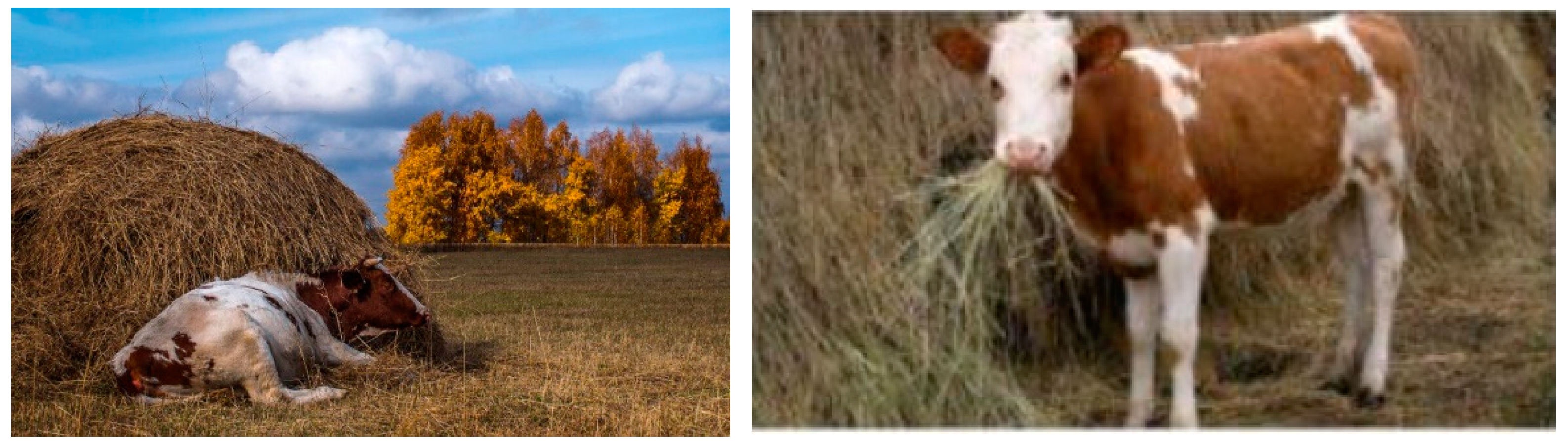
Figure 2.
(a) Hot-plate device; (b) Scheme of the apparatus for determining the ignition temperatures of settled dust EN 50281-2-1:1998 [26]. Legend: A – heated plate, B – frame, C – heating element, D – base of the heating element, E – outlet for connecting the heating element to the power source and control, F – ring for creating the layer of dust, G – thermocouple in the plate for regulation, H – thermocouple in the plate for temperature recording, I – thermocouple for temperature recording in the layer of dust, J – height adjustment of the thermocouple using screws, K – spring.
Figure 2.
(a) Hot-plate device; (b) Scheme of the apparatus for determining the ignition temperatures of settled dust EN 50281-2-1:1998 [26]. Legend: A – heated plate, B – frame, C – heating element, D – base of the heating element, E – outlet for connecting the heating element to the power source and control, F – ring for creating the layer of dust, G – thermocouple in the plate for regulation, H – thermocouple in the plate for temperature recording, I – thermocouple for temperature recording in the layer of dust, J – height adjustment of the thermocouple using screws, K – spring.

Figure 3.
Temperature increase inside the samples of hay (Thay) and straw (Tstraw) as a function of time.
Figure 3.
Temperature increase inside the samples of hay (Thay) and straw (Tstraw) as a function of time.
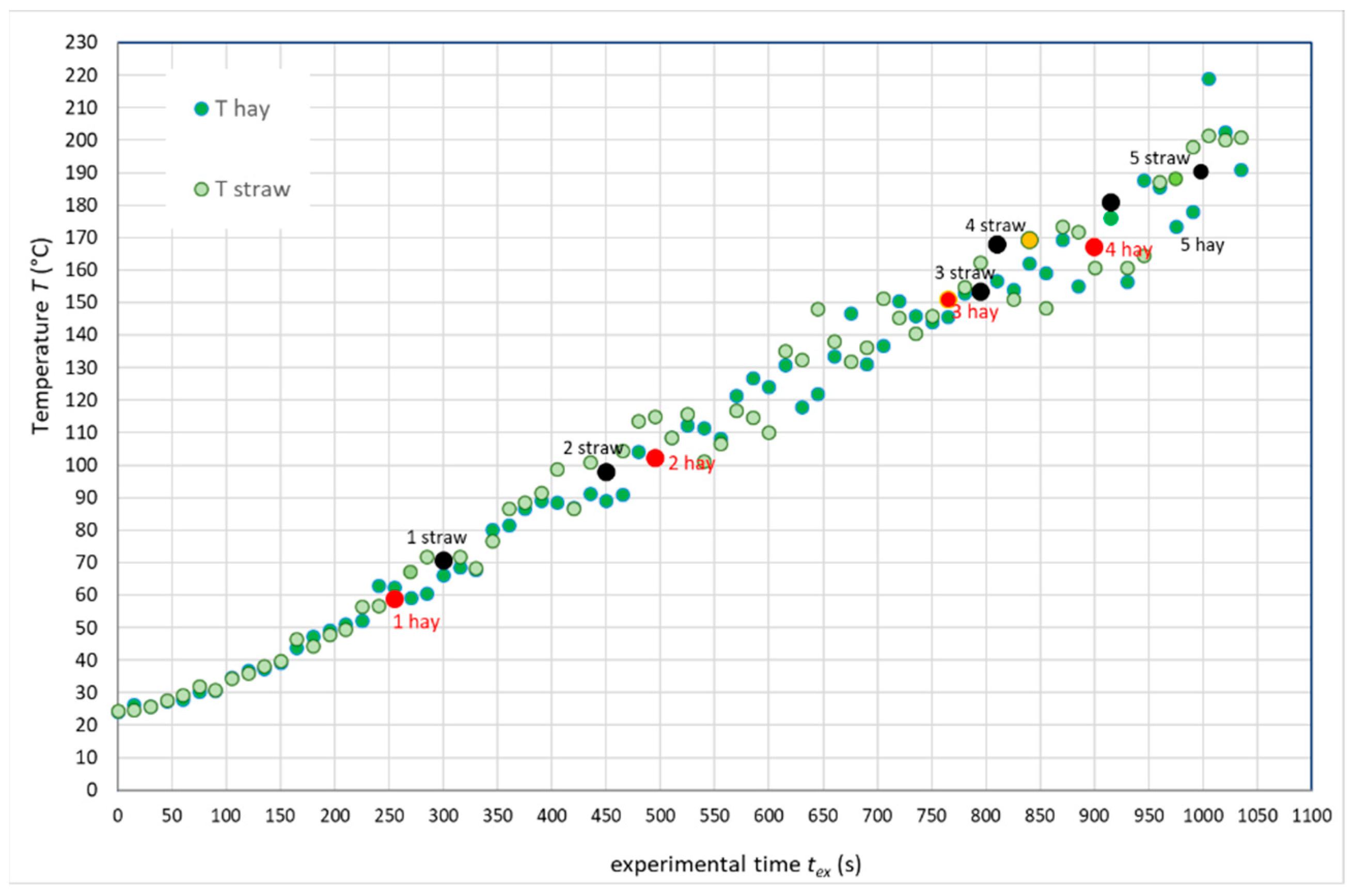
Figure 4.
Samples after ignition (a) 2 g of hay sample, measurement at 1020 seconds; (b) 2 g of straw sample, measurement at 1050 seconds.
Figure 4.
Samples after ignition (a) 2 g of hay sample, measurement at 1020 seconds; (b) 2 g of straw sample, measurement at 1050 seconds.
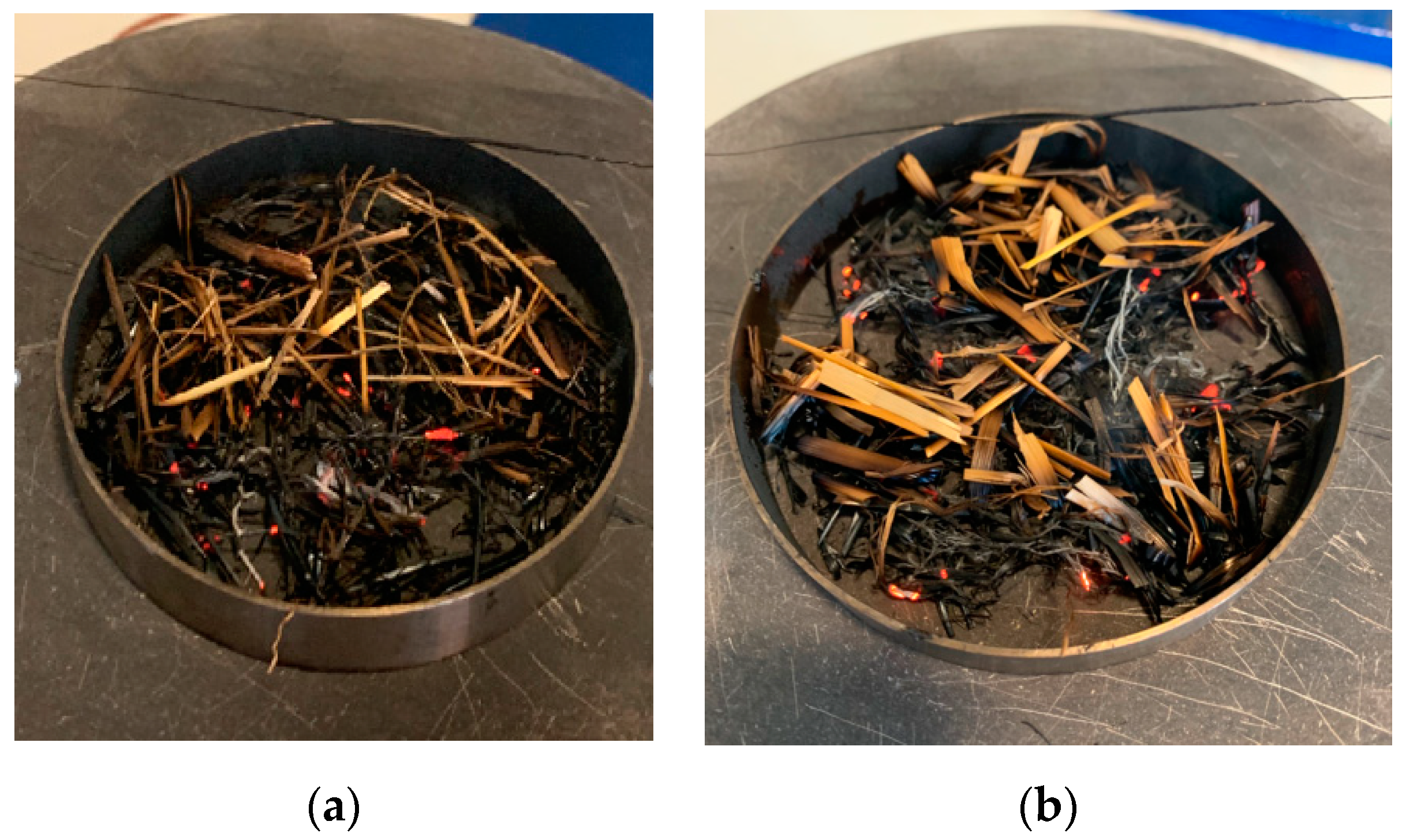
Figure 5.
Box plots - graphical dependencies. (a) of wood species and weight on the minimum ignition temperature; (b) of wood species on the time course of the thermal degradation.
Figure 5.
Box plots - graphical dependencies. (a) of wood species and weight on the minimum ignition temperature; (b) of wood species on the time course of the thermal degradation.
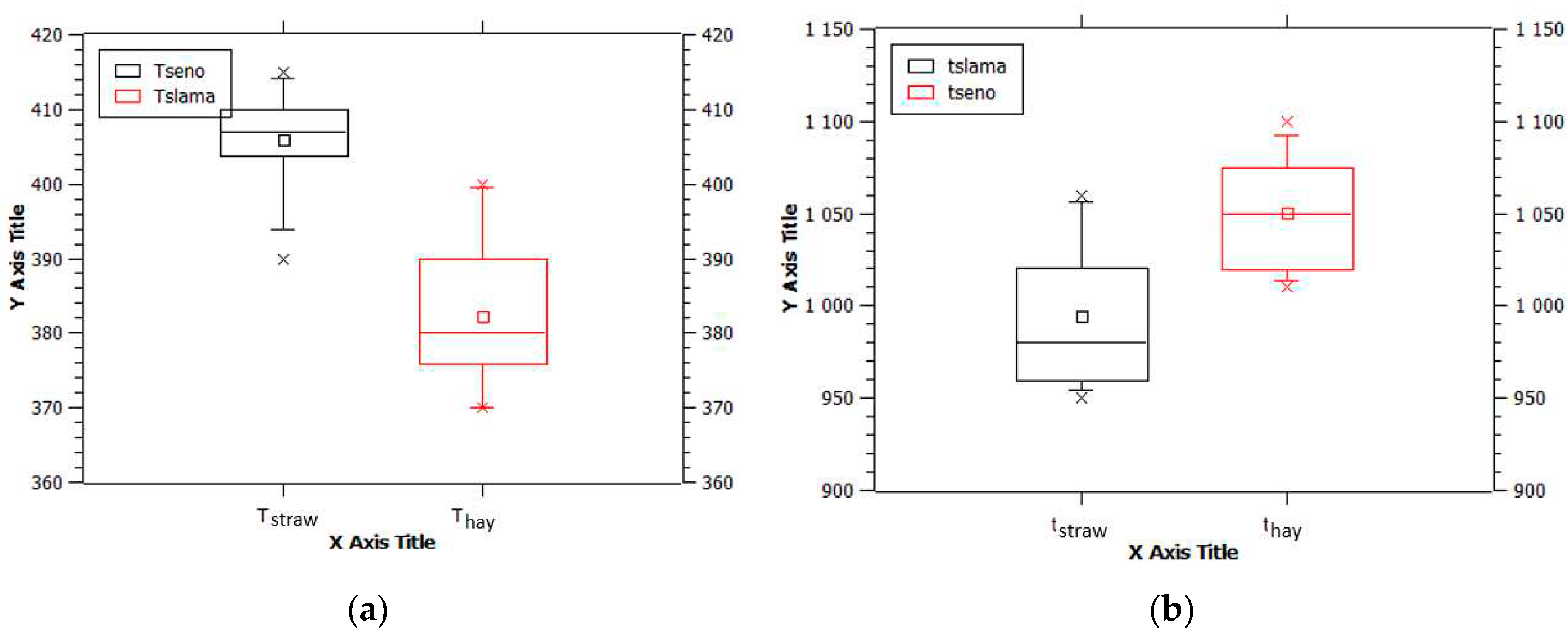
Figure 6.
TGA-DTA-DSC curves of rape straw under a heating rate at 10°C.min-1 [30]
Figure 6.
TGA-DTA-DSC curves of rape straw under a heating rate at 10°C.min-1 [30]
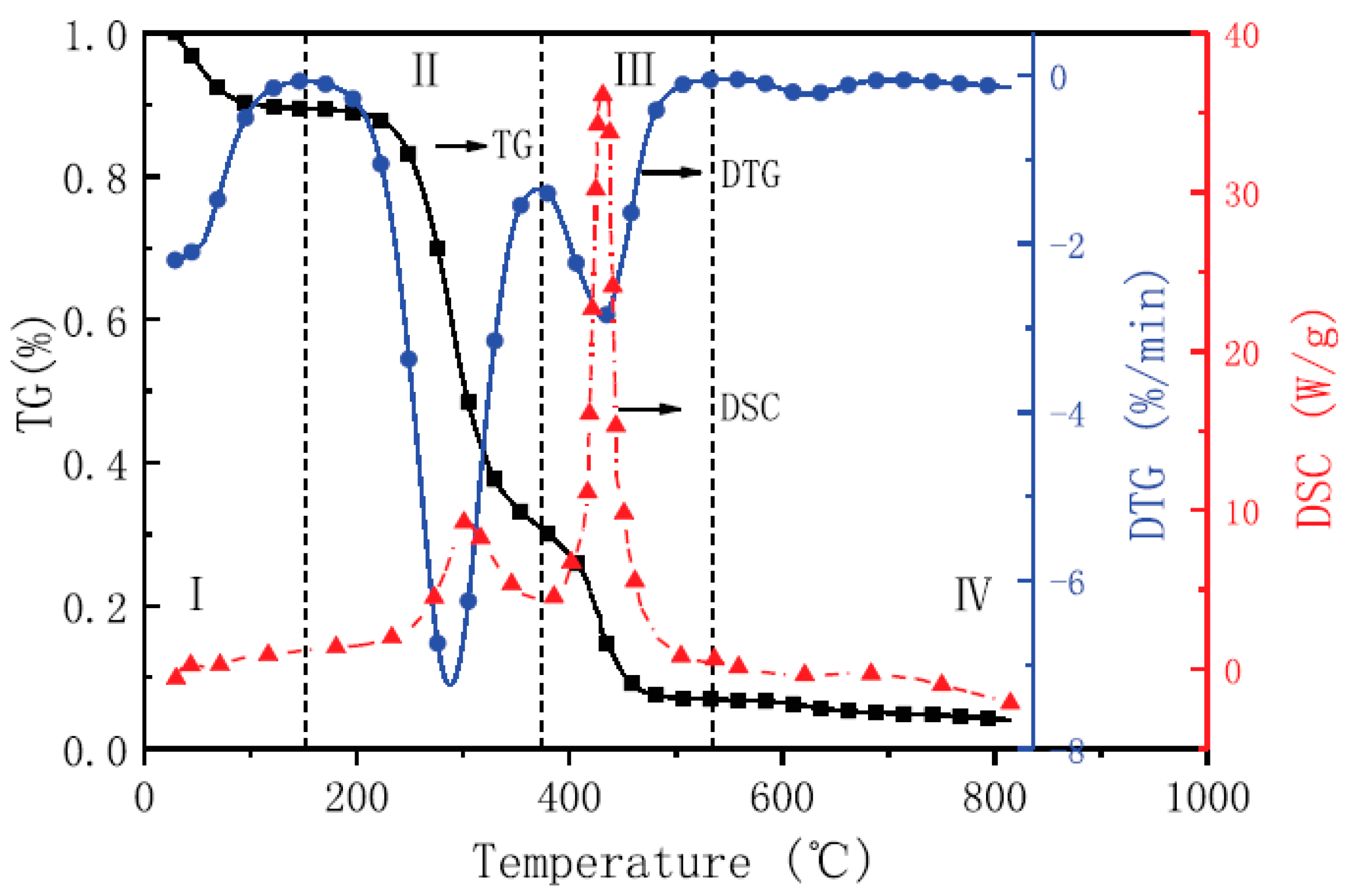
Table 1.
Group of Solid Fuels according to Decree 258/2007 Coll. [20].
Table 1.
Group of Solid Fuels according to Decree 258/2007 Coll. [20].
| Solid flammable substance | Characteristics | Moisture | Storage [17]. |
|---|---|---|---|
| Dried animal feed (silage) | Mown green grasses | more than 16% and up to 30% | |
| Mown green legumes | more than 16% and up to 35% | ||
| Hay | Dried stem of grasses or legumes | Up to 16 % | Bales, Haystack, Hay loft, Barn, Hay shed |
| Straw | Dried stalk of cereal crops | - |
Table 2.
Characteristics of samples.
| Samples (Fodder) | Hay | Straw |
|---|---|---|
| Moisture (%) determined gravimetrically | 11 | 10 |
| Moisture (%) according to 258/2007 Act No. [20] | 9-10 | 10 |
| Sample before the experiment |  |
 |
| Straw | ||||
| Process order | Tstraw (°C) | tex(min)/(s) * | Visual observations during measurement | Tigniton °C |
| 1. | 69.1 | 6 (360s) | Odour noted | 385.33±13.2 |
| 2. | 91.4 | 8.5 (525s) | Smoking process appeared | |
| 3. | 142.6 | 11 (825s) | Carbonization of the lower stems of the tested sample | |
| 4. | 145.2 | 16 (975s) | Carbonization of the edges of the tested sample, increasing smoke intensity | |
| 5. | 173.2 | 17.5 (1050s) | Ignition and formation of flames | |
1. 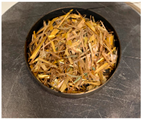 2. 2. 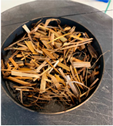 3. 3. 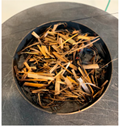 4. 4. 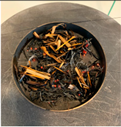 5. 5. 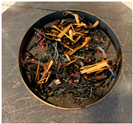
| ||||
| Hay | ||||
| Process order | Thay (°C) | tex(min)/(s) * | Visual observations during measurement | Tigniton °C |
| 1. | 111.3 | 8 (480 s) | Smoke, thermal degradation | 406.6±5.1 |
| 2. | 160.8 | 13.5 (810 s) | Carbonization of the layer on the surface of the hot-plate | |
| 3. | 185.4 | 16.75 (1005s) | Carbonization of the edges of the samples and gradual degradation of the entire surface, smouldering process observed | |
| 4. | 192.6 | 18 (1080 s) | Ignition occurs | |
2. 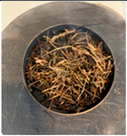 3. 3. 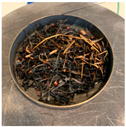 4. 4. 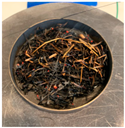
| ||||
* tex (min)/(s) – real experimental time, critical time, which identified steps of thermal degradation.
Table 4.
Experimentally determined temperatures of hay and straw degradation processes as a function of time
Table 4.
Experimentally determined temperatures of hay and straw degradation processes as a function of time
| Samples | Hay | Straw | ||||
|---|---|---|---|---|---|---|
| Monitored parameters | Thot (°C) | Thay (°C) | tex (s) | Thot (°C) | Tstraw (°C) | tex (s) |
| 1. process: Odour | - | 62.1±5.1 | - | 110-160 | 68.9±1.1 | 305±43.0 |
| 2. process: Smoke | 220-280 | 105.9±5.2 | 505±69.9 | 160-200 | 97-5±5.8 | 454±61.5 |
| 3. process: Carbonization of the bottom layer of the sample | 340-360 | 150.2±7.6 | 765±44.1 | 360-400 | 169.4±19.27 | 800±18.7 |
| 4. process: Carbonization of the edges of the sample | 400-430 | 175.6±6.9 | 905±50.1 | 400-410 | 179.4±27.5 | 815±30.8 |
| 5. process: Ignition and burning |
430-450 | 183.8±9.2 | 1050±24.5 | 410-430 | 189.9±25.6 | 960±63.6 |
| Ignition temperature | 406.6±5.1 | 385.33±13.2 | ||||
| Ignition temperature according to EN 50281-2-1:1998 [26]. | 407 | 380 | ||||
* Tables may have a footer. Explanation of abbreviations: Thot (°C) – temperature of the hot-plate surface, Thay (°C) and Tstraw(°C) – temperatures measured in the samples, tex (s) – real experimental time.
Disclaimer/Publisher’s Note: The statements, opinions and data contained in all publications are solely those of the individual author(s) and contributor(s) and not of MDPI and/or the editor(s). MDPI and/or the editor(s) disclaim responsibility for any injury to people or property resulting from any ideas, methods, instructions or products referred to in the content. |
© 2023 by the authors. Licensee MDPI, Basel, Switzerland. This article is an open access article distributed under the terms and conditions of the Creative Commons Attribution (CC BY) license (http://creativecommons.org/licenses/by/4.0/).
Copyright: This open access article is published under a Creative Commons CC BY 4.0 license, which permit the free download, distribution, and reuse, provided that the author and preprint are cited in any reuse.


