

Submitted:
25 July 2023
Posted:
26 July 2023
You are already at the latest version
Abstract
In accordance with regulations set forth by the Ministry of Land, Infrastructure, and Transport in Korea regarding the "Flame Retardant Performance of Building Finishing Materials and Fire Spread Prevention Structure," it is mandated that semi-noncombustible materials have a total heat emission less than 8 MJ/m2. Consequently, our study aimed to determine the ideal quantity of flame-retardant treatment required to meet the fire safety standards for Korean larch and Japanese cedar, commonly used exterior materials in Korean construction. To this end, we investigated using a cone calorimeter to observe changes in the THR (Total Heat Released) based on the AFI (Amount of Flame-retardant Impregnation) in Korean larch and Japanese cedar. Our findings indicated that the AFI needed to satisfy the prescribed flame-retardant standard of 8 MJ/m2 was THR 299 MJ/m2 for Korean larch and THR 526 MJ/m2 for Japanese cedar. As a result, we established optimal impregnation levels of flame retardant for both species.
Keywords:
Korean larch
; Japanese cedar
; flame retardant
; amount of flame-retardant impregnation
Introduction
The impact of human activities on the Earth's climate has been widely recognized as a significant threat [1]. In light of this, reduction of energy use and greenhouse gas emissions, particularly carbon dioxide, has become a major global concern [2]. In particular, the construction sector faces significant challenges in preserving natural resources and reducing its carbon footprint [3]. Globally, this industry is accountable for 40-50% of total CO2 emissions [4].
Wood has been used in the construction industry for thousands of years as a fundamental building material and primary furnishings source [5,6,7]. Wood offers environmental benefits such as renewability, sustainability, and minimization of energy loss through production and disposal. Therefore, increasing the use of wood in construction could be one strategy to reduce the carbon footprint [8,9]. To align with carbon footprint reduction goals, the French government mandated that more than 50% of new public buildings be constructed using wood by 2022 [10,11]. This initiative reflects a commitment to promoting the use of renewable and environmentally friendly materials in construction [10].
However, wood has some disadvantages compared to materials like steel and concrete. One of the challenges with wood is its hydrophilic nature, which readily absorbs and releases moisture [12]. Changes in dimensional stability due to moisture levels in wood materials may cause wooden structures to warp, twist, or crack [12].
Additionally, wood is more susceptible to microbiological decay. Fungi, insects, and other organisms can thrive in wood materials, potentially leading to wood rot and degradation over time if proper precautions are not taken [13,14]. This necessitates preservation treatment and maintenance to protect wood from decay-causing agents [13,14,15]. However, the biggest disadvantage of wood as a building material is that it is flammable, a matter related to human safety and life. Therefore, various methods have been proposed to protect wood from fire [16,17].
There are two methods for applying flame retardant treatment to wood: coating the wood with flame-retardant material and impregnating the wood pores with vacuum pressure [18,19]. Compared to coating, impregnation is a more beneficial method for introducing a flame-retardant effect of wood [20].
The vacuum pressure impregnation process can be optimized by adjusting the flow characteristics of the chemical, chamber temperature, and impregnation pressure and time. Jang and Kang [21] reported that, among various variables in the vacuum pressure impregnation process, pressure was a significant variable in improving the impregnation of wood.
In addition, it has been reported by various researchers that impregnation ability can be improved by inducing pore structure changes through chemical pretreatment of wood or through physical pretreatments such as drilling, laser incising, and grooving [22,23,24]. Flame retardant impregnation of wood is meaningful only when accompanied by improvement of flame-retardant properties. Therefore, it is essential to investigate the flame-retardant properties of wood after flame retardant treatment.
Park et al. [25] investigated the effective heat of combustion of 12 species mainly used as domestic building materials using a cone calorimeter. From their results, Merbau showed the lowest value with 5.85 MJ/kg and Kempas showed the highest value with 13.31 MJ/kg.
Jin and Chung [26] treated Hinoki wood with metal oxides and metal silicates and investigated the fire hazard characteristics using a cone calorimeter. The smoke performance index indicated an increase in smoke risk in the following sequence: SnO < mica < CO3O4 < ZrSiO4 < Hinoki. Meanwhile, the smoke growth index showed a decrease of 93% to 98% compared to untreated wood. The smoke risk attributed to the smoke growth index increased in the order of SnO < mica < ZrSiO4≈ Co3O4 < Hinoki.
Li et al. [27] investigated the flame-retardant properties of wood treated with chitosan-SiO2. Chitosan promotes the deposition of silicon dioxide (SiO2) in the cell walls and intercellular space of wood forming a chitosan-SiO2 film. The highest peak in the cone calorimeter reflected a significant decrease in the heat release rate of mineralized wood, and similar results were obtained in microcalorimeter experiments.
According to the administrative rules announced by the Ministry of Land, Infrastructure, and Transport in Korea, "Flame Retardant Performance of Building Finishing Materials and Fire Spread Prevention Structure," the total heat emission of semi-noncombustible materials is stipulated to be less than 8 MJ/m2 [28,29,30]. Therefore, even if flame-retardant material is not entirely impregnated into the wood, it can be used as a building exterior if this standard is met. Insufficient flame-retardant impregnation leads to lower fire safety. On the other hand, excessive flame-retardant impregnation can lead to longer processing time and unnecessary flame-retardant abuse, which may cause an increase in the cost of flame-retardant wood.
Therefore, it is necessary to investigate the optimal flame-retardant impregnation amount for each species that meets Ministry of Land, Infrastructure, and Transport standards. However, research in this area is limited. Therefore, we selected Korean larch and Japanese cedar, the most widely used exterior building materials in Korea, and investigated whether they met the Ministry of Land, Infrastructure, and Transport standard in Korea according to the degree of impregnation of flame retardants.
Materials and Methods
Timber preparation
This study utilized air-dried Japanese cedar (Cryptomeria japonica D. Don.) and Korean larch (Larix kaempferi (Lamb.) Carriere) timbers obtained from the domestic wood market. The dimensions of prepared wood samples were 100 (length) × 100 (width) × 21 mm (thickness). Ten samples were prepared for each species. The average moisture content of the wood samples was analyzed by a contact moisture meter as 13% (Korean larch) and 8.2% (Japanese cedar).
Water-soluble flame retardant
The study utilized a water-soluble flame retardant supplied by a domestic supplier based in Jeonju, Korea. The flame-retardant formulation also contained a resin content of approximately 30%. The flame retardant contained various components: dibasic ammonium phosphate comprising 12% of the formulation, ammonium polyphosphate comprising 8%, anhydrous sodium borate comprising 7%, the remaining 3% consisting of other ingredients and 70% water. The formulation density (25℃) and pH were 1.18 ± 0.02 g/cm3 and 7.10 ± 0.5, respectively.
Vacuum-pressure impregnation
This study used a wood vacuum pressure impregnation machine from Jeonbuk National University (Jeonju, Korea). The wood samples to which each grooving model was applied were placed in a chamber and subjected to a decompression process at -0.1 Mpa for approximately 5 minutes using a vacuum pump. Subsequently, the flame retardant was added to the chamber and was injected into the wood samples at a pressure of 20 kgf/cm² using a pressurized pump. The impregnation performance was monitored by weighing the samples at hourly intervals. In addition, the AFI (Amount of Flame-retardant Impregnation) was calculated as shown in Equation 1.
where m1 is the sample weight before flame-retardant impregnation (kg), m2 is the sample weight after flame-retardant impregnation (kg), and Vis the sample volume (m3).
Cone calorimeter test
To assess the flame-retardant effectiveness of domestic larch and Japanese cedar impregnated with flame retardants, cone calorimeter (Figure 1) tests were conducted in accordance with the KS F ISO 5660-1 standard [31]. During tests, a cone-shaped heater and an electric ignition source generating a heat flux of 50 kW/m2 were used to heat the sample for 10 minutes. The sample underwent combustion, and the gases produced were ignited. During the combustion process, the consumption of oxygen was measured, and the data were used to calculate the THR (Total Heat Released), representing the amount of heat released during the sample's combustion, which is determined by converting the oxygen consumption into a calorific value of 13.1 × 10³ KJ per 1 kg of oxygen.
Results and Discussion
Visual inspection
Figure 2 shows photographs of samples after cone calorimeter testing. Upon visual observation, it could be seen that the carbonization proceeded intensely on the surface in the untreated specimens. On the other hand, it was confirmed that high AFI made the carbonization of the surface proceed much less compared to the untreated case. Also, they had less cracking and greater density of the surface carbonized layer. This carbonized layer is believed to play a role in resisting heat transfer.
Comparison of AFI and THR
Figure 3 shows the AFG and THR of Korean larch and Japanese cedar. As shown in Figure 3-a, Sample 1 is a specimen not subjected to flame retardant treatment, and the higher is the sample number, the higher is the AFI. The fire-retardant performance of building finishing materials prescribed by the Ministry of Land, Infrastructure, and Transport is less than 8 MJ/m2. Samples 7 to 10 met this regulation, and the optimal AFI was 299 kg/m3. As shown in Figure 3-b, the THR of the untreated specimen (Sample 1) of Japanese cedar was 24.02 MJ/m2, about 1.16 times lower than that of Korean larch, which indicates Korean larch as the more favorable species for fire safety than Japanese cedar. Samples 6 to 10 met the Ministry of Land, Infrastructure, and Transport standards, and the optimal AFI was 526 MJ/m2. Compared to Japanese cedar, Korean larch achieved fire safety standards with a smaller amount of injected flame retardant. From these results, the optimal flame-retardant impregnation amounts of Korean larch and Japanese cedar were obtained.
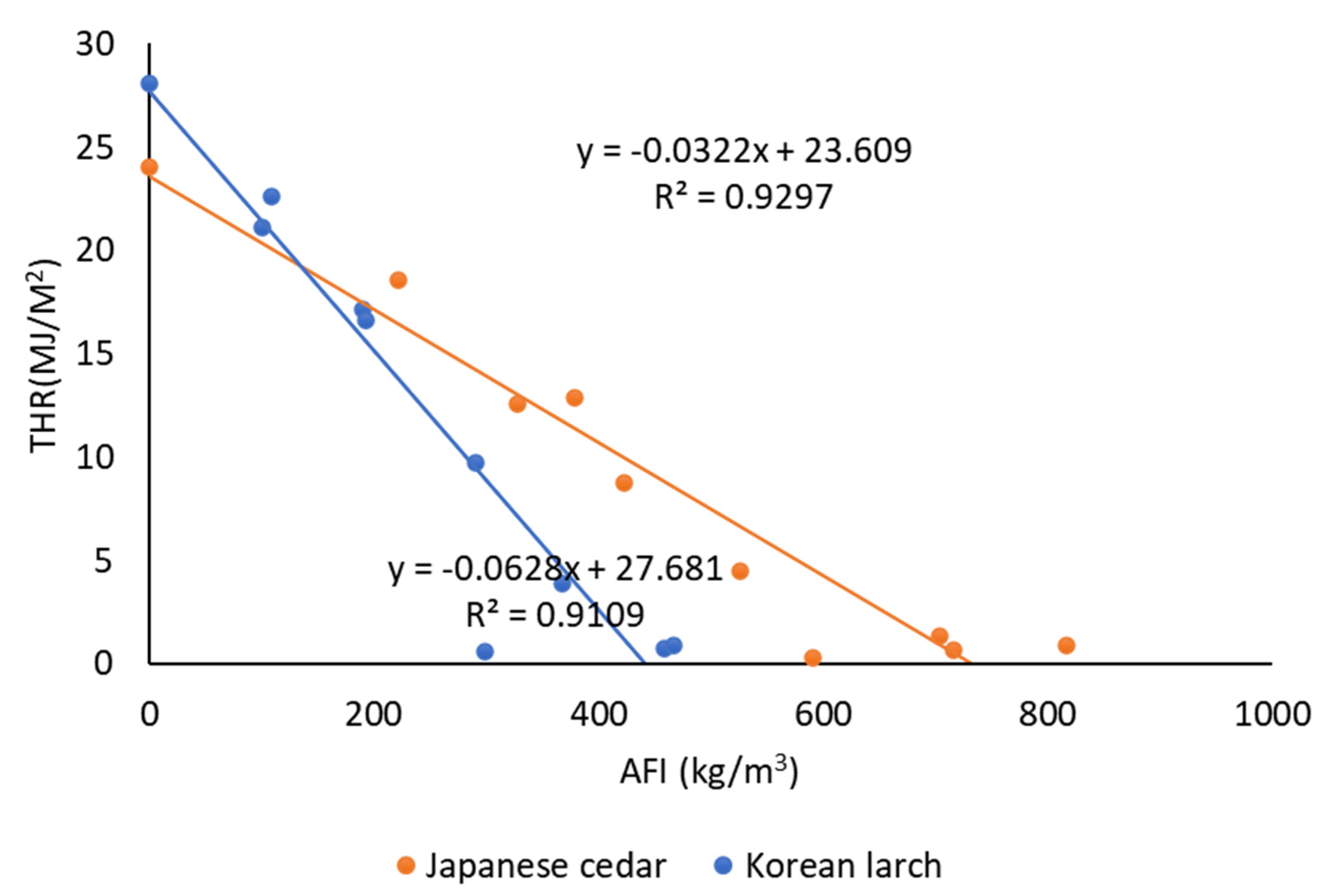
Figure 4 shows the results of a simple linear regression analysis of Korean larch and Japanese cedar with THR as the dependent variable and AFI as the independent variable. Regression equations were obtained for each species, giving R2 of 0.91 for Japanese cedar and 0.93 for Korean larch. These coefficients of determination reflect that the independent variable explains the dependent variable well. The difference between the slopes of the two equations is about twice as high for Japanese cedar as for Korean larch. This indicates that Korean larch has greater flame-retardant efficiency than Japanese cedar.
From this study, we quantified the optimal impregnation amount of flame retardant that satisfies the fire safety regulations for Korean larch and Japanese cedar and the difference in flame retardant performance between the two species. In the future, we plan to augment these data using more wood species and various flame retardants. We expect these studies to contribute to the efficiency of wood flame retardant treatment.
Conclusions
We investigated changes in THR according to AFI in Korean larch and Japanese cedar. As AFI increased, THR tended to decrease. The AFI that satisfies 8 MJ/m2, Flame Retardant Performance of Building Finishing Materials and Fire Spread Prevention Structure, notified by the Ministry of Land, Infrastructure and Transport, was THR 299 MJ/m2 for Korean larch and THR 526 MJ/m2 for Japanese cedar. From the acquired data, we obtained the optimal impregnated amount of flame retardant for both species. In addition, Korean larch required less flame retardant to meet the Korean standard compared to Japanese cedar.
Author Contributions
SUJ: First author, experiments, formal analysis, writing (review & edition), HBC: co-First author, experiments, formal analysis, HJP: Corresponding author, supervision, conceptualization, methodology, writing (review & editing), ESJ: Corresponding author, writing (original draft, review & editing)
Funding
FTIS-2022457A00-2224-AC02, FTIS-2020223A00-2222-AC02
Ethics approval and consent to participate
Not applicable.
Consent for publication
Not applicable.
Availability of data and materials
Not applicable.
Acknowledgment
This research was funded by the R&D Program for Forest Science Technology in Korea (FTIS 2022457A00-2224-AC02, FTIS 2020223A00-2222-AC02).
Competing Interest
The authors have no competing interests.
Abbreviations
AFI: Amount of Flame-retardant Injection; THR: Total Heat Released; m1: sample weight before flame-retardant impregnation (kg); m2: sample weight after flame retardant impregnation (kg); V: sample volume (m3).
References
- Driga, A.M.; Drigas, A.S. Climate Change 101: How Everyday Activities Contribute to the Ever-Growing Issue. Int. J. Recent Contributions Eng. Sci. IT 2019, 7, 22–31. [Google Scholar] [CrossRef]
- Luo, Z.; Yang, L.; Liu, J. Embodied carbon emissions of office building: a case study of China's 78 office buildings. Building and Environment 2016, 95, 365–371. [Google Scholar] [CrossRef]
- Chen, J.; Shen, L.; Song, X.; Shi, Q.; Li, S. An empirical study on the CO2 emissions in the Chinese construction industry. Journal of Cleaner production 2017, 168, 645–654. [Google Scholar] [CrossRef]
- Orsini, F.; Marrone, P. Approaches for a low-carbon production of building materials: A review. Journal of Cleaner Production 2019, 241, 118380. [Google Scholar] [CrossRef]
- Jang, E.-S. Use of Pine (Pinus densiflora) Pollen Cones as an Environmentally Friendly Sound-Absorbing Material. Journal of the Korean Wood Science and Technology 2022, 50, 186–192. [Google Scholar] [CrossRef]
- Jang, E.-S.; Kang, C.-W. () Investigation of the pore structure and sound-absorbing capability of the Chinese parasol tree (Firmiana simplex (L.) W. Wight) and Chinese tulip poplar (Liriodendron chinense) transverse sections as eco-friendly, porous, sound-absorbing materials. Journal of Porous Materials 2022, 29, 1791–1796. [Google Scholar] [CrossRef]
- Jang, E.-S. Investigation of sound absorption ability of Hinoki Cypress (Chamaecyparis obtusa) cubes. Journal of the Korean Wood Science and Technology 2022, 50, 365–374. [Google Scholar] [CrossRef]
- Farid, T.; Rafiq, M.I.; Ali, A.; Tang, W. Transforming wood as next-generation structural and functional materials for a sustainable future. EcoMat 2022, 4, e12154. [Google Scholar] [CrossRef]
- Fan, Z.; Sun, H.; Zhang, L.; Zhao, X.; Hu, Y. Lightweight, high-strength wood prepared by deep eutectic solvent treatment as a green structural material. ACS Sustainable Chemistry & Engineering 2022, 10, 9600–9611. [Google Scholar]
- Walter, A. France requires new public buildings to contain at least 50% wood. Availabe online: https://archinect.com/news/article/150183480/ (accessed on 23 June).
- Jang, E.-S. Experimental investigation of the sound absorption capability of wood pellets as an eco-friendly material. Journal of the Korean Wood Science and Technology 2022, 50, 126–133. [Google Scholar] [CrossRef]
- Sargent, R. Evaluating dimensional stability in solid wood: a review of current practice. Journal of Wood Science 2019, 65, 1–11. [Google Scholar] [CrossRef]
- Evans, P.D.; Matsunaga, H.; Preston, A.F.; Kewish, C.M. Wood protection for carbon sequestration—a review of existing approaches and future directions. Current Forestry Reports 2022, 8, 181–198. [Google Scholar] [CrossRef]
- Schultz, T.P.; Nicholas, D.D.; Preston, A.F. A brief review of the past, present and future of wood preservation. Pest Management Science: formerly Pesticide Science 2007, 63, 784–788. [Google Scholar] [CrossRef] [PubMed]
- Thybring, E.E. The decay resistance of modified wood influenced by moisture exclusion and swelling reduction. International Biodeterioration & Biodegradation 2013, 82, 87–95. [Google Scholar]
- Lowden, L.A.; Hull, T.R. Flammability behaviour of wood and a review of the methods for its reduction. Fire science reviews 2013, 2, 1–19. [Google Scholar] [CrossRef]
- Popescu, C.M.; Pfriem, A. Treatments and modification to improve the reaction to fire of wood and wood based products—An overview. Fire and Materials 2020, 44, 100–111. [Google Scholar] [CrossRef]
- Mali, P.; Sonawane, N.; Patil, V.; Lokhande, G.; Mawale, R.; Pawar, N. Morphology of wood degradation and flame retardants wood coating technology: an overview. International Wood Products Journal 2022, 13, 21–40. [Google Scholar] [CrossRef]
- Ali, S.; Hussain, S.A.; Tohir, M.Z.M. Fire Test and Effects of Fire Retardant on the Natural Ability of Timber: A Review. Pertanika Journal of Science & Technology 2019, 27. [Google Scholar]
- Oh, S.; Park, H. Vacuum pressure treatment of water-soluble melamine resin impregnation for improvement of dimensional stability on softwoods. Journal of the Korean Wood Science and Technology 2015, 43, 327–333. [Google Scholar] [CrossRef]
- Jang, E.-S.; Kang, C.-W. Effects of Pressure and Temperature on Wood Impregnation–Focusing on Larch (Larix kaempferi) and Korean Pine (Pinus koraiensis). BioResources 2023, 18, 3208–3216. [Google Scholar] [CrossRef]
- Fukuta, S.; Nomura, M.; Kurisaki, H.; Okamura, H. Application of laser micro incisions in the fire-retardant treatment. European Journal of Wood and Wood Products 2022, 80, 255–258. [Google Scholar] [CrossRef]
- He, X.; Li, X.J.; Zhong, Z.; Mou, Q.; Yan, Y.; Chen, H.; Liu, L. Effectiveness of impregnation of ammonium polyphosphate fire retardant in poplar wood using microwave heating. Fire and materials 2016, 40, 818–825. [Google Scholar] [CrossRef]
- Kuai, B.; Wang, Z.; Gao, J.; Tong, J.; Zhan, T.; Zhang, Y.; Lu, J.; Cai, L. Development of densified wood with high strength and excellent dimensional stability by impregnating delignified poplar by sodium silicate. Construction and Building Materials 2022, 344, 128282. [Google Scholar] [CrossRef]
- Park, W.-H.; Cho, Y.; Kim, C.-Y.; Na, S.; Lee, D. Study on comparison and database for combustibility of various wood materials. Journal of the Korean Society of Hazard Mitigation 2018, 18, 207–214. [Google Scholar] [CrossRef]
- Jin, E.; Chung, Y.-J. Fire risk assessment of cypress wood coated with metal oxide and metal silicate flame retardant using cone calorimeter. Journal of fire sciences 2020, 38, 504–521. [Google Scholar] [CrossRef]
- Li, H.; Wang, C.; Yang, T.; Wang, Z.; Xia, M.; Zhang, M.; Liu, D.; Yuan, G. Mineralizing wood with chitosan–silica to enhance the flame retardant and physical-mechanical properties. Journal of Sol-Gel Science and Technology 50, 1–13. [Google Scholar] [CrossRef]
- Hun, S. Flame resistance performance of architectural membranes using basalt woven fabric. Fire Science and Engineering 2016, 30, 35–42. [Google Scholar]
- Bong-Hoon, H.; Dong-Ho, S.; Young-Hee, K.; Se-Hong, M. A Study on the Fire Characterization of Foam block using Cone-calorimeter and FTIR. Fire Science and Engineering 2017, 31, 23–32. [Google Scholar]
- Seo, H.J.; Hwang, W.; Lee, M.C. Fire properties of Pinus densiflora utilizing fire-retardant chemicals based on borated and phosphorus (I)–combustion characteristics. BioResources 2017, 12, 5417–5427. [Google Scholar] [CrossRef]
- KSFISO5660-1; Reaction-to-fire tests — Heat release, smoke production and mass loss rate — Part 1: Heat release rate(cone calorimeter method) and smoke production rate (dynamic measurement). Korean Agency for Technology and Standards: Seoul, Korea, 2015.
- Park, S.-Y.; Kim, D.-H.; Im, H.-S. The experimental study for the combustion-property of sandwich panels using ISO 5660 cone calorimeter. Fire Science and Engineering 2006, 20, 33–41. [Google Scholar]
Figure 1.
Schematic diagram of the cone calorimeter [32].
Figure 1.
Schematic diagram of the cone calorimeter [32].
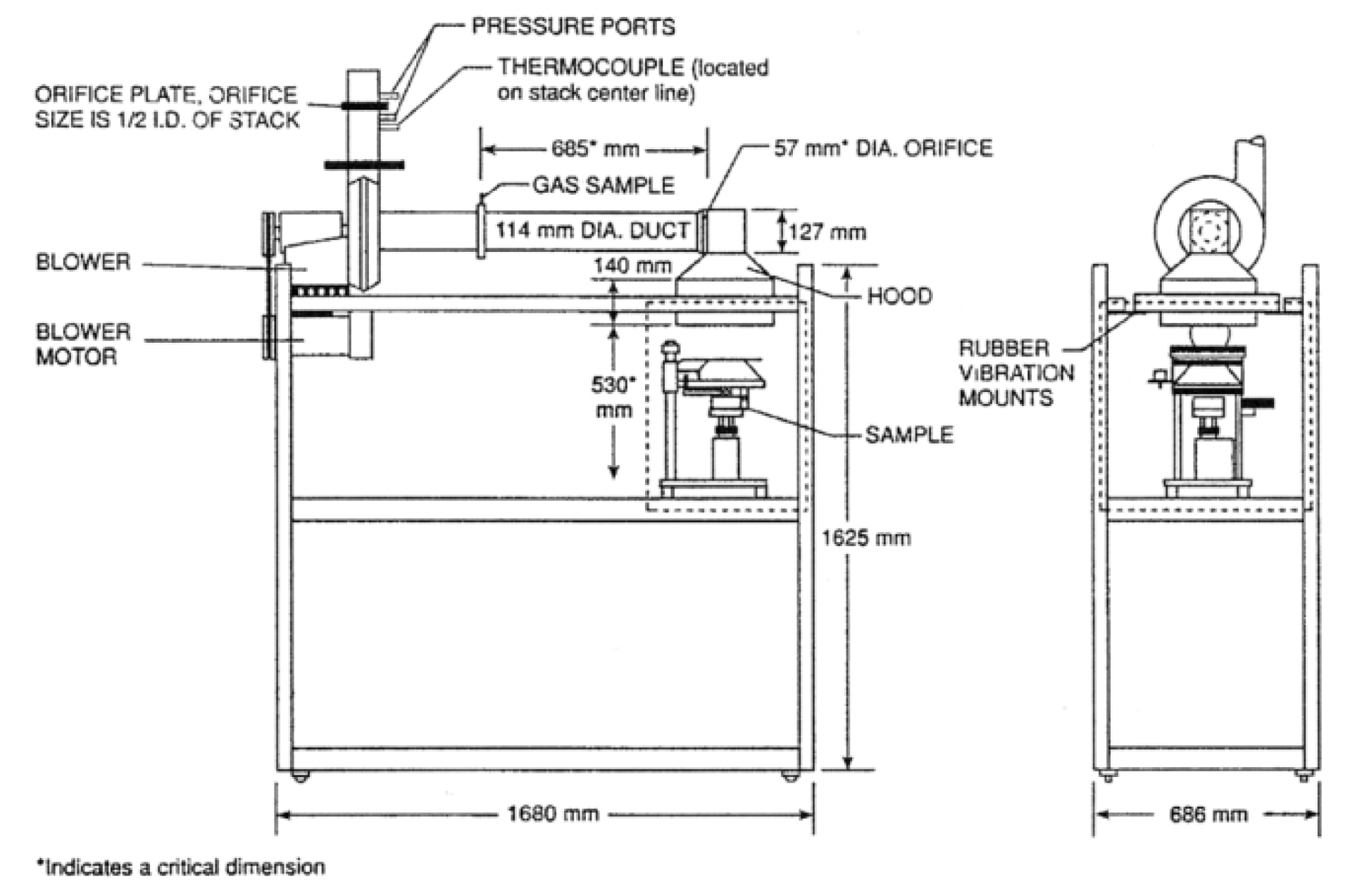
Figure 2.
Visual inspection after cone calorimeter testing (Number is AFI value kg/m3).
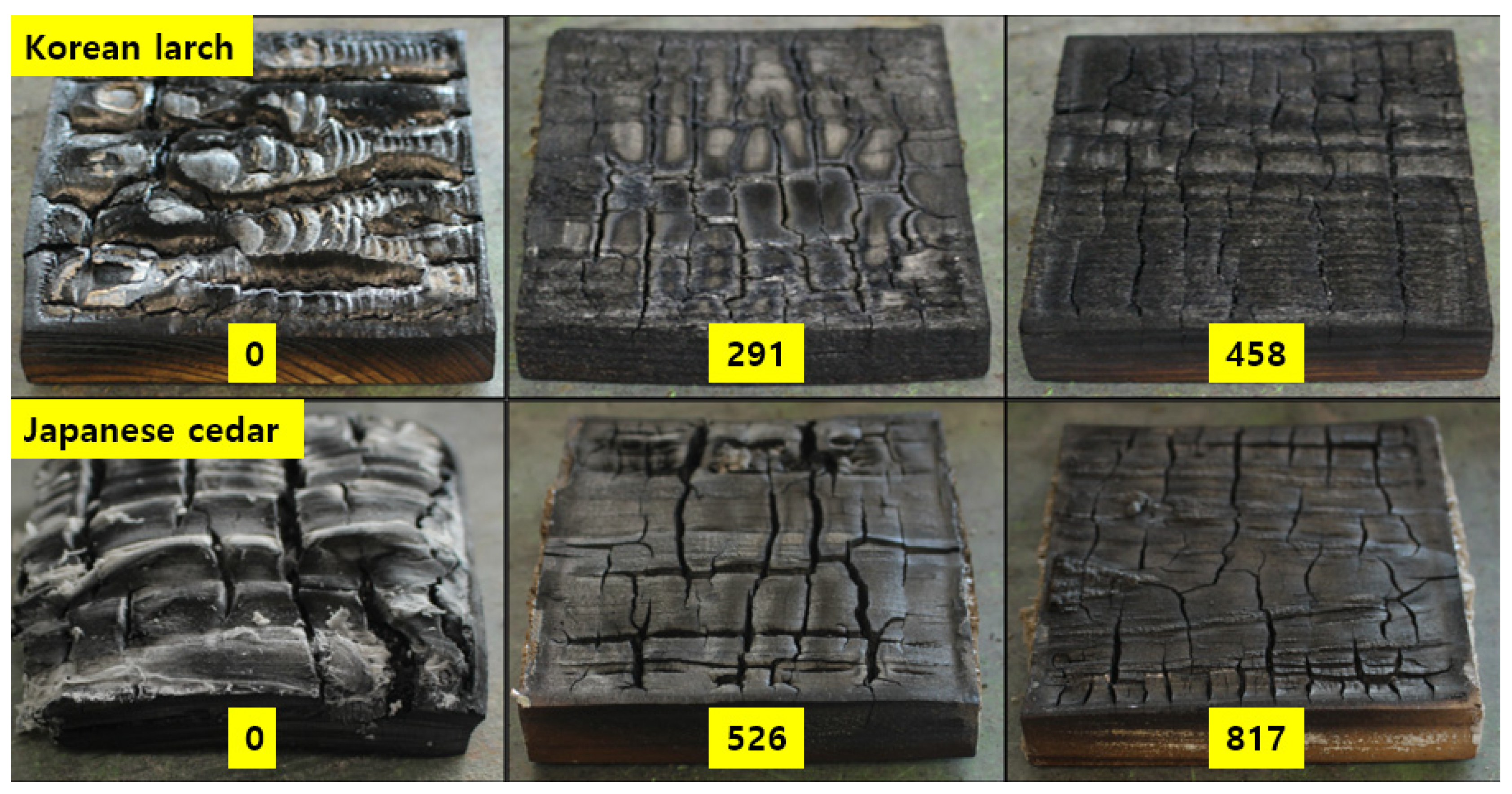
Figure 3.
THR and AFI of Korean larch and Japanese cedar.
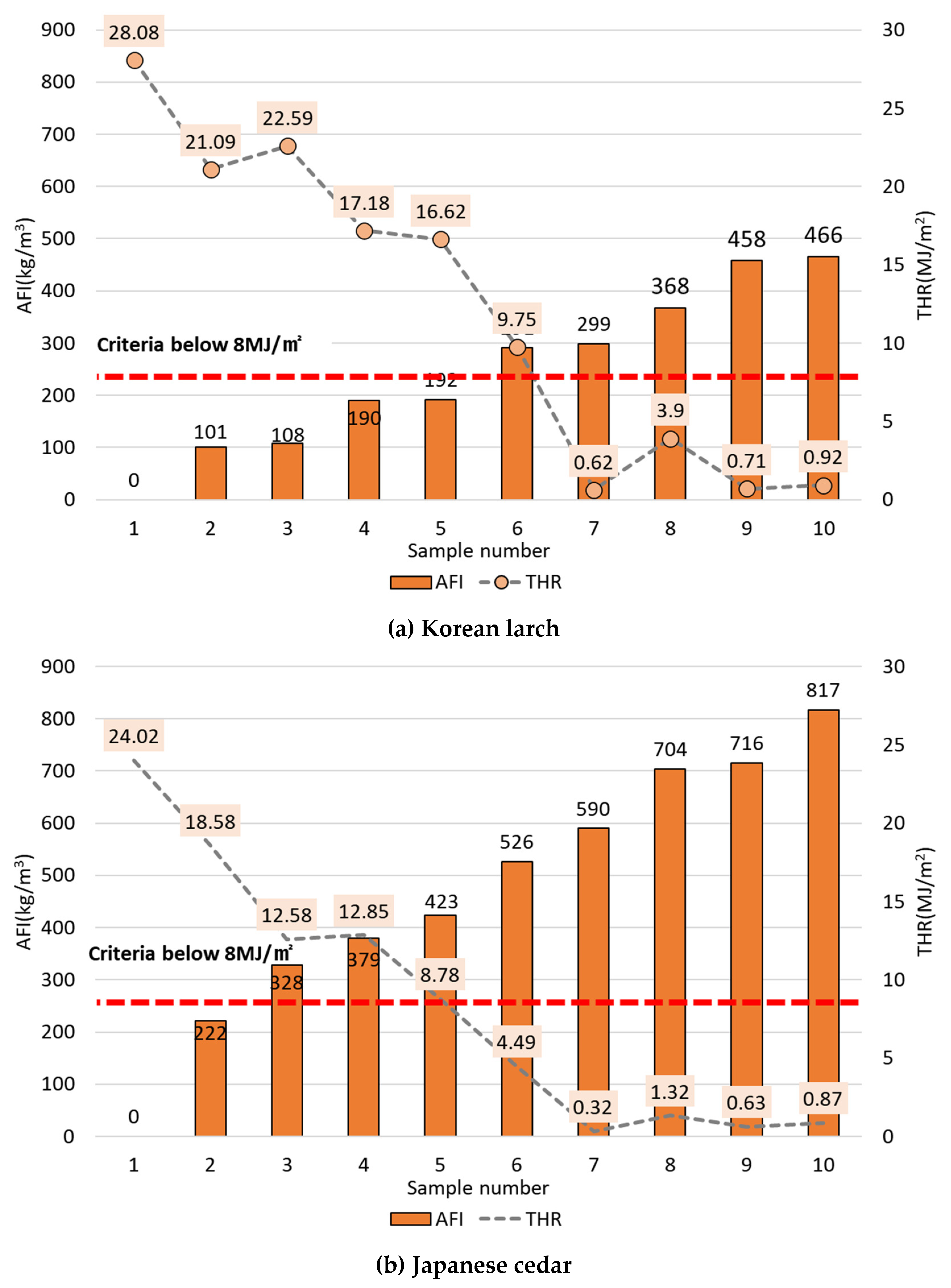
Figure 4.
Simple regression analysis result.
Disclaimer/Publisher’s Note: The statements, opinions and data contained in all publications are solely those of the individual author(s) and contributor(s) and not of MDPI and/or the editor(s). MDPI and/or the editor(s) disclaim responsibility for any injury to people or property resulting from any ideas, methods, instructions or products referred to in the content. |
© 2023 by the authors. Licensee MDPI, Basel, Switzerland. This article is an open access article distributed under the terms and conditions of the Creative Commons Attribution (CC BY) license (http://creativecommons.org/licenses/by/4.0/).
Copyright: This open access article is published under a Creative Commons CC BY 4.0 license, which permit the free download, distribution, and reuse, provided that the author and preprint are cited in any reuse.


