
Submitted:
16 August 2023
Posted:
17 August 2023
You are already at the latest version
Abstract
This paper explores the challenges of providing services of general interest in rural areas of Germany and proposes co-created mobility software solutions to address the specific needs of these regions. The research is part of the Smarte.Land.Regionen project, which aims to improve digital public services at the district level. Focusing on rural mobility, the paper introduces the concept of ride-sharing benches as a potential solution. Through workshops, surveys and market research, the study identifies barriers to the adoption of ride-sharing benches and investigates factors contributing to their success. The proposed software solution emphasizes user-centered development, geographic location of benches and prioritized matching of passengers. Findings highlight safety concerns, lack of reliability, and the importance of getting people who are theoretically interested in solutions to actively participate in them. The paper emphasizes the importance of collaborative development with county stakeholders. Future research should focus on sustaining and scaling digital solutions, measuring their impact on rural mobility, and ensuring their transferability to other regions. The ultimate goal is to contribute to inclusive and sustainable rural development by improving access to digital public services and promoting the adoption of tailored mobility solutions.
Keywords:
smart region
; shared mobility
; rural mobility
; ride-sharing benches
; co-creation
; software development
1. Introduction
In Germany, a digital divide between urban and rural areas is often assumed [1,2,3]. The implementation of the online access law and digital strategies is also slower in smaller municipalities, which supports this thesis [4,5].
Additionally, services of general interest are more challenging to provide in rural areas compared to urban areas due to numerous factors such as lower population density, limited infrastructure, longer distances, and a lack of specialized service providers. Digital solutions are seen as having great potential to address these challenges in rural areas. By leveraging technology, digital solutions can bridge geographical gaps and help overcome the limitations of traditional service delivery models [6,7,8,9,10].
Furthermore, in the provision of public services, it is necessary to adapt technical solutions to regional needs and contextual conditions, so that they can be implemented by local institutions and utilized by the population [11].
Moreover, the digitalization of rural areas faces various barriers, as identified by Ferrari et al. [12], which can be categorized into the following areas: socio-cultural, technical, economic, and regulatory-institutional barriers. Socio-cultural barriers involve demographic factors, distrust, fear, values, competence, and complexity, all of which can potentially hinder the adoption of digital technologies in rural communities. Technical barriers encompass connectivity, dependability, usability, and scalability issues related to the application of technology in rural environments. Economic barriers revolve around the high costs of technology and infrastructure modernization, as well as limited financial resources. Regulatory-institutional barriers involve challenges in data management and unclear regulations that might hinder access to funds and technology. Overcoming these barriers is essential to ensure the successful implementation of digital solutions and bridge the digital divide between urban and rural areas in Germany.
The "Smarte.Land.Regionen" research project, funded by the German Federal Ministry of Food and Agriculture (BMEL) aims to improve digital public services at county level and to develop transferable strategies and measures. Together with government and industry partners and seven counties, Fraunhofer IESE is designing, implementing, and evaluating digital solutions in the areas of education, health, community, volunteering, and mobility. Each area is worked on with two partner counties to include the local perspectives and to ensure transferability. In addition, a digital platform is being developed as a central 'digital ecosystem' to ensure the widespread adoption of these solutions beyond the model regions and to facilitate the integration of existing digital solutions. For a more in-depth look at the project see Bartels et. al [13] .
This paper focuses on the mobility aspect, as improving rural mobility presents a significant challenge for smaller municipalities in Germany. The German government's objectives for rural development, as outlined by the Federal Ministry of Food and Agriculture [14], include creating equal living conditions, with mobility being an explicit area of concern. This highlights the significance of efforts to enhance mobility and generate more opportunities in these regions.
The digital divide between urban and rural areas often results in limited transport options, especially in relation to mobility providers that make extensive use of digital tools. This results in car dependency and reduced access to mobility sharing services, which are predominantly concentrated in urban areas [15,16,17].
Ride-sharing solutions also face significant challenges when implemented in rural areas, as shown by the study conducted by Hult et al. [17] using rural Sweden as an example. The results indicate persistent problems with limited public acceptance and use, highlighting the difficulty of establishing successful and widely accepted ridesharing initiatives in such regions.
To address these issues, this paper looks at co-created mobility software solutions that aim to address the challenges faced by rural residents. In doing so, it aims to contribute to inclusive and sustainable development in these regions by improving transport options.
In addition, existing transport systems are failing to meet climate targets, highlighting the urgency of action [18]. Low car occupancy rates [19] (p. 233), coupled with the increasing size and cost of cars, exacerbate the problem. In rural areas, the proliferation of electric cars only benefits those who can afford and operate them. Due to the increased emphasis on volunteerism in rural areas [20], self-help initiatives tailored to the specific needs and characteristics of the region can be crucial in addressing these challenges and providing viable solutions for the future.
A report by the International Transport Forum [21] has analyzed how to improve mobility in rural areas. The study's findings recommend a national accessibility policy and sustainable regional mobility plans, a whole-of-government approach, flexible regulations, combining budgets, funding pilot projects, prioritizing high-impact services over high-tech solutions, innovative financing approaches, increased central government funding, technical assistance, mobility hubs and supporting the development of Mobility as a Service. The points on shared mobility and pilot projects are in line with the objectives of our project and underline the importance of this approach.
In summary, it can be said that the future of rural mobility, supported by digital technologies, can advance the concept of a 'smart countryside'. This concept can be realized to make rural mobility more efficient and better [22].
2. Research Design and Objectives
2.1. Goal and Research Questions
This paper focuses on the collaborative development of software to bolster the use of ride-sharing benches.
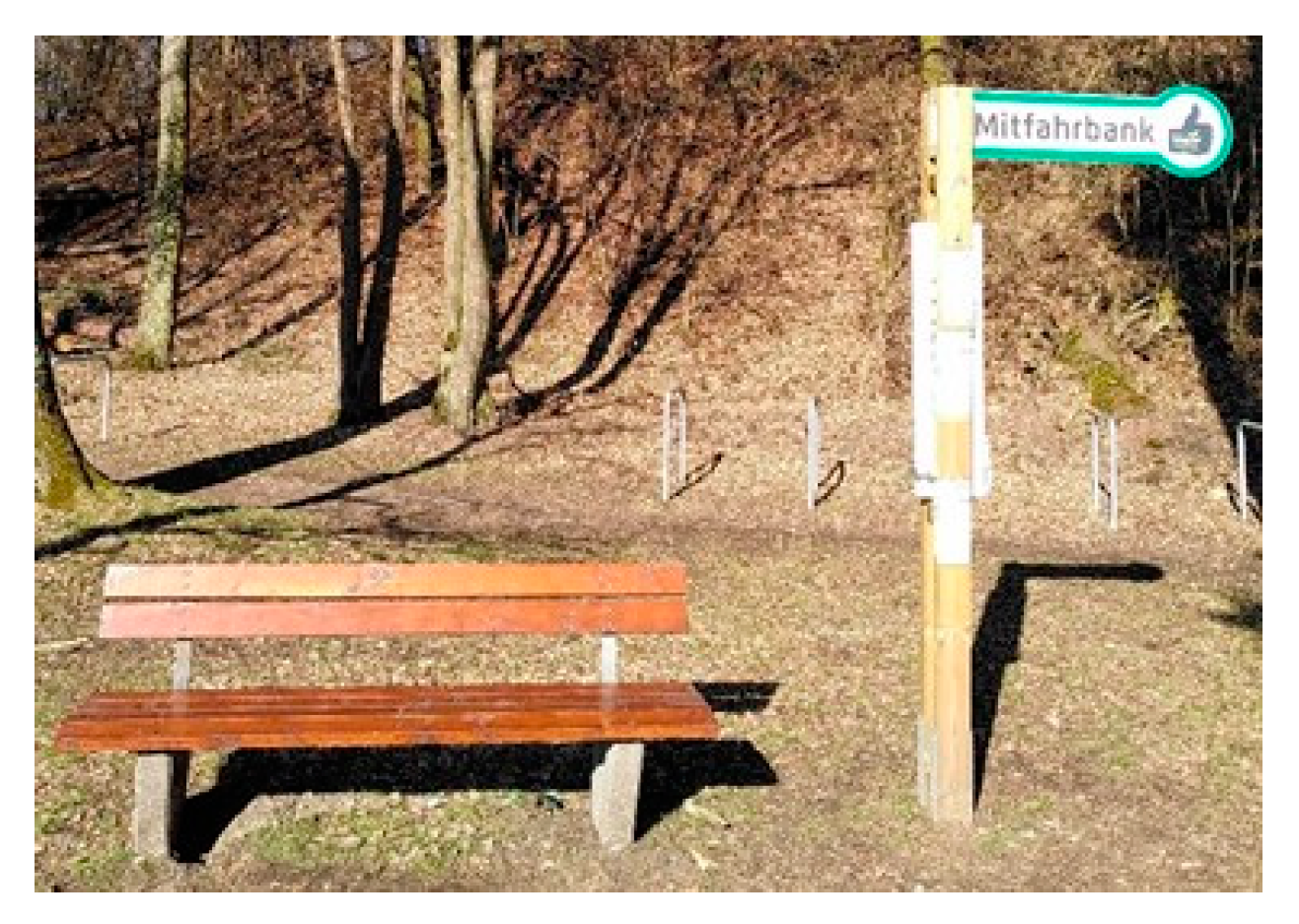
The concept of ride-sharing benches involves the use of specifically designed public benches. By sitting on such a bench individuals express interest in getting a free ride to a specific destination. In Germany, there are currently 190 ride-sharing benches either being discussed, planned, or already implemented [23].
Figure 1.
Example of a ride-sharing bench [24].
Figure 1.
Example of a ride-sharing bench [24].
These findings highlight the need for further exploration and analysis of ride-sharing benches as a mobility solution. Understanding the factors that contribute to their effectiveness, as well as the challenges that limit their usage, is crucial for optimizing their potential and improving the overall efficiency of carpooling initiatives in rural regions.
This paper aims to address the following research questions:
- What specific challenges arise in the development of co-created mobility software for rural regions?
- To what extent and with what specifics are ride-sharing benches used?
- How can the use of ride-sharing benches be increased through digital solutions?
- Does involving counties in the cooperative development of software in rural areas positively impact effectiveness and user acceptance?
By addressing these research questions, this paper seeks to shed light on the challenges, usage patterns, potential enhancements, and impacts of co-created mobility software in rural regions. Through a comprehensive analysis, the findings will contribute to the development of effective strategies for improving rural mobility and fostering the adoption of digital solutions tailored to the specific needs of these areas.
2.2. Method and Approach
As a first step in our methodology, two partnering counties were selected through an application process in which counties were asked to formulate their specific digitization goals. We then identified two counties with similar goals and challenges. This matching process provided the basis for a cohesive and productive collaboration. For further information on the partner counties, refer to Table 1.
In this scenario, Bernkastel-Wittlich county was a junior partner. This means that representatives from the county participated in all important meetings, but no additional activities took place within the district for use case identification and development. All activities mentioned in the paper, such as workshops and the survey, took place in Potsdam-Mittelmark.
After selecting the partner counties, our methodological approach involved the following steps, as illustrated in Table 2.
To develop the use case, two initial workshops were held with stakeholders from the city governments and the mobility sectors from the partner district Potsdam-Mittelmark. Once we had decided on a use case, we started to investigate it further. This included another workshop, a literature review, market research and a survey to further explore how the solution needed to evolve.
This helped define the exact requirements and look of the solution. Feedback from the partner districts played a crucial role in refining the requirements and ensuring user-centric use cases. The final step was to start developing the solution with the close involvement of the districts.
3. Results: Finding and Analyzing a Use Case
3.1. Elaboration of the Use Case
The use case was developed in collaboration with the partner counties, involving participants from various stakeholders in civil society and the industry. The process began with two workshops, each attended by approximately 20 participants. The first workshop focused on representatives from the county while the second workshop involved stakeholders from the mobility sector. The workshops aimed to assess the current state of mobility and identify problems that could be addressed through digital solutions.
Following the workshops, ideas were further discussed with representatives of the county of Potsdam-Mittelmark. Examples of ideas include the digitalization of small-scale bike rentals, prevention of empty cabs, and enabling the sharing of vehicles owned by municipalities and clubs to attain better utilization. Another much-discussed idea was the development of a new software interface standard to integrate different mobility services into a multimodal platform. However, after conducting short research within the county and among mobility stakeholders, it was discovered that many of these ideas were already being pursued by other mobility players or were not feasible due to organizational or legal reasons.
Despite this exploration process, a use case ultimately emerged after careful consideration: the implementation of a digital ride-sharing bench.
Reasons for selecting this use case are as follows:
- Ride-sharing benches are already present in both partner counties, providing an existing infrastructure to build upon.
- The use case could be replicated in other districts, making it a scalable solution.
- Digitizing the ride-sharing bench provides an opportunity to bridge digital and analog realms, promoting digital solutions at a physical location.
- The implementation of a QR code-based solution would offer a simple and user-friendly software solution to facilitate digital interactions.
By selecting the use case of a digital ride-sharing bench, the aim is to leverage existing infrastructure, promote digital solutions, enable transferability, and provide a straightforward and purposeful software solution.
3.2. Further Use Case Analysis
3.2.1. Workshops
To gain a deeper understanding of the ride-sharing bench use case, a kick-off workshop was organized with representatives of the county and citizens interested in ride-sharing. A total of 15 people attended the workshop. Only two participants had experience of using ride-sharing benches. However, during the workshop, initial discussions and stories emerged on how the solution could potentially work (see Figure 2).
3.2.2. Survey Analysis in Existing Literature
Analyzing the existing research literature about ride-sharing benches surveys showed that there is interest in using ride-sharing benches, but only a small percentage (0-25%) of respondents has already used them [27,28,29]. The survey also revealed that there is more interest in being a passenger than in offering rides [27,28,29]. Participation in fuel cost was found to be relevant for only 3% of respondents. Furthermore, a significant proportion (63-68%) expressed discomfort in giving rides or being a passenger riding with strangers [29]. However, of those who had given someone a ride, 90% reported feeling comfortable [27].
3.2.3. Results from Our Conducted Survey
The survey was distributed and completed online, with participants recruited through the partner county's extensive network. The questions were developed from the existing literature on ride-sharing and the information we received from the workshops.
A total of 221 participants completed the survey. The survey consisted of 31 questions, 11 of which were open-ended. The questions covered various aspects, including general information about the participants, the types of technical devices they owned, their mobility patterns, inquiries about the concept of ride-sharing benches and digital solutions supporting them.
In terms of participant demographics, it was observed that 67% of the participants identified as females. Regarding age distribution, 46% of the respondents fell within the 35-49 age group. Furthermore, 99% of the participants were of German nationality.
The survey findings provide valuable insights into the participants' characteristics and attitudes, shedding light on important aspects related to the use case of ride-sharing benches. Among the notable results are:
- Nearly all participants reported owning a smartphone, tablet, and laptop/PC, indicating a high level of digital device ownership and accessibility.
- Approximately 70% of the participants were already familiar with the concept of ride-sharing benches, demonstrating a reasonable level of awareness regarding this mobility solution.
- A significant majority (90%) of the participants owned a car, suggesting that private vehicle ownership is prevalent among the target population.
- Half of the respondents said they would be willing to use a car-sharing bench, although only 1% had used one.
- Around 70% of the participants indicated their willingness to give someone a lift, highlighting a potential pool of individuals open to engaging in ride-sharing activities.
- Furthermore, a considerable percentage (74%) of participants expressed their openness to using a digital ride-sharing solution, suggesting a receptiveness to digital platforms for facilitating mobility.
These findings reveal a positive inclination towards technology adoption and a general interest in ride-sharing concepts among the target population. However, it is evident that there is a gap between the willingness to adopt such solutions and the actual usage rates. Addressing this gap through targeted interventions and strategies could help bridge the divide and increase the uptake of ride-sharing benches among potential users.
In addition, open questions in the survey provided valuable insights into the factors that prevented participants from using ride-sharing benches and their specific concerns. In interpreting the results, it is important to note that we used Chat GPT 3.5 to group the questions. As the software is still prone to error in this area, the results are presented here in terms of the most frequently mentioned, without knowing the exact number of responses.
In particular, the results of the two open questions show the obstacles that a software solution must overcome. They are consistent with the results of the literature review and the workshop.
3.2.4. Market Research
According to our market survey, there are already around 74 digital portals in Germany that aim to facilitate car-pooling [31]. Despite the availability of many car-pooling solutions, a random sample did not reveal any cases of these solutions being used for short distances or in areas outside the scope of long distances between large cities. Statistics from the German Federal Statistical Office support these results. According to them only 2% of the citizen in Germany use carpooling tools [32].
In addition, there are only three software products in Germany that explicitly target ride-sharing benches. These are barely different from other carpooling portals, except that they show the ride-sharing benches on maps [33,34,35]. In addition, two of the solutions look unused and one of them has bugs that make it unpleasant and difficult to use. The only solution that has some visible use in their app had around 120 registered users and three successful rides in the first weeks after implementation [35,36].
Nevertheless the poor usability of many car sharing software solutions is confirmed in a study by the Fraunhofer Fit [37], which shows that despite the large number of solutions available, there is still room for improvement.
During the use case workshops, messenger groups were repeatedly mentioned as a best practice solution for digitally connecting ride-sharing benches. However, only one of these groups could be found when interviewing stakeholders related to ridesharing and ridesharing benches. In this group, about 25 residents of a village arranged to carpool without explicitly using the benches [38].
3.2.5. Location of the Benches
In the partner county, they are strategically positioned along routes that lead to the main station.
However, a random examination of other bench locations reveals that many of them were installed without a clear concept. The likely reason for this is that each municipality decides on its own and there is little evaluation to determine where the benches are best received.
This lack of a systematic approach raises concerns about the effectiveness and optimal placement of these benches in facilitating carpooling opportunities.
3.2.6. Summary Use Case Analysis
Overall, the findings from the use case analysis emphasize the significance of addressing safety concerns and managing reliability and uncertainty in usage to improve the effectiveness and user acceptance of co-created mobility software solutions in rural regions. By addressing these challenges, the development and adoption of digital solutions tailored to the specific needs of these areas can be a step towards improving rural mobility.
4. Results: First Insights in the Solution
The existing software solutions show that it is important to try to differentiate from them, to avoid the same mistakes and to try something new to make ride-sharing usable and to enable ride-sharing over shorter distances.
Therefore, the aim of the proposed solution is to simplify the process of matching drivers and passengers, while incorporating both digital and analog elements. This approach distinguishes our solution from other existing ones in several ways.
Firstly, our solution emphasizes user-centered development in collaboration with the county. By involving the local community and stakeholders in the design and implementation process, we ensure that the solution meets the specific needs and requirements of the rural region. This participatory approach increases user acceptance and facilitates the integration of the solution into the local context.
Another unique aspect of our solution is the inclusion of the routes of the ride-sharing benches. By incorporating the geographical location of the benches into the digital platform, users can easily identify and access relevant ride-sharing opportunities along their desired routes. This feature enhances the efficiency and convenience of the carpooling experience, particularly for short journeys within the county. Furthermore, our solution focuses on prioritizing the matching of passengers seeking rides over drivers offering rides. Finally, there are plans to send push notifications to all local users to make people waiting on a ride-sharing bench more visible. This concept aligns with our study, which revealed a higher number of available drivers compared to individuals seeking rides, allowing us to explore a different approach in addressing this disparity.
Figure 3.
First insights in the design of the solution.
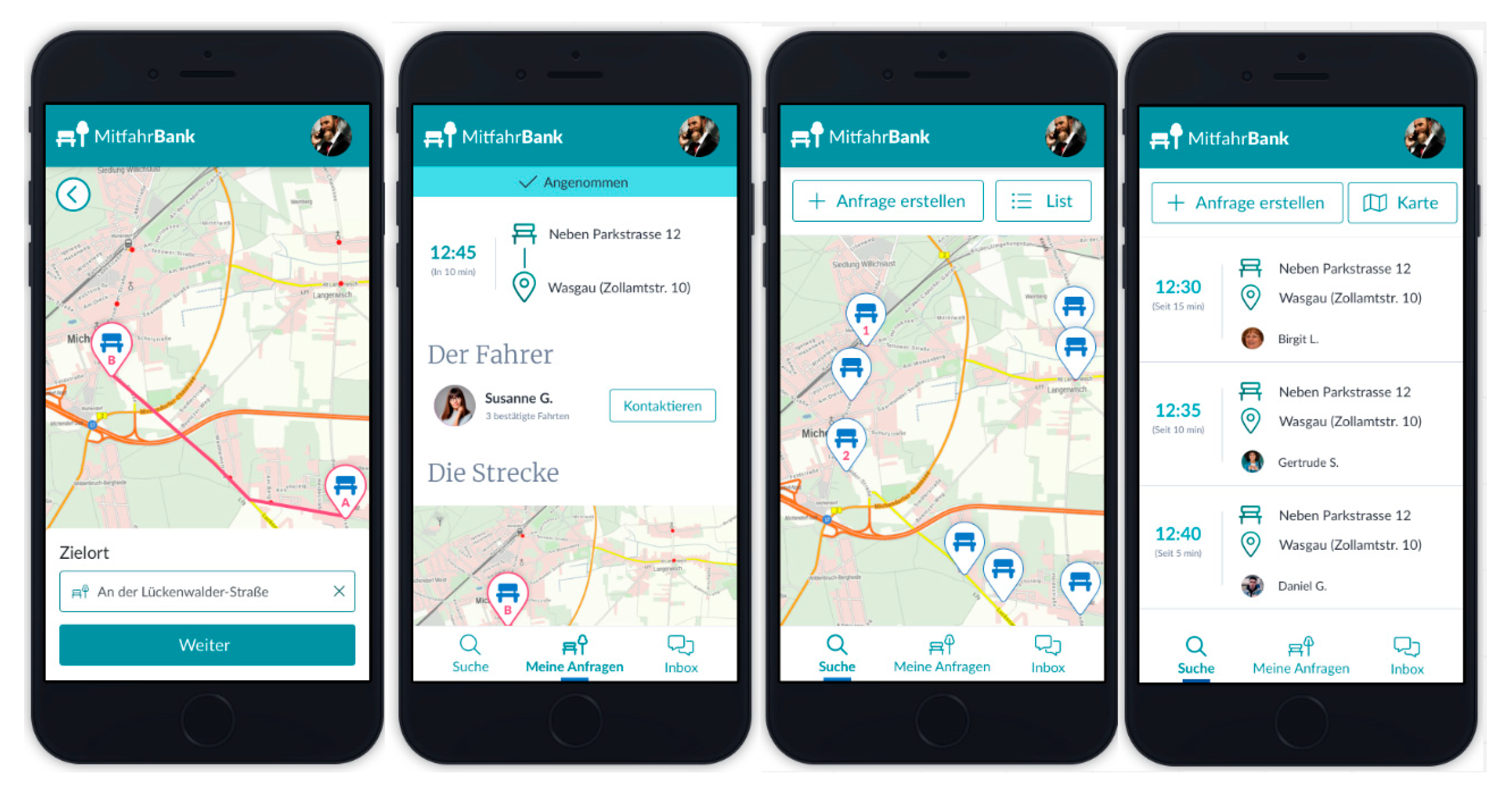
In terms of the technical implementation, our solution is a simple, browser-based platform with minimal features. Its primary focus is to provide a user-friendly interface for drivers and passengers to connect with each other and coordinate rides.
The key components of the solution include:

Table 5.
Key Components of the solution.
| Component | Description |
|---|---|
| Browser-based solution with quick access: | Users can access the platform directly through their web browsers, eliminating the need for additional app installations or complex setup processes. This approach ensures easy and widespread accessibility. |
| Map-based overview of benches and rides/ride requests | The platform presents a visual map that displays the locations of the ride-sharing benches as well as available rides and ride requests. This map-based overview enhances the visibility and understanding of the available options for both drivers and passengers. |
| Profile to step out of anonymity | Users have the option to create profiles, which allows them to provide relevant information about themselves and their preferences. This step encourages transparency and trust among participants, fostering a sense of social connection within the carpooling community. |
| Two levels of verification: | Users must verify their mobile phone number, ensuring valid contact information. Additionally, the municipality conducts a verification process to enhance trust and security. Even without completing the second level of verification, users can access essential information such as available rides and current bench occupancy. |
| Pre-registration view | This view is specifically designed to encourage users to register by showing basic information about rides without revealing personal information about the user. |
5. Conclusions: Challenges in Developing Co-Created Mobility Software for Rural Regions
In theory, car-pooling presents a promising solution for promoting sustainable mobility and inclusive access to transportation for individuals without cars. However, the limited adoption of car-pooling solutions, particularly in regions that are not well-connected to large cities, poses significant challenges in effectively matching passengers with drivers.
While there is a potential for innovative digital platforms, there seems to be a lack of practical implementation. This gap between theory and practice hinders progress in the adoption of these solutions.
Subjective fear also plays a significant role in hindering the adoption of new mobility solutions. People may have concerns about safety, reliability, or privacy, which acts as a barrier to their acceptance. Overcoming these fears and building trust is crucial for successful implementation.
Even with advancements in software and technology, reaching a critical mass remains a challenge. Software improvements alone are not sufficient to achieve widespread adoption. It requires a comprehensive approach that addresses the barriers to adoption and motivates users to embrace these solutions.
In the context of cooperative development with counties, the motivation of county stakeholders plays a critical role in the success of mobility initiatives. While collaboration with stakeholders, citizens, and counties is often pursued to harness their valuable input and insights, it is important to recognize that such cooperation does not guarantee the identification of an innovative solution that will have a profound impact on mobility. Additionally, it should be noted that the process of finding a use case becomes relatively complex when involving citizens, administration, and stakeholders. Furthermore, legal, and organizational obstacles arise, which would likely pose fewer problems in a market-oriented development approach. Nevertheless, cooperative development has more advantages than disadvantages. The main advantage is the identification of the population and administration with the solution and the alignment with the specific problems of a region.
Whether the solution can address a digital divide is difficult to determine. However, it is evident that parts of the population are learning and appreciating the cooperative approach, understanding how a digital solution can be developed. Discussions between county representatives and citizens, as well as initial media coverage of the project [39], indicate a notable interest within the county for a solution that is specifically tailored to and designed with the county.
If the solution were to be adopted by a significant portion of the population and replicated in many other ride-sharing bench projects, the project could have an impact on climate goals in the transportation sector. However, without incentive systems to promote ride-sharing, the likelihood of citizens starting to connect and ride together is low.
In summary, previous failures, limited utilization of ride-sharing benches, lack of practical implementation, subjective fear, and difficulty in reaching critical mass are challenges that need to be overcome in the field of ride sharing. County motivation, user motivation, effective implementation, and a comprehensive approach are key factors in addressing these challenges. It is important to carefully consider the benefits and limitations of stakeholder collaboration to find more promising and effective solutions.
6. Research Needs
The digital solution for the ride-sharing bench is currently in its developmental stage, making it uncertain whether the co-creation process and differentiation efforts will lead to a widely adopted solution. Future research should focus on investigating the factors that contribute to the success of such solutions in attracting many active users, as well as strategies for maintaining their activity over an extended period. Additionally, it is crucial to explore methods for sustaining and scaling these digital solutions, measuring their impact on rural mobility, and identifying approaches for transferring them effectively to other counties.
Funding
This research was funded by the Federal Ministry of Food and Agriculture in Germany (BMEL) under the Funding reference number 2818SL001.
Acknowledgments
The author would like to thank the entire smarte.land.regionen team, especially the project managers and the Mobility Solution team.
Conflicts of Interest
The authors declare no conflict of interest.
References
- Fraunhofer IESE. Strategiepapier für Smarte Landkreise, Kaiserslautern, 2021. Available online: https://www.toolset-landkreise.digital/wp-content/uploads/sites/12/2023/05/Strategiepapier-fuer-Smarte-Landkreise.pdf (accessed on 25 July 2023).
- Dubois, A.; Sielker, F. Digitalization in sparsely populated areas: between place-based practices and the smart region agenda. Regional Studies 2022, 56, 1771–1782. [Google Scholar] [CrossRef]
- Stein, V.; Pentzold, C.; Peter, S.; Sterly, S. Digitalization and Civic Participation in Rural Areas. A Systematic Review of Scientific Journals, 2010-2020. RuR 2022, 80, 251–265. [Google Scholar] [CrossRef]
- Halsbenning, S. Digitalisierung öffentlicher Dienstleistungen: Herausforderungen und Erfolgsfaktoren der OZG-Umsetzung in der Kommunalverwaltung. HMD 2021, 58, 1038–1053. [Google Scholar] [CrossRef]
- Initiative Stadt.Land.Digital. Wie smart sind Deutschlands Kommunen?: Studie im Auftrag des Bundesministeriums für Wirtschaft und Energie, Berlin, 2022. Available online: https://www.de.digital/DIGITAL/Redaktion/DE/Publikation/stadt-land-digital-update-digitalisierung.pdf?__blob=publicationFile&v=1 (accessed on 25 July 2023).
- Hildner, A.; Stutz, D.; Teuteberg, F. Sorgenetzwerk: Digitalisierung unterstützt rurale Versorgung. Pflegez 2018, 71, 44–47. [Google Scholar] [CrossRef]
- Digitale Transformation von Dienstleistungen im Gesundheitswesen IV; Pfannstiel, M.A.; Krammer, S.; Swoboda, W., Eds.; Springer Fachmedien Wiesbaden: Wiesbaden, 2018, ISBN 978-3-658-13643-7.
- Simon, R.; Garthaus, M.; Koppenburger, A.; Remmers, H. Dorfgemeinschaft 2.0 – Altern und Digitalisierung im ländlichen Raum. Zur Entwicklung eines Instruments zur ethischen Fallbesprechung in der ambulanten Gesundheitsversorgung. In Digitale Transformation von Dienstleistungen im Gesundheitswesen IV; Pfannstiel, M.A., Krammer, S., Swoboda, W., Eds.; Springer Fachmedien Wiesbaden: Wiesbaden, 2018; ISBN 978-3-658-13643-7. [Google Scholar]
- Williger, B.; Wojtech, A. DIGITALISIERUNG IM LÄNDLICHEN RAUM: STATUS QUO & CHANCEN FÜR GEMEINDEN. Available online: https://www.scs.fraunhofer.de/content/dam/scs/DE/download/studien/Digitalisierung_im_L%C3%A4ndlichen_Raum_WhitePaper_FraunhoferSCS.pdf (accessed on 25 July 2023).
- Gilroy, P.; Krimmer, H.; Priemer, J.; Kononykhina, O.; Pereira Robledo, M.; Stratenwerth-Neunzig, F. Vereinssterben in ländlichen Regionen: Digitalisierung als Chance, Berlin, 2018. Available online: https://www.ziviz.de/sites/ziv/files/vereinssterben_in_laendlichen_regionen.pdf (accessed on 25 July 2023).
- Janacek, E.; Margarian, A. Digitalisierung sozialer Dienstleistungen in ländlichen Regionen: Eine Analyse feldkonfigurierender Diskurse; Johann Heinrich von Thünen-Institut, 2020.
- Ferrari, A.; Bacco, M.; Gaber, K.; Jedlitschka, A.; Hess, S.; Kaipainen, J.; Koltsida, P.; Toli, E.; Brunori, G. Drivers, barriers and impacts of digitalisation in rural areas from the viewpoint of experts. Information and Software Technology 2022, 145, 106816. [Google Scholar] [CrossRef]
- Bartels, N.; Koch, M.; Schmitt, A. Digitale Ökosysteme im ländlichen Raum: Herausforderungen bei der Gestaltung eines Digitalen Ökosystems und zugehöriger Geschäftsmodelle. Informatik Aktuell 2021. [Google Scholar]
- BMEL. Das Land lebt!: Dritter Bericht der Bundesregierung zur Entwicklung der ländlichen Räume, 2022. Available online: https://www.bmel.de/SharedDocs/Downloads/DE/_laendliche-Regionen/regierungsbericht-laendliche-raeume-2020.pdf?__blob=publicationFile&v=5 (accessed on 25 July 2023).
- Nobis, C.; Kuhnimhof, T. Mobilität in Deutschland, 2019. Available online: https://www.mobilitaet-in-deutschland.de/archive/pdf/MiD2017_Ergebnisbericht.pdf (accessed on 25 July 2023).
- Schaefer, C.; Stelter, A.; Holl-Supra, S.; Weber, S.; Niehaves, B. The Acceptance and Use Behavior of Shared Mobility Services in a Rural Municipality. Smart Cities 2022, 5, 1229–1240. [Google Scholar] [CrossRef]
- Hult, Å.; Perjo, L.; Smith, G. Shared Mobility in Rural Contexts: Organizational Insights from Five Mobility-as-a-Service Pilots in Sweden. Sustainability 2021, 13, 10134. [Google Scholar] [CrossRef]
- Höhne, N.; Fekete, H.; Wong, J. Klimaschutzpolitik im deutschen Verkehrssektor entspricht etwa 3°C globaler Erwärmung, 2023. Available online: https://newclimate.org/sites/default/files/2023-04/temperaturpfad_verkehr_2.pdf (accessed on 25 July 2023).
- Deutsches Zentrum für Luft- und Raumfahrt, e.V. Verkehr in Zahlen 2022/2023, 2022. Available online: https://bmdv.bund.de/SharedDocs/DE/Publikationen/G/verkehr-in-zahlen-2022-2023-pdf.pdf?__blob=publicationFile (accessed on 25 July 2023).
- Julia Simonson; Nadiya Kelle; Corinna Kausmann; Nora Karnick; Céline Arriagada; Christine Hagen; Nicole Hameister; Oliver Huxhold; Clemens Tesch-Römer. Volunteering in Germany: Key Findings of the Fifth German Survey on Volunteering (FWS 2019), 2019. Available online: https://www.bmfsfj.de/resource/blob/184604/a7cd006da6aed57d6d0dfab4a38e4212/5-freiwilligensurvey-englisch-data.pdf (accessed on 25 July 2023).
- ITF. Innovations for Better Rural Mobility, Paris. Available online: https://www.itf-oecd.org/sites/default/files/docs/innovation-rural-mobility.pdf (accessed on 25 July 2023).
- Bosworth, G.; Price, L.; Collison, M.; Fox, C. Unequal futures of rural mobility: Challenges for a “Smart Countryside”. Local Economy 2020, 35, 586–608. [Google Scholar] [CrossRef]
- Renner, N. Mitfahrbänke als Mobilitätskonzept in ländlichen Regionen: Eine Analyse von Best Practise Beispielen. Master; Technische Universität Kaiserslautern, Kaiserslautern, 2020.
- Linis Neugebauer. Mitfahrbank. Picture, 2023. Available online: https://qimby.net/LinusNeugebauer (accessed on https://qimby.net/LinusNeugebauer).
- Potsdam Mittelmark. Vollantrag Smarte.Land.Regionen, 2020.
- Bernkastel Wittlich. Vollantrag Smarte.Land.Regionen, 2020.
- Blees, V.; Becker, J.; Freyer, L.; Löw, G. Erfolgsfaktor Mitfahrbank?! : Wissenschaftliche Untersuchung der Akzeptanz und des Nutzens von Mitfahrbänken, 2019. Available online: https://www.frankfurt-university.de/fileadmin/standard/Hochschule/Fachbereich_1/FFin/Neue_Mobilitaet/Veroeffentlichungen/2020/Schlussbericht_Mitfahrbaenke_19-12-09.pdf (accessed on 25 July 2023).
- B.A.U.M. ConsultGmbH. Umfrageauswertung Mitfahrbänke: im Landkreis Ebersberg und der Region, 2021. Available online: https://www.energieagentur-ebe-m.de/data/dokumente/sonstige/2021-07-14_Umfrageauswertung_Mitfahrbnke.pdf (accessed on 25 July 2023).
- Wolfrum, L. "Lift-sharing benches" as additional low-threshold mobility service for rural areas : an evaluation of their use in selected communities in Lower Austria and recommendations for actions. Master, 2021.
- Holzapfel, D. Wie die Mitfahrbank zum Exportschlager der Eifel wurde. Spiegel [Online], April 25, 2023. Available online: https://www.spiegel.de/auto/wie-die-mitfahrerbank-zum-exportschlager-der-eifel-wurde-a-9a61f287-2dd6-4925-b2fb-a5dc8bcc7999 (accessed on 26 July 2023).
- Mitfahrverband, e.V. Mitfahrportale. Available online: https://mitfahrverband.org/projekte/mitfahrportale/ (accessed on 26 July 2023).
- Statistisches Bundesamt. Press release No. 356 of 13 September 2019.
- FELGO Gmbh. Mitfahrbänke; Amt Altenpleen.
- Boben op Klima- und Energiewende, e.V. Mitfahrbank-App; Boben op Klima- und Energiewende e.V., 2022.
- DevLabor. APP-DURCH-DIE-EIFEL; Eifelkreis, 2023.
- Borens, S. Vorstellung APP DURCH DIE EIFEL, July 7, 2023.
- Fraunhofer FIT. Mitfahrzentralen erschweren das Finden passender Mitfahrgelegenheiten durch unnötig minimalistische Funktionalität!, 2022. Available online: https://www.fit.fraunhofer.de/content/dam/fit/de/documents/easy2use%20Studie-Mitfahrzentralen-2022.pdf (accessed on 25 July 2023).
- Hennemann, A. WhatsApp Gruppe Mitfahrbank, 2023.
- Hauptstadt, TV. Die Mitfahrbank, 2023. Available online: https://www.hauptstadt.tv/sendeformate/130/Zuhause_in_Brandenburg/8012/Zuhause_in_Brandenburg_Die_Mitfahrbank.html (accessed on 26 July 2023).
Figure 2.
Workshop participants' visualization of how the software could be used.
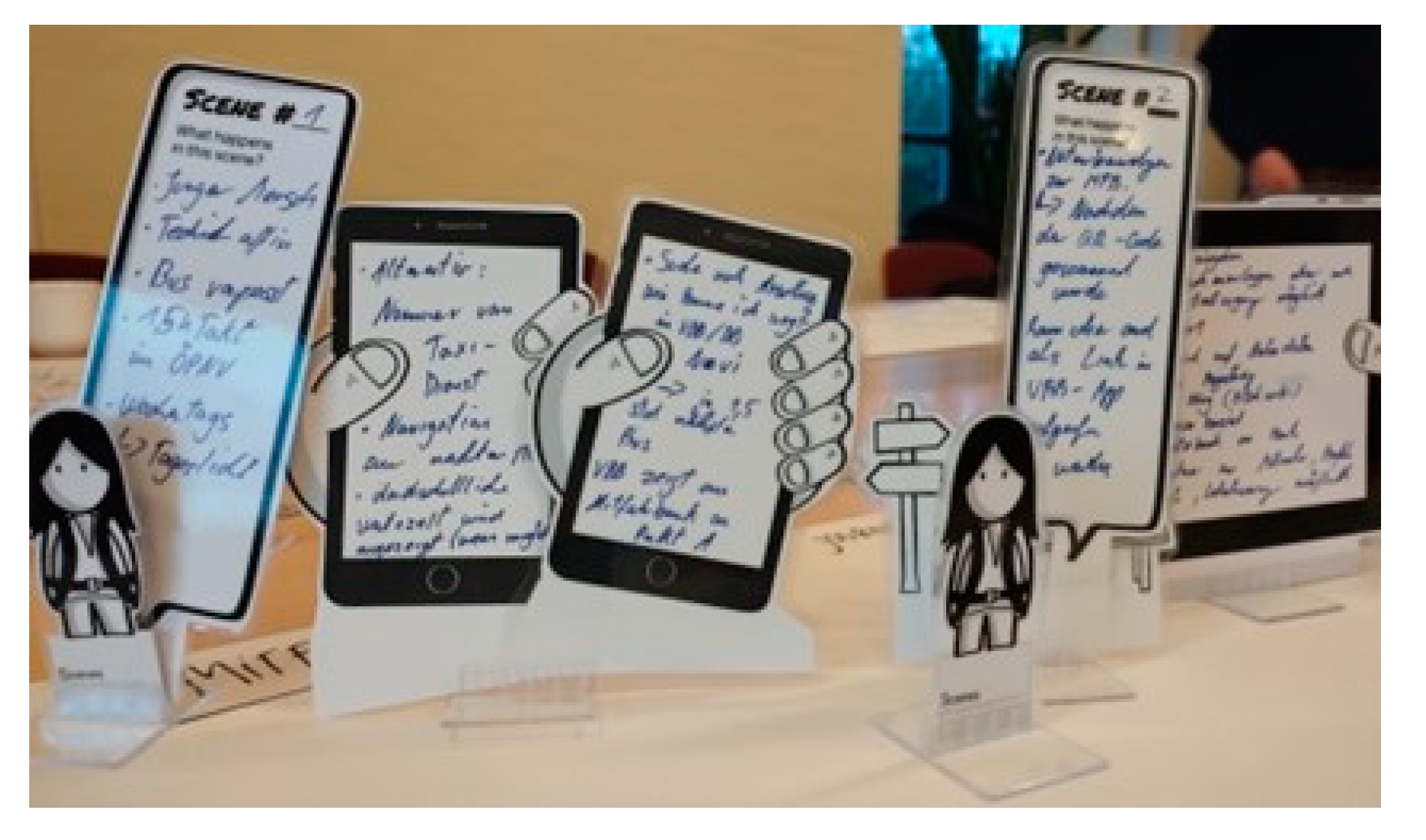
Table 1.
The partner counties.
| Municipality | Population | Population density | Application goal |
|---|---|---|---|
| Potsdam-Mittelmark | 214.000 | 86/km² | Car-free mobility, multi-modal mobility platform |
| Bernkastel-Wittlich | 112.000 | 97/km² | Car-free mobility, ride sharing |
Table 2.
Method.
| What? | How? | When? |
|---|---|---|
| Development/Decision of a use case | Workshops | 2021/22 |
| Defining use case | Workshops/Survey/Literature/Market research/ | Spring 2023 |
| Software Requirements (RE) and Design (UX) | Co-creative process with the partner counties | Spring/Summer 2023 |
| Development | Co-creative process between the partner counties | Autumn 2023 |
Table 3.
Concerns and Factors Hindering Usage.
| Title | Description |
|---|---|
| Safety concerns: | Most of the participants expressed safety concerns as a primary reason for not utilizing ride-sharing benches. |
| Reliability and uncertainty in usage: | Some participants mentioned concerns regarding the reliability and uncertainty associated with using ride-sharing benches. |
| Lack of need or existing alternatives: | A few participants stated that they did not perceive a need for ride-sharing benches or already had alternative transportation options available to them. |
Table 4.
Reasons for Not Riding Despite Interest:.
| Title | Description |
|---|---|
| Absence of ride-sharing benches: | Many participants mentioned the lack of available ride-sharing benches in their area as a significant barrier |
| Ownership of personal vehicles and preferred transportation method: | Some participants indicated that they had their own cars and preferred individual transportation methods, which discouraged them from using ride-sharing benches. |
| Uncertainty regarding return trips or reliability of ride offers: | Some participants expressed concerns about the uncertainty surrounding return trips or the reliability of ride offers. |
Disclaimer/Publisher’s Note: The statements, opinions and data contained in all publications are solely those of the individual author(s) and contributor(s) and not of MDPI and/or the editor(s). MDPI and/or the editor(s) disclaim responsibility for any injury to people or property resulting from any ideas, methods, instructions or products referred to in the content. |
© 2023 by the authors. Licensee MDPI, Basel, Switzerland. This article is an open access article distributed under the terms and conditions of the Creative Commons Attribution (CC BY) license (http://creativecommons.org/licenses/by/4.0/).
Copyright: This open access article is published under a Creative Commons CC BY 4.0 license, which permit the free download, distribution, and reuse, provided that the author and preprint are cited in any reuse.


