

Submitted:
02 August 2023
Posted:
04 August 2023
You are already at the latest version
Abstract
Biodiesel is seen as a successor to diesel of petrochemical origin, as it can be used in cycle engines and stationary engines, and be obtained from renewable raw materials. Currently, the biodiesel production process on an industrial scale is mostly carried out through the transesterification reaction, also forming glycerol as a product. Pure glycerol is used in the pharmaceutical, cosmetic, cleaning, food and other industries. Even presenting numerous applications, studies indicate that there is a saturation of glycerol in the market which is directly related to the production of biodiesel. This increase causes a commercial devaluation of pure glycerol; making the separation and purification processes unfeasible from an economic point of view. Despite the economic unfeasibility of the aforementioned processes, they continue to be carried out due to environmental issues. Faced with the problem presented, this work aims at a bibliographical review of works that aimed to use glycerol as a raw material for the production process of biofuels, these processes being carried out mostly via fermentation.
Keywords:
biodiesel
; glycerol
; biogas
; biohydrogen
; bioethanol
1. Introduction
Currently, biodiesel has been standing out as the successor of diesel of petrochemical origin, since there is a worldwide concern with the depletion of fossil fuels, as well as the emission of gases produced from their burning, gases that contribute to the aggravation of the greenhouse effect [1,2]. Biodiesel, like diesel, can be used in cycle engines and stationary engines [3]. The use of biodiesel has some advantages, such as: being obtained from renewable sources, lower rate of emission of gases that contribute to the worsening of the greenhouse effect [4,5].
Biodiesel on an industrial scale is mostly produced through the methyl transesterification reaction using basic homogeneous catalysts, such as sodium hydroxide or potassium hydroxide [6,7,8], and can be obtained from different raw materials, such as: oils vegetable and animal fats [9,10].
During the biodiesel production process via transesterification there is also the formation of glycerol [4,11]. It is estimated that for every 10 kg of biodiesel produced approximately 1 kg of crude glycerol is formed [12,13]. For the commercialization of the glycerol produced from the biodiesel production process, the crude glycerol is subjected to separation and purification processes, thus obtaining pure glycerol [14].
Pure glycerol is used in the food industry as a stabilizer, antioxidant, humectant and emulsifier; in the pharmaceutical industry in cosmetics and medicines; in the chemical industry in the composition of resin and polymers, among others [15,16]. Despite being used in several industrial sectors, there is a saturation of this product in the market, in which the demand for glycerol is smaller than the quantity produced, causing a commercial devaluation of glycerol [17]. According to Zhang et al. (2016) the energy expenditure during the separation and purification processes become unfeasible due to the low economic value attributed to purified glycerol, associating the growing increase of glycerol in the market with the production of biodiesel [18].
It is important to point out that although the separation and purification processes are impracticable, they are necessary, since crude glycerol, that is, without treatment, cannot be discarded in the environment; and its use as fuel is unfeasible because its direct burning produces toxic gases [14].
In this way, this work aims to present the problems about glycerol from the biodiesel production process, and to present works that aimed to use it as a raw material for the production process of other biofuels.
2. Glycerol
The official name of glycerol, according to IUPAC – Union of Pure and Applied Chemistry, is propane – 1, 2, 3 – triol. The molecular formula of glycerol is C3H5(OH)3. Glycerol is a colorless liquid, with an oily appearance, viscous, with relatively high density, colorless, soluble in water and alcohols, and practically insoluble in hydrocarbons [19,20]. Table 1 presents the physicochemical properties of glycerol.
As shown in Table 1, the decomposition point of glycerol is 290 °C. According to Gupta et al. (2012) it is at this temperature that the decomposition of glycerol into acrolein, a toxic and carcinogenic compound, occurs [14].
The glycerol from the biodiesel production process is mostly carried out through the transesterification reaction [21,22]. The transesterification reaction is represented by Figure 1.
The transesterification reaction is a reversible reaction, so it is necessary to add one of the reagents in excess, in this case, it is common to add alcohol in excess [24,25]. The alcohols frequently used are methanol and ethanol, methanol being the most used, since the use of ethanol in the production process requires a greater excess of product, presents a greater propensity to form soaps, forming an emulsion that makes the process of separation and purification difficult, in addition to the relatively higher commercial price when compared to methanol [26,27]. The catalysts frequently used on an industrial scale are homogeneous alkaline catalysts, especially sodium hydroxide and potassium hydroxide [28]. The use of these catalysts has some advantages, such as lower economic cost, shorter reaction time, higher conversion rates, etc. However, these same catalysts have disadvantages, such as the need for a raw material with a low content of fatty acids, since these catalysts in the presence of fatty acids and alcohol favor the formation of soaps [6,8,29,30,31,32]. It is important to highlight that there are works available in the literature that aimed to propose the use of other catalysts, such as heterogeneous acid catalysts, microbiological catalysts, among others [23,33]. After the transesterification reaction, the reaction product goes to the separation and purification processes, where the catalyst is neutralized, the alcohol added in excess is recovered, and the purified products are obtained for commercialization [34,35,36]. The Figure 2 is a diagram that represents the biodiesel and glycerol production process.
The purification process begins with the separation of the light phase, mostly made up of biodiesel, from the heavy phase, mostly made up of glycerol. The heavy phase, as mentioned, is mostly formed by glycerol, alcohol, water, catalyst, impurities, soaps and non-glycerol organic matter. The glycerol purification process begins with the process of neutralizing the catalyst present in the solution, followed by the process of separating the salts formed in the neutralization process, catalyst residues, soaps and organic material. The resulting solution has a concentration of 40 - 70% of glycerol, this solution undergoes a vacuum evaporation process, where almost all water and alcohol is removed, the resulting solution has a concentration greater than or equal to 80% of glycerol, this The solution, in turn, undergoes a refining process until it reaches the purity level required for commercialization [38,39]. Vacuum distillation is the process often used to obtain purified glycerol [20,38]. Figure 3 is a simplified diagram of the glycerol separation and purification processes.
The biodiesel and glycerol production process is a complex process, which demands a high energy expenditure from the preparation of the raw material to the obtaining of the final products. Reinforcing the need to make glycerol an energetically and economically attractive product, consequently increasing the viability of the biodiesel production process on an industrial scale [40].
3. Biofuel production processes using glycerol as biomass
The use of glycerol as a carbon source for the production of biofuels has been gaining prominence due to its wide availability [18,41]. Another reason that corroborates the development of research in this area is the physicochemical characteristics of glycerol, such as high autoignition temperature and low heating value, causing glycerol to decompose into acrolein at 290 °C [42]. The following topics are intended to present works that aimed to use glycerol as a renewable raw material for the production of fuels.
3.1. Biogas
Recent studies present glycerol as a promising source of organic matter for the production of biogas [43,44,45]. In the biogas production process, glycerol can be used as substrate or co-substrate [46]. Different bacteria are capable of metabolizing glycerol, including those of the Klebsiella, Clostridium and Enterobacter genera [15,47,48,49].
The work carried out by Astals et al. (2012) aimed to produce biogas from the anaerobic digestion of swine effluents using crude glycerol as co-substrates. They added 4% w/w, on a wet basis, of crude glycerol to the bioreactor and obtained a 400% increase in biogas production with respect to monodigestion. The authors conclude that the results are satisfactory, and the increase in biogas production may be due to the increase in organic load, carbon-nitrogen balance and the decrease in ammonia concentration [50].
The work carried out by Siles et al. (2010) aimed to use glycerol in the co-digestion of wastewater formed during the biodiesel production process, with the purpose of treating the effluent, as well as the production of methane. Some of the main factors evaluated by the authors were: biodegradability of the mixture formed by wastewater and glycerol, methane yield coefficient and methane production kinetics. The inoculum used was the active methanogenic granular biomass used to treat wastewater from breweries. According to the authors, this biomass was selected due to its high methanogenic activity. Before forming the mixture, which was subsequently treated, the authors carried out the acidification and centrifugation of the glycerol, with the purpose of removing the catalysts used in the transesterification reaction, and electrocoagulation process in the wastewater. The authors conclude that the results presented were satisfactory, where the mixture showed a high level of biodegradability, the kinetics of methane production remained constant, and the production of 310 mL of CH4/g removed at 1 atm and 25 °C [51].
The work carried out by Beschkov et al. (2012) aimed to develop a mathematical model to describe the production of biogas and other products from the anaerobic digestion of crude glycerol using the bacteria Klebsiella sp. Experiments were carried out in a multistage bioreactor, and the results obtained were used to develop the proposed model. The choice of a multistage reactor is directly related to the intermediates formed during the glycerol digestion process, these intermediates being acidic in character, lowering the pH of the medium and inhibiting the methanogenesis reaction. separate the inhibition zone from the methanogenesis zone. The authors conclude that, although simple, the proposed model allows estimating the number of compartments necessary for the total conversion of glycerol into biogas [52].
The work carried out by Fountoulakis et al. (2009) aimed to verify the influence of adding glycerol in continuous bioreactors that treated small fractions of urban organic waste and wastewater. The authors observed that the methane production rate increased with the addition of crude glycerol. The reactor was inoculated with anaerobic sludge from the municipal sewage treatment plant in the city of Iraklio, Greece. The authors observed the production of 1400 mL CH4/d before without adding glycerol and 2094 mL CH4/d after adding glycerol. And they conclude that the results are satisfactory [46].
The work carried out by Oliveira (2015) aimed to evaluate the optimal conditions for methane production using the macroalgae Sargassum sp. co-digested with glycerol and residual frying oil. The authors noted that without the addition of glycerol and residual oil the biochemical potential of Sargassum sp. was 181 ± 1 L CH4/L of COD and the methane rate increased 56% with the addition of glycerol and 46% with the addition of residual oil. The authors conclude that the addition of glycerol or residual oil is a promising alternative for methane production [53].
The work carried out by Sittijunda and Reungsang (2018) aimed to verify the methane production from the co-digestion of algae biomass with crude glycerol. The authors show that under optimal conditions the maximum methane production was 58.88 mL CH4/L. And the bacteria detected responsible for the digestion of the biomass were Methanosarcina sp., Methanoregula sp., Methanospirillum sp. and Methanoculleus sp.
The work carried out by Baba et al. (2013) aimed to carry out an energy balance in a process plant where crude glycerol is digested. The results presented, according to the authors, are satisfactory in terms of methane production. And according to the analyzes carried out, the digested sludge contained fertilizer components (N: 0.11%, P2O5: 0.036%, K2O: 0.19%). Thus, the authors conclude that crude glycerol is an attractive biomass for methane production and the residual sludge can be used as liquid fertilizer [43].
The work carried out by Chou and Su (2019) aimed to evaluate the feasibility of biogas production by anaerobic co-digestion of wastewater from dairy cattle and crude glycerol. The authors conclude that the conversion of residual crude glycerol into biogas showed satisfactory results and can be applied in the near future on an industrial scale to treat waste from slaughterhouses [54]
The work carried out by Sawasdee et al. (2019) aimed to evaluate the production of biogas from the co-digestion of glucose and glycerol in laboratory-scale batch reactors. The experiments involved varying glycerol/glucose ratios with fixed initial chemical oxygen demand for all conditions. The inoculum was obtained from cassava starch sludge. The highest yield of biogas production was in the 5:5 ratio of glycerol/glucose with a maximum production rate of 8 mL/h [55].
3.2. Hydrogen
Currently, hydrogen is seen as a form of clean energy, since the only product of the combustion process is water [56]. Conventional forms of hydrogen production are from the process of catalytic reforming of petroleum, the steam reforming of methane present in natural gas, however, these methods cannot be considered renewable, since both use raw materials of fossil origin [57,58]. Another conventional method also used for the production of hydrogen is through the electrolysis of water, however, this method demands a high energy cost [56]. Due to the problems involving conventional methods, the conversion of biomass to hydrogen production is presented as an alternative method that aims to minimize environmental impacts [59,60].
The work carried out by Maru et al. (2016) aimed to produce hydrogen through the fermentation process using pure and residual glycerol as raw material. The fermentation process is carried out and compared using three strains, Escherichia coli CECT432, Escherichia coli CECT434 and Enterobacter cloacae MCM2/. Escherichia coli CECT432 was the strain that obtained the highest hydrogen production using pure glycerol, and a co-culture formed by Escherichia coli CECT432 and Enterobacter cloacae MCM2/ showed the highest productivity; this same co-culture was used in the fermentation process using residual glycerol, and according to the authors the results were satisfactory. The authors conclude that the strains metabolize residual glycerol without any purification step, and that the ability to produce H2 without prior purification of residual glycerol is attractive because it avoids extra costs in the process [61].
The work carried out by Sittijunda and Reungsang (2020) proposed the simultaneous study of the production of hydrogen, ethanol and 1,3 – propanediol. The authors used pure and residual glycerol to convert desirable products. The process was carried out via fermentation using a co-culture of Enterobacter sp., Klebsiella sp. and Klebsiella pneumoniae. The authors conclude that the use of crude glycerol as raw material presented satisfactory results [62].
The work carried out by Prakash et al. (2018) aimed to use domestic wastewater and crude glycerol from the biodiesel production process to produce biodiesel to produce hydrogen via the fermentation process. The cultures used were Bacillus thuringiensis strain EGU4 and Bacillus amyloliquefaciens strain CD16. The results were satisfactory, but when comparing the performance of the two cultures, it was detected that the Bacillus amyloliquefaciens strain CD16 had the highest yield. The authors conclude that the results are satisfactory, however, they emphasize the need for biosafety when working with non-sterile sludge [63].
The work carried out by Chen et al. (2021) aimed at producing hydrogen from fermentation processes using raw glycerol as raw material; and compare the yield of fermentation with immobilized and suspended microorganisms. The inoculum used was collected at a wastewater treatment plant in Beijing, China, a pre-treatment by ionizing radiation was performed in order to eliminate hydrogen-consuming bacteria; and the predominant bacterium in the culture was Clostridium sp. The results presented by the authors show greater yield for fermentation that used microorganisms used, as well as greater tolerance to the substrate [64].
The work carried out by Silva et al. (2020) aimed to use semi-continuous reactors for the production of hydrogen and volatile fatty acids via a fermentation process, using residual glycerol as a substrate. The microorganisms used were bacteria of the genus Enterobacter and Clostridium. The reactor that operated using the bacterium of the genus Clostridium showed lower performance. The authors conclude that the yields found for the production of hydrogen using a semi-continuous reactor via a fermentation process with bacteria of the genus Enterobacter are satisfactory and are consistent with the literature [65].
The work carried out by Mirzoyan et al. (2019) aimed to use a mixture of lactose and glycerol for the production of hydrogen via a fermentation process using the bacterium Escherichia coli, at different pH values and different concentrations. The authors conclude that the results are satisfactory and an alternative for the production of renewable hydrogen [66].
The work carried out by Toledo-Alarcon et al. (2020) aimed at producing hydrogen using glycerol as substrate; and verify the impact of sludge pre-treatment on the production process. Two types of inoculum were used, aerobic and anaerobic sludge, and two types of pre-treatment, aeration and thermal shock. The bacterium of the genus Clostridium sp. was detected as dominant in all inocula. The best results were obtained using anaerobic sludge with thermal pre-treatment [67].

Table 3.
Production of hydrogen using glycerol as raw material.
| Authors | Feedstock | Microorganism | Results |
|---|---|---|---|
| Maru et al. (2016) | Pure glycerol and crude glycerol | Escherichia coli CECT432, Escherichia coli CECT434 e Enterobacter cloacae MCM2/1 | Co-culture of Escherichia coli CECT 432 and Enterobacter cloacae yields 1.26 mol H2/mol residual glycerol |
| Sittijunda e Reungsang (2020) | Pure glycerol and crude glycerol | Enterobacter sp., Klebsiella sp. e Klebsiella pneumoniae | The yield of hydrogen was 2.90 mol H2/mol pure glycerol and 2.05 mol H2/mol residual glycerol |
| Prakash et al. (2018) | Domestic wastewater and waste glycerol | Bacillus thuringiensis EGU4 e Bacillus amyloliquefaciens cepa CD16 | The hydrogen yield with Bacillus thuringiensis EGU4 was 100 L H2/L of residual glycerol and Bacillus amyloliquefaciens strain CD16 was 120 L H2/L |
| Chen et al. (2021) | Gycerol | Clostridium sp. | The yield of hydrogen 0.52 mol H2/mol glycerol for immobilized microorganisms and 0.29 mol H2/mol glycerol for suspended microorganisms |
| Silva et al. (2020) | Gycerol l | Enterobacter e Clostridium | The hydrogen yield for Enterobacter 0.25 mol H2/mol glycerol and Clostridium 0.01 mol H2/mol glycerol |
| Mirzoyan et al. (2019) | Lactose e glicerol | Escherichia coli | High H2 yield can be achieved during fermentation of 1 g/L lactose at pH 7.5 with H2 production rate of 21.94 mL/L |
| Toledo-Alarcon et al. (2020) | Glycerol | Clostridium sp. | The presented results allow a better understanding of the production of H2 in continuous systems, and provide informationfor future industrial applications |
3.3. Ethanol
Ethanol is mostly produced from renewable raw materials, especially from sugarcane and corn [68,69]. But, according to the study carried out by Yazdani and González (2007), the cost of producing ethanol from glycerol is almost 40% lower when compared to ethanol produced from corn, taking into account the demand for raw materials and costs. operational [70]. Studies indicate that the production of ethanol from glycerol, derived from the biodiesel production process, is an attractive option for using this by-product as biomass for the production of another biofuel [71,72].
The work carried out by Sunarno et al. (2019) aimed to produce ethanol from crude glycerol using Enterobacter aerogenes TISTR 1468 supplemented by a cheaply available nutrient substrate, in the case of condensed tuna. The authors aimed to find the optimal conditions for the concentration of crude glycerol, tuna condensate, inorganic salts and pH. With 20 g/L of crude glycerol, and the pH maintained at 7, these were the optimal conditions for ethanol production, with a yield of 12.33 g/L [73].
The work carried out by Oh et al. (2011) aimed to produce ethanol using glycerol as a carbon source. A mutant strain was used in the process, Klebsiella pneumoniae GEM167 obtained by irradiation. According to the authors, when comparing production with the control strain, the increase in ethanol production is expressly noticeable when using the mutant strain. The maximum production level was 21.5 g/L, with a productivity of 0.93 g/L/h [74].
The work carried out by Stepanov and Efremenko (2017) aimed to develop and use a biocatalyst in the form of a cryogel immobilizing the yeast Pachysolen tannophilus that can convert glycerol into ethanol in both batch and continuous mode. According to the authors, the conversion of glycerol into ethanol, using this biocatalyst, resulted in a yield of 90% in relation to the theoretical limit [75].
The work carried out by Sunarno et al. (2020) aimed to produce ethanol from crude glycerol using Enterobacter aerogenes TISTR 1468. The authors evaluated the conversion of glycerol into ethanol under aerobic and anaerobic conditions. The evaluation was carried out in a reactor with aeration in a continuous and batch process, the conversion process without aeration was also evaluated. The aeration rate was controlled using a redox potential (OPR). The results presented by the authors show that in the fermentation process without aeration the ethanol yield was 18.78 g/L, with aeration in continuous process it was 30.31 g/L and batch was 12.33 g/L [76].
The work carried out by Suzuki et al. (2015) aimed at producing ethanol using glycerol from the development of a highly ethanol-tolerant Klebsiella variicola mutant, as well as improving the mutant's ethanol production by optimizing the culture conditions. The mutant was obtained from Klebsiella variicola TB-83 was called TB-83D was modified by means of ribosome engineering, being more resistant to streptomycin and tolerant to ethanol. The results that the mutant strain showed higher ethanol production [77].
The work carried out by Vikromvarasiri et al. (2016) used an anaerobic sludge blanket reactor for wastewater treatment to test the possibility of producing ethanol in the fermentation process using glycerol as a co-substrate at various glycerol concentrations. Ethanol concentration and yield were highly dependent on the initial glycerol concentration. The highest ethanol concentration was 11.1 g/L obtained after 72 h of fermentation at an initial concentration of 45 g/L of glycerol. The main ethanol producers have been identified as Enterobacter and Klebsiella strains [78].
The work carried out by Lee et al. (2017) aimed to convert glycerol into ethanol using Enterobacter aerogenes ATCC 29007 immobilized using alginate. The fermentation process was carried out in a continuous stirred tank reactor (CSTR) designed for continuous production with immobilized cells. The experiments were performed using pure glycerol and crude glycerol. Under optimal conditions, the ethanol production and yield were approximately 5.38 g/L and 0.96 mol-ethanol/mol-glycerol with pure glycerol, while the ethanol production and yield were approximately 5.29 g/ L and 0.91 mol ethanol/mol-glycerol with crude glycerol [79].
Table 4.
Ethanol production using glycerol as raw material.
| Authors | Feedstock | Microorganism | Results |
|---|---|---|---|
| Sunarno et al. (2019) | Crude glycerol | Enterobacter aerogenes | With 20 g/L of crude glycerol, and the pH maintained at 7, the ethanol production was 12.33 g/L |
| Oh et al. (2011) | Crude glycerol | Klebsiella pneumoniae GEM167 | The maximum production level was 21.5 g/L, with a productivity of 0.93 g/L/h |
| Stepanov e Efremenko (2017) | Glycerol | Pachysolen tannophilus | The conversion of glycerol into ethanol, using immobilized yeast, resulted in a yield of 90% in relation to the theoretical limit |
| Sunarno et al. (2020) | Crude glycerol | Enterobacter aerogenes TISTR1468 | In the fermentation process without aeration, the ethanol yield was 18.78 g/L, with aeration in continuous process it was 30.31 g/L and batch was 12.33 g/L |
| Suzuki et al. (2015) | Glycerol | Klebsiella variicola TB-83 e TB-83D | The strain TB-83D is effective for the production of ethanol from glycerol, and this strain is a mutant of Klebsiella variicola TB-83 |
| Vikromvarasiri et al. (2016) | Crude glycerol and waste water | Enterobacter e Klebsiella | The highest concentration of ethanol was 11.1 g/L obtained after 72 h of fermentation at an initial concentration of 45 g/L of glycerol |
| Lee et al. (2017) | Pure glycerol and crude glycerol | Enterobacter aerogenes ATCC 29007 imobilizado | Under optimal conditions, the ethanol production and yield were approximately 5.38 g/L and 0.96 mol-ethanol/mol-glycerol with pure glycerol, while the ethanol production and yield were approximately 5.29 g/ L and 0.91 mol ethanol/mol-glycerol with crude glycerol |
4. Considerations
The biodiesel production process is a complex process that demands a high energy and economic expenditure [80,81]. Therefore, it is important for the industrial viability of biodiesel production to add economic value to glycerol, to make glycerol a useful product and not an undesirable by-product [82,83,84].
The production of methane from glycerol is a sustainable alternative to methane extracted from natural gas [85]. Methane production is directly related to biogas production, in this biogas it is important to detect which other gases are present; and thus propose a treatment for the purification of this biogas, as well as the degree of purity of methane [85].
Hydrogen is a promising alternative to fossil fuels because it has a high energy yield (122 kJ/g) and its combustion product is water instead of gases that contribute to the worsening of the greenhouse effect [86]. Hydrogen produced through catalytic cracking of petroleum or through steam reforming of methane present in natural gas cannot be considered a renewable alternative since it is obtained from fossil fuels. The production of hydrogen through water electrolysis demands a high energy cost, making the process unfeasible from an economic point of view. Thus, the fermentation pathway using glycerol as biomass can be attractive both from an environmental and economic point of view for the production of hydrogen [87,88,89].
Currently, ethanol is produced predominantly from sugarcane and corn [90,91]. However, by producing ethanol from glycerol, which is currently seen as a by-product of the biodiesel production process, it is a way of adding economic value to glycerol [92,93]. Another perspective is the use of ethanol produced from glycerol to return to the biodiesel production process as one of the reagents [94].
Another alcohol that can be returned to the process is methanol, which in turn can be obtained from the biogas produced from glycerol, requiring biogas purification processes [95]. The work carried out by Magalhães et al. (2004) proposes the purification of biogas using a packing column and water as solvent at pressures between 6 – 12 bar [96]. After purifying the biogas, methane undergoes an oxidation process in order to obtain synthesis gas, and use catalytic reform to obtain methanol [97,98]. The proposal to use biogas to produce methanol is a way to obtain alcohol from a renewable source, since the methanol produced in the current context is predominantly from natural gas of fossil origin [99,100]. And the methanol produced by this route can return to the biodiesel production process plant and be used as one of the reagents [101,102].
Finally, it is important to highlight that production is mostly carried out through biochemical processes; therefore, it is important that the residues from these processes have an adequate microbiological treatment for biosafety reasons [103]. The biofuels reported in this work can be applied in different industrial sectors; and according to the authors, they are attractive alternatives for the use of glycerol as a raw material.
5. Conclusion
The biodiesel production process is a complex process, which demands a high energy expenditure, consequently a high economic cost. Reinforcing the need to make glycerol an attractive product energetically and economically. Thus, we can conclude that the works presented are alternatives to make the biodiesel production process viable, since they seek to use glycerol as a raw material for the production of other biofuels.
References
- Ghosh, S.K. Biomass & Bio-Waste Supply Chain Sustainability for Bio-Energy and Bio-Fuel Production. Procedia Environ Sci 2016, 31, 31–39. [CrossRef]
- Gaurav, N.; Sivasankari, S.; Kiran, G.S.; Ninawe, A.; Selvin, J. Utilization of Bioresources for Sustainable Biofuels: A Review. Renewable and Sustainable Energy Reviews 2017, 73, 205–214.
- Luque, R.; Lovett, J.C.; Datta, B.; Clancy, J.; Campelo, J.M.; Romero, A.A. Biodiesel as Feasible Petrol Fuel Replacement: A Multidisciplinary Overview. Energy Environ Sci 2010, 3, 1706–1721. [CrossRef]
- Chuah, L.F.; Klemeš, J.J.; Yusup, S.; Bokhari, A.; Akbar, M.M. A Review of Cleaner Intensification Technologies in Biodiesel Production. J Clean Prod 2017, 146, 181–193. [CrossRef]
- Mamtani, K.; Shahbaz, K.; Farid, M.M. Deep Eutectic Solvents – Versatile Chemicals in Biodiesel Production. Fuel 2021, 295.
- Demirbas, A. Competitive Liquid Biofuels from Biomass. Appl Energy 2011, 88, 17–28.
- Srilatha, K.; Prabhavathi Devi, B.L.A.; Lingaiah, N.; Prasad, R.B.N.; Sai Prasad, P.S. Biodiesel Production from Used Cooking Oil by Two-Step Heterogeneous Catalyzed Process. Bioresour Technol 2012, 119, 306–311. [CrossRef]
- Leung, D.Y.C.; Wu, X.; Leung, M.K.H. A Review on Biodiesel Production Using Catalyzed Transesterification. Appl Energy 2010, 87, 1083–1095.
- Abbaszaadeh, A.; Ghobadian, B.; Omidkhah, M.R.; Najafi, G. Current Biodiesel Production Technologies: A Comparative Review. In Proceedings of the Energy Conversion and Management; November 2012; Vol. 63, pp. 138–148.
- Faruque, M.O.; Razzak, S.A.; Hossain, M.M. Application of Heterogeneous Catalysts for Biodiesel Production from Microalgal Oil—a Review. Catalysts 2020, 10, 1–25.
- Tachibana, Y.; Shi, X.; Graiver, D.; Narayan, R. The Use of Glycerol Carbonate in the Preparation of Highly Branched Siloxy Polymers. Silicon 2015, 7, 5–13. [CrossRef]
- Badia-Fabregat, M.; Rago, L.; Baeza, J.A.; Guisasola, A. Hydrogen Production from Crude Glycerol in an Alkaline Microbial Electrolysis Cell. Int J Hydrogen Energy 2019, 44, 17204–17213. [CrossRef]
- Zhou, J.J.; Shen, J.T.; Wang, X.L.; Sun, Y.Q.; Xiu, Z.L. Stability and Oscillatory Behavior of Microbial Consortium in Continuous Conversion of Crude Glycerol to 1,3-Propanediol. Appl Microbiol Biotechnol 2018, 102, 8291–8305. [CrossRef]
- Gupta, M.; Kumar, N. Scope and Opportunities of Using Glycerol as an Energy Source. Renewable and Sustainable Energy Reviews 2012, 16, 4551–4556.
- da Silva, G.P.; Mack, M.; Contiero, J. Glycerol: A Promising and Abundant Carbon Source for Industrial Microbiology. Biotechnol Adv 2009, 27, 30–39.
- Faccendini, P.L.; Ribone, M.É.; Lagier, C.M. Selective Application of Two Rapid, Low-Cost Electrochemical Methods to Quantify Glycerol According to the Sample Nature. Sens Actuators B Chem 2014, 193, 142–148. [CrossRef]
- Anitha, M.; Kamarudin, S.K.; Kofli, N.T. The Potential of Glycerol as a Value-Added Commodity. Chemical Engineering Journal 2016, 295, 119–130.
- Zhang, X.; Yan, S.; Tyagi, R.D.; Surampalli, R.Y.; Valéro, J.R. Energy Balance of Biofuel Production from Biological Conversion of Crude Glycerol. J Environ Manage 2016, 170, 169–176. [CrossRef]
- Ladero, M.; de Gracia, M.; Tamayo, J.J.; Ahumada, I.L. de; Trujillo, F.; Garcia-Ochoa, F. Kinetic Modelling of the Esterification of Rosin and Glycerol: Application to Industrial Operation. Chemical Engineering Journal 2011, 169, 319–328. [CrossRef]
- Mendes, D.B.; Carlos, J.; Serra, V. Artigo Recebido Em 21; 2011; Vol. 12;
- Haigh, K.F.; Vladisavljević, G.T.; Reynolds, J.C.; Nagy, Z.; Saha, B. Kinetics of the Pre-Treatment of Used Cooking Oil Using Novozyme 435 for Biodiesel Production. Chemical Engineering Research and Design 2014, 92, 713–719. [CrossRef]
- Perdomo, F.A.; Perdomo, L.; Millán, B.M.; Aragón, J.L. Design and Improvement of Biodiesel Fuels Blends by Optimization of Their Molecular Structures and Compositions. Chemical Engineering Research and Design 2014, 92, 1482–1494. [CrossRef]
- Almeida, E.L.; Andrade, C.M.G.; Andreo Dos Santos, O. Production of Biodiesel Via Catalytic Processes: A Brief Review. International Journal of Chemical Reactor Engineering 2018, 16.
- Dasari, S.R.; Borugadda, V.B.; Goud, V. V. Reactive Extraction of Castor Seeds and Storage Stability Characteristics of Produced Biodiesel. Process Safety and Environmental Protection 2016, 100, 252–263. [CrossRef]
- Dasari, S.R.; Goud, V. V. Simultaneous Extraction and Transesterification of Castor Seeds for Biodiesel Production: Assessment of Biodegradability. Process Safety and Environmental Protection 2017, 107, 373–387. [CrossRef]
- Verma, P.; Sharma, M.P.; Dwivedi, G. Impact of Alcohol on Biodiesel Production and Properties. Renewable and Sustainable Energy Reviews 2016, 56, 319–333.
- Jafari, D.; Esfandyari, M. Optimization of Temperature and Molar Flow Ratios of Triglyceride/Alcohol in Biodiesel Production in a Batch Reactor. Biofuels 2020, 11, 261–267. [CrossRef]
- Moser, B.R. Biodiesel Production, Properties, and Feedstocks. In Vitro Cellular and Developmental Biology - Plant 2009, 45, 229–266.
- Tan, K.T.; Lee, K.T. A Review on Supercritical Fluids (SCF) Technology in Sustainable Biodiesel Production: Potential and Challenges. Renewable and Sustainable Energy Reviews 2011, 15, 2452–2456.
- Atadashi, I.M.; Aroua, M.K.; Abdul Aziz, A.R.; Sulaiman, N.M.N. Production of Biodiesel Using High Free Fatty Acid Feedstocks. Renewable and Sustainable Energy Reviews 2012, 16, 3275–3285.
- Bateni, H.; Karimi, K. Biodiesel Production from Castor Plant Integrating Ethanol Production via a Biorefinery Approach. Chemical Engineering Research and Design 2016, 107, 4–12. [CrossRef]
- Cristina Santos de Mello, M.; Gomes D’Amato Villardi, H.; Ferreira Young, A.; Luiz Pellegrini Pessoa, F.; Medeiros Salgado, A. Life Cycle Assessment of Biodiesel Produced by the Methylic-Alkaline and Ethylic-Enzymatic Routes. Fuel 2017, 208, 329–336. [CrossRef]
- Wong, W.Y.; Lim, S.; Pang, Y.L.; Shuit, S.H.; Chen, W.H.; Lee, K.T. Synthesis of Renewable Heterogeneous Acid Catalyst from Oil Palm Empty Fruit Bunch for Glycerol-Free Biodiesel Production. Science of the Total Environment 2020, 727. [CrossRef]
- Vasconcelos, B.; Teixeira, J.C.; Dragone, G.; Teixeira, J.A. Oleaginous Yeasts for Sustainable Lipid Production—from Biodiesel to Surf Boards, a Wide Range of “Green” Applications. Appl Microbiol Biotechnol 2019.
- Jayakumar, M.; Karmegam, N.; Gundupalli, M.P.; Bizuneh Gebeyehu, K.; Tessema Asfaw, B.; Chang, S.W.; Ravindran, B.; Kumar Awasthi, M. Heterogeneous Base Catalysts: Synthesis and Application for Biodiesel Production – A Review. Bioresour Technol 2021, 331.
- Rastogi, R.P.; Pandey, A.; Larroche, C.; Madamwar, D. Algal Green Energy – R&D and Technological Perspectives for Biodiesel Production. Renewable and Sustainable Energy Reviews 2018, 82, 2946–2969.
- Leandro Almeida, E.; Inácio Gomes, S.; Andrade, C.M.G.; Aparecida Andreo dos Santos, O. Biodiesel Production Process Versus Bioethanol Production Process. Preliminary Analysis.; Faculty of Law, University of Maribor, July 7 2017; pp. 333–342.
- Luo, X.; Ge, X.; Cui, S.; Li, Y. Value-Added Processing of Crude Glycerol into Chemicals and Polymers. Bioresour Technol 2016, 215, 144–154. [CrossRef]
- Ardi, M.S.; Aroua, M.K.; Hashim, N.A. Progress, Prospect and Challenges in Glycerol Purification Process: A Review. Renewable and Sustainable Energy Reviews 2015, 42, 1164–1173.
- Quispe, C.A.G.; Coronado, C.J.R.; Carvalho, J.A. Glycerol: Production, Consumption, Prices, Characterization and New Trends in Combustion. Renewable and Sustainable Energy Reviews 2013, 27, 475–493.
- Kondaveeti, S.; Kim, I.W.; Otari, S.; Patel, S.K.S.; Pagolu, R.; Losetty, V.; Kalia, V.C.; Lee, J.K. Co-Generation of Hydrogen and Electricity from Biodiesel Process Effluents. Int J Hydrogen Energy 2019, 44, 27285–27296. [CrossRef]
- Steinmetz, S.A.; Herrington, J.S.; Winterrowd, C.K.; Roberts, W.L.; Wendt, J.O.L.; Linak, W.P. Crude Glycerol Combustion: Particulate, Acrolein, and Other Volatile Organic Emissions. Proceedings of the Combustion Institute 2013, 34, 2749–2757. [CrossRef]
- Baba, Y.; Tada, C.; Watanabe, R.; Fukuda, Y.; Chida, N.; Nakai, Y. Bioresource Technology Anaerobic Digestion of Crude Glycerol from Biodiesel Manufacturing Using a Large-Scale Pilot Plant : Methane Production and Application of Digested Sludge as Fertilizer. Bioresour Technol 2013, 140, 342–348. [CrossRef]
- Fontes, G.C.; Ramos, N.M.; Amaral, P.F.F.; Nele, M.; Coelho, M.A.Z. Renewable Resources for Biosurfactant Production by Yarrowia Lipolytica. 2012, 29, 483–493.
- Paulista, L.O.; Boaventura, R.A.R.; Vilar, V.J.P.; Pinheiro, A.L.N.; Martins, R.J.E. Enhancing Methane Yield from Crude Glycerol Anaerobic Digestion by Coupling with Ultrasound or A. Niger/E. Coli Biodegradation. Environmental Science and Pollution Research 2020, 27, 1461–1474. [CrossRef]
- Fountoulakis, M.S.; Manios, T. Bioresource Technology Enhanced Methane and Hydrogen Production from Municipal Solid Waste and Agro-Industrial by-Products Co-Digested with Crude Glycerol. Bioresour Technol 2009, 100, 3043–3047. [CrossRef]
- Konstantinović, S.; Danilović, B.R.; Ćirić, J.T.; Ilić, S.B.; Savić, D.S.; Veljković, V.B. Valorization of Crude Glycerol from Biodiesel Production. Chemical Industry and Chemical Engineering Quarterly 2016, 22, 461–489. [CrossRef]
- Chiodo, V.; Zafarana, G.; Maisano, S.; Freni, S.; Galvagno, A.; Urbani, F. Molten Carbonate Fuel Cell System Fed with Biofuels for Electricity Production. Int J Hydrogen Energy 2016, 41, 18815–18821. [CrossRef]
- Ferreira, J.S.; Volschan, I.; Cammarota, M.C. Enhanced Biogas Production in Pilot Digesters Treating a Mixture of Sewage Sludge, Glycerol, and Food Waste. Energy and Fuels 2018, 32, 6839–6846. [CrossRef]
- Astals, S.; Nolla-Ardèvol, V.; Mata-Alvarez, J. Anaerobic Co-Digestion of Pig Manure and Crude Glycerol at Mesophilic Conditions: Biogas and Digestate. Bioresour Technol 2012, 110, 63–70. [CrossRef]
- Siles, J.A.; Martín, M.A.; Chica, A.F.; Martín, A. Anaerobic Co-Digestion of Glycerol and Wastewater Derived from Biodiesel Manufacturing. Bioresour Technol 2010, 101, 6315–6321. [CrossRef]
- Beschkov, V.; Sapundzhiev, T.; Angelov, I. Modelling of Biogas Production from Glycerol by Anaerobic Process in a Baffled Multi-Stage Digestor. Biotechnology and Biotechnological Equipment 2012, 26, 3244–3248. [CrossRef]
- Oliveira, J. V.; Alves, M.M.; Costa, J.C. Optimization of Biogas Production from Sargassum Sp. Using a Design of Experiments to Assess the Co-Digestion with Glycerol and Waste Frying Oil. Bioresour Technol 2015, 175, 480–485. [CrossRef]
- Chou, Y.C.; Su, J.J. Biogas Production by Anaerobic Co-Digestion of Dairy Wastewater with the Crude Glycerol from Slaughterhouse Sludge Cake Transesterification. Animals 2019, 9. [CrossRef]
- Sawasdee, V.; Haosagul, S.; Pisutpaisal, N. Co-Digestion of Waste Glycerol and Glucose to Enhance Biogas Production. Int J Hydrogen Energy 2019, 44, 29575–29582. [CrossRef]
- Wang, R.; Liu, S.; Liu, S.; Li, X.; Zhang, Y.; Xie, C.; Zhou, S.; Qiu, Y.; Luo, S.; Jing, F.; et al. Glycerol Steam Reforming for Hydrogen Production over Bimetallic MNi/CNTs (M[Dbnd]Co, Cu and Fe) Catalysts. Catal Today 2020, 355, 128–138. [CrossRef]
- Cortright, R.D.; Davda, R.R.; Dumesic, J.A. Hydrogen from Catalytic Reforming of Biomass-Derived Hydrocarbons in Liquid Water. Nature 2002, 418, 964–967. [CrossRef]
- Kondratenko, E. V.; Mul, G.; Baltrusaitis, J.; Larrazábal, G.O.; Pérez-Ramírez, J. Status and Perspectives of CO2 Conversion into Fuels and Chemicals by Catalytic, Photocatalytic and Electrocatalytic Processes. Energy Environ Sci 2013, 6, 3112–3135.
- Sarma, S.; Ortega, D.; Minton, N.P.; Dubey, V.K.; Moholkar, V.S. Homologous Overexpression of Hydrogenase and Glycerol Dehydrogenase in Clostridium Pasteurianum to Enhance Hydrogen Production from Crude Glycerol. Bioresour Technol 2019, 284, 168–177. [CrossRef]
- Varella Rodrigues, C.; Oliveira Santana, K.; Nespeca, M.G.; Varella Rodrigues, A.; Oliveira Pires, L.; Maintinguer, S.I. Energy Valorization of Crude Glycerol and Sanitary Sewage in Hydrogen Generation by Biological Processes. Int J Hydrogen Energy 2020, 45, 11943–11953. [CrossRef]
- Maru, B.T.; López, F.; Kengen, S.W.M.; Constantí, M.; Medina, F. Dark Fermentative Hydrogen and Ethanol Production from Biodiesel Waste Glycerol Using a Co-Culture of Escherichia Coli and Enterobacter Sp. Fuel 2016, 186, 375–384. [CrossRef]
- Sittijunda, S.; Reungsang, A. Valorization of Crude Glycerol into Hydrogen, 1,3-Propanediol, and Ethanol in an up-Flow Anaerobic Sludge Blanket (UASB) Reactor under Thermophilic Conditions. Renew Energy 2020, 161, 361–372. [CrossRef]
- Prakash, J.; Sharma, R.; Patel, S.K.S.; Kim, I.W.; Kalia, V.C. Bio-Hydrogen Production by Co-Digestion of Domestic Wastewater and Biodiesel Industry Effluent. PLoS One 2018, 13. [CrossRef]
- Chen, Y.; Yin, Y.; Wang, J. Comparison of Fermentative Hydrogen Production from Glycerol Using Immobilized and Suspended Mixed Cultures. Int J Hydrogen Energy 2021, 46, 8986–8994. [CrossRef]
- Cristina, M.; Silva, A.; Monteggia, L.O. Hydrogen Production Potential Comparison of Sucrose and Crude Glycerol Using Different Inoculums Sources; 2020; Vol. 25;
- Mirzoyan, S.; Trchounian, A.; Trchounian, K. Hydrogen Production by Escherichia Coli during Anaerobic Utilization of Mixture of Lactose and Glycerol: Enhanced Rate and Yield, Prolonged Production. Int J Hydrogen Energy 2019, 44, 9272–9281. [CrossRef]
- Toledo-Alarcón, J.; Cabrol, L.; Jeison, D.; Trably, E.; Steyer, J.P.; Tapia-Venegas, E. Impact of the Microbial Inoculum Source on Pre-Treatment Efficiency for Fermentative H2 Production from Glycerol. Int J Hydrogen Energy 2020, 45, 1597–1607. [CrossRef]
- Cardona, C.A.; Sánchez, Ó.J. Fuel Ethanol Production: Process Design Trends and Integration Opportunities. Bioresour Technol 2007, 98, 2415–2457.
- Ganguly, A.; Chatterjee, P.K.; Dey, A. Studies on Ethanol Production from Water Hyacinth - A Review. Renewable and Sustainable Energy Reviews 2012, 16, 966–972.
- Yazdani, S.S.; Gonzalez, R. Anaerobic Fermentation of Glycerol: A Path to Economic Viability for the Biofuels Industry. Curr Opin Biotechnol 2007, 18, 213–219.
- Yu, K.O.; Kim, S.W.; Han, S.O. Engineering of Glycerol Utilization Pathway for Ethanol Production by Saccharomyces Cerevisiae. Bioresour Technol 2010, 101, 4157–4161. [CrossRef]
- Lee, J.H.; Yoo, H.Y.; Lee, S.K.; Chun, Y.; Kim, H.R.; Bankeeree, W.; Lotrakul, P.; Punnapayak, H.; Prasongsuk, S.; Kim, S.W. Significant Impact of Casein Hydrolysate to Overcome the Low Consumption of Glycerol by Klebsiella Aerogenes ATCC 29007 and Its Application to Bioethanol Production. Energy Convers Manag 2020, 221. [CrossRef]
- Sunarno, J.N.; Prasertsan, P.; Duangsuwan, W.; Cheirsilp, B.; Sangkharak, K. Biodiesel Derived Crude Glycerol and Tuna Condensate as an Alternative Low-Cost Fermentation Medium for Ethanol Production by Enterobacter Aerogenes. Ind Crops Prod 2019, 138. [CrossRef]
- Oh, Y.K.; Hwang, K.R.; Kim, C.; Kim, J.R.; Lee, J.S. Recent Developments and Key Barriers to Advanced Biofuels: A Short Review. Bioresour Technol 2018, 257, 320–333. [CrossRef]
- Stepanov, N.; Efremenko, E. Immobilised Cells of Pachysolen Tannophilus Yeast for Ethanol Production from Crude Glycerol. N Biotechnol 2017, 34, 54–58. [CrossRef]
- Sunarno, J.N.; Prasertsan, P.; Duangsuwan, W.; Cheirsilp, B.; Sangkharak, K. Improve Biotransformation of Crude Glycerol to Ethanol of Enterobacter Aerogenes by Two-Stage Redox Potential Fed-Batch Process under Microaerobic Environment. Biomass Bioenergy 2020, 134. [CrossRef]
- Suzuki, T.; Seta, K.; Nishikawa, C.; Hara, E.; Shigeno, T.; Nakajima-Kambe, T. Improved Ethanol Tolerance and Ethanol Production from Glycerol in a Streptomycin-Resistant Klebsiella Variicola Mutant Obtained by Ribosome Engineering. Bioresour Technol 2015, 176, 156–162. [CrossRef]
- Vikromvarasiri, N.; Haosagul, S.; Boonyawanich, S.; Pisutpaisal, N. Microbial Dynamics in Ethanol Fermentation from Glycerol. Int J Hydrogen Energy 2016, 41, 15667–15673. [CrossRef]
- Lee, S.J.; Lee, J.H.; Yang, X.; Yoo, H.Y.; Han, S.O.; Park, C.; Kim, S.W. Re-Utilization of Waste Glycerol for Continuous Production of Bioethanol by Immobilized Enterobacter Aerogenes. J Clean Prod 2017, 161, 757–764. [CrossRef]
- Pereyra, D. de L.A.D.; Rueger, I.B.; Barbosa, P.A.M. de A.; Peiter, F.S.; da Silva Freitas, D.M.; de Amorim, E.L.C. Co-Fermentation of Glycerol and Molasses for Obtaining Biofuels and Value-Added Products. Brazilian Journal of Chemical Engineering 2020, 37, 653–660. [CrossRef]
- Ren, J.; Manzardo, A.; Mazzi, A.; Fedele, A.; Scipioni, A. Emergy Analysis and Sustainability Efficiency Analysis of Different Crop-Based Biodiesel in Life Cycle Perspective. The Scientific World Journal 2013, 2013.
- Viana, M.B.; Freitas, A. V.; Leitão, R.C.; Pinto, G.A.S.; Santaella, S.T. Anaerobic Digestion of Crude Glycerol: A Review. Environmental Technology Reviews 2012, 1, 81–92. [CrossRef]
- Quispe, C.A.G.; Coronado, C.J.R.; Carvalho, J.A. Glycerol: Production, Consumption, Prices, Characterization and New Trends in Combustion. Renewable and Sustainable Energy Reviews 2013, 27, 475–493.
- Bułkowska, K.; Białobrzewski, I.; Klimiuk, E.; Pokój, T. Kinetic Parameters of Volatile Fatty Acids Uptake in the ADM1 as Key Factors for Modeling Co-Digestion of Silages with Pig Manure, Thin Stillage and Glycerine Phase. Renew Energy 2018, 126, 163–176. [CrossRef]
- Kapoor, R.; Ghosh, P.; Tyagi, B.; Vijay, V.K.; Vijay, V.; Thakur, I.S.; Kamyab, H.; Nguyen, D.D.; Kumar, A. Advances in Biogas Valorization and Utilization Systems: A Comprehensive Review. J Clean Prod 2020, 273. [CrossRef]
- Kurahashi, K.; Kimura, C.; Fujimoto, Y.; Tokumoto, H. Value-Adding Conversion and Volume Reduction of Sewage Sludge by Anaerobic Co-Digestion with Crude Glycerol. Bioresour Technol 2017, 232, 119–125. [CrossRef]
- Vivek, N.; Pandey, A.; Binod, P. Biological Valorization of Pure and Crude Glycerol into 1,3-Propanediol Using a Novel Isolate Lactobacillus Brevis N1E9.3.3. Bioresour Technol 2016, 213, 222–230. [CrossRef]
- Johnson, E.E.; Rehmann, L. The Role of 1,3-Propanediol Production in Fermentation of Glycerol by Clostridium Pasteurianum. Bioresour Technol 2016, 209, 1–7. [CrossRef]
- Poladyan, A.; Baghdasaryan, L.; Trchounian, A. Escherichia Coli Wild Type and Hydrogenase Mutant Cells Growth and Hydrogen Production upon Xylose and Glycerol Co-Fermentation in Media with Different Buffer Capacities. Int J Hydrogen Energy 2018, 43, 15870–15879. [CrossRef]
- Jansen, M.L.A.; Bracher, J.M.; Papapetridis, I.; Verhoeven, M.D.; De Bruijn, H.; De Waal, P.P.; Van Maris, A.J.A.; Klaassen, P.; Pronk, J.T. Saccharomyces Cerevisiae Strains for Second-Generation Ethanol Production: From Academic Exploration to Industrial Implementation.
- Mohsenzadeh, A.; Zamani, A.; Taherzadeh, M.J. Bioethylene Production from Ethanol: A Review and Techno-Economical Evaluation. ChemBioEng Reviews 2017, 4, 75–91.
- Bateni, H.; Karimi, K. Biodiesel Production from Castor Plant Integrating Ethanol Production via a Biorefinery Approach. Chemical Engineering Research and Design 2016, 107, 4–12. [CrossRef]
- Yu, K.O.; Kim, S.W.; Han, S.O. Reduction of Glycerol Production to Improve Ethanol Yield in an Engineered Saccharomyces Cerevisiae Using Glycerol as a Substrate. J Biotechnol 2010, 150, 209–214. [CrossRef]
- Farobie, O.; Sasanami, K.; Matsumura, Y. A Novel Spiral Reactor for Biodiesel Production in Supercritical Ethanol. Appl Energy 2015, 147, 20–29. [CrossRef]
- Patel, S.K.S.; Mardina, P.; Kim, D.; Kim, S.Y.; Kalia, V.C.; Kim, I.W.; Lee, J.K. Improvement in Methanol Production by Regulating the Composition of Synthetic Gas Mixture and Raw Biogas. Bioresour Technol 2016, 218, 202–208. [CrossRef]
- Magalhães, A.; Melegari De Souza, S.N.; Divino De Lima Afonso, A.; Ricieri, R.P. Confecção e Avaliação de Um Sistema de Remoção Do CO 2 Contido No Biogás; 2004; Vol. 26;
- Bozzano, G.; Manenti, F. Efficient Methanol Synthesis: Perspectives, Technologies and Optimization Strategies. Prog Energy Combust Sci 2016, 56, 71–105.
- Su, Z.; Ge, X.; Zhang, W.; Wang, L.; Yu, Z.; Li, Y. Methanol Production from Biogas with a Thermotolerant Methanotrophic Consortium Isolated from an Anaerobic Digestion System. Energy and Fuels 2017, 31, 2970–2975. [CrossRef]
- Keshavarz, A.; Mirvakili, A.; Chahibakhsh, S.; Shariati, A.; Rahimpour, M.R. Simultaneous Methanol Production and Separation in the Methanol Synthesis Reactor to Increase Methanol Production. Chemical Engineering and Processing - Process Intensification 2020, 158. [CrossRef]
- Riaz, A.; Zahedi, G.; Klemeš, J.J. A Review of Cleaner Production Methods for the Manufacture of Methanol. J Clean Prod 2013, 57, 19–37. [CrossRef]
- Sittijunda, S.; Reungsang, A. Methane Production from the Co-Digestion of Algal Biomass with Crude Glycerol by Anaerobic Mixed Cultures. Waste Biomass Valorization 2018, 11, 1873–1881. [CrossRef]
- Hogendoorn, C.; Pol, A.; Nuijten, G.H.L.; Op den Camp, H.J.M. Methanol Production by “Methylacidiphilum Fumariolicum” Solv under Different Growth Conditions. Appl Environ Microbiol 2020, 86. [CrossRef]
- Bannantine, J.P.; Register, K.B.; White, D.M. Application of the Biosafety RAM and EProtocol Software Programs to Streamline Institutional Biosafety Committee Processes at the USDA-National Animal Disease Center. Applied Biosafety 2018, 23, 100–105.
Figure 1.
Representation of the transesterification reaction adapted from the work by Almeida et al. (2018) [19].
Figure 1.
Representation of the transesterification reaction adapted from the work by Almeida et al. (2018) [19].
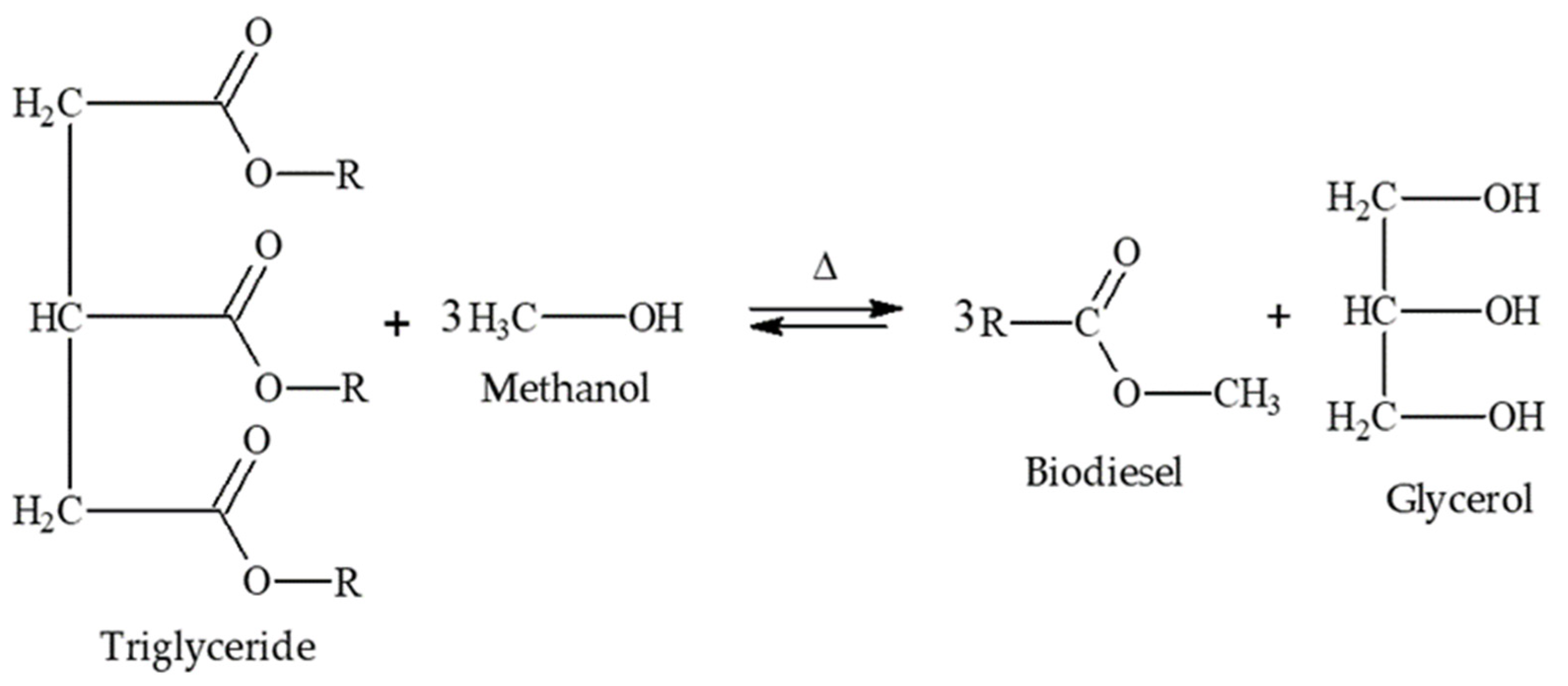
Figure 2.
Diagram of the biodiesel and glycerol production process adapted from Almeida et al. (2017) [37].
Figure 2.
Diagram of the biodiesel and glycerol production process adapted from Almeida et al. (2017) [37].
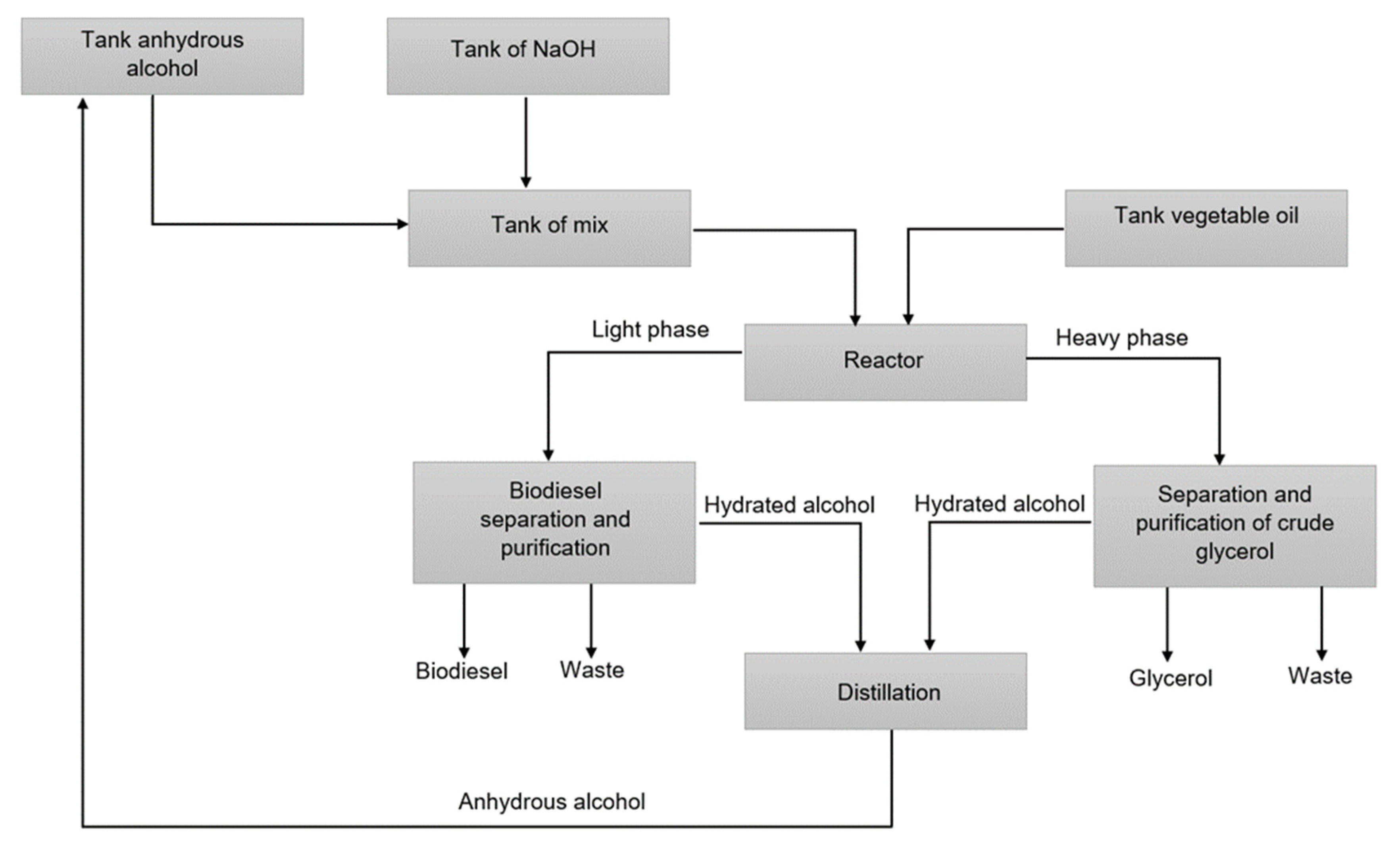
Figure 3.
Simplified diagram of the separation and purification processes of glycerol adapted from Luo et. al (2016) [38].
Figure 3.
Simplified diagram of the separation and purification processes of glycerol adapted from Luo et. al (2016) [38].
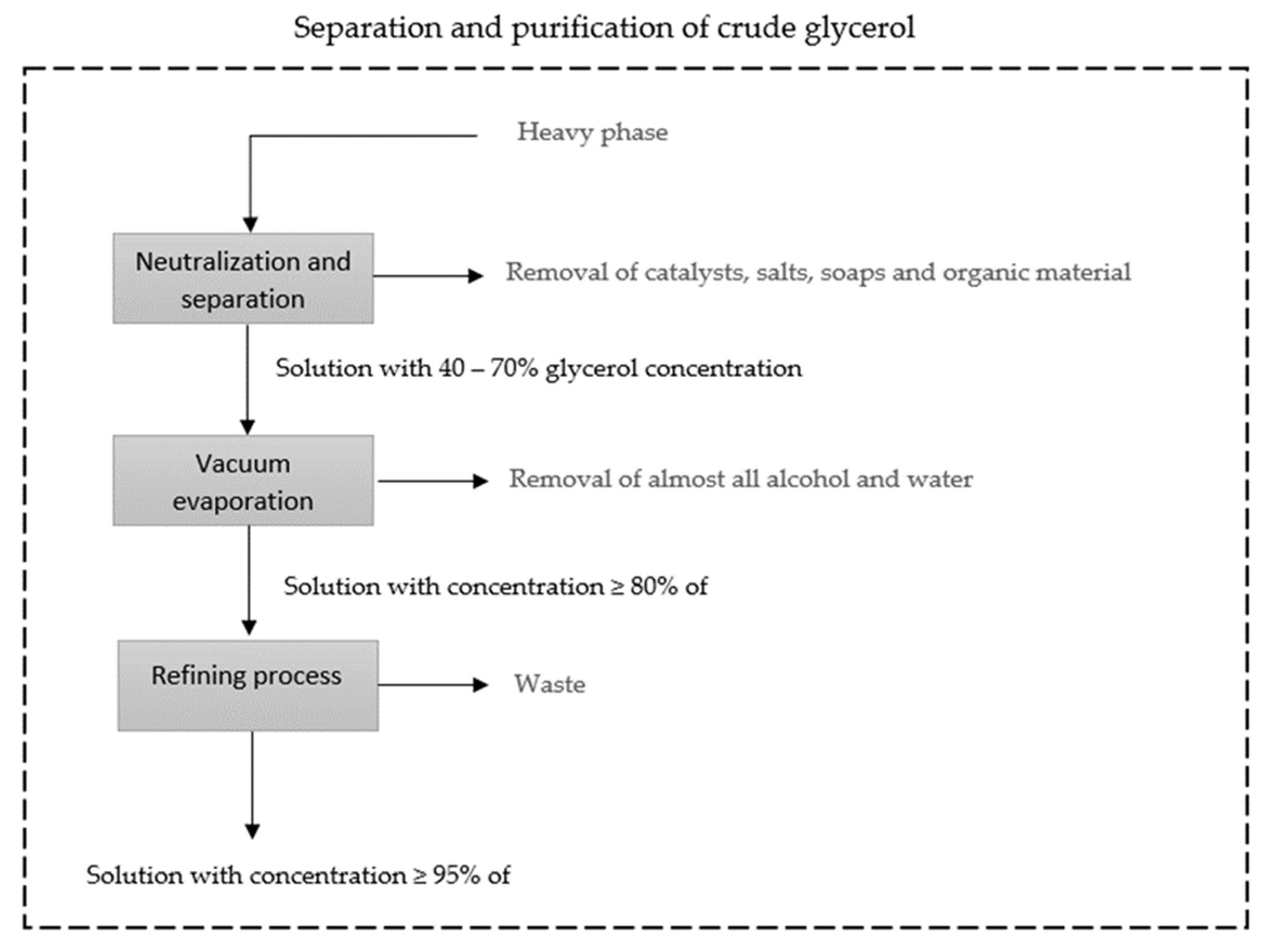
Table 1.
Physicochemical properties of glycerol.
| Property | Value |
|---|---|
| Molecular weight | 92.09 g/mol |
| Density at 20°C | 1.261 g/cm³ |
| Viscosity at 20°C | 1499 cP |
| Specific heat at 26°C | 2.42 J/g |
| Heat of formation | 159.6 Kcal/g mol |
| Heat of combustion | 1662 KJ/mol |
| Heat of fusion | 18.3 KJ/mol |
| Fusion point | 17.8 °C |
| Flash point | 177 °C |
| Point of combustion | 204 °C |
| Point of decomposition | 290 °C |
Table 2.
Production of biogas using glycerol as raw material.
| Authors | Feedstock | Microorganism | Results | |
|---|---|---|---|---|
| Astals et al. (2012) | Swine effluent and crude glycerol | Pig manure was used as inoculum | The best yield was obtained with 4% crude glycerol added to the bioreactor, obtaining a 400% increase in biogas production with respect to monodigestion | |
| Siles et al. (2010) | Crude glycerol and wastewater from the biodiesel production process | Active methanogenic granular biomass | Maximum production was 310 mL of CH4/g per organic matter removed | |
| Beschkov et al. (2012) | Crude glycerol | Klebsiella sp. | The authors carried out the modeling of a multistage biodigester; and from this modeling it is possible to estimate the number of stages necessary so that one stage does not inhibit the other | |
| Fountoulakis et al. (2009) | Urban effluent and crude glycerol | The inoculum was obtained from the anaerobic sludge from the municipal station | The authors observed the production of 1400 mL CH4/d before without adding glycerol and 2094 mL CH4/d after adding glycerol | |
| Oliveira (2015) | Crude glycerol and residual frying oil | Sargassum sp. | Without the addition of glycerol and residual oil, the biochemical potential of Sargassum sp. was 181 ± 1 L CH4/L of DOC and the methane rate increased 56% with the addition of glycerol and 46% with the addition of residual oil | |
| Sawasdee et al. (2019) | Glucose and glycerol | The inoculum was obtained from cassava starch sludge | The highest yield of biogas production was in the 5:5 ratio of glycerol/glucose with a maximum production rate of 8 mL/h | |
Disclaimer/Publisher’s Note: The statements, opinions and data contained in all publications are solely those of the individual author(s) and contributor(s) and not of MDPI and/or the editor(s). MDPI and/or the editor(s) disclaim responsibility for any injury to people or property resulting from any ideas, methods, instructions or products referred to in the content. |
© 2023 by the authors. Licensee MDPI, Basel, Switzerland. This article is an open access article distributed under the terms and conditions of the Creative Commons Attribution (CC BY) license (http://creativecommons.org/licenses/by/4.0/).
Copyright: This open access article is published under a Creative Commons CC BY 4.0 license, which permit the free download, distribution, and reuse, provided that the author and preprint are cited in any reuse.


