

Submitted:
31 July 2023
Posted:
01 August 2023
You are already at the latest version
Abstract
The European Union's current pressure on Member States to adopt the Green Deal and the Fit for 55 package is leading to an accelerated drive to put in place measures to meet the 2030 climate targets. At the same time, many discussions at international bilateral meetings of EU country representatives raise the question of the realism of setting climate targets and therefore the ability to meet these commitments. The results elaborated in this analytical study offer a realistic picture of the possibilities of meeting strategic climate targets using the example of the use of forest dendromass for the ability to achieve a 22% share of renewable energy sources (RES) in gross final energy consumption by 2030 in the Czech Republic. The study points out that at present the use of forest dendromass from primary pro-duction is at its maximum and meeting the climate targets for increasing the share of RES in the energy mix represents a major problem in the long term. The findings published in this study also point to the objective threat of increased use of dendrmass in the energy sector to the maintenance of sustainable forest management and the preservation of forest quality.
Keywords:
dendromass
; energy potential
; logging residues
; growing stock
; national climate targets
1. Introduction
Climate change has become one of the most globally discussed environmental issues in recent years [1,2]. It is now indisputable that the climate is changing [3,4,5] and will continue to do so in the future. But the extent and spatial and temporal impacts of these changes on the environment have yet to be seen [6]. In this context, the possibilities of further research and solutions to the adverse effects of these changes are debated worldwide. The ongoing global climate change poses a challenge for all sectors, forestry included [7]. Forests are believed to play a crucial role in mitigating climate changes [8,9,10]. They are essential for global carbon sequestration and storage and are largely responsible for the consistency of the global carbon sink [11]. The impacts of climate change will affect the conditions for the forestry sector [9,12]. The forestry sector can help mitigate climate change significantly by increasing carbon stocks in the forest soil, either through changed forestry management practices or the use of harvested timber [13,14,15]. Kirilenko and Sedjo [16] argue that climate change will affect all types of forests and forest management. Forests will face profound long-term changes, such as changes in species communities on a scale that is still difficult to predict [17,18,19,20,21]. The issue of climate change is therefore taken seriously in the forestry sector. The Paris Agreement adopted by the Parties to the United Nations Framework Convention on Climate Change [22] also acknowledged the role of forests in mitigating climate change. Scientists and multi-faceted research projects are trying to develop a range of readily available adaptation options [6,20,21,23]. Adaptation of forests to climate change involves forestry measures such as using different tree species and promoting mixed stands. However, the adaptive capacity of forests to overcome the adverse effects of climate change remains highly uncertain despite intensive research efforts [25].
From the perspective of possible solutions to climate change, searching for new energy sources and optimising the existing ones are currently the priority themes in environmental protection. Limiting the use of fossil fuels and massively expanding the use of renewable energy sources (RES) in its individual Member States, the European Union (EU) is considered the world’s pioneer in the transition to cleaner energy [26,27], with renewable energy being one of the fundamental pillars of the European Union’s strategy for energy and climate protection until 2030 and beyond [28]. Renewable energy sources have significant potential to contribute to economic, social and environmental energy sustainability [28]. The above stems primarily from the obligations of the EU Member States, which are declared in binding documents such as the European Green Deal [30] and subsequent documents [31,32,33,34,35]. Results of various studies show [2,29,39], that renewable energy consumption is a significant factor in reducing carbon emissions.
The EU framework for climate and energy policies was adopted by the Conclusions of the European Council of October 2014 [31]. The adopted goals in renewable sources and energy efficiency were subsequently increased in 2018 by the amendment of the Renewable Energy Directive [32], which sets the target for the share of renewable resources in overall gross final energy consumption to 32% by 2030. The amendment of the Renewable Energy Directive of 2021 [32,34] further increased the target for the share of renewable resources in overall gross final energy consumption by 2030 to 40%. The latest increase to 45% was carried out in 2022 under the so-called REPowerEU Plan [36]. The need to increase the share of renewable energy sources is also included in the Communication from the Commission to the European Parliament entitled ‘A Clean Planet For All’ [30]. The Czech Republic (CR) has set a target of a 22% share of renewable energy sources in gross final consumption [33].
The Renewable Energy Directive 2009/28/EC (RED I) defines ‘gross final energy consumption’ as energy commodities supplied for energy purposes to industry, transport, households, services (including utilities), agriculture, forestry and fishing, including electricity and heat consumption by the energy sector used for electricity and heat generation and including electricity and heat losses during distribution and transmission.
In 2021, the share of gross final energy consumption from renewable sources at the EU level reached 21.8%. Compared to 2020, this was a decrease of 0.3 percentage points (p.p.) and the first recorded decrease ever. In the Czech Republic, the share of renewable sources in gross final energy consumption accounted for 17.7% in 2021. Compared to the preceding year, it represented an increase of 0.4 p.p. [37,38,39].
One of the renewable sources of energy is biomass. Biomass is a competitive fuel that can be successfully used for energy production. With a share of more than 60%, biomass for energy production (bioenergy) is the primary source of renewable energy in the EU [38]. The volume of biomass for energy production depends on the origin of the resource, its alternative use, and the limitation of its use [39]. The Renewable Energy Directive 2009/28/EC (RED I) defines ‘gross final energy consumption’ as energy commodities supplied for energy purposes to industry, transport, households, services (including utilities), agriculture, forestry and fishing, including electricity and heat consumption by the energy sector used for electricity and heat generation and including electricity and heat losses during distribution and transmission. In 2021, the share of gross final energy consumption from renewable sources at the EU level reached 21.8%. Compared to 2020, this was a decrease of 0.3 percentage points (p.p.) and the first recorded decrease ever. In the CR, the share of renewable sources in gross final energy consumption accounted for 17.7% in 2021. Compared to the preceding year, it represented an increase of 0.4 p.p. [38]. One of the renewable sources of energy is biomass. Biomass is a competitive fuel that can be successfully used for energy production. With a share of more than 60%, biomass for energy production (bioenergy) is the primary source of renewable energy in the EU [40]. The volume of biomass for energy production depends on the origin of the resource, its alternative use, and the limitation of its use [41].
Forests are an important potential source of biomass. Forest tree biomass (dendromass) mainly comprises forest residues, which are divided into primary, secondary and tertiary residues in the published literature [40]. The Intergovernmental Panel on Climate Change (IPCC) identified forest biomass as an essential source of renewable energy [41]. Efficient use of resources such as forest biomass (e.g. logging residues) expands the overall availability of biomass for both industrial and energy purposes. One of the main products of forestry, wood is a renewable and sustainable raw material that is currently widely used in all sectors of the national economy, including the energy sector [42-46]. As Europe is moving towards a bioeconomy by reducing dependence on fossil fuels, forest products are increasingly used to secure energy supplies [25]. Forest biomass for energy purposes is one of the most important sources of energy thanks to the raw material potential and the possibility of its renewal [47]. Moiseyev et al. [48] estimate that 24% of the European Union’s renewable energy goal was met through forests and the forest industry. Therefore, the consumption and production of wood biomass and other forms of renewable energy have been increasing significantly. One of the factors influencing the overall balance of forest biomass is the form and quality of wood mass that cannot be further mechanically processed [49].
From a biophysical point of view, wood biomass resources are large enough to cover a substantial part of the world’s primary energy consumption in 2050. However, these resources have alternative uses, and their availability is limited, making them less competitive with other forms of energy [50]. In order to solve some of the problems related to climate change and the search for alternative raw materials for energy use, the energy sector pays more and more attention to low-cost waste and biomass residues [51,52]. The focus is on improving the flow of waste in a circular economy and enabling better management [53].
The article concentrates on the use of forest logging residues for energy purposes. A cheap and available raw material, forest residues can replace current fossil energy sources, thereby contributing to reducing greenhouse gas emissions and increasing energy security [52-55]. However, it has been argued that besides its positive impacts, logging forest residues could also have negative impacts on the carbon and nutrient balance and subsequently on climate change, as well as other bioenergy impacts depending on the forest management methods [55,56]. Therefore, it is vital to analyse the consequences of the increased use of forest logging residues on the environment and the economy with respect to all processes in the supply chain and the regional perspective [59-61]. Czech forestry produces approx. 2 million m3 (approx. 0.77 million tons) of wood chips, 1.5 million tons of cellulose leach and nearly 5 million tons of fuelwood for energy purposes [37]. As stated in the document of the Ministry of Industry of the Czech Republic [37], predicting the availability of forest biomass for energy purposes is currently extremely complex due to the ongoing bark beetle calamity. The article aims to analyse the base of forest raw material for energy use and predict the volumes of available forest biomass (primarily forest logging residues) in the Czech Republic with regard to the next possible occurrence of calamities caused by abiotic or biotic factors. The outputs of the article will include a quantified estimate of whether the Czech Republic can meet the goals in the utilisation of renewable energy sources set by binding documents of the European Union.
2. Materials and Methods
The results of the study, which are presented in the “Results” section, were obtained using the method of modelling the overall overview of logging possibilities applied to model data of forest stands and wood stocks in the Czech Republic. The goal of modelling the overall overview of logging possibilities in forests in the Czech Republic was to determine the theoretical outlook of ten-year logging possibilities in Czech forests for the period 2021-2061. The outlook has been prepared for the entire Czech Republic using the following inputs:
- Data obtained during the preparation of forest management plans (FMP) and forest management outlines (FMO) that are stored in the Data Warehouse of the Information and Data Center of the Institute for Forest Management Brandýs nad Labem Czech Republic (Institute for FM CR): available current FMP and FMO data (2012-2021)
- Other underlying data related to restrictions on the felling volumes (categorisation of forests, NATURA 2000, etc.).
For the study, forests were divided into economically usable forests and forests with economic restrictions. The criteria for the division were the categories and subcategories as per the Forest Act (Act No. 289/1996 Coll., Sections 6-9):
- Economically usable forests are production forests and special-use forests, with the exception of
- The first zone of National Parks and Protected Landscape Areas, National Nature Reserves, National Natural Landmarks, and Nature Parks.
- Forests with economic restrictions are protection forests and special-status forests of
- The first zone of National Parks and Protected Landscape Areas, National Nature Reserves, National Natural Landmarks, and Nature Parks.
The economically usable forests were used as the basis for processing the outlooks for the development of logging possibilities. The modelling and the prediction of logging were prepared by the Institute for Forest Management in Brandýs nad Labem CR as an expert consultant. Subsequently, the potential volume of forest logging residues from forests on the territory of the Czech Republic has been prepared in two variants:
- Variant I:
- -
- Ad a) Theoretical outlook for forest logging residues in the period 2021-2061 by individual decades. The outlook has been processed for individual regions and converted for the entire area of the Czech Republic.
- -
- Ad b) Theoretical outlook for forest logging residues in the period 2014-2053 by individual decades. The output is calculated in aggregate for the Czech Republic.
- Variant II:
- -
- Theoretical outlook for forest logging residues in the period 2021-2061, by individual decades. The outlook has been processed for individual regions and converted for the entire area of the Czech Republic.
- -
- The theoretical outlook for forest logging residues in units of volume for Variants I (a, b) was prepared by the Institute for FM CR on the basis of the Agreement.
- Variant I – Ad a)
A derivation of the potential volume of forest logging residues in forests on the Czech territory for the period 2021-2061 by individual decades. The outlook was prepared for individual regions and converted to the entire area of the Czech Republic. The volume of forest logging residues was determined using the Biomass Conversion and Expansion Factors (BCEF) derived by ass. Prof. Cienciala for the purposes of the emission balance of the Czech Republic. Table 1 shows the used average proportions of forest logging residues per 1 m3 of harvested wood, separately for regeneration and tending felling.
The derived potential volume of forest logging residues represents the total volume of forest logging residues (including bark) without any reductions.
- Variant I – Ad b)
A derivation of the potential annual volume of forest logging residues in forests on the Czech territory for the period 2014-2053 by individual decades. The output is calculated in aggregate for the Czech Republic. For the first decade, a part of the logging volume is taken from data obtained by the Czech Statistical Office (2014-2021); the rest is a qualified estimate (2022-2023), whereas the calamity period is taken into account. The volume of forest logging residues was derived using the Biomass Conversion and Expansion Factors (BCEF) derived by ass. Prof. Cienciala for the purposes of the emission balance of the Czech Republic. Table 1 shows the used average proportions of forest logging residues per 1 m3 of harvested wood, separately for regeneration and tending logging.
- Variant II:
The volume of logging residues can also be quantified using the Forest Ressource Assessment based on the relationships shown in Table 2.
If we want to expand the volume of timber with a top diameter of 7 cm or more without bark to the total shoot mass using the above values, we must multiply the value of timber with a top diameter of 7 cm and more under bark by a coefficient of 1.299. In other words, branches thinner than 7 cm, bark and stumps amount to approx. 30% more than the recorded stock of timber with a top diameter of 7 cm or more without bark.
The theoretical conversions of the potential of forest logging residues from m3 to tons (t) for variants I (a; b) and variant II were carried out using a coefficient of 0.625 based on the bulk density of wood, its moisture content, and, for example, long-term contracts with Forest of the Czech Republic, state enterprises (FCR, s.e.). Furthermore, attention must be drawn to other specifics of handling forest dendromass (forest wood chips) arising from transport, handovers, etc. It means that the basic unit of wood (m3, plm) must be converted to bulk space meter (prms) and then to tons (t). The empirically determined coefficient of woodchip production volume used in operation is approx. 0.7 prms per 1 m3 of timber with a top diameter of 7 cm and more under bark; the weight of a loose cubic meter of wood chips varies depending on the type of wood and the moisture content of the wood chips. For instance, the bulk weight of coniferous wood chips with a moisture content of around 50-60% is approx. 250-400 kg. For deciduous wood chips with a moisture content of around 50-60%, the bulk weight of the wood chips is around 350-450 kg.
3. Results
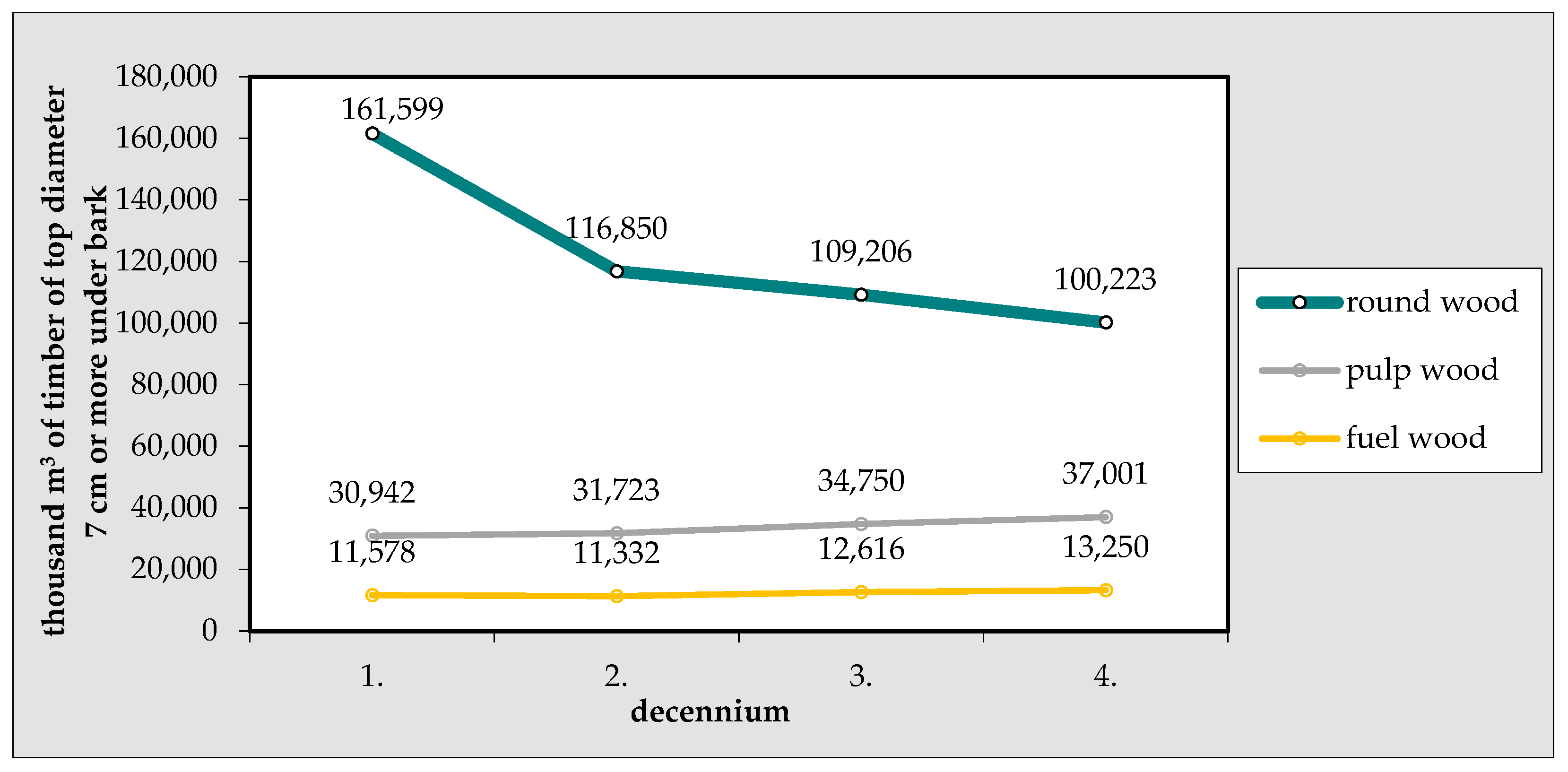
The Figures below provide information about the development in standing volume and an outlook of felling possibilities depicted in the volumes of regeneration and tending felling, ending felling increased by 15% (the average increase for the entire Czech Republic pursuant to Section 8(10) of Decree of the Ministry of Agriculture No. 84/1996 Coll., and total felling volume (a sum of the regeneration felling volume and the volume of tending felling increased by 15%). The last Figure shows assortment possibilities by the individual assortment types: roundwood, pulpwood, and fuelwood.
Figure 1.
Outlook for the development of standing volume. Source: own processing based on data from Institut for FM CR.
Figure 1.
Outlook for the development of standing volume. Source: own processing based on data from Institut for FM CR.
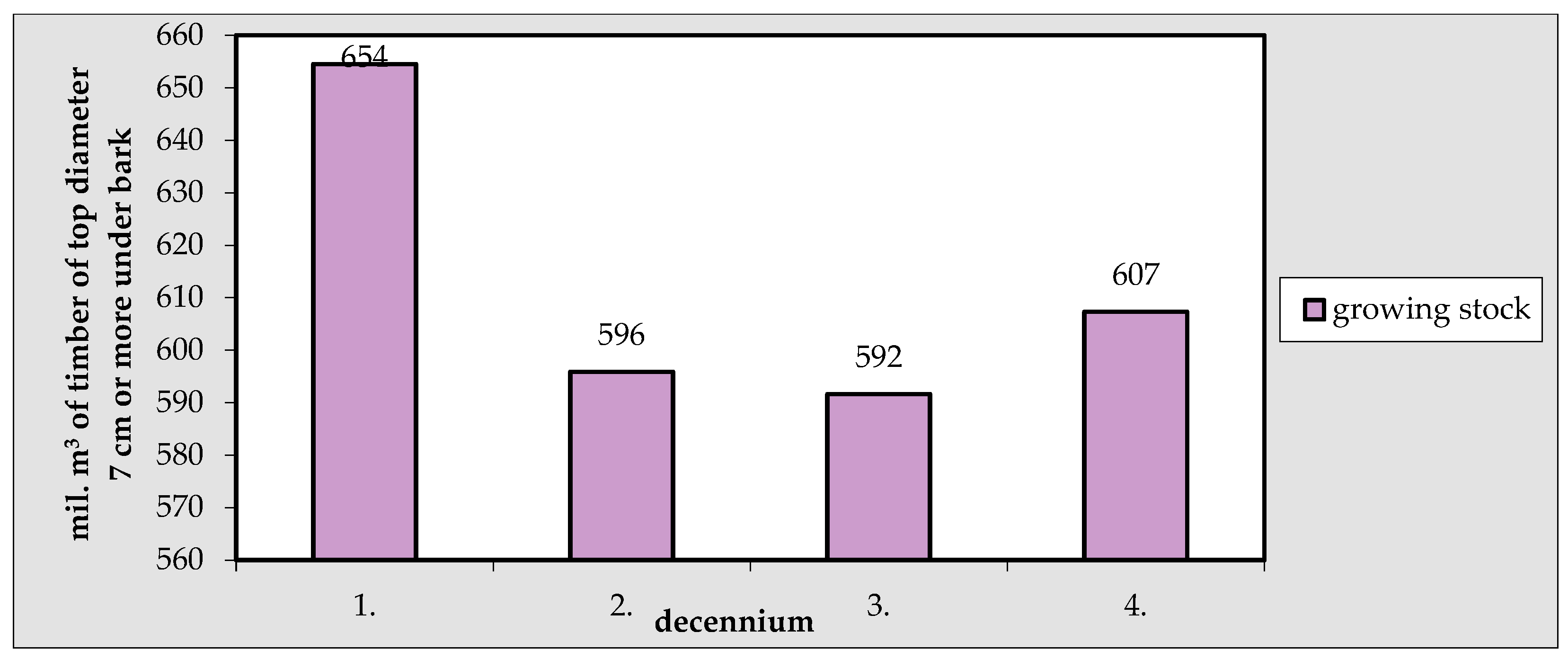
Figure 2.
Theoretical outlook for ten-year logging possibilities (of logging percentages). Source: own processing based on data from Institut for FM CR.
Figure 2.
Theoretical outlook for ten-year logging possibilities (of logging percentages). Source: own processing based on data from Institut for FM CR.
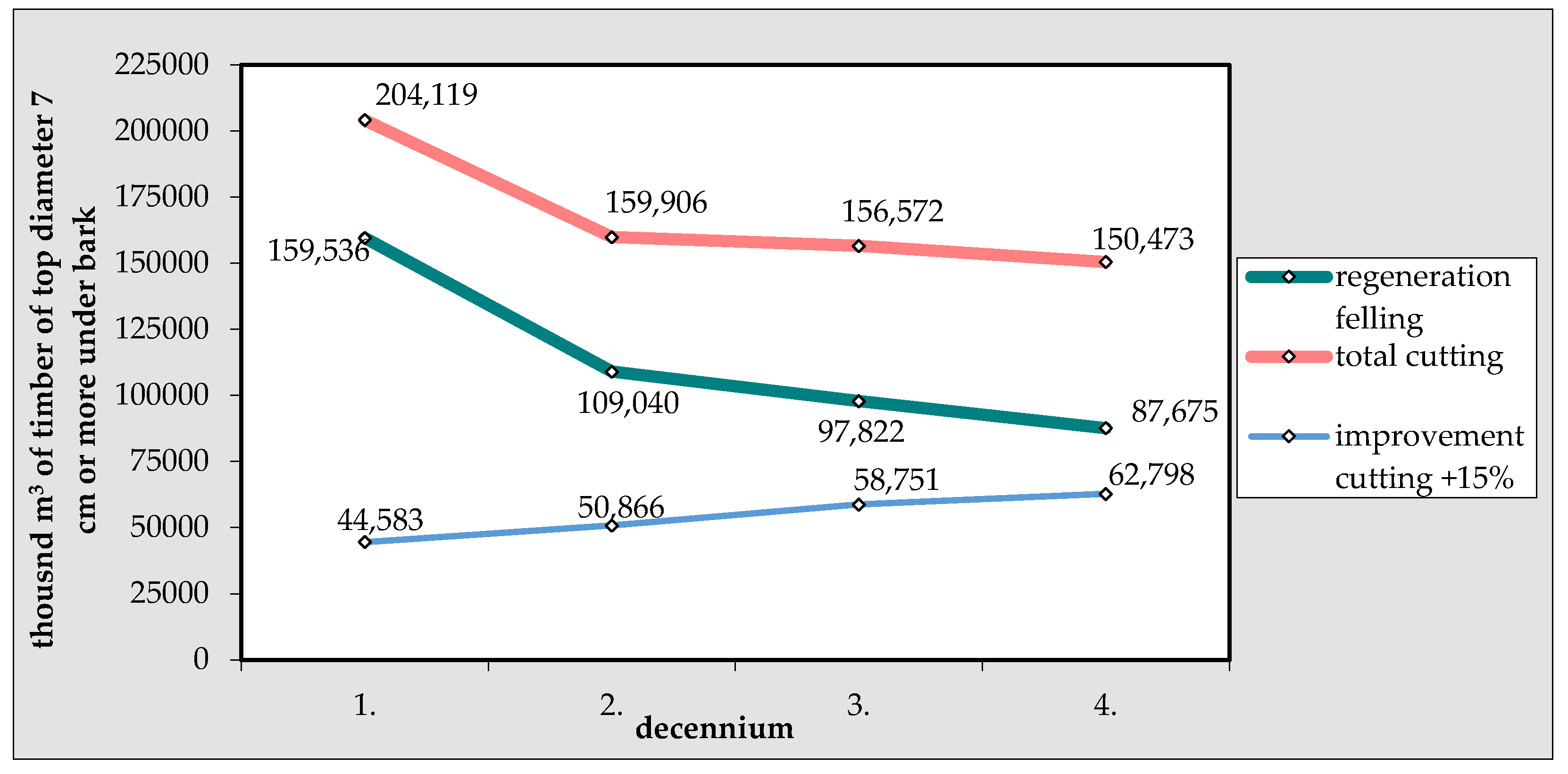
Figure 3.
Theoretical outlook of assortment options. Source: own processing based on data from Institut for FM CR.
Figure 3.
Theoretical outlook of assortment options. Source: own processing based on data from Institut for FM CR.
Based on the results of felling possibilities analyses, a more significant decrease in felling possibilities can be predicted, derived from the current development of incidental felling in the past years (2015-2021), a decrease in increment, and felling percentage. In the second decade (2031-2040), the total standing volume will drop below 600 million m3 of timber with a top diameter of 7 cm or more under bark. Due to the course of the bark beetle calamity, there will be significant differences in the individual regions.
The theoretical potential of forest logging residuals
Variant I (ad a) represents a derivation of the potential volume of forest logging residues in forests on the Czech territory for the period 2021-2061 by individual decades. The outlook has been processed for individual regions and converted for the entire area of the Czech Republic. Table 10 shows an overview of forest logging residues by individual regions and for the Czech Republic in individual decades. Table 3 gives an overview of the annual potential of forest logging residues by individual regions and for the Czech Republic. The overview shows the distribution of the volume of forest logging residues in individual decades based on the annual available capacity.
Table 4 demonstrates the annual potential volume of forest logging residues in individual decades by individual regions and for the entire Czech Republic, calculated in tons.
Variant I (ad b) represents a derivation of the potential volume of forest logging residues in forests on the Czech territory for the period 2014-2053 by individual decades. The output has been calculated in aggregate for the Czech Republic. For the first decade, part of the logging volume is taken from data obtained by the Czech Statistical Office (2014-2021); the rest is a qualified estimate (2022-2023), whereas the calamity period is taken into account. Table 5 shows an overview of the annual potential of forest logging residues by individual decades for the Czech Republic by volume of the main tree species.
Table 6 shows the annual potential volume of forest logging residues by individual decades for the entire territory of the Czech Republic, calculated in tons.
3.1. Derivation of the potential volume of forest logging residues in forests on the Czech territory (Variant II)
Table 7 gives an overview of the annual potential of forest logging residues by individual regions and for the Czech Republic. The overview shows the distribution of the volume of forest logging residues in individual decades based on the annual available capacity.
Table 8 demonstrates the annual potential volume of forest logging residues in individual decades by individual regions and for the entire Czech Republic, calculated in tons.
| Individual decades in (m3) | 1 | 2 | 3 | 4 |
| South Bohemian Region | 607,125 | 456,313 | 438,563 | 422,625 |
| Plzeň Region | 447,625 | 344,938 | 336,125 | 321,688 |
| Karlovy Vary Region | 200,188 | 157,000 | 150,125 | 145,813 |
| Ústí nad Labem Region | 137,875 | 123,375 | 128,000 | 117,188 |
| Liberec Region | 155,813 | 129,313 | 125,438 | 118,375 |
| Hradec Králové Region | 188,625 | 154,625 | 153,250 | 145,875 |
| Pardubice Region | 227,188 | 176,625 | 172,188 | 166,313 |
| Vysočina Region | 384,875 | 305,563 | 304,875 | 291,688 |
| South Moravian Region | 262,250 | 206,438 | 201,375 | 191,063 |
| Olomouc Region | 267,813 | 214,813 | 211,813 | 209,625 |
| Zlín Region | 282,688 | 219,625 | 213,688 | 203,563 |
| Moravian-Silesian Region | 269,125 | 211,438 | 216,313 | 218,563 |
| Central Bohemian Region; Prague | 396,063 | 298,250 | 284 063 | 269,000 |
| Czech Republic (total) | 3,827,253 | 2,998,316 | 2,935,816 | 2,821,379 |
| Source: processed by the authors based on data from Institut for FM CR. |
The potential used by the industry, limited by unperformed projects, logistics and fossil fuel prices on the one hand and by increasing requirements for keeping biomass from primary forest production in forest stands on the other, amounts to max. 2.5 million tons per year (4 mil. m3). This includes farmed trees, where there is some room for an increase (estimated at max. 100,000 tons), and residual dendromass in the forests. This outlook is for the middle of the second decade, approximately until 2035.
Another factor that plays a significant role is the fact that forests with an increased interest in nature protection make up 44% of the forest land for which FCR, s.e. holds the management right. The collection of forest logging residues is excluded for the category of protective forests, national nature reserves, national natural landmarks, nature reserves, nature parks, first zones of National Parks, European areas of conservation, and water resource protection zones. Furthermore, the following locations are also not particularly suitable for forest logging residues collection: exposed sites, natural pine sites, natural regeneration areas, and locations in the 7th and 8th forest vegetation stage zones. It follows from the above that 657 thousand ha (i.e. 56% of timber land) of land for which FCR, s.e. holds the management rights meet the criteria for locations suitable for collecting forest logging residues for energy purposes.
Another important aspect is that for 2021-2030, FCR, s.e. anticipates the sale of forest logging residues amounting to approx. 2,700,000 m3 of concentrated felling and approx. 165,000 m3 of first thinning. For 2031-2040, this volume is expected to decrease by approximately 40%.
The overall energy mix does provide much room for improvement unless the following changes:
- a)
- combustion technology and increase in efficiency,
- b)
- technology for the production of noble fuels (2nd generation).
4. Discussion
Climate change, pollution and energy insecurity are among the biggest problems our society is facing [62]. With the ongoing energy crisis, renewable energy sources, if used correctly, contribute to reducing energy dependence on conventional energy sources. Thanks to low operating costs, renewable energy sources are little affected by fossil fuel price fluctuations [27].
The Green Deal for Europe [30], a very ambitious package of measures that should enable European citizens and businesses to enjoy the benefits of a sustainable ecological transition – has set the goal for the EU to become the world’s first climate-neutral continent by 2050. Society’s need to address issues related to global climate change has fueled interest in the research and adoption of renewable energy sources such as the use of biomass [60].
Demand for renewable energy sources (including biomass) is growing in many countries worldwide. Results of scientific research and the recent guidelines laid down by the Paris Agreement [63,64] call for radical changes in this area. Renewable energy sources play a crucial role in the transition to clean energy. The deployment of renewable energy sources is one of the main factors in keeping the rise in average global temperature below 1.5°C [10].
Yet, electricity generation from renewable sources must expand faster to reach the milestones set in the Net Zero Emissions scenario by 2050, which demands the share of electricity generation from renewable sources to increase from nearly 29% in 2021 to more than 60% by 2030. Annual generation must grow at an average rate of over 12% in 2022-2030, i.e. double the 2019-2021 average [10].
The EU needs to include as many renewable energy sources as possible in the comprehensive energy mix to meet its 2030 targets for the share of renewable energy in final gross energy consumption and the carbon neutrality of the energy sector by 2050. Looking at the EU goal, which is currently set at 32% for 2030 by Directive 2018/2001 of 11 December 2018 on the Promotion of the Use of Energy from Renewable Sources, the share of 21.8% recorded in 2021 is still significantly below this objective. Therefore, countries need to step up their efforts to stay above the baseline set in Regulation 2018/1999 on the Governance of the Energy Union and Climate Action and to follow the EU’s required trajectory. That is all the more so since the Commission issued a proposal to amend the Renewable Energy Directive in 2021, seeking to increase this target to 40%, and with the REPowerEU plan further increasing this target to 45% in 2022.
Currently, the share of renewable energy in the total consumption of the Czech Republic is more than 17%, while the vast majority of this energy comes from various forms of biomass [65].
According to the publication Development of Renewable Energy in the Czech Republic until 2030 [65], the Czech Republic should increase its share of renewable energy sources to 33-35% by 2030. The report indicates that the use of sustainable biomass, such as wood waste, plays only a complementary role in the further development of renewable energy – simply because biomass is and will be a limited resource. According to this report, this type of renewable energy source should increase by 4 p.p. Despite its renewable nature, however, wood is a limited resource and currently, a significant volume of processed raw material that ends up in secondary streams is used as fuel [43]. Wood biomass can be a sustainable source of energy, a valuable renewable alternative to the limited supply of available fossil fuels [42]. Regarding forest use, sustainability means that forests and the benefits they bring to current generations should not jeopardise the possibility for future generations to benefit from them similarly [44]. What our forests will look like for future generations and the resulting impact of climate change on forestry will be is in the hands of forest managers [7]. This being said, more research is needed that takes into account the environmental, economic and social constraints of logging residue disposal [61].
5. Conclusions
If the set goal for the Czech Republic is the share of renewable energy sources in the total gross final energy consumption of 22% by 2030, the share of forest biomass from primary production in the energy mix is currently at its maximum available limit. A further increase in the share by 2030 while maintaining the principles of sustainable forest management is no longer possible; it could result in a threat to the security of supply in the longer term, including the risk of distortion of the wood raw material markets in technological processing assortments – saw logs, wood for the paper and pulp industry, and the production of wood-based agglomerated materials.
It is, therefore, possible to state that, currently, the share of forest biomass from primary production in the energy mix of the Czech Republic is at its maximum available limit. Hence, if we want to preserve the quality of forests in the Czech Republic in the future, we must focus on other resources that could be used to fulfil the goals that our country, as one of the EU Member States, has set for itself. A potential option can be found in the waste generated at sawmills, paper mills, or the construction industry, i. e., wherever unprocessed wood waste remains.
Author Contributions
conceptualization, J.M. and P.H.; methodology, D.B.; validation, P.H. and J.M.; investigation, D.B.; resources, D.B.; data curation, P.H and J.M.; writing—original draft preparation, P.H.; writing—review and editing, P.H.; supervision, P.H and D.B.; project administration, J.M.; funding acquisition, D.B. All authors have read and agreed to the published version of the manuscript.
Funding
This research was funded with support from the European Union’s Horizon 2020 research and innovation programme under grant agreement No.952314.
Data Availability Statement
The data presented in this study are available on request from the corresponding author.
Acknowledgments
The authors are grateful for funding received from the European Union’s Horizon 2020 research and innovation programme under grant agreement No.952314. Thanks are also due to the contract research entitled: "Analysis and prediction of the development of raw timber stocks in forest areas of the Czech Republic and the development of the available raw material base of forest dendromass for technological and energy purposes in the Czech Republic"; prepared for the Forestry and Timber Chamber of the Czech Republic. The Institut for Forest Management in Brandýs nad Labem CR also participated in the study.
Conflicts of Interest
The authors declare no conflict of interest.
References
- Li, Y.; Alharthi, M.; Ahmad, I.; Hanif, I.; Hassan, M. U. Nexus between renewable energy, natural resources and carbon emissions under the shadow of transboundary trade relationship from South East Asian economies. Energy Strategy Reviews 2022, 41, 100855. [Google Scholar] [CrossRef]
- Chen, H.; Shi, Y.; Zhao, X. Investment in renewable energy resource, sustainable financial inclusion and energy efficiency: A case of US economy. Resources Policy 2022, 77, 102680. [Google Scholar] [CrossRef]
- IPCC. Climate Change 2007. Impacts, Adaptation and Vulnerability. Contribution of Working Group I to the Fourth Assessment Report of the Intergovernmental Panel on Climate Change, M.L. https://www.ipcc.ch/site/assets/uploads/2018/03/ar4_wg2_full_report.pdf.
- IPCC. Climate Change 2023. Synthesis Report of the Intergovernmental Panel on Climate Change Sixth Assessment Report (AR6). https://www.ipcc.ch/report/ar6/syr/.
- WMO. State of the Global Climate in 2022. World Meteorological Organization. https://storymaps.arcgis.com/stories/6d9fcb0709f64904aee371eac09afbdf.
- Fouqueray, T.; Latune, J.; Trommetter, M.; Frascaria-Lacoste, N. Interdisciplinary modeling and participatory simulation of forest management to foster adaptation to climate change. Environmental Modelling and Software 2022, 151, 105338. [Google Scholar] [CrossRef]
- Vacek, Z.; Vacek, S.; Cukor, J. European forests under global climate change: Review of tree growth processes, crises and management strategies. Journal of Environmental Management 2023, 332, 117353. [Google Scholar] [CrossRef]
- Njana, M. A.; Mbilinyi, B.; Eliakimu, Z. The role of forest in the mitigation of global climate change: Emprical evidence from Tanzania. Environmental Challenges 2021, 4, 100170. [Google Scholar] [CrossRef]
- Andersson, M.; Bostedt, G.; Sandström, C. The role of Swedish forests in climate change mitigation – A frame analysis of conflicting interests. Forest Policy and Economics 2022, 144, 102842. [Google Scholar] [CrossRef]
- Annevelink, B.; Chavez, L. C.; van Ree, R.; Gursel, I. V. Global biorefinery status report 2022. IEA Bioenergy 2022, Technology Collaboration Programme. https://www.ieabioenergy.com/wp-content/uploads/2022/09/IEA-Bioenergy-Task-42-Global-biorefinery-status-report-2022-220712.pdf.
- Hurteau, M. D. Chapter 27 – The role of forests in the carbon cycle and in climate change. In Climate Change; Letcher, T.M, Ed.; Elsevier, 2021; pp. 561–579. [Google Scholar] [CrossRef]
- Eriksson, L. Conventional and new ways of governing forest threats: a study of stakeholder coherence in Sweden. Environ. Manag. 2018, 61(1), 103–115. [Google Scholar] [CrossRef]
- Griscom, B. W.; Adams, J.; Ellis, P. W.; Fargione, J. Natural climate solutions. PNAS 2017, 114, 11645–11650. [Google Scholar] [CrossRef]
- Jorgensen, K.; Granath, G.; Lindahl, B. D.; Strengbom, J. Forest management to increase carbon sequestration in boreal Pinus sylvestris forests. Plant and Soil 2021, 466, 165–178. [Google Scholar] [CrossRef]
- Sikkema, R.; Styles, D.; Jonsson, R.; Tobin, B.; Byrne, K. A. A market inventory of construction wood for residential building in Europe – in the light of the Green Deal and new circular economy ambitions. Sustainable Cities and Society 2023, 90, 104370. [Google Scholar] [CrossRef]
- Kirilenko, A. P.; Sedjo, R. A. Climate change impacts on forestry. Proc. Natl. Acad. Sci. Unit. States Am 2007, 104, 19697e19702. [Google Scholar] [CrossRef] [PubMed]
- Lindner, M.; Maroschek, M.; Netherer, S.; Kremer, A.; Barbati, A.; Garcia-Gonzalo, J.; Seidl, R.; Delzon, S.; Corona, P.; Kolstrom, M.; Lexer, M. J.; Marchetti, M. Climate change impacts, adaptive capacity, and vulnerability of European forest ecosystems. For. Ecol. Manag. 2010, 259, 698–709. [Google Scholar] [CrossRef]
- Kouba, Y.; Camarero, J. J. Alados, C. L. Roles of land-use and climate change on the establishment and regeneration dynamics of Mediterranean semi-deciduous oak forests. Forest Ecology and Management 2012, 274, 143–150. [Google Scholar] [CrossRef]
- García-Valdés, R.; Estrada, A.; Early, R.; Lehsten, V.; Morin, X. Climate change impacts on long-term forest productivity might be driven by species turnover rather than by changes in tree growth. Global Ecol. Biogeogr. 2020, 29, 1360–1372. [Google Scholar] [CrossRef]
- Keenan, R.J. Climate change impacts and adaptation in forest management: a review. Ann. For. Sci. 2015, 72, 145–167. [Google Scholar] [CrossRef]
- Fouqueray, T.; Charpentier, A.; Trommetter, M.; Frascaria-Lacoste, N. The calm before the storm: how climate change drives forestry evolutions. For. Ecol. Manag. 2020, 460, 117880. [Google Scholar] [CrossRef]
- United nations. Paris Agreement. 2015. https://unfccc.int/sites/default/files/english_paris_agreement.pdf.
- Bošela, M.; Stefaňčík, I.; Marčiš, P.; Rubio-Cuadrado, A.; Lukac, M. Thinning decreases above-ground biomass increment in central European beech forests but does not change individual tree resistance to climate events. Agric. For. Meteorol. 2021, 306, 108441. [Google Scholar] [CrossRef]
- Mason, W. L.; Petr, M.; Barhgate, S. Silvicultural strategies for adapting planted forests to climate change: from theory to practice. Journal of Forest Science 2012, 58, 265–277. [Google Scholar] [CrossRef]
- Khanan, T.; Rahman, A.; Mola-Yudego, B. Renewable energy and wood fuel production in the Nordic region: Can it be changed? Journal of Cleaner Production 2020, 276, 123547. [Google Scholar] [CrossRef]
- Pozner, E.; Bar-On, P.; Livne-Luzon, S.; Moran, U.; Tsamir-Rimon, M.; Dener, E.; Schwartz, R.; Rotenberg, E.; Tatarinov, F.; Preisler, Y.; Zecharia, N.; Osem, Y.; Yakir, D.; Klein, T. A hidden mechanism of forest loss under climate change: The role of drought in eliminating forest regeneration at the edge of its distribution. Forest Ecology and Management. 2022, 506, 119966. [Google Scholar] [CrossRef]
- Ioannidis, F.; Kosmidou, K.; Papanastasiou, D. Public awareness of renewable energy sources and Circular Economy in Greece. Renewable Energy 2023, 206, 1086–1096. [Google Scholar] [CrossRef]
- Knápek, J.; Vávrová, K.; Králík, T.; Outrata, D. Biomass potential – Theory and practice: Case example of the Czech Republic region. 7th International Conference on Energy and Environment Research, ICEER 2020, 14–18 September, ISEP, Porto, Portugal. Energy Reports 2020, 6, 292–297. [Google Scholar] [CrossRef]
- Algarni, S.; Tirth, V.; Algahtani, T.; Alshehery, S.; Kshirsagar, P. Contribution of renewable energy sources to the environmental impact and economic benefits for sustainable development. Sustainable Energy Technologies and Assessments 2023, 56, 103098. [Google Scholar] [CrossRef]
- European Commision. COM(2019) 640 final. COMMUNICATION FROM THE COMMISSION TO THE EUROPEAN PARLIAMENT, THE EUROPEAN COUNCIL, THE COUNCIL, THE EUROPEAN ECONOMIC AND SOCIAL COMMITTEE AND THE COMMITTEE OF THE REGIONS The European Green Deal. 2019. https://ec.europa.eu/info/strategy/priorities-2019-2024/european-green-deal_en (accessed on 4 June 2023).
- European Commision. COM(2014) 015 final. COMMUNICATION FROM THE COMMISSION TO THE EUROPEAN PARLIAMENT, THE COUNCIL, THE EUROPEAN ECONOMIC AND SOCIAL COMMITTEE AND THE COMMITTEE OF THE REGIONS A policy framework for climate and energy in the period from 2020 to 2030. 2014. https://eur-lex.europa.eu/legal-content/EN/TXT/?uri=COM:2014:15:FIN.
- European Union. Directive (EU) 2018/2001 on the promotion of the use of energy from renewable resources. 2018a. https://www.europeansources.info/record/directive-eu-2018-2001-on-the-promotion-of-the-use-of-energy-from-renewable-sources/ (accessed on 6 June 2023).
- European Union. COM(2018) 773 final. COMMUNICATION FROM THE COMMISSION TO THE EUROPEAN PARLIAMENT, THE EUROPEAN COUNCIL, THE COUNCIL, THE EUROPEAN ECONOMIC AND SOCIAL COMMITTEE, THE COMMITTEE OF THE REGIONS AND THE EUROPEAN INVESTMENT BANK A Clean Planet for all A European strategic long-term vision for a prosperous, modern, competitive and climate neutral economy. https://eur-lex.europa.eu/legal-content/EN/TXT/?uri=CELEX%3A52018DC0773 (accessed on 5 June 2023).
- European Commision. COM(2020) 80 final. Proposal for a REGULATION OF THE EUROPEAN PARLIAMENT AND OF THE COUNCIL establishing the framework for achieving climate neutrality and amending Regulation (EU) 2018/1999 (European Climate Law). 2020a. https://eur-lex.europa.eu/legal-content/EN/TXT/?uri=CELEX:52020PC0080 (accessed on 5 June 2023).
- European Commision. COM(2020) 563 final. Amended proposal for a REGULATION OF THE EUROPEAN PARLIAMENT AND OF THE COUNCIL on establishing the framework for achieving climate neutrality and amending Regulation (EU) 2018/1999 (European Climate Law). 2020b. https://eur-lex.europa.eu/legal-content/EN/TXT/?uri=CELEX:52020PC0563 (accessed on 4 June 2023).
- European Commision. COM(2022) 230 final. COMMUNICATION FROM THE COMMISSION TO THE EUROPEAN PARLIAMENT, THE EUROPEAN COUNCIL, THE COUNCIL, THE EUROPEAN ECONOMIC AND SOCIAL COMMITTEE AND THE COMMITTEE OF THE REGIONS REPowerEU Plan. 2022. https://eur-lex.europa.eu/legal-content/EN/TXT/?uri=COM%3A2022%3A230%3AFIN&qid=1653033742483 (accessed on 8 June 2023).
- Ministry of Industry and Trade, Czech Republic. The National Energy and Climate Plan of the Czech Republic. 2019. Available online: https://www.mpo.cz/en/energy/strategic-and-conceptual-documents/the-national-energy-and-climate-plan-of-the-czech-republic--252018/ (accessed on 4 June 2023).
- Eurostat. Forests, forestry and logging. European Union. 2023. https://ec.europa.eu/eurostat/statistics-explained/index.php?title=Forests,_forestry_and_logging#Economic_indicators_for_forestry_and_logging (accessed on 5 June 2023).
- Khan, Y.; Oubaih, H.; Elgourrami, F. Z. The effect of renewable energy sources on carbon dioxide emission: Evaluating the role of governance, and ICT in Maroco. Renewable Energy 2022, 190, 752–763. [Google Scholar] [CrossRef]
- European Commision. Brief of biomass for energy in the European Union. The European Commission’s Knowledge Centre for Bioeconomy. European Commission's Knowledge Centre for Bioeconomy. 2019. https://ec.europa.eu/knowledge4policy/bioeconomy.
- Bentsen, N. S.; Jack, M. W.; Felby, C.; Thorsen, B. J. Allocation of biomass resources for minimising energy system greenhouse gas emission. Energy 2014, 69, 506–515. [Google Scholar] [CrossRef]
- Röser, D.; Asikainen, A.; Stupak, I.; Pasanen, K. Forest Energy Resources and Potentials. In Sustainable Use of Forest Biomass for Energy: A Synthesis with Focus on the Baltic and Nordic Region; Röser, D., et al., Eds.; Springer Science+Business Media B. V., 2008; pp. 9–28. [Google Scholar]
- Dupuis, É.; Thiffault, E.; Barrette, J.; Adjallé, K.; Martineau, C. Bioenergy Conversion Potential of Decaying Hardwoods. Energies 2021, 14, 93. [Google Scholar] [CrossRef]
- Saidur R, Abdelaziz EA, Demirbas A, Hossain MS, Mekhilef S. A review on biomass as a fuel for boilers. Renewable and Sustainable Energy Reviews 2011, 15, 2262–89.
- Kromoser, B.; Reichenbach, S.; Hellmayr, R.; Myna, R.; Wimmer, R. Circular economy in wood construction – Additive manufacturing of fully recyclable walls made from renewables: Proof of concept and preliminary data. Construction and Building Materials 2022, 344. [Google Scholar] [CrossRef]
- Zastempowski, M. Analysis and modeling of innovation factors to replace fossil fuels with renewable energy sources - Evidence from European Union enterprises. Renewable and Sustainable Energy Reviews 2023, 178, 113262. [Google Scholar] [CrossRef]
- Đerčan, B.; Lukić, T.; Bubalo-Živković, Đurđev B.; Stojsavljević, R.; Pantelić, M. Possibility of efficient utilization of wood waste as a renewable energy resource in Serbia. Renewable and Sustainable Energy Reviews 2012, 16, 1516–1527. [Google Scholar] [CrossRef]
- Moiseyev, A.; Solberg, B.; Kallio, A.; Maarit, I.; Lindner, M. An economic analysis of the poential contribution of forest biomass to the EU RES target and its implications for the EU forest industries. J. Forest Econ. 2011, 17, 197e213. [Google Scholar] [CrossRef]
- Wieruszewski, M.; Górna, A.; Mydlarz, K.; Adamowicz, K. Wood Biomass Resources in Poland Depending on Forest Structure and Industrial Processing of Wood Raw Material. Energies 2022, 15, 4897. [Google Scholar] [CrossRef]
- Lauri, P.; Havlík, P.; Kindermann, G.; Forsell, N.; Böttcher, H.; Obersteiner, M. Woody biomass energy potential in 2050. Energy Policy 2014, 66, 19–31. [Google Scholar] [CrossRef]
- Sikkema, R.; Proskurina, S.; Banja, M.; Vakkilainen, E. How can solid biomass contribute to the EU’s renewable energy target in 2020, 2030 and what are the GHG drivers and safeguards in energy- and forest sector? Renewable energy 2021, 165, 758–772. [Google Scholar] [CrossRef]
- Balcioglu, G.; Jeswani, H. K.; Azapagic, A. Energy from forest residues in Turkey: An environmental and economic life cycle assessment of different technologies. Science of the Total Environment 2023, 874, 162316. [Google Scholar] [CrossRef] [PubMed]
- Cherubini, F.; Bird, N. D.; Cowie, A.; Jungmeier, G.; Schlamadinger, B.; Woess-Gallasch, S. Energy- and greenhouse gas-based LCA of biofuel and bioenergy systems: key issues, ranges and recommendations. Resour. Conserv. 2009, 53(8), 434–447. [Google Scholar] [CrossRef]
- Nurmi, J. Recovery of logging residues for energy from spruce (Pices abies) dominated stands. Biomass and Bioenergy 2007, 31, 375–380. [Google Scholar] [CrossRef]
- Zhu, H.; Saddler, J.; Bi, X. An economic and environmental assessment of biofuel produced via microwave-assisted catalytic pyrolysis of forest residues. Energy Conversion and Management 2022, 263, 115723. [Google Scholar] [CrossRef]
- Ortiz, C. A., Lundblad, M., Lundström, Stendahl, J. The effect of increased extraction of forest harvest residues on soil organic carbon accumulation in Sweden. Biomass and Bioenergy 2014, 70, 230–238. [CrossRef]
- Da Costa, T.P.; Quinteiro, P.; Arroja, L.; Dias, A.C. Environmental comparison of forest biomass residues application in Portugal: electricity, heat and biofuel. Renew. Sust. Energ. Rev. 2020, 134. [Google Scholar] [CrossRef]
- Arroja, L.; Dias, A. C. Environmental comparison of forest biomass residues application in Portugal: electricity, heat and biofuel. Renew. Sust. Energ. Rev. 2020, 134. [Google Scholar] [CrossRef]
- Delivand, M. K.; Barz, M.; Gheewala, S. H.; Sajjakulnukit, B. Economic feasibility assessment of rice straw utilization for electricity generating through combustion in Thailand. Appl. Energy 2011, 88(11), 3651–3658. [Google Scholar] [CrossRef]
- Cambero, C.; Hans Alexandre, M.; Sowlati, T. Life cycle greenhouse gas analysis of bioenergy generation alternatives using forest and wood residues in remote locations: a case study in British Columbia, Canada. Resour. Conserv. Recycl. 2015, 105, 59–72. [Google Scholar] [CrossRef]
- Gómez-García, E. Estimation of primary forest harvest residues and potential bioenergy production from fast-growing tree species in NW Spain. Biomass and Bioenergy 2021, 148, 106055. [Google Scholar] [CrossRef]
- Jacobson, M. Z.; Delucchi, M. A. Providing all global energy with wind, water, and solar power, Part I: technologies, energy resources, quantities and areas of infrastructure, and materials. Energy Pol 2011, 39, 1154–1169. [Google Scholar] [CrossRef]
- Sette Jr, C. R.; de Moraes, M. D. A.; Coneglian, A.; Ribeiro, R. M.; Hansted, A. L. S.; Yamaji, F. M. Forest harvest by products: Use of waste as energy. Waste Management 2020, 114, 196–201. [Google Scholar] [CrossRef]
- Oberthür, S.; Groen, L. The European Union and the Paris Agreement: Leader, mediator or bystander? Wiley Interdiscip. Rev. Clim. Chang. 2017, 8, e445. [Google Scholar] [CrossRef]
- Krčál, J.; Otýpková, L.; Kolouchová, K. Development of renewable energy in the Czech Republic by 2030 to strengthen security and meeting the EU's climate goals. Frank Bold. 2023. 2023-rozvoj-obnovitelne-energie-v-cesku-do-2030.pdf (faktaoklimatu.cz).

Table 1.
Derivation of average shares of forest logging residues per 1m3 of timber yield.
| Species category | Average share of forest logging residues/m3 | |
|---|---|---|
| Regeneration felling | Tending felling | |
| Spruce; Other coniferous species | 0.138 | 0.224 |
| Pine | 0.082 | 0.115 |
| Oak | 0.222 | 0.313 |
| Beech; Other deciduous species | 0.123 | 0.186 |
Source: own processing based on data from Institut for FM CR.
Table 2.
Ratio of the mass of timber with a top diameter of 7 cm or more under the bark to the volume of forest logging residues.
Table 2.
Ratio of the mass of timber with a top diameter of 7 cm or more under the bark to the volume of forest logging residues.
| Stock component | Share in the total of shoot biomass |
|---|---|
| Volume of timber with a top diameter of 7 cm or more under bark (w/o bark) | 77 % |
| Bark | 9 % |
| Volume of timber with a top diameter of up to 7 cm | 12 % |
| Stump | 2 % |
Source: own processing based on data from Institut for FM CR.
Table 3.
Overview of forest logging residues by individual regions and for the Czech Republic in individual decades.
Table 3.
Overview of forest logging residues by individual regions and for the Czech Republic in individual decades.
| Individual decades in m3 | 1 | 2 | 3 | 4 |
|---|---|---|---|---|
| South Bohemian Region | 446,800 | 364,100 | 364,000 | 357,500 |
| Plzeň Region | 336,900 | 276,800 | 277,500 | 270,800 |
| Karlovy Vary Region | 157,600 | 130,100 | 128,500 | 127,900 |
| Ústí nad Labem Region | 108,700 | 100,800 | 106,900 | 101,800 |
| Liberec Region | 114,100 | 100,800 | 100,900 | 98,000 |
| Hradec Králové Region | 151,300 | 129,000 | 131,100 | 128,800 |
| Pardubice Region | 178,300 | 146,600 | 147,100 | 144,300 |
| Vysočina Region | 309,700 | 260,000 | 266,100 | 258,600 |
| South Moravian Region | 216,500 | 180,200 | 180,100 | 173,300 |
| Olomouc Region | 220,500 | 187,600 | 190,100 | 189,000 |
| Zlín Region | 227,400 | 186,700 | 187,300 | 181,800 |
| Moravian-Silesian Region | 221,100 | 183,700 | 191,700 | 194,300 |
| Central Bohemian Region; Prague | 299,300 | 240,600 | 237,400 | 230,400 |
| Czech Republic (total) | 2,988,200 | 2,487,000 | 2,508,700 | 2,456,500 |
Source: own processing based on data from Institut for FM CR.
Table 4.
Overview of the annual potential of forest logging residues by individual regions and for the Czech Republic.
Table 4.
Overview of the annual potential of forest logging residues by individual regions and for the Czech Republic.
| Individual decades in (t) | 1 | 2 | 3 | 4 |
|---|---|---|---|---|
| South Bohemian Region | 279,250 | 227,563 | 227,500 | 223,438 |
| Plzeň Region | 210,563 | 173,000 | 173,438 | 169,250 |
| Karlovy Vary Region | 98,500 | 81,313 | 80,313 | 79,938 |
| Ústí nad Labem Region | 67,938 | 63,000 | 66,813 | 63,625 |
| Liberec Region | 71,313 | 63,000 | 63,063 | 61,250 |
| Hradec Králové Region | 94,563 | 80,625 | 81,938 | 80,500 |
| Pardubice Region | 111,438 | 91,625 | 91,938 | 90,188 |
| Vysočina Region | 193,563 | 162,500 | 166,313 | 161,625 |
| South Moravian Region | 135,313 | 112,625 | 112,563 | 108,313 |
| Olomouc Region | 137,813 | 117,250 | 118,813 | 118,125 |
| Zlín Region | 142,125 | 116,688 | 117,063 | 113,625 |
| Moravian-Silesian Region | 138,188 | 114,813 | 119,813 | 121,438 |
| Central Bohemian Region; Prague | 187,063 | 150,375 | 148,375 | 144,000 |
| Czech Republic (total) | 1,867,625 | 1,554,375 | 1,567,938 | 1,535,313 |
Source: processed by the authors based on data from Institut for FM CR.
Table 5.
Overview of the annual potential of forest logging residues for the Czech Republic by individual decades and main tree species.
Table 5.
Overview of the annual potential of forest logging residues for the Czech Republic by individual decades and main tree species.
| Annual potential in individual decades in (m3) | 1 | 2 | 3 | 4 |
|---|---|---|---|---|
| Spruce | 3,157,067 | 1,725,947 | 1,466,856 | 1,446,864 |
| Pine | 132,675 | 153,425 | 137,372 | 129,709 |
| Other coniferous species | 98,077 | 129,661 | 118,550 | 135,718 |
| Oak | 80,632 | 148,620 | 177,285 | 205,843 |
| Beech | 86,565 | 101,501 | 134,095 | 163,773 |
| Other deciduous species | 84,849 | 131,398 | 153,003 | 164,897 |
| Total | 3,639,865 | 2,390,550 | 2,187,161 | 2,246,803 |
Source: processed by the authors based on data from Institut for FM CR.
Table 6.
Overview of the annual potential of forest logging residues by individual decades for the Czech Republic.
Table 6.
Overview of the annual potential of forest logging residues by individual decades for the Czech Republic.
| Annual potential in individual decades in (t) | 1 | 2 | 3 | 4 |
|---|---|---|---|---|
| Total | 2,274,916 | 1,494,094 | 1,366,976 | 1,404,252 |
Source: processed by the authors based on data from Institut for FM CR.
Table 7.
The overview shows the distribution of the volume of forest logging residues in individual decades based on the annual available capacity.
Table 7.
The overview shows the distribution of the volume of forest logging residues in individual decades based on the annual available capacity.
| Individual decades in (m3) | 1 | 2 | 3 | 4 |
|---|---|---|---|---|
| South Bohemian Region | 971,400 | 730,100 | 701,700 | 676,200 |
| Plzeň Region | 716,200 | 551,900 | 537,800 | 514,700 |
| Karlovy Vary Region | 320,300 | 251,200 | 240,200 | 233,300 |
| Ústí nad Labem Region | 220,600 | 197,400 | 204,800 | 187,500 |
| Liberec Region | 249,300 | 206,900 | 200,700 | 189,400 |
| Hradec Králové Region | 301,800 | 247,400 | 245,200 | 233,400 |
| Pardubice Region | 363,500 | 282,600 | 275,500 | 266,100 |
| Vysočina Region | 615,800 | 488,900 | 487,800 | 466,700 |
| South Moravian Region | 419,600 | 330,300 | 322,200 | 305,700 |
| Olomouc Region | 428,500 | 343,700 | 338,900 | 335,400 |
| Zlín Region | 452,300 | 351,400 | 341,900 | 325,700 |
| Moravian-Silesian Region | 430,600 | 338,300 | 346,100 | 349,700 |
| Central Bohemian Region; Prague | 633,700 | 477,200 | 454,500 | 430,400 |
| Czech Republic (total) | 6,123,600 | 4,797,300 | 4,697,300 | 4,514,200 |
Source: processed by the authors based on data from Institut for FM CR.
Disclaimer/Publisher’s Note: The statements, opinions and data contained in all publications are solely those of the individual author(s) and contributor(s) and not of MDPI and/or the editor(s). MDPI and/or the editor(s) disclaim responsibility for any injury to people or property resulting from any ideas, methods, instructions or products referred to in the content. |
© 2023 by the authors. Licensee MDPI, Basel, Switzerland. This article is an open access article distributed under the terms and conditions of the Creative Commons Attribution (CC BY) license (https://creativecommons.org/licenses/by/4.0/).
Copyright: This open access article is published under a Creative Commons CC BY 4.0 license, which permit the free download, distribution, and reuse, provided that the author and preprint are cited in any reuse.


