

Submitted:
21 July 2023
Posted:
25 July 2023
You are already at the latest version
Abstract
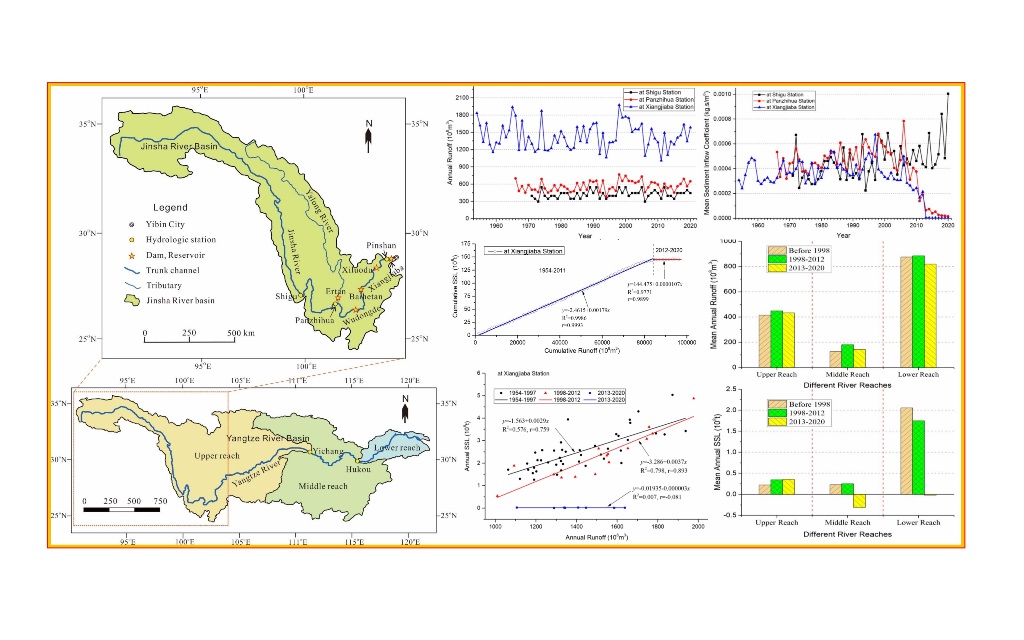
For the purpose of clean energy hydropower development, the construction of reservoirs has been continuously promoted in the Jinsha River basin for many years, and how the reservoirs affect the water and sediment process is a very necessary topic to study. This study is based on the gauged water and sediment data (span from the 1960’s to 2020) at Shigu, Panzhihua, and Xiangjiaba stations downstream located in the trunk channel of the river, and uses Mann-Kendall trend test method and double cumulative curve method to comprehensively judge the variation trends of runoff and suspended sediment load and reveal their credible mutation years. The linear regression method is used to reveal the variation characteristics of the relationship between water and sediment before and after the abrupt change years. The results show that the variations in runoff at Shigu and Panzhihua stations have significant and relatively obvious increasing trends, respectively, and that at Panzhihua station has a mutation year of 1985. The runoff at Xiangjiaba Station slightly increased but not significantly. The variation of suspended sediment load showed a temporal and spatial differentiation. The variation of sediment discharge at Shigu Station showed an increasing trend with a mutation year of 1997. For Panzhihua Station, it showed an increasing trend before 1998, but has significantly decreased since 1998. The fluctuation of sediment transport at Xiangjiaba Station was significant before 1998, but the trend is unclear. In the period of 1998−2020, it showed a significant decreasing trend, especially since 2013, when the mean annual suspended sediment load only accounted for 0.61% of its multi-year average. The variations of mean annual sediment concentration and sediment inflow coefficient at the hydrological stations is consistent with the variation trend of sediment transport. Before 2013, the correlation between water and sediment was strong, but thereafter it was extremely weak. The two sudden years of 1998 and 2013 are consistent with the year when large reservoirs were built in the river basin. The construction of large reservoirs and their large amount of sediment retention are the key reasons for the sudden changes in the water-sediment relationship and the sharp decrease in sediment transport in the downstream reach of the reservoir dam. The climate and underlying surface changes in the study area are not significant, and their impact on the water and sediment processes in the watershed is limited.
Keywords:
runoff
; sediment
; sediment concentration
; sediment inflow coefficient
; variation
; reservoir
; Jinsha River
1. Introduction
Rivers are the main carriers and driving forces for the transportation of various types of clastic sediments within the watershed, and are the direct channels for the watershed to supply sediment to the ocean or lakes. According to statistics, about 85-90% of all clastic sediments entering the ocean is transported by rivers [1,2,3], which play a crucial role in the evolution of land surface and estuarine landforms (e.g., [4,5]). When the impact of human activities is negligible, the ability of rivers to transport sediment is mainly influenced by natural factors, but there are significant differences at different time scales. For example, in geological time scales, the ability of rivers to transport sediment is mainly related to the relative rise and fall of the crust and changes in land and sea; In the geomorphologic time scale, it is mainly related to the adjustment of river geomorphology, especially the gradient changes of river channels; In the hydrological time scale, it is mainly related to climate fluctuations, which not only affect the vegetation abundance and spatial distribution in watersheds, but also cause changes in sediment yield modulus and runoff, leading to changes in sediment transport.
The hydrological time scale is the most closely related to human activities. The annual sediment discharge of rivers under this scale will show gradual or fluctuating changes. The short-term large change of sediment discharge caused by some spontaneous generation events is difficult to cause the trend change of sediment transport. However, in recent decades, with the increasing influences of humans on the vegetation distribution and/or surface morphology in river basins and severe intervention in river sediment processes, the sediment transport process of river systems has shown significant trend changes (e.g., [6,7,8,9,10,11]). Moreover, some of the sediment transport changes caused by this not only have suddenness, but also have a persistent state after the sudden change. The construction of a series of reservoirs in rivers in areas with water shortage and strong hydropower development has caused a sharp decrease in sediment transport, which is very obvious in the world's major rivers such as the Amazon, Nile, Yangtze River, Yellow River, and Colorado River [12,13,14,15,16,17,18]. Therefore, the impact of human activities characterized by dam construction on river flow and sediment processes has received widespread attention from the academic community in recent years (e.g., [9,10,11,12,18,19,20,21,22,23]), with a particular focus on the impact on river sediment transport in different regions and the issue of riverbed coarsening downstream of dams. Obviously, under the combined effects of natural and human factors, the water and sediment changes in many rivers around the world have shown new characteristics in time and space.
As the source area of the upper reach of the Yangtze River, the Jinsha River has a wide range of terrain elevation differences, large water volume, strong hydrodynamic force, and rich hydropower potential. Therefore, with the development of productivity and technological progress, it has gradually become a reality to build reservoirs on its main stream and tributaries to produce clean energy, especially the cascade reservoirs in the lower reaches of the Jinsha River that have been completed successively in the past decade (Figure 1), It will provide abundant clean energy and correspondingly reduce the consumption of fossil fuels, making a contribution to reducing the growth rate of global temperature. However, the construction of large reservoirs has changed the water and sediment processes in the dam-controlled reaches, disrupted the original sediment transport trend, changed the original erosion and sedimentation mechanism of the river, and even altered the habitat and ecology of the reach to varying degrees. Therefore, issues related to the construction of reservoirs in the upper reach of the Yangtze River and their impact on water, sediment, and ecological habitats have attracted widespread attention from researchers, and a series of related research results have been published successively (e.g., [19,20,21,22,23,24,25,26,27,28,29,30]). This provides a new perspective for the correct understanding of the new situation of water and sediment changes in the upper reach of the Yangtze River, including the Jinsha River.
With the completion of the construction of Baihetan Reservoir in 2021, the four cascade reservoirs on the main stream in the lower reach of the Jinsha River show that the planning of head to tail connection and continuous distribution of reservoir areas has been realized, and the spatial changes of water and sediment, especially sediment transport, of the Jinsha River will show different characteristics from the previous changes. Based on the measured data of water and sediment at the outlet hydrometric stations of three river sections in the upper, middle and lower reaches of Jinsha River, this paper analyzes the variation characteristics of water and sediment processes and water sediment relationship in different regions of the basin over the past 50 years. Combined with the relevant data of large reservoirs built over the years, this paper focuses on revealing the phased variation characteristics of sediment transport and its response mechanism to the construction of large reservoirs. The research results can provide a new perspective for the temporal and spatial variation trend of sediment transport in the reach of cascade reservoirs, the variation trend of sediment transport in the reach downstream of the dam and its potential long-term impact, as well as the adjustment mechanism of the habitat in the affected reach, and help to predict the change of the river landscape habitat in the Jinsha River basin under the conditions of dam construction and reservoir group operation, and formulate and implement corresponding scientific management measures.
2. Study Area, Dataset and Methods
2.1. Study Area
The Jinsha River basin is located above Yibin City in the upper reach of the Yangtze River, between 90oE−105oE and N24oN−36o36N (Figure 1). The source area of the Jinsha River is composed of several tributaries, such as the main source Dangqu River, the central source Ulan Moron, and the northern source Chumar River in the northeast of Tanggula Mountain in Zadoi County, Qinghai Province. The main stream flows outflow from Qinghai Province, then flows mainly along the boundary line between Qinghai and Tibet, Sichuan and Tibet, and Sichuan and Yunnan Provinces, in its process, there are individual river sections that pass through partial regions of Sichuan and Yunnan provinces. The total length of the main stream of the Jinsha River, from the river source to Yibin City, is 348l km, with a drainage area of 458800 km2, accounting for 77.3% and 45.88% of the main stream length and drainage area of the upper reach of the Yangtze River, and 55.3% and 25.49% of the total length and drainage area of the Yangtze River, respectively. The largest tributary, the Yalong River with a drainage area of 128400 km2, flows into the main stream of the Jinsha River nearby above Sanduizi Hydrological station, which located in East District of Panzhihua City (Figure 1). Compared with the tributary Yalong River, the drainage area of other tributaries is smaller, almost less than 10000 km2.
According to the geomorphic characteristics, the Jinsha River basin can be divided into two typical river sections by Sanduizi Hydrological Station (with a controlled drainage area of 388500 km2). However, since the hydrological observation of this station started in 2005, the data sequence is short, which is not convenient for comparative analysis of sediment transport characteristics of the river basin in a long time series. In combination with the geomorphic characteristics and the setting of hydrological stations, researchers usually take Shigu, Panzhihua, and Pingshan Hydrological Stations (changed to Xiangjiaba Station since 2012) as the dividing points, and divide the Jinsha River basin into three sections: upper, middle and lower reaches. The watershed areas controlled by the above hydrological stations are 214100 km2, 259200 km2, and 458800 km2, respectively. The length of the main stream above the stations is 2149 km, 2713 km, and 3481 km, respectively [16]. The main stream of the Jinsha River has steep riverbed, rapid flow, strong water erosivity, and sediment carrying capacity, with an average water discharge and mean annual suspended sediment load of 4750 m3/s and 255 million tons, respectively. The distribution of water and sediment process is uneven throughout the year, with runoff and sediment transport during the flood season (from June to October) accounting for over 68% and over 85% of the year, respectively [19,31]. The climate types of the Jinsha River basin are complex and diverse, ranging from the semi-arid climate of the plateau sub-cold zone to the subtropical humid monsoon climate. The average annual temperature of the Jinsha River basin is 3.04 ℃, and the average annual precipitation is 753 mm.
2.2. Dataset
Considering the integrity of available data and the need for relatively longer time series, the Shigu, Panzhihua, and Xiangjiaba (Pingshan before 2012) Hydrological Station with longer time series observation data are selected as the reference stations for spatial comparison of runoff and sediment transport changes. The basic measured hydrological data of these stations are annual runoff, annual sediment transport and annual average sediment concentration, with the time sequence of 1971−2020, 1966−2020, and 1954−2020, respectively. These data are collected from ‘Hydrological Data of the Changjiang River Basin’, Annual hydrological Report of P. R. China issued by the Hydrological Bureau of the Ministry of Water Resources of the People's Republic of China. The longest time span of the dataset is from 1954 to 2020. The distribution location, dem closure year or reservoir completion year, storage capacity and other data of large reservoirs in the Jinsha River basin were collected from literature before 2015 [26], and that after the year collected from the ‘China River Sediment Bulletin’ issued by the Ministry of Water Resources of the People's Republic of China (https://mwr.gov.cn). Other types of data in the paper, such as coefficient of incoming sediments and cumulative of various data, are calculated based on the above relevant basic data.
2.3. Methods
According to the needs of this study, the research methods involved in this article mainly include Mann-Kendall trend test and mutation analysis method [32,33], double cumulative curve method, and linear regression analysis method.
The double cumulative curve analysis method is used to reveal whether there are inflection points in the temporal order relationship curve of the cumulative data sequence of two variables with clear correlation. Based on this, the mutation time can be determined and different change stages can be divided. The linear regression analysis method is mainly used to reveal the trend of changes in relevant parameters and the change rate in different stages, and to give the correlation between the independent variable and the dependent variable and their change characteristics in different stages.
The Mann-Kendall (M-K) rank correlation test method [32,33] is used to reveal the trend and significance of water and sediment changes, and the mutation analysis method can reveal the mutation points of data sequences. This method is a non-parametric statistics test method, which does not require data to follow a certain probability distribution, nor is it disturbed by a few outliers. It is widely used in the trend research of hydrological and sediment processes. In the M-K test, assuming that the time series X is a sample with n variables (x1, x2, ..., xn), which independent and identically distributed random, the calculation formula for the test statistic S is defined as follows:
Where The test statistic S in formula (1) is approximately subject to normal distribution, with the mean E(S)=0, and variance:
When n>10, the standard normal distribution test statistic is as below:
When the statistic Z is greater than 0, it indicates an upward trend, and when it is less than 0, it indicates a downward trend. The absolute value of Z >=1.28, Z >=1.96, and Z >=2.32 represents passing the significance tests with confidence levels of 90%, 95%, and 99%, respectively.
3. Results
3.1. Interannual Variations of Runoff and Sediment Transport
In the whole time series, the annual runoff of the Shigu, Panzhihua, and Xiangjiaba stations on the main stream of the Jinsha River ranges from 29.64 billion m3/a to 54.35 billion m3/a, 38.34 billion m3/a to 76.68 billion m3/a, and 101.0 billion m3/a to 197.69 billion m3/a (Figure 2), while the annual average runoff is 42.29 billion m3/a, 56.97 billion m3/a and 143.5 billion m3/a, respectively. There is little difference in the interannual variation process of runoff between Shigu and Panzhihua stations, with small interannual fluctuations. The positive Z value obtained by Mann-Kendall trend analysis indicates that both have an increasing trend (Table 1), and both have passed the 95% confidence test indicating a significant increasing trend. In comparison, the annual runoff and its fluctuation amplitude of Xiangjiaba Station are much larger than those of the first two hydrological stations (Figure 2). A positive Z value indicates an increasing trend (Table 1), but the increasing trend is not significant as it did not pass the 95% confidence test.
The annual suspended sediment load at the hydrological stations mentioned above ranges from 6.8 to 62.9 million t/a, 2.0 to 126.9 million t/a, and 0.6 to 503.6 million t‧yr−1, respectively (Figure 2). The mean annual suspended sediment load at the stations is 27.6, 43.1, and 217.2 million t‧yr−1, respectively. The annual SSL at Shigu Station in the time period from 1960 to 2020 showed an increasing trend in general, with the maximum value of 63 million t‧yr−1 occurring in 1998 and 2020. The annual SSL at Panzhihua Station showed an increasing trend in the time period from 1966 to 1998, with a variation range from 21 to 127 million t‧yr−1 and an average annual value of 47.7 million t‧yr−1. It significantly has decreased since 1998, with a variation range from 127 to 2 million t‧yr−1 and an average annual value of 36.3 million t‧yr−1. Especially since 2003, it has reached a very small value, with a variation range from 7 to 2 million t‧yr−1 and an mean annual value of 2.6 million t‧yr−1 (Figure 2). The annual SSL at Xiangjiaba Station showed significant fluctuations before 1995, with no significant trend of change. The variation range was 149 to 504 million t‧yr−1, with a mean annual value of 245.7 million t‧yr−1. In the time period from 1995 to 1998, there was a significant trend of increase, with a variation range of 126 to 488 million t‧yr−1 and an average annual value of 358.3 million t‧yr−1. In the time period from 1998 to 2012, it showed a significant decreasing trend, with a variation range of 488~2 million t‧yr−1 and an average annual value of 234.5 million t‧yr−1. Since 2013, it has shown a low value and low fluctuation, with a variation range from 0.7 to 2 million t‧yr−1 and a mean annual value of only 1.5 million t‧yr−1. The average annual SSL at the Xiangjiaba Station in the time periods from 1954 to 1998, 1998 to 2020, 1954 to 2012, 2013 to 2020 and 1954 to 2020 were 256, 188, 246, 1.5, and 217.2 million t‧yr−1, respectively,
The Mann-Kendall trend analysis shows that the Z value for the annual suspended sediment load of the Shigu Station is positive and passes the 99% confidence test (Table 1), indicating that the interannual variation of the SSL at the station has a significant increasing trend in general. The Z value for the annual suspended sediment load of Panzhihua Station and Xiangjiaba Station are both negative and have passed 95% and 99% confidence tests, respectively, indicating that the interannual variation of the suspended sediment load at the stations has a decrease and significant decrease trend, respectively.
3.2. Variations of Sediment Concentration and Incoming Sediment Coefficient
Sediment concentration is a hydrological parameter that connects the sediment transport capacity and water discharge. Understanding the changes in sediment concentration can help reveal the characteristics of sediment transport in rivers.
The variation ranges of the annual mean sediment concentration at the Shigu, Panzhihua, and Xiangjiaba hydrological stations during their respective investigation periods are 0.23 to 1.42 kg/m3, 0.03 to1.66 kg/m3, and 0.005 to 2.90 kg/m3, respectively. The mean annual sediment concentration of each station is 0.63 kg/m3, 0.74 kg/m3, and 1.48 kg/m3, respectively. The interannual variation of the mean annual sediment concentration of the three hydrological stations mentioned above is roughly similar to their respective annual SSL (Figure 2 and Figure 3), but there are also certain differences. In general, the sediment concentration of the three hydrological stations showed an increasing trend in fluctuations before 1998. After 1998, except for Shigu Station, which still showed a large fluctuation, the sediment concentration of Panzhihua and Xiangjiaba Stations showed a significant decreasing trend, especially in the very small low value since 2013, when the mean sediment concentration of the two hydrological stations has been 0.07 kg/m3 and 0.01 kg/m3, which only account for 9.5% and 0.7% of their annual mean sediment concentration in the entire period, respectively.
The incoming sediment coefficient is the ratio of sediment concentration to water discharge for stream flow, which means the sediment concentration in specific discharge [34]. This facilitates the quantitative comparison of sediment transport capacity of river sections between different rivers and hydrological stations. The variation ranges of the annual incoming sediment coefficient of the three hydrological stations during their respective investigation periods are 0.000224 to 0.001 kg‧s/m6, 0.000016 to 0.00078 kg‧s/m6, and 0.000001 to 0.00067 kg‧s/m6, respectively. The annual mean incoming sediment coefficient of the three stations is 0.00046 kg‧s/m6, 0.00041 kg‧s/m6, and 0.00033 kg‧s/m6, respectively.
From the interannual variation characteristics, the ISC of the three hydrological stations have both similarities and differences with each other (Figure 3). Prior to 1998, the interannual variation of ISC for the three stations all showed an increasing trend, with the mean values of 0.00040 kg‧s/m6, 0.00048 kg‧s/m6, and 0.00039 kg‧s/m6, respectively. The difference among the mean ISC is not significant. After 1998, the ISC at the three stations appeared differentiation, and it was still increasing in fluctuation for Shigu Station, with its average becoming 0.00054 kg‧s/m6. However, there was a significant decrease at Panzhihua and Xiangjiaba Stations, with the average values of 0.00029 kg‧s/m6 and 0.00019 kg‧s/m6, respectively. Especially since 2012, the ISC at Panzhihua and Xiangjiaba Stations have decreased to very low values, with the average values dropping to 0.00004 kg‧s/m6 and 0.0000026 kg‧s/m6, which accounting for only 9.8% and 0.8% of their average values in the entire period, respectively.
3.3. Mutation in Water and Sediment Processes
There are various research methods for determining whether there is a mutation between the series data of two related variables, among which the Mann-Kendall method, double cumulative curve method, cumulative anomaly method, etc. are widely used. The Mann-Kendall method and cumulative anomaly method mainly reveal the mutation points of single variable such as runoff or sediment transport in the data series, which may result in inconsistent mutation points of runoff or sediment transport and can cause difficulties in analyzing changes in water sediment relationships. If the two types of related data sequences to be analyzed do not strictly maintain the same proportional variation, then the double cumulative curve method is the most intuitive and concise analysis method [35]. Here, Mann-Kendall method is first selected to detect the main mutation points of single variable including runoff and suspended sediment load at Shigu, Panzhihua, and Xiangjiaba Stations in the study area, and then the double cumulative curve method is used to reveal the overall change trend and mutation time of the water sediment relationship of the above hydrological stations. On this basis, the optimal mutation time is comprehensively selected as the basis for dividing the different change stages of the water and sediment in the study area.
When using the Mann-Kendall method to detect a mutation point, if the curves UF(k) and UB(k) intersect within the confidence interval of a=0.05 (−1.96<U<1.96), and the trend after the intersection of the curves does not reverse, then the point is considered a mutation point. The single variable mutation detection results of annual runoff and annual suspended sediment load at the three hydrological stations are shown in Figure 4. The mutation of annual runoff is reflected in the Panzhihua hydrological station, with the mutation time being 1985. The other intersections of the runoff mutation detection curves UF(k) and UB(k) involving these hydrological stations are not mutation points because the trend quickly reversed. The abrupt change of annual suspended sediment load at Shigu Station was in 1997, at Panzhihua Station was in 2017, and at Xiangjiaba Station was in 2012.
The results of mutation analysis by the double cumulative curve method are shown in Figure 5. It can be found that the scattered points of the cumulative runoff and cumulative suspended sediment load have obvious turning points, which are the intersections of the linear fitting lines for adjacent time period. Each inflection point reflects a change in the slope of the linear relationship between accumulated water and sediment before and after the year it is located, thereby reflecting a change in the quantitative relationship between annual runoff and sediment transport. In the case of the selected time series, there are two abrupt changes at Shigu Station, namely 1979 and 1997. The mutation years at Panzhihua Station were 1988 and 2009, while at Xiangjiaba Station is 2012. Because this method comprehensively considers two variable factors of runoff and suspended sediment load, it is not completely consistent with the mutation point detected by the Mann-Kendall method mentioned above. However, the suspended sediment load at Shigu Station changed (increased) in 1997, and that at Xiangjiaba Station changed (decreased) in 2012, which is completely consistent with the mutation time detected by the Mann-Kendall method.
It can be seen from the characteristics of the double cumulative curves (Figure 5) that the water sediment relationship at Shigu Station has undergone two abrupt changes in the time period from 1971 to 2020, and the mutation occurred in 1980 and 1998, respectively. The slope of the fitted linear relationship lines between the cumulative runoff and cumulative suspended sediment load in the 1970s, 1980−1997, and 1998−2020, was 0.0425, 0.059, and 0.072, respectively, showing an increasing trend. This shows that the cumulative suspended sediment load increased faster than the cumulative runoff at Shigu Station in the latter two periods.
The relationship between water and sediment at Panzhihua Station also experienced two mutations during the time period from 1966 to 2020, but the mutation years were 1989 and 2010 which can be used to divide the entire period into three different time sub-periods, 1966−1988, 1989−2009, and 2010−2020 (Figure 5). The slopes of the fitted linear relationship lines between the cumulative runoff and cumulative suspended sediment load in the sub-periods were 0.00076, 0.00106, and 0.000104, respectively. This indicates that the growth rate of cumulative sediment transport and runoff at the station significantly increased between 1989 and 2009, while decreased significantly between 2010 and 2020. In other words, the relationship between sediment transport and runoff in the later period was significantly out of balance.
During the time period from 1954 to 2020, the water sediment relationship at Xiangjiaba Station only experienced a significant mutation in 2012 which can be used to divided the entire period into two sub-periods, 1954−2011 and 2012−2020 (Figure 5). The slopes of the fitted linear relationship lines between the cumulative runoff and cumulative suspended sediment load in the two sub-periods were 0.00179 and 0.0000107, respectively. This indicates that the growth rate of the cumulative suspended sediment load in the later sub-period was much smaller than that in the former sub-period at Xiangjiaba Station. Compared with the previous sub-period, the relationship between the runoff and sediment transport in the later sub-period was also significantly out of balance.
3.4. Variation of Relationship Between Water and Sediment
The relationship between cumulative runoff and cumulative suspended sediment load can reflect the characteristics of the relationship between water and sediment in the cumulative state year by year. Since the cumulative value in the later period is far greater than the actual value in the corresponding years, this kind of relationship only reflects the change trend of water and sediment process and indicates the possible sudden change time, but does not represent the true relationship between water and sediment changes. Based on the results obtained by Mann-Kendall mutation detection method and double cumulative curve method for the water and sediment processes at Panzhihua and Xiangjiaba Stations, and considering the need for easy comparison of the corresponding data, it is comprehensively concluded that the mutation years of the water and sediment data series at these two hydrological stations are 1998 and 2012. On this basis, further analyze the actual fitting relationship between the annual runoff and annual suspended sediment load of these two hydrological stations in the different sub-periods divided by the two mutation years mentioned above.
The linear fitting results of annual runoff and annual suspended sediment load show (Figure 6) that the slopes of the fitted linear relationship lines between water and sediment at Panzhihua and Xiangjiaba stations before 1998 were 0.0019 and 0.0029, with correlation coefficients of 0.897 and 0.759, respectively. This indicates that the annual transported suspended sediment at Xiangjiaba and Panzhihua stations increases with the increase of annual runoff, and the growth rate at the Xiangjiaba Station is greater than that at Panzhihua Station.
During the sub-period from 1998 to 2012, the slopes of the fitted linear relationship lines between annual runoff and annual suspended sediment load at these two hydrological stations were 0.0027 and 0.0037, with correlation coefficients of 0.0.789 and 0.893, respectively. This also indicates that the annual suspended sediment transport at Xiangjiaba Station and Panzhihua Station increases with the increase of annual runoff, but the former having a greater growth rate than the latter. At the same time, the slope of the same station also significantly increases compared to that in the previous period. These phenomena reveal that the ratio of annual yield suspended sediment to annual yield runoff in the river sub-basins above the given hydrological stations during this period has increased compared to that in the previous period, that is, the sediment concentration and sediment incoming coefficient have increased compared to that in the previous period.
After 2012, the slopes of the fitted linear relationship lines between annual runoff and suspended sediment load for the two stations mentioned above were −0.000044 and −0.000003, respectively, showing a very weak negative correlation compared to the past. Due to the slope value being very close to 0, it can be seen that there is almost no relationship between annual sediment transport and annual runoff, that is, the sediment transport was very small and almost unrelated to changes in runoff, especially for Xiangjiaba Station. This indicates that compared to the previous two sub-periods, the changes in the water sediment relationship since 2012 have significant uniqueness and do not follow the inherent laws of natural water sediment processes, but are severely controlled by human factors beyond the natural factors of the river basin.
4. Discussion
4.1. Reservoir Construction and the years of sharp-increasing storage capacity
The Jinsha River basin, whether the main stream or the main tributary Yalong River, has abundant water volume and high channel gradient, so it has huge potential for hydropower development. The reservoir construction in the Jinsha River basin for the purpose of producing clean energy has been going on for many years, and the earliest reservoir construction started in the 1960s. However, due to various objective conditions, both the capacity of the reservoir and the quantity of construction are very limited. With the advancement of dam construction technology and building material production technology, more and more large reservoirs are being built one by one. In particular, the four cascade reservoirs in the lower reach of Jinsha River have been completed in 2021, and this reach has become a fully dam controlled reach. Figure 7 show that the periods of significant increase in storage capacity of large reservoirs in the Jinsha River basin were 1998, 2011−2015 (especially 2013), and 2020−2021, respectively.
From 1960’s to 2015, there were 22 large reservoirs (with a storage capacity of ≥ 100 million m3), 108 medium reservoirs (with a storage capacity ranges from 10 to 100 million m3) and 2537 small reservoirs (with a storage capacity of <10 million m3) built in the Jinsha River basin. Their cumulative total storage capacity in the periods was 42.92 billion m3, 2.481 billion m3 and 1.638 billion m3, respectively. The total storage capacity of these three types of reservoirs was 47.039 billion m3 [26]. The total storage capacity of the large, medium, and small reservoirs accounts for 91.24%, 5.27%, and 3.48% of the total storage capacity of all reservoirs, respectively. Obviously, although the total number of large reservoirs is the smallest, their total storage capacity occupies absolute advantage. Large reservoirs, due to their large storage capacity, can effectively store a large amount of water. They can turn the water flow from the upstream river of the reservoir with normal river flow velocity into low-speed water flow or even a stationary water body for a large amount or a longer duration. As a result, due to the significant decrease in water flow velocity in the reservoir area, the suspended sediment carried by river flow is heavily deposited, resulting in a significant decrease in the sediment concentration. The suspended sediment discharge in the river section below the reservoir dam has also significantly decreased. If a small reservoir is built at the same dam site, the amount of water it can effectively retain is limited, and the water flow from the upstream river channel with normal flow velocity can be transformed into a water body with lower flow velocity or a static flow state, and its duration is relatively limited. Therefore, the amount of suspended sediment that can be deposited in the small reservoir area due to a decrease in flow velocity is also relatively limited, resulting in a limited decrease in sediment concentration in the downstream flow section below the dam. The decrease in suspended sediment discharge at the river section below the dam is also not significant. For the same reason, the decrease in sediment concentration and sediment transport in the downstream river section of medium-sized reservoirs built at the same dam site is intermediate.
The interannual distribution of the storage capacity and cumulative storage capacity of the large reservoirs built in the river reaches above Shigu, Panzhihua, and Xiangjiaba stations of the Jinsha River is shown in Figure 7. It can be seen that only a large reservoir with a storage capacity of 300 million m3 (Mangcuo Lake, located in Cuolongmenqu, a tributary of the Jinsha River) have been built in the river reach above Shigu Station in 2003, and its control area only accounts for 0.057% of the total drainage area above Shigu Station. The reservoir has no obvious impact on the sediment transport process at Shigu Station. Therefore, the change of suspended sediment discharge at Shigu Station is basically affected by natural factors such as climate and precipitation change.
In the river reach above Panzhihua Station, in addition to the Mangcuo Reservoir, the Jinanqiao Reservoir and Buxi Reservoir (with a total storage capacity of 910 million m3 and 250 million m3, respectively) have been built in 2011, Ahai, Longkaikou, and Ludila Reservoirs (with a total storage capacity of 890 million m3, 560 million m3, and 1.72 billion m3, respectively) have been built in 2014, and Liyuan and Guanyinyan Reservoirs (with a total storage capacity of 810 million m3 and 2.25 billion m3, respectively) have been built in 2015. The total storage capacity of the reservoirs built in 2011, 2014, and 2015 is 1.16 billion m3, 3.17 billion m3, and 3.06 billion m3, respectively. These reservoirs are the main control factors affecting the significant reduction of suspended sediment discharge at Panzhihua Station below the normal fluctuation range.
In the river reach above Xiangjiaba Station, in addition to the aforementioned reservoirs, more and larger reservoirs have been built. Among them, Ertan have been built in 1998, Xiangjiaba and Jinpingyiji Reservoirs began to store water in 2012 and 2013, respectively. Wudongde and Baihetan Reservoirs have been built in 2020 and 2021, respectively. The total storage capacity of these reservoirs (Ertan, Xiangjiaba, Jinpingyiji, Xiluodu, Wudongde, and Baihetan) is 5.8 billion m3, 5.16 billion m3, 7.76 billion m3, 16.27 billion m3, 7.4 billion m3, and 20.6 billion m3, respectively. The year when the storage capacity of large reservoirs built in the Jinsha River basin increased sharply is also the year when the suspended sediment discharge at Xiangjiaba Station began to decrease sharply (Figure 7 and Figure 8). From this, it can be seen that the sediment retention of large reservoirs in the research area is the fundamental reason for the significant reduction in measured suspended sediment transport at the cross-section after dam construction.
4.2. Impact of Reservoirs on Water and Sediment Processes
The annual suspended sediment load at Xiangjiaba Station of the Jinsha River has obviously decreased since 1998, especially since 2013, which only accounted for 0.61% of mean annual suspended sediment load in the period from 1954 to 2012. The annual suspended sediment load at Panzhihua Station has significantly decreased since 2003 and has also sharply decreased since 2013. The mean annual suspended sediment load in the periods from 1998 to 2020 and from 2003 to 2020 accounted for 76.1% and 5.5% of that in the period from 1966 to 1998, respectively. The two key time nodes of 1998 and 2013 coincide with the time point when the storage capacity of large reservoirs in the Jinsha River basin increased significantly (Figure 7). The increase in the storage capacity of large reservoirs in the Jinsha River basin and the interannual variation of their cumulative storage capacity (Figure 7) show that the Ertan Reservoir built near the end of the Yalong River in 1998 controls a drainage area of 116400 km2, and its storage capacity is 5.8 billion m3, which accounts 63.8% of the total storage capacity (9.09 billion m3) of all nine large reservoirs built in the Jinsha River basin before 2013. The mean annual suspended sediment load of the Yalong River is 45 million t yr−1, accounting for 20.7% of that at Xiangjiaba Station. After the completion of Ertan Reservoir, the mean annual suspended sediment detention is 315 million t yr−1, accounting for 70.1% of that transported by the Yalong River in average [30]. This is the main reason why the annual suspended sediment discharge at Xiangjiaba Station has decreased significantly since reaching the maximum in 1998. However, due to the fact that the annual suspended sediment load at Panzhihua Station was generally in a high range between 1998 and 2006, this can partially offset the decrease in the annual suspended sediment load at Xiangjiaba Station caused by the sediment interception of Ertan Reservoir. It can be seen that although the sediment detention rate of Ertan Reservoir in the Yalong River basin is very high, its annual sediment detention volume only accounts for 14.5% of the annual sediment discharge at Xiangjiaba Station. Therefore, the construction of Ertan Reservoir has not caused a sudden change in the annual sediment discharge of Xiangjiaba Station.
Two, three, and two large reservoirs have been built in the middle reach (between Shigu and Panzhihua Stations) of the Jinsha River mainstream in 2011, 2014, and 2015 (Figure 7), with a total storage capacity of 1.16 billion m3, 3.17 billion m3 and 3.06 billion m3, respectively. This is the key human influence factor leading to the sharp decrease of suspended sediment transport at Panzhihua Station after 2012, and also the basic influence factor promoting the sharp decrease of sediment transport at Xiangjiaba Station. Xiangjiaba Reservoir at the outlet of Jinsha River and Xiluodu Reservoir adjacent to its upstream began to store water in 2012 and 2013, respectively, with a storage capacity of 5.16 billion m3 and 12.67 billion m3, respectively. The capability in phased water storage and long-term sediment retention of the reservoirs with huge storage capacity are extremely strong, which is the fundamental reason for the sharp reduction of suspended sediment load to a very small value at Xiangjiaba Station since 2012.
After the completion of the dams, the sediment retention capacity of the reservoir is very strong, but the impact on runoff is mainly manifested in seasonal changes, and the overall impact on changes in runoff over a longer time scale (several years or more) is limited. Figure 9 shows that before and after the period when a large number of large reservoirs were built, the variation in runoff was not significant for a given cross-section or river section downstream of the dam, but the suspended sediment transport decreased sharply. Compared with that before 1998, the mean annual runoff of the upper, middle, and lower reaches of the Jinsha River increased in the period from 1998 to 2012, with the increase rates of 8.0%, 41.9%, and 1.1%, respectively, while in the period from 2013 to 2020, there was a slight decrease, with reduction rates of −3.2%, 244.5%, and 86.5%, respectively. Compared with that before 1998, the annual average runoff of the upper, middle and lower reaches of the Jinsha River increased from 1998 to 2012, with the increase rates of 8.0%, 41.9%, and 1.1% respectively. However, there was a slight decrease in the period from 2013 to 2020, with reduction rates of 3.6%, 28.9%, and 7.5%, respectively. The mean annual suspended sediment load decreased by −55.9%, −8.3%, and 14.7% in the period from 1998 to 2012, while were −3.2%, 244.5%, and 86.5% in the period from 2013 to 2020, respectively. The abovementioned phenomena further indicate that after the completion of a large reservoir, the downstream runoff below its dam will increase or decrease appropriately in annual or decadal time scale, while the suspended sediment load will decrease significantly, leading to a significant decrease in sediment concentration and sediment incoming coefficient (Figure 3) and a noticeable change in the relationship between water and sediment (Figure 6).
Although annual or decadal fluctuations in climate factors such as temperature and precipitation can cause changes in vegetation conditions, runoff generation and confluence capacity, erosion and sediment production, and then cause suspended sediment transport within the watershed [36,37,38,39,40]. However, changes in climate and underlying surface are not obvious in the Jinsha River basin [42], which is insignificant compared with human activities, especially the construction of large reservoirs that have direct and strong impacts on sediment transport. The huge water storage and sediment retention function of large reservoirs not only changes the sediment transport process, but also greatly changes the water and sediment transportation mechanism or hydraulic regime [41,42,43]. For example, due to the influence of large reservoirs, the hydrograph of the monthly mean flow and sediment concentration in the lower reach below the Xiaolangdi Reservoir on the Yellow River has changed from the previous clockwise loop to the counterclockwise loop [7]. Similar phenomena may occur in the lower reaches below the reservoirs of the Jinsha River, which is a scientific problem that needs further study in the future.
5. Conclusions
Based on long series of water and sediment data at Shigu, Panzhihua, and Xiangjiaba hydrological stations, the runoff and sediment transport processes in different regions of the Jinsha River basin are analyzed and the impact of large reservoirs are discussed. The main conclusions are as follows:
- The runoff of the Jinsha River basin has a significant and relatively obvious trend of increasing at Shigu and Panzhihua stations, respectively, while it slightly increases but not significantly at Xiangjiaba station. The interannual variation of runoff at Panzhihua Station has a significant mutation year, which is 1985, while that at the other two hydrological stations does not exhibit abrupt changes.
- The sediment transport process in the Jinsha River basin is characterized by both phased changes and spatial differentiation. The annual suspended sediment load at Shigu Station showed a fluctuating increasing trend, and the mutation year is 1997. For Panzhihua Station, the annual suspended sediment load showed an increasing trend before 1998, but has significantly decreased since 1998. The annual suspended sediment load at Xiangjiaba Station fluctuated significantly before 1998, but the trend was unclear. Since 1998, it has shown a significant decreasing trend, especially since 2013, the annual suspended sediment load has only accounted for 0.61% of its multi-year average. The interannual variation of sediment concentration and sediment inflow coefficient at the above hydrological stations is consistent with the interannual variation trend of sediment transport. The annual mean sediment concentration (0.63kg/m3, 0.74kg/m3, and 1.48kg/m3) increases along the river course, Indicating an increasing trend of sediment production and sediment transport capacity along the river course.
- Taking the 1998 and 2013 mutation years as the boundary of the data series, the coefficient of determination between annual runoff and suspended sediment load at Panzhihua and Xiangjiaba stations was high and higher (0.80, 0.58) before 1998, higher and high (0.62, 0.80) in the period from 1998 to 2012, and both very small (0.03, 0.01) in the period from 2013 to 2020, respectively.
- The storage capacity of large reservoirs in the Jinsha River basin accounts for more than 91% of the storage capacity of all types of reservoirs. At the same time, the year when the storage capacity of large reservoirs increase sharply is just the same as the year when the sediment transport process and the relationship between water and sediment change abruptly. Therefore, it can be considered that the dam construction of large reservoirs and their large amount of sediment retention are the key reasons for the sudden change in the water-sediment relationship and the sharp decrease in annual suspended sediment load in the downstream sections below the reservoirs. The dam construction of large reservoirs also changed the natural attributes of the water-sediment relationship below the dam. The changes of climate and underlying surface in the study area are not significant, and their impact on the water and sediment processes, as well as the relationship between water and sediment in the river basin is limited.
Author Contributions
Conceptualization, S.W.; Formal Analysis, X.W. and S.W.; Draft Preparation, X.W. and S.W.; Review & Editing, S.W.
Funding
This research was funded by the National Key Research and Development Program of China (Grant No. 2022YFC3203903) and National Natural Science Foundation of China (Grant No. 41971004).
Acknowledgments
The authors thank the Yangtze River Water Conservancy Committee and the Hydrological Bureau of the Ministry of Water Resources of the People's Republic of China, for permission to access the hydrological gauging data.
Conflicts of Interest
The authors declare no conflict of interest.
References
- Walling, D.E. The impact of global change on erosion and sediment transport by rivers: Current progress and future challenges; UNESCO: Paris, France, 2009. [Google Scholar]
- Milliman, J.D.; Farnsworth, K.L. River discharge to the coastal ocean: A global synthesis; Cambridge University Press: Cambridge, 2011. [Google Scholar]
- Walling, D.E; Fang, D. Recent trends in the suspended sediment loads of the world’s rivers. Global Planetary Changes 2003, 39, 111–126. [Google Scholar] [CrossRef]
- Wang, S.; Hassan, M.A.; Xie, X. Relationship between suspended sediment load, channel geometry and land area increment in the Yellow River delta. Catena 2006, 65(3), 302–314. [Google Scholar] [CrossRef]
- Walling, D.E. Human impact on land-ocean sediment transfer by the world's rivers. Geomorphology 2006, 79, 192–216. [Google Scholar] [CrossRef]
- Wang, S.; Yan, M.; Yan, Y. X.; Shi, C.; He, L. Contributions of climate change and human activities to the changes in runoff increment in different sections of the Yellow River. Quaternary International 2012, 282, 66–77. [Google Scholar] [CrossRef]
- Wang, S.; Wang, X. Changes of water and sediment processes in the Yellow River and their responses to ecological protection during the last six decades. Water 2023, 15, 2285. [Google Scholar] [CrossRef]
- Miao, C.; Ni, J.; Borthwick, A. G. L.; Yang, L. A preliminary estimate of human and natural contributions to the changes in water discharge and sediment load in the Yellow River. Global and Planetary Change 2011, 76, 196–205. [Google Scholar] [CrossRef]
- Walling, D.E. The role of dams in the global sediment budget. In A. L. Collins, V. Golosov, A.J. Horowitz, X. Lu, M. Stone, D.E. Walling, & X. Zhang (Eds.), Erosion and sediment yields in the changing environment (pp. 3–11). Wallingford: International Association of Hydrological Science. IAHS Publication, NO. 356. 2012.
- Wang, S.; Liu, W.; Yan, M.; He, L. Stepped changes in suspended sediment transport efficiency and discharge ratio and the main causes in the lower reach of the Yellow River. Research of Soil and Water Conservation 2020, 27, 104–111. (in Chinese). [Google Scholar]
- Wang, S.; Wang, Y.; Ran, L.; Su, T. Climatic and anthropogenic impacts on runoff changes in the Songhua River basin over the last 56 years (1955-2010), Northeastern China. Catena 2015, 127, 258–269. [Google Scholar] [CrossRef]
- Rossi, A.; Massei, N.; Laignel, B.; Sebag, D.; Copard, Y. The response of the Mississippi River to climate fluctuations and reservoir construction as indicated by wavelet analysis of streamflow and suspended–sediment load, 1950–1975. Journal of Hydrology 2009, 377, 237–244. [Google Scholar] [CrossRef]
- Hu, C.; Wang, Y.G; Zhang, Y.J. Variation tendency of runoff and sediment load in China major rivers and its causes. Advances in water science 2010, 21, 524–532. (in Chinese). [Google Scholar]
- Zhao, G.; Mu, X.; Strehmel, A.; Tian, P. Temporal variation of streamflow, sediment load and their relationship in the Yellow River Basin, China. PLOS One 2014, 9(3), e91048. [Google Scholar] [CrossRef] [PubMed]
- Wang, Y.; Hu, C.; Liu, X.; Shi, H. Study on variations of runoff and sediment load in the Upper Yangtze River and main influence factors. Journal of Sediment Research 2016, 1, 1–8. (in Chinese). [Google Scholar]
- Lu, C.; Dong, X.; Tang, J.; Liu, G. Impacts of large cascade reservoirs on runoff and sediment load variations in Jinsha River Basin. Science of Soil and Water Conservation 2019, 17, 36–43. (in Chinese). [Google Scholar]
- Chen, K.; Liu, C. The impact of human activities on the variation of water and sediment conditions in the upper reaches of the Yangtze River. China Rural Water and Hydropower 2021, 4, 126–131. (in Chinese). [Google Scholar]
- Liu, W.; Wang, S.; Sang, Y.; Ran, L.; Ma, Y. Effects of large upstream reservoir operations on cross–sectional changes in the channel of the lower Yellow River reach. Geomorphology 2021, 387, 107768. [Google Scholar] [CrossRef]
- Liu, H.C.; Zhang, H.L; Xia, S.Q; Pang, J. Runoff and sediment discharge variations and corresponding driving mechanism in Jinsha River Basin. Research of Soil and Water Conservation 2023, 30, 107–115. (in Chinese). [Google Scholar]
- Xu, J. Recent variations in water and sediment in relation with reservoir construction in the upper Changjiang River Basin. Journal of Mountain sciences 2009, 27, 385–393. (in Chinese). [Google Scholar]
- Li, H.B.; Zhang, X.F.; Hu, C.H.; Xu, Q. Impact of cascade reservoirs construction in the upper Yangtze River on sediment inflow to Three Gorges reservoirs. Journal of Hydroelectric Engineering 2011, 30(1), 94–100. [Google Scholar]
- Yang, X.; Lu, X.X. Estimate of cumulative sediment trapping by multiple reservoirs in large river basins: an example of the Yangtze River basin. Geomorphology 2014, 227, 49–59. [Google Scholar] [CrossRef]
- Duan, Y.C.; Li, D.X.; Wang, X.K. Analysis of the sediment trapping by reservoirs in the Upper Yangtze River. Journal of Sichuan University (Engineering Science Edition) (in Chinese). 2015, 47, 15–23. [Google Scholar]
- Yang, S.L.; Xu. K.H.; Milliman, J.D.; Yang, H.F.; Wu, C.S. Decline of Yangtze River water and sediment discharge: impact from natural and anthropogenic changes. Scientific Reports 2015, 5, 12581. [CrossRef]
- Zhu, L.L.; Dong, X.Y.; Chen, Z.F. Sediment deposition of cascade reservoirs in the Lower Jinsha River and its impact on Three Gorges Reservoir. Journal of Yangtze River Scientific Research Institute 2016, 34, 1–7. (in Chinese). [Google Scholar]
- Yuan, J.; Xu, Q.X. Sediment trapping effect by reservoirs in the Jinsha River basin. Advances in Water Science 2018, 29, 482–491. (in Chinese). [Google Scholar]
- Qin, L.L.; Dong, X.Y.; Du, Z.D.; Chen, X.J. Processes of water–sediment and deposition in cascade reservoirs in the lower reach of Jinsha River. Journal of Sediment Research 2019, 44, 24–30. (in Chinese). [Google Scholar]
- Zhang, M.; Huang, X.; Wang, Y. Analysis of runoff evolution process and influencing factors in Jinsha River Basin. Water Resources and Power 2022, 40, 27–31. (in Chinese). [Google Scholar]
- Feng, S.H.; Wang, D.W.; Qin, L.L.; Deng, A.J.; Xing, L. The characteristics and cause of runoff variation in Jingsha River basin. South–to–North Water Transfers and Water Science & Technology 2023, 21, 248–257. (in Chinese). [Google Scholar]
- Liu, S.W.; Zhang, X.F.; Xu, Q.X.; Yue, Y. Transport characteristics and contributing factors of suspended sediment in Jinsha River in recent 50 years. Journal of Sediment Research 2020, 45, 30–37. (in Chinese). [Google Scholar]
- Xi, Y.Y.; Huang, X.R.; Li, J.J. Analysis on variation features of precipitation in Jinsha River basin. Yangtze River 2017, 48, 50–55. (in Chinese). [Google Scholar]
- Mann, H.B. Nonparametric tests against trend. Econometrica 1945, 13, 245–259. [Google Scholar] [CrossRef]
- Kendall, M.G. Rank Correlation Methods; Charles Griffin and Company Ltd: London, UK, 1975. [Google Scholar]
- Wu, B.S.; Shen, G.Q. Discussion on physical meaning of sediment–coming coefficient. Yellow River 2008, 30, 15–16. (in Chinese). [Google Scholar]
- Wang, S.; Yan, Y.; Yan, M.; Zhao, X. Quantitative estimation of the impact of precipitation and human activities on runoff change of the Huangfuchuan River basin. Journal of Geographical Sciences 2012, 22(5), 906–918. [Google Scholar] [CrossRef]
- Lu, L.; Wang, Q.; Wang, G.; Liu, Y.; Liu, C. Trend of climate change over the recent 60 years and its hydrological responses for Jinsha River Basin. Journal of North China University of Water Resources and Electric Power (Natural Science Edition) 2016, 37, 16–21. (in Chinese). [Google Scholar]
- Shi, W.Y.; Zhang, Z.Y.; Li, Z.Y. Temporal and spatial distribution characteristics of precipitation in Jinsha River Basin in recent 55 years and changing trend. Yangtze River 2016, 47, 39–43. (in Chinese). [Google Scholar]
- Wang, G.; Han, L.; Tang, X.Y.; Jin, Z.C. Temporal and spatial variation of vegetation in the Jinsha River basin. Resources and Environment in the Yangtze Basin 2012, 21, 1191–1196. (in Chinese). [Google Scholar]
- Du, J.; Shi, C.X.; Zhang, C. D.Modeling and analysis of effects of precipitation and vegetation coverage on runoff and sediment yield in Jinsha River Basin. Water Science and Engineering 2013, 6(1), 44–58. [Google Scholar]
- Zhang, G.; Chen, G.; Shao, H.; Xian, W. Spatial-temporal characteristics of vegetation coverage and its response to climate from 2000 to 2015 in Jinsha River Basin, China. Resources and Environment in the Yangtze Basin 2021, 30, 1638–1648. (in Chinese). [Google Scholar]
- Magilligan, F.J.; Nislow, K.H. Changes in hydraulic regime by dams. Geomorphology 2006, 71, 61–78. [Google Scholar] [CrossRef]
- Wang, H.; Sun, F.; Liu, W. Characteristics of streamflow in the main stream of Changjiang River and the impact of the Three Gorges Dam. Catena 2020, 189, 104498. [Google Scholar] [CrossRef]
- Gao, Y.; Ren, S.; Wang, H.; Lv, C.; Zhao, H. Characteristics of incoming runoff and sediment load in the Three Gorges Reservoir during high flood period after the operation of the cascade reservoirs in the lower Jinsha River. J. Lake Sci. 2023, 35. (in Chinese) [Google Scholar] [CrossRef]
Figure 1.
Location of representative hydrological stations and large reservoirs on the Jinsha River basin.
Figure 1.
Location of representative hydrological stations and large reservoirs on the Jinsha River basin.
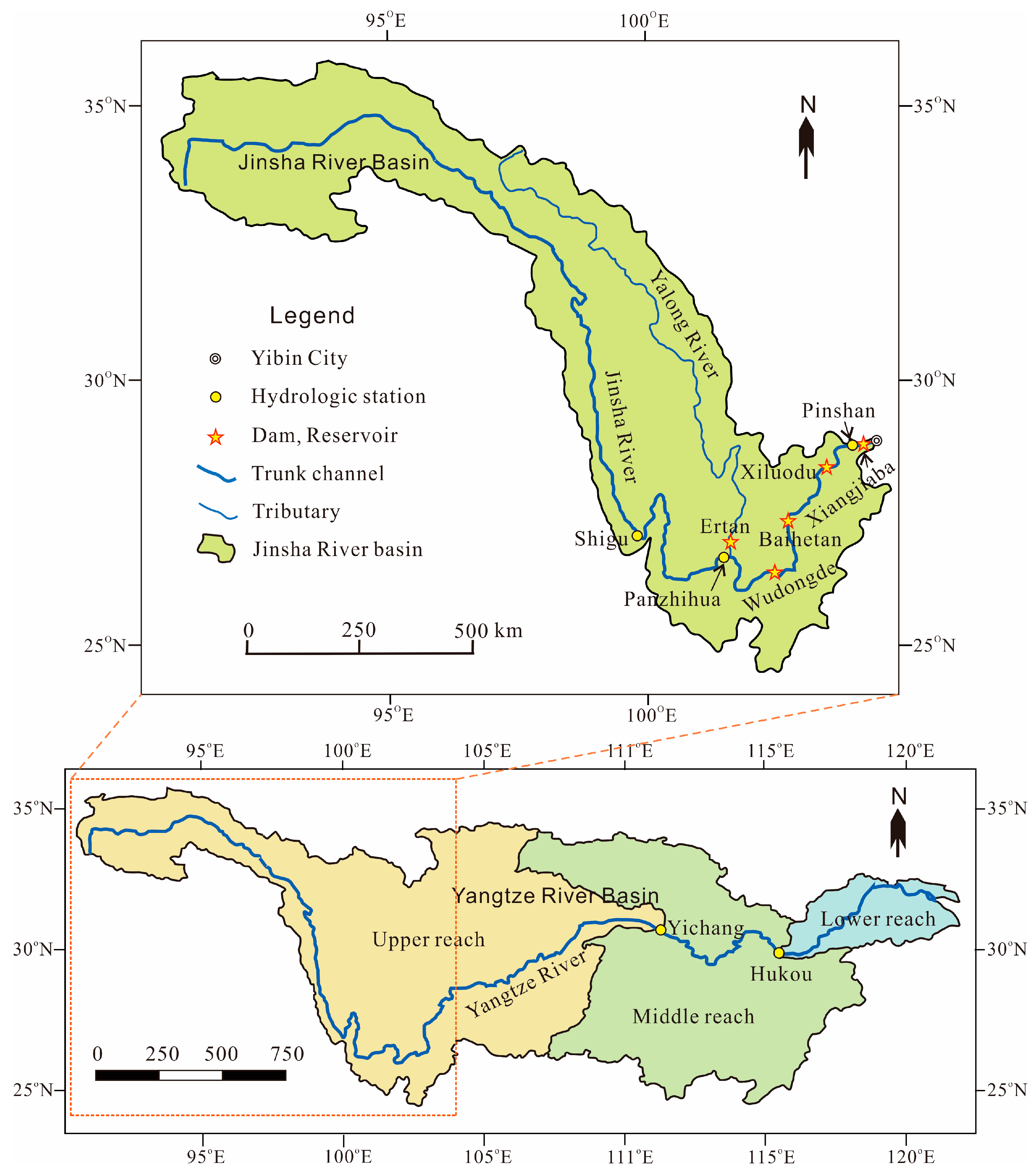
Figure 2.
Annual variation characteristics of runoff and suspended sediment load of representative hydrological stations of the Jinsha River.
Figure 2.
Annual variation characteristics of runoff and suspended sediment load of representative hydrological stations of the Jinsha River.
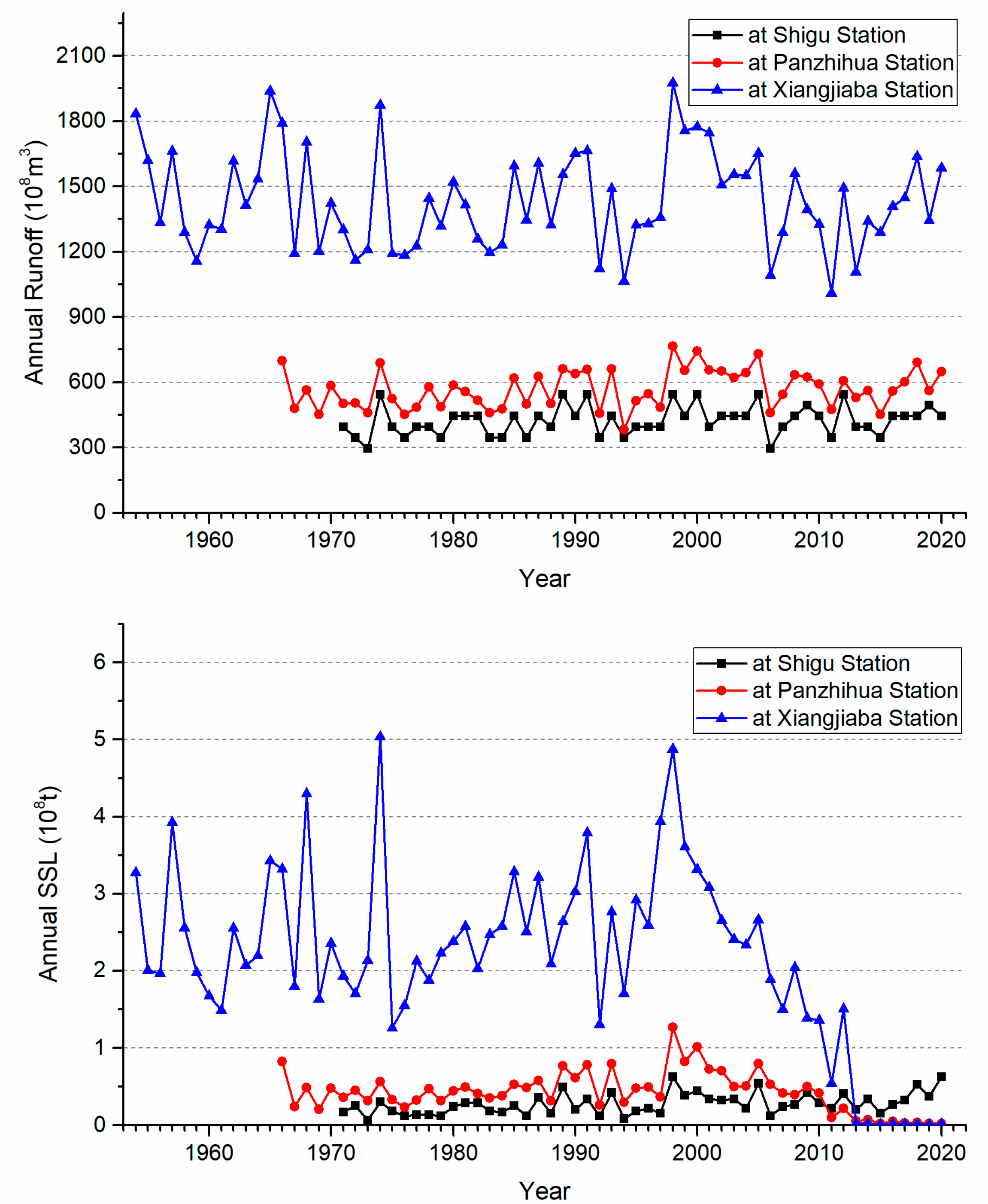
Figure 3.
Variation characteristics of annual mean sediment concentration and a incoming sediment coefficient at the Shigu, Panzhihua, and Xiangjiaba hydrological stations of the Jinsha River.
Figure 3.
Variation characteristics of annual mean sediment concentration and a incoming sediment coefficient at the Shigu, Panzhihua, and Xiangjiaba hydrological stations of the Jinsha River.
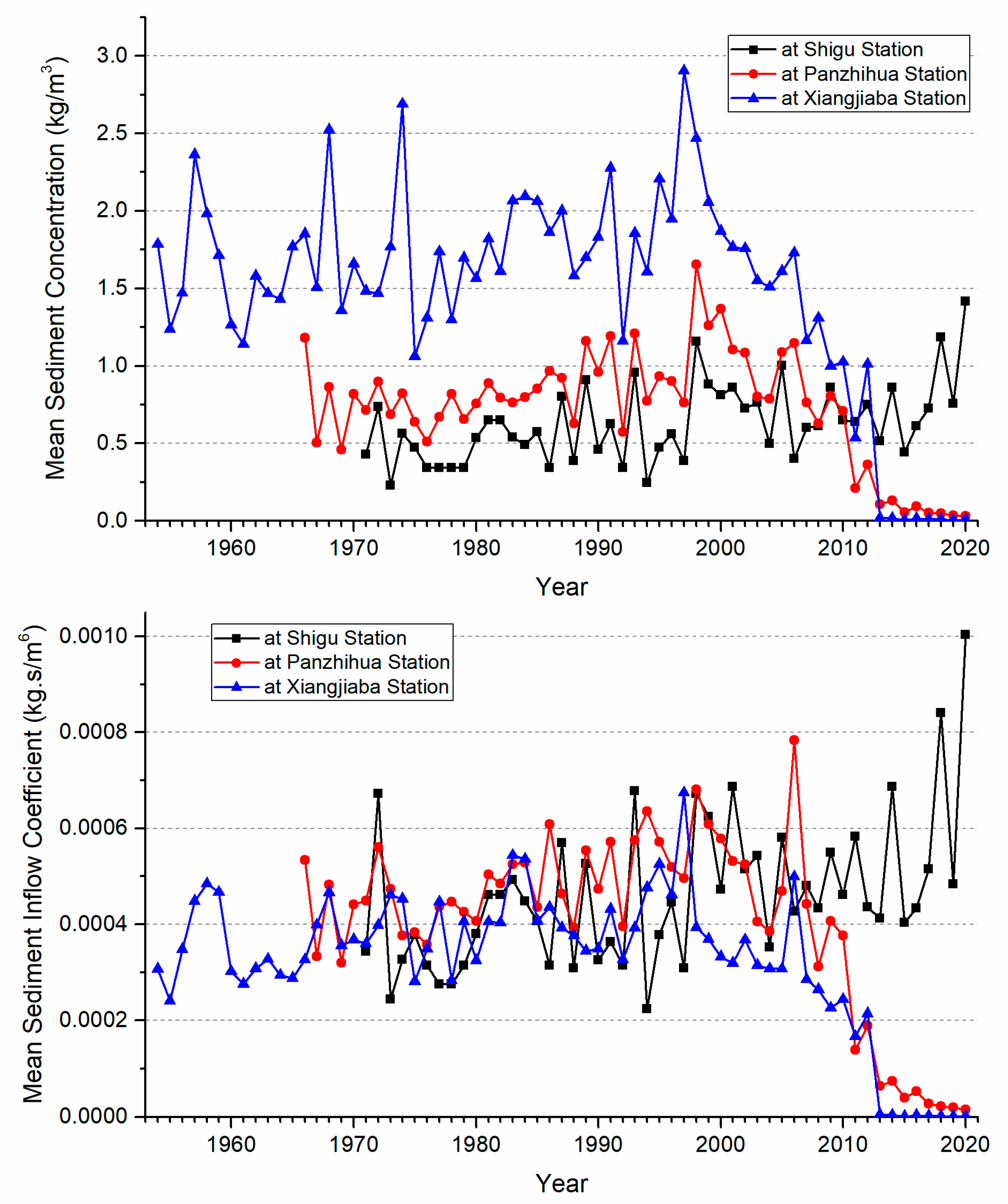
Figure 4.
Mann-Kendall mutation test of annual runoff and suspended sediment load at the representative hydrological stations of the Jinsha River.
Figure 4.
Mann-Kendall mutation test of annual runoff and suspended sediment load at the representative hydrological stations of the Jinsha River.
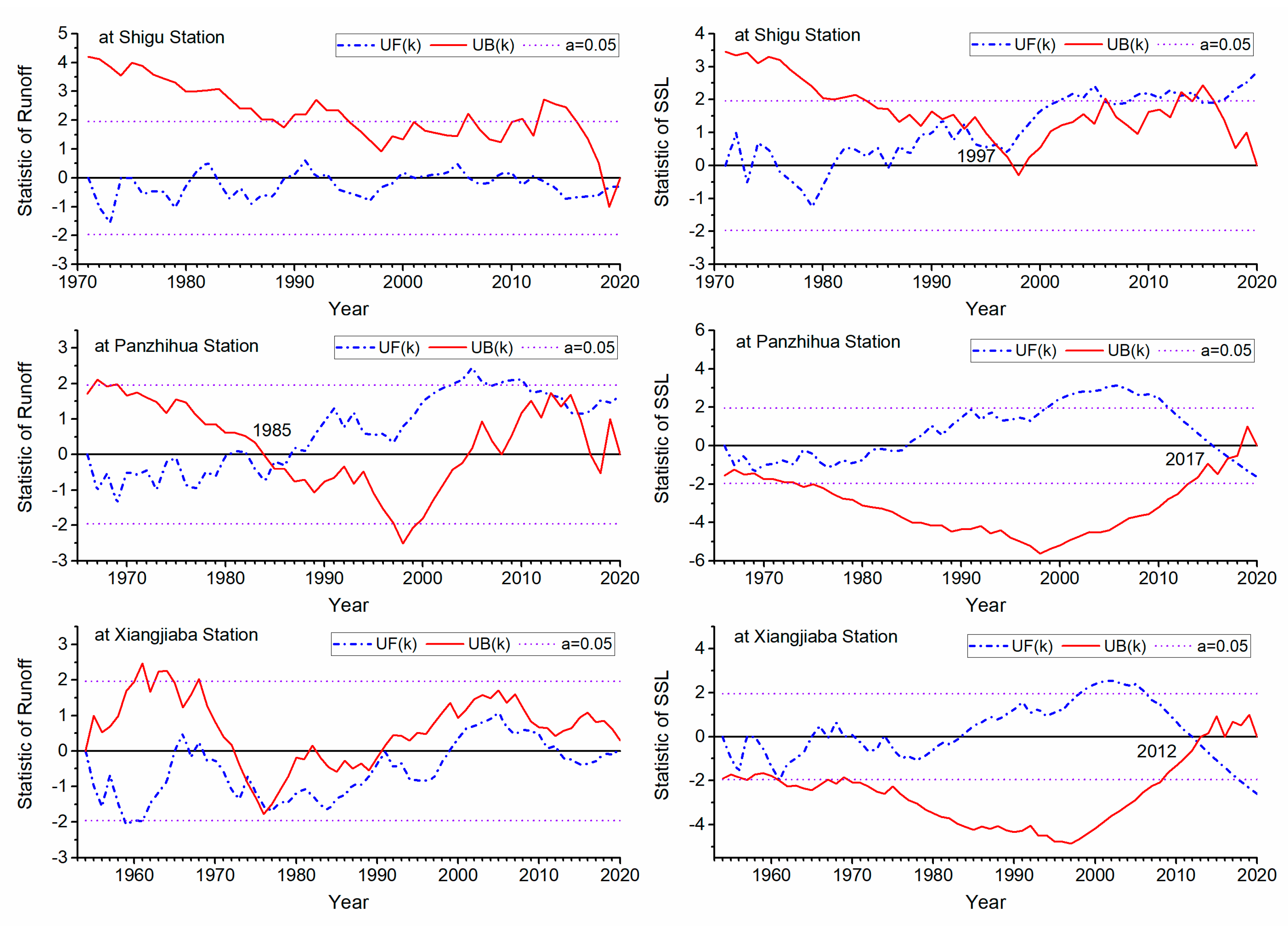
Figure 5.
Characteristics of the double cumulative curves of runoff and suspended sediment load of the representative hydrological stations of Jinsha River and the fitted linear relationships in different periods.
Figure 5.
Characteristics of the double cumulative curves of runoff and suspended sediment load of the representative hydrological stations of Jinsha River and the fitted linear relationships in different periods.
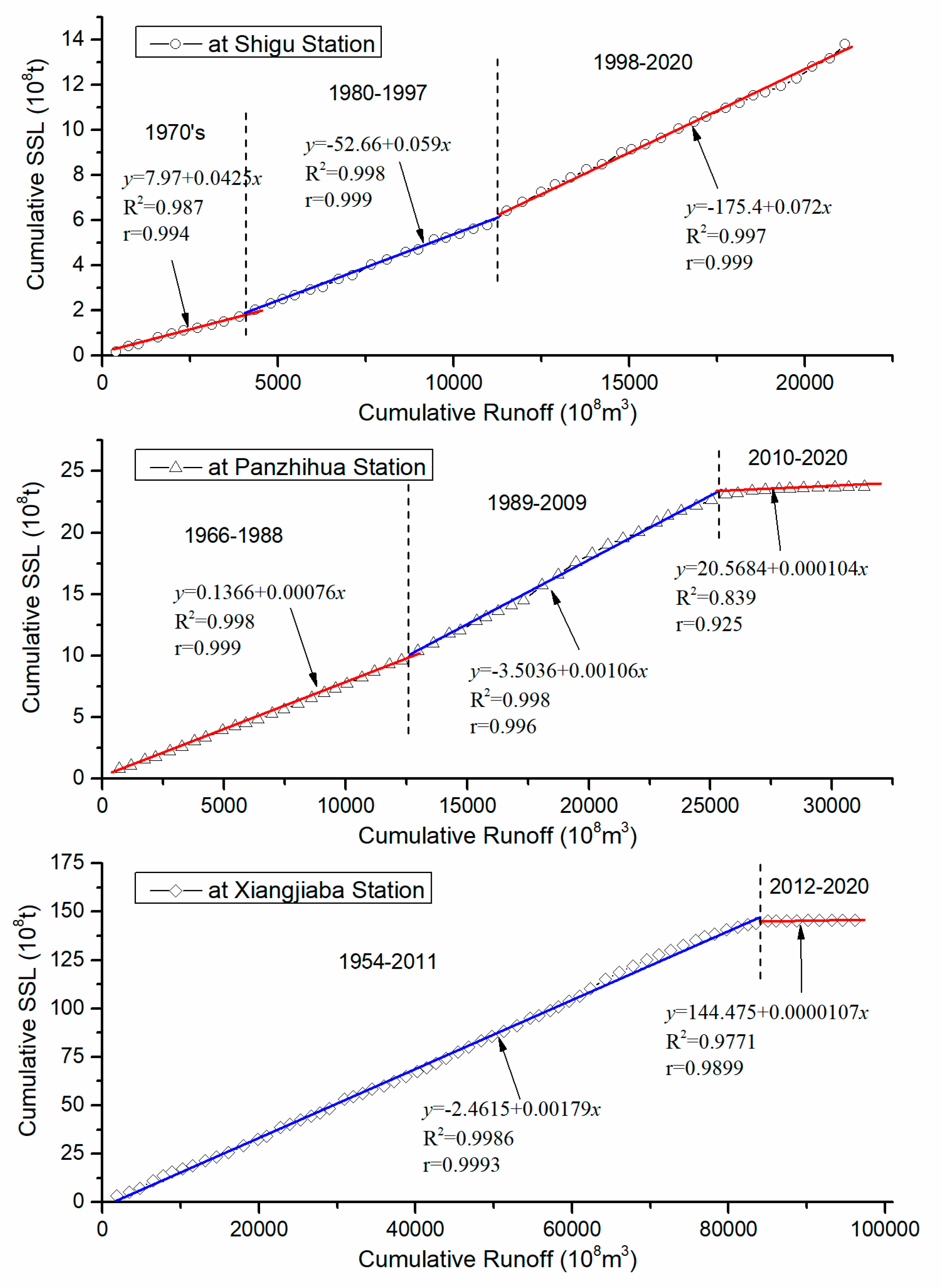
Figure 6.
Stage change characteristics of the relationship between annual runoff and annual sediment discharge of representative hydrological stations on Jinsha River.
Figure 6.
Stage change characteristics of the relationship between annual runoff and annual sediment discharge of representative hydrological stations on Jinsha River.
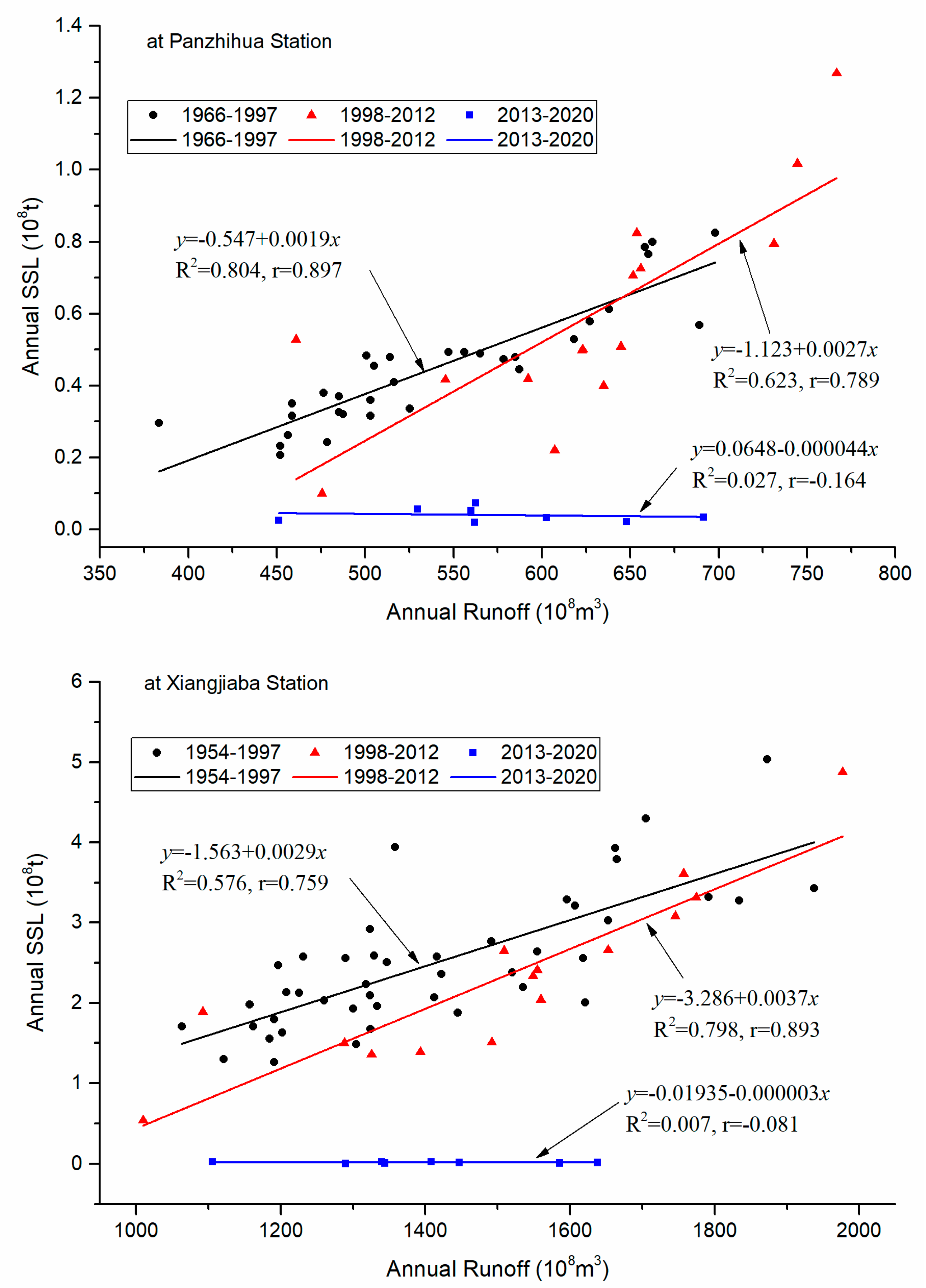
Figure 7.
Annual built and accumulated storage capacity of large reservoirs in the river reaches above Shigu, Panzhihua and Xiangjiaba Stations of the Jinsha River.
Figure 7.
Annual built and accumulated storage capacity of large reservoirs in the river reaches above Shigu, Panzhihua and Xiangjiaba Stations of the Jinsha River.
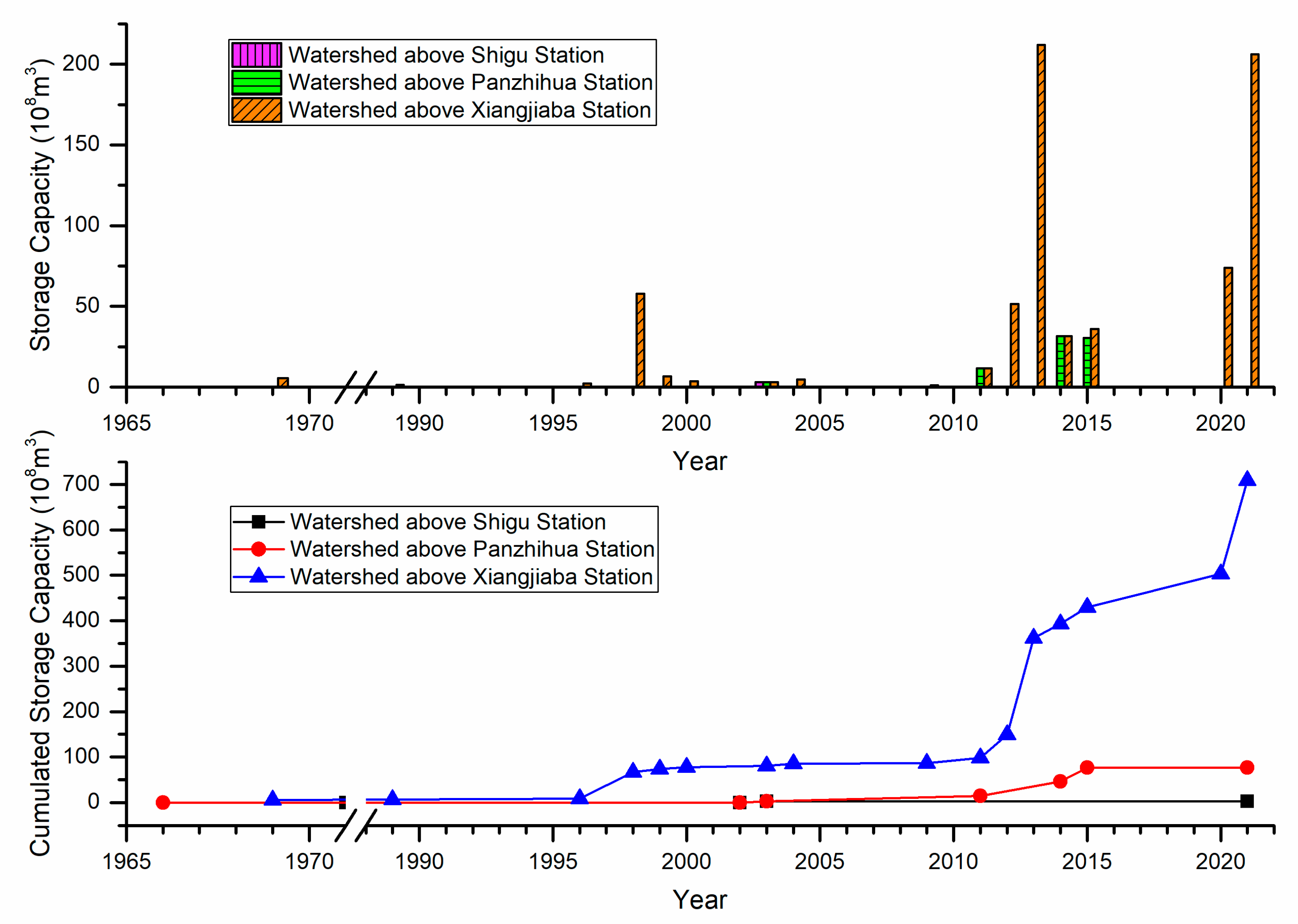
Figure 8.
The mean annual runoff and SSL in the upper reach (above Shigu Station), middle reach (between Shigu and Panzhihua Stations), and lower reach (between Panzhihua and Xiangjiaba Stations) of the Jinsha River in different periods and their decrease between adjacent periods.
Figure 8.
The mean annual runoff and SSL in the upper reach (above Shigu Station), middle reach (between Shigu and Panzhihua Stations), and lower reach (between Panzhihua and Xiangjiaba Stations) of the Jinsha River in different periods and their decrease between adjacent periods.
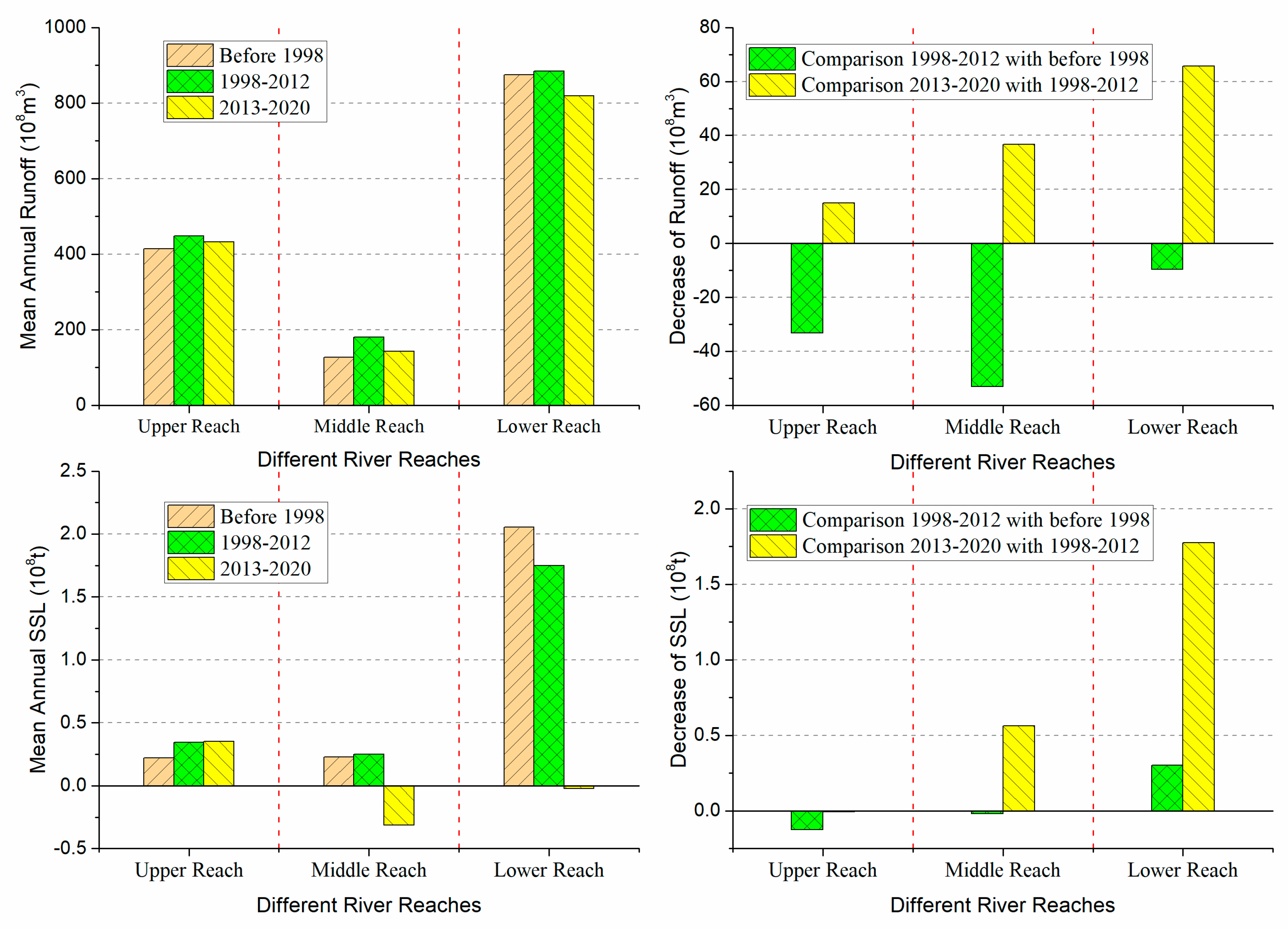
Figure 9.
The decrease ratio of the mean annual runoff and SSL in the upper (above Shigu Station), middle (between Shigu and Panzhihua Stations), and lower (between Panzhihua and Xiangjiaba Stations) reaches of the Jinsha River in the periods from 1998 to 2012 and from 2013 to 2020 comparing with that before 1998.
Figure 9.
The decrease ratio of the mean annual runoff and SSL in the upper (above Shigu Station), middle (between Shigu and Panzhihua Stations), and lower (between Panzhihua and Xiangjiaba Stations) reaches of the Jinsha River in the periods from 1998 to 2012 and from 2013 to 2020 comparing with that before 1998.
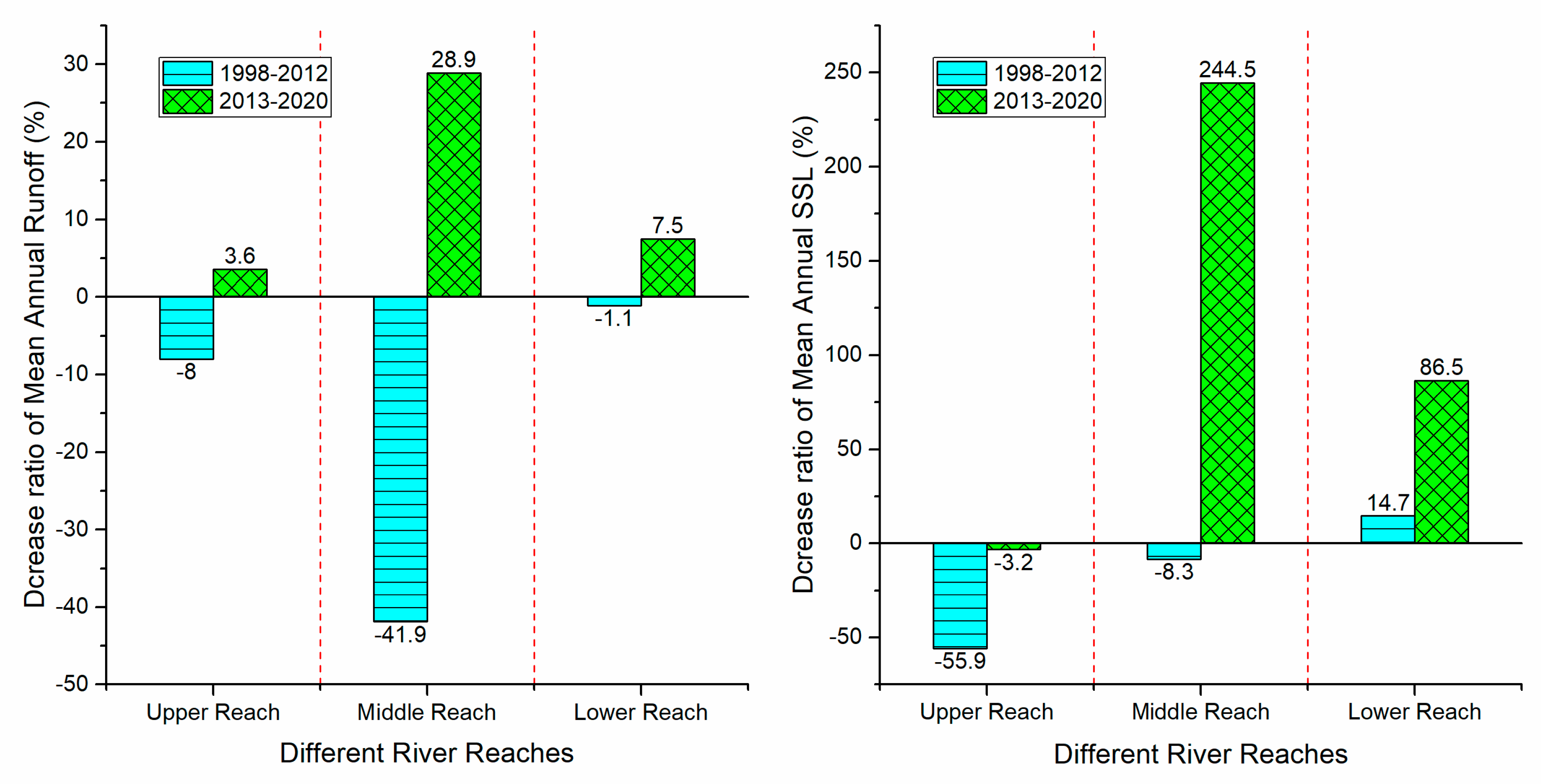

Table 1.
Mann-Kendall trend test of annual runoff and suspended sediment load (SSL) at the typical hydrological stations of the Jinsha River.
Table 1.
Mann-Kendall trend test of annual runoff and suspended sediment load (SSL) at the typical hydrological stations of the Jinsha River.
| Hydrological station | Dataset span | S for runoff | Z for runoff | S for SSL | Z for SSL |
|---|---|---|---|---|---|
| Shigu | 1971−2020 | 236 | 1.966** | 379 | 3.162** |
| Panzhihua | 1966−2020 | 234 | 1.647* | −217 | −1.527* |
| Xiangjiaba | 1954−2020 | 34 | 0.179 | −472 | −2.549** |
Note: The Z values marked with * and ** indicate passing 90% and 95% confidence tests, respectively.
Disclaimer/Publisher’s Note: The statements, opinions and data contained in all publications are solely those of the individual author(s) and contributor(s) and not of MDPI and/or the editor(s). MDPI and/or the editor(s) disclaim responsibility for any injury to people or property resulting from any ideas, methods, instructions or products referred to in the content. |
© 2023 by the authors. Licensee MDPI, Basel, Switzerland. This article is an open access article distributed under the terms and conditions of the Creative Commons Attribution (CC BY) license (http://creativecommons.org/licenses/by/4.0/).
Copyright: This open access article is published under a Creative Commons CC BY 4.0 license, which permit the free download, distribution, and reuse, provided that the author and preprint are cited in any reuse.


