

Submitted:
19 July 2023
Posted:
21 July 2023
You are already at the latest version
Abstract
Humans can recombine thousands of different facial expressions. This variability is due to the ability to voluntarily or involuntarily modulate emotional expressions, which, in turn, depends on the existence of two anatomically separate pathways. The Voluntary (VP) and Involuntary (IP) pathways mediate the production of posed and spontaneous facial expressions, respectively, and might also affect the left and right sides of the face differently. This is a neglected aspect in the emotion literature, where posed expressions instead of genuine expressions are often used as stimuli. Two experiments with different induction methods were specifically designed to inves-tigate the unfolding of spontaneous and posed facial expressions of happiness along the facial vertical axis (left, right) with a high-definition 3D optoelectronic system. The results showed that spontaneous expressions were distinguished from posed facial movements as revealed by relia-ble spatial and speed key kinematic patterns in both experiments. Moreover, VP activation pro-duced a lateralization effect: compared with the felt smile, the posed smile involved an initial acceleration of the left corner of the mouth, while an early deceleration of the right corner oc-curred in the second phase of the movement, after the velocity peak.
Keywords:
emotion expressions
; kinematics
; lateralization
; happiness
; emotional induction
; motor contagion
; voluntary mimicry
; dynamic patterns
1. Introduction
The human face has 43 muscles, which can stretch, lift and contort into thousands combinations involving different muscles at different times and with different intensities [1]. In neuroanatomical terms, movement of the human face is controlled by two cranial nerves, the facial nerve (cranial nerve VII) and the trigeminal nerve (cranial nerve V). The facial nerve controls the superficial muscles attached to the skin, which are primarily responsible for facial expressions, and originate in the two facial nuclei located on either side of the midline in the pons. These nuclei do not communicate directly with each other, and this is why emotional expression can vary in intensity across a vertical axis (i.e., left vs. right). Differences can also occur across a horizontal axis (i.e., upper vs. lower area) given that the facial nerve has five major branches, with each branch serving a different portion of the face. In particular, the upper face (i.e., eye area) is controlled differently than the lower part (i.e., mouth area [2,3]). The upper part of the face receives input from both the ipsilateral and contralateral facial nerves, whereas the lower part is controlled primarily by the contralateral facial nerve [4,5]. Differences in the lateralization of facial expressions may therefore result from a lack of communication between the facial nuclei. These differences are mainly observed in the lower part of the face, due to the contralateral innervation produced by the branch of the facial nerve responsible for the contraction of the muscles around the mouth. These asymmetries should be specifically amplified during posed expressions of happiness, which are controlled by the Voluntary pathway. Indeed, emotional expressions can be voluntarily or involuntarily modulated depending on the recruitment of two anatomically separate pathways for the production of facial expressions: the Voluntary Pathway (VP) and the Involuntary Pathway (IP [6]). The former involves input from the primary motor cortex and is primarily responsible for voluntary expression. The second, on the other hand, is a subcortical system that is primarily responsible for spontaneous expression. The contraction of facial muscles related to genuine emotion originates from subcortical brain areas that provide excitatory stimuli to the facial nerve nucleus via extrapyramidal motor tracts. In contrast, posed expressions are controlled by impulses of the pyramidal tracts from the primary motor cortex [7,8,9,10]. Therefore, small changes in the dynamical development of a facial display may characterize and distinguish genuine from posed facial expressions in each of the four quadrants resulting from the intersection of the vertical and horizonal axes, a topic so far neglected.
In this respect, three major models of emotional processing address the so-called “hemispheric lateralization of emotion” topic in humans [11,12]: the Right-Hemisphere Hypothesis [8], the Valence-Specific Hypothesis [13], and the Emotion-type Hypothesis [5,10]. Analysis of facial expressions has been a traditional means for inferring hemispheric lateralization of emotions by measuring expressive differences between the left and right hemiface, based on the assumption that the right hemisphere controls the left side of the face, and the left hemisphere controls the right side of the face [10,14,15,16,17,18,19]. The Right-Hemisphere Hypothesis [8] states that all emotions are a dominant, lateralized function of the right hemisphere, regardless of their valence or the emotional feeling processed. Their associated expressions would therefore be lateralized in the left side of the face. The Valence-Specific Hypothesis [13] states that negative, avoidance or withdrawal-type emotions are lateralized to the right hemisphere (the associated expressions would then be lateralized to the left hemiface), whereas positive emotions such as happiness are lateralized to the left hemisphere (with expressions lateralized to the right hemiface). Finally, the Emotion-type Hypothesis [5,10] states that primary emotional responses are initiated by the right hemisphere on the left side of the face, while social-emotional responses are initiated by the left hemisphere on the right side of the face. Primary emotions and their manifestations are happiness, sadness, anger, fear, disgust, surprise; whereas social emotions such as embarrassment, envy, guilt, and shame are acquired through parental socialization and during play, school and religious-cultural activities [20].
Based on these theories, various patterns of facial lateralization of emotion expressions can be hypothesized (for a schematic representation of different hypotheses and related predictions on happiness expressions, see Figure 1a). However, a large number of replication studies exploring those hypotheses provided inconsistent results [11,12]. One possible explanation for these contradictory data is that previous literature considered both genuine and posed expressions without distinction. This aspect is particularly remarkable when considering expressions of happiness. Duchenne and non-Duchenne are terms used to classify if a smile reflects a true emotional feeling versus a false smile [21,22,23]. A felt (Duchenne) smile is very expressive and it is classically described as causing the cheeks to lift, the eyes to narrow and wrinkling of the skin to produce crow's feet. A false (non-Duchenne) smile, instead, would only involve the lower face area. However, recent research has shown that the difference between a felt (Duchenne) versus a fake smile might in fact relate to the side of the face initiating the smile [5], thus providing a fundamental – yet not tested – cue to an observer for emotion authenticity detection. The key role of temporal features as a locus for investigating the encoding aspect of facial displays has been in fact largely neglected. A rigorous methodological approach and more consistent proofs across the two axes are therefore necessary to characterize and distinguish spontaneous from posed smiles.
A major drawback of the existing literature on facial expressions is that to collect reliable and controlled databases, researchers typically showed participants static images of posed expressions (for reviews see [14,24]). Adopted stimuli were not dynamic nor genuine, and the induction method [25] did not differentiate between Emotional Induction (i.e., the transmission of emotions from one individual to another [26,27]) and Motor Contagion (i.e., the automatic reproduction of the motor patterns of another individual, [20]). To conclude, inconsistencies in the major models of hemispheric lateralization of emotion, and arbitrary use of different experimental stimuli and elicitation methods are all sources of poor consensus in the literature on facial expressions of emotion.
The objective of this study was to investigate lateralized patterns of movement in the expression of happiness and the possible impact of dynamic stimuli with different induction methods on spontaneous expressions (i.e., Emotional Induction, Motor Contagion). In particular, we hypothesized that lateralized kinematic patterns should have emerged in the lower part of the face for posed expressions innervated contralaterally by the VP and that Motor Contagion should have modified the choreography of spontaneous expressions.
To investigate these hypotheses, in Experiment 1 we presented two sets of stimuli: i) videoclips extracted from popular comedies that produced hilarity without showing smiling faces (Spontaneous condition, Emotional Induction), and ii) static pictures of smiles (Posed condition). In Experiment 2 we showed videos of people shot frontally while manifesting the expression of happiness (Spontaneous condition, Motor Contagion). For the Posed condition, we maintained the same procedure as in Experiment 1.
To test the spatiotemporal dynamics of facial movements we capitalized on a method recently developed in our laboratory [30] which combines an ultra-high definition optoelectronic system with a Facial Action Coding System (FACS, a comprehensive, anatomically based system for describing all visually discernible facial movement) [31]. This method proved to be remarkably accurate in the quantitative capture of facial motion.
Thanks to this method, in Experiments 1 and 2 we expected to show lateralized kinematic patterns in the lower part of the face for posed compared to spontaneous expressions. On the other hand, we expected to find differences for spontaneous expressions across the two Experiments depending on the induction method.
In summary, the main aim of the present study was to investigate the lateralization patterns of the posed smile with a mathematical approach to clarify whether the difference between a felt (Duchenne) smile and a fake smile can actually emerge in the side of the face that initiates the facial expression. We also tried to disambiguate which hypothesis on the lateralization of emotion expressions is more rigorous in explaining the observed data.
2. General methods
The data for Experiments 1 and 2 were collected at the Department of General Psychology - University of Padova.
2.1. Ethics Statement
All Experiments were conducted in accordance with the Declaration of Helsinki and approved by the Ethics Committee of the University of Padova (protocols n. 3580, 4539). All participants were naïve to the purposes of the experiment and gave their written informed consent for their participation.
2.2. Apparatus
Participants were tested individually in a dimly lit room. Their faces were recorded frontally with a video camera (Logitech C920 HD Pro Webcam, Full HD 1080p/30fps) positioned above the monitor for FACS validation procedure. The stimuli presentation was implemented using E-prime V2.0. Five infrared reflective markers (i.e., ultra-light 3 mm diameter semi-spheres) were applied to the face of participants according to the Clepsydra Model (Figure 1b, top picture; [32]) for kinematic analysis. We selected the minimum number of markers adopted in the literature as a common denominator to compare our findings with previous results [33,34]. Markers were taped to the left and right eyebrows and to the left and right cheilions to test the facial nerve branches that specifically innervate the upper and the lower parts of the face, respectively. A further marker was placed on the tip of the nose to perform a detailed analysis of the lateralized movements of each marker with respect to this reference point. The advantage of applying kinematic analysis to pairs of markers rather than individual markers is that it accounts for any head movement [35]. Because of its simplicity, the Clepsydra model could be validated and replicated by different laboratories around the world [36]. Six infrared cameras (sampling rate 140 Hz), placed in a semicircle at a distance of 1–1.2 meters from the center of the room (Figure 1b, bottom picture) captured the relative position of the markers. Facial movements were recorded using a 3-D motion analysis system (SMART-D, Bioengineering Technology and Systems [B|T|S]). The coordinates of the markers were reconstructed with an accuracy of 0.2 mm over the field of view. The standard deviation of the reconstruction error was 0.2 mm for the vertical (Y) axis and 0.3 mm for the two horizontal (X and Z) axes.
2.3. Procedure
Each participant underwent a single experimental session (Experiment 1 or 2) lasting approximately 20 minutes. They were seated in a height-adjustable chair in front of a monitor (40 cm from the edge of the table) and were free to move while observing selected stimuli displayed on the monitor (Figure 2). Facial movements were recorded under two experimental conditions: (i) Spontaneous condition, in which participants watched happiness-inducing videos and reacted freely (i.e., they were given no instructions); (ii) Posed condition, in which participants produced a voluntary expression of happiness, while a posed image of happiness was shown on the monitor. The two experimental conditions within each experiment - Spontaneous and Posed - were specifically adopted to activate the two Pathways (Voluntary and Involuntary). Crucially, we wanted to test the two methods of spontaneous induction in two separate experiments to avoid possible carry-over effects between them while comparing them both with the same Posed condition. This condition served on the one hand to define each participant's expressive baseline (as a term of intra-individual comparison) and on the other hand to test the specific role of the Voluntary versus Involuntary Pathway. Moreover, for the Posed condition we chose a classical image of happiness taken from Ekman’s dataset for three reasons: i) for comparison with previous literature [37]; ii) for relevance to our experimental manipulation (being a prototypical non-genuine expression of happiness); iii) to keep the attention fixed on the monitor. Participants were instructed to mime the happiness expression three times so that we could have a sufficient number of repetitions. No instruction whatsoever was given on the duration of the expression. This procedure was aimed at generating expressions without forcing the participants to respect time constraints as in the Spontaneous conditions [38]. To avoid possible carry-over effects between trials due to the emotional induction from the videos used in the spontaneous condition, we capitalised on the procedure adopted by Sowden and colleagues [33], and divided the trials into two separate blocks (first the spontaneous block, then the posed block after a brief pause). The inter stimulus interval was comprised between 30-60 seconds.
2.4. Expression extraction and FACS validation procedure
All repeated expressions of happiness within a single trial were included in the analysis. A two-step procedure was adopted to ensure a correct selection of each expression. First, we manually identified all the single epochs – the beginning and end of each smile – according to the FACS criteria (e.g., Action Units 6 and 12, the Cheek Raiser and the Lip Corner Puller). Despite the existence of an automated FACS coding, we decided to apply the manual one as it is demonstrated to have a strong concurrent validity with the automated FACS coding, thus denoting the reliability of the method. Furthermore, the manual procedure has recently been demonstrated to outperform the automated one [39]. Second, we applied a kinematic algorithm to automatically identify the beginning and end of each smile using the cross-reference on the threshold velocity of the cheilion. Identification of motion onset and end performed with the two methods were compared and obtained a 100% match.
2.5. Data Acquisition
2.5.1. Kinematic 3-D tracking
Following kinematic data collection, the SMART-D Tracker software package (Bioengineering Technology and Systems, B|T|S) was employed to automatically reconstruct the 3-D marker positions as a function of time. Then, each clip was individually checked for correct marker identification.
2.5.2. Kinematic 3-D analysis
To investigate spatial, velocity and temporal key kinematic parameters in both the upper and lower face, we considered the relative movement of two pairs of markers:
Lower part of the face:
- Left cheilion and tip of the nose (Left-CH);
- Right cheilion and tip of the nose (Right-CH).
Upper part of the face:
- Left eyebrow and tip of the nose (Left-EB);
- Right eyebrow and tip of the nose (Right-EB).
Each expression was analysed from the onset point to the apex (i.e., the peak). Movement onset was calculated as the first time point at which the mouth widening speed crossed a 0.2 mm/s threshold and remained above it for longer than 100 ms. Movement end was considered when the lip corners reached the maximum distance (i.e., the time at which the mouth widening speed dropped below the 0.2 mm/s threshold). Movement time was calculated as the temporal interval between movement onset and movement offset. We measured morphological (i.e., spatial) and dynamic (i.e., velocity and temporal) characteristics of each expression on each pair of markers [40]:
Spatial parameters:
- Maximum Distance (MD, mm) was calculated as the maximum distance reached by the 3-D coordinates (x,y,z) of two markers.
- Delta Distance (DD, mm) was calculated as the difference between the maximum and the minimum distance reached by two markers, to account for functional and anatomical differences across participants.
Velocity parameters:
- Maximum Velocity (MV, mm/s) was calculated as the maximum velocity reached by the 3-D coordinates (x,y,z) of each pair of markers during movement time.
- Maximum Acceleration (MA, mm/s2) was calculated as the maximum acceleration reached by the 3-D coordinates (x,y,z) of each pair of markers during movement time.
- Maximum Deceleration (MDec, mm/s2): was calculated as the maximum deceleration reached by the 3-D coordinates (x,y,z) of each pair of markers during movement time.
The time parameters were calculated by measuring the time when the spatial and velocity parameters just described reached their peaks after movement onset. Each temporal parameter was then normalized with respect to movement time to account for individual speed differences:
- Time to Maximum Distance (TMD%);
- Time to Maximum Velocity (TMV%);
- Time to Maximum Acceleration (TMA%);
- Time to Maximum Deceleration (TMDec%).
2.6. Statistical Approach
All behavioral data were analysed using JASP version 0.16 [41] statistical software. Data analysis for each Experiment was divided into three main parts: the first one was aimed at testing if facial motion differs across the vertical axis (i.e., Left-CH vs. Right-CH and Left-EB vs. Right-EB) for spontaneous and posed emotional expressions; the second part was aimed at exploring differences in the induction methods. During the first part of the analysis, for each Experiment, a repeated-measures ANOVA with condition (Spontaneous, Posed) and side of the face (left, right) as within-subjects variable was performed together with planned orthogonal contrasts. The Volk-Selke Maximum p-Ratio on the two-sided p-value was computed too, in order to quantify the maximum possible odds in favour of the alternative hypothesis over the null one (VS-MPR [42]). Finally, to explore the possible differences triggered by different induction methods in the expression of happiness (posed and spontaneous), we conducted a mixed analysis of variance with Experiment (1, 2) as between-subjects factor, Condition (Spontaneous, Posed), and Side of the face (left, right) as within-subjects factor. For all statistical analyses, a significance threshold of p < 0.05 was set and Bonferroni correction was applied to post-hoc contrasts.
Sample size was determined by means of GPOWER 3.1 [43] based on previous literature [35]. Since we used a repeated-measures design in Experiments 1 and 2, we considered an effect size f of 0.25, alpha = 0.05 and power = 0.8. The projected sample size needed with this effect size was N = 20 for within group comparisons in each experiment. For the comparison analysis the sample obtained was the sum of the samples from Experiments 1 and 2, and for this reason it was not estimated a priori. We then calculated the post hoc power and found that even with small effects the power was high, namely > 0.95.
3. Experiment 1
3.1. Participants
Twenty participants were recruited to take part to the experiment. Three participants were subsequently excluded due to technical or recording problems, therefore a sample of seventeen participants (13 females, 4 males) aged between 21 and 32 years (M = 24.8, SD = 3) were included in the analysis.
3.2. Stimuli
For the Spontaneous condition we selected N = 2 emotion-inducing videos from a recently-validated dataset structured to elicit genuine facial expressions [44]. Videoclips were extracted from popular comedy movies in which actors produced hilarity without showing smiling faces (e.g., jokes by professional comedians). Videoclips lasted an average of 2 min and 55 sec (video 1 = 3 min 49 sec; video 2 = 2 min 2 sec). The length of the clips did not exceed 5 minutes according to the recommended size for emotional video [45]. Each video was presented once without repetition to avoid possible habituation effects. Participants rated the intensity of the emotion felt while watching the videos at the end of each presentation. Participants rated the stimuli on a 9-point Likert scale, where 1 was negative, 5 was neutral and 9 was positive. The mean score assigned to the stimuli (6; SD = 1.286) was significantly higher than the central value of the Likert scale (i.e., 5; t17 = 2.383; p = 0.015).
3.3. Results
Participants performed a range of 3-5 expressions of happiness per trial in the Spontaneous condition and three in the Posed condition.
3.3.1. Repeated-measures ANOVA
In the lower part of the face, all the spatial and velocity kinematic parameters, together with a couple of temporal parameters (TMD%, TMA%) showed a main effect of Condition (Posed vs. Spontaneous). In the upper part of the face, MD and TMV% showed a main effect of Condition (Table 1). In general, the results showed an amplified choreography for posed expressions in spatial, velocity and temporal terms compared to spontaneous expressions: posed smiles were wider, quicker and more anticipated than spontaneous smiles (see graphical representation in Figure S1, Supplementary Material). A main effect of Side of the face (Left vs. Right) was found on the lower part of the face for TMV% and TMDec% (Figure 3). In particular, the left cheilion reached its peak Velocity earlier than the right cheilion, and the right cheilion reached its Maximum Deceleration earlier than the left cheilion in both Conditions.
4. Experiment 2
In this experiment we specifically manipulated the induction method to evaluate the effect of Motor Contagion (i.e., the automatic reproduction of the motor patterns of another individual) on the spontaneous expressions of happiness. While in Experiment 1 happiness was induced with movie scenes showing professional actors who performed hilarious scenes without exhibiting smiling faces, in Experiment 2 we selected videos from YouTube in which people were shot frontally while being particularly happy and expressing uncontrollable laughter.
4.1. Participants
Twenty participants (15 females, 5 males) aged between 21 and 27 years (M = 23, SD = 1.8) were recruited to take part to the experiment.
4.2. Stimuli
The image adopted for the Posed condition was the same as for Experiment 1. Spontaneous happiness was instead elicited by using three emotion-inducing videos extracted from YouTube and already validated in a previous study from our laboratory [30]. While Experiment 1 videos were longer because the actor needed time to deliver the hilarious joke, in Experiment 2 the videos were shorter because only the expression of happiness was presented. As a result, the time available for participants to spontaneously smile while watching the videos was shorter. We therefore increased the number of stimuli from two to three to collect enough observations. Videoclips lasted an average of 49 seconds (video 1 = 31 sec; video 2 = 57 sec; video 3 = 59 sec). Each video was presented once without repetition to avoid possible habituation effects. As in Experiment 1, participants rated the intensity of the emotion felt while watching the videos at the end of each presentation stimuli on a 9-point Likert scale, where 1 was negative, 5 was neutral and 9 was positive. The mean score assigned to the stimuli (7; SD = 1.457) was significantly higher than the central value of the Likert scale (i.e., 5; t19 = 5.679; p < 0.001) and higher than the score reported in Experiment 1 (t36 = -2.535; p = 0.008).
4.3. Results
Participants performed a range of 3-5 expressions of happiness per trial in the Spontaneous condition and three in the Posed condition.
4.3.1. Repeated-measures ANOVA
In the lower part of the face, all the kinematic parameters showed a main effect of Condition (Posed vs. Spontaneous), except for TMV%. In the upper part of the face, no parameters showed any statistically significant effect (all ps > 0.05; Table 2). In general, the results confirmed the amplified choreography for posed expressions found in Experiment 1 for spatial, velocity and temporal parameters compared to spontaneous expressions (for a graphical representation of the main effects of Condition, see Figure S2 in the Supplementary material). A main effect of Side of the face (Left vs. Right) was shown for TMD%, TMA%, and TMDec%, and a statistically significant interaction Condition by Side of the face was found for MD and TMDec% (Figure 4 and Table 2). The results of the interaction showed that the left cheilion during posed expressions was more distal than the right cheilion during spontaneous expressions (Figure 4a). Crucially, the peak Deceleration of the right cheilion during posed expressions occurred earlier than during spontaneous expressions, and earlier than the peak of the left cheilion during posed smiles (Figure 4d). The results of the main effects showed that the left cheilion reached its Maximum Acceleration earlier than the right cheilion in both conditions (Figure 4c), but it reached its Maximum Distance later than the right cheilion in both conditions (Figure 4b).
5. Comparison analysis (Experiment 1 vs. 2)
5.1. Mixed ANOVA: Posed vs. Spontaneous, left vs. right, and Experiment 1 vs. 2
When directly comparing the possible differences triggered by different induction methods in the expression of happiness (posed and spontaneous), the variable Experiment (1 vs. 2) was never found to be significant, and consequently neither was the 3-way interaction between Condition, Side of the face and Experiment for all investigated variables. However, a statistically significant main effect of Condition (Posed vs. Spontaneous) was found in the lower part of the face for all the kinematic parameters, except for TMV%. In the upper part of the face, only MD showed a main effect of Condition (see Table 3). In general, considering both Experiments 1 and 2, the results confirmed the amplified choreography for posed expressions for spatial, velocity and temporal parameters compared to spontaneous expressions (for a graphical representation of the main effects of Condition, see Figure S3 in the Supplementary material). A main effect of Side of the face (Left vs. Right) was shown for MD, TMV%, and TMDec%, and a statistically significant interaction Condition by Side of the face was found for MD and TMDec% (Figure 5 and Table 3). The results of the interaction showed that during posed expressions the left cheilion was more distal than the right cheilion (Figure 5a). Crucially, the peak Deceleration of the right cheilion during posed expressions occurred earlier than during spontaneous expressions, and earlier than the peak of the left cheilion during posed smiles (Figure 4c). Moreover, during spontaneous expressions the peak Deceleration of the right cheilion occurred earlier than the peak of the left cheilion (Figure 4c). The results of the main effects showed that the left cheilion reached its Maximum Acceleration earlier than the right cheilion in both conditions (Figure 4c), but it reached its Maximum Distance later than the right cheilion in both conditions (Figure 4b).
6. Discussion
Facial expressions are a mosaic phenomenon, in which there is independent motor control of upper and lower facial expressions and a partially independent hemispheric motor control of the right and left sides [5]. Here, with two Experiments, we reliably confirmed that facial movements provide relevant and consistent details to characterize and distinguish between spontaneous and posed expressions. In particular, the comparison analysis showed that a posed expression of happiness is characterized by increased peak distance of both cheilions and eyebrows, and increased peak velocity, acceleration and deceleration of the cheilions compared to a spontaneous expression. In temporal terms, posed smiles show anticipated acceleration and deceleration peaks and a delayed peak distance than spontaneous smiles. These results were extended by showing also a lateralization pattern in spatiotemporal terms for posed expressions. The peak Distance and the Time to peak Velocity and Deceleration appear in fact to be reliable markers of differences across the facial vertical axis. The peak Distance was increased, and Velocity peak was reached earlier in the left side of the mouth compared to the right side. Whereas in the second phase of the movement, after the velocity peak, an early Deceleration occurred in the right corner of the mouth. These data seem to indicate that the complex choreography of a fake smile implies a spatial amplification of the movement in the left hemiface, which then cascades into a slowdown in the final phase. More importantly, they tell us that this effect had a double peak across the hemiface, with the right corner of the mouth reaching earlier the peak Deceleration. In the case of a spontaneous smile, we find a lateralized effect only for one temporal component: the right corner of the mouth reached earlier the Deceleration peak with respect to the left side of the mouth.
6.1. Left vs. right
In 2016, Ross and colleagues [5] were the first to describe a double-peak phenomenon. They reported that in some cases, emotion-related expressions showed a slight relaxation before continuing to the final peak, and in about one third of these expressions, the second innervation started on the contralateral side of the face. These qualitative observations led the authors to believe that the expressions were the result of two innervations, a “double-peak vertical blend”, indicating that the expression of interest had two independent motor components driven by opposite hemispheres. In the present study, in line with the hypothesis by Ross and colleagues [20], we found a consistent lateralization pattern in the left lower hemiface specific to posed expressions of happiness. That is, an acceleration that began first in the left corner of the mouth until the peak of maximum speed, beyond which an anticipated peak of Deceleration occurred in the right corner of the mouth.
The adoption of a novel 3-D kinematic approach allowed us to investigate the morphological and dynamic characteristics of lateralized expressions on each of the four quadrants resulting from the vertical and horizontal axes. Notably, previous studies using 2-D automated facial image analysis (e.g., [46]) found no evidence of asymmetry between the left and right side of a smile, likely due to a methodological limitation. Accurate assessment of asymmetry requires in fact either a frontal view of the face or precise 3-D registration. Moreover, a 3-D dynamic analysis is also required to exclude that asymmetries simply result from baseline differences in face shape.
In the light of these results, we speculate that it is necessary to study the expressions of emotions in each of the four quadrants resulting from the horizontal and vertical axes, by distinguishing between spontaneous and posed displays, and investigating the function for which they are expressed and the type of anatomical pathway (i.e., Voluntary vs. Involuntary) underlying them before we can draw a firm conclusion. Recent research points indeed at the existence of multiple interrelated networks, each associated with the processing of a specific component of emotions (i.e., generation, perception, regulation), which do not necessarily share the same lateralization patterns [47]. A recent meta-analysis revealed in fact that the perception, experience, and expression of emotion are each subserved by a distinct network [48]. Hence, the lateralization of emotion is a multi-layered phenomenon and as such should be considered.
6.2. Posed vs. Spontaneous
Results from two experiments demonstrated and confirmed that facial movements provide relevant and consistent details to characterize and distinguish between spontaneous and posed expressions. In line with our predictions, results revealed that the speed and amplitude of the mouth as it widens into a smile are greater in posed than genuine happiness. In particular, a posed smile is characterized by an increase of the smile amplitude, speed and deceleration, as indicated by the cheilion pair of markers. As concern the upper part of the face, results showed a similar increase of the Maximum Distance of the eyebrows when the participants performed a posed smile compared to when they smiled spontaneously. These findings confirm and extend previous literature [33,35,49,50], by showing that performing a fake smile entails a speeded choreography of amplified movements both in the lower and upper parts of the face. The main limitation of our experiment is that dynamic stimuli (video clips) could not be adopted for the posed condition as well, because otherwise the voluntarily generated expressions would have overlapped and mixed with the authentic ones, not giving us the ability to discern one from the other. Further studies are needed to ensure a greater degree of external validity and generalizability.
6.3. Emotional Induction vs. Motor Contagion
Our data on the Likert scale indicate that both Emotional Induction and Motor Contagion were effective in activating a felt emotion of happiness. Moreover, videos adopted for the Motor Contagion were rated as more intense than those for the Emotional Induction. However, the comparison analysis on the two Experiments showed no kinematic differences on spontaneous expressions depending on the method. Spontaneous expressions seem therefore conveyed by an automatic pathway, which is difficult to modify. This result is in line with the notion that a genuine emotion originates from subcortical brain areas that provide excitatory stimuli to the facial nerve nucleus via extrapyramidal motor tracts (i.e., the Involuntary Pathway). Future studies are needed to apply this methodology to other emotions in order to accurately investigate the full range of subtle differences in facial expressions and the role played by the Involuntary Pathway in emotion expression.
6.4. Clinical applications
The possibility of discriminating the spontaneous vs. posed expression of emotions by means of sophisticated analysis of facial movements has potential for future clinical applications. One example is the application of this technique to patients suffering from Parkinson's disease (PD), who are characterized by a deficit in the expression of genuine emotions (i.e. amimia), but who are still able to intentionally produce emotional expressions [51], thus manifesting the automatic-voluntary dissociation that underlies the distinction between the Voluntary and Involuntary Pathways. From a neuroanatomical point of view, patients with PD present defective functioning of the basal ganglia [52]. The connections between the basal ganglia and the cerebral cortex form extrapyramidal circuits, which are divided into five parallel networks connected to: the frontal motor and oculomotor cortex, the prefrontal cortex dorsolateral, the anterior cingulate cortex and the orbitofrontal cortex [53]. Connections with the orbitofrontal and cingulate cortex constitute the limbic circuits, which also involve subcortical structures such as the amygdala and hippocampus [54]. This rich neural network between the basal ganglia and the structures of the limbic system establishes a link between the perception of emotions, their motor production through facial expressions and final recognition [55]. An in-depth investigation of PDs' ability to produce spontaneous and posed expressions, using an advanced and validated protocol for emotion induction and a sophisticated technique for data acquisition and analysis, could therefore be applied to investigate the emotion expression deficits in these patients. Furthermore, future research could investigate the correlation between the deficit in emotion production and functional/structural alterations of the brain in PD patients, in order to identify a behavioral biomarker that can estimate the severity of the disease.
7. Conclusions
Despite the importance of emotion in human functioning, scientists have been unable to reach a consensus on the debated issue concerning the lateralization of emotions. Our research, conducted with a high-definition 3D optoelectronic system, has shown that the left hemiface is more expressive than the right hemiface for posed but not for spontaneous smiles, and that specific spatiotemporal parameters are reliable markers of kinematic differences across the facial horizontal and vertical axes. This result would be in line with a recent hypothesis that it is the temporal dynamics of the movement that distinguishes a posed from a spontaneous smile [20]. Our findings may be the key to resolving the apparent conflict between various theories that have attempted to discriminate true and false expressions of happiness and will aid to clarify the hemispheric bases of emotion expression. We believe indeed that investigating the dynamic pattern of facial expressions of emotions, which can be controlled consciously only in part, would provide a useful operational test for comparing the different predictions of various lateralization hypotheses, thus allowing this long-standing conundrum to be solved.
Supplementary Materials
The following supporting information can be downloaded at the website of this paper posted on Preprints.org. Table S1: Dataset.
Author Contributions
Conceptualization, E.S., C.S. and L.S.; methodology, C.S. and L.S.; software, E.S.; validation, E.S, C.S., S.B., and L.S.; formal analysis, E.S. and A.S.; investigation, E.S., S.B., and B.C.B; resources, L.S.; data curation, E.S. and A.S.; writing—original draft preparation, E.S. and L.S.; writing—review and editing E.S., C.S., S.B. and L.S.; visualization, E.S., C.S., A.S., S.B., B.C.B. and L.S.; supervision, L.S.; project administration, L.S.; funding acquisition, L.S. All authors have read and agreed to the published version of the manuscript.
Funding
The present work was carried out within the scope of the research programme Dipartimenti di Eccellenza (art.1, commi 314- 337 legge 232/2016), which was supported by a grant from MIUR to the Department of General Psychology, University of Padova. The present study was partially supported by a grant from the University of Padova (Supporting TAlent in ReSearch @ University of Padova - STARS Grants 2017) to C.S.
Institutional Review Board Statement
The study was conducted in accordance with the Declaration of Helsinki, and approved by the Ethics Committee of University of Padova (protocol n. 3580 and date of approval 1st June 2020; protocol n. 4539 and 31 December 2021).
Informed Consent Statement
Informed consent was obtained from all subjects involved in the study.
Data Availability Statement
The dataset has been uploaded in the Supplementary Material section.
Acknowledgments
We thank Alessio Miolla for the technical support with the FACS coding.
Conflicts of Interest
The authors declare no conflict of interest.
References
- Ekman, P. Lie Catching and Microexpressions. In The Philosophy of Deception; Martin, C.W., Ed.; 2009; pp. 118–136 ISBN 978-0-19-532793-9.
- Koff, E.; Borod, J.; Strauss, E. Development of Hemiface Size Asymmetry. Cortex 1985, 21, 153–156. [Google Scholar] [CrossRef] [PubMed]
- Rinn, W.E. The Neuropsychology of Facial Expression: A Review of the Neurological and Psychological Mechanisms for Producing Facial Expressions. Psychol. Bull. 1984, 95, 52–77. [Google Scholar] [CrossRef] [PubMed]
- Morecraft, R.J.; Stilwell–Morecraft, K.S.; Rossing, W.R. The Motor Cortex and Facial Expression:: New Insights From Neuroscience. The Neurologist 2004, 10, 235–249. [Google Scholar] [CrossRef] [PubMed]
- Ross, E.D.; Gupta, S.S.; Adnan, A.M.; Holden, T.L.; Havlicek, J.; Radhakrishnan, S. Neurophysiology of Spontaneous Facial Expressions: I. Motor Control of the Upper and Lower Face Is Behaviorally Independent in Adults. Cortex J. Devoted Study Nerv. Syst. Behav. 2016, 76, 28–42. [Google Scholar] [CrossRef]
- Morecraft, R.J.; Louie, J.L.; Herrick, J.L.; Stilwell-Morecraft, K.S. Cortical Innervation of the Facial Nucleus in the Non-Human Primate: A New Interpretation of the Effects of Stroke and Related Subtotal Brain Trauma on the Muscles of Facial Expression. Brain J. Neurol. 2001, 124, 176–208. [Google Scholar] [CrossRef]
- Gazzaniga, M.S.; Smylie, C.S. Hemispheric Mechanisms Controlling Voluntary and Spontaneous Facial Expressions. J. Cogn. Neurosci. 1990, 2, 239–245. [Google Scholar] [CrossRef]
- Hopf, H.C.; Md, W.M.-F.; Hopf, N.J. Localization of Emotional and Volitional Facial Paresis. Neurology 1992, 42, 1918–1918. [Google Scholar] [CrossRef]
- Krippl, M.; Karim, A.A.; Brechmann, A. Neuronal Correlates of Voluntary Facial Movements. Front. Hum. Neurosci. 2015, 9. [Google Scholar] [CrossRef]
- Ross, E.D.; Prodan, C.I.; Monnot, M. Human Facial Expressions Are Organized Functionally Across the Upper-Lower Facial Axis. The Neuroscientist 2007, 13, 433–446. [Google Scholar] [CrossRef]
- Demaree, H.A.; Everhart, D.E.; Youngstrom, E.A.; Harrison, D.W. Brain Lateralization of Emotional Processing: Historical Roots and a Future Incorporating “Dominance. ” Behav. Cogn. Neurosci. Rev. 2005, 4, 3–20. [Google Scholar] [CrossRef]
- Killgore, W.D.S.; Yurgelun-Todd, D.A. The Right-Hemisphere and Valence Hypotheses: Could They Both Be Right (and Sometimes Left)? Soc. Cogn. Affect. Neurosci. 2007, 2, 240–250. [Google Scholar] [CrossRef] [PubMed]
- Davidson, R.J. Affect, Cognition, and Hemispheric Specialization. In Emotions, cognition, and behavior; Cambridge University Press: New York, NY, US, 1985; ISBN 978-0-521-25601-8. [Google Scholar]
- Straulino, E.; Scarpazza, C.; Sartori, L. What Is Missing in the Study of Emotion Expression? Front. Psychol. 2023, 14. [Google Scholar] [CrossRef] [PubMed]
- Sackeim, H.A.; Gur, R.C.; Saucy, M.C. Emotions Are Expressed More Intensely on the Left Side of the Face. Science 1978, 202, 434–436. [Google Scholar] [CrossRef]
- Ekman, P.; Hager, J.C.; Friesen, W.V. The Symmetry of Emotional and Deliberate Facial Actions. Psychophysiology 1981, 18, 101–106. [Google Scholar] [CrossRef] [PubMed]
- Borod, J.C.; Cicero, B.A.; Obler, L.K.; Welkowitz, J.; Erhan, H.M.; Santschi, C.; Grunwald, I.S.; Agosti, R.M.; Whalen, J.R. Right Hemisphere Emotional Perception: Evidence across Multiple Channels. Neuropsychology 1998, 12, 446–458. [Google Scholar] [CrossRef] [PubMed]
- Borod, J.C.; Koff, E.; White, B. Facial Asymmetry in Posed and Spontaneous Expressions of Emotion. Brain Cogn. 1983, 2, 165–175. [Google Scholar] [CrossRef]
- Thompson, J.K. Right Brain, Left Brain; Left Face, Right Face: Hemisphericity and the Expression of Facial Emotion. Cortex J. Devoted Study Nerv. Syst. Behav. 1985, 21, 281–299. [Google Scholar] [CrossRef]
- Ross, E.D. Differential Hemispheric Lateralization of Emotions and Related Display Behaviors: Emotion-Type Hypothesis. Brain Sci. 2021, 11, 1034. [Google Scholar] [CrossRef]
- Duchenne de Boulogne, G.-B. The Mechanism of Human Facial Expression; Studies in Emotion and Social Interaction; Cuthbertson, R.A., Ed.; Cambridge University Press: Cambridge, 1990; ISBN 978-0-521-36392-1. [Google Scholar]
- Ekman, P.; Friesen, W.V. Felt, False, and Miserable Smiles. J. Nonverbal Behav. 1982, 6, 238–252. [Google Scholar] [CrossRef]
- Ekman, P.; Friesen, W.V.; O’Sullivan, M. Smiles When Lying. J. Pers. Soc. Psychol. 1988, 54, 414–420. [Google Scholar] [CrossRef]
- Barrett, L.F.; Adolphs, R.; Marsella, S.; Martinez, A.M.; Pollak, S.D. Emotional Expressions Reconsidered: Challenges to Inferring Emotion From Human Facial Movements. Psychol. Sci. Public Interest J. Am. Psychol. Soc. 2019, 20, 1–68. [Google Scholar] [CrossRef]
- Siedlecka, E.; Denson, T.F. Experimental Methods for Inducing Basic Emotions: A Qualitative Review. Emot. Rev. 2019, 11, 87–97. [Google Scholar] [CrossRef]
- Kavanagh, L.C.; Winkielman, P. The Functionality of Spontaneous Mimicry and Its Influences on Affiliation: An Implicit Socialization Account. Front. Psychol. 2016, 7. [Google Scholar] [CrossRef] [PubMed]
- Prochazkova, E.; Kret, M.E. Connecting Minds and Sharing Emotions through Mimicry: A Neurocognitive Model of Emotional Contagion. Neurosci. Biobehav. Rev. 2017, 80, 99–114. [Google Scholar] [CrossRef] [PubMed]
- Rizzolatti, G.; Fogassi, L.; Gallese, V. Neurophysiological Mechanisms Underlying the Understanding and Imitation of Action. Nat. Rev. Neurosci. 2001, 2, 661–670. [Google Scholar] [CrossRef] [PubMed]
- Hess, U.; Fischer, A. Emotional Mimicry: Why and When We Mimic Emotions. Soc. Personal. Psychol. Compass 2014, 8, 45–57. [Google Scholar] [CrossRef]
- Straulino, E.; Scarpazza, C.; Miolla, A.; Spoto, A.; Betti, S.; Sartori, L. Different Induction Methods Reveal the Kinematic Features of Posed vs. Spontaneous Expressions. under review.
- Ekman, P.; Friesen, W. Facial Action Coding System: A Technique for the Measurement of Facial Movement.; Consulting Psychologists Press: Palo Alto, 1978. [Google Scholar]
- Straulino, E.; Miolla, A.; Scarpazza, C.; Sartori, L. Facial Kinematics of Spontaneous and Posed Expression of Emotions. In Proceedings of the International Society for Research on Emotion - ISRE 2022; Los Angeles, California USA; 2022. [Google Scholar]
- Sowden, S.; Schuster, B.A.; Keating, C.T.; Fraser, D.S.; Cook, J.L. The Role of Movement Kinematics in Facial Emotion Expression Production and Recognition. Emot. Wash. DC 2021, 21, 1041–1061. [Google Scholar] [CrossRef]
- Zane, E.; Yang, Z.; Pozzan, L.; Guha, T.; Narayanan, S.; Grossman, R.B. Motion-Capture Patterns of Voluntarily Mimicked Dynamic Facial Expressions in Children and Adolescents With and Without ASD. J. Autism Dev. Disord. 2019, 49, 1062–1079. [Google Scholar] [CrossRef]
- Guo, H.; Zhang, X.-H.; Liang, J.; Yan, W.-J. The Dynamic Features of Lip Corners in Genuine and Posed Smiles. Front. Psychol. 2018, 9. [Google Scholar] [CrossRef]
- Fox, D. The Scientists Studying Facial Expressions. Nature 2020. [Google Scholar] [CrossRef]
- Ekman, P.; Friesen, W.V. Pictures of Facial Affect; Consulting Psychologists Press: Palo Alto, Calif, 1976. [Google Scholar]
- Miolla, A.; Cardaioli, M.; Scarpazza, C. Padova Emotional Dataset of Facial Expressions (PEDFE): A Unique Dataset of Genuine and Posed Emotional Facial Expressions 2021.
- Le Mau, T.; Hoemann, K.; Lyons, S.H.; Fugate, J.M.B.; Brown, E.N.; Gendron, M.; Barrett, L.F. Professional Actors Demonstrate Variability, Not Stereotypical Expressions, When Portraying Emotional States in Photographs. Nat. Commun. 2021, 12, 5037. [Google Scholar] [CrossRef] [PubMed]
- Vimercati, S.L.; Rigoldi, C.; Albertini, G.; Crivellini, M.; Galli, M. Quantitative Evaluation of Facial Movement and Morphology. Ann. Otol. Rhinol. Laryngol. 2012, 121, 246–252. [Google Scholar] [CrossRef] [PubMed]
- JASP Team JASP - Version 0. 16.4. Comput. Softw. 2022. [Google Scholar]
- Sellke, T.; Bayarri, M.J.; Berger, J.O. Calibration of ρ Values for Testing Precise Null Hypotheses. Am. Stat. 2001, 55, 62–71. [Google Scholar] [CrossRef]
- Erdfelder, E.; Faul, F.; Buchner, A. GPOWER: A General Power Analysis Program. Behav. Res. Methods Instrum. Comput. 1996, 28, 1–11. [Google Scholar] [CrossRef]
- Miolla, A.; Cardaioli, M.; Scarpazza, C. Padova Emotional Dataset of Facial Expressions (PEDFE): A Unique Dataset of Genuine and Posed Emotional Facial Expressions. Behav. Res. Methods 2022. [Google Scholar] [CrossRef]
- Rottenberg, J.; Ray, R.D.; Gross, J.J. Emotion elicitation using films. Emot. Elicitation Using Films 2007, 9–28. [Google Scholar]
- Ambadar, Z.; Cohn, J.F.; Reed, L.I. All Smiles Are Not Created Equal: Morphology and Timing of Smiles Perceived as Amused, Polite, and Embarrassed/Nervous. J. Nonverbal Behav. 2009, 33, 17–34. [Google Scholar] [CrossRef]
- Palomero-Gallagher, N.; Amunts, K. A Short Review on Emotion Processing: A Lateralized Network of Neuronal Networks. Brain Struct. Funct. 2022, 227, 673–684. [Google Scholar] [CrossRef]
- Morawetz, C.; Riedel, M.C.; Salo, T.; Berboth, S.; Eickhoff, S.B.; Laird, A.R.; Kohn, N. Multiple Large-Scale Neural Networks Underlying Emotion Regulation. Neurosci. Biobehav. Rev. 2020, 116, 382–395. [Google Scholar] [CrossRef]
- Schmidt, K.L.; Ambadar, Z.; Cohn, J.F.; Reed, L.I. Movement Differences between Deliberate and Spontaneous Facial Expressions: Zygomaticus Major Action in Smiling. J. Nonverbal Behav. 2006, 30, 37–52. [Google Scholar] [CrossRef] [PubMed]
- Schmidt, K.L.; Bhattacharya, S.; Denlinger, R. Comparison of Deliberate and Spontaneous Facial Movement in Smiles and Eyebrow Raises. J. Nonverbal Behav. 2009, 33, 35–45. [Google Scholar] [CrossRef] [PubMed]
- Smith, M.C.; Smith, M.K.; Ellgring, H. Spontaneous and Posed Facial Expression in Parkinson’s Disease. J. Int. Neuropsychol. Soc. JINS 1996, 2, 383–391. [Google Scholar] [CrossRef] [PubMed]
- Blandini, F.; Nappi, G.; Tassorelli, C.; Martignoni, E. Functional Changes of the Basal Ganglia Circuitry in Parkinson’s Disease. Prog. Neurobiol. 2000, 62, 63–88. [Google Scholar] [CrossRef]
- Alexander, G.E.; Crutcher, M.D. Functional Architecture of Basal Ganglia Circuits: Neural Substrates of Parallel Processing. Trends Neurosci. 1990, 13, 266–271. [Google Scholar] [CrossRef] [PubMed]
- McDonald, A.J. Organization of Amygdaloid Projections to the Prefrontal Cortex and Associated Striatum in the Rat. Neuroscience 1991, 44, 1–14. [Google Scholar] [CrossRef]
- Adolphs, R. Recognizing Emotion from Facial Expressions: Psychological and Neurological Mechanisms. Behav. Cogn. Neurosci. Rev. 2002, 1, 21–62. [Google Scholar] [CrossRef]
Figure 1.
Schematic representation of the three main hypotheses of emotional processing and related patterns of facial lateralization (panel a). The Clepsydra Model (panel b, top image) was adopted to test these hypotheses. Five markers were applied to the left and right eyebrows, left and right cheilions, and tip of the nose. The experimental set up was equipped by six infrared cameras placed in a semicircle (bottom figure).
Figure 1.
Schematic representation of the three main hypotheses of emotional processing and related patterns of facial lateralization (panel a). The Clepsydra Model (panel b, top image) was adopted to test these hypotheses. Five markers were applied to the left and right eyebrows, left and right cheilions, and tip of the nose. The experimental set up was equipped by six infrared cameras placed in a semicircle (bottom figure).
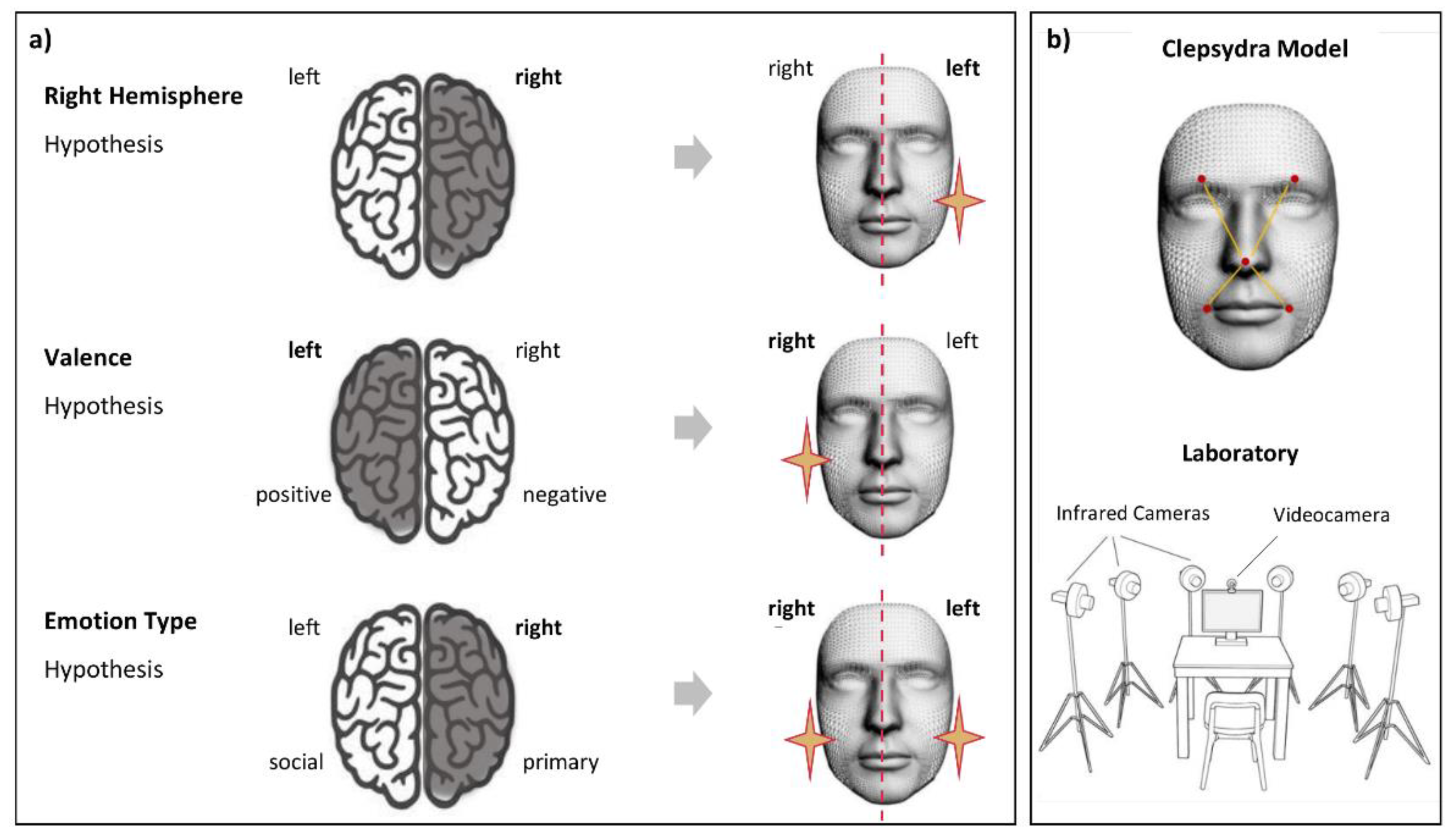
Figure 2.
Experimental design. Spontaneous conditions for Experiments 1 and 2 are represented in the top panels, and Posed conditions in the bottom panels. In Experiment 1 (left panel), participants viewed video extracts from comedy for Emotional induction (Spontaneous Condition, upper image; source: YouTube) and a static image of happiness (Posed Condition, lower image; source: Pictures of Facial Affect [37]). In Experiment 2 (right panel), participants viewed videos showing happy faces inducing Motor Contagion (Spontaneous Condition, upper image; source: YouTube) and the same static image of happiness adopted in Experiment 1 (Posed Condition, lower image; Pictures of Facial Affect [37]).
Figure 2.
Experimental design. Spontaneous conditions for Experiments 1 and 2 are represented in the top panels, and Posed conditions in the bottom panels. In Experiment 1 (left panel), participants viewed video extracts from comedy for Emotional induction (Spontaneous Condition, upper image; source: YouTube) and a static image of happiness (Posed Condition, lower image; source: Pictures of Facial Affect [37]). In Experiment 2 (right panel), participants viewed videos showing happy faces inducing Motor Contagion (Spontaneous Condition, upper image; source: YouTube) and the same static image of happiness adopted in Experiment 1 (Posed Condition, lower image; Pictures of Facial Affect [37]).
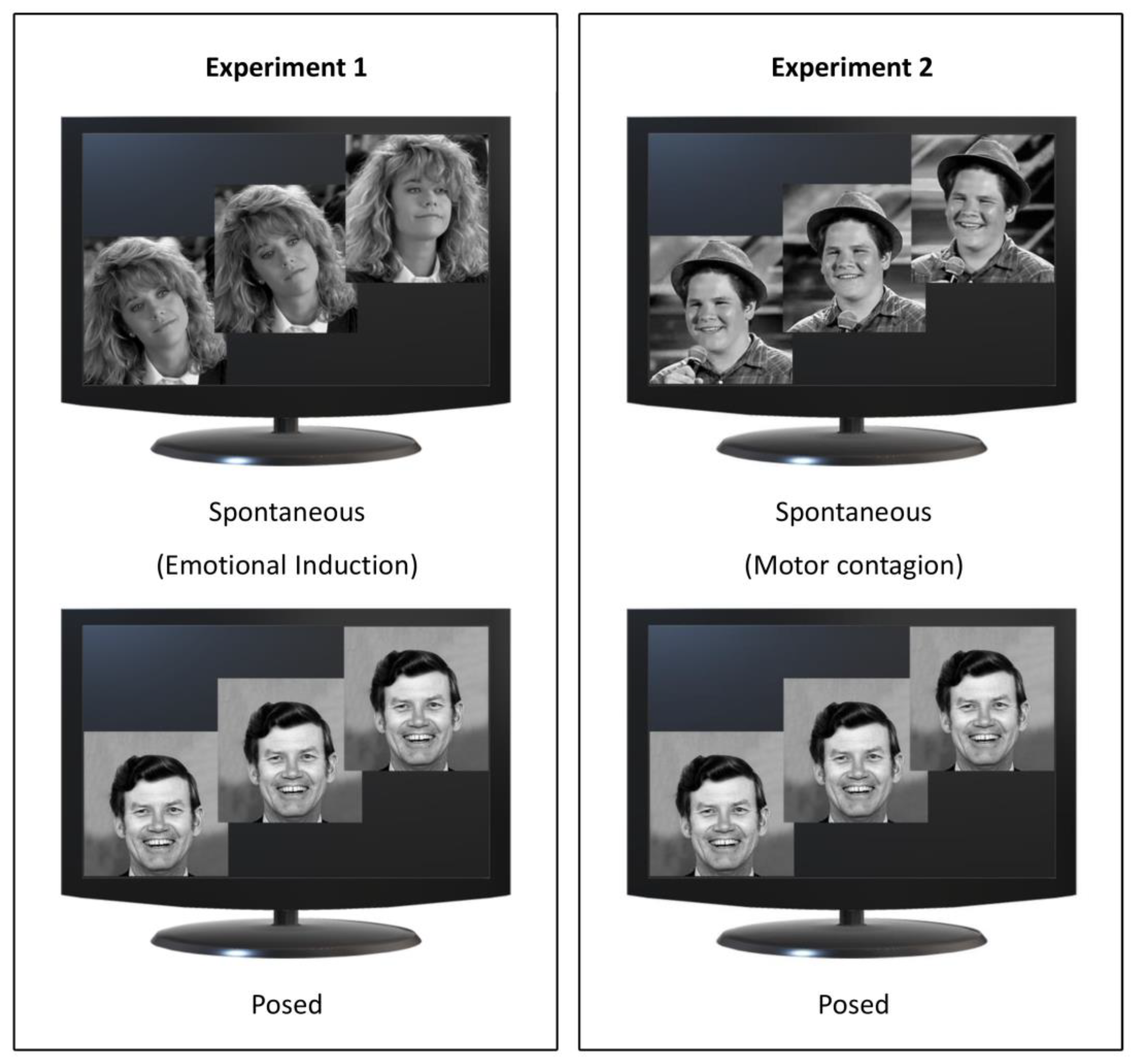
Figure 3.
Graphical representation of temporal components of movement in the lower part (i.e., cheilion markers, CH) of the face during Posed and Spontaneous expressions of happiness. A significant main effect of Side of the face was found for: (a) Time to Maximum Velocity (TMV%) and (b) Time to Maximum Deceleration (TMDec%) in the lower part of the face. Error bars represent standard error. Asterisks indicate statistically significant comparisons (* = p < 0.05; *** = p < 0.001).
Figure 3.
Graphical representation of temporal components of movement in the lower part (i.e., cheilion markers, CH) of the face during Posed and Spontaneous expressions of happiness. A significant main effect of Side of the face was found for: (a) Time to Maximum Velocity (TMV%) and (b) Time to Maximum Deceleration (TMDec%) in the lower part of the face. Error bars represent standard error. Asterisks indicate statistically significant comparisons (* = p < 0.05; *** = p < 0.001).
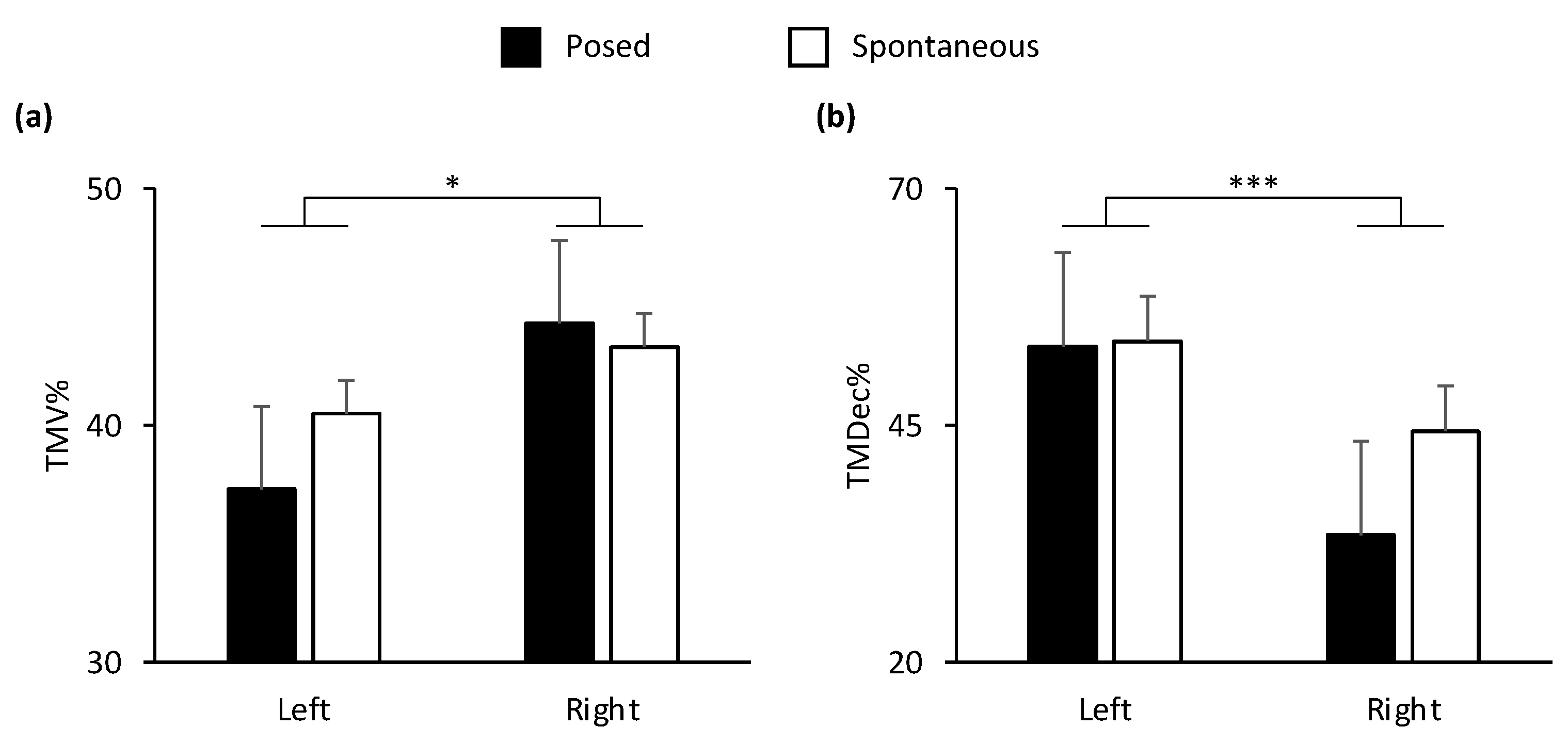
Figure 4.
Graphical representation of spatial and temporal components of movement in the lower part (i.e., cheilion markers, CH) of the face during Posed and Spontaneous expressions of happiness. A main effect of Side of the face (Left vs. Right) was shown for: (b) Time to Maximum Distance (TMD%), (c) Time to Maximum Acceleration (TMA%), and (d) Time to Maximum Deceleration (TMDec%). A statistically significant interaction Condition by Side of the face was found for: (a) Maximum Distance (MD) and (d) Time to Maximum Deceleration (TMDec%). Error bars represent standard error. Asterisks indicate statistically significant comparisons (* = p < 0.05; ** = p < 0.01; *** = p < 0.001).
Figure 4.
Graphical representation of spatial and temporal components of movement in the lower part (i.e., cheilion markers, CH) of the face during Posed and Spontaneous expressions of happiness. A main effect of Side of the face (Left vs. Right) was shown for: (b) Time to Maximum Distance (TMD%), (c) Time to Maximum Acceleration (TMA%), and (d) Time to Maximum Deceleration (TMDec%). A statistically significant interaction Condition by Side of the face was found for: (a) Maximum Distance (MD) and (d) Time to Maximum Deceleration (TMDec%). Error bars represent standard error. Asterisks indicate statistically significant comparisons (* = p < 0.05; ** = p < 0.01; *** = p < 0.001).
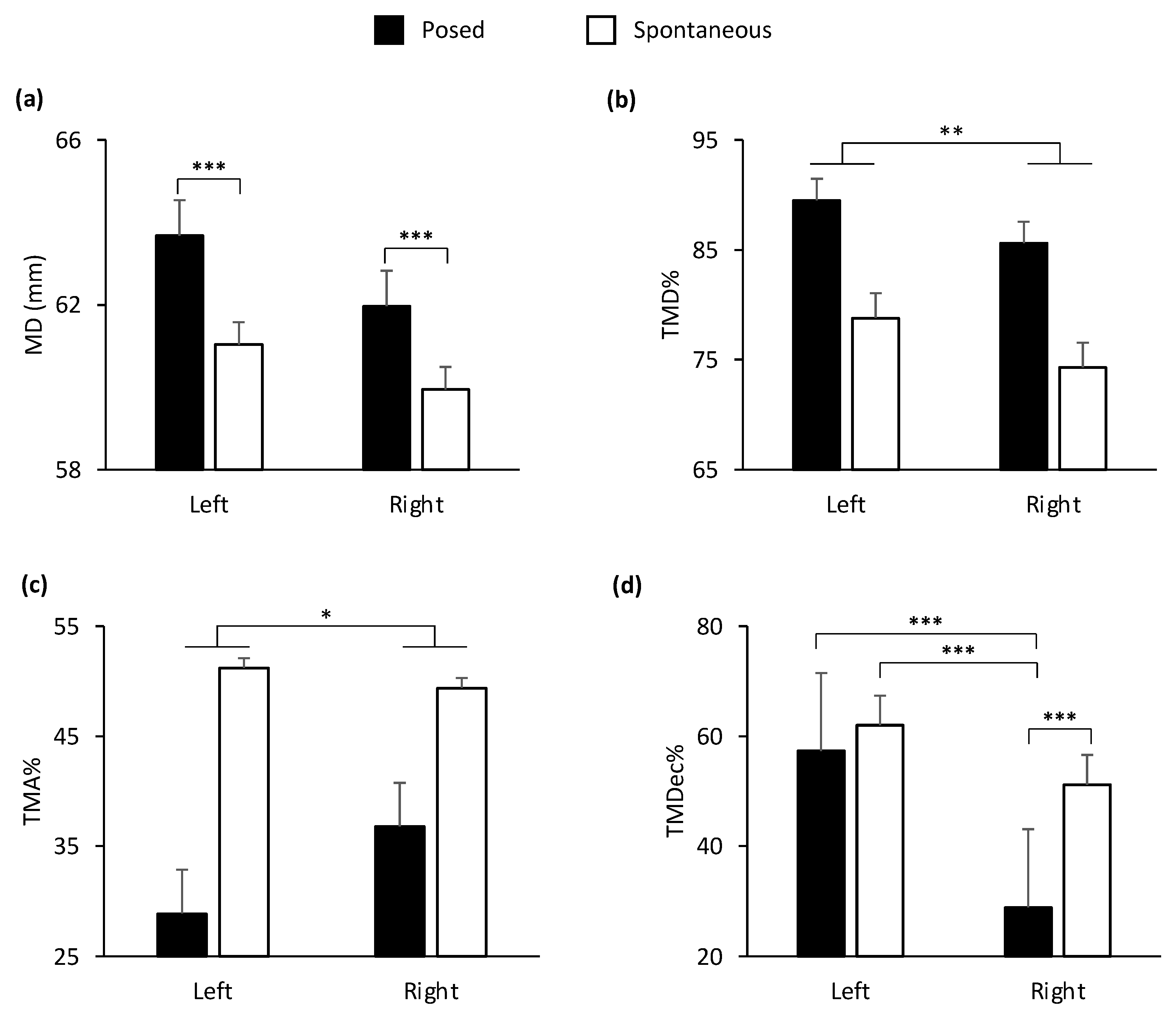
Figure 5.
Graphical representation of spatial and of temporal components of movement in the lower part (i.e., cheilion markers, CH) of the face during Posed and Spontaneous expressions of happiness. A main effect of Side of the face (Left vs. Right) was shown for: (a) Maximum Distance (MD), (b) Time to Maximum Velocity (TMV%), and (c) Time to Maximum Deceleration (TMDec%). A statistically significant interaction Condition by Side of the face was found for: (a) Maximum Distance (MD), and (c) Time to Maximum Deceleration (TMDec%). Error bars represent standard error. Asterisks indicate statistically significant comparisons (* = p < 0.05; ** = p < 0.01; *** = p < 0.001).
Figure 5.
Graphical representation of spatial and of temporal components of movement in the lower part (i.e., cheilion markers, CH) of the face during Posed and Spontaneous expressions of happiness. A main effect of Side of the face (Left vs. Right) was shown for: (a) Maximum Distance (MD), (b) Time to Maximum Velocity (TMV%), and (c) Time to Maximum Deceleration (TMDec%). A statistically significant interaction Condition by Side of the face was found for: (a) Maximum Distance (MD), and (c) Time to Maximum Deceleration (TMDec%). Error bars represent standard error. Asterisks indicate statistically significant comparisons (* = p < 0.05; ** = p < 0.01; *** = p < 0.001).
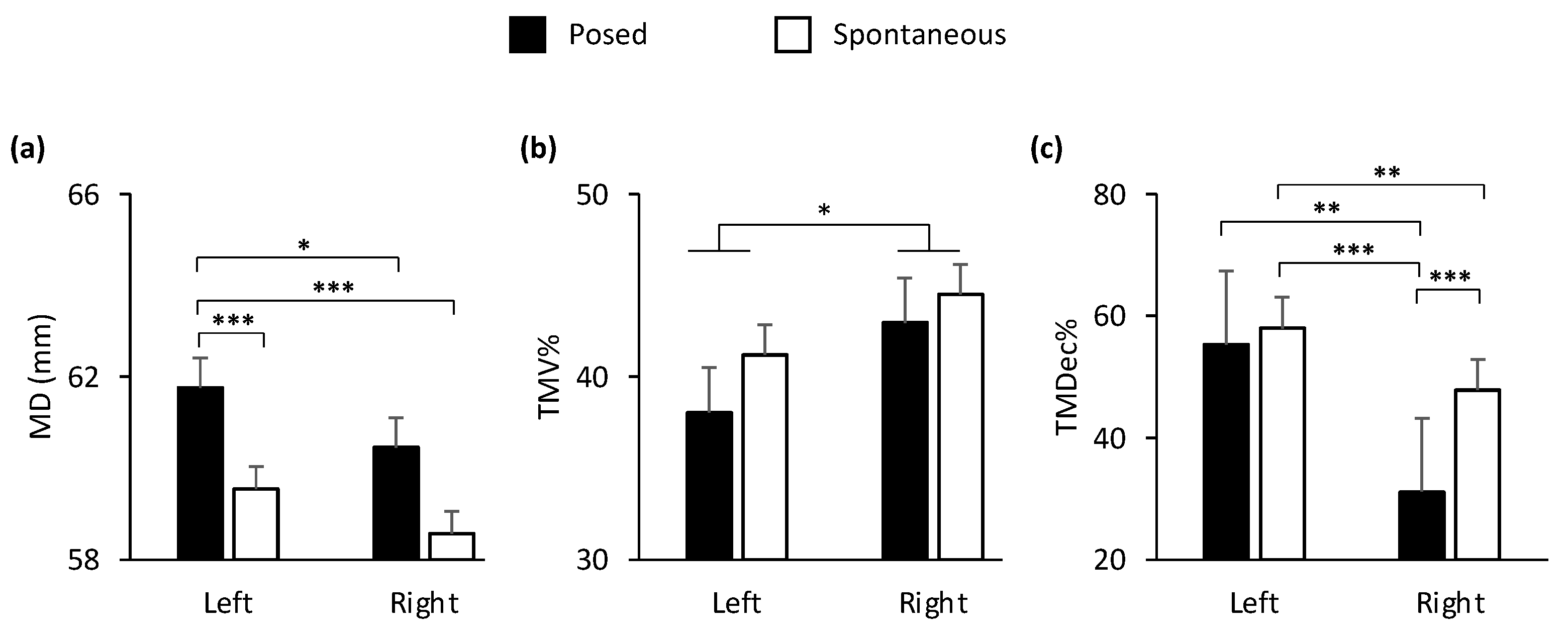

Table 1.
Results of Repeated-measures ANOVA for Experiment 1. Only parameters with at least one significant result were reported.
Table 1.
Results of Repeated-measures ANOVA for Experiment 1. Only parameters with at least one significant result were reported.
| Kinematicparameters | Main effect Condition |
Main effect Side of the face |
Interaction Condition by Side of the face |
|---|---|---|---|
| Cheilions (CH) | |||
| MD |
F(1,16) = 21.440, p < 0.001, VS-MPR = 161.690, η2p = 0.573 |
F(1,16) = 3.007, p = 0.102, VS-MPR = 1.579, η2p = 0.158 |
F(1,16) = 0.014, p = 0.908, VS-MPR = 1.000, η2p < 0.001 |
| DD |
F(1,16) = 8.221, p = 0.011, VS-MPR = 7.325, η2p = 0.339 |
F(1,16) = 1.882, p = 0.189, VS-MPR = 1.168, η2p = 0.105 |
F(1,16) = 1.23, p = 0.305, VS-MPR = 1.016, η2p = 0.066 |
| MV |
F(1,16) = 10.595, p = 0.005, VS-MPR = 13.958, η2p = 0.398 |
F(1,16) = 0.636, p = 0.437, VS-MPR = 1.000, η2p = 0.038 |
F(1,16) = 0.539, p = 0.473, VS-MPR = 1.000, η2p = 0.033 |
| MA |
F(1,13) = 8.523, p = 0.012, VS-MPR = 6.952, η2p = 0.396 |
F(1,13) = 0.365, p = 0.556, VS-MPR = 1.000, η2p = 0.027 |
F(1,13) = 0.029, p = 0.868, VS-MPR = 1.000, η2p = 0.002 |
| MDec |
F(1,13) = 6.491, p = 0.024, VS-MPR = 4.073, η2p = 0.333 |
F(1,13) = 0.766, p = 0.397, VS-MPR = 1.000, η2p = 0.056 |
F(1,13) = 0.192, p = 0.668, VS-MPR = 1.000, η2p = 0.015 |
| TMD% |
F(1,16) = 5.670, p = 0.030, VS-MPR = 3.495, η2p = 0.262 |
F(1,16) = 0.026, p = 0.873, VS-MPR = 1.000, η2p = 0.002 |
F(1,16) = 1.142, p = 0.301, VS-MPR = 1.018, η2p = 0.067 |
| TMV% |
F(1,16) = 0.120, p = 0.733, VS-MPR = 1.000, η2p = 0.007 |
F(1,16) = 4.616, p = 0.047, VS-MPR = 2.548, η2p = 0.224 |
F(1,16) = 0.530, p = 0.477, VS-MPR = 1.000, η2p = 0.032 |
| TMA% |
F(1,14) = 5.670, p = 0.030, VS-MPR = 3.495, η2p = 0.262 |
F(1,14) = 0.709, p = 0.414, VS-MPR = 1.000, η2p = 0.048 |
F(1,14) = 0.562, p = 0.466, VS-MPR = 1.000, η2p = 0.039 |
| TMDec% |
F(1,14) = 1.168, p = 0.298, VS-MPR = 1.020, η2p = 0.077 |
F(1,14) = 24.37, p < 0.001, VS-MPR = 188.689, η2p = 0.632 |
F(1,14) = 2.795, p = 0.117, VS-MPR = 1.467, η2p = 0.166 |
| Eyebrows (EB) | |||
| MD |
F(1,16) = 12.298, p = 0.003, VS-MPR = 21.580, η2p = 0.435 |
F(1,16) = 0.518, p = 0.482, VS-MPR = 1.000, η2p = 0.031 |
F(1,16) = 1.411, p = 0.252, VS-MPR = 1.059, η2p = 0.081 |
| TMV% |
F(1,14) = 10.083, p = 0.007, VS-MPR = 10.912, η2p = 0.419 |
F(1,14) = 0.287, p = 0.601, VS-MPR = 1.000, η2p = 0.020 |
F(1,14) = 0.413, p = 0.531, VS-MPR = 1.000, η2p = 0.029 |
Table 2.
Results of Repeated-measures ANOVA for Experiment 2. Only parameters with at least one significant result were reported.
Table 2.
Results of Repeated-measures ANOVA for Experiment 2. Only parameters with at least one significant result were reported.
| Kinematic parameters |
Main effect Condition |
Main effect Side of the face |
Interaction Condition by Side of the face |
|---|---|---|---|
| Cheilions (CH) | |||
| MD |
F(1,19) = 29.400, p < 0.001, VS-MPR = 1135.133, η2p = 0.607 |
F(1,19) = 5.681, p = 0.028, VS-MPR = 3.700, η2p = 0.230 |
F(1,19) =6.452, p = 0.020, VS-MPR = 4.706, η2p = 0.253 |
| DD |
F(1,19) = 21.393, p < 0.001, VS-MPR = 231.784, η2p = 0.530 |
F(1,19) = 0.187, p = 0.670, VS-MPR = 1.000, η2p = 0.010 |
F(1,19) = 0.080, p = 0.780, VS-MPR = 1.000, η2p = 0.004 |
| MV |
F(1,19) = 29.728, p < 0.001, VS-MPR = 1205.041, η2p = 0.610 |
F(1,19) = 3.451, p = 0.079, VS-MPR = 1.837, η2p = 0.154 |
F(1,19) = 0.165, p = 0.689, VS-MPR = 1.000, η2p = 0.009 |
| MA |
F(1,19) = 17.149, p < 0.001, VS-MPR = 88.406, η2p = 0.474 |
F(1,19) = 0.102, p = 0.753, VS-MPR = 1.000, η2p = 0.005 |
F(1,19) = 0.273, p = 0.608, VS-MPR = 1.000, η2p = 0.014 |
| MDec |
F(1,19) = 18.450, p < 0.001, VS-MPR = 120.051, η2p = 0.493 |
F(1,19) = 0.473, p = 0.500, VS-MPR = 1.000, η2p = 0.024 |
F(1,19) = 0.895, p = 0.356, VS-MPR = 1.001, η2p = 0.045 |
| TMD% |
F(1,19) = 26.586, p < 0.001, VS-MPR = 669.279, η2p = 0.583 |
F(1,19) = 9.818, p = 0.005, VS-MPR = 12.910, η2p = 0.341 |
F(1,19) = 0.036, p = 0.851, VS-MPR = 1.000, η2p = 0.002 |
| TMA% |
F(1,19) = 17.956, p < 0.001, VS-MPR = 106.987, η2p = 0.486 |
F(1,19) = 5.300, p = 0.033, VS-MPR = 3.282, η2p = 0.218 |
F(1,19) = 4.089, p = 0.057, VS-MPR = 2.241, η2p = 0.177 |
| TMDec% |
F(1,19) = 10.120, p = 0.005, VS-MPR = 14.076, η2p = 0.348 |
F(1,19) = 46.466, p < 0.001, VS-MPR = 16685.144, η2p = 0.710 |
F(1,19) = 9.707, p = 0.006, VS-MPR = 12.502, η2p = 0.338 |
Table 3.
Results of Mixed ANOVA (comparison analysis). Only parameters with at least one significant result were reported.
Table 3.
Results of Mixed ANOVA (comparison analysis). Only parameters with at least one significant result were reported.
| Kinematic parameters |
Main effect Condition |
Main effect Side of the face |
2-way interaction between Condition and Side of the face |
|---|---|---|---|
| Cheilions (CH) | |||
| MD |
F(1,35) = 49.138, p < 0.001, VS-MPR = 579497.156, η2p = 0.584 |
F(1,35) = 8.314, p = 0.007, VS-MPR = 10.987, η2p = 0.192 |
F(1,35) = 4.106, p = 0.05, VS-MPR = 2.443, η2p = 0.105 |
| DD |
F(1,35) = 27.775, p < 0.001, VS-MPR = 4382.16, η2p = 0.442 |
F(1,35) = 1.380., p = 0.248, VS-MPR = 1.064, η2p = 0.038 |
F(1,35) = 0.487, p = 0.490, VS-MPR = 1.000, η2p = 0.014 |
| MV |
F(1,35) = 36.953, p < 0.001, VS-MPR = 42283.314, η2p = 0.514 |
F(1,35) = 3.246, p = 0.080, VS-MPR = 1.817, η2p = 0.085 |
F(1,35) = 0.167, p = 0.685, VS-MPR = 1.000, η2p = 0.005 |
| MA |
F(1,32) = 23.699, p < 0.001, VS-MPR = 1208.896, η2p = 0.425 |
F(1,32) = 0.498, p = 0.485, VS-MPR = 1.000, η2p = 0.015 |
F(1,32) = 0.031, p = 0.861, VS-MPR = 1.000, η2p < 0.001 |
| MDec |
F(1,32) = 22.148, p < 0.001, VS-MPR = 791.644, η2p = 0.409 |
F(1,32) =0.038, p = 0.847, VS-MPR = 1.000, η2p = 0.001 |
F(1,32) = 0.898, p = 0.350, VS-MPR = 1.001, η2p = 0.027 |
| TMD% |
F(1,35) = 27.941, p < 0.001, VS-MPR = 4576.896, η2p = 0.444 |
F(1,35) =3.258, p = 0.080, VS-MPR = 1.825, η2p = 0.085 |
F(1,35) = 1.128, p = 0.296, VS-MPR = 1.021, η2p = 0.031 |
| TMV% | F(1,35) =1.136, p = 0.294, VS-MPR = 1.022, η2p = 0.031 |
F(1,35) = 6.551, p = 0.015, VS-MPR = 5.851, η2p = 0.158 |
F(1,35) =0.200, p = 0.657, VS-MPR = 1.000, η2p = 0.006 |
| TMA% |
F(1,33) = 20.198, p < 0.001, VS-MPR = 481.057, η2p = 0.380 |
F(1,33) = 3.389, p = 0.075, VS-MPR = 1.900, η2p = 0.093 |
F(1,33) = 3.683, p = 0.064, VS-MPR = 2.098, η2p = 0.100 |
| TMDec |
F(1,33) = 8.160, p = 0.007, VS-MPR = 10.181, η2p = 0.198 |
F(1,33) = 66.159, p < 0.001, VS-MPR > 100000, η2p = 0.667 |
F(1,33) = 10.947, p = 0.002, VS-MPR = 26.596, η2p = 0.249 |
| Eyebrows (EB) | |||
| MD |
F(1,35) = 6.535, p = 0.015, VS-MPR = 5.818, η2p = 0.157 |
F(1,35) < 0.01, p = 0.986, VS-MPR = 1.000, η2p < 0.001 |
F(1,35) = 2.596, p = 0.116, VS-MPR = 1.471, η2p = 0.069 |
Disclaimer/Publisher’s Note: The statements, opinions and data contained in all publications are solely those of the individual author(s) and contributor(s) and not of MDPI and/or the editor(s). MDPI and/or the editor(s) disclaim responsibility for any injury to people or property resulting from any ideas, methods, instructions or products referred to in the content. |
© 2023 by the authors. Licensee MDPI, Basel, Switzerland. This article is an open access article distributed under the terms and conditions of the Creative Commons Attribution (CC BY) license (http://creativecommons.org/licenses/by/4.0/).
Copyright: This open access article is published under a Creative Commons CC BY 4.0 license, which permit the free download, distribution, and reuse, provided that the author and preprint are cited in any reuse.


