

Submitted:
17 July 2023
Posted:
18 July 2023
You are already at the latest version
Abstract
The emergence of Digital Twin (DT) technology is creating unique opportunities for human so-ciety in terms of real-time data transfer from the physical environment to its digital replica. DT technology has two-way interaction capabilities that enable data exchange between physical and virtual environments, creating bidirectional data flows. Progress has been made in different in-dustry sectors, but the Architecture, Engineering, Construction, and Operation (AECO) sector still requires further development. Recent studies have shown the potential for DT-based platform implementation in the lifecycle management of buildings and infrastructure. This paper examines the development and implementation of DT technology in the construction sector, identifying key definitions, enablers and use cases, while comparing its use with other industries and evaluating benefits and future potential.
Keywords:
Digital Twin
; Virtual Model
; Building Information Modelling
; Geographical Information System
; Artificial Intelligence
1. Introduction
The impact of the built environment, which includes infrastructure, buildings, and urban spaces, on our daily lives cannot be overstated. It is responsible for nearly 40% of global energy consumption and carbon dioxide emissions, making it a crucial area for sustainability efforts (UN Environment, 2018) [1]. In order to make necessary improvements in sustainability, efficiency, and occupant comfort, building owners, facility managers, and city planners require precise and comprehensive information about the performance of the built environment. To obtain this information, Digital Twin technology can be utilized in order to create a virtual replica of a physical system allowing for real-time monitoring, analysis, and optimization.
The continuous evolution of technology has played a vital role in providing quick access to vast amounts of information, bringing about considerable advancements in several fields, particularly digital technology. [2] With the increasing development of virtual modeling and data collection technology [3], the Digital Twin (DT) concept has become increasingly feasible as it involves the creation of a digital model of the physical environment that adapts to real-time changes and provides optimal outcomes quickly [4].
Digital twin (DT) platforms have the capability to improve and advance themselves by utilizing data gathered from installed sensors that update and simulate information from the environment [5]. In the first phase, virtual models of the physical environment are used to create DT platforms, and the gathered physical data is integrated to establish a unified connection with the physical environment, enabling real-time monitoring [4]. Therefore, DT platforms manage and supervise the physical conditions of the environment through their corresponding DT.
In addition, DT platforms offer features that can increase efficiency, prolong lifespan, and lower operational expenses of the targeted physical environment through proactive and predictive monitoring and maintenance tools [5]. Furthermore, the latest mapping technologies utilizing data gathered from the physical environment and remote sensing from Earth Observation (EO) satellites are integrated into the built environment tools within DT platforms [6]. While still in their early phases, DT platforms have already demonstrated numerous capabilities in various scientific domains.
A review of published articles on DT platforms has revealed a significant gap in the implementation of DT platforms in the construction sector. Although DT platform applications have been explored in multiple sectors, including construction, the industry has not fully adopted the DT paradigm. This can be attributed to the various stakeholders involved. The goal of this article is to conduct a thematic analysis to provide an up-to-date review of DT platform applications. It will examine the extent of DT implementation in the AECO sector, define the principal concepts and significant enablers, and identify recommendations from other industrial sectors.
2. Key definitions
The concept of "twinning" was initially introduced in the aerospace industry during the NASA Apollo project of 1960 [7]. The project required the spacecraft to communicate with its Earth-bound twin, as if it were on a space mission [8]. Later, Dr. Michael Grieves coined the term "digital twin" related to Product Lifecycle Management (PLM) [9].
PLM is an all-encompassing strategy for managing every aspect of a product, and it entails the use of several tools, technologies, and procedures to streamline product development and management [10]. In this context, Kritzinger et al. [11] describe DT as a digital information system that can be employed to simulate and optimize various stages of a product's lifecycle. The various definitions and applications of DT have characterized this idea as a digital model connected to a physical entity using smart devices and a stable real-time communication network.
Different authors have provided diverse definitions to explain the meaning and objectives of DT technologies. Dr. Michael Grieves defined DT as an information model that reflects the product lifecycle management [12]. Similarly, other authors have also given their own descriptions of DT. For instance, Rosen et al. [13] defined DT as a combination of physical and virtual spaces that can mirror each other to evaluate physical life cycle operations. Bushert and Rosen [7] asserted that DT includes all valid physical and functional data of a system, with their definition focusing on data exchange and algorithms controlling physical behavior and virtual models. However, this definition only concentrates on DT data and disregards its components and purpose. Grieves and Vickers [14], on the other hand, presented DT as a set of virtual information structures in product life cycle management, with the ability to represent data linked to a possible or actual physical product.
Regarding the engineering design of the physical environment, the objective of DT is to achieve the final product quality with digital design while reducing the gaps between design and implementation [14].
According to Lui et al. [15], a digital twin is a model of a system that dynamically adapts to changes in the physical environment by using collected data and information to predict future changes. A DT utilizes a range of technologies, tools, and internet systems to gather real-time data from the physical environment, which is then used for simulation and virtual modeling. As explained by Madani et al. [16], a DT serves as a virtual representation of the performance, maintenance, and health of a physical environment, continuously updated throughout the system's life cycle. Lui et al. [15] further suggested that a DT can operate over time to enhance its performance by utilizing the information received from the physical environment.
The emergence of digital twin (DT) platforms has opened up new avenues for more precise and accessible functions and services in various fields [17]. The domain of DT platforms can be defined by the interaction principles between the physical and virtual worlds that enable data analysis and system monitoring [4]. This interaction between the physical environment and virtual modeling is greatly facilitated by communication platforms that are enhanced using real-time data and dataset updates. In this context, the Internet of Things (IoT) can be mentioned as a highly dependable communication system that operates on sensors, cloud computing, and data analysis. Therefore, the continuous flow of data and information transferred between the physical and virtual environments is a crucial element of DTs, enabling the platform environment's life cycle [18].
The DT platform is capable of predicting the future of the physical environment by continuously adjusting to operational changes through online data collection and information. Therefore, the DT platform consists of integrating systems from data sources and datasets, supported or formed by embedded sensors, wireless sensor networks, and digitized life cycle systems, and integration with cloud services and data providers [19].
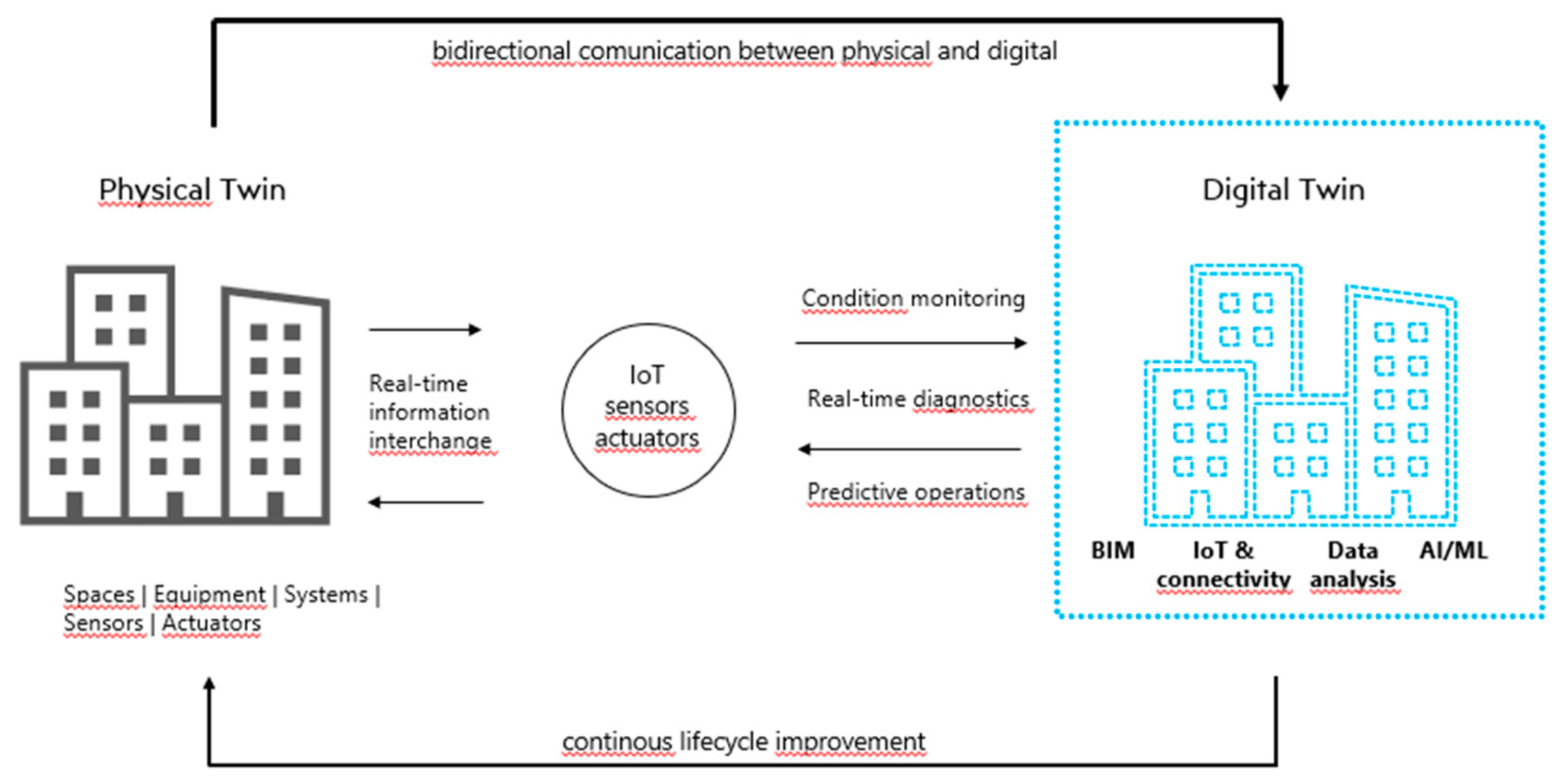
Advancements in sensor design and fabrication make it easy to synchronize the DT platform with collecting information from the physical environment. These sensors immediately receive information and enable the virtual model's continuous ability. Based on this, the DT paradigm can be divided into three parts: a) physical product, b) virtual product, and c) communication infrastructure and data collection systems [20]. As such, the critical aspect of the DT is the connection between physical and virtual product environments, which involves various approaches and sub-components at each stage.
Figure 1.
Main Digital Twin components.
3. Primary components and system architecture
The development and administration of a virtual model for Built Environment Management require the integration of numerous linked elements that form a Digital Twin platform.
The architecture of a typical Digital Twin system for Built Environment Management comprises several key components.
Digital Twin Model: is the core component of the system, consisting of mathematical models that simulate the physical behavior of the real-world system. These models can be based on first principles, empirical data, or a combination of both, and can represent various aspects of the built environment, such as energy consumption, indoor air quality, and occupant behavior [20] which can be updated in real-time based on data collected from various sensors and IoT devices.
Data Acquisition and Integration: is another critical component of the Digital Twin system, responsible for collecting data from sensors, IoT devices, and Building Management Systems (BMS). This data is then processed and integrated into the Digital Twin Model to provide a more accurate representation of the real-world system.
Data Analytics and Machine Learning techniques: are used to analyze the data and extract valuable insights, such as energy consumption patterns, equipment performance, and occupant behavior [21]. This component also includes data pre-processing and filtering algorithms to ensure that the data is accurate and reliable.
The Data Analytics and Machine Learning component processes the data collected by the Data Acquisition and Integration component. This element employs various data analytics and machine learning techniques to extract meaningful insights from data. These insights can be used to optimize the performance of the physical system, predict maintenance requirements, and identify anomalies or faults.
Visualization and User Interface: provide a user-friendly interface for interacting with the Digital Twin system. This component enables users to view and analyze the data collected from the real-world system and make informed decisions regarding optimization and maintenance. The interface can be in the form of a web application, dashboard, or augmented reality (AR) visualization [22].
Communication and Interoperability: enable the Digital Twin system to communicate with external systems and platforms, such as BIM (Building Information Modeling) software, GIS (Geographic Information System), and energy management systems. This component facilitates data exchange and interoperability, allowing for more comprehensive and accurate analysis and optimization [21].
A representation of the Digital Twin framework for building asset portfolio is proposed and displayed in Figure 2 which demonstrates main components and data aggregation from multiple sources.
4. Digital Twin in the AECO industry
In the early stages, the development of digital platforms is focused on the construction and urban industry. Researchers have highlighted the benefits of implementing DT technology, which includes monitoring facility performance and operation, as well as cost analysis and reliable scenarios for maintenance. Although significant investment is required for launching and developing digital platforms, it can provide a long-term return on investment [16].
Digital platforms offer several benefits, such as effective data management, anomaly detection in maintenance and control stages, and management of different departments. Parrott et al [23] reported that digital platforms increase quality, reduce warranty, service, and operational costs, introduce new digital products, and create opportunities for capital growth.
The practical advantages of digital platforms in the construction and urban development sector include real-time monitoring of construction progress, updated use of maps and models, appropriate planning for resource support, monitoring safety departments and structure quality, equipment optimization monitoring, supervision, management, and operation of facilities, improved decision-making, and sustainable development of buildings and cities [24].
The construction industry has not fully utilized the advantages of digital platforms yet, but there is hope that it will soon take full advantage of the potential of DT by implementing it as much as possible in the construction industry. Additionally, the growing trend of intelligent building construction and big data can significantly impact the mandatory growth of DT platforms in this industry. Digital platforms have made many advances in other industries, which can show significant benefits. However, compared to other industries, the growth of digital platforms in the construction sector has not been very impressive due to different factors [25].
To advance the development of digital platforms as much as possible, it is crucial to collect and use massive data received by various sources. However, another limiting factor that can affect the construction sector is the lack of trust due to the fear of losing jobs and reducing work. Using online platforms can be one solution to this issue. The slow growth and development of digital platforms in the construction industry can also be attributed to the nature of the industry, where each project differs from another. The use of different standards in the development of digital platforms can effectively help the growth and development of DT technologies. Therefore, increasing the development of standardization in this sector can significantly help producing valuable digital products.
However, it should be noted that this standardization should be applied to various projects. According to a study by Siemens, another limitation of adopting digital platforms in the construction industry is the lack of defined budgets for developing these platforms in "digital" planning and simulation to reduce costs in the long term [26].
According to several studies conducted in the United States, 89% of IoT platforms will contain some form of digital twin capacity by 2025 [27].
As a result of the COVID-19 pandemic, 31% of companies are using digital twin systems to improve employee safety, such as using remote asset monitoring systems to reduce the need for in-person monitoring [28].
According to a report by Markets and Markets [29], the global value of the digital twin market was estimated at $3.1 billion in 2020 and is expected to reach $48 billion by 2026.
Below are the key elements of a DT with reference to build assets and the product lifecycle management (PLM) in design, construction, delivery, operation, maintenance, renewal, and end-of-life stages.
Virtual representation: refers to a digital copy of the construction objects and processes that are being considered (as outlined in ISO 23387). This digital representation comprises a series of interconnected digital assets, including but not limited to building information models (BIM), computer-aided design (CAD) models, images, videos, point clouds, documents, and spreadsheets. These assets serve to capture the as-built construction objects. Additionally, virtual representation is supported by data that pertains to the construction objects and processes. This data includes information about products, systems, materials, elements, entities, processes, work performances, and more. All of this data works together to provide comprehensive and cohesive information about real-world entities and processes.
The utilization of digital resources and supportive data is crucial for building computational models that precisely depict and link the past, present, and future potential statuses of assets. Virtual representation transforms and progresses from the design stage to end-of-life or decommissioning stage. Redundant data and information are continuously updated, overwritten, or archived as appropriate.
The acquisition of real-time data during the construction and utilization stage of the asset offers valuable insights that can extract additional efficiencies. This data can be employed to enhance the entire comprehension of the asset or to plan out particular scenarios.
Entities and processes in the real world can be categorized into three levels including (I) construction objects such as products, systems, spaces, or components; (II) building or civil engineering assets such as bridges, industrial plants, or buildings; (III) and portfolios of assets such as social housing programs, highway networks, or offshore wind farms.
The physical environment and the production and support processes used in the design, construction, and operation of these entities are also considered. Real-world entities include a hospital room, an excavator, a pump, a building, an office block, a worker, an occupant, a neighbourhood, and a city; real-world processes include work planning or space planning etc.
As DTs are purpose-driven, considering these levels is essential in driving the development of the DT and helping DT developers define the system architecture and technical specifications to ensure that it meets the stakeholders' original requirements. Additionally, thinking about entities and processes at different levels can indicate the scale of the DT application and the timing of its application during the asset's lifecycle, such as during pre-design, design, or operation.
Synchronization is the connection between virtual representation and real-world entities which is critical and sets DTs apart from other digital models as it enables a loop between the virtual and physical worlds for management, forecasting, optimization, and simulations. The definition of synchronization is somewhat flexible and can involve one-way connections with sensors providing data on real-world entity performance or bidirectional connections with control commands to actuators or a system connected to actuators, and/or with human intervention. Matching real-world entities and processes with the virtual representation is essential, and synchronization helps achieve this. It also determines the design, development, distribution, and use of DTs, which need to be regularly updated.
The synchronization mechanism plays an additional role in connecting the DT to other DTs, making them part of a DT ecosystem, and other external data sources such as local weather, environmental, and economic data.
Frequency of physical-virtual synchronization: determines how often the virtual representation is updated to match the current state of connected entities and processes. The update can happen in real-time, daily, or at a predetermined interval, depending on the use case, resources available, real-world entity or process type, and real-time data collection technologies. Regular updates are necessary to prevent the virtual representation from becoming obsolete and limiting the usefulness of the digital twin. Without proper monitoring and maintenance of synchronization frequency, confidence in the DT's ability to meet requirements and provide benefits will decrease.
Fidelity pertains to the precision and accuracy of the virtual representation and the synchronization mechanisms used. It's also an indicator of data governance and information management framework that ensures accurate data collection, tracking, and maintenance for the model.
The level of fidelity varies based on the intended use of the DT. The degree of fidelity is driven by the granularity of the synchronized information. For instance, some applications may only require time-series data on a building's overall energy consumption, while others may need data on specific equipment, systems, and devices on each floor of the same building.
The DT can also be customized to receive various data types from different sources, such as video devices, laser scanners, accelerometers, and displacement sensors. Multi-fidelity is the term used when fidelity varies with the data stream.
Similar to frequency, if the data source is not accurately maintained, trust in the DT is affected. Therefore, project teams usually require a demonstration of the reliability of both the data generation process and the update cycles before adopting a DT. In the built environment industry, frequency and fidelity dictate the level of effort required to maintain the virtual representation up to date.
4.1. Enabling technologies use cases
4.1.1. IoT and lighting systems
Numerous studies have explored methods to reduce energy consumption in lighting technology and its control systems [30]. The incorporation of LED lights has been identified as one such approach, capable of reducing energy consumption by 10-25% [26]. Furthermore, the integration of sensor control technology can reduce lighting energy consumption by over 50%. Jontonen et al. [31] utilized passive infrared (PIR) sensors to intelligently track pedestrian movement and dynamically control lighting devices, resulting in a savings of over 60% compared to traditional street lighting systems. Optical sensors may also be implemented to optimize sensor installation location and adjust brightness, which can potentially reduce energy consumption by 45-61% [32].
A matrix mathematical model was developed by Gao et al. [33] through the use of an RBF (radial basis function) neural network. They further optimized the sensor distribution by utilizing genetic algorithms. Mayol et al. [34] proposed a distributed lighting control system that makes use of sensors to adjust lighting levels efficiently in response to ambient lighting. In addition, Wagiman et al. [35] suggested a new technique for optimizing optical sensors by using particle swarm optimization (PSO) algorithms to minimize light and energy consumption. Sun et al. [36] integrated several technologies such as routers, databases, and servers to create a distributed multi-agent framework for multiple sensors. This integration enhances the ability to interact with the environment and supplement intelligent controls in lighting systems.
4.1.2. Computer vision
The technology of computer vision and the tools used for processing and analyzing images can be seen as an emulation of biological vision, and it includes various subsets, such as object detection, scene reconstruction, 3D pose estimation, video tracking, image recovery, and 3D scene modeling. These technologies are extensively employed in everyday life due to significant advancements in computer vision and smart city construction [37]. As a result, numerous sectors have made great progress in terms of efficiency, safety, and smartness, especially in the realm of remote computer vision. This progress is evident in the areas of facial recognition [38], smart locks [39] and entrance and exit control in office buildings [40].
In addition to its various applications, computer vision can also contribute to energy conservation in buildings. For instance, deep learning techniques have been employed by researchers to detect equipment and heat increase in office buildings [41] and forecast heating energy demand in residential buildings [42]. Moreover, computer vision has a great potential for intelligent lighting systems, as demonstrated in several studies.
Zawadzki et al. [43] suggest the use of a microprocessor controller for image analysis and remote control of light beam direction. Carrillo et al. [44] utilized a digital camera to improve the environment's lighting by adapting it to artificial light, providing a better effect on the buyers while also saving energy. Wu et al. [45] presented a method for adaptive adjustment of light brightness using quasi-real calculation of ambient brightness for high dynamic range (HDR) imaging.
Visual sensors with high dynamic range were investigated by Motamed et al. [46] to monitor lighting systems, while Liu et al. [44] used infrared image processing for intelligent control of library lighting devices. Finally, Shanmugam et al. [47] employed computer vision and integrated deep learning algorithms for video stream processing to investigate warehouse material transfer in their intelligent lighting control. Computer vision has played a crucial role in various aspects, such as ambient light calculation, lighting quality assessment, and intelligent control of lighting systems, resulting in significant energy savings.
4.1.2. Building Information Modelling (BIM)
The process of simulating physical models and updating data in multidisciplinary and multiscale domains can be accomplished through digital platforms [48]. These platforms utilize efficient models to display accurate world information in a virtual space.
In a study conducted by Pan et al. [49], a digital platform framework for advanced project management was built using BIM and IoT. Similarly, Zhao et al. [50] employed IoT and BIM technology to develop DT platforms for designing intelligent storage systems and managing goods safety. Additionally, digital twins have been utilized by researchers to monitor the management of smart urban infrastructures [51].
Digital twins have also proven useful in the field of damage detection in smart city infrastructures [52]. By identifying damages to the built environment, digital twins enable risk-based decisions and reduce environmental stress using smart management approaches [53,54]. The relationship between BIM and digital twin technology is closely intertwined, as BIM can provide technical support for digital platforms. Several researchers have explored the concept of BIM technology in digital platforms and presented case studies [54]. Combining BIM models and IoT has also been beneficial [55], as the models provided by BIM technology utilize different sensors for dynamic collection and integration of data and operations within the BIM environment [56].
BIM models contain real-time building information, enabling the ability to make quick decisions and respond to emergencies. Srini-vasan et al. [57] used BIM models to examine the combination of 3D heat transfer analysis results. Additionally, BIM models are utilized for other applications such as monitoring construction facilities [58], emergency evacuation of buildings [59], and developing prefabricated buildings [60].
4.1.3. Systems and data integration
Effective collaboration among stakeholders is crucial for the success of construction projects as it enables the use of new and updated data. Inaccurate or outdated information can hinder building maintenance and operation efforts, and thus timely and accurate data is imperative. Facility management (FM) provides a fitting example of the benefits of using building maintenance systems data, which can save up to 80% of efficient time compared to paper reports or Excel spreadsheets [61]. In contrast, traditional transmission methods can lead to lengthy maintenance services and processes [62].
In facility management, digital twin technology has garnered significant attention due to its potential to enhance asset performance, operational efficiency, and reduce maintenance costs. Numerous scientific research studies have supported the benefits of digital twin implementation in facility management, including:
Predictive maintenance: Digital twin technology enables facility managers to predict equipment failure, resulting in proactive maintenance scheduling. Digital twin technology can reduce maintenance costs by up to 40% by predicting maintenance needs and preventing unexpected equipment downtime.
Improved energy efficiency: Digital twins can monitor and optimize energy consumption in buildings, which can lead to a 20-30% reduction in energy usage and cost savings, as well as reduced carbon emissions, according to a study [63].
Enhanced occupant comfort: Digital twin technology can help facility managers improve occupant comfort by monitoring and adjusting environmental conditions such as temperature, lighting, and air quality. A study by [64] found that the use of digital twins in HVAC systems can improve thermal comfort by up to 20%.
Improved asset management: Digital twin technology can provide facility managers with real-time information on the status and performance of building assets, resulting in increased productivity, reduced costs, and improved asset utilization, according to a study by Azari et al. (2020) [65].
In building maintenance operations, BIM models can serve as a source and repository of information alongside other services. Due to their compatibility with various technologies and support for all stakeholders' activities, BIM models can offer robust solutions in a short amount of time during the building's lifespan [66].
4.1.4. GIS and BIM integration
The management of cities and districts is highly dependent on the use of GIS software layers [69]. BIM models can provide valuable data and layers that are essential for infrastructure design and construction processes. The integration of GIS software and BIM models is a fundamental requirement for software function integration, including coordinate systems, semantic standards, data formats, and other parameters.
To enhance the performance of models, several researchers have focused on maximizing their integration. Integrating GIS software and BIM models can save time and allow for more precise monitoring of construction and post-construction processes [70,71]. Numerous studies have demonstrated the successful utilization of GIS software and BIM model integration for developing and visualizing a range of functions [72].
The availability of updated information models is essential to retrieve information and obtain a comprehensive view of different stages of urban construction. Such information can assist urban planners in estimating and analyzing urban sustainability more scientifically and accurately. The support of GIS and BIM technologies is crucial in this regard, and their practical development is necessary to understand, recognize, develop, and improve urban laws on a large scale. The development of these technologies and integration of GIS and BIM have provided a more scientific and practical approach to urban planning [73]. Prior studies have shown how to extract information from BIM and 3D urban models to urban information models [74]
GIS and BIM have played a vital role in the proper management of urban information. The creation of the City Information Models (CIM) cadastre database is crucial for the development and expansion of urban information[74,75]. Integrating GIS and BIM technologies with urban cadastre management can help increase and expand the standardization of the BIM modeling process and unify the information data formats used to facilitate it [76,77].
A Digital Twin system architecture proposed by the authors aimed at combining BIM and GIS data with asset static and operational data for building management is shown in Figure 3.
The integration of GIS software and BIM model technology can benefit buildings in various fields, such as reducing energy consumption, optimizing the construction site, and improving architectural designs [78]. Research on using the integration of GIS software and BIM model technology is ongoing and can be applied in many sectors, such as water and hydropower protection projects [79,80], tunnels [81], and bridges [82]. With such broad applications, the integration of GIS software technologies and BIM models can be used as a digital twin tool to achieve digital transformation in large-scale projects (Table 1).
5. Digital Twins and Smart Cities
Advanced technologies are utilized for efficient and timely analysis and integration of crucial information systems in urban areas [90] to facilitate data-driven decision-making in various domains like environmental management, public safety, and city services [91]. Digital platforms have many potential applications in urban planning for immediate, medium-term and long-term improvement of people's quality of life. One such application is the use of a digital twin (DT) platform for water supply management in Carson, Nevada, that can increase water efficiency and prevent wastage [92].
Virtual Singapore is another notable project in this field that integrates 3D maps and urban models on one platform, providing detailed information on building materials, texture, and facility components. This platform is instrumental in enhancing decision-making in managing resources and responding to emergencies, enabling citizens, businesses, and research communities to test new ideas [93].
The city of Amaravati in India is another significant project in this area. A DT platform is being developed at a cost of 6.5 billion dollars, covering various facilities, such as metro networks, main roads, hospitals, schools, universities, and buildings [94,95]. Similarly, the Australian government has launched a project to create a DT platform near Melbourne that visualizes real-time data on public transport, building sectors, traffic analysis, and forecasting electricity and water consumption [96].
Moreover, digital platforms can be utilized for emergency response management during disasters [54,97]. For example, G. White et al. [98] state that river level data can be used to predict flooding, and warning citizens about possible flooding can help minimize the damages. Historical data of floods in smart cities can be used to prevent future floods in the long term. The extensive use of DT platforms can change people's perspectives on cities and living spaces, providing ample opportunities for urban designers, architects, engineers, builders, property owners, and citizens to analyze the city in various scenarios [99]. Thus, with the participation of all stakeholders, cities can become more democratic [100] (Table 2).
6. Other Industries DT Applications
The continuous progress of technology has paved the way for the integration of DT platforms in various industrial and commercial sectors. These platforms can offer numerous benefits to society, particularly in industrial settings. For instance, DT platforms can create a virtual replica of the actual industrial environment in real-time, allowing for better and more precise monitoring of the final products [111]. To further understand the viability of DT platforms in different industries and showcase their accomplishments, several industrial sectors with significant growth in DT platform development and design have been analyzed. This comparison can aid in assessing the potential application of DT platforms in different industries.
6.1. Aerospace
In the US Air Force Research Laboratory, the aerospace industry is utilizing digital platforms to create a precise flight model. This virtual model's data is combined with the data from the physical models to produce highly accurate predictions [112]. Tuegel et al. [116] suggest that using digital platforms can be helpful in predicting the structural life reengineering process of an aircraft. One of the top design systems and components manufacturers for aerospace and defense organizations, Test-Fuchs, has successfully implemented a dedicated digital twin approach for test equipment [113].
Seshadri and Krishnamurthy [114] propose using digital twin platforms for damage detection in aircraft structural health management. Another application of digital twin platforms in aerospace is the Airframe Digital Twin (ADT), which can assess and update the latest damage status and flight status in real-time [115]. Digital twin platforms are currently used in various stages of product services and maintenance in aviation and astronautics (Table 3).
6.2. Industry and Manufacturing
The automotive industry, which produces cars in various models and designs, requires advanced capabilities to ensure the quality of final products. In recent years, there has been significant growth in car design technology, with more cars moving towards automatic control systems. Lane monitoring systems, hands-free driving, and alarm sensors that detect objects in close proximity are some examples of automatic systems used in designing new cars [125].
DT digital platforms can play a critical role in the success of self-driving cars in the near future. The first step is to design a digital version of the car, which is then analyzed using data obtained from actual test drives in simulation models to determine how the car will perform before designing. The simulation uses data such as aerodynamic data, engine specifications, body design, and materials to be used. The use of digital technology in this process can help the automobile industry grow even further.
With the progress of the Internet of Things, cloud computing, and artificial intelligence, more manufacturing industries are expected to benefit from intelligent technologies for their production processes [126]. Roy et al. [127] have reviewed the evolution of the manufacturing industry from Industry 1.0 to Industry 4.0 after the industrial revolution, examining the different stages and discussing their integration. Digital platforms with real-time data management enable intelligent production in industries, leading to more opportunities for automated data collection and optimization.
DT platforms can improve supply chain efficiency, optimize energy consumption, and improve product assembly steps. They can also be used for monitoring and control in production stages and have other advantages, such as multi-objective optimization and machine simulation and monitoring [127] (Table 4).
6.3. Energy
In the present era, there is a noticeable rise in the number of newly constructed energy farms being established and operated to diminish air pollution and combat global warming.
The integration of DT technology in the energy sector has multiple advantages, which include enhanced efficiency, decreased expenses, and improved safety measures. One of the significant benefits of DT is its capability to simulate real-life situations, enabling energy firms to optimize their activities and minimize the likelihood of costly downtime.
Lu et al. (2020)[137] examined the use of DT technology in the maintenance of power plants. The study found that the deployment of a DT system in a power plant led to a reduction in unexpected downtime, increased safety measures, and improved efficiency. Furthermore, the DT system provided valuable insights into the plant's operation, enabling the maintenance teams to recognize potential issues before they arose.
According to a study conducted by Bortolini et al. (2021) [138], the use of digital technologies (DTs) can optimize energy systems and improve their efficiency, resulting in reduced energy consumption. DTs can monitor and manage renewable energy sources, such as wind turbines and solar panels, improving their performance and reducing maintenance costs.
To meet the growing demand for electricity, clean energy farms, including wind and wave farms, are being installed and operated in offshore areas worldwide [139]. Remote digital platforms that are affected by weather conditions such as wind, waves, water level, or temperature can reduce the operation and maintenance costs of marine turbines and wave converters by up to 25% [139].
In this industry, developing digital platform technology is crucial. These platforms can help facility management improve the performance of built projects by monitoring and controlling their health status in real-time. In order to make necessary improvements in sustainability, efficiency, and occupant comfort, building owners, facility managers, and city planners require precise and comprehensive information about the performance of the built environment. To obtain this information, Digital Twin technology can be utilized, which creates a virtual replica of a physical system and allows for real-time monitoring, analysis, and optimization.
The continuous evolution of technology has played a vital role in providing quick access to vast amounts of information, bringing about considerable advancements in several fields, particularly digital technology [2] With the increasing development of virtual modeling and data collection technology [3,4], the Digital Twin (DT) concept has become increasingly feasible. DT technology involves the creation of a digital model of the physical environment that adapts to real-time changes and provides optimal outcomes quickly [4].
Digital twin (DT) platforms have the capability to improve and advance themselves by utilizing data gathered from installed sensors that update and simulate information from the environment [4]. The digital twin turbine displays all the data needed to determine the physical turbines' performance based on wind power and turbine engine temperature, and sensors connected to the turbines display the data virtually on the platform. An application program for monitoring and estimating the temperature of turbines and wave converters can be developed and used in the next step (Table 5).
8. Conclusions
The purpose of this article is to review recent studies on digital technology in various industries, with a focus on the construction sector. Digital platforms have various applications, including designing, constructing, operating, and maintaining facilities. As the use of digital platforms in construction sectors increases, data collected in real-time can provide essential information to various communities, aiding in monitoring and controlling assets, optimizing processes, and creating economic value. Despite the significant expansion of online platforms in many sectors, including construction, their full potential has not been realized.
By reviewing successful studies, it is possible to update the application of DT platforms in different industries and fields, defining their purpose. The emergence of new smart technologies such as BIM, point cloud segmentation, artificial intelligence, machine learning in data analysis and sensors, and the successful implementation of DT platforms in the construction industry make it more possible. The application of DT platforms in construction can aid in analyzing the feasibility of designs, monitoring progress according to schedules, monitoring building performance, and managing facilities.
The next step is to investigate the impact of digital platforms on the construction industry and develop a DT application to monitor the progress of construction work and the performance of construction activities, as well as manage available resources and facilities. Predictions show that hospitals, ports, airports, hotels, and similar projects are eager to use digital platform technology installed in other places. The successful implementation of DT platforms in the construction industry can address the various issues faced by this industry, optimizing building performance and aiding in decision-making.
Author Contributions
Conceptualization, S.A. and G.P.; methodology, S.A.; validation, S.A, G.P.; formal analysis, S.A. and G.P.; investigation, S.A. and G.P.; resources, S.A.; data curation, S.A.; writing—original draft preparation, S.A.; writing—review and editing, S.A. and G.P.; visualization, S.A.; supervision, G.P.
References
- UN Environment, “Global status report for buildings and construction 2018. Available online: https://www.worldgbc.org/sites/default/files/UNEP%20188_GABC_en%20%28web%29.pdf.
- P. N. Negroponte, Being Digital. New York: Random House Incorporated. New York, NY, 1995.
- Lamagna, M.; Groppi, D.; Nezhad, M.M.; Piras, G. A comprehensive review on digital twins for smart energy management system. Int. J. Energy Prod. Manag. 2021, 6, 323–334. [Google Scholar] [CrossRef]
- Lamagna, M.; Groppi, D.; Nezhad, M.M.; Piras, G. A comprehensive review on digital twins for smart energy management system. Int. J. Energy Prod. Manag. 2021, 6, 323–334. [Google Scholar] [CrossRef]
- Carrasco, C.A.; Lombillo, I.; Sánchez-Espeso, J.M.; Balbás, F.J. Quantitative and Qualitative Analysis on the Integration of Geographic Information Systems and Building Information Modeling for the Generation and Management of 3D Models. Buildings 2022, 12, 1672. [Google Scholar] [CrossRef]
- Liu, W.; Zhang, W.; Dutta, B.; Wu, Z.; Goh, M. Digital Twinning for Productivity Improvement Opportunities with Robotic Process Automation: Case of Greenfield Hospital. Int. J. Mech. Eng. Robot. Res. 2020. [Google Scholar] [CrossRef]
- S. P. A. Datta, “Emergence of Digital Twins,” Oct. 2016.
- Rosen, R.; Boschert, S.; Sohr, A. Next Generation Digital Twin. atp Mag. 2018, 60, 86–96. [Google Scholar] [CrossRef]
- Zhuang, C.; Liu, J.; Xiong, H. Digital twin-based smart production management and control framework for the complex product assembly shop-floor. Int. J. Adv. Manuf. Technol. 2018, 96, 1149–1163. [Google Scholar] [CrossRef]
- Michael Grieves, “Digital Twin: Manufacturing Excellence through Virtual Factory Replication,” 2014.
- Schroeder, G.N.; Steinmetz, C.; Pereira, C.E.; Espindola, D.B. Digital Twin Data Modeling with AutomationML and a Communication Methodology for Data Exchange. IFAC-PapersOnLine 2016, 49, 12–17. [Google Scholar] [CrossRef]
- Kritzinger, W.; Karner, M.; Traar, G.; Henjes, J.; Sihn, W. Digital Twin in manufacturing: A categorical literature review and classification. IFAC-PapersOnLine 2018, 51, 1016–1022. [Google Scholar] [CrossRef]
- Grieves, M.W. Product lifecycle management: the new paradigm for enterprises. Int. J. Prod. Dev. 2005, 2, 71. [Google Scholar] [CrossRef]
- Rosen, R.; von Wichert, G.; Lo, G.; Bettenhausen, K.D. About The Importance of Autonomy and Digital Twins for the Future of Manufacturing. IFAC-PapersOnLine 2015, 48, 567–572. [Google Scholar] [CrossRef]
- S. Flumerfelt, “Transdisciplinary Perspectives on Complex Systems_ New Findings and Approaches,” 2017.
- Liu, Z.; Meyendorf, N.; Mrad, N. The Role of Data Fusion in Predictive Maintenance Using Digital Twin. In Proceedings of the 44th Annual Review of Progress in Quantitative Nondestructive Evaluation, Provo, Utah, USA, 16–21 July 2017; 2018; p. 020023. [Google Scholar] [CrossRef]
- Madni, A.M.; Madni, C.C.; Lucero, S.D. Leveraging Digital Twin Technology in Model-Based Systems Engineering. Systems 2019, 7, 7. [Google Scholar] [CrossRef]
- O. A. N. C. B. and D. B. V. Martinez, “Service business model innovation: the digital twin technology,” Cambridge Serv. Alliance, 2019.
- Abramovici, M.; Göbel, J.C.; Dang, H.B. Semantic data management for the development and continuous reconfiguration of smart products and systems. CIRP Ann. 2016, 65, 185–188. [Google Scholar] [CrossRef]
- S., F. Y. S., F. Y., & H. W. Chen, “Augmented reality visualization of building energy performance data based on BIM and IoT,”. Autom Constr 2018. [Google Scholar]
- S., H. W. S., H. W., & F. Y. Chen, “Digital twin technology for building energy management: A review. Appl Energy 2020. [Google Scholar]
- J., L. J., L. S., & K. J. Lee, “A review of digital twin technology for sustainable building management. J Clean Prod 2020.
- Glaessgen, E.; Stargel, D. The digital twin paradigm for future NASA and U. In S. Air Force Vehicles. In Proceedings of the 53rd AIAA/ASME/ASCE/AHS/ASC Structures, Structural Dynamics and Materials Conference, Honolulu, Hl, USA, 23–26 April 2012. [Google Scholar] [CrossRef]
- Tao, F.; Sui, F.; Liu, A.; Qi, Q.; Zhang, M.; Song, B.; Guo, Z.; Lu, S.C.-Y.; Nee, A.Y.C. Digital twin-driven product design framework. Int. J. Prod. Res. 2019, 57, 3935–3953. [Google Scholar] [CrossRef]
- Y. P. A. B. and H.-G. M. I. Brilakis, “Built Environment Digital Twinning,” 2019.
- Identity Management Institute, “Digital twin technology benefits and challenges.
- Research and Markets, “Digital Twin Market Research Report: By Type, Technology, Enterprise, Application, Industry - Global Industry Analysis and Growth Forecast to 2030. Available online: https://www.researchandmarkets.com/reports/5128896/digital-twin-market-research-report-by-type.
- Gartner, “Market Guide for Digital Twin Portfolios and Enabling Technologies,” 2022. Available online: https://www.gartner.com/en/newsroom/press-releases/2019-02-20-gartner-survey-reveals-digital-twins-are-entering-mai.
- Digital Twin Market. Global Forecast to 2027. Available online: https://www.marketsandmarkets.com/Market-Reports/digital-twin-market-225269522.html.
- Siemens, “Digital twin - Driving business value throughout the building life cycle,” 2020.
- Agostinelli, S.; Cumo, F.; Nezhad, M.M.; Orsini, G.; Piras, G. Renewable Energy System Controlled by Open-Source Tools and Digital Twin Model: Zero Energy Port Area in Italy. Energies 2022, 15, 1817. [Google Scholar] [CrossRef]
- Juntunen, E.; Sarjanoja, E.-M.; Eskeli, J.; Pihlajaniemi, H.; Österlund, T. Smart and dynamic route lighting control based on movement tracking. Build. Environ. 2018, 142, 472–483. [Google Scholar] [CrossRef]
- Roisin, B.; Bodart, M.; Deneyer, A.; D’herdt, P. Lighting energy savings in offices using different control systems and their real consumption. Energy Build. 2008, 40, 514–523. [Google Scholar] [CrossRef]
- Gao, Y.; Lin, Y.; Sun, Y. A wireless sensor network based on the novel concept of an I-matrix to achieve high-precision lighting control. Build. Environ. 2013, 70, 223–231. [Google Scholar] [CrossRef]
- van de Meugheuvel, N.; Pandharipande, A.; Caicedo, D.; Hof, P.v.D. Distributed lighting control with daylight and occupancy adaptation. Energy Build. 2014, 75, 321–329. [Google Scholar] [CrossRef]
- Wagiman, K.R.; Abdullah, M.N.; Hassan, M.Y.; Radzi, N.H.M. A new optimal light sensor placement method of an indoor lighting control system for improving energy performance and visual comfort. J. Build. Eng. 2020, 30, 101295. [Google Scholar] [CrossRef]
- Sun, F.; Yu, J. Indoor intelligent lighting control method based on distributed multi-agent framework. Optik 2020, 213. [Google Scholar] [CrossRef]
- Wei, W.; Wu, J.; Zhu, C. Special issue on role of computer vision in smart cities. Image Vis. Comput. 2021, 107, 104113. [Google Scholar] [CrossRef]
- Ramanathan, S.S.K.; Basha, R.F.K.; Banu, A. A novel face recognition technology to enhance health and safety measures in hospitals using SBC in pandemic prone areas. Mater. Today: Proc. 2021, 45, 2584–2588. [Google Scholar] [CrossRef]
- Zhu, Z.; Cheng, Y. Application of attitude tracking algorithm for face recognition based on OpenCV in the intelligent door lock. Comput. Commun. 2020, 154, 390–397. [Google Scholar] [CrossRef]
- Seelam, V.; Penugonda, A.K.; Kalyan, B.P.; Priya, M.B.; Prakash, M.D. Smart attendance using deep learning and computer vision. Mater. Today: Proc. 2021, 46, 4091–4094. [Google Scholar] [CrossRef]
- Wei, S.; Tien, P.W.; Calautit, J.K.; Wu, Y.; Boukhanouf, R. Vision-based detection and prediction of equipment heat gains in commercial office buildings using a deep learning method. Appl. Energy 2020, 277, 115506. [Google Scholar] [CrossRef]
- Despotovic, M.; Koch, D.; Leiber, S.; Döller, M.; Sakeena, M.; Zeppelzauer, M. Prediction and analysis of heating energy demand for detached houses by computer vision. Energy Build. 2019, 193, 29–35. [Google Scholar] [CrossRef]
- Zawadzki, A. Lighting Fitting Controller Using Image Processing System. IFAC Proc. Vol. 2009, 42, 133–136. [Google Scholar] [CrossRef]
- Carrillo, C.; Diaz-Dorado, E.; Cidrás, J.; Bouza-Pregal, A.; Falcón, P.; Fernández, A.; Álvarez-Sánchez, A. Lighting control system based on digital camera for energy saving in shop windows. Energy Build. 2013, 59, 143–151. [Google Scholar] [CrossRef]
- Wu, Y.; Këmpf, J.H.; Scartezzini, J.-L. Characterization of a quasi-real-time lighting computing system based on HDR imaging. Energy Procedia 2017, 122, 649–654. [Google Scholar] [CrossRef]
- Motamed, A.; Deschamps, L.; Scartezzini, J.-L. On-site monitoring and subjective comfort assessment of a sun shadings and electric lighting controller based on novel High Dynamic Range vision sensors. Energy Build. 2017, 149, 58–72. [Google Scholar] [CrossRef]
- Shanmugam, M.; Aravind, S.; Yuvashree, K.; JaiVignesh, M.; Shrinivasan, R.J.; Santhanam, V. Energy efficient intelligent light control with security system for materials handling warehouse. Mater. Today: Proc. 2020, 37, 1884–1886. [Google Scholar] [CrossRef]
- VanDerHorn, E.; Mahadevan, S. Digital Twin: Generalization, characterization and implementation. Decis. Support Syst. 2021, 145, 113524. [Google Scholar] [CrossRef]
- Pan, Y.; Zhang, L. A BIM-data mining integrated digital twin framework for advanced project management. Autom. Constr. 2021, 124, 103564. [Google Scholar] [CrossRef]
- Huang, J.; Zhao, L.; Wei, F.; Cao, B. The Application of Digital Twin on Power Industry. IOP Conf. Series: Earth Environ. Sci. 2021, 647, 012015. [Google Scholar] [CrossRef]
- Shahzad, M.; Shafiq, M.T.; Douglas, D.; Kassem, M. Digital Twins in Built Environments: An Investigation of the Characteristics, Applications, and Challenges. Buildings 2022, 12, 120. [Google Scholar] [CrossRef]
- Fan, C.; Jiang, Y.; Mostafavi, A. Social Sensing in Disaster City Digital Twin: Integrated Textual–Visual–Geo Framework for Situational Awareness during Built Environment Disruptions. J. Manag. Eng. 2020, 36. [Google Scholar] [CrossRef]
- Ham, Y.; Kim, J. Participatory Sensing and Digital Twin City: Updating Virtual City Models for Enhanced Risk-Informed Decision-Making. J. Manag. Eng. 2020, 36. [Google Scholar] [CrossRef]
- Dutta, S.; Cai, Y.; Huang, L.; Zheng, J. Automatic re-planning of lifting paths for robotized tower cranes in dynamic BIM environments. Autom. Constr. 2020, 110. [Google Scholar] [CrossRef]
- Alves, M.; Carreira, P.; Costa, A.A. BIMSL: A generic approach to the integration of building information models with real-time sensor data. Autom. Constr. 2017, 84, 304–314. [Google Scholar] [CrossRef]
- Valinejadshoubi, M.; Moselhi, O.; Bagchi, A.; Salem, A. Development of an IoT and BIM-based automated alert system for thermal comfort monitoring in buildings. Sustain. Cities Soc. 2020, 66, 102602. [Google Scholar] [CrossRef]
- Srinivasan, R.S.; Rinker, M.; Thakur, S.; Parmar, M.; Akhmed, I. Towards the implementation of a 3D heat transfer analysis in dynamic-bim (dynamic building information modeling) workbench. 2014, 3224–3235. In Proceedings of the Winter Simulation Conference 2014; pp. 3224–3235. [CrossRef]
- Edmondson, V.; Cerny, M.; Lim, M.; Gledson, B.; Lockley, S.; Woodward, J. A smart sewer asset information model to enable an ‘Internet of Things’ for operational wastewater management. Autom. Constr. 2018, 91, 193–205. [Google Scholar] [CrossRef]
- Chen, X.-S.; Liu, C.-C.; Wu, I.-C. A BIM-based visualization and warning system for fire rescue. Adv. Eng. Informatics 2018, 37, 42–53. [Google Scholar] [CrossRef]
- Zhou, J.X.; Shen, G.Q.; Yoon, S.H.; Jin, X. Customization of on-site assembly services by integrating the internet of things and BIM technologies in modular integrated construction. Autom. Constr. 2021, 126, 103663. [Google Scholar] [CrossRef]
- B. B. Atkin, Total Facility Management. 2021.
- Jamil, S.; Rahman, M. ; Fawad A Comprehensive Survey of Digital Twins and Federated Learning for Industrial Internet of Things (IIoT), Internet of Vehicles (IoV) and Internet of Drones (IoD). Appl. Syst. Innov. 2022, 5, 56. [Google Scholar] [CrossRef]
- Khallaf, R.; Khallaf, L.; Anumba, C.J.; Madubuike, O.C. Review of Digital Twins for Constructed Facilities. Buildings 2022, 12, 2029. [Google Scholar] [CrossRef]
- Nasab, S.N.; Azeri, A.R.K.; Mirbazel, S. Ideal physical features of environmental design in children’s hospital. Facilities 2020, 38, 445–466. [Google Scholar] [CrossRef]
- Parsanezhad, P.; Dimyadi, J. Effective Facility Management and Operations via a BIM-based Integrated Information System. [CrossRef]
- Volk, R.; Stengel, J.; Schultmann, F. Building Information Modeling (BIM) for existing buildings — Literature review and future needs. Autom. Constr. 2014, 38, 109–127. [Google Scholar] [CrossRef]
- R. De Silva, “Related papers The Need for an Integrated Cost Modelling Framework for Building Information Modelling (BIM),” 2008.
- Deng, Y.; Cheng, J.C.; Anumba, C. Mapping between BIM and 3D GIS in different levels of detail using schema mediation and instance comparison. Autom. Constr. 2016, 67, 1–21. [Google Scholar] [CrossRef]
- Nastasi, B.; Nezhad, M.M. GIS and Remote Sensing for Renewable Energy Assessment and Maps. Energies 2021, 15, 14. [Google Scholar] [CrossRef]
- Xia, H.; Liu, Z.; Maria, E.; Liu, X.; Lin, C. Study on city digital twin technologies for sustainable smart city design: A review and bibliometric analysis of geographic information system and building information modeling integration. Sustain. Cities Soc. 2022, 84, 104009. [Google Scholar] [CrossRef]
- Rong, Y.; Zhang, T.; Zheng, Y.; Hu, C.; Peng, L.; Feng, P. Three-dimensional urban flood inundation simulation based on digital aerial photogrammetry. J. Hydrol. 2019, 584, 124308. [Google Scholar] [CrossRef]
- Lochhead, I.; Hedley, N. Mixed reality emergency management: bringing virtual evacuation simulations into real-world built environments. Int. J. Digit. Earth 2018, 12, 190–208. [Google Scholar] [CrossRef]
- Olfat, H.; Atazadeh, B.; Shojaei, D.; Rajabifard, A. The Feasibility of a BIM-Driven Approach to Support Building Subdivision Workflows—Case Study of Victoria, Australia. ISPRS Int. J. Geo-Information 2019, 8, 499. [Google Scholar] [CrossRef]
- Shahi, K.; McCabe, B.Y.; Shahi, A. Framework for Automated Model-Based e-Permitting System for Municipal Jurisdictions. J. Manag. Eng. 2019, 35. [Google Scholar] [CrossRef]
- Sun, J.; Mi, S.; Olsson, P.-O.; Paulsson, J.; Harrie, L. Utilizing BIM and GIS for Representation and Visualization of 3D Cadastre. ISPRS Int. J. Geo-Information 2019, 8, 503. [Google Scholar] [CrossRef]
- Giuffrida, D.; Nardo, V.M.; Neri, D.; Cucinotta, G.; Calabrò, I.V.; Pace, L.; Ponterio, R.C. A Multi-Analytical Study for the Enhancement and Accessibility of Archaeological Heritage: The Churches of San Nicola and San Basilio in Motta Sant’Agata (RC, Italy). Remote Sens. 2021, 13, 3738. [Google Scholar] [CrossRef]
- Gotlib, D.; Wyszomirski, M.; Gnat, M. A Simplified Method of Cartographic Visualisation of Buildings’ Interiors (2D+) for Navigation Applications. ISPRS Int. J. Geo-Information 2020, 9, 407. [Google Scholar] [CrossRef]
- Siahboomy, M.A.; Sarvari, H.; Chan, D.W.M.; Nassereddine, H.; Chen, Z. A multi-criteria optimization study for locating industrial warehouses with the integration of BIM and GIS data. Arch. Eng. Des. Manag. 2021, 17, 478–495. [Google Scholar] [CrossRef]
- Zhang, S.; Jiang, P. Implementation of BIM + WebGIS Based on Extended IFC and Batched 3D Tiles Data: An Application in RCC Gravity Dam for Republication of Design Change Model. KSCE J. Civ. Eng. 2021, 25, 4045–4064. [Google Scholar] [CrossRef]
- Zhang, S.; Hou, D.; Wang, C.; Pan, F.; Yan, L. Integrating and managing BIM in 3D web-based GIS for hydraulic and hydropower engineering projects. Autom. Constr. 2020, 112, 103114. [Google Scholar] [CrossRef]
- Borrmann, A.; Kolbe, T.; Donaubauer, A.; Steuer, H.; Jubierre, J.; Flurl, M. Multi-Scale Geometric-Semantic Modeling of Shield Tunnels for GIS and BIM Applications. Comput. Civ. Infrastruct. Eng. 2014, 30, 263–281. [Google Scholar] [CrossRef]
- Carrasco, C.A.; Lombillo, I.; Sánchez-Espeso, J.M.; Balbás, F.J. Quantitative and Qualitative Analysis on the Integration of Geographic Information Systems and Building Information Modeling for the Generation and Management of 3D Models. Buildings 2022, 12, 1672. [Google Scholar] [CrossRef]
- Ali, K.N.; Alhajlah, H.H.; Kassem, M.A. Collaboration and Risk in Building Information Modelling (BIM): A Systematic Literature Review. Buildings 2022, 12, 571. [Google Scholar] [CrossRef]
- Miller, C.; Abdelrahman, M.; Chong, A.; Biljecki, F.; Quintana, M.; Frei, M.; Chew, M.; Wong, D. The Internet-of-Buildings (IoB) — Digital twin convergence of wearable and IoT data with GIS/BIM. J. Physics: Conf. Ser. 2021, 2042. [Google Scholar] [CrossRef]
- Sammartano, G.; Avena, M.; Cappellazzo, M.; Spanò, A. Hybrid gis-bim approach for the torino digital-twin: the implementation of a floor-level 3d city geodatabase. ISPRS - Int. Arch. Photogramm. Remote. Sens. Spat. Inf. Sci. -2. [CrossRef]
- Zhu, J.; Wu, P. A Common Approach to Geo-Referencing Building Models in Industry Foundation Classes for BIM/GIS Integration. ISPRS Int. J. Geo-Information 2021, 10, 362. [Google Scholar] [CrossRef]
- Diakite, A.A.; Zlatanova, S. Automatic geo-referencing of BIM in GIS environments using building footprints. Comput. Environ. Urban Syst. 2019, 80, 101453. [Google Scholar] [CrossRef]
- Pan, Z.; Shi, J.; Jiang, L. A Novel HDF-Based Data Compression and Integration Approach to Support BIM-GIS Practical Applications. Adv. Civ. Eng. 2020, 2020, 1–22. [Google Scholar] [CrossRef]
- Pan, Z.; Shi, J.; Jiang, L. A Novel HDF-Based Data Compression and Integration Approach to Support BIM-GIS Practical Applications. Adv. Civ. Eng. 2020, 2020, 1–22. [Google Scholar] [CrossRef]
- Razmjoo, A.; Mirjalili, S.; Aliehyaei, M.; Østergaard, P.A.; Ahmadi, A.; Nezhad, M.M. Development of smart energy systems for communities: technologies, policies and applications. Energy 2022, 248, 123540. [Google Scholar] [CrossRef]
- Janoskova, P.; Stofkova, K.R.; Kovacikova, M.; Stofkova, J.; Kovacikova, K. The Concept of a Smart City Communication in the Form of an Urban Mobile Application. Sustainability 2021, 13, 9703. [Google Scholar] [CrossRef]
- Persson, “The Digital Twin — Unsung Hero in F1 and in the Smart City,”. Available online: https://sensative.com/thedigital- twin-unsung-hero-in-f1-and-in-the-smart-city/.
- N. R. Foundation, “Virtual Singapore,”. Available online: https://www.nrf.gov.sg/programmes/virtual-singapore.
- Amaravati Smart City,”. Available online: https://cityzenith.com/customers/amaravati-smart- city.
- SmartCitiesWorld, “Digital Twin Created for New Indian Smart City, 2018. Available online: https://www.smartcitiesworld.net/news/news/digitaltwin- created-for-new-indian-smart-city-3674.
- Fishermans Bend Digital Twin,” https://www.delwp.vic.gov.au/maps/digital-twin. 2020. Available online: https://www.delwp.vic.gov.au/maps/digital-twin.
- Ford, D.N.; Wolf, C.M. Smart Cities with Digital Twin Systems for Disaster Management. J. Manag. Eng. 2020, 36. [Google Scholar] [CrossRef]
- White, G.; Zink, A.; Codecá, L.; Clarke, S. A digital twin smart city for citizen feedback. Cities 2021, 110, 103064. [Google Scholar] [CrossRef]
- Hämäläinen, M. Smart city dvelopment with digital twin technology. 2020. [CrossRef]
- Deren, L.; Wenbo, Y.; Zhenfeng, S. Smart city based on digital twins. Comput. Urban Sci. 2021, 1. [Google Scholar] [CrossRef]
- Huang, W.; Zhang, Y.; Zeng, W. Development and application of digital twin technology for integrated regional energy systems in smart cities. Sustain. Comput. Informatics Syst. 2022, 36. [Google Scholar] [CrossRef]
- J. Grübel et al., “The Hitchhiker’s Guide to Fused Twins -- A Conceptualization to Access Digital Twins in situ in Smart Cities,” Remote Sens (Basel), vol. 14, pp. 1–54, 2022.
- Xia, H.; Liu, Z.; Maria, E.; Liu, X.; Lin, C. Study on city digital twin technologies for sustainable smart city design: A review and bibliometric analysis of geographic information system and building information modeling integration. Sustain. Cities Soc. 2022, 84, 104009. [Google Scholar] [CrossRef]
- Ramu, S.P.; Boopalan, P.; Pham, Q.-V.; Maddikunta, P.K.R.; Huynh-The, T.; Alazab, M.; Nguyen, T.T.; Gadekallu, T.R. Federated learning enabled digital twins for smart cities: Concepts, recent advances, and future directions. Sustain. Cities Soc. 2022, 79, 103663. [Google Scholar] [CrossRef]
- Li, X.; Liu, H.; Wang, W.; Zheng, Y.; Lv, H.; Lv, Z. Big data analysis of the Internet of Things in the digital twins of smart city based on deep learning. Futur. Gener. Comput. Syst. 2021, 128, 167–177. [Google Scholar] [CrossRef]
- Bujari, A.; Calvio, A.; Foschini, L.; Sabbioni, A.; Corradi, A. A Digital Twin Decision Support System for the Urban Facility Management Process. Sensors 2021, 21, 8460. [Google Scholar] [CrossRef]
- Ana, R.R.S.; Escoto, J.E. ; Jr., D.F.; Panlilio, K.; Jerez, M.; Sarmiento, C.J. Development of a digital twin for the monitoring of smart cities using open-source software. ISPRS - Int. Arch. Photogramm. Remote. Sens. Spat. Inf. Sci. [CrossRef]
- Deng, T.; Zhang, K.; Shen, Z.-J.M. A systematic review of a digital twin city: A new pattern of urban governance toward smart cities. J. Manag. Sci. Eng. 2021, 6, 125–134. [Google Scholar] [CrossRef]
- Mylonas, G.; Kalogeras, A.; Kalogeras, G.; Anagnostopoulos, C.; Alexakos, C.; Munoz, L. Digital Twins From Smart Manufacturing to Smart Cities: A Survey. IEEE Access 2021, 9, 143222–143249. [Google Scholar] [CrossRef]
- Mylonas, G.; Kalogeras, A.; Kalogeras, G.; Anagnostopoulos, C.; Alexakos, C.; Munoz, L. Digital Twins From Smart Manufacturing to Smart Cities: A Survey. IEEE Access 2021, 9, 143222–143249. [Google Scholar] [CrossRef]
- Parrott and, L. Warshaw, “Industry 4.0 and the digital twin,” Deloitte Univ. Press, 2017.
- Tuegel, E.J.; Ingraffea, A.R.; Eason, T.G.; Spottswood, S.M. Reengineering Aircraft Structural Life Prediction Using a Digital Twin. Int. J. Aerosp. Eng. 2011, 2011, 1–14. [Google Scholar] [CrossRef]
- West, T.D.; Pyster, A. Untangling the Digital Thread: The Challenge and Promise of Model-Based Engineering in Defense Acquisition. INSIGHT 2015, 18, 45–55. [Google Scholar] [CrossRef]
- Seshadri, B.R.; Krishnamurthy, T. Structural Health Management of Damaged Aircraft Structures Using Digital Twin Concept. In Proceedings of the 25th AIAA/AHS Adaptive Structures Conference, Reston, Grapevine, TX, USA, 9–13 January 2017., Virginia: American Institute of Aeronautics and Astronautics.
- Zhuang, C.; Liu, Z.; Liu, J.; Ma, H.; Zhai, S.; Wu, Y. Digital Twin-based Quality Management Method for the Assembly Process of Aerospace Products with the Grey-Markov Model and Apriori Algorithm. Chin. J. Mech. Eng. 2022, 35, 1–21. [Google Scholar] [CrossRef]
- Conde, J.; Munoz-Arcentales, A.; Romero, M.; Rojo, J.; Salvachúa, J.; Huecas, G.; Alonso. Applying digital twins for the management of information in turnaround event operations in commercial airports. Adv. Eng. Informatics 2022, 54. [Google Scholar] [CrossRef]
- Hultman, H.; Cedergren, S.; Wärmefjord, K.; Söderberg, R. Predicting Geometrical Variation in Fabricated Assemblies Using a Digital Twin Approach Including a Novel Non-Nominal Welding Simulation. Aerospace 2022, 9, 512. [Google Scholar] [CrossRef]
- Candon, M.; Esposito, M.; Fayek, H.; Levinski, O.; Koschel, S.; Joseph, N.; Carrese, R.; Marzocca, P. Advanced multi-input system identification for next generation aircraft loads monitoring using linear regression, neural networks and deep learning. Mech. Syst. Signal Process. 2022, 171, 108809. [Google Scholar] [CrossRef]
- Medina, F.G.; Umpierrez, A.W.; Martinez, V.; Fromm, H. A Maturity Model for Digital Twin Implementations in the Commercial Aerospace OEM Industry. 2021, 149–156. [CrossRef]
- Borgen, K.B.; Ropp, T.D.; Weldon, W.T. Assessment of Augmented Reality Technology’s Impact on Speed of Learning and Task Performance in Aeronautical Engineering Technology Education. Int. J. Aerosp. Psychol. 2021, 31, 219–229. [Google Scholar] [CrossRef]
- Liu, S.; Bao, J.; Lu, Y.; Li, J.; Lu, S.; Sun, X. Digital twin modeling method based on biomimicry for machining aerospace components. J. Manuf. Syst. 2020, 58, 180–195. [Google Scholar] [CrossRef]
- Ezhilarasu, C.M.; Skaf, Z.; Jennions, I.K. A Generalised Methodology for the Diagnosis of Aircraft Systems. IEEE Access 2021, 9, 11437–11454. [Google Scholar] [CrossRef]
- Z, H.Y.; Wang, L. Application and Development Prospect of Digital Twin Technology in Aerospace. IFAC-PapersOnLine 2020, 53, 732–737. [Google Scholar] [CrossRef]
- Z, H.Y.; Wang, L. Application and Development Prospect of Digital Twin Technology in Aerospace. IFAC-PapersOnLine 2020, 53, 732–737. [Google Scholar] [CrossRef]
- N. Lahoti, “How is digital twin technology impacting the automotive industry? Available online: http://mobisoftinfotech.com/resources/blog/digital-twin-technology- impacting-automotive-industry/.
- Mourtzis, D.; Vlachou, E.; Milas, N. Industrial Big Data as a Result of IoT Adoption in Manufacturing. Procedia CIRP 2016, 55, 290–295. [Google Scholar] [CrossRef]
- Henrichs, E.; Noack, T.; Piedrahita, A.M.P.; Salem, M.A.; Stolz, J.; Krupitzer, C. Can a Byte Improve Our Bite? An Analysis of Digital Twins in the Food Industry. Sensors 2021, 22, 115. [Google Scholar] [CrossRef]
- Schroeder, G.N.; Steinmetz, C.; Rodrigues, R.N.; Henriques, R.V.B.; Rettberg, A.; Pereira, C.E. A Methodology for Digital Twin Modeling and Deployment for Industry 4.0. Proc. IEEE 2020, 109, 556–567. [Google Scholar] [CrossRef]
- Tao, F.; Qi, Q.; Wang, L.; Nee, A. Digital Twins and Cyber–Physical Systems toward Smart Manufacturing and Industry 4.0: Correlation and Comparison. Engineering 2019, 5, 653–661. [Google Scholar] [CrossRef]
- Min, Q.; Lu, Y.; Liu, Z.; Su, C.; Wang, B. Machine Learning based Digital Twin Framework for Production Optimization in Petrochemical Industry. Int. J. Inf. Manag. 2019, 49, 502–519. [Google Scholar] [CrossRef]
- Singh, M.; Srivastava, R.; Fuenmayor, E.; Kuts, V.; Qiao, Y.; Murray, N.; Devine, D. Applications of Digital Twin across Industries: A Review. Appl. Sci. 2022, 12, 5727. [Google Scholar] [CrossRef]
- Huang, J.; Zhao, L.; Wei, F.; Cao, B. The Application of Digital Twin on Power Industry. IOP Conf. Series: Earth Environ. Sci. 2021, 647, 012015. [Google Scholar] [CrossRef]
- Wanasinghe, T.R.; Wroblewski, L.; Petersen, B.; Gosine, R.G.; James, L.A.; De Silva, O.; Mann, G.K.I.; Warrian, P.J. Digital twin for the oil and gas industry: Overview, research trends, opportunities, and challenges. IEEE Access 2020, 8, 104175–104197. [Google Scholar] [CrossRef]
- Guerra-Zubiaga, D.; Kuts, V.; Mahmood, K.; Bondar, A.; Nasajpour-Esfahani, N.; Otto, T. An approach to develop a digital twin for industry 4.0 systems: manufacturing automation case studies. Int. J. Comput. Integr. Manuf. 2021, 34, 933–949. [Google Scholar] [CrossRef]
- Leng, J.; Wang, D.; Shen, W.; Li, X.; Liu, Q.; Chen, X. Digital twins-based smart manufacturing system design in Industry 4.0: A review. J. Manuf. Syst. 2021, 60, 119–137. [Google Scholar] [CrossRef]
- Yu, J.; Liu, P.; Li, Z. Hybrid modelling and digital twin development of a steam turbine control stage for online performance monitoring. Renew. Sustain. Energy Rev. 2020, 133, 110077. [Google Scholar] [CrossRef]
- Bortolini, R.; Rodrigues, R.; Alavi, H.; Vecchia, L.F.D.; Forcada, N. Digital Twins’ Applications for Building Energy Efficiency: A Review. Energies 2022, 15, 7002. [Google Scholar] [CrossRef]
- Leng, J.; Wang, D.; Shen, W.; Li, X.; Liu, Q.; Chen, X. Digital twins-based smart manufacturing system design in Industry 4.0: A review. J. Manuf. Syst. 2021, 60, 119–137. [Google Scholar] [CrossRef]
- Yu, W.; Patros, P.; Young, B.; Klinac, E.; Walmsley, T.G. Energy digital twin technology for industrial energy management: Classification, challenges and future. Renew. Sustain. Energy Rev. 2022, 161, 112407. [Google Scholar] [CrossRef]
- Xu, B.; Wang, J.; Wang, X.; Liang, Z.; Cui, L.; Liu, X.; Ku, A.Y. A case study of digital-twin-modelling analysis on power-plant-performance optimizations. Clean Energy 2019, 3, 227–234. [Google Scholar] [CrossRef]
- Zhang, H.; Liu, Q.; Chen, X.; Zhang, D.; Leng, J. A Digital Twin-Based Approach for Designing and Multi-Objective Optimization of Hollow Glass Production Line. IEEE Access 2017, 5, 26901–26911. [Google Scholar] [CrossRef]
- Blume, C.; Blume, S.; Thiede, S.; Herrmann, C. Data-Driven Digital Twins for Technical Building Services Operation in Factories: A Cooling Tower Case Study. J. Manuf. Mater. Process. 2020, 4, 97. [Google Scholar] [CrossRef]
- Pimenta, F.; Pacheco, J.; Branco, C.M.; Teixeira, C.M.; Magalhães, F. Development of a digital twin of an onshore wind turbine using monitoring data. J. Physics: Conf. Ser. 2020, 1618. [Google Scholar] [CrossRef]
- Steindl, G.; Stagl, M.; Kasper, L.; Kastner, W.; Hofmann, R. Generic Digital Twin Architecture for Industrial Energy Systems. Appl. Sci. 2020, 10, 8903. [Google Scholar] [CrossRef]
- Yu, J.; Liu, P.; Li, Z. Hybrid modelling and digital twin development of a steam turbine control stage for online performance monitoring. Renew. Sustain. Energy Rev. 2020, 133, 110077. [Google Scholar] [CrossRef]
- Prawiranto, K.; Carmeliet, J.; Defraeye, T. Physics-Based Digital Twin Identifies Trade-Offs Between Drying Time, Fruit Quality, and Energy Use for Solar Drying. Front. Sustain. Food Syst. 2021, 4. [Google Scholar] [CrossRef]
Figure 2.
Digital Twin Platform for multidomain data management.
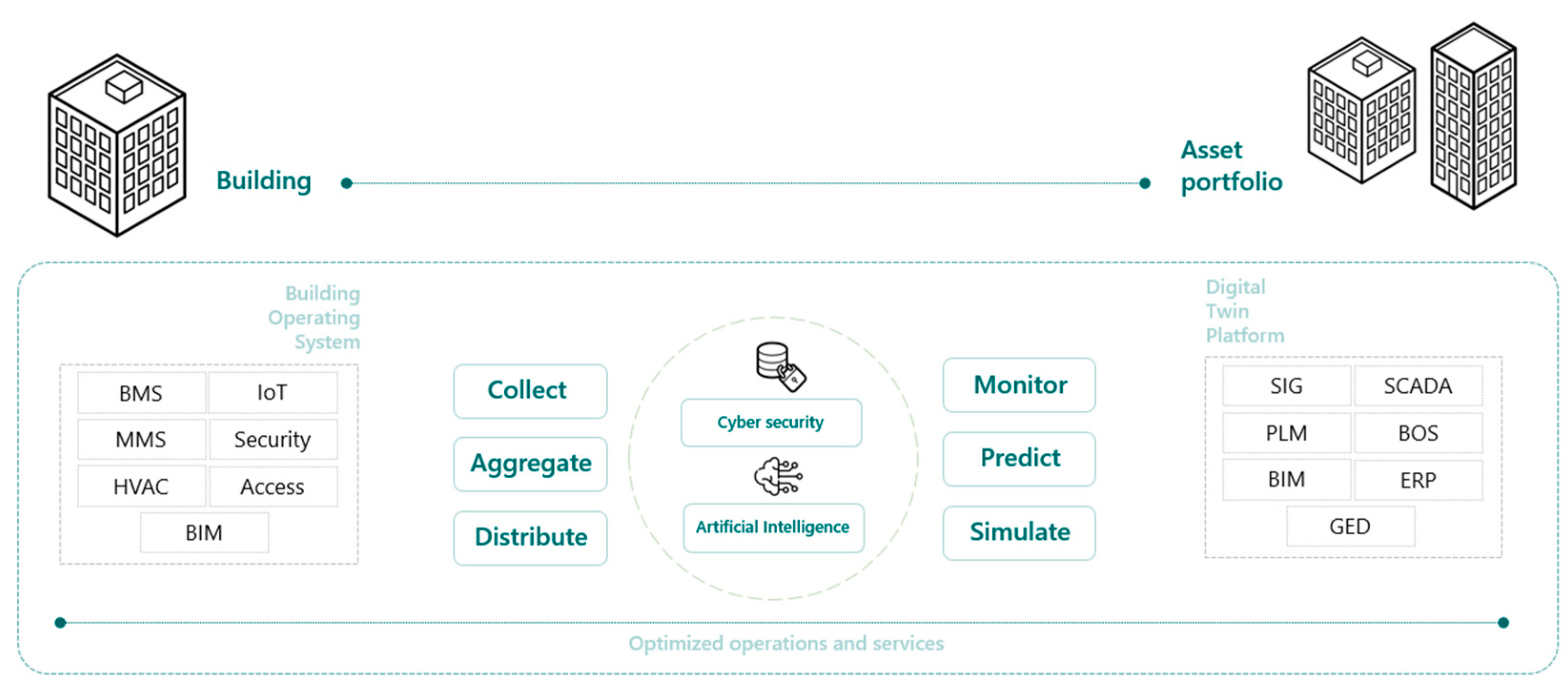
Figure 3.
Integrating BIM and GIS for multi-scale Digital Twins.
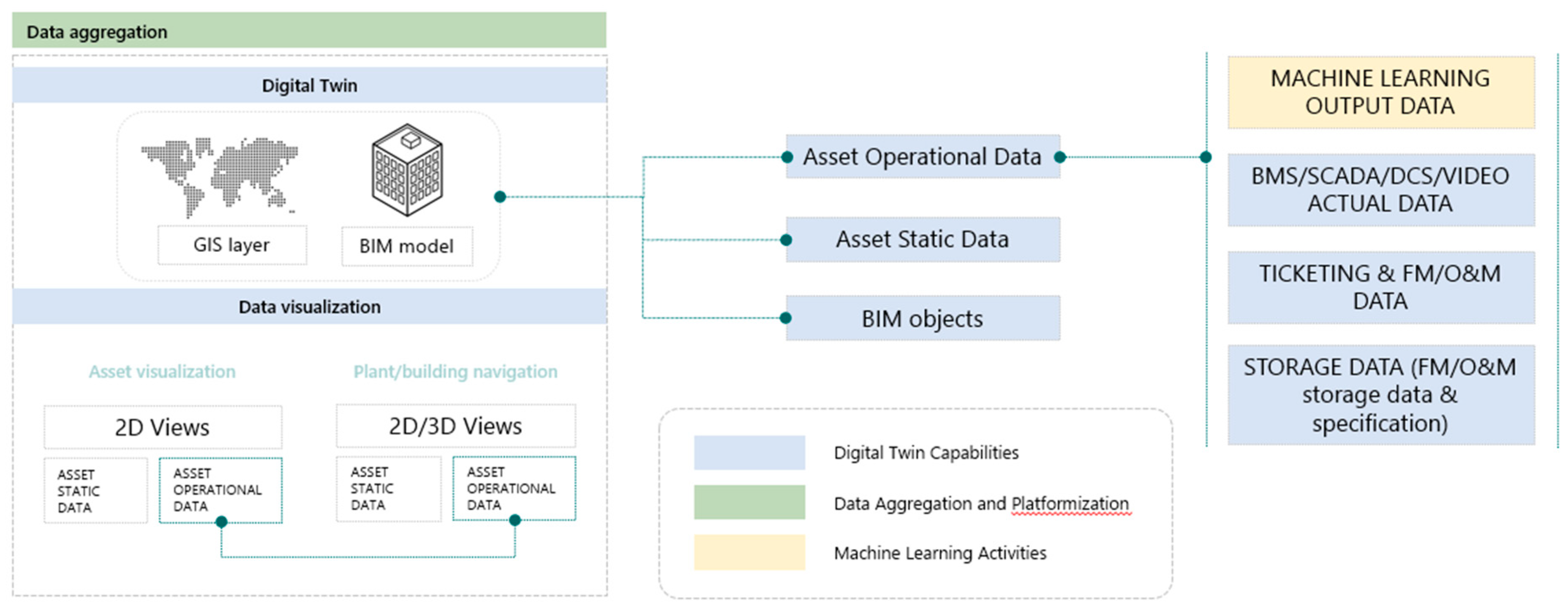

Table 1.
Main outcomes of DT implementation in built environment’s lifecycle.
| Lifecycle stage | DT outcome |
|---|---|
| Design | Model, simulate and conduct what-if scenarios. Improve and optimize their design. Environmental impacts analysis. Individual asset scale, district or city level analysis. Design informed by data, information and connected ecosystems. Improve the built environment’s operational efficiency (traffic flow, occupancy, energy etc). |
| Construction | Site-based process enhancement (sensors, drones, laser scanning). Supply chain allowing real-time inventory tracking. Prefabrication and industrialised construction. Benefits in production management, work performance, health, safety and wellbeing of workers, materials, equipment tracking. Streamline the management of data and information during construction. |
| Operation and maintenance | Predictive maintenance (monitoring of health of building systems and equip-ment in real-time, enabling predictive maintenance and reducing downtime and repair costs). Improved energy efficiency optimizing building systems and operations. Better asset management (track the location, condition, and performance of building assets). Enhanced safety and security (simulation of emergency scenarios, identifica-tion of potential safety and security risks, proactive measures). Reduced operational costs (identification of inefficiencies and areas of waste). Improved occupant experience (tracking occupant behavior). Increased sustainability (track and reduce the environmental impact of build-ings). |
| Decommissioning | Planning and executing the decommissioning process safely and efficiently. Simulate and optimize different decommissioning scenarios and identify potential risks. Reducing the likelihood of unexpected delays or complications. Facilitate collaboration and communication between different stakeholders. Progress tracking and monitoring. Improved sustainability and resource efficiency. |
Table 2.
Summary of recent studies in the integration of GIS software technologies and BIM models.
| Author(s) | Year | Methodology | Aims | Reference |
|---|---|---|---|---|
| Carrasco et al, | 2022 | A review: BIM and GIS integration. | The research objective is to identify the most significant technological developments and potential applications integration. To these aims, after a bibliographic consultation, two analyses are carried out, one quantitative and the other qualitative. | [83] |
| Xia et al, | 2022 | A review: the BIM, GIS, data value, and ontology-based data integration. | Keyword analysis, co-country analysis, and co-citation and pairwise analyzes are performed using CiteSpace. The GIS and BIM integration has attracted much attention. The professional disconnection and fragmented composition create challenges for GIS and BIM integration. | [79] |
| Nita Ali et al, | 2022 | A review: BIM and GIS integration. The current status and future trends in BIM from the Web of Science database. | Focus on the following topics: collaboration in BIM, integration of BIM, GIS and IoT, barriers to the BIM, sustainability and BIM, and risk assessment and uncertainty integration. | [84] |
| Miller et al, | 2021 | A DT case study of the data intersection from systems are described. | Preliminary insights are discussed for an experiment with participants focused on residents' feedback collection to characterize indoor comfort. | [85] |
| Sammartano et al, | 2021 | Based on the actual scenario to address the advantage of the BIM-GIS models dataset, test availability at a different scale, with different potential and bottlenecks. The proposed methodology tries to elaborate rules on shared language parameters by combining parametric modeller software (Revit) and visual programming language (Dynamo). |
A preliminary work into geo-spatial management of public administration assets thanks to interoperability of BIM-GIS models related to urban scale scenarios. | [86] |
| Zhu et al, | 2021 | A systematic and thorough investigation into the IFC standard was conducted to assess the IFC geo-referencing capability. | The study aims to clarify the meaning of geo-referencing in the context of BIM/GIS data integration and develop a common geo-referencing approach for IFC. | [87] |
| Diakite et al, | 2020 | The GIS data geo-referencing comes from the BIM domain and the Computer-Aided Design (CAD) world. |
The paper aims to create an automatic framework to transform the BIM model's local coordinates into real-world geographic coordinates. | [88] |
| Pan et al, | 2020 | An HDF- (Hierarchical Data Format-) based and synthesized scheme with three (IFC-SPF (IFC STEP Physical File) and XML-encoded CityGML (City Geography Markup Language), bidirectional transformation methods and data aggregation enhances the integrated model bond and heterogeneous data resources from the transformed HDF files) significant technical processes. | The case studies show that the approach proposed to reach high efficiency for the BIM + GIS integration model practicability. This lightweight integration method can further improve the front-end service responsiveness in DT applications. | [89] |
Table 3.
Summary of recent studies in the DT implementation in Smart Cities.
| Author(s) | Year | Methodology | Aims | Reference |
|---|---|---|---|---|
| Deren et al, | 2021 | Using digital twins and DT cities concepts. | The relationship between digital twins and smart cities analyzes the smart cities' characteristics based on digital twins and focuses on the smart cities' five main applications based on digital twins. | [101] |
| Wolf et al, | 2022 | A fundamental concept of the digital twin and gives the construction method and possible applications of the energy internet digital twin. | The development and application of DT technology in the integrated regional energy system of smart cities. | [102] |
| Grübel et al, | 2022 | A review | Situated Analytics, and Smart Cities as the foundations of Physical Twins. | [103] |
| Xia et al, | 2022 | A review and bibliometric analysis of geographic information system and building information modeling integration. | Study on city DT technologies for sustainable smart city design. | [104] |
| Priya Ramu et al, | 2022 | Present an extensive survey on the various smart city-based applications of Federated Learning (FL) models in DTs. The Deep Learning (DL) algorithm uses BDA and puts forward the distributed parallelism strategy of the Convolutional Neural Net (CNN). | The integration of Artificial Intelligence (AI) and the IoT promising technologies for adoption in real-time and life-critical scenarios for ease of governance in smart city-based applications. | [105] |
| Li et al, | 2022 | Present an extensive survey on the various smart city-based applications of Federated Learning (FL) models in DTs. The Deep Learning (DL) algorithm uses BDA and puts forward the distributed parallelism strategy of the Convolutional Neural Net (CNN). | Big Data Analysis (BDA) on the massive data generated in the smart city IoT. | [106] |
| Bujari et al, | 2021 | The Interactive Planning Platform for City District Adaptive Maintenance Operations (IPPODAMO). | Presenting a detailed proof-of-concept implementation of a DT solution for the Urban Facility Management (UFM) process. | [107] |
| Sta. Ana et al, | 2021 | Unity3D, QGIS2threejs, and TerriaMap. | A DT development for the smart cities monitoring. | [108] |
| Deng et al, | 2021 | A review | A DT city concept | [109] |
| Mylonas et al, | 2021 | A review | The current research landscape regards DTs in the field of smart cities, while also attempting to draw parallels with the DTs application. | [110] |
Table 4.
Summary of recent studies in the DT in aerospace.
| Author(s) | Year | Methodology | Aims | Reference |
|---|---|---|---|---|
| Zhuang et al, | 2022 | Quality management (Using the Grey-Markov Model and Apriori Algorithm). | The aerospace products assembly process. | [116] |
| Conde et al, | 2022 | Reference Conceptualisations and data model based on FIWARE Generic Enablers and the Next Generation Service Interfaces-Linked Data standard. | Information management in turnaround event operations in commercial airports. | [117] |
| Hultman et al, | 2022 | A Novel Non-Nominal Welding Simulation. | Predicting Geometrical Variation in Fabricated Assemblies. | [118] |
| Candon et al, | 2022 | linear regression, neural networks and deep learning. | Advanced multi-input system identification for next generation aircraft loads monitoring. | [119] |
| Gomez Medina et al, | 2021 | The Design Science Research (DSR) framework has been used to structure the maturity model development. | Implementations in the Commercial Aerospace OEM Industry. | [120] |
| B. Borgen et al, | 2021 | The university undergraduate students enrolled in a university aeronautical engineering technology program were divided into AR and paper-based groups and compared on first-time task execution times for starting an aircraft Auxiliary Power Unit (APU). | Assessment of Augmented Reality Technology’s Impact on Learning Speed and Task Performance. | [121] |
| Liu et al, | 2021 | Based on biomimicry for machining aerospace components. | Fusing multi-dimensional in-context machining process data, such as changes in geometry, material properties and machining parameters. | [122] |
| Ezhilarasu et al, | 2021 | Based on OSA-CBM (Open System Architecture for Condition Based Maintenance). | Efficiently informing aircraft maintenance to the Original Equipment Manufacturers, the operators /airlines, and the Maintenance, Repair, and Overhaul organizations. |
[123] |
| Yin Z H et al, | 2020 | Compared modelling simulations, the advantages of shorting design cycle, high reliability, less frequent overhaul and low maintenance cost. | Focusing on the DT application's current situation in aerospace. | [124] |
Table 5.
Summary of recent studies in the DT in industry and manufacturing.
| Author(s) | Year | Method | Aims | Reference |
|---|---|---|---|---|
| Henrichs et al, | 2021 | Overview | The DT applications in the food industry and analyze their challenges and potentials. | [128] |
| Schroeder et al, | 2021 | Model Driven Engineering (MDE). | This article focuses on DT and proposes a methodology for DT design using model-driven engineering (MDE) that strives to be flexible and generic. | [129] |
| Tao et al, | 2019 | A review | A Correlation and Comparison of DTs and Cyber-Physical Systems toward Smart Manufacturing and Industry. | [130] |
| Min et al, | 2019 | A machine learning-based approach is proposed to form a mathematical DT model that simulates the control inputs and outputs. | A framework and approaches for constructing a DT based on the petrochemical industrial IoT, machine learning and a practice loop for information exchange between the physical factory and a virtual DT model to realize production control optimization. | [131] |
| Singh et al, | 2022 | A review | Covering the DT applications in different industries. | [132] |
| Huang et al, | 2021 | Real-time situational awareness uses real-time virtual deduction as a cognitive means and real-time feedback from virtual to real space as an iterative method. | Develop a smarter new generation of Smart Power Systems (SPS). | [133] |
| Wanasighe et al, | 2020 | A review | The Oil and Gas Industry: Overview, Research Trends, Opportunities, and Challenges. |
[134] |
| Guerra-Zubiaga et al, | 2021 | Digital Manufacturing Tools (DMT). | Develop a DT of production systems to optimize the planning and commissioning process. | [135] |
| Leng et al, | 2021 | A review | To reduce the vast time and cost of physical commissioning/reconfiguration by the Smart Manufacturing System (SMS) design errors/flaws early detection. | [136] |
Table 5.
Summary of recent studies in the DT in energy.
| Author(s) | Year | Method | Aims | Reference |
|---|---|---|---|---|
| Yu et al, | 2022 | A review. | To accelerate the understanding, classification, and application of energy DT technology. | [140] |
| Xu et al, | 2019 | Optimization solutions and their cost effectiveness have been evaluated using DT modeling analysis. | Using a PPSM case study in a 320 MW coal-fired thermal power plant unit, it examines how DT technology can be used to explore and analyze optimization solutions. | [141] |
| Zhang et al, | 2017 | The DT merges physics-based system modeling and distributed real-time process data to generate a traditional digital system design at the pre-production phase. | Approach for rapid individualized designing of the hollow glass production line. | [142] |
| Blume et al, | 2020 | Comprises seven consecutive steps in a broadly applicable workflow based on the CRISP-DM paradigm. | Improve system understanding and performance prediction as essentials for successful operations management. | [143] |
| Pimenta et al, | 2020 | FAST software and ANSYS Fluent. | To create a DT of an onshore wind turbine tool for continuous tracking of accumulated fatigue damage and evaluation of alternative operation strategies and to perform the first tasks for creating a reliable numerical of a floating wind turbine to simulate experimental data. | [144] |
| Steindl et al, | 2020 | Analyzed concepts, architectures, and frameworks for DTs in the literature | To develop a technology-independent Generic Digital Twin Architecture (GDTA), which is aligned with the information technology layers of the Reference Architecture Model Industry 4.0 (RAMI4.0). | [145] |
| Yu et al, | 2020 | A hybrid modelling method based on operation data and first-principal mechanism. | Performance monitoring of control stage systems. | [146] |
| Prawiranto et al, | 2021 | Combine a mechanistic fruit drying model, quality models and weather data. | Evaluate apple fruit's drying characteristics and quality evolution with and without the improvement above strategies. | [147] |
Disclaimer/Publisher’s Note: The statements, opinions and data contained in all publications are solely those of the individual author(s) and contributor(s) and not of MDPI and/or the editor(s). MDPI and/or the editor(s) disclaim responsibility for any injury to people or property resulting from any ideas, methods, instructions or products referred to in the content. |
© 2023 by the authors. Licensee MDPI, Basel, Switzerland. This article is an open access article distributed under the terms and conditions of the Creative Commons Attribution (CC BY) license (http://creativecommons.org/licenses/by/4.0/).
Copyright: This open access article is published under a Creative Commons CC BY 4.0 license, which permit the free download, distribution, and reuse, provided that the author and preprint are cited in any reuse.


