

Submitted:
28 June 2023
Posted:
28 June 2023
You are already at the latest version
Abstract
Harsh parenting could be regarded as a harsh form of behavior, feelings and attitude towards children in the process of parenting. According to the theory of intergenerational transmission of violence, harsh parenting is an important factor affecting children's aggressive behavior, but the theory does not clarify the specific action path between the harsh parenting and aggressive behavior. In order to reveal the relationship between harsh parenting and aggressive behavior of juvenile delinquents, 604 male juvenile delinquents (N=604, Mage=16.57 years, SD=0.612 years) were investigated using Harsh Parenting Questionnaire, Buss-Perry Aggression Questionnaire, Multidimensional Peer-Victimization Scale, and the Word Sentence Association Paradigm for Hostility in Chinese version. Analysis using structural equation modeling procedures showed that (a) all variables were positively associated with each others; (b) the partial indirect effect of harsh parenting on aggressive behaviors was realized through the mediator of peer victimization and hostile attribution bias independently, (c) as well as the partial indirect effect through the mediator of peer victimization and hostile attribution bias sequentially. The results suggested that harsh parenting can explain the high aggressive behavior of male juvenile delinquents. Moreover, harsh parenting may also lead to the formation of hostile attribution bias by increasing the risk of peer victimization, and ultimately lead to the formation of highly aggressive behaviors.
Keywords:
harsh parenting
; aggressive behavior
; peer victimization
; hostile attribution bias
; male juvenile delinquent
1. Introduction
Adolescence is an important stage of transition and development in life. Overall, aggressive behavior presents a trend of gradual increase with the entry of individuals into adolescence, and reaches a peak in adolescence [1,2]. Aggressive behavior is any behavior directed toward another individual that is carried out with the proximate (immediate) intent to cause harm [3]. Aggressive behavior not only violate social norms, but also bring negative effects to the physical and mental health, academic progress, emotional regulation, behavior shaping, personality development and social adaptation after adulthood [4]. More dangerously, aggressive behavior may increase risks of crime among male adolescents [5]. A survey’s result showed that the amounts and severity of juvenile delinquents’ aggressive behavior are higher than that among common adolescents of the same age [6]. Moreover, the data in China’s White Paper on Juvenile Prosecutorial Work (2021) showed that, in 2021, amounts of juvenile suspects reviewed and prosecuted by the procuratorial organ, respectively had 19061 for larceny, 9049 for affray, 7591 for rape, 7186 for robbery, and 6902 for provocation, as top five respectively accounting for 25.8%, 12.2%, 10.3%, 9.7%, and 9.3% of total, four of the five types involved violent or aggressive behavior [7].
According to the intergenerational transmission of violence, harsh parenting may explain why children show severe aggressive behavior and even violent behavior [8]. In particular, harsh parenting may transmit an aggressive pattern of interpersonal interaction to children, who easily internalize this pattern into their own behavior and apply it to a broader process of interpersonal interaction after long-term reinforcement of this pattern [9]. Harsh parenting refers to harsh treatment to children in the process of parenting, including behavior, emotion and attitude [10]. Harsh parenting includes physical aggression in form of spanking, slapping, pinching/twisting and hitting with objects; verbal aggression in form of abuse, sarcasm, scolding; mental aggression in form of ignorance, neglect, exclusion; over-control in form of supervision, obedience. The significant positive correlation between harsh parenting and aggressive behavior has been widely discussed in elementary, middle and college students [11,12,13]. However, there are few studies on the relationship between harsh parenting and juvenile delinquents’ aggressive behavior. Considering the importance of clarifying the causes of violent criminal behavior of juvenile delinquents, the current study addressed to explore the relationship between harsh parenting and aggressive behavior of juvenile delinquents. Therefore, we propose the first research hypothesis that harsh parenting could directly and positively predict aggressive behavior(H1).
However, the theory of intergenerational transmission of violence has not clarified the specific action path of harsh parenting on children’s aggressive behavior. According to the social information processing model [14], harsh parenting parents are unable to show reasonable emotional and behavioral control strategies to children, which may lead to emotional disorders and impulsivity of children, forming aggressive hostile attribution bias, and responding with irrational aggressive behaviors. Parents’ physical and verbal aggression might cause children to be overly vigilant to potentially threatening social cues, developed hostile attribution bias, and thus had difficulty to control angry responses and exhibited aggressive behavior [15]. Hostile attribution bias is a tendency to attribute hostile intentions to peers in ambiguous circumstances [16]. Although existing studies have not directly explored the mediating role of hostile attribution bias between harsh parenting and aggressive behavior, the relationship between harsh parenting and hostile attribution bias or the relationship between hostile attribution bias and aggressive behavior has been fully verified by previous studies. For example, Milner et al. (2017) through six studies demonstrated that reducing harsh parenting can reduce children’s hostile attribution bias [17]. Perhamus and Ostrov (2021) showed that children's hostility attribution bias could positively predict their subsequent aggressive behavior through longitudinal study [18]. Accordingly, we propose the second study hypothesis that hostile attribution bias played a mediating role in the relationship between harsh parenting and aggressive behavior(H2).
According to the developmental cascade model of adolescent aggression [19], the evolution of individual aggression or violent behavior was influenced by early family factors (e.g., harsh parenting), school factors (e.g., peer victimization), moreover, family factors had a progressive influence on individuals through school factors. In particular, after experiencing harsh parenting, children will transfer the negative emotions learning from parent-child interaction to the peer situation and lead to poor peer relationships. In the sum, the cumulative negative experiences from the family and school level further magnify the individual’s cognitive bias and eventually lead to the outbreak of severe aggressive behavior. Peer victimization is defined as physical or psychological injury from peers in forms of physical aggression, verbal aggression and relational aggression [20]. Although previous studies had not directly investigated the pathways of peer victimization and hostility attribution bias between harsh parenting and aggressive behavior, physiological or neurological disorders caused by harsh parenting could explain this pathway. For example, Lewis et al. (2021) found that children who long-term exposure to harsh parenting would stay highly alert to anger signals at stage of adolescences, meanwhile trigger the response of the individual’s sympathetic -- adrenal -- spinal system and HPA axis system which result in the frequent release of catecholamine and cortisol [21]. Following psychological and physiological changes, adolescences who suffered harsh parenting developed the high sensitivity of individuals to stressful situations such as peer victimization, aggravated the hostile attribution bias, and pronged to express anger in aggressive ways. Therefore, We propose the third and fourth research hypothesis that: (H3)peer victimization play a mediating role in the relationship between harsh parenting and aggressive; (H4) peer victimization and hostility attribution bias played a chain mediating role between harsh parenting and aggressive behavior.
2. Materials and Methods
2.1. Participants
A total of 630 male juvenile delinquents were randomly recruited from juvenile prison in a Chinese province. Because some participants didn't answer carefully or missed more than half of the questions, their answers were eliminated, and the final valid sample size was 604 (95.87% retention rate). The participants’ age ranged from 15 to 17, and the mean age was 16.57 years (SD = 0.61), the mean age at which they entered prison was 16.31 (SD = 0.78). Among the participants, 221 (36.6%) had been stay behind (both parents or one parent had migrated for work).
The main types of crimes committed by these juvenile delinquents include robbery (51%), rape (25%), intentional injury (13%), theft (2%) and intentional homicide (2%), etc. The average number of crimes committed was 1.03 (SD = 0.21), the mean initial term of sentence was 3.63 (SD = 2.61).
2.2. Measures
Harsh parenting. Harsh parenting was assessed by the Chinese version [22] of the Harsh Parenting Questionnaire [23]. This questionnaire consisted of 4 items (e.g., “Dad hit me or kicked me.”) rated on a five-point scale ranging from 1 (strongly disagree) to 5(strongly agree).High mean score indicates serious harsh parenting for all items. In current study, confirmatory factor analysis for the data showed that the structure validity of the Chinese version was good (χ2/df= 43.41, CFI = 0.96, TLI =0.92, SRMR = 0.03, RMSEA = 0.08, 95%CI RMSEA= [0.06, 0.11]). The Cronbach′s alpha coefficient for the father’s version was 0.69. The Cronbach′s alpha coefficient for the mother’s version was 0. 67. The Cronbach′s alpha coefficient for the total questionnaire was 0.77.
Aggressive behavior. Aggressive behavior was assessed by the Chinese version [24] of the Buss-Perry Aggression Questionnaire [25]. We assessed aggressive behavior by the sub- scale of physical aggressive behavior (e.g., “Once in a while I can’t control the urge to strike another person.”) and the sub- scale of verbal aggressive behavior (e.g., “I tell my friends openly when I disagree with them.”). High mean score indicates serious aggressive behavior for all items. In current study, confirmatory factor analysis for the data showed that the structure validity of the Chinese version was good (χ2/df= 66.191, CFI = 0.93, TLI =0.91, SRMR = 0.03 RMSEA = 0.04, 95%CIRMSEA= [0.03, 0.05]). The Cronbach′s alpha coefficient for the sub-scale of physical aggressive behavior was 0.61. The Cronbach’s alpha coefficient for the sub-scale of verbal aggressive behavior was 0. 64. The Cronbach’s alpha coefficient for the total questionnaire was 0.68.
Peer victimization. Peer victimization was assessed by the Chinese version of the Multidimensional Peer-Victimization Scale [26]. We assessed peer victimization by the sub-scale of physical victimization (e.g., “Beat me up.”) and the sub-scale of relational victimization(e.g., “Tried to make my friends turnagainst me.”). High mean score indicates serious victimization for all items. In current study, confirmatory factor analysis for the data showed that the structure validity of the Chinese version was good (χ2/df= 149.80, CFI = 0.93, SRMR = 0.04, RMSEA = 0.06, 95%CIRMSEA= [0.05, 0.08]). The Cronbach’s alpha coefficient for the sub-scale of physicalvictimization was 0.63. The Cronbach's alpha coefficient for the sub-scale of verbal victimization was 0. 80. The Cronbach's alpha coefficient for the total questionnaire was 0.81.
Hostile attribution bias. Hostile attribution bias was assessed by the Chinese version [27] of the Word Sentence Association Paradigm for Hostility [16]. We assessed hostile attribution bias by the sub-scale of hostile attribution bias. The sub-scale contained 16 distinct ambiguous sentences (e.g., “Someone is in your way”), followed by either a hostility-related word (e.g., “inconsiderate”) or a benign word (e.g., “unaware”). Each of sentences presented twice in random. High mean score indicates high hostile attribution bias for all items. In current study, confirmatory factor analysis for the data showed that the structure validity of the Chinese version was good (χ2/df= 141.78, CFI = 0.93, TLI =0.92, SRMR = 0.04, RMSEA = 0.03, 95%CIRMSEA= [0.02, 0.04]). The Cronbach′s alpha coefficient for the sub-scale was 0.72.
2.3. Procedure and Statistical Analysis
With the cooperation of the prison guards, questionnaires were distributed to each block by two psychological doctoral students straining before. These participants were supposed to read the instructions carefully before completing the scale. In the process of testing, if the subjects had doubts about the questionnaire questions, they could ask the interviewer questions at any time. The test lasted for about 30 minutes, and questionnaires were taken back by researcher after completing. The study was approved by the Ethics Committee of the Faculty of Psychology, Tianjin Normal University. All participants signed a written consent form before the study was conducted. We conducted descriptive analysis, correlation analysis, and multiple mediation analysis using SPSS 18.0 and Mplus 7.0.
3. Results
3.1. Common Method Bias
Harman’s single-factor test was used to test the common method bias when the data were collected. The results showed that 13 factors had an eigenvalue that was more than 1. The first factor accounted for 12.41% of the total variance, which was less than the critical standard 40%. Therefore, no significant common method bias was observed.
3.2. Descriptive Statistics and Correlations
In Table 1, we display means, standard deviations, and correlations of research variables. For the demographics, the results of correlational studies revealed that there were some significant correlation between demographic variables, such as age and initial term of sentence, age and age to enter prison, degree of education and age to enter prison, degree of education and mothering harsh parenting, type of crime and count of crime, type of crime and age to enter prison, type of crime and mothering harsh parenting, count of crime and initial term of sentence, count of crime and fathering harsh parenting. For the study variables, there were significant positive correlation between all study variables.
3.3. Mediation Model Analysis
SEM was used to examine the hypothesized mediation model. The final model is presented in Figure 1; the model fitted the data well, CFI = 0.98, TLI = 0.94, RMSEA= 0.06,and SRMR = 0.06.The results of bootstrap test showed that the direct effect of harsh parenting on aggressive behavior was positive and significant (β = 0.28, p < 0.001, 95% CI [0.15, 0.42]), and the total indirect effect of harsh parenting on aggressive behavior via the two mediators was positive and significant (β = 0.1, p < 0.001, 95% CI [0.06, 0.16]). The mediating effects of peer victimization and hostile attribution bias are presented in Table 2, Figure 1.
4. Discussion
Previous research investigated the relationship between harsh parenting and aggressive behavior using general children, adolescents, and adults, instead of severe-aggression people. In this study, male juvenile offenders were sampled as the research subjects to investigate the relationship between harsh parenting and aggressive behavior. We found that harsh parenting could directly predict aggressive behavior among juvenile delinquents, and the partial mediating effect of peer victimization and hostile attribution bias between harsh parenting and aggressive behavior respectively. More importantly, we found a chain mediating effect of peer victimization and hostile attribution bias between harsh parenting and aggressive behavior.
The finding that harsh parenting might positively predict aggressive behavior which indicated more serious harsh parenting the juvenile delinquents suffered, the easier it is for them to observe, learn and imitate their parents' aggressive behavior, and apply those scripts into interpersonal communication. The current results confirmed the H1, and also consistent with previous studies in various respects. For example, Liu et al (2022) recruited 235 Chinese adolescents as participants to investigate the relationship between harsh parenting and aggressive behavior [13]. Their study has shown that harsh parenting could significantly predict aggressive behavior among children. In addition, harsh parenting may influence children’s development on brain structure. Cortes Hidalgo et al. (2022) using rest-state fMRI scanned 2410 children at age 10 who experienced harsh parenting, and found that maternal harsh parenting was associated with smaller total gray, cerebral white matter and amygdale volumes, and those brain outcomes might predict children’s aggressive behavior [28]. Moreover, previous studies had found that aggressive behavior of children could decrease by preventing harsh parenting. Milner et al. (2017) using evaluative conditioning (EC) improved parents' attitude towards upbringing, reduced the expected demand for educating children, and avoided harsh parenting towards children [17]. Those changes could rebuild positive attachment between parents and children so as to help children make warmer awareness of society rather than violence. At present, there are few studies speculated about links between harsh parenting and aggressive behavior among juvenile delinquents. Future studies on harsh parenting and aggressive behavior should focus more on juvenile delinquents, adult delinquents and people with high aggression proneness, especially through longitudinal research to explore the family causes of those people.
The second finding that the partial mediating effect of peer victimization between harsh parenting and aggressive behavior indicated that harsh parenting positively predict peer victimization and ultimately predict aggressive behavior. The results supported the H3 and dynamic cascade model [19]. According to the dynamic cascade model, evolution of individual aggressive behavior or violence was affected by early factors of family and school, moreover, factors of family had a progressive impact on individuals through factors of school. Our results also confirmed existing literature. In a longitudinal study, Perry et al. (2021) investigated family violence, peer victimization and aggressive behavior at early and middle stages of childhood, as well as early stage of adolescence [29]. They found that family violence significantly predict peer victimization and aggressive behavior. Children with harsh parenting cannot build a heath attachment with parents, following by which they also cannot build a heath attachment with peers [30]. Eventually, they may be more vulnerable to exclusion or even serious violations by other children. Unfortunately, negative experiences from parents and peers trigger their thoughts of retaliation, which lead to aggressive behavior to those attackers.
This study also revealed the partial mediating effect of hostile attribution bias between harsh parenting and aggressive behavior. The results confirmed the H2. We suggested that harsh parenting positively predict hostile bias and ultimately predict aggressive behavior. This result supports the view of the social information processing model [14]. Although previous studies had not investigated the mediating effect of hostile attribution bias between harsh parenting and aggressive behavior, several studies showed that harsh parenting predicted emotional regulation disorders and selective attention to hostile information [31], which lead to internal problems (e.g., social anxiety) and external problems (e.g., aggressive behavior). Specially, parents’ harsh parenting in forms of physical aggression or verbal aggression can be viewed as unsatisfied signal towards children, which induce them become more sensitive to exclusion, and prone to express hostility in ways of aggressive behaviors or violence. Zhao et al. (2021) recruited 76 male juvenile delinquents as participants, confirmed the relation between hostile attribution bias and aggressive behavior [32]. Prior researches had emphasized effects of reducing hostility attribution bias on preventing aggressive behavior.
Finally, we examined the chain mediating effects of peer victimization and hostile attribution bias between harsh parenting and aggressive behavior. The results supported the H4 and suggested that the early experience of harsh parenting may positively predict the hostile attribution bias, peer victimization and ultimately predict aggressive behavior. Specifically, after experiencing harsh parenting, they are more sensitive to stressful environments and tend to overreact to environmental stimuli, which may lead to peer rejection or even peer victimization, and lead to the formation of hostile attribution bias to external environmental information, and eventually show serious aggressive behavior or even violent criminal behavior. Although existing empirical studies have not explored the chain mediating role of peer victimization and hostile attribution bias between harsh parenting and aggressive behavior, the results of current study support the idea of a developmental cascade model of adolescent aggression [19]. The developmental cascade model of adolescent aggression suggested that negative daily events (e.g., harsh parenting and peer victimization) activated negative self-schema (e.g., “I am a loser; everyone doesn’t like me”). As a result, individuals will feel hostility around the world and initiate negative perspectives about future, thus increasing hostile attribution bias to the external environment. In addition, harsh parenting and peer victimization may activate threatening schema (e.g., “Everyone hurt me”), and aggravate thoughts of hostility, eventually enhancing aggression in interpersonal communication [33]. A genetic study carried out by Brody et al. (2014) showed that harsh parenting of individuals might impair the short allele carried by 5-HTTLPR, which can induce individuals to overreact to the external environment. In particular, threatening stimuli would be a priority and cannot be overridden, thus increasing the risk to aggressive behavior [34].
The current study bears some limitation. At first, the study is based on self-reported data, which could prone to social desirability, specially considering the negative topic of harsh parenting, peer victimization, hostile attribution bias and aggressive behavior. Second, the cross-sectional design of the study does not allow for causality to be examined between variables in the model. However, as far as we know, there is no longitudinal study on the relationship between harsh parenting and aggressive behavior. Third, the current study only investigates the physical aggression and verbal aggression dimensions from the aggressive behavior form, and lack of research from the perspective of motivation of aggressive behavior (i.e, proactive aggression and reactive aggression [35]). Thus, future research can be done by reporting variables from multiple perspectives (i.e, harsh parent report by parents, peer victimization report by peer), and examine the long-term effects of harsh parents on aggressive behavior and the mediating role of peer victimization and hostility attribution bias through longitudinal studies. Moreover, more types of aggressive behaviors can be included to observe the difference in the influence of different parental rough parenting forms on different aggressive behaviors.
5. Conclusions
In the present study, we examined the links of harsh parenting and aggressive behavior among male juvenile delinquents. The findings suggested that harsh parenting enhanced risks to aggression among male adolescents. Specially, peer victimization and hostile attribution bias could be the reasons to interpret harsh parenting’s negative effects on aggressive behavior.
Author Contributions
Conceptualization, S.L.; methodology S.L. and Y.W.; software, G. C.; validation, G. C.; formal analysis Y.W.; resources, S.L.; data curation, Y.W.; writing—original draft preparation, S.L. and Y.W.; writing—review and editing, S.L. and Y.W.; supervision, X.B.; project administration, X.B.; funding acquisition, X.B. All authors have read and agreed to the published version of the manuscript.
Funding
This research was funded by the Nation Social Science Foundation of China(20ZDA079) to X.B.
Institutional Review Board Statement
This study was conducted in accordance with the Declaration of Helsinki and approved by the Human Research Ethics Committee of the Faculty of Psychology, Tianjin Normal University (protocol number: 2020093001, date of approval: 15 September 2022).
Informed Consent Statement
Informed consent was obtained from all subjects involved in this study.
Acknowledgments
All participants in this study are gratefully acknowledged. We would also like to acknowledge other students in the research group for their help in the process of this research.
Conflicts of Interest
The authors declare no conflict of interest.
References
- Moffitt, T.E. Male antisocial behaviour in adolescence and beyond. Nat Hum Behav. 2018, 2, 177–186. [Google Scholar] [CrossRef] [PubMed]
- Lei, H.; Chiu, M. M.; Cui, Y.; Li, S.; Lu, M. Changes in aggression among mainland Chinese elementary, junior high, and senior high school students across years: A cross-temporal meta-analysis. Aggress Violent Behav. 2019, 48, 190–196. [Google Scholar] [CrossRef]
- Anderson, C.A.; Bushman, B.J. Human Aggression. Annu Rev Psychol. 2002, 53, 27–51. [Google Scholar] [CrossRef]
- Goemans, A.; E. Viding.; E. McCrory. Child Maltreatment, Peer Victimization, and Mental Health: Neurocognitive Perspectives on the Cycle of Victimization. TVA. 2021, 152483802110363. [CrossRef]
- Kassing, F.; Lochman, J. E.; Vernberg, E.; Hudnall, M. Using Crime Data to Assess Longitudinal Relationships Between Community Violent Crime and Aggressive Behavior Among At-Risk Youth. J Early Adolesc. 2022, 2022. 42, 431–448. [Google Scholar] [CrossRef]
- Zhao, Z.; Yu, X.; Ren, Z.; Zhang, L.; Li, X. Attentional variability and avoidance of hostile stimuli decrease aggression in Chinese male juvenile delinquents. Child Adolesc Psychiatry Ment Health. 2021, 15, 19–19. [Google Scholar] [CrossRef] [PubMed]
- China's Supreme People's Procuratorate releases White Paper on Juvenile Prosecutorial Work (2021). https://www.spp.gov.cn/spp/xwfbh/wsfbt/202206/t20220601_558766.shtml#1.
- Widom, C.S. , Does violence beget violence? A critical examination of the literature. Psychol Bull. 1989, 106, 3–28. [Google Scholar] [CrossRef] [PubMed]
- Rousson, A. N.; Tajima, E. A.; Herrenkohl, T. I.; Casey, E. A. Patterns of Intimate Partner Violence and the Harsh Parenting of Children. J Interpers Violence. 2023, 38, 955–980. [Google Scholar] [CrossRef]
- Wang, M.; Wang, J. Harsh parenting and children's peer relationships: Testing the indirect effect of child overt aggression as moderated by child impulsivity. School Psychology International. 2019, 40, 366–380. [Google Scholar] [CrossRef]
- Cui, G.; Lan, X. The Associations of Parental Harsh Discipline, Adolescents’ Gender, and Grit Profiles With Aggressive Behavior Among Chinese Early Adolescents. Front. Psychol. 2020, 11. [Google Scholar] [CrossRef]
- Chong, L. S.; Rabkin, A. N.; Emhoff, S. M.; Barry-Menkhaus, S.; Rivers, A. J.; Lehrbach, M.; Gordis, E. B. Childhood Harsh Parenting and Later Aggression: Non-violent Discipline and Resting Skin Conductance as Moderators. J Aggress Maltreat T. 2023, 32, 537–554. [Google Scholar] [CrossRef]
- Liu, B.; Yang, Y.; Geng, J.; Cai, T.; Zhu, M.; Chen, T.; Xiang, J. Harsh Parenting and Children’s Aggressive Behavior: A Moderated Mediation Model. IJERPH. 2022, 19, 2403. [Google Scholar] [CrossRef]
- Crick, N. R.; Dodge, K. A. Social information-processing mechanisms in reactive and proactive aggression. Child Dev. 1996, 67, 993–1002. [Google Scholar] [CrossRef]
- Stephanie,A., Godleski,a., Jamie,M.,Ostrov. (2020). Parental influences on child report of relational attribution biases during early childhood. JECP. 2020. 192. [CrossRef]
- Dillon, K. H.; Allan, N. P.; Cougle, J. R.; Fincham, F. D. Measuring Hostile Interpretation Bias: The WSAP-Hostility Scale. Assessment (Odessa, Fla.) 2016, 23, 707–719. [Google Scholar] [CrossRef]
- Milner, J. S.; Wagner, M. F.; Crouch, J. L. Reducing Child-Related Negative Attitudes, Attributions of Hostile Intent, Anger, Harsh Parenting Behaviors, and Punishment Through Evaluative Conditioning. Cogn Ther Res. 2017, 41, 43–61. [Google Scholar] [CrossRef]
- Perhamus, G. R.; Ostrov, J. M. Emotions and Cognitions in Early Childhood Aggression: the Role of Irritability and Hostile Attribution Biases. Res Child Adolesc Psychopathol. 2021, 49, 63–75. [Google Scholar] [CrossRef]
- Dodge, K. A.; Greenberg, M. T.; Malone, P. S. Testing an idealized dynamic cascade model of the development of serious violence in adolescence. Child Dev. 2008, 79, 1907–1927. [Google Scholar] [CrossRef]
- Mynard, H., & Joseph, S. Development of the multidimensional peer-victimization scale. Aggress Behav. 2000, 26, 169–178. [CrossRef]
- Lewis, K. C.; Ridenour, J. M.; Pitman, S.; Roche, M. Harsh Parenting Predicts Novel HPA Receptor Gene Methylation and NR3C1 Methylation Predicts Cortisol Daily Slope in Middle Childhood. Cell Mol Neurobiol. 2021, 41, 783–793. [Google Scholar] [CrossRef]
- Wang, M., Deng, X., & Du, X. Harsh parenting and academic achievement in Chinese adolescents: Potential mediating roles of effortful control and classroom engagement. J School Psychol. 2018, 67, 16–30. [CrossRef]
- Simons, R. L.; Whitbeck, L. B.; Conger, R. D.; Wu, C. Intergenerational transmission of harsh parenting. Dev Psychol. 1991, 27, 159–171. [Google Scholar] [CrossRef]
- Lau, E. Y. H., & Li, J. Child Physical Aggression: The Contributions of Fathers’ Job Support, Mothers’ Coparenting, Fathers’ Authoritative Parenting and Child’s Theory of Mind. Child Ind Res. 2020, 13, 1085–1105.
- Buss, A. H., & Perry, M. The aggression questionnaire. J Pers Soc Psychol. 1992, 63, 452–9. [CrossRef]
- Li, Z.; Yu, C.; Nie, Y.; Liu, Q. Parental Corporal Punishment, Peer Victimization, and Aggressive Adolescent Behavior: The Moderating Effect of Parent-Adolescent Relationship. J Child Fam Stud. 2022, 31, 949–961. [Google Scholar] [CrossRef]
- Quan, F.; Yang, R.; Zhu, W.; Wang, Y.; Gong, X.; Chen, Y.; Dong, Y.; Xia, L. The relationship between hostile attribution bias and aggression and the mediating effect of anger rumination. Pers Indiv Differ. 2019, 139, 228–234. [Google Scholar] [CrossRef]
- Cortes Hidalgo, A. P.; Thijssen, S., Delaney, S. W.; Vernooij, M. W.; Jansen, P. W.; Bakermans-Kranenburg, M. J.; van IJzendoorn, M. H.; White, T.; Tiemeier, H. Harsh Parenting and Child Brain Morphology: A Population-Based Study. Child Maltreat. 2022, 27, 163–173. 27. [CrossRef]
- Perry, K. J.; Ostrov, J. M.; Shisler, S.; Eiden, R. D.; Nickerson, A. B.; Godleski, S. A.; Schuetze, P. Pathways from Early Family Violence to Adolescent Reactive Aggression and Violence Victimization. J Fam Viol. 2021, 36, 75–86. [Google Scholar] [CrossRef] [PubMed]
- Wang, F.; Wang, M.; Wang, T.; Wang, Z. Harsh Parental Discipline, Parent-Child Attachment, and Peer Attachment in Late Childhood and Early Adolescence. J Child Fam Stud. 2021, 30, 196–205. [Google Scholar] [CrossRef]
- Wang, M.; Li, M.; Wu, X.; Zhou, Z. Cognitive reactivity and emotional dysregulation mediate the relation of paternal and maternal harsh parenting to adolescent social anxiety. Child Abuse Neglect. 2022, 129, 105621. [Google Scholar] [CrossRef]
- Zhao, Z.; Yu, X.; Ren, Z.; Zhang, L.; Li, X. Attentional variability and avoidance of hostile stimuli decrease aggression in Chinese male juvenile delinquents. Child Adolesc Psychiatry Ment Health. 2021, 15, 19. [Google Scholar] [CrossRef]
- Witt, A., Fegert, J. M., Rodens, K. P., Brähler, E., Lührs Da Silva, C., & Plener, P. L. The Cycle of Violence: Examining Attitudes Toward and Experiences of Corporal Punishment in a Representative German Sample. J Interpers Violence. 2021, 36, 263–286. [CrossRef]
- Brody, G. H., Yu, T., Beach, S. R. H., Kogan, S. M., Windle, M., & Philibert, R. A. Harsh parenting and adolescent health: A longitudinal analysis with genetic moderation. Health Psycholo. 2014, 33, 401–409. [CrossRef]
- Li, X.; Wang, Y.; Li, J.; Tang, J.; Zhang, J.; Wang, M.; Jiang, S. Violence exposure across multiple contexts as predictors of reactive and proactive aggression in Chinese preadolescents. Aggress Behav. 2022, 48, 319–330. [Google Scholar] [CrossRef]
Figure 1.
Final model illustrating the chain mediation of peer victimization and hostile attribution bias on the association between harsh parenting and aggressive behavior.* p <0. 05; ** p <0. 01; ***p<0. 001.
Figure 1.
Final model illustrating the chain mediation of peer victimization and hostile attribution bias on the association between harsh parenting and aggressive behavior.* p <0. 05; ** p <0. 01; ***p<0. 001.
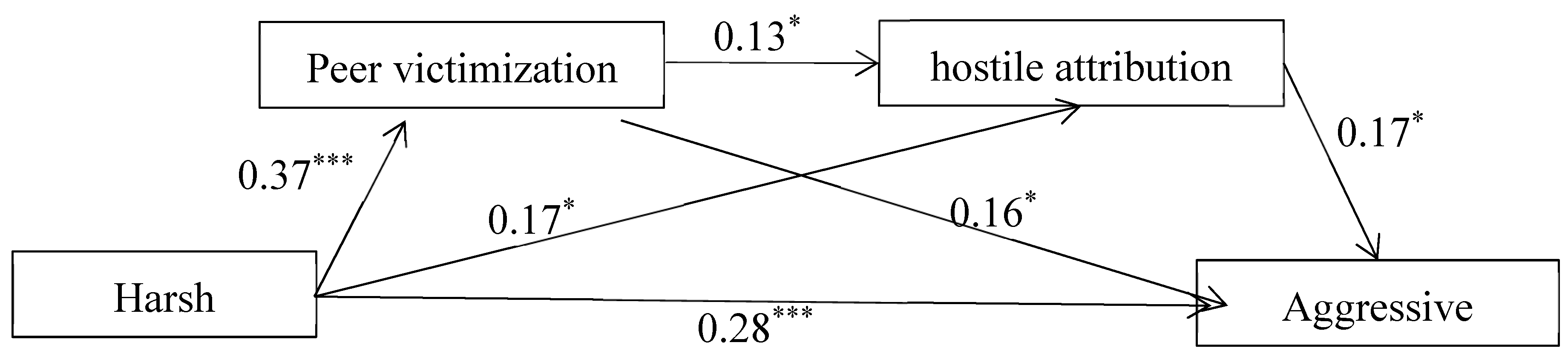

Table 1.
Descriptive statistics and correlations of measures (N = 604).
| M±SD | 1 | 2 | 3 | 4 | 5 | 6 | 7 | 8 | 9 | 10 | 11 | 12 | 13 | 14 | |
|---|---|---|---|---|---|---|---|---|---|---|---|---|---|---|---|
| 1.Age | 16.57±0.61 | 1 | |||||||||||||
| 2.DE | 0.96±0.42 | .1* | 1 | ||||||||||||
| 3.TOC | 0.05±0.23 | .01* | .01 | 1 | |||||||||||
| 4.COC | 1.03±0.21 | .08 | .05 | .25*** | 1 | ||||||||||
| 5.ITS | 3.63±2.61 | .14*** | .02 | -.10* | .12*** | 1 | |||||||||
| 6.AEP | 16.30±0.78 | .55** | .16** | .14*** | .03 | -.06 | 1 | ||||||||
| 7.SD | 0.37±0.48 | -.06 | -.02 | .05 | .02 | -.01 | -.01 | 1 | |||||||
| 8.FHP | 7.68±2.618 | -.004 | .05 | .14 | .16*** | -.02 | -.01 | .04 | 1 | ||||||
| 9.MHP | 6.92±2.518 | .00 | -.08* | .09* | .00 | -.03 | -.02 | .02 | .56*** | 1 | |||||
| 10.HAB | 46.43±9.848 | -.06 | .07 | -.01 | .01 | -.03 | -.07 | .03 | .14*** | .10* | 1 | ||||
| 11.PAB | 16.18±4.227 | .03 | -.02 | .07 | .00 | -.07 | .05 | -.01 | .25*** | .19*** | .26*** | 1 | |||
| 12.VAB | 13.15±3.091 | -.02 | .04 | .05 | -.05 | -.06 | .01 | -.04 | .18*** | .20*** | .19*** | .46*** | 1 | ||
| 13.PV | 5.96±1.831 | -.02 | .06 | .00 | -.02 | .02 | -.02 | .00 | .22*** | .21*** | .10* | .20*** | .23*** | 1 | |
| 14.RV | 15.50±4.617 | -.002 | .01 | -.05 | .05 | .03 | -.05 | .01 | .16*** | .19*** | .16*** | .17*** | .26*** | .43*** | 1 |
Note: * p <0. 05; ** p <0. 01; ***p<0. 001. DE, degree of education; TOC, type of crime; COC, count of crime; ITS, initial term of sentence; AEP, age to enter prison; SD, stayed behind; FHP, fathering harsh parenting; MHP, mothering harsh parenting; HAB, hostile attribution bias; PAB, physical aggressive behavior; VAB, verbal aggressive behavior; PV, peer victimization; RV, relational victimization. Type of crime was coded: 0-violent crimes (e.g., intentional injury, intentional murder, and rape); 1-economic crimes (e.g., stealing, organized prostitution, and drug trafficking); 2-others. Degree of education was coded: 0-primary school; 1-junior high school; 2-senior high school.
Table 2.
Bootstrapping indirect effects, 95% confidence intervals (CI) and ratio of total effects for the mediation model
Table 2.
Bootstrapping indirect effects, 95% confidence intervals (CI) and ratio of total effects for the mediation model
| Effect | β | p | 95%CI | Ratio of Total Effects |
|---|---|---|---|---|
| Direct Effect | ||||
| HP→AB | 0.28*** | <0.001 | [0.15,0.42] | 74.32% |
| Indirect Effect | ||||
| HP→PV→AB | 0.06* | <0.01 | [0.03,0.11] | 15.95% |
| HP→HAB→AB | 0.03* | <0.05 | [0.01,0.07] | 7.57% |
| HP→PV→HAB→AB | 0.01* | <0.05 | [0.002,0.02] | 2.16% |
| Total Mediation Effect | 0.10*** | <0.001 | [0.06,0.16] | 25.68% |
Note: HP, harsh parenting; PV, peer victimization; HAB, hostile attribution bias; AB, aggressive behavior; TIE, total indirect effect.
Disclaimer/Publisher’s Note: The statements, opinions and data contained in all publications are solely those of the individual author(s) and contributor(s) and not of MDPI and/or the editor(s). MDPI and/or the editor(s) disclaim responsibility for any injury to people or property resulting from any ideas, methods, instructions or products referred to in the content. |
© 2023 by the authors. Licensee MDPI, Basel, Switzerland. This article is an open access article distributed under the terms and conditions of the Creative Commons Attribution (CC BY) license (http://creativecommons.org/licenses/by/4.0/).
Copyright: This open access article is published under a Creative Commons CC BY 4.0 license, which permit the free download, distribution, and reuse, provided that the author and preprint are cited in any reuse.


