

Submitted:
21 June 2023
Posted:
22 June 2023
You are already at the latest version
Abstract
E-commerce platforms created to meet the needs of digital consumers, who are the leading actors of digital-oriented consumption, are increasing rapidly. Revolutionizing our daily lives by offering the digital equivalent of real-world experiences, e-commerce now offers a comfortable shopping experience that transcends the limitations of time and space. This phenomenon has been embraced by individuals spanning all age groups, from young children to the elderly. Structural equation modeling was used in this study, in which the factors affecting online shopping addiction were determined. In this direction, the causal and correlational relationships between the variables of fear of missing out (FoMO), cognitive load, personality types, some socio-demographic characteristics (gender and monthly shopping amount) and online shopping addiction in online shopping were revealed structurally. Since the purposive sampling was used, the study was carried out on 488 people. The goodness-of-fit indices included in the created model were found at an “acceptable” level (χ2/df= 2.248, p=0.000; RMSEA=0.051; GFI=0.878; AGFI=0.856; CFI=0.950; NFI=0.914). These results show that the final version of the model meets the necessary criteria for a good fit, its validity and accuracy. The study revealed the causal and correlational relationship between online shopping addiction and cognitive load, personality types, FoMO, gender, and monthly online shopping amount.
Keywords:
online shopping
; structural equation modeling
; cognitive load
; fear of missing out
; personality type
; online shopping addiction
1. Introduction
In today's digitally-driven consumption world, there is a structure designed to meet the needs of the digital consumers with user-friendly online shopping platforms. E-commerce has revolutionized our daily lives by providing a digital counterpart to real-world experiences, and now offers a convenient shopping experience that exceeds limitations of time and place. This phenomenon has been embraced by individuals spanning all age groups, from young children to the elderly.
Since more than half of the world's population (68%) owns a mobile phone, there has been a significant increase in the number of global internet users. It is anticipated that 64.4% of the world's total population is connected online and 59.4% is actively engaging with social media platforms. On average, individuals spend approximately 6 hours and 37 minutes on the internet daily and dedicates 2 hours and 31 minutes to social media usage. In Türkiye, the numbers are even more noticeable. 83.4% of the population are internet users and with 95.4% has access to mobile connections. In addition, 73.1% of the population actively engages with social media platforms. As a result, the average daily internet usage in Türkiye is 7 hours and 24 minutes per day (Kemp, 2023). The widespread adoption of technology and the internet has led to a shift in traditional shopping methods. Over time, e-commerce, or online shopping, has gained massive popularity (Civek & Ulusoy, 2020)
E-commerce represents a cutting-edge innovation that restructures the entire process of production, launching, selling, insuring, distributing. Making online payments eliminates the need for face-to-face interactions between sellers and customers. This digital platform has significantly facilitated trade, making it more convenient than ever before (Civek & Ulusoy, 2020). There is a clear change in people's preferences regarding online activities, with quality now being prioritized over quantity. Kemp (2023) highlights that individuals have become more sensitive and intentional in their online interactions. Being online has become just as important as being physically present. Thus, comprehending the key elements of online culture and creating valuable e-commerce content greatly influences our online orientations.
Due to the COVID-19 restrictions, people have been forced to adopt new habits, and these behaviors have now become permanent as individuals recognize their advantages. Consequently, there has been an increase in the willingness and familiarity of people to engage in e-commerce due to the impact of COVID-19 (Kemp, 2023). The purchasing habits and motivations of consumers have gone through notable changes (Deloitte.Digital & TÜSİAD, 2022). Despite the circumstances favoring online channels, they currently account for only 17.1% of retail spending. In addition, in January 2023, individuals aged 16 to 64 ranked shopping, auctions, and postings as among the most popular website and app categories, with a percentage of 76%. Among active social media users in Türkiye, the most followed categories were "friends, family, and people we know" (42.4%), followed by "brands we purchase" (35.2%) and "brands we want to purchase" (33.4%). Almost half of the social media users worldwide use social platforms to explore brands and engage with their content, rather than relying on search engines. In Türkiye, 36.8% of users discover new brands, products, and services through social media advertisements. The examination of the global internet users who make online purchases on a weekly basis, Türkiye ranks 3rd with a percentage of 64.6%. These statistics indicate a steady increase in the share of e-commerce within overall shopping activities in the coming years. However, it is worth mentioning that e-commerce still represents only approximately 1 in every $6 of consumers' retail spending on a global scale (Kemp, 2023). The traditional methods of shopping and purchasing have experienced a significant shift as traditional methods become prominent for online marketing (Aydın, 2022).
When individuals experience personal stress, such as anxiety, worry, or discomfort, they may seek relief through online shopping by distancing themselves from negative emotions. Lively and visually appealing online shopping platforms, interactive videos, and timely communication can create a sense of happiness and enjoyment during online social interactions. The process of making online payments is fast and convenient. Through online shopping, individuals can temporarily escape the pressures of reality, participate in pleasurable experiences, and unconsciously engage in excessive consumption (Li et al., 2023).
During online shopping, individuals engage in product exploration to find out products they want to consume, making careful selections based on perceived benefits and evaluating their financial capacity after making these choices (Aydın, 2022). The online shopping journey involves distinct phases, namely the pre-purchase search and decision phase, the actual purchase phase, and the subsequent payment phase, all of which require considerable effort. As a result, individuals experience a cognitive load throughout the online shopping process.
In e-commerce, individuals find it difficult to absorb the large amount of information they come across on web pages, which overwhelms them. In online shopping, a learning process begins in the brain from the entrance to the websites. While following a lot of information within the scope of websites, individuals are in a mental effort-cognitive load in the need to learn to use websites as well. The more cognitive loads of individuals are reduced, that is, the less they think about what they will do to reach the goal, the more likely they will be to succeed and buy (Aydın, 2022).
The concept of shopping addiction leads to questions such as who is more susceptible and which characteristics are more advantageous to its development (Birincioğlu, 2021). Consumer behavior is influenced by individual and business choices, which are in turn shaped by personality traits and personal traits such as age, occupation, economic status, lifestyle, and self (Aydın, 2022; Kotler & Armstrong, 2015). Personality traits serve as influential factors in online shopping addiction since they contribute to individual behavior (Mount et al., 2005). The negative consequences of online shopping addiction are observed in individuals' economic status, daily lives, and social interactions (Günüç & Doğan Keskin, 2016; Rose & Dhandayudham, 2014; Yılmaz et al., 2022). In addition, internet addiction serves as one of the underlying causes of online shopping addiction (Leblebicioğlu & Aysuna Türkyılmaz, 2022), as excessive internet use has been linked to increased online shopping activities (Kuss et al., 2013). Considering this connection, personality traits that contribute to internet addiction and online social activities (Kuss et al., 2013) are also likely to influence online shopping behaviors.
Considering that all forms of excessive behavior are believed to have many commonalities (Griffiths, 2005), it can be thought that there is a connection between online shopping addiction and FOMO (Fear of Missing Out). While individuals with shopping addiction experience depression and anxiety (Bal & Okkay, 2022), individuals experiencing FoMO also face a sense of emotional deprivation when missing out on any social activity (Argan et al., 2018), tend to experience intense restlessness when faced with the risk of missing a positive experience (Przybylski et al., 2013), and may experience irritability, anxiety, and feelings of inadequacy (Abel et al., 2016). FoMO influences consumer online habits and behaviors (İşçan et al., 2022).
The constant need of individuals to remain connected online (Aslan, 2019) leads them to move their real-life relationships and activities to these digital platforms (Mutlu, 2021), as it is easier to establish relationships online compared to real-life interactions (Mantovani, 2001). FoMO is connected to the desire for self-fulfillment (Argan et al., 2018). The sociological need for acceptance and psychological need for approval lead individuals to adhere to advertisements influenced by popular culture, which in turn results in consumption even when it is unnecessary. When this consumption becomes uncontrollable, individuals suffer both financially and morally. Over time, shopping addicts harm their families, relationships, friendships, and careers, and they face financial difficulties (Bal & Okkay, 2022). FoMO plays a role in triggering online shopping addiction due to the amount of online shopping involved. Moreover, considering that FoMO impacts decision-making and behavior (Abel et al., 2016), it is also associated with cognitive load.
Understanding the influence of personality traits on online shopping is a crucial aspect (Yılmaz et al., 2022). Individual personality traits significantly impact behavior patterns, interpersonal relationships, perception of the environment, and overall psychological well-being (Durna, 2005). Consequently, these traits also affect cognitive load, FoMO (Fear of Missing Out), and online shopping addictions. This suggests that all these variables (personality types, FoMO, cognitive load, amount of online shopping, gender, and online shopping addiction) are interconnected with one another either directly or indirectly.
1.1. Fear of Missing Out (FoMO)
During the COVID-19 pandemic, as individuals suspended their usual lives, they relied on digital environments as a new socialization environment and adopted a lifestyle in these virtual spaces. While this form of life existed prior to the pandemic on social media platforms and internet applications, it reached its peak during this time. In this internet-based virtual world, individuals engaged in conscious or unconscious behaviors. Initially, the fear of not accessing certain products triggered a sense of FoMO, but later on, consumers began to experience the absence of a number of experiences and products (Güven, 2021).
The easy access to real-time information about activities, events, and conversations in virtual environments leads individuals to constantly seek updates, resulting in FoMO which is an anxiety-driven concern that others may be having rewarding experiences, even in the individual's absence. FoMO is characterized by a desire to stay connected with what others are doing (Przybylski et al., 2013). Furthermore, FoMO generates a sense of social and personal exclusion, as individuals fear missing out on experiences that could contribute to their personal or social goals (Tandon et al., 2021; Zhang et al., 2020).
Participating in social media platforms tends to be particularly attractive for individuals with FoMO (Przybylski et al., 2013). Considering the fact that over half of the global population are social media users (Kemp, 2023), the likelihood of experiencing FoMO increases. According to Maslow's hierarchy of needs, human needs, including physiological, safety, love, esteem, and self-actualization, are organized in a hierarchical manner and the emergence of one need is often dependent on the satisfaction of previous needs (Maslow, 1943; 1958). As individuals fulfill their basic needs and progress to the stage of socialization, the need for social connection becomes more prominent. The combination of this increased need and the influence of social media contributes to the appearance of FoMO in individuals. The impact of FoMO experienced at the fourth level of Maslow's hierarchy is unlikely to be problematic for individuals who have already reached the level of self-actualization (Argan et al., 2018).
FoMO is influenced by individual differences in factors like psychological need satisfaction (Przybylski et al., 2013), which can be linked to personality variations (Griffin & Moorhead, 2014). Personality is shaped through the interaction between individuals and their social environment (Aslan, 2008). FoMO, driven by the fear of missing out on better alternatives or experiences (Güven, 2021), has gained significance in understanding consumer behavior in the realm of social media marketing (Argan et al., 2018; Güven, 2021; Zhang et al., 2020). With the rise of technology, behaviors and habits have changed, and digital marketing (e-commerce) has provided individuals with various experiences (Bulunmaz, 2016). Consequently, individuals experiencing FoMO are motivated to actively participate and make purchases of new products (Korkmaz & Dal, 2020).
Individuals suffering from FoMO have a strong desire to stay online (Alt, 2015) and thus often engage in online shopping. This can lead to emotional instabilities. For example, some individuals experience negative emotions such as regret, stress, and anxiety during or after online shopping, while others may experience positive emotions such as excitement and relaxation. These emotions can be considered both as causes and consequences of online shopping and online shopping addiction. Feelings of regret, stress, and anxiety can evoke feelings of pleasure, excitement, and impulsiveness in individuals (Günüç & Doğan Keskin, 2016). Furthermore, FoMO can result in individuals experiencing a sense of restlessness, fear, anxiety, and distress (Korkmaz & Dal, 2020). Excessive buying behavior often recurs in response to stressful situations, negative emotions, and tension (Müller, 2007). Moreover, individuals with online shopping addiction tend to have higher levels of anxiety (Rose & Dhandayudham, 2014).
1.2. Cognitive Load
Cognitive load refers to the load placed on a learner's cognitive system while performing a task, and it is represented as a multidimensional structure (Paas & Van Merriënboer, 1994). The theory of cognitive load is associated with the development of teaching methods that effectively use individuals' limited cognitive processing capacity to enhance their ability to apply acquired knowledge and skills in new situations (Paas et al., 2003). This theory categorizes cognitive load into three types: intrinsic load, extraneous (ineffective) load, and germane (effective) load (Paas et al., 2004; Paas & Van Merriënboer, 1994). It is based on a cognitive architecture consisting of a limited working memory, which includes distinct processing units for visual/spatial and auditory/verbal information. These units interact with a relatively unlimited long-term memory (Paas et al., 2003).
Cognitive architecture includes various structures and processes involved in cognitive functioning. In framework, working memory plays a crucial role in processing educational materials. Working memory has limited information processing capacity. However, its capacity can be enhanced by engaging both the visual and auditory channels. All information processed by working memory can be transferred to long-term memory. Consequently, knowledge acquired through working memory processing is effectively stored in long-term memory as schemas with varying levels of automaticity. The generation of schemas and their automation serve a dual purpose of consolidating information in long-term memory and reducing the cognitive load on working memory (Sweller et al., 1998).
Cognitive load theory is closely linked to strategies for managing working memory load in order to facilitate the formation and automation of schemas in long-term memory (Paas et al., 2004). While schemas are stored in long-term memory, their formation requires the processing of information in working memory. Relevant information needs to be extracted and manipulated in the working memory before it can be stored as schemas in long-term memory. Cognitive load theory places significant emphasis on the ease of information processing in working memory. The load on working memory can be influenced by the intrinsic characteristics of the material (intrinsic cognitive load) or by the presentation of the material and the tasks assigned to learners (extraneous cognitive load). Intrinsic cognitive load is inherent to the material and cannot be changed through instructional interventions, whereas extraneous cognitive load is associated with redundant cognitive demands and can be modified through instructional interventions. Another distinction is between extraneous cognitive load and germane cognitive load. While both can be influenced by instructional interventions, extraneous cognitive load reflects the effort required to process poorly designed instruction. In contrast, germane cognitive load represents the effort that contributes to schema construction. Effective instructional designs increase germane cognitive load while reducing extraneous cognitive load (Sweller et al., 1998).
1.3. Online Shopping Addiction
With the gradual increase in internet usage worldwide, including Türkiye (Kemp, 2023; TÜİK, 2022), there has been a remarkable shift in individuals' shopping routines and habits. Shopping behavior has extended to online environments which become the primary means of purchasing for many people (Rose & Dhandayudham, 2014). The ease of shopping from home, as well as the opportunities for price comparison, searching for products, and finding affordable deals online (Algür & Cengiz, 2011), has contributed to the widespread adoption of online shopping. Globally, 43.4% of internet users engage in online searches for products and brands, while in Türkiye, this figure stands at 58.9% (Kemp, 2023). According to data from the Turkish Statistical Institute [TÜİK] (2022), the percentage of individuals in Türkiye who made online purchases for personal use (e-commerce) was 44.3% in 2021, which increased to 46.2% in 2022. This percentage was higher for men at 49.7% compared to 42.7% for women. While online shopping offers several advantages, it was also observed that it may lead to problematic behaviors (Algür & Cengiz, 2011; Rose & Dhandayudham, 2014). When a behavior becomes excessive, it can be considered addictive. Accordingly, based on statistical data, online shopping addiction is now recognized as a form of addiction (Birincioğlu, 2021). Online shopping addiction refers to the tendency to engage in excessive, compulsive, and problematic internet shopping, which can lead to economic, social, and emotional problems (Zhao et al., 2017).
Online shopping addiction is considered a behavioral addiction (Bal & Okkay, 2022) and characterized by a number of features shared with other types of addiction (Griffiths, 2005). These components include salience, mood modification, tolerance, withdrawal, conflict, and relapse. Salience means that addictive behavior becomes the most important and prominent activity in someone's life. It consumes thoughts, feelings, and actions and leads to distorted thinking, anxiety, and strong desires. People might constantly think about their next online shopping session, even when they're not actually doing it. Online shopping addiction involves a range of experiences and behaviors. It can lead to a significant shift in mood modification, from excitement and elation during shopping to emptiness and depression once the excitement disappears. Tolerance develops over time and leads to increased intensity or frequency of online shopping to achieve the same satisfaction. Withdrawal symptoms occur when individuals attempt to stop or limit their online shopping, which in turn may result in emotional distress and physical discomfort. Online shopping addiction leads to conflict in individuals as they try to control their behavior despite knowing the negative consequences, and it also results in strained relationships due to the financial and time commitments associated with excessive online shopping. Relapse is also quite common in that individuals often tend to return to their previous online shopping habits even after attempts to quit. Understanding these components is essential in developing interventions to address online shopping addiction and support individuals in their recovery (Griffiths, 2005).
1.4. Personality Type
Personality is a unique and dynamic aspect of individuals (Fırın & Sevim, 2022). It includes their behaviors, emotions, and cognitive style (Mount et al., 2005). It is shaped by various factors, such as personal priorities, preferences, coping mechanisms, and desired perception by others (Özsoy, 2013).
Personality traits affect how people shop online, along with factors such as product appearance, presentation, campaign images, and features that encourage purchases (Činjarević, 2010; Üster, 2014). They influence motivations and perspectives of the individuals during online shopping. Some individuals use shopping to relieve impatience or negative moods (Činjarević, 2010), while others pursue enjoyment and unique experiences (Üster, 2014). Considering the role of personality traits on online shopping behaviors (Sönmez, 2019), individuals should be categorized based on their unique personality types. Understanding the relationship between personality traits and online shopping can help businesses and marketers modify strategies to engage different personality types and to meet their specific needs and preferences. This personalized approach leads to greater customer satisfaction and a better online shopping experience for individuals.
Friedman and Rosenman's Type A and Type B personality classification describes two distinct behavioral patterns. Type A individuals, mainly observed in men under 55 years of age, display a behavior pattern associated with symptoms of coronary heart disease (Rosenman et al., 1966). They are generally ambitious, time-conscious, and driven. In contrast, Type B individuals are more relaxed, less aggressive, and tend to move at a slower pace (Bortner, 1969).
Individuals with Type A behavior are known for being highly competitive, dedicated, and time-sensitive. In addition, they may exhibit aggression, impatience, and a strong emphasis on business-oriented activities. They tend to be driven, ambitious, and focused on achieving their goals quickly (Griffin & Moorhead, 2014).
Type B individuals are less competitive, less dedicated to work and less sensitive to time. They feel less conflict with people and time and has a more balanced, relaxed approach to life. There is not an evidence whether Type B individuals are more or less successful than Type A individuals (Griffin & Moorhead, 2014). Individuals may not be purely type A or type B, but may instead be more prone to either type (Friedman & Rosenman, 1974).
The table below presents a clear distinction between Type A and Type B personality structures (Luthans, 2011):

Table 1.
Types A and B Personality Structures.
| Type A Personality Structure | Type B Personality Structure |
|---|---|
| They are always in action. | It has little to do with time. |
| They walk fast. | They are patient. |
| Fast places. | They don't like to brag. |
| They talk fast. | They do games and sports for fun, not to win. |
| They are impatient. | They rest comfortably. |
| They do two things at once. | They are not under pressure to get the job done right away. |
| They do not have much free time. | They are soft headed. |
| They are obsessed with numbers. | They never rush. |
| Numbers tend to measure success. | |
| They are aggressive. | |
| They are competitive. | |
| They are under constant time pressure. |
Online shopping addiction has been found to be associated with certain personality traits (Rose & Dhandayudham, 2014). Individuals who engage excessively in online shopping activities may experience depressive symptoms (Morgan & Cotten, 2003). Consequently, individuals displaying Type A behavior may be more susceptible to online shopping addiction due to their characteristics such as high mobility, impulsive and passionate tendencies, competitiveness, aggression, hostility, and a one-sided personality (Baltaş & Baltaş, 2000 cited in Durna, 2005). It shoud be noted that the relationship between personality traits and online shopping addiction is complex, and other factors may also contribute to the development of addiction in individuals.
Figure 1 provides a visual representation of the relationships between the variables examined in this study, as well as the related studies in the literature investigating these relationships.
Figure 2 provides an overview of the variables and relationships examined in this study, based on the problem situation and findings from the literature review. It is important to recognize that the depicted variables and relationships offer a general representation of the tested model, and more detailed sub-factors or sub-dimensions of each variable will be discussed in later sections.
According to Kemp (2023), 26.4% of people watch product review videos on Google each week, which indicates a large number of individuals involved in this activity. In this sense, Understanding the factors linked to online shopping addiction is crucial. Moreover, the global nature of this phenomenon and its examination across different geographical contexts make this study unique and significant. By exploring the contributing factors to online shopping addiction in diverse geographic settings, a comprehensive understanding can be achieved.
1.5. Purpose of The Study
The aim this study was to explore the relationships among variables such as FoMO, cognitive load, personality types, some socio-demographic characteristics (gender and monthly shopping amount), and online shopping addiction in online shopping. The model in Figure 3 was studied based on the findings of the studies in the literature to understand the relationships and dynamics involved. The following assumptions were made regarding this model:
H1: Personal FoMO has an impact on online shopping addiction.
H2: Social FoMO has an impact on online shopping addiction.
H3: Personal FoMO has an impact on Cognitive load for searching.
H4: Personal FoMO has an impact on Cognitive load for purchase.
H5: Personal FoMO has an impact on Cognitive load for paying.
H6: Social FoMO has an impact on Cognitive load for searching.
H7: Social FoMO has an impact on Cognitive load for purchase.
H8: Social FoMO has an impact on Cognitive load for paying.
H9: Personality type has an impact on Personal FoMO.
H10: Age has an impact on Personal FoMO.
H11: Number of shopping has an impact on Personal FoMO.
H12: Gender has an impact on Personal FoMO.
H13: Personality type has an impact on Social FoMO.
H14: Age has an impact on Social FoMO.
H15: Number of shopping has an impact on Social FoMO.
H16: Gender has an impact on Social FoMO.
H17: Cognitive load for searching has an impact on online shopping addiction.
H18: Cognitive load for purchase has an impact on online shopping addiction.
H19: Cognitive load for paying has an impact on online shopping addiction.
H20: Gender has an impact on online shopping addiction.
H21: Number of shopping has an impact on online shopping addiction.
H22: Age has an impact on online shopping addiction.
H23: Personality type has an impact on online shopping addiction.
In addition to these hypotheses, the study also examined the online platforms and applications used for online shopping and identified the primary needs fulfilled through online shopping.
2. Method
The study employed Structural Equation Modeling (SEM) path analysis to examine the relationship between the independent variables (personality types, cognitive load, FoMO, gender, and monthly shopping amount) and the dependent variable of online shopping addiction. SEM was preferred since it allows for the assessment of whether the theoretical model aligns with the observed data and determines the goodness of fit (Alkış, 2016). Path analysis, within the SEM framework, was used to represent the relationships between the variables, determine the magnitude and direction of the linear relationships, and interpret the effects of these relationships (Karagöz, 2016). The analysis also involved estimating the relationships and revealing both the direct and indirect effects of these relationships (Hair et al., 2014).
2.1. The Universe and Sample
The sample for this study consisted of individuals who engage in online shopping. The sample size was determined using probability sample size calculation with a 95% confidence level (Balcı, 2009). Initially, 526 individuals participated in the study. The valid data is 517. But after applying purposeful sampling (Büyüköztürk et al., 2016), participants who indicated that they did not shop online were excluded from the analysis. As result, 488 participants took part in the study. The use of purposeful sampling ensured that the study focused specifically on individuals who engage in online shopping. The sample size in this study aligns with the recommended guidelines for most studies. Typically, a sample size of over 100 is suggested for uncomplicated models, while for complex models, a sample size of over 200 is recommended. Additionally, most studies advise a sample size ranging from 250 to 500 participants (Karagöz, 2016).
The study focused on individuals who engage in online shopping. Table 2 presents the characteristics of the participants who shop online. The majority of participants were women, university students, and single. The study revealed that a significant proportion of participants preferred both web and mobile shopping, and made three or fewer online purchases per month. Furthermore, most participants reported a monthly total household income between 10001 and 20000 TRY, and they typically spent three to five hours on the internet (including their time on social media). The average age of the participants in the study was 29 and their age ranged between 21 and 30. Considering that these data are the data of online shoppers, the results here can also be used in the evaluation of online shopping.
In the study, 29 participants (5.6%) reported that they did not experience online shopping. The average age of these participants were 29. The majority of them were women, single, university graduates. They reported a monthly household income of less than 10000 TRY. Also they reported that they spent one to three hours per day using the internet.
2.2. Data Collection Tools
The questionnaire form used in the study consisted of two sections. The aim of the first section was to obtain demographic information. The second section included a number of scales used in the study. The information requested in the first part were as follows: gender, age, marital status, education level, monthly total household income, online shopping preferences, daily internet usage time, monthly online shopping amount, online shopping sites/applications used, and online shopping needs. In addition the following scales were used in the second section: Fear of Missing Out (FoMO) scale, Cognitive Load Scale, Online Shopping Addiction Scale, and Personality Inventory. These scales were utilized to measure specific constructs and variables related to the research topic.
2.1.1. FoMO Scale
FoMO scale was used in the study. The scale was originally developed by Zhang et al. (2020) and adapted to Turkish by Çelik and Özkara (2022). It consists of two sub-factors: personal FoMO (5 Items) and social FoMO (4 Items). Exploratory factor analysis (EFA) results revealed that the two-factor structure of the scale accounted for 61.45% of the total variance. The standardized regression weights for the item loadings ranged from 0.949 to 0.655. The fit index values for the two-factor model were excellent. The Cronbach's alpha value was 0.86 for the personal FoMO factor, and 0.92 for the social FoMO factor (Zhang et al., 2020). The FoMO scale is measured on a 7-point Likert-type scale, where the lowest score is nine and the highest score is 63 (Çelik & Özkara, 2022). In the Turkish version of the scale, the total variance explained was 60.63%, and the standardized factor loading ratios of the items ranged from 0.70 to 0.88. Confirmatory factor analysis (CFA) results indicated that the fit index values of the model were satisfactory. The Cronbach's alpha was 0.85 value for the personal FoMO factor and 0.85 for the social FoMO factor (Çelik & Özkara, 2022).
2.1.2. Cognitive Load Scale
The cognitive load scale used in the study was adapted into Turkish by Kılıç and Karadeniz (2004) and is based on the single-item scale developed by Paas and Van Merriȅnboer (1993). Cronbach's alpha internal consistency coefficient was 0.90 for the original scale (Paas & Van Merriȅnboer, 1993), 0.78 for the Turkish version (Kılıç & Karadeniz, 2004). The scale measures perceived mental effort on a 9-point symmetrical category scale, ranging from very very low (1) to very very high (9). It should be noted that participants' ratings below 5 indicate a lower cognitive load, while ratings above 5 indicate a higher cognitive load (Kılıç & Karadeniz, 2004; Paas & Van Merriȅnboer, 1993). In the measurement section, participants were asked three questions related to cognitive load. In online shopping;
- To what extent do you exert effort in searching for the product you want to buy?
- How much effort do you invest in the shopping process?
- How much effort do you dedicate to the payment process?
The study also examined cognitive load in relation to the stages of searching, purchase, and paying in online shopping. These stages were based on "The four stages of compulsive buying (anticipation, preparation, shopping, and spending)" as described by Black (2007). Black (2007) explained these stages as follows:
- Anticipation: Individuals experience expectations, personal emotions, and desires that drive them to shop.
- Preparation: They engage in activities such as deciding where to go, what to wear, and which credit cards to use in preparation for shopping and spending.
- Shopping: This is considered the most crucial stage, where individuals may experience temporary relief, intense excitement, or even sexual arousal.
- Spending: Shortly after making the purchase, individuals may start feeling frustrated or regretful about their actions.
2.1.3. Online Shopping Addiction Scale
The Online Shopping Addiction Scale used in the study is a five-point Likert-type scale with 18 items and six factors. It was originally developed by Zhao et al. (2017) and adopted to Turkish by Yılmaz et al. (2022). The scale demonstrates high internal consistency, with a Cronbach Alpha coefficient of 0.95. The Turkish adaptation of the scale has an internal consistency coefficient of 0.92 and a test-retest reliability of 0.79. The Turkish version consists of five factors: significance-tolerance, mood modification, withdrawal, relapse, and conflict. Higher scores on the scale indicate a higher level of online shopping addiction.
2.1.4. Personality Inventory
To assess personality traits, the short form of the Bortner Rating Scale (Bortner, 1969) was utilized. The scale was initially developed by Friedman and Rosenman (1959; 1974) to examine the relationship between personality and coronary atherosclerosis. It was later named the Type A and Type B Personality Inventory and further developed by Bortner (Bortner, 1969). The scale consists of seven items presented as contradictory statements, and participants rate their agreement on an 8-point Likert scale. The inter-item reliability of the scale is reported to be 0.68 (Bortner, 1969). The total score obtained from the scale is multiplied by 3. If a participant's resulting score exceeds 100, they are classified as having a Type A personality. If the score is below 100, they are classified as having a Type B personality. The range of possible scores on the scale is from 21 (the lowest) to 168 (the highest) (Mavili Aktaş, 2001).
2.2. Data Collection and Analysis
The data for this research were collected using a Google Form prepared by the researchers and distributed to the participants through digital media. Participation in the study was based on voluntary participation. The participants completed various scales included in the survey, and the collected data were analyzed according to the predetermined relationships determined by the researchers. The accuracy and fit of the proposed model, based on the literature, were assessed using the AMOS 24 software package. The assumptions of structural equation modeling (SEM) include the following: normal distribution of variables, linearity of relationships between variables, absence of outliers, presence of at least three observed variables for each latent variable, no correlation between error terms, no multicollinearity among variables, and adequacy of sample size (Karagöz, 2016). The SEM process typically involves the following steps (Alkış, 2016; Hair et al., 2014; Karagöz, 2016; Sümer, 2000):
- The theory was developed by reviewing the existing literature.
- The model associated with the theory was identified and visually represented.
- The sample for the study was determined, and data were collected using specific measurement scales.
- The model's accuracy was assessed through path analysis.
- Based on the analysis results, the model's compatibility was examined using goodness-of-fit indices. If inconsistencies were found, modifications were made to the model, which was then finalized and reported.
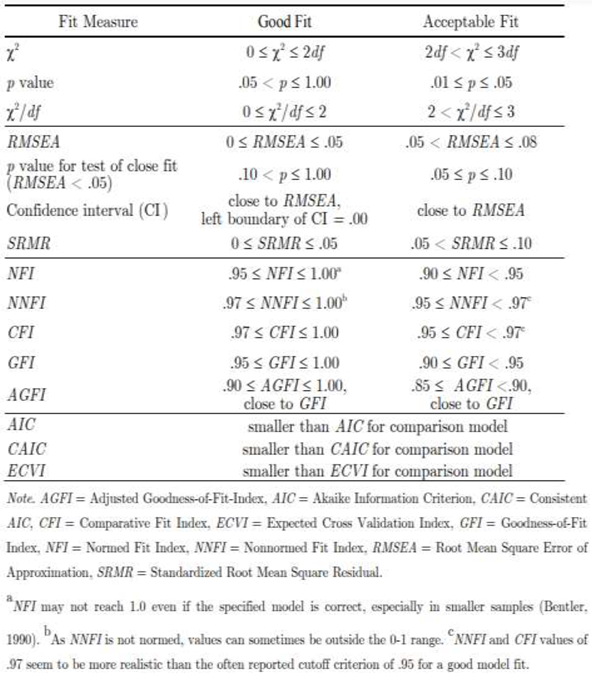
The adequacy of the model was assessed by evaluating the goodness-of-fit indices based on established criteria (Schermelleh-Engel & Moosbrugger, 2003):
Table 3.
Recommendations for Model Evaluation: Rules of Thumb
 |
Data analysis, except for Structural Equation Modeling (SEM), was performed using the SPSS 25 in the study.
3. Findings and Comment
3.1. Findings Describing The Participants
The figure below illustrates the personality types of individuals engaged in online shopping.
Figure 4.
Distribution of personality types of online shoppers.
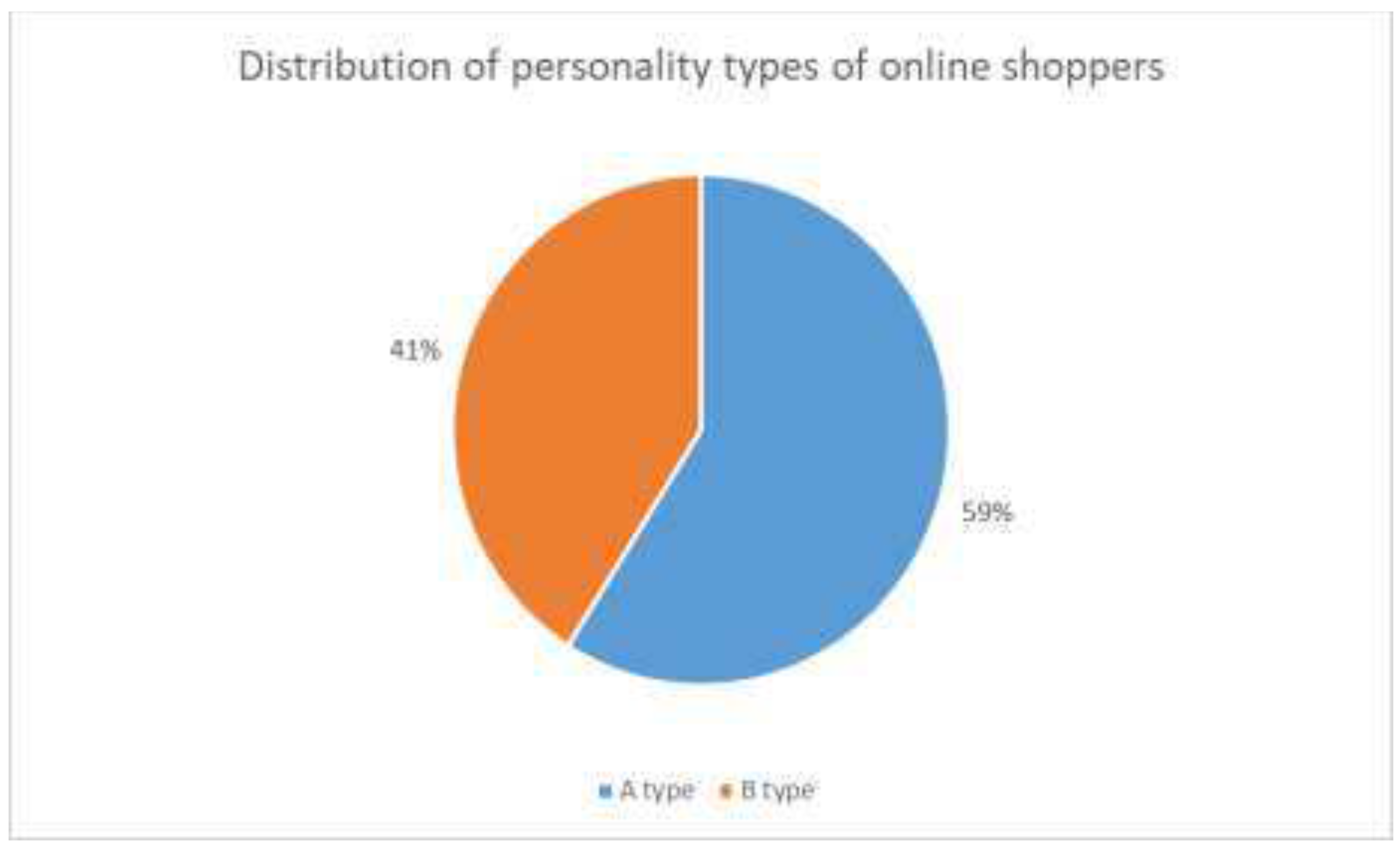
It was found that the majority of online shoppers displayed type A personality traits. On the other hand, it was found that the majority of individuals who do not engage in online shopping also displayed type A personality traits.
In the study, participants were asked about their most frequently used sites or applications for online shopping. The majority of participants reported that they used the following platforms, respectively: Trendyol.com, Hepsiburada.com, websites with physical stores, N11.com, Amazon.com, other sites, Alibaba.com, and eBay.com (Table 4). It was found that the most commonly used platform for online shopping was Trendyol. Furthermore, participants were also asked which needs were primarily met through online shopping. The majority of participants reported the following needs, respectively: clothing, personal care products, education-related items, technology/electronics, household goods/furniture/appliances, food market items, non-food market items, DIY market/hand tools, health-related products, and various spare parts and other miscellaneous needs (Table 5).
3.2. Findings on The Model
Figure 5 shows the model emerged as a result of the SEM analysis. Goodness-of-fit indices were also compared with the values in Table 3 to determine the acceptance of the model.
The examination the goodness-of-fit indices in the model showed that the values indicated a acceptable fit (χ2/df= 2.248, p=0.000; RMSEA=0.051; GFI=0.878; AGFI=0.856; CFI=0.950; NFI=0.914). These results indicated that the tested model met the necessary criteria for a good fit, indicating its validity and accuracy. The fit indexes of the verified structural model is shown in Table 6.
Based on the results of the SEM analysis, the explained variance values of the dependent variables are found to be significant at the p<0.05 level. The evaluation of the hypotheses is as follows:
H1: Personal FoMO (β= 0.28) was observed to positively and significantly affect online shopping addiction. The hypothesis that personal FoMO affects online shopping addiction is accepted. Personal FoMO positively affects online shopping addiction. Personal FoMO has a stronger effect on online shopping addiction than social FoMO.
H2: Social FoMO (β= 0.16) positively and significantly affects online shopping addiction. And it has a positive impact. The hypothesis “Social FoMO has an impact on online shopping addiction.” was accepted.
H3: Personal FoMO (β = 0.23) has a positive and significant effect on cognitive load searching. There is a positive and linear relationship between cognitive load seeking and Personal FoMO. The hypothesis that personal FoMO has an effect on cognitive load searching was accepted.
H4: Personal FoMO (β = 0.23) has a positive and significant effect on cognitive load for searching. There is a positive and linear relationship between cognitive load seeking and Personal FoMO. The hypothesis that personal FoMO has an effect on cognitive load for searching was accepted.
H5: Personal FoMO has a positive and significant effect on cognitive load for paying (β = 0.12). Personal FoMO significantly affects cognitive load for paying. The hypothesis “Personal FoMO has an impact on Cognitive load for paying.” was accepted.
H6: Social FoMO (β= -0.15) negatively and significantly affects cognitive load for searching. There is a negative effect between social FoMO and cognitive load for searching. The hypothesis “Social FoMO has an impact on Cognitive load for searching.” was accepted.
H7: Social FoMO (β= -0.10) negatively and significantly affects cognitive load for purchase. The hypothesis “Social FoMO has an impact on Cognitive load for purchase.” was accepted.
H8: Social FoMO was observed to have no effect on cognitive load for paying. The hypothesis “Social FoMO has an impact on Cognitive load for paying.” was rejected.
H9: Personality types have a negative and significant effect on personal FoMO (β= -0.12). The hypothesis “Personality type has an impact on Personal FoMO.” was accepted.
H10: Age was observed to have no effect on individual FoMO. The hypothesis that “Age has an impact on Personal FoMO.” was rejected.
H11: We examined at whether the monthly number of online shopping has an effect on personal FoMO, but no effect was observed. The hypothesis that “Number of shopping has an impact on Personal FoMO.” was rejected.
H12: The effect of gender on personal FoMO has been investigated and not observed. Therefore, the hypothesis “Gender has an impact on Personal FoMO.” was rejected.
H13: The effect of gender on personal FoMO has been investigated and not observed. Therefore, the hypothesis “Personality type has an impact on Social FoMO.” was rejected.
H14: The effect of age on social FoMO was also examined. As a result of the analysis, it was observed that there was no effect. The hypothesis that “Age has an impact on Social FoMO.” was rejected.
H15: The effect of the monthly numbers of online shopping of the participants on their Social FoMOs was examined. It has been determined that the amount of online shopping has a negative and significant effect on Social FoMO (β= -0.10). The hypothesis “Number of shopping has an impact on Social FoMO.” was accepted.
H16: The effect of gender on Social FoMO was investigated and it was observed that there was no effect in this direction. Therefore, the hypothesis that “Gender has an impact on Social FoMO.” was rejected.
H17: Cognitive load for searching does not affect online shopping addiction. It has been determined that cognitive load has no effect on online shopping addiction while searching for the desired product in online shopping. The hypothesis that “Cognitive load for searching has an impact on online shopping addiction.” was rejected.
H18: Cognitive load for puchase does not affect online shopping addiction. It is seen that the cognitive load that occurs in the process of obtaining what is desired in online shopping has no effect on online shopping addiction. The hypothesis that “Cognitive load for purchase has an impact on online shopping addiction.” was rejected.
H19: Cognitive load for paying (β = 0.13) positively and significantly affects online shopping addiction. For payment status, cognitive load for paying has a directly proportional effect with online shopping addiction. The hypothesis that “Cognitive load for paying has an impact on online shopping addiction.” was accepted.
H20: Gender (β = 0.14) positively and significantly affects online shopping addiction. The hypothesis that “Gender has an impact on online shopping addiction.” was accepted.
H21: The monthly numbers of online shopping (β = 0.15) positively and significantly affects online shopping addiction. It has been determined that the monthly numbers of online shopping of online shoppers has a positive effect on online shopping addiction. For this reason, the hypothesis that " Number of shopping has an impact on online shopping addiction." was accepted.
H22: It was investigated whether the age variable affects online shopping addiction and it was observed that it did not. Based on this result, the hypothesis " Age has an impact on online shopping addiction." was rejected.
H23: Personality types in online shopping do not affect online shopping addiction. The hypothesis that “Personality type has an impact on online shopping addiction.” was rejected.
The results suggested that the proposed model, which examined the relationship between online shopping addiction, FoMO, cognitive load, personality types, gender, and monthly shopping amount, was valid. The findings supported the validity of the model in explaining the patterns of these relationships.
4. Conclusions, Discussion and Recommendations
Advancements in technology, processes, and user experiences have led to the spread of various applications (Deloitte.Digital & TÜSİAD, 2022). As a result, the market has made significant progress towards becoming mainly online. This shift towards digital platforms has influenced the online purchasing habits of different age groups. Users between the ages of 16-24 showed a higher preference and interest in online shopping, while users aged 55-64 also started taking on e-commerce at a faster pace (Deloitte.Digital & TÜSİAD, 2022). Several factors were identified as influential in this context, including FoMO (Argan & Tokay-Argan, 2018; Bekman, 2022; Korkmaz & Dal, 2020; İşcan et al., 2022; Şahin & Çavuş, 2020), personality types (Aydın, 2022; Sönmez, 2019), cognitive load (Aydın, 2022), gender (Üster, 2014), shopping amount (Beziroğlu, 2018), and online shopping addiction (Üster, 2014).
This study focused on adult individuals, particularly those in their twenties, who engage in online shopping. This age group was selected because studies in the literature report that compulsive buying disorders, such as online shopping addiction, often develop during late adolescence or early adulthood and can become chronic over time (Black, 2007). Furthermore, individuals in their twenties typically have their own bank accounts, personal finances, and credit cards. This means a shift from relying on pocket money to earning their own income. This period marks a significant transition where individuals have new autonomy in spending (Bal & Okkay, 2022). Additionally, since income status was found to be associated with FoMO (Bekman, 2022), it was considered necessary to collect information about participants' income status in order to examine its potential impact on shopping behavior. The findings of this study revealed that most of the participants shopping online were women, in university and single. They preferred to shop using both websites and mobile apps. They typically shopped three times a month or less, and their monthly household income was between 10,000 TRY and 20,000 TRY. It was also found that people between the ages of 21 and 30, who were considered to have a type A personality, spend around three to five hours on the internet, including their online shopping time. However, it was found in another study that 63.3% of people who usually shop in physical stores shop online less than once a month, while 45.3% of online shoppers make purchases a few times a month (Saygılı & Sütütemiz, 2017).
Although online shopping is rapidly becoming widespread, many people do not prefer to shop online due to the fact that it is different from traditional shopping habits and due to the uncertainties in the internet environment (Algür & Cengiz, 2011). Although those who did not shop online were not included in the study, their information was still considered. Although the number of people who do not shop is generally low, important to understand the general characteristics of these individuals in the digital age and explore ways to include them in the online shopping system. After all, these people have potential in terms of marketing.
This study identified several popular websites and applications for online purchases, including Trendyol.com, Hepsiburada.com, sites with physical stores, N11.com, Amazon.com, and other platforms, Alibaba.com and ebay.com. In addittion, as of March 2023, the most frequently visited e-commerce and shopping websites in Türkiye were Trendyol.com, Sahibinden.com, Hepsiburada.com, Amazon.com.tr, and Akakçe.com (similarweb, 2023b). Furthermore, in global Google searches, Amazon ranked as the most searched e-commerce platform (Kemp, 2023). As of March 2023, the most popular e-commerce and shopping websites worldwide were Amazon.com, eBay.com, Amazon.co.jp, Rakuten.co.jp, Etsy.com, and AliExpress.com. Particularly, eBay.co.uk ranked 17th, Trendyol.com ranked 28th, Sahibinden.com ranked 34th, and Alibaba.com ranked 44th (similarweb, 2023a).
This study also revealed that participants engaged in online shopping to fulfill various needs. The most common product categories were clothing, personal care items, education-related purchases, technology products, household goods/furniture/appliances, groceries, non-food items, DIY materials/hand tools, health products, and various spare parts. It was reported in a study that the most purchased product categories for online shoppers were "clothing and shoes," "books, magazines, and stationery," and "banking services," while traditional shoppers primarily purchased "technology products" (computers, cameras, mobile phones, etc.), "books, magazines, and stationery," and "travel tickets" (Saygılı & Sütütemiz, 2017). Based on estimated annual expenditure, the ranking of online consumer goods included fashion, electronics, toys, hobbies, DIY materials, furniture, personal and home care products, food, beverages, and physical media (Kemp, 2023). In Türkiye specifically, the most commonly purchased items online were clothing, shoes, and accessories (71.3%), followed by deliveries from restaurants, fast food chains, and catering companies (50.2%), food products (41.9%), cleaning and personal care products (28.7%), and beauty and health products (27.4%) (TÜİK, 2022).
In addition, this study highlighted the significant relationship between FoMO, cognitive load, personality types, gender, monthly shopping amount, and online shopping addiction among individuals shopping online Although age was thought to have an effect while creating the model, it was seen that there was no effect in the last stage and it was removed from the model. While individuals' cognitive load while searching and receiving during their online shopping did not have an effect on online shopping addiction; It was found that cognitive loading during payment has a significant effect on online shopping addiction. This result shows that while the cognitive load for payment increases, online shopping addiction increases and significantly affects it. Time and product diversity are among the perceived advantages in online shopping, and the concern about sharing identity and credit card information, which is seen as a perceived risk (Algür & Cengiz, 2011), will cause excessive effort in online shopping. This concern makes them more cautious and increases the cognitive load when making online payments. Cognitive overload, influenced by factors such as social anonymity and excessive visual stimuli (images, animations, pop-up applications, notifications), weakens self-control and facilitates an increase in online shopping addiction. Cognitive overload was identified as a predictor of online shopping addiction (Rose & Dhandayudham, 2014). Moreover, this study provided insights into the factors that users prioritize to facilitate their online purchasing processes in Türkiye (Kemp, 2023). These factors include:
- Free delivery (57.3%)
- Easy return policy (49.4%)
- Coupons and discounts (43.5%)
- Fast and easy payment (34.8%)
- Customer comments (34.7%)
- Next day delivery (34.2%)
- Likes or positive comments on social media accounts (27.1%)
- Cash on delivery option (26.4%)
- Loyalty points (26.0%)
- Company appearing environmentally friendly (21.6%)
- Interest-free payment option (21.1%)
- Live chat support (19.5%)
- Membership-free ordering feature (18.9%)
- In-store pickup option (17.9%)
- Exclusive content or services (15.8%)
These data can be used to address cognitive load, FoMO, and online shopping addiction, and to design online shopping experiences to address users' preferences and needs.
While it is important to reduce cognitive load in e-commerce, it is also necessary to consider the question of whether it causes individuals to become addicted to online shopping. There is a delicate balance here since the motto of cognitive load is "don't make me think", while online addiction has a situation "without thinking about it, unconsciously". It's crucial not to overlook the fact that minimizing exhaustion and effort during e-commerce can unintentionally contribute to online shopping addiction.
The study revealed a significant and inverse relationship between personality types and personal FoMO. However, no relationship was observed between personality types and social FoMO. While the level of FoMO differs among individuals, it has an impact on purchasing behavior (Bekman, 2022). Individual differences in FoMO can be attributed to varying personality types (Rozgonjuk et al., 2021). When individuals are evaluated considering physiological, psychological, biological, and sociological aspects (Luthans, 1995), personality types influences personal FoMO, considering factors such as inheritance and bodily structure (Çetin & Beceren, 2007), which contribute to the formation of personality. Also, personality type appears to have an impact on online shopping addiction via Personal FoMO. There isn’t direct a connection between personality types and online shopping addiction. In this case, personality types affect online shopping addiction weakly (Rose & Dhandayudham, 2014). Personality traits are enduring psychological characteristics that remain stable over time (Mount et al., 2005). Studies have identified that personality traits, environmental factors, and characteristics of online retail contribute to the prediction of online shopping addiction (Chen & Zhang, 2015; Yang, 2021).
FoMO (personal FoMO and social FoMO) has a significant and positive impact on online shopping addiction. Individuals who experience FoMO tend to exhibit higher levels of online shopping addiction. In fact, 60% of people shop online due to FoMO and often make purchases within 24 hours (Taheer, 2023). This increased shopping behavior is believed to contribute to the development of online shopping addiction. FoMO, a psychological phenomenon (Song et al., 2017), can lead individuals to use excessive internet use as a form of self-medication (Kandell, 1998). While many people who spend excessive time online may not become dependent on the internet itself, they may utilize the online environment to engage in other addictive behaviors (Pontes et al., 2015). Addicted individuals tend to rely on the internet to fulfill their problematic shopping tendencies (Zhao et al., 2017). In addition, Kerse and Yüce (2022) discovered that FoMO has a positive influence on online compulsive buying behavior.
Gender differences exist in terms of both online shopping addiction and the experience of FoMO. There is a positive and consistent, relationship between the gender and online shopping addiction. In this sense, Rose and Dhandayudham (2014) highlighted the predictive role of being a woman in the development of online shopping addiction. In addition, Üster (2014) found that women displayed higher levels of uncontrolled purchasing tendencies compared to men. Birincioğlu (2021) also observed that women, in particular, were more prone to shopping addiction compared to men. In addition, it was found in the study that gender did not have a direct effect on FoMO.
A linear relationship between the frequency of monthly online shopping and online shopping addiction was found in the study. As individuals engage in more frequent online shopping, the risk of shopping addiction increases (Birincioğlu, 2021). According to TÜİK (2022) data, a significant majority of people in Türkiye (82.7%) used the internet regularly, often multiple times a day, which had a direct impact on online shopping behavior. Excessive use of mobile internet was found to have a positive effect on shopping addiction (Özçelik et al., 2017). In addition, the amount of time spent shopping on a weekly basis significantly predicted the compulsive purchasing scores among individuals (Beziroğlu, 2018). In addition, it was determined in the study that the amount of monthly shopping has a linear and negative effect on social FoMO, while it has no effect on personal FoMO.
Online shopping addiction is influenced by various factors, including both internet-related variables and user-related variables (Doğan Keskin & Günüç, 2017). The impact of gender and the frequency of online shopping on online shopping addiction supports this notion since these factors are interconnected. Gender differences can vary based on the extent of online shopping (Birincioğlu, 2021).
This study found a positive relationship between cognitive load (searching, purchase and paying) and personal FoMO, and a negative relationship between searching and purchase for cognitive load and social FoMO. Another result is that social FoMO has no effect on cognitive load at the payment stage. Cognitive load is assessed through indicators such as mental effort, mental load, and performance (Paas & Van Merriënboer, 1994). When individuals achieve high performance with low mental effort, the effectiveness of the environment is high, whereas low performance despite high mental effort indicates a low effectiveness of the environment (Paas & Van Merriënboer, 1993). This finding explains the relationship between social FoMO and cognitive load. In multimedia tasks, cognitive overload can burden users mentally as they attempt to establish and manage connections (Kılıç Çakmak, 2007). Experiencing negative effects of excessive mental workload can result in poor performance in complex tasks (Paas and Van Merriënboer, 1993). Stress and cognitive overload can contribute to mental and physical health issues such as depression or anxiety (Caldiroli et al., 2022).
In the present study, the factors affecting individuals' online shopping orientations were tried to be revealed by a structural equation modeling. This study provides valuable insights into the relationship between online shopping addiction and cognitive load, personality types, FoMO, gender, and monthly online shopping frequency. These findings can serve as a guide for future research in this area.
Author Contributions
Conceptualization, O.O. and P.E.; methodology, O.O. and P.E.; softwares, O.O.; validation, O.O. and P.E.; formal analysis, O.O.; investigation, P.E..; resources, P.E.; writing—original draft preparation, , O.O. and P.E.; writing—review and editing, O.O.; visualization, , O.O. and P.E.; supervision, O.O..; All authors have read and agreed to the published version of the manuscript
Funding
This research received no external funding.
References
- Abel, J. P., Buff, C. L., & Burr, S. A. (2016). Social media and the fear of missing out: Scale development and assessment. Journal of Business & Economics Research (JBER), 14(1), 33-44. [CrossRef]
- Algür, S., & Cengiz, F. (2011). Türk tüketicilere göre online (çevrimiçi) alışverişin riskleri ve yararları [The risk and benefit perceptions of online shopping according to the Turkish consumers]. Journal of Yaşar University, 6(22), 3666-3680.
- Alkış, N. (2016). BAYES yapısal eşitlik modellemesi: Kavramlar ve genel bakış [BAYESIAN structural equation modeling: Concepts and a general overview]. Gazi İktisat ve İşletme Dergisi [Gazi Journal of Economics and Business], 2(3), 105-116.
- Alt, D. (2015). College students’ academic motivation, media engagement and fear of missing out. Computers in Human Behavior, 49, 111-119. [CrossRef]
- Argan, M., Tokay Argan, M., & İpek, G. (2018). I wish I were! Anatomy of a fomsumer [Keşke olsaydım! Bir fomo tüketicinin (fomsumer) anatomisi]. İnternet Uygulamaları ve Yönetimi Dergisi [Journal of Internet Applications and Management], 9(1), 43-57. [CrossRef]
- Argan, M., & Tokay-Argan, M. (2018). Fomsumerism: A theoretical framework. International Journal of Marketing Studies, 10(2), 109-117. [CrossRef]
- Armstrong, A., & Kotler, D. (2015). Principles of Marketing 6e. Pearson Australia Group Pty Ltd.
- Aslan, S., (2008). Kişilik, huy ve psikopatoloji [Personality, temperament and psychopatology]. Psikiyatride Derlemeler, Olgular ve Varsayımlar [Reviews, Cases and Hypotheses in Psychiatry], 2(1-2), 7-18.
- Aydın, B. (2022). Dijital pazarlamada online kullanıcı deneyimi: anne bebek sektörü örneği [Online user experience in digital marketing: The case of the mother-baby industry] (Unpublished master’s thesis). Maltepe University Social Sciencens Graduate School.
- Bal, F., & Okkay, İ. (2022). İnternet tabanlı sorunlu alışveriş davranışı: Çevrimiçi alışveriş bağımlılığı [Internet-based problem shopping behavior: Online shopping addiction]. Bağımlılık Dergisi [Journal of Dependence], 23(1), 111-120. [CrossRef]
- Balcı, A. (2009). Sosyal bilimlerde araştırma yöntem, teknik ve ilkeleri [Research methods, techniques and principles in Social Sciences] (7th ed.). Pegem Akademi Publishing.
- Bekman, M. (2022). The effect of FoMO (Fear of Missing Out) on purchasing behavior in public relations practices. Journal of Selçuk Communication, 15(2), 528-557. [CrossRef]
- Beziroğlu, M. (2018). Kompulsif satın alma, bilişsel duygu düzenleme ve davranışsal inhibisyon, davranışsal aktivasyon sistemi arasındaki ilişkiler [Relationship between compulsive buying, cognitive emotion regulation, behavioral inhibition and behavioral activation system]. (Unpublished master’s thesis) Maltepe University Institute of Social Sciences.
- Birincioğlu, F. N. (2021). Alışveriş bağımlılığı ve kişilik tipleri arasındaki ilişkinin incelenmesi [Examining the relationship between shopping addiction and personality types]. (Unpublished master’s thesis). İstanbul Sabahattin Zaim Üniversitesi Lisansüstü Eğitim Enstitüsü [Istanbul Sabahattin Zaim University Graduate School of Education].
- Black, D. W. (2007). Compulsive buying disorder: A review of the evidence. CNS Spectrums, 12(2), 124-132. [CrossRef]
- Bortner, R. W. (1969). A short rating scale as a potential measure of pattern a behavior. Journal of Chronic Diseases, 22(2), 87-91. [CrossRef]
- Bulunmaz, B. (2016). Gelişen teknolojiyle birlikte değişen pazarlama yöntemleri ve dijital pazarlama [Evolution in marketing methods with developing technology and digital marketing] TRTAkademi, 1(2), 348-365.
- Büyüköztürk, Ş., Kılıç Çakmak, E., Akgün, Ö. E., Karadeniz, Ş., & Demirel, F. (2016). Bilimsel araştırma yöntemleri [Scientific research methods] (21st ed.). Pegem Akademi Publishing.
- Caldiroli, C. L., Gasparini, F., Corchs, S., Mangiatordi, A., Garbo, R., Antonietti, A., & Mantovani, F. (2022). Comparing online cognitive load on mobile versus PC-based devices. Personel and Ubiquitous Computing, 27, 495-505. [CrossRef]
- Chen, Y., & Zhang, L. (2015). Influential factors for online impulse buying in China: A model and its empirical analysis. International Management Review, 11(2), 57-60.
- Činjarević, M. (2010). Cognitive and affective aspects of impulse buying. Sarajevo Business and Economics Review, 30, 168-184.
- Civek, F., & Ulusoy, G. (2020). X ve Y kuşağı tüketicilerin nomofobik eğilimlerinin çevrimiçi alışveriş bağımlılığı ile olan ilişkisinin belirlenmesi [Determining the relationship between nomophonic intentions of X and Y generation consumers and online Marketing]. Turkish Studies-Social, 15(1), 141-156. [CrossRef]
- Çelik, F., & Özkara, B. Y. (2022). Gelişmeleri kaçırma korkusu (FoMO) ölçeği: Sosyal medya bağlamına uyarlanması ve psikometrik özelliklerinin sınanması [Fear of Missing Out (FoMO) scale: Adaptation to social media context and testing its psychometric properties]. Psikoloji Çalışmaları [Studies in Psychology], 42(1), 71-103. [CrossRef]
- Çetin N. G., & Beceren, E. (2007). Lider kişilik: Gandhi. Süleyman Demirel Üniversitesi Sosyal Bilimler Enstitüsü Dergisi. 3(5), 110-132.
- Deloitte.Digital & TÜSİAD. (2022). E-ticaretin öne çıkan başarısı, tüketici davranışlarında değişim ve dijitalleşme [The outstanding success of e-commerce, change in consumer behavior and digitalization]. Deloitte.Digital. 1-138.
- Doğan Keskin, A., & Günüç, S. (2017). Testing models regarding online shopping addiction. Addicta: The Turkish Journal on Addictions, 4(2), 221-242. [CrossRef]
- Durna, U. (2005). A Tipi ve B Tipi kişilik yapıları ve bu kişilik yapılarını etkileyen faktörlerle ilgili bir araştırma [A research on Type A and Type B personality structures and the factors affecting these personality structures]. Atatürk Üniversitesi İktisadi ve İdari Bilimler Dergisi [Journal of Economics and Administrative Sciences], 19(1), 275-290.
- Fırın, S., & Sevim, Ş. (2022). Kişilik özelliklerinin yenilikçi davranış etkisi üzerine bir araştırma [A research on the effect of personality traits on innovative behavior]. İşletme Araştırmaları Dergisi [Journal of Busıness Research-Türk], 14(2), 1189-1200. [CrossRef]
- Friedman, M., & Rosenman, R. H. (1959). Association of specific overt behavior pattern with blood and cardiovascular findings: Blood cholesterol level, blood clotting time, incidence of arcus senilis, and clinical coronary artery disease. Journal of the American Medical Association, 169(12), 1286-1296. [CrossRef]
- Friedman, M., & Rosenman, R. H. (1974). Type A behavior and your heart. Knopf.
- Griffin, R. W., & Moorhead, G. (2014). Organizational Behavior: Managing People and Organizations (Eleventh Edition). South-Western, Cengage Learning.
- Griffiths, M. (2005). A “components” model of addiction within a biopsychosocial framework. Journal of Substance Use, 10(4), 191-197. [CrossRef]
- Günüç, S., & Doğan Keskin, A. (2016). Online shopping addiction: Symptoms, causes and effects. Addicta: The Turkish Journal on Addictions, 3(3), 353-364. [CrossRef]
- Güven, A. (2021). Multidisipliner bir kavram olarak “Fear of missing out” (Fomo): Literatür taraması [Fear of missing out (Fomo) as a multidisciplinary concept: Literature review]. Hatay Mustafa Kemal Üniversitesi Sosyal Bilimler Enstitüsü Dergisi [Mustafa Kemal University Journal of Social Sciences Institute], 18(48), 99-124.
- Hair Jr., J. F., Black, W. C., Babin, B. J., & Anderson, R. E. (2014). Multivariate Data Analysis (Seventh Edition, Pearson New International Edition). Pearson Education Limited.
- İşcan, R. V., Kapusuz, N., Bazancır, S., Bayram, İ., & Durukan, T. (2022). Sosyal medya fenomen bağlılığının tüketicilerin kaçırma korkusu (FoMO) ve satın alma niyetlerine etkisi [The effect of social media phenomena commitment on consumers' fear of missing out (FoMO) and purchase ıntention]. International Academic Social Resources Journal, 7(42), 1219- 1228. [CrossRef]
- Kandell, J. J. (1998). Internet addiction on campus: The vulnerability of college students. CyberPsychology & Behavior, 1(1), 11-17. [CrossRef]
- Karagöz, Y. (2016). SPSS 23 ve AMOS 23 Uygulamalı İstatistiksel Analizler [SPSS 23 and AMOS 23 Applied Statistical Analysis]. Nobel Akademik Publishing.
- Kemp, S. (2023, 26 January). Digital 2023: Global overview report. Datareportal. https://datareportal.com/reports/digital-2023-global-overview-report.
- Kerse, Y., & Yüce, A. (2022). FoMO ve online kompulsif satın alma: Sosyal medya fenomenleri tüketicilerin kaygılarını ve takıntılarını tetikliyor mu? [FoMO and online compulsive buying: Do social media ınfluencers trigger consumers' anxiety and obsession?]. Karamanoğlu Mehmetbey Üniversitesi (KMÜ) Sosyal ve Ekonomik Araştırmalar Dergisi [KMU Journal of Social and Economic Research], 24(43), 704-716.
- Kılıç Çakmak, E. (2007). Çoklu ortamlarda dar boğaz: Aşırı bilişsel yüklenme [The bottle neck in multimedia: Cognitive overload]. Gazi Eğitim Fakültesi Dergisi [Gazi Eğitim Fakültesi Dergisi], 27(2), 1-24.
- Kılıç, E., & Karadeniz, Ş. (2004). Hiper ortamlarda öğrencilerin bilişsel yüklenme ve kaybolma düzeylerinin belirlenmesi [Specifying students' cognitive load and disorientation level in hypermedia]. Kuram ve Uygulamada Eğitim Yönetimi Dergisi [Educational Administration in Theory & Practice], 40, 562-579.
- Korkmaz, İ., & Dal, N. (2020). Bireysel yenilikçiliğin tüketici yenilikçiliğine etkisinde fomo’nun aracılık rolü [The mediating role of FoMO in the effect of individual innovativeness on consumer innovativeness]. Pazarlama ve Pazarlama Araştırmaları Dergisi [The Journal of Marketing and Marketing Research], 13(3), 532-567.
- Kuss, D. J., Griffiths, M. D., & Binder, J. F. (2013). Internet addiction in students: Prevalence and risk factors. Computers in Human Behavior, 29(3), 959–966.
- Leblebicioğlu, B., & Aysuna Türkyılmaz, C. (2022). Understanding the moderator role of COVID-19 pandemic anxiety on the relationship between internet addiction and online shopping addiction. Marmara Üniversitesi İktisadi ve İdari Bilimler Dergisi [Marmara University Journal of Economic and Administrative Sciences ], 44(1), 104-118. [CrossRef]
- Li, H., Ma, X., Fang, J., Liang, G., Lin, R., Liao, W., & Yang, X. (2023). Student stress and online shopping addiction tendency among college students in Guangdong Province, China: The mediating effect of the social support. International Journal of Environmental Research and Public Health, 20(1), 176. [CrossRef]
- Luthans, F. (1995). Organizational Behaviour. Literatür Publications.
- Luthans, F. (2011). Organizational Behavior: An evidence-based approach (12th Edition). McGraw-Hill/Irwin.
- Mantovani, F. (2001). Cyber-attraction: The emergence of computer-mediated communication in the development of interpersonal relationships. In L. Anolli, R. Ciceri, & G. Riva (Eds.), Say not to say: New perspectives on miscommunication (pp. 236-250). IOS Press.
- Maslow, A. H. (1943). A theory of human motivation. Psychological Review, 50(4), 370-396. [CrossRef]
- Maslow, A. H. (1958). A Dynamic Theory of Human Motivation. In C. L. Stacey & M. DeMartino (Eds.), Understanding human motivation (pp. 26-47). Howard Allen Publishers. [CrossRef]
- Mavili Aktaş, A. (2001). Bir kamu kuruluşunun üst düzey yöneticilerinin iş stresi ve kişilik özellikleri [Stress levels and characteristics of personalities of top level managers of the government sector]. Ankara Üniversitesi Siyasal Bilgiler Fakültesi Dergisi [Ankara Univerity SBF Journal], 56(4), 25-42. [CrossRef]
- Morgan, C., & Cotten, S. (2003). The relationship between internet activities and depressive symptoms in a sample of college freshmen. CyberPsychology & Behavior, 6(2), 133-142. [CrossRef]
- Mount, M. K., Barrick, M. R., Scullen, S. M., & Rounds, J. (2005). Higher-order dimensions of the big five personality traits and the big six vocational interest types. Personal Psychology, 58(2), 447-478. [CrossRef]
- Mutlu, T. (2021). Sosyal medya bağımlılığı ve kişilik ilişkisi: Sosyal medya üzerinden bir uygulama [Social media addiction and personality relationship: An application through social media]. (Unpublished master’s thesis). Sakarya Üniversitesi Sosyal Bilimler Enstitüsü [Sakarya University Institute of Social Sciences].
- Müller, A. (2007). Kaufsucht/Pathologisches Kaufen: Weit verbreitet, wenig erforscht. Deutsches Ärzteblatt, 10, 468-469.
- Özçelik A. B., Gegez, E. E., & Burnaz, Ş. (2017). Mobil internet, tüketici materyalizmi ve alışveriş bağımlılığı: Alışveriş motivasyonlarının düzenleyici etkisi üzerine bir araştırma [Mobile internet, consumer materialism, and compulsive buying: An examination of the moderating role of shopping motivations]. Pazarlama Teorisi ve Uygulamaları Dergisi [Journal of Theory and Practice in Marketing], 3(2), 1-20.
- Özsoy, E. (2013). A tipi ve B tipi kişilik ile iş tatmini arasındaki ilişkinin belrlenmesne yönelik br araştırma [A research on determining the relationship between type A and type B personality and job satisfaction.]. (Unpublished master’s thesis). Sakarya Üniversitesi Sosyal Bilimler Enstitüsü.
- Paas, F. G. W. C., Renkl, A., & Sweller, J. (2004). Cognitive load theory: Instructional implications of the interaction between information structures and cognitive architecture. Instructional Science 32, 1-8.
- Paas, F. G. W. C., & Van Merriȅnboer, J. J. G. (1993). The efficiency of instrutional conditions: An approach to combine mental effort and performance measures. Human Factors, 35(4), 737-743.
- Paas, F. G. W. C., & Van Merriȅnboer, J. J. G. (1994). Instructional control of cognitive load in the training of complex cognitive tasks. Educational Psychology Review, 6(4), 351-371.
- Paas, F., Tuovinen, J. E., Tabbers, H., & Van Gerven, P. W. M. (2003). Cognitive load measurement as a means to advance cognitive load theory. Educational Psychologist, 38(1), 63-71.
- Pontes, H. M., Szabo, A., & Griffiths, M. D. (2015). The impact of Internet-based specific activities on the perceptions of Internet addiction, quality of life, and excessive usage: A cross-sectional study. Addictive Behaviors Reports, 1, 19-25. [CrossRef]
- Przybylski, A. K., Murayama, K., DeHaan, C. R., & Gladwell, V. (2013). Motivational, emotional, and behavioral correlates of fear of missing out. Computers in Human Behavior, 29(4), 1841-1848. [CrossRef]
- Rose, S., & Dhandayudham, A. (2014). Towards an understanding of internet-based problem shopping behaviour: The concept of online shopping addiction and its proposed predictors. Journal of Behavioral Addictions, 3(2), 83-89. [CrossRef]
- Rosenman, R. H., Friedman, M., Straus, R., Wurm, M., Jenkins, C. D., & Messınger, H. B. (1966). Coronary heart disease in the Western Collaborative Group study: A follow-up experience of two years. Journal of American Medical Association, 195(2), 86-92. [CrossRef]
- Rozgonjuk, D., Sindermann, C., Elhai, J. D., & Montag, C. (2021). Individual differences in Fear of Missing Out (FoMO): Age, gender, and the Big Five personality trait domains, facets, and items. Personality and Individual Differences, 171, 110546. [CrossRef]
- Saygılı, M., & Sütütemiz, N. (2017). Tüketicilerin alışveriş tarzına göre online alışverişin karşılaştırmalı analizi [Comparative analysis of online shopping according to consumers shopping style]. Researcher: Social Science Studies, 5(9), 230-243.
- Schermelleh-Engel, K., Moosbrugger, H., & Müller, H. (2003). Evaluating the fit of structural equation models: Tests of significance and descriptive goodness-of-fit measures. Methods of Psychological Research Online, 8(2), 23-74.
- similarweb. (2023a, Nisan 1). Mart 2023 tarihinde en çok ziyaret edilen e-ticaret ve alışveriş web siteleri sıralama analizi [Ranking analysis of the most visited e-commerce and shopping websites in March 2023]. https://www.similarweb.com/tr/top-websites/e-commerce-and-shopping/.
- similarweb. (2023b, Nisan 1). Türkiye genelinde mart 2023 tarihli en popüler e-ticaret ve alışveriş web siteleri sıralama analizi [Ranking analysis of the most popular e-commerce and shopping websites in Turkey in March 2023]. https://www.similarweb.com/tr/top-websites/turkey/e-commerce-and-shopping/.
- Song, X., Zhang, X., Zhao, Y., & Song, S. (2017). Fearing of missing out (foMO) in mobil social media environment: Conceptual development and measurement scale. In iConferenre 2017 Proceedings, 733-738.
- Sönmez, U. (2019). Online alışverişe yönelik satın alma tarzlarının kişilik tipleri açısından incelenmesi: Sakarya ili örneği [Investigation of purchasing styles for online shopping in terms of personality traits: Case of Sakarya province]. (Unpublished master’s thesis). Sakarya Üniversitesi İşletme Enstitüsü.
- Sümer, N. (2000). Yapisal eşitlik modelleri: Temel kavramlar ve örnek uygulamalar [Structural equation modeling: Basic concepts and applications]. Türk Psikoloji Yaziları [Turkish Psychological Review], 3(6), 49-74.
- Sweller, J., Van Merriȅnboer, J. J. G., & Paas, F. G. W. C. (1998). Cognitive architecture and instructional design. Educational Psychology Review, 10(3), 251-296.
- Şahin, E., & Çavuş, B. F. (2020). Sosyal medya algısı ve FoMO’nun tüketici satın alma davranışına etkisinin belirlenmesine yönelik bir araştırma: Selçuk Üniversitesi İktisadi ve İdari Bilimler Fakültesi örneği [A research about the fears of social media perception and FoMO on determining the effect of purchasing behavior of consumer: example of Selcuk University Faculty of Economics and Administrative Sciences]. Fırat Üniversitesi İİBF Uluslararası İktisadi ve İdari Bilimler Dergisi [Firat University International Journal of Economics and Administrative Sciences], 4(1), 149-182.
- Taheer, F. (2023, April 14). 21 FOMO statistics: Understanding the fear of missing out. TrustPulse Marketing Blog. https://trustpulse.com/fomo-statistics/.
- Tandon, A., Dhir, A., Almugren, I., AlNemer, G. N., & Mäntymäki, M. (2021). Fear of missing out (FoMO) among social media users: A systematic literature review, synthesis and framework for future research. Internet Research, 31(3), 782-821. [CrossRef]
- Turkish Statistical Institute (TÜİK). (2022). Survey on Information and Communication Technology (ICT) Usage in Households and by Individuals, 2022. https://data.tuik.gov.tr/Bulten/Index?p=Survey-on-Information-and-Communication-Technology-(ICT)-Usage-in-Households-and-by-Individuals-2022-45587.
- Üster, Z. (2014). Elektronik ortamda alışveriş yapan tüketicilerin kontrolsüz satın alma eğilimlerinin incelenmesi: İnteraktif bir uygulama [An investigation of impulsive buying tendencies of shoppers in electronic environment]. Business & Management Studies: An International Journal. 2(2), 168-187. [CrossRef]
- Yang, J. (2021). An empirical analysis of psychological factors based on EEG characteristics of online shopping addiction in e-commerce. Journal of Organizational and End User Computing, 33(6), 1-17. [CrossRef]
- Yılmaz, T., İkiz, G., & Avcı, F. M. (2022). Çevrimiçi alışveriş bağımlığı ölçeğinin Türkçe psikometrik özelliklerinin incelenmesi [Psychometric properties of Turkish online shopping addiction scale]. Bağımlılık Dergisi [Journal of Dependence], 23(2), 205-215. [CrossRef]
- Zhang, Z., Jiménez, F. R., & Cicala, J. E. (2020). Fear of missing out scale: A self-concept perspective. Psychology & Marketing, 37(11), 1619-1634. [CrossRef]
- Zhao, H., Tian, W., & Xin, T. (2017). The development and validation of the online shopping addiction scale. Frontier Psychology, 8(735), 1-9. [CrossRef]
Figure 1.
Representation of the relations of the variables with each other in the literature.
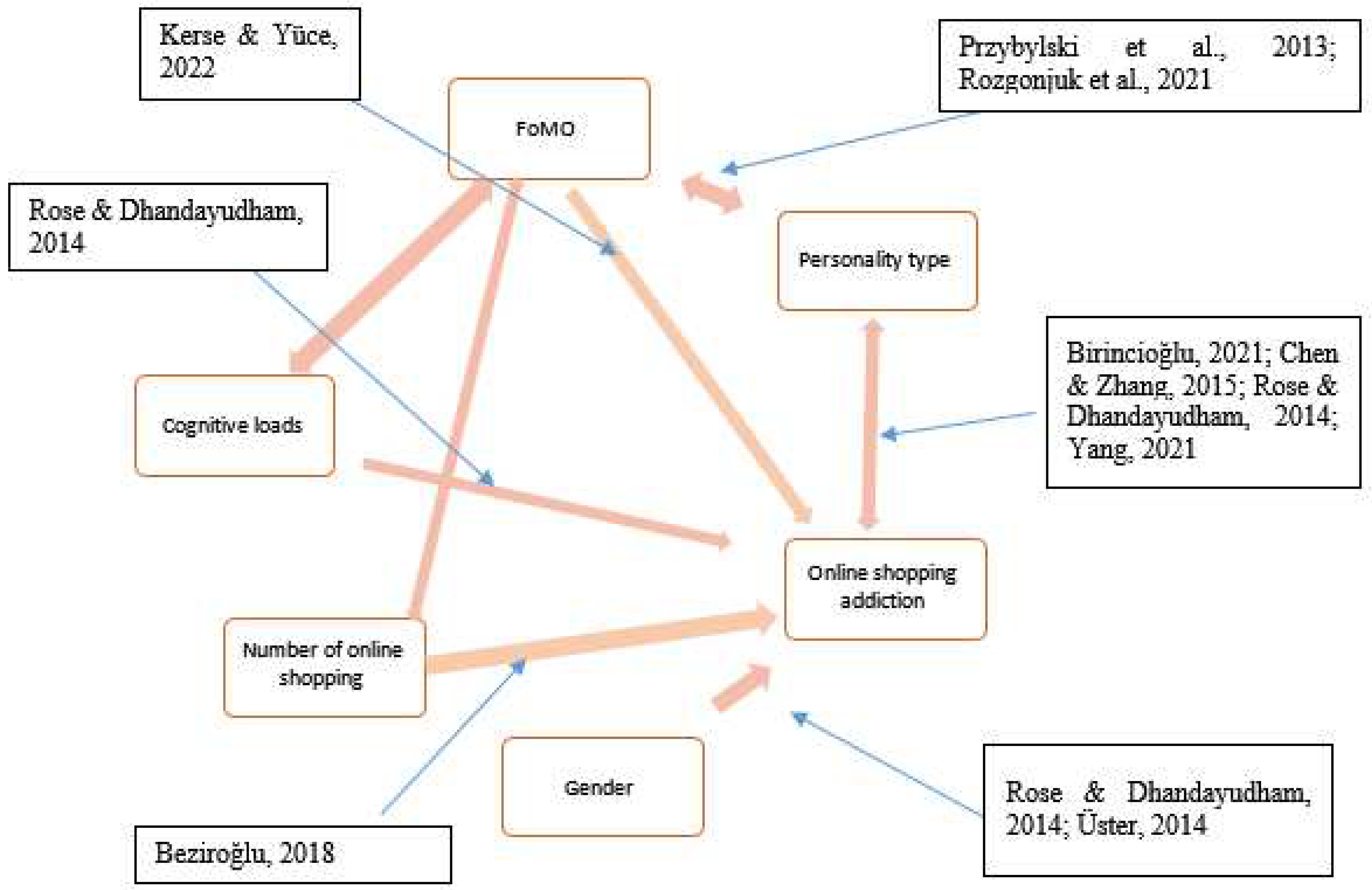
Figure 2.
The visual representation of the relationships between the variables.
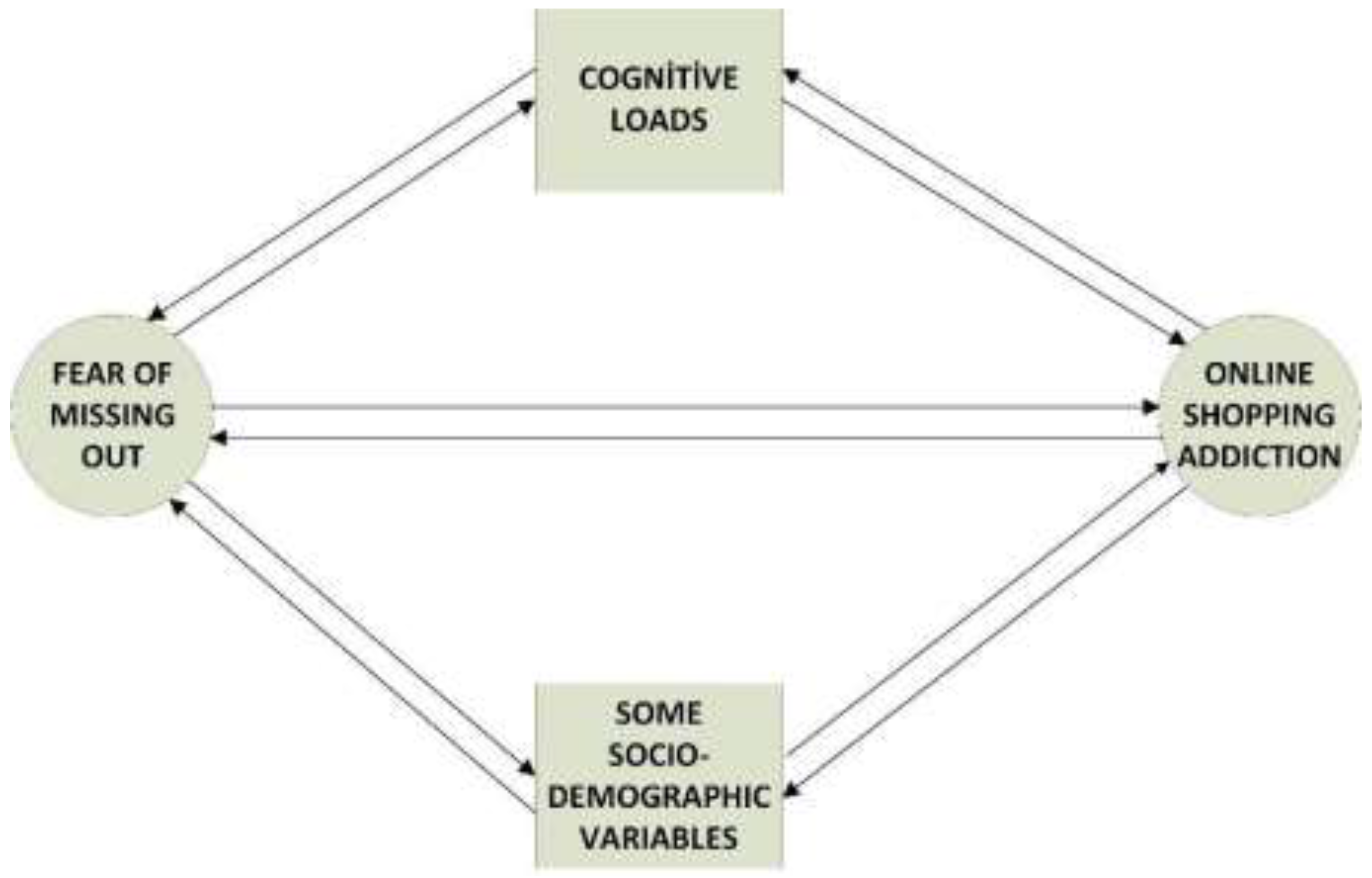
Figure 3.
The variables and relationships examined in this study.
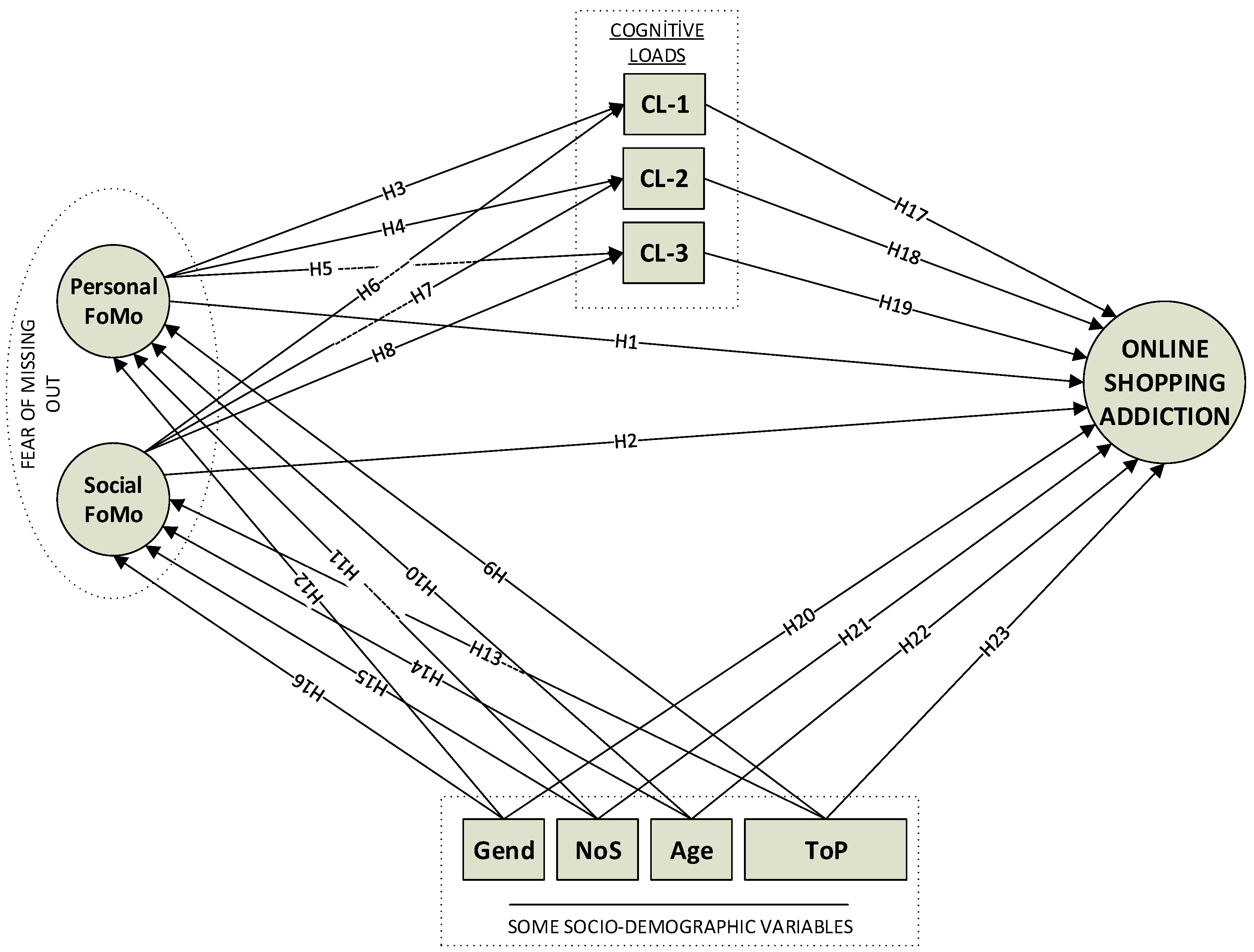
Figure 5.
The path coefficients of the verified structural model. Note: ***p<0.001, **p<0.01, **p<0.05.
Figure 5.
The path coefficients of the verified structural model. Note: ***p<0.001, **p<0.01, **p<0.05.
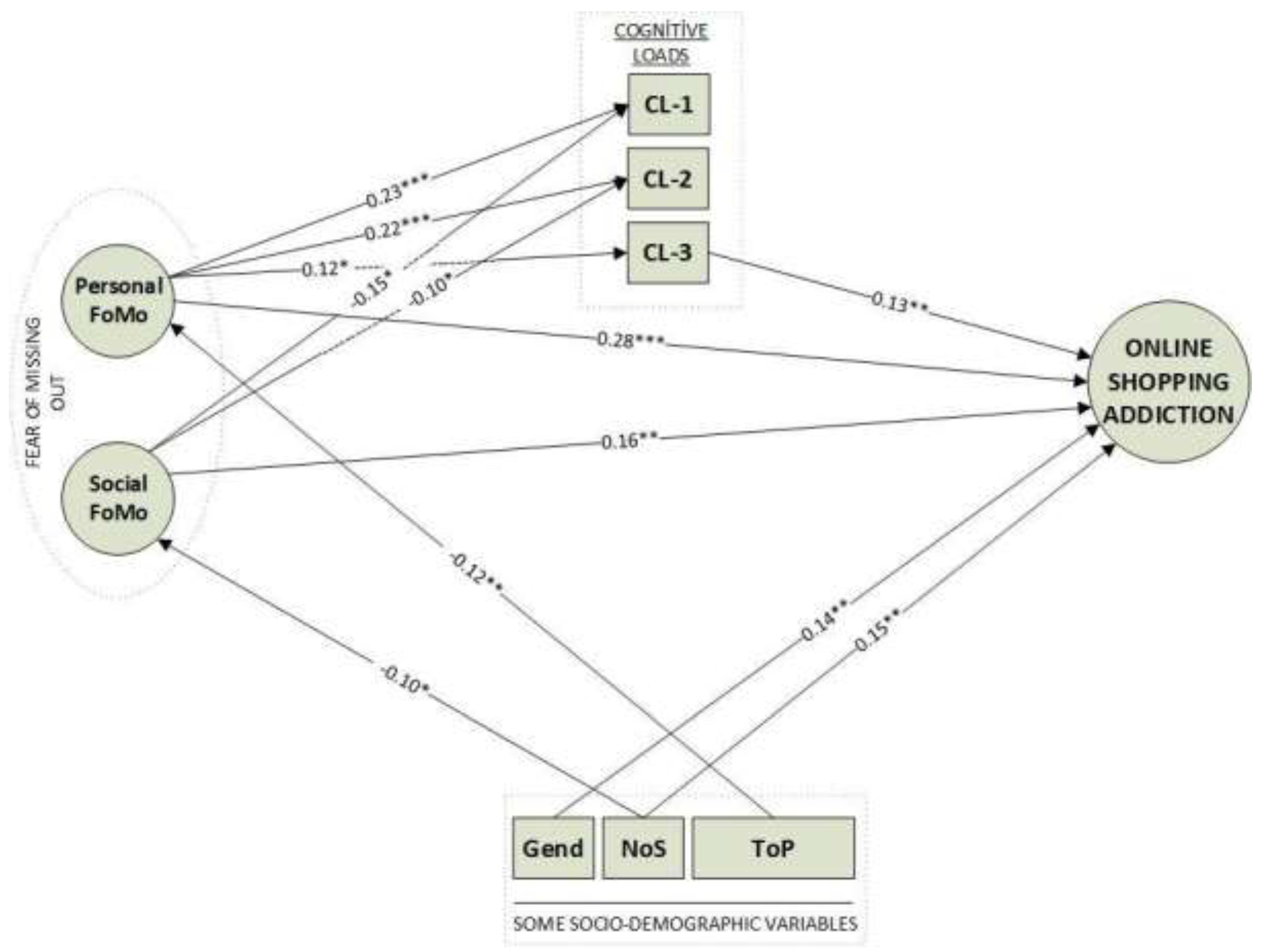
Table 2.
Demographic features.
| Gender | f | % |
|---|---|---|
| Female | 300 | 61.5 |
| Male | 188 | 38.5 |
| Marital status | ||
| Single | 283 | 58.0 |
| Married | 198 | 40.6 |
| Other | 7 | 1.4 |
| Age | ||
| 20 years and under | 88 | 18.0 |
| 21-30 years | 190 | 38.9 |
| 31-40 years | 143 | 29.3 |
| 41-50 years | 57 | 11.7 |
| 51 years and older | 10 | 2.0 |
| Household monthly total income status | ||
| Less than 10000 TL | 125 | 25.6 |
| Between 10001-20000 TL | 172 | 35.2 |
| Between 20001-30000 TL | 99 | 20.3 |
| Between 30001-40000 TL | 45 | 9.2 |
| Between 40001-50000 TL | 25 | 5.1 |
| More than 50001 TL | 22 | 4.5 |
| Number of shopping per month | ||
| 3 and less | 282 | 57.8 |
| Between 4-6 | 151 | 30.9 |
| Between 7-10 | 32 | 6.6 |
| Between 11-14 | 9 | 1.8 |
| more than 15 | 14 | 2.9 |
| Education status | ||
| Secondary school graduate | 2 | 0.4 |
| High school graduate | 111 | 22.7 |
| University student | 80 | 16.4 |
| Graduated from a Universty | 199 | 40.8 |
| Master's/PhD graduate | 96 | 19.7 |
| Online shopping preference | ||
| I prefer to do it from websites | 34 | 7.0 |
| I prefer to do it from mobile apps | 143 | 29.3 |
| I use both (web and mobile) | 311 | 63.7 |
| Daily internet usage time (including social media usage) | ||
| Less than 1 hour | 24 | 4.9 |
| 1-3 hours | 170 | 34.8 |
| 3-5 hours | 175 | 35.9 |
| More than 5 hours | 119 | 24.4 |
| Total | 488 | 100.0 |
Table 4.
The most used websites or applications for online shopping.
| Frequency | Percentage in the number of participants | Percentage of total number of answers | |
|---|---|---|---|
| Amazon | 120 | 24.59 | 9.55 |
| Alibaba | 20 | 4.10 | 1.59 |
| Hepsiburada | 309 | 63.32 | 24.58 |
| N11 | 145 | 29.71 | 11.54 |
| Trendyol | 464 | 95.08 | 36.91 |
| Ebay | 7 | 1.43 | 0.56 |
| Websites with physical store | 151 | 30.94 | 12.01 |
| Other | 41 | 8.40 | 3.26 |
| TOTAL | 1257 |
Table 5.
Most fulfilled needs with online shopping.
| Frequency | Percentage in the number of participants | Percentage of total number of answers | |
|---|---|---|---|
| Food Market | 140 | 28,69 | 7,49 |
| Non-food market | 94 | 19,26 | 5,03 |
| Technology (Phone, Computer…) | 226 | 46,31 | 12,09 |
| Household goods/furniture/white… | 161 | 32,99 | 8,61 |
| DIY market/Hand tools | 91 | 18,65 | 4,87 |
| All kinds of spare parts | 65 | 13,32 | 3,48 |
| Clothes | 425 | 87,09 | 22,74 |
| Health | 72 | 14,75 | 3,85 |
| Education | 282 | 57,79 | 15,09 |
| Personal care | 304 | 62,30 | 16,27 |
| Other | 9 | 1,84 | 0,48 |
| Total | 1869 |
Table 6.
The fit indexes of the verified structural model.
| B1 | B2 | S.E. | C.R. | p | |||
|---|---|---|---|---|---|---|---|
| Personal FoMO | <--- | Personality type | -0,119 | -0,408 | 0,137 | -2,967 | 0,003 |
| Cognitive load for paying | <--- | Personal FoMO | 0,118 | 0,156 | 0,062 | 2,514 | 0,012 |
| Social FoMO | <--- | Number of shopping | -0,098 | -0,2 | 0,079 | -2,525 | 0,012 |
| Online Shopping Addiction | <--- | Personal FoMO | 0,283 | 0,054 | 0,013 | 4,205 | *** |
| Online Shopping Addiction | <--- | Social FoMO | 0,158 | 0,034 | 0,012 | 2,763 | 0,006 |
| Online Shopping Addiction | <--- | Cognitive load for paying | 0,128 | 0,018 | 0,007 | 2,752 | 0,006 |
| Online Shopping Addiction | <--- | Gender | 0,142 | 0,093 | 0,031 | 3,017 | 0,003 |
| Online Shopping Addiction | <--- | Number of shopping | 0,154 | 0,067 | 0,021 | 3,202 | 0,001 |
| Cognitive load for searching | <--- | Personal FoMO | 0,228 | 0,307 | 0,073 | 4,204 | *** |
| Cognitive load for purchase | <--- | Personal FoMO | 0,224 | 0,286 | 0,068 | 4,19 | *** |
| Cognitive load for searching | <--- | Social FoMO | -0,147 | -0,225 | 0,071 | -3,172 | 0,002 |
| Cognitive load for purchase | <--- | Social FoMO | -0,099 | -0,144 | 0,064 | -2,244 | 0,025 |
Disclaimer/Publisher’s Note: The statements, opinions and data contained in all publications are solely those of the individual author(s) and contributor(s) and not of MDPI and/or the editor(s). MDPI and/or the editor(s) disclaim responsibility for any injury to people or property resulting from any ideas, methods, instructions or products referred to in the content. |
© 2023 by the authors. Licensee MDPI, Basel, Switzerland. This article is an open access article distributed under the terms and conditions of the Creative Commons Attribution (CC BY) license (http://creativecommons.org/licenses/by/4.0/).
Copyright: This open access article is published under a Creative Commons CC BY 4.0 license, which permit the free download, distribution, and reuse, provided that the author and preprint are cited in any reuse.


