

Submitted:
21 June 2023
Posted:
21 June 2023
You are already at the latest version
Abstract
The need to address climate change and establish sustainable urban environments has driven increased efforts in Europe to develop climate-neutral cities. This study highlights the importance of integrating solar energy technologies and nature-based solutions as key strategies to achieve climate neutrality. By examining current practices, emerging trends, and case examples, it explores the benefits, challenges, and prospects associated with the integration of solar energy and nature-based solutions in urban contexts. The study presents a pioneering approach to assess the urban heat and climate change mitigation benefits of combining building-integrated photovoltaics and nature-based solutions specifically within the European context. The results emphasize the synergistic relationship between nature-based components and solar conversion technology, identifying effective combinations for different climatic zones. In warmer regions of Southern Europe, strategies like rooftop photovoltaics on cool roofs, photovoltaics shadings, green walls, and urban trees have demonstrated effectiveness. Conversely, mid- and high-latitude European cities have seen positive impacts through the integration of rooftop photovoltaics and photovoltaics facades with green roofs and green spaces. As solar cell conversion efficiency improves, the environmental impact of photovoltaics is expected to decrease, facilitating their integration into urban environments. The study emphasizes the importance of incorporating water bodies, cool pavements, spaces with high sky-view factors, and effective planning in urban design to maximize resilience benefits. It also highlights the significance of prioritizing mitigation actions in low-income regions and engaging citizens in the development of social photovoltaics positive energy houses, resilient neighbourhoods, and green spaces. By adopting these recommendations, European cities can lead the way in creating climate-neutral urban environments that prioritize clean energy, nature-based solutions, and the overall well-being of residents. The findings underscore the need for a multidisciplinary approach that combines technological innovation, urban planning strategies, and policy frameworks to effectively achieve climate neutrality in European cities.
Keywords:
Built environment
; Climate adaptation and mitigation
; Carbon footprint
; Eco-design
; Nature-based solutions
; Resilient living spaces
; Solar energy technologies
; Sustainable urban developments
; Urban heat island
; Urban planning
1. Introduction
During COP26, the commitment to the Paris Agreement’s goal of limiting global temperature rise to below 1.5°C was reaffirmed. The need for adaptation, mitigation, financing, technology transfer, and capacity building to achieve this goal was emphasized [1]. Currently, over half of the global population lives in urban areas, and this number is projected to increase further by 2050 [2]. Consequently, the role of cities in greenhouse gas (GHG) emissions has become crucial, accounting for up to 70% of global carbon dioxide (CO2) emission, which is expected to rise as the world recovers from the Covid-19 pandemic [3]. As cities continue to expand, it becomes imperative to mitigate their environmental impact and strive toward climate neutrality.
Urbanization and GHG emissions in Europe have been significant factors contributing to environmental challenges. The process of urbanization, accompanied by population growth and economic development, has resulted in increased energy consumption, transportation demands, and industrial activities, all of which contribute to GHG emissions. According to the European Environment Agency (EEA), as of 2020, approximately 74% of the European Union's (EU) population lived in urban areas [4]. This high level of urbanization has led to increased energy use for buildings, transportation, and industries, which in turn has resulted in substantial GHG emissions. In terms of specific numbers, it is estimated that urban areas in Europe are responsible for around 70% of total energy related GHG emissions [5]. This highlights the significant impact of urbanization on CO2 and other GHG emissions in the region.
Furthermore, transportation is a major contributor to urban GHG emissions. The International Energy Agency (IEA) reported that road transport alone accounted for approximately 20% of total CO2 emissions in Europe in 2019 [6]. This underscores the importance of addressing transportation-related emissions in urban areas. To mitigate these challenges, cities need to promote sustainable urban development and implement various measures and policies, including improving energy efficiency in buildings, promoting public transportation, and cycling infrastructure, supporting renewable energy sources, and implementing stricter emissions standards for vehicles.
The recent report from Working Group III (WGIII) for mitigating climate crisis [7], highlighted that 21% of global GHG emissions in 2019 originated from the building sector (12 GtCO2eq.) with 57% indirect CO2 emissions from offsite electricity and heat generation, 24% from on-site sources, and 18% from the cement and steel industry involved in buildings construction. Thus, buildings contribute to more than 40% of energy-related CO2 emissions [8], making them significant sources of emissions in Europe. This highlights the urgent need for sustainable solutions in the construction and operation of urban buildings to mitigate their environmental impact.
In a life cycle assessment (LCA) of buildings, it becomes evident that the raw materials used in construction are finite and cannot be continuously extracted from the earth. Over time, these materials degrade, leading to a reduction in their embodied energy and operational efficiency. Additionally, concrete production, which is heavily used in buildings, accounts for 7-10% of global CO2 emissions. During the summer, conventional air conditioning is commonly used to combat increased indoor temperatures, resulting in a surge in electricity consumption. Depending on various factors such as climatic conditions, building characteristics, and operations, air conditioning can contribute significantly to peak electricity demand (e.g., 40% of peak load in Shanghai [9]. The IEA reports that energy consumption for heating, ventilation, and air conditioning (HVAC) systems in Europe has risen considerably, accounting for approximately 50% of total building energy consumption, especially in southern countries [10]. Therefore, reducing reliance on mechanical (active) HVAC systems and developing alternative, sustainable, and efficient cooling technologies are of paramount importance.
To address these challenges and strive work towards achieving climate neutrality, deploying solar energy technologies and nature-based solutions (NBS) holds great potential. Solar energy technologies, like photovoltaic panels and solar thermal systems can harness renewable energy sources to power buildings, reduce reliance on fossil fuels, and decrease GHG emissions. NBS, on the other hand, involves the incorporation of green spaces, urban forestry, and sustainable drainage systems to mitigate the urban heat island effect, enhance biodiversity, and improve overall urban liveability [11, 12]. By integrating renewable energy sources and sustainable NBS, cities can reduce their carbon footprint, improve energy efficiency, and establish healthier and more resilient living spaces. By focusing on implementing solar energy technologies and NBS, this study aims to provide insights into the potential pathways for building climate-neutral urban environments.
2. Analytical approach
The analytical approach employed in this study (Figure 1) begins with an examination of climate change and urban heat island impact (Section 3.1), and key NBS and their impact on building energy performance and microclimate regulation (Section 3.2). Subsequently, the study reviews the influence of emerging solar energy technologies, such as rooftop PV (RTPV) and building-integrated PV (BIPV), on decarbonizing the building sector, considering their effects on the built microclimate environment (Section 4.1). The intermittent nature of solar energy is comprehensively considered through the application of dedicated artificial storage and indirectly through electric vehicle units. Additionally, the concepts of solar cities and energy citizens are analysed (Section 4.2), while research gaps and requirements for optimal eco-design and urban planning are discussed, emphasizing the synergy of natural, technical, and social aspects (Section 5). The study primarily focuses on the European climatic conditions, categorized using the extended Koppen-Geiger-Global Horizontal Irradiation classification scheme proposed by Skandalos et al. in 2022 [13].
3. Climate change, urban heat island impact, nature-based solution in built environment
3.1. Climate change and urban heat island impact
In recent decades, urban areas have experienced remarkable growth, with over four hundred cities having populations exceeding one million. This trend is expected to continue, with approximately 70% of the world population projected to live in urban areas by 2050 [14]. The rapid urbanization process, characterized by the construction of buildings and pavements that absorb and store solar radiation, limited airflow due to constrained roads, and low wind speeds within urban canyons, has led to elevated temperatures in cities compared to surrounding rural areas. A horizontal temperature gradient of up to 4°C per kilometre at the urban-rural boundary has been observed [15]. Although the urban heat island phenomenon was first identified 170 years ago, it continues to be the subject of intensive research. For example, Athens experiences an average intensity of over 10°C [16-18], while London reaches 8.9 ˚C [19-21]. Urban heat islands are not limited to large cities, even small cities exhibit temperature differences of over 5°C during the summer [22]. The consequences of these urban microclimate changes include chemical weathering of building materials, environmental degradation, increased discomfort, elevated mortality rates during the summer [23], and increased demand for cooling energy and electricity generation, leading to higher levels of pollutants and GHG emissions.
The severity of urban heat island (UHI) increases due to global and urban climate change. UHI interacts with climate change and the urban environment is being affected, especially by the production of heatwaves during high heat events in summertime and magnification of the city temperature. Therefore, the thermal urban conditions are enhanced, and heat stress affects human health, especially of the most vulnerable groups [24].
Furthermore, the UHI effect significantly contributes to increased electricity demand for air-conditioning in various climatic conditions (Table 1). The heat island effect doubles the energy required for cooling buildings in Athens and triples the peak electricity load for cooling [16]. In London, the cooling load in urban areas can be 25% higher compared to rural environments [19]. The average increase of cooling energy needs globally due to UHI is 6.63 kWh/m2/y/°C and 3.81 kWh/m2/y/°C, for residential and office use, respectively [25]. Consequently, a substantial amount of electricity is needed for a short period during the summer, primally generated from fossil fuels. Moreover, the increased indoor heat caused by the UHI effect is transferred outdoors through air conditioning, further exacerbating the urban heat generated by air-conditioning, contributing to the UHI effect [26].
Among building envelope components, the glazing ratio or wall insulation has minimal impact on the change in energy demand resulting from the UHI effect [27]. Roofs are the most exposed building elements to solar radiation, leading to excessive heat flow indoors. In arid and hot areas, nearly 50% of the building’s heat load comes from the roof [28, 29]. Roof temperatures during summer can reach up to 70°C, turning surfaces into radiators and disrupting indoor thermal comfort. Additionally, day and night temperature variations cause high expansion-contraction oscillations, leading to cracks. Roofs account for more than 20% of urban accessible areas [30], and mitigation measures for the urban heat island effect can directly impact cooling loads on the top floor and throughout the entire building [31]. Therefore, applying new and innovative responsive and dynamic technologies, even for well-insulated building roofs with significant temperature attenuation, can further enhance energy efficiency and reduce cooling loads.
Due to the significance of the UHI issue and the increased energy consumption in buildings, there has been a strong impetus for research and innovation to develop appropriate methods and solutions that can mitigate the severe consequences associated with these challenges, particularly during the summer.

Table 1.
Studies on the effect of urban heat island effect in building’s energy consumption.
| City, country | Koppen Geiger climate classification; mean annual temperature (°C) | Global horizontal irradiation (kWh/m2/y) (BIPV zone) | Urban heat island intensity (°C) | Effect on building energy consumption | Reference |
|---|---|---|---|---|---|
| Manchester, UK | Cfb (Marine West Coast Climate) 9.4 | 949 (1) | 3°C | 9.4–12.2% increase in cooling energy needs | [32] |
| London, UK | Cfb (Temperate) 11.3 | 1001 (2) | 6°C | Up to 25% increase in cooling and up to 22% decrease in heating energy needs | [33] |
| London, UK | Cfb (Temperate) 11.3 | 1001 (2) | Mean daily intensity of 2°C; the mean night-time 3.2°C | Cooling energy consumption is 32–42% higher than cooling energy required for the same building based outside the urban heat island | [34] |
| Reading, UK | Cfb (Oceanic) 10.5 | 1077 (2) | 0.73 °C | 0.9–10.8% reduction of heating needs | [35] |
| Berlin, DE | Cfb (Oceanic) 10.1 | 1113 (2) | 2.2 °C | 10% reduction of energy consumption | [36] |
| Antwerp, BE | Cfb (oceanic) 10.6 | 1107 (2) | 2.4–3.3 °C | 60.8–90% (res); 17.3–30.6% (off) increase in cooling energy needs | [37] |
| Munich, DE | Cfb (Marine West Coast Climate) 8.8 | 1194 (2) | 17% increase in heating degree hours for 1982 | 17% lower heating loads in the city centre than rural site | [38] |
| Basel, CH | Cfb (Oceanic) 9.6 | 1240 (2) | 1.7 °C (max) | 43% in demand | [39] |
| Toulouse, FR | Cfa (Oceanic) 13.8 | 1428 (2) | 5.3 °C (night winter) | A 5% increase in cooling energy demand per 1 K increase in the maximum UHI effect at night. | [27] |
| Modena, IT | Cfa (Humid subtropical climate) 13.8 | 1482 (3) | 1.4 °C | 10% increase in cooling and 16% decrease in heating energy needs | [40] |
| Rome, IT | Csa (Mediterranean) 15.2 | 1592 (3) | 8 °C | 12–46% increase in cooling energy needs | [41] |
| Rome, IT | Csa (Mediterranean) 15.2 | 1592 (3) | 1.4 °C | 30% increase in cooling and 16% decrease in heating energy needs | [42] |
| Barcelona, ES | Csa (Mediterranean) 17.7 | 1663 (3) | 4.3 °C | 18–28% increase in cooling energy needs | [43] |
| Agrinio, GR | Csa (Mediterranean); 17.2 | 1727 (3) | Mean hourly UHI intensities up to 6 °C; mean intensity of 3.8 °C during nocturnal hours of August | 36.3% (max) higher cooling energy needs in the city centre than the rural areasxc. (CDD: 27 °C - HDD: 18 °C) | [22] |
| Athens, GR | Csa (Mediterranean); 18.3 | 1833 (3) | 10 °C | 120% increase in cooling load; 27% decrease in heating needs | [16] |
| Western Athens, GR | Csa (Mediterranean); 18.3 | 1833 (3) | 6 °C | 66% (in 1997) and 33% (in 1998) increase of cooling energy needs | [44] |
| Delhi, IN | BSh (Mid-Latitude Steppe and Desert) 25.2 | 1921 (4) | 5.9 °C | 6.2% to 15.7% increase in electricity consumption | [45] |
| Lusail, QA | BWh (Desert) 27.2 | 2125 (4) | NA | 5.1 to 15.6% increase of cooling energy needs | [46] |
3.2. Nature-based solutions for urban environments
3.2.1. NBS and climate-neutral urban environment
NBS offers a promising approach to tackling climate change impacts while enhancing urban spaces’ quality. European cities are increasingly adopting NBS to enhance climate neutrality [11,12]. This involves the integration of green roofs, green walls, urban forests, and green spaces within urban landscapes. These NBS contribute to energy efficiency, carbon sequestration, temperature regulation, stormwater management and air purification. They also provide multiple co-benefits such as increased biodiversity, enhanced aesthetics, improved human well-being, and the creation of more liveable and healthy cities [5,11,47,48,49].
In the urban built environment, the following types of NBS are increasingly being adopted to enhance energy efficiency, reduce the urban heat island effect, improve air quality and health and well-being, including: i) green roofs and walls - incorporating vegetation, such as plants, shrubs, and trees, on rooftops and vertical surfaces, providing insulation, natural cooling, and biodiversity benefits [50,51]; ii) Biophilic design - connecting building occupants with nature by incorporating natural elements, materials, and patterns into the built environment, such as indoor plants, natural lighting, and views of green spaces, to improve well-being, productivity, and energy efficiency in buildings [52,53]; iii) Urban agriculture - such as rooftop gardens, community gardens, and vertical farming, contribute to climate neutrality by promoting local food production, reducing food miles, mitigating the urban heat island effect, providing opportunities for food security and social cohesion [54,55]; iv) Natural ventilation and passive design - focusing on optimizing natural ventilation and reducing the reliance on mechanical cooling and heating systems by incorporating features like operable windows, shading devices, and building orientation, natural ventilation can maximize, reduce energy consumption and enhance occupant comfort [17,56]; v) Biomimicry - involving drawing inspiration from nature's designs, processes, and systems to develop sustainable solutions for buildings, emulating nature's efficiency and resilience, improving energy efficiency, optimizing resource use, and enhancing the overall performance of urban buildings [57,58]; and vi) Smart green infrastructure - integration of smart technologies and green infrastructure in buildings, including sensor networks, real-time monitoring, and automation systems that optimize energy use, water management, and resource efficiency in buildings [59,60].
3.2.2. NBS case studies and best practices in urban built environments
The effective implementation of NBS requires customization based on specific climatic conditions to maximize their impact and ensure long-term sustainability [61,62,63]. For instance, the selection of tree species for afforestation projects in arid regions may differ from those in temperate or tropical regions, considering their ability to withstand drought or extreme heat events. In Europe, with its diverse range of climatic zones, from Mediterranean to subarctic and coastal to continental, tailoring NBS to these conditions is crucial for successful implementation. A specific example of this customization is the implementation of green roofs. However, green roofs’ design and plant selection must be adapted to the local climate. In Mediterranean regions, where hot and dry summers are common, NBS, like green roofs, should consider drought-tolerant plant species that can withstand high temperatures [64,65]. Suitable plant species for Mediterranean green roofs include Sedum spp., Lavandula spp., and Rosmarinus officinalis [66]. Conversely, green roofs should be designed with cold-hardy plant species that can tolerate high moisture levels in northern European regions with colder and wetter climates. Commonly used plant species for green roofs in these regions include Festuca rubra, Deschampsia cespitosa, and Geranium sylvaticum [67,68].
In Europe, numerous case studies and best practices showcase the implementation of NBS in urban built environments. For example, Antwerp’s Green Blue Heart project established a network of blue and green spaces throughout the city, integrating water management, biodiversity conservation, and recreational opportunities [69]. The Thamesmead Waterways project in London revitalized urban waterways, transforming them into vibrant green corridors that enhance biodiversity, provide recreational spaces, and manage stormwater [70]. Rotterdam is well-known for its innovative NBS approaches, including the construction of floating parks, green roofs, and water squares that manage stormwater, reduce heat island effects, and enhance urban resilience [71]. Milan implemented an Urban Forest Strategy focused on increasing green cover and enhancing urban forests, contributing to improved air quality, climate regulation, and the overall well-being of the city's residents [72]. These case studies and best practices highlight the wide range of NBS initiatives in European cities, emphasizing the integration of green infrastructure, water management, biodiversity enhancement, and community engagement. They offer valuable insights into successful approaches and serve as inspiring examples for other urban areas seeking to implement NBS to address environmental challenges and promote sustainable development.
The implementation of NBS plays a crucial role in enhancing energy efficiency and addressing the challenges of heat islands. Notable research by Getter et al. (2009) [73] reveals that green walls can effectively lower surface temperatures by 3 to 8°C compared to bare walls. Another study conducted by Nguyen et al. (2019) [74] emphasizes the benefits of vertical greening systems, demonstrating a significant reduction in indoor temperature (~1°C) and up to a 35% decrease in cooling energy consumption. Furthermore, Table 2 presents an extensive compilation of NBS case studies and best practices from various European locations. These examples highlight the key features, climate classifications, and quantified benefits of different NBS approaches, including green roofs, urban tree canopies, blue-green infrastructure, cool materials and coatings, and green spaces. The showcased benefits encompass temperature reduction, energy consumption decrease, and CO2 emission reduction. This resource offers valuable insights and evidence for policymakers, urban planners, and researchers seeking to implement similar NBS strategies in their cities, fostering the development of climate-neutral urban environments.
3.2.3. Impact of green roofs, walls and spaces on building energy performance and urban microclimate
Green roofs: The impact of green roofs on building energy performance has been extensively studied in the literature, considering various climatic conditions. Generally, green roofs contribute positively to energy savings, depending on the level of insulation and irrigation, and offer several co-benefits. Their effects are particularly significant for poorly or non-insulated roofs, leading to a reduction of up to 50% in cooling and heating needs, especially in warm climates. However, for well-insulated buildings compliant with updated regulatory standards, the reduction is relatively low across different climatic zones [89]. For example, in the temperate climate of London (classified as Dfb(2)) according to the Köppen-Geiger-GHI classification), green roofs influence heating and cooling loads based on insulation and irrigation. Regular irrigation enhances evapotranspiration and cooling, resulting in a higher reduction of the cooling load during night-time [90]. Similar findings were reported by Solcerova et al. (2017) [91] for Utrecht (classified as Ufb), where a green roof induced a slight warming effect during the daytime and a significant cooling effect at night-time, contributing to the mitigation of the nocturnal UHI. Jaffal et al. (2012) [92] observed a reduction in total annual energy demand of 32% for Athens (climatic zone 3 with a GHI of 1832 kWh/m2/y), 6% for La Rochelle (climatic zone 2 with a GHI of 1437 kWh/m2/y), and 8% for Stockholm (climatic zone 1 with a GHI of 996 kWh/m2/y).
Green roofs, along with greenery in general, primarily reduce air temperature through two main mechanisms: increased latent heat flux from water evaporation in the roof substrate (and potentially through reflection if "cool" and porous materials are used) and increased evapotranspiration from the plants on the roof (and potential shading from the leaf area). The evaporation effect is more prominent during summer when the amount of solar heat absorbed for the phase change of water corresponds to the atmospheric parameters of temperature and relative humidity. However, the cooling capacity of dry green roofs is significantly reduced. Green roofs are suitable as a mitigation measure for UHI in regions with intense UHI and high night-time temperatures.
In the temperate climate of London (classified as Cfb in the Köppen-Geiger-GHI classification), green roofs effectively reduce microclimatic temperature rise during the summer and have a slight impact on heating needs in winter due to continued cooling. Model results from Virk et al. (2015) [90] showed maximum microclimate perturbations of -1.05 °C and -1.27 °C for green and cool roofs, respectively, during the summer. However, positive temperature perturbations are observed on cloudy days in winter (up to 0.55 °C and 0.33 °C for green and cool roofs, respectively). Irrigation is essential during the summer period to maintain the cooling effectiveness of roofs, particularly in the evening and at night when their impact is more pronounced. It is worth noting that the cooling action of green roofs in the evening differs from that of cool materials, which exhibit a negative heat flux and cooling action due to solar reflection during the day and thermal radiation at night. Berlin (classified as Dfb warm humid continental) reported even lower summer perturbations, with a maximum air temperature reduction at pedestrian level of 0.3 °C. Therefore, the cooling effect of green roofs at street level is almost negligible when applied to mid- to high-rise buildings. However, their thermal regulation and summer cooling effect remain considerable at the roof level.
In the climate of Madrid (classified as Csa, transitioning to a cold semi-arid BSk climate), the microclimate regulation provided by green roofs is less pronounced. To be considered a significant urban adaptation strategy against climate change, green roofs in Madrid should be combined with urban trees (resulting in up to a 2 °C reduction in air temperature at pedestrian level) and porous-moist materials (resulting in up to a 5 °C reduction at 1 m above moist ground soil and impervious surfaces) [93].
In summary, green roofs offer benefits to both building energy performance and microclimate environments. However, the magnitude of their effects is relatively low, suggesting that they are a useful supplementary action rather than an artificial alternative to the network of urban green spaces comprising green parks, urban gardens, and trees.
Green walls: Green walls, also known as vertical green spaces, serve as an alternative or complementary solution to green roofs for buildings. According to a recent review article by Susca et al. (2022) [94] living or green walls offer significant benefits in reducing building energy consumption and mitigating the urban heat island effect across various climatic conditions. Although the initial installation cost of green walls, compared to green roofs, can be significant (approximately double for green facades and twenty times for living walls, costing around 50 €/m2), they can result in up to a 16.5% reduction in heating needs, a 51% reduction in cooling needs, and a decrease of up to 5°C in urban heat island intensity.
In terms of heating energy reduction, a green facade covering the entire building in Reading, UK, can reduce heating needs by 21-37% during winter. A south-oriented living wall in Turin can save 56-68% of heating energy, while in Braganca, Portugal, a living wall can save 37% of heating energy throughout the season. Modelling studies estimate heating savings of 12% in La Rochelle, France, and 9% in Athens, Greece [94].
Green walls also have a significant impact on cooling energy, particularly in cities in southern Europe. In Puigverd de Lleida, Spain, living and green walls can achieve cooling savings of up to 59% and 34% respectively in July. Similar effects are observed through modelling in La Rochelle and Athens, with living walls resulting in savings of 50% and 37% respectively. In Genoa, Italy, an experimentally observed south-oriented living wall reduces cooling loads by 26.50%. The cooling reduction effect is less pronounced in northern regions, such as Belgrade, where a living wall covering the entire building can achieve reductions of 10-18% [94].
Green wall also impacts on surface temperature. The decrease in daytime surface temperature varies across locations, ranging from 5-7°C in Bari to 29°C in Turin and 34°C in Ljubljana during the summer. In London, the reduction is lower, reaching up to 10°C. Conversely, night-time surface temperatures slightly increase in Bari (up to 2.2°C) and Ljubljana (up to 2°C) during the summer, remain the same in London during the summer, but slightly increase during winter in northern Europe (1.5°C in Reading, UK). Importantly, green walls have a positive effect on daytime air temperature reduction, with reductions of up to 1.5°C in La Rochelle, 2.9°C at 5 meters from a wall in Madrid, and 3.2-4°C in Athens. Night-time air temperatures are also reduced during warm nights in July in Athens (up to 3°C) [94].
However, it should be noted that the air temperature reduction effect of vertical green spaces is only influential in the immediate vicinity of the building surface. Recent findings suggest that this influence may not be sufficient to be used as a sole solution, and considerations of installation and maintenance costs are necessary when considering widespread deployment [95].
Green spaces: Green spaces play a crucial role in mitigating the UHI effect at the neighbourhood scale. The presence of extensive greenery leads to a substantial cooling effect within the greenspaces, resulting in less sensible heat and influencing the surrounding urban environment through advection currents. Reported values for European cities demonstrate a wide variation, ranging from 0.4°C to over 10°C, with the impact extending several meters into the surrounding built areas. This variation is attributed to factors such as the city's climatic zone, size of the green space, sky view, weather conditions (including humidity, wind speed below 5-6 m/s), sunshine duration, and time of day.
In the cold maritime climate of Göteborg, Sweden (GHI: 980 kWh/m2/y), measurements in two small parks and a large park near the Göta river and built-up areas showed a maximum temperature difference of 5.9°C for the large park during summertime, with smaller differences observed in the small parks. The cooling effect extended up to 1100 meters from the park borders, accompanied by low air temperatures.
In a detailed 5-month experimental campaign conducted in the milder and temperate climate of London (GHI: 1077 kWh/m2/y), Doick et al. (2014) [96] measured temperature variations in a large greenspace, Kensington Gardens (111 ha) with two ponds (4.9 ha and 2.8 ha) and compared the results with measurements in an adjacent area. They found that the greenery cooled the adjacent space by 1.1°C on average during summer nights, with temperature reductions ranging from 0.4°C to 4°C, at distances ranging from 20 to 440 meters.
Moving to the moderate climate of Ljubljana (GHI: 1265 kWh/m2/y), Vidrih et al. (2013) [97] conducted extensive computational fluid dynamics (CFD) modelling and found that a 2-hectare green park with a leaf area index (LAI) of 3.16 (45 fifty-year-old trees per hectare) can achieve a 4.8°C air temperature reduction during summertime. The temperature reduction is lower for less dense parks, reaching 1.2°C for an LAI of 1.05.
The effect of green parks on the UHI intensity was also studied in Milan (GHI: 1458 kWh/m2/y) by Mariani et al. (2016) [98]. They determined an average reduction of 2.5°C between the surface temperature of typical land use and an irrigated grass park area at midday, while a tree canopy-shaded surface with an LAI of 3.5 showed a reduction of 3.8°C.
In the warmer climatic conditions of Lisbon (GHI: 1765 kWh/m2/y), Oliveira et al. (2011) [99] found that the air temperature in a small green park (0.24 ha) can be up to 6.9°C lower than the surrounding areas during summer daytime. Even greater temperature differences were observed in a water park (6 ha) in Athens (GHI: 1833 kWh/m2/y), reaching up to 8.8°C during the night. The park was irrigated in the summer after sunrise and at sunset. The temperature difference between the park and the surrounding built-up areas was shown to correlate with the ambient temperature, resulting in higher nocturnal differences for elevated air temperatures. During daylight hours, differences up to 2.6°C were measured, with the cooling effect in the park correlating with the maximum daytime temperature at the urban station. However, the cooling effect plateaued and decreased rapidly for extremely high summer temperatures around 40°C.
Based on these findings, it can be concluded that the cooling effect of greenspaces in the urban environment is more pronounced in warmer and drier climates and is further enhanced by the presence of water bodies. Therefore, incorporating greenspaces into the urban environment is a highly effective and significant strategy for mitigating the UHI, especially in anticipation of the projected climate change impacts leading to warmer and drier urban summers.
4. Solar energy technologies for urban environments
4.1. BIPV and climate mitigation
4.1.1. Building integrated photovoltaics for European cities
The construction of environmentally friendly, energy-efficient, and carbon-neutral buildings has become a focal point, emphasizing the importance of incorporating efficient energy management systems to reduce emissions significantly. In this context, Building Integrated Photovoltaics (BIPV) systems have garnered increased interest as a promising solution for decarbonizing urban environments [13]. They can be utilized either as a building's envelope material or as a retrofit for facades, enabling them to generate electricity while fulfilling architectural requirements [100]. In the literature, several BIPV studies focus on its technology [101], environmental impact [102], economic viability [103], policy support [104], and real-world case studies [105]. By examining the opportunities and challenges of BIPV, we can understand its role in creating sustainable and low-carbon cities.
Evidently, rooftop integration should be prioritized since it provides the best annual solar energy harvesting (no matter the climate zone). At the same time, combining PV systems with different azimuth and tilt angles contributes to better load-matching, reducing storage needs [106]. This particularly applies to rooftop PV systems, commonly utilized in residential buildings, and offers greater flexibility than facade systems. However, it should be noted that facade PV systems are available in various configurations that can impact energy performance and indoor comfort [107]. An excellent demonstration of a rooftop BIPV installation corresponds to Umwelt Arena [108]. This remarkable structure features an octagonal design with 33 distinct surfaces, highlighting the limitless possibilities of architectural spaces. Remarkably, the BIPV system implemented in this facility achieves a zero CO2 balance while generating twice the energy required to power the building [109].
However, the limited roof area, aesthetic considerations, and passive energy strategies highlighted façade-integrated photovoltaic systems as promising solutions for zero-energy buildings in different European countries. Such systems can be particularly advantageous in regions with higher latitudes and cold climates, where sunlight exposure is comparable to tilted roof integration during the cold season (when energy demand is high). The suggested practical values for implementing BIPV on facades and roofs range from 800 kWh/m2/year to 1000 kWh/m2/year [110]. Nevertheless, lower values of 600 kWh/m2 can be justified considering the cost reduction and advancements in the PV industry [111]. This has been successfully demonstrated in North Europe's public (Copenhagen International School), commercial (Solsmaragden, Oslo), and residential (Frodeparken, Uppsala) buildings [112]. Although, additional energy sources (wind, biodiesel) are needed to meet heating needs and achieve the zero-energy target.
At lower latitudes and cities with moderate climate conditions, the integration approach starts with roof PV installations, followed by facade and shading structures. This sequential approach has demonstrated significant energy reduction and overall building efficiency advantages. An illustrative instance of this is the utilization of fixed or adjustable PV shading systems, which generate electricity and offer sun protection while ensuring minimal interference with winter solar gains in buildings. In this regard, the idea of a folded façade (zig-zag geometry) has been implemented for the ENERGY base office in Vienna [113]. Opaque PV modules are optimally oriented to receive the maximum solar radiation while providing shade, and the tilted glass panes (70% WWR) deliver daylight indoors. With a specific yield comparable to a rooftop PV system, up to 77% of the produced electricity is self-consumed, contributing 34% to the building energy demand (ranging between 18-22 kWh/m2) [113]. In another BIPV configuration, vertical blinds along the facade have been installed on a laboratory building in Petten, Netherlands. Electricity generation from the rooftop and façade integrated PVs was relatively high corresponding to 90% of the electricity demand. In addition, the proposed PV louver system optimized solar gains on the PV modules provided adequate shading during summer (no cooling is needed) and diffused/distributed daylight indoors [114]. Finally, BIPV elements as fixed external devices (vertical fins) were used to complement the rooftop PV system in the City Hall building in Freiburg (almost all around the façade), controlling the daylight and solar gains to the interior [115]. Results after the first year of monitoring indicated that even though it only contributed to approx. 18% of the total solar gain, in addition to the PV installation of the roof, façade BIPV is indispensable to reach the net plus-energy objective in such a building [116].
In warm-climate cities of Southern Europe (such as Lisbon), integrating BIPVs can transform buildings into net zero or even Positive Energy Buildings [117]. While incorporating PV systems on rooftops already has a positive effect on the thermal needs of buildings, traditional horizontal PV mounting often demands significant space. To address this challenge, both established and innovative BIPV technologies can be utilized as integral components of the building envelope, optimizing self-sufficiency and self-consumption. However, careful design is needed to cope with the overheating of the modules. An example of such an installation with a high level of detail was provided by Martín-Chivelet et al. (2018) [118] for a case study building in Madrid. This study presented an affordable and uncomplicated architectural approach for renovating buildings by incorporating standard PV modules into a newly designed ventilated façade. In addition, PV shading devices (PVSD) have shown favourable results in reducing cooling loads and increasing electricity generation potential in low latitudes [94, 119].
Similarly, semi-transparent PV (STPV) glazing [120] is unsuitable for cold climates due to overcooling in winter but has been proven to be beneficial for reducing solar gains and achieving energy savings, as documented by several experimental and simulation investigations for different Mediterranean cities. For instance, STPV windows were found to reduce heat gains by 30%, leading to a temperature drop of up to 2.5°C for an office room in Western Greece [121]. Their passive benefits were also confirmed by Cannavale et al. (2017) [122] for real case building in Southern Italy. The authors found that PV glass integrated as window and horizontal overhangs can lead to up to 22% net energy reduction with notable visual comfort benefits.
Hence, based on the preceding paragraphs, it becomes evident that the integration of photovoltaics into buildings surpasses the narrow scope of electricity generation, as observed in standalone PV systems. When addressing BIPV installations, it becomes imperative to consider their adaptability, which pertains to the capacity of the PV power system to modulate its electricity production in response to load variations. Other factors, such as aesthetics, shading from neighbouring structures, and existing support systems, also contribute to the need for flexible PV installations in densely populated areas. In this context, the characterization of BIPV technologies and their integration flexibility within specific building components becomes a multifaceted process. This review elucidates that local climate is significant in determining the optimal PV technology solution for building integration and enhancing energy flexibility. A compilation of real case buildings featuring integrated photovoltaic systems, along with their key findings pertaining to different European climates, is presented in Table 3.
4.1.2. BIPV and urban heat island
The urban environment requires further investigation in terms of building photovoltaics thermal or cooling effect and mostly studies have been focused on rooftop photovoltaics (RTPV) deployment. The rate of absorption of solar energy fluctuates according to the different spectral ranges and is not always higher with PV than the albedo rate, therefore, releasing the excess difference to the environment as heat, daily, diurnal, or seasonally. The latter develops thermal potential in local and even large, scaled impacts in urban islands. Therefore, using highly efficient PV panels reduces the heat waste in the environment and the risk of urban heating. The higher the photon-to-charge efficiency the lower the heat waste to the environment and the probability of the risk events. The interactions around the RTPV are well documented by modelling but lacks experimental evidence and remains at the top of the research due to the multi impacts in the energy and built environment and different climates. The solar flux exchanges and the balance in every layer are continuously changing both the irradiation parameters, the heat transfer characteristics and an interplay between the cooling and heating fluxes within a broad spectrum of incoming solar irradiation is of paramount importance to the sustainable energy transition.
In a daily operation with standard RTPV installations and built materials, the corresponding electricity production is accompanied by shading effects which in turn reduce the radiation and the emissivity downwards and upwards, while parameters as local temperature, wind speed and humidity interfere as disturbances in addition to evaporation and condensation phenomena.
On the other hand, during the diurnal operation, as the longwave radiation emission is blocked, it interferes with external and internal conditions, building upon the occurred difference. Internal and external comfort is positively and negatively affected, and this is a complicated process with contradicting parameters. The simulation results are not always accurate since the longwave radiation and other local effects need validation with experimental data to approach the performance behaviour better. Consequently, the above-mentioned results are integrated into the urban scale effects.
Another aspect worth investigating is the climate diversity effects, which characterize the building and the urban built environment, on a large scale. Indeed, in our previous works [13], where we distinguished the worldwide effects in four zones, depending on their discrete global horizontal irradiation, we addressed different effects of the BIPV or RTPV across these zones. Therefore, further analysis regarding the urban heat diffusion effects is expected to differentiate respectively and reveal the associated processes.
The wide installation of RTPVs in roof spaces must always be considered in alignment with the localized conditions and accompanied by a careful study of the heat waves on the urban scale. Besides the RTPVs, the appropriate design of mixed configurations, minimize the harmful effects of the urban islands or turn it in positive (for example, cool materials and PV with tuneable reflectance, depending on the climatic zone, could manage the sensible heat upwards or the longwave radiation). The positive effect against urban island is further increased when the latter surfaces are combined with open green spaces.
Several studies have been conducted to define the effect of PV deployment on the UHI in urban environments. Taha (2013) [127] stated that the effective albedo, equals to the reflectivity corresponding to the annual mean value of diurnal hours plus the solar conversion efficiency, is the main surface characteristic that changes due to the PV panels deployment. The surface radiation balance and the local interactions between the PV panels and the back and bare surrounding surfaces albedo need appropriate modification strategies to vanish the negative impacts of the heat waves. Furthermore, the analysis showed that, in Europe, considering mean values, the increase of solar energy conversion more than 20% would induce an ambient cooling effect under certain climate conditions, back and bare surfaces integration and PV potential deployment within the urban matrix [92]. The potential of the localized impact is a more complicated process, including climate parameters, heat transfer dynamics, discrete and sudden events, architecture, and technical parameters influence and spatial to name some. Furthermore, due to possible synergetic effect of thermal waves and urban heat island, thermal stresses in cities become stronger during the respective periods and increase the vulnerability and thermal risks in urban areas, requiring more detailed analysis of the balancing model to reveal the effects [128,129].
The solar energy harvesting optimization turns into a difficult task due to the contradicting effects in urban spaces modelling. The dark surfaces of PV modules and building glasses suffer from low reflectivity of solar energy which together with high incident angles of irradiance, both reduce the efficiency and the output and make vertical surfaces to demand enhanced optimization strategies tasks. The RTPV modules impact the PV induced heat island by increasing the ambient temperature where the vegetation and cool roofs reduce the temperature, depending on the hour and the PV efficiency [130,131]. The compromise between the maximization of open of green areas, RTPV modules, cool roofs and façade placed PV needs a comprehensive analysis considering the aforementioned UHI effects [132].
Table 4.
Studies on the RTPV interactions with urban heat island.
| City/country | Variables and simulations | Remarks on UHI effects | Reference |
|---|---|---|---|
| Europe | Effective and modified albedo, absorptivity, potential of PV deployment | 0.05 effective albedo increase, and solar conversion efficiency increase from 10% to 20% is equivalent Cooling effect to the surroundings is expected at solar conversion efficiency values more than 20%, in Europe |
[127] |
| France | Energy plus modelling, Surface Energy Balance |
Reduces the effect on UHI in summer due to radiative and convection fluxes. Reduces the air condition demand by reducing the cooling needs. Slightly increase the heating demand in winter |
[133] |
| Toronto | Urban Temperature Comfort Index, UHI mitigation scenarios under trees coverage and RTPV, Simplified analysis, convection effects lacking |
Thermal stress is stronger in places perpendicular to the south – east wind directions. PV roofs with shortwave radiation larger than that of bare surfaces seemed cooler and offered less sensible heat to the air. The PV interventions in air temperature limited about 5m below the roof. Humidity, mean radiant temperature and wind speed are also affect the outdoor thermal comfort |
[128] |
| Paris Strasbourg Marseille |
Passive cooling assessment with two key performance indicators Cool roof, natural ventilation and RTPV comparison for UHI mitigation |
RTPV as a shading device depicts a slight increase of the nearby environment heat. Cool Roofs mitigate the rejected heat to the environment up to 50% in all three cities with temperate climates due to increased albedo. Nocturnal night ventilation has no or low impact in the outdoor cooling potential |
[134] |
| Roma | Energy plus simulation with Open Studio plug in coupled with Urban Weather Generator, UHI free and UHI influenced comparison are examined. PV model based on Energy plus is used |
Both energy demand and supply optimization are needed to be integrated with urban climatic conditions and radiation UHI increased the building energy demand for air conditioning while the PV electricity supply declined by 0.33% In Net Zero Energy Building Districts (NZEB) the 60% façade PV covering reduced the modules productivity by 11% and more RTPV are needed to fill the gap. |
[132] |
4.1.3. The effect of BIPV on the built and urban environment of Europe
Building integration of photovoltaics affect their surrounding environment with a variable effect, influenced by many parameters and processes as the local global horizontal irradiation, PV geometries, PV-solar interaction properties (efficiency, albedo, thermal storage capacity, heat transfer and radiative loss), surface conditions underneath the photovoltaic panels (before and after panel deployment), wind direction and speed, heat balance of the surrounding environment (e.g., presence of water bodies with increased evaporation), sky-view factor and prevailing atmospheric conditions as temperature, humidity, precipitation and snow. Due to the large and wide variability of these parameters and the approximations used in modelling, conflicted conclusions have been reported in the scientific literature with both positive and negative effects of BIPV on the built environment.
In high-latitude climate, the literature review revealed that urban studies in the European cities are mainly concentrated on PV building integration and their effect on building energy performance or indoor environment. Outdoor effects are less studied especially in the high-latitude climate with a significant research gap in the studies on solar accessibility for the built environment and in agreement with the recent study of Formolli et al. 2023 [135].
In the warm urban microclimate of a strong heatwave at European mid-latitudes (or typical climate conditions of low latitude cities as in South Europe) with maximum summertime temperatures of 36°C and minimum of 27°C, Zonato et al., 2021 [136] found that rooftop photovoltaics have a positive effect on the building energy consumption (up to 210%) for all the studied urban configurations due to the electricity produced by the installed photovoltaics. In their study, a very low roof reflectance of 0.11 was used which combined with 0.19 PV efficiency attributes the largest remaining fraction of the incoming radiation to be converted in sensible heat and be transferred by convection in the surrounding environment. Therefore, air temperature at 2m in the PV environment increases during daytime with a peak of 1.5°C early in the morning and decreases at night up to 0.5°C due to the reduced heat stored in the building and emitted at night-time. In contrast, cool and green roofs were found to be more effective in reducing the 2m air temperature. Same results were also recently observed by Tan et al. (2023) [137] in the city-scale of the climate of Chicago (GHI: 1440 kWh/m2/y and considering a heatwave of 35°C) by applying a regional scale model of high resolution coupled with a building energy model and PV with albedo, efficiency, and emissivity of 0.2, 0.19, 0.90, respectively in parallel and unattached to the roof, parametrization. The model was validated by measuring 2m air temperatures with a good agreement but underestimated the 10m wind speed (and probably the daytime convective warming during the day due to the heat transferred from PV panels). In this work, the rooftop PV panels decreased the daytime temperature up to 0.6°C, a value lower than the corresponding of green roofs (1.2°C) and cool roofs (1.5°C). The daily average air-conditioning needs were reduced by 7.6 %, 14% and 16.6 % for RTPVs, green and cool roofs, respectively [137]. However, energy savings due to photovoltaics were increased to 46.7% by also summing electricity production.
In addition, the positive PV effect in the reduction of energy consumption is even higher if a higher reflectance is used. 17.8% reduction of the building cooling needs was determined with the RTPV deployment for a roof reflectance of 0.45 by Kapsalis et al., 2015 [138]. The reduction can take even higher values for several climatic zones if a white roof is considered underneath the photovoltaics panels [139] or these are installed on top of green roofs [136]. In these cases, the potential PV heat effect in increasing air-temperature is counterbalanced either directly by white roofs beneath the PVs or indirectly by the green roof for all the diurnal cycle with a positive additional effect in the night-time and wintertime. However, PV panels over a cool or a green roof increase the heat flux in the built environment, especially in warm and hot climate, compared to each solution [139]. Therefore, the excess heat generated in the PV environment can be dissipated by the use of phase change materials or thermal systems in PV/T combinations or with the installation of green walls. According to the results assessed in this review, the deployment of rooftop PV for electricity production and radiation shading combined with green walls as shadings and reducing both sensible and latent heat can be synergistically beneficial for the warm and hot climatic zones. Since green space is the most effective greenery mitigation strategy for the street-level UHI air temperature reduction during the summertime in almost all climatic zones of Europe with high sensible heat, the rooftop PV deployment should be ad hoc accompanied with the increase of trees and canopy cover in the urban environment. Towards sufficiency in energy production and a healthy urban environment, the potential air temperature increase per deployed PVs in hot climate should be balanced by an effective equivalent air temperature decrease per surface area of added vegetation. This first approximation in energy budget assumes a normalized equivalence between the two effects and a linear cooling from urban greenery. Since the research field of the synergistic effects of NBS and solar technologies in the urban energy budget is complex with the absence of large-scale experimental measurements, it needs particular attention and beyond integrated simplifications and approximated modelling.
It should also be noted that air temperature is an important factor to control in the urban environment and appropriate to start urban planning. However, all the parameters affecting indoor and outdoor thermal comfort like urban geometry, humidity, radiant load, and ventilation should be subsequently integrated in the thermal comfort design of urban neighbourhoods with the strategic goal of a sustainable planning with protection and enhancement of ecological systems and processes and reduction of GHG emission and use of resources. In this context, the co-function of different UHI and climate change mitigation methods in the strategic management of urban spaces will be maximized and succeed in making cities resilient to heat stresses, sustainable and liveable.
In the warm and hot climatic zones of the cities above and below Mediterranean Sea, the severity of microclimate change with UHI is high and will be further exacerbated from climate change with intense heatwaves, health effects and lives threats. In these urban areas, water bodies are the most effective UHI mitigation method in temperature reduction due to the transformation of the largest part of environmentally sensible heat in evaporated water vapor. However, the increase of humidity partially counterbalances the high improvement of urban thermal comfort. Therefore, the effectiveness of green spaces in the latter is higher due to the shading effect of trees and partially (around 0.3) reflection of incoming irradiation back to the atmosphere in addition to the heat reduction through evaporation and transpiration. The effect has been quantitively characterized by ENVI-met modelling in the hot climate of Beirut, Lebanon by comparing “green” and “blue” models [140]. In the same study, a “white” model with cool materials was found to positively affect only main roads and places with high sky-view factors during the daytime compared to shaded areas. Therefore, urban parks with greenery and water bodies, cool materials for roads and pervious pavements are essential means to regulate the heat released in the built environment while BIPV deployment is required for deep decarbonization and sustainability of the urban landscape.
Moreover, sufficiency at different scales (neighbourhood, district, city) may require additional technological solutions to overcome the intermittent nature of solar energy, especially in the mid- and high-latitude cities. In this case, energy storage can be used at the corresponding scale of PV deployment. On the building and neighbourhood scale, the interconnection of building energy to electric vehicles storage system can provide a mitigating solution to the diurnal lack of solar electricity accessibility and at all climatic conditions. In the district level, heating and cooling storage at a seasonal level have been successfully combined with RTPVs in the mid- and high- latitudes cities for positive energy districts. Use of NBS based on water bodies and grey urban infrastructure as a storage medium is another opportunity to merge solar technological to natural solutions. Ultimately, carbon neutrality at the city level can be attained by full decarbonization from fossil fuels and electrification with additional utility-scale solar energy applications, if needed, and large-scale storage by hydro-pumps.
4.2. Solar cities and energy citizenship: empowering communities in sustainable energy transition
4.2.1. Solar city and energy citizenship: pioneering new frontiers in sustainable energy concepts
Mitigating climate change and transitioning to renewable energy sources necessitates active citizen involvement in the energy transition process. Energy citizenship provides a system that enables individuals and communities to actively participate in shaping their energy systems [141,142]. On the other hand, solar city initiatives represent a comprehensive approach to introducing solar energy in urban areas, effectively engaging communities and promoting energy citizenship [143].
Solar city initiatives encompass various aspects, including solar installations on public and private buildings, public engagement, financial incentives, and policy support. Integrating these components aims to maximize solar energy production, optimize energy efficiency, and encourage local participation [144,145]. The concept of a solar city revolves around a comprehensive and integrated approach to urban planning and development, focusing on maximizing solar energy utilization within a city or urban area. It involves strategies and initiatives to promote the widespread adoption of solar technologies, optimize energy efficiency, and foster sustainable energy practices [146].
Solar cities rely on harnessing the power of sunlight as a renewable energy source through technologies such as photovoltaic panels, solar water heating systems, and solar thermal applications [147]. To maximize solar energy production and utilization, these technologies are seamlessly integrated into the city's infrastructure, including roofs, facades, and open spaces. The realization of a solar city typically requires collaboration and coordination among multiple stakeholders, including local governments, urban planners, architects, engineers, utilities, and community organizations [148]. Together, they strive to create a conducive environment for solar adoption by developing supportive policies, streamlining regulations, providing financial incentives, and fostering public engagement [149].
The key guiding objectives of the solar city initiative are as follows: i) Renewable energy production: Promoting widespread adoption of solar technologies to produce clean and sustainable energy, thereby reducing dependence on fossil fuels and GHG emissions [150,151]; ii) Energy efficiency: Optimizing energy use and implementing energy-efficient practices in buildings and infrastructure within the city to complement solar energy production and achieve a more sustainable energy balance [146]; iii) Local ownership and participation: Encouraging community engagement and empowering citizens to actively participate in the energy transition by facilitating access to solar energy, fostering collaborative models, and ensuring local ownership and control of solar installations [152]; iv) Sustainable urban development: Integrating solar energy technologies into urban planning and design, seamlessly incorporating them into the built environment to improve the aesthetic appeal, functionality, and sustainability of cities [148]; and v) Economic development: Creating jobs and stimulating local economic growth through the installation, operation, and maintenance of solar energy systems, thereby contributing to the green economy [150,153].
Solar city represents a holistic and inclusive approach to urban development that leverages solar energy as a key component of sustainable and renewable energy systems [154]. By integrating solar technology into the urban fabric, engaging stakeholders, and implementing supportive policies, solar city initiatives aim to create environmentally friendly, economically viable, and socially inclusive cities for a sustainable future.
In contrast, energy citizenship is defined as a concept that empowers individuals and communities to actively participate in and take ownership of their energy systems [104, 155]. It encompasses citizens’ rights, responsibilities, and opportunities to participate in decision-making processes, access renewable energy resources, and promote the transition to sustainable and clean energy. Energy citizenship recognizes that energy is not solely a technical and economic matter but also a social and political issue. It emphasizes the active involvement of individuals and communities in shaping their energy future, considering their needs, aspirations, and values [156].
The main elements of energy citizenship include: i) Participation: Energy citizenship highlights the importance of involving citizens in energy-related decision-making processes. It promotes public engagement, dialogue, and collaboration among stakeholders, including individuals, communities, policymakers, industry, and civil society organizations [157]; ii) Rights and responsibilities: Energy citizenship acknowledges the right of individuals and communities to access clean, affordable, and reliable energy services [158]. It also emphasizes the responsibility of citizens to make informed choices, promote energy conservation, and adopt sustainable energy practices; iii) Access to renewable energy: Energy citizenship supports equal access to renewable energy resources, enabling citizens to participate in and benefit from the clean energy transition. It advocates for the democratization of energy, ensuring that all members of society have equal opportunities to produce, consume, and share renewable energy; iv) Energy education and awareness: Energy citizenship emphasizes the need for education and awareness programs to enhance citizens' understanding of energy issues, technologies, and the environmental impact of energy choices [159]. It encourages informed decisions and empowers people to make sustainable energy choices in their daily lives; and v) Energy justice: Energy citizenship incorporates the principles of energy justice, aiming for fairness, equity, and inclusiveness in energy systems [160]. It recognizes that the energy transition should not disproportionately burden vulnerable communities but prioritize their well-being and access to clean energy resources. Through energy citizenship, individuals and communities can actively participate in energy policymaking, support the use of renewable energy, and promote sustainable practices. It fosters a sense of ownership, engagement, and responsibility, empowering citizens to contribute to a more sustainable energy future.
In summary, energy citizenship seeks to bridge the gap between energy decision-makers and society, ensuring that energy systems align with society's values, contribute to environmental sustainability, and enhance the well-being of communities.
4.2.2. Comparing solar city and energy citizenship: a paradigm shift in sustainable energy transition
The global pursuit of a sustainable energy transition has led to innovative approaches to harnessing renewable energy sources. Two emerging concepts, solar cities and energy citizenship have gained significant attention due to their potential to reshape the energy landscape. Solar city focuses on local-scale solar energy production and integration within urban areas. At the same time, Energy citizenship emphasizes the active participation of individuals and communities in producing and managing of renewable energy. Solar cities and energy citizenship present distinct approaches to addressing sustainability and climate change challenges. To compare both concepts, it is necessary to evaluate their benefits and challenges.
The key benefits of solar city include: i) Decentralized Energy Generation: Solar city promotes the decentralized generation of electricity, reducing dependence on centralized power plants and transmission infrastructure [161]; ii) Carbon Footprint Reduction: Solar city contributes to the reduction of GHG emissions by replacing fossil fuel-based electricity with clean solar energy [162]; iii) Energy Cost Savings: Local solar energy production can reduce energy bills for households, businesses, and communities, leading to increased energy affordability [163]); and iv) Resilience and Security: Solar city enhances energy resilience by diversifying the energy mix and reducing vulnerability to disruptions in the centralized energy grid.
Solar city faces the following challenges: i) Space Constraints: Urban areas may face limited available space for solar panel installation, necessitating creative solutions such as rooftop installations, solar canopies, or shared community solar projects [164]; ii) Grid Integration: Integrating solar energy into existing grid infrastructure poses technical challenges, including grid stability, load balancing, and power management [165]; and iii) Upfront Costs: The initial investment required for solar panel installation can be a barrier for some households or communities [166], although declining costs and financial incentives have made solar energy more accessible.
Energy Citizenship Benefits are i) Empowerment and Local Engagement: Energy Citizenship empowers individuals and communities by allowing them to actively contribute to the energy transition [153]. It fosters a sense of ownership, participation, and shared responsibility; ii) Social and Economic Development: Community-based renewable energy projects can stimulate local economies, create job opportunities, and enhance social cohesion [167]; and iii) Education and Awareness: Energy Citizenship raises awareness about renewable energy and fosters a culture of sustainability through education and knowledge sharing.
Energy Citizenship Challenges include i) Regulatory and Policy Frameworks: Existing regulations and policies may not fully support the integration of community-based renewable energy projects, hindering their development and scalability [168]; ii) Financial and Technical Expertise: Establishing and managing community energy projects requires financial resources, technical knowledge, and administrative capabilities that may pose challenges for some communities; and iii) Social Inclusion: Ensuring equitable access to energy benefits and opportunities across diverse communities is crucial for the success of energy citizenship.
While solar city and energy citizenship differ in their focal points, they share several common objectives and potential synergies. Both concepts aim to decentralize energy production, increase renewable energy adoption, and foster community engagement. Combining the principles of solar city with the participatory aspects of energy citizenship can lead to enhanced sustainable energy outcomes. For instance, solar city initiatives can be integrated into community-based projects, where residents actively contribute to and benefit from local solar energy generation.
Solar city and energy citizenship represent innovative approaches in the pursuit of a sustainable energy transition. While solar city focuses on the integration of solar energy within urban areas, energy citizenship emphasizes community engagement in renewable energy production and management. Both concepts offer unique benefits and face specific challenges. By leveraging their potential synergies, policymakers, communities, and individuals can work towards a more inclusive, resilient, and sustainable energy future.
The synergetic benefits of solar city and energy citizenship include increased renewable energy production, reduced GHG emissions, improved local economic development, greater personal freedoms of citizens (financial, information access, etc.), and improved public involvement in civic processes. However, integration of solar city and energy citizenship face significant challenges such as upfront costs, regulatory hurdles, and the need for effective stakeholder engagement and education to ensure the long-term success of solar city and energy citizenship projects. One of the significant challenges is adapting supportive policies and systems. The future of solar cities and energy citizenship is closely linked to the adoption of technologically adapted approaches that suit different local conditions. Policy implications include financial incentives, simplified permitting processes, and the importance of community capacity building to promote widespread adoption of solar city initiatives and energy citizenship. Equally important is educating society about the benefits and opportunities provided by these concepts.
Together, with the principles of energy citizenship, solar city initiatives offer promising growth for empowering communities and promoting a sustainable energy transition. Solar cities and energy citizenship initiatives can drive meaningful change at the community level by engaging citizens, fostering local participation, and encouraging the use of renewable energy. However, to maximize the impact of these initiatives and ensure a sustainable energy future based on energy citizenship, it is essential to address the financial and technological challenges and secure political support now.
5. Harnessing solar energy and nature-based solutions
Recent studies suggest that relying solely on NBS may not be adequate in mitigating the global and regional impacts of climate change. Roebroek et al. (2023) [169] conducted a study examining the effects of ceasing human activities such as wood harvesting and fire suppression in forests on their carbon sequestration capacity. The results revealed a marginal increase of approximately 15% in global forest carbon storage that occurs naturally, without human intervention. However, this increase is insufficient to counterbalance the continuous emission of anthropogenic carbon and effectively mitigate climate change. It merely delays its progression by a few years. Similarly, Griscom et al. (2019) [170] reached a similar conclusion, emphasizing the need for a combination of natural and energy-based solutions to stabilize the climate. At the urban level, Brilli et al. (2022) [171] conducted research on a representative medium-sized European city and found that afforestation efforts increased CO2 sequestration capacity from 33.1 ktCO2/y to 51.0 ktCO2/y. However, these values represent only 7.1% and 11% of the city's total emissions (465.8 ktCO2/y), respectively. Consequently, urban afforestation alone is incapable of achieving carbon neutrality, and significant decarbonization measures are required. Therefore, it is crucial to reduce carbon emissions through a clean energy transition, emphasizing the utilization of solar energy in the built environment, to ensure the sustainability of our living environment. In this context, harnessing solar energy and NBS are crucial strategies for achieving climate neutrality in cities. These two approaches can work together synergistically to create sustainable urban environments. For instance, solar energy systems can be integrated with NBS to enhance their functionality and environmental benefits. One example is combining solar-powered water pumps with NBS such as rainwater harvesting systems or green infrastructure for sustainable irrigation in urban gardens or agricultural areas [172]. Another example is the installation of solar-powered lights in parks, greenways, or pedestrian areas where NBS elements are implemented, promoting safety, accessibility, and energy efficiency [173].
Furthermore, integrating solar panels into NBS infrastructure offers dual benefits of renewable energy generation and environmental enhancement. For instance, installing solar panels on green roofs enhances energy production and leverages the cooling and stormwater management properties of the green roof system [174]; and integrating solar panels within tree-like structures or shading canopies, known as solar trees and canopies, combines renewable energy generation with the benefits of urban greening [175]. Additional examples include using solar energy to power decentralized water treatment systems integrated with NBS, such as constructed wetlands or natural filtration systems, to enhance water quality and reduce energy demand [176], and implementing solar-powered floating wetlands, which incorporate solar panels to power aeration systems, promotes water purification and biodiversity [177].
5.1. State of the art for harnessing solar energy and nature-based solutions
The integration of solar energy and NBS is a relatively new and evolving field. While both solar energy and NBS have been implemented independently, their integration is a more recent development. As a result, there is a lag in the number of documented case studies showcasing this specific combination. In addition, integrating solar energy and NBS can present technical, logistical, and regulatory challenges. It requires coordination between stakeholders, such as urban planners, architects, energy providers, and environmental agencies. Overcoming these challenges and ensuring successful integration may take time, resulting in a limited number of implemented projects to date. Also, the integration of solar energy and NBS often depends on the local context, including climate, available space, and policy frameworks. Each city or region has unique circumstances, which can influence the feasibility and implementation of such integrated solutions. This context-specific nature may limit the generalizability of case studies across different locations. Furthermore, it is possible that some successful integration projects exist but have not been widely documented or published. The lack of available case studies may be a result of a research and documentation gap, where valuable projects have not been extensively studied or shared within the scientific community or public domain. Despite the current scarcity of case studies, there is a growing interest in and recognition of the potential synergies between solar energy and NBS. As the field evolves, more case studies will likely emerge, highlighting successful integration projects and offering valuable insights for future sustainable urban development.
One notable example of the coexistence and synergy of NBS and building-integrated photovoltaics in the built environment globally is the Centre for Sustainable Landscapes in Pittsburgh, USA (Figure 2). The Centre, which is a part of Phipps Conservatory and Botanical Gardens, was established with the aim of advancing sustainability, promoting human well-being, and fostering environmental and human health connections. The building itself is designed to achieve net-zero to positive energy performance. It accomplishes this through the integration of solar photovoltaics, with a capacity of 125.25 kW, as well as a vertical wind turbine generating 2.4 kW of electricity. Geothermal energy is employed for heating and cooling purposes, while an array of passive technological systems, including ventilation and shading techniques such as phase change materials, further enhance energy efficiency. Additionally, the Centre demonstrates net-zero water management through a combination of hybrid, grey, and green technologies for water collection and reuse. This holistic approach ensures that the Centre minimizes its reliance on external resources, achieving self-sustainability in terms of energy and water usage. The example of the Centre for Sustainable Landscapes clearly illustrates that the integration of NBS and solar energy technologies, both passive and active, can enable the attainment of net-zero resource consumption. It demonstrates the feasibility of merging these approaches to create self-sustained and environmentally conscious built environments. This case serves as a compelling testament to the potential of synergistic solutions in advancing sustainable urban development and inspiring future projects.
Here are a few case studies that demonstrate the integration of solar energy and NBS in Europe, including 1) The Solar Leaf Façade - Zurich, Switzerland: In Zurich, the Solar Leaf project combines solar energy generation with green façades. The building's innovative façade consists of bioreactors with microalgae that harness solar energy and convert CO2 into biomass. The system generates renewable energy while providing shade and insulation, reducing the building's energy demand [178]; 2) Solar-Powered Floating Wetlands - Rotterdam, The Netherlands: The Floating Ecosystem project in Rotterdam incorporates solar panels into floating wetlands. The solar panels power aeration systems that enhance water quality and support biodiversity, while the wetlands provide natural water purification and habitat creation. This integration offers a sustainable approach to urban water management [179]; 3) Solar Trees - Barcelona, Spain: In Barcelona, solar trees are deployed to combine renewable energy generation with urban greening. These tree-like structures incorporate solar panels in their canopy, providing shade, generating solar energy, and improving the aesthetics of urban spaces. The solar trees contribute to the city's sustainability goals by promoting clean energy and urban greenery [180]; and 4) Solar-Powered Green Infrastructure - Malmö, Sweden: The Solgården project in Malmö integrates solar energy with green roofs. Solar panels are installed on the green roofs, combining renewable energy generation with the benefits of temperature regulation, stormwater management, and biodiversity enhancement provided by the green roof systems. This integration demonstrates the synergies between solar energy and green infrastructure [181].
5.2. Challenges and opportunities
The pursuit of climate-neutral urban environments by harnessing solar energy and nature-based solutions (NBS) presents both challenges and opportunities. The implementation of solar energy technologies and NBS faces shared barriers that require attention for successful integration. One significant challenge is the inadequacy of existing urban infrastructure, which often lacks the necessary design and technologies to effectively incorporate solar energy and NBS [182]. Retrofitting buildings to accommodate solar panels, green roofs, or vertical gardens can be costly and necessitates careful planning and coordination [183]. Moreover, limited space in urban areas poses difficulties in finding suitable locations for solar installations and implementing NBS. Optimizing energy production and ensuring sufficient sunlight availability further complicate the integration of solar energy systems [184]. Additionally, comprehensive planning and policy frameworks present another challenge. Building climate-neutral urban environments necessitates collaboration among various stakeholders, including urban planners, architects, policymakers, and the community. Developing comprehensive strategies, regulations, and incentives to promote the adoption of solar energy and NBS is crucial. Overcoming administrative barriers, streamlining permitting processes, and providing financial support for implementing these technologies are essential steps [182-185].
However, there are significant opportunities associated with the integration of solar energy technologies and NBS, leading to diverse synergistic benefits. For instance, it enhances energy efficiency in buildings and urban environments, reduces energy consumption, and results in cost savings for building owners and occupants. Additionally, there is policy support, such as the European Union's initiatives, which provide funding and support for greening urban landscapes and achieving climate neutrality [186]. Programs like Horizon Europe, the European Green Deal, and the Urban Agenda for the EU aim to accelerate the transition towards sustainable and carbon-neutral cities by integrating solar energy technologies and NBS [187]. The Horizon Europe program has allocated over €100 billion for research and innovation projects, including those focused on sustainable energy and climate solutions [188]. Furthermore, the European Green Deal aims to mobilize at least €1 trillion in investments over the next decade to achieve carbon neutrality and promote sustainable urban development [189].
To effectively leverage these opportunities, collaboration and knowledge-sharing among cities are crucial. Sharing best practices, success stories, and lessons learned can accelerate the transition towards climate-neutral urban environments. Initiatives like the Smart Cities and Communities European Innovation Partnership (EIP-SCC) and the Covenant of Mayors for Climate and Energy facilitate experience exchange and promote cooperation among cities in adopting solar energy and NBS [189, 190]. Through learning from each other and working together, European cities can overcome challenges, drive innovation, and create sustainable urban environments that prioritize clean energy and the integration of NBS.
6. Conclusions
Building climate-neutral urban environments requires a comprehensive approach, as no single solution can effectively improve urban climate resilience. The integration of solar energy systems in urban areas holds immense potential for reducing reliance on fossil fuels, decreasing greenhouse gas emissions, and achieving energy independence. By leveraging technologies like photovoltaic systems and solar thermal technologies, cities can tap into abundant renewable energy resources, contributing to a transition towards a clean energy future. This integration not only reduces vulnerabilities in centralized power grids but also enhances urban resilience through decentralized energy production.
NBS plays a critical role in establishing climate-neutral urban environments. Implementing green roofs, vertical gardens, and urban forests offers numerous benefits, including improved energy efficiency, mitigation of the urban heat island (UHI) effect, enhanced air quality, promotion of biodiversity, and the creation of appealing green spaces for residents. These solutions have transformative potential, making cities more liveable, sustainable, and ultimately improving the well-being and quality of life for urban dwellers.
Harnessing solar energy and implementing NBS are transformative steps towards building climate-neutral urban environments and addressing the challenges posed by climate change while promoting sustainable development. Although obstacles such as infrastructure upgrades and comprehensive planning exist, the opportunities presented by solar energy and NBS are significant. Their synergistic impact varies depending on the type of NBS and solar energy, climatic conditions, and specific location.
In South Europe, green walls have proven particularly beneficial in effectively mitigating the UHI effect and reducing building energy consumption. Conversely, the use of facade photovoltaics (PV) may not be as effective compared to strategies like rooftop PV and shading techniques in this region. Therefore, a combination of green walls and rooftop PV emerges as a suitable approach for achieving energy efficiency and addressing the UHI effect in South European climates.
In North Europe, the performance of green walls in terms of building energy and UHI effects may be less pronounced. Other strategies, such as facade PV systems, have the potential to yield better results in North European climates compared to South Europe. Hence, combining facade PV systems with shading techniques becomes more appropriate for addressing energy performance and UHI effects in North European contexts.
In mid-Europe, the effects of green walls on building energy performance and UHI mitigation may not be as evident as in the extreme climates of South and North Europe. Consequently, combining green walls with other strategies may not be as critical in this region. However, it is important to consider site-specific factors and conduct further research to assess the potential benefits and feasibility of combining different strategies in mid-European climates.
To optimize building energy performance and mitigate the UHI effect, it is essential to consider the regional context, climate, and building characteristics when determining the most suitable combination of strategies. Additionally, collaboration and knowledge-sharing among cities are pivotal in accelerating the adoption of solar energy and NBS. By exchanging best practices, sharing successful case studies, and learning from past experiences, cities can overcome challenges, streamline processes, and inspire innovation. With the right strategies, collaborative efforts, and support, cities can lead the way in transforming urban areas into climate-neutral and resilient hubs that prioritize clean energy and the integration of NBS.
While green infrastructure and photovoltaics are vital components, achieving carbon neutrality requires rethinking traditional socio-economic growth models of power and consumption. Furthermore, the preservation of landscapes and plants is crucial for our connection to nature. As urban land availability becomes limited due to the growing demand for renewable energies worldwide, the coexistence of NBS should be acknowledged and protected. Therefore, an urgent need exists for an eco-design NBS-photovoltaics urban framework that integrates the natural, technical, and social aspects of sustainability to mitigate the severe consequences of irreversible climate change.
In summary, building climate-neutral urban environments in Europe requires commitment, collaboration, and comprehensive planning. By embracing the opportunities presented by solar energy and NBS, European cities can take the lead in mitigating climate change, enhancing energy efficiency, and creating sustainable and resilient urban environments for the benefit of both present and future generations.
Author Contributions
Conceptualization, methodology and original draft preparation, Liu, H.-Y. and Karamanis, D.; Writing – section 3.1, Skandalos, N. and Kapsalis, V.; Writing – section 3.2, Braslina, L.; Writing - review and editing, Liu, H.-Y., Karamanis, D., and Skandalos, N. All authors have read and agreed to the published version of the manuscript.
Funding
This research received no external funding.
Institutional Review Board Statement
Not applicable.
Informed Consent Statement
Not applicable.
Data Availability Statement
No applicable.
Conflicts of Interest
The authors declare that the research was conducted in the absence of any commercial or financial relationships that could be construed as a potential conflict of interest.
References
- Smith, R. COP26 diary: making health central to tackling climate change. BMJ 2021, 375, n2728. [Google Scholar] [CrossRef]
- IEA - Empowering cities for a net zero future. Available online: www.iea.org/reports/empowering-cities-for-a-net-zero-future (accessed on 5 June 2023).
- Grafakos, S.; Viero, G.; Reckien, D.; et al. Integration of mitigation and adaptation in urban climate change action plans in Europe: A systematic assessment. Renew. Sustain. Energ. Rev. 2020, 121, 109623. [Google Scholar] [CrossRef]
- EEA - Urban Europe - statistics on cities, towns and suburbs. Available online: https://www.eea.europa.eu/data-and-maps/daviz/urban-europe-statistics-on-cities-2 (accessed on 5 June 2023).
- EC - NBS for Cities: NBS for Climate Change Mitigation and Adaptation in Urban Areas - Action 10a. Available online: https://ec.europa.eu/environment/nature/ecosystems/pdf/NBS_leaflet_web.pdf (accessed on 6 June 2023).
- (IEA - Global CO2 emissions in 2019. Available online: https://www.iea.org/articles/global-co2-emissions-in-2019 (accessed on 6 June 2023).
- IPCC, 2022: Climate Change 2022: Mitigation of Climate Change. Contribution of Working Group III to the Sixth Assessment Report of the Intergovernmental Panel on Climate Change [P.R. Shukla, J. Skea, R. Slade, A. Al Khourdajie, R. van Diemen, D. McCollum, M. Pathak, S. Some, P. Vyas, R. Fradera, M. Belkacemi, A. Hasija, G. Lisboa, S. Luz, J. Malley, (eds.)]. Cambridge University Press, Cambridge, UK and New York, NY, USA. [CrossRef]
- Shi, X.; Abel, T. ; Wang, L Influence of two motion types on solar transmittance and daylight performance of dynamic façades. Solar Energy 2020, 201, 561–580. [Google Scholar] [CrossRef]
- Chan, HY.; Riffat, SB. , Zhu J. Review of passive solar heating and cooling technologies. Renew. Sustain. Energ. Rev. 2010, 14, 781–789. [Google Scholar] [CrossRef]
- Orosa, JA.; Oliveira, A. Energy saving with passive climate control methods in Spanish office buildings. Ener. Build. 2009, 41, 823–828. [Google Scholar] [CrossRef]
- Liu, H.-Y.; Jay, M.; Chen, X. The Role of NBS for Improving Environmental Quality, Health and Well-Being. Sustainability 2021, 13, 10950. [Google Scholar] [CrossRef]
- Aalmo, G.O.; Gioli, B.; Rodriguez, D.G.P.; et al. Development of a Novel Framework for the Assessment and Improvement of Climate Adaptation and Mitigation Actions in Europe. Front. Sustain. Cities. 2022, 4, 1–12. [Google Scholar] [CrossRef]
- Skandalos, N.; Wang, M.; Kapsalis, V.; et al. Building PV integration according to regional climate conditions: BIPV regional adaptability extending Köppen-Geiger climate classification against urban and climate-related temperature increases. Renew. sustain. Energy. rev. 2022, 2022. 169, 112950. [Google Scholar] [CrossRef]
- UN - 68% of the world population projected to live in urban areas by 2050. Available online: https://www.un.org/development/desa/en/news/population/2018-revision-of-world-urbanization-prospects.html (accessed on 8 June 2023).
- Oke, R. Boundary Layer Climates, 2nd ed.; Rontledge: London, UK, 1987; p. 289. [Google Scholar]
- Santamouris, M.; Papanikolaou, N.; Livada, I.; Koronakis, I.; Georgakis, C.; Argiriou, A.; Assimakopoulos, D.N. On the impact of urban climate on the energy consumption of buildings. Sol. Ener. 2001, 70, 201–216. [Google Scholar] [CrossRef]
- Santamouris, M. Cooling the Cities: A Review of Reflective and Green Roof Mitigation Technologies to Fight Heat Island and Improve Comfort in Urban Environments. Sol. Ener. 2007, 81(6), 755–769. [Google Scholar] [CrossRef]
- Santamouris, M.; Ding, L.; Fiorito, F.; et al. Passive and active cooling for the outdoor built environment – Analysis and assessment of the cooling potential of mitigation technologies using performance data from 220 large scale projects. Sol. Ener. 2017, 154: 14-33. [CrossRef]
- Kolokotroni, M.; Zhang, Y.; Watkins, R. The London Heat Island and building cooling design Sol. Energy 2007, 81, 102–110. [Google Scholar]
- Kolokotroni, M.; Giridharan, R. Urban heat island intensity in London: An investigation of the impact of physical characteristics on changes in outdoor air temperature during summer. Sol. Ener. 2008, 82, 986–998. [Google Scholar] [CrossRef]
- Kolokotroni, M.; Davies, M.; Croxford, B.; Bhuiyan, S.; Mavrogianni, A. A validated methodology for the prediction of heating and cooling energy demand for buildings within the Urban Heat Island: Case-study of London. Sol. Ener. 2010, 84, 2246–2255. [Google Scholar] [CrossRef]
- Vardoulakis, E.; Karamanis, D.; Fotiadi, A.; Mihalakakou, G. The urban heat island effect in a small Mediterranean city of high summer temperatures and cooling energy demands. Sol. Ener. 2013, 94, 128–144. [Google Scholar] [CrossRef]
- Wong, KV.; Paddon, A.; Jimenez, A. Review of world urban heat islands: many linked to increased mortality. J. Ener. Resour. Tech. 2013, 135, 022101–12. [Google Scholar] [CrossRef]
- Luber, G.; McGeehin, M. Climate change and extreme heat events. Am. J. Prev. Med. 2008, 35, 429–435. [Google Scholar] [CrossRef] [PubMed]
- López-Guerrero, RE.; Verichev, K.; Moncada-Morales, GA.; Carpio, M. How do urban heat islands affect the thermo-energy performance of buildings? J. Clean. Prod. 2022, 373, 133713. [Google Scholar] [CrossRef]
- De Munck, C.; Pigeon, G.; Masson, V.; Meunier, F.; Bousquet, P.; Tremeac, B.; Merchat, M.; Poeuf, P.; Marchadier, C. How much can air conditioning increase air temperatures for a city like Paris, France? Int. J. Climatol. 2013, 33, 210–227. [Google Scholar] [CrossRef]
- Bueno, B.; Norford, L.; Pigeon, G.; Brittera, R. A resistance-capacitance network model for the analysis of the interactions between the energy performance of buildings and the urban climate. Build. Environ. 2012, 54, 116–125. [Google Scholar] [CrossRef]
- Nahar, NM.; Sharma, P.; Purohit, MM. Studies on solar passive cooling techniques for arid areas. Ener. Conver. Manag. 1999, 40, 89–95. [Google Scholar] [CrossRef]
- Florides, GA.; Tassou, SA.; Kalogirou, SA.; Wrobel, LC. Review of solar and low energy cooling technologies for buildings. Renew. Sustain. Ener. Rev. 2002, 6, 557–572. [Google Scholar] [CrossRef]
- Akbari, H.; Rose, SL.; Taha, H. Analyzing the land cover of an urban environment using high-resolution orthophotos. Land Urban Plan 2003, 63, 1–14. [Google Scholar] [CrossRef]
- Spala, A.; Bagiorgas, HS.; Assimakopoulos, MN.; Kalavrouziotis, J.; Matthopoulos, D.; Mihalakakou, G. On the green roof system. Selection, state of the art and energy potential investigation of a system installed in an office building in Athens, Greece. Renew Ener 2008, 33, 173–177.
- Skelhorn, CP.; Levermore, G.; Lindley, SJ. Impacts on cooling energy consumption due to the UHI and vegetation changes in Manchester, UK. Ener. Build. 2016, 122, 150–159. [Google Scholar] [CrossRef]
- Kolokotroni, M.; Zhang, Y.; Watkins, R. The London Heat Island and building cooling design Sol. Energy 2007, 81, 102–110. [Google Scholar]
- Kolokotroni, M.; Davies, M.; Croxford, B.; Bhuiyan, S.; Mavrogianni, A. A validated methodology for the prediction of heating and cooling energy demand for buildings within the Urban Heat Island: Case-study of London. Sol. Ener. 2010, 84, 2246–2255. [Google Scholar] [CrossRef]
- Xie, X.; Sahin, O.; Luo, Z.; Yao, R. Impact of neighbourhood-scale climate characteristics on building heating demand and night ventilation cooling potential. Renew. Energy 2020, 150, 943–956. [Google Scholar] [CrossRef]
- Jin, L.; Schubert, S.; Fenner, D.; Meier, F.; Schneider, C. Integration of a building energy model in an urban climate model and its application. Boundary-Layer Meteorol. 2021, 178, 249-281. [CrossRef]
- Toparlar, Y.; Blocken, B.; Maiheu, B.; Van Heijst, G.J.F. Impact of urban microclimate on summertime building cooling demand: a parametric analysis for Antwerp, Belgium. Appl. Energy 2018, 228, 852–872. [Google Scholar] [CrossRef]
- Briindl, W.; Hoppe, P. Advantages and disadvantages of the urban heat island – an evaluation according to the hygro-thermic effects. Arch. Meteo. Geophys. Bioclim. B 1984, 35, 55–66. [Google Scholar] [CrossRef]
- Allegrini, J.; Dorer, V.; Carmeliet, J. Influence of the urban microclimate in street canyons on the energy demand for space cooling and heating of buildings. Energy Build. 2012, 55, 823–832. [Google Scholar] [CrossRef]
- Magli, S.; Lodi, C.; Lombroso, L.; Muscio, A.; Teggi, S. Analysis of the urban heat island effects on building energy consumption. Int. J. Ener. Environ. Eng. 2015, 6, 91–99. [Google Scholar] [CrossRef]
- Zinzi, M.; Carnielo, E. Impact of urban temperatures on energy performance and thermal comfort in residential buildings. The case of Rome, Italy. Ener. Build. 2017, 157, 20-29. [CrossRef]
- Guattari, C.; Evangelisti, L.; Balaras, C.A. On the assessment of urban heat island phenomenon and its effects on building energy performance: a case study of Rome (Italy). Energy Build 2018, 158(2018), 605–615. [Google Scholar] [CrossRef]
- Salvati, A.; Roura, HC.; Cecere, C. Assessing the urban heat island and its energy impact on residential buildings in Mediterranean climate: Barcelona case study. Ener. Build. 2017, 146, 38–54. [Google Scholar] [CrossRef]
- Hassid, S.; Santamouris, M.; Papanikolaou, N.; Linardi, A.; Klitsikas, N.; Georgakis, C.; Assimakopoulos, D.N. The effect of the Athens heat island on air conditioning load. Ener. Build. 2000, 32(2), 131–141. [Google Scholar] [CrossRef]
- Kumari, P.; Kapur, S.; Garg, V.; Kumar, K. Effect of surface temperature on energy consumption in a calibrated building: a case study of Delhi. Climate 2020, 8, 2–15. [Google Scholar] [CrossRef]
- Kamal, A.; Abidi, SMH.; Mahfouz, A.; Kadam, S.; Rahman, A.; Hassan, IG.; Wang, LL. Impact of urban morphology on urban microclimate and building energy loads. Ener. Build. 2021, 253, 111499. [Google Scholar] [CrossRef]
- Kabisch, N.; Qureshi, S.; Haase, D. Human-environment interactions in urban green spaces — A systematic review of contemporary issues and prospects for future research. Environmental Impact Assessment Review, 2016, 58, 1–14. [Google Scholar] [CrossRef]
- Hyde, R.; Woods, P. Climate Responsive Design: A Study of Buildings in Moderate and Cold Climates, 1st ed.; Taylor & Francis Ltd, 2000, pp. 256.
- EC - Building on EU nature laws – biodiversity proofing urban projects. Available online: https://ec.europa.eu/environment/nature/ecosystems/index_en.htm (accessed on 7 June 2023).
- Berndtsson, J.C. Green Roof Performance Towards Management of Runoff Water Quantity and Quality: A Review. Ecological Engineering 2010, 36(4), 351–360. [Google Scholar] [CrossRef]
- Getter, K. L.; Rowe, D. B. The Role of Extensive Green Roofs in Sustainable Development. HortScience 2006, 41(5), 1276–1285. [Google Scholar] [CrossRef]
- Browning, W. D.; Ryan, C. O.; Clancy, J. O. 14 Patterns of Biophilic Design: Improving Health and Well-Being in the Built Environment. Terrapin Bright Green LLC: New York, USA, 2014, pp. 64.
- Kellert, S. R.; Heerwagen, J. H.; Mador, M. L. Biophilic Design: The Theory, Science and Practice of Bringing Buildings to Life, 1st ed.; Wiley, 2008, pp. 432.
- Specht, K.; Siebert, R.; Hartmann, I.; Freisinger, U. B.; Sawicka, M.; Werner, A.; Thomaier, S. Urban Agriculture of the Future: An Overview of Sustainability Aspects of Food Production in and on Buildings. Agriculture and Human Values, 2014, 31(1), 33-51.
- Orsini, F.; Gasperi, D.; Marchetti, L.; Piovene, C.; Draghetti, S.; Ramazzotti, S.; Bazzocchi, G.; Gianquinto, G. Exploring the Production Capacity of Rooftop Gardens (RTGs) in Urban Agriculture: The Potential Impact on Food and Nutrition Security, Biodiversity and Other Ecosystem Services in the City of Bologna. Food Security, 2014, 6(6), 781-792.
- Givoni, B. Passive and Low Energy Cooling of Buildings. Wiley, 1994, pp. 272.
- Benyus, J. M. Biomimicry: Innovation Inspired by Nature. Harper Perennial, 2002, pp. 308.
- Pawlyn, M. Biomimicry in Architecture. RIBA Publishing, 2016, pp. 176.
- Thaicharoen, A.; Chirarattananon, S. Energy Management System for Green Buildings Based on Internet of Things (IoT) and Computational Intelligence. Sustainable Cities and Society, 2018, 38, 709-718.
- Zhang, Y.; Wu, J.; Jiang, B.; Zhou, C. Smart Green Building: An Implementation of Sustainable Development Goals. Journal of Cleaner Production, 2018, 192, 26-35.
- Baudron, F.; Delaporte, A.; Corbeels, M.; Herrera, J. M. How climate and socioeconomic factors determine the sustainability of NBS for watershed services. Environmental Research Letters, 2019, 14(3), 034038. [CrossRef]
- UNEP - Making peace with nature: A scientific blueprint to tackle the climate, biodiversity and pollution emergencies. Available online: https://www.unep.org/resources/making-peace-nature (accessed on 8 June 2023).
- World Bank - NBS for sustainable development. Available online: https://www.worldbank.org/en/topic/environment/brief/nature-based-solutions (accessed on 8 June 2023).
- Makhzoumi, J.; Pungetti, G. Green roofs in semi-arid and arid climates: Research and design possibilities. Urban Ecosystems, 2013, 16(2), 241-251. [CrossRef]
- Yahdjian, L.; Ghermandi, L.; Chertcoff, M.; van Renterghem, T.; Monteverdi, M.; Renison, D. Designing green roofs for arid and semi-arid environments: A review. Journal of Arid Environments, 2020, 179, 104160. [CrossRef]
- Raimondo, F.; Domina, G.; Spadaro, V. Native plant species for extensive green roofs in Mediterranean climates. Ecological Engineering, 2018, 118, 87-94. [CrossRef]
- Lundholm, J. T. Plant species and functional group combinations affect green roof ecosystem functions. PLOS ONE 2015, 10(6), e0128001. [Google Scholar] [CrossRef]
- Stovin, V.; Vesuviano, G.; Kasmin, H. Green roof vegetation for enhanced rainwater retention: The importance of plant species choice. Ecological Engineering 2017, 98, 123–124. [Google Scholar] [CrossRef]
- Smolders, S.; Keuckelaere, M. D.; Van Eetvelde, V. Reconnecting the Blue and Green Heart of Antwerp: Collaborative Water System Planning and Design of Blue-Green Infrastructure. Sustainability, 2021, 13(4), 1937. [CrossRef]
- Gaterell, M.; Ashley, R.; Tucker, G. Waterways as green infrastructure: Demonstration projects in Thamesmead, UK. Urban Water Journal 2016, 13(4), 422–433. [Google Scholar] [CrossRef]
- Frantzeskaki, N.; Tillie, N. Urban nature development and climate adaptation: A transformative perspective on green space development in Rotterdam. Environmental Science & Policy 2017, 77, 15-24. [CrossRef]
- Massetti, L.; Mattioli, W.; & Paletto, A. Urban forest and city resilience: A comprehensive assessment framework. Urban Forestry & Urban Greening 2018, 32, 120-132. [CrossRef]
- Getter, KL.; Rowe, DB.; Robertson, GP.; Cregg, BM.; Andresen, JA. Carbon sequestration potential of extensive green roofs. Environ Sci Technol 2009, 43, 7564–7570. [Google Scholar] [CrossRef] [PubMed]
- Nguyen, P. A.; van Bokel, R.; van den Dobbelsteen, A. Effects of a Vertical Green Façade on the Thermal Performance and Cooling Demand: A Case Study of a Tube House in Vietnam. Journal of Facade Design and Engineering 2019, 7(2), 45–64. [Google Scholar] [CrossRef]
- CABERNET - NBS and Re-Naturing Cities. Available online: https://www.renaturecities.eu/media/1905/nbs-and-re-naturing-cities-summary-brief.pdf (accessed on 9 June 2023).
- PBL Netherlands Environmental Assessment Agency. Enhancing urban nature provision in the Netherlands. PBL Netherlands Environmental Assessment Agency: The Hague, Netherlands, 2023, pp. 87. T: Environmental Assessment Agency.
- The Rotterdam Climate Change Adaptation Strategy. Available online: https://prospectcv2030.com/wp-content/uploads/2019/12/Bass-Amelung-2.pdf (accessed on 8 June 2023).
- The benefits of living walls. Available online: https://www.livingroofs.org/living-walls/the-benefits (accessed on 8 June 2023).
- Gholami, M.; Barbaresi, A.; Tassinari, P.; Bovo, M.; Torreggiani, D. A Comparison of Energy and Thermal Performance of Rooftop Greenhouses and Green Roofs in Mediterranean Climate: A Hygrothermal Assessment in WUFI. Energies 2020, 13, 2030. [Google Scholar] [CrossRef]
- Sanyé-Mengual, E.; Specht, K.; Krikser, T.; Vanni, C.; Pennisi, G.; Orsini, F.; Gianquinto, G.P. Social acceptance and perceived ecosystem services of urban agriculture in Southern Europe: The case of Bologna, Italy. PLoS ONE 2018, 13(9), e0200993. [Google Scholar] [CrossRef] [PubMed]
- Milan - NBS for urban regeneration. Available online: https://networknature.eu/casestudy/19446 (accessed on 9 June 2023).
- Mariani, L.; Parisi, S.G.; Cola, G.; Lafortezza, R.; Colangelo, G.; Sanesi, G. Climatological analysis of the mitigating effect of vegetation on the urban heat island of Milan, Italy. Science of The Total Environment 2016, 569–570, 762-773.
- Municipality of Milan - ForestaMi: The Forestation Project of the Municipality of Milan. Available online: https://www.comune.milano.it/forestami (accessed on 7 June 2023).
- Elmes, A.; Rogan, J.; Williams, C.; Ratick, S.; Nowak, D.; Martin, D. Effects of urban tree canopy loss on land surface temperature magnitude and timing. ISPRS Journal of Photogrammetry and Remote Sensing 2017, 128, 338–353. [Google Scholar] [CrossRef]
- Venter, Z.S.; Krog, N.H.; Barton, D.N. Linking green infrastructure to urban heat and human health risk mitigation in Oslo, Norway. Science of The Total Environment 2020, 709, 136193. [Google Scholar] [CrossRef]
- Rahman, M.A.; Armson, D.; Ennos, A.R. A comparison of the growth and cooling effectiveness of five commonly planted urban tree species. Urban Ecosyst 2015, 18, 371–389. [Google Scholar] [CrossRef]
- Žuvela-Aloise, M.; Koch, R.; Buchholz, S.; Früh, B. Modelling the potential of green and blue infrastructure to reduce urban heat load in the city of Vienna. Climatic Change 2016, 135, 425–438. [Google Scholar] [CrossRef]
- Vienna unveils comprehensive Smart Climate Strategy for the next 20 years. Available online: https://www.themayor.eu/en/a/view/vienna-unveils-comprehensive-smart-climate-strategy-for-the-next-20-years-9813 (accessed on 8 June 2023).
- Castleton, HF.; Stovin, V.; Beck, SBM.; Davison, JB. Green roofs; building energy savings and the potential for retrofit. Energy Build. 2010, 42, 1582-1591.
- Virk, G.; Jansz, A.; Mavrogianni, A.; Mylona, A.; Stocker, J.; Davies, M. Microclimatic effects of green and cool roofs in London and their impacts on energy use for a typical office building. Ener. Build. 2015, 88, 214–228. [Google Scholar] [CrossRef]
- Solcerova, A.; van de Ven, F.; Wang, M.; Rijsdijk, M.; Giesen, N. Do green roofs cool the air? Build Environ. 2017, 111, 249–255. [Google Scholar] [CrossRef]
- Jaffal, I.; Ouldboukhitine, SE.; Belarbi, R. A comprehensive study of the impact of green roofs on building energy performance. Renew. Ener. 2012, 43, 157–164. [Google Scholar] [CrossRef]
- Alcazar, SS.; Olivieri, F.; Neila, J. Green roofs: Experimental and analytical study of its potential for urban microclimate regulation in Mediterranean–continental climates. Urban Climate 2016, 17, 304–317. [Google Scholar] [CrossRef]
- Susca, T.; Zanghirella, F.; Colasuonno, L.; Del Fatto, V. Effect of green wall installation on urban heat island and building energy use: A climate-informed systematic literature review. Renew. Sustain. Energy Rev. 2022, 159, 112100. [Google Scholar] [CrossRef]
- Doick, KJ.; Peace, A.; Hutchings, TR. The role of one large greenspace in mitigating London's nocturnal urban heat island. Sci. Total Environ. 2014, 493, 662–671. [Google Scholar] [CrossRef]
- Gunawardena, K.; Steemers, K. Assessing the influence of neighbourhood-scale vertical greening application. Build. Cities 2023, 4, 103–123. [Google Scholar] [CrossRef]
- Vidrih, B.; Medved, S. Multiparametric model of urban park cooling island. Urban For. Urban Green. 2013, 12, 220–229. [Google Scholar] [CrossRef]
- Mariani, L.; Parisi, SG.; Cola, G.; Lafortezza, R.; Colangelo, G.; Sanesi, G. Climatological analysis of the mitigating effect of vegetation on the urban heat island of Milan, Italy. Sci. Total Environ 2016, 569–570, 762-773.
- Oliveira, S.; Andrade, H.; Vaz, T. The cooling effect of green spaces as a contribution to the mitigation of urban heat: a case study in Lisbon. Build. Environ. 2011, 46, 2186–2194. [Google Scholar] [CrossRef]
- Attoye, D.E.; Aoul, K.A.T.; Hassan, A. A review on building integrated photovoltaic façade customization potentials. Sustainability (Switzerland), 2017. 9(12).
- Kuhn, T.E., Erban, C.; Heinrich, M.; Eisenlohr, J.; Ensslen, F.; Neuhaus, D.H. Review of technological design options for building integrated photovoltaics (BIPV). Energy and Buildings 2021, 231, 110381. [CrossRef]
- Lu, L.; H. Yang, Environmental payback time analysis of a roof-mounted building-integrated photovoltaic (BIPV) system in Hong Kong. Applied Energy 2010, 87(12), 3625-3631. 12.
- Weerasinghe, R.P.N.P.; Yang, R.J.; Wakefield, R.; Too, E.; Le, T.; Corkish, R.; Chen, S.; Wang, C.. Economic viability of building integrated photovoltaics: A review of forty-five (45) non-domestic buildings in twelve (12) western countries. Renewable and Sustainable Energy Reviews 2021, 137, 110622. [CrossRef]
- Lucchi, E., Dall'Orto, I.; Peluchetti, A.; Toledo, L.; Pelle, M.; López, C.P.; Guazzi, G. Photovoltaic technologies in historic buildings and protected areas: Comprehensive legislative framework in Italy and Switzerland. Energy Policy 2022, 161, 112772. [CrossRef]
- IEA - Successful Building Integration of Photovoltaics - Collection of International Projects. Available online: https://iea-pvps.org/wp-content/uploads/2021/03/IEA-PVPS-Task-15-book-executive-summary.pdf (accessed on 8 June 2023).
- Freitas, S.; Reinhart, C.; Brito, M. Minimizing storage needs for large scale photovoltaics in the urban environment. Solar Energy 2018, 159, 375–389. [Google Scholar] [CrossRef]
- Skandalos, N.; Karamanis, D. An optimization approach to photovoltaic building integration towards low energy buildings in different climate zones. Applied Energy 2021, 295. [Google Scholar] [CrossRef]
- Architekten, R.S. Umwelt Arena. Available online: https://archello.com/project/umwelt-arena (accessed on 9 June 2023).
- Devetaković, M.; Djordjević, D.; Radojević, M.; Krstić-Furundžić, A.; Burduhos, B.-G.; Martinopoulos, G.; Neagoe, M.; Lobaccaro, G. Photovoltaics on Landmark Buildings with Distinctive Geometries. Appl. Sci. 2020, 10, 6696. [Google Scholar] [CrossRef]
- Compagnon, R. Solar and daylight availability in the urban fabric. Energy and Buildings 2004, 36(4), 321–328. [Google Scholar] [CrossRef]
- Aguacil, S.; Lufkin, S.; Rey, E. Active surfaces selection method for building-integrated photovoltaics (BIPV) in renovation projects based on self-consumption and self-sufficiency. Energy and Buildings 2019, 193, 15–28. [Google Scholar] [CrossRef]
- SUPSI. Building Integrated Photovoltaics: A practical handbook for solar buildings' stakeholders. SUPSI-Becquerel Institute: Trevano, Switzerland, 2020, pp 54.
- Selke, T.; Wiedermann, W. ENERGYbase office building: A reality check by seven years of monitored energy system performance. In Proceedings of the EuroSun 2016, Palma de Mallorca, Spain, 11-14 October 2016. [Google Scholar]
- Kaan, H.F.; Reijenga, T. H. Retrofit & Architectural Integration of PV Modules in Façade and roof of an Office & Laboratory Building, Energy research Centre of the Netherlands ECN: Petten, Netherlands, 2002, pp 26.
- Freiburg Town Hall. Available online: https://architizer.com/projects/freiburg-town-hall (accessed on 9 June 2023).
- Réhault, N.; Engelmann, P.; Lämmle, M.; Munzinger, L. New town hall in Freiburg (D): concept, performance and energy balance after the first year of monitoring of a large net plus-energy building. In IOP Conference Series: Earth and Environmental Science, Volume 352, 1st Nordic conference on Zero Emission and Plus Energy Buildings, 6–7 November 2019, Trondheim, Norway. 6–7 November.
- Aelenei, D.; Lopes, R.A.; Aelenei, L.; Gonçalves, H. Investigating the potential for energy flexibility in an office building with a vertical BIPV and a PV roof system. Renewable Energy 2019, 137, 189–197. [Google Scholar] [CrossRef]
- Martín-Chivelet, N.; Gutiérrez, J. C.; Alonso-Abella, M.; Chenlo, F.; Cuenca, J. Building retrofit with photovoltaics: Construction and performance of a BIPV ventilated façade. Energies 2018, 11(7), 1719. [Google Scholar] [CrossRef]
- Mandalaki, M.; Zervas, K.; Tsoutsos, T.; Vazakas, A. Assessment of fixed shading devices with integrated PV for efficient energy use. Solar Energy 2012, 86(9), 2561–2575. [Google Scholar] [CrossRef]
- Skandalos, N.; Karamanis, D. PV glazing technologies. Renewable and Sustainable Energy Reviews 2015, 49, 306–322. [Google Scholar] [CrossRef]
- Skandalos, N.; Karamanis, D.; Peng, J.; Yang, H. Overall energy assessment and integration optimization process of semitransparent PV glazing technologies. Progress in Photovoltaics: Research and Applications 2018. 26(7), 473-490. [CrossRef]
- Cannavale, A.; Ierardi, L.; Hörantner,M.; Eperon, G.F.; Snaith, H.J.; Ayr, U.; Martellotta, F. Improving energy and visual performance in offices using building integrated perovskite-based solar cells: A case study in Southern Italy. Applied Energy 2017, 205, 834-846. [CrossRef]
- Gholami, H.; Røstvik, H.N.; Kumar, N.M.; Chopra, S.S. Lifecycle cost analysis (LCCA) of tailor-made building integrated photovoltaics (BIPV) façade: Solsmaragden case study in Norway. Solar Energy 2020, 211, 488–502. [Google Scholar] [CrossRef]
- Nørgaard, P.; Poder, S.H. Perspectives on solar power in dense urban areas–with Copenhagen International School as case study. The Journal of Engineering 2019, 18, 5134–5137. [Google Scholar] [CrossRef]
- Vasiliev, M.; Nur-E-Alam, M.; Alameh, K. Recent Developments in Solar Energy-Harvesting Technologies for Building Integration and Distributed Energy Generation. Energies 2019, 12(6), 1080. [Google Scholar] [CrossRef]
- Theokli, C.; Elia, C.; Markou, M.; Vassiliades, C. Energy renovation of an existing building in Nicosia Cyprus and investigation of the passive contribution of a BIPV/T double façade system: A case-study. Energy Reports 2021, 7, 8522–8533. [Google Scholar] [CrossRef]
- Taha, H. The potential for air-temperature impact from large-scale deployment of solar photovoltaic arrays in urban areas. Sol. Ener. 2013, 91, 358–367. [Google Scholar] [CrossRef]
- Berardi, U.; Graham, J. Investigation of the impacts of microclimate on PV energy efficiency and outdoor thermal comfort. Sustain. Cities Soc. 2020, 62, 102402. [CrossRef]
- Founda, D.; Santamouris, M. Synergies between Urban Heat Island and Heat Waves in Athens (Greece), during an extremely hot summer (2012). Sci. Rep. 2017, 7, 10973. [CrossRef]
- Brito, MC. Assessing the Impact of Photovoltaics on Rooftops and Facades in the Urban Micro-Climate. Energies 2020, 13(11), 2717. [CrossRef]
- Mandavgane, A.; Karve, S.; Kulkarni, P.; Dhamankar, N. The Impact of Solar Photovoltaic (PV) Rooftop Panels on Temperature Profiles of Surroundings and Urban Thermal Environment. In ICAER 2022: Advances in Clean Energy and Sustainability; Doolla, S., Rather, Z.H., Ramadesigan, V., Eds.; 2023 Springer: Singapore. pp. 409-419. [CrossRef]
- Boccalatte, A.; Fossa, M.; Ménézo, C. Best arrangement of BIPV surfaces for future NZEB districts while considering urban heat island effects and the reduction of reflected radiation from solar façades. Renew. Ener. 2020, 160, 686–697. [Google Scholar] [CrossRef]
- Masson, V.; Bonhomme, M.; Salagnac, J-L.; Briottet, X.; Lemonsu, A. Solar panels reduce both global warming and urban heat island. Frontiers Environ. Sci. 2014, 2. [CrossRef]
- Kaboré, M.; Bozonnet, E.; Salagnac, P.; Abadie, M. Indexes for passive building design in urban context–indoor and outdoor cooling potentials. Ener. Build. 2018, 173, 315–25. [Google Scholar] [CrossRef]
- Formolli, M.; Kleiven, T.; Lobaccaro, G. Assessing solar energy accessibility at high latitudes: A systematic review of urban spatial domains, metrics, and parameters. Renew. Sustain. Energy Rev. 2023, 177, 113231. [Google Scholar] [CrossRef]
- Zonato, A.; Martilli, A.; Gutierrez, E.; Chen, F.; He, C.; Barlage, M.; Zardi, D.; Giovannini, L. Exploring the Effects of Rooftop Mitigation Strategies on Urban Temperatures and Energy Consumption. JGR Atmospheres 2021, 126. [Google Scholar] [CrossRef]
- Tan, H.; Kotamarthi, R.; Wang, J.; Qian, Y.; Chakraborty, TC. Impact of different roofing mitigation strategies on near-surface temperature and energy consumption over the Chicago metropolitan area during a heatwave event. Sci Total Environ. 2023, 860, 160508. [Google Scholar] [CrossRef]
- Kapsalis, V.; Karamanis, D. On the effect of roof added photovoltaics on building's energy demand. Ener. Build. 2015, 108, 195–204. [Google Scholar] [CrossRef]
- Scherba, A.; Sailor, DJ.; Rosenstiel, TN.; Wamser, CC. Modeling impacts of roof reflectivity, integrated photovoltaic panels and green roof systems on sensible heat flux into the urban environment. Build. Environ. 2011, 46, 2542–2551. [Google Scholar] [CrossRef]
- Fahed, J.; Kinab, E.; Ginestet, S.; Adolphe, L. Impact of urban heat island mitigation measures on microclimate and pedestrian comfort in a dense urban district of Lebanon. Sustain. Cities Soc. 2020, 61, 102375. [Google Scholar] [CrossRef]
- Koirala, B.P.; Koliou, E.; Friege, J.; Hakvoort, R.A.; Herder, P.M. Energetic communities for community energy: A review of key issues and trends shaping integrated community energy systems. Renewable and Sustainable Energy Reviews 2016, 56, 722–744. [Google Scholar] [CrossRef]
- Kloppenburg, S.; Smale, R.; Verkade, N. Technologies of engagement: how battery storage technologies shape householder participation in energy transitions. Energies 2019, 12(22), 4384. [Google Scholar] [CrossRef]
- Becker, S.; Kunze, C.; Vancea, M. Community energy and social entrepreneurship: Addressing purpose, organisation and embeddedness of renewable energy projects. Journal of Cleaner Production 2017, 147, 25–36. [Google Scholar] [CrossRef]
- Raina, G.; Sinha, S. Outlook on the Indian scenario of solar energy strategies: Policies and challenges. Energy Strategy Reviews 2019, 24, 331–341. [Google Scholar] [CrossRef]
- Lee, J.; Shepley, M.M. Benefits of solar photovoltaic systems for low-income families in social housing of Korea: Renewable energy applications as solutions to energy poverty. Journal of Building Engineering 2020, 28, 101016. [Google Scholar] [CrossRef]
- Amado, M.; Poggi, F.; Amado, A.R. Energy efficient city: A model for urban planning. Sustainable Cities and Society 2016, 26, 476–485. [Google Scholar] [CrossRef]
- Parida, B.; Iniyan, S.; Goic, R. A review of solar photovoltaic technologies. Renewable and sustainable energy reviews 2011, 15(3), 1625–1636. [Google Scholar] [CrossRef]
- Akrofi, M.M.; Okitasari, M. Integrating solar energy considerations into urban planning for low carbon cities: a systematic review of the state-of-the-art. Urban Governance, 2022, 2, 1, 157-172. [CrossRef]
- Lange, M.; Page, G.; Cummins, V. Governance challenges of marine renewable energy developments in the US–Creating the enabling conditions for successful project development. Marine Policy 2018, 90, 37–46. [Google Scholar] [CrossRef]
- Beatley, T. Envisioning solar cities: Urban futures powered by sustainable energy. Journal of Urban Technology 2007, 14(2), 31–46. [Google Scholar] [CrossRef]
- Shahsavari, A.; Akbari, M. Potential of solar energy in developing countries for reducing energy-related emissions. Renewable and Sustainable Energy Reviews 2018, 90, 275–291. [Google Scholar] [CrossRef]
- Lennon, B.; Dunphy, N.P.; Sanvicente, E. Community acceptability and the energy transition: A citizens’ perspective. Energy, Sustainability and Society 2019, 9(1), 1-18.
- McCauley, S.M.; Stephens, J.C. Green energy clusters and socio-technical transitions: analysis of a sustainable energy cluster for regional economic development in Central Massachusetts, USA. Sustainability Science 2012, 7, 213–225. [Google Scholar] [CrossRef]
- Hoang, A.T.; Nguyen, X.P. Integrating renewable sources into energy system for smart city as a sagacious strategy towards clean and sustainable process. Journal of Cleaner Production 2021, 305, 127161. [Google Scholar] [CrossRef]
- Wahlund, M.; Palm, J. The role of energy democracy and energy citizenship for participatory energy transitions: A comprehensive review. Energy Research & Social Science 2022, 87, 102482.
- Lennon, B.; Dunphy, N.; Gaffney, C.; Revez, A.; Mullally, G.; O’Connor, P. Citizen or consumer? Reconsidering energy citizenship. Journal of Environmental Policy & Planning 2020, 22(2),184-197.
- Kalkbrenner, B.J.; Roosen, J. Citizens’ willingness to participate in local renewable energy projects: The role of community and trust in Germany. Energy Research & Social Science 2016, 13, 60-70.
- Danielsen, K. Gender equality, women’s rights and access to energy services. Available online: https://www.kit.nl/wp-content/uploads/2018/08/1975_Gender-Rights-and-Energy-Report-final.pdf (accessed on 9 June 2023).
- Lowitzsch, J.; Hoicka, C.E.; van Tulder, F.J. Renewable energy communities under the 2019 European Clean Energy Package–Governance model for the energy clusters of the future? Renewable and Sustainable Energy Reviews 2020, 122, 109489. [Google Scholar] [CrossRef]
- Feenstra, M.; Özerol, G. Energy justice as a search light for gender-energy nexus: Towards a conceptual framework. Renewable and Sustainable Energy Reviews 2021, 138, 110668. [Google Scholar] [CrossRef]
- de Faria Jr, H.; Trigoso, F.B.; Cavalcanti, J.A. Review of distributed generation with photovoltaic grid connected systems in Brazil: Challenges and prospects. Renewable and Sustainable Energy Reviews 2017, 75, 469–475. [Google Scholar] [CrossRef]
- Owusu, P.A.; Asumadu-Sarkodie, S. A review of renewable energy sources, sustainability issues and climate change mitigation. Cogent Engineering 2016, 3(1), 1167990. [Google Scholar] [CrossRef]
- Catney, P.; MacGregor, S.; Dobson, A.; Hall, S.M.; Royston, S.; Robinson, Z.; Ormerod, M.; Ross, S. Big society, little justice? Community renewable energy and the politics of localism. Local Environment 2014, 19(7), 715–730. [Google Scholar] [CrossRef]
- Shirazi, A.M.; Zomorodian, Z.S.; Tahsildoost, M. Techno-economic BIPV evaluation method in urban areas. Renewable Energy 2019, 143, 1235–1246. [Google Scholar] [CrossRef]
- Mwasilu, F.; Justo, J.J.; Kim, E.K.; Do, T.D.; Jung, J.W. Electric vehicles and smart grid interaction: A review on vehicle to grid and renewable energy sources integration. Renewable and sustainable energy reviews 2014, 34, 501–516. [Google Scholar] [CrossRef]
- Levesque, V.; Sivapalan, S.; Salvia, A.L.; Fritzen, B.; Deckert, R.; Kozlova, V.; LeVasseur, T.J.; Emblen-Perry, K.; Azeiteiro, U.M.; Paço, A.; Borsari, B. Social values and sustainable development: community experiences. Environmental Sciences Europe 2022, 34(67).
- Palm, J. Household installation of solar panels–Motives and barriers in a 10-year perspective. Energy Policy 2018, 113, 1–8. [Google Scholar] [CrossRef]
- Allen, J.; Sheate, W.R.; Diaz-Chavez, R. Community-based renewable energy in the Lake District National Park–local drivers, enablers, barriers and solutions. Local Environment 2012, 17(3), 261–280. [Google Scholar] [CrossRef]
- Roebroek, CT.; Duveiller, G.; Seneviratne, SI.; Davin, EL.; Cescatti, A. Releasing global forests from human management: How much more carbon could be stored? Science 2023, 380, 749–75. [Google Scholar] [CrossRef]
- Griscom, BW.; Lomax, G.; Kroeger,T.; Fargione, JE.; Adams, J.; Almond, L.; Bossio, D.; Cook-Patton, SC.; Ellis, PW.; Kennedy, CM.; Kiesecker, J. We need both natural and energy solutions to stabilize our climate. Change Biol. 2019, 25, 1889–2204.
- Brilli, L.; Carotenuto, F.; Chiesi, M.; Fiorillo, E.; Genesio, L.; Magno, R.; Morabito, M.; Nardino, M.; Zaldei, A.; Gioli, B. An integrated approach to estimate how much urban afforestation can contribute to move towards carbon neutrality. Sci. Tot. Environ. 2022, 842, 156843. [Google Scholar] [CrossRef] [PubMed]
- Sharon, H.; Reddy, K.S. A review of solar energy driven desalination technologies," Renewable and Sustainable Energy Reviews. Elsevier 2015, 41(C), 1080–1118. [Google Scholar]
- UNEP Solar for All: Bringing Solar Power to Agriculture. Available online: https://www.unenvironment.org/resources/report/solar-all-bringing-solar-power-agriculture (accessed on 9 June 2023).
- Schindler, BY.; Blaustein, L.; Lotan, R.; Shalom, H.; Kadas, GJ.; Seifan, M. Green roof and photovoltaic panel integration: Effects on plant and arthropod diversity and electricity production. J Environ Manage. 2018, 1, 225:288-299. 2: 1, 225. [CrossRef]
- Solaripedia - Solar Trees and Urban Canopies. Available online: https://www.solaripedia.com/13/215/solar_trees_and_urban_canopies.html (accessed on 9 June 2023).
- WHO - Solar powered disinfection of drinking water in the prevention of diarrhoeal diseases: field experiences in northern Bolivia. Available online: https://apps.who.int/iris/handle/10665/44520 (accessed on 9 June 2023).
- Chen, Z. Wetland Artificial Floating Island Systems as a Potential Sustainable Solution for Nutrient Removal from Urban Runoff : A Pilot Study. Degree Master of Science, The Ohio State University, 2021.
- BIQ House+SolarLeaf – the use of microalgae. Available online: https://pocacito.eu/sites/default/files/BIQhouse_Hamburg.pdf (accessed on 9 June 2023).
- Rotating floating solar park for water utility Evides. Available online: https://www.dutchwatersector.com/news/rotating-floating-solar-park-for-water-utility-evides (accessed on 9 June 2023).
- Solaripedia - Barcelona Solar Tree. Available online: https://www.solaripedia.com/13/285/barcelona_solar_tree.html (accessed on 9 June 2023).
- Formolli, M.; Lobaccaro, G.; Kanters, J. Solar Energy in the Nordic Built Environment: Challenges, Opportunities and Barriers. Energies 2021, 14, 8410. [Google Scholar] [CrossRef]
- Evans, J.; Strezov, V. Challenges and solutions for sustainable solar cities. Renewable and Sustainable Energy Reviews 2018, 81(Part 1), 855–863. [Google Scholar]
- Ifaei, P.; Khiabani, H.; Piran, M.J.; Yoo, C.K. Techno-econo-environmental feasibility of retrofitting urban transportation system with optimal solar panels for climate change mitigation – A case study. Journal of Cleaner Production 2020, 251, 119639. [Google Scholar] [CrossRef]
- Formolli, M.; Croce, S.; Vettorato, D.; Paparella, R.; Scognamiglio, A.; Mainini, A.G.; Lobaccaro, G. Solar Energy in Urban Planning: Lesson Learned and Recommendations from Six Italian Case Studies. Appl. Sci. 2022, 12, 2950. [Google Scholar] [CrossRef]
- EU - Green infrastructure. Available online: https://environment.ec.europa.eu/topics/nature-and-biodiversity/green-infrastructure_en (accessed on 9 June 2023).
- Horizon Europe Work Programme 2023-2024 - Climate, Energy and Mobility. Available online: https://ec.europa.eu/info/funding-tenders/opportunities/docs/2021-2027/horizon/wp-call/2023-2024/wp-8-climate-energy-and-mobility_horizon-2023-2024_en.pdf (accessed on 9 June 2023).
- EU - Horizon Europe. Available online: https://research-and-innovation.ec.europa.eu/funding/funding-opportunities/funding-programmes-and-open-calls/horizon-europe_en (accessed on 9 June 2023).
- EU - A European Green Deal, striving to be the first climate-neutral continent. Available online: https://commission.europa.eu/strategy-and-policy/priorities-2019-2024/european-green-deal_en (accessed on 9 June 2023).
- EC - Energy Storage: The Role of Energy Storage in the Clean Energy Transition. Available online: https://ec.europa.eu/energy/sites/ener/files/energy_storage_2020.pdf (accessed on 9 June 2023).
- EEA - NBS for urban areas: A potential approach to support urban adaptation to climate change. Available online: https://www.eea.europa.eu/publications/nature-based-solutions-for-urban-areas (accessed on 9 June 2023).
Figure 1.
Analytical approach of the study.
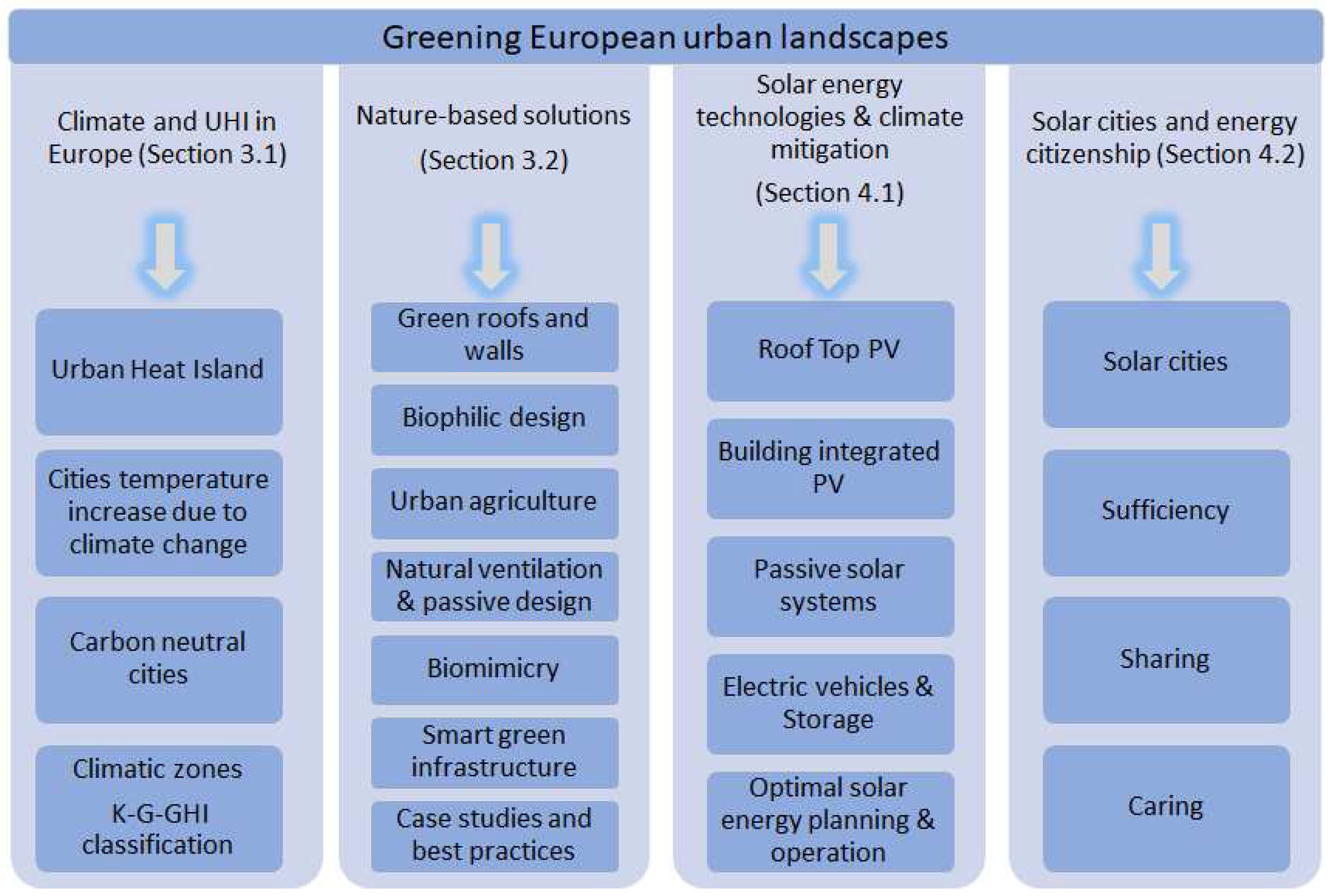
Figure 2.
The Centre for Sustainable Landscapes is part of Phipps Conservatory and Botanical Gardens (Source: Google Earth).
Figure 2.
The Centre for Sustainable Landscapes is part of Phipps Conservatory and Botanical Gardens (Source: Google Earth).
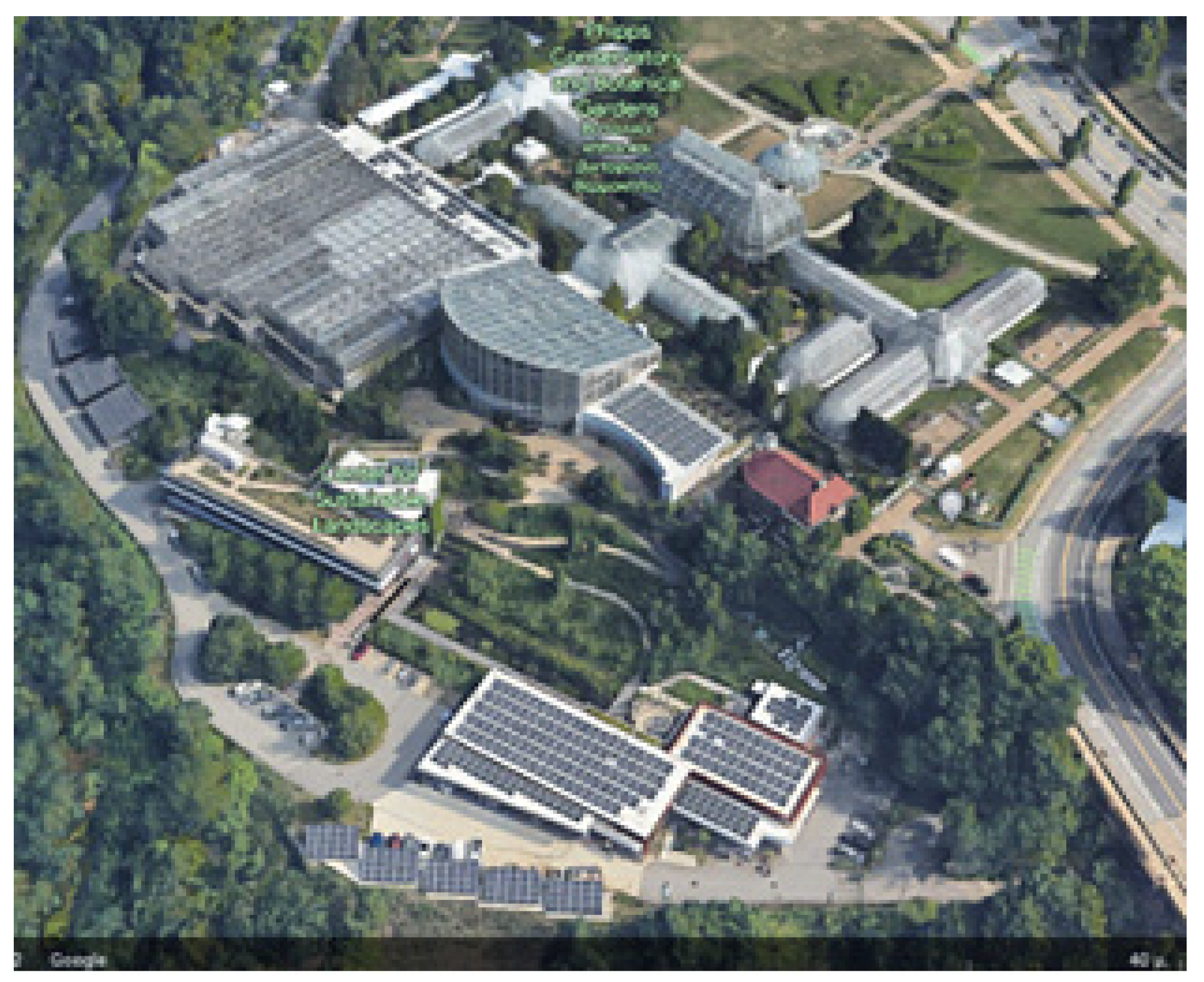
Table 2.
Table 2. NBS case studies and best practices for improving energy efficiency and/or mitigating urban heat island impact in Europe.
Table 2.
Table 2. NBS case studies and best practices for improving energy efficiency and/or mitigating urban heat island impact in Europe.
| Case studies | Location | Climate classification | Key features | Quantified benefits | Reference |
|---|---|---|---|---|---|
| Green roofs and walls | Copenhagen, DK | Cfb (Oceanic) – mild and damp winters and cool summers with moderate precipitation throughout the year | Installation of green roofs on various buildings across the city | - Reduction in surface temperature by up to 32.3°C - Reduction in peak runoff by 50-90% |
[50] |
| Urban tree canopy | Amsterdam, NL | Increasing the urban tree canopy across the city | - A decrease in annual heating and cooling energy demand by 5% | [75] | |
| Blue-green infrastructure | Rotterdam, NL | Creation of water plazas, green roofs, and rain gardens | - A temperature reduction of up to 1.8°C - Resulted in annual energy savings of approximately 17 GWh - Contributed to a reduction of approximately 30,000 tons of CO2 emissions annually |
[76, 77] | |
| Green roofs | London, UK | Installation of green roofs on various buildings across the city | - A temperature reduction of up to 10°C in the immediate vicinity | [78] | |
| Cool materials and coatings | Athens, GR | Csa (Mediterranean) - hot, dry summers and mild, wet winters | Using cool materials, such as reflective pavements and coatings | - Increasing the reflective coating area by 40% led to a decrease in air temperature by up to 1.2°C | [18] |
| Green roofs and walls | Barcelona, ES | Installation of green roofs on various buildings across the city | - Reduced building energy consumption by up to 25% for cooling and 9% for heating | [79] | |
| Green Spaces | Barcelona, ES | Redesigning city blocks to create large pedestrian-only zones with green spaces, trees, and shading structures | - Reduction in ambient temperature by up to 6°C - Energy savings of 9.3% in cooling demand |
[80] | |
| ForestMe project – Creation of green infrastructure | Milan, IT | Cfa (Humid Subtropical) - hot, humid summers and mild, wet winters | Creation of green infrastructure including urban forests and green roofs | - Green roofs alone can reduce surface temperatures by up to 20°C and air temperatures by up to 2-4°C in the surrounding area - Green roofs can lead to energy savings of 25-30 kWh/m² per year - ForestMe project is expected to remove approximately 5,500 tons of CO2 from the atmosphere annually |
[81-83] |
| Green Space | Warsaw, PL | Dfb (Continental) - cold winters and warm summers | Creation of green spaces across the city | - An increase in green space by 15% resulted in a temperature reduction of 1-2°C | [84] |
| Urban tree canopy | Berlin, DE | Increasing of urban tree canopy cover | - An increase of tree cover by 10% led to a temperature reduction of up to 4.7°C | [5] | |
| Urban Forests | Oslo, NO | Creation of urban forests through tree planting and green spaces | - Reduction in ambient temperature by up to 2.5°C | [85] | |
| Green spaces | Vienna, AT | Retrofitting streets with green infrastructure, including green roofs, trees, and permeable surfaces | - Reduction in surface temperatures by up to 6.4°C | [86] | |
| Increasing green spaces (parks, street trees, green roofs) | - Reduction in ambient temperatures by up to 3.2°C - Reduction in the energy demand for cooling buildings by up to 30%, equal to an annual energy savings of approximately 4,000 MWh. - Reduction of approximately 42,000 tons of CO2 emissions per year. |
[87, 88] |
Table 3.
Summary of the reviewed BIPV case studies as a strategy for decarbonizing European building stock.
Table 3.
Summary of the reviewed BIPV case studies as a strategy for decarbonizing European building stock.
| Case studies | Location | Climate classification | PV performance | Quantified benefits | Reference(s) |
|---|---|---|---|---|---|
| PV facade | Oslo, NO | Dfb | 700 kWh/kWp |
Economically feasible with 98% self-consumption and 23% self-sufficiency | [123] |
| PV facade | Copenhagen, DK | Cfb | 714 kWh/kWp |
50% of the total electricity consumption. | [124,125] |
| BIPV ventilated roof | Spreitenbach, CH | Cfb | 733 MWh/year | Twice the amount of energy that it consumes, with a zero CO2 balance |
[110] |
| PV Exterior shielding on tilted façade | Vienna. AU | Cfb | 983 kWh / kWp |
23% – 34% of the electricity the PV system produces consumption for the building operation, and 69% to 77% of the PV production is self-consumed. | [114] |
| Vertical BIPV overhangs, rooftop | Freiburg, DE | Cfb | Roof: 982 kWh/kWp Façade: 448 kWh/kWp |
The BIPV system on the façade is indispensable to reaching the positive energy target. | [117] |
| Roof/Blinds | Petten, NL | Cfb | - | No cooling is needed. BIPV system supplies 90% of the building's electricity needs. |
[115] |
| PV façade cladding | Madrid, ES | Csa | 735 kWh/kWp |
100% self-consumption | [119] |
| PV Roof/Facade | Lisbon. PT | Csa | 717 kWh/kWp |
Net positive. Improved flexibility due to battery storage. |
[118] |
| PV Window/Shades | Bari, IT | Csa | 53.6 MWh/year | 4% saving due to passive benefits. Up to 22% net energy reduction. Notable advantages in terms of visual comfort |
[122] |
| PV Window | Agrinio, GR | Csa | 822 kWh/kWp |
Up to 50% energy savings, due to the cooling effect in addition to electricity generation. | [121] |
| Rooftop/Canopy/ Double façade BIPV/T | Nicosia, CY | Bsh | 1188 kWh/kWp | >25% of total primary energy consumption. An energetically and financially viable solution for existing buildings. |
[126] |
Disclaimer/Publisher’s Note: The statements, opinions and data contained in all publications are solely those of the individual author(s) and contributor(s) and not of MDPI and/or the editor(s). MDPI and/or the editor(s) disclaim responsibility for any injury to people or property resulting from any ideas, methods, instructions or products referred to in the content. |
© 2023 by the authors. Licensee MDPI, Basel, Switzerland. This article is an open access article distributed under the terms and conditions of the Creative Commons Attribution (CC BY) license (http://creativecommons.org/licenses/by/4.0/).
Copyright: This open access article is published under a Creative Commons CC BY 4.0 license, which permit the free download, distribution, and reuse, provided that the author and preprint are cited in any reuse.


