
Submitted:
06 June 2023
Posted:
07 June 2023
You are already at the latest version
Abstract
When following a prescribed route, we need to decide at each intersection which way to proceed. The present work addressed several factors that might influence the difficulty of this decision making process. Participants repeatedly followed a route through a virtual maze with twelve or eighteen intersections, and with two or three choices per intersection. One group performed task S, which promoted decision making by the serial order strategy since all intersections looked alike. Another group performed task SA, which allowed the use of the serial order and the associative cue strategy since unique visual cues were presented at each intersection. We found that in both tasks, participants were more accurate in making decisions on routes with twelve rather than eighteen intersections, and more accurate by a similar amount on routes with two rather than three choices. Reaction time in task SA was reciprocal to accuracy; reaction time in task S was generally lower and route-independent. Accuracy in task SA was similar for participants who experienced smooth transport across intersections and those who experienced abrupt transport, while accuracy in task S was lower for participants who experienced smooth rather than abrupt transport across intersections. We conclude that the number of intersections and the number of choices were equivalent determinants of route following difficulty. We further conclude that optic flow during turns at intersections interfered with anticipatory decision making in task S; hence natural (smooth) transport across intersections did not enhance route following performance.
Keywords:
wayfinding
; navigation
; decision making
; spatial orientation
; task demand
Introduction
Our ability to navigate through urban environments and buildings is crucial for maintaining a mobile and independent lifestyle. A key component of this ability is decision making at intersections: when approaching an intersection of streets or corridors, we must decide in which direction to proceed in order to reach our destination. To investigate this decision-making process, researchers have employed a task in which participants are asked to repeatedly follow a prescribed route through a virtual maze, presented on a computer monitor from a first-person perspective. One experimental task was designed to promote decision making by the serial order strategy, where participants memorize the serial order of directions to take (Iglói et al., 2009; Tlauka & Wilson, 1994). In this task S, all corridors and intersections within the maze looked exactly the same, providing no cues about the correct direction. Another experimental task allowed participants to use also the serial order strategy and/or the associative cue strategy, where participants memorize cue-direction pairs such as “turn left at the town hall” (Tlauka & Wilson, 1994; Waller & Lippa, 2007). In this task SA, a unique visual cue such as a child’s toy, a tree or a distinctive building was displayed near each intersection (for an overview of other tasks that have been used in literature but require other decision strategies, see Bock & Borisova, 2022).
Some studies have found that participants’ accuracy on task SA was similar to that on task S, while others have reported that accuracy on task SA was better than that on task S. One important difference between these two groups of studies is the number of intersections encountered along the route. Studies involving routes with six (Lingwood et al., 2015), nine (Jansen-Osmann, 2002), twelve (Bock & Borisova, 2022) or fourteen intersections (Tlauka & Wilson, 1994) observed comparable accuracy on both tasks, while studies with twelve (Bock et al., 2023), eighteen (Bock et al., 2023) or nineteen intersections (Waller & Lippa, 2007) reported higher accuracy on task SA. This pattern of findings is compatible with the hypothesis (Hamburger, 2020) that the serial order strategy is limited by working memory capacity, such that it is fully adequate for routes with a moderate number of intersections, but is substituted or combined with the associative cue strategy when the number of intersections is higher. Specifically, the aforementioned findings suggest that the presumed capacity limit is reached at about twelve to fourteen intersections.
We recently reported that on routes with a higher number of intersections, the accuracy on task SA was not only superior to that on task S, but also to that on a novel task A which solely relies on the associative cue strategy (Bock et al., 2023). This finding suggests that the serial order strategy was not substituted by the associative cue strategy, but rather that both strategies were combined. Such a combination could be achieved through dual encoding of the route, both as a series of directions and as cue-direction pairs. Previous research has shown that dual encoding indeed can enhance memory in tasks other than route following (cf. Paivio & Csapo, 1973). Alternatively, strategies may be combined by memorizing the serial order of directions at some sections of the route, and memorizing cue-direction pairs at other sections. Indeed, a number of participants reported during debriefing that they used the serial order strategy at the first and last few intersections of the route, and the associative cue strategy at intermediate intersections. This suggests a flexible strategy allocation along the route.
Our recent study (Bock et al., 2023) further documented an inverse relationship between route length and route following accuracy. Thus, participants who performed task S on a route with twelve intersections exhibited higher accuracy compared to those who performed task S on a route with eighteen intersections, and a similar benefit of shorter routes was observed for tasks A and SA as well. The number of intersections therefore seems to be a determinant of task difficulty when using the serial order strategy, the associative cue strategy, or a combination of both. The main purpose of the present research was to confirm the above finding by using a within-subject rather than a between-subject design, and to extend that finding by including not only the number of intersections, but also the number of directional choices at each intersection, as a putative determinant of task difficulty. Specifically, we hypothesized that reducing the number of intersections from 18 to 12 would have a similar effect on route following accuracy as reducing the number of choices from 3 (left/straight/right) to 2 (left/right). We deduced this similarity from the fact that in both cases, (1) the numerical value of the putative determinant decreases by one-third, and (2) the amount of information that needs to be memorized also decreases by approximately one-third[1]. As a corollary of this hypothesis, reducing the number of intersections or choices should have comparable effects on tasks S and SA, since the decrease of the putative determinants’ value and of the information to be memorized is commensurate for both tasks.
A second objective of the present research was to assess not only the accuracy but also the reaction time of wayfinding decisions. Reaction time has been widely recognized as an indicator of task difficulty (e.g., Hick, 1952); in the context of human navigation research, reaction time was found to decrease with practice (Geisen et al., 2021; Wiener et al., 2011), and to increase when cognitive resources are tied up by an additional task (Condappa & Wiener, 2016). We therefore hypothesized that, If the number of intersections and the number of choices are indeed determinants of task difficulty, decreasing the value of either determinant would not only lead to decreased accuracy but also to increased reaction time in wayfinding decisions.
Finally, a third purpose of the present research was to find out whether participants’ transport from one intersection to the next influences their decision-making process. In most earlier studies, participants decided at an intersection which way to proceed, and were then smoothly and continuously transported across the intersection and down the next corridor. However, a few studies took a different approach and showed participants only the static images of intersections, omitting any transport (Cohen & Schuepfer, 1980; Wiener et al., 2012). Our earlier study (Bock et al., 2023) adopted an intermediate stance by including the linear transport down the corridor, but not the straight movements and turns at intersections. Our approach has been criticized for lacking ecological validity, as it introduced a non-natural discontinuity: after making a decision, participants found themselves in the next corridor without having crossed the intersection. We hypothesized that the absence of smooth transport across intersections would not influence route following decisions, as we considered transport and decision-making to be independent processes. However, such independence is not self-evident: it could be argued that realistic transport across intersections would yield contextual savings, i.e., benefits of performing a task within its natural context (see review in Smith, 2014), or that it would yield dual-task costs, i.e., detrimental effects of performing two tasks in parallel (see review in Wickens, 1980). In this particular case, dual-task costs could emerge because visuo-spatial processing would interfere with decision making. It therefore is conceivable that, contrary to our hypothesis, smooth transport across intersections may improve or impair decision making. To find out, participants in the present study were transported smoothly and continuously across intersections and down the corridors, and we compared their performance to the available data from our earlier study without smooth transport across intersections (Bock et al., 2023).
When designing task SA, we took into consideration that some visual cues may be more helpful for route following decisions than others, in dependence on cue familiarity (Hamburger & Röser, 2014), cue similarity (Strickrodt et al., 2015), as well as the visual, semantic and emotional salience of cues (Dong et al., 2020; Yesiltepe et al., 2021). Furthermore, we noticed some cues may be more helpful than others due to their explicit representation of directional information; this information can be provided at a topographical level (e.g., a mountain peak depicted on the left side but not on the right side of a picture), or at a symbolic level (e.g., a religious building evoking the concept of ‘straight faith’). To disambiguate differences between routes from differences between visual cues, we balanced the assignment of visual cues to routes between participants in task SA.
Materials and Methods
Participants
Participants were recruited online through various social media channels and the Prolific recruitment platform (https://www.prolific.co). The study was advertised as suitable for individuals between the ages of 18 and 80 who were proficient readers in either German or English. Participants were randomly assigned to either group S or SA (for details, see below). Recruitment was terminated once data had been collected from 96 participants, 48 per group. The demographic characteristics of those persons are summarized in Table 1. All of them provided informed consent to participate and have their accuracy and reaction time registered and anonymously published. The study was conducted in compliance with the Helsinki Declaration. It was part of a broader research program approved in advance by the Ethics Committee of the German Sport University.
Procedures
The experiment was designed and conducted using the online behavioral science platform Gorilla (www.gorilla.sc; Anwyl-Irvine et al., 2020). Following informed consent, participants completed a demographics questionnaire (age, gender, education) and the general self-efficacy scale ASKU (Beierlein et al., 2012). We adapted the three items of the ASKU questionnaire to specifically assess self-efficacy for navigation rather than general self-efficacy; the modified items were (1) Can you rely on your sense of orientation even in difficult situations? (2) Do you usually find your way in unfamiliar places without asking for help? (3) Are you typically able to navigate even in complex situations? Participants responded on a 5-point scale ranging from 1 = not at all to 5 = perfectly. The total score, derived from the sum of all item scores, ranged from 3 to 15. After completing ASKU, participants engaged in the route following task described below. Overall, the entire experiment lasted about 40 to 45 minutes.
Route-following task in general
Participants were instructed to follow a prescribed route through a virtual maze displayed on their desktop PC, notebook, or tablet PC. We disallowed the use of smartphones due to their small screen size, which we deemed unsuitable for the experiment. We also disallowed the use of some web browsers due to compatibility issues identified during pilot tests. The virtual maze consisted of uniform corridors with four-way intersections, as illustrated in Figure 1. In an initial practice phase, participants were familiarized with decision making at intersections. They were smoothly transported down a corridor until they reached an intersection, where they came to a stop. A leftward-pointing arrow was then presented on the floor, prompting participants to press the left arrow key on their keyboard. A progress bar below the virtual maze indicated the passage of the 3 s response time. If participants failed to press a key or pressed an incorrect key within the allotted time, an error message appeared for 1 s (cf. Figure 1), after which they were given another opportunity to respond. If participants pressed the correct arrow key within 3 s, they were smoothly transported through a left turn and then down the next corridor to the subsequent intersection. This practice could be repeated as desired, but only a few persons took advantage of this option.
After completing the practice phase, participants undertook an arrow-guided trip through the maze, where the practiced sequence of events was repeated at each intersection. The arrow now could point in a different direction at successive intersections (left, right or straight on), and participants now were smoothly transported across the intersection in the corresponding direction (left turn, right turn or straight movement, respectively). Once participants responded correctly at the final intersection of the arrow-guided trip, they were notified of this and were reminded that no more arrows will be displayed in subsequent trips. They then proceeded to undertake five self-guided trips through the maze along the same route, i.e., following the same sequence of directions as on the arrow-guided trip even though no arrows were displayed.
Following the last self-guided trip, participants took a self-terminated rest break. They then undertook an arrow-guided trip along a different route, followed once again by five self-guided trips. This procedure was repeated once more with yet another route. Thus, each participant undertook 6 trips (1 arrow-guided and 5 self-guided) on each of 3 routes, amounting to a total of 18 trips.
Performance was quantified as response accuracy, which was the proportion of correct responses per trip. Only the first attempt at each intersection entered in the calculation of accuracy, hence the score could range from 0 (first attempts at all intersections were wrong to 1 (first attempts at all intersections were correct). Random performance would yield a score of 0.33 on routes with three directional choices and of 0.5 on routes with two directional choices. We also determined the reaction time of each response that was correct upon the first attempt, as the interval between stopping at an intersection and pressing the correct arrow key.
Routes and groups in the route-following task
Each participant completed three different routes, 18(3), 18(2) and 12(3). Route 18(3) consisted of eighteen intersections, where paticipants had to choose among three possible directions: left turn, right turn, or straight movement. Route 18(2) also had eighteen intersections, but only required a choice between a left turn or a right turn at each intersection. Route 12(3) had twelve intersections with three possible directions: left turn, right turn, or straight movement. The sequence of correct directions differed on each route, while ensuring that each possible direction occurred equally often within a given sequence. Additionally, no direction was correct more than twice in a row on routes 8(3) and 12(3), and more than three times in a row on route 18(2). The order of the three routes was balanced across participants and, before the first trip along a new route, participants were informed about the number of intersections and choices involved.
Participants from group S saw a pair of greyscale rectangles on the opposite walls of each intersection, as depicted in the top part of Figure 1. The rectangles were identical at all intersections, hence they provided no information about the direction to take. Participants therefore had to rely on memorizing the serial order of correct directions to respond correctly during self-guided trials. Since some series of directions might be easier to remember than others, we designed three alternative series of directions for each route and used them in an order that was balanced across participants.
Group SA participants saw a pair of identical photographs on the opposite walls of each intersection, as illustrated in the bottom part of Figure 1. The photographs appeared upon stopping at an intersection and disappeared when participants began crossing the intersection. Different pairs of photographs were displayed at each intersection, and therefore could be used as a visual cue for the direction to take. To respond correctly on self-guided trials, therefore, group SA could memorize the serial order of directions just like group S, and/or could memorize cue-direction pairs. The cues depicted landscapes or buildings, and were sourced from the authors’ family albums or the license-free repository Shutterstock. Since some photographs may be more helpful for route following decisions than others (see Introduction), we assigned blocks of six photographs to route segments of six intersections in an order that was balanced across participants.
Data analysis
To determine whether route following performance was modulated by age or sex, we conducted multiple linear regression analyses with the regressors ‘calendric age’ and ‘sex’ (0 = male, 1 = female; no participant indicated the third option, ‘diverse’). The dependent variable was ‘accuracy’ in one analysis, and ‘reaction time’ in the other. Since both regressors yielded no significance (see Results), they were not included in subsequent analyses.
To test our first hypothesis, that the number of intersections and the number of choices have similar effects on accuracy, we conducted an analysis of variance (ANOVA) on the dependent variable ‘accuracy’. This ANOVA involved the repeated-measures factors Route (18(3), 18(2), 12(3)) and Trip (self-guided trip 1, 2, 3, 4, 5), and the grouping factor Task (SA, S). To address our second hypothesis, which assumes a reciprocal relationship between accuracy and reaction time, we used the same ANOVA model for the dependent variable ‘reaction time’. To examine our third hypothesis, which deals with the influence of smooth transport across intersections on route following decisions, we conducted an ANOVA for the dependent variable ‘accuracy’ with the repeated-measures factor Trip (self-guided trip 1, 2, 3, 4, 5), and the grouping factors Task (SA, S) and Transport across intersections (smooth, abrupt). Data with abrupt transport were taken from our preceding study (Bock et al., 2023). Since Route was a repeated measures factor in the present work but a grouping factor in the preceding study, we decided to average the data across the two routes administered in both studies (i.e., routes 18(3) and 12(3)). Specifically, we averaged the data from each given participant in the present work, and averaged the data from randomly paired participants in the preceding study. This analysis was not replicated with the dependent variable ‘reaction time’ as reaction time was not registered in the preceding study.
Results
Multiple regression yielded no significance of age or sex on mean accuracy (age: t(93) = -1.66, p = 0.100; sex: t(93) = 0.34; p = 0.735) or mean reaction time (age: t(93) = -0.48, p = 0.633; sex: t(93) = -1.06; p = 0.291). Furthermore, no significant correlations emerged between ASKU scores and mean accuracy (r = 0.05; p = 0.629) or between ASKU scores and mean reaction time (r = -0.07; p = 0.498); we thus found no evidence for self-perceived navigation skill being related to actual route following performance.
Figure 2 depicts the accuracy of participants in the present study, and Table 2 presents the pertinent ANOVA outcome. Accuracy was generally lower in task S compared to task SA, and increased less from trip to trip in task S compared to task SA. Importantly, accuracy differed between routes; Tukey HSD post-hoc tests confirmed that accuracy was significantly lower on route 18(3) compared to route 18(2) and route 12(3), with both p < 0.001, and that accuracy on route 18(2) was comparable to that on route 12(3), with p = 0.698. ANOVA also revealed a significant three-way interaction, indicating that accuracy on the three routes tended to diverge across trips in group S but converge in group SA.
Figure 3 illustrates the reaction time observed in the present study, and Table 3 presents the pertinent ANOVA results. Reaction time was generally lower in task S compared to task SA, and decreased less from trip to trip in task S compared to task SA. Additionally, reaction time was similar on all three routes of task S. In task SA, reaction time differed between routes, but this observed difference was not reflected by significance of the Task * Route or the Task * Route * Trip term.
We reasoned that the observed reaction time differences between routes in task SA may have failed to reach statistical significance because participants used the associative cue strategy on some intersections and the serial order strategy on others. Since reaction times under the latter strategy were route-independent (cf. left part of Figure 3), using that strategy might have attenuated the differences that would have otherwise emerged when using the associative cues strategy alone. Indeed, Figure 4 illustrates that for task SA, reaction time was lower at the first and last few intersections. This corresponds with participants’ introspective reports of using the serial order strategy mainly at those intersections (see Introduction), and with our finding that reaction time was lower under the serial order strategy than under the associative cue strategy (a shown in Figure 3). To mitigate the presumed impact of the serial order strategy, we decided to exclude the first and the last five intersections when calculating the reaction time in task SA and to calculate a Route * Trip repeated measures ANOVA with the reduced data set. We thus yielded a significant effect not only for Trip (F(3.24, 152.51) = 25.65; p < 0.001; eta^2 = 0.35) but also for Route (F(1.87, 87.95) = 5.38; p = 0.007; eta^2 = 0.10), while the Route * Trip term remained non-significant (F(5.45, 256.32) = 1.49; p = 0.187; eta^2 = 0.03). Tukey HSD tests confirmed that reaction time was significantly higher on route 18(3) than on route 18(2) (p = 0.007) and on route 12(3) (p = 0.040), while there was no significant difference in reaction times between routes 18(2) and 12(3) (p = 0.802). This exploratory analysis provides support for the view that reaction time in task SA differed significantly between routes once the impact of using the serial order strategy was diminished.
Figure 4 illustrates the accuracy of route following with smooth versus abrupt transport across intersections, and Table 4 presents the pertinent ANOVA outcome. Table 4 replicates the effects of Task, Trip, and Task * Trip reported in Table 2, and additionally reveals significant effects of Transport * Trip, and of Transport * Task * Trip. Figure 4 shows that the trip-to-trip increase in accuracy was less pronounced on task S with smooth transport than on the other task x transport combinations. This finding highlights the distinct influence of transport type on accuracy in task S but not in task SA.
Discussion
The current study investigated three hypotheses regarding the difficulty of route following tasks. Participants were asked to navigate a virtual maze along prescribed routes that varied in the number of intersections and choices per intersection. One group of participants followed routes where all intersections looked exactly the same, promoting the use of the serial order strategy (task S). Another group saw unique visual cues at each intersection, so that both the serial order strategy and the associative cue strategy could be used (task SA). Our hypotheses were as follows: (1) reducing the number of intersections and reducing the number of choices would have similar effects on route following accuracy, both in task S and in task SA, (2) these reductions would reciprocally affect accuracy and reaction time, and (3) the smoothness or abruptness of transportation across intersections would not influence route following accuracy.
An initial analysis revealed no significant effects of age and sex on our participants’ accuracy and reaction time. While a number of earlier studies have highlighted age and sex differences in spatial navigation (review e.g., in Hegarty et al., 2022), that research mainly concerned mental representations of surrounding space: young persons and men are adept at forming such representations, and are more likely to use those representations to navigate, while older persons and women are more likely to navigate along familiar routes (Yu et al., 2021). Accordingly, age-related deficits were found for navigating by mental maps, but not for following a prescribed route (Fricke and Bock, 2018). Since the present research focused on route following that did not require mental representations of space, the lack of significant age and sex effects is not surprising.
We found that reducing the number of intersections by one-third led to a similar increase in accuracy as reducing the number of choices by one-third, both in task S and in task SA. This confirms our first hypothesis; the number of intersections and the number of choices therefore seem to be equivalent determinants of task difficulty in our study. This outcome could not be predicted from extant literature since depending on methodological details, the list length may or may not play a role for serial order memory (Dennis and Humphreys, 2001) and for paired associate memory (Ensor et al., 2020). Also depending on methodological details, the use of repeated items (e.g., “left” being used six times on route 18(3) but nine times on route 18(2)) may facilitate, degrade or not affect memory (Kahana and Jacobs, 2000; Cowan and Hardman, 2021). We therefore had no a priori assurance that reducing the two metrics would enhance memory in our route following context.
We further found that in task SA, both the number of intersections and the number of choices had reciprocal effects on accuracy and on reaction time, which is in accordance with our second hypothesis. Thus, easier routes allowed participants to make more accurate and quicker decisions at intersections. Again, this outcome could not be predicted from literature where, depending on methodological details, changes of task difficulty had reciprocal (e.g., Verhaeghen et al., 2003) or parallel effects on accuracy and on reaction time (e.g., Palada et al., 2019). We therefore could not be certain in advance that task difficulty would have reciprocal effects in our route following context.
Unlike in task SA and contrary to our second hypothesis, reaction time in task S did not differ between routes. This unexpected result may be attributable to participants’ anticipatory behavior when using the serial order strategy. Consider, e.g., a participant who had memorized the response sequence “left - left - right - left”; if that person had just made two left turns followed by one right turn, (s)he could decide already during transport to the next intersection to turn left there. Anticipatory behavior is indeed common in navigation tasks with predetermined turns (Brunyé et al., 2018; Kim et al., 2020). Thus, decision making was possibly anticipatory in task S because the serial order strategy was used consistently; it possibly was less anticipatory in task SA where the serial order strategy was used only sporadically, as per participants’ introspective reports and our analysis of reaction times at individual intersections.
Finally, we found that route following accuracy in task SA was similar in participants who were transported smoothly and in those who were transported abruptly across intersections. This is in accordance with our third hypothesis, supporting the idea that visuo-spatial processing at intersections had no impact on decision making at intersections. Contrary to the third hypothesis, however, the increase in accuracy from trip to trip was smaller in participants who completed task S with smooth transport than in those who experienced one of the other transport x task combinations. This unexpected finding suggests that in task S but not SA, visuo-spatial processing can interfere with decision making. This unexpected outcome might be attributable to the fact that the optic flow pattern evoked by smoothly curving into a new corridor is remarkably complex (Saunders, 2010), and its processing might therefore continue during the subsequent transport down the next corridor where it might interfere with anticipatory decision making under the serial order strategy. Such persisting visuo-spatial processing is less likely to interfere with decision making under the associative cue strategy, which in our study could only begin after participants reached the next intersection and the next visual cues were revealed.
To sum up, our findings indicate that the number of intersections, the number of choices at intersections, and the complexity of optic flow may all influence the difficulty of route following decisions. This should be taken into account when comparing participants’ performance in different studies, and when designing training regimes to counteract deficits in route following. However, caution is needed when generalizing the present findings to other, seemingly similar scenarios. The difficulty of route following tasks is likely to vary in dependence of methodological details (see above) such as the temporal task structure, visual, semantic and emotional cue properties, cue familiarity and placement, maze décor and geometry, as well as participants’ acquaintance with the use of mnemonic aids. Some or all of those factors might modify the impact of the above determinants of task difficulty. They also might influence the use of anticipations, and the detrimental role of visuo-spatial processing on decision making. Additionally, the present findings do not necessarily extend to routes with a widely different number of intersections or choices than those we evaluated. Future research using multiple task variants is therefore needed to validate the robustness of our present findings. It also is worth noting that data for the present study were collected online, which limited our control over participants’ behavior. However, our participants’ well thought-out comments about the experiment, the characteristics of their data, and their temporal progress through the experimental session provided no indications of lower data quality compared to traditional laboratory experiments. Instead, the potential benefits of online data collection include a reduced impact of experimenter effects on performance, and an easy access to a representative sample of the general population (for other benefits of online experiments, see e.g., Arechar et al., 2018).
Author Contributions
Conceptualization, Otmar Bock; Data curation, Otmar Bock; Formal analysis, Otmar Bock and Ju-Yi Huang; Funding acquisition, Otmar Bock; Investigation, Otmar Bock; Methodology, Otmar Bock and Ju-Yi Huang; Project administration, Otmar Bock; Software, Otmar Bock; Supervision, Otmar Bock; Validation, Otmar Bock and Ju-Yi Huang; Writing – original draft, Otmar Bock; Writing – review & editing, Ju-Yi Huang.
Funding
This research was funded by the Marga und Walter Boll-Stiftung, grant number 210-05. 01-21.
Institutional Review Board Statement
The study was conducted according to the guidelines of the Declaration of Helsinki. It was part of a research program approved by the Ethics Committee of the German Sport University, 062/2020 - „Struktur und Plastizität der Wegfindung” 7. May 2020.
Informed Consent Statement
Informed consent was obtained from all subjects involved in the study.
Institutional Review Board Statement
The study was conducted according to the guidelines of the Declaration of Helsinki. It was part of a research program approved by the Ethics Committee of the German Sport University, 062/2020 - „Struktur und Plastizität der Wegfindung” 7. May 2020.
Data Availability Statement
The code for running the experiments and datasets generated and analyzed during the current study are available from the corresponding author on reasonable request.
Conflicts of Interest
The authors declare no conflicts of interest.
References
- Anwyl-Irvine, A.L.; Massonnié, J.; Flitton, A.; Kirkham, N.; Evershed, J.K. Gorilla in our midst: An online behavioral experiment builder. Behav. Res. Methods 2019, 52, 388–407. [Google Scholar] [CrossRef]
- Arechar, A.A.; Gächter, S.; Molleman, L. Conducting interactive experiments online. Exp. Econ. 2017, 21, 99–131. [Google Scholar] [CrossRef] [PubMed]
- Bock, O.; Borisova, S. A Comparison of the Serial Order Strategy and the Associative Cue Strategy for Decision Making in Wayfinding Tasks. Interdiscip. J. Signage Wayfinding 2022, 6, 7–16. [Google Scholar] [CrossRef]
- Bock, O.; Huang, J.-Y.; Onur. A.; Memmert, D. Choice between decision-making strategies in human route-following. Mem. Cogn. 2023, 51, 1–9. [Google Scholar] [CrossRef]
- Brunyé, T.T.; Gardony, A.L.; Holmes, A.; Taylor, H.A. Spatial decision dynamics during wayfinding: intersections prompt the decision-making process. Cogn. Res. Princ. Implic. 2018, 3, 1–19. [Google Scholar] [CrossRef]
- Caplan, J.B.; Glaholt, M.G.; McIntosh, A.R. Linking associative and serial list memory: Pairs versus triples. J. Exp. Psychol. Learn. Mem. Cogn. 2006, 32, 1244–1265. [Google Scholar] [CrossRef]
- Cohen, R.; Schuepfer, T. The Representation of Landmarks and Routes. Child Dev. 1980, 51, 1065–1071. [Google Scholar] [CrossRef]
- De Condappa, O.; Wiener, J.M. Human place and response learning: navigation strategy selection, pupil size and gaze behavior. Psychol. Res. 2014, 80, 82–93. [Google Scholar] [CrossRef]
- Cowan, N.; Hardman, K.O. Immediate recall of serial numbers with or without multiple item repetitions. Memory 2021, 29, 744–761. [Google Scholar] [CrossRef] [PubMed]
- Dennis, S.; Humphreys, M.S. A context noise model of episodic word recognition. Psychol. Rev. 2001, 108, 452–478. [Google Scholar] [CrossRef] [PubMed]
- Dong, W.; Qin, T.; Liao, H.; Liu, Y.; Liu, J. Comparing the roles of landmark visual salience and semantic salience in visual guidance during indoor wayfinding. Cartogr. Geogr. Inf. Sci. 2019, 47, 229–243. [Google Scholar] [CrossRef]
- Ebbinghaus, H. Memory: A Contribution to Experimental Psychology. Ann. Neurosci. 2013, 20, 155–156. [Google Scholar] [CrossRef] [PubMed]
- Ensor, T.M.; Guitard, D.; Bireta, T.J.; Hockley, W.E.; Surprenant, A.M. The list-length effect occurs in cued recall with the retroactive design but not the proactive design. Ebbinghaus 2020, 74, 12–24. [Google Scholar] [CrossRef] [PubMed]
- Fricke, M.; Bock, O. Egocentric navigation is age-resistant: First direct behavioral evidence. Curr. Neurobiol. 2018, 9, 69–75. [Google Scholar]
- Geisen, M.; Kim, K.; Klatt, S.; Bock, O. Effects of practice on visuo-spatial attention in a wayfinding task. Psychol. Res. 2021, 85, 2900–2910. [Google Scholar] [CrossRef]
- Hamburger, K. Visual Landmarks are Exaggerated: A Theoretical and Empirical View on the Meaning of Landmarks in Human Wayfinding. Psychol. Res. 2020, 34, 557–562. [Google Scholar] [CrossRef]
- Hamburger, K.; Röser, F. The Role of Landmark Modality and Familiarity in Human Wayfinding. Swiss J. Psychol. 2014, 73, 205–213. [Google Scholar] [CrossRef]
- Hegarty, M.; He, C.; Boone, A.P.; Yu, S.; Jacobs, E.G.; Chrastil, E.R. Understanding Differences in Wayfinding Strategies. Top. Cogn. Sci. 2022, 15, 102–119. [Google Scholar] [CrossRef]
- Hick, W.E. On the Rate of Gain of Information. Q. J. Exp. Psychol. 1952, 4, 11–26. [Google Scholar] [CrossRef]
- Iglói, K.; Zaoui, M.; Berthoz, A.; Rondi-Reig, L. Sequential egocentric strategy is acquired as early as allocentric strategy: Parallel acquisition of these two navigation strategies. Hippocampus 2009, 19, 1199–1211. [Google Scholar] [CrossRef]
- Jansen-Osmann, P. Using desktop virtual environments to investigate the role of landmarks. Comput. Hum. Behav. 2002, 18, 427–436. [Google Scholar] [CrossRef]
- Jensen, A.R. Transfer between paired-associate and serial learning. J. Verbal Learn. Verbal Behav. 1963, 1, 269–280. [Google Scholar] [CrossRef]
- Kahana, M.J.; Jacobs, J. Interresponse times in serial recall: Effects of intraserial repetition. J. Exp. Psychol. Learn. Mem. Cogn. 2000, 26, 1188–1197. [Google Scholar] [CrossRef] [PubMed]
- Kim, K.; Fricke, M.; Bock, O. Eye–Head–Trunk Coordination While Walking and Turning in a Simulated Grocery Shopping Task. J. Mot. Behav. 2020, 53, 575–582. [Google Scholar] [CrossRef] [PubMed]
- Lingwood, J.; Blades, M.; Farran, E.K.; Courbois, Y.; Matthews, D. The development of wayfinding abilities in children: Learning routes with and without landmarks. J. Environ. Psychol. 2015, 41, 74–80. [Google Scholar] [CrossRef]
- Paivio, A.; Csapo, K. Picture superiority in free recall: Imagery or dual coding? Cogn. Psychol. 1973, 5, 176–206. [Google Scholar] [CrossRef]
- Palada, H.; Neal, A.; Strayer, D.; Ballard, T.; Heathcote, A. Using response time modeling to understand the sources of dual-task interference in a dynamic environment. J. Exp. Psychol. Hum. Percept. Perform. 2019, 45, 1331–1345. [Google Scholar] [CrossRef]
- Saunders, J.A. View rotation is used to perceive path curvature from optic flow. J. Vis. 2010, 10, 25–25. [Google Scholar] [CrossRef]
- Smith, S.M. Effects of environmental context on human memory. In The Sage Handbook Of Applied Memory; SAGE Publications: 2014; pp. 162–182.
- Strickrodt, M.; O'Malley, M.; Wiener, J.M. This Place Looks Familiar—How Navigators Distinguish Places with Ambiguous Landmark Objects When Learning Novel Routes. Front. Psychol. 2015, 6, 1936. [Google Scholar] [CrossRef]
- Tlauka, M.; Wilson, P.N. The effect of landmarks on route-learning in a computer-simulated environment. J. Environ. Psychol. 1994, 14, 305–313. [Google Scholar] [CrossRef]
- Verhaeghen, P.; Steitz, D.W.; Sliwinski, M.J.; Cerella, J. Aging and dual-task performance: A meta-analysis. Psychol. Aging 2003, 18, 443–460. [Google Scholar] [CrossRef] [PubMed]
- Waller, D.; Lippa, Y. Landmarks as beacons and associative cues: Their role in route learning. Mem. Cogn. 2007, 35, 910–924. [Google Scholar] [CrossRef] [PubMed]
- Wickens, C. The structure of attentional resources. In Attention and Performance; Nickerson, R., Ed.; Erlbaum Assoc: 1980; pp. 239–257.
- Wiener, J.; De Condappa, O.; Holscher, C. Do you have to look where you go? Gaze behaviour during spatial decision making. Proc. Annu. Meet. Cogn. Sci. Soc. 2011, 33, 1583–1588. [Google Scholar]
- Wiener, J.M.; Hölscher, C.; Büchner, S.; Konieczny, L. Gaze behaviour during space perception and spatial decision making. Psychol. Res. 2011, 76, 713–729. [Google Scholar] [CrossRef]
- Yesiltepe, D.; Dalton, R.C.; Torun, A.O. Landmarks in wayfinding: a review of the existing literature. Cogn. Process. 2021, 22, 369–410. [Google Scholar] [CrossRef]
- Yu, S.; Boone, A.P.; He, C.; Davis, R.C.; Hegarty, M.; Chrastil, E.R.; Jacobs, E.G. Age-Related Changes in Spatial Navigation Are Evident by Midlife and Differ by Sex. Psychol. Sci. 2021, 32, 692–704. [Google Scholar] [CrossRef]
Figure 1.
Exemplary snapshots from a self-guided trip of group S (top) and SA (bottom)*. *Note: The sprocket holes in the fourth row symbolize animated transport from one intersection to the next.
Figure 1.
Exemplary snapshots from a self-guided trip of group S (top) and SA (bottom)*. *Note: The sprocket holes in the fourth row symbolize animated transport from one intersection to the next.
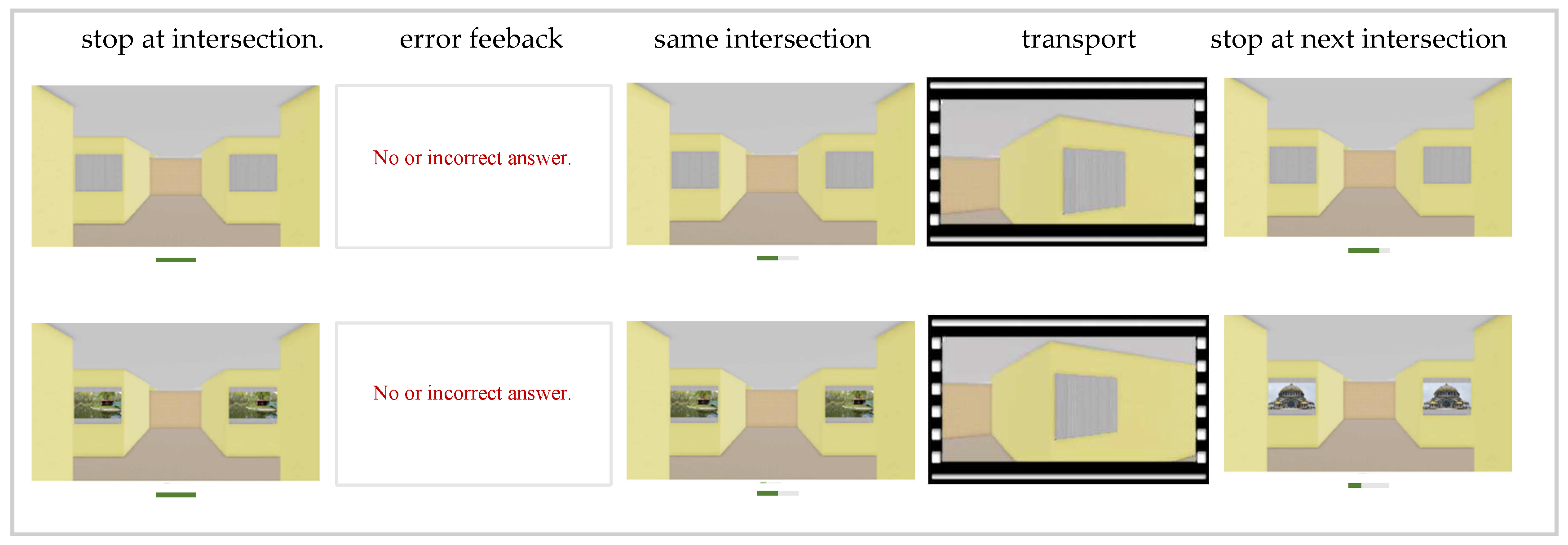
Figure 2.
Accuracy on self-guided trips for both tasks and all three routes*. *Curves connect across-participant means; error bars are between-participant standard deviations.
Figure 2.
Accuracy on self-guided trips for both tasks and all three routes*. *Curves connect across-participant means; error bars are between-participant standard deviations.
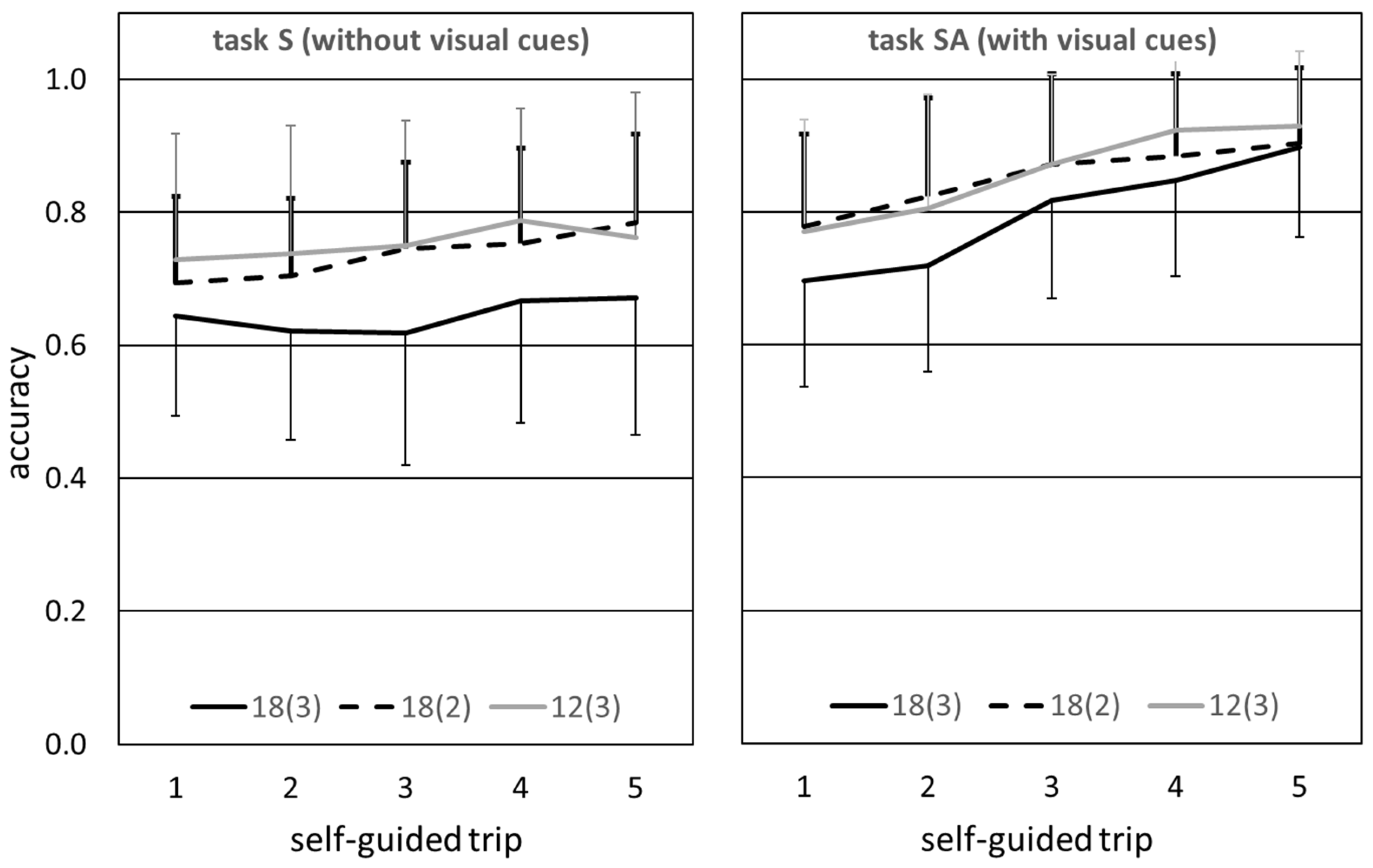
Figure 3.
Reaction time on self-guided trips for both tasks and all three routes*. *Curves connect across-participant means; error bars are between-participant standard deviations.
Figure 3.
Reaction time on self-guided trips for both tasks and all three routes*. *Curves connect across-participant means; error bars are between-participant standard deviations.
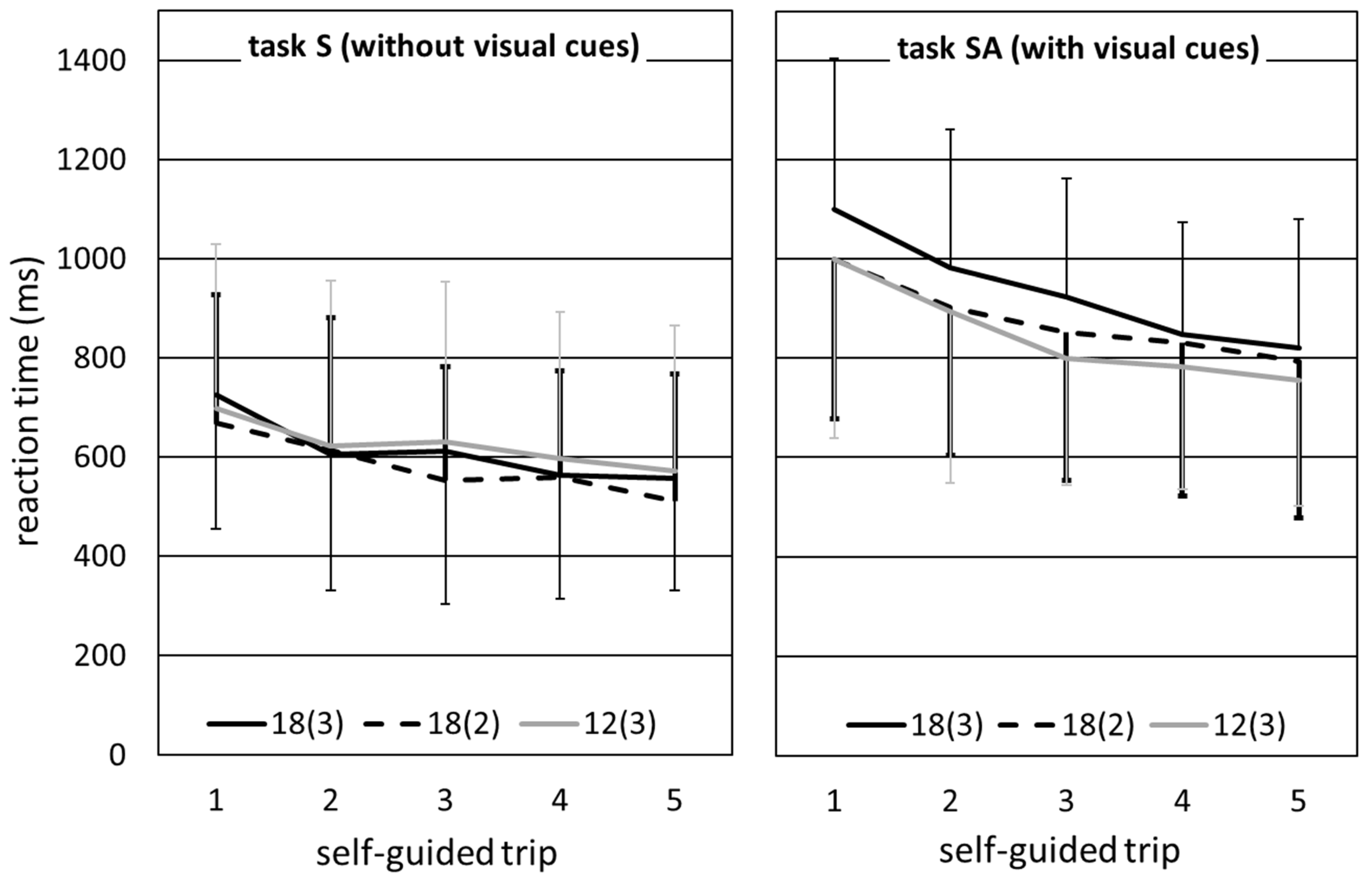
Figure 4.
Reaction time at successive intersections of self-guided trips in task SA*. *Note: Data are averaged across trips, and are plotted separately for the first to the last intersection along the route. Curves connect across-participant means; error bars are between-participant standard deviations.
Figure 4.
Reaction time at successive intersections of self-guided trips in task SA*. *Note: Data are averaged across trips, and are plotted separately for the first to the last intersection along the route. Curves connect across-participant means; error bars are between-participant standard deviations.
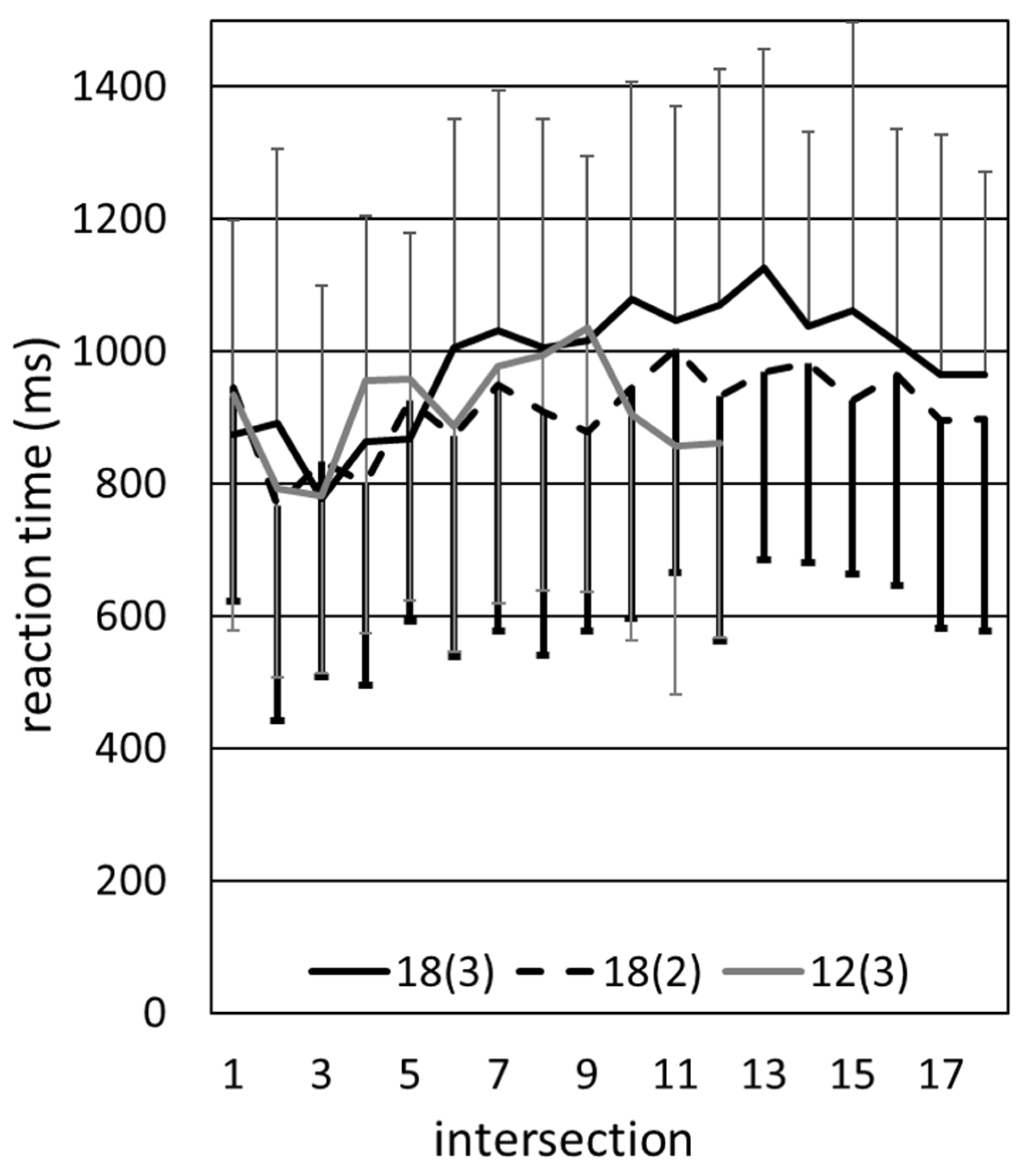
Figure 5.
Accuracy on self-guided trips with smooth versus abrupt transport*. *Note: Data for smooth transport come from Bock et al. (2023). Curves connect across-participant means; error bars are between-participant standard deviations.
Figure 5.
Accuracy on self-guided trips with smooth versus abrupt transport*. *Note: Data for smooth transport come from Bock et al. (2023). Curves connect across-participant means; error bars are between-participant standard deviations.
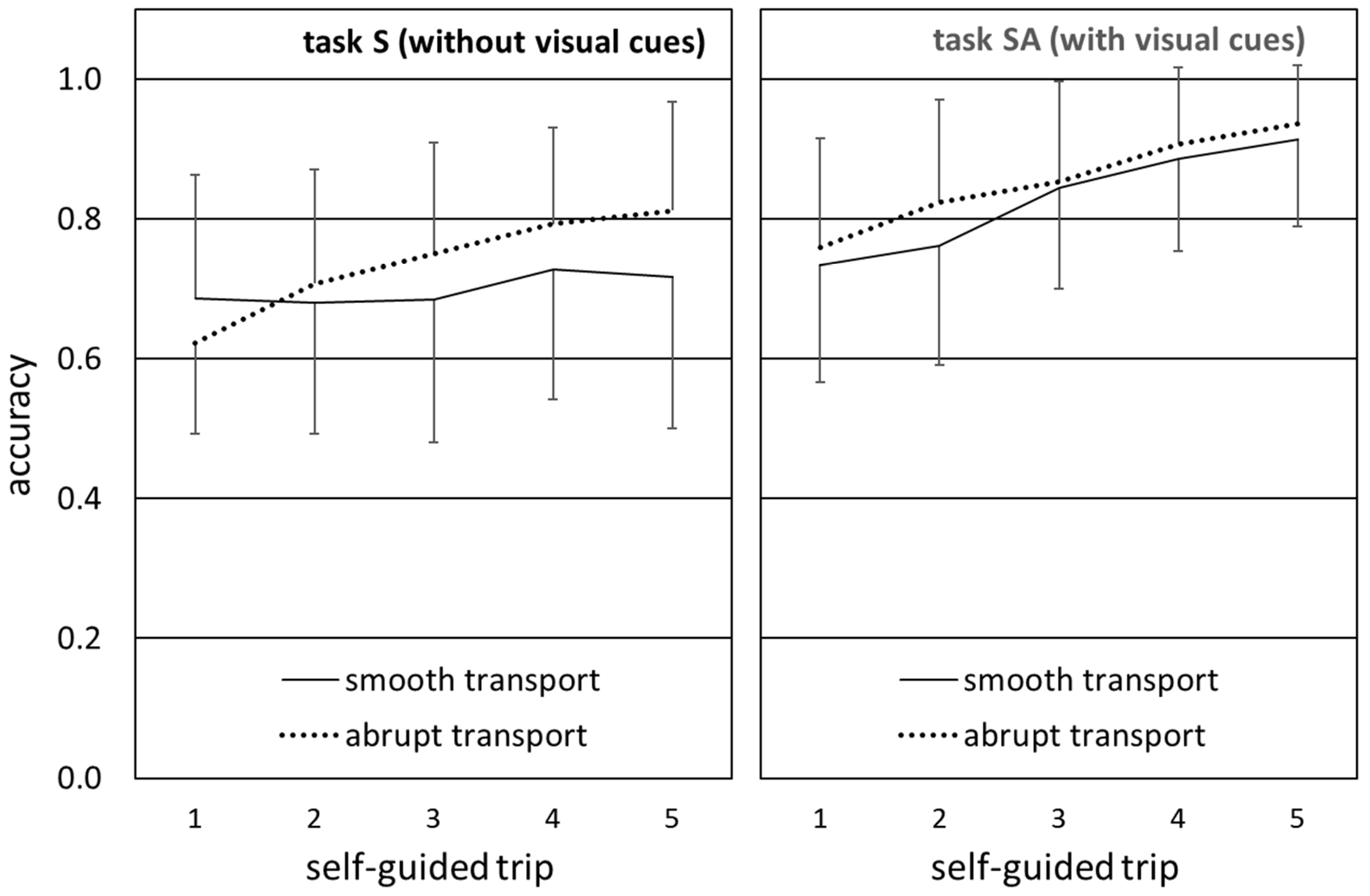

Table 1.
Characteristics of participants*.
| Group | Group S | Group SA |
|---|---|---|
| Sample size | 48 | 48 |
| Age (mean ± SD) | 31.1 ±10.4 | 37.6 ±15.2 |
| Females | 24 | 28 |
| Education (years) | 16.8 ±3.0 | 16.6 ±2.9 |
*Note: For education, we used the flat scores of 18.5 years in case of a university degree, 12.5 years in case of a high school diploma, and 10.5 years else.
Table 2.
ANOVA outcome for the dependent variable ‘accuracy’ in the present study*.
| df1 | df2 | F | p | eta^2 | |
|---|---|---|---|---|---|
| Task | 1.00 | 94.00 | 38.11 | 0.000 | 0.29 |
| Route | 2.00 | 187.54 | 18.81 | 0.000 | 0.17 |
| Trip | 3.06 | 287.44 | 59.86 | 0.000 | 0.39 |
| Task*Route | 2.00 | 187.54 | 1.20 | 0.304 | 0.01 |
| Task*Trip | 3.06 | 287.44 | 14.98 | 0.000 | 0.14 |
| Route*Trip | 6.65 | 625.21 | 1.45 | 0.186 | 0.02 |
| Task*Route*Trip | 6.65 | 625.21 | 2.76 | 0.009 | 0.03 |
*df1 and df2 are the Greenhouse-Geisser adjusted degrees of freedom.
Table 3.
ANOVA outcome for the dependent variable ‘reaction time’ in the present study*.
| df1 | df2 | F | p | eta^2 | |
|---|---|---|---|---|---|
| Task | 1.00 | 94.00 | 45.79 | 0.000 | 0.33 |
| Route | 1.93 | 181.23 | 2.51 | 0.086 | 0.03 |
| Trip | 3.17 | 297.64 | 50.83 | 0.000 | 0.35 |
| Task*Route | 1.93 | 181.23 | 2.83 | 0.064 | 0.03 |
| Task*Trip | 3.17 | 297.64 | 3.71 | 0.011 | 0.04 |
| Route*Trip | 6.30 | 592.23 | 0.65 | 0.699 | 0.01 |
| Task*Route*Trip | 6.30 | 592.23 | 0.67 | 0.685 | 0.01 |
*df1 and df2 are the Greenhouse-Geisser adjusted degrees of freedom.
Table 4.
ANOVA outcome for the dependent variable ‘accuracy’ with smooth versus abrupt transport*.
| df1 | df2 | F | p | eta^2 | |
|---|---|---|---|---|---|
| Transport | 1.00 | 132.00 | 2.77 | 0.098 | 0.02 |
| Task | 1.00 | 132.00 | 38.79 | 0.000 | 0.23 |
| Trip | 3.28 | 432.67 | 77.35 | 0.000 | 0.37 |
| Transport * Task | 1.00 | 132.00 | 0.06 | 0.803 | 0.00 |
| Transport * Trip | 3.28 | 432.67 | 4.98 | 0.001 | 0.04 |
| Task * Trip | 3.28 | 432.67 | 4.36 | 0.004 | 0.03 |
| Transport * Task * Trip | 3.28 | 432.67 | 6.60 | 0.000 | 0.05 |
* df1 and df2 are the Greenhouse-Geisser adjusted degrees of freedom.
| 1 | The information coded by a route with 18 intersections and 3 choices corresponds to an eighteen-digit number in a ternary number system, and its information therefore is 18 * ld(3) = 28.53 bit. Similarly, a route with 12 intersections and 3 choices corresponds to 19.02 bit, and a route with 18 intersections and 2 choices corresponds to 18 bit. Hence the decrease of information is (28.53 - 18) /28.53 = 0.37 when reducing the number of intersections, and (28.53 - 19.02) /28.53 = 0.33 when reducing the number of choices per intersection. |
Disclaimer/Publisher’s Note: The statements, opinions and data contained in all publications are solely those of the individual author(s) and contributor(s) and not of MDPI and/or the editor(s). MDPI and/or the editor(s) disclaim responsibility for any injury to people or property resulting from any ideas, methods, instructions or products referred to in the content. |
© 2023 by the authors. Licensee MDPI, Basel, Switzerland. This article is an open access article distributed under the terms and conditions of the Creative Commons Attribution (CC BY) license (http://creativecommons.org/licenses/by/4.0/).
Copyright: This open access article is published under a Creative Commons CC BY 4.0 license, which permit the free download, distribution, and reuse, provided that the author and preprint are cited in any reuse.


