

Submitted:
05 June 2023
Posted:
06 June 2023
You are already at the latest version
Abstract
Human activities continue to degrade oceanic, coastal and inland waters. The generational change in the role of society in actively looking after the health of water resources can be achieved through the expansion of ocean and water literacy in schools. The Network of European Blue Schools established under the EU4Ocean Coalition for Ocean Literacy has improved ocean and water literacy; however, this Network needs to grow and be supported. Here we present ProBleu; a recently funded EU project that will expand and support the Network, partly through the use of citizen science. The core of the proposed methodology is facilitating school activities related to ocean and water literacy through funding calls to sustain and enrich current school activities, and kick-start and support new activities. The outcomes of the project are anticipated to have wide and long-term impacts across society, oceanic, coastal and inland water environments.
Keywords:
education
; schools
; ocean literacy
; citizen science
; SDGs
1. Introduction
Worldwide, progress in reaching good environmental status in inland and marine waters is slow. For example, the 2020 targets of the European Union (EU) (in the Marine Strategy Framework Directive [1] and the Water Framework Directive [2]) have not been met. Oceanic, coastal and inland waters continue to degrade due to human activities, including unsustainable exploitation of resources, chemical and plastic pollution, and destruction of habitats. In the EU, half of coastal and freshwater habitats are assessed as threatened (in the categories Critically Endangered, Endangered, and Vulnerable) according to the European Red List of Habitats [3].
Several United Nations’ Sustainable Development Goals (SDGs) aim to reverse this scenario: SDG6 Clean water and sanitation aims to protect and restore ecosystems, prevent and eliminate pollution, and make the blue economy circular; SDG14 Life below water aims to conserve and sustainably use the oceans, seas and marine resources; and the education aims of SDG4 Quality education target oceanic, coastal and inland waters. However, the SDGs are insufficient and the world is not on track to achieve either SDG6 [4] or SDG 14 [5].
A generational change in the role of society in actively looking after the health of water resources is needed: a change that allows to achieve national and global environmental policy agendas, and the SDGs. A significant part of this change is in the environmental education needed to foster broad societal responsibility towards oceans and waters [6] and to achieve related policy change [7].
One way to make this change and address the urgent question, “Why are we not making progress on environmental crises, particularly on restoring aquatic ecosystems and biodiversity?” is to expand ocean and water literacy in schools, cutting across cultural and socio-economical barriers.
Ocean-literate individuals understand fundamental concepts about ocean functioning, can discuss ocean issues meaningfully, and can make informed and responsible decisions regarding the ocean and its resources [8]. Current ocean-literacy frameworks primarily focus on educational programs for children and youth in formal school settings. However, additional guidance is needed to address the needs of all socio-demographics, across developed and developing countries, and in marine and landlocked regions [8].
The Network of European Blue Schools (the Network) [9], established under the EU4Ocean Coalition for Ocean Literacy [10], has improved ocean and water literacy: as of May 2022, 150 schools and teachers committed to bringing the ocean into classrooms. However, this Network needs to grow and be supported.
ProBleu: Promoting Ocean and Water Literacy in School Communities
ProBleu is a 2023-2026 EU project that will expand and support the Network. The ProBleu-CS methodology - partly based on the use of citizen science - is designed to attract a wide diversity of new members, improve ocean and water literacy across school communities, and contribute to the SDGs; in particular to protect marine and freshwater ecosystems and biodiversity, and to prevent and eliminate pollution.
The vision behind ProBleu-CS is the achievement of societal stewardship of a healthy and sustainable aquatic environment by improving water and ocean literacy from a young age; and its mission is to make a paradigm shift - starting from children and youth in primary and secondary schools - to improve policies on the management of oceans and waters. Implementing green and blue agendas to sustain and enhance the health and biodiversity of oceans and inland waters currently encounters resistance from various actors. Today’s children and youth are the decision makers of tomorrow, and their understanding and appreciation of the environment will pave the way towards its long-term sustainable and resilient future.
ProBleu-CS helps make the protection of oceans and waters an integral part of education and promote the understanding of the close connection between humans and environments among children and youth. ProBleu-CS helps promote and grow the Network, increasing the impact of ocean and water education by providing interaction with scientists and research centres across a range of scientific disciplines which underpin the understanding of sustainable and equitable exploitation of ocean and water resources.
ProBleu-CS includes a pool of innovative, practical resources based on methodologies of open schooling (the combination of online and place-based activities). These resources will be complemented by stimulating the connection between people and the places where they live. Besides several actions to promote, encourage participation in, and increase the diversity of the Network, one resource, currently lacking from the majority of school curricula, is explored in ProBleu-CS: what is collectively known as ‘citizen science’, defined as work undertaken by educators together with communities to advance science, foster a broad scientific mentality, or encourage democratic engagement, which allows society to deal rationally with complex modern problems [11]. Collecting and analysing data through citizen science [12] ensures that student activities contribute directly to fostering their ocean and water literacy. By fostering relationships between the school communities and their local waters, ProBleu-CS assists schools in developing project activities related to the SDGs, particularly SDG6. Most importantly, ProBleu-CS supports and helps grow the Network and aims to achieve four objectives.
Firstly, to mobilise and engage students and school communities in relation to SDG6. ProBleu-CS helps mobilise and engage children, youth, teachers and school communities in implementing SDG 6. Encouraging open schooling, ProBleu-CS also helps engage parents, carers, professionals from enterprises, and civil society to increase ocean and water literacy, and implement SDG 6 through environmental education projects and other activities. (Key performance indicators: the number of schools, students and educators using ProBleu-CS resources.)
Secondly, to improve the understanding of and enhance the sense of stewardship towards the value and challenges of oceans and waters among children, youth and teachers. ProBleu-CS supports schools in developing and implementing innovative projects through shared teaching and learning methods, such as challenge-based learning, design thinking, and science shops, to improve the understanding of oceans and waters. (Key performance indicators: assessment of improved understanding through standardised interviews with children, youth and teachers across countries and teaching backgrounds; evaluation of enhanced sense of stewardship through standardised surveys (using local languages) with children, youth and teachers in participating schools; uptake of practical teaching aids (schools doing local environmental observations); the number of school projects using challenge-based learning, design thinking or science shops.)
Thirdly, to grow the Network of European Blue Schools, bringing ocean and water literacy into the classroom. ProBleu-CS helps ramp up the accreditation of schools in the Network established under the EU4Ocean Coalition for Ocean Literacy, and the engagement in their related activities, based on methodologies of open schooling. (Key performance indicators: growth of the Network of European Blue Schools; the number of calls for student and school projects; projects funded; development of the Network through twinned applications.)
Finally, to mobilise and engage the broader community with the Network of European Blue Schools activities, and communicate the results of actions towards SDG6, sustaining the Network’s growth. ProBleu-CS helps engage the broader community with the activities of the Network through targeted dissemination and communication actions, increasing awareness and further expanding the Network. (Key performance indicators: catalogue of new teaching materials (courses, websites, multimedia items and text documents), following the FAIR principles, shared by their creators; diversity and inclusivity measured through geographic coverage, languages and functional diversity (teaching material and activities accessible to any kind of special need) supported by ProBleu-CS.)
2. Proposed Research
2.1. Funding Calls
The core of the ProBleu-CS methodology is facilitating school activities related to ocean and water literacy. This facilitation is mainly achieved through funding calls to sustain and enrich current school activities, and kick-start and support new activities. The core support provided by ProBleu-CS is the facilitation of youth and school mobilisation and engagement, and of ocean and water literacy activities with clearly defined goals and focused on concrete actions and projects. Funding is awarded based on the following:
- the needs and aims of individual projects;
- the potential to be shared across the educational sector;
- environmental themes and issues addressed;
- types of participation involved; and
- the innovation potential of impact across society.
Grant categories and conditions for participation capture the full range of related school activities, recognise their achievements across several domains (society, science, economy, governance, environment), and consider the potential impact on all types of target groups involved.
2.2. Adaptation of Reseources
Another level of support provided by ProBleu-CS is the adaptation of existing educational methods and resources to support, strengthen and sustain school activities. School activities are supported by adapting and utilising existing tools and materials, developed through previous school projects and activities, and through AI large language models like LaMDA or GPT. Best practice guidance ensures that school activities maximise their potential in bridging the gap between scientific research and children’s ocean literacy, and, at the same time, inspire the co-creation of ideas within the Network.
The scientific underpinning and the sharing of the scientific experience in teaching materials add relevance to the curriculum, help draw new schools and educators to join the Network, and provide wider avenues for Network promotion, given their significance to the global environmental agenda. Information sharing is a two-way process, capturing feedback from school actors on the benefits of and improvements from the guidance provided, allowing the gathering of information about factors that support or hinder the sustainability of school activities. This process also helps reduce the chances of project failure, ensures sustainability so that the funding processes receive a strong return on investment, and opens avenues for continued investment building on the outcomes of applying the methodology. Considerations across the areas of impact, education, inclusivity, responsible research and innovation (RRI), policy, interoperability and societal measures are included, as learning from existing methodologies (e.g., EU-Citizen.Science, ECS, and Science-with-and-for-Society project results, citizen observatories, communities of practice, bio- and water-blitzes, SDG monitoring), with tools and resources available in a range of formats (including school policy briefs, training and educational resources, videos and interviews, open-source software and equipment repositories). This information is always shared openly and widely.
2.3. Development of Tools
A further level of support is the creation of tools to facilitate the sustained growth of the Network of European Blue Schools. ProBleu-CS aims to pave the way for ensuring the long-term sustainability of school activities and accreditations. The methodology helps to develop a detailed exploitation model for educational results, and will link it to the UNESCO Ocean Literacy Portal [13], the EU-Citizen.Science platform [14], and the European Open Science Cloud (EOSC) portal [15]. To achieve long-lasting change, the ProBleu-CS methodology supports schools to create a plan to maintain the changes made beyond their first blue school activities; otherwise, ocean and water literacy is likely to start decreasing. Once schools have achieved their initial ocean and water literacy goals, they will retain access to the tools used to continue their learning journey and to renew their accreditation in the Network. Within an open-science setting, ProBleu-CS helps liaise with existing, related projects worldwide that may benefit from timely exchanges of environmental-education methodologies, literacy data, behaviour-change approaches, and evaluation data immediately as they become available. Finally, ProBleu-CS helps establish a reciprocal relationship among ocean and water literacy support systems worldwide, especially in Europe, the US and Australia, where these systems are well developed in the context of citizen science (see ECSA [16], CSA [17] and ACSA [18]).
2.4. Key Methodological Processes
To recognise, invest in and support school activities in fully realising their potential to bridge the gap between science and society, five key methodological processes – detailed below and summarized in Figure 1- are essential in achieving success.
(i) Supporting open schooling and innovative teaching and learning methods, such as challenge-based learning, design thinking, and science shops. ProBleu-CS allows to analyse how science-based open schooling affects the target groups’ ocean literacy and engagement in ocean and water issues, their interest in pursuing a related career, and whether socio-geographical aspects of their school influence this. Also, ProBleu-CS supports using student-centred and practice-oriented teaching/learning methods as follows. The challenge-based learning methodology applies a multidisciplinary approach which encourages students to develop a deeper understanding of real-world problems, work in teams, and use creativity to reach the solution, for it to be based on their prior knowledge and innovative at the same time. Similarly, the design thinking methodology employs a student-centred and practice-oriented approach by encouraging students’ out-of-the-box thinking, creativity, brainstorming of innovative ideas, and creation of prototypes. Science shops ensure closer cooperation between scientists and students by introducing experimentation and real-life problem-solving. These methods effectively engage students in practice-oriented learning, encouraging curiosity, critical thinking and creativity while increasing learning motivation. Previous research shows that challenge-based learning is highly effective in secondary schools, helping students most at risk of dropping out [19].
(ii) Adopting a user-centred approach, incorporating co-design principles when appropriate. Key to implementing ProBleu-CS is developing funding criteria and support tools applicable and representative of the broad range of school initiatives and the issues they address. The risk of failure in this respect would be maintaining a status quo of insufficient support for ocean and water literacy, resulting in a lack of school engagement in the discipline. Without the proper support, school projects and activities would ultimately become unsustainable over the long term. ProBleu-CS includes a user-centred approach to prevent this, incorporating the relevant end-users at all stages of the recognition, investment and support activities. Resources and methodologies are co-designed, where possible, with the involvement of various target groups. For instance, tools and best-practice guidance are developed with teachers who have already benefited from the Network of European Blue Schools accreditation.
(iii) Putting ethics and inclusivity at the heart of every activity and process. Educational activities have long had an issue in terms of becoming truly inclusive, with existing programmes often offering only an illusion of support for all students. This forms a significant barrier when attempting to realise the full potential of environmental education in bridging the gap between science and society. To ensure ProBleu-CS activities are inclusive in terms of geography, gender, ethnicity, functional diversity, age, and socio-economic situation, an external, independent ethics advisor is appointed. Additional guidance is followed, such as that provided by the COST Action CA15212 [20] regarding inclusiveness and diversity, and by projects such as DITOs (funded within the Horizon 2020 programme). Funding criteria recognise projects that address inclusivity, with tools and best-practice guidance available to provide evidence. More broadly, ProBleu-CS includes ethical, transparent practices across all activities and funding reviewers enlisted from beyond the geographical scope of deployment to reduce the chance of bias and a clash of interest, with a broad representation of ethnicity, gender and expertise. Ethical, legal, socio-economic, cultural and gender considerations - concerning transparency, privacy and data protection, and the involvement of minors and vulnerable populations – are also addressed in the methodology.
(iv) Ensuring the involvement of all target groups throughout all activities. The following target groups are involved throughout the ProBleu-CS methodology to ensure the success of the recognition, investment and support mechanisms.
- Primary school children; secondary school youth; teachers; school administration; Network of European Blue Schools. Children, youth and teachers are the lifeblood of school projects. Different school actors can be applicants for funding, as the coordinators of student- or school-led initiatives.
- Wider school community, including parents, NGOs, and other social partners. The wider school community involvement takes several forms. Apart from being a target of extended actions to improve ocean and water literacy, it is engaged as a potential sponsor of events, helping to communicate activities as widely as possible. Social partners are also part of the user-centred design process, helping to ensure that support tools assist environmental education in fully realising its potential to bridge the gap between science and society. Some social partners can further engage participants with learning outside the school environment (e.g., educational activities in aquaria).
- Academia. Not only are academics involved as part of a user-centred design approach, but existing networks (e.g., EU-Citizen.Science, ECS, ECSA, MICS, current and past Science-with-and-for-Society projects) are also used to communicate activities and disseminate outputs and results.
- Policy makers. A key aim of ProBleu-CS is to implement innovative systems to support environmental education. are critical in ensuring that future research-and-innovation systems learn from applying ProBleu-CS and that societal impacts from environmental-education actions are fully realised.
- Journalists and media, including scientific and educational publications. Journalists are key in widely communicating the funding opportunities related to ProBleu-CS and enhancing the recognition of successful practices through publicising the best school projects.
- Large-scale initiatives and programmes.
(v) Establishing a learning, ocean-literate community, ensuring best practices and knowledge are fully shared. Due to the broad types of environmental education covered, and the large number of projects supported through ProBleu-CS actions, there is a risk that project support and communication become inefficient. To prevent this, the help and guidance offered by ProBleu-CS are designed not only to be top-down, but also peer-to-peer in nature. A learning community is formed in participating schools through community events, resources and guidance, allowing existing and new projects to learn from each other. The culmination of these communities is to contribute to the packaged outputs of ProBleu-CS, which are disseminated widely and openly and used to inform future research-and-innovation approaches.
3. Anticipated Results
The ProBleu-CS methodology is related to four expected outcomes and other broader impacts through the pathways, expected results and key performance indicators (KPIs) described in Table 1.
Beyond the engagement increase caused by the direct investment in kick-starting and sustaining environmental-education activities, the implementation of ProBleu-CS will also have a long-term impact. Through the tools and guidance supplied, supported schools can develop sustainable engagement strategies by diversifying their methods of teaching/learning and participation in scientific activities, and realising their societal impact beyond the initial school-projects’ scope. A dedicated methodology task helps evaluate behavioural change regarding engagement and public trust. This change refers to the behaviour of grantees, participants, and citizens involved in activities oriented to the broader community.
A vital element of the ProBleu-CS methodology is to support environmental education in realising its potential to bridge the gap between science and society. In doing this, environmental-education activities, through the resources provided, help address societal needs, expectations and values. The knowledge gathered during this process can be used to create policy recommendations and guidance for specific interested parties and actors to inform future research and education strategies.
Through the grants made available for kick-starting and sustaining environmental-education projects, in parallel with the tools and resources made public, the educational value of understanding the importance of oceans and waters is realised and increased across the European Research Area (ERA). The longer-term impact will be an increased understanding of the scientific method and its processes by the citizens involved in activities foreseen in ProBleu-CS. The ProBleu-CS user-centred methodology helps also increase this understanding by involving all interested parties and actors, including citizens, in the design and implementation process.
The citizen-science facets of the ProBleu-CS methodology already complement an open-science approach. Therefore, the actions included in ProBleu-CS related to kick-starting, sustaining, and recognising environmental-education activities and the resulting knowledge learnt can only increase the research-and-innovation system in its capacity to conduct open science. The resources provided include guidance on co-design and co-creation processes and data-sharing practices, to further increase the synergy between environmental education and open science.
The inclusivity at the core of the ProBleu-CS methodology helps ensure special consideration is given to ethnicity, gender, geography, functional diversity, age and socio-economic background. Eligibility criteria reward school-project activities with coherent pathways for achieving inclusivity. The benefits and barriers of the pathways taken are reported back to interested parties and actors via policy briefs and reports, informing future research-and-innovation systems towards an open and inclusive structure.
4. Discussion
4.1. Impact
The ProBleu-CS methodoly is anticipated to achieve scientific, economic, technological and societal impacts.
4.1.1. Scientific Impacts
One critical expected impact to be achieved through ProBleu-CS results is the direct and indirect improvement of inland and marine waters. The ProBleu-CS methodology helps assess ocean and water literacy. The methodology is available for all interested parties and actors in an open-access format. In addition, by assessing the change in ocean and water literacy and in the understanding of the value of oceans and waters, ProBleu-CS helps generate scientific knowledge on (1) ocean and water literacy at primary and secondary school education levels and (2) perceptions of the value of oceans and waters by the youth and teachers. ProBleu-CS helps generate qualitative data from interviews (interviewing five different target groups: children in primary education, youth in secondary education, teachers, schools’ administration and the wider community (e.g., parents)) and quantitative data from surveys, which are published in open-access repositories (such as Zenodo) and freely available for other scholars and other interested individuals for secondary use and analysis. The team using ProBleu-CS analyses the empirical data generated and can develop publications discussing the impact of the intervention of ProBleu-CS on the learning outcomes and changing perceptions of the oceans and waters. The data generated also allow cross-cultural comparative analysis, especially if the geographical coverage is significant.
4.1.2. Economic and Technological Impacts
Another critical expected impact to be achieved is that disadvantaged schools are facilitated to join the Network thanks to ProBleu-CS resources. Also, ProBleu-CS helps improve the local blue economy through contributions to SDG 6. Moreover, ProBleu-CS supports innovative student and school projects that can strengthen schools’ economic opportunities and competitive capacity in the education sector. The economic impact of ProBleu-CS is then indirect. For example, a better understanding of ocean and water value, and accessibility to new educational resources allow schools to improve their learning programs, which may lead to economic and financial benefits for schools by attracting more students and more experienced personnel. Participating teachers can gain new competencies regarding teaching methods and will be more competitive in the labour market, and ProBleu-CS offers new technological solutions for environmental education by developing a platform for educational resources.
4.1.3. Societal Impacts
ProBleu-CS helps increase ocean and water literacy in the population, with individuals and communities behaving more responsibly towards aquatic environments. ProBleu-CS also helps enhance the sense of responsibility among the youth and teachers towards oceans and waters by engaging schools in student-centred, practice-oriented innovative learning and teaching processes. By developing student and school projects, schools can facilitate addressing local environmental issues; thus, ProBleu-CS contributes to bridging the gap between science and society by enhancing the understanding among the youth, teachers, and broader school communities of the importance of building scientific knowledge through experimentation and practice-orientated learning. ProBleu-CS activities also contribute to the achievement of SDGs. Schools include low-cost observation kits, which are popular in citizen-science projects, in their teaching. Citizen science has been touted as a methodology that can address the SDGs. It has contributed to several SDG indicators, potentially addressing many more [22]. Still, a significant barrier exists due to the lack of expertise of educators to realise this connection, and a lack of sustainable funding to consider the longer-term impact. Through more suitable funding systems, coupled with the tools and resources provided to help support gaps in expertise, ProBleu-CS supports school activities in fully realising their potential to contribute to the SDG framework. Finally, ProBleu-CS helps address the policy priorities in research and innovation by accelerating the cooperation between science and society. The methodology will also include policy recommendations and guidance for specific interested parties and actors, in order to inform future research and education strategies.
4.2. Scale and Significance
To approximate the scale and significance of the proposed methodology, the expected uses of ProBleu-CS resources are as follows:
- At least 400 schools, 30,000 students, and 1300 educators mobilised to use ProBleu-CS resources
- At least 300 projects using challenge-based learning, design thinking or science shops
- Catalogue of new co-created teaching materials, such as courses, websites, multimedia items and text documents, shared by at least 300 creators
- At least 10% of teaching material and activities accessible to any kind of special need
The funding for school projects to be provided in a typical deployment of ProBleu-CS is €750,000 and would achieve impact as follows:
- Financing of at least 100 projects
- At least 300 twinned applications submitted
- Documentation of the management, reviewing, monitoring, reporting and marketing processes of funding calls publicly available
4.3. Requirements and Potential Barriers
ProBleu-CS builds on previous knowledge from education networks and projects supported by European Commission’s FP6 (Science and Society), FP7 (Science in Society) and Horizon 2020 (Science with and for Society) programmes. This knowledge includes the successes and limitations discovered (i.e., obstacles, barriers and potential threats). In providing tools and best-practice resources regarding engagement, training, data quality and interoperability to support associated school activities, ProBleu considers requirements and potential barriers across neutrality, equitability and transparency, scale, unfair advantages, languages, functional diversity and sustainability.
4.3.1. Neutrality
School projects are required to make efforts to ensure their diversity and consider broader societal impacts, enlarging the focus from ocean and water issues approached using ‘in-the-field’ participatory models to covering a multitude of related domains, including health, chemistry, meteorology, and biology, supported through a range of types of participation including ‘live’, in-situ observations, remote sensing observations, and ubiquitous data collection of behaviour and health through apps and digital technology. ProBleu-CS aims to be neutral across all types of school activity regarding the eligibility criteria for funding, and the support tools and resources provided. To assist in this goal, an advisory board representing a wide range of disciplines and expertise is required to guide the methodology and help prevent bias toward a particular field or method.
4.3.2. Equitability and Transparency
Many education projects, networks and platforms have already taken shape and established themselves. Networks like the European Citizen Science Association and its associated conference, platforms like EU-Citizen.Science, EU COST Actions, and various supporting projects and tools have created a close-knit community to engage schools. Whilst such a community has apparent advantages in communication, dissemination and exploitation of knowledge and learning, it carries a risk of bias, conflict of interest and transparency when selecting grantees for the funded activities through peer review [23]. The risk of bias increases when the reviewer pool is relatively small and closely connected. To mitigate this potential issue, in recruiting advisory board members, ProBleu-CS recommends reaching out to networks and communities beyond the geographical scope of deployment, thus reducing the chances of a connection with applicants.
This approach will further contribute to the long-term goal of establishing a reciprocal relationship with other ocean and water literacy support systems beyond the geographical scope of deployment. In doing this, a broader network of knowledge and expertise can be established, with research-and-innovation systems and support resources able to draw on the experiences of other geographical areas with unique and different societal issues.
4.3.3. Scale
To scale activities, ProBleu-CS recommends organising a dissemination campaign inviting teachers to share the learning scenarios and activities prepared, to enhance the catalogue of ProBleu-CS teaching materials on ocean and water literacy (target: >500 teachers participating, reaching over 6000 pupils).
4.3.4. Unfair Advantages
ProBleu-CS has the potential to raise standards in science education, which ironically risks further divergence of beneficiary schools from underprivileged communities that may be less likely to engage. To ensure that funding effectively removes barriers, allowing educators and schools from all backgrounds to benefit from funded efforts to engage with SDG6, ProBleu-CS aims to account for the socio-economic factors of schools engaging with the methodology, so that funds can be equitably distributed where they are likely to be most impactful. This criterion does not preclude schools with more financial freedom from engaging, and emphasis is placed on co-creating high-quality resources (which are subsequently shared), as well as more direct engagement mechanisms such as twinning schools in different areas or from diverse backgrounds.
4.3.5. Languages
Language is a potentially difficult barrier when reaching schools using a variety of languages different from English. ProBleu-CS recommends having a dedicated budget for technical support to ensure diversity and inclusivity in geographic coverage and languages.
4.3.6. Functional Diversity
Functional diversity is always a potential barrier, and ProBleu-CS recommends having a dedicated budget for technical support to ensure that at least 10% of teaching material and activities are accessible to any kind of special need. For example, material can be produced for children with visual functional diversity, and school-project activities could be available (thanks to specific selection criteria) for children with mobility functional-diversity.
4.3.7. Sustainability
To ensure sustained growth of the Network and that ProBleu resources and findings are available in the long term, a concrete sustainability plan is required, especially to identify suitable large-scale initiatives and programmes with potential partners for school projects and activities, and to raise awareness of the ProBleu-CS approach.
5. Conclusions
Implementing green agendas targeted at sustaining and improving the health and biodiversity of oceans and inland waters currently encounters resistance from various actors. Today's children and youth are the decision makers of tomorrow, and their understanding and appreciation of the environment will pave the way towards its long-term sustainable and resilient future. ProBleu will promote and grow the Network of European Blue Schools, increasing the impact of ocean and water education beyond the classroom by providing interaction with the major science disciplines underpinning the understanding of sustainable and equitable exploitation of ocean and water resources.
Author Contributions
Conceptualization, L.C. and J.P.; methodology, L.C., S.M.W., E.B., S.P., J.S., P.C., S.G.H.S., G.L., S.L., B.C., E.B. and J.P.; writing—original draft preparation, L.C.; writing—review and editing, S.M.W., E.B., S.P., J.S., P.C., S.G.H.S., G.L., S.L., B.C., E.B. and J.P.; supervision, L.C. and J.P.; project administration, L.C. and J.P.; funding acquisition, L.C. and J.P. All authors have read and agreed to the published version of the manuscript.
Funding
ProBleu has received funding from the European Union’s Horizon Europe research and innovation programme under the grant agreement No 101113001
Institutional Review Board Statement
Not applicable
Informed Consent Statement
Not yet applicable
Data Availability Statement
No new data were created.
Conflicts of Interest
The authors declare no conflict of interest.
References
- European Union. (2008). Directive 2008/56/EC of the European Parliament and of the Council of 17 June 2008 establishing a framework for community action in the field of marine environmental policy (Marine Strategy Framework Directive). Official Journal of the European Union, L 164/19-40.
- European Union. (2000). Directive 2000/60/EC of the European Parliament and of the Council of 23 October 2000 establishing a framework for Community action in the field of water policy (Water Framework Directive). Official Journal of the European Communities, L 327/1-72.
- European Commission, Directorate-General for Environment, Tsiripidis, I., Piernik, A., Janssen, J. (2017). European red list of habitats. Part 2, Terrestrial and freshwater habitats – , Publications Office. https://data.europa.eu/doi/10.2779/091372.
- UN-Water, 2021: Summary Progress Update 2021 – SDG 6 – water and sanitation for all. Version: July 2021. Geneva, Switzerland.
- Andriamahefazafy, M., Touron-Gardic, G., March, A., Hosch, G., Palomares, M. L. D., & Failler, P. (2022). Sustainable development goal 14: To what degree have we achieved the 2020 targets for our oceans? Ocean & Coastal Management, 227, 106273. [CrossRef]
- Fisman, L. (2005) The Effects of Local Learning on Environmental Awareness in Children: An Empirical Investigation, The Journal of Environmental Education, 36:3, 39-50. [CrossRef]
- Wichmann, C-S., Fischer, D., Geiger, S.M., Honorato-Zimmer, D., Knickmeier, K., Kruse, K., Sundermann, A., & Thiel, M. (2022) Promoting pro-environmental behavior through citizen science? A case study with Chilean schoolchildren on marine plastic pollution. Marine Policy, 141, 105035. [CrossRef]
- Kelly, R., Evans, K., Alexander, K. et al. Connecting to the oceans: supporting ocean literacy and public engagement. Rev Fish Biol Fisheries 32, 123–143 (2022). [CrossRef]
- https://maritime-forum.ec.europa.eu/en/frontpage/1485.
- https://maritime-forum.ec.europa.eu/en/frontpage/1482.
- Ceccaroni, L., Bowser, A., & Brenton, P. (2017). Civic education and citizen science: Definitions, categories, knowledge representation. In Analyzing the role of citizen science in modern research (pp. 1-23). IGI Global.
- Mominó, J. M., Piera, J., & Jurado, E. (2017). Citizen observatories as advanced learning environments. In Analyzing the Role of Citizen Science in Modern Research (pp. 192-212). IGI Global.
- https://oceanliteracy.unesco.org/.
- https://eu-citizen.science/.
- https://eosc-portal.eu/.
- https://www.ecsa.ngo/.
- https://citizenscience.org/.
- https://citizenscience.org.au/.
- Johnson, L.F., Smith, R.S., Smythe, J.T. & Varon, R.K. (2009). Challenge-Based Learning: An Approach for Our Time. Austin, Texas: The New Media Consortium. [https://www.learntechlib.org/p/182083/].
- Paleco C, García Peter S, Salas Seoane N, Kaufmann J, Argyri P (2020), Inclusiveness and Diversity in Citizen Science, The Science of Citizen Science, 261-281.
- Wam, H. K., Goździk, A., Aspholm, P. E., & Juńczyk, T. (2022). Democratizing education: Open schooling engaged the less privileged in environmental sciences. Plos one, 17(4), e0266655.
- Fraisl, D., Campbell, J., See, L. et al. (2020) Mapping citizen science contributions to the UN sustainable development goals. Sustain Sci 15, 1735–1751. [CrossRef]
- Souder, L. (2011). The eth ics of scholarly peer review: a review of the literature. Learned Publishing, 24(1), 55-72.
Figure 1.
ProBleu-CS methodology.
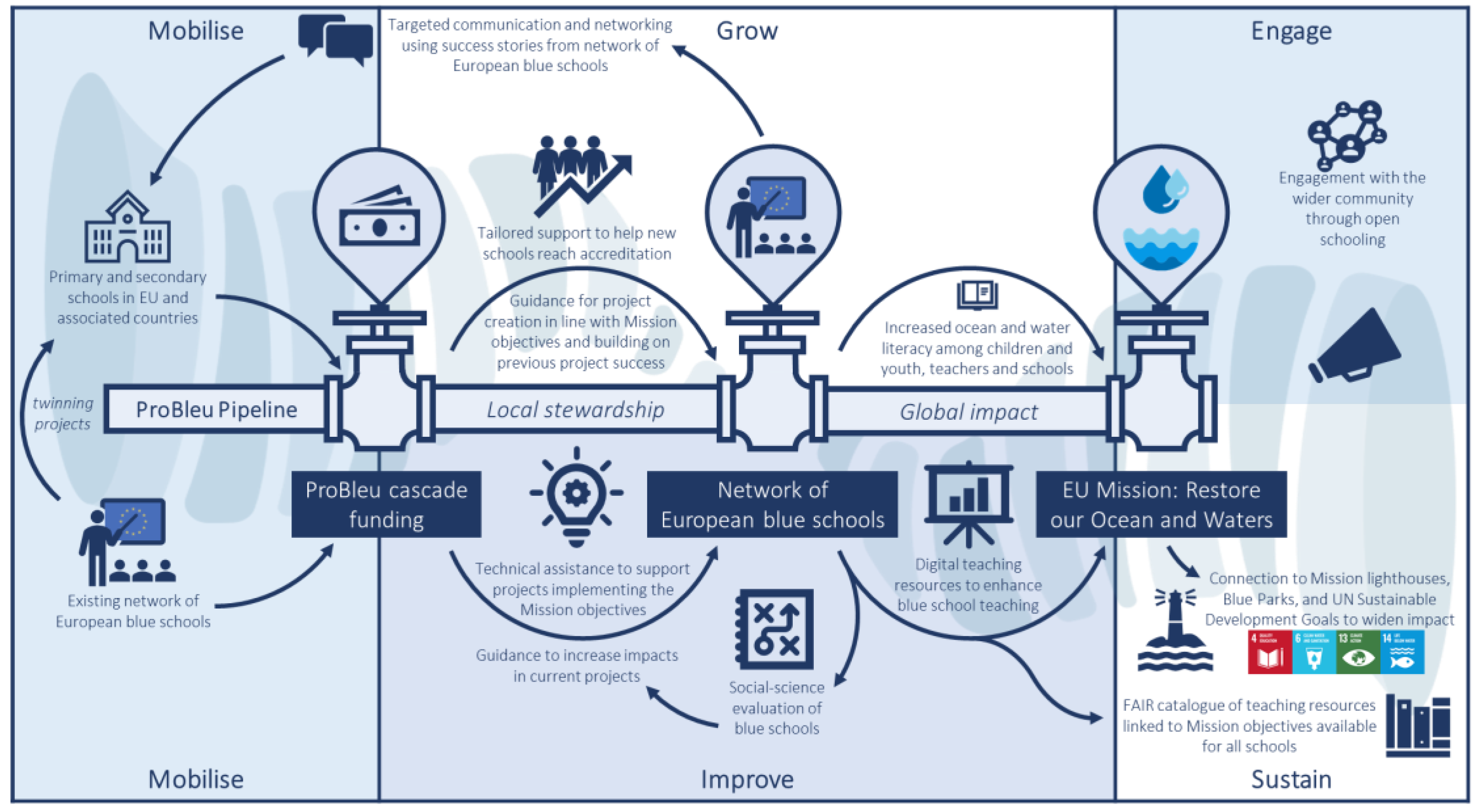

Table 1.
Anticipated outcomes from the ProBleu-CS methodology.
| Expected outcomes, results and KPIs | Pathways to achievement |
|---|---|
| Expected outcomes | ProBleu-CS helps mobilise and engage children, youth, teachers and school communities to implement SDG 6 through innovative environmental education programmes. These programmes increase (1) ocean and water literacy and (2) the understanding of their value and of the overall SDG 6. For example, ProBleu-CS helps make the most relevant ocean and freshwater data from biogeochemical models and satellite Earth observation accessible and understandable to the school communities. As a baseline for educators’ engagement, an H2020 project (EDU-ARCTIC) [21] enrolled 1200 teachers in an informal open-schooling course in environmental science. |
| Expected results | Increased mobilisation through engagement in environmental education, directly addressing SDG 6 |
| KPIs | KPI#1: At least 400 schools mobilised to use resources KPI#2:At least 30,000 students and 1300 educators using ProBleu-CS resources |
| Expected outcomes | ProBleu-CS helps mobilise and engage children, youth, teachers and school communities to implement SDG 6 through the funding of student and school projects and generating resources like recommendations, guidance and best-practice materials. The call for student and school projects helps promote SDG 6 and attract new schools to apply for Network of European Blue Schools membership. The Network’s growth is also supported by twinned applications (by a school from the Network and those aspiring to become accredited members of the Network) employing a perspective of peer-to-peer learning. |
| Expected results | Schools’ engagement in student and school projects, addressing SDG6 Growing Network of European Blue Schools |
| KPIs | KPI#3: At least four calls for students and school projects’ funding KPI#4: At least 100 projects funded and successfully implemented KPI#5: The Network of European Blue Schools ten times the size it had at the beginning of the implementation of the ProBleu methodology KPI#6:At least 300 twinned applications submitted |
| Expected outcomes | ProBleu-CS supports schools to implement SDG 6 and mobilise students, teachers and the broader community by offering innovative educational content and teaching/learning methods, such as challenge-based learning, design thinking, science shops, and citizen science. For example, schools can link school projects to the evidence used in the international research community advising on pollution and biodiversity-loss crises. This link allows participants to address school- or student-project questions such as ‘Is our lake water level and quality changing?’, ‘How will subsidence in coastal areas affect my town?’, ‘What happens to the plastic pollution in our river-sea system?’ or ‘Are algal blooms becoming more widespread?’. Barriers to data uptake in the classroom are removed by coupling age-relevant data-views to clear teaching and learning goals, including input from scientists and educators to suit their specific needs. |
| Expected results | Increased mobilisation through engagement in environmental education, directly addressing SDG6Increased ocean and water literacy among children and youth, teachers and schools Improved understanding of the value and sense of responsibility towards ocean and waters among the youth and teachers |
| KPIs | KPI#7: Number of students and teachers engaged in environmental education programs KPI#8: Uptake of practical teaching aids by at least 30 schools KPI#9: Teaching aids from the shared catalogue used by educators at least 300 times KPI#10: At least 300 projects using challenge-based learning, design thinking or science shops KPI#11: Assessment of the change in ocean and water literacy in at least 30 schools, by interviews KPI#12: Assessment of the change in ocean and water value perceptions in at least 300 schools, by surveys |
| Expected outcomes | ProBleu-CS helps grow the Network by (1) engaging schools in activities related to SDG 6 and based on an open schooling perspective, (2) mobilising a wider community for co-creation and communication of SDG 6, as well as (3) raising awareness about the Network through targeted dissemination and communication actions. Adopting the informal open-schooling methodology developed by the H2020 project EDU-ARCTIC [21] for environmental science, aimed at teachers with teenage pupils, ProBleu-CS helps engage parents, carers, professionals from enterprises, and civil society, to identify and counter failures to reach the less privileged and to document learning. Finally, to facilitate the engagement in implementing SDG6, ProBleu-CS will offer the possibility to quantitatively explore complex scientific data, and will generate ready-to-use map figures. |
| Expected results | Mobilisation of the broader community through engagement in environmental education, directly addressing SDG6 Increased diversity and inclusivity Growing Network of European Blue Schools An open platform, hosting all resources generated in the context of ProBleu-CS Fully accessible documentation of funding calls, marketing and creative materials which can be adapted and reused by citizen-science projects to support future implementation of the methodology |
| KPIs | KPI#13: Catalogue of new co-created teaching materials, such as courses, websites, multimedia items and text documents, following the FAIR principles and shared by at least 300 creators KPI#14: At least 10% of teaching material and activities accessible to any kind of special need KPI#15: Functioning platform, hosting ProBleu-CS resources KPI#16: Documentation of the management, reviewing, monitoring,reporting and marketing processes of funding calls |
Disclaimer/Publisher’s Note: The statements, opinions and data contained in all publications are solely those of the individual author(s) and contributor(s) and not of MDPI and/or the editor(s). MDPI and/or the editor(s) disclaim responsibility for any injury to people or property resulting from any ideas, methods, instructions or products referred to in the content. |
© 2023 by the authors. Licensee MDPI, Basel, Switzerland. This article is an open access article distributed under the terms and conditions of the Creative Commons Attribution (CC BY) license (http://creativecommons.org/licenses/by/4.0/).
Copyright: This open access article is published under a Creative Commons CC BY 4.0 license, which permit the free download, distribution, and reuse, provided that the author and preprint are cited in any reuse.