
Submitted:
02 June 2023
Posted:
05 June 2023
You are already at the latest version
Abstract
Perovskite solar cells are an evolving technology owing to self-assembling and highly tunable bandgap properties of materials. In this context, thin films of perovskites have attracted immense attention and witnessed great advancement because of their low manufacturing cost. The key development in these devices is the conversion efficiency, which rose from 3.8% to 28%. The formulation of innovative materials with the proper replacement of lead in perovskites is imperative to mitigate lead toxicity. Here, we analyzed the challenges like material and structural stability, device stability under high temperature and humidity conditions, lifetime, manufacturing cost, etc. faced in the commercialization of perovskite devices. This review shows that challenges such as device engineering, performance stability against the harsh environment, cost-effectiveness, and environmental concern should be taken into consideration for the widespread acceptance of perovskite-based solar devices. In conclusion, we suggested that an enormous scope exists for exploring high-performance and long-lasting perovskites for energy applications.
Keywords:
Perovskite materials
; Solar cells
; Energy conversion efficiency
; Issue and challenges in commer-cialization
1. Introduction
Energy usage is considered one of the key indicators of the social progress index of development. Fossil fuels, namely oil, natural gas, and coal, are the most abundant and widely used energy sources for the generation of electricity. The continuing use of fossil fuels is having a serious impact on climate change, animal habitat destruction, and global warming [1]. Considering the environmental threats, many countries have committed themselves to the mitigation of greenhouse gas (GHG) emissions as a part of the 2015 Paris Agreement and are now focusing on replacing fossil fuels with renewable energy resources [1]. In recent years, there have been discussions on the energy transition toward sustainable renewable sources, which were taken forward at the COP26 conference in Glasgow, UK, in 2021 [2]. Solar and wind energy sources are considered clean energy sources for the future and are abundantly available worldwide. Undoubtedly, solar energy and solar-based devices are the most feasible alternatives to fossil fuels.
Various materials are utilized for the fabrication of solar cells that convert the solar spectrum into electrical energy. However, it is difficult for any photovoltaic (PV) cell to convert the entire spectral range into electrical energy. The most practically demonstrated and successfully commercialized material is the crystalline (c-Si) solar cell. Although this solar cell has been widely employed, it has several drawbacks, such as a low efficiency of 17% because of the Schokley Queisser limit, even though the theoretically estimated efficiency is 29% [3]. In this context, organometallic perovskites are viewed as the most promising alternative. Perovskite solar cells are accepted as the third-generation technology, which also incorporates dye sensitized (DSSC) and quantum dots (QD) solar cells. These perovskite materials are sensitive to visible solar radiation for the PV cell [4] and have an efficiency equivalent to the C-Si solar cell. In recent years, hybrid perovskites have exhibited high performance [5,6,7], and conversion efficiency of approximately 20% was achieved in PV cells [8,9]. Interestingly, the recent data suggest an incredibly rapid external quantum efficiency (EQE) improvement trend, particularly for tandem perovskite/CIGS (~25%) and perovskite/c-Si solar cells (~28%) [10,11].
This review article aims to discuss the perovskite materials with regards to energy conversion efficiency and stability. The evolution of perovskite materials is presented in Section 2. Section 3 describes the evolution of perovskite for solar cells, including inorganic and hybrid solar cells, whereas perovskite materials concerned with solar cell applications are discussed in Section 4. Issues and challenges, such as structure stability, device fabrication, lifetime, manufacturing cost, and practical alternatives to lead metal in perovskite, have been addressed in Section 5. Conclusions have been summarized in Section 6. We suggest that industrialization challenges such as device engineering, performance stability against harsh environments, cost-effectiveness, and environmental concern should be taken into consideration for the widespread acceptance of solar cell devices.
2. Perovskite Materials
The first inorganic perovskite material, calcium titanate (CaTiO3) (the naturally occurring mineral), discovered by the Russian Mineralogist Perovskite in 1839, is the origin of perovskite and perovskite-based materials [12]. Pioneering studies on the structure of perovskites were performed by Victor Goldschmidt (1926) [13]. Subsequently, several synthetic perovskites were prepared and studied [14,15]. Approximately more than 40 naturally-occurring minerals in the form of oxides, halides, hydroxides, arsenide, and intermetallic compounds have been identified in the perovskite supergroup [16]. The classification of the perovskite system is presented in Figure 1.
Perovskites are very versatile materials and have been emerging as the rising star in the field of optoelectronics during the past decade, as displayed in Figure 2 [17]. Optoelectronic devices based on perovskites include solar cells, photodetectors, lasers, electrochemical cells, and light emitting diodes. Revolutionary applications of these devices are in the fields of energy harvesting and conversion, imaging and sensing, X-ray detectors, display and communication, and manufacturing and medicine [17,18].
Perovskite materials have several distinct properties. The key electrical, physical, and optical characteristics include long-range ambipolar behavior of charge transport, small exciton-binding energy, a high-value dielectric constant, a high-absorption coefficient, ferroelectric properties, a tunable bandgap, and ease of manufacturing at low temperatures. Such favorable attributes of these materials have attracted immense interest for optoelectronic and PV applications [19]. Mixed lead halide-layered perovskite materials have been explored for usage in thin-film light-emitting diodes (LEDs) and also for field-effect transistors (FETs) because of the strong excitonic properties of these materials.
Halide perovskites (HPs) are recognized as the most favorable and accepted materials in PV, thermoelectric, optoelectronic radiation detection, and emission optoelectronic applications owing to their exceptional optical and excitonic properties [20,21,22]. Among organic halide perovskite materials, methylammonium lead triiodide (MAPbI3) is commonly used in PV applications. Its stable structure and simple and inexpensive manufacturing process make lead halide perovskites the preferred material for the mass production of solar panels. Metal halide perovskites have revolutionized the field of solution-processable devices and opened the way for the development of efficient flexible PV cells [23]. Ge et al. reviewed the recent progress in multidimensional metal halide perovskites for PV applications and highlighted the challenges in the field [24].
The hybrid metal halide perovskite materials exhibit promising optoelectronic properties. Zhu and Gong (2021), in this article, opined that 3D halide perovskites possess unique potentials for efficient optoelectronic applications [25]. The researchers also summarized the preparation process of low-dimensional halides and addressed the systematic scientific methodology and technical challenges in the 3D perovskite materials, like inferior long-term stability, which slow down practical applications.
3. Evolution of Perovskite for Solar Cells
Figure 3 (a) shows the block diagram of perovskite solar cells. The operation principle of multilayer solar cells is illustrated in Figure 3 (b). The basic device structure contains a radiation-absorbing perovskite layer squeezed in between the anode, usually F-doped SnO2, and a high-work-function cathode, like Ag or Au metal. The light absorption by the solar cells is due to the formation of excitons (a quasiparticle comprising a pair of positive (hole) and negative (electron) charges) in their absorbing layer (the perovskite material layer). The electrons get excited by the incident photons to a higher energy level and leave the holes behind. Often, the charge transport layers are used in devices to facilitate the movement of the accumulated charges that generate an electric current in the circuit.
During early usage, the perovskites were created on DSSC and combined with a thin perovskites layer on a substrate of mesoporous TiO2 that acted as an electron collector, which had a power conversion efficiency (PCE) of 3.8% [26]. Later, using the same concept of DSSC, Park et al. (2011) obtained a PCE of up to 6.5% [27]. An efficiency value of 9.7% was subsequently achieved using a solid-state electrolyte that operated like a hole transport material (HTM) [28]. Heo et al. (2013) reported PCE up to 12% with the use of an HTM-based perovskite solar cell (PSC) and poly(triarylamine) layers [29]. The obtained efficiency was improved further to 12.3% with the use of a mixed halide CH3NH3PbI3-xBrx perovskite structure [30]. The efficiency of the mixed halide was attributed to the introduction of small-radius bromide (Br) ions and the phase transition from tetragonal to cubic structure, which provided stability to perovskite.
Later, improvement in efficiency (up to 15.2%) with the introduction of the pinhole-free perovskite film using a non-halide (PbAC2) under the direct illumination of sunlight was achieved by Zang et al. (2015) [31]. Such a substantial efficiency improvement (>15%) and stability were reported by several researchers when the devices were fabricated with PbX2 (X=Cl and I) using solution deposition and thermal evaporation techniques [32,33,34,35]. This PCE performance was enhanced up to 16.2% by varying the energy bands of the mixed halides [36] and modifying the thickness of the perovskite-infiltrated TiO2 frame link to the constant perovskite layer [37]. Shin et al. (2017) have shown that the adjustment of the band arrangement of HTM/ETM (hole/electron transport material) improves the efficiency from 19.3% to 20.1% [38]. The contribution of various institutions and scientific laboratories to the development of PSCs is displayed in Figure 4.
A dramatic rise in the efficiency from 3.8% (2009) to 20% (2017) of perovskite solar cells was achieved with solid-state thin-film design, modified film formation technique, optimization of film thickness and morphology, interface engineering, and the use of the mixed-halide perovskites as a photon-absorbing layer in the cell structures [39].
3.1. Inorganic Perovskites Solar Cells
Inorganic perovskite is commonly referred to as the ABX3 compound, wherein A refers to the cations (Cesium: Cs+ ions) occupying the cubo-octahedral site and BX3 occupies the octahedral site. In this structure, B is the anion (Pb2+ ions) and X= Cl, Br, or I. Table 1 lists the developments in CsPbX3(Br, I, Cl) perovskite materials, fabrication processes employed, solar cell device structure, and conversion efficiency achieved [40,41,42,43,44,45].
3.2. Hybrid Perovskite Materials Solar Cell
Hybrid perovskites are an emerging field of semiconductor materials. Favorable attributes are affordable, solution-based semiconducting materials with promising optoelectronic properties. Tunable bandgap [46,47], strong absorption coefficient, small excitation binding energy [48,49], and balanced mobility of the charge carriers with minimal defect formation characteristics make them suitable for application in solar cells and LEDs [45,50]. The rapid advancements in perovskite materials have enhanced the efficacy of solar cells from 3.8% to 22% in a very short span [27,29,37]. The intensive developments in methylammonium (MA) lead halide perovskites with respect to efficiency and the trials of various HTMs have led to considerable progress in thin-film optoelectronics. The development of hybrid PSCs with PCE using various HTMs has been described in Table 2 [27,36,37,51,52,53,54].
3.3. Materials Requirements for High Performance Solar Cell Devices
Fabrication of perovskite film with good quality, robustness against harsh environmental conditions, and structural stability is imperative for the high-performance device of solar cells. Many properties of perovskites, such as direct bandgap, phase purity and stability at room temperature, illumination, and degradation at high temperatures, have been well studied. Hence, some other vital properties of perovskite materials, which enable better performance compared with other semiconductors and dyes, have been highlighted here. These properties include the maximum absorption range, the optimal bandgap required for the excitation coefficient, the dispersion of charge carriers to enhance the intensity, photoluminescence, and electroluminescence emission spectra. Perovskites enjoy a wide absorption range, including the visible and near-IR (NIR) regions. In this context, organometal halides are advantageous over dyes. CH3NH3PbI3 perovskite absorbs the entire range of the visible spectrum with a halide film about 600 nm thick [55]. CH3NH3PbI3 shows better absorption, which is the main requirement for any solar material. Moreover, this material has a bandgap of 1.55 eV, which is almost equal to the bandgap of 1.4 eV. This property, combined with an extinction coefficient value of 1.5 × 10⁵ (mol/L)-1.cm-1 at around 550 nm, makes CH3NH3PbI3 an excellent solar radiation-absorbing material [55] and gives an exceptional quantum efficiency at 800nm in the solar cell. Several researchers have discussed the ambipolar behavior of CH3NH3PbI3 perovskite. A mesoporous TiO2/CH3NH3PbI3 solar cell with 5.5% efficiency [56] displays a p-type nature. MAPbBr3-based LEDs have been demonstrated to reduce metallic grain impurities. The nanograin of MAPbBr3 is approximately 100nm thick with an EQE of 8% [57]. The mesoporous ZnO2/CH3NH3PbI3 solar cell exhibits n-type behavior with 10.8% efficiency [34]. Other researchers have shown that Al2O3/CH3NH3PbI-xClx possesses an n-type charge transport characteristic [30,37,52,57]. The organometal halide perovskite has a high mobility of charge carriers and generates charges quickly, which simplifies the manufacturing process [58]. The charge transport characteristics are mainly responsible for the long-range light absorption in relation to the charge carrier's diffusion length. Methylammonium lead iodide (MAPbX3) perovskite possesses significant optical and electronic properties [59,60]. The absorption starts at 800nm and fairly covers the visible spectrum region, with separated free cations even at room temperature [61,62]. Iodine can be a good substitute for chloride (Cl-) and bromide (Br-) because of the continuous tuning of the bandgap, which covers most of the visible spectrum [63,64,65,66]. The large bandgap value of 2.2 eV and binding energy of 150 meV of bromide in CH3NH3Br3 in comparison with CH3NH3I3, which has a bandgap of 1.5 eV and binding energy of 50 meV, limit the light absorption up to 550nm and hence lower the photocurrent [65] and also restrict the PCE [67]. The classification of perovskite materials based on their characteristics is presented in Table 3.
The advancements in solar perovskites and increase in their conversion efficiency from 3.8% to 26% witnessed over the past decade could be attributed to the frantic research and mass production of perovskite materials. Highly stabilized solar cells with low voltage loss have also been investigated recently [68]. A device with long-term stability has displayed a PCE of approximately 25.2%. This value is near the C-Si efficiency of 26.2%, which has dominated the market as per several reports. The Oxford PV made use of tandem solar perovskites, achieving lab efficiency of up to 28% [69], wherein all perovskites in tandem exhibited comparable tandem efficiencies.
4. Perovskite Materials Concern for Solar Cell Applications
Lead-free perovskite seems to be the most appropriate alternative. Intensive research and technological advancements in lead-based perovskites are at their pinnacle and progressing toward commercialization. The modified compounds are required to have optoelectronic properties that should be at par with Pb-based perovskites and fulfill the criteria for mass production and commercialization. Tin (Sn), Bismuth (Bi), Antimony (Sb), Germanium (Ge), Double halide perovskite materials, and chalcogenide perovskites could become favorable compounds in perovskite solar cell applications.
Sn-Based Solar Cells
Bi-Based Solar Cells
Bi2+ is a potential candidate for optoelectronic applications. A report on MA3Bi2A9 (A = Cl, Br, or I) quantum dots, produced by synthesizing using a ligand-assisted recrystallization approach, established that the tunable band can be varied from 360 to 540 nm. This wide range of variation is due to the anion composition, which gives intense emission at 423 nm with a PL quantum yield (PLQY) of around 12%. At present, a few successful results have been obtained with the Bi perovskite materials, which hold promise for replacing the Pb-based perovskites. However, some research observations have implied unfavorable results, such as a broad bandgap, low performance, and more internal defects in Bi-based perovskite materials. Some Bi-based PSCs and their properties have been shown in Table 5 [76,77,78,79].
Sb-Based Solar Cells
Sb is a heavy metal of low toxicity that belongs to the same element group as Bi3+. Sb3+ cations possess an identical electron lone pair as Pb2+ and are therefore likely to replace Pb in the perovskite materials. The bandgap of inorganic Cs3Sb2I9 is 2.05 eV and shows absorption comparable to that of the hybrid Pb-based perovskite CH3NH3PbI3. This material exhibits higher stability in air compared with CH3NH3PbI3. The thin films of (CH3NH3)3SbI9 demonstrated a photosensitive bandgap of 2.14 eV and PL at 1.58 eV.
Ge-Based Solar Cells
Another class of materials are the Ge-based inorganic and hybrid perovskites. The experimentally measured bandgap values for CsGeI3, MAGeI3, and FAGeI3 are 1.66 eV, 1.9 eV, and 2.2 eV [80], respectively. Thus, Ge materials possess desirable optoelectronic properties and could become a potential replacement for Pb in perovskite materials. Some selected Ge-based PSCs and their properties have been presented in Table 6 [81,82,83].
Double Perovskite Solar Cells
Computational investigations on the hypothetical perovskite with the general formula Cs2BB3+X6 (called double perovskite) showed promising results with a bandgap in the visible region and a low effective mass [84]. McClure et al. reported the synthesis routes for the lead-free hybrid perovskites Cs2BiAgCl6 and Cs2BiAgBr6 [85]. Whereas Wei Fengxia et al. showed the synthesis of (CH3NH3)2KBiCl6 double halide perovskite [86]. Lijun Zhang et al. (2017) [87] proposed the new formula A2B+B3+X6VII (A = Cs+, B+ =Na+, K+, Rb+) from group IA or (Cu+, Ag+, Au+) or (In+, Ti+) from group IIIB, B3+ = (Bi3+, Sb3+), and X = (F-, Cl-, Br-, I-). They identified 64 such combinations and optimized them to 11 compounds with robust stability, which can be considered promising candidates for lead-free PVs. Furthermore, two compounds identified using computational methods, namely Cs2InSbCl6 and Cs2InSbCl6, with bandgaps of 1.02 eV and 0.9 eV, respectively, showed theoretical solar efficiency comparable to that of CH3NH3PbI3.
Chalcogenide Perovskites Solar Cells
Very recent computational simulations have proposed a new class of chalcogenide perovskites [88]. Limited studies have been presented on these perovskite materials, and some materials, such as BaZrS3 [89], SrZrS3 [88], BaHfS3 [88], and SrHfS3 [89], have been synthesized. These materials possess bandgaps and absorption coefficients that are appropriate for solar devices. Shallow point defects are observed in these materials, which open the chance of fine-tuning charge transport and photosensitive properties. The actual experimental work is likely to open a new era in fabrication and thin-film technology and provide tailored materials for solar applications.
5. Issues and Challenges in Perovskite Solar Cells
Substantial experimental and theoretical research has been made in learning and understanding the materials structure, device stability, efficiency, and complex composition. In recent years, perovskite materials and technology have taken a step toward manufacturing and have explored the market for the commercialization of perovskite solar cell devices. Wang et al. opined that the mass production of PSCs is not yet feasible due to various factors [90]. Challenges faced by perovskite solar cells are (i) high-quality perovskite layer fabrication with low cost and large-scale reproducibility, (ii) the choice and deposition of charge extraction layers, and (iii) the fabrication of bottom and top electrodes using low-cost processes. These issues need to be addressed to build small- and large-area PSC devices. In a review report, Yang et al. presented the advancement of efficient large-area PVs with stability for commercialization [91].
Furthermore, several concerns, such as lifetime, stability, lead toxicity, environmental contamination, and cost-benefit, are fundamental factors for the effective commercialization of perovskite solar cells. Perovskite compounds have a great tolerance to crystalline defects because of the ionic bonding, and thin films with high crystallinity can be fabricated at low temperatures only. Further, these materials have low decomposition temperatures, making them less thermally stable than Si [92]. Recently, Lin et al. summarized the issues, such as high stability and long lifetime, lead toxicity, fabrication repeatability, large-area fabrication, and flexible devices [93]. Metal halide perovskite solar panels merits and demerits are shown in Table 8.
Milić et al. (2021) observed that hybrid perovskites are affected by external factors such as air and moisture, photo-stability, and device operating voltage, thus resulting in various degradation routes [94]. Various strategies to overcome these instabilities, such as the use of low-dimensional hybrid perovskite materials, were proposed. Low-dimensional materials include layer-by-layer stacks of 2D perovskite and organic layers that are separated by hybrid perovskite slabs. Such a structure is more stable in ambient conditions and in ion relocation.
Although inorganic perovskites exhibit higher thermal stability, they have poorer phase stability than their hybrid counterparts. This is associated with the strain in the lattice and voids within the inorganic perovskite material crystals. In a recent review, Xiang et al. (2021) summarized and discussed the stability and lifetime mechanisms of inorganic perovskites with regard to heat, humidity, and oxygen [95]. Minimizing the vacancies and strain during the film processing may be a possible way to address the stability concerns related to both intrinsic and extrinsic factors. Challenges that need to be overcome strategically to transform perovskite modules into marketable PVs include stability, lead leakage, and outdoor testing of the modules, as discussed by Cheng et al. (2021) [96].
It may be mentioned here that lead is likely to be widely used in perovskite PV industries in the future. When the PSC panels die, the lead metal could possibly leach into the ecosystem, causing contamination of the air, earth, and groundwater. The major challenges like material stability, device fabrication, lifetime of the devices, manufacturing cost, lead toxicity, best practices to overcome these challenges, and viable alternatives to Pb metal have been discussed below.
5.1. Perovskite Structural Stability Perspective
The thin film of perovskites is polycrystalline and can vary with unit cell orientation. The thin film structure of the perovskite materials is important for the stable operation of any device. A small alteration in the synthesis route and formulation can lead to a remarkable change in texture and morphology, which exert severe impacts on the device's performance. Therefore, the production of efficient and stable perovskite materials for the solar cells faces a serious challenge in defining the structure. Liu et al. (2020) examined the instability and phase behavior of FAPbI3 and showed that it is highly efficient but shows instability in air and decays rapidly in a hexagonal structure [97]. Schmidt-Mende et al. (2021) [98] suggested in situ real-time scattering measurement during the film formation to obtain a better understanding of the intermediate phases formed during the process. The hybrid perovskite is expected to be highly ordered and likely to be the better alternative for the reliable operation of devices.
5.2. Device Fabrication Issues
The spin-coating technique is commonly used for the deposition of a perovskite layer on the substrate in solution-processed device production. During the preparation, the solvent interacts with the precursor and forms halide complexes. The solvent plays a vital role and influences various properties of the precursor, such as its i) solubility; ii) evaporation rate; iii) viscosity; iv) crystallization; and v) formation of the intermediate phase. The formation of several complexes occurs with the use of strong binding solvents, like dimethyl sulfoxide (DMSO). The weakly interacting solvents allow strong interaction among the starting ingredients. This leads to the creation of the intermediate phase and its subsequent conversion into the perovskite phase, which allows the rapid formation of the perovskite phase upon evaporation [99]. Whereas strong-interacting solvents usually require annealing at a higher temperature for a few minutes to obtain the pure perovskite phase [100]. The formation of these complexes can be avoided by adding a few polymer additives [101,102]. To overcome these challenges in the solution process, many reports have highlighted the step-by-step mechanism of thin-film formation.
5.3. Lifetime and Stability under High Temperature and Humidity
Most investigations and results reported by researchers for perovskite technology are focused on color, purity, and efficiency. However, the perovskite material and hence the stability of devices in harsh environmental conditions, such as high temperatures, weather fluctuations, and high humidity, are crucial factors to be considered seriously for commercialization. Therefore, it is vital to address the concerns of stability issues in order to achieve high efficiency and high durability simultaneously. Prolonged exposure to high temperatures or illumination and to moisture in the air result in the degradation of the perovskites [103]. The device's performance is susceptible to oxygen, as the perovskite layers degrade when they meet oxygen [103,104]. Many researchers have argued that moisture, atmospheric oxygen, heat, etc. are possible causes for the degradation of PSCs. Whereas Wang et al. (2017) stated that PSC's degradation is due to the material’s natural properties [105]. Iodide-based perovskites like MAPbI3 generate a gaseous state of iodine (I2) that results in the degradation of the perovskite material. Furthermore, the acid-based chemical process used in the deposition of ZnO/MAPbI3 layers causes degradation. TiO2 and SnO2, used in solar cell manufacturing, demonstrate better stability, but their excessive use causes degradation when exposed to UV radiation and leads to defects [106]. The morphology of spiro-MeOTAD and additives restricts its stability. Also, the commonly used Au electrode atoms diffuse at high temperatures via spiro-MeOTAD, causing degradation [107]. The use of carbon electrodes is found to be highly practicable for the device's stability [108].
Compared with the hybrid organic-inorganic perovskites, all inorganic lead halide perovskites, such as CsPbI3, exhibited better thermal stability and, hence, attracted the attention of several researchers. But their low structural stability (phase stability) under ambient conditions limits their practical applications [109]. To improve longevity, the formation of 2D and 3D perovskites was suggested as a possible alternative. Next, the long-term stability of PSCs under ambient conditions can be augmented by using proper encapsulation to protect the device from environmental changes [105,110]. Recently, Ling Xiang et al. investigated detailed requirements for the encapsulation process and encapsulant materials to meet external challenges like temperature, oxygen, moisture, and UV light [111]. Figure 6 shows the schematic of the encapsulation of commercial silicon and perovskite solar cells. Ethylene-vinyl-acetate (EVA) is the most commonly used encapsulation material for commercial use owing to its low cost, adequate transparency, and flexibility. But it is prone to acetic acid formation and has a high water vapor transmission rate. Two alternatives for EVA are thermoplastic polyolefin (TPO) and polyvinyl butyral (PVB) [112]. More recently, interest in polyolefin elastomer-based (POE) and thermoplastic polyurethane (TPU) is increasing. A variety of encapsulation materials, such as fluoropolymeric coatings, TPU, ethylene methyl acrylate, cyclized perfluoro-polymer (Cytop), organic-inorganic hybrid materials (ORMOCERs), ORMOSIL aero-gel thin film, various polymer films, etc., have been reported for perovskite solar cells [113]. Although the encapsulation method has been successfully implemented using a glass cover and inert epoxy resin, it influences the performance of the device [114,115]. Therefore, optimization of sealing is necessary to have good performance under heat and pressure stresses. Earlier, Yaoguang Rong et al. reported that the methacrylate glue, krypton polymer layer encapsulation, etc., exhibit the stable performance of the devices for more than 1300 hours in dark conditions [114]. This type of encapsulation has been adopted by several researchers for achieving a significantly higher device operation lifetime. The performance of MAPbI3 perovskite solar cells under various atmospheric conditions is described in Table 9 [36,116,117,118,119,120].
5.4. Alternatives to the Toxic Heavy Metal Lead
Among all perovskite materials, MAPbI3 has a stable perovskite phase in air. Therefore, many researchers have focused on the optimization of this material [121,122]. However, lead in perovskite solar cells poses serious risks to human health and the ecosystem. Ren et al. (2021) examined the latest developments in the safety issue of lead perovskite PVs and the corresponding solutions [123]. When the perovskite solar cells are degraded or damaged, the released or leaked PbI2 pollutes the surrounding environment, exhibits toxicity toward the human respiratory and nervous systems, and increases oxidative stress [124]. Lead contamination is largely minimized in many developed countries, but the threat continues in developing countries. Nevertheless, the use of Pb in PV solar cells is likely to continue as the solar panels are pardoned from the European Legislation Restriction of Hazardous Substances [125]. The power conversion efficiency and stability of PCS cells are far better than those of lead-free PSCs. As a result, Chun-Hao Chen et al. in 2023 proposed the methodology of reducing lead leakage based on polymer resin protective layers and self-healing encapsulation, which can increase lead capture rates up to 95% under harsh conditions [126]. In summary, the development of Pb-free perovskite materials that are more competent, economical, and long-lasting may be the better option and is necessary.
Future Perovskite Materials - Machine Learning Approach
Recently, the use of computational methods and artificial intelligence (AI), referred to as machine learning (ML), has attracted worldwide attention for the prediction and assessment of perovskite materials [127]. ML is a statistical model that requires a systematic approach to data analysis based on historical data, mathematical calculations, statistics, and computer and engineering knowledge. To maintain the stability of the hybrid perovskite MAPbI3, Hartono et al. (2020) developed 21 different capping layers using the ML approach [128]. Photocurrent extraction by solar cells depends on their mobility, lifetime diffusion length, and charge carriers. Consequently, researchers examined the problem via an AI approach. They proposed that this process not only facilitated the fast screening and completed the calculations of charge carrier mobilities but also provided a straightforward path to determine the charge carrier masses, electron-phonon coupling, and phonon frequency in metal halide perovskites [129].
Currently, ML and AI techniques are widely used to understand the bandgap, stability, crystal formation, and charge carrier mobilities of perovskites. These studies are limited to small structures and are considerably away from realistic conditions, such as temperature dependence, atmospheric moisture that affects the bandgap, effective masses, thermal disorders, and structural changes [130,131]. The theoretical calculations demand a highly precise explanation of metal halide perovskites in spin-orbit coupling, interactions of charge carriers, structural properties, lattice vibrations, and the complexity of the bandgaps of hybrid and inorganic perovskite materials.
5.5. Manufacturing Cost
The affordability of any electronic device relies on its performance and long lifespan. The cost-performance ratio is calculated based on the expenses incurred regarding the raw materials used, fabrication of the device, labor, operation, overhead cost, and disposal or recycling. These factors together constitute the capital cost, which must be taken into consideration during the commercialization of the product. Although no standard lifetime has been reported for perovskites, it is assumed to be >1000 hours and needs to be further improved. Other constituents that added to the cost were the back-contact electrodes made of gold or silver. These are costly metals, and hence, it is necessary to develop economical contact materials. Alternatively, the use of highly stable carbon electrodes may reduce expenses and improve stability [116]. Copper electrodes could also be considered as an alternative in high-performance solar perovskites [132]. In addition to these issues, the main concern is the presence of lead halide in the perovskites. To minimize lead toxicity in the environment, recycling and reuse of lead (Pb) are recommended. However, recycling is economical only when there is a large active market [133,134]. Furthermore, the conductive glass (FTO) used in solar cells is the most expensive part, which can be reused without reducing the performance of the devices.
Panel Cost Analysis
A recent report by Mark Hutchins stated the scientists came up with the new measurements that projected the production of 100 MW of perovskites solar cells [135]. The report also claims that many different viable possibilities exist to commercialize the product. Recently, Pavel Čulík et al. in 2022 showed that the production of perovskite solar panels requires a process cost calculation model that includes different climate conditions and labor costs at different locations for installations [136]. They showed that perovskite PV production is competitive with other PV technologies even at smaller scales of production.
6. Conclusions
We analyzed the challenges like material and structural stability, device stability under high temperatures and humidity, lifetime, manufacturing cost, etc. faced in the commercialization of perovskite devices. Perovskite materials are highly practical and competitive for fabrication due to their benefits, such as low cost, easy fabrication technique, and perfect crystallinity. Particularly, hybrid perovskites have many advantages, such as a strong absorption coefficient, balanced mobility of the charge carriers, and small defect formation. As the power conversion efficiency and stability of PCS cells are far better than those of lead-free PSCs, the use of Pb in PV solar cells is likely to continue in the future. But the toxicity and environmental issues related to Pb in perovskite materials are of serious concerns and need to be addressed urgently before the large-scale adoption of perovskite solar panels. Therefore, to prevent mitigation of the environment and harm to human health, the proposed options are to increase the material stability, have a long lifetime of the device, use hermetic encapsulation, have a proper disposal option, and recycle the dead devices. Nonetheless, the degradation of perovskite solar cells due to prolonged exposure to high temperatures and relative humidity could not be avoided in practical applications.
The replacement of Pb metal completely from the perovskite by new non-toxic materials that possess properties like those of lead-based perovskites is necessary. Prolonged exposure of Pb may be hazardous to human health and may cause irritation to the skin, lungs, and eyes. Continuous exposure may result in serious health issues. Many materials such as Sn, Ge, Sb, Bi, etc. have so far been proposed to replace the Pb in perovskites to prevent damage to the environment.
The cost analysis shows that material selection, production, and ground installation reduce the cost significantly. The energy payback time shows the perovskite layer consumes only 1% of the input energy, and the production process consumes 5.3%. The sensitivity measurements show the major cost concerns are production, maintenance, and local labor. Here we suggest the installation of solar panels should be at a 365-day location with hot and dry weather conditions, with local maintenance and local labor such as cleaning the panel using a robot machine.
Future perovskite materials with precise knowledge about their properties are likely to be synthesized using ML and AI techniques. The compounds identified via computational methods, such as double halide perovskites and chalcogenide perovskites, have a long way to go to dominate the market because they must follow the appropriate synthesis route, deposition of thin films, device engineering, and thermodynamic stability. Computational research has suggested that double-halide perovskites and chalcogenide compounds could be reasonable replacements for the Pb metal.
The development of solar cells that are cost-effective, efficient, and stable is necessary so that they are easily widespread and accessible to the general population. In summarizing, it is suggested that the efficacious replacement of Pb metal, environmental concerns, cost-effectiveness, and industrialization challenges are required to be addressed for the widespread acceptance of perovskite solar cells.
Data Availability Statement
Not applicable.
Conflicts of Interest
The authors declare no conflict of interest.
References
- Nunez, C. Learn how human use of Fossil Fuel non-renewable energy resources coal, oil, and natural gas-affect climate change. National Geographic, April-2, 2019. Available online: https://www.nationalgeographic.com/environment/article/fossil-fuels.
- United Nations Climate Change Conference, Glasgow, UK from 31 October-13 November 2021. Available online: https://earth5r.org/cop26-the-negotiations-explained/.
- Shockley, W.; Queisser, H.J. Detailed balance limit of efficiency of p-n junction solar cells. Journal of applied physics 1961, 32, 510–519. [Google Scholar] [CrossRef]
- Akihiro, K.; Teshima, K.; Shirai, Y.; Miyasaka, T. Organometal halide perovskites as visible-light sensitizers for photovoltaic cells. Journal of the American Chemical Society 2009, 131, 6050–6051. [Google Scholar]
- Green, M.A.; Ho-Baillie, A.; and Henry, J.; Snaith, H.J. The emergence of perovskite solar cells. Nature photonics 2014, 8, 506–514. [Google Scholar] [CrossRef]
- Snaith, H.J. Perovskites: the emergence of a new era for low-cost, high-efficiency solar cells. The journal of physical chemistry letters 2013, 4, 3623–3630. [Google Scholar] [CrossRef]
- Park, N.-G. Perovskite solar cells: an emerging photovoltaic technology. Materials today 2015, 18, 65–72. [Google Scholar] [CrossRef]
- Julian, B.; Pellet, N.; Moon, S.-J.; Humphry-Baker, R.; Gao, P.; Nazeeruddin, M.K.; Grätzel, M. Sequential deposition as a route to high-performance perovskite-sensitized solar cells. Nature 2013, 499, 316–319. [Google Scholar]
- Zhang, W.; Anaya, M.; Lozano, G.; Calvo, M.E.; Johnston, M.B.; Míguez, H.; Snaith, H.J. Highly efficient perovskite solar cells with tunable structural color. Nano letters 2015, 15, 1698–1702. [Google Scholar] [CrossRef] [PubMed]
- Wang, R.; Huang, T.; Xue, J.; Tong, J.; Zhu, K.; Yang, Y. Prospects for metal halide perovskite-based tandem solar cells. Nature Photonics 2021, 15, 411–425. [Google Scholar] [CrossRef]
- Eike, K.; Wagner, P.; Lang, F.; Cruz, A.; Li, B.; Roß, M.; Jošt, M.; Morales-Vilches, A.B.; Topič, M.; Stolterfoht, M.; et al. 27.9% Efficient Monolithic Perovskite/Silicon Tandem Solar Cells on Industry Compatible Bottom Cells. Solar RRL 2021, 2100244. [Google Scholar]
- Katz, E.A. Perovskite: name puzzle and German-Russian odyssey of discovery. Helvetica Chimica Acta 2020, 103, e2000061. [Google Scholar] [CrossRef]
- Goldschmidt, V.M. Die gesetze der krystallochemie. Naturwissenschaften 1926, 14, 477–485. [Google Scholar] [CrossRef]
- Halasyamani, P.S.; Noncentrosymmetric Inorganic Oxide Materials: Synthetic Strategies and Characterization Techniques. In Functional Oxides, John Wiley & Sons, Ltd., Book Editor(s): O’Hare, D.; Walton, R.I.; Bruce, D.W. 2010, 1-40. Print ISBN:9780470997505.
- Goel, P.; Sundriyal, S.; Shrivastav, V.; Mishra, S.; Dubal, D.P.; Kim, K.-H.; Deep, A. Perovskite materials as superior and powerful platforms for energy conversion and storage applications. Nano Energy 2021, 80, 105552. [Google Scholar] [CrossRef]
- Locock, A.J.; Mitchell, R.H. Perovskite classification: An Excel spreadsheet to determine and depict end-member proportions for the perovskite-and vapnikite-subgroups of the perovskite supergroup. Computers & Geosciences 2018, 113, 106–114. [Google Scholar]
- Dong, H.; Ran, C.; Gao, W.; Li, M.; Xia, Y.; Huang, W. Metal Halide Perovskite for next-generation optoelectronics: progresses and prospects. eLight (Springer) 2023, 3, 3. [Google Scholar] [CrossRef]
- Baeva, M.; Gets, D.; Polushkin, A.; Vorobyov, A.; Goltaev, A.; Neplokh, V.; Mozharov, A.; Krasnikov, D.V.; Nasibulin, A.G.; Mukhin, I.; Makarov, S. ITO-free silicon-integrated perovskite electrochemical cell for light-emission and light-detection. Opto-Electron Adv 2023, 6, 220154. [Google Scholar] [CrossRef]
- Thomas, S.; Thankappan, A. eds. Perovskite photovoltaics: Basic to advanced concepts and implementation. Academic Press, 2018., 197-229.
- Orrea-Baena, J.-P.; Saliba, M.; Buonassisi, T.; Grätzel, M.; Abate, A.; Tress, W.; Hagfeldt, A. Promises and challenges of perovskite solar cells. Science 2017, 358, 739–744. [Google Scholar] [CrossRef]
- Lin, K.; Xing, J.; Quan, L.N.; García de Arquer, F.P.; Gong, X.; Lu, J.; Xie, L.; Zhao, W.; Zhang, D.; Yan, C.; et al. Perovskite light-emitting diodes with external quantum efficiency exceeding 20 per cent. Nature 2018, 562, 245–248. [Google Scholar] [CrossRef]
- Akkerman, Q.A.; Manna, L. What defines a halide perovskite? ACS Energy Letters 2020, 5, 604–610. [Google Scholar] [CrossRef]
- Hoefler, S.F.; Trimmel, G.; Rath, T. Progress on lead-free metal halide perovskites for photovoltaic applications: a review. Monatshefte für Chemie-Chemical Monthly 2017, 148, 795–826. [Google Scholar] [CrossRef]
- Ge, C.; Xue, Y.Z.B.; Li, L.; Tang, B.; Hu, H. Recent Progress in 2D/3D Multidimensional Metal Halide Perovskites Solar Cells. Frontiers in Materials 2020, 7, 601179. [Google Scholar] [CrossRef]
- Zhu, T.; Gong, X. Low-dimensional perovskite materials and their optoelectronics. InfoMat 2021, 3, 1039–1069. [Google Scholar] [CrossRef]
- Green, M.A. Silicon solar cells: evolution, high-efficiency design and efficiency enhancements. Semiconductor science and technology 1993, 8, 1. [Google Scholar] [CrossRef]
- Im, J.-H.; Lee, C.-R.; Lee, J.-W.; Park, S.-W.; Park, N.-G. 6.5% efficient perovskite quantum-dot-sensitized solar cell. Nanoscale 2011, 3, 4088–4093. [Google Scholar] [CrossRef] [PubMed]
- Kim, H.-S.; Lee, C.-R.; Im, J.-H.; Lee, K.-B.; Moehl, T.; Marchioro, A.; Moon, S.-J.; Humphry-Baker, R.; Yum, J.-H.; Moser, J.E.; et al. Lead iodide perovskite sensitized all-solid-state submicron thin film mesoscopic solar cell with efficiency exceeding 9%. Scientific reports 2012, 2, 1–7. [Google Scholar] [CrossRef] [PubMed]
- Heo, J.-H.; Im, S.-H.; Noh, J.-H.; Mandal, T.N.; Lim, C.-S.; Chang, J.-A.; Lee, Y.-H.; Kim, H.-S.; Sarkar, A.; Nazeeruddin, M.K.; Grätzel, M.; et al. Efficient inorganic–organic hybrid heterojunction solar cells containing perovskite compound and polymeric hole conductors. Nature photonics 2013, 7, 486–491. [Google Scholar] [CrossRef]
- Noh, J.-H.; Im, S.-H.; Heo, J.-H.; Mandal, T.N.; Seok, S.-I. Chemical management for colorful, efficient, and stable inorganic–organic hybrid nanostructured solar cells. Nano letters 2013, 13, 1764–1769. [Google Scholar] [CrossRef]
- Zhang, W.; Saliba, M.; Moore, D.T.; Pathak, S.K.; Hörantner, M.T.; Stergiopoulos, T.; Stranks, S.D.; Eperon, G.E.; Alexander-Webber, J.A.; Abate, A.; Sadhanala, A.; Yao, S.; Chen, Y.; Friend, R.H.; Estroff, L.A.; Wiesner, U.; Snaith, H.J. Ultrasmooth organic–inorganic perovskite thin-film formation and crystallization for efficient planar heterojunction solar cells. Nature communications 2015, 6, 1–10. [Google Scholar] [CrossRef]
- Chang, Y.H.; Park, C.-H.; Matsuishi, K. First-principles study of the Structural and the electronic properties of the Lead-Halide-based inorganic-organic perovskites (CH~ 3NH~ 3) PbX~ 3 and CsPbX~ 3 (X= Cl, Br, I). Journal-Korean Physical Society 2004, 44, 889–893. [Google Scholar]
- Frost, J.M.; Butler, K.T.; Brivio, F.; Hendon, C.H.; van Schilfgaarde, M.; Walsh, A. Atomistic origins of high-performance in hybrid halide perovskite solar cells. Nano letters 2014, 14, 2584–2590. [Google Scholar] [CrossRef]
- Brivio, F.; Walker, A.B.; Walsh, A. Structural and electronic properties of hybrid perovskites for high-efficiency thin-film photovoltaics from first-principles. Apl Materials 2013, 1, 042111. [Google Scholar] [CrossRef]
- Umari, P.; Mosconi, E.; De Angelis, F. Relativistic GW calculations on CH3NH3PbI3 and CH3NH3SnI3 perovskites for solar cell applications. Scientific reports 2014, 4, 1–7. [Google Scholar] [CrossRef] [PubMed]
- Jeon, N.-J.; Noh, J.-H.; Kim, Y.-C.; Yang, W.-S.; Ryu, S.-C.; Seok, S.-I. Solvent engineering for high-performance inorganic–organic hybrid perovskite solar cells. Nature materials 2014, 13, 897–903. [Google Scholar] [CrossRef]
- Zhou, H.; Chen, Q.; Li, G.; Luo, S.; Song, T.-B.; Duan, H.-S.; Hong, Z.; Jingbi You, J.; Liu, Y.; Yang, Y. Interface engineering of highly efficient perovskite solar cells. Science 2014, 345, 542–546. [Google Scholar] [CrossRef] [PubMed]
- Shin, S.-S.; Yeom, E.-J.; Yang, W.-S.; Hur, S.; Kim, M.-G.; Im, J.; Seo, J.-W.; Noh, J.-H.; Seok, S.-I. Colloidally prepared La-doped BaSnO3 electrodes for efficient, photostable perovskite solar cells. Science 2017, 356, 167–171. [Google Scholar] [CrossRef]
- Yin, W.-J.; Yang, J.-H.; Kang, J.-G.; Yan, Y.; Wei, S.-H. Halide perovskite materials for solar cells: a theoretical review. Journal of Materials Chemistry 2015, A3, 8926–8942. [Google Scholar] [CrossRef]
- Swarnkar, A.; Marshall, A.R.; Sanehira, E.M.; Chernomordik, B.D.; Moore, D.T.; Christians, J.A.; Chakrabarti, T.; Luther, J.M. Quantum dot–induced phase stabilization of α-CsPbI3 perovskite for high-efficiency photovoltaics. Science 2016, 354, 92–95. [Google Scholar] [CrossRef] [PubMed]
- Wang, P.; Zhang, X.; Zhou, Y.; Jiang, Q.; Ye, Q.; Chu, Z.; Li, X.; Yang, X.; Zhigang Yin, Z.; You, J. Solvent-controlled growth of inorganic perovskite films in dry environment for efficient and stable solar cells. Nature communications 2018, 9, 1–7. [Google Scholar] [CrossRef]
- Wang, Y.; Zhang, T.; Kan, M.; Zhao, Y. Bifunctional stabilization of all-inorganic α-CsPbI3 perovskite for 17% efficiency photovoltaics. Journal of the American Chemical Society 2018, 140, 12345–12348. [Google Scholar] [CrossRef]
- Liu, C.; Li, W.; Zhang, C.; Ma, Y.; Fan, J.; Mai, Y. All-inorganic CsPbI2Br perovskite solar cells with high efficiency exceeding 13%. Journal of the American chemical society 2018, 140, 3825–3828. [Google Scholar] [CrossRef]
- Liu, C.; Li, W.; Li, H.; Wang, H.; Zhang, C.; Yang, Y.; Gao, X.; Xue, Q.; Yip, H.-L.; Fan, J.; et al. Structurally Reconstructed CsPbI2Br Perovskite for Highly Stable and Square-Centimeter All-Inorganic Perovskite Solar Cells. Advanced Energy Materials 2019, 9, 1803572. [Google Scholar] [CrossRef]
- Wang, J.; Zhang, J.; Zhou, Y.; Liu, H.; Xue, Q.; Li, X.; Chueh, C.-C.; Yip, H.-L.; Zhu, Z.; Jen, A.K.Y. Highly efficient all-inorganic perovskite solar cells with suppressed non-radiative recombination by a Lewis base. Nature communications 2020, 11, 1–9. [Google Scholar] [CrossRef] [PubMed]
- Stoumpos, C.C.; Malliakas, C.D.; Kanatzidis, M.G. Semiconducting tin and lead iodide perovskites with organic cations: phase transitions, high mobilities, and near-infrared photoluminescent properties. Inorganic chemistry 2013, 52, 9019–9038. [Google Scholar] [CrossRef] [PubMed]
- Xing, G.; Mathews, N.; Lim, S.S.; Yantara, N.; Liu, X.; Sabba, D.; Grätzel, M.; Mhaisalkar, S.; Sum, T.C. Low-temperature solution-processed wavelength-tunable perovskites for lasing. Nature materials 2014, 13, 476–480. [Google Scholar] [CrossRef] [PubMed]
- Miyata, A.; Mitioglu, A.; Plochocka, P.; Portugall, O.; Wang, J.T.-W.; Stranks, S.D.; Snaith, H.J.; Nicholas, R.J. Direct measurement of the exciton binding energy and effective masses for charge carriers in organic–inorganic tri-halide perovskites. Nature Physics 2015, 11, 582–587. [Google Scholar] [CrossRef]
- Noda-Yamamuro, N.; Matsuo, T.; Suga, H. Dielectric study of CH3NH3PbX3 (X= Cl, Br, I). Journal of Physics and Chemistry of Solids 1992, 53, 935–939. [Google Scholar] [CrossRef]
- Sanehira, E.M.; Marshall, A.R.; Christians, J.A.; Harvey, S.P.; Ciesielski, P.N.; Wheeler, L.M.; Schulz, P.; Lin, L.Y.; Beard, M.C.; Luther, J.M. Enhanced mobility CsPbI3 quantum dot arrays for record-efficiency, high-voltage photovoltaic cells. Science advances 2017, 3, eaao4204. [Google Scholar] [CrossRef] [PubMed]
- Christians, J.A.; Fung, R.C.M.; Kamat, P.V. An inorganic hole conductor for organo-lead halide perovskite solar cells. Improved hole conductivity with copper iodide. Journal of the American Chemical Society 2014, 136, 758–764. [Google Scholar] [CrossRef] [PubMed]
- Subbiah, A.S.; Halder, A.; Ghosh, S.; Mahuli, N.; Hodes, G.; Sarkar, S.K. Inorganic hole conducting layers for perovskite-based solar cells. The journal of physical chemistry letters 2014, 5, 1748–1753. [Google Scholar] [CrossRef]
- Qin, P.; Tanaka, S.; Ito, S.; Tetreault, N.; Manabe, K.; Nishino, H.; Nazeeruddin, M.K.; Grätzel, M. Inorganic hole conductor-based lead halide perovskite solar cells with 12.4% conversion efficiency. Nature communications 2014, 5, 1–6. [Google Scholar] [CrossRef]
- Yin, X.; Chen, P.; Que, M.; Xing, Y.; Que, W.; Niu, C.; Shao, J. Highly efficient flexible perovskite solar cells using solution-derived NiOx hole contacts. ACS Nano 2016, 10, 3630–3636. [Google Scholar] [CrossRef]
- Kim, H.-S.; Lee, J.-W.; Yantara, N.; Boix, P.P.; Kulkarni, S.A.; Mhaisalkar, S.; Gratzel, M.; Park, N.G. High efficiency solid-state sensitized solar cell-based on submicrometer rutile TiO2 nanorod and CH3NH3PbI3 perovskite sensitizer. Nano letters 2013, 13, 2412–2417. [Google Scholar] [CrossRef] [PubMed]
- Etgar, L.; Gao, P.; Xue, Z.; Peng, Q.; Chandiran, A.K.; Liu, B.; Md, K. Nazeeruddin, M.K.; Grätzel, M. Mesoscopic CH3NH3PbI3/TiO2 heterojunction solar cells. Journal of the American Chemical Society 2012, 134, 17396–17399. [Google Scholar] [CrossRef] [PubMed]
- Cho, H.; Jeong, S.-H.; Park, M.-H.; Kim, Y.-H.; Wolf, C.; Lee, C.-L.; Heo, J.-H.; Sadhanala, A.; Myoung, N.; Yoo, S.-H.; et al. Overcoming the electroluminescence efficiency limitations of perovskite light-emitting diodes. Science 2015, 350, 1222–1225. [Google Scholar] [CrossRef] [PubMed]
- Gauthron, K.; Lauret, J.S.; Doyennette, L.; Lanty, G.; Al Choueiry, A.; Zhang, S.J.; Brehier, A.; Largeau, L.; Mauguin, O.; Bloch, J.; et al. Optical spectroscopy of two-dimensional layered (C6H5C2H4-NH3) 2-PbI4 perovskite. Optics Express 2010, 18, 5912–5919. [Google Scholar] [CrossRef]
- Chen, Q.; Zhou, H.; Hong, Z.; Luo, S.; Duan, H.-S.; Wang, H.-H.; Liu, Y.; Li, G.; Yang, Y. Planar heterojunction perovskite solar cells via vapor-assisted solution process. Journal of the American Chemical Society 2014, 136, 622–625. [Google Scholar] [CrossRef] [PubMed]
- Baikie, T.; Fang, Y.; Kadro, J.M.; Schreyer, M.; Wei, F.; Mhaisalkar, S.G.; Graetzel, M.; White, T.J. Synthesis and crystal chemistry of the hybrid perovskite (CH 3 NH 3) PbI 3 for solid-state sensitised solar cell applications. Journal of Materials Chemistry A 2013, 1, 5628–5641. [Google Scholar] [CrossRef]
- Sum, T.C.; Mathews, N. Advancements in perovskite solar cells: photophysics behind the photovoltaics. Energy & Environmental Science 2014, 7, 2518–2534. [Google Scholar]
- Ponseca Jr, C.S.; Savenije, T.J.; Abdellah, M.; Zheng, K.; Yartsev, A.; Pascher, T.; Harlang, T.; Chabera, P.; Pullerits, T.; Stepanov, A.; et al. Organometal halide perovskite solar cell materials rationalized: ultrafast charge generation, high and microsecond-long balanced mobilities, and slow recombination. Journal of the American Chemical Society 2014, 136, 5189–5192. [Google Scholar] [CrossRef]
- Mosconi, E.; Amat, A.; Nazeeruddin, M.K.; Grätzel, M.; De Angelis, F. First-principles modeling of mixed halide organometal perovskites for photovoltaic applications. The Journal of Physical Chemistry C 2013, 117, 13902–13913. [Google Scholar] [CrossRef]
- Koutselas, I.B.; Ducasse, L.; Papavassiliou, G.C. Electronic properties of three-and low-dimensional semiconducting materials with Pb halide and Sn halide units. Journal of Physics: Condensed Matter 1996, 8, 1217–1227. [Google Scholar]
- Zhang, M.; Yu, H.; Lyu, M.; Wang, Q.; Yun, J.-H.; Wang, L. Composition-dependent photoluminescence intensity and prolonged recombination lifetime of perovskite CH 3 NH 3 PbBr 3− x Cl x films. Chemical Communications 2014, 50, 11727–11730. [Google Scholar] [CrossRef] [PubMed]
- Cai, B.; Xing, Y.; Yang, Z.; Zhang, W.-H.; Qiu, J. High performance hybrid solar cells sensitized by organolead halide perovskites. Energy & Environmental Science 2013, 6, 1480–1485. [Google Scholar]
- Zhang, J.; Yin, C.; Yang, F.; Yao, Y.; Yuan, F.; Chen, H.; Wang, R.; Bai, S.; Tu, G.; Hou, L. Highly Luminescent and Stable CsPbI3 Perovskite Nanocrystals with Sodium Dodecyl Sulfate Ligand Passivation for Red-Light-Emitting Diodes. The Journal of Physical Chemistry Letters 2021, 12, 2437–2443. [Google Scholar] [CrossRef] [PubMed]
- Yoo, J.J.; Wieghold, S.; Sponseller, M.C.; Chua, M.R.; Bertram, S.N.; Hartono, N.T.P.; Tresback, J.S.; Hansen, E.C.; Correa-Baena, J.-P.; Bulović, V.; et al. An interface stabilized perovskite solar cell with high stabilized efficiency and low voltage loss. Energy & Environmental Science 2019, 12, 2192–2199. [Google Scholar]
- Report of Best Research Cell efficiencies. Available online: www.nrel.gov/pv/assets/pdf/best-research-cell-efficiencies.2019106.pdf.
- Lee, B.-H.; Stoumpos, C.C.; Zhou, N.; Hao, F.; Malliakas, C.; Yeh, C.Y.; Marks, T.J.; Kanatzidis, M.G.; Chang, R.PH. Air-stable molecular semiconducting iodosalts for solar cell applications: Cs2SnI6 as a hole conductor. Journal of the American Chemical Society 2014, 136, 15379–15385. [Google Scholar] [CrossRef]
- Maughan, A.E.; Ganose, A.M.; Bordelon, M.M.; Miller, E.M.; Scanlon, D.O.; Neilson, J.R. Defect tolerance to intolerance in the vacancy-ordered double perovskite semiconductors Cs2SnI6 and Cs2TeI6. Journal of the American Chemical Society 2016, 138, 8453–8464. [Google Scholar] [CrossRef] [PubMed]
- Kaltzoglou, A.; Antoniadou, M.; Kontos, A.G.; Stoumpos, C.C.; Perganti, D.; Siranidi, E.; Raptis, V.; Trohidou, K.; Psycharis, V.; Kanatzidis, M.G.; et al. Optical-vibrational properties of the Cs2SnX6 (X= Cl, Br, I) defect perovskites and hole-transport efficiency in dye-sensitized solar cells. The Journal of Physical Chemistry C 2016, 120, 11777–11785. [Google Scholar] [CrossRef]
- Kadro, J.M.; Pellet, N.; Giordano, F.; Ulianov, A.; Müntener, O.; Maier, J.; Grätzel, M.; Hagfeldt, A. Proof-of-concept for facile perovskite solar cell recycling. Energy & Environmental Science 2016, 9, 3172–3179. [Google Scholar]
- Tsai, C.-M.; Mohanta, N.; Wang, C.-Y.; Lin, Y.-P.; Yang, Y.-W.; Wang, C.-L.; Hung, C.-H.; Diau, E.W.-G. Formation of Stable Tin Perovskites Co-crystallized with Three Halides for Carbon-Based Mesoscopic Lead-Free Perovskite Solar Cells. Angewandte Chemie International Edition 2017, 56, 13819–13823. [Google Scholar] [CrossRef]
- Sabba, D.; Mulmudi, H.K.; Prabhakar, R.R.; Krishnamoorthy, T.; Baikie, T.; Boix, P.P.; Mhaisalkar, S.; Mathews, N. Impact of anionic Br–substitution on open circuit voltage in lead free perovskite (CsSnI3-xBr x) solar cells. The Journal of Physical Chemistry C 2015, 119, 1763–1767. [Google Scholar] [CrossRef]
- Ma, Z.; Peng, S.; Wu, Y.; Fang, X.; Chen, X.; Jia, X.; Zhang, K.; Yuan, N.; Ding, J.; Dai, N. Air-stable layered bismuth-based perovskite-like materials: Structures and semiconductor properties. Physica B: Condensed Matter 2017, 526, 136–142. [Google Scholar] [CrossRef]
- Jain, S.M.; Phuyal, D.; Davies, M.L.; Li, M.; Philippe, B.; De Castro, C.; Qiu, Z.; Kim, J.-H.; Watson, T.; Tsoi, W.C.; et al. An effective approach of vapour assisted morphological tailoring for reducing metal defect sites in lead-free, (CH3NH3) 3Bi2I9 bismuth-based perovskite solar cells for improved performance and long-term stability. Nano Energy 2018, 49, 614–624. [Google Scholar] [CrossRef]
- Zhang, Z.; Li, X.; Xia, X.; Wang, Z.; Huang, Z.; Lei, B.; Gao, Y. High-quality (CH3NH3) 3Bi2I9 film-based solar cells: pushing efficiency up to 1.64%. The journal of physical chemistry letters 2017, 8, 4300–4307. [Google Scholar] [CrossRef] [PubMed]
- Lan, C.; Liang, G.; Zhao, S.; Lan, H.; Peng, H.; Zhang, D.; Sun, H.; Luo, J.; Fan, P. Lead-free formamidinium bismuth perovskites (FA) 3Bi2I9 with low bandgap for potential photovoltaic application. Solar Energy 2019, 177, 501–507. [Google Scholar] [CrossRef]
- Stoumpos, C.C.; Frazer, L. Hybrid germanium Iodide perovskite semiconductors: Active lone pairs, structural distortion, Direct and Indirect energy gaps, and strong nonlinear optical properties. J. Am. Chem. Soc. (ACS) 2015, 137, 6804–6819. [Google Scholar] [CrossRef] [PubMed]
- Krishnamoorthy, T.; Ding, H.; Yan, C.; Leong, W.L.; Baikie, T.; Zhang, Z.; Sherburne, M.; Li, S.; Asta, M.; Mathews, N.; et al. Lead-free germanium iodide perovskite materials for photovoltaic applications. Journal of Materials Chemistry A 2015, 3, 23829–23832. [Google Scholar] [CrossRef]
- Chatterjee, S.; Pal, A.J. Tin (IV) substitution in (CH3NH3) 3Sb2I9: toward low-band-gap defect-ordered hybrid perovskite solar cells. ACS applied materials & interfaces 2018, 10, 35194–35205. [Google Scholar]
- Kopacic, I.; Friesenbichler, B.; Hoefler, S.F.; Kunert, B.; Plank, H.; Rath, T.; Trimmel, G. Enhanced performance of germanium halide perovskite solar cells through compositional engineering. ACS Applied Energy Materials 2018, 1, 343–347. [Google Scholar] [CrossRef]
- Slavney, A.H.; Leppert, L.; Bartesaghi, D.; Gold-Parker, A.; Toney, M.F.; Savenije, T.J.; Neaton, J.B.; Karunadasa, H.I. Defect-induced band-edge reconstruction of a bismuth-halide double perovskite for visible-light absorption. Journal of the American Chemical Society 2017, 139, 5015–5018. [Google Scholar] [CrossRef]
- McClure, E.T.; Ball, M.R.; Windl, W.; Woodward, P.M. Cs2AgBiX6 (X= Br, Cl): new visible light absorbing, lead-free halide perovskite semiconductors. Chemistry of Materials 2016, 28, 1348–1354. [Google Scholar] [CrossRef]
- Wei, F.; Deng, Z.; Sun, S.; Xie, F.; Kieslich, G.; Evans, D.M.; Carpenter, M.A.; Bristowe, P.W.; Cheetham, A.K. The synthesis, structure and electronic properties of a lead-free hybrid inorganic–organic double perovskite (MA) 2 KBiCl 6 (MA= methylammonium). Materials Horizons 2016, 3, 328–332. [Google Scholar] [CrossRef]
- Zhao, X.-G.; Yang, J.-H.; Fu, Y.; Yang, D.; Xu, Q.; Yu, L.; Wei, S.-H.; Zhang, L. Design of lead-free inorganic halide perovskites for solar cells via cation-transmutation. Journal of the American Chemical Society 2017, 139, 2630–2638. [Google Scholar] [CrossRef] [PubMed]
- Tiwari, D.; Hutter, O.S.; Longo, G. Chalcogenide perovskites for photovoltaics: current status and prospects. Journal of Physics: Energy 2021, 3, 034010. [Google Scholar] [CrossRef]
- Nishigaki, Y.; Nagai, T.; Nishiwaki, M.; Aizawa, T.; Kozawa, M.; Hanzawa, K.; Kato, Y.; Sai, H.; Hiramatsu, H.; Hosono, H.; et al. Extraordinary strong band-edge absorption in distorted chalcogenide perovskites. Solar RRL 2020, 4, 1900555. [Google Scholar] [CrossRef]
- Wang, H.; Wang, Y.; Xuan, Z.; Chen, T.; Zhang, J.; Hao, X.; Wu, L.; Constantinou, I.; Zhao, D. Progress in perovskite solar cells towards commercialization—a review. Materials 2021, 14, 6569. [Google Scholar] [CrossRef]
- Yang, F.; Jang, D.; Dong, L.; Qiu, S.; Distler, A.; Li, N.; Brabec, C.J.; Egelhaaf, H.-J. Upscaling Solution-Processed Perovskite Photovoltaics. Advanced Energy Materials 2021, 11, 2101973. [Google Scholar] [CrossRef]
- Snaith, H.J. ; Present status and future prospects of perovskite photovoltaics. Nature materials 2018, 17, 372–376. [Google Scholar] [CrossRef]
- Fu, L.; Li, B.; Li, S.; Yin, L. Future Challenges of the Perovskite Materials. In: Arul, N.; Nithya, V. (Eds) Revolution of Perovskite. Materials Horizons: From Nature to Nanomaterials. Springer, Singapore. 2020, pp 315–320.
- Milić, J.V.; Zakeeruddin, S.M.; Grätzel, M. Layered Hybrid Formamidinium Lead Iodide Perovskites: Challenges and Opportunities. Accounts of Chemical Research 2021, 54, 2729–274. [Google Scholar] [CrossRef]
- Xiang, W.; Liu, S.F.; Tress, W. A review on the stability of inorganic metal halide perovskites: challenges and opportunities for stable solar cells. Energy & Environmental Science 2021, 14, 2090–2113. [Google Scholar]
- Cheng, Y.; Peng, Y.; Jen, A.K.-Y.; Yip, H.-L. Development and challenges of metal halide perovskite solar modules. Solar RRL 2022, 6, 2100545. [Google Scholar] [CrossRef]
- Liu, Y.; Akin, S.; Hinderhofer, A.; Eickemeyer, F.T.; Zh, H.; Seo, J.-Y.; Zhang, J.; Schreiber, F.; Zhang, H.; Zakeeruddin, S.M.; et al. Stabilization of highly efficient and stable phase-pure FAPbI3 perovskite solar cells by molecularly tailored 2D-overlayers. Angewandte Chemie International Edition 2020, 59, 15688–15694. [Google Scholar] [CrossRef] [PubMed]
- Schmidt-Mende, L.; Dyakonov, V.; Olthof, S.; Ünlü, F.; Lê, K.M.T.; Mathur, S.; Karabanov, A.D.; et al. Roadmap on organic–inorganic hybrid perovskite semiconductors and devices. APL Materials 2021, 9, 109202. [Google Scholar] [CrossRef]
- Wang, G.; Liao, L.; Chen, L.; Xu, C.; Yao, Y.; Liu, D.; Li, P.; Deng, J.; Song, Q. Perovskite solar cells fabricated under ambient air at room temperature without any post-treatment. Organic Electronics 2020, 86, 105918. [Google Scholar] [CrossRef]
- Deng, Y.; Van Brackle, C.H.; Dai, X.; Zhao, J.; Chen, B.; Huang, J. Tailoring solvent coordination for high-speed, room-temperature blading of perovskite photovoltaic films. Science advances 2019, 5, eaax7537. [Google Scholar] [CrossRef] [PubMed]
- Huckaba, A.J.; Lee, Y.; Xia, R.; Paek, S.; Bassetto, V.C.; Oveisi, E.; Lesch, A.; Kinge, S.; Dyson, P.J.; Girault, H.; et al. Inkjet-Printed Mesoporous TiO2 and Perovskite Layers for High Efficiency Perovskite Solar Cells. Energy Technology 2019, 7, 317–324. [Google Scholar] [CrossRef]
- Ma, L.; Yan, Z.; Zhou, X.; Pi, Y.; Du, Y.; Huang, J.; Wang, K.; Wu, K.; Zhuang, C.; Han, X. A polymer controlled nucleation route towards the generalized growth of organic-inorganic perovskite single crystals. Nature communications 2021, 12, 1–10. [Google Scholar] [CrossRef]
- Berhe, T.A.; Su, W.-N.; Chen, C.-H.; Pan, C.-J.; Cheng, J.-H.; Chen, H.-M.; Tsai, M.-C.; Chen, L.-Y.; Dubale, A.R.; Hwang, B.-J. Organometal halide perovskite solar cells: degradation and stability. Energy & Environmental Science 2016, 9, 323–356. [Google Scholar]
- Niu, G.; Guo, X.; Wang, L. Review of recent progress in chemical stability of perovskite solar cells. Journal of Materials Chemistry A 2015, 3, 8970–8980. [Google Scholar] [CrossRef]
- Wang, Z.; Lin, Q.; Chmiel, F.P.; Sakai, N.; Herz, L.M.; Snaith, H.J. Efficient ambient-air-stable solar cells with 2D–3D heterostructured butylammonium-caesium-formamidinium lead halide perovskites. Nature Energy 2017, 2, 1–10. [Google Scholar] [CrossRef]
- Leijtens, T.; Eperon, G.E.; Pathak, S.; Abate, A.; Lee, M.M.; Snaith, H.J. Overcoming ultraviolet light instability of sensitized TiO 2 with meso-superstructured organometal tri-halide perovskite solar cells. Nature communications 2013, 4, 1–8. [Google Scholar] [CrossRef]
- Domanski, K.; Correa-Baena, J.-P.; Mine, N.; Nazeeruddin, M.K.; Abate, A.; Saliba, M.; Tress, W.; Hagfeldt, A.; Grätzel, M. Not all that glitters is gold: metal-migration-induced degradation in perovskite solar cells. ACS Nano 2016, 10, 6306–6314. [Google Scholar] [CrossRef] [PubMed]
- Zhang, H.; Wang, H.; Williams, S.T.; Xiong, D.; Zhang, W.; Chueh, C.-C.; Chen, W.; Jen, A.K.-Y. SrCl2 Derived Perovskite Facilitating a High Efficiency of 16% in Hole-Conductor-Free Fully Printable Mesoscopic Perovskite Solar Cells. Advanced Materials 2017, 29, 1606608. [Google Scholar] [CrossRef]
- Liu, D.; Shao, Z.; Li, C.; Pang, S.; Yan, Y.; Cui, G. Structural Properties and Stability of Inorganic CsPbI3 Perovskites. Small Structures 2021, 2, 2000089. [Google Scholar] [CrossRef]
- Li, X.; Tschumi, M.; Han, H.; Babkair, S.S.; Alzubaydi, R.A.; Ansari, A.A.; Habib, S.S.; Nazeeruddin, M.K.; Zakeeruddin, S.M.; Grätzel, M. Outdoor performance and stability under elevated temperatures and long-term light soaking of triple-layer mesoporous perovskite photovoltaics. Energy Technology 2015, 3, 551–555. [Google Scholar] [CrossRef]
- Ling, X.; Gao, F.; Cao, Y.; Li, D.; Liu, Q.; Liu, H.; Li, S. Progress on the stability and encapsulation techniques of perovskite solar cells. Organic Electronics 2022, 106, 106515. [Google Scholar]
- Ahmad, J.; Bazaka, K.; Anderson, L.J.; White, R.D.; Jacob, M.V. Materials and methods for encapsulation of OPV: A review. Renewable & Sustainable Energy Reviews 2013, 27, 104–117. [Google Scholar]
- Wang, Y.; Ahmad, I.; Leung, T.; Lin, J.; Chen, W.; Liu, F.; Ching Ng, A.M.; Zhang, Y.; Djurišić, A.B. Encapsulation and Stability Testing of Perovskite Solar Cells for Real Life Applications. ACS Materials 2022, 2, 215–236. [Google Scholar] [CrossRef]
- Chen, X.; Cao, H.; Yu, H.; Zhu, H.; Zhou, H.; Yang, L.; Yin, S. Large-area, high-quality organic–inorganic hybrid perovskite thin films via a controlled vapor–solid reaction. Journal of Materials Chemistry A 2016, 4, 9124–9132. [Google Scholar] [CrossRef]
- Matteocci, F.; Cinà, L.; Lamanna, E.; Cacovich, S.; Divitini, G.; Midgley, P.A.; Ducati, C.; Di Carlo, A. Encapsulation for long-term stability enhancement of perovskite solar cells. Nano Energy 2016, 30, 162–172. [Google Scholar] [CrossRef]
- Rong, Y.; Hou, X.; Hu, Y.; Mei, A.; Liu, L.; Wang, P.; Han, H. Synergy of ammonium chloride and moisture on perovskite crystallization for efficient printable mesoscopic solar cells. Nature communications 2017, 8, 1–8. [Google Scholar] [CrossRef]
- Zhou, H.; Shi, Y.; Dong, Q.; Zhang, H.; Xing, Y.; Wang, K.; Du, Y.; Ma, T. Hole-conductor-free, metal-electrode-free TiO2/CH3NH3PbI3 heterojunction solar cells based on a low-temperature carbon electrode. The Journal of Physical Chemistry letters 2014, 5, 3241–3246. [Google Scholar] [CrossRef] [PubMed]
- Kwon, Y.-S.; Lim, J.; Yun, H.-J.; Kim, Y.-H.; Park, T. A diketopyrrolopyrrole-containing hole transporting conjugated polymer for use in efficient stable organic–inorganic hybrid solar cells based on a perovskite. Energy & Environmental Science 2014, 7, 1454–1460. [Google Scholar]
- Chang, C.-Y.; Lee, K.-T.; Huang, W.-K.; Siao, H.-Y.; Chang, Y.-C. High-performance, air-stable, low-temperature processed semitransparent perovskite solar cells enabled by atomic layer deposition. Chemistry of Materials 2015, 27, 5122–5130. [Google Scholar] [CrossRef]
- Hashmi, S.G.; Tiihonen, A.; Martineau, D.; Ozkan, M.; Vivo, P.; Kaunisto, K.; Ulla, V.; Zakeeruddin, S.M.; Grätzel, M. Long term stability of air processed inkjet infiltrated carbon-based printed perovskite solar cells under intense ultra-violet light soaking. Journal of Materials Chemistry A 2017, 5, 4797–4802. [Google Scholar] [CrossRef]
- Eperon, G.E.; Stranks, S.D.; Menelaou, C.; Johnston, M.B.; Herz, L.M.; Snaith, H.J. Formamidinium lead trihalide: a broadly tunable perovskite for efficient planar heterojunction solar cells. Energy & Environmental Science 2014, 7, 982–988. [Google Scholar]
- Filip, M.R.; Eperon, G.E.; Snaith, H.J.; Giustino, F. Steric engineering of metal-halide perovskites with tunable optical band gaps. Nature Communications 2014, 5, 1–9. [Google Scholar] [CrossRef] [PubMed]
- Ren, M.; Qian, X.; Chen, Y.; Wang, T.; Zhao, Y. Potential lead toxicity and leakage issues on lead halide perovskite photovoltaics. Journal of Hazardous Materials 2022, 426, 127848. [Google Scholar] [CrossRef]
- Flora, G.; Gupta, D.; Tiwari, A. Toxicity of lead: a review with recent updates. Interdisciplinary toxicology 2012, 5, 47–58. [Google Scholar] [CrossRef]
- Green, M.A.; Ho-Baillie, A.; Snaith, H.J. The emergence of perovskite solar cells. Nature Photonics 2014, 8, 506–514. [Google Scholar] [CrossRef]
- Chen, C.-H.; Cheng, S.-N.; Cheng, L.; Wang, Z.-K.; Liao, L.-S. Toxicity, Leakage, and Recycling of Lead in Perovskite Photovoltaics. Advanced Energy Materials 2023, 13, 2204144. [Google Scholar] [CrossRef]
- Wu, C.; Zhang, Q.; Liu, Y.; Luo, W.; Guo, X.; Huang, Z.; Ting, H.; Sun, W.; Zhong, X.; Wei, S.; et al. The dawn of lead-free perovskite solar cell: highly stable double perovskite Cs2AgBiBr6 film. Advanced Science 2018, 5, 1700759. [Google Scholar] [CrossRef] [PubMed]
- Hartono, N.T.P.; Thapa, J.; Tiihonen, A.; Oviedo, F.; Batali, C.; Yoo, J.J.; Liu, Z.; Li, R.; Marrón, D.F.; Bawendi, M.G.; et al. How machine learning can help select capping layers to suppress perovskite degradation. Nature Communications 2020, 11, 4172. [Google Scholar] [CrossRef]
- Herz, L.M. How lattice dynamics moderate the electronic properties of metal-halide perovskites. The journal of physical chemistry letters 2018, 9, 6853–6863. [Google Scholar] [CrossRef]
- Gu, E.; Tang, X.; Langner, S.; Duchstein, P.; Zhao, Y.; Levchuk, I.; Kalancha, V.; Stubhan, T.; Hauch, J.; Egelhaaf, H.J.; et al. Robot-based high-throughput screening of antisolvents for lead halide perovskites. Joule 2020, 4, 1806–1822. [Google Scholar] [CrossRef]
- Byrne, F.P.; Jin, S.; Paggiola, G.; Petchey, T.HM.; Clark, J.H.; Farmer, T.J.; Hunt, A.J.; McElroy, C.R.; Sherwood, J. Tools and techniques for solvent selection: green solvent selection guides. Sustainable Chemical Processes 2016, 4, 1–24. [Google Scholar] [CrossRef]
- Zhao, J.; Zheng, X.; Deng, Y.; Li, T.; Shao, Y.; Gruverman, A.; Shield, J.; Huang, J. Is Cu a stable electrode material in hybrid perovskite solar cells for a 30-year lifetime? Energy & Environmental Science 2016, 9, 3650–3656. [Google Scholar]
- Binek, A.; Petrus, M.L.; Huber, N.; Bristow, H.; Hu, Y.; Bein, T.; Docampo, P. Recycling perovskite solar cells to avoid lead waste. ACS Applied Materials & Interfaces 2016, 8, 12881–12886. [Google Scholar]
- Kadro, J.M.; Pellet, N.; Giordano, F.; Ulianov, A.; Müntener, O.; Maier, J.; Grätzel, M.; Hagfeldt, A. Proof-of-concept for facile perovskite solar cell recycling. Energy & Environmental Science 2016, 9, 3172–3179. [Google Scholar]
- Hutchins, M. The Economics of Solar Perovskite Manufacturing, PV magazine 2022 Sept-22. Available online: https://www.pv-magazine.com/2022/09/02/the-economics-of-perovskite-solar-manufacturing/.
- Čulík, P.; Brooks, K.; Momblona, C.; Adams, M.; Kinge, S.; Maréchal, F.; Dyson, P.J.; Nazeeruddin, M.K. Design and Cost Analysis of 100 MW Perovskite Solar Panel Manufacturing Process in Different Locations. ACS Energy Letters 2022, 7, 3039–3044. [Google Scholar] [CrossRef]
Figure 1.
Classification of the Perovskite System.
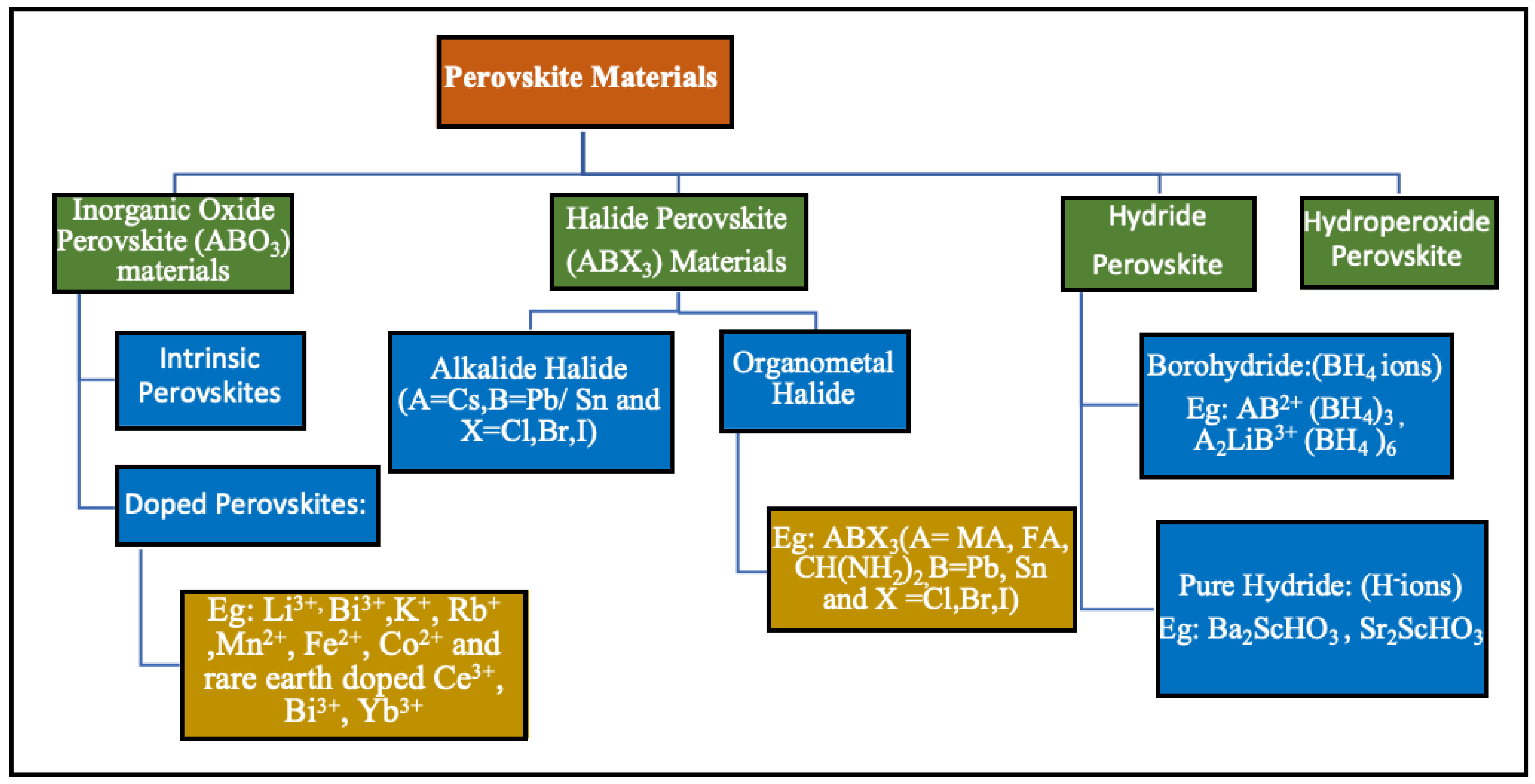
Figure 2.
Optoelectronics devices based on metal halide perovskite materials and revolutionary applications.
Figure 2.
Optoelectronics devices based on metal halide perovskite materials and revolutionary applications.
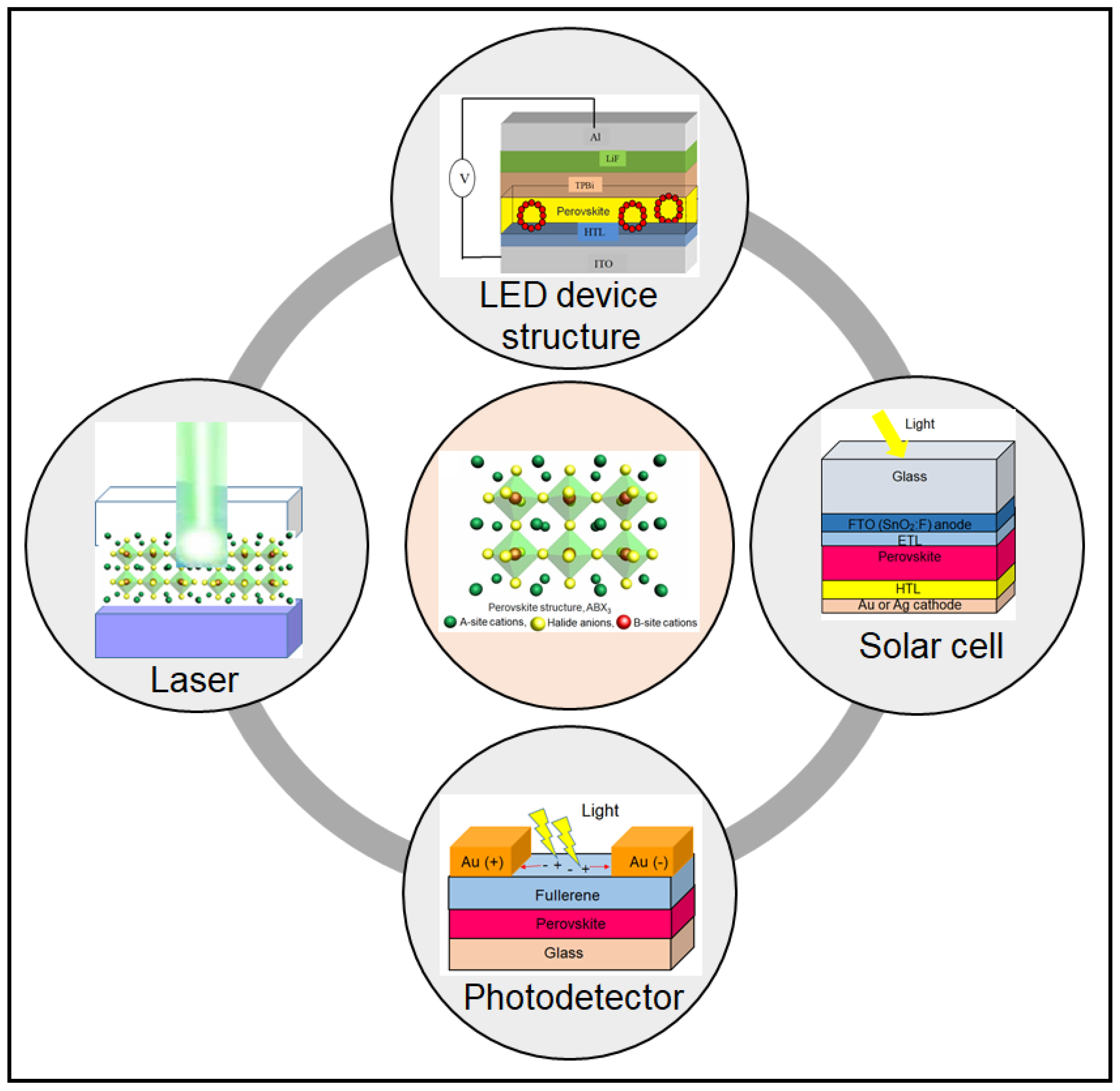
Figure 3.
(a) Schematic diagram of perovskite solar cells. (b) Operational Principle of the Multilayer Solar Cell.
Figure 3.
(a) Schematic diagram of perovskite solar cells. (b) Operational Principle of the Multilayer Solar Cell.
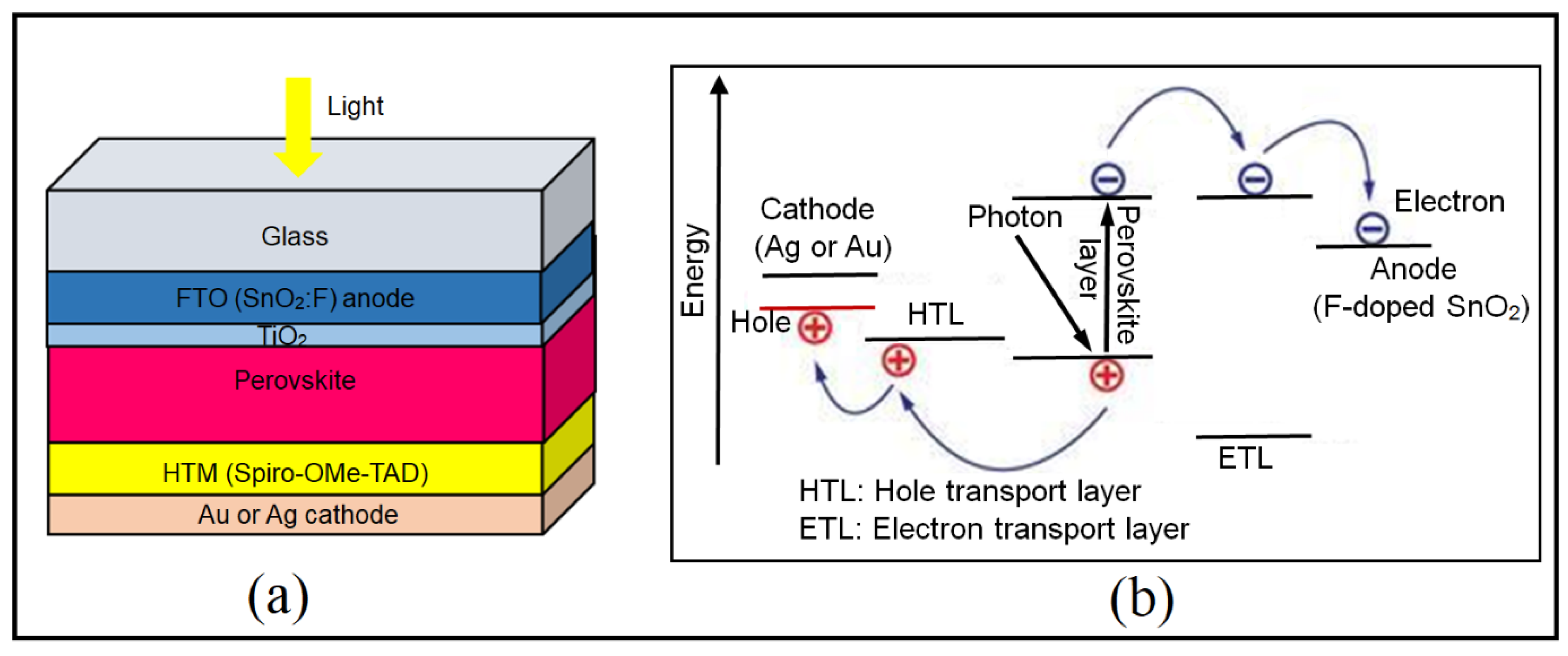
Figure 4.
Contributions of Institute and Laboratories toward the Evolution of Solar Cells using Perovskite Materials.
Figure 4.
Contributions of Institute and Laboratories toward the Evolution of Solar Cells using Perovskite Materials.

Figure 5.
Development of Next-Generation Materials in terms of Power Conversion Efficiency.
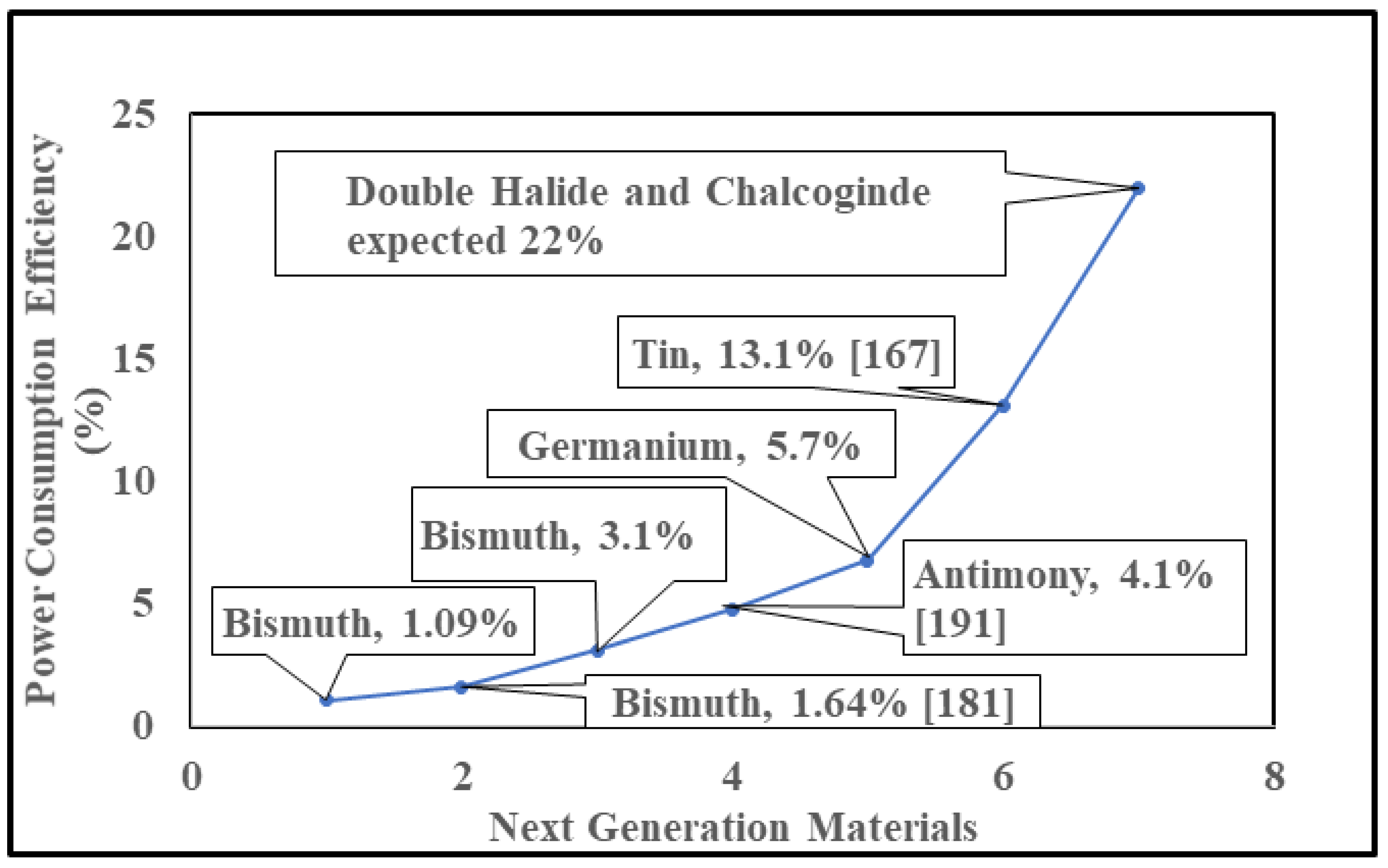
Figure 6.
Encapsulation of solar cells. (a) commercial Si solar cells, (b) perovskite solar cells.
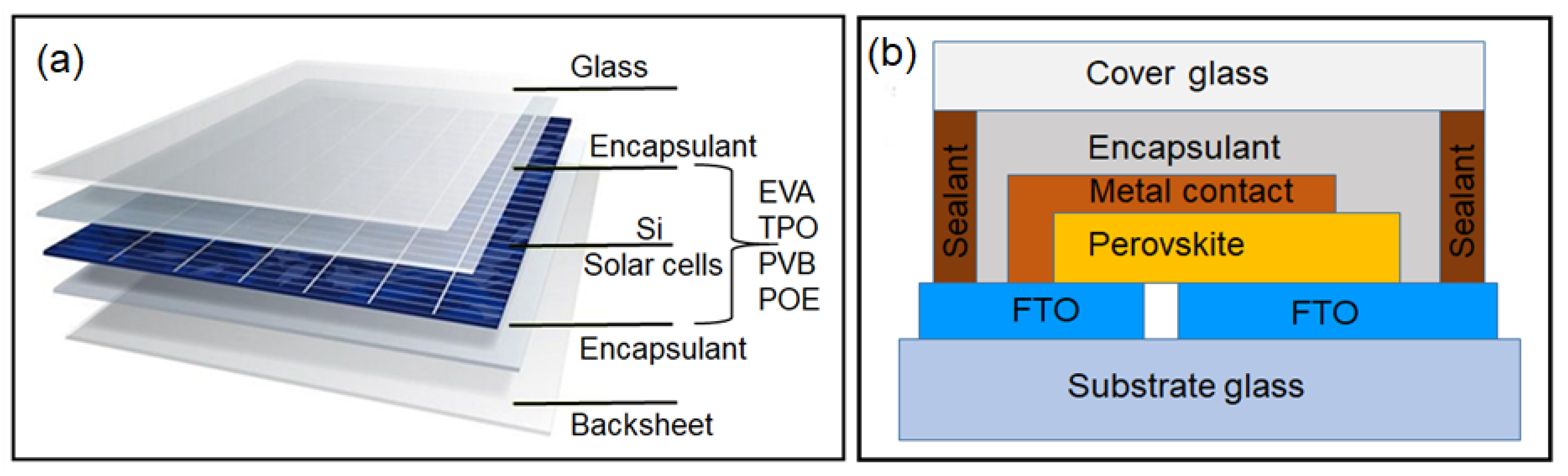

Table 1.
Developments in Inorganic ABX3 Compounds in Terms of Efficiency.
| S. No. | Inorganic Perovskite | Method | Solar Cell Device Structure | Efficiency (%) |
Ref. |
| 1 | CsPbI3 and its derivative perovskite solar cells (PSC) | Solvent controlled growth | Stable α-phase CsPbI3. Device structure: (ITO)/SnO2/CsPbI3/Spiro-OMeTAD/Au |
15.77 | [41] |
| 2 | CsPbI3 | PCE-based PSC via surface termination of the perovskite film using phenyl trimethyl ammonium bromide (PTMBr) | Highly stable phase due to the use of PTMBr treated with CsPbI3. Device layers: FTO/c: TiO2/perovskite/Spiro-OMeTAD/Ag | 17.06 | [42] |
| 3 | CsPbI3 | Formamidium (FA) iodide (FAI)-coated quantum dots | Tio2/FAI-coated CsPbI3/Spiro-O MeTAD/ MoOx/Al | 10.7 | [40] |
| 4. | CsPbI2Br | Fabrication of ZnO/C60 bilayer electron transport layer in inverted PSC PCE | FTO/NIOx/ CsPbI2Br/ZnO @C60 | 13.3 | [43] |
| 5 | CsPbI2Br | Introduction of InCl3 to enhance the efficiency of inverted PSC | Yellow stable (δ-phase). Device structure: FTO/NiOx/perovskite/ZnO@C60/Ag using InCl3:CsPbI2Br perovskite |
13.74 | [44] |
| 6. | CsPbIxBr3-x | Lewis base, 6TIC-4F certified, and the most efficient inverted inorganic PSC with improved photostability reported till date. | Inverted layer with structure FTO/NIOx/ CsPbIxBr3-x /ZnO/ C60/Ag | 16.1 certified 15.6 | [45] |
Table 2.
Progress in Hybrid Perovskite Solar Cells and Power Conversion Efficiency.
| SN | Hybrid Perovskite | HTM | Device Structure | Efficiency (%) | Ref. |
| 1. | CH3NH3PbI3 | I-/I-3 | CH3NH3PbI3 Quantum dots (QD)/TiO2 substrate | 6.5 | [27] |
| 2. | CH3NH3PbI3 | CuI | TiO2/ CH3NH3PbI3/ spiroOMeTAD | 6.0 | [51] |
| 3. | CH3NH3PbI3-xClx | NiO | FTO/NiO/CuSCN/ CH3NH3PbI3-xClx/ PCBM/Ag | 7.3 | [52] |
| 4. | CH3NH3PbI3 | CuSCN | TiO2/ CH3NH3PbI3/ CuSCN/Au | 12.4 | [53] |
| 5. | CH3NH3PbI3-xBrx | PTAA | TiO2/ CH3NH3PbI3-xBrx/DMSO/PTAA/Au | 16.2 | [36] |
| 6. | CH3NH3PbI3 | NiOx | ITO/NiOx/ CH3NH3PbI3/PCBM/Ag | 16.47 | [54] |
| 7. | CH3NH3PbI3-xClx | spiroOMeTAD | ITO/PEIE/TiO2 CH3NH3PbI3-xClx/ spiroOMeTAD/Au | 19.32 | [37] |
Table 3.
Classification of Perovskite Materials based on their Characteristics.
| Perovskite | Characteristics | Behavior Response |
| CsPbI3 | Bandgap | Spin-orbit coupling approximation 1.16eV can be reduced to 0.39eV |
| Binding energy | 169eV | |
| Photoluminescence | λem = 680nm, λex = 365nm | |
| CH3NH3PbBr3 | Absorption | 800–550nm |
| Bandgap | 2.2eV | |
| Binding energy | 150meV | |
| Photoluminescence | Emission at shorter wavelength owing to larger bandgap λem = 560nm | |
| CH3NH3PbI3 | Absorption | 800nm to complete visible spectrum |
| The thickness of the film | 600nm | |
| Bandgap | 1.55eV comparable with the optimal band gap 1.4eV | |
| Binding energy | 50meV | |
| Photoluminescence | Emission at longer wavelength owing to small bandgap (λem = 770nm for λex = 546 nm) | |
| Ambipolar behavior | Mesoporous TiO2/ CH3NH3PbI3 | p-type charge transport. Solar efficiency of 5.5% |
| Mesoporous ZnO2/ CH3NH3PbI3 | n-type charge transport. Solar efficiency of 10.8% | |
| Dispersion range | 130nm and 100nm. 1100nm and 1200nm in CH3NH3PbI3-xClx |
Table 4.
Summary of Selected Sn-based Perovskite Materials and their Characteristics.
| Perovskite Materials | Eg (eV) | Voc (V) | Jsc (mA-cm2) | FF | PCE (%) | Ref. |
| MASnI3 | 1.3 | 0.68 | 16.3 | 0.48 | 5.23 | [73] |
| MASnI3-xBrx | 1.75 | 0.82 | 12.3 | 0.57 | 5.73 | [73] |
| MASnIBr0.8Cl0.2 | 1.25 | 0.38 | 14 | 0.57 | 3 | [74] |
| CsSnI2.9Br0.1 | 0.22 | 24.16 | 0.33 | 1.76 | [75] |
(where, Eg - Energy Band fap, VOC – Open Circuit Voltage, Jsc – Short Circuit Current Density and FF- Fill Factor).
Table 5.
Summary of Selected Bismuth Perovskite Materials and their Characteristics.
| Perovskite Materials | Eg (eV) | Voc (V) | Jsc (A-cm2) | FF | PCE (%) | Ref. |
| Cs3Bi2I9 | 2.2 | 0.53 | 0.58 | 0.5 | 1.09 | [76] |
| MA3Bi2I9 | 2.1 | 0.83 | 3.0 | 0.79 | 3.17 | [77] |
| MA3Bi2I9 | 0.83 | 0.83 | 3.0 | 0.79 | 1.64 | [78] |
| FA3Bi2I9 | 2.19 | 0.48 | 0.11 | 0.46 | 0.022 | [79] |
| MA3Bi2I9-xClx | 2.4 | 0.04 | 0.18 | 0.38 | 0.003 | [77] |
(where, Eg - Energy Band fap, VOC – Open Circuit Voltage, Jsc – Short Circuit Current Density and FF- Fill Factor).
Table 6.
Summary of Selected Ge-based Perovskite Materials and their Characteristics.
| Perovskite Materials | Eg (eV) | Voc (V) | Jsc (A-cm2) | FF | PCE (%) | Ref. |
| CsGeI3 | 1.63 | 0.074 | 5.7 | 0.27 | 1.1 | [81] |
| MAGeI3 | 2.2 | 0.15 | 4.0 | 0.3 | 2.0 | [82] |
| MAGeI2.7Br0.3 | 0.46 | 3.11 | 0.48 | 5.7 | [83] |
(where, Eg - Energy Band fap, VOC – Open Circuit Voltage, Jsc – Short Circuit Current Density and FF- Fill Factor)
Table 7.
Summary of Merits, Demerits, and Challenges in Next-generation Materials.
| Materials | Merits | Demerits and Challenges |
| Tin (Sn) based perovskites | The optical bandgap is in the near infrared region, has a comparable ionic radius (1.35 Å) to Pb2+ (1.49 Å), and exhibits stability against moisture. Sn-based materials possess stability for 3800 hours. Among all lead-free materials, this material has presently achieved the highest efficiency. | Sn2+ may be as hazardous as Pb2+ and, therefore, may also face the same challenges that Pb-based perovskites are facing today. |
| Bismuth (Bi) based perovskites | Bi2+ has the same electronic configuration as Pb2+ (ns2). Inorganic Bi2+-based materials show promising stability, are insoluble in water, are not toxic to the environment, are cost-effective, and have the potential to overcome most of the challenges that are faced by Pb in terms of industrialization. | has a broad bandgap, low performance, and more internal defects. Organic compound stability is relatively low. The lowest power conversion efficiency (PCE) achieved so far in comparison with other materials Needs a more promising research direction. |
| Increasing quantum yield and PCE can make this candidate an immediate replacement for Pb in the near future. | ||
| Antimony (Sb) based perovskites | Sb3+ compounds show stability in the presence of air, and the bandgap is also comparable to that of Pb (2.14 eV). They are insoluble in water, and Sb2+ possesses good charge transport properties owing to the small bandgap. | (CH3NH3)3SbI9 may face the challenges of energetic disorder and low photocurrent density. low-hopping mechanism for charge transport owing to the large bandgap. |
| Germanium (Ge) based perovskites | These are leading materials in the semiconductor industry and possess good optoelectronic properties. Moreover, they are lightweight and less toxic to the environment. They are stable in an inert atmosphere. | Decomposes easily in the air. It is not a cost-effective material. |
| Double halide perovskites | Robust stability and a direct bandgap of 0.9–1.02 eV. | Most of the research is based on the computational method. |
Table 8.
Merits and Demerits of Halide Perovskite Solar Panels.
| Merits | Demerits |
|---|---|
| Hybrid perovskites with the general formula ABX3 (A = organic cation, B = divalent metal, and X = halogen or pseudo-halogen) are used. | External factors, such as water, heat, humidity, and sunlight, inherently degrade the stability of the active layer of perovskite solar panels. |
| Easy, low-cost manufacturing processes make perovskite the obvious choice for mass production. | Water sensitivity causes irreversible damage to perovskite materials. |
| The PCE of perovskite solar cells is high. | Heat: Lead halides show an inability to sustain thermal stress. Therefore, the perovskite structure degrades under heat and creates halogen gases that are the source of the formation of B metals (lead, tin, germanium, etc.) on the perovskite film. |
| Hybrid perovskite film solar panels are confirming candidates for power generation in the near future. | Oxygen and light: Prolonged exposure to air and light photons adversely degrades the longevity of the solar panel. |
| Conversion energy loss is less in perovskite solar cells compared with other cells. | Scalability and efficiency on large-area perovskite are comparatively small. The technology is yet to be effectively transferred from the laboratory to the industry. |
Table 9.
Stability and Performance of MAPbI3 perovskite solar cells in Response to Illumination, Atmospheric Conditions, and Encapsulation.
Table 9.
Stability and Performance of MAPbI3 perovskite solar cells in Response to Illumination, Atmospheric Conditions, and Encapsulation.
| Solar Cell Structure | Testing Conditions | ||||||
| Stability Time (hours) | Illumination Dark/Light | Temperature (0C) | Atmospheric Condition Humidity (%) | Encapsulation | Percentage of initial Performance (%) | Ref. | |
| m-TiO2/MAPbI3/Carbon | >2000 | Dark | RT | Air | No | 100 | [117] |
| m-TiO2/MAPbI3/PDPPDBTE/Au | 1000 | Dark | RT | Air (20) | No | 100 | [118] |
| ITO/NiOx/MAPbI3/ZnO/Al | 1440 | Dark | 25 | Air (30–35) | No | 90 | [119] |
| ITO/PETOD:PSS/MAPbI3/ZnO/Ag | 1000 | Dark | 30 | Air (65) | Yes | >95 | [119] |
| m-TiO2 /ZrO2/MAPbI3/Carbon | >3000 | Dark | RT | Air (35) | no | ~100 | [116] |
| m-TiO2/MAPbI3/Carbon | 1002 | Ultraviolet | 40 | Air (45) | Yes | ~100 | [120] |
| BaSnO3/MaPbI3/NiO/Au | 1000 | Light | RT | Air | Yes | 93 | [36] |
(Light: subjected to continuous solar illumination; Dark: storage without illumination).
Disclaimer/Publisher’s Note: The statements, opinions and data contained in all publications are solely those of the individual author(s) and contributor(s) and not of MDPI and/or the editor(s). MDPI and/or the editor(s) disclaim responsibility for any injury to people or property resulting from any ideas, methods, instructions or products referred to in the content. |
© 2023 by the authors. Licensee MDPI, Basel, Switzerland. This article is an open access article distributed under the terms and conditions of the Creative Commons Attribution (CC BY) license (http://creativecommons.org/licenses/by/4.0/).
Copyright: This open access article is published under a Creative Commons CC BY 4.0 license, which permit the free download, distribution, and reuse, provided that the author and preprint are cited in any reuse.


