

Submitted:
01 June 2023
Posted:
02 June 2023
Read the latest preprint version here
Abstract
This paper illustrates that the ROTASE model proposed by the author for the formation of spiral arms of galaxies is nicely demonstrated by the spirals generated by rockets venting fuel during free fall. The patterns of spirals by the falling rockets strongly support that the spiral galaxies with perfect central symmetry have to be originated from the galactic centers, and the spiral arms and the galactic bars are bound together as “rigid” body. The exclusive presence of a rear side trail effect in galaxies indicates the absence of co-rotation, and the rotation of spiral arms is faster than the galactic matters. The exact nature of X-matter remains an open question.
Keywords:
Spiral arms
; Spiral galaxies
; X-matter
; Black holes
; Galaxy evolution
; Spirals by rockets
1. Introduction
If two subjects look similar and act similarly, most likely, they shall share a same mechanism in great extent. Our universe is teeming with galaxies, and the majority, about 60% to 70%, of these galaxies are spiral galaxies. Each spiral galaxy possesses a unique spiral pattern akin to a human fingerprint or DNA. These spiral patterns were first classified by Hubble [1] and are referred to as the Hubble sequence. Most spiral galaxies exhibit nearly perfect central symmetry, with spiral arms bound to the ends of galactic bars. There are only a few exceptions where spiral arms are not bound to galactic bars, although in some cases, these exceptions still exhibit traceable connections between the spiral arms and the galactic bars, as seen in galaxies such as NGC 4548 and MCG+00-04-051 [2].
The formation of spiral arms in cosmic objects of such immense scale has been a topic of curiosity and extensive study ever since Lord Rosse observed the first spiral galaxy, M51, in 1845, describing it as a spiral nebula [3]. However, the mechanism behind the formation of spiral arms remains unclear to this day, and various models have been proposed in the past. The current leading model is the density wave theory, proposed by Lin and Shu in 1964 [4], which describes spiral arms as quasi-stationary density waves. According to this model, galactic clouds are compressed as they pass through density waves, leading to a high rate of new star formation. However, this model has limited application to few grand designed galaxies, does not clearly explain how and where the density waves are initiated in the galactic disk.
Other models proposed in the past include the Swing Amplification model, which treats spiral arms as a superposition of many unstable waves, and the leading mode is amplified into spiral arms due to self-gravity. The spiral arms generated by the swing amplification model are transient and recurrent [5]. Another model, the tidal interaction model, proposes that density waves are induced by tidal interactions between companion galaxies, such as in the case of the M51-NGC5195 pair. These induced density waves slowly wind up over time and develop into spiral arms [6]. The manifold model was also proposed by Romero-Gomez et. al. [7,8,9,10,11], the spirals and rings are developed in the vicinity of Lagragian points near the ends of galactic bars. The stars and interstellar matter circulate along the pipeline guided by the invariant manifolds. Those models mentioned above have not made significant progress so far.
In 2019, the author proposed an alternative model called the "ROtating Two Arm Sprinkler Emission" (ROTASE) model for the formation of spiral arms in disc galaxies [2,12,13]. This model derived a set of new galactic spiral equations that can accurately fit and explain various common spiral patterns observed in galaxies, including open spirals, single rings, 8-shaped double rings, 8-shaped double rings wrapped with larger outer rings, single spiral arms, and broken connections of spiral arms from galactic bars. The 8-shaped double ring patterns are referred to as "Chain-link double rings”, which provide a more precise description of the unique characteristics of these spiral patterns.
According to Hawking's definition of a good theory [14], the ROTASE model seems to satisfy the requirements, as it accurately describes a large class of observations based on a model with few arbitrary elements, and makes definite predictions about future observations. However, it is crucial for any proposed theory to be tested by reliable experiments.
Interestingly, the formation of spirals by falling rockets, which can be observed from Earth as they spin and vent unused fuel during free fall, shows remarkable similarity to the mechanism proposed by the ROTASE model for the formation of spiral arms in galaxies. In fact, the spirals generated by falling rockets can be considered as “experimental” duplications of the spirals predicted by the ROTASE model, as elaborated in detail in this paper.
2. Spiral arm formation through ROTASE mechanism
The formation of spiral arms through the ROTASE mechanism can be visualized in Figure 1, and a detailed description and derivation of the galactic spiral equations can be found in the references [2,12,13].
In the ROTASE model, a disc galaxy is considered as an ideal fluid system with flat differential rotation. The central supermassive black hole emits X-matter, which is proposed to be converted from gravitational matter to unknown antigravitational or non-gravitational matter. The “X” means “unknown” similar to X-ray. The X-matter is emitted in two opposite directions within the rotation plane of the black hole, and it follows in a confined straight path for a certain distance before being freely dragged by the galactic rotation fluid matter. The final motion of the X-matter is a combination of its emission velocity and the galactic flat rotation velocity, the yellow bands of the Figure 1 are the X-matter bands emitted from the central black hole which is responsible for the spiral arm formation with higher new star formation rate; the balck hole can change the X-matter emission at any time and in any format.
Previous papers by the author have proposed that the X-matter gradually converts into hydrogen, leading to an increase in local hydrogen density and subsequent promotion of new star formation, resulting in enhanced local luminosity, which manifests as observed spiral arms. In this paper, the author further suggests that the X-matter may just act as a new star formation initiator or catalyst instead of converting to hydrogens, with its unknown special property that enhances the rate of new star formation and local luminosity, ultimately leading to the formation of spiral arms.
The trajectory of the X-matter can be calculated using the galactic spiral equations developed from the ROTASE model:
where Rb represents the half length of the galactic bar (the rotation radius of the bar), and the parameter ρ(θ) is defined as the ratio of X-matter emission velocity over the galactic flat rotation velocity. The θ in the equations (1) represents the rotation angle of the galactic bar, which represents the elapsed time after the X-matter emission, rather than the spiral rotation angle. Therefore, ρ(θ) is a function of time, and the spiral morphology of the galaxy is determined by ρ(θ) which can change in anytime and any format. The differential galactic spiral equations (1) can be solved in a polar coordinate system for three different cases:
ρ(θ) > 1, ρ(θ) = 1, and ρ(θ) < 1, respectively.
The calculated x and y have to be rotated backward (-θ) for spiral plotting. Euler rotation may be needed to match the orientation of the line of sight. It is evident that a galaxy with a parameter ρ(θ) less than 1 will exhibit a ring pattern, and the radius of the ring is defined by the following equation:
The ROTASE model has provided comprehensive explanations for various spiral patterns observed in galaxies, as illustrated by the reference paper [2], these patterns include regular grand design patterns, broken connection of spiral arms from the galactic bars, one-arm galaxy, single rings, 8-shaped double rings and 8-shaped double ring wrapped by a larger outer ring. The 8-shaped double ring is also named as Chain-link double rings, as illustrated in Figure 2 using galaxy UGC 12646 as a prominent example. Figure 2a is the original image of galaxy UGC 12646, it clearly shows the 8-shaped double ring pattern with a sequential decrease in luminosity along the ring line. Figure 2b depicts the fitting of the double ring pattern of galaxy UGC 12646 using the ROTASE model, represented by red and yellow lines with ρ(θ) change with time (θ) following Gaussian function. The two rings intersect at crossing points C and E. The red line ring originates from the bar end A (clearly, not the bar end F) and extends to BCDE, with luminosity gradually decreasing from A to E. The yellow line ring originates from the bar end F (not the bar end A) and extends to GEHC. At the ring crossing point C, the luminosity of the red line is much stronger than that of the yellow line, which almost fades away; while at the ring crossing point E, the situation is reversed, with the luminosity of the yellow line much stronger than the red line, which almost fades away (barely visible). This discrepancy in luminosity between the red and yellow line arms near the crossing points C and E is explained by the significant difference in the density of the X-matter bands, as clarified by the ROTASE model. Specifically, the density of the X-matter band of the red line arm at crossing point C is much higher than that of the yellow line arm; and similarly, the density of the X-matter band of the yellow line arm at crossing point E is much higher than that of the red line arm. Thus, the crossing pattern of the two rings morphologically resembles a chain-link pattern of gold and silver rings, as illustrated in Figure 2c, at the ring crossing point M, the silver ring is over (“dominates”) the gold ring, but, at the crossing point N, the gold ring is over (“dominate”) the silver ring, the name “Chain-link” is introduced specifically for such galactic ring crossing style by the author. Notably, this Chain-link ring crossing style is observed in all galaxies with 8-shaped double ring patterns, such as NGC 7098, NGC 2665, and SDSS J0157.50-001644.4, even including the 8-shaped unequal double ring galaxy J102942.99-022704.0. [2,8].
3. Spiral arm formation of galaxies through ROTASE mechanism is perfectly demonstrated by falling rockets venting fuel
3.1. Two-section spirals by the falling rocket
It is well known that when man-made space objects are launched by rockets, the rockets eventually fall back to Earth. During their descent, the rockets rotate and vent remaining fuel, generating bright spirals in the sky as the fuel burns (or icing which reflects sun light). However, the formation mechanism proposed by the ROTASE model for the galactic spiral arms and the formation mechanisms of these spirals created by falling rockets are remarkably similar. As a rocket falls back to Earth, it rotates and emits remaining fuel (equivalent to X-matter) from the fuel container inside the rocket, which is equivalent to the central black hole in the ROTASE model. The emitted fuel moves with its emission velocity, burning in the air and creating a bright spiral pattern observed in the sky. The amount of emitted fuel gradually decreases due to burning (consumed) as it moves, causing the luminosity of the spiral to gradually decrease along the spiral line from the central starting point to the outer edge. Any change in the fuel emission behavior of the rocket will result in a change in the spiral pattern. Therefore, the formation of spirals by falling rockets can be viewed as a perfect “experimental” demonstration of the ROTASE model, although such “experiment” is completely unintentional.
Figure 3 shows an example of spirals created by a falling SpaceX rocket after a satellite launch on Jun 19, 2022, as well as the galaxies M51 and UGC 6093 for comparison.
The spirals created by the falling rocket are each broken into two sections, but the entire spiral pattern exhibits perfect central symmetry, including the broken points. This perfect central symmetry indicates that the fuel emitted from the rocket was almost equally distributed on both sides. The broken spirals are caused by the sudden and simultaneous change in fuel emission from both sides of the rocket at that time. It is certain that any unequal change in the timing and amount of fuel emission from the two sides of the rocket will not generate a pattern with such perfect central symmetry.
The impressive spiral pattern created by the falling rocket brings to mind the famous M51 galaxy, as shown in Figure 3B. The galaxy's spiral arms exhibit two distinctly different sections, as indicated by yellow and red lines fitted by the ROTASE model [2]. These two sections are connected by sharp corners, with one sharp corner appearing damaged. The physical conditions required for the generation of these two different spiral sections must have been significantly different and changed suddenly in cosmic time scale. The most striking characteristic of this spiral pattern is that the winding of the two spiral arms shows nearly perfect central symmetry, with slight damage in the south arm as indicated by the white arrow. This damage is caused by its companion galaxy NGC 5195 located at the top right corner. The tidal interaction between the two galaxies is extremely non-symmetric for M51, with the right side of M51 being much closer to NGC 5195 than the left side. As a result, the right side of M51 experiences a much stronger tidal force, leading to notable changes in the morphology of the spiral arm and damage to the sharp corner as indicated by the white arrow. The sudden change that caused the two very different sections of the spiral arms must have occurred at the galactic center.
While M51 is a typical example of the tidal interaction model [6], there does not seem to be a reasonable explanation within this model for the two significantly different sections of the spiral arms exhibiting almost perfect central symmetry and joined by sharp corners, other unexpected impact(s) has to be introduced. Could it be possible that another similarly sized galaxy passed by in the past, or that the motion and interaction between the M51-NGC 5195 pair suddenly changed, or that some other sudden impact occurred in the galaxy's history?
For galaxy NGC 6093, as shown in Figure 3C, the spiral pattern can be nicely fitted by the ROTASE model with three different sections indicated by yellow, red, and blue lines [2]. The yellow line spiral arms are noticeably more open compared to the red and blue line arms, suggesting that the yellow line arms were formed under significantly different physical conditions. However, unlike M51, the winding of the entire spiral arms of NGC 6093 changes smoothly without sudden bending. The overall morphology of the spiral arms exhibits perfect central symmetry, even though each arm was developed under three distinct physical conditions. Similar to M51, the smooth change in spiral winding for perfect central symmetry indicates that the cause of the change must have occurred at the center of the galaxy.
If the spiral arms with such perfect central symmetry were produced by non-central impacts in the cases of galaxies M51 and NGC 6093, then there would have to be two identical impacts exactly opposite to the galactic center, acting simultaneously. While such collaborative and synchronized interactions may be theoretically possible, they are realistically impossible to occur in such large cosmic scale systems.
The Figure 4a shows a very amazing image of the spirals by the SpaceX rocket launched on April 17, 2023. The entire spiral structure was developed in two time periods as depicted in Figure 4b. The rocket started to vent the remaining fuel at the two sides almost at the same time, because the outer end A of red line spiral and the outer end C of yellow line spiral show “roughly” central symmetry. However, the red line spiral ends at B which is much shorter than yellow line spiral which ends at D, this means that the fuel venting for the red line spiral was terminated much earlier than the fuel venting for the yellow line spiral. The “X” marks the end of yellow line spiral if its fuel venting was terminated at the same time as the fuel venting for the red line spiral. The dashed yellow and green sections are the weak residual spirals which are made by one side or both sides weak fuel emission. The red line spiral is more tightly wound than the yellow line spiral indicating that the emission velocity of the red line spiral is less than the yellow line spiral, so the red line spiral and the yellow line spiral do not have central symmetry.
The fuel venting was resumed equally and simultaneously at the two sides of the rocket after halt for a period of time, the central small and bright spiral outlined by the blue lines is created with nice “S” shape and perfect central symmetry, even the bar-like straight section is clearly visible at the center, really resembling the SBb or SBc type galaxy.
For comparison, Figure 4c shows the image of NGC 4622 galaxy and the Figure 4d is the spiral fitting by ROTASE model [12]. The winding of the two spiral arm of this galaxy is different, the red line arm is more tightly wound than the yellow line spiral arm, so the two spiral arms do not have central symmetry due to unequal X-matter emissions. The X-matter emission behavior could be changed irregularly (fluctuatedly) leading to a possible fake impression that the outer pair of spiral arms wind outward clockwise and the a single inner arm winds outward counterclockwise [15].
3.2. Broken connection of spirals from the ends of the rockets
Figure 5A is the spirals created by the same SpaceX rocket (for Figure 3A) that was launched on June 19, 2022, as captured by another observer Clare Rehill in Queenstown, South Island of New Zealand. This photo reveals that the rocket has rotated approximately 90° relative to Figure 3A, resulting in longer and outwardly expanded spirals. However, the inner ends of the spiral arms are disconnected from the ends of the rocket, indicating that the fuel emission ceased due to empty fuel. Nevertheless, the rocket continues to rotate and the spirals continue to expand outwardly, resulting in gaps between the inner ends of the spirals and the ends of the rocket. This observation suggests that the rocket rotated ahead of the spirals.
Logically, it can be predicted that the spirals will resemble the pattern shown in Figure 5B after further 90° rotation of the rocket, which is similar to the galaxy MCG+00-04-051 (also known as SDSS J011430.80+001928.3) shown in Figure 5C, as well as the galaxy NGC 4548 [2]. This predicted pattern would create the false impression that the spirals rotate ahead of the rocket, when in fact, the spirals rotate behind the rocket. For the galaxy MCG+00-04-051, the two arms are disconnected from the bar ends due to the termination of X-matter emission, but one side still has weak X-matter emission which creates a weak but still clearly visible section of the spiral connecting the bar end to one major spiral arm. Such special cases have been extensively analyzed in the references [2,7], supporting the validity of the ROTASE model, as demonstrated by the spiral pattern evolution from Figure 3A to Figure 5A.
Figure 6 presents a comparison of spirals created by falling rockets with the spiral galaxy NGC 4548. Figure 6A displays the spiral pattern produced by a SpaceX Falcon 9 rocket observed over Tulsa, OK on Jan. 31, 2022, exhibiting perfect central symmetry and being disconnected from the rocket. Figure 6B is the spiral created by a SpaceX rocket observed over Hawaii on Jan 18, 2023, with the image showing the spiral disconnected from the rocket, indicating the cessation of fuel emission. Figure 6C displays an image of galaxy NGC 4548 with broken connection of the spiral arms from the bar ends. The similarity between Figure 6B and the image of the galaxy MCG+00-04-051 in Figure 5C is evident, further supporting the ROTASE model.
3.3. One-side fuel emission of rockets resulting in a single spiral pattern
It is evident from the aforementioned examples that when only one side of a rocket emits fuel, it produces a distinct single spiral pattern. Figure 7A is an image of such a single spiral pattern created by SpaceX Falcon 9 rocket, captured by Lance Godwin on June 5, 2020 in Australia. Similarly, Figure 7B shows another single spiral pattern produced by Long March 6C rocket over the northwest Pacific on June 8, 2021, captured by an unknown observer. Additionally, Figure 7C is the well-known galaxy NGC 4618, which exhibits only one spiral arm. This phenomenon of a single-arm galaxy can be explained by the ROTASE model [2], which is due to the one-side X-matter emission.
The single spiral pattern of the galaxy NGC 4618 is nicely fitted by the ROTASE model [2], it is equivalent to the half side of the 8-shaped double ring like the galaxy SDSS J015701.50-001644.4 with parameter ρ(θ) change with time following the Gaussian equation.
3.4. Trail effect of spiral arms
Trail effects refer to marks or indicators left behind by past events, typically associated with a specific time interval and gradually diminishing over time, it contains rich information about the history of the events. Figure 8 illustrates two common examples of trail effects in our everyday lives. A firework show is a classic example of a trail effect, where the burning gunpowder inside the firework propels the head upwards, leaving behind a long, bright trail below the firework head. The brightness of the trail gradually decreases over time, displaying a luminosity gradient following the firework head. Another example is the trail created by a jet boat sailing on the water. The boat's propeller disturbs the water, pushing the boat forward and leaving behind a distinct area of disturbed water that appears different from the rest of the water surface. However, over time, the disturbed water returns to its normal state, and the trail disappears. It is important to note that trails always occur behind the event and not ahead of it.
The presence of trail effects in galaxies is a well-established phenomenon, as depicted in the top row of Figure 9 which showcases three galaxies. However, it is worth noting that despite its significance which should be included in description of any models for the formation of the spiral arms of galaxies, based on author’s limited knowledge, this phenomenon has not received adequate attention in the past, and the author appears to be addressing it for the first time [2]. According to the ROTASE model, spiral galaxies should exhibit rear side trail effects. All three galaxies in the top row of Figure 9 rotate clockwise and display clear rear side trail effects. The front side of the spiral arms has a sharp and well-defined edge, with luminosity decreasing rapidly, while the rear side of the spiral arms exhibits an unclear and blurred edge, with luminosity gradually decreasing slowly from the spiral arm line. The trail effects of galaxies J010650.99-003413.7 (Figure 9B) and J131730.17+203556.0 (Figure 9C) are particularly strong and wide. The trail effect of galaxy J101652.52 has been previously studied in detail [2].
The second row of Figure 9 showcases three spirals with trail effects of spirals generated by falling rockets. Figure 9D displays a single spiral with a clear trail effect, while the trail effects of Figure 9E and Figure 9F are notably wide and strong, exhibiting perfect central symmetry, with luminosity gradually decreasing from the front spiral lines. Both spirals in Figure 9E and Figure 9F were generated by the same falling rocket, but the two photos were taken by different individuals at distinct locations and times.
The image of Figure 9F is particularly intriguing as it displays a large pair of spirals and a much smaller pair of spirals, both exhibiting perfect central symmetry. This suggests that the rocket emitted fuel equally from two opposite sides, generating the large spirals for a certain period of time, before abruptly halting fuel emission simultaneously from both sides. After a while, fuel emission resumed equally from both sides, producing the smaller spirals. The large spirals eventually fade away, while the smaller spirals grow and replace them. This image further supports the notion that spiral arms with perfect central symmetry must be initiated from the center and cannot be generated by any non-central initiation.
4. Trail effect predicted by Density Wave theory
In the density wave model, the spiral arms rotate as if they were rigid structures, while the galactic matter rotates differentially with a flat rotation velocity. There is a co-rotation radius at which the spiral arms and the galactic matter rotate at the same velocity. In the inner region of the co-rotation radius, the galactic matter rotates faster than the spiral arms, whereas in the outer region of the co-rotation radius, the galactic matter rotates slower than the spiral arms [16]. The spiral arms are regions of high-density waves, where the rate of new star formation is significantly higher than in other areas. This high rate of new star formation results in a higher luminosity of the density wave regions, which are the bright spiral arms observed optically. The galactic matter of the density waves is constantly and dynatically in-and-out. Hence, the trail effect can be predicted based on this model, as illustrated in Figure 10. The predicted trail effect by the ROTASE model is also presented in Figure 10 for comparison.
The red dashed circle in Figure 10 represents the co-rotation line. In the inner region of the co-rotation circle, as shown in Figure 10A, the galactic matter (including stars, new-born stars, interstellar dust, etc.) rotates faster than the spiral arm, causing the new-born stars to exit the spiral arm at the front side, resulting in a trail effect at the front side of the spiral arm. In the outer region of the co-rotation circle, the galactic matter rotates slower than the spiral arm, causing the new-born stars to exit the spiral arm at the rear side, resulting in a trail effect at the rear side of the spiral arm. At the co-rotation circle region, where the galactic matter rotates at the same speed as the spiral arm, there is no trail effect. If the co-rotation circle is larger than the visible galactic disc, as shown in Figure 10B, the entire trail effect should be on the front side of the spiral arm. However, to the best of the author's knowledge, none of these trail effects predicted by the Density Wave theory have been observed in available images of galaxies on the internet.
5. Discussion
It is truly remarkable that during the final stage of their journey, after launching spacecraft into space, rockets produce mesmerizing spirals in the upper sky. These spirals not only captivate humans with their beauty, but they also inadvertently provide a perfect demonstration of the ROTASE model, resembling the formation of spiral arms in galaxies and contributing to scientific understanding. Perhaps in the future, when people witness these spectacular spirals in the sky generated by falling rockets, they will ponder on how the spiral arms of galaxies might be formed in similar ways. The spirals generated by falling rockets clearly demonstrates that morphology of spiral pattern is decided by the emission behavior, any change of the emission will cause the change of the spirals. It has to be realized that the mechanism of the X-matter emission by the central black hole should be much more complicated than the fuel dumping by the rockets, the two mechanisms are just figuratively similar. Among all the proposed models for the formation of spiral arms in galaxies, the ROTASE model appears to be the only one that can be "experimentally" replicated.
The trail effect observed in the spirals further supports the notion that the spiral arms and galactic bars are bound together and rotate as a "rigid" body, with a rotation speed faster than galactic matter of the galaxies. Importantly, the exclusive presence of a rear side trail effect strongly suggests the absence of co-rotation in these galaxies.
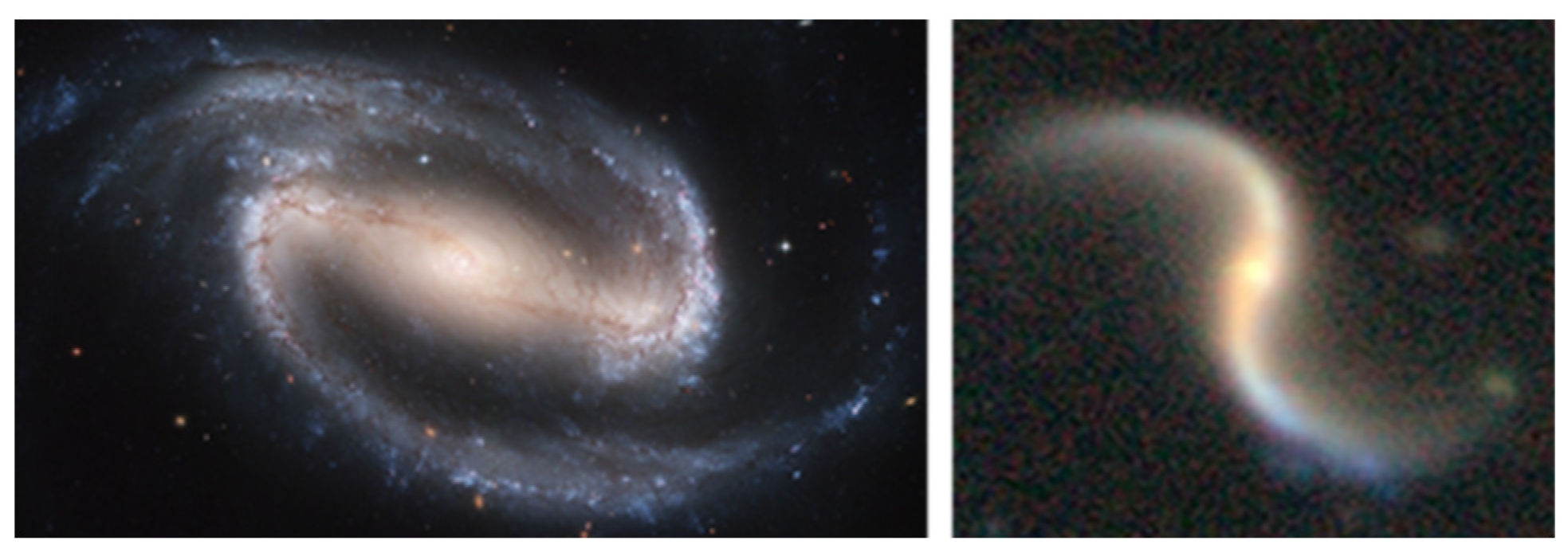
Based on current and past studies, it can be concluded that spiral galaxies with perfect central symmetry have to be originated at the centers of galaxies. The ROTASE model provides a reasonable description of the formation of spiral patterns in galaxies and mathematically fits the observed spiral patterns very well with the newly derived galactic spiral equations from this model. However, the concept of X-matter emission from the central black holes of galaxies challenges our current knowledge, as black holes are traditionally believed to emit nothing beyond their event horizon. The nature of X-matter, which appears to connect the central symmetry of spiral patterns with the galactic centers, is mysterious and open to speculation. It is proposed that X-matter may be converted into hydrogens, as previously suggested, to promote new star formation or just act as a catalyst to increase new star formation, resulting in regions with higher luminosity, which are observed as spiral arms. The exact nature of X-matter, whether it is a particle, an unknown physical field, or another unknown physical entity, remains an open question; deep researches shall be conducted theoretically and experimentally with novel ideas and approaches by experts in particle physics, high energy physics, astronomy, astrophysics, cosmology and black holes, surprises may come out. After inspecting the striking spiral patterns of those well-constructed spiral galaxies as represented by galaxies NGC 1300 and J101652.52 shown in Figure 11, the sixth sense strongly feels that a mysterious fluid-like matter should flow out of the galactic centers in two opposite directions, it is this fluid-like matter instead of “waves” responsible for the formation of the spiral arms of the galaxies. However, everyone has his/her own sixth sense, may feel differently, and will realistically make his/her own judgement if the spiral arms of galaxies are formed by such fluid-like matter or by waves or by something else.
The central supermassive black holes seem much more complicate than what we think today, and play a critical role for the formation of the spiral structure of galaxies with central symmetry. It is certain that the ROTASE model is not perfect at current stage, can be improved in the future. People may propose new models for the formation of spirals of galaxies when more evidences are available in the future. It will be appropriate to finish this paper with the American poet Robert Frost’s words: Two roads diverged in a wood, and I, I took the one less travelled by, and that has made all the difference.
6. Conclusions
- The ROTASE model is successfully demonstrated by falling rockets venting fuel, providing valuable insights into the formation of spiral arms in galaxies.
- The spiral structure of galaxies with perfect central symmetry must be initiated realistically at the galactic center, as any non-central initiation to develop such a large cosmic-scale object with perfect central symmetry may be mathematically and imaginarily possible, but realistically implausible.
- Spiral arms and bars are bound together and rotate as a rigid body, with a faster rotation speed than the galactic disc.
- The exclusive presence of a rear side trail effect in galaxies indicates the absence of co-rotation.
- The exact nature of X-matter, whether it is a particle, an unknown physical field, or another unknown physical entity, remains an open question.
Acknowledgements
The author would like to give special thanks to all those individuals and organizations around the world who took photos of those amazing spirals generated by falling rockets and shared them through the internet which makes this paper possible.
References
- Hubble, E. The Classification of Spiral Nebulae, The Observatory, 1927, 50, 276-281.
- Pan H, Spirals and rings in barred galaxies by the ROTASE model, IJP. 9(6), 286 (2021). [CrossRef]
- Seigar M (editor), Spiral Structure in Galaxies, Morgan & Claypool Publishers, 2017.
- Lin C and Shu F, On the spiral structure of disk galaxies, ApJ. 140, 646 (1964). [CrossRef]
- Julian W and Toomre A., Non-axisymmetric responses of differentially rotating disks of stars, ApJ. 146, 810 (1966). [CrossRef]
- Dobbs C and et. al. Simulations of the grand design galaxy M51: a case study for analysing tidally induced spiral structure, Mon. Not. R. Astron. Soc. 403 625 (2010). [CrossRef]
- Romero-Gómez, M.; Masdemont, J.; Athanassoula, E.; García-Gómez, C. The origin of rR1 ring structures in barred galaxies, A&A 2006, 453, 39–45. [CrossRef]
- Romero-Gómez, M.; Athanassoula, E.; Masdemont, J.; García-Gómez, C. The formation of spiral arms and rings in barred galaxies, A&A, 2007, 472, 63–75. [CrossRef]
- Athanassoula, E.; Romero-Gómez, M.; Masdemont, J.; Rings and spirals in barred galaxies – I. Building blocks, MNRAS, 2009, 394(1), 67–81. [CrossRef]
- Athanassoula, M.; Romero-Gómez, M.; Bosma, A.; Masdemont, J. Rings and spirals in barred galaxies – II. Ring and spiral morphology, MNRAS, 2009, 400(4), 1706–1720. [CrossRef]
- Athanassoula, E.; Romero-Gómez, M.; Bosma, A.; Masdemont, J. Rings and spirals in barred galaxies – III. Further comparisons and links to observations, MNRAS, 2010, 407(3), 1433–1448. [CrossRef]
- Pan H, Spirals and rings in barred galaxies by the ROTASE model, IJP 7(3) 73 (2019).
- Pan H., Application of new formulas for the spiral arm formation to selected galaxies with special patterns, AJAA 8(3) 45 (2020). [CrossRef]
- Hawking S. 1998 A brief history of time, (Bantam Books, NY, NY), pp 10. ISBN 0-553-10953-7.
- Byrd, G. et al. Leading spiral arms, retrograde galaxy encounters and massive halos. Celest. Mech. 45, 31 (1988). [CrossRef]
- Pour-Imani H and et. al. Strong evidence for the density-wave theory of spiral structure in disk galaxies, ApJL 827, L2 (2016). [CrossRef]
Figure 1.
Illustration of the spiral arm formation by the ROTASE model.
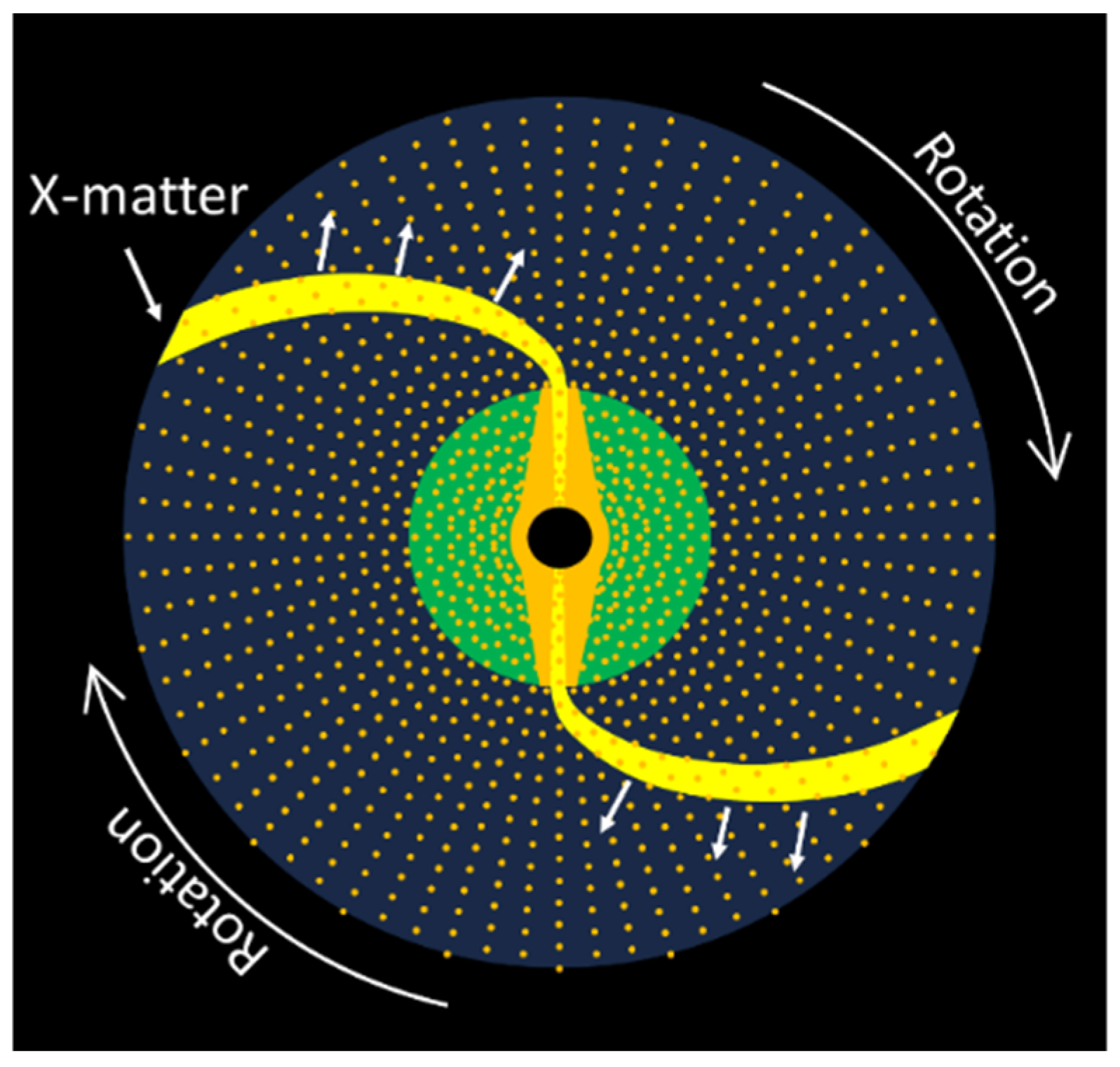
Figure 2.
Illustration of the application of ROTASE model to the galaxy UGC 12646 with 8-shaped double ring pattern with chain-link crossing style.
Figure 2.
Illustration of the application of ROTASE model to the galaxy UGC 12646 with 8-shaped double ring pattern with chain-link crossing style.
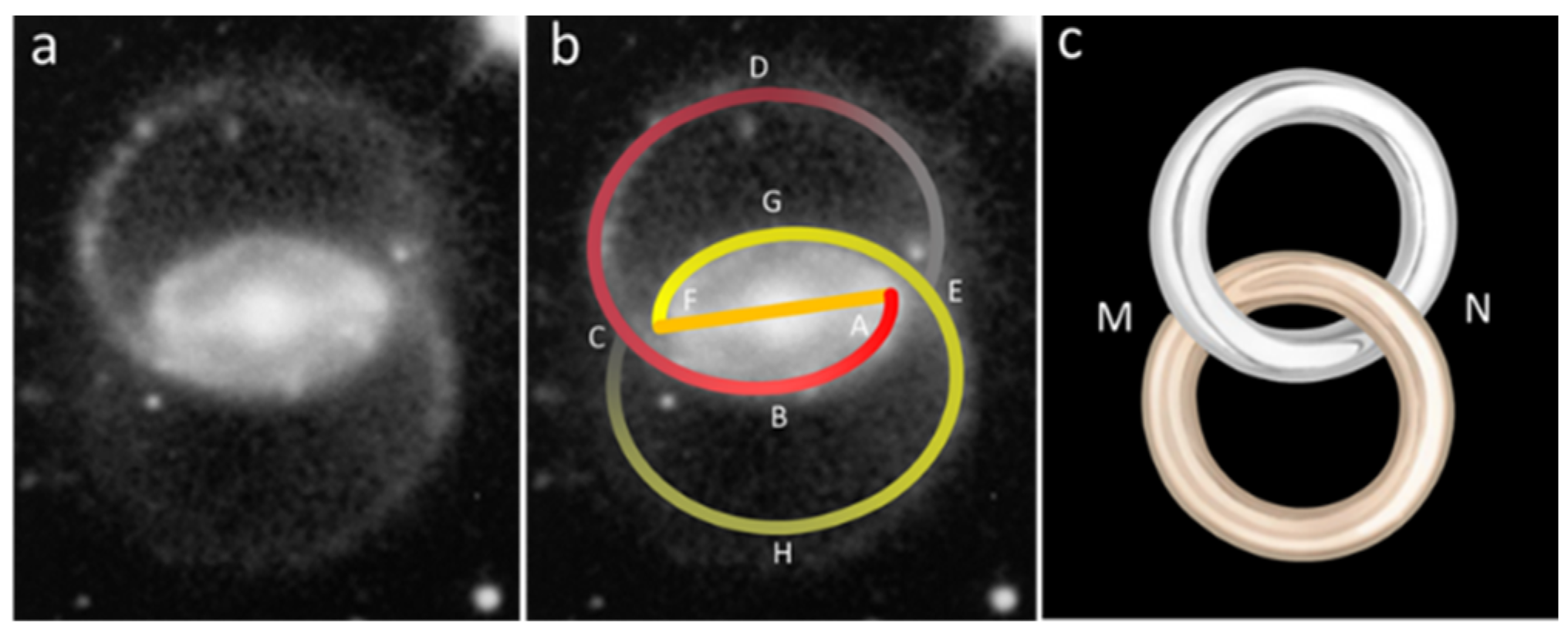
Figure 3.
A: Spirals by falling SpaceX rocket, Image credit: Alasdair Burns, observed in New Zealand, posted on Twitter, 6/19/2022; B: the galaxy M51; C: the galaxy UGC 6093.
Figure 3.
A: Spirals by falling SpaceX rocket, Image credit: Alasdair Burns, observed in New Zealand, posted on Twitter, 6/19/2022; B: the galaxy M51; C: the galaxy UGC 6093.
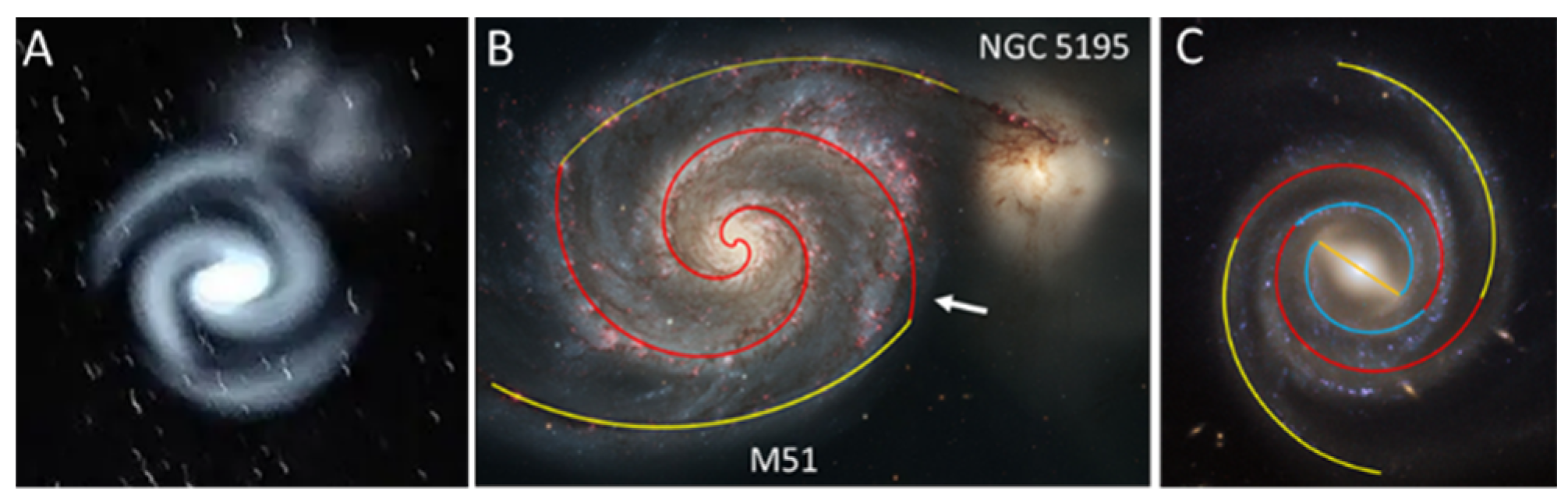
Figure 4.
Spirals by unequal emission. a is the spiral by the SpaceX rocket launched on 4/17/2023, captured by Talia MacDonald at Alaska. b is the depicted profile of the a. c is the image of NGC 4622; d is the spiral fitting by ROTASE model.
Figure 4.
Spirals by unequal emission. a is the spiral by the SpaceX rocket launched on 4/17/2023, captured by Talia MacDonald at Alaska. b is the depicted profile of the a. c is the image of NGC 4622; d is the spiral fitting by ROTASE model.
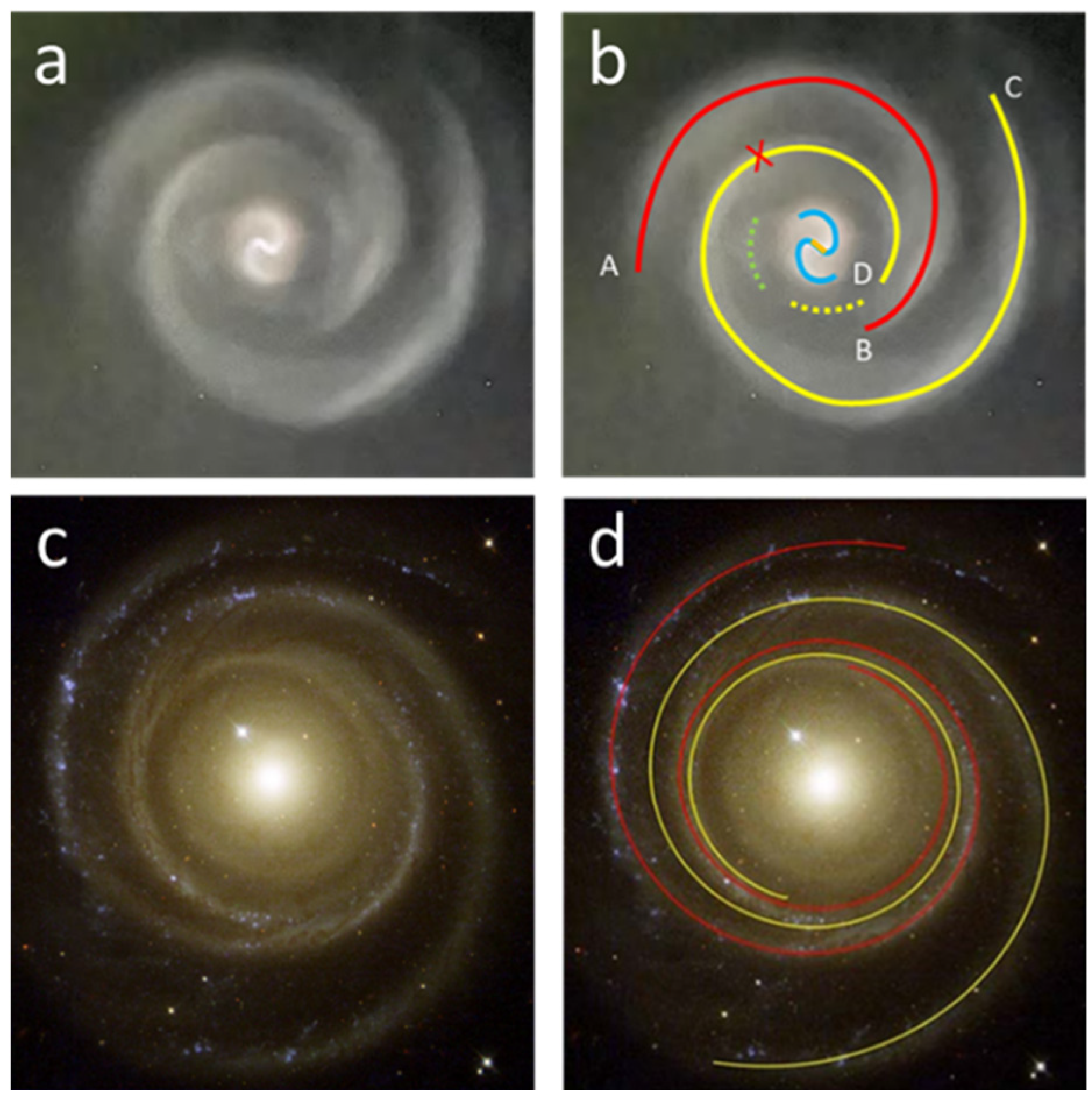
Figure 5.
Spirals with broken connection from the rockets. A, the spirals by the same falling SpaceX rocket as Figure 3A at later time, photo by Clare Rehill at Queenstown of South Island of New Zealand, June 19, 2022; B, photoshop modified from Fig 5A as the predicted spiral pattern after further 90° rotation of the rocket; C, the image of the galaxy MCG+00-04-051.
Figure 5.
Spirals with broken connection from the rockets. A, the spirals by the same falling SpaceX rocket as Figure 3A at later time, photo by Clare Rehill at Queenstown of South Island of New Zealand, June 19, 2022; B, photoshop modified from Fig 5A as the predicted spiral pattern after further 90° rotation of the rocket; C, the image of the galaxy MCG+00-04-051.
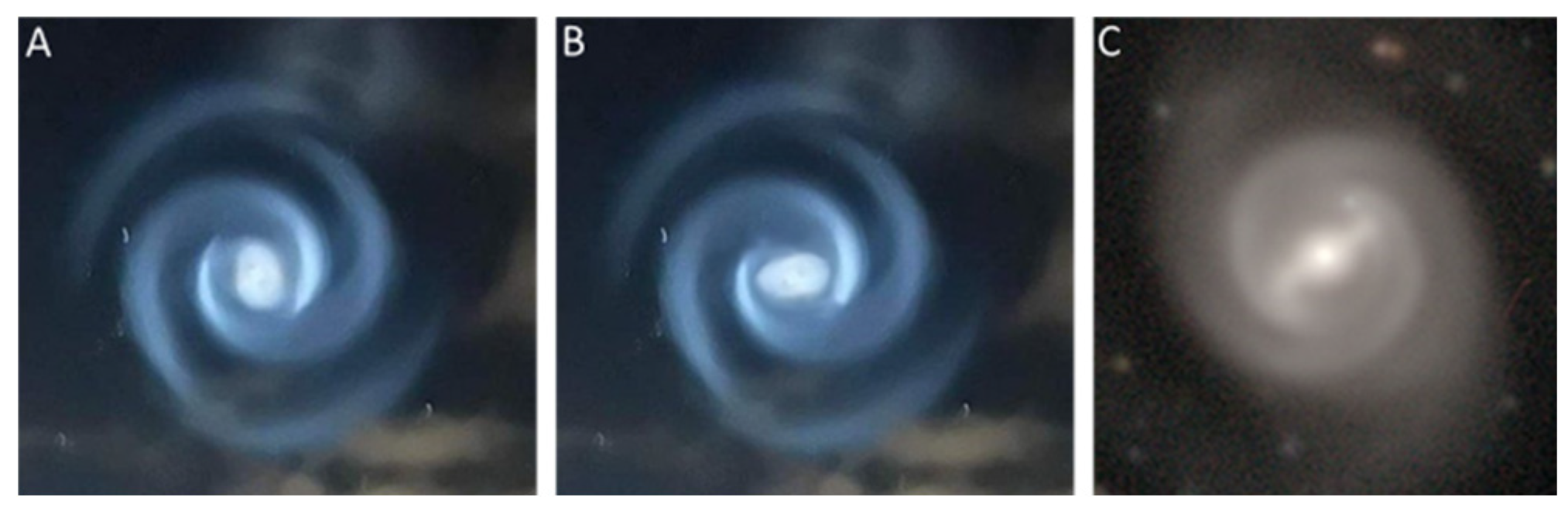
Figure 6.
Additional images of spirals with broken connection from rockets. A, spiral by SpaceX Falcon 9 observed over Tulsa, OK on Jan. 31, 2022; B, the spiral by SpaceX rocket, observed on Jan. 18, 2023 over Hawaii. C, the galaxy NGC 4548.
Figure 6.
Additional images of spirals with broken connection from rockets. A, spiral by SpaceX Falcon 9 observed over Tulsa, OK on Jan. 31, 2022; B, the spiral by SpaceX rocket, observed on Jan. 18, 2023 over Hawaii. C, the galaxy NGC 4548.
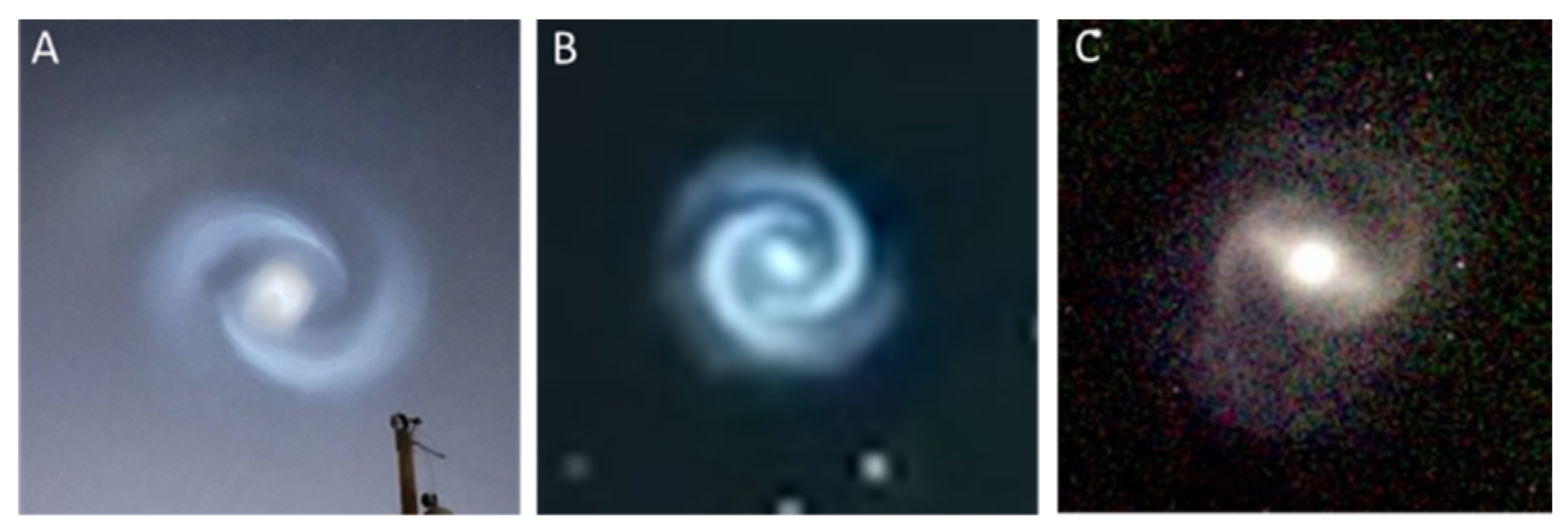
Figure 7.
One spiral by one-side fuel emission. A, the one spiral by SpaceX Falcon 9, photo was taken by Lance Godwin on Jun 5, 2020 in Australia; B, one spiral by Long March 2C rocket over the northwest Pacific on June 8, 2021; C, the galaxy NGC 4618 with only one spiral arm.
Figure 7.
One spiral by one-side fuel emission. A, the one spiral by SpaceX Falcon 9, photo was taken by Lance Godwin on Jun 5, 2020 in Australia; B, one spiral by Long March 2C rocket over the northwest Pacific on June 8, 2021; C, the galaxy NGC 4618 with only one spiral arm.
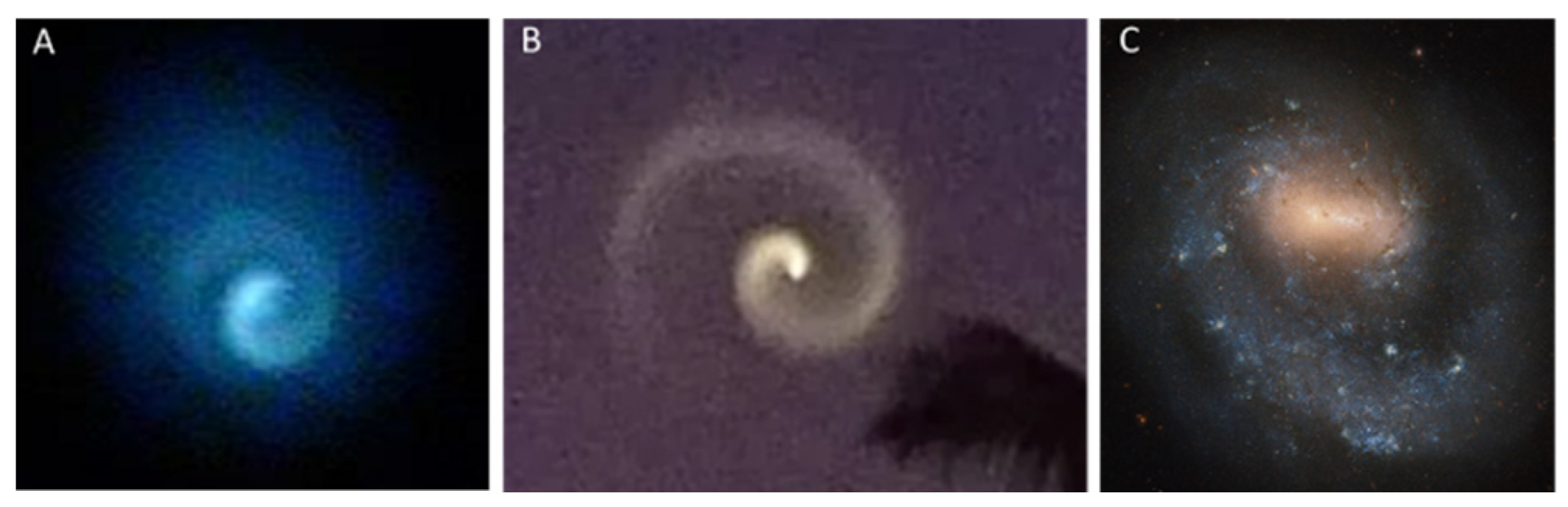
Figure 8.
Common trail effect of firework shows and the trail by jet boat.
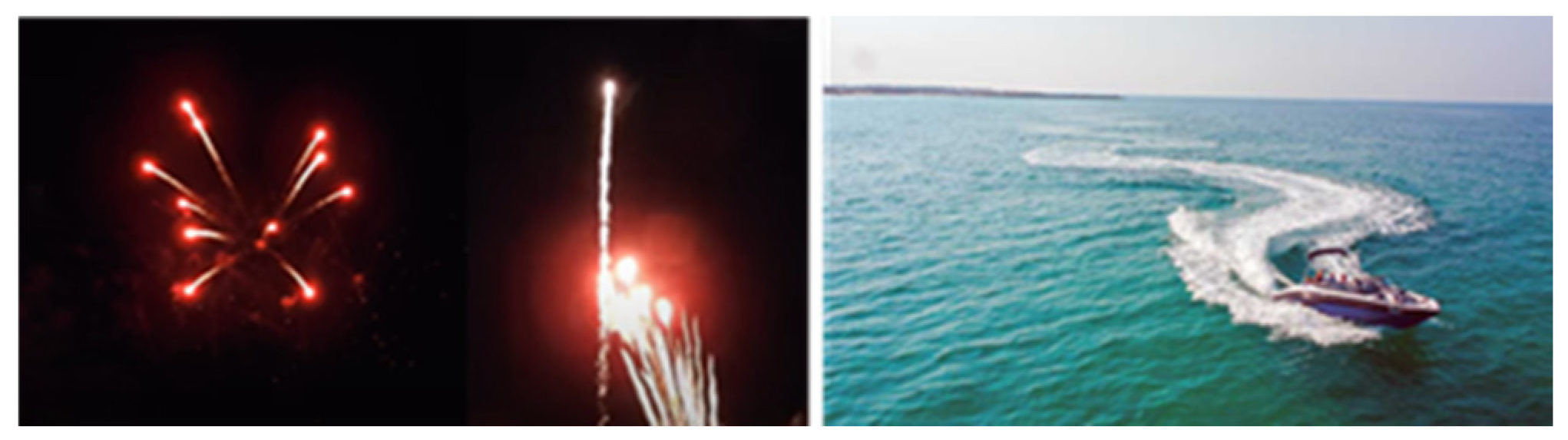
Figure 9.
The trail effects of the galaxies and the spirals produced by falling rockets. A, J101652.52; B, J010650.99-003413.7; C, J131730.17+203556.0 ; D, spiral by SpaceX Falcon 9 rocket over the Australia's east coast on June 5,2010 by Ryan Northover; E, spirals by SpaceX Falcon 9 rocket over Sudan, photo was taken by Sam Cornwell on 1/8/2018; F, Spirals by SpaceX Falcon 9 rocket over Khartoum, Sudan, photo was taken by Peter Horstink, January 8, 2018.
Figure 9.
The trail effects of the galaxies and the spirals produced by falling rockets. A, J101652.52; B, J010650.99-003413.7; C, J131730.17+203556.0 ; D, spiral by SpaceX Falcon 9 rocket over the Australia's east coast on June 5,2010 by Ryan Northover; E, spirals by SpaceX Falcon 9 rocket over Sudan, photo was taken by Sam Cornwell on 1/8/2018; F, Spirals by SpaceX Falcon 9 rocket over Khartoum, Sudan, photo was taken by Peter Horstink, January 8, 2018.
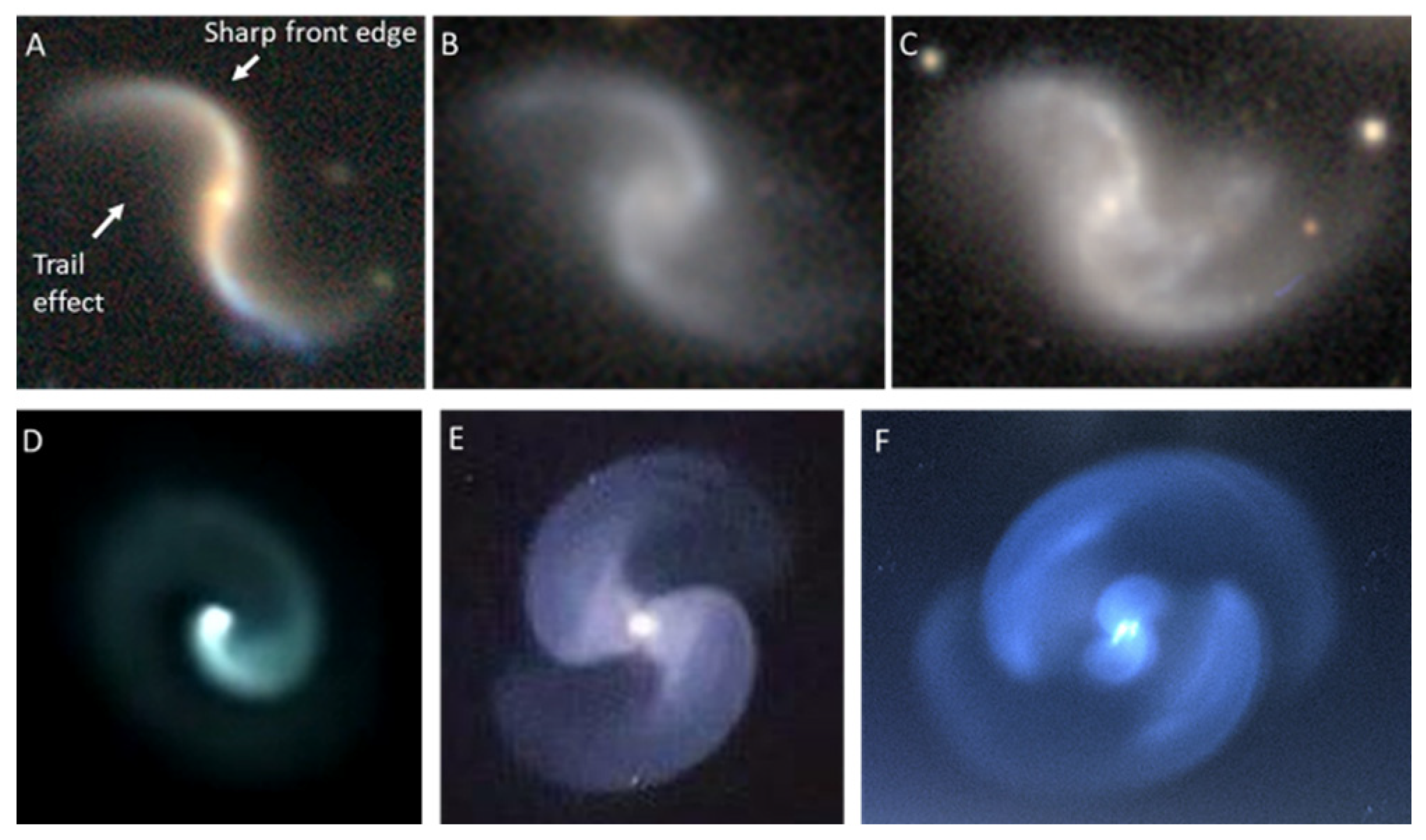
Figure 10.
comparison of trail effects predicted by the Density wave theory with the ROTASE model. A: the trail effect with co-rotation circle in the middle region of visible galactic disc; B: the trail effect with co-rotation circle outside of visible galactic disc; C: trail effect predicted by ROTASE model.
Figure 10.
comparison of trail effects predicted by the Density wave theory with the ROTASE model. A: the trail effect with co-rotation circle in the middle region of visible galactic disc; B: the trail effect with co-rotation circle outside of visible galactic disc; C: trail effect predicted by ROTASE model.
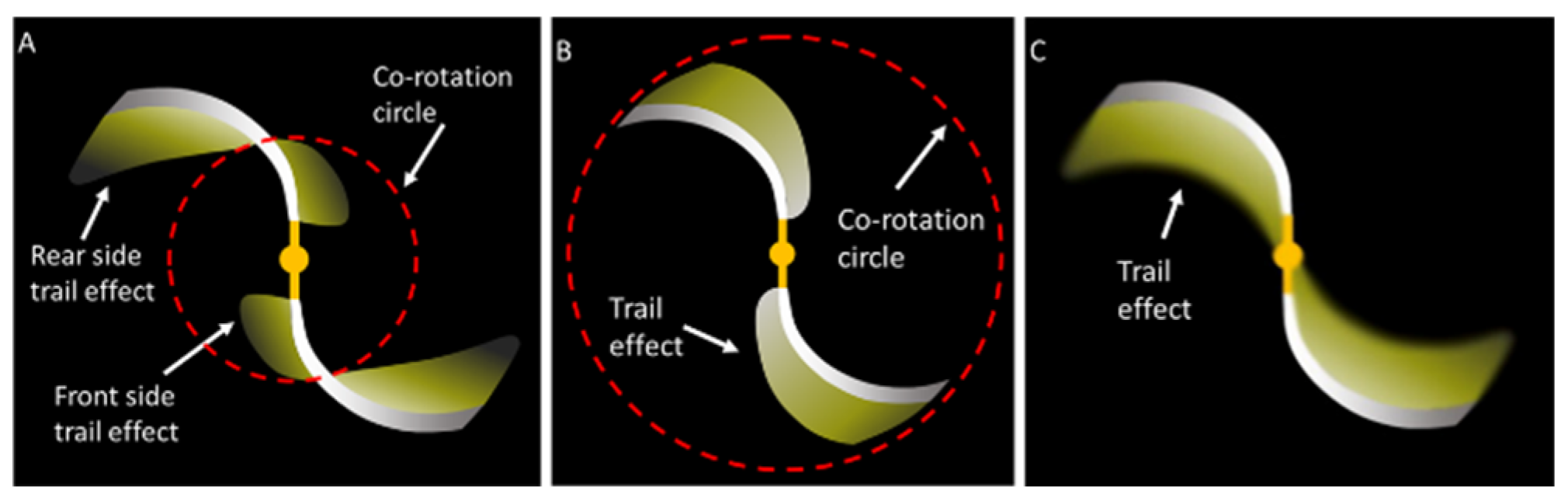
Figure 11.
Left: NGC 1300; right: J101652.52.
Disclaimer/Publisher’s Note: The statements, opinions and data contained in all publications are solely those of the individual author(s) and contributor(s) and not of MDPI and/or the editor(s). MDPI and/or the editor(s) disclaim responsibility for any injury to people or property resulting from any ideas, methods, instructions or products referred to in the content. |
© 2023 by the authors. Licensee MDPI, Basel, Switzerland. This article is an open access article distributed under the terms and conditions of the Creative Commons Attribution (CC BY) license (http://creativecommons.org/licenses/by/4.0/).
Copyright: This open access article is published under a Creative Commons CC BY 4.0 license, which permit the free download, distribution, and reuse, provided that the author and preprint are cited in any reuse.