

Submitted:
02 July 2024
Posted:
03 July 2024
You are already at the latest version
Abstract
With the galaxy J101652.52 as a model galaxy, this paper studied on the temporal duration of optically observed spiral patterns in disc galaxies is based on the finite reservoir of hydrogen available without replenishment following the initial formation of these well-isolated galaxies. The galaxy J101652.52 exhibits a grand design spiral pattern of two wide open spiral arms with perfect central symmetry, has only rear side trail effect, which clearly indicates that there is no corotation circle, therefore, the Density wave theory proposed for the spiral arm formation may not be applicable in this galaxy. The results reveal a gradual decline in observable spiral arms regardless of any spiral arm formation mechanism. This reduction occurs after half-loop rotation (as defined in the paper) as hydrogen reserves deplete, hindering new star formation. Ultimately, spiral patterns may possibly become optically invisible at normal conditions after a full-loop rotation (as defined in the paper) with hydrogen depletion, even if the formation mechanism remains active. The spiral galaxies with spiral arms decoupled from galactic bars or having soft spiral structures shall have similar results as long as that the spiral pattern rotation speed is significant different from the galactic matter rotation speed. Most of observed spiral galaxies have soft spiral structures, their spiral patterns dynamically change constantly. The results of this study support the idea of short-lived spiral patterns compared to the lifespan of the spiral galaxies. The spiral arm formation may occur once like the onetime firework show in a galaxy’s life based on the limited availability of hydrogens. A concise, universally applicable mechanism for spiral arm formation across various galaxies should exist which provides a single mathematical formula to describe the broad range of morphologies of the spiral arms with few adjustable parameters. Some exceptions may be explained within this framework. Furthermore, the observed data on spiral pattern and galactic bar rotation speeds in the Milky Way require rigorous verification, particularly concerning the winding problem.
Keywords:
spiral arms
; spiral pattern evolution
; rigid spiral arms
; soft spiral arms
; spiral galaxies
1. Introduction
Spiral galaxies are the most fascinating celestial objects in the universe, attracting observers with their rich and ever-changing spiral patterns that radiate a profound sense of beauty. They can emit electromagnetism waves from low radio frequency to high gamma ray in the electromagnetism spectrum. These mesmerizing phenomena can be witnessed through various instruments operating in different frequencies; the most common observation is by the ground telescopes; the advanced tools in the space like the Hubble Space Telescope and the James Webb Space Telescope significantly enhance our ability to explore them. However, all such observations depend entirely on the intensity of electromagnetism waves emitted by the stars within these galaxies. As is the case with all-natural phenomena, spiral arms too follow a unique evolutionary trajectory, with a beginning and an end. This leads us to the intriguing inquiry: how long can we continue to optically observe the spiral arms of galaxies?
This question is closely entwined with the lifespan of the spiral patterns exhibited by disc galaxies, a subject that has been the focus of extensive research in the past. However, the results of these studies have been marked by inconsistency and lack of a definitive conclusion. Sellwood contends that recurrent, short-lived transient spiral patterns are favored [1], while Hao et al. reported that spiral patterns may persist for extended periods [2]. A key challenge lies in the absence of a clear delineation between “long” and “short” in this context. To answer this question with precision, we must gain a deeper understanding of the mechanisms governing the formation and evolution of spiral arms in galaxies, a field that, regrettably, has yet to achieve clarity. Over the years, several hypotheses have been put forth to elucidate the formation of spiral arms, encompassing the Density Wave Theory (DWT) [3,4], the Swing Amplification theory [5], the Manifold theory [6,7,8,9,10], and the author’s own proposal, the Rotating Two Arm Sprinkler Emission (ROTASE) theory [11], in which, the precise characterization of the proposed X-matter emitted by the central blackhole remains an open question, it may act like a catalyst to promote new star formation or as initially proposed that the X-matter may convert to hydrogens to increase the local density of the hydrogens and enhance the new star formation, whether it manifests as a particle, an unidentified physical field, or another elusive entity yet to be defined and subject to speculation. Saha and Elmegreen, drawing from N-body simulations, proposed that spiral wave modes might experience slow growth during the initial 1 to 2 billion years and subsequently evolve rapidly, reaching a relatively large amplitude within the next billion years. Following this phase, they maintain a constant pattern speed for an additional 5 billion years [12]. Can the spiral arms be optically observed for a span of 5 billion years after they are fully developed?
Nevertheless, certain fundamental observations about spiral arms can guide us in addressing some facets of this intriguing question:
- Spiral galaxies take on a flat, disc-like shape and rotate about their centers.
- The spiral arms boast significantly higher rates of new star formation when compared to other non- arm regions. These new stars consume hydrogen, increasing the local luminosity and giving rise to the optical visibility of the spiral arms which is clearly distinguished from other regions of the galactic disc.
- The rotation of the spiral arms occurs independently of the galactic materials (such as gases, interstellar dust, and all stars), the spiral arms may rotate as a “rigid body” at a constant angular speed [13]. In contrast, the galactic material orbits the galactic center with a flat differential rotation [14,15].
Given these fundamental insights, we can delve further into the intriguing question at hand.
2. Evolution of Optically Observed Spiral Arms in a Simplified Spiral Galaxy
The galaxy J101652.52, as depicted in Figure 1, serves as an excellent candidate for a model galaxy to explore the question at hand. The left side of Figure 1 presents the original image of the galaxy, showcasing a grand design pattern characterized by luminous, widely open, unblemished, and well-structured spiral arms that exhibit perfect central symmetry.
On the right side of Figure 1, the spiral arm fitting has been executed using the galactic spiral equation derived from the ROTASE model [11]. In this representation, the red and yellow lines correspond to the fittings for the northern and southern arms, respectively, while the orange line designates the galactic bar. Here, R signifies the maximum radius, marking the outermost boundary of the observed spiral arm at the moment, the actual disc size could be larger than R; and Rb denotes the radius of the galactic bar, representing half its length. The ratio R/Rb equals 5.2. Notably, the dashed yellow and red lines indicate the potential past positions of the spiral arms about 75° in rotation angle relative to their current orientation.
Evidently, this galaxy undergoes clockwise rotation around its galactic center. A close examination of the original image reveals distinct characteristics: the front side of the spiral arms appears crisp, featuring a well-defined edge, and luminosity diminishes rapidly. Conversely, the rear side displays a pronounced trailing effect, marked by a gradual reduction in luminosity. The trailing effect of this galaxy has been extensively explored in a prior study [11], offering valuable insights into the dynamics and evolution of the system. Remarkably, this model galaxy exclusively exhibits the trailing effect on its rear side. This observation strongly implies that the entire spiral arms rotate at a faster rate than the galactic matter does. New stars exit the spiral arms at the rear side, leading to a luminosity gradient resulting from the aging of these stars and the gradual depletion of available hydrogen within them after their formation. The blue arc labeled as ABCD represents the orbital rotation of the galactic matter around the galactic center.
In density wave theory, as illustrated in Figure 2 (left)[16], density waves—whose origin remains unclear—manifest as spiral patterns rotating at specific angular speeds known as pattern speeds. Meanwhile, the galactic matter and existing stars within the galactic disk orbit differentially. A critical feature is the presence of a corotation radius (depicted by the red dashed circle), where the density wave and the galactic matter (comprising stars, gas, and stellar dust) rotate at matching speeds.
Within this corotation radius, galactic matter and stars outpace the wave, entering (indicated by purple arrows) from the rear side of the wave and exiting (indicated by white arrows) from its front side. Conversely, beyond this radius, galactic matter and stars lag behind the waves, entering from the front side and exiting from the rear side. This phenomenon leads to compression of galactic matter, significantly enhancing the rate of new star formation upon entering the wave, resulting in star formation of various sizes.
Consequently, within the corotation radius, a luminosity gradient is expected on the front side of the wave, while beyond it, a similar gradient should occur on the rear side of the wave, as depicted in Figure 2 (left).
However, in the case of galaxy J101652.52, the spiral arms exhibit clear and distinct leading edges, while only rear-side trailing pattern is observed. This distinct pattern strongly suggests that the entire spiral arms rotate at a faster pace than the galactic matter. Consequently, the galactic matter and existing stars enter the spiral arms at their leading edge and exit at the trailing edge. In essence, the spiral arms sweep through the galactic matter, markedly enhancing the rate of new star formation within these regions. This process results in the luminous appearance of the spiral arms and the trailing patterns left behind by newly formed stars as they exit the spiral arms, as depicted in Figure 2 (right). However, the precise mechanism behind this enhancement remains unclear, although several hypotheses have been proposed.
This observation notably challenges the existence of a corotation radius in this galaxy, suggesting that the density wave theory might not be applicable. This model galaxy thus serves as a valuable tool for swiftly evaluating hypotheses regarding the formation of spiral arms in disk galaxies.
Another notable characteristic of this model galaxy is the distinct color contrast between its bar section and spiral arms shown in this image. The bar exhibits a yellow-orange hue, while the spiral arms display a bright blueish color. This pronounced difference in color suggests significant variations in composition and physical environment between the galactic bar and the spiral arms. It is conceivable that the bar section is predominantly composed of older stars, whereas the spiral arms likely harbor a higher proportion of young stars undergoing active formation processes.
Within this particular galaxy, it is evident that the spiral arms are firmly tethered to the galactic bar, a pattern that aligns with the majority of observed galaxies. While there are a few exceptions in which the spiral arms appear to disengage from the galactic bars, it’s worth noting that, in some of these exceptional cases, further investigation has revealed that the connection between the spiral arms and their respective galactic bars remains intact. Notable examples include galaxies like MCG+00- 04-051 and NGC 4548 [11].
Based on the ROTASE model, spiral arms exhibit rigidity and maintain a uniform spiral pattern rotation speed when they conform to the galactic spiral equation with a constant parameter ρ. However, if the spiral arms are characterized by a time-varying parameter ρ, they lose their rigidity, leading to a non-uniform spiral pattern speed that dynamically changes over time, as evidenced by galaxies such as UGC 6093 and M51 [11].
The current spiral pattern observed in galaxy J101652.52 aligns well with the galactic spiral equation derived from the ROTASE model, with a parameter ρ = 2.5, as depicted in Figure 1 on the right. Consequently, the entire arms, bound by the galactic bar, rotate as a single rigid body with a constant angular rotation speed, at least within a reasonable time frame spanning from the past to the future. Therefore, the orbital rotation speed of the spiral arms linearly increases with distance from the galactic center. Generally, the rotational velocity of galactic matter exhibits a linear increase with radius when that radius falls within the bounds of the galactic bar. Beyond the galactic bar, the rotation speed remains approximately constant [14,15]. To visualize this, the orbital rotation velocities of both the spiral arm and the galactic matter for an ideal model galaxy are depicted in Figure 3.
The orbital rotation velocity of the spiral arm steadily escalates with radius, ultimately rotating at a considerably higher speed than the galactic matter. To simplify this concept, one can liken these significantly different rotations to the famous fable of the rabbit and the turtle, with the spiral arm rotation akin to the swift rabbit and the galactic matter rotation akin to the steady but slower-moving turtle. Of course, in this new race, the rabbit has learned the lessons from the previous race and will run as hard as he can without stop and nap, and never make any mistakes again. Despite various proposed models aimed at elucidating the mechanisms behind the formation of spiral arms in galaxies, none of these models have garnered conclusive confirmation. As a result, there is presently no reliable method for describing the evolution of spiral patterns in galaxies. Nevertheless, it is widely acknowledged that spiral arms are regions with markedly higher rates of new star formation than other parts of the galaxy. The formation of new stars hinges on the availability of sufficient hydrogen as raw material. Therefore, we can approach the question posed in the title by considering the availability of hydrogen within galaxies. In the context of this paper, the illustrations and analysis are rooted in a set of assumptions for an idealized and simplified galaxy model:
- The galaxy is well-isolated from other galaxies. The spiral arms and galactic bar are conjoined and rotate as a unified, rigid body, maintaining a constant angular speed. The orbital rotation velocity increases proportionally with radius.
- Beyond the galactic bar, the galactic matter, which includes stars, interstellar dust, gases, and more, undergoes differential rotation, following a flat rotation velocity. This differential rotation results in these components moving along perfect circular paths without radial movement.
- There is no influx of additional hydrogen from external sources into the galaxy following its initial formation.
- The rate of new star formation in the spiral arms significantly surpasses that in other regions of the galaxy.
- The mechanism responsible for the formation of the spiral arms remains consistent and active throughout the period under consideration.
Using the galaxy J101652.52 as the model, Figure 4 depicts an idealized and simplified barred spiral galaxy based on the assumption that the spiral arms are instantaneously formed (neglecting the process of spiral arm formation for the time being). In this depiction, the entire galactic disk is presumed to be replete with hydrogen and other materials necessary for star formation. This region is referred to as the “virgin land.” The galactic bar is initially positioned horizontally. The ratio of the outer edge of the galactic disk (R) to the radius of the galactic bar (Rb) stands at 6 (R/Rb = 6). Two spiral arms are represented by yellow and purple colors, respectively. The galaxy rotates in a clockwise direction, and two blue lines at the front side of spiral arms denote the rotational tracking positions of the spiral arms. The letters a, b, c, d, e, and f correspond to tracking points for the spiral arms during their rotation, while the Greek letters α, β, γ, δ, ε, and ζ designate tracking points for the galactic materials throughout the rotation.
At the outset of the rotation, the tracking points of the spiral arms align with the tracking points of the galactic materials, as visually depicted in Figure 4. A yellow rabbit located at the point c symbolizes the outer edge of the yellow spiral arm, and a yellow turtle situated at the point γ represents the outer boundary of the galactic materials in the disk. This arrangement also applies to the purple spiral arm, represented by a purple rabbit and a purple turtle.
It’s essential to acknowledge that in reality, new stars have the potential to form anywhere within the galactic disc, including what we might term “virgin land.” However, within the spiral arms, the rate of star formation typically registers about 5 to 10 percent higher compared to other regions. Though seemingly small in mathematical terms, this slight variance significantly heightens the sensitivity of optical observations.
Additionally, these “virgin lands” may host long-lived stars of diverse sizes, akin to our Sun. Nevertheless, the overall radiation intensity emanating from these regions remains notably lower than that observed within the spiral arms.
Following a 90° rotation of the galactic bar and the spiral arms, the galactic bar assumes a vertical position, as visually depicted in Figure 5. At this juncture, the tracking points for the spiral arms, denoted by a, b, c, d, e, and f, have advanced to positions a1, b1, c, d1, e1, and f1, respectively. Simultaneously, the galactic materials continue their rotation with a flat differential velocity, with tracking points α, β, γ, δ, ϵ, and ζ moving along white lines to reach positions α1, β1, γ1, δ1, ε1, and ζ1. Here, it’s important to note that the spiral arms rotate at a faster pace than the galactic materials, leading to the arms sweeping through the galactic matter. New stars form as galactic matter enters the spiral arms on their front side and exit the arms on their rear side. This process results in the creation of new stars and contributes to the depletion of available hydrogen and other star-building materials in the areas swept by the spiral arms. These areas are represented by the yellow shadow area, which is swept by the yellow spiral arm and is termed the “single swept area.” The same concept applies to the purple shadow area. These shadow regions experience a significant reduction in available hydrogen and other star-building materials.
Due to the substantial difference in rotational velocities, the yellow rabbit is notably distant from the yellow turtle, emphasizing the varying rates of rotation between the spiral arms and the galactic materials. In this scenario, approximately 34% of the total area within the galactic disc constitutes the single swept area, while the remaining 66% of the disc area remains in a state of “virgin land,” featuring an abundance of hydrogens and other essential star-building materials.
The yellow and purple shadow areas are also the rear side trail areas which are fully observed in the galaxy J101652.52. The observed length of the trail effect depends on how fast the new stars burn the hydrogens and the sensitivity of the observation instruments.
Following an approximately 216° rotation of the galactic bar, a significant development occurs, illustrated in Figure 6. At this point, the yellow rabbit has caught up with the purple turtle, and the purple rabbit has similarly caught up with the yellow turtle. The tracking points for the spiral arms are now positioned at a2, b2, c2, d2, e2, and f2, while the tracking points for the galactic matter have advanced to positions α2, β2, γ2, δ2, ε2, and ζ2.
This particular configuration marks a significant change in the galaxy’s dynamics. Around 86% of the total area within the galactic disc has now been subject to a single sweep by the spiral arms, leaving only approximately 14% of the total area in a state of “virgin land.” This phase is referred to as a “half loop,” denoting the moment when the yellow rabbit catches up with the purple turtle.
The rotation angle of the “half loop” is determined by the ratio of the radius of the point of interest on the spiral arm to the radius of the galactic bar. For instance, it requires a greater rotation for point b2 to synchronize with point ε2. The relationship between the rotation angle ψ (in degrees) of the half loop and the radius ratio µ(=R/Rb), defined as the radius (R) of the point of interest relative to the radius (Rb) of the galactic bar, can be described as follows:
The variable µ can be regarded as the radius of the point on the spiral arm, measured in units of the galactic bar. Figure 7 illustrates the variation in the half loop rotation angle ψ in relation to µ. Notably, the half loop rotation angles for the Milky Way (µ = 3.6, as determined from the current visual representation of the Milky Way) and the galaxy J10165.52 (µ = 5.2) are also indicated.
Following the “half loop” rotation, the yellow spiral arm proceeds to rotate forward and encounters the previously single-swept purple area. This marks the initiation of the second sweeping or “double sweeping.” In the context of the Density Wave Theory (DWT), this phase is associated with the galactic matter entering the spiral wave and undergoing a second compression.
During this double sweeping, the rate of new star formation significantly decreases due to the substantial depletion of available hydrogen and other star-building materials in the previously single-swept area. This decrease occurs under the assumption that no additional hydrogen or star-forming matter enters the galaxy from external sources following the galaxy’s initial formation. Consequently, the luminosity of the spiral arm gradually diminishes along the length of the spiral arm toward the bar’s end during its continued rotation. For the sake of clarity and simplification, two levels of brightness are defined in the illustration:
- “Full brightness” refers to the brightness of the spiral arm sweeping the virgin land.
- “Reduced brightness” represents the brightness of the spiral arm sweeping the single-swept area.
As the spiral arm continues to rotate, the length of the reduced brightness section of the spiral arm progressively increases, while the full brightness section gradually decreases. This transformation is visually depicted in Figure 8. The horizontal orange line in the figure represents the radius of the galactic disc in this model (µ = 6), while the red double-arrow line symbolizes the spiral arm section with full brightness, and the green double-arrow line signifies the spiral arm section with reduced brightness. On the right side of the image, there is a representation of half of the side view of the Milky Way, illustrating how the thickness and density of the galactic disc gradually decrease with increasing radius. This further adds context to the changes in brightness and star formation within the spiral arms as they sweep through the galactic matter.
In Figure 9, the graphic illustration details the change in the luminosity of the spiral arms as a function of the rotation angle. Let’s analyze this in conjunction with the information from Figure 4, Figure 6, and Figure 8 to better understand the depicted sequence.
As per Figure 4, the spiral arms, which were assumed to be “instantly established,” commence their clockwise rotation from the 0° position with full brightness which is not shown due to overlap by the later spiral arms of 360° rotation. During this initial phase, the entire length of the spiral arms sweeps through the “virgin area,” characterized by an abundance of hydrogen and other star-forming materials. Consequently, the spiral arms radiate at full brightness during this period. This period extends from the starting position at 0° to 216° of rotation, corresponding to the section from 0 to A in Figure 8.
However, after reaching point A (at 216°) in Figure 8, marked as A1 and B1 in Figure 9 for both spiral arms, a pivotal transition occurs. The spiral arms begin to sweep the “single-swept area,” where the quantity of available hydrogen and other star-forming materials is significantly reduced. Consequently, the rate of new star formation in this region undergoes a substantial reduction, resulting in a decrease in the luminosity of the spiral arms due to this “double sweeping.” In the meantime, the partial sections of the spiral arms continue to sweep the remaining “virgin land” area, generating spiral arms with full brightness.
As the spiral arms rotate further, the length of the spiral arms with full brightness gradually decreases, following the trajectory indicated by the blue curve in Figure 8. Simultaneously, the length of the spiral arms with reduced brightness steadily increases. To provide some context, if the initial radius of the spiral arms with full brightness at the starting position is set to 6 (as represented by the orange line in Figure 8), then the radius of the spiral arms with full brightness diminishes to 4 at a rotation angle of 240° and decreases to 2.5 at 300°, and so forth. Figure 9 illustrates this phenomenon by displaying how the radius of the full brightness spiral arms decreases with the rotation angle, as indicated by the red dashed curves.
A pertinent question arises: Can we optically observe spiral arms with reduced brightness under normal conditions (same instrument with the same observation frequency range and the same sensitivity)? To address this, we must consider at least three factors.
- The reduction in the thickness and density of the galactic disc as demonstrated by the Milky Way in Figure 8.
- It’s widely accepted that the star formation rate within the spiral regions typically exceeds that of other areas by about 5 to 10 percent. Despite this seemingly modest increase, even a “small” percentage variation significantly influences optical observations in galaxies like J101652.52, as illustrated in Figure 1 by comparing the luminosity disparity between points C and A. Notably, a mere 1 percent decrease in the star formation rate can have a notable impact on the optical visibility of the spiral arms.
- The prominent presence of giant OB stars within these spiral arms is a key contributor to their brightness, emitting intense blue light. However, the formation of these massive OB stars necessitates substantial amounts of hydrogen and other star-building materials. Consequently, it’s likely that the rate of formation for these giant stars will decline more sharply than that of smaller stars during subsequent sweeping periods.
- 3.
- In a real galaxy like J101652.52 depicted in Figure 1, the formation of spiral arms is a protracted process during which a substantial amount of hydrogen and other star-forming materials are already depleted. Consequently, it is likely that the spiral arms with reduced brightness are exceedingly faint and may not be observable under standard conditions. They might only become detectable with advanced instruments that operate at longer wavelengths, such as the James Webb Space Telescope.
After another half-loop rotation (equivalent to a total of 432°), the yellow rabbit has caught up with the yellow turtle, and the purple rabbit has caught up with the purple turtle, as illustrated in Figure 10. This occurrence is referred to as a full-loop rotation. Following a full-loop rotation, approximately 78% of the disk area experiences double sweeping presented by reddish-orange color—meaning it is swept by both the yellow arm and the purple arm—while about 18% of the disk area undergoes a single sweep. Only about 4% of the disk area remains as the virgin land.
If the spiral arms continue rotating beyond the 432° point, it would initiate a third sweeping or third compression by the Density Wave Theory. Realistically, there may not be sufficient hydrogen available for a significant number of new star formations and maintaining the same luminosity level, rendering the spiral arm not optically observable at normal conditions, even if the mechanism for star formation remains operational. As a result, it consists mainly of aging stars like a lenticular galaxy. N-body simulations conducted by Saha and Elmergreen [12] suggest that two-arm spiral wave modes may endure for approximately 5 billion years, possibly up to 20 rotations in the case of the Milky Way.
If the spiral arm formation follows the DWT, the galactic matter is still compressed in the density waves with much lower star formation rate without enough hydrogens from the remaining galactic matter compared to the rate at the virgin land, the galaxy may be considered as a lenticular galaxy with little star formation. In other words, the extended persistence of spiral wave modes does not guarantee their optical observability over such prolonged time spans.
The actual conditions of galaxies may differ or deviate significantly from the ideal model presented in Figure 4. For instance, spiral arms, like those observed in the galaxy J101652.52, require a substantial amount of time to grow to their current observed size, as indicated by N-body simulations [12]. This growth process may span approximately 1 billion years, during which a significant portion of hydrogen and other star- forming materials would have been consumed.
For galaxies that align with the simplified galaxy outlined earlier, it can be inferred that the upper limit for observing well-defined spiral patterns may persist for only a period of one to two rotations after the complete development of the spiral arms regardless of any specific mechanism of spiral arm formation. However, a significant shift occurs if additional hydrogen resources are introduced into galaxies during their evolution, either through accretion from the surrounding environment or via galactic mergers. In such scenarios, the situation is drastically altered.
3. Description of a Possible Evolution of the Optically Observed Spiral Arms of the Galaxy J101652.52
Based on the previous illustration, we can derive a plausible scenario for the evolution of optically observable spiral arms in the galaxy J101652.52. To do so, we make the following assumptions:
1. The galaxy remains stable with all its physical properties unchanged throughout the period under consideration. This includes no alterations in the size, distribution of matter, orbital rotation, and the mechanism responsible for spiral arm formation. The spiral arms continue to form according to the current mechanism.
2. The ratio of the radius R of the outer edge of the galactic disc to the radius Rb of the galactic bar remains constant at 5.2 for this galaxy in the future.
According to the equation (1), the half-loop rotation angle is estimated to be 223° for the galaxy J101652.52. It’s worth noting that this galaxy exhibits a strong rear- side trailing effect, as indicated previously [11], suggesting that the entire spiral arms rotate at a faster rate than the galactic matter. Therefore, the series of illustrations presented from Figure 4 to Figure 10 can be applied to describe the evolutionary process for this galaxy. However, in this real galaxy, the spiral arms are not formed instantly and the spiral arms may have already rotated for significant amount of time.
The luminosity profile along the blue circular path in Figure 1 right has been previously extracted [11] and visualized in Figure 11.
The blue line extending from the point C to the point A in Figure 11 visually represents the gradual change in luminosity, from the maximum brightness to the background level following exponential day function along the blue arc corresponding to C to A segment in Figure 1 (on the right), the x in the fitting equation is the rotation angle (represents the “time”) with negative value in the exponential decay equation, marks the tracking back from current to the past, such exponential decay is a common behavior of the first order consumption rate.
Let “L” represent the luminosity, “H” represent the total amount of hydrogens of all new stars with various sizes and lifetimes which are initially formed in the spiral arm point C in the Figure 1 right, exit the point C and lag behind the spiral arm along the blue line from C to A as the point C rotating forward. The L will be proportional to the burning rate of the hydrogens of those new stars. The first order consumption rate of hydrogens can be written as:
where, the k is the first order rate constant. The consumption rate is the collective rate of all new stars, not an individual star, the θ is the rotation angle of spiral arms as “time”, in this case, the θ will be positive by standard mathematic process. The total amount of hydrogens of all new stars at the rotation angle (time) “θ” after their formation is:
where, the H0 is the initial total amount of hydrogens of all new stars initially formed in the spiral arms. The luminosity L will be:
where, K is a constant, and the L0 is the initial luminosity of all new formed stars with various sizes. From the fitting of Figure 11,
L0 = 64.394 (arbitrary unit)
k = 0.0179/degree
To provide some context, in Figure 1, the red dashed line (along with the yellow dashed line and the dashed bar as a whole unit body) located at point A denote the hypothetical positions galaxy of the spiral arms about 75° in the past. This suggests that the spiral arms of the galaxy were already in existence at least 75° rotation time ago. Figure 12 is the illustration of the current situation of the galaxy J101652.52 with possible swept areas based on the information from Figure 11.
As a result, the shaded regions in purple and yellow, which account for approximately 38% of the total disc area in Figure 12, have undergone at least one sweeping by the spiral arms. The significant reduction in available hydrogens and other star-building materials in these shaded areas is a natural consequence of this sweeping. On the other hand, the unshaded blue regions, constituting around 62% of the total disc area, are assumed to represent virgin land. In other words, they have presumably never been swept by the spiral arms and are presumed to be rich in hydrogens and other materials suitable for star formation.
As the spiral arms continue their rotation and reach approximately 148° into the future (adding this to the 75° from the past for a total of 223°), a significant transition occurs. At this point, the spiral arms commence the process of sweeping through areas that have previously been single-swept, initiating the double sweeping. This phase leads to the division of the spiral arms into two distinct sections:
Outer sections: These parts of the spiral arms will be located in the double-swept regions, where the availability of materials necessary for new star formation, such as hydrogens, is considerably reduced. Consequently, the rate of new star formation in these sections will be significantly lower, leading to a considerable reduction in the luminosity of these areas. In some cases, these outer sections may even become optically invisible when observed under normal optical conditions. As the rotation progresses, the length of these sections will gradually increase following the double-arrow green line as shown in Figure 8.
Inner sections: In contrast, the inner sections of the spiral arms continue to sweep through the virgin land, areas rich in hydrogens and other star-building materials. Here, the luminosity remains high, but it gradually decreases as the rotation advances, following the double- arrow red line from Figure 8.
Figure 13 illustrates a potential scenario for the evolution of optically observable spiral arms as the galaxy’s rotation continues under the assumptions that the galaxy’s properties remain stable, including the unchanged mechanism of spiral arm formation. From approximately 148° to 225° into the future, the portions of the spiral arms that remain optically observable will have been reduced to just 48% of their original radius. This marks a significant transformation in the appearance and characteristics of the spiral arms.
The future possible evolution of the galaxy J101652.52, as depicted in Figure 13, is contingent on the adherence to specific assumptions. The actual evolution of this galaxy in the near future may or may not align with the scenario presented in Figure 13. However, this illustration serves as a valuable reference for predicting its future development under the specified assumptions.
It’s important to note that there is no available data regarding the rotation pattern speed of the spiral arms in this galaxy. In the absence of direct measurements, we can use data from our Milky Way as a reference point. In the Milky Way, the spiral pattern rotation period is estimated to be about 245 million years [13]. Assuming that the spiral pattern rotation period of J101652.52 is similar to that of the Milky Way or in the similar magnitude, we can extrapolate that approximately 148 million years later, the radius of the observable spiral pattern in J101652.52 would have decreased to roughly half its current size.
However, a consideration arises regarding the timeline for the development and evolution of the current spiral arms in this galaxy. These spiral arms likely took a substantial amount of time to form from scratch and would have consumed a significant portion of available hydrogens and other star-forming materials during their development. Consequently, the initially assumed “virgin land” as shown in Figure 12 should be significantly smaller. This implies that the optically observed spiral arms would start to shrink much earlier than the 148° rotation mark in the future or may already be shrinking. The analysis results presented here favor the notion of short-lived spiral patterns due to the gradual decrease of the availability of hydrogens after the formation of well-isolated galaxies. The optically observed spiral arms will start to shrink at the half-loop point. For Milky Way with spiral pattern rotation period of 245 Myr [13] and the half-loop rotation angle 250° as a reference, a full-loop rotation only takes about 340 Myr. This is very short time compared to the lifespan of Milky Way which could be formed at about 13.6 billion years ago [17]. Therefore, for the most of the well-isolated spiral galaxies, the beauty of the spirals might be just a blip like the one-time firework show.
It is important to note that the illustration depicting the potential evolution of the optically observed spiral arms of the galaxy J101652.52 in this section relies on certain underlying assumptions. Firstly, it assumes that the spiral arms of this galaxy are consistently linked to a galactic bar. Secondly, it presupposes that the spiral arms existing at a rotation angle of 75° in the past exhibit a pattern compatible with the current configuration. Additionally, it assumes the stability of the spiral arm pattern, which can be represented by the galactic spiral equation with ρ = 2.5 during the period under discussion. However, it should be acknowledged that such underlying assumptions are subject to challenge due to lack of any information about its past history. For instance, according to the ROTASE model, the emission behavior of X-matter by the central black hole could change at any time in any formats, the spiral pattern of the galaxy will change accordingly [11]. Nevertheless, these underlying assumptions are deemed reasonable for theoretical illustration, given the absence of past images of this galaxy and the lack of a reliable theory regarding spiral arm formation and evolution.
Another issue may arise regarding the Figure 3 which illustrates the orbital rotation speeds of the rigid spiral arms and the flat rotation of disc galactic matters. According to the ROTASE model, only spiral arms of disc galaxies which can be fit by the galactic spiral equations with constant parameter ρ will rotate as a “rigid” body with constant angular rotation speed, the orbital rotation speed of the spiral arms linearly increases with the distance from the galactic center and the spiral pattern of the galaxies will be unchanged as long as the parameter ρ is unchanged. So far, the galaxy J101652.52 is the only spiral galaxy with open spiral pattern perfectly matching the Figure 3 among all galaxies fitted by the galactic spiral equations from the ROTASE model; single ring galaxies (galaxy ESO-325-28) nicely fitted by constant ρ less than 1 also have “rigid” body with constant pattern rotation speed [11]. All other spiral arms of disc galaxies with non-constant ρ fitting will have a “soft” body, which means that different parts of the spiral arms rotate differentially, the straight red line of Figure 3 is not applicable, which will be less steed or even curved. Buta and Zhang studied 153 spiral galaxies and found that multiple pattern speeds are common in disk galaxies [18], this means that the spiral arms of those galaxies have “soft” body, and different parts of the spiral arms rotate at different speeds, the spiral patterns of the galaxies will dynamically change with time, such finding is completely in accord with expectation of the ROTASE model with non-constant parameter ρ fitting. Buta and Zhang also found that many galaxies have the spiral arms decoupled from the galactic bars, however, the results from Figure 3 to Figure 10 are still generally applicable as long as there is significant difference between the spiral arm rotation speed and the galactic matter rotation speed.
The rotation speeds of the galactic matter of disc galaxies are not always perfectly flat shown in the Figure 3, most of those rotation curves fluctuate around the average flat lines [19]. However, such imperfection of the flat rotation curves does not change the general result of above discussion as long as there is significant difference between the spiral arm rotation speed and the galactic matter rotation speed.
4. Possible Winding Problem of the Spiral Arms of Milky Way?
Shen and Zheng’s report regarding the Milky Way indicates that the rotation period of the galactic bar falls within the range of 160 to 180 million years [20]. In contrast, the rotation period of the spiral arm pattern is reported to be approximately 220 to 360 million years [21]. Dias et. al. report that the rotation velocity of the spiral arm pattern of Milky Way is roughly 28.2 km/s/kpc or an estimated 245 million years for the spiral arm pattern’s rotation period [13]. This data reveals a significant disparity in the rotation periods of the galactic bar and the spiral arm pattern, suggesting a potential winding problem for the spiral arms. Compounding this issue is the fact that over 95% of observed barred galaxies exhibit a clear attachment of the spiral arms to the bar ends.
Despite these findings, when the author reached out to numerous renowned astronomers for insights into this potential winding problem based on the reported data, no satisfactory explanations were provided.
If the spiral arms are indeed bound to the galactic bars and rotate as a rigid body, then one would expect the bar and the spiral arms to have the same rotation periods. Conversely, if the spiral arms are not tightly bound to the galactic bars and instead rotate independently with different rotation pattern speeds, the angle of separation between the spiral arm ends and the bars could vary randomly between 0° and 90° within the galactic disc among all available images of spiral galaxies. For instance, using the Milky Way as an example, where the average rotation period of the galactic bar is reported as 170 million years [20] and the average spiral arm pattern rotation speed stands at 28.2 km/s per kiloparsec, equivalent to a spiral pattern rotation period of 245 million years [13], after the galactic bar has rotated approximately 90 degrees, the spiral arms would have rotated by only about 62°.
Figure 14 showcases the galaxy MCG+00-04-051, also known as SDSS J011430.80+001928.3, which clearly displays a broken connection between the spiral arms and the galactic bar ends. This pattern suggests that the spiral arms and the galactic bars may be rotating independently with different rotation speeds. If this interpretation holds true, it raises questions about the prevalence of such broken connections in barred spiral galaxies, potentially challenging the conventional understanding.
However, it’s worth noting that at present, this specific case of broken connection between the spiral arms and bar ends can be explained by the ROTASE model [11], the galaxy MCG+00-04-051 may be an intermediate pattern of grand designed barred spiral galaxies gradual transiting to flocculent spiral galaxies, which may further evolve into lenticular galaxies with little star formation, and become “dark” galaxies. Future models or research may provide further insights into this phenomenon.
If the spiral arms possess a soft or malleable structure and remain bound to the galactic bar ends during rotation, the winding problem is likely to be a significant concern. The observed disparity in the rotation periods of galactic bars and spiral arm patterns, coupled with the attachment of spiral arms to the bar ends in over 95% of observed barred galaxies, suggests that there may be a complex issue involving the observation accuracy and the reliability of the proposed mechanism for the spiral arm formation.
The potential winding problem presents a fascinating challenge in our understanding of galactic dynamics and the formation of spiral structures within barred galaxies. Researchers continue to investigate and explore the intricate mechanisms that govern these structures to gain a more comprehensive understanding of the processes involved. This exploration may also provide insights into whether there are alternative models or explanations for the observed spiral patterns in barred galaxies.
5. Discussion
The previous illustration offers an upper limit for the duration during which well-developed spiral arms can be optically observed under normal observational conditions in an idealized model of a simplified spiral galaxy, as constrained by five key assumptions. To comprehensively understand the entire spectrum of spiral arm evolution, it is crucial to identify a plausible and reasonable mechanism underlying their formation.
Many images of spiral galaxies showcase spiral structures that not only possess a striking visual beauty but also exhibit a remarkable mathematical simplicity. These spiral patterns can be elegantly described using a single mathematical differential equation (5) with one adjustable parameter, ρ(θ). Here, θ represents the angle of galactic bar rotation, signifying the passage of time from the current position of the galactic bars as time zero. It is important to note that all spiral arms in this framework have formed in the past, and ρ(θ) can exhibit various forms of time dependence.
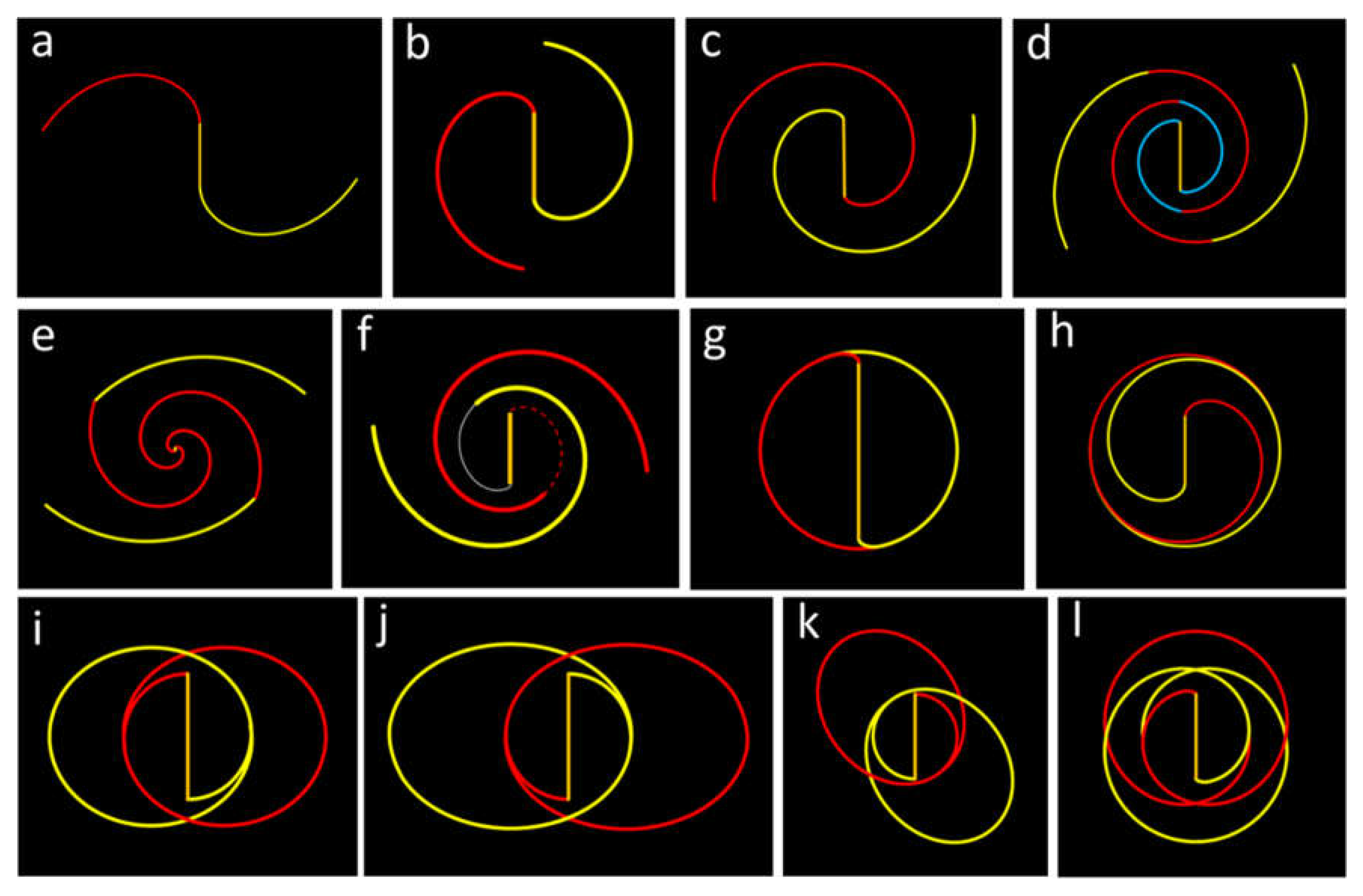
Figure 15 presents 12 face-on spiral patterns fitted to selected spiral galaxies. These patterns are generated using the galactic spiral equation (5) derived from the ROTASE model, omitting the Euler rotation. Each spiral is characterized by a specific parameter, ρ(θ), and listed in previous work [11], various forms of ρ(θ) are detailed, including constants, linear changes with time θ, Gaussian equations, and more. These 12 spirals collectively illustrate a broad spectrum of spiral morphologies observed in actual galaxies, highlighting the diversity of spiral patterns that can be described using this mathematical framework.
The general formulas for the ρ(θ) change with time “θ” can be written as:
Figures 15a to 15f provide a visual overview mathematical spiral curves of galaxies featuring open spiral patterns, showcasing a progression from simple to intricate patterns with k = 0. In Figure 15a, we observe the galaxy J101652.52 with two simple and widely spaced spirals. Figure 15d represents the galaxy UGC 6093, characterized by spirals fitted using three sections, while Figure 15e showcases the renowned galaxy NGC 5194, also known as M51, featuring two- section spirals. Finally, Figure 15f presents the galaxy SDSSJ011430.80+001928.3, which exhibits spiral arms that one arm is still weakly connected to the galactic bar end through the dashed red spiral and the other spiral arm does not connect to the galactic bar end. Despite this, the galaxy displays beautiful, smooth spirals with perfect central symmetry.
Figures 15g to 15l depict mathematical spiral curves of galaxies with ring structures, ranging from simple to complex, where the parameter ρ(θ) follows a Gaussian equation with different values of k and θ0, and f(θ) remains constant. Figure 15i showcases the galaxy CGCG-119-82, distinguished by a perfect ring and a robust bar without visible spirals, or its spirals may be too short to be seen. Figures 15i, 15j, and 15k feature 8-shaped double ring patterns with two arm crossings, following the Chain-link crossing style as described in author’s previous work [11]. Lastly, Figure 15l introduces the galaxy NGC 1079 with a double-8-shaped double ring pattern. Remarkably, this complex ring pattern can still be accurately described using the galactic spiral equation (5) as detailed in author’s previous work [11]. Notably, galaxies NGC 3081 and ESO 507-16 share the same double-8-shaped double ring pattern [22,23].
The visual and artistic beauty of these spiral galaxies, coupled with their mathematical elegance, is clearly illustrated. The amazing and intricate patterns observed on a cosmic scale demonstrate the remarkable precision and artistry of the natural world, guided by specific mathematical principles that reflect a superlative engineering design, reminiscent of a divine craftsman. The ROTASE model, while not without its imperfections and potential flaws, demonstrates the feasibility of mathematically describing the majority of spiral galaxies using a single equation with a single parameter. This serves as a reminder that nature often adheres to principles of simplicity, as evidenced by the universality of fundamental equations governing different realms of science and the cosmos. Just as the motion of common objects can be described by Newton’s second law of motion with the simplest mathematical equation F = ma in the physics, no matter how complex the motion is; the structures and motions of objects at molecular- level and smaller regions follow Schrödinger’s equation; and the properties and motions in the space-time and gravity follow the Einstein’s field equation. Therefore, the universe operates under overarching laws, with mathematics serving as the tool for executing these laws guided by the principle of simplicity.
Currently, the Density Wave Theory (DWT) stands as the leading explanation for spiral arm formation in galaxies. However, an increasing body of evidence has emerged to suggest that DWT may only satisfactorily explain the spiral structure in a fraction of spiral galaxies [24,25]. This observation has led many to contemplate the possibility that diverse spiral structures might originate from distinct mechanisms. However, this notion of “multi-mechanistic” explanations appears to run counter to the inherent principle of simplicity in nature.
Furthermore, DWT lacks the capability to precisely specify how density waves are initiated at the very inception of the spiral arm formation process. Given these limitations and considering the wealth of variations observed in spiral structures, the author posits that all spiral patterns observed in galaxies should be attributed to a single underlying mechanism. This mechanism should possess the flexibility to account for the variations in spiral structures by adjusting specific parameters. The age gradient (or color gradient) of stars, often used as tracers, and other physical phenomena associated with spiral arms are then viewed as side effects or the natural consequences of the spiral arm formation and evolution.
This assertion garners support from the fact that over 95% of spiral galaxies exhibit common characteristics. These shared traits encompass:
1. The well-defined and mathematically predictable nature of spiral arms, which tend to conform to specific mathematical functions when analyzed.
2. The attachment of spiral arms to the ends of galactic bars.
3. The prominent central symmetry displayed by spiral arms.
4. The gradual decline in quality along the lines of spiral arms, not determined by their distance from the galactic centers.
This gradual quality degradation serves as a temporal indicator of spiral arm development, with exemplary cases found in galaxies like UGC 12646 and NGC 4618 [11]. These commonalities strongly suggest that a single, versatile mechanism, operating under varying parameters, underlies the generation of these diverse spiral patterns.
Hence, we should possess a high degree of confidence in the idea that a singular, comprehensive physical mechanism exists which can effectively elucidate the formation and evolution of spiral arms across all spiral galaxies. This mechanism would also offer a straightforward mathematical framework, permitting the uniform description of spiral patterns in all spiral galaxies by adjusting one or a few key parameters. This realization would be akin to a dazzling crown jewel, capable of unlocking many of the universe’s enigmatic secrets and profoundly advancing our understanding of galaxies and the cosmos as a whole.
The quest for such a unified physical mechanism would undoubtedly be a thrilling, exhilarating endeavor, comparable in excitement and challenge to the concept of interstellar travel. However, it would also come laden with difficulties and uncertainties. It’s important to acknowledge that at this moment, such a physical mechanism remains a conjecture and, realistically, more of a dream. In closing, the wisdom of Isaac Newton’s words resonates, “Nature is pleased with simplicity. And nature is no dummy.”
6. Summary
The idealized and simplified model of the spiral galaxy presented in this paper, paints a picture of spiral galaxies where the visible spiral arms gradually diminish in length after reaching their maximum extent. This decline initiates at the half-loop rotation point due to a substantial decrease in available hydrogens, and the spiral arms eventually become realistically and optically invisible after one or two full-loop rotations, the galaxy mainly consists aging stars with very little ongoing star formation, even though the formation mechanism may still remain active for an extended period. In essence, these spiral arms appear to be short-lived relative to the galaxies’ lifetimes, suggesting that the process of forming spiral arms may be a unique, one-time event without replenishment of hydrogens.
However, it’s important to note that real spiral galaxies may not match all aspects of the simplified ideal galaxy. In actuality, developing spiral arms should consume a significant amount of time, and substantial quantities of hydrogen are expended during this formative period. This could result in the actual duration of observable spiral arms being considerably shorter than what is depicted in the ideal model. Nonetheless, the outcomes of this analysis offer valuable insights into the likely evolution of spiral arms. The spiral galaxies with spiral arms decoupled from galactic bars or having soft spiral structures shall have similar results as long as that the spiral pattern rotation speed is significant different from the galactic matter rotation speed. Most of observed spiral galaxies have soft spiral structures, their spiral patterns dynamically change constantly.
It is reasonable to assert that a concise and universal mechanism for spiral arm formation in disk galaxies should exist, capable of describing the process while adjusting one or a few key parameters. This mechanism can provide a comprehensive mathematical framework to consistently depict the various spiral patterns encountered, with some exceptions being explainable within this mechanism. The observational data relating to the spiral pattern speed and the rotational speed of the galactic bar in the Milky Way should be subjected to thorough verification, taking into consideration the potential issue of winding and possible other related issues.
Funding source: This research received no funding.
Data Availability Statement
No additional data are needed.
Conflicts of Interest
The authors declare no conflict of interest.
References
- Sellwood, J. , The lifetime of spiral patterns of disc galaxies, MNRAS, 410, 1637-1646, 2011.
- Hao, C., et. al., Evolution of the local spiral structure of the Milky Way revealed by open clusters, A&A, 652, A102, 2021.
- Lin C., & Shu F., On the spiral structure of disk galaxies, ApJ. 140, 646-655, 1964.
- Shu, F. , Six Decades of Spiral Density Wave Theory, Annu. Rev. Astron. Astrophys. 54, 667–724, 2016.
- Julian, W.; Toomre, A. , Non-axisymmetric responses of differentially rotating disks of stars, ApJ. 146, 810-830, 1966.
- Romero-Gómez, M.; Masdemont, J.; Athanassoula, E.; García- Gómez, C. The origin of rR1 ring structures in barred galaxies, A&A 453, 39–45, 2006.
- Romero-Gómez, M.; Athanassoula, E.; Masdemont, J.; García- Gómez, C. The formation of spiral arms and rings in barred galaxies, A&A, 472, 63–75, 2007.
- Athanassoula, E.; Romero-Gómez, M.; Masdemont, J.; Rings and spirals in barred galaxies –, I. Building blocks, MNRAS, 394(1), 67–81, 2009.
- Athanassoula, M.; Romero-Gómez, M.; Bosma, A.; Masdemont, J. Rings and spirals in barred galaxies – II. Ring and spiral morphology, MNRAS, 400(4), 1706–1720, 2009.
- Athanassoula, E.; Romero-Gómez, M.; Bosma, A.; Masdemont, J. Rings and spirals in barred galaxies – III. Further comparisons and links to observations, MNRAS, 407(3), 1433–1448, 2010.
- Pan, H. , Spirals and rings in barred galaxies by the ROTASE model, IJP, 9(6), 286-307, 2021.
- Saha, K. , and Elmegreen, B., Long-lived spiral structure for galaxies with intermediate-size bugles, ApJL, 826: L21(5pp), 2016.
- Dias, W. , and Lepine J., Direct determination of the spiral pattern rotation speed of the galaxy, ApJ. 629, 825-832, 2005.
- Chemin, L. , Renaud, F., and Soubiran, C., Incorrect rotation curve of the Milky Way, A&A, 578, A14. 2015.
- Begeman, K. HI rotation curves of spiral galaxies, Astron. Astrophys. 223, 47-60, 1989.
- Pour-Imani, H. , and et. al. Strong evidence for the density- wave theory of spiral structure in disk galaxies, ApJL 827, L2, 2016.
- Frebel, A. , et al., Discovery of HE 1523–0901, a Strongly r-Process-enhanced Metal-poor Star with Detected Uranium, ApJ, 660, L117, 2007.
- Buta, R. , and Zhang, X., Pattern corotation radii from potential-density phase-shifts for 153 OSUBGS sample galaxies, ApJS, 182:559–583, 2009.
- Bosma, A. , The distribution and kinematics of neutral hydrogen in spiral galaxies of various morphological types, Ph.D. thesis, Groningen University, 1978.
- Shen, J. , and Zheng, X., The bar and spiral arms in the Milky Way: structure and kinematics, RAA, 20(10), 159(18pp), 2020.
- Gerhard, O., Pattern speeds in the Milky Way. Mem. S.A.It. Suppl. 18, 185-188, 2011.
- Buta, R., Burcell, G., NGC 3081: Surface photometry and kinematics of a classic resonance ring barred galaxy. AJ, 115, 484-501, 1998.
- Buta, R., Resonance Rings and Galaxy morphology, Astrophys. Space Sci. 269–270, 79–99, 1999.
- Meidt, S. E., Rand, R. J., & Merrifield, M. R., Uncovering the Origins of Spiral Structure by Measuring Radial Variation in Pattern Speeds. Astrophys. J. 702, 277-290, 2009.
- Hart, R., E. et al. Galaxy Zoo and SPARCFIRE: constraints on spiral arm formation mechanisms from spiral arm number and pitch angles. MNRAS, 472, 2263–2279, 2017.
Figure 1.
Galaxy J101652.52, left: original image; right: fitted by galactic spiral equation from ROTASE model with ρ = 2.5, and the Euler (-14,15,0).
Figure 1.
Galaxy J101652.52, left: original image; right: fitted by galactic spiral equation from ROTASE model with ρ = 2.5, and the Euler (-14,15,0).
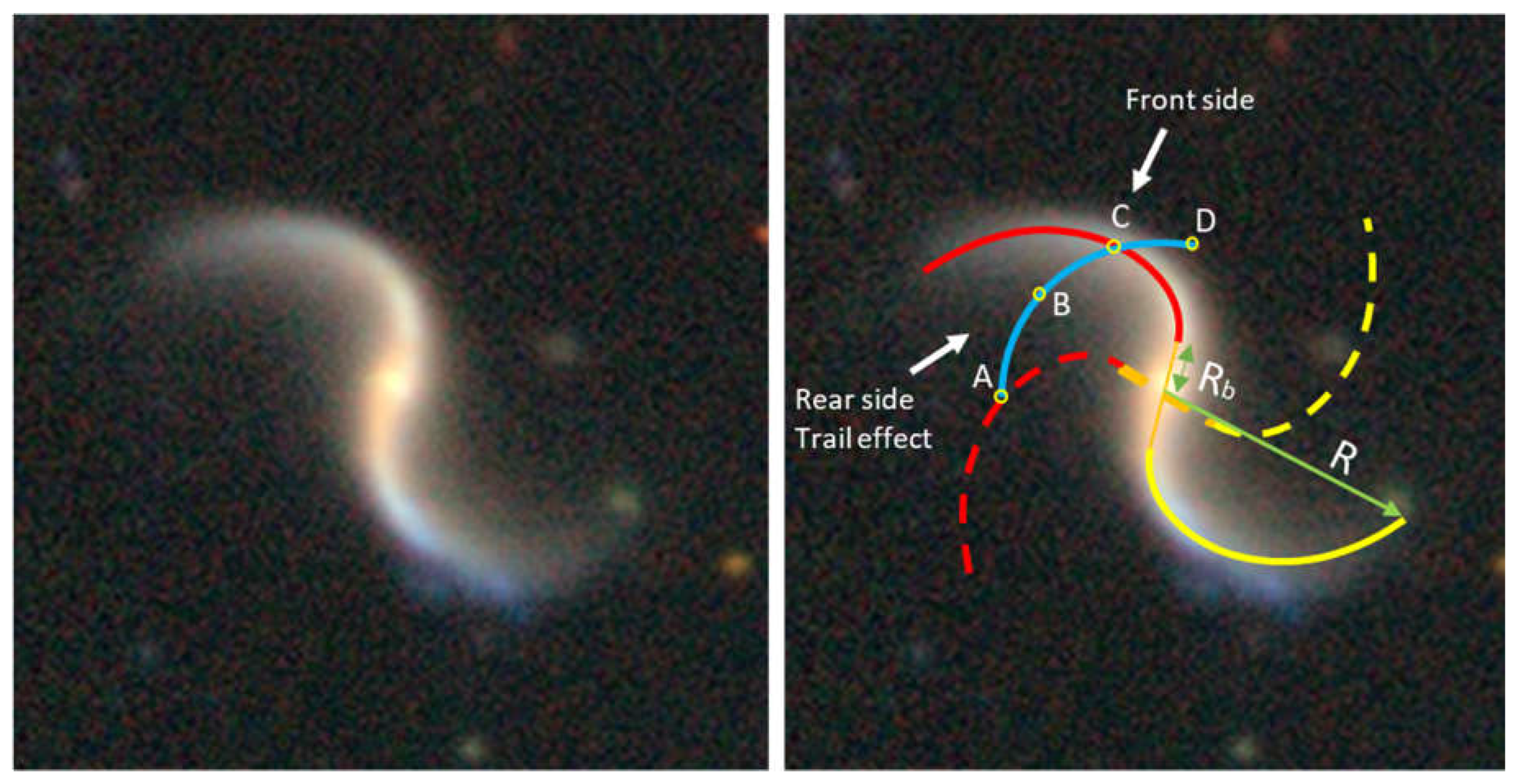
Figure 2.
left: illustration of density wave theory with galactic matters entering and exiting density waves as well as the expected trail luminosity gradient pattern, the red dashed circle is the corotation radius; right: actual observation of the galactic matters entering and exiting the spiral arm and the trail luminosity gradient in the galaxy J101652.52.
Figure 2.
left: illustration of density wave theory with galactic matters entering and exiting density waves as well as the expected trail luminosity gradient pattern, the red dashed circle is the corotation radius; right: actual observation of the galactic matters entering and exiting the spiral arm and the trail luminosity gradient in the galaxy J101652.52.
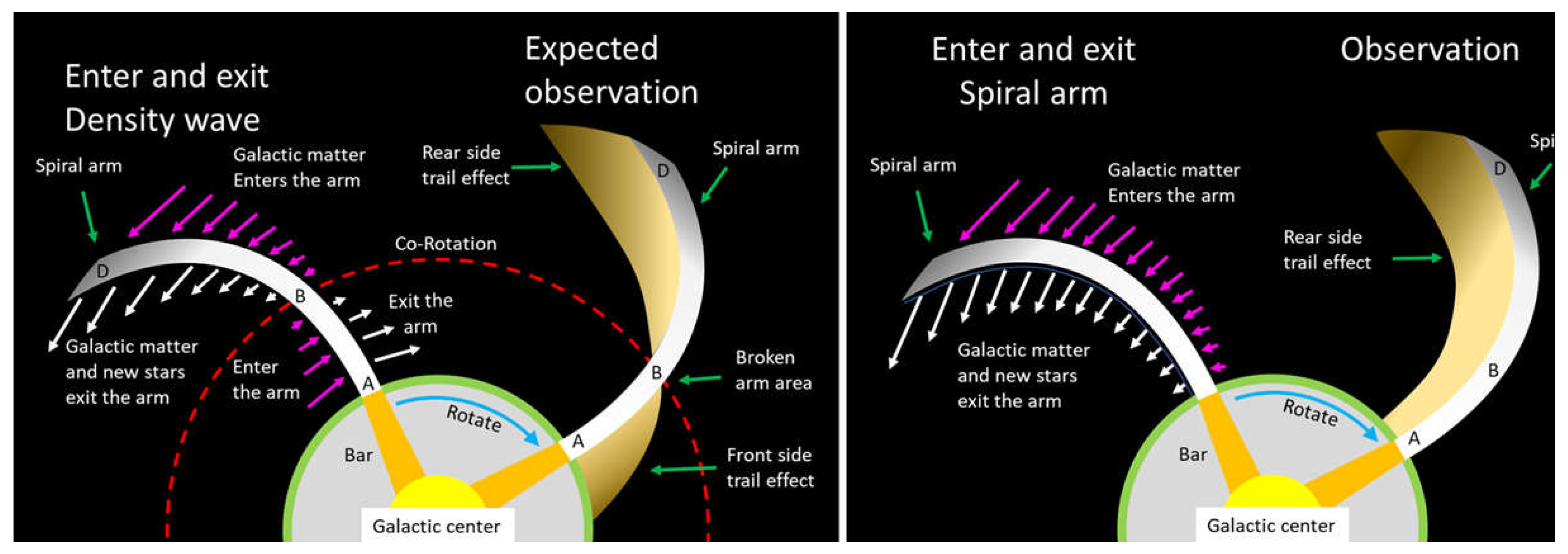
Figure 3.
Orbital rotation speed of spiral arms and the galactic disc of a simplified galaxy.
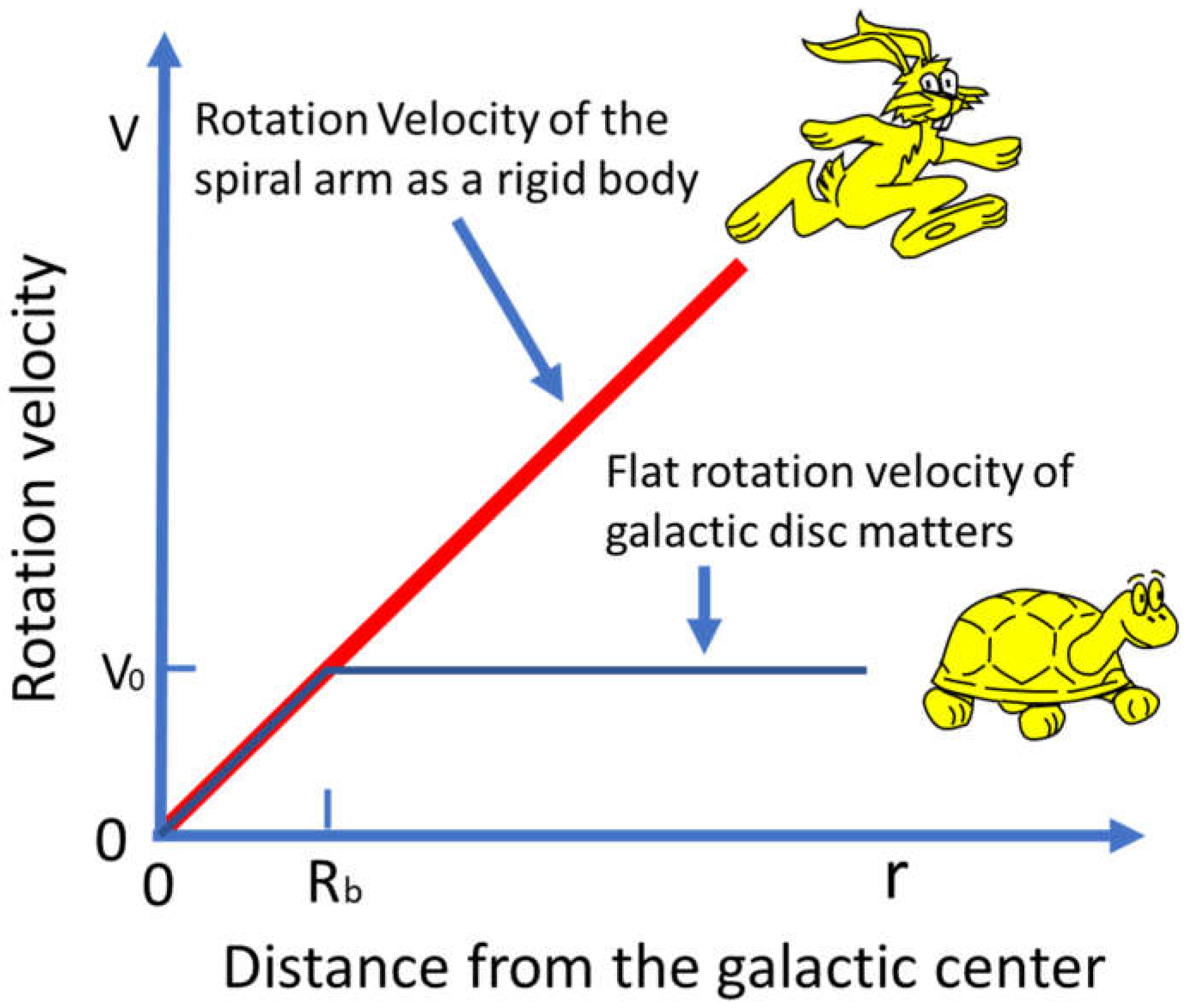
Figure 4.
A simplified ideal model galaxy with two “instantly” formed spiral arms.
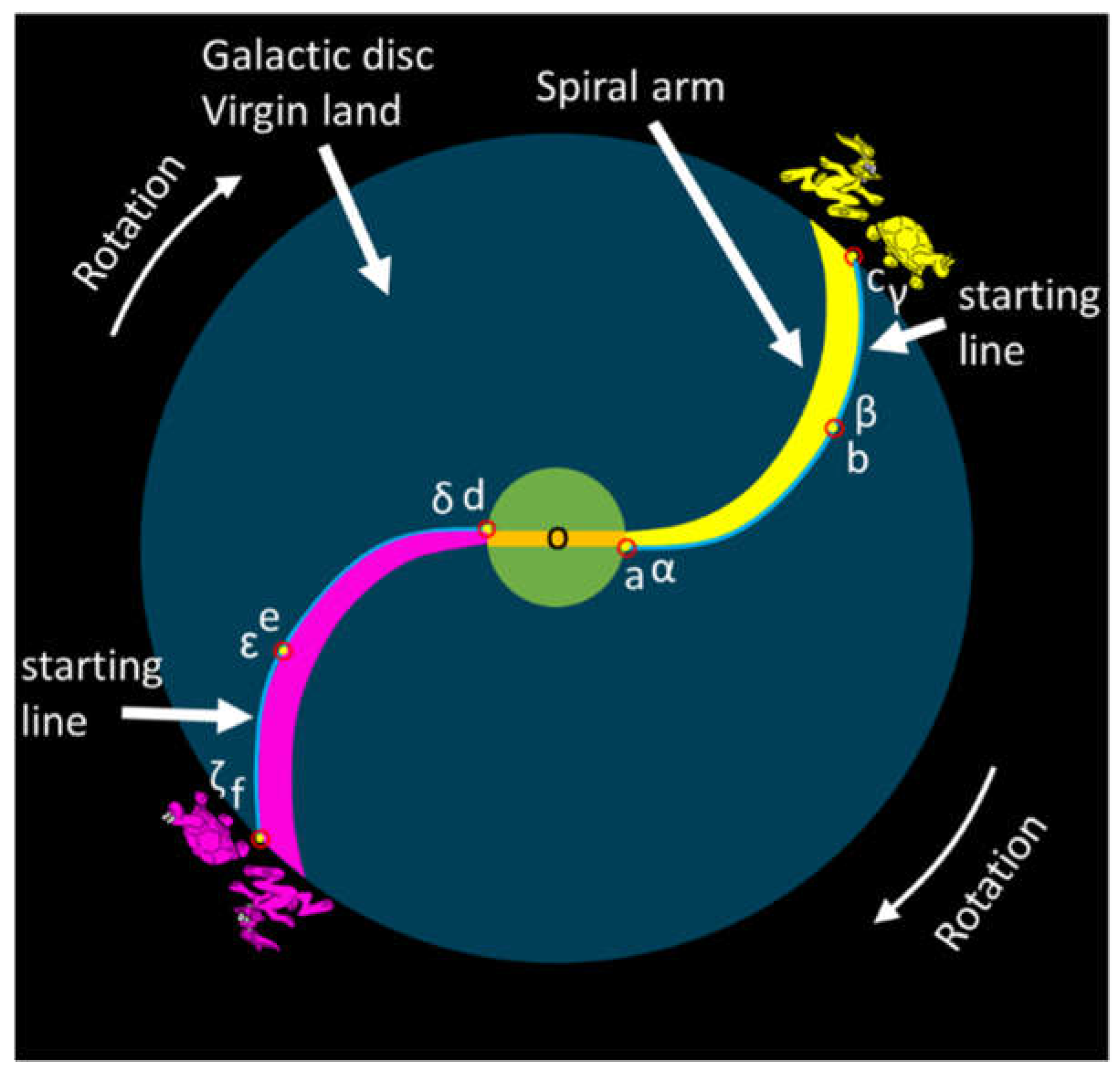
Figure 5.
After 90° rotation of spiral arms, about 34% of the area is single swept, 66% is virgin area.
Figure 5.
After 90° rotation of spiral arms, about 34% of the area is single swept, 66% is virgin area.
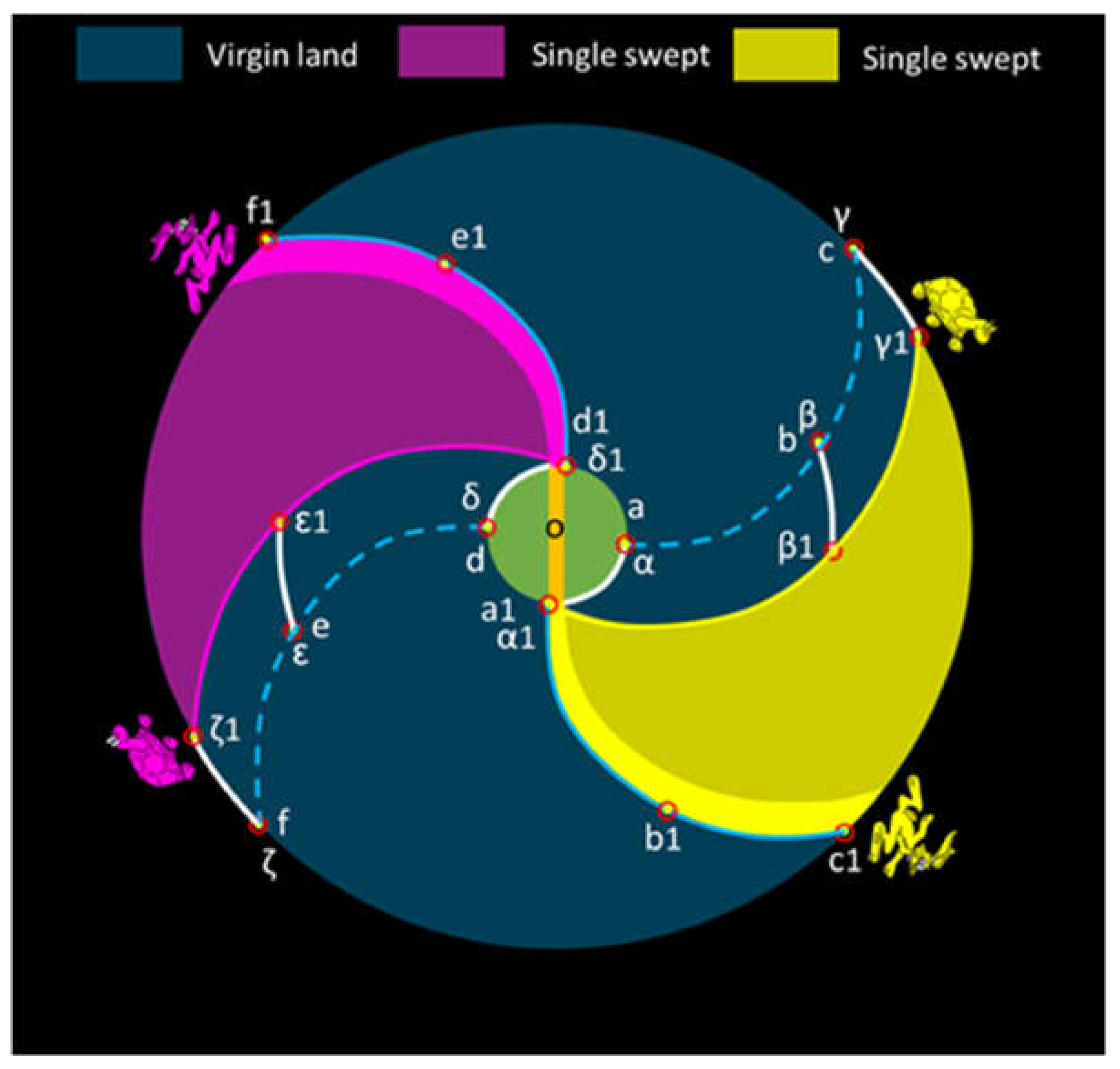
Figure 6.
After a half-loop rotation of spiral arms, 86% single swept area, 14% is virgin area.
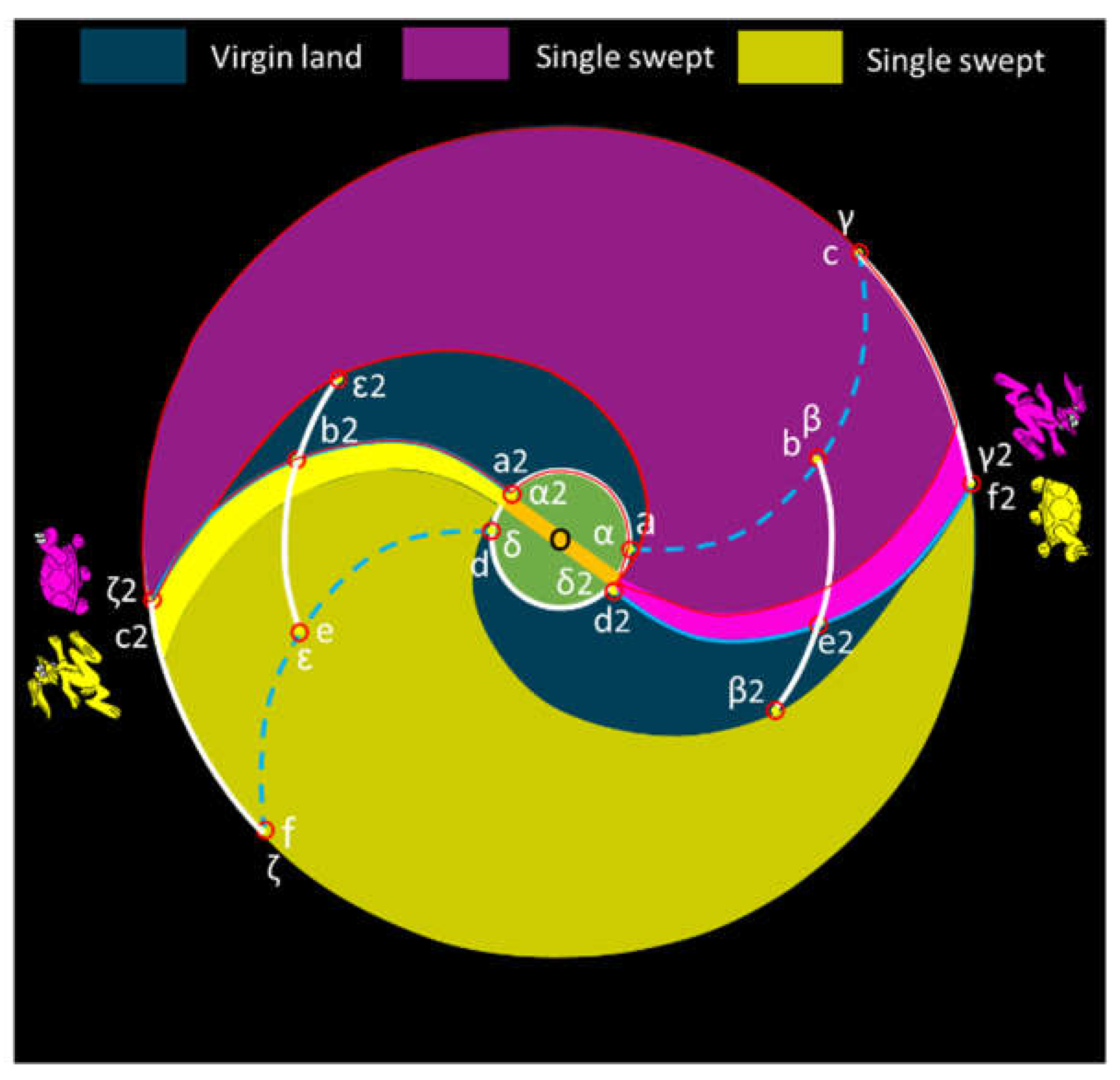
Figure 7.
Change of the half loop rotation angle ψ with the µ.
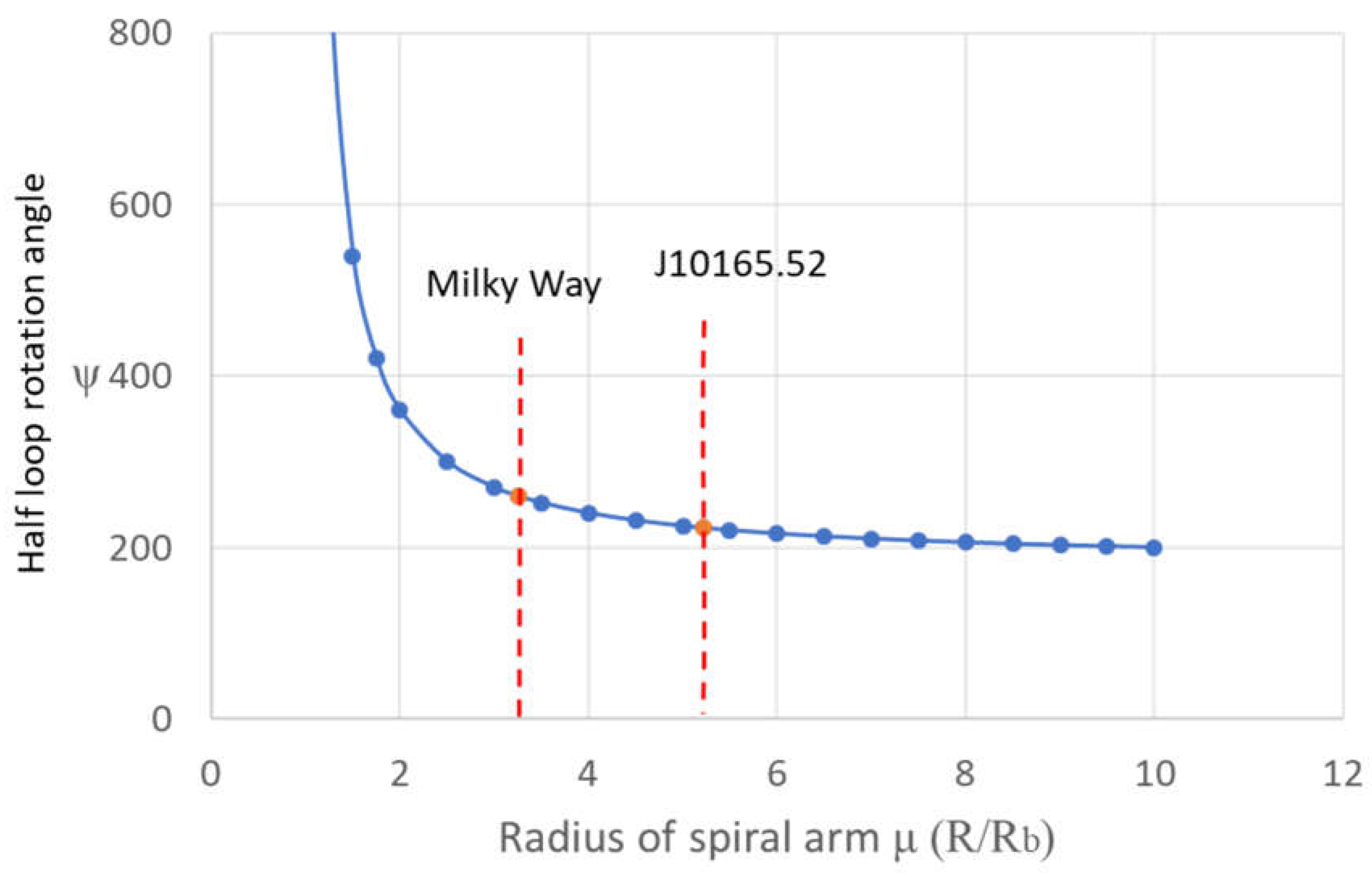
Figure 8.
Illustration of the luminosity of the spiral arms changes with the rotation angle with µ = 6. The letter A marks the half loop rotation angle 216°, the letter B marks the full loop rotation angle. 432°. The right side is the half image of side view of Milky Way showing the thickness and density of the disc decreasing with radius.
Figure 8.
Illustration of the luminosity of the spiral arms changes with the rotation angle with µ = 6. The letter A marks the half loop rotation angle 216°, the letter B marks the full loop rotation angle. 432°. The right side is the half image of side view of Milky Way showing the thickness and density of the disc decreasing with radius.
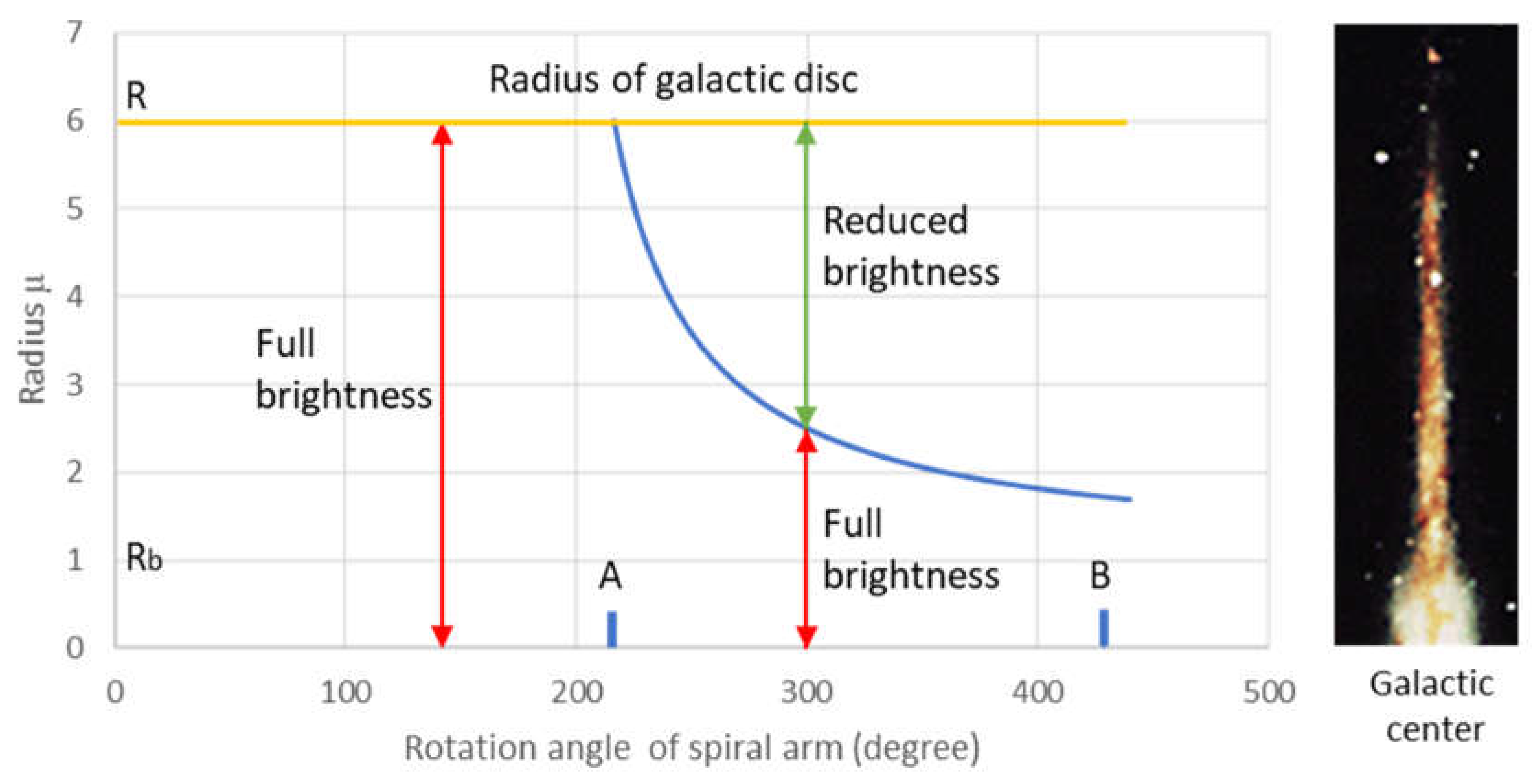
Figure 9.
Luminosity of the spiral arms changes with rotation angle after the half loop with µ = 6.
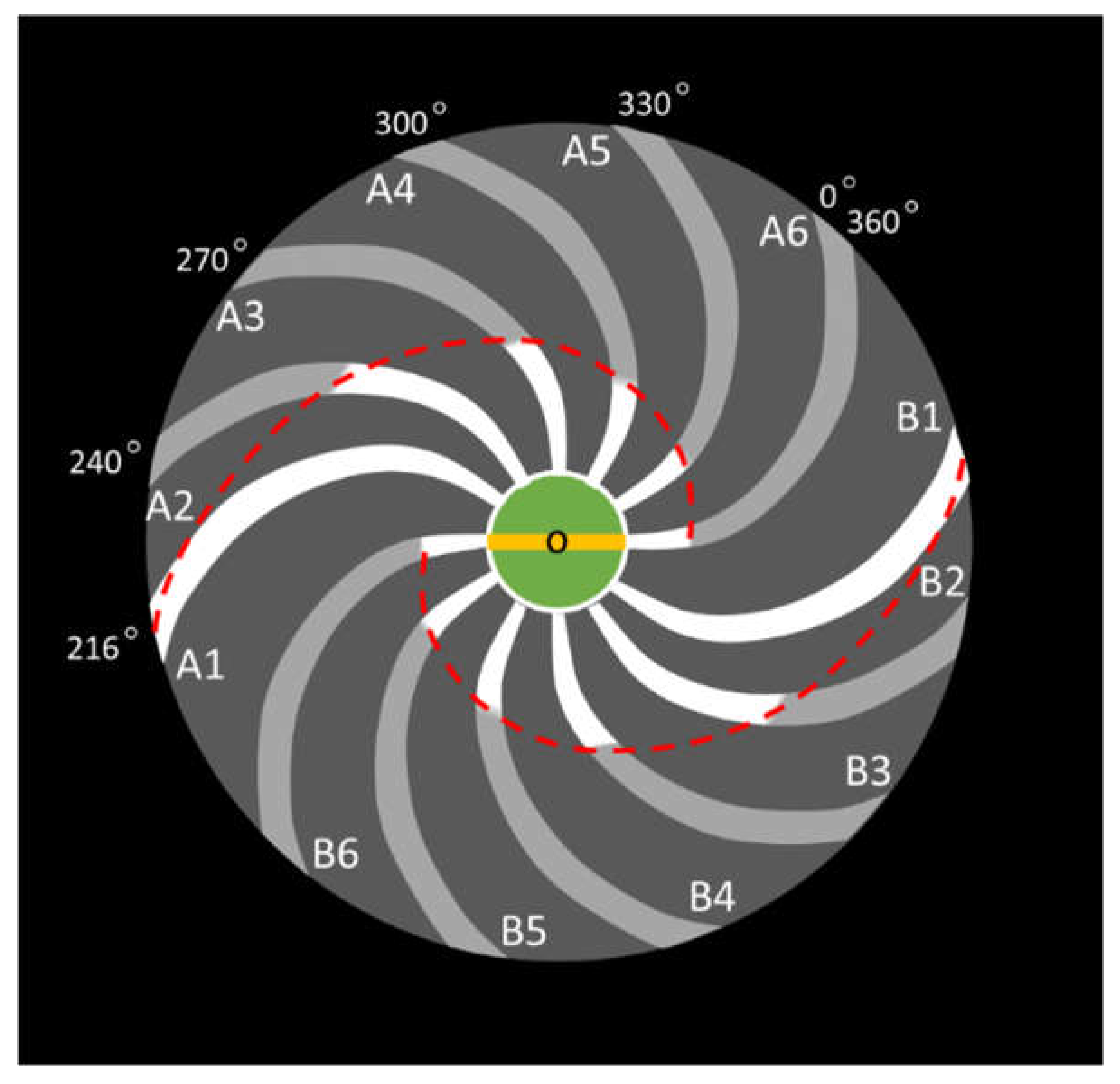
Figure 10.
After a full loop rotation, double swept = 78%, single swept = 18%, virgin = 4%.
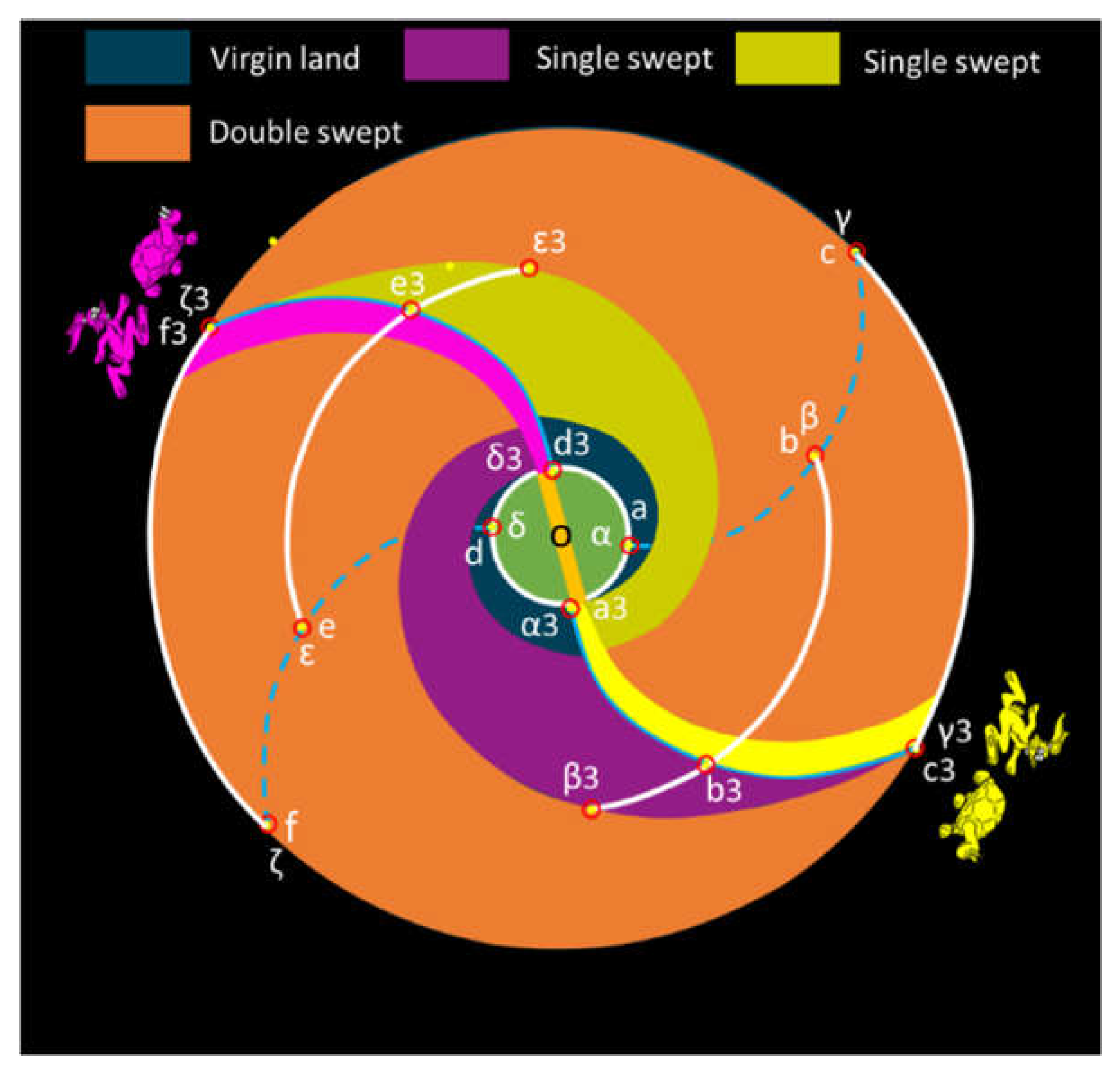
Figure 11.
The surface luminosity changes along the selected blue arc in the Figure 1 right.
Figure 11.
The surface luminosity changes along the selected blue arc in the Figure 1 right.
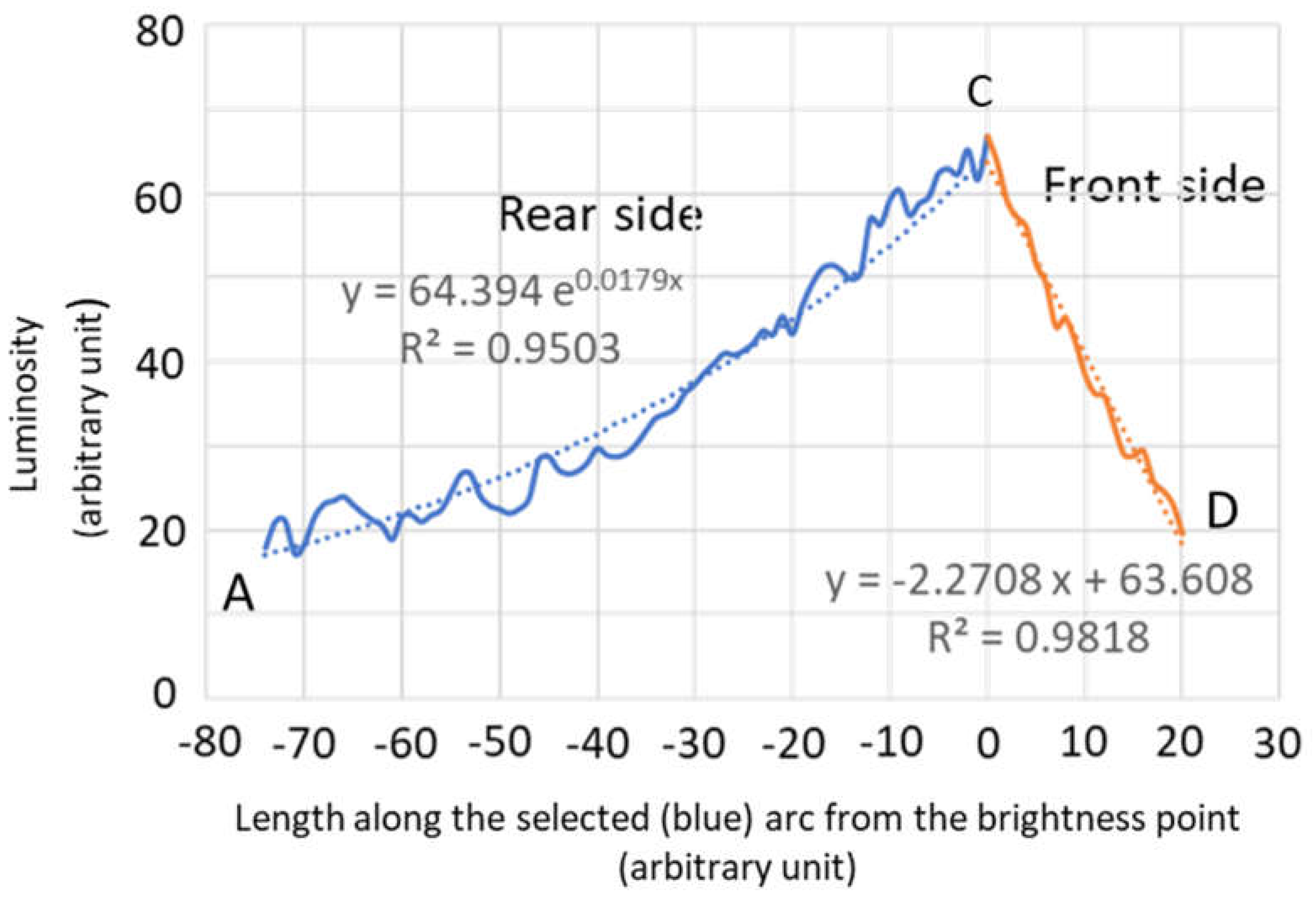
Figure 12.
Illustration of the assumed single-swept area and non- swept area of the Galaxy J101652.52 at present time.
Figure 12.
Illustration of the assumed single-swept area and non- swept area of the Galaxy J101652.52 at present time.
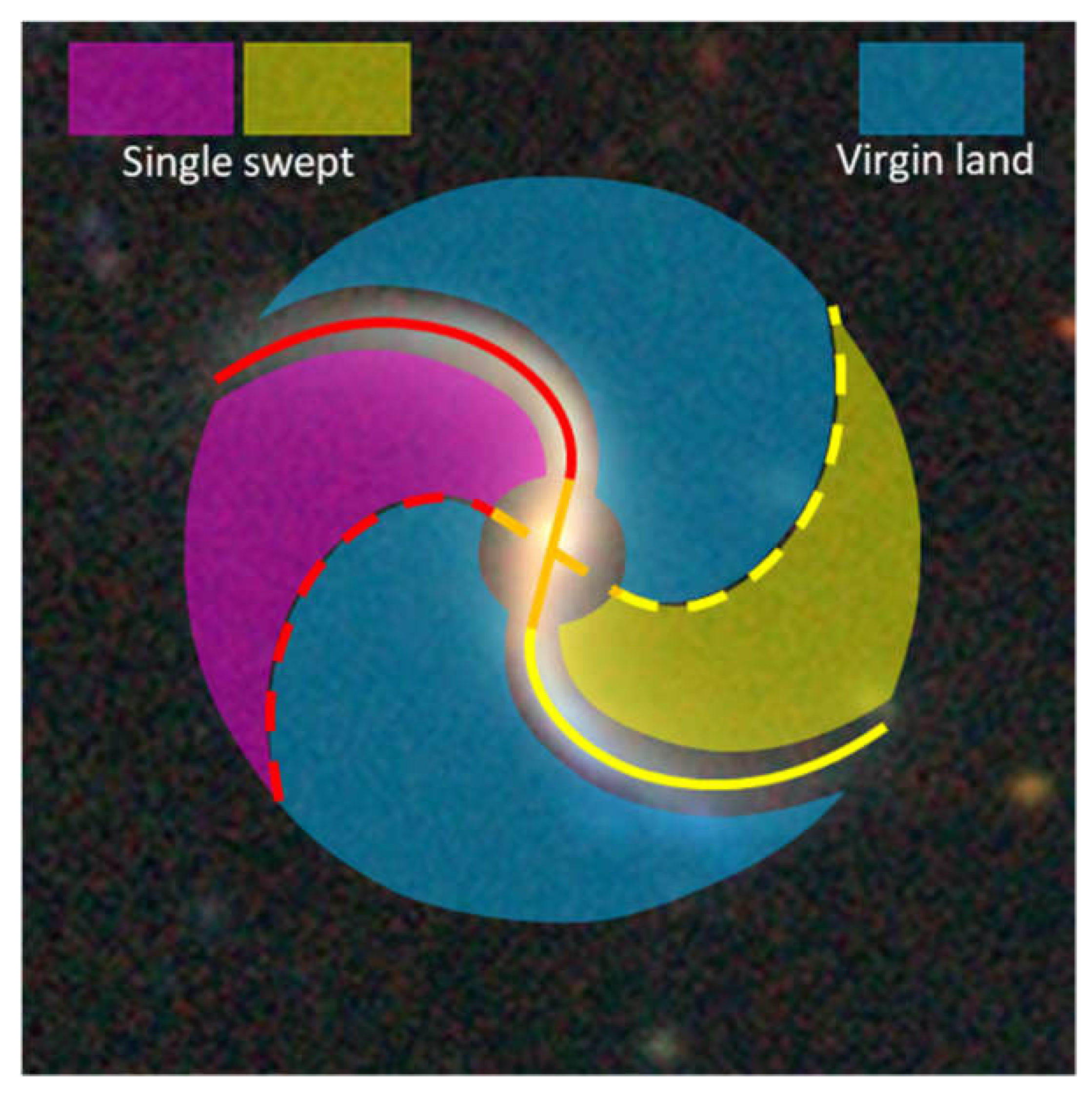
Figure 13.
Illustration of the possible evolution of spiral arms of the galaxy J101652.52 in the future at normal optical observation condition and without additional hydrogens moving into the galaxy.
Figure 13.
Illustration of the possible evolution of spiral arms of the galaxy J101652.52 in the future at normal optical observation condition and without additional hydrogens moving into the galaxy.
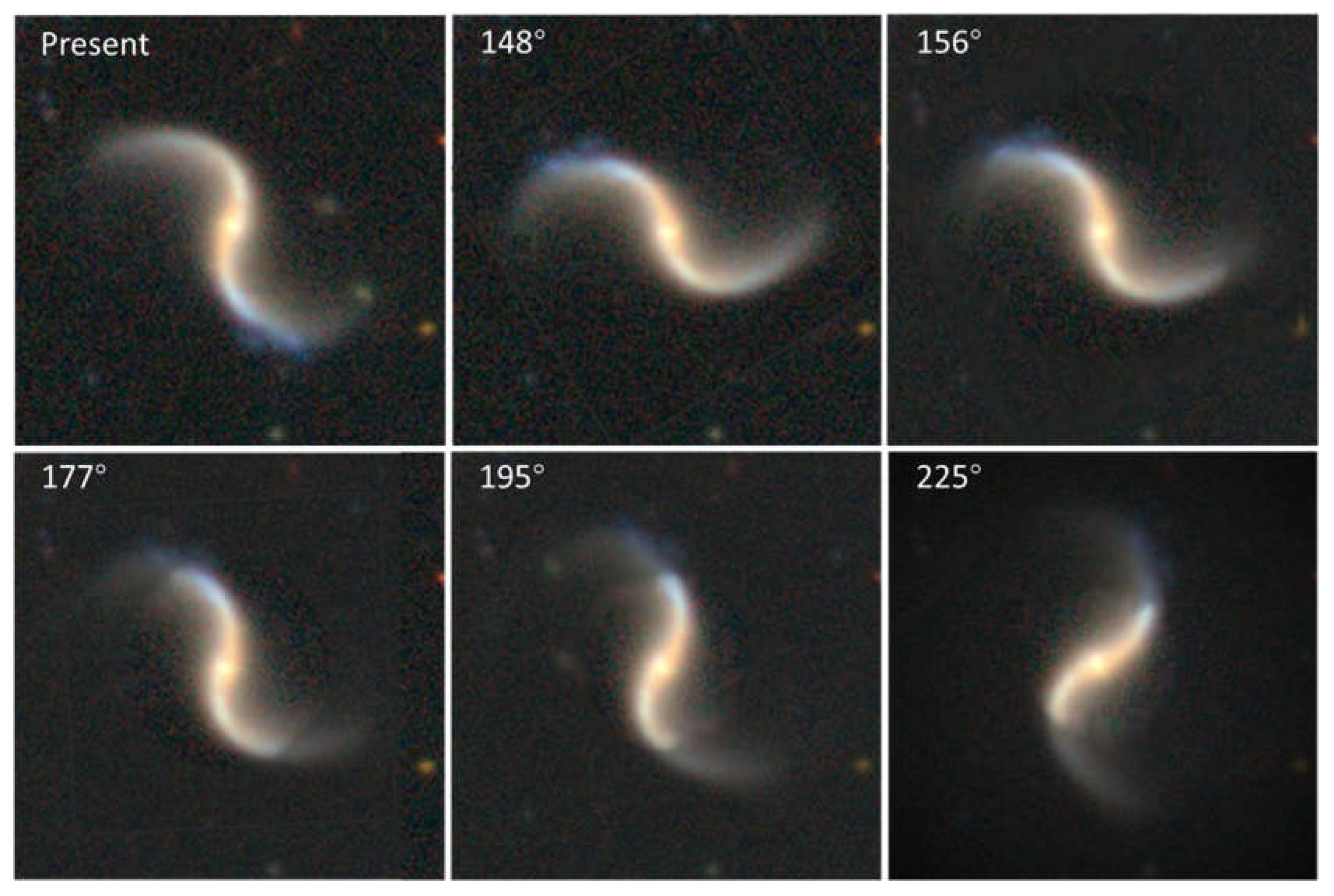
Figure 14.
The galaxy MCG+00-04-051 shows well separated spiral arm ends from the bar ends.
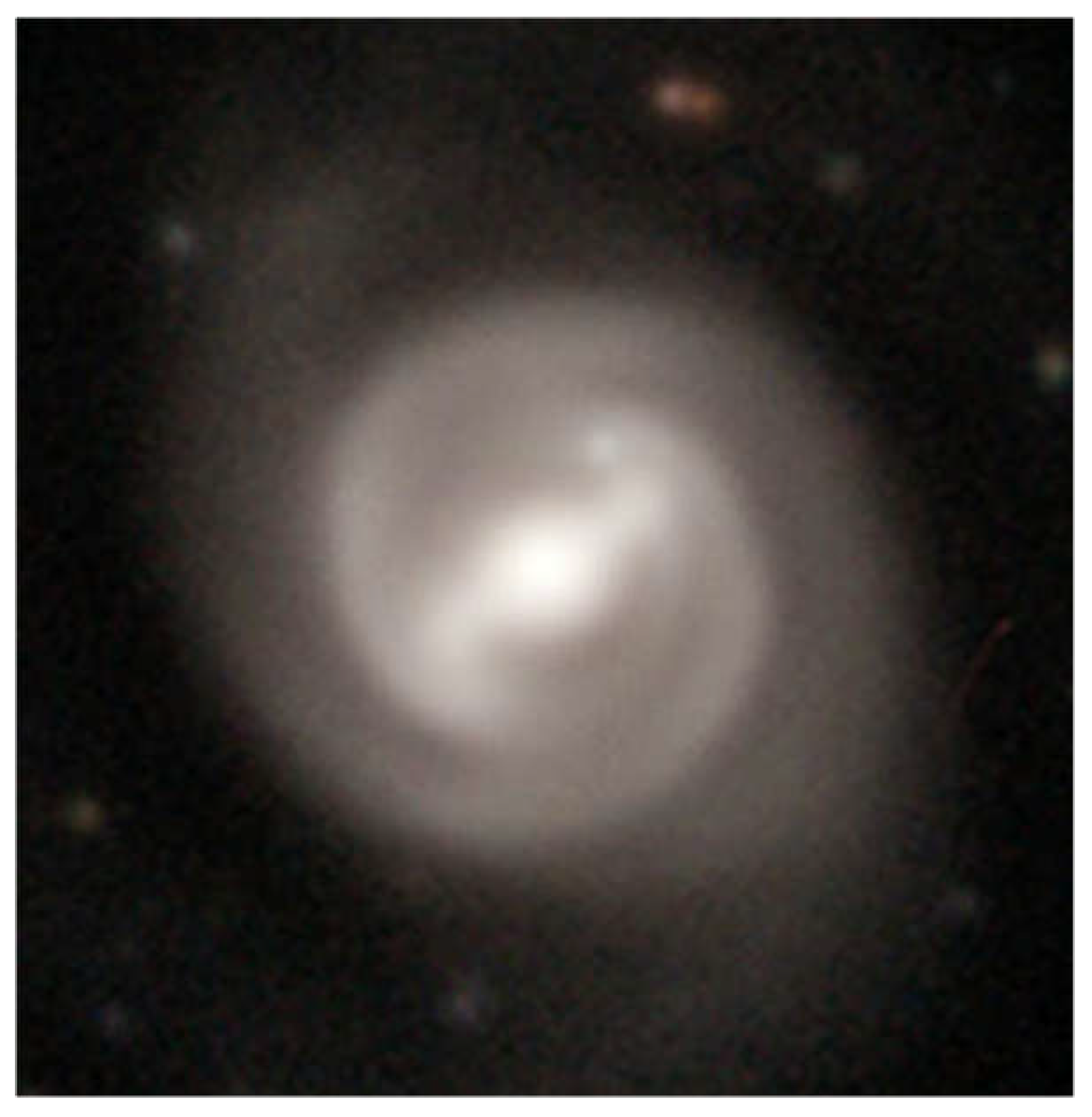
Figure 15.
Faced-on spiral patterns of 12 selected spiral galaxies fitted by the galactic spiral equation (5) without Euler rotation. All parameters for the fitting are listed in the reference (Pan 2021). a: J101652.52; b: NGC 1300, c: Milky Way; d: NGC 6093; e: M51; f: MCG+00-04-051; g: CGCG-119-82; h: ESO-325-28; i: NGC 7098; j: UGC 12646; k: J015701.50-001644.4; l: NGC 1079.
Figure 15.
Faced-on spiral patterns of 12 selected spiral galaxies fitted by the galactic spiral equation (5) without Euler rotation. All parameters for the fitting are listed in the reference (Pan 2021). a: J101652.52; b: NGC 1300, c: Milky Way; d: NGC 6093; e: M51; f: MCG+00-04-051; g: CGCG-119-82; h: ESO-325-28; i: NGC 7098; j: UGC 12646; k: J015701.50-001644.4; l: NGC 1079.
Disclaimer/Publisher’s Note: The statements, opinions and data contained in all publications are solely those of the individual author(s) and contributor(s) and not of MDPI and/or the editor(s). MDPI and/or the editor(s) disclaim responsibility for any injury to people or property resulting from any ideas, methods, instructions or products referred to in the content. |
© 2024 by the authors. Licensee MDPI, Basel, Switzerland. This article is an open access article distributed under the terms and conditions of the Creative Commons Attribution (CC BY) license (http://creativecommons.org/licenses/by/4.0/).
Copyright: This open access article is published under a Creative Commons CC BY 4.0 license, which permit the free download, distribution, and reuse, provided that the author and preprint are cited in any reuse.


