
Submitted:
23 May 2023
Posted:
25 May 2023
You are already at the latest version
Abstract
Alum sludge, an inevitable by-product from the water purification process, which had been applied as substrates in some constructed wetlands with good performance, especially for phosphorus (P) adsorption. The raw alum sludge is like clay lump with irregular shape and has a leaching concern used in the water. For a better reuse, herein, sludge was fired to produce alum sludge ceramsite (ASC) with a uniform spherical shape via four-step process of kneading sludge ball, air drying, preheating at 400°C for 10 min and firing at 600℃ for 5 min. Thereafter the physicochemical properties and P adsorption ability of ceramsite were investigated. Through XRD and FT-IR tests, there was no obvious difference between ASC and air-dried alum sludge ball (adASB) on the phase structure, but a certain amount of Al-OH group loss on the surface of ASC. The structure of ASC was still amorphous as same as adASB, while ASC possessed more micropore structure and bigger specific surface area than those of adASB. Adsorption experiments showed the P adsorption behaviors of ASC and adASB were much similar, and their adsorption kinetics all accorded with the two-step adsorption kinetics rate equation and pseudo-second-order kinetics equation. The maximum adsorption capacities of ASC and adASB fitted by Langmuir model were 1.66 mg/g and 1.89 mg/g respectively. It should be pointed that, compared with other adsorbents, ASC produced in this study still had a higher ability to adsorb P. Therefore, ASC should have a great application potential for P removal in the wastewater treatment in China.
Keywords:
Alum sludge
; Ceramsite
; Physicochemical property
; Phosphorus adsorption
1. Introduction
With the process of urbanization and industrialization, more and more pollutants including organic and inorganic contaminants have been discharged into natural water bodies, resulting in high concentrations of BOD (biochemical oxygen demand), SS (suspended solids), and other types of pollutants in the receiving rivers, lakes and reservoirs, particularly nitrogen and phosphorus [1]. Excessive nutrients can lead to eutrophication, the explosion in growth of algae, and eventually the deterioration of water quality, which has been a big environmental concern worldwide. Thus, it is necessary and urgent to remove nutrients from natural water bodies.
Over the past 20 years, different methods have been applied for eutrophication control, which can be classified to mechanical methods, chemical methods and biological remediation methods. As the main limiting element for eutrophication, how to remove P from water is the key issue to solve this problem. There also have been different kinds of methods for P removal, while the application of adsorption is wide adopted relatively. Compared with traditional adsorbents such as activated carbon, sulfonated coal and diatomite used in wastewater treatment, alum sludge is drawing more and more attention due to its low-cost and high efficiency for P removal [2].
Alum sludge is the inescapable by-product from the water treatment works, and normally it was discharged by landfill. Therefore, the beneficial reuse of alum sludge is quite important for saving land and eliminating the environmental risk. Many researches proved that alum sludge can be used as a low-cost P adsorption medium in wastewater treatment and had good performance in the lab experiments and some pilot tests [3]. Yang[2] reported that the maximum adsorption capacity of 3.5 mg-P/g was achieved when the pH of the synthetic P solution was 4.3, and the aging time had no significant effect on phosphorus adsorption of alum sludge[4]. Zhao[5] incorporated dewatered alum sludge cakes as main substrate into constructed wetlands receiving farm wastewater, indicating a high efficiency of 86.4±6% on RP (reactive P) removal in a long-term trial. Hu[6] developed a novel alum sludge-based tidal flow constructed wetlands system, the average treatment efficiency for TP (total phosphorus) can reach 90%. However, as a kind of solid waste, there also existed some disadvantages for the reuse of alum sludge. As well known, the raw air-dried alum sludge just like clay rocks, no definite shape, quite loose and there is a concern that the alum sludge could be eroded gradually by water, then eventually collapsed to run off.
Therefore, based on the idea of transforming alum sludge from waste into a resource and better reusing it in practice, the main subject of this study is to develop a treatment process for the production of alum sludge ceramsite (ASC) with a fixed shape and a certain mechanical strength, which simultaneously possesses a high capacity for P adsorption. It could be believed that this kind of ASC has a potential to be widely used as a novel adsorbent in wastewater treatment.
2. Materials and Methods
2.1. Preparation of ASC
The alum sludge was taken from a Waterworks in Xi’an, China. Normally, the raw slum sludge is dark-brown, pH neural with high water content of around 80%. As tested before, TOC (total organic carbon) content in the air-dried alum sludge is roughly 15-20% and others are inorganic substances. From the element test by XRF (Daojin 1800, Japan), it was clear that the main components shown as oxides were Al2O3 and SiO2, which are important for pottery. Certainly, the form of aluminum in alum sludge was not crystal Al2O3 but amorphous hydroxyl polymeric aluminum[2], but proper high temperature modification can beneficially transfer Al3+ to Al2O3, which has an effect to support the skeleton of ceramsite. Therefore, alum sludge has a potential to produce ceramsite.
Based on the conventional process of ceramsite and characteristics of alum sludge, a three-step procedure of producing ASC was developed in this study. Firstly, due to the high moisture content of around 80%, the raw alum sludge can be kneaded by hands to the shape of ball without adding any extra water or other additions. Then, the alum sludge ball should be naturally air-dried in a well-ventilated place at room temperature (25°C). Finally, when the weight of ball was stable, the air-dried alum sludge ball (adASB) was fired gradually in the muffle furnace (SX2-2014, Boxun, China). The sintering process included 1) preheating for 10 minutes under about 400°C, 2) heating with the temperature rising to 600°C and keep sintering for 5 minutes, and 3) Cooling in which the muffle was turned off and the ASC was cooled without taking out for about 12 hours.
2.2. P-adsorption tests
P-contained solution used in the experiments was made by distilled water and a certain amount of KH2PO4 (AR). Two series experiments were implemented in laboratory and the steps were described below:
(1) Adsorption kinetics: 2 g ASC (or 2 g adASB) was added to 100 mL P-contained solution (the initial P concentration was 10 mg/L) in a series of Erlenmeyer flasks, then adjusting pH to 7 by using NaOH. Prepared flasks were placed on an orbital shaker (SPH-100B) to be shaken at 150 rpm. The samples were taken after shaking 30, 60, 120, 240, 480, 720, 1440, 2160, 2880, 3600 min, respectively and filtered by 0.45 μm millipore filter for P measurement.
(2) Isothermal adsorption experiment: 2 g ASC (or 2 g adASB) were added to 100 mL P-contained solution in a series of Erlenmeyer flasks and the initial P concentrations of the solution were 5, 10, 15, 20, 30, 50 mg/L, respectively. Then, the pH of the solution was adjusted to 7. After shaking for 48 h, water samples were taken from every container to measure the concentration of P.
All the experiments were conducted at room temperature and replicated three times and the results were shown in average values.
2.3. Analytical methods
The P concentration was monitored by an ultraviolet-visible spectrophotometer (DR6000, HACH, America) according to the standard method. To further study the characteristics of ASC and the impact of firing on alum sludge, ASC and adASB were characterized by XRD (BRUKER D8 ADVANCE), FTIR (Nicolet iS50), SEM (Hitachi S-4800), BET (Micromeritics ASAP2020) methods. XRD pattern can help to learn the phase structure of materials and the FT-IR spectrum identify the changes of typical functional groups. Apparent morphology of ASC and adASB can be observed directly through the SEM. The specific surface area and porosity of materials can be examined with BET analysis.
2.4. P-adsorption models
There were three adsorption kinetics models to fit the experimental results, namely pseudo-first order kinetic model, pseudo-second order kinetic model and intra-particle diffusion model. The isotherm adsorption models adopted were Langmuir and Freundlich equations. All models were shown in detail in Table 1. In addition, correlation coefficient (R2) and four error functions were calculated to evaluate the fitting accuracy.
3. Results
3.1. ASC product and its characterization
3.1.1. Apparent change
The procedure and apparent change of alum sludge in each stage of ASC producing process were shown in Figure 1. The raw alum sludge taken after sludge conditioning and dewatering process contained 85% water, which was brown color, soft, quite loose like clay mud. After kneaded by hand, alum sludge ball was produced with 10mm diameter and the single weight of 1.1±0.1 g. Through 3-4 days air drying, alum sludge ball shrank significantly to dark brown adASB, losing about 80% weight and the diameter reduced to 7-8 mm. In the firing process, approximate 45% weight of adASB was lost further and the diameter of ASC shrank to 4-5 mm. The color of ASC changed to light brown, as same as ceramsite.
3.1.2. Microstructure of adASB and ASC
To further investigate the effect of firing process on microstructure of alum sludge, the analytic approaches including FT-IR, XRD and BET were adopted and the results were illustrated in Figure 2. Chemical groups are important factors affecting the chemical properties of materials. The chemical functional groups of ASC and adASB were determined by FT-IR analysis and the results were shown in Figure 2(A). It can be seen that the infrared spectra of asASB and ASC have obvious absorption peaks at wave numbers of 3438, 1635, 1418, 1087, 518 and 474 cm-1. Through comparison of relevant studies and the standard spectrum, the greatest absorbance value appears at 3438 cm-1 was identified as the stretching vibration of the OH group connected to Al, and the absorption peak at 1635 cm-1 may linked to the bonded OH or vibration of other organic functional groups. The absorbance value appears at the wave number of 1418 cm-1 may be the bending of Al-OH. As to the adsorption band appearing at 1087 cm-1, it can be recognized as the Al-O group. The peaks of 518 and 474 cm-1 may represent the stretch of O-Si-O [7,8].
Based on the FT-IR analysis above, the main chemical functional groups in both ASC and adASB can be inferred to be SiO2 and Al-OH groups which are related to the sediment carried by raw water and the residual coagulant of PAC. Compared with the spectra of ASC and adASB, the absorption peaks of sludge ceramsite at wave numbers of 3438, 1635 and 1418 cm-1 were slightly weakened, probably due to the removal of coordination water molecules or hydroxyl groups during the firing process. On the contrary, at the wave number of 518 cm-1, the absorption peak strength of ASC increased compared with that of adASB. This change may come from the loss of water molecules, then resulting in the increasing strength of O-Si-O bond in ASC. On the whole, the firing process developed in this study just brought some loss of water and OH groups and no essential changes on either phase structure or chemical components.
The X-ray diffraction patterns of ASC and adASB were illustrated in Figure 2(B). It can be seen clearly that their XRD characteristics are quite similar. The strongest and sharp peak corresponds to an angle of 26.6 degrees, which was identified as crystal SiO2 by comparing the diffraction peaks in the standard diffraction spectra of typical SiO2. The source of SiO2 in alum sludge was mainly from the sediment brought by the raw water. There were no characteristics peaks of aluminum crystals in the spectra of the two samples, which indicated that phase of aluminum with high contents in ASC and adASB was still amorphous and the crystallization of aluminum did not occur during the firing process. The possible reason may due to the low firing temperature and short firing time which were not enough to change the phase structure of alum sludge essentially. In a short, except crystal SiO2, the other elements in ASC or adASB are still amorphous, especially for the aluminum.
The BET plots of the adASB and ASC were presented in Figure 2(C). Through calculating from BET model, the results including Qm, C and BET surface area are shown in Table 2. The BET surface area of adASB and ASC are 110.22 m2/g, 253.29 m2/g, respectively, proving that the sintering process was helpful for the increase of BET surface area. During the firing process, organic matters in the alum sludge burned off to produce gases and the escape of gases can lead to the formation of pores, thus resulting in the weight losing and increasing the BET surface area of ASC.
The pore properties including pore type, pore size and pore volume can also affect the adsorption capacity since the pores on the surface of the alum sludge ball provide the pathway for adsorbate, such as P. More importantly, any significant change in pore properties may result in the change of microorganism quantity adhering to alum sludge ball. Based on the BET analysis, the pore volume and pore size were determined. By using single point adsorption method, the total pore volumes of ASC and adASB were 0.224 and 0.066 cm³/g while the average pore diameters of ASC and adASB were 3.54 and 2.41 nm, respectively. No doubt, the total pore volume and average pore size of alum sludge ball had increased greatly after sintering which could be a potential benefit to the adsorption ability of ASC.
The SEM images of adASB and ASC were shown in Figure 3. Obviously, there are several pores and fissures on their surfaces. When the magnification was 50 times, a certain number of cracks could be observed on the surface of ASC and adASB, which may be caused by the shrinkage of the sphere volume due to the evaporation of water during the drying process. It should be noted that the surface of ASC was smoother and there was less cracks compared with adASB, revealing ASC was more solid and durable. When the magnification is 1000 times, the images showed that the surface of adASB and ASC were similar, very rough with irregular bulges and some pores with the size distribution about 1~5 μm.
Overall, the test approaches used to analyses the physical-chemical characteristics revealed that the slight losing of OH group could bring an adverse effect on adsorption whereas increasing of the surface area and the pore volume (size) could bring some advantages. Therefore, the final change of adsorption ability should depend on their integrated effect.
3.2. Adsorption behaviors on P removal
3.2.1. Adsorption kinetics
The results of P adsorption kinetics of adASB and ASC were showed in Figure 4, which represented the relationship of time and residual P concentrations (A), the fitting results of the linear fitting of pseudo-first order kinetic model (B),pseudo-second order kinetic model (C) and intra-particle diffusion model (D), respectively.
It is obvious that there was no big difference on the P adsorption behaviors between ASC and adASB. From Figure 4(A), adsoption equilibriums were obtained after 48h in two systems. The adsorption rate of P was sharp in the beginning, then dropped down gradually after 4h, showing a trend of “adsorb quickly, equilibrate slowly”. P removals in the adASB and ASC systems were 47.5% and 42.2% in 2h, and can reach to 78.3% and 76% in 12h respectively. After 48h reaction, there was no more decreasing on P contents, indicating P adsorption achieved equilibrium and 14.8% and 18.1% P were left in the adASB and ASC system, respectively. On the whole, the capacity of ASC on P adsorption was around 3.3% lower than that of adASB.
Generally, the chemical adsorption rate between phosphorus and metal element such as Al, Fe or Ca, which are active substances of adsorbents is faster, while the physical adsorption rate between adsorbent and phosphorus is slower [9].Therefore, the process of phosphorus adsorption by adASB and ASC may all include two stages: chemical adsorption and physical adsorption.
Theoretically, the control step of the adsorption process will be intragranular diffusion if t^1/2 and Qt relationship is a line across the zero point. From Figure 4(D), t^1/2-Qtcorrelations of adASB and ASC are not linear in total, but the matched curves were divided into two different linear segments. As assumption above, the first stage nearly across the zero point is chemical adsorption which was possibly controlled by intragranular diffusion, whereas the second stage may represent physical adsorption progress. In short, The adsorption behaviors of phosphorus by adASB and ASC were very similar and might be controlled by multiple steps [10].
The linear fittings of pseudo-first order kinetic model and pseudo-second order kinetic model were illustrated in Figure 2 (B) and (C) respectively. Additionally, Table 3 summarized the computed values of qe, K1, K2, K3and the correlation coefficient (R2) in three adsorption kinetics models. The actual equilibrium adsorption capacity (qesj) of adASB and ASC were 0.418 and 0.403 mg/L, while the computed qe values obtained by pseudo-first-order model of adASB and ASC were 0.357 and 0.332 mg/L respectively. On the contrast, the computed qe values achieved with pseudo-second-order model of adASB and ASC were litter bit higher, with 0.432 and 0.418 mg/L respectively. These results revealed that the capacity of P adsorption by adASB was slightly higher than that of ASC, indicating that the ability of alum sludge for P removal had been reduced a little bit by sintering process. Based on correlation coefficients, the pseudo-second-order kinetic model for adASB and ASC (R2= 0.999-0.999) were more in line with the experimental data than the pseudo-first-order kinetic model (R2 = 0.978-0.980), which indicated that there are rate-limiting steps on the adsorption of P for both two adsorbents, and the adsorption characteristics of P could be concluded as a kind of chemisorption for ASC and adASB.
3.2.2. Adsorption isotherm
The results of adsorption isotherms of ASC and adASB were illustrated in Figure 5. As shown in Figure 5(A), the residual P concentrations (Ct) after 48h reaction (equilibrium concentration) increased along with the increasing initial P contents (C0, from 5 to 50 mg/L with different intervals), and the higher initial P contents, the greater difference of residual P between ASC and adASB system. When the initial P concentration was 5 mg/L, the residual P concentrations in the adASB and ASC systems were 0.72 mg/L and 0.79 mg/L respectively, whereas when the initial P was 50 mg/L, the residual P of the adASB and ASC adsorption system were 22.56 mg/L and 24.84 mg/L respectively. Accordingly, the amounts of P removed by ASC were 0.21 and 1.26 mg/g under the initial P of 5 and 50 mg/L respectively, indicating the initial P concentrations had a certain effect on the adsorption capacities of both ASC and adASB.
Langmuir and Freundlich adsorption isotherm models were adopted for the fitting of experiments data and the results were shown in Figure 5(B) and (C). The parameters such as qe, K, et.al, were summarized in Table 4. Based on the values of correlation coefficient R2, the Langmuir model was more in line with the experimental data (both adASB and ASC) than the Freundlich model. The theoretic maximum adsorption capacities represented by Qm were 1.66 mg/g for ASC and 1.89 mg/g for adASB obtained from Langmuir fitting, which means that firing process may have a slight negative effect on the adsorption characteristics of alum sludge.
4. Discussion
4.1. The firing procedure and features of ASC
In general, according to the firing procedure and inter reactions occurred, there are two kinds of ceramsites, that is sintered ceramsite and expended ceramsite [11]. Normally, the sintered ceramsite is more compact with polycrystalline oxides and has high mechanical strength under higher firing temperature and mixture of suitable supplements, which could be used as building material. Whereas, the specific surface area and the porosity of expended ceramsite must be improved significant via aerogenesis and bloating during firing process. Therefore, except the raw materials should have a certain recipe, the firming temperature must be controlled precisely, normally higher than 1100°C. He [12] reported that if the recipe of raw materials is 40-68% SiO2, 12-18% Al2O3, 5-10% Fe2O3, 2.5-7% K2O and Na2O, there is no need for expanding aid. Ren [13] used alum sludge as main material added with bentonite to make ceramsite under 1050℃ firming for 10min. Similarly, alum sludge mixed with clay can be changed to ceramsite by firing at 1150°C for 8-10 min [14,15]. In contrast, there were several studies trying to produce alum sludge pellets without any additive under lower temperatures ranged from 200 to 800°C. Zheng [16] firmed alum sludge balls at 200, 400, 600, 800°C for 3h respectively and found that the pellets produced at 400, 600°C have higher P adsorption capacity. In addition, higher contents of Si and Al in material required higher firing temperature [17]. As shown in Figure S1, alum sludge adopted in this trial has high Si, Al contents, needing high firing temperature ordinarily which is high energy consumption and may results in the collapse of internal holes and damage of activated groups [17].
Phase structure of the alum sludge played an important role on its adsorption ability, Yang [2] reported that the reaction of amorphous aluminium in alum sludge with phosphate was the main mechanism for P adsorption from alum sludge, and compared with the crystal aluminum, amorphous aluminum can provide a larger specific surface area and a stronger ability of phosphorus adsorption. Meanwhile, the functional group contained in alum sludge was also closely related to the adsorption capacity of alum sludge. OH group plays an important role in the ligand exchange process, because phosphate ions can be adsorbed by ligand exchange with -OH on the surface of alum sludge [4]. Therefore, aiming to neither destroy functional groups for P adsorption of alum sludge nor require high energy and resource, the procedure of low temperature firing was developed in this paper.
It should be mentioned that the preheating is also the key process besides the firming, which can eliminate the explosion induced by dramatic change of temperature, and prepare for aerogenesis. Generally, the preheating temperatures ranged from 300 to 500°C. In this trail, preheating at 400°C for 10 min was implemented and firing temperatures of 400, 500, 600, 700, 800°C were tried respectively. The results showed that at 400 or 500°C, the obtained pellets were uneven dark color and there was rupture of pellets at 700 and 800°C. Nevertheless, hard ASC with perfect spherical shape and light brown color can be produced under 600°C firing for only 5 min which was selected consequently.
Based on the micro-structure analysis via FT-IR, XRD, BET and SEM methods, and the P adsorption experiments, there was little difference of phase structure or chemical groups between ASC and adASB. The maximum adsorption capacity of ASC fitted by Langmuir model is 1.66 mg/g, close to the 1.85 mg/g of adASB, indicating that the firing process we used had little effect on the physical and chemical characteristics of alum sludge.
In practice, clay ceramsite and shale ceramsite are being used widely worldwide [18]. But clay and shale are non-renewable resources and overexploitation of them has a potential risk of environment. Thus, reuse of municipal sludge including alum sludge from waterworks and activated sludge from wastewater treatment plants as raw material to making ceramsite is more and more attractive for researchers. Compared with activated sludge, alum sludge is more like clay and there is little harmful pollutants such as heavy metal and pathogenic bacteria, suitable to making ceramsite at low temperature. Moreover, the previous study proved that there was little leaching of aluminum when alum sludge was used in wastewater treatment [19]. Hence, producing ASC can not only realize the reuse of alum sludge, but also can be used as a novel low-cost adsorbent for P removal in practice.
4.2. Prospects of using ASC in China
In China, sludge from drinking water treatment is estimated to be approximately 200×104 t in dry solids per year [20]. Due to the economy development and rapid urbanization, this amount is increasing annually. If landfill site is 25 km away from waterworks, the cost of transporting alum sludge to landfill site will be 3-4 dollars per ton [21], which should be a big burden for the waterworks. Meanwhile, landfill is wasting and damaging the valuable and limited land resource. Therefore, how to rationally reuse alum sludge is still a big challenge in China. Although in infant stage, this study provides a promising method of transforming raw alum sludge to ASC, which is low-cost and easy control. Compared with other firing procedures, there is no any additives such as extra water, binder or fluxing agent and the firing temperature and time are lower, significantly saving energy and investment. In respect of P adsorption ability, ASC showed the similar capacity with asASB. As shown in Figure 6, the final product ASC with fixed shape and a certain mechanical strength could be used either as substrates for plants growing or a P-adsorbent used in wastewater treatment. Compared with employment of alum sludge directly, it is convenient to recycle ASC and possibly recover P from it. In total, reusing waste alum sludge to treat wastewater, adsorbing and recovering P, is not only a win-win method, but also in line with China's sustainable development.
Nevertheless, although this trial developed the procedure of making ceramsite from alum sludge, it is only in lab-scale. Further exploration should carry out at big scale to ensure that the procedure and products are reliable and some applications like using ASC as substrate in floating bed for eutrophication control or as a medium in the constructed wetland should be tried in the future.
5. Conclusions
ASC made from alum sludge in this study showed the similar P-adsorption ability compared with that of adASB and its adsorption kinetics accords with the two-step adsorption kinetics and pseudo-second-order kinetics equation. The maximum adsorption capacity of ASC fitted by Langmuir model is 1.66 mg/g, close to the 1.85 mg/g of adASB, which means the firing process has a slight effect on P adsorption capacity. The XRD and FT-IR results revealed that the phase structure and functional groups on the surface of the alum sludge changed slightly over the firing process, expressing as the loss of -OH and Al-OH, which may be the reason of reduce of the adsorption capacity of ASC. The morphological appearance observed by SEM shows that the surface of ASC is smoother than that of adASB, but the specific surface areas of ASC and adASB were 253.29 and 110.23 m2/g respectively from BET test. In addition, the pore size and pore volume of ASC increased simultaneously. In brief, after firing process, alum sludge can be changed to ASC with fixed shape and good ability of P adsorption, which could have a potential to be used as low-cost absorbent in wastewater treatment.
Supplementary Materials
The following supporting information can be downloaded at the website of this paper posted on Preprints.org.
Author Contributions
Conceptualization, X.Z. and L.S.; Funding acquisition, L.S. and X.S; Investigation, X.Z. and Y.C.; Methodology and formal analysis, X.Z.; Supervision, L.S. and Y.C.; Writing—original draft, H.M.; Writing—review and editing, X.Z. All authors have read and agreed to the published version of the manuscript.
Funding
This research was funded by the Key Laboratory of Subsurface Hydrology and Ecological Effects in Arid Region, Ministry of Education (Chang’an University) (No. 300102291501) as well as Shaanxi Union Research Center of University and Enterprise for River and Lake Ecosystems Protection and Restoration with funding from Power China Northwest Engineering Corporation Limited, Xi’an 710065, China (No. 220228220662).
Conflicts of Interest
The authors declare no conflict of interest.
References
- Cao W.P., Zhang Y.Q. Removal of nitrogen (N) from hypereutrophic waters by ecological floating beds (EFBs) with various substrates. Ecological Engineering. 2014, 62,148-152. [CrossRef]
- Yang Y., Zhao Y.Q., Babatunde A.O., Wang L., Ren Y., Han Y. Characteristics and mechanisms of phosphate adsorption on dewatered alum sludge. Separation and Purification Technology. 2006, 51, 193-200. [CrossRef]
- Babatunde A.O., Zhao Y.Q., Burke A.M., Morris M.A., Hanrahan J.P. Characterization of aluminium-based water treatment residual for potential phosphorus removal in engineered wetlands. Environmental Pollution. 2009, 157, 2830-2836. [CrossRef]
- Yang Y., Zhao Y.Q., Kearney P. Influence of ageing on the structure and phosphate adsorption capacity of dewatered alum sludge. Chemical Engineering Journal. 2008, 145, 276-284. [CrossRef]
- Zhao Y.Q., Babatunde A.O., Zhao X.H., Li W.C., Development of alum sludge-based constructed wetland: An innovative and cost effective system for wastewater treatment. Journal of Environmental Science and Health, Part A. 2009, 44, 827-832. [CrossRef]
- Hu Y.S., Zhao Y.Q., Zhao X.H., Kumar J.L.G. Comprehensive analysis of step-feeding strategy to enhance biological nitrogen removal in alum sludge-based tidal flow constructed wetlands. Bioresource Technology.2012, 111, 27-35. [CrossRef]
- Babatunde A.O., Zhao Y.Q. Forms, patterns and extractability of phosphorus retained in alum sludge used as substrate in laboratory-scale constructed wetland systems. Chemical Engineering Journal. 2009, 152, 8-13. [CrossRef]
- Li X., Cui J., Pei Y. Granulation of drinking water treatment residuals as applicable media for phosphorus removal. Journal of Environmental Management. 2018, 213, 36. [CrossRef]
- Zhao G.Y. Screening and adsorption mechanisms on substrates for phosphorus removal in constructed wetlands. Tongji University, 2007.
- Chakravarty S., Mohanty A., Sudha T.N., Upadhyay A.K., Konar J., Sircar J.K., Madhukar A., Gupta K.K. Removal of Pb (II) ions from aqueous solution by adsorption using bael leaves (Aegle marmelos). Journal of Hazardous Materials. 2010, 173, 502-509. [CrossRef]
- Luo L.Q., Tu X., Zhou P.F. Preparation and application of sludge ceramsite prepared from sludge. China Mining Magazine. 2018, 27, 154-160. [CrossRef]
- He J., Wang Q.S., Ren A.L. Technology research on the production of high strength ceramsite by waterworks sewage. Industrial Safety and Environmental Protection. 2010, 36, 51-52. [CrossRef]
- Ren X., Wang J.Q., Guo M.Q., Zhao X.S. Adsorption of Cr6+ in the water by ceramsite made from urban waterworks sludge. Jilin Normal University Journal(Natural Science Edition). 2017, 38, 113-118.
- Chen Y. Study on preparation ceramsite in water supply sludge and it’s application of phpsphorus removal. Shandong University, 2017.
- Meng P.P. Study of light-weight aggregates-based constructed wetlands for wastewater treatment and development of sludge media. Shandong University, 2017.
- Zheng Y., Yu Y., Li Y., Wu C., Liu W., Liu C. Adsorption of phosphorus or ammonia nitrogen by ceramsite made from waterworks sludge. Chinese Journal of Environmental Engineering. 2015, 9, 756-762.
- Liu Q.D., Zhou Z.M., Zhang H.Z., Fei L., Xie B., Li S., Wan B. Phosphorus removal characteristics of calcined water treatment plant sludge. Environmental Chemistry. 2019, 38, 95-103. [CrossRef]
- Li X.L., Marella T.K., Tao L., Dai L., Peng L., Song C., Li G. The application of ceramsite ecological floating bed in aquaculture: Its effects on water quality, phytoplankton, bacteria and fish production. Water Science and Technology. 2018, 77, 2742-2745. [CrossRef]
- Babatunde A.O., Kumar J. L.G., Zhao Y. Constructed wetlands using aluminium-based drinking water treatment sludge as P-removing substrate: Should aluminium release be a concern? Journal of Environmental Monitoring. 2011, 13, 1775.
- Li Z., Jiang N., Wu F., Zou Z. Experimental investigation of phosphorus adsorption capacity of the waterworks sludges from five cities in China. Ecological Engineering. 2013, 53, 165-172. [CrossRef]
- Chen T. Treatment and utilization of sludge. Science News. 2002, 11.
Figure 1.
Each production stage of ASC and its apparent change.
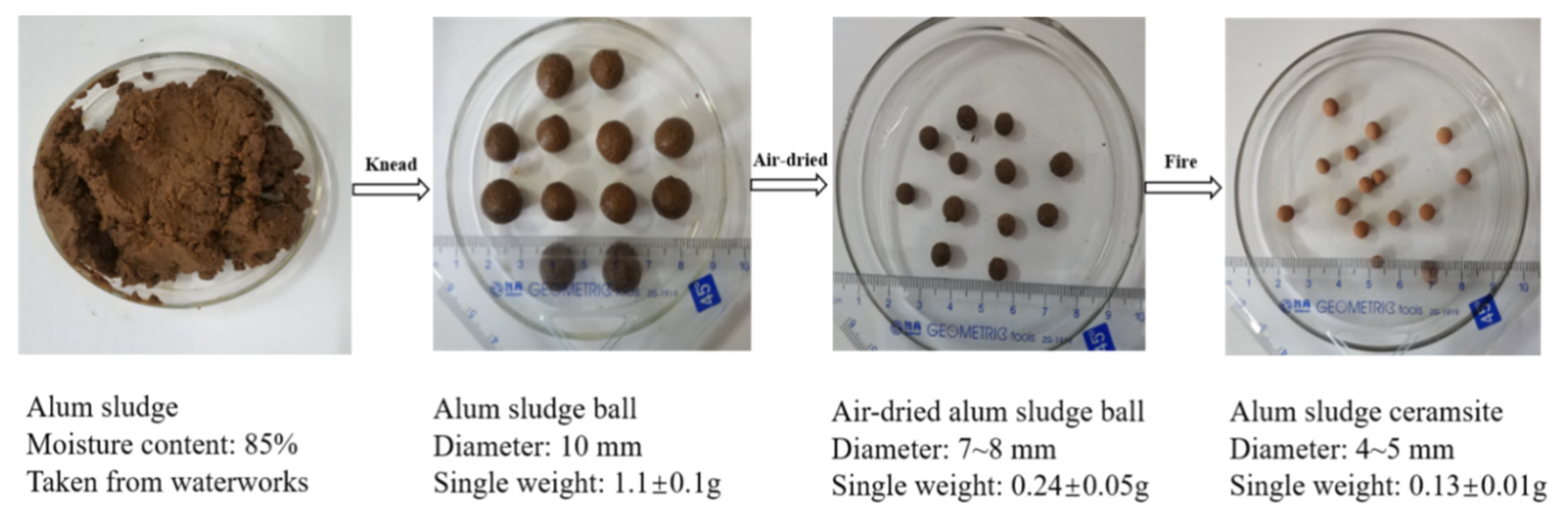
Figure 2.
Microstructure of adASB and ASC: (A) FT-IR spectra; (B): XRD spectra and (C): BET test.
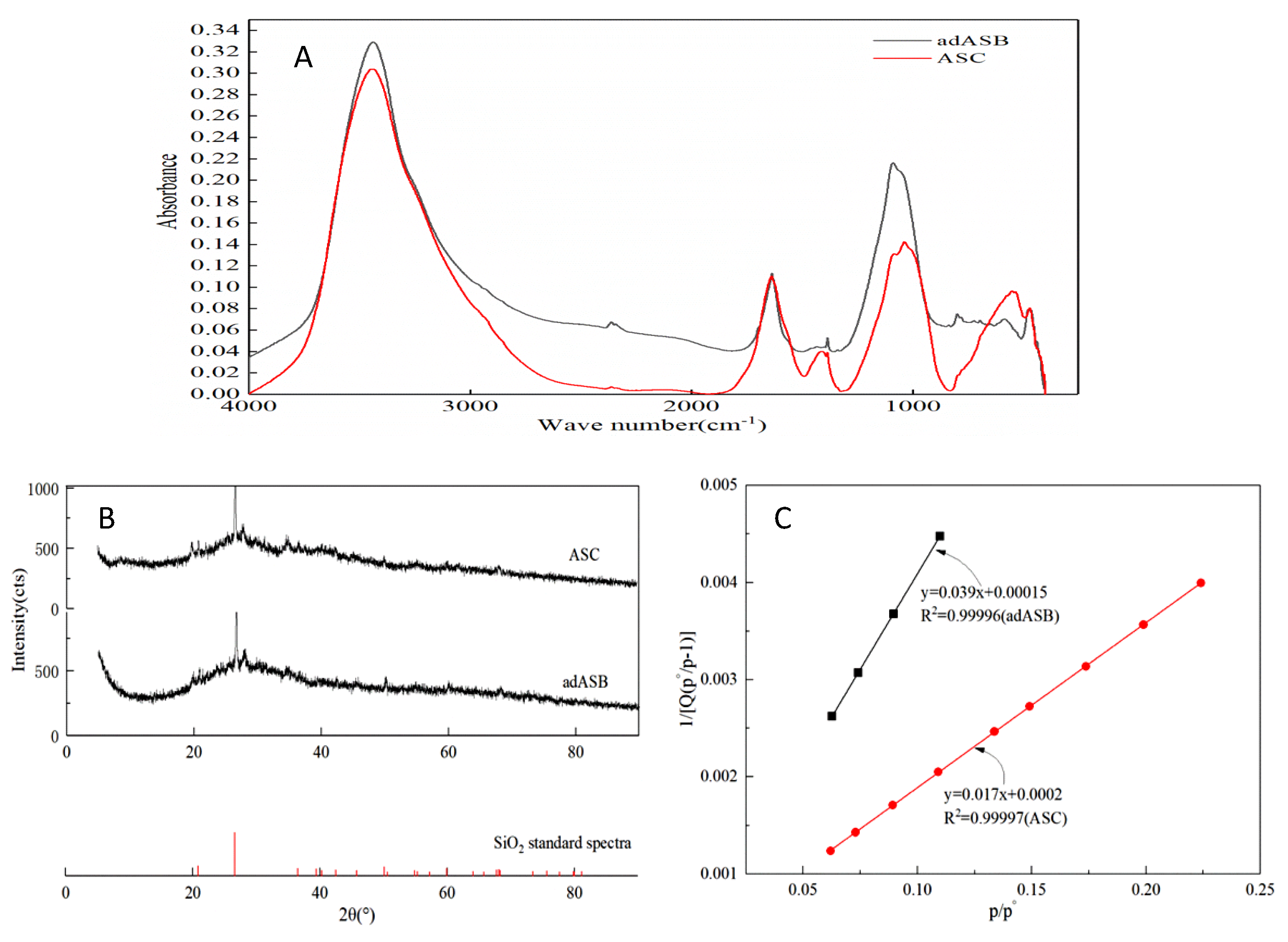
Figure 3.
SEM images of adASB and ASC under different resolution ratios.
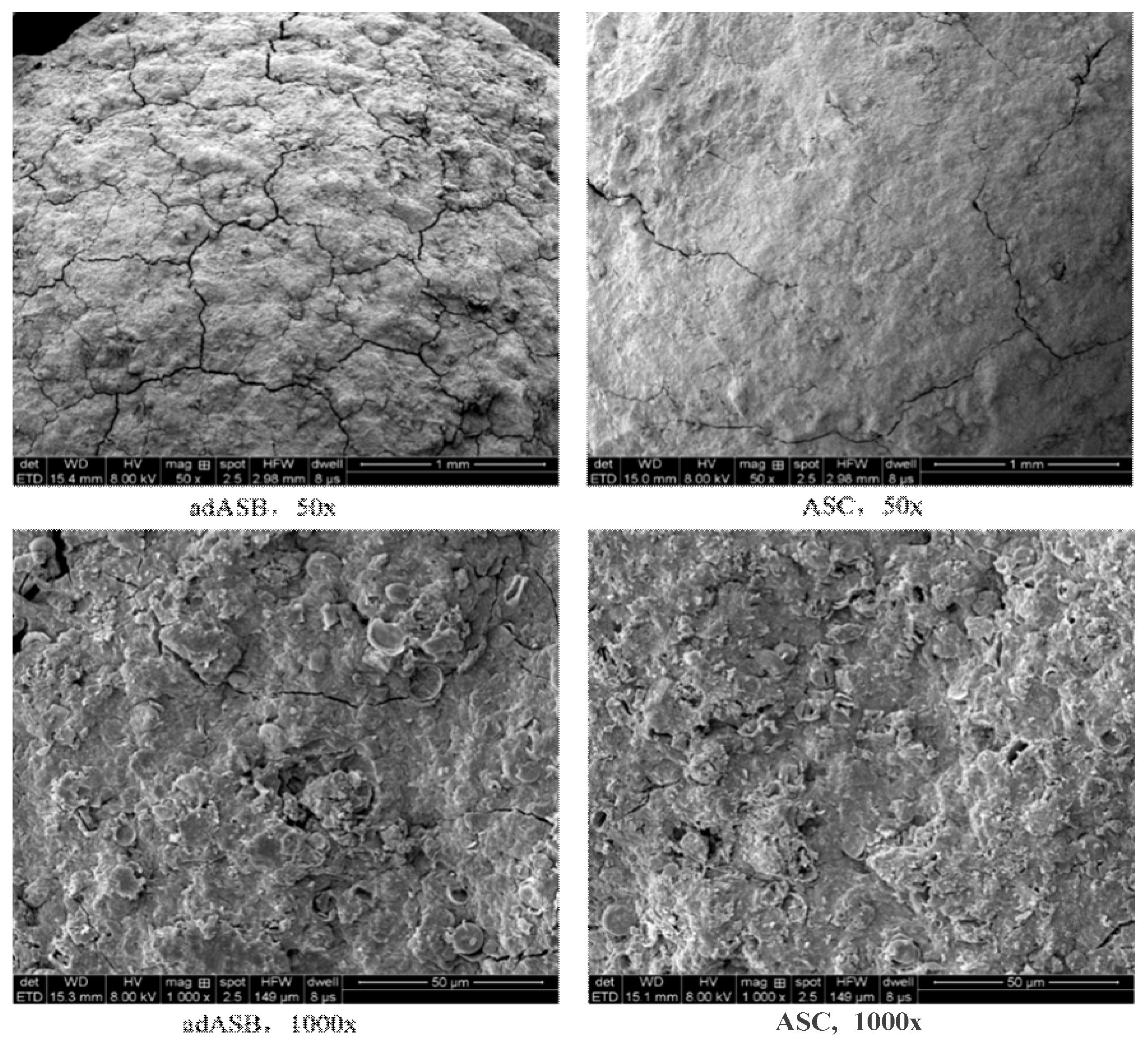
Figure 4.
P adsorption behaviors of adASB and ASC: (A): the relationship of time and residual P concentration; (B): the fitting of pseudo-first order kinetic model; (C): the fitting of pseudo-second order kinetic model; and (D): the fitting of intra-particle diffusion model.
Figure 4.
P adsorption behaviors of adASB and ASC: (A): the relationship of time and residual P concentration; (B): the fitting of pseudo-first order kinetic model; (C): the fitting of pseudo-second order kinetic model; and (D): the fitting of intra-particle diffusion model.
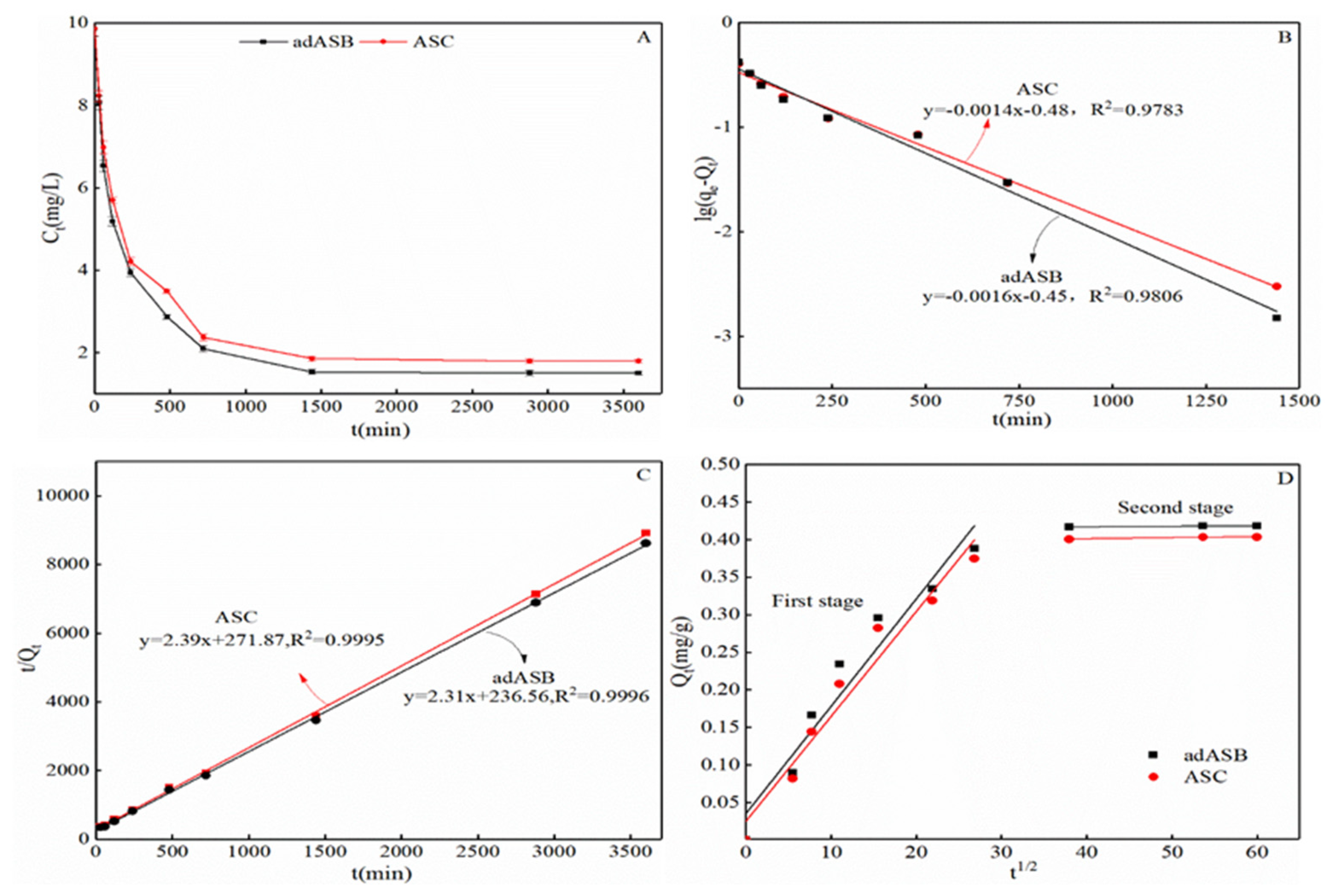
Figure 5.
P-adsorption isotherms of adASB and ASC: (A): the relationship of initial P concentration and residual P after 48h reaction; (B): the fitting of Langmuir model; and (C): the fitting of Freundlich model.
Figure 5.
P-adsorption isotherms of adASB and ASC: (A): the relationship of initial P concentration and residual P after 48h reaction; (B): the fitting of Langmuir model; and (C): the fitting of Freundlich model.
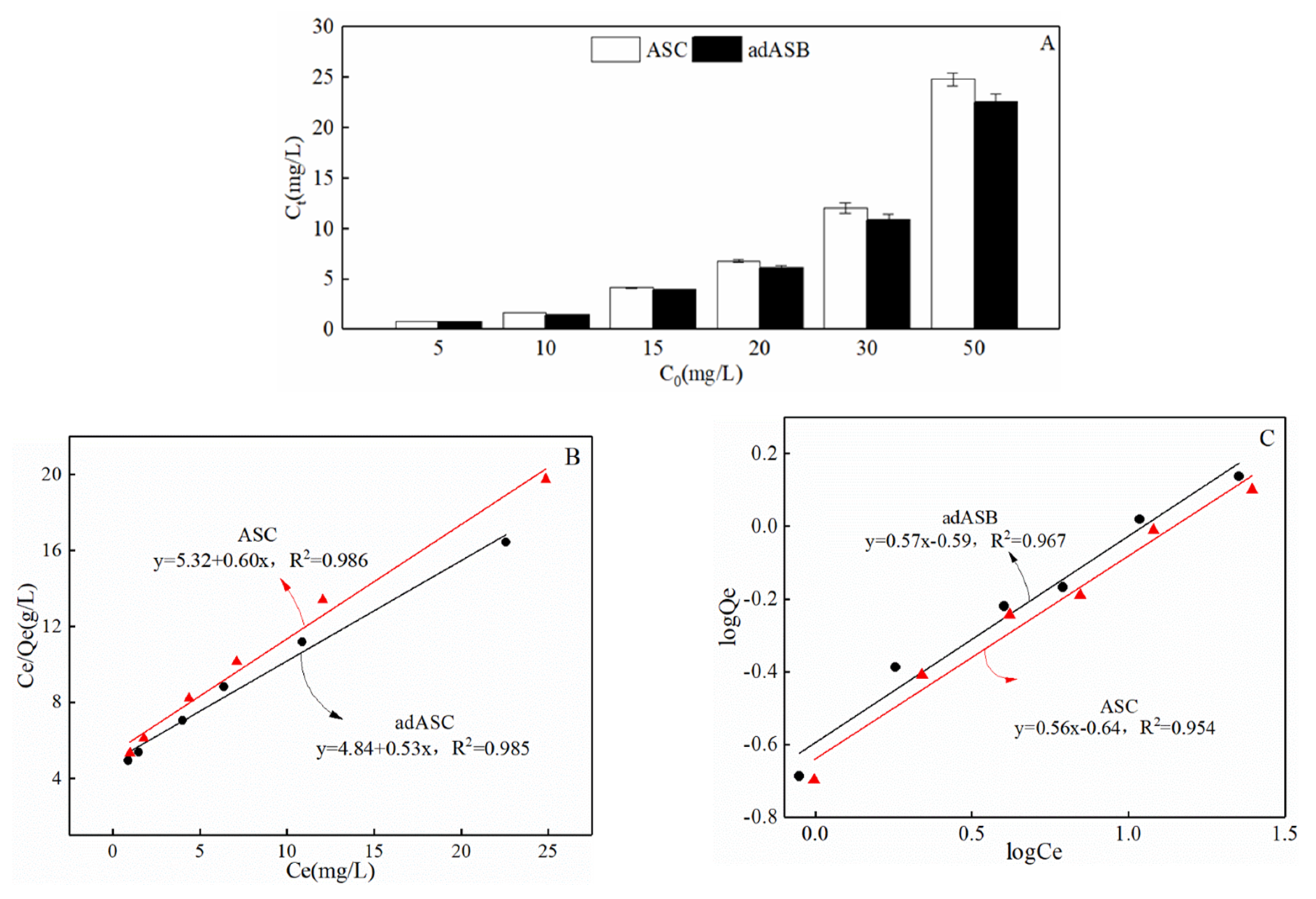
Figure 6.
The potential use of ASC.
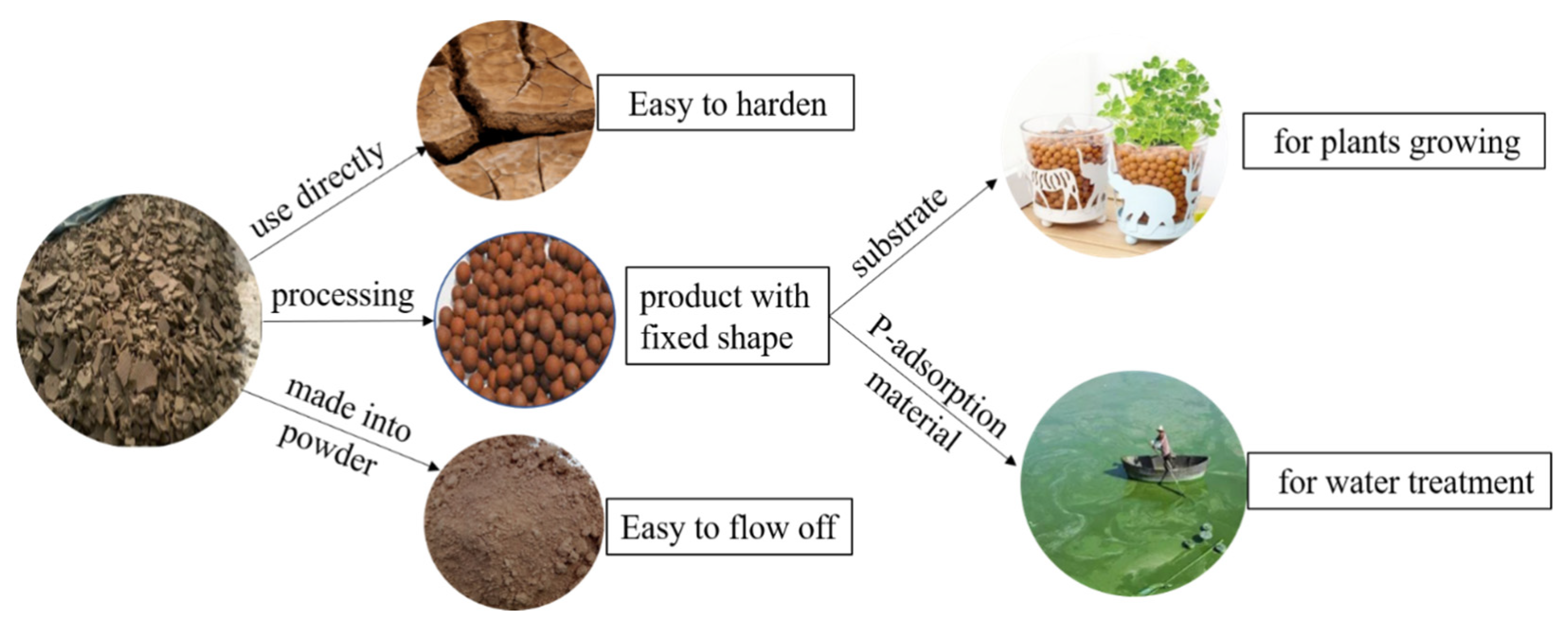

Table 1.
The models adopted in this study.
| Name | Equation | Parameters |
|---|---|---|
| Pseudo-first order kinetic model |
|
qe, Qt: the amounts of adsorbed P at equilibrium and at time t (min), respectively (mg/g); K1: the first-order rate constant (min/L). |
| Pseudo-second order kinetic model | K2: the second-order rate constant (g/mg min). | |
| Intra-particle diffusion model | K3: the intra-particle diffusion rate constant (min-1). | |
| Langmuir Isotherm |
Qe: the mass of P adsorbed on adsorbent at equilibrium (mg/g); Ce: the equilibrium concentration of P solution (mg/L); Qm: the maximum adsorption capacity (mg/g); K: Langmuir constant (l/mg), a measure of the affinity of the adsorbate for the adsorbent. |
|
| Freundlich Isotherm |
Kf : the Freundlich constant (l/g) related to the bonding energy; 1/n: the heterogeneity factor. |
Table 2.
BET analysis by using nitrogen adsorption isotherm.
| Materials | p/p°range |
Total pore volumes (cm3/g) |
Average pore diameters (nm) |
BET surface area (m2/g) |
R2 |
|---|---|---|---|---|---|
| adASB | 0.0626-0.1098 | 0.066 | 2.412 | 110.23 | 0.9996 |
| ASC | 0.06209-0.224 | 0.224 | 3.540 | 253.29 | 0.9997 |
Table 3.
Summary of adsorption kinetic parameters on adsorption of P by different materials.
| Material | qesj | Pseudo-first-order kinetics | Pseudo-second-order kinetics | Intra-particle diffusion | ||||||
| qe | K1 | R2 | qe | K2 | R2 | R2(first stage) | K3 | R2(second stage) | ||
| adASB | 0.418 | 0.357 | 0.0016 | 0.980 | 0.432 | 0.022 | 0.999 | 0.958 | 0.014 | 0.924 |
| ASC | 0.403 | 0.332 | 0.0014 | 0.978 | 0.418 | 0.020 | 0.999 | 0.952 | 0.014 | 0.921 |
Table 4.
Summary of adsorption isotherm parameters on adsorption of P by different materials.
| Material | Langmuir | Freundlich | ||||
| Qm | K | R2 | Kf | 1/n | R2 | |
| adASB | 1.89 | 0.11 | 0.985 | 0.257 | 0.57 | 0.967 |
| ASC | 1.66 | 0.11 | 0.986 | 0.229 | 0.56 | 0.954 |
Disclaimer/Publisher’s Note: The statements, opinions and data contained in all publications are solely those of the individual author(s) and contributor(s) and not of MDPI and/or the editor(s). MDPI and/or the editor(s) disclaim responsibility for any injury to people or property resulting from any ideas, methods, instructions or products referred to in the content. |
© 2023 by the authors. Licensee MDPI, Basel, Switzerland. This article is an open access article distributed under the terms and conditions of the Creative Commons Attribution (CC BY) license (http://creativecommons.org/licenses/by/4.0/).
Copyright: This open access article is published under a Creative Commons CC BY 4.0 license, which permit the free download, distribution, and reuse, provided that the author and preprint are cited in any reuse.


