

Submitted:
18 May 2023
Posted:
19 May 2023
You are already at the latest version
Abstract
Background: Globally, women’s responsibility for unpaid care work (UCW) remains a barrier to gender equality and women’s empowerment. Rwanda, a low-income country, has a legal and policy framework for promoting gender equality but remains a patriarchal society with women responsible for UCW. Reseaux des Femmes, a local NGO, has been delivering a programme targeted at reducing and redistributing the UCW of women with the objective of gender transformational change. However, there has been no impact evaluation of their intervention to date. Methods/Design: The impact evaluation will be a proof-of-concept critical realist cluster control trial (CRcCT) to evaluate for which women, how and under what circumstances the intervention reduces and redistributes women’s UCW, promote gender equality and women’s empowerment, and improves women’s quality of life. Four clusters of villages in each of five districts in Rwanda will be randomly allocated to the intervention or control arms, and all eligible households, those headed by a couple with at least one child under 12 years, will be recruited. This will yield a sample of around 550 intervention households and 550 control. Discussion: This protocol describes the design of mixed-methods research to evaluate an intervention in Rwanda aimed at reducing and redistributing the time women spend on UCW, thereby promoting gender equality and women’s empowerment. This paper will contribute to our understanding of interventions for transforming gender relations from a scholarly perspective. From a policy perspective, it will act as a proof of concept of Reseaux des Femmes’ Programme.
Keywords:
Rwanda
; Unpaid care work
; Critical realism
; Cluster randomised control trial
; Gender transformative change
; Gender equality and women’s empowermenttransformative change
; Gender equality and women’s empowerment
1. Background
The aim is to conduct a proof-of-concept mixed-methods evaluation of Reseaux des Femmes’ (R des F) programme to reduce and redistribute unpaid care work (UCW)i through homegrown solutions. We will do this using a critical realist cluster randomised control trial (CRcRCT) (Porter et al., 2017; Danermark et al., 2019)ii. In Rwanda, as is the case globally, women and girls are responsible for UCW, which is indispensable in contributing to the wellbeing of individuals and society that goes unrecognised (Budlender, 2010; Ferrant et al., 2014; Ferrant and Thim, 2019). It is work essential for the reproduction of (male) labour-power, the maintenance of the workforce and the future workforce, yet limits the paid work women can do, making them dependent on men for their maintenance (Vogel, 1983; Mies, 1986). Furthermore, women still do the bulk of UCW even when they have paid employment (Ferrant and Thim, 2019). The problem is not an individual one for individual households to solve but a social one that requires collective interventions to reduce the burden of reproductive work on women and households.
However, UCW is often dismissed as just women’s work, arising from their ‘maternal’ and caring ‘instincts and carried out as a labour of love (Chopra et al., 2013). It is not included in countries’ calculation of GDP, although the International Labour Office (ILO) estimates, using an hourly minimum wage, that globally UCW contributes 9% of GDP. The unequal distribution of UCW is an infringement of women’s rights (Sepúlveda, 2013), harms their physical and mental wellbeing and quality of life, and is an impediment to their economic empowerment (Ferrant et al., 2014; Seedat and Rondon, 2021), and is a barrier to gender equality and the empowerment of women. For women to claim and exercise their rights, it is necessary to recognise, reduce, and redistribute UCW to enable women to challenge the patriarchal social norms (structural relationships) and culture which have assigned them an inferior status to men so that there is a society-wide shift in gender norms, and a move towards a more equitable society in which women are able to exercise strategic life choices (Kabeer, 2012; Bilfield et al., 2020).
There is a lack of evidence of what works in reducing and redistributing UCW, especially of interventions that have been evaluated using rigorous impact evaluation. We have found none informed by a critical realist approach. The impact research that has been carried out generally finds that interventions to reduce UCW and provide childcare have a positive impact but that there is little evidence of changes in men’s behaviour or culture. A review of studies in low-and-middle-income countries found that the provision of child care had a positive impact on mothers' labour force participation (Halim et al., 2021). The findings from RCTs of interventions to promote positive masculinity mainly aimed at reducing domestic violence and engaging men and boys in sexual and reproductive health have been mixed, but have generally found that there has been little sustained change (Ruane-McAtee et al., 2019; Nicholas et al., 2020). However, one meta-analysis of 19 RCTs assessing the impact of women’s economic empowerment on intimate partner violence (IPV) found an overall significant reduction and tentative evidence that the impact was amplified when gender sensitisation was included (Eggers del Campo and Steinert, 2020). However, there were mixed results across the studies. An RCT of a home-visiting parenting programme in Rwanda found a reduction in IPV and increased father engagement with their children (Jensen et al., 2021). An RCT of an intervention to promote male engagement in reproductive and maternal health and IPV prevention found a reduction in women’s experience of IPV, in men’s dominance in the household, and improvements in the household division of labour at 21 months (Doyle et al., 2018).
2. The Rwanda Context and Unpaid Care Work
Rwanda is an aid-dependent least developed country with over 70% of the population living in rural areas and dependent on mainly subsistence farming (National Institute of Statistics of Rwanda, 2018). In 2017 57% (WDIs) of the population lived on less than $1.9 a day, but due to the impact of COVID-19, the poverty headcount is likely to have increased by five percentage points, threatening the human capital gains made in recent years (World Bank, 2022). There is a shortage of attractive employment, with most women in rural areas cultivating the family farm. Women from landless households do poorly paid casual, day farm labouring (National Institute of Statistics, 2020a, 2020b). Women have limited access to and control over resources, which has been exacerbated by the COVID-19 Pandemic (Katabarwa, 2020). Despite a progressive gender legal and policy framework, Rwanda remains a profoundly patriarchal society with reproductive work feminised (Abbott and Malunda, 2016; Rohwerder et al., 2017; Action Aid, 2020; Chopra, 2021). There is limited policy support for women’s economic empowerment, no specific policy promoting it, inadequate financing of programmes, poor coordination across sectors, and a lack of clarity among policymakers and funders on who has overall responsibility (IDRC, 2020). There is little prenursery, nursery school, or other provision to support working mothers, especially in rural areas (Abbott and D’Ambruoso, 2019; World Bank, 2020). However, the main barriers (mechanisms that lie behind the problem) to gender equality and women’s empowerment are patriarchal institutional structures and a culture of patriarchy.
Women do the bulk of UCW. The burden is highest for married women with dependent children, especially preschool children (Abbott et al., 2012; Action Aid, 2020; National Institute of Statistics, 2020b). In 70% of households, men and boys do not contribute to UCW, and in rural areas, women spend, on average, 6 hours a day on UCW compared to five hours in suburban areas and two hours in urban areas (Action Aid, 2020). Men, by comparison, do an average of two hours UCW a day in rural areas and one hour a day in suburban and urban areas. Women find it difficult to balance reproductive and productive work; they find UCW and the paid work available physically demanding and exhausting and have little time for leisure and personal care (Action Aid, 2020). Women argue that they need funded childcare, labour-saving devices such as water tanks and improved cookstoves, combined with the availability of decent work (Kennedy and Roelen, 2017; Rohwerder et al., 2017; Action Aid, 2020).
3. Methodology/Methods/Design
3.1. Study Design
The study design is a three-armed (two intervention arms and a control arm) CRcRCT using quantitative and qualitative methods. It takes a critical realist stance that acknowledges the complexity of the social world - the overall interaction of a given culture and its current institutions with individual agents' experiences and reactions. It aims not just to provide a yes/no answer to the question of whether the intervention 'works', but to look at for whom it works or does not work, how the success or failure is produced in the light of personal biography and current context and what kind of explanation is needed for making sense of these results. A CRcRCT overcomes the main weakness of RCTs, the conception of causality as the regular succession of events in the form of stimulus and response (Pawson, 2013). It does so by recognising that context matters, that social evaluation takes place in an open system and that human agency matters. The cRCT can enumerate the outcome patterns and help us assess the relative contribution of the intervention mechanisms to the outcome (Bonell et al., 2018). A CRcRCT, in addition, enables us to open the ‘black box’ and identify the mechanisms embedded in the intervention and the social context and uncover the experiences, interpretations, and responses of the participants in the trial, both positive and negative (Archer, 1996; Danermark et al., 2019). This enables us to build theoretical explanations for what works for whom under what circumstances taking account of the intervention being introduced in an open system, where the context influences the outcomes and may affect sustained effectiveness. Policy actors can be given information about what it is about the intervention mechanisms that work and what conditions need to be in place for them to work.
The goal of R des F’s intervention is to bring about gender transformative change through cost-effective homegrown interventions resulting in the redistribution of reproductive and productive labour, a reduction in the UCW that women do, the mutual recognition of the equal status of men and women and the work they do, and the creation of an inclusive social and political environment that supports expanded choices for men and women. It is predicated on the assumption that the changes will tackle the patriarchal barriers to gender equality and women’s empowerment (Figure 1).
R des F programme is designed to recognise, reduce, and redistribute women’s UCW and consists of the following intervention mechanisms:
- water tanks for rainwater harvesting to reduce the time women spend collecting water;
- a training session on positive masculinities aimed at increasing the UCW men do, reducing IPV and more generally leading to women’s empowerment;
- two training sessions on entrepreneurship for women to enable them to set up household enterprises and become economically empowered;
- two training sessions on sexual and reproductive health rights to couples to encourage family planning, use of modern contraception, and respect for women’s right to bodily integrity;
- Regular home visits by trained workers and monitoring for the six months of project implementation.
Half the intervention clusters will have all the interventions, and the other half will have all the interventions except positive masculinities. This will enable us to see if it has added value beyond the other interventions. In addition, adolescents will be sensitised to positive masculinity in the intervention clusters and a series of three participatory action research workshops to agree on homegrown solutions to providing ECEC at the community leveliii. We will also develop a costing of the intervention (Long et al., 2015).
The aims of our research are to:
- Enumerate the outcome patterns - what mechanisms worked for what women in what circumstances in reducing and redistributing UCW;
- To show what impact the mechanisms had on gender relations, women’s empowerment, and their quality of life;
- To uncover how the interventions tackled the barriers to reducing and redistributing women’s UCW and gender equality and women’s empowerment;
- To explain how and why the interventions worked how they overcame the barriers to gender equality and women’s empowerment in the intervention clusters.
3.2. Participants and Sample Size
The intervention will be delivered in five rural districts in Rwanda (see Map 1).
Map 1.
Intervention and Control Clusters.
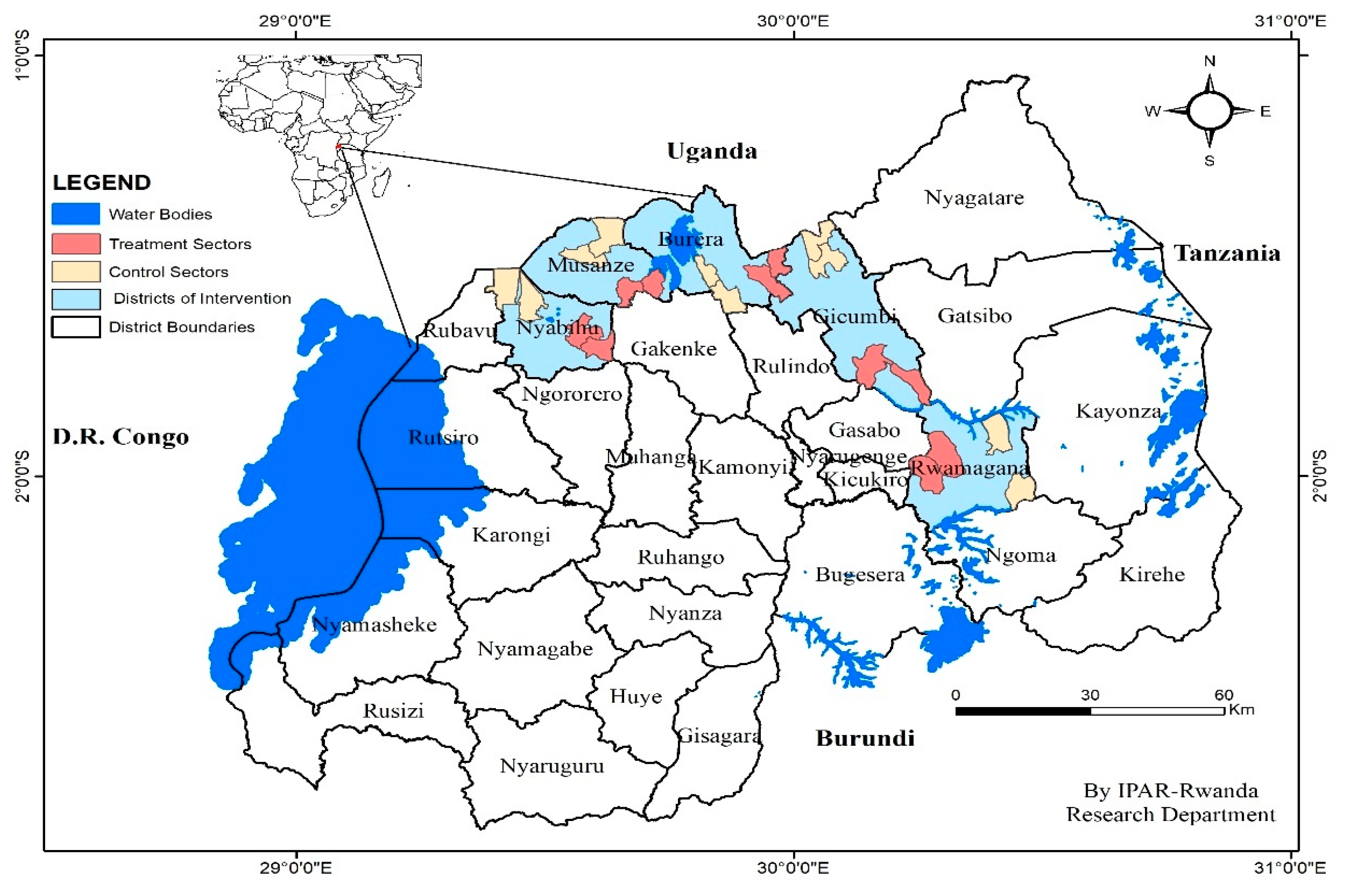
Given the nature of the intervention, which is to be at the community level, we opted for a cRCT. In each District, four sectors were randomly selected and randomly allocated to either treatment or control on a ratio of 1:1. Subsequently, two clusters of villages were randomly selected within each sector, resulting in an overall study frame of ten intervention and ten control clusters in total. The target group is households headed by a married/cohabiting couple with at least one dependent child younger than 12 years old, as women in such households have the greatest burden of unpaid care work. All households that met the inclusion criteria were invited by R des F to participate - approximately 55 households in each cluster. The total sample is 1,100 households (550 intervention and 550 control) with 2,200 participants (husband and wife in each household).
3.3. Intervention and Research Implementation
Figure 2 shows the intervention cycle and how, by studying the interplay between the pre-existing context (structural and cultural), the interventions and agency, and outcomes (CAIMO), we can move from what makes the intervention work to understand why it works and for whom under what circumstances. To do this, we will use mixed methods research with a baseline, midterm, and end of line survey and collection of 7-day time diaries in control and interventions clusters, FGDs, key informant interviews and household case studies in the intervention clusters. The participants in FGDs and household case studies will be selected to reflect the range of household structures. Local leaders will be interviewed, and FGDs facilitated with community members, including adolescents not living in households benefitting from the project, to explore if there had been any change in the community context. The survey and 7-day time diaries will measure what has changed, and the qualitative research will enable us to understand what changed to enable it to work and theorise why it worked. An essential element of our sampling for the qualitative research will be the sampling of ‘extreme cases’, households with the least and most change in the reduction and redistribution of UCW, among the intervention households based on the findings from the midterm survey/ 7-day time diaries. This will assist us in explaining how, for whom and under what conditions the intervention works (Danermark et al., 2019).
To capture the complex processes of transforming gender relations, change will be measured at the community level and the individual and household levels (Morgan, 2014; Hillenbrand et al., 2015). We will measure changes in structure, culture, and agency. Structures are informal and formal institutional rules and norms embedded within relationships and govern individual and collective lives. Culture is ‘a historically transmitted pattern of meanings embodied in symbols’ (Geertz, 1975, 89). Agency includes the skills actors use, their attitudes, the assets they possess, and the services they access. Changes in power will be measured at four levels: the power within (personal sense of self-worth, aspirations); power over (control over people and resources); power to (act to realise one’s aspirations); and power with (collaborative and collective power with others). The project’s theory of change is: access to assets and opportunities, social inclusion (removal of the multidimensional constraints women face) and non-discrimination (women as a group NOT being denied opportunities and access) will counter the mechanisms that deny women gender equality result in gender transformation and women’s the empowerment. Table 1 provides examples of how the different types of data will enable us to answer our research questions.
3.4. Data analysis
The survey data will be entered into SPSS version 26 and analysed using descriptive statistics, regression, matched pairs t-test and independent t-test. For the qualitative data, we will use NVivo to manage the data and use qualitative thematic analysis guided by abduction and retroduction to move the analysis of the data beyond the original research premise to develop novel theoretical explanations for how the interventions worked, for whom and under what circumstances (Meyer and Lunnay, 2013). The analysis will identify the most complete and logically compelling explanation of how and why R des R programme, in the specific context of the intervention clusters, modifyed gender relationships with the potential to transform them.
3.5. Ethical Considerations and Safeguarding
The project has been given ethical approval through the IPAR-Rwanda’s ethics review procedures. Enrolment in the project will depend on giving informed consent. Informed consent will also be obtained from participants for each survey round, the 7-day diaries, and the qualitative research. Key informants will also be asked to give informed consent each time they are interviewed. Adolescents will be asked to give informed consent, and for those under 18 years, parental consent will also be required. Participants will be given a project information sheet in non-technical Kinyarwanda explaining the purpose, approach, and dissemination strategy, their rights to withdraw from the research and how anonymity and confidentiality will be afforded. This will be read aloud to participants before they are asked to give informed consent. Researchers will provide women who report that they have experienced domestic violence with information on the help available to them and leave an information sheet where they agree that it is safe to have it. Measures will be taken to safeguard participants and researchers during fieldwork, including measures to mitigate COVID-19iv. Fieldwork will only be undertaken with the permission of the Rwandan government and, when undertaken, comply with the government requirements. All data will be stored securely following IPAR’s data management policy to prevent data linkage and unauthorised access to data.
4. Discussion
This protocol describes mixed-methods research designed to evaluate an intervention in Rwanda to reduce and redistribute the time women spend on UCW and promote gender equality and women’s empowerment. From a scholarly perspective, this paper will contribute to our understanding of what interventions can work under what circumstances to transform gender relations and empower women. From a policy perspective, it will act as a proof of concept of the Reseaux des Femmes programme and provide policymakers with details of what needs to be in place to enable interventions to redistribute and reduce women’s UCW to transform women’s lives so that they are recognised as equal to men and empowered to take control of their lives individually and collectively. It will also advance our understanding of how a CRcRCT can provide an understanding of how interventions work in open systems where it is not possible to control all the institutional and culture mechanisms constraining and enabling agency, and where the complexity of the social world means that we can only ever have an incomplete and fallible understanding of it.
Author Contributions
All authors have read and approved the manuscript. DM, PA, made substantial contributions to the conception of the work and acquisition of funding. All authors contributed to the research design, PA drafted the protocol, all authors reviewed it critically, and PA drafted the final version. All authors agree to be accountable for the content of the protocol.
Funding
The project is funded by the International Research Development Centre, Canada.
Availability of data
The data sets arising from this project will be publicly available after the project concludes in May 2023.
Acknowledgement
the authors would like to thank Amber Peterman for her comments on an earlier version of the protocol
Competing interests
The authors declare they have no competing interests.
Disclaimer
the authors are responsible for the content of this protocol, and it cannot be taken to necessarily represent the views of the International Development Research Centre, Canada, or the employers of the authors.
| i | The main characteristics of UCW are that it is: unpaid, the individual performing the work is not paid in cash and/or in kind; care, the activity provides for the health, wellbeing and maintenance of members of the household or community; and work, the activity involves mental and /or physical effort and is costly in terms of time (Ferrant et al., 2014). |
| ii | It is not possible within the limits of writing a research protocol to discuss critical realism as an enquiry paradigm. For the interested reader Andrew Sayer (2000) and Danermark et. al. (2019) provide accessible introductions. |
| iii | R des F did consider including a community child-care intervention based on the Rwandan Government’s policy, but the Ministry of Gender advised that it would be premature to do this as insufficient was known about the acceptability and practicality of such provision. |
| iv | The research will follow the requirements of UK R&I policy on safeguarding and UK R&I Guidance on Safeguarding in International Development. There are four safeguarding issues relating to the project, the risks associated with COVID-19, interviewing vulnerable women, the risks of junior researchers being bullied and harassed by more senior researchers, and the risk of researchers being distressed by the disclosures that vulnerable women make. |
References
- Abbott, P., and D’Ambruoso, L. (2019). Rwanda Case Study: Promoting the Integrated Delivery of Early Childhood Development.
- Abbott, P., and Malunda, D. (2016). The Promise and the Reality: Women’s Rights in Rwanda. African J. Int. Comp. Law 24, 561–581. [CrossRef]
- Abbott, P., Malunda, D., Mugisha, R., Mutesi, L., and Rucogoza, M. (2012). Women’s Economic Empowerment in Rwanda: A Situational Analysis.
- Action Aid (2020). National Level Research to Assess the Effect of Unpaid Care Work on Women’s Economic Participation in Rwanda.
- Archer, M. (1996). Social integration and system integration: developing the distinction. Sociology 30, 679–699. [CrossRef]
- Archer, M. (2008). Realist Social Theory: The Morphogenetic Approach. Cambridge: Cambridge University Press.
- Bilfield, A., Seal, D., and Donald, R. (2020). Brewing a More Balanced Cup: Supply Chain Perspectives on Gender Transformative Change within the Coffee Value Chain. Int. J. Food Syst. Dyn. 11, 26–38.
- Bonell, C., Moore, G., Warren, E., and Moore, L. (2018). Are randomized Controlled Trials Positivist? Reviewing the Social Science and Philosophy Literature to Assess Positivist Tendencies of Trials of Social Interventions in Public Health and Health Services. Trials 19, 238.
- Budlender, D. (2010). “What do Time Use Studies Tell Us about Unpaid Care Work? Evidence from Seven Countries,” in Time Use Studies and Unpaid Care Work, ed. D. Budlender (Geneva: United Nations Research Institute for Social Development).
- Chopra, D. (2021). “Paid Work and Unpaid Care Work in India, Nepal, Tanzania, and Rwanda: A Bi-directional Relationship,” in Women’s Economic Empowerment: Insights from Africa and South Asia, eds. K. Grantham, G. Dowie, and A. de Haan (London and New York, NY: Routledge).
- Chopra, D., Kelbert, A. W., and Iyer, P. (2013). Empowerment of Women and Girl.
- Danermark, B., Ekström, M., and Karlsson, J. C. (2019). Explaining Society: Critical Realism in the Social Sciences. London and New York, NY: Routledge.
- Doyle, K., Levtov, R. G., Barker, G., Bastian, G. G., Bingenheimer, J. B., Kazimbaya, S., et al. (2018). Gender-transformative bandebereho couples’ intervention to promote male engagement in reproductive and maternal health and violence prevention in Rwanda: Findings from a randomized controlled trial. PLoS One 13, 1–17. [CrossRef]
- Eggers del Campo, I., and Steinert, J. I. (2020). The Effect of Female Economic Empowerment Interventions on the Risk of Intimate Partner Violence: A Systematic Review and Meta-Analysis. Trauma, Violence, Abus. [CrossRef]
- Ferrant, G., Pesando, L. M., and Nowacka (2014). Unpaid Care work: The missing Link in the analysis of Gender Gaps in Labour Outcomes.
- Ferrant, G., and Thim, A. (2019). Measuring Women’s Economic Empowerment Time Use Data and Gender Inequality.
- Geertz, C. (1975). Interpretation of Culture. Chicago, IL: University of Chicago Press Available at: https://www.amazon.co.uk/dp/B01M1GJ0D1/ref=dp-kindle-redirect?_encoding=UTF8&btkr=1.
- Halim, D., Perova, E., and Reynolds, S. (2021). Childcare and Mothers’ Labor Market Outcomes in Lower- and Middle-Income Countries. [CrossRef]
- Hillenbrand, E., Karim, N., Mohanraj, P., and Wu, D. (2015). Measuring Gender-transformative change A Review of Literature and Promising Practices.
- IDRC (2020). Mapping the Policy Landscape for Women’s Economic Empowerment in Rwanda.
- Jensen, S. K., Placencio-Castro, M., Murray, S. M., Brennan, R. T., Goshev, S., Farrar, J., et al. (2021). Effect of a home-visiting parenting program to promote early childhood development and prevent violence: A cluster-randomized trial in Rwanda. BMJ Glob. Heal. 6, 1–13. [CrossRef]
- Kabeer, N. (2012). Empowerment, Citizenship and Gender Justice: A Contribution to Locally Grounded Theories of Change in Women’s Lives. Ethics Soc. Welf. 6, 216–232. [CrossRef]
- Katabarwa, J. K. (2020). Policy Mapping: Women’s Economic Empowerment in Rwanda.
- Kennedy, L., and Roelen, K. (2017). ActionAid’s Food Security and Economic Empowerment Programme in Muko Sector, Northern Rwanda: Guidelines for Achieving the Double Boon.
- Long, K., Brown, J. L., Jones, S. M., Aber, J. L., and Yates, B. T. (2015). Cost Analysis of a School-Based Social and Emotional Learning and Literacy Intervention. J. Benefit-Cost Anal. 6, 545–571. Available at: https://www.cambridge.org/core/journals/journal-of-benefit-cost-analysis/article/abs/cost-analysis-of-a-schoolbased-social-and-emotional-learning-and-literacy-intervention-1/2167979501B6C6D158F337F1458E407A.
- Meyer, S. B., and Lunnay, B. (2013). The Aplication of Abductive and Retroductive Inference for the Design and Analysis of Theory-Driven Sociological Research. Sociol. Res. Line 18, 12. Available at: https://www.socresonline.org.uk/18/1/12/12.pdf.
- Mies, M. (1986). Patriarchy and Accumulation on a World Scale: Women in the International Division of Labour. London: Zed Books. [CrossRef]
- Morgan, M. (2014). Measuring Gender Transformative Change.
- National Institute of Statistics (2020a). Labour Force Survey Annual Report 2019. Available at: https://www.statistics.gov.rw/datasource/labour-force-survey-2019.
- National Institute of Statistics (2020b). Labourforce Survey 2019 Thematic Report on Gender.
- National Institute of Statistics of Rwanda (2018). The Fifth Integrated Living Conditions Survey: Main Indicators Report.
- Nicholas, N., Ovenden, G., and Vlais, R. (2020). Evaluating Behaviour Change Programs for Men who Use Domestic and family Violence: Key Findings and Future Directions.
- Pawson, R. (2013). The Science of Evaluation: A Realist Manifesto. London: Sage.
- Porter, S., McConnell, T., and Reid, J. (2017). The Possibility of Critical Realist Randomised Controlled Trials. Trials 18, 133.
- Rohwerder, B., Müller, C., Nyamulinda, B., Chopra, D., Zambelli, E., and Hossain, N. (2017). ‘You Cannot Live Without Money’: Balancing Women’s Unpaid Care Work and Paid Work in Rwanda.
- Ruane-McAtee, E., Amin, A., Hanratty, J., Lynn, F., Willenswaard, K. C. van, Reid, E., et al. (2019). Interventions addressing men, masculinities and gender equality in sexual and reproductive health and rights: an evidence and gap map and systematic review of reviews. BMJ Glob. Heal. 4, e001634. [CrossRef]
- Seedat, S., and Rondon, M. (2021). Women’s wellbeing and the burden of unpaid work. BMJ 374, n1972. [CrossRef]
- Sepúlveda, M. (2013). Women’s unpaid work in the home is a ‘major human rights issue. UN News.
- Vogel, L. (1983). Marxism and the Oppression of Women: Toward a Unitary Theory. New Brunswick, NJ: Rutgers University Press. [CrossRef]
- World Bank (2020). Women Business and the Law 2020. Available at: http://pubdocs.worldbank.org/en/102741522965756861/WBL-Key-Findings-Web-FINAL.pdf.
- World Bank (2022). Overview Rwanda. #Africa Can. Available at: https://www.worldbank.org/en/country/rwanda/overview#1 [Accessed February 27, 2022].
Figure 1.
Simplified Project Theory of Change.
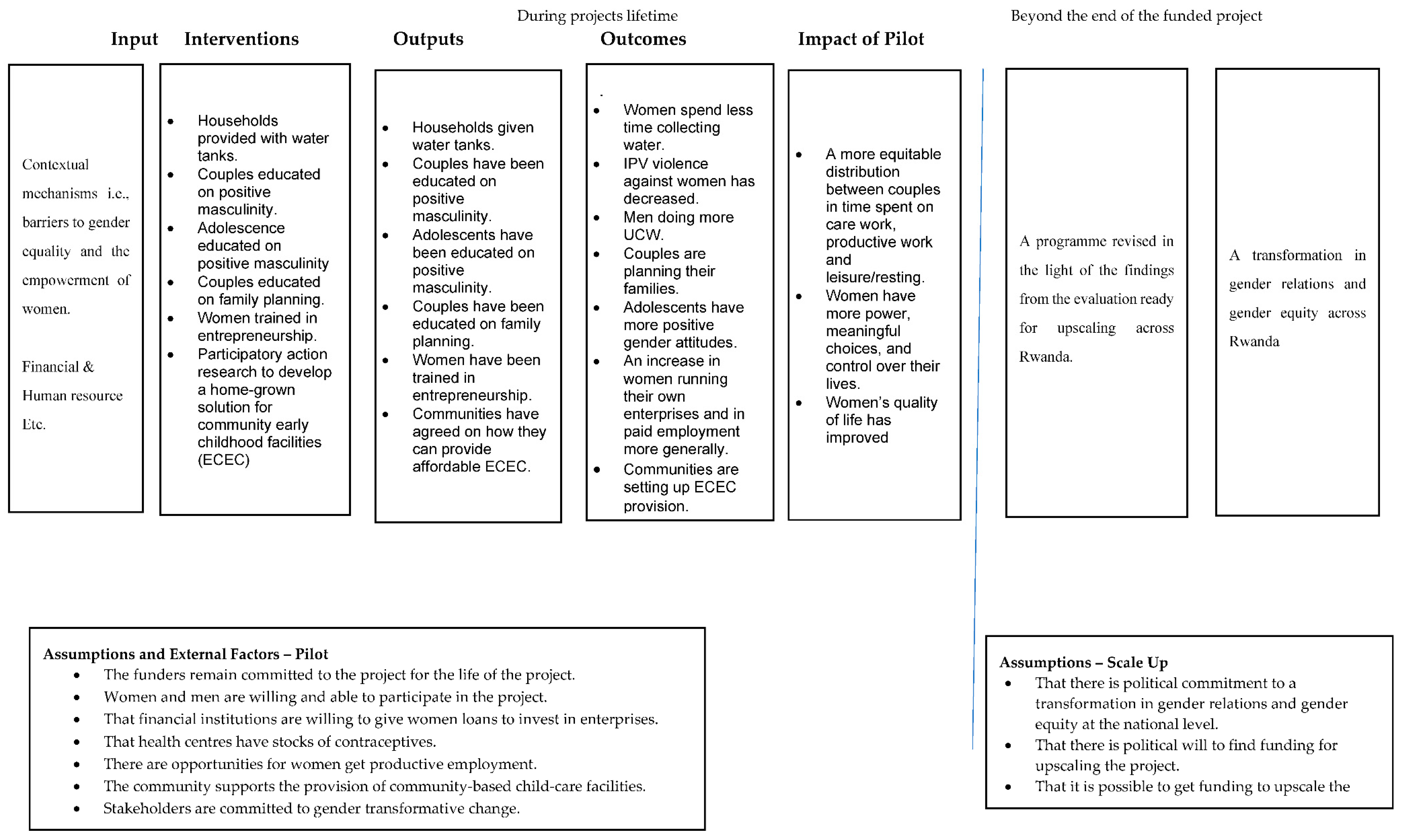
Figure 2.
Intervention Cycle Showing CAIMO Configuration.
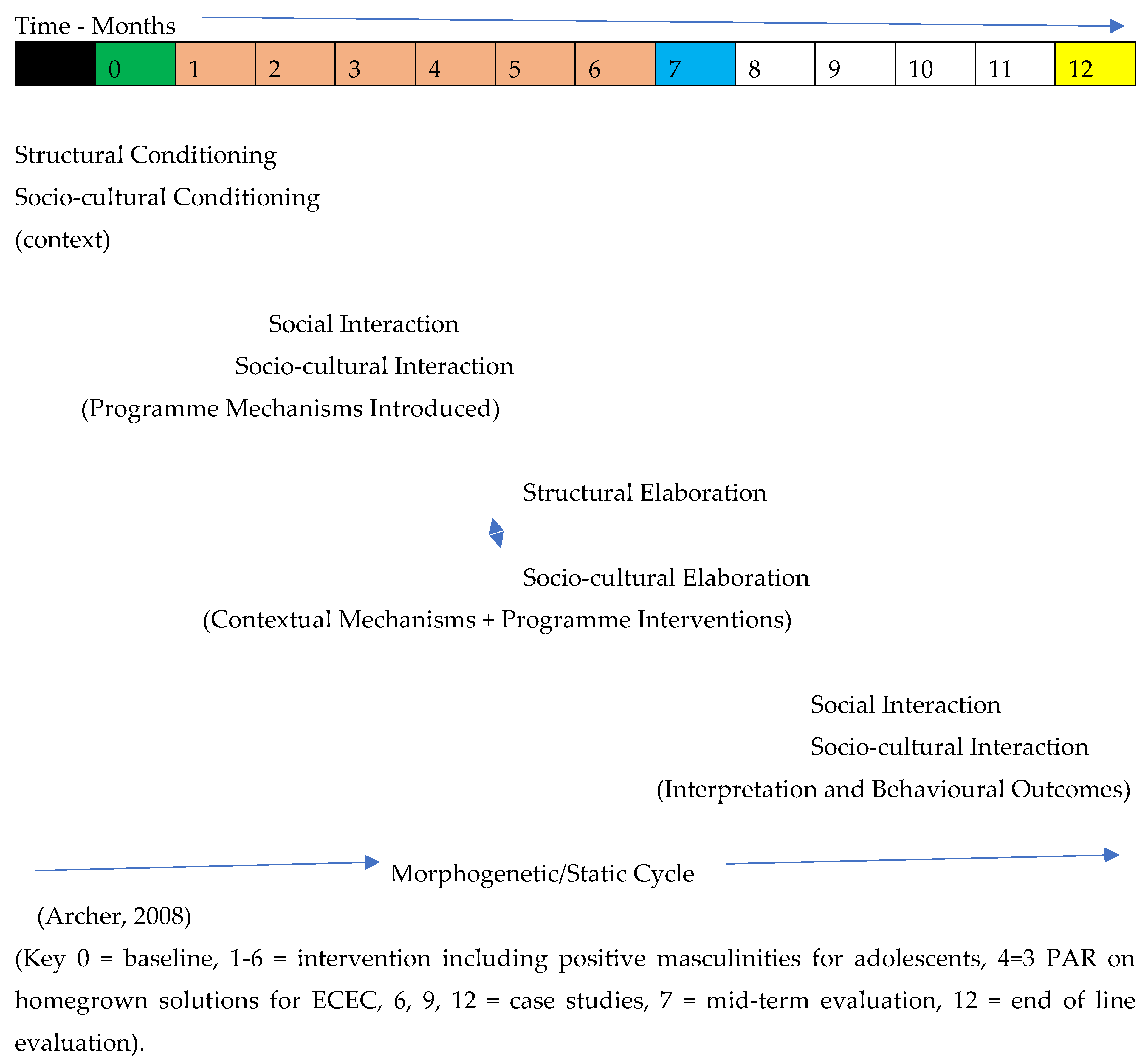

Table 1.
Research Questions and Examples of Sources of Evidence.
| Research Questions | Survey Data Questions | 7-day Time Diaries | FGDs & Key Informant Interviews | Case Study Households | Participatory Action Research - ECEC | Cost Analysis |
| For which women and under what circumstances, and how does providing households with labour-saving devices (water tanks) reduce the burden of UCW for women? | Time spent collecting water by all members of the household | Tell me about how the time members of your household spent collecting water has changed since you started using a water tank? Why has this change occurred? | ||||
| For which women and under what circumstances, and how does training in entrepreneurship enable women to set up productive micro-enterprises? | Employment, borrowing, contribution to household cash income | Time spent running an enterprise by women | Please tell me about any changes in women’s income-generating strategies in your village in the last 6 months. Why and how have these changes taken place. What are the barriers to women setting up enterprises? |
What changes have occurred in your household’s income-generating strategy in the last 3 months? Why and how have these changes occurred? What would have to change for you/your wife to set up an enterprise? |
||
| For which men under what circumstances and how does taking part in positive masculinity dialogues lead to positive changes in attitudes and behaviour to gender equality and the empowerment of women? (As reported by husbands and wives) | Economic empowerment Political empowerment Decision making in the household. Control over economic resources Bodily integrity and domestic violence (women only) |
Time spent doing income-generating work. Time spent on leisure and personal care. |
Please tell me about any changes in men’s behaviour in the last 6 months. Why do you think these changes have taken place? Why do some men think that it is OK to abuse their wives? How can domestic violence be prevented? |
Have there been any changes in the relationship between you and your husband(wife) in the last 3 months? Why have these changes occurred? |
||
| For which men, under what circumstances and how does taking part in positive masculinity dialogues lead to them taking on more responsibility for UCW? (As reported by women and men. | Gender roles Gendered division of labour in the household |
Time spent doing UCW | Tell me about men’s attitudes to care and domestic work? Why do you think that men have these attitudes? |
Have there been any changes in who is responsible for your household's care or domestic work in the last 3 months? What would have to change for your husband/you to take on more responsibility for it? |
||
| For which women and under what circumstances have the interventions positively impacted their wellbeing and quality of life? | Kessler Psychological Distress Scale Quality of life scale Domestic violence questions (wives only). |
What makes women dissatisfied with their lives and why? What changes would make women more satisfied with their lives and why? |
Tell me about any changes in how you feel about your life in general over the last 3 months. What changes in your daily life would be necessary for you to enjoy life more? |
|||
| For which couples, under what circumstances, and why has there been a redistribution of reproductive and productive labour? (As reported by husbands and wives). | How much of the unpaid care work do you do? If these 20 beans represented all the UCW done in your household, how many would represent your share? | Time spent on a different activity across the day and week | What are the expectations in your village of what women and men are responsible for in your village? What would have to change for the division of labour between men and women to change |
What are the main tasks you are responsible for in looking after your household, and what are your partner's responsibilities? Why is this the case? |
||
| How cost-effective is the programme, and how can it be scaled -up? | Cost analysis of interventions. | |||||
| What is the feasibility, desirability, and practicability of introducing Homebased ECD Facilities? | Time spent caring for children under 7-years. | Tell me about policies that could be introduced to enable women to have more time to do paid work? | What difference would it make to your household if there was ECEC for infants and young children? How would it make this difference? | Participants asked, over a series of three workshops, to agree on homegrown solutions that would work for them. | ||
| What are the key lessons from the research findings for programming and policy formulation for women’s empowerment in Rwanda? | Acceptability of the recommendations from the participatory workshops. | Acceptability of the recommendations from the participatory workshops. | Recommendations from participatory workshops. |
Disclaimer/Publisher’s Note: The statements, opinions and data contained in all publications are solely those of the individual author(s) and contributor(s) and not of MDPI and/or the editor(s). MDPI and/or the editor(s) disclaim responsibility for any injury to people or property resulting from any ideas, methods, instructions or products referred to in the content. |
© 2023 by the authors. Licensee MDPI, Basel, Switzerland. This article is an open access article distributed under the terms and conditions of the Creative Commons Attribution (CC BY) license (http://creativecommons.org/licenses/by/4.0/).
Copyright: This open access article is published under a Creative Commons CC BY 4.0 license, which permit the free download, distribution, and reuse, provided that the author and preprint are cited in any reuse.


