
Submitted:
06 May 2023
Posted:
09 May 2023
You are already at the latest version
Abstract
In this study, GC–IMS was used to analyze the volatile component and flavor profiles of Crassostrea gigas individuals of different ploidy and gender. Principal component analysis was used to explore overall differences in flavor profiles and a total of 54 volatile compounds were identified. The total volatile flavor contents in edible parts of tetraploid oysters were significantly higher than in diploid and triploid oysters. The concentrations of ethyl (E)-2-butenoate and 1-penten-3-ol were significantly higher of triploid oysters than in diploid and tetraploid oysters. In addition, the volatile compounds propanoic acid, ethyl propanoate, 1-butanol, butanal, and 2-ethyl furan were significantly higher in females than in males. The volatile compounds p-methyl anisole, 3-octanone, 3-octanone, and (E)-2-heptenal were present in higher levels in male than in female oysters. Overall, different ploidy and gender of oysters were being presented with different sensory characteristics, providing new insights for understanding the flavor characteristics of oysters.
Keywords:
Crassostrea gigas
; Gas chromatography–ion mobility spectrometry (GC–IMS)
; Ploidy
; Volatile
; Flavor
1. Introduction
Oysters belong to the Mollusca phylum, Bivalve class, and Pearl shell order. They are the most cultured shellfish globally and are important marine resources. Oysters exhibit rich nutritional value [1] and are essential aquatic products that are incorporated into healthy diets [2]. Their meat is rich in proteins, fatty acids, and other compounds, leading to their widespread recognition as being delicious and their wide consumption by humans. The freshness and hygiene of oysters meet international standards and can thus be directly eaten raw [3]. Most oysters aquacultured in North China are Pacific oysters (Crassostrea gigas). The development of diploid oysters is seasonal, because propagation and ovulation occur in the summer, resulting in very thin gonads of diploid oysters after ovulation that then affects their taste. For example, Qin et al. observed that the biochemical composition, nutritional value, and taste of triploid Hong Kong oysters (C. hongkongensis) were better than diploid oysters [4]. Compared with diploid oysters, triploid oysters are infertile, which reduces energy loss caused by gonadal development [5], thereby leading to biological and economic advantages [6] that can improve meat quality [4]. Consequently, many aquaculture industries choose excellent quality triploid oysters, with the proliferation of triploid oysters becoming a top priority for the aquaculture industry. To prevent the release of a second polar body during fertilization, chemical [7] and physical methods are usually used to obtain triploid oysters [8]. However, chemicals used in chemical methods can harm experimenters due to improper operation, while triploids obtained using the physical method are not generated at a 100% induction rate [9]. However, stable and reliable triploid oysters can be produced by crossing a tetraploid male oyster gamete with a diploid female oyster gamete [8,10,11]. Moreover, tetraploid oysters can be successfully produced by self-breeding [12]. Concomitantly, some studies have observed that the biochemical compositions of oysters change based on gonad development [13]. Li et al. showed that glycogen provides the primary energy for the occurrence of oyster gametes and gradually decreases with gonadal development [14]. In addition, oocytes are stalled in the meiosis M1 stage before spawning [15,16], while sperm can complete two meiosis stages [17], inevitably leading to differences in energy expenditure and structural components between female and male oysters. It is consequently possible that the specific meiotic modes of oysters may result in large differences of volatile compound compositions between male and female oysters.
Volatile flavor compounds (VFCs) play important roles in the sensory and quality characteristics of oysters. In addition, the formation of volatile flavors in oysters is closely related to various chemical reactions involving lipids, proteins, and sugars [2]. For example, Ma et al. reported that hydrocarbons are the most prominent volatile flavor substances in oysters. Among these, 3-octanone appears to be the primary volatile compound in oysters and produces a mushroom-like aroma [2]. Lin et al. investigated diploid and triploid oyster-free amino acid, inosine monophosphate, succinate, trimethylamine oxide, and betaine levels, revealing that combined chemical analysis with sensory evaluation is essential for accurately assessing the tastes of oysters [6]. Houcke et al. assessed differences in VOCs produced by Ostrea edulis and C. gigas in two separate areas of the Netherlands, demonstrating that the primary volatile compound in O. edulis was 3-cyclohexene-1-ethanol, but 1, 5-octandiene-3-ol in C. gigas [18]. Sheng Liu et al. also speculated that aldehydes might be the characteristic flavor compounds in C. sikamea [19]. Nevertheless, few studies have reported differences in VFCs between various oysters with different ploidy and sex characteristics. Of the few, Qin et al. investigated differences in biochemical components of three oyster types [13]. Nevertheless, few studies of volatile flavor components have been conducted by comparing male and female oysters. Consequently, the aim of this study was to explore differences in VFC profiles for oysters with different ploidy levels and sexes via GC–IMS and the development of fingerprint maps. These results provide new insights for understanding the flavors of different ploidy oysters.
2. Materials and Methods
2.1. Materials
Diploid, triploid and tetraploid C. gigas samples were collected freshly on August of 2022 in Kong tong Island Yantai City, Shandong Province. Diploid is a high glycogen content new strain Luyi No.1 (Certificate Number: GS-01-006-2020), which has been approved by the Ministry of Agriculture and Rural Affairs of China. Base on diploid Luyi No.1, we induced tetraploid oyster, and triploid oysters were produced by diploid ♀ with tetraploid ♂ of Luyi No.1. We carefully opened the shell with a special knife, trying to keep it intact so as not to destroy the gonads. Firstly, we verified the ploidy status of each oyster using flow cytometry. A single of gill filament of oyster was collected, and PBS buffer was added to prepare single-cell suspension. DAPI dye was added for dyeing and fixed for 20min. Finally, the fixed solution was filtered, and the ploidy of oyster was determined by flow cytometry. Afterward, the diploid and tetraploid oysters were sex detected, and a toothpick was used to scrape some of the material from the gonads and placed it on a slide dripped with seawater, stirring it gently. If it’s grainy, it’s a female oyster. If it’s foggy or lumpy, it’s a male oyster. The slide was placed under a microscope to confirm the gender again. After confirmation, they were divided into five groups: diploid male (2N-M), diploid female (2N-F), triploid (3N), tetraploid male (4N-M) and tetraploid female (4N-F). About 250g of soft tissue (adductor muscle was excluded) with 5 oysters were taken in each group. The homogenizer was used to homogenate the products, and put them into a ziplocked bag and placed them in a -80℃ refrigerator for freezing storage.
2.2. Experimental Methods
2.2.1. GC–IMS Analysis
The volatile components of each sample were identified using the Flavor Spec® flavor analyzer (GC–IMS, German GAS Company). Prior to the experiment, samples were thawed at 4°C. Then, 2 g of samples from homogenates of the five oysters were weighed and placed into a bottle with 20 ml headspace, capped, and sealed. After incubation at 40°C for 15 min, 700μL of samples were injected into the instrument with the carrier gas. Three parallel samples were included for each group.
2.2.2. GC–IMS Analysis
An MXT-WAX metal chromatographic column was used for GC–IMS that exhibited an inner diameter of 0.53 mm and a film thickness of 1μm. The column temperature was set to 60°C, the carrier gas/drift gas was dinitrogen (99.999% purity), and the temperature of the ion mobility spectrum was 45°C. Carrier gas flow rates were set at 0–2 min, 2 mL/min; 2–10 min, 10 mL/min; 10–30 min, 100 mL/min, and a drift gas flow of 150 mL/min.
2.2.3. Data Analysis
The VOCal software program was used to analyze the spectra and characterize VOCs in samples. The NIST and IMS databases integrated into the software were used to identify the compounds. The Reporter plug-in for the LAV software program was used to directly and easily compare two-dimensional top views and three-dimensional spectra between samples, enabling comparison of VOC profiles among samples. The Gallery Plot plug-in was used to visualize the fingerprint spectra of volatile substances, followed by qualitative and quantitative comparison of differences in VOCs between different samples. The Dynamic PCA plug-in was used for classification analysis to observe variation in VOC compositions between samples. The SPSS 20.0 software program (SPSS Inc., Chicago, IL, USA) was used to assess the significance of different ploidy and sex groups based on the pairwise comparison method (Duncan) and by using a p < 0.05 significance threshold. The experimental results are presented as means ± standard deviation (mean ± SD).
3. Results and Discussion
3.1. GC-IMS Profiles of Male and Female Oysters with Different Ploidy Levels
The three-dimensional spectra of volatile components within 2N-M, 2N-F, 3N, 4N-M, and 4N-F oyster groups were evaluated with GC–IMS (Figure 1). The x-axis, y-axis, and z-axis in Figure 1 indicate the migration time (normalized treatment), retention time(s) of gas chromatography, and peak intensities, respectively. The distributions of peak signals were highly similar across groups, indicating overall similarity in VOCs across male and female oysters with different ploidy levels. However, some differences in peak intensities were observed among samples, indicating differences in volatile component contents among oysters. To more directly assess differences in the types and concentrations of volatile substances in each sample, the three-dimensional GC–IMS spectra were projected onto a two-dimensional plane to obtain an overhead GC–IMS plane (Figure 2). The red vertical line at an x-axis value of 1.0 (Figure 2) represents the normalized active ion peak (RIP). Each point on both sides of the ion peak represents one VOC and the depth of the color indicates concentration levels, with higher concentrations in red and lower concentrations in white.
To more accurately compare differences among the five oyster groups, the difference comparison model was used for the differential analysis of oyster samples. The composition profiles of the 2N-M oyster group were used as a reference in Figure 3 and the composition profiles of the other four groups were inferred from the 2N-M composition profiles. If the volatile components in the other samples were consistent with those in the 2N-M oysters, the two offset and the background was white. In contrast, if the composition was higher than in the reference oyster, the value was colored red, or otherwise was shown in blue. Compared with diploid oysters, greater red points were apparent for triploid and tetraploid oysters during the retention period of 200–400 s and 600–800 s, indicating an enhanced signal of VOCs among oysters with different ploidy levels. Thus, significant differences in VOCs were present among oysters with different ploidy levels. Compared with 2N-M oysters, more blue points were apparent for the 2N-F oysters during the retention period of 200–600 s. A similar observation was made for tetraploid oyster samples, indicating that some volatile compounds disappeared, or the signal intensity decreased for oysters of different sexes. Thus, differences in VOCs between oysters of different sexes, but with the same ploidy level, were observed.
3.2. Identification of VOCs in Male and Female Oysters with Different Ploidy Levels
Qualitative analysis of the volatile components of oysters was conducted in this study (Figure 4). Taking 2N-M as an example, the x-axis represents the normalized ion migration time and the y-axis represents the retention time. Each point in Figure 4 represents a compound that was individually identified (Table 1). Eighty-five peaks were detected among the five groups, comprising 54 volatile compounds that accounted for 92.25% of the total peak area. These volatiles consisted of 20 alcohols, 13 ketones, eight alcohols, five esters, two acids, three furans, two pyridines, and one ether. Due to the different concentrations of compounds, several signals were generated when the concentrations of some compounds were too high. Thus, multiple spots were generated to visualize multiple peaks (indicating the production of monomers and dimers), when passing through the drift region. Qualitative results are shown in Table 1. Some of these compounds exhibited multiple peaks, including phenylacetaldehyde, propanoic acid, (E)-non-3-en-2-one, (E)-2-nonenal, benzaldehyde, furfural, 3-(methylsulfonyl)propanal, (E)-2-octenal, (E,E)-2,4-hexadienal, 1-nonanal, 1-hexanol, 2-butanone, 3-hydroxy, 3-octanone, (Z)-4-heptenal, and 1-pentanol, indicating the presence of both monomers and dimers of these compounds.
Ketones (38.4%), aldehydes (14.26%), alcohols (18.5%), and esters (12.8%) were the primary components of volatile aromatic compounds detected in oyster samples. Differences in VOCs from different samples are shown in Figure 5. Compared with diploid and triploid oysters, tetraploid oysters exhibited significantly increased levels of volatile components, indicating that oysters with different ploidy levels greatly differed in flavor profiles. Thus, changes in ploidy also resulted in altered compositions of volatile components. In addition, the ketone levels in 2N-M oysters were significantly higher than in 2N-F oysters, while aldehydes, alcohols, and esters were significantly higher in 2N-F oysters than in 2N-M oysters. The same observation was also made for tetraploid oysters, indicating differences in volatile flavor compounds between male and female oysters.
Ketones were the primary volatile flavor compounds that contributed to oyster profiles. Ketones are produced by the oxidation or degradation of polyunsaturated fatty acids, the degradation of amino acids, or microbial oxidation, but they may also be generated by the oxidation of alcohols and decomposition of esters [20]. Ketones are also more stable than other volatile substances and are less prone to oxidation, resulting in longer-lasting floral fragrances. Among the ketones, 3-pentanone, 2-propanone, and 1-penten-3-one significantly contributed to the volatile flavor profiles of oysters, including through sweet floral and fruit-scented odors.
A total of 20 aldehydes were detected and these were the most diverse compounds identified in this study. Aldehydes are typically produced by the oxidative degradation of polyunsaturated fatty acids [21]. The primary aldehydes identified here were (E)-2-pentenal, butanal, phenylacetaldehyde, (E)-2-nonenal, and (E)-2-butenal. Aldehydes generally have a low odor threshold and play an important role in oyster biologically processes, while greatly influencing the flavors of oysters. Among the aldehydes, olefine aldehyde and enal contents were very high. (E)-2-pentenal produces a grass-like smell [22], while (E)-2-octena can produce an almond cucumber-like taste [23] and phenylacetaldehyde can produce a sweet honey-like taste [24]. Benzaldehyde was also detected, that when volatilized, produces a bitter almond taste that may be related to amino acid degradation [25].
Alcohol compound thresholds are relatively high and these compounds come from the oxidation and decomposition of oils [26] that do not appreciably contribute to the flavors of shellfish substances. However, the threshold value for unsaturated aldehydes is relatively low, and these compounds greatly contribute to oyster flavors. Alcohols often produce aromatic and plant-based aromas [2]. Among them, 1-octen-3-ol, 1-butanol, 1-penten-3-ol, and 1-propanol contributed most to oyster flavors. 1-octen-3-ol can produce unique earthy and mushroom tastes, primarily from the oxidation of unsaturated fatty acids [27].
Esters are obtained by the esterification of alcohols and carboxylic acids [28], exhibiting unique fruity and aromatic odors. Detected ester compounds included butyl pentanoate, ethyl propanoate, ethyl acetate, ethyl (E)-2-butenoate, and ethyl-butyrate.
Among the acids, propionic and acetic acids were detected at low concentrations, although their threshold values are large, so they minimally affect oyster flavors. Furans are primarily generated by sugar decomposition and Maillard reactions, exhibit a very low aroma threshold, and imbue caramel- or meat-like odors, among others. Maillard reactions can occur between amino acids and reducing sugars, resulting in the production of numerous important flavor compounds, including heterocyclic compounds such as furans and pyrazine [29]. Heterocyclic compounds that were identified included 2-ethyl furan, 2-butylfuran, 2-pentyl furan, 2-ethyl-3-methyl pyrazine, and 2,3,5-trimethyl pyrazine that can all produce attractive aromatic flavors. Overall, the odor profiles from the above compounds contribute to the volatile odors of di-, tri-, and tetra-ploid oysters being recognized as grassy, fatty, and sweet fruity aromas, respectively.
3.3. Fingerprint Analysis of VOCs in Male and Female Oysters with Different Ploidy Levels
To more directly evaluate the variation of volatile compounds and their relative concentrations in different oyster samples, a fingerprint map of VOCs was visualized to quantitatively compare differences of VOCs among groups. The fingerprint profiles of oyster samples were generated based on peak volumes (Figure 6; rows represent volatile compositions and columns represent signal peaks of VOCs for samples, while peak color correlates to VOC concentration, with color brightness correlated to higher concentrations). Compounds are denoted by numbers, nameless ones denote undefined substances, and suffixes -M and -D correspond to monomers and dimers, respectively. Comparison of fingerprints allowed the visualization of dynamic changes in VOCs. Although significant differences in the types of volatile compounds were not apparent, a significant difference in volatile compound contents was apparent among samples and volatile compound contents in tetraploid oysters were significantly higher. Benzaldehyde, ethyl(E)-2-butenoate, and 1-penten-3-one were most abundant in diploid male samples, while (E)-non-3-en-2-one and 1-pentanol were most abundant in diploid female samples, and 1-nonanal and 1-penten-3-ol were most abundant in triploid samples. In addition, 2-butanone, 3-hydroxy, 3-octanone, 3-pentanone, 2-propanone, and 2-methyl-2-heptene-6-one were most abundant in tetraploid male samples, while (E)-2-pentenal, (E)-2-hexen-1-al, propanoic acid, 2-heptanone, 2-pentyl furan, and 2-ethyl furan were most abundant in tetraploid female samples.
3.4. Principal Component Analysis (PCA) of Volatile Compounds Profiles
To better visualize sample data and remove noise, the dimensionality of the original data was reduced, followed by classification of samples with PCA (Figure 7). PCA is a multivariate statistical method used to assess correlations between multiple variables and can be used to comprehensively evaluate multidimensional problems. Generally, when the cumulative contribution rates of PC1 and PC2 reach 60%, the PCA model can be used to adequately separate different samples. PCA was used to distinguish oysters with different ploidy profiles in this study, with contributions of PC1 and PC2 of 44% and 30%, respectively (total cumulative contribution of 74%), indicating distinct characteristic differences in flavor compounds between male and female oyster samples with different ploidy profiles. The samples were clearly separated in the ordination and the samples with high correlations were distributed in the same region (Figure 7). Tetraploids were clustered separately from other samples and exhibited a positive PC1 score, indicating that ploidy differences were associated with significant differences in VOC profiles. The VOC compositions of diploids were relatively similar to those in triploids, indicating the presence of more similar VFCs within diploid and triploid oysters compared to tetraploid oysters, as also reflected in more similar sensory characteristics. In addition, 4N-M and 4N-F samples were clearly distinguished along PC2. Similar differences were observed for diploid samples, indicating that gender differences can affect VFC profiles in oysters. Thus, GC–IMS techniques can effectively produce distinguishable VOC profiles of tetraploid and diploid oysters, triploid oyster samples, and different sexes of diploid/tetraploid oyster samples.
3.5. Comparison of Volatile Compounds between Different Sexes of Oysters
Differences in concentration of volatile compounds between diploid and tetraploid oysters of different sexes were also analyzed based on compound peak volumes (Table 2). No significant differences in total volatile compounds were observed between diploid and tetraploid female and male oysters. Considering the edible components of diploid oysters, the contents of several volatile compounds were more abundant in diploid female oysters than in diploid male oysters (p < 0.05), including propanoic acid, (E, E)-2,4-hexadienal, 2-butanone,3-hydroxy, acetic acid, 2-butanone,3-hydroxy, 1-butanol, ethyl propanoate, butanal, 2-propanone, and 2-ethyl furan. Several volatile compounds were also significantly lower in females than in males (p < 0.05), including p-methyl anisole, (E)-2-octenal, 1-hydroxy-2-propanone, 3-octanone, 2-pentyl furan, 3-pentanone, 3-octanone, 2-nonanone, and (E)-2-heptenal. Several volatile compounds were identified that were significantly enriched in tetraploid female oysters compared to male oysters (p < 0.05), including propanoic acid, 1-hydroxy-2-propanone, 2-pentyl furan, 1-butanol, ethyl propanoate, 2-butanone, butanal, and 2-ethyl furan. In addition, several VOCs were significantly more abundant in male oysters than in female oysters, including p-methyl anisole, 2-butanone,3-hydroxy, 3-octanone, 3-octanone, ethyl (E)-2-butenoate, 2-propanone, 2-methyl-2-hepten-6-one, (E)-2-heptenal, and 2-butylfuran (p < 0.05). Overall, the volatile compounds of female oysters were significantly different than those in male oysters. The reason for the difference of volatile compounds in male and female oysters may be that the nutrients required by egg and sperm are different, which leads to the difference of volatile flavor compounds in the gonads of male and female oysters. Because the gonads’ primary role is to provide nutrients for gametogenesis and development, female oyster gonads are rich in lipids, while male oyster gonads are rich in protein. On the other hand, it could be related to the unique meiotic modes of oysters.
3.6. Comparison of Volatile Compounds between Different Ploidy Oysters
Volatile compounds that resulted in the volatile odor differences between diploid and triploid oysters included eight ketones, four aldehydes, four esters, three alcohols, two acids, and one furan (Table 3). Ketones and aldehydes were the main factors that affected the volatile odor differences between diploid, triploid, and tetraploid oysters. Ketones were the most abundant, while aldehydes exhibited a low threshold and produced a significant effect on the aroma and taste sensory characteristics of oysters. The total content of total volatile organic compounds (TVOC) in tetraploid oysters was significantly higher than in diploid and triploid oysters (p < 0.05). Specifically, propanoic acid, 2-Butanone,3-hydroxy, Acetic acid, 2-Butanone,3-hydroxy, (Z)-4-heptenal, 1- butanol in tetraploid oysters, (E)-2-butenal, 3-Pentanone, Ethyl propanoate, 2-Butanone, Ethyl Acetate, Butanal, 2-propanone, ethyl-butyrate, 2-ethyl furan content was significantly higher than that of diploidy and triploid (p < 0.05). Based on analysis of detected volatile compounds, the diploid, triploid, and tetraploid oysters exhibited grassy, fatty, fruity, and sweet floral aromas on the whole, while these characteristic aromas were more prominent in tetraploid oysters than in diploid and triploid oysters. The reason for the difference of volatile flavor compounds may be that the cell size and shape of C. gigas with different ploidy have physiological differences, which affect the energy metabolism process of oyster growth.
4. Conclusions
In this study, volatile compound profiles were investigated among five groups of oysters based on characteristic peak volumes determined with GC–IMS analysis. These analyses provided high resolution for understanding differences in flavor compounds between oysters with different genders and ploidy levels. The total contents of volatile flavoring substances in tetraploid oysters were significantly higher than in diploid and triploid oysters. Several compounds were significantly higher (p < 0.05), in tetraploid oysters than in diploid and triploid oysters, including propanoic acid, 2-butanone,3-hydroxy, acetic acid, 2-butanone,3-hydroxy, (Z)-4-heptenal, 1-butanol, (E)-2-butenal, 3-pentanone, ethyl propanoate, 2-butanone, ethyl acetate, butanal, 2-propanone, ethyl-butyrate, and 2-ethyl furan. Thus, the volatile aromatic characteristics of tetraploid oysters were significantly different from those of diploid and triploid oysters. Further, the contents of ethyl (E)-2-butenoate and 1-penten-3-ol were significantly higher in edible parts of triploid oysters than in diploid and tetraploid oysters (p < 0.05). This could be related to triploid oysters using less energy for gonadal development. The concentrations of several volatile compounds in female oysters were significantly higher than in male oysters, including propanoic acid, ethyl propanoate, 1-butanol, butanal, and 2-ethyl furan. In contrast, p-methyl anisole, 3-octanone, 3-octanone, and (E)-2-heptenal concentrations were more abundant in male than female oysters. Differences between male and female oysters could be related to the oocytes of female oysters stagnating in the M1 phase of meiosis before egg laying, it may also have to do with the different nutrients that eggs and sperm need, leading to different concentrations in male and female gonads. While the differences between diploid, triploid and tetraploid oysters may be related to physiological differences in cell size and shape, related to energy metabolism processes that affect oyster growth. In conclusion, this study analyzed differences in volatile flavor compounds between oysters of different ploidy oysters and genders for the first time, providing new insights into our understanding of oyster flavor characteristics.
Author Contributions
J.J.F. and Y.M.S.: designed and supervised the study, analyzed all data, wrote the manuscript. M.X.C., E.S.Z., L.Y.D. and Y.C.W.: prepared the samples. W.J.W., J.M.Y. and Z.L.: designed and supervised the study. All authors have read and agreed to the published version of the manuscript.
Funding
This work was supported by the Earmarked Fund for Agriculture Seed Improvement Project of Shandong Province, China (No. 2020LZGC016), fund of central government guiding local for scientific and technological development (No. YDZX2021017).
Conflicts of Interest
The authors declare that they have no known competing financial interests or personal relationships that could have appeared to influence the work reported in this paper.
References
- Ma, Y.; Jiang, S.; Zeng, M. In vitro simulated digestion and fermentation characteristics of polysaccharide from oyster (Crassostrea gigas), and its effects on the gut microbiota. Food Res. Int 2021, 149, 110646. [Google Scholar] [CrossRef] [PubMed]
- Ma, Y.; Wang, R.; Zhang, T.; Xu, Y.; Jiang, S.; Zhao, Y. High Hydrostatic Pressure Treatment of Oysters (Crassostrea gigas)—Impact on Physicochemical Properties, Texture Parameters, and Volatile Flavor Compounds. Molecules 2021, 26, 5731. [Google Scholar] [CrossRef] [PubMed]
- Felici, A.; Vittori, S.; Meligrana, M.; Roncarati, A. Quality traits of raw and cooked cupped oysters. Eur. Food Res. Technol. 2020, 246, 349–353. [Google Scholar] [CrossRef]
- Qin, Y.; Zhang, Y.; Ma, H.; Wu, X.; Xiao, S.; Li, J.; Mo, R.; Yu, Z. Comparison of the biochemical composition and nutritional quality between diploid and triploid Hong Kong oysters, Crassostrea hongkongensis. Front. Physiol. 2018, 9, 1674. [Google Scholar] [CrossRef]
- Villanueva-Fonseca, B.P.; Góngora-Gómez, A.M.; Muñoz-Sevilla, N.P.; Domínguez-Orozco, A.L.; Hernández-Sepúlveda, J.A.; García-Ulloa, M.; Ponce-Palafox, J.T. Growth and economic performance of diploid and triploid Pacific oysters Crassostrea gigas cultivated in three lagoons of the Gulf of California. Lat. Am. J. Aquat. Res. 2017, 45, 466–480. [Google Scholar] [CrossRef]
- Hong, L.; Xiaoxue, W.; Bin, Z.; Haiqing, T.; Changhu, X.; Jiachao, X. Comparison of taste components between triploid and diploid oyster. J. Ocean Univ. Qingdao 2002, 1, 55–58. [Google Scholar] [CrossRef]
- Quillet, E.; Panelay, P. Triploidy induction by thermal shocks in the Japanese oyster, Crassostrea gigas. Aquaculture 1986, 57, 271–279. [Google Scholar] [CrossRef]
- Dong, Q.; Eudeline, B.; Huang, C.; Allen Jr, S.K.; Tiersch, T.R. Commercial-scale sperm cryopreservation of diploid and tetraploid Pacific oysters, Crassostrea gigas. Cryobiology 2005, 50, 1–16. [Google Scholar] [CrossRef]
- Guo, X.; Allen Jr, S.K. Viable tetraploids in the Pacific oyster (Crassostrea gigas Thunberg) produced by inhibiting polar body 1 in eggs. Mol. Mar. Biol. Biotechnol. 1994, 3, 42–50. [Google Scholar]
- Guo, X.; Allen, S.K., Jr. Reproductive potential and genetics of triploid Pacific oysters, Crassostrea gigas (Thunberg). Biol. Bull. 1994, 187, 309–318. [Google Scholar] [CrossRef]
- Nell, J.A. Farming triploid oysters. Aquaculture 2002, 210, 69–88. [Google Scholar] [CrossRef]
- Guo, X.; DeBrosse, G.A.; Allen, S.K., Jr. All-triploid Pacific oysters (Crassostrea gigas Thunberg) produced by mating tetraploids and diploids. Aquaculture 1996, 142, 149–161. [Google Scholar] [CrossRef]
- Qin, Y.; Li, R.; Liao, Q.; Shi, G.; Zhou, Y.; Wan, W.; Li, J.; Ma, H.; Zhang, Y.; Yu, Z. Comparison of biochemical composition, nutritional quality, and metals concentrations between males and females of three different Crassostrea sp. Food Chem. 2022, 398, 133868. [Google Scholar] [CrossRef] [PubMed]
- Hao, R.; Du, X.; Yang, C.; Deng, Y.; Zheng, Z.; Wang, Q. Integrated application of transcriptomics and metabolomics provides insights into unsynchronized growth in pearl oyster Pinctada fucata martensii. Sci. Total Environ. 2019, 666, 46–56. [Google Scholar] [CrossRef] [PubMed]
- Portillo-López, A.; Gould, M.C.; Stephano, J.L. MAPK is involved in metaphase I arrest in oyster and mussel oocytes. Biol. Cell 2003, 95, 275–282. [Google Scholar] [CrossRef] [PubMed]
- George, O.; Johnston, M.A.; Shuster, C.B. Aurora B kinase maintains chromatin organization during the MI to MII transition in surf clam oocytes. Cell Cycle 2006, 5, 2648–2656. [Google Scholar] [CrossRef] [PubMed]
- Yoshida, M.; Asturiano, J.F. Reproduction in Aquatic Animals: From Basic Biology to Aquaculture Technology; Springer: Berlin/Heidelberg, Germany, 2020. [Google Scholar]
- Van Houcke, J.; Medina, I.; Linssen, J.; Luten, J. Biochemical and volatile organic compound profile of European flat oyster (Ostrea edulis) and Pacific cupped oyster (Crassostrea gigas) cultivated in the Eastern Scheldt and Lake Grevelingen, the Netherlands. Food Control 2016, 68, 200–207. [Google Scholar] [CrossRef]
- Liu, S.; Xu, H.; Jian, S.; Xue, Q.; Lin, Z. Molecular basis of taste and micronutrient content in Kumamoto oysters (Crassostrea sikamea) and Portuguese oysters (Crassostrea angulata) from Xiangshan bay. Front. Physiol. 2021, 12, 713736. [Google Scholar] [CrossRef]
- Elmore, J.; Mottram, D. Flavour development in meat. Improving the sensory and nutritional quality of fresh meat 2009, 111–146. [Google Scholar]
- Zhang, Z.; Li, T.; Wang, D.; Zhang, L.; Chen, G. Study on the volatile profile characteristics of oyster Crassostrea gigas during storage by a combination sampling method coupled with GC/MS. Food Chem. 2009, 115, 1150–1157. [Google Scholar] [CrossRef]
- Pennarun, A.-L.; Prost, C.; Haure, J.; Demaimay, M. Comparison of two microalgal diets. 2. Influence on odorant composition and organoleptic qualities of raw oysters (Crassostrea gigas). J. Agric. Food Chem. 2003, 51, 2011–2018. [Google Scholar] [CrossRef] [PubMed]
- Piveteau, F.; Le Guen, S.; Gandemer, G.; Baud, J.-P.; Prost, C.; Demaimay, M. Aroma of fresh oysters Crassostrea gigas: Composition and aroma notes. J. Agric. Food Chem. 2000, 48, 4851–4857. [Google Scholar] [CrossRef] [PubMed]
- Lotfy, S.N.; Fadel, H.H.; El-Ghorab, A.H.; Shaheen, M.S. Stability of encapsulated beef-like flavourings prepared from enzymatically hydrolysed mushroom proteins with other precursors under conventional and microwave heating. Food Chem. 2015, 187, 7–13. [Google Scholar] [CrossRef] [PubMed]
- Wang, Y.; Song, H.; Zhang, Y.; Tang, J.; Yu, D. Determination of aroma compounds in pork broth produced by different processing methods. Flavour Fragr. J. 2016, 31, 319–328. [Google Scholar] [CrossRef]
- Zhang, J.; Cao, J.; Pei, Z.; Wei, P.; Xiang, D.; Cao, X.; Shen, X.; Li, C. Volatile flavour components and the mechanisms underlying their production in golden pompano (Trachinotus blochii) fillets subjected to different drying methods: A comparative study using an electronic nose, an electronic tongue and SDE-GC-MS. Food Res. Int 2019, 123, 217–225. [Google Scholar] [CrossRef]
- Ma, R.; Liu, X.; Tian, H.; Han, B.; Li, Y.; Tang, C.; Zhu, K.; Li, C.; Meng, Y. Odor-active volatile compounds profile of triploid rainbow trout with different marketable sizes. Aquac. Rep. 2020, 17, 100312. [Google Scholar] [CrossRef]
- Ramírez, R.; Cava, R. Volatile profiles of dry-cured meat products from three different Iberian X Duroc genotypes. J. Agric. Food Chem. 2007, 55, 1923–1931. [Google Scholar] [CrossRef]
- Duflos, G.; Coin, V.M.; Cornu, M.; Antinelli, J.F.; Malle, P. Determination of volatile compounds to characterize fish spoilage using headspace/mass spectrometry and solid-phase microextraction/gas chromatography/mass spectrometry. J. Sci. Food Agric. 2006, 86, 600–611. [Google Scholar] [CrossRef]
Figure 1.
Three-dimensional spectrum of the volatile components for diploid male oyster(2N-M)、diploid female oyster(2N-F)、triploid oyster(3N)、tetraploid male oyster(4N-M) and tetraploid female oyster(4N-F) evaluated by GC-IMS. Note: the bright spot denotes a volatile component, and its hue spans from blue to red, signifying the concentration of compound from less to greater. The x-axis, y-axis, and z-axis indicate the migration time (normalized treatment), retention time(s) of gas chromatography, and peak intensities, respectively.
Figure 1.
Three-dimensional spectrum of the volatile components for diploid male oyster(2N-M)、diploid female oyster(2N-F)、triploid oyster(3N)、tetraploid male oyster(4N-M) and tetraploid female oyster(4N-F) evaluated by GC-IMS. Note: the bright spot denotes a volatile component, and its hue spans from blue to red, signifying the concentration of compound from less to greater. The x-axis, y-axis, and z-axis indicate the migration time (normalized treatment), retention time(s) of gas chromatography, and peak intensities, respectively.
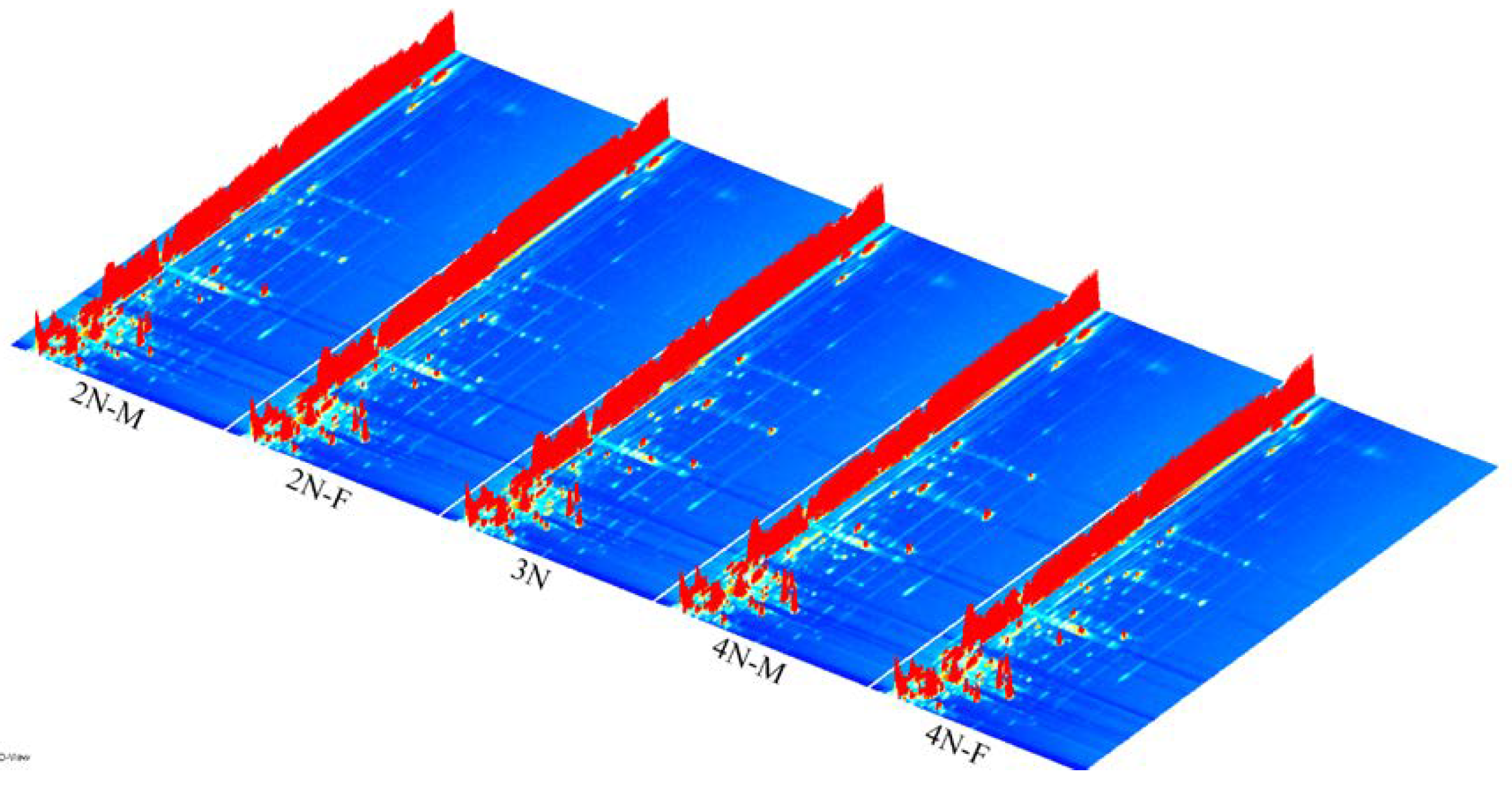
Figure 2.
Two-dimensional top view of five groups of volatile matter in oyster. The x-axis and y-axis indicate the migration time (normalized treatment), and retention time(s), respectively.
Figure 2.
Two-dimensional top view of five groups of volatile matter in oyster. The x-axis and y-axis indicate the migration time (normalized treatment), and retention time(s), respectively.
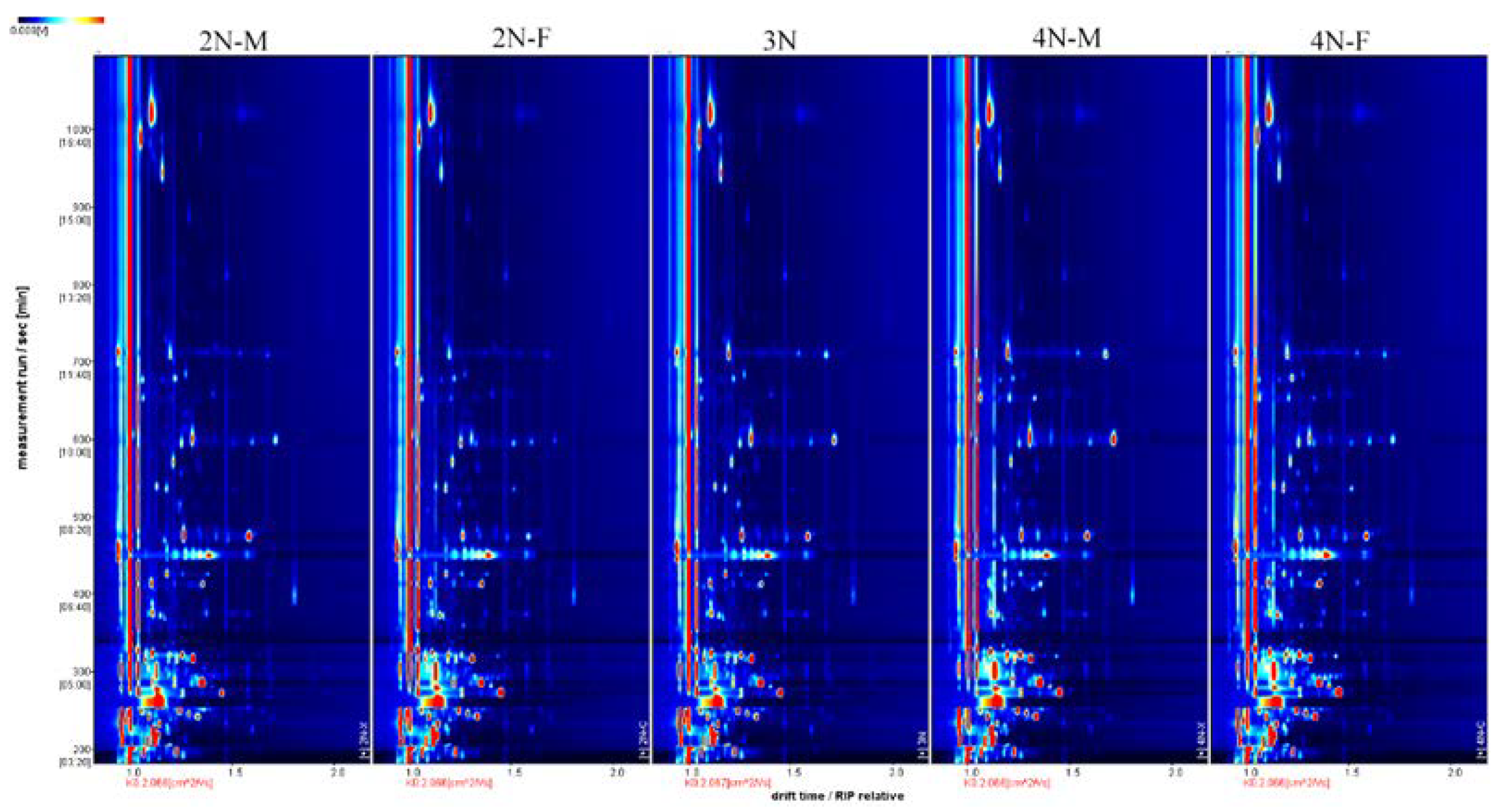
Figure 3.
Comparison and differences in the spectra of volatile components in the five groups of oysters. Using the 2N-M sample as a reference, the comparison shows how all the volatile substances in the sample differ from one sample to another, with red representing a higher concentration of the substance in the sample than the reference sample and blue representing a lower concentration.
Figure 3.
Comparison and differences in the spectra of volatile components in the five groups of oysters. Using the 2N-M sample as a reference, the comparison shows how all the volatile substances in the sample differ from one sample to another, with red representing a higher concentration of the substance in the sample than the reference sample and blue representing a lower concentration.
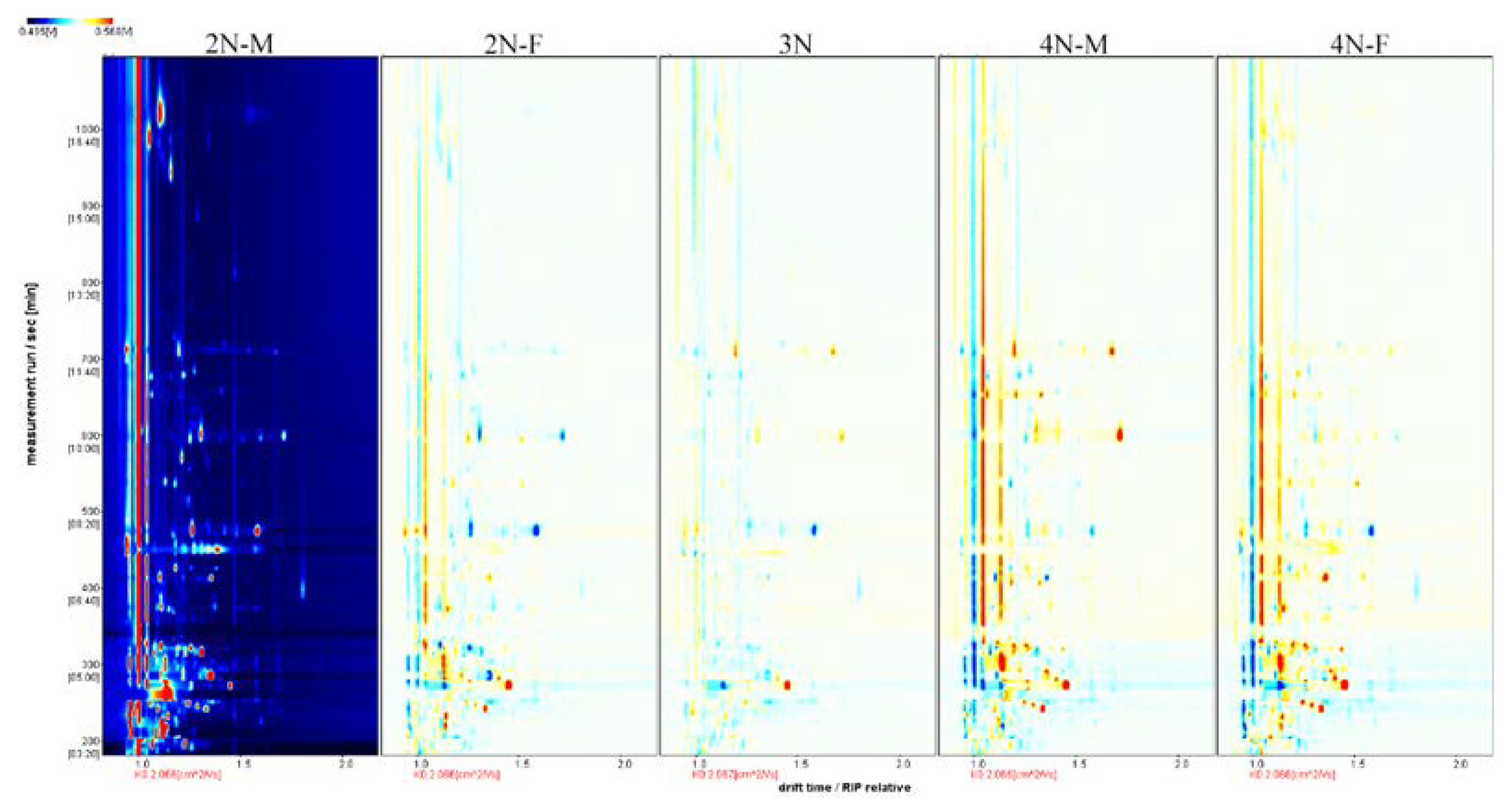
Figure 4.
Qualitative analysis of different oyster samples by GC-IMC with 2N-M was taken as an example. The figures in the figure correspond to those in Table 1.
Figure 4.
Qualitative analysis of different oyster samples by GC-IMC with 2N-M was taken as an example. The figures in the figure correspond to those in Table 1.
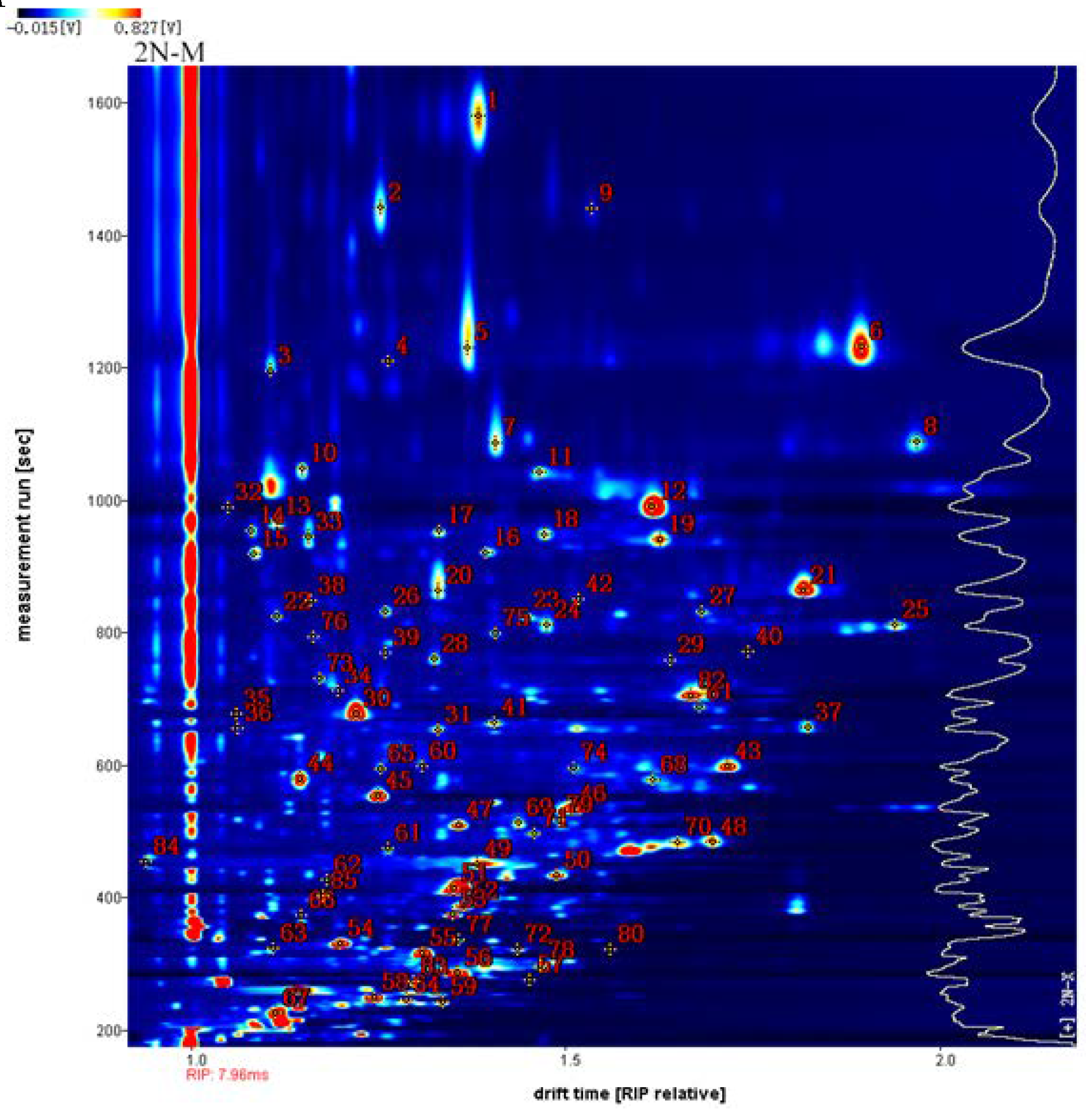
Figure 5.
Comparison of VOCs in oysters from different samples.
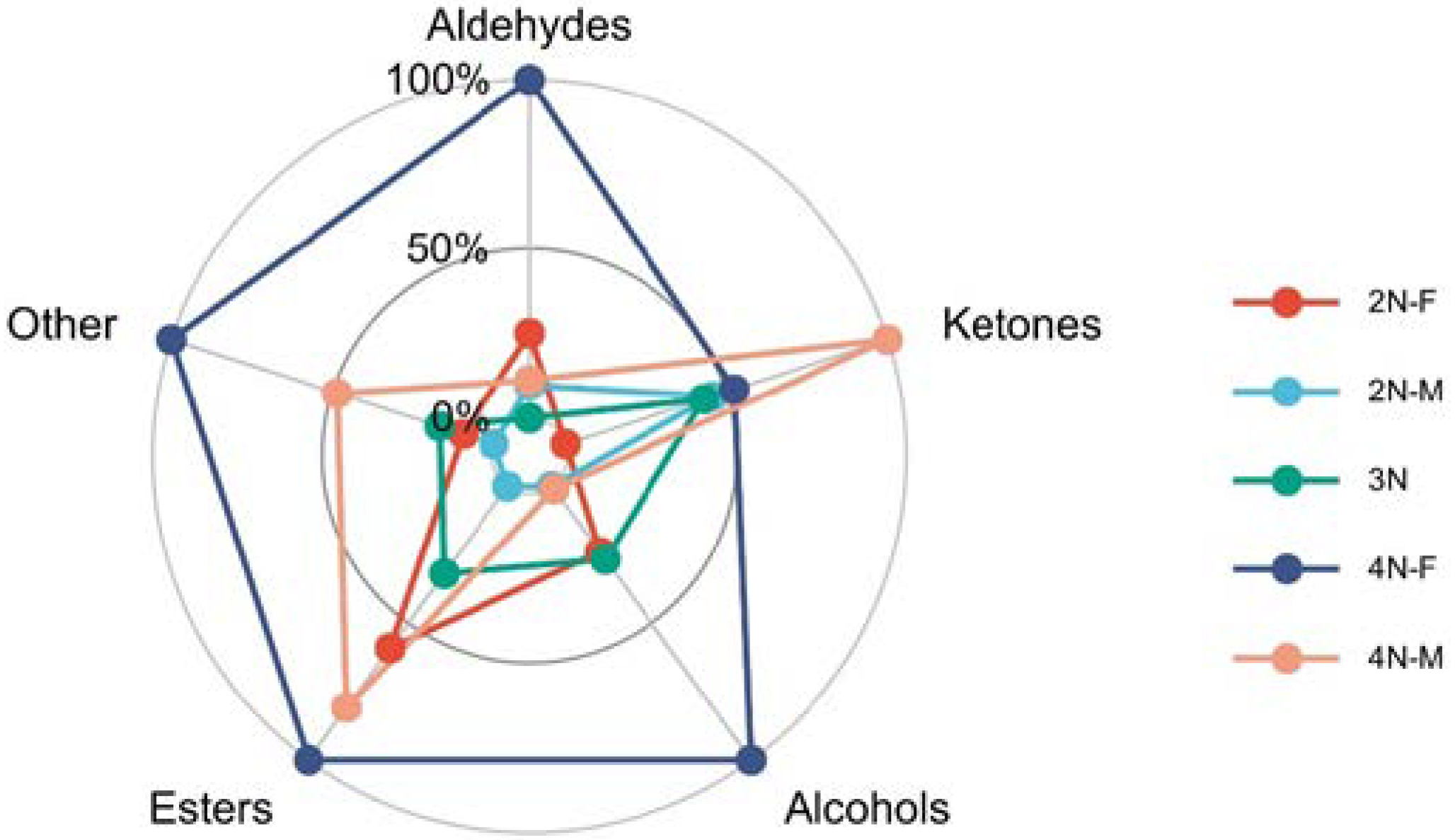
Figure 6.
Oyster sample fingerprints after incubation at 40°C. Each row represents all of the signal peaks that were chosen in a sample and each column depicts the signal peak of the same volatile chemicals in various oyster samples.
Figure 6.
Oyster sample fingerprints after incubation at 40°C. Each row represents all of the signal peaks that were chosen in a sample and each column depicts the signal peak of the same volatile chemicals in various oyster samples.
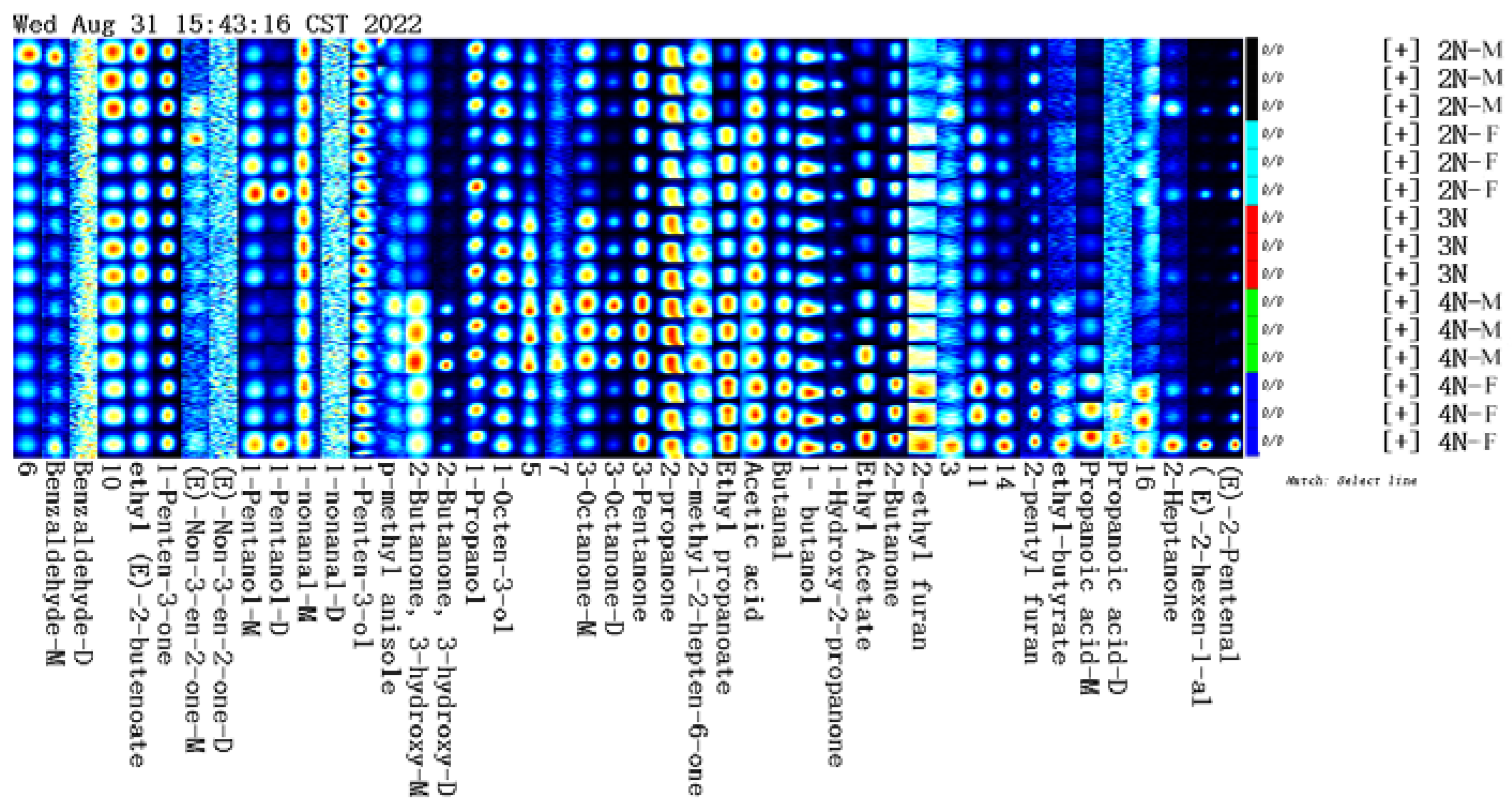
Figure 7.
PCA of VFC profiles among different oysters.
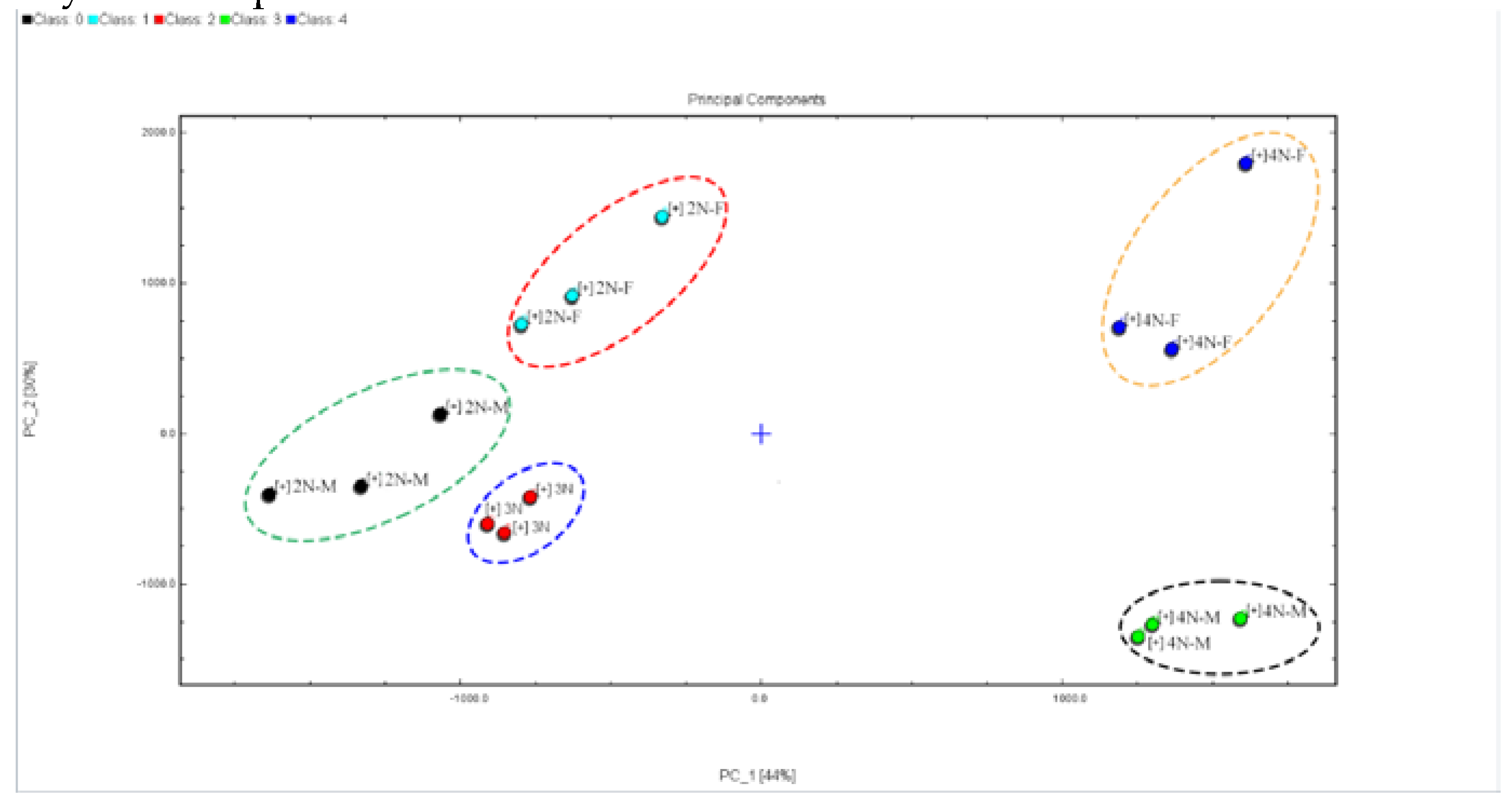

Table 1.
Qualitative GC–IMS results of male and female oysters with different ploidy oysters.
| No.1 | Compound | CAS# | Formula | MWa | RIb | Rtc | Dtd | Commente |
|---|---|---|---|---|---|---|---|---|
| 1 2 3 4 5 6 7 8 9 10 11 12 13 14 15 16 17 20 21 22 23 24 25 28 29 30 31 32 33 36 37 38 41 43 44 45 46 47 48 49 50 51 52 53 54 55 56 57 58 59 60 62 63 64 65 67 68 70 73 74 75 76 79 80 81 82 83 84 85 |
(E, Z)-2,6-nonadienal phenylacetaldehyde Propanoic acid Propanoic acid (E)-Non-3-en-2-one (E)-Non-3-en-2-one (E) -2-nonenal (E) -2-nonenal phenylacetaldehyde Benzaldehyde Benzaldehyde (E, E)-2,4-heptadienal p-methyl anisole Furfural 3-(methylsulfanyl)propanal 3-(methylsulfanyl)propanal Furfural (E)-2-octenal (E)-2-octenal (E, E)-2,4-hexadienal (E, E)-2,4-hexadienal 1-nonanal 1-nonanal 1 -hexanol 1 -hexanol 1-Hydroxy-2-propanone 2-Butanone, 3-hydroxy Acetic acid 1-Octen-3-ol 2-Butanone, 3-hydroxy 1-octanal 2-Ethyl-3-methyl pyrazine butyl pentanoate 3-Octanone (Z)-4-heptenal 2-pentyl furan (E)-2-hexen-1-al 3-Methyl-2-butenal Heptaldehyde 1-butanol (Z)-2-Methylpent-2-enal (E)-2-Pentenal (Z)-2-pentenal (E)-3-penten-2-one (E)-2-butenal 1-Penten-3-one 3-Pentanone Ethyl propanoate 2-Butanone Ethyl Acetate 3-Octanone ethyl (E)-2-butenoate 1-Propanol Butanal 1-Pentanol 2-propanone (Z)-4-heptenal 2-Heptanone 2-methyl-2-hepten-6-one 1-Pentanol 2-Nonanone 2,3,5- trimethylpyrazine 1-Butanol, 3-methyl ethyl-butyrate 1-Octen-3-one (E)-2-Heptenal 2-ethyl furan 1-Penten-3-ol 2-butylfuran |
C557482 C122781 C79094 C79094 C18402830 C18402830 C18829566 C18829566 C122781 C100527 C100527 C4313035 C104938 C98011 C3268493 C3268493 C98011 C2548870 C2548870 C142836 C142836 C124196 C124196 C111273 C111273 C116096 C513860 C64197 C3391864 C513860 C124130 C15707230 C591684 C106683 C6728310 C3777693 C6728263 C107868 C111717 C71363 C623369 C1576870 C1576869 C3102338 C123739 C1629589 C96220 C105373 C78933 C141786 C106683 C623701 C71238 C123728 C71410 C67641 C6728310 C110430 C110930 C71410 C821556 C14667551 C123513 C105544 C4312996 C18829555 C3208160 C616251 C4466244 |
C9H14O C8H8O C3H6O2 C3H6O2 C9H16O C9H16O C9H16O C9H16O C8H8O C7H6O C7H6O C7H10O C8H10O C5H4O2 C4H8OS C4H8OS C5H4O2 C8H14O C8H14O C6H8O C6H8O C9H18O C9H18O C6H14O C6H14O C3H6O2 C4H8O2 C2H4O2 C8H16O C4H8O2 C8H16O C7H10N2 C9H18O2 C8H16O C7H12O C9H14O C6H10O C5H8O C7H14O C4H10O C6H10O C5H8O C5H8O C5H8O C4H6O C5H8O C5H10O C5H10O2 C4H8O C4H8O2 C8H16O C6H10O2 C3H8O C4H8O C5H12O C3H6O C7H12O C7H14O C8H14O C5H12O C9H18O C7H10N2 C5H12O C6H12O2 C8H14O C7H12O C6H8O C5H10O C8H12O |
138.2 120.2 74.1 74.1 140.2 140.2 140.2 140.2 120.2 106.1 106.1 110.2 122.2 96.1 104.2 104.2 96.1 126.2 126.2 96.1 96.1 142.2 142.2 102.2 102.2 74.1 88.1 60.1 128.2 88.1 128.2 122.2 158.2 128.2 112.2 138.2 98.1 84.1 114.2 74.1 98.1 84.1 84.1 84.1 70.1 84.1 86.1 102.1 72.1 88.1 128.2 114.1 60.1 72.1 88.1 58.1 112.2 114.2 126.2 88.1 142.2 122.2 88.1 116.2 126.2 112.2 96.1 86.1 124.2 |
1737.5 1691.5 1597.9 1603.6 1611.9 1612.7 1549.9 1550.3 1691.2 1531.9 1529.3 1503.8 1491.9 1484.8 1466.1 1467.4 1484.2 1434.9 1434.9 1411.6 1413.1 1403.7 1404.0 1370.7 1369.5 1313.6 1294.8 1502.6 1479.7 1296.6 1298.7 1426.5 1304.3 1265.7 1254.7 1239.0 1227.3 1211.6 1194.1 1169.8 1157.3 1139.8 1118.0 1105.9 1053.9 1031.9 985.5 961.9 901.0 884.0 1265.2 1150.4 1043.2 896.2 1263.7 843.9 1254.0 1193.4 1351.1 1264.4 1396.2 1393.1 1216.4 1040.9 1321.3 1333.5 957.8 1171.9 1130.9 |
1580.877 1441.904 1195.785 1209.576 1229.733 1231.854 1086.517 1087.265 1441.125 1048.106 1042.566 990.859 967.468 953.925 918.838 921.301 952.694 863.438 863.438 824.042 826.505 811.116 811.731 759.409 757.562 677.539 652.276 988.507 944.205 654.891 657.566 849.028 665.014 598.497 579.319 552.949 534.114 509.799 484.114 450.824 434.743 413.076 387.568 374.154 331.065 315.212 285.945 274.969 248.547 241.637 597.553 426.075 323.287 246.591 594.974 226.112 578.092 483.056 730.198 596.137 799.107 794.156 517.124 321.634 688.033 704.915 273.08 453.687 402.512 |
1.3853 1.25563 1.10796 1.26464 1.37089 1.89675 1.40871 1.96933 1.53643 1.1505 1.46691 1.6172 1.1157 1.08248 1.08564 1.39572 1.33244 1.33086 1.81812 1.1157 1.44793 1.4764 1.94152 1.32611 1.64093 1.2217 1.3317 1.05136 1.1587 1.06375 1.82562 1.16209 1.40639 1.71809 1.14747 1.25109 1.51085 1.35897 1.69822 1.38425 1.48969 1.35223 1.36614 1.35167 1.20029 1.31048 1.35723 1.45295 1.24704 1.33831 1.30973 1.18305 1.11199 1.28862 1.25483 1.11453 1.61885 1.65086 1.17369 1.51151 1.40828 1.16446 1.49232 1.56149 1.67936 1.6689 1.29858 0.94218 1.17811 |
Monomer Monomer Dimer Monomer Dimer Monomer Dimer Dimer Monomer Dimer Monomer Monomer Dimer Dimer Monomer Dimer Monomer Dimer Monomer Dimer Monomer Dimer Dimer Monomer Dimer Monomer Monomer Monomer Dimer Dimer |
a Represents the molecular mass. b Represents the retention index of volatile components calculated. c Represents the retention time in the capillary GC column (unit: sec). d Represents the drift time in the tube (unit: msec). e Represents the volatile component was monomer or dimer.
Table 2.
GC–IMS-based identification of differences between male and female oysters.
| No. | Compound | The peak volume | P-value | ||||
|---|---|---|---|---|---|---|---|
| 2N-M | 2N-F | 4N-M | 4N-F | ||||
| 3 | Propanoic acid | 104.56±3.98b | 122.28±7.57a | - | - | <0.05 | |
| - | - | 300.06±49.44b | 615.37±103.41a | <0.01 | |||
| 13 | p-methyl anisole | 175.79±12.15a | 94.12±11.26a | - | - | <0.01 | |
| - | - | 164.68±15.94a | 112.81±22.24b | <0.05 | |||
| 21 | (E)-2-octenal | 85.89±7.44a | 70.27±10.64b | - | - | <0.05 | |
| - | - | 88.06±6.30a | 80.31±14.13a | 0.435 | |||
| 23 | (E,E)-2,4-hexadienal | 43.16±2.50a | 56.04±7.30a | - | - | <0.05 | |
| - | - | 47.54±10.81a | 45.02±2.52a | 0.728 | |||
| 30 | 1-Hydroxy-2-propanone | 477.89±44.53a | 324.98±53.87b | - | - | <0.05 | |
| - | - | 342.43±28.23b | 551.35±21.73a | <0.01 | |||
| 31 | 2-Butanone,3-hydroxy | 72.97±7.12b | 93.46±8.48a | - | - | <0.05 | |
| - | - | 234.25±55.86a | 155.55±15.99a | 0.079 | |||
| 32 | Acetic acid | 1576.30±5.72b | 1652.99±16.02a | - | - | <0.01 | |
| - | - | 1760.70±45.02a | 1825.28±37.38a | 0.129 | |||
| 36 | 2-Butanone,3-hydroxy | 95.25±6.71b | 129.73±12.40a | - | - | <0.05 | |
| - | - | 235.27±24.64a | 176.28±9.61b | <0.05 | |||
| 43 | 3-Octanone | 465.51±16.49a | 165.57±2.74b | - | - | <0.01 | |
| - | - | 1676.19±155.93a | 450.18±70.83b | <0.01 | |||
| 45 | 2-pentyl furan | 130.04±8.65a | 99.22±13.44b | - | - | <0.05 | |
| - | - | 114.70±21.40b | 163.59±12.81a | <0.05 | |||
| 49 | 1- butanol | 1062.35±26.96b | 1165.43±13.89a | - | - | <0.01 | |
| - | - | 1227.71±80.73b | 1434.19±13.50a | <0.05 | |||
| 56 | 3-Pentanone | 3463.02±33.01a | 2435.40±75.58a | - | - | <0.01 | |
| - | - | 4518.05±266.45a | 3509.57±578.61a | 0.052 | |||
| 57 | Ethyl propanoate | 815.47±52.01b | 2568.56±54.98a | - | - | <0.01 | |
| - | - | 3093.35±40.73b | 3523.66±107.29a | <0.01 | |||
| 58 | 2-Butanone | 745.20±34.15a | 794.30±46.05a | - | - | 0.212 | |
| - | - | 893.98±33.19b | 1112.21±10.28a | <0.01 | |||
| 60 | 3-Octanone | 850.65±37.88a | 417.32±36.7b | - | - | <0.01 | |
| - | - | 1300.20±43.89a | 652.47±111.80b | <0.01 | |||
| 62 | ethyl (E)-2-butenoate | 379.92±68.51a | 308.87±4.05a | - | - | 0.214 | |
| - | - | 284.01±5.25a | 264.81±7.75b | <0.05 | |||
| 64 | Butanal | 330.81±15.83b | 472.97±56.93a | - | - | <0.05 | |
| - | - | 558.10±48.26b | 662.81±35.06a | <0.05 | |||
| 67 | 2-propanone | 2616.37±52.58a | 2328.45±134.30b | - | - | <0.05 | |
| - | - | 3054.40±95.93a | 2775.62±66.91b | <0.05 | |||
| 73 | 2-methyl-2-hepten-6-one | 78.51±6.50a | 67.43±4.05ab | - | - | 0.067 | |
| - | - | 82.51±4.17a | 66.90±5.42b | <0.05 | |||
| 75 | 2-Nonanone | 59.67±4.50a | 44.86±3.27b | - | - | <0.05 | |
| - | - | 54.25±7.59a | 53.33±7.33a | 0.887 | |||
| 82 | (E)-2-Heptenal | 76.38±6.70a | 57.71±6.00b | - | - | <0.05 | |
| - | - | 332.24±18.93a | 116.55±27.76b | <0.01 | |||
| 83 | 2-ethyl furan | 40.83±7.08b | 71.54±2.00a | - | - | <0.01 | |
| - | - | 81.72±2.01b | 95.48±5.88a | <0.05 | |||
| 85 | 2-butylfuran | 15.21±1.43a | 13.14±1.62a | - | - | 0.173 | |
|
TVOCd |
- 27027.36±1521.508a |
- 26771.64±2015.42a |
53.36±6.71a - 34016.38±953.05a |
20.86±9.20b - 34890.89±2916.28a |
<0.01 0.869 0.647 |
||
e Total volatile organic compounds.
Table 3.
Identification of VOC differences between oysters with different ploidy levels based on GC–IMS analysis.
Table 3.
Identification of VOC differences between oysters with different ploidy levels based on GC–IMS analysis.
| No. | Compound | The peak volume | P-value | |||||
|---|---|---|---|---|---|---|---|---|
| 2N-M | 2N-F | 3N | 4N-M | 4N-F | ||||
| 3 | Propanoic acid | 104.56±3.98c | - | 190.68±30.05b | 300.06±49.44a | - | <0.01 | |
| - | 122.28±7.57b | 190.68±30.05b | - | 615.37±103.41a | <0.01 | |||
| 15 | 3-(methylsulfanyl)propanal | 92.75±0.69b | - | 104.51±3.62a | 103.67±5.93a | - | <0.05 | |
| - | 92.71±4.40b | 104.51±3.62a | - | 102.83±0.82a | <0.05 | |||
| 30 | 1-Hydroxy-2-propanone | 477.89±44.53a | - | 311.82±42.53b | 342.43±28.23b | - | <0.01 | |
| - | 324.98±53.87b | 311.82±42.53b | - | 551.35±21.73a | <0.01 | |||
| 31 | 2-Butanone,3-hydroxy-D | 72.97±7.12b | - | 64.33±10.64b | 234.25±55.86a | - | <0.01 | |
| - | 93.46±8.48b | 64.33±10.64c | - | 155.55±15.99a | <0.01 | |||
| 32 | Acetic acid | 1576.30±5.72c | - | 1641.73±2.81b | 1760.70±45.02a | - | <0.01 | |
| - | 1652.99±16.02b | 1641.73±2.81b | - | 1825.28±37.38a | <0.01 | |||
| 36 | 2-Butanone,3-hydroxy | 95.25±6.71b | - | 90.66±16.97b | 235.27±24.64a | - | <0.01 | |
| - | 129.73±12.40b | 90.66±16.97c | - | 176.28±9.61a | <0.01 | |||
| 43 | 3-Octanone | 465.51±16.49c | - | 700.41±42.92b | 1676.19±155.93a | - | <0.01 | |
| - | 165.57±2.74c | 700.41±42.92a | - | 450.18±70.83b | <0.01 | |||
| 44 | (Z)-4-heptenal | 111.71±38.42b | - | 100.00±21.30b | 202.99±5.99a | - | <0.01 | |
| - | 144.08±37.23b | 100.00±21.30b | - | 244.71±48.97a | <0.01 | |||
| 49 | 1- butanol | 1062.35±26.96b | - | 1129.44±34.33ab | 1227.71±80.73a | - | <0.05 | |
| - | 1165.43±13.89b | 1129.44±34.33b | - | 1434.19±13.50a | <0.01 | |||
| 54 | (E)-2-butenal | 209.26±22.19b | - | 202.55±22.17b | 328.25±25.85a | - | <0.01 | |
| - | 278.55±107.07b | 202.55±22.17b | - | 521.75±157.66a | <0.05 | |||
| 56 | 3-Pentanone | 3463.02±33.01b | - | 2957.40±98.31c | 4518.05±266.45a | - | <0.01 | |
| - | 2435.40±75.58b | 2957.40±98.31ab | - | 3509.57±578.61a | <0.05 | |||
| 57 | Ethyl propanoate | 815.47±52.01c | - | 1969.56±54.98b | 3093.35±40.73a | - | <0.01 | |
| - | 2568.56±54.98b | 1969.56±54.98c | - | 3523.66±107.29a | <0.01 | |||
| 58 | 2-Butanone | 745.20±34.15b | - | 879.82±49.96a | 893.98±33.19a | - | <0.01 | |
| - | 794.30±46.05c | 879.82±49.96b | - | 1112.21±10.28a | <0.01 | |||
| 59 | Ethyl Acetate | 532.94±31.52b | - | 593.64±57.28b | 1378.32±360.09a | - | <0.01 | |
| - | 1057.36±317.92b | 593.64±57.28b | - | 1636.02±316.90a | <0.01 | |||
| 60 | 3-Octanone-M | 850.65±37.88c | - | 1052.75±32.04b | 1300.20±43.89a | - | <0.01 | |
| - | 417.32±36.7c | 1052.75±32.04a | - | 652.47±111.80b | <0.01 | |||
| 62 | ethyl (E)-2-butenoate | 379.92±68.51a | - | 371.75±4.54a | 284.01±5.25b | - | <0.05 | |
| - | 308.87±4.05b | 371.75±4.54a | - | 264.81±7.75c | <0.01 | |||
| 64 | Butanal | 330.81±15.83b | - | 387.23±19.72b | 558.10±48.26a | - | <0.01 | |
| - | 472.97±56.93b | 387.23±19.72c | - | 662.81±35.06a | <0.01 | |||
| 67 | 2-propanone | 2616.37±52.58c | - | 2812.23±76.19b | 3054.40±95.93a | - | <0.01 | |
| - | 2328.45±134.30b | 2812.23±76.19a | - | 2775.62±66.91a | <0.01 | |||
| 80 | ethyl-butyrate | 14.77±2.37ab | - | 13.38±3.50b | 19.84±1.30a | - | <0.05 | |
| - | 14.09±2.05b | 13.38±3.50b | - | 24.56±6.10a | <0.05 | |||
| 82 | (E)-2-Heptenal | 76.38±6.70c | - | 185.52±12.88b | 332.24±18.93a | - | <0.01 | |
| - | 57.71±6.00c | 185.52±12.88a | - | 116.55±27.76b | <0.01 | |||
| 83 | 2-ethyl furan | 40.83±7.08c | - | 59.79±2.36b | 81.72±2.01a | - | <0.01 | |
| - | 71.54±2.00b | 59.79±2.36c | - | 95.48±5.88a | <0.01 | |||
| 84 | 1-Penten-3-ol | 1733.78±17.79b | - | 1821.35±9.59a | 1604.56±20.70c | - | <0.01 | |
| - | 1744.23±8.94b | 1821.35±9.59a | - | 1649.95±25.41c | <0.01 | |||
| TVOC | 27027.36±1521.50b | - | 28222.26±714.81b | 34016.38±953.05a | - | <0.01 | ||
| - | 26771.64±2015.46b | 28222.26±714.81b | - | 34890.89±2916.28a | <0.01 | |||
Disclaimer/Publisher’s Note: The statements, opinions and data contained in all publications are solely those of the individual author(s) and contributor(s) and not of MDPI and/or the editor(s). MDPI and/or the editor(s) disclaim responsibility for any injury to people or property resulting from any ideas, methods, instructions or products referred to in the content. |
© 2023 by the authors. Licensee MDPI, Basel, Switzerland. This article is an open access article distributed under the terms and conditions of the Creative Commons Attribution (CC BY) license (http://creativecommons.org/licenses/by/4.0/).
Copyright: This open access article is published under a Creative Commons CC BY 4.0 license, which permit the free download, distribution, and reuse, provided that the author and preprint are cited in any reuse.


