
Submitted:
06 May 2023
Posted:
08 May 2023
You are already at the latest version
Abstract
Communication and effective interactions are inevitable necessities in every organizational setting. In this era of information and communication technology, where limitations and difficulties in proper communication and interactions between different entities of various organizations have been reduced maximally, the government, stakeholders, and citizens of the different nations should also utilize these available tools in a way to improve the maximum performance in governance through interactions and e-participation between the citizens, stakeholders, and the government parastatals. This research focuses on examining the available and most preferred applications or platforms which encourage the best level of communication and interaction through E-participation among the citizens, stakeholders, and government from the local government lev-el taking Nigeria as a case study
Keywords:
E-participation
; social media
; E-government
; Twitter
; local government
1. Introduction
In every sector, organization, and institution, proper communication is a vital key to relating with one another, and the applicability of proper communication not only fosters understanding and unity but also enhances the level of relationship, trust, and interactions among the parties involved in diverse ways [1,2]. The same principles apply to the government of any nation. Interactions and effective communication between the citizens and the government parastatals are inevitable. In any institution where proper communication is absent, there will be lots of issues, misunderstandings, and a lack of unity. There are several concepts of communication as a form of interchange of emotions, ideologies, thoughts, opinions, or even attitudes, as the case may be, either through verbal or non-verbal mediums between two or more people involved [3]. Communication is not only limited to humans; most living things communicate. One of the major keys to communication is sending information and getting feedback, which is what makes it interactive and not a one-sided opinion [4,5]. According to [6,7] if the government of a country and the leaders of a sect of people neglect or violate the principle of proper communication, there will be chaos, miscommunication, and bad administration, and all of the aforementioned will be inevitable. This is how the concept of communication relates to government, stakeholders, and citizens in a national setting. Proper communication based on good engagement is strongly encouraged to unify and promote synergy between the government (or ruler, as the case may be) and their populace. This is incorporated through interaction and participation, employing all available means.
The recent advancement in technology has geometrically improved over the years, thereby causing numerous changes, ease, and enlightenment in different sectors, and one of the sectors of concern is the public sector. The term e-government is described as the means by which the government adopts a developed web-based internet application alongside other forms of technology to enable quality and sound service delivery between the government and the public. The e-government system is aimed at enhancing positively their major operations in order to promote effective transparency and efficiency in governance [8,9,10]
On a worldwide scale, e-government has grown into a revolutionary tool for the management of public sector organizations. In keeping with current global trends, governments in several African states are familiar with the relevance of information and communications technologies (ICT) and specifically, e-government in promoting the quality of their services and all-inclusive governance productivity in the last ten years. [11,12]. Many African sovereign governments are embracing e-government because it aids in the development of electronic platforms through which individuals get public services and information via electronic means [13,14]. The United Nations e-government Survey is a commonly used benchmark for assessing the e-government initiatives of different nations. The survey goal is aimed at appraising and comparing countries on the extent of their e-government preparation, as well as examining how people utilize and engage with e-Government services [15,16]. According to the latest e-government statistics, Nigeria is one of the lowest users and adoption of E-government with an index of 0.4525, ranking 140 out of 193 nations. Also, the E-participation level. Is. Low but a little bit better with an. Index of 0.3068 ranking 117 out of 193 nations [15,16].
Nigeria is located in the western part of Africa with the highest population of over 200 million and has a total of 36 states and 774 local governments, several attempts have been made in other to introduce and implement a working E-government in Nigeria but have failed due to some barriers and limitations. [17,18,19,20]. Irrespective of the barriers and limitations to the implementation of e-government in Nigeria, the level of E-participation has found a way into the limelight through the evolving technology and social media use and spread in the country. According to [21], Nigeria has a higher level of use of different social networking applications which include Facebook, Twitter, TikTok, WhatsApp, Instagram, YouTube, etc.
Considering the level of internet use and social media involvement level in Nigeria as a whole, and with the geometric way in which technology and information system are advancing, the level of citizens' engagement and e-participation should be a thing of concern, such that advancement to the level of interaction and contributions from both sides of the government, stakeholders and the citizens should have been easily noticed through its effectiveness and should have attained an excellent level of effectiveness.
This research aims to investigate the awareness, adoption, and use of the available e-participation platforms for e-government advancement from the local Government level of Nigeria and verify the most preferred social media platforms which encourage more interaction and participation most especially from the government and their citizens.
This research will propose a way forward to fill the communication gap and to properly highlight the most preferred and effective platform for e-participation which will be a tool for the government to adopt and direct their energy in a way to improve their citizen's engagement and most importantly increase the level of e-government development in the nearest future through social media governance as proposed by [22,23,24].
In the Period of the research, the following research questions were used as a guide during the research.
- Are there e-government platforms utilized by Nigerians from the local government level?
- Has social media increased the level of e-participation and engagement?
- Is Twitter the most preferred means of e-participation?
- Does trust in the government affect the level of e-participation?
Literature Review
The focus on E-government adoption and implementation in Nigeria has drawn the attention of some researchers to a commendable extent. Different research has been conducted in this field. Some of the major research was highlighted. Areas where E-government initiatives have been implemented to improve the efficiency, transparency, and accountability of government processes, include the National e-Government Strategy and Implementation Plan (NeGSP), which was launched in 2017. The NeGSP aims to provide a framework for the development and implementation of e-government initiatives across all levels of government in Nigeria. It identifies key areas for intervention, including the development of e-services, the establishment of a national data center, the implementation of a national identity management system, and the promotion of open data. Another important e-government initiative in Nigeria is the Treasury Single Account (TSA) system [32,35,36]. Another one is the Federal Road Safety Corps (FRSC) which has developed an online platform for the issuance of driver's licenses and vehicle registration, which has reduced the time and cost required to obtain these documents. The National Identity Management Commission (NIMC) has also developed an online platform for the registration and issuance of national identity cards, which has improved the accuracy and reliability of identity data in Nigeria.
Despite these achievements, there are still challenges to the effective implementation of e-government in Nigeria. One of the major challenges is the lack of adequate ICT infrastructure and connectivity, particularly in rural areas. This has limited the reach and impact of e-government initiatives in Nigeria and has hindered the participation of citizens in digital governance processes. In addition, there is a need for greater collaboration and coordination among government agencies in the implementation of e-government initiatives, as well as the need for capacity building and skills development among government officials and citizens. [35,36]
There have been several studies conducted on e-government in Nigeria, which have focused on various aspects of e-government implementation and its impact on government processes, citizen participation, and service delivery. In this analysis, we will review some of the key findings and recommendations from these studies. A study by [25] examined the challenges and prospects of e-government implementation in Nigeria. The study identified a lack of political will, inadequate ICT infrastructure and connectivity, poor data management, and inadequate funding as some of the major challenges facing e-government implementation in Nigeria. The study recommended the need for sustained political commitment, capacity building, and skills development, and the establishment of a dedicated e-government agency to coordinate and oversee e-government initiatives in Nigeria.
Another study by [26,37] examined the impact of e-government on citizen participation in Nigeria. The study found that while e-government initiatives have the potential to increase citizen participation in governance processes, there are several barriers to its effective implementation, including limited access to ICT infrastructure, low levels of digital literacy, and a lack of trust in government institutions. The study recommended the need for greater investment in ICT infrastructure, the development of user-friendly e-services, and the promotion of citizen engagement and participation in e-government processes.
A study by [27]. examined the factors influencing the adoption of e-government services in Nigeria. The study found that perceived usefulness, perceived ease of use, perceived risk, and trust were significant predictors of e-government adoption in Nigeria. The study recommended the need for the development of user-friendly e-services, the provision of adequate ICT infrastructure and connectivity, and the establishment of trust and credibility in e-government processes.
A study by [28] examined the impact of e-government on service delivery in Nigeria. The study found that e-government initiatives have the potential to improve the efficiency, transparency, and accountability of government processes, and to enhance the quality of public services. However, the study also identified several challenges facing e-government implementation in Nigeria, including inadequate funding, poor data management, and a lack of political will. The study recommended the need for sustained political commitment, adequate funding, and the establishment of effective data management systems to support e-government initiatives in Nigeria. Overall, these studies highlight the significant potential of e-government to improve government processes and service delivery in Nigeria.
With the level of research conducted already, there are still several gaps to be filled regarding the development and optimum adoption of e-government opportunities. This research mainly focuses on the level of awareness, adoption, and participation in e-government in Nigeria.
2. Materials and Methods
This study aims to apply a quantitative research methodological approach with the processes of data collection, analysis, evaluation, and justification. Approximately about eighty million (80m) Nigerians inhabit the four geopolitical zones involved in this study; each consisting of about twenty million Nigerians. The Populations sample comprises the Local Governments in the States present in the four (4) Geopolitical zones in Nigeria namely: South West, North West, South-South, and South East. The primary source of data collection was employed using the online Google form and adopting the 5-point Likert scale method. The questionnaires were administered and filled by participants from the various geopolitical zones and collated. Relevant Questions were included in the questionnaire putting the research questions into consideration and respondents' consent was requested in the design of the questionnaire. A total (1000+) thousand responders across the four geopolitical zones selected were targeted to fill the distributed questionnaires and their responses were analyzed using Statistical Package.
Inclusion And Exclusion Criteria: The remaining two Geopolitical zones which are North Central and North East were not covered due to the insecurity in those regions. Although, the situation could not have affected the online distribution of questionnaires but could create biases in the mind of the responders when filling out the forms. Furthermore, the four Geopolitical zones South West, North West, South-South, and South East are considered based on the information and Communications Technology (ICT) exposure and social media (SM) engagement which were reported to be higher in those regions [29,30].
3. Results
The following are the finding which was obtained after the analysis of the collected data. The collected data was analyzed using SPSS. We consider the hypothesis:
Null Hypothesis: There is no correlation between the use of Twitter in a local government and the level of e-participation.
There is no correlation between the use of social media in a local government and the level of trust from citizens to their government.
Alternative Hypothesis: There is an association between the use of Twitter in a local government and the level of e-participation.
There is an association between the use of social media in a local government and the level of trust from citizens to their government.
Firstly, the reliability of the questionnaire was tested using Cronbach's Alpha whereby the alpha value of the questionnaire should be between the values 0.9 and 0.6 for acceptability. Here, the alpha value is 0.723, (Table 1) which implies that the questionnaire is reliable.
Although, Cronbach’s alpha measuring reliability can be as high as 0.9 which is regarded as the best acceptable value, and could also be as low as 0.5 or less, which is considered to be very poor and unacceptable.
The use of social media has been argued to affect the level of e-participation among citizens in the selected LGs; thus,
Figure 1.
Percentage frequency of social media (SM) users for E-participation in the selected Geopolitical zones.
Figure 1.
Percentage frequency of social media (SM) users for E-participation in the selected Geopolitical zones.
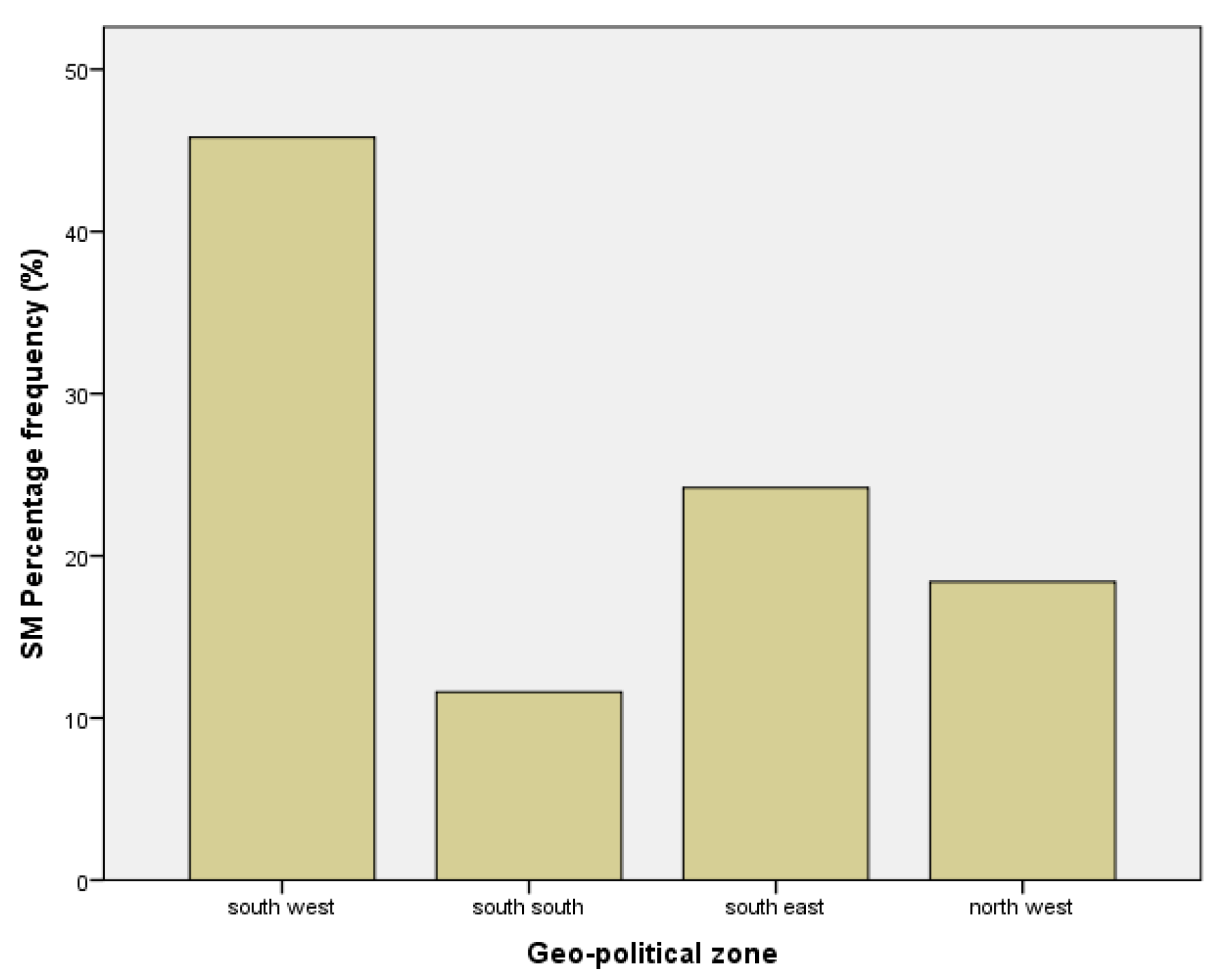
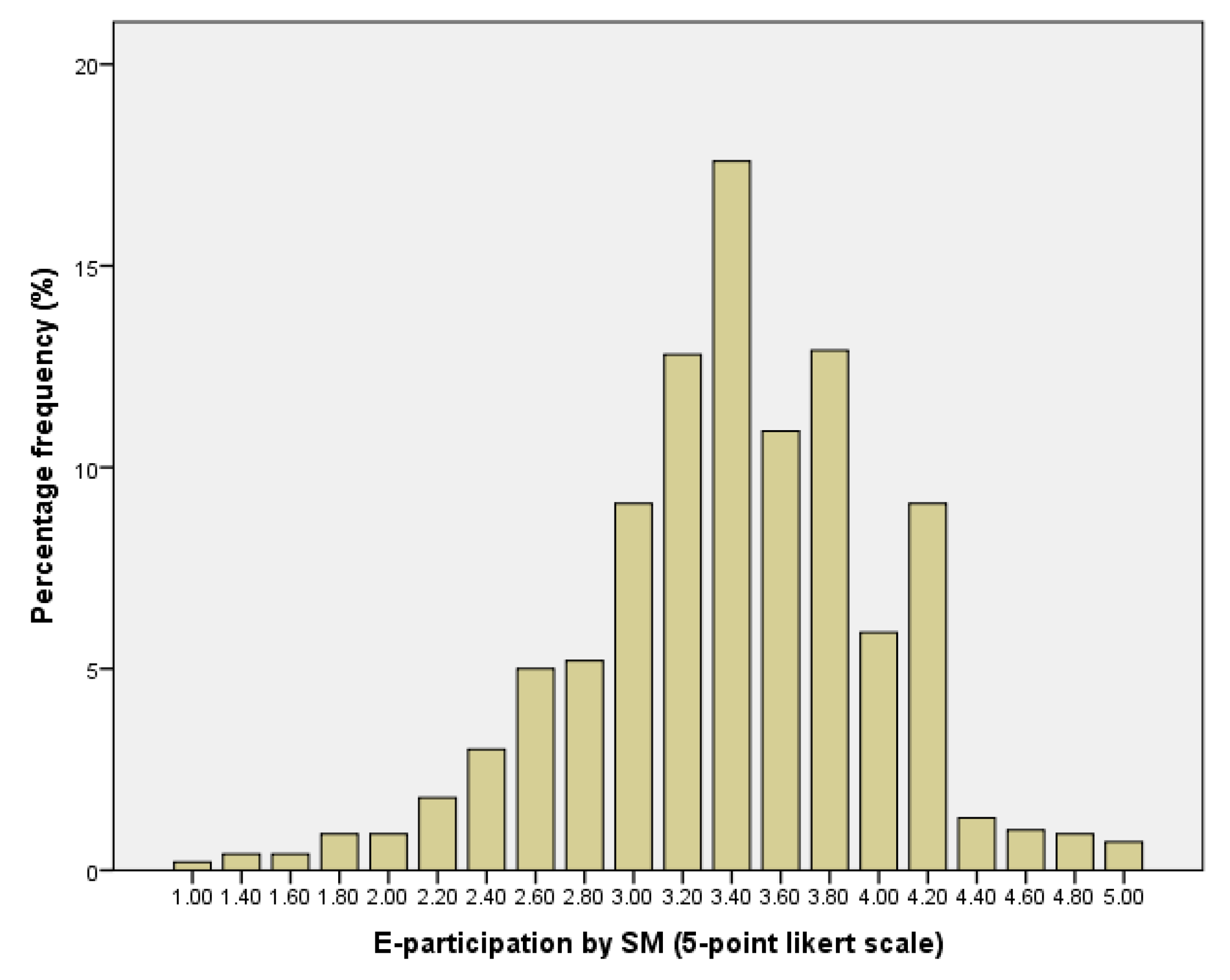
Figure 2.
The skewness of the Percentage frequency of the mean by the Likert scale of Social Media users for E-participation.
Figure 2.
The skewness of the Percentage frequency of the mean by the Likert scale of Social Media users for E-participation.
In this study, Figure 1 above shows the number of social media (SM) users channeled for e-participation in the selected Geopolitical zones.
The actual value of skewness shown below (Table 2) is -0.417 which implies that the distribution is fairly symmetrical. A skewness value that lies between 1 and 0.5 or -0.5 and -1 can be said to be moderately skewed while a value between -0.5 and 0.5 is said to be fairly symmetrical.
The skewness value lies between 0 and -0.5 depicting that the distribution is moderately skewed and fairly symmetrical. (Skewness is the measurement of how symmetrical a distribution is, which explains how symmetric or identical the right and left sides of the graph are with each other).
The standard deviation between the means of the variables e-participation and Government Trust is shown in Table 3 below.
The value of the standard deviation for e-participation is 0.6 which implies that the sample mean of 3.4 is within 0.6 of the actual population mean. This also, virtually means that about 20% of the normally distributed data lies between the mean and 0.6 standard deviations to the right of the mean.
Table 3 and Table 4 show the standard deviation of gender, age, employment, geopolitical zone, Twitter users, e-participation, and government trust
3.1. Factor Analysis
Factor Analysis is the process of reducing the dimension of items in a sample where the number of variables is numerous. Here, a set of variables (24) will be reduced into dimensions or super variables by loading a set of characteristic factors together. If the group of items loads together on the same construct using a factor loading element, that implies true correlation. In other words, this factor analysis will help determine the correlation between the numerous variables.
On the Statistical Package software, the following were analyzed as shown below. Table 5-10 shows the correlation matrix between variables. Between the same variable, there is a singularity of unity (1.000), while other values show the correlation between different variables.

Table 5.
Correlation Matrix Between All Variables.
| SM use | info use | IT SM use | SM as evolving tool | SM use for LG ePart | Govt trust | ||
|---|---|---|---|---|---|---|---|
| Correlation | SM use | 1.000 | 0.063 | -0.219 | -0.327 | -0.262 | -0.160 |
| info use | 0.063 | 1.000 | 0.073 | 0.030 | 0.018 | 0.109 | |
| IT SM use | -0.219 | 0.073 | 1.000 | 0.594 | 0.467 | 0.170 | |
| SM as evolving tool | -0.327 | 0.030 | 0.594 | 1.000 | 0.530 | 0.208 | |
| SM use for LG ePart | -0.262 | 0.018 | 0.467 | 0.530 | 1.000 | 0.321 | |
| Govt trust | -0.160 | 0.109 | 0.170 | 0.208 | 0.321 | 1.000 | |
| -0.085 | 0.163 | 0.100 | 0.082 | 0.234 | 0.319 | ||
| -0.055 | -0.030 | 0.231 | 0.211 | 0.151 | 0.115 | ||
| -0.105 | 0.266 | 0.052 | 0.020 | 0.077 | 0.175 | ||
| -0.431 | 0.027 | 0.389 | 0.492 | 0.378 | 0.235 | ||
| -0.131 | 0.106 | 0.074 | 0.025 | 0.087 | 0.192 | ||
| -0.158 | 0.151 | 0.062 | 0.087 | 0.086 | 0.180 | ||
| -0.049 | 0.199 | -0.103 | -0.149 | -0.023 | 0.160 | ||
| -0.108 | 0.149 | -0.101 | -0.110 | 0.004 | 0.231 | ||
| -0.252 | 0.113 | 0.218 | 0.275 | 0.265 | 0.178 | ||
| 0.328 | 0.006 | -0.035 | -0.079 | -0.071 | -.0.063 | ||
| -0.056 | 0.209 | 0.003 | -0.029 | 0.052 | 0.187 | ||
| -0.177 | 0.171 | 0.035 | 0.111 | 0.130 | 0.187 | ||
| -0.012 | 0.221 | -0.156 | -0.205 | -0.051 | 0.197 | ||
| -0.062 | 0.164 | -0.124 | -0.119 | -0.006 | 0.215 | ||
| -0.247 | 0.125 | 0.105 | 0.159 | 0.205 | 0.196 | ||
| 0.384 | 0.036 | -0.102 | -0.161 | -0.127 | -0.106 | ||
| -0.281 | 0.088 | 0.373 | 0.365 | 0.339 | 0.196 | ||
| -0.458 | 0.011 | 0.412 | 0.452 | 0.411 | 0.240 | ||
Table 6.
Correlation Matrix Between All Variables.
| Inc eGov dev | bad attitude of leaders | SM penetration rate | SM types | prefer Twitter | preferFacebook | ||
|---|---|---|---|---|---|---|---|
| Correlation | -0.085 | -0.055 | -0.105 | -0.431 | -0.131 | -0.158 | |
| 0.163 | -0.030 | 0.266 | 0.027 | 0.106 | 0.151 | ||
| 0.100 | 0.231 | 0.052 | 0.389 | 0.074 | 0.062 | ||
| 0.082 | 0.211 | 0.020 | 0.492 | 0.025 | 0.087 | ||
| 0.234 | 0.151 | 0.077 | 0.378 | 0.087 | 0.086 | ||
| 0.319 | 0.115 | 0.175 | 0.235 | 0.192 | 0.180 | ||
| Inc eGov dev | 1.000 | 0.208 | 0.357 | 0.139 | 0.160 | 0.179 | |
| bad attitude of leaders | 0.208 | 1.000 | 0.072 | 0.204 | 0.001 | -0.019 | |
| SM penetration rate | 0.357 | 0.072 | 1.000 | 0.187 | 0.227 | 0.237 | |
| SM types | 0.139 | 0.204 | 0.187 | 1.000 | 0.171 | 0.229 | |
| prefer Twitter | 0.160 | 0.001 | 0.227 | 0.171 | 1.000 | 0.222 | |
| preferFacebook | 0.179 | -0.019 | 0.237 | 0.229 | 0.222 | 1.000 | |
| 0.183 | -0.105 | 0.277 | -0.011 | 0.360 | 0.403 | ||
| 0.198 | -0.122 | 0.301 | 0.032 | 0.336 | 0.399 | ||
| 0.201 | 0.033 | 0.231 | 0.289 | 0.052 | 0.297 | ||
| -0.067 | 0.058 | -0.107 | -0.219 | -0.109 | -0.144 | ||
| 0.188 | -0.070 | 0.310 | 0.065 | 0.385 | 0.149 | ||
| 0.203 | 0.049 | 0.298 | 0.208 | 0.156 | 0.392 | ||
| 0.220 | -0.132 | 0.322 | -0.010 | 0.311 | 0.239 | ||
| 0.246 | -0.050 | 0.315 | 0.041 | 0.318 | 0.245 | ||
| 0.205 | -0.020 | 0.271 | 0.280 | 0.154 | 0.271 | ||
| -0.013 | 0.047 | -0.093 | -0.294 | -0.138 | -0.138 | ||
| 0.110 | 0.139 | 0.178 | 0.416 | 0.176 | 0.157 | ||
| 0.108 | 0.113 | 0.086 | 0.506 | 0.154 | 0.194 |
Table 7.
Correlation Matrix Between All Variables.
| preferInstagram | preferTelegram | preferWhatsApp | another effective SM | Twitter most in my LG | Facebook most my LG | ||
|---|---|---|---|---|---|---|---|
| -0.049 | -0.108 | -0.252 | 0.328 | -0.056 | -0.177 | ||
| Correlation | 0.199 | 0.149 | 0.113 | 0.006 | 0.209 | 0.171 | |
| -0.103 | -0.101 | 0.218 | -0.035 | 0.003 | 0.035 | ||
| -0.149 | -0.110 | 0.275 | -0.079 | -0.029 | 0.111 | ||
| -0.023 | 0.004 | 0.265 | -0.071 | 0.052 | 0.130 | ||
| 0.160 | 0.231 | 0.178 | -0.063 | 0.187 | 0.187 | ||
| 0.183 | 0.198 | 0.201 | -0.067 | 0.188 | 0.203 | ||
| -0.105 | -0.122 | 0.033 | 0.058 | -0.070 | 0.049 | ||
| 0.277 | 0.301 | 0.231 | -0.107 | 0.310 | 0.298 | ||
| -0.011 | 0.032 | 0.289 | -0.219 | 0.065 | 0.208 | ||
| 0.360 | 0.336 | 0.052 | -0.109 | 0.385 | 0.156 | ||
| 0.403 | 0.399 | 0.297 | -0.144 | 0.149 | 0.392 | ||
| Prefer Instagram | 1.000 | 0.581 | 0.244 | -0.069 | 0.320 | 0.242 | |
| Prefer Telegram | 0.581 | 1.000 | 0.311 | -0.086 | 0.325 | 0.293 | |
| preferWhatsApp | 0.244 | 0.311 | 1.000 | -0.065 | 0.186 | 0.263 | |
| another effective SM | -0.069 | -0.086 | -0.065 | 1.000 | -0.015 | -0.120 | |
| Twitter most in my LG | 0.320 | 0.325 | 0.186 | -0.015 | 1.000 | 0.251 | |
| Facebook most my LG | 0.242 | 0.293 | 0.263 | -0.120 | 0.251 | 1.000 | |
| 0.538 | 0.487 | 0.206 | -0.086 | 0.471 | 0.375 | ||
| 0.437 | 0.566 | 0.209 | -0.118 | 0.426 | 0.359 | ||
| 0.225 | 0.274 | 0.475 | -0.201 | 0.242 | 0.377 | ||
| 0.003 | -0.088 | -0.191 | 0.511 | -0.032 | -0.114 | ||
| 0.036 | 0.048 | 0.241 | -0.152 | 0.133 | 0.211 | ||
| 0.054 | 0.087 | 0.308 | -0.258 | 0.066 | 0.191 |
Table 8.
Correlation Matrix Between All Variables.
| Instagram most in my LG | Telegram most in my LG | WhatsApp most in my LG | another SM in my LG | SM inc E-participation | More effort in my LG | ||
|---|---|---|---|---|---|---|---|
| Correlation | -0.012 | -0.062 | -0.247 | 0.384 | -0.281 | -0.458 | |
| 0.221 | 0.164 | 0.125 | 0.036 | 0.088 | 0.011 | ||
| -0.156 | -0.124 | 0.105 | -0.102 | 0.373 | 0.412 | ||
| -0.205 | -0.119 | 0.159 | -0.161 | 0.365 | 0.452 | ||
| -0.051 | -0.006 | 0.205 | -0.127 | 0.339 | 0.411 | ||
| 0.197 | 0.215 | 0.196 | -0.106 | 0.196 | 0.240 | ||
| 0.220 | 0.246 | 0.205 | -0.013 | 0.110 | 0.108 | ||
| -0.132 | -0.050 | -0.020 | 0.047 | 0.139 | 0.113 | ||
| 0.322 | 0.315 | 0.271 | -0.093 | 0.178 | 0.086 | ||
| -0.010 | 0.041 | 0.280 | -0.294 | 0.416 | 0.506 | ||
| 0.311 | 0.318 | 0.154 | -0.138 | 0.176 | 0.154 | ||
| 0.239 | 0.245 | 0.271 | -0.138 | 0.157 | 0.194 | ||
| 0.538 | 0.437 | 0.225 | 0.003 | 0.036 | 0.054 | ||
| 0.487 | 0.566 | 0.274 | -0.088 | 0.048 | 0.087 | ||
| 0.206 | 0.209 | 0.475 | -0.191 | 0.241 | 0.308 | ||
| -0.086 | -0.118 | -0.201 | 0.511 | -0.152 | -0.258 | ||
| 0.471 | 0.426 | 0.242 | -0.032 | 0.133 | 0.066 | ||
| 0.375 | 0.359 | 0.377 | -0.114 | 0.211 | 0.191 | ||
| Instagram most in my LG | 1.000 | 0.649 | 0.313 | -0.022 | 0.031 | 0.004 | |
| Telegram most in my LG | 0.649 | 1.000 | 0.343 | 0.008 | 0.081 | -0.001 | |
| WhatsApp most in my LG | 0.313 | 0.343 | 1.000 | -0.136 | 0.272 | 0.297 | |
| another SM in my LG | -0.022 | 0.008 | -0.136 | 1.000 | -0.154 | -0.349 | |
| SM inc E-participation | 0.031 | 0.081 | 0.272 | -0.154 | 1.000 | 0.523 | |
| More effort in my LG | 0.004 | -0.001 | 0.297 | -0.349 | 0.523 | 1.000 |
Table 9.
Correlation between the variable groups.
| Correlations | ||||||||
|---|---|---|---|---|---|---|---|---|
| gender | age | Employment | Geo-political zone | E-participation by SM | Twitter most in my LG | Govt. trust | ||
| Gender | Pearson Correlation | 1 | 0.019 | 0.062 | 0.033 | 0.011 | -0.010 | -0.029 |
| Sig. (2-tailed) | 0.551 | 0.051 | 0.295 | 0.718 | 0.747 | 0.362 | ||
| N | 1000 | 1000 | 1000 | 1000 | 1000 | 1000 | 1000 | |
| age | Pearson Correlation | 0.019 | 1 | 0.008 | -0.186** | -0.046 | 0.057 | 0.024 |
| Sig. (2-tailed) | 0.551 | 0.797 | 0.000 | 0.143 | 0.072 | 0.445 | ||
| N | 1000 | 1000 | 1000 | 1000 | 1000 | 1000 | 1000 | |
| employment | Pearson Correlation | 0.062 | 0.008 | 1 | 0.141** | -0.010 | -0.030 | -0.101** |
| Sig. (2-tailed) | 0.051 | 0.797 | 0.000 | 0.741 | 0.338 | .001 | ||
| N | 1000 | 1000 | 1000 | 1000 | 1000 | 1000 | 1000 | |
| Geo-political zone | Pearson Correlation | 0.033 | -0.186** | 0.141** | 1 | 0.101** | -0.093** | -0.116** |
| Sig. (2-tailed) | 0.295 | .000 | 0.000 | 0.001 | 0.003 | 0.000 | ||
| N | 1000 | 1000 | 1000 | 1000 | 1000 | 1000 | 1000 | |
| E participation by SM | Pearson Correlation | 0.011 | -0.046 | -0.010 | 0.101** | 1 | 0.066* | 0.231** |
| Sig. (2-tailed) | 0.718 | 0.143 | 0.741 | 0.001 | 0.037 | 0.000 | ||
| N | 1000 | 1000 | 1000 | 1000 | 1000 | 1000 | 1000 | |
| Twitter most in my LG | Pearson Correlation | -0.010 | 0.057 | -0.030 | -0.093** | .066* | 1 | 0.187** |
| Sig. (2-tailed) | 0.747 | 0.072 | 0.338 | 0.003 | .037 | 0.000 | ||
| N | 1000 | 1000 | 1000 | 1000 | 1000 | 1000 | 1000 | |
| Govt trust | Pearson Correlation | -0.029 | 0.024 | -0.101** | -0.116** | 0.231** | 0.187** | 1 |
| Sig. (2-tailed) | 0.362 | 0.445 | 0.001 | 0.000 | 0.000 | 0.000 | ||
| N | 1000 | 1000 | 1000 | 1000 | 1000 | 1000 | 1000 | |
| **. Correlation is significant at the 0.01 level (2-tailed). | ||||||||
| *. Correlation is significant at the 0.05 level (2-tailed). | ||||||||
Correlations above 0.8 are termed multicollinearity. Thus, the accepted range for correlation is between 0.00001 and 0.8. Any variable with a value outside this range is ejected.
Table 10 shows the Kaiser-Meyer-Olkin (KMO) measure of sampling adequacy and Bartlett's test of sphericity. More importantly, we consider the KMO value as seen in Table 10. The accepted KMO range of value is 0.5 minimum, which is fairly accepted and 0.9 maximum, which is a perfect KMO value. Here we have a KMO value of 0.859, which shows that our data is highly acceptable.
Table 10.
The Kaiser-Meyer-Olkin (KMO) and Bartlett’s Test.
| KMO and Bartlett's Test | ||
| Kaiser-Meyer-Olkin Measure of Sampling Adequacy. | 0.859 | |
| Bartlett's Test of Sphericity | Approx. Chi-Square | 7616.448 |
| df | 276 | |
| Sig. | >0.0001 | |
The degree of freedom (df) shows a value of 276 which depicts a high chance of rejecting the null hypothesis (Ho). The level of significance (sig.) is less than 0.0001 which relates to a higher chance of rejecting Ho The commonalities table in Table 11 explains the level of acceptance across all variables where the acceptable standard value of extraction is 0.3 and above. Thus, Table 3 clearly shows that all variables are acceptable for the research
Table 11.
Communalities Table.
| Communalities | ||
| Initial | Extraction | |
| SM use | 1.000 | 0.522 |
| info use | 1.000 | 0.651 |
| IT SM use | 1.000 | 0.621 |
| SM as evolving tool | 1.000 | 0.666 |
| SM use for LG ePart | 1.000 | 0.548 |
| Govt trust | 1.000 | 0.458 |
| Inc eGov dev | 1.000 | 0.642 |
| bad attitude of leaders | 1.000 | 0.525 |
| SM penetration rate | 1.000 | 0.568 |
| SM types | 1.000 | 0.550 |
| prefer Twitter | 1.000 | 0.648 |
| preferFacebook | 1.000 | 0.417 |
| preferInstagram | 1.000 | 0.589 |
| preferTelegram | 1.000 | 0.653 |
| preferWhatsApp | 1.000 | 0.601 |
| another effective SM | 1.000 | 0.687 |
| Twitter most in my LG | 1.000 | 0.553 |
| Facebook most my LG | 1.000 | 0.457 |
| Instagram most in my LG | 1.000 | 0.645 |
| Telegram most in my LG | 1.000 | 0.601 |
| WhatsApp most in my LG | 1.000 | 0.532 |
| another SM in my LG | 1.000 | 0.669 |
| SM inc E-participation | 1.000 | 0.490 |
| More effort in my LG | 1.000 | 0.623 |
| Extraction Method: Principal Component Analysis. | ||
Figure 3.
Scree Plot.
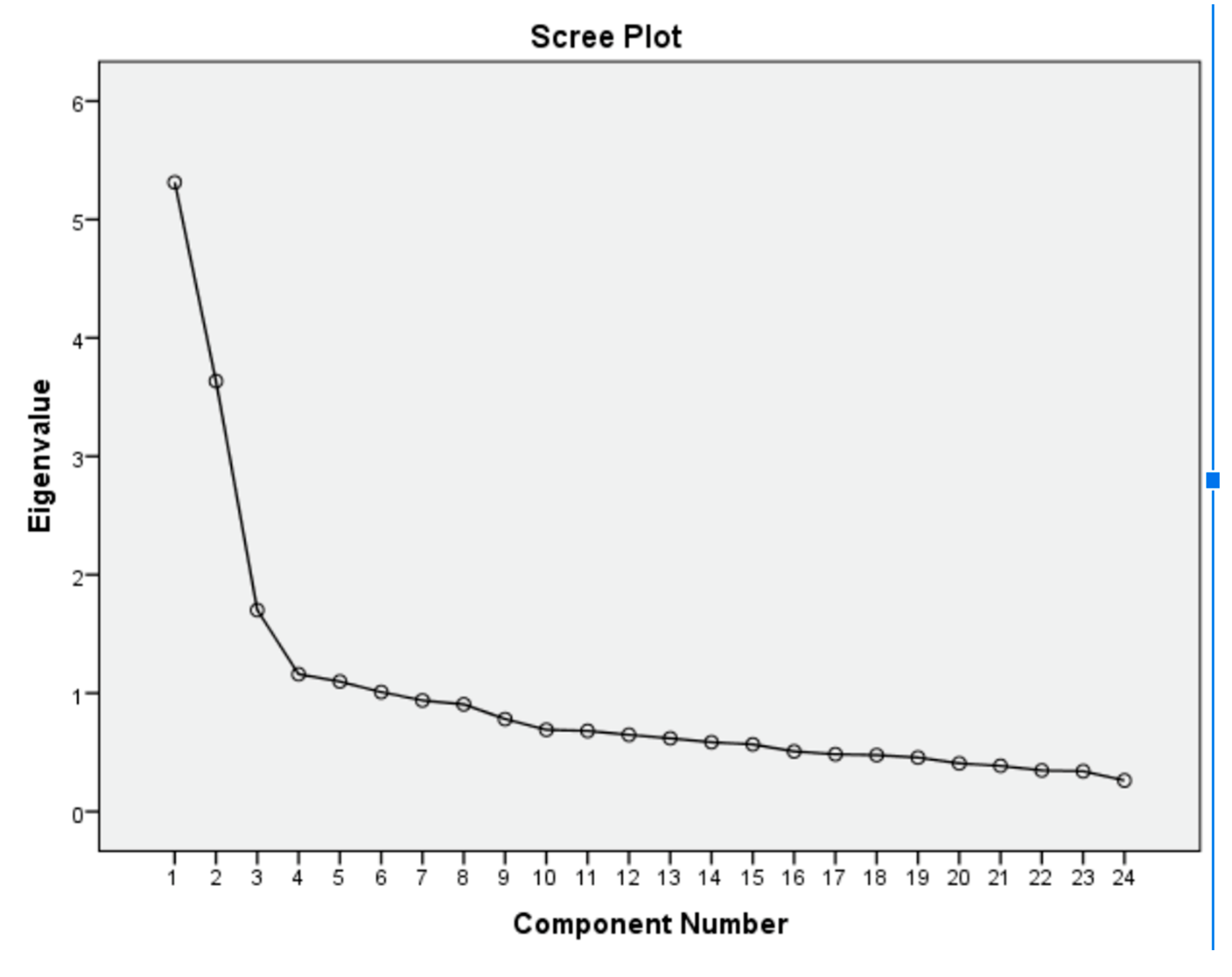
Furthermore, we use the scree plot in Figure 3 above to observe Total Variance Explained in Table 12.
The eigenvalue represents the total amount of variance that can be attributed to a variable. It is also known as characteristic value. The eigenvalue is set at 1. Thus, only variables above 1 eigenvalue on the scree plot will be considered on the Total Variance table. Only six components cross the value 1 on the scree plot. Therefore, the cumulative frequency of the six components in Table 13 shows 57.983 percent which is well above the minimum accepted value of 50 percent.
Finally, in Table 13, the Rotated Component Matrix shows how the components of variables are loaded together, this means the two or more variables that are loaded together can be categorized on the same construct.
The Varimax orthogonal rotation was used in this factor analysis, which converged in eight iterations. Ideally, values that are closer to each other will load together for convergence validity, but too-low values like below 0.5 are normally not considered. As we see in Table 5, the variables with social media (SM) use load together strongly (0.771, 0.788, and 0.684). Most usage of Twitter, Instagram, and Telegram also load together, likewise preferences for SM channels (between 0.739 to 0.649). Another good loading is the increase of e-governance development and bad attitude of leaders (0.735 and 0.663), likewise loading together of "social media increased participation" and "more effort in my local government" (0.636 and 0.676)
Table 14.
Paired Samples Statistics of E-participation and Most Twitter Users.
| Paired Samples Statistics | |||||
|---|---|---|---|---|---|
| Mean | N | Std. Deviation | Std. Error Mean | ||
| Pair 1 | E-participation on SM | 3.3986 | 1000 | 0.61261 | 0.01937 |
| Twitter most in my LG | 3.36 | 1000 | 1.317 | 0.042 | |
Table 15.
Correlation between E-participation and most Twitter User.
| Paired Samples Correlations | ||||
|---|---|---|---|---|
| N | Correlation | Sig. | ||
| Pair 1 | E-participation by SM & Twitter most in my LG | 1000 | 0.066 | 0.037 |
4. Discussion
The effect of social media on governance has been emphasized over the years but this study sheds light on electronic participation in governance through relevant social media. It was observed that Twitter engagement measures have a drastic effect on governance. The highly rated text-based postings with the rate of speed at which information is conveyed, and accommodating a large volume of registered users make it difficult for this Twitter study to be undermined. This study also illuminates the pace and impact of electronic participation in government through social media.
The findings highlight the degree to which social media and politics are intertwined globally. As a result of the fact that teenagers controlled and owned a substantial portion of the Twitter accounts examined, also demonstrates the veracity of the youths' political interest. Insofar as the interested youth are concerned, this is a key point to watch in the process of elections and other political involvement.
According to the distributed questionnaires and statistical analysis, the findings revealed an association between the use of social media and the rate of e-participation. Approximately 47% of social media users preferred the use of WhatsApp and Twitter, but 76% of all users were known for the use of Twitter (for reaching large audiences) which has the most user involvement in e-participation and governance (see Appendix). The study also revealed an association between e-participation and Government trust to such an extent that the level of trust earned by the government and its representatives determines the level to which citizens create interest in participating and engage more in their level of interactions and involvement in governance knowing fully well that their contributions will be valued and implemented.
However, both associations (between social media use and e-participation, also between Government trust and e-participation) were shown to have a statistically weak positive correlation of 0.066 and 0.231 respectively. The weakness in the positive correlation means the relationship between both variables is not yet very strong because the values are not close to 1.0. This contradicts the study of Kim and Lee, (2019) [31] which revealed a high level of e-participation of both male and female participants in an online and offline e-participation study in South Korea. This contradiction could be a result of a high level of collaboration and involvement of female folks in offline social groups of governmental and non-governmental organizations. However, the weak positive correlation in this study indicates the inefficiency of strong technological prowess and the functioning database of media users in Nigeria.
According to [35], subsidization and availability of the Internet for social media access have contributed to huge e-participation in governance in some countries such as Germany, France, the United States of America, and the United Kingdom. Conversely, in Nigeria, the unavailability of adequate tax fares on internet subscribers and violation of due processes have hampered the effectiveness of e-participation in governance.
[32] also confirm the link between social media and e-participation but in reality, the benefits of e-participation have not been accrued. They further explained that due to challenges from the stakeholders, the context of e-participation, research methods, and the theoretical background, the results of e-participation have not been discovered. This is almost in tandem with the observations in this study showing a high response from a majority, but a weak positive correlation and in reality, a few impacts in e-participation.
In a recent study by [34], there have been numerous works done on the issue of e-participation but several of the findings have not been reaching a decision-making stage. However, their findings were based on a Philipino Facebook algorithm check using a lexicon-based model and unsupervised machine learning to see how they can classify the emotions of Philipinos on the proposed bill of the minimum age of criminal liability. Their study results showed that 42% of the emotions were negative while 54% were positive and the remaining 4% were neutral. Thus, they concluded that the users' engagement on social media comes with varied emotions but the online presence of government stakeholders can promote positive emotions and e-participation from users. This study however recorded a weak positive correlation between e-participation and social media.
The provision of adequate responses to the research questions, which can be seen as a road map for efficient electronic participation on social media in managing our country’s political arena and governing structures, has done justice to meeting all of the study's objectives. Based on interactions discovered through the examination of social media engagement tools and other E-government platforms, the study determined the most efficient tools for communication and online participation. The social media platform Twitter, with its characteristic wide users-base, tweet volume, and high number of followers made up of young people, has demonstrated competitive strength in determining the most effective social media platform as a remedy for a hampered political, electoral, and administrative government process.
A high turnover rate from technology-based companies will be achieved if collaborative efforts from government stakeholders are approved on due process. Accessibility and mobile data subscription, if enhanced and subsidized respectively, will enhance trust and increase e-participation both within the nation and in the diaspora. The association between social media and e-participation is still weak due to the inefficient strong technological prowess and functioning database of media users, especially at the grassroots. Other factors of this weakness may include past political chaos, economic instability, improper collaborative efforts, and government injustice to citizens.
5. Conclusions
The extent to which the chosen samples were covered is a significant study constraint. Firstly, the study was unable to include Nigeria's central north and northeastern geopolitical zones because of the prevailing insecurities and agitations. Additionally, perceived bias and socio-cultural orientation from respondents in these regions could result in improper statistics and misinformation of research protocols.
Secondly, due to the inaccessibility of internet connection in many parts of the North West region of the country, the researcher could not generate information from respondents in those regions electronically. Hence, to address this challenge, the researcher employed the instrumentality of unstructured interviews and print questionnaires. This method helped the researcher to achieve the objective of the study.
Thirdly, conventional literacy disparity affected respondent-researcher interactions. In most rural areas of all the geopolitical zones of the country, the researcher encountered communication hitches and had to employ the services of an interpreter in many parts of the country. These interpreters translated from English to languages such as Hausa, Yoruba, Ibibio, Fulfulde, Kanuri, Ebira, and Vernacular. Hence, due to the literacy level in these areas, this study observes there is almost zero percent e-participation in governance
As social media, like Twitter, expands with general technology usage, which in turn is accompanied by online government advocacy or electronic governance in recent years, it is impossible to overstate the great eclipses of contemporary technology. Increasing citizens' understanding of how internet services provided by the government operate is essential, among other ideas. Finding out how effective e-governance is through social media is one of the main objectives. Proper public management relies on partnerships between the public and commercial sectors. Web navigation abilities and exposure to e-governance both improve as the use of the Internet for everyday communication increases.
It is notable to highlight the impact of government stakeholders in the success and progress of e-participation in the process of e-governance. The lack of government support could result in the stagnation of political resurgence and a lack of personal interest from the citizens. Therefore, the gap between the leaders and the led should be closed or reduced so that the level of trust, which is discovered to be associated with e-participation in this study, will increase exponentially.
The evidence of the interaction between citizens and the polity cannot be over-emphasized. The goodwill of citizens is intentional in participating in governance with consistent rapport with the government. This intention will produce a positive result in e-participation if relevant stakeholders maximize the huge potential of youth’s interest in governance with guided policies, terms, and conditions to assist the departments, ministries, and parastatals for digital communications to effectively manage the decision-making processes that will unite and move the nation forward.
Author Contributions
Conceptualization, O.O., and T.K; methodology, O.O.; formal analysis, O.O.; investigation, O.O.; data curation, O.O.; writing—original draft preparation, O.O.; writing—review and editing, D.K; supervision, D.K, and T.K.; project administration, D.K.; All authors have read and agreed to the published version of the manuscript.
Funding
This research received no external funding.
Informed Consent Statement
Informed consent was obtained from all subjects involved in the study.
Data Availability Statement
Acknowledgments
I want to appreciate the Almighty God who has been the Source of encouragement and also friends and families.
References
- Mohd Azul Mohamad Salleh, N., Abdullah, N. A., Yusoff, R. Z., & Harun, H. (2016). The importance of communication skills among employees: A case study of a Malaysian organization. Procedia Economics and Finance, 37, 138-142. [CrossRef]
- Đukić, S., Đorđević, M., Stojanović-Aleksić, V., & Todorović, M. (2021). The Importance of Communication Skills for Contemporary Engineering Education. Sustainability, 13(1), 172. [CrossRef]
- Mayasari, M., Arumsari, T., & Tjahjono, H. K. (2022). The Impact of Communication, Self-Efficacy, and Work Motivation on Employee Performance in a Manufacturing Company. Journal of Physics: Conference Series, 1946, 012068. [CrossRef]
- Abdulrahman, N. C., Al-Khalifa, H. S., Aljaffan, N. O., Alrashed, M. H., & Aljamea, S. A. The Impact of social media on the Communication Skills of University Students. International Journal of Applied Engineering Research 2019, 14(10), 2258–2261.
- Capriotti, P., Zarlenga, G., & Raschio, A. (2020). Destination branding on Instagram: The influence of user-generated content on tourist behavior. Journal of Destination Marketing & Management, 17, 100394. [CrossRef]
- Kitcat, J. (2004). Beyond E-Government: The Case for Open Networks. First Monday, 9(1). [CrossRef]
- De la Torre-Gea, G., Boada-Grau, J., Prizmic-Kuzmica, A. J., & Vigil-Colet, A. (2018). Big Five and communication in customer service interactions: a study of the banking sector. Revista de Psicología Social, 33(3), 607-642. [CrossRef]
- Grönlund, Å., Andersson, A., & Wästlund, E. (2004). Electronic government in Scandinavia: Current research and practice. Government Information Quarterly, 21(1), 71-81. [CrossRef]
- Krah, R. Y., Krah, R. D. Y., & Mertens, G. (2020). The Role of Social Media in Citizen Journalism: A Systematic Literature Review. Journalism Practice, 14(10), 1293-1313. [CrossRef]
- Alawadhi, S., & Dwivedi, Y. K. (2021). A systematic literature review of e-government research from 2000 to 2020: identifying emerging themes and future research directions. Information Systems Frontiers, 23(4), 813-848. [CrossRef]
- Olumoye, M. Y., Fagbohun, F. O., Adebiyi, A. A., & Adebiyi, M. A. (2017). Evaluating the challenges of e-government implementation in Nigeria. International Journal of Management, Accounting and Economics, 4(9), 977-988.
- Ogunsola, K., Oyelade, O. J., & Akinwale, R. O. (2021). An assessment of e-government readiness and service delivery in Nigeria. Journal of e-Government Studies and Best Practices, 2021(1), 1-11.
- Mansoori, S., Mirfakhredini, S. A., & Ghadimi, P. (2018). E-government: A systematic review of literature and future research directions. Telematics and Informatics, 35(4), 844-864. [CrossRef]
- Kanat, B., Kılıç, İ., & Yıldız, O. (2019). E-Government and citizen satisfaction: The impact of digital public services on public satisfaction in Turkey. In M. E. Ozturk & U. Arslan (Eds.), Public Administration in the Digital Age (pp. 39-53). Springer. [CrossRef]
- United Nations. (2020). E-Government Survey 2020: Digital Government in the Decade of Action for Sustainable Development. Department of Economic and Social Affairs. New York. Retrieved from https://publicadministration.un.org/egovkb/en-us/Data-Center/UN-E-Government-Surveys.
- Dibie, R. A. (2018). A conceptual model of e-government adoption in developing countries: The case of Nigeria. Information Technology for Development, 24(4), 656-687. [CrossRef]
- Gilbert, D., & Balestrini, P. (2004). Barriers and benefits in the adoption of e-government. International Journal of Public Sector Management, 17(4), 286-301. [CrossRef]
- Mundy, D. P., & Musa, P. F. (2010). E-Government readiness in developing countries: An empirical analysis. Journal of Global Information Technology Management, 13(2), 5-29. [CrossRef]
- Eyupoglu, A., & Kaya, T. E-Government Awareness and Adoption by the Residents. In Proceedings of the 2020 5th International Conference on Computer Science and Engineering; 2020; pp. 193–197.
- Oseni, M. and Dingley, K. (2015). The impact of e-government on citizen satisfaction with government: evidence from the Nigerian public sector. Transforming Government: People, Process and Policy, 9(1), pp.132-151.
- Oyekan, M. (2022). Social Media Marketing and Small and Medium Enterprises (SMEs) in Nigeria. International Journal of Business and Management Review, 10(1), 1-12.
- Lu, B., Liang, Y., Li, C., & Yao, Y. (2015). Electronic government adoption in rural China: A case study of Shanxi Province. Government Information Quarterly, 32(2), 159-168.
- Flew, T. The communication industries in the era of convergence. In Media and communication industries in the twenty-first century; Springer: Cham, 2018; pp. 3–22. [Google Scholar]
- Samijadi, M. F. (2017). The Development of E-Government and Its Effectiveness in Indonesia. Journal of Indonesian Economy and Business, 32(1), 43-62.
- Adewumi, D., Misra, S., & Omoregbe, N. A. (2018). Leveraging E-Government to Improve Public Service Delivery in Nigeria. International Journal of Public Administration in the Digital Age (IJPADA), 5(2), 18-34.
- Oluwagbemi, O., Adeyemo, O., & Ojewumi, M. E. (2018). E-Government and Good Governance in Nigeria: A Descriptive Analysis. International Journal of Emerging Technologies in Learning, 13(4), 103-117. [CrossRef]
- Ayo, C.K. and Adebiyi, A.A. (2018). E-commerce adoption in Nigeria: a review of key drivers, inhibitors and opportunities. Journal of Science and Technology Policy Management, 9(2), 188-207. [CrossRef]
- Adebayo, A., Adeyemo, D., Adegboye, F. B., & Oyedele, A. (2019). Online Social Networks, Social Support, and Coping Strategies among University Students in South-West Nigeria. International Journal of Adolescence and Youth, 24(1), 119-129. [CrossRef]
- Onuigbo, I. N., & Okechukwu, E. O. (2015). E-governance and service delivery in Nigeria: Challenges and prospects. Journal of Internet and Information Systems, 6(2), 25-33.
- Nigeria Communications Commission. (2019). Annual Report 2019. Retrieved from https://www.ncc.gov.ng/stakeholder/media-publication/publications/annual-reports/category/41-annual-report-2019.
- Kim, H., & Lee, J. (2019). Digital divide and social media: Connectivity doesn't always bring us closer. Computers in Human Behavior, 90, 189-195. [CrossRef]
- Adewale, O. Adebayo, Olumuyiwa O. Oludayo, Olumuyiwa A. Fagbohun, and Omowumi O. Iledare (2019). "Influence of Information Technology on the Performance of Small and Medium Enterprises in Nigeria." International Journal of Business and Social Science, vol. 10, no. 1, pp. 57–68.
- Khan, M. L., & Krishnan, V. (2017). Social media engagement: What motivates user participation and consumption on YouTube?. Computers in Human Behavior, 75, 52-63. [CrossRef]
- Pitigo, R., & Ramos, I. (2020). Factors influencing e-government adoption: A systematic review. Telematics and Informatics, 48, 101365. [CrossRef]
- Oseni, O. M., & Dingley, J. (2015). National E-Government Platforms and Initiatives in Nigeria: A Review. International Journal of E-Adoption (IJEA), 7(1), 1-23. [CrossRef]
- Oseni, O. M., & Dingley, J. (2015). E-Government and Public Service Delivery in Nigeria: A Case Study of the State of Osun. International Journal of Public Administration in the Digital Age (IJPADA), 2(3), 1-16. [CrossRef]
- Adeyemo, A. B. (2011). E-government implementation in Nigeria: An assessment of Nigeria's global e-gov ranking. International Journal of Emerging Sciences, 1(3), 330Oyegoke, T. O., & Ayo, C. K. (2017). E-commerce adoption in Nigerian Small and Medium Enterprises (SMEs): extending the technology-organization-environment framework. Information Technology for Development, 23(1), 161-187.
- Oyegoke, T. O., & Ayo, C. K. (2017). E-government adoption and implementation in Nigeria: A review of literature. International Journal of Computer Applications, 176(1), 1-10. [CrossRef]
- David Le Blanc (2020). E-participation: A Quick Overview of Recent Qualitative Trends UN Department of Economic and Social Affairs (DESA) Working Papers, 33. [CrossRef]
- Ferenc, H., Sofia Ira K., Conor O’Brien and Moritz H. (2021) Algorithmic amplification of politics on Twitter. Proceedings of the National Academy of Sciences (PNAS) 119: 1. [CrossRef]
- Fernando, S.; Díaz López, J.A.; ¸Serban, O.; Gómez-Romero, J.; Molina-Solana, M.; Guo, Y. Towards a large-scale twitter observatory for political events. Future Gener. Comput. Syst. 2019, 14, 976–983. [Google Scholar] [CrossRef]
- Adebanjo, D., & Tshitangano, T. (2015). E-government implementation readiness assessment: A case study of Nigeria. Journal of Business Research, 68(7), 1561-1569. [CrossRef]
- Olumide, A. O. (2014). E-government in Nigeria: Prospects and challenges. International Journal of Innovative Research and Development, 3(6), 11-22. [CrossRef]
- Adomi, E. E., & Anie, S. O. (2011). E-government in Nigeria: Prospects and challenges. African Journal of Business Management, 5(21), 8639-8645. [CrossRef]
- Adebayo, A. A., & Rufai, A. A. (2013). The prospects and challenges of e-government implementation in Nigeria. International Journal of Computer Science and Mobile Computing, 2(9), 455-464. [CrossRef]
- Aina, O. A., & Oyelude, A. A. (2016). E-government and public service delivery in Nigeria: Challenges and prospects. Library Philosophy and Practice (e-journal), 1423. https://digitalcommons.unl.edu/libphilprac/1423.
- Jimoh, R. G., & Danlami, J. M. (2014). E-government in Nigeria: An overview of progress and challenges. International Journal of Computer Science and Mobile Computing, 3(4), 39-49. [CrossRef]
- Adeyemo, D. A. (2015). An assessment of e-government implementation in Nigeria. Journal of Computer Science and Engineering, 1(1), 1-6. [CrossRef]
- Adeleke, B. O., & Oyewunmi, A. E. (2017). E-government implementation in Nigeria: Prospects and challenges. Journal of e-Government Studies and Best Practices, 2017. https://www.researchgate.net/publication/333825578_E-Government_Implementation_in_Nigeria_Prospects_and_Challenges.
- Obaji, N., & Ukwuoma, U. C. (2019). E-government adoption in Nigeria: A review of progress, challenges, and prospects. Journal of Information Technology and Economic Development, 10(2), 1-21. [CrossRef]
Table 1.
Cronbach's Alpha of Reliability of the Questionnaire
| Reliability Statistics | ||
|---|---|---|
| Cronbach's Alpha (α) | Cronbach's Alpha Based on Standardized Items | No. of Items |
| 0.734 | 0.723 | 28 |
NB: 0.8 > α ≥ 0.7 is acceptable.
Table 2.
Skewness and deviation of the E-participation on Social Media.
| Gender | Age | E-participation on SM | Geo-political zone | ||
|---|---|---|---|---|---|
| N | Valid | 1000 | 1000 | 1000 | 1000 |
| Missing | 0 | 0 | 0 | 0 | |
| Mean | 1.50 | 1.55 | 3.3986 | 2.15 | |
| Std. Deviation | 0.500 | 0.678 | 0.61261 | 1.189 | |
| Skewness | -0.008 | 0.837 | -0.417 | 0.363 | |
| Std. Error of Skewness | 0.077 | 0.077 | 0.077 | 0.077 | |
Table 3.
Standard Deviation of E-participation and Government Trust.
| Descriptive Statistics | |||||
|---|---|---|---|---|---|
| N | Minimum | Maximum | Mean | Std. Deviation | |
| E-participation by SM | 1000 | 1.00 | 5.00 | 3.3986 | 0.61261 |
| Govt. trust | 1000 | 1 | 5 | 3.56 | 1.221 |
| Geo-political zone | 1000 | 1 | 4 | 2.15 | 1.189 |
| Valid N (listwise) | 1000 | ||||
Table 4.
Standard Deviation of Gender, Age, Employment, Geopolitical zone, Twitter users, E-participation, and Government Trust.
Table 4.
Standard Deviation of Gender, Age, Employment, Geopolitical zone, Twitter users, E-participation, and Government Trust.
| Descriptive Statistics | |||||
|---|---|---|---|---|---|
| N | Minimum | Maximum | Mean | Std. Deviation | |
| Gender | 1000 | 1 | 2 | 1.50 | 0.500 |
| Age | 1000 | 1 | 3 | 1.55 | 0.678 |
| Employment | 1000 | 1 | 3 | 1.91 | 0.769 |
| Geo-political zone | 1000 | 1 | 4 | 2.15 | 1.189 |
| Govt trust | 1000 | 1 | 5 | 3.56 | 1.221 |
| E-participation by SM | 1000 | 1.00 | 5.00 | 3.40 | 0.61261 |
| Twitter most in my LG | 1000 | 1 | 5 | 3.36 | 1.317 |
| Valid N (listwise) | 1000 | ||||
Table 12.
Total Variance Explained for Variables.
| Total Variance Explained | |||||||||
| Component | Initial Eigenvalues | Extraction Sums of Squared Loadings | Rotation Sums of Squared Loadings | ||||||
| Total | % of Variance | Cumulative % | Total | % of Variance | Cumulative % | Total | % of Variance | Cumulative % | |
| 1 | 5.313 | 22.138 | 22.138 | 5.313 | 22.138 | 22.138 | 3.523 | 14.677 | 14.677 |
| 2 | 3.635 | 15.146 | 37.284 | 3.635 | 15.146 | 37.284 | 3.140 | 13.084 | 27.762 |
| 3 | 1.701 | 7.088 | 44.372 | 1.701 | 7.088 | 44.372 | 2.488 | 10.365 | 38.127 |
| 4 | 1.159 | 4.831 | 49.204 | 1.159 | 4.831 | 49.204 | 1.984 | 8.267 | 46.394 |
| 5 | 1.098 | 4.575 | 53.778 | 1.098 | 4.575 | 53.778 | 1.485 | 6.188 | 52.582 |
| 6 | 1.009 | 4.205 | 57.983 | 1.009 | 4.205 | 57.983 | 1.296 | 5.401 | 57.983 |
| 7 | 0.939 | 3.912 | 61.895 | ||||||
| 8 | 0.906 | 3.775 | 65.670 | ||||||
| 9 | 0.781 | 3.254 | 68.923 | ||||||
| 10 | 0.691 | 2.878 | 71.802 | ||||||
| 11 | 0.681 | 2.838 | 74.639 | ||||||
| 12 | 0.648 | 2.702 | 77.341 | ||||||
| 13 | 0.618 | 2.577 | 79.918 | ||||||
| 14 | 0.586 | 2.440 | 82.358 | ||||||
| 15 | 0.567 | 2.364 | 84.722 | ||||||
| 16 | 0.508 | 2.115 | 86.837 | ||||||
| 17 | 0.484 | 2.016 | 88.853 | ||||||
| 18 | 0.476 | 1.985 | 90.839 | ||||||
| 19 | 0.456 | 1.901 | 92.740 | ||||||
| 20 | 0.407 | 1.696 | 94.436 | ||||||
| 21 | 0.386 | 1.608 | 96.044 | ||||||
| 22 | 0.347 | 1.446 | 97.490 | ||||||
| 23 | 0.340 | 1.417 | 98.907 | ||||||
| 24 | 0.262 | 1.093 | 100.000 | ||||||
Table 13.
Rotated Component Matrix for Factors Loaded Together.
| Rotated Component Matrix | ||||||
| Component | ||||||
| 1 | 2 | 3 | 4 | 5 | 6 | |
| SM use | -0.393 | -0.049 | -0.204 | 0.545 | -0.032 | 0.159 |
| info use | 0.061 | 0.129 | 0.107 | 0.106 | -0.026 | 0.779 |
| IT SM use | 0.771 | -0.084 | -0.032 | 0.062 | 0.083 | 0.082 |
| SM as evolving tool | 0.788 | -0.168 | 0.092 | -0.027 | 0.090 | -0.014 |
| SM use for LG ePart | 0.684 | 0.025 | 0.107 | 0.023 | 0.242 | -0.095 |
| Govt trust | 0.293 | 0.342 | 0.097 | -0.027 | 0.481 | -0.119 |
| Inc eGov dev | 0.039 | 0.176 | 0.185 | -0.035 | 0.735 | 0.184 |
| bad attitude of leaders | 0.205 | -0.180 | -0.079 | 0.065 | 0.663 | -0.021 |
| SM penetration rate | 0.003 | 0.255 | 0.256 | -0.153 | 0.351 | 0.539 |
| SM types | 0.619 | 0.003 | 0.186 | -0.328 | 0.154 | 0.033 |
| prefer Twitter | 0.205 | 0.739 | -0.174 | -0.157 | 0.040 | 0.050 |
| preferFacebook | 0.081 | 0.254 | 0.575 | -0.110 | 0.054 | -0.022 |
| preferInstagram | -0.106 | 0.660 | 0.375 | 0.037 | -0.011 | -0.016 |
| preferTelegram | -0.097 | 0.649 | 0.460 | -0.032 | 0.037 | -0.094 |
| preferWhatsApp | 0.319 | 0.051 | 0.704 | -0.005 | 0.006 | 0.019 |
| another effective SM | -0.005 | -0.040 | -0.071 | 0.822 | -0.016 | -0.062 |
| Twitter most in my LG | 0.102 | 0.653 | 0.038 | 0.025 | -0.016 | 0.339 |
| Facebook most my LG | 0.071 | 0.182 | 0.575 | -0.113 | 0.146 | 0.235 |
| Instagram most in my LG | -0.184 | 0.671 | 0.342 | -0.016 | 0.043 | 0.204 |
| Telegram most in my LG | -0.136 | 0.650 | 0.358 | -0.022 | 0.141 | 0.111 |
| WhatsApp most in my LG | 0.211 | 0.143 | 0.648 | -0.142 | 0.010 | 0.162 |
| another SM in my LG | -0.150 | -0.020 | -0.064 | 0.800 | 0.044 | 0.021 |
| SM inc E-participation | 0.636 | 0.106 | 0.112 | -0.150 | -0.016 | 0.197 |
| More effort in my LG | 0.676 | 0.066 | 0.191 | -0.349 | -0.017 | -0.055 |
| Extraction Method: Principal Component Analysis. Rotation Method: Varimax with Kaiser Normalisation. | ||||||
| a. Rotation converged in 8 iterations. | ||||||
Note: Acceptable values of >0.5 are written in bold. .
Disclaimer/Publisher’s Note: The statements, opinions and data contained in all publications are solely those of the individual author(s) and contributor(s) and not of MDPI and/or the editor(s). MDPI and/or the editor(s) disclaim responsibility for any injury to people or property resulting from any ideas, methods, instructions or products referred to in the content. |
© 2023 by the authors. Licensee MDPI, Basel, Switzerland. This article is an open access article distributed under the terms and conditions of the Creative Commons Attribution (CC BY) license (http://creativecommons.org/licenses/by/4.0/).
Copyright: This open access article is published under a Creative Commons CC BY 4.0 license, which permit the free download, distribution, and reuse, provided that the author and preprint are cited in any reuse.


