

Submitted:
28 June 2024
Posted:
01 July 2024
You are already at the latest version
Abstract
The distribution of zakat, which is still carried out directly through mosques or zakat amil bodies, can hinder the payment process due to inaccurate calculations and difficulties in finding zakat amil institutions. In the digital era, information technology is very important in the management of zakat, alms, and infaq. Therefore, a zakat information management system was created. The e-Zakat program, developed using the waterfall method, plays an important role in five main aspects of zakat management: muzaki and mustahiq data collection, zakat collection, zakat distribution, mustahiq development, and reporting. The use of information technology in this program is expected to increase efficiency, accountability, transparency, as well as the reach of zakat and muzaki involvement.
Keywords:
zakat
; management
; information system
; water- fall
;
Index Terms:zakat; management; information system; water- fall;
I. Introduction
Zakat, alms and infaq are the obligations and of muslim to clean up their wealth and help others. Zakat distribution is prioritized to alleviate poverty. In the digital era, zakat man- agement needs to be optimized by utilizing information tech- nology in five aspects: muzaki and mustahiq data collection, zakat collection, zakat distribution, mustahiq development, [1] and reporting. The use of IT in zakat management has many benefits, such as incrasing efficiency, accounttability ,reach of zakat and transparency, as well increasing muzaki involement. This will encourage wider muzaki participation and increase the positive impact of zakat in realizing social justice and community welfare [2].
For every eligible Muslim, must be paid at any time ac- cording to Baehaqi (Fitri Maltuf, 2017). Distribution of zakat is generally carried out through mosques or zakat amil bodies to eligible mustahiq. However, the payment process is often hampered by a lack of knowledge about zakat calculations and timing, busy work schedules, and difficulty finding zakat amil institutions. [3] Therefore, an information system is needed that helps people pay zakat fitrah and maal quickly and practically. This system is expected to facilitate payment and processing of zakat data practically and quickly [4].
The use of information technology is very important in supporting better zakat management. Information technology can make zakat management more honest, professional, trans- parent, accountable and in accordance with sharia. It is hoped that a good information system can increase public trust in zakat amil institutions and make it easier to manage zakat [5]. The distribution of zakat that is right on target is the key to achieving the main goal of zakat, namely alleviating poverty and empowering mustahiq. Information technology can help zakat institutions in distributing zakat efficiently and on target.
By utilizing accurate data, zakat amil institutions can make better decisions in distributing zakat to mustahiq who really need it. Apart from that, technology also enables monitoring and evaluation of zakat distribution programs, so that zakat amil institutions can measure the impact of the assistance provided and make adjustments if necessary [7].
This paper proposes a credit scoring method based on FICO score and FIVE Cs, we analyze the research conduct of credit scoring model that have been implemented [8].
II. Related Work
A. Sistem Informasi Pengelolaan Transaksi Kas Pada Badan Amil Zakat Nasional (Baznas) Kota Sukabumi (2022) This research developed a cash management application for the National Amil Zakat Agency (Baznas) of Sukabumi City. The method used is the Waterfall model, which systematically describes the software lifecycle approach. The system design is divided into several parts such as software system data design, interface representation, and coding procedures for cash management. The software used to create the cash man- agement system design includes Sublime Text, MySQL, and Xampp 3.2.4, while the tools used for designing the interface representation are PHP, CSS, Javascript, and HTML.
B. Pengembangan Subsistem Aplikasi Zakat Online Berba- sis Web pada BAZNAS Kota Bogor Menggunakan Model Waterfall (2022) This research focuses on developing an online zakat payment application for BAZNAS Bogor City. The chosen Software Development Life Cycle (SDLC) model is the Waterfall approach, consisting of five stages: software requirements analysis, design, coding, testing, and support or maintenance. Additionally, the system design is visualized using Unified Modeling Language (UML).
C. Pengembangan Subsistem Aplikasi Zakat Online Berba- sis Web pada BAZNAS Kota Bogor Menggunakan Model Waterfall (2023) This study encompasses the development of a web-based online zakat application subsystem for BAZNAS Bogor City using the Waterfall model. Related research typ- ically includes previous implementations of zakat payment systems, comparative analyses of SDLC models focusing on the suitability of the Waterfall model, case studies of web- based applications for nonprofit organizations, evaluations of UML’s impact on system design, and strategies for system maintenance and support. This collective study provides a comprehensive understanding of methodologies, technologies, and pertinent challenges for developing the online zakat ap- plication subsystem at BAZNAS Bogor City.
D. Zakat Calculation System Based on Desktop Application Using Waterfall Model in Serang District Baznas This study aims to facilitate the calculation of zakat for muzak (those who pay zakat) in Serang Regency. The application developed cal- culates both zakat maal and zakat fitrah. Given the significant number of muzak in Serang Regency, a systematic software solution is required to handle zakat calculations efficiently. The designed system aims to structure data and minimize processing errors, producing an application that provides zakat guidance, calculation, and generates reports on zakat receipt and distribution.
III. Methodology
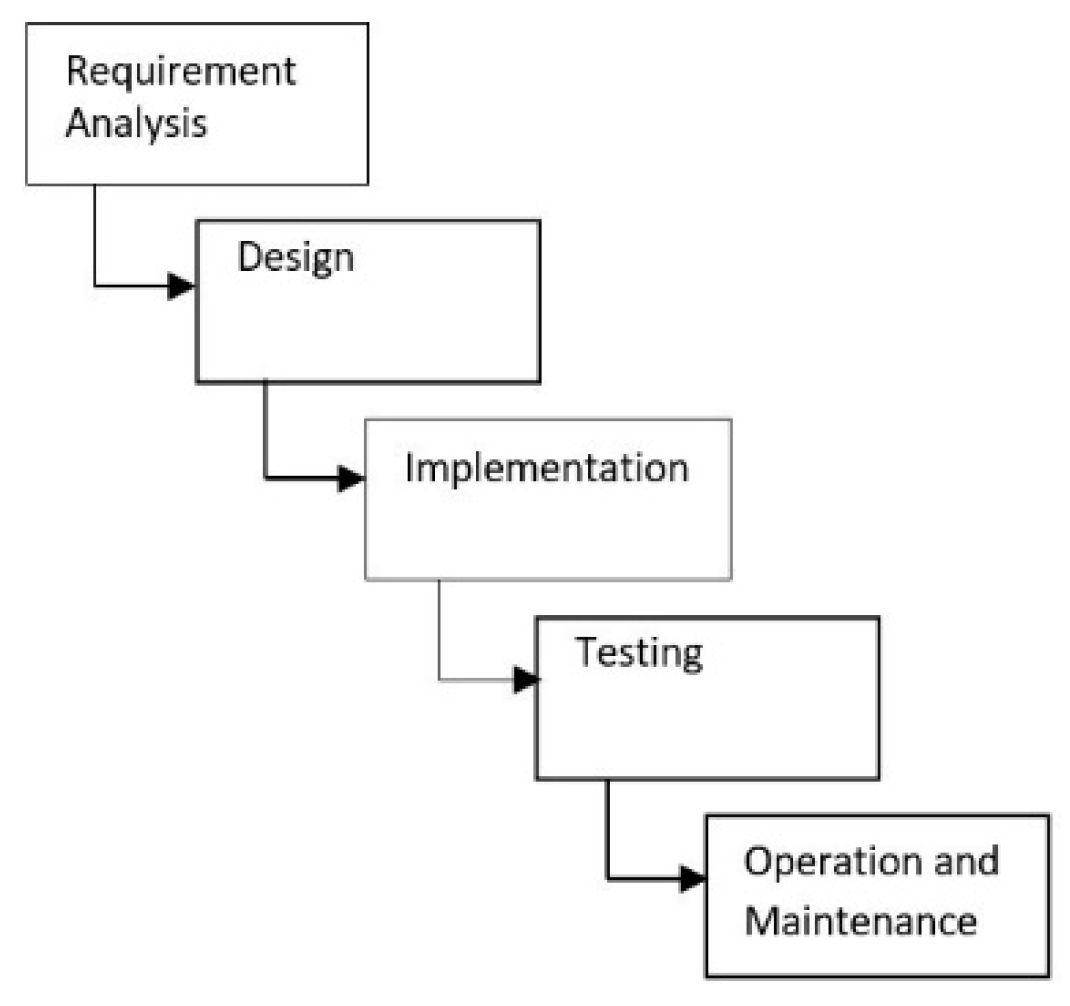
In this study, the methodology adopted is the water- fall model, a structured approach comprising five sequential phases: requirements analysis, design, coding, testing, and maintenance. This model is particularly suitable for projects demanding stringent quality control, as it emphasizes detailed documentation and meticulous planning. Each phase in the waterfall model flows logically into the next without overlap, ensuring clear milestones and facilitating a systematic devel- opment process from initial requirements gathering through to system maintenance and support. [9] This section provides a deeper explanation of the traditional approach using the water- fall model, as well as the object-oriented approach employing iterative and incremental models.
This model is also suitable for software with structured system development, where making changes after the coding stage is not recommended. Therefore, if there is data that needs to be changed, the code must also be modified [10]. Because the entire process must be adjusted to make adaptations, the software becomes difficult to reuse and the system challenging to upgrade [11].
Figure 1.
The phases of Waterfall Model [12].
Figure 1.
The phases of Waterfall Model [12].
A. Requirement Analysis
The software development process begins with creating a comprehensive description of the expected behavior. This involves system and business analysts defining functional and non-functional requirements, including reliability, scalability, testability, availability, maintenance, performance, and quality standards. [13] In this phase, our team consulting with the mosque administrator (amil) to explore their concerns regard- ing the management of zakat data. After extensive discussions and analysis, we identify the key features to be included in the software. and we carefully select the specifications necessary to ensure that the software aligns with the solutions to solve the amil’s needs. This phase signifies the requirement analysis process, where we gather insights and define the functionalities and specifications essential for the software development.
B. Design
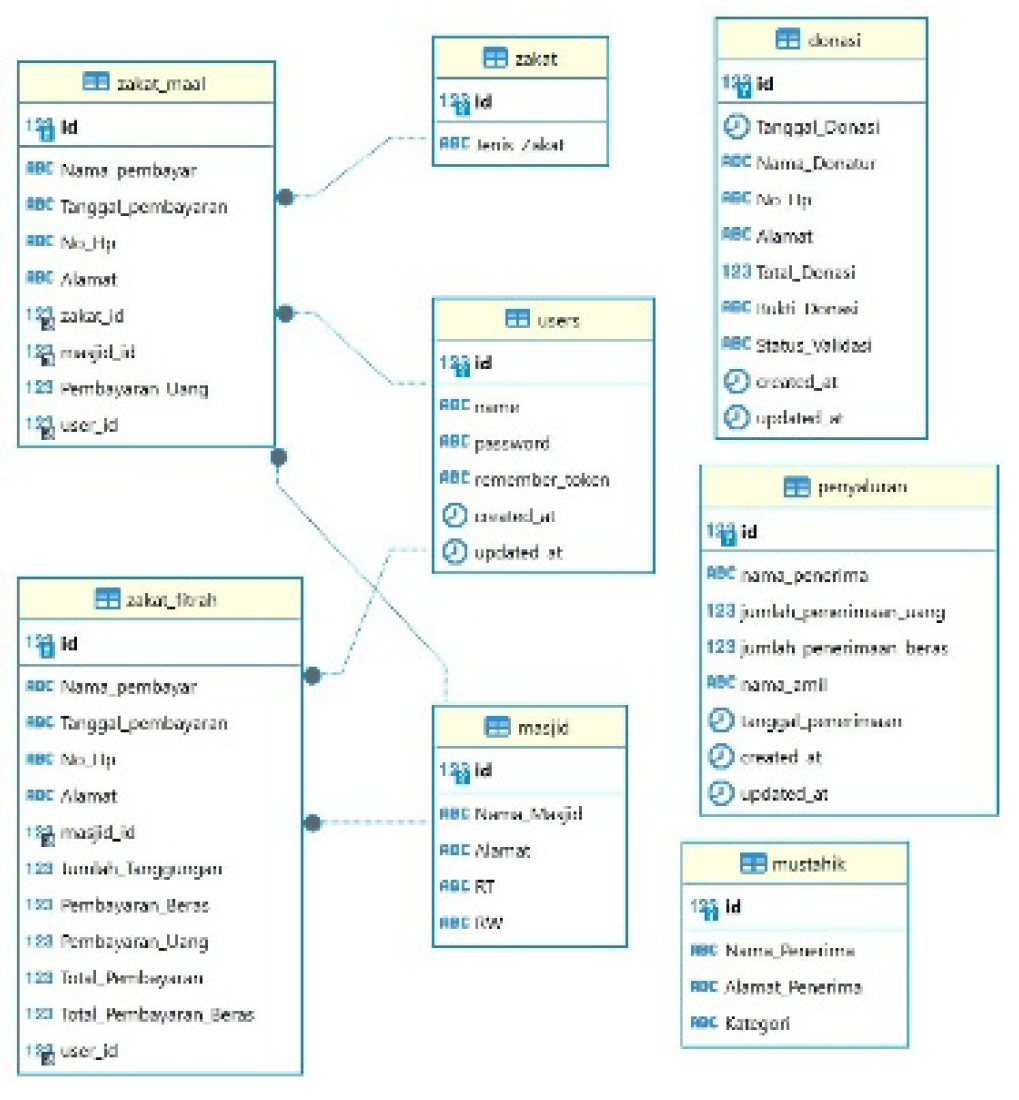
After completing the requirements analysis, the next step is design phase. our team uses the understanding gained from the analysis stage to design the structure and interface of the software in more detail. We organize how the predetermined features will be technically implemented in the software. This process involves creating workflow diagrams, user interface (UI) sketches, and detailed design specifications to guide the software development. [14] We ensure that our design takes into account user needs and enables an intuitive and efficient user experience. This design phase is a crucial foundation before we actively enter the software development stage. Our goal is to create a blueprint that outlines the architecture and functionality of the software, ensuring that it meets the identified requirements and addresses the concerns of the mosque amil.
Figure 2.
PDM.
C. Coding
After completing the design phase, the next step in software development process is the coding phase. In this phase, our development team begins to write code based on the design and specifications determined. [15] Each feature and function- ality outlined in our design is converted into lines of code using JavaScript as the main programming language. For this software, we are using Laravel as the Backend Framework, MySQL for the Database, Laragon for the Web Server, and Git for version control. During the coding phase, our developers work closely together to ensure that the code is written efficiently, following best coding practices and standards. We also conduct regular code reviews to maintain the quality and consistency of the code. Additionally, our team utilizes Git version control system to manage changes and collaborate effectively. Transforming conceptual design into a functional product is our main focus in this phase. This phase requires careful attention to detail and rigorous testing to identify and resolve issues early in the development process.
D. Unit Testing
The next step after coding is unit testing. Unit testing involves testing individual components or units of the software to ensure that each part functions correctly in isolation [14]. In this stage, each line of code or each unit of code is tested and executed to confirm its functionality. This process helps iden- tify and fix bugs or errors in the code during the development phase. Additionally, manual testing is conducted to validate the software’s behavior against predefined requirements. Unit testing is crucial to ensure the reliability, functionality, and quality of the software before proceeding to the next stages of testing and implementation. Through meticulous unit testing, our goal is to ensure that each part of the software operates effectively and meets expectations, thereby reducing the risk of failure when the software is deployed on a larger scale.
E. Operation and Maintenance
The Final step when the software that has been developed and operated in the mosque’s environment. The software is deployed to the intended environment, whether it be on local servers or in the cloud. This involves configuring the necessary hardware, software, and network infrastructure to support the software’s operation. Once deployed our team test systems and program units, ensuring that each program unit meets its specifications. [16] and then the software is available for use by end-users. Meanwhile, in the maintenance phase, our team continues to monitor the performance of the software and address any issues that arise. This includes fixing bugs, applying patches, and making enhancements or updates as needed. [17]
IV. Result and Discussion
A. Result
- (1)
- Landing Page: .
Figure 3.
Landing Page.
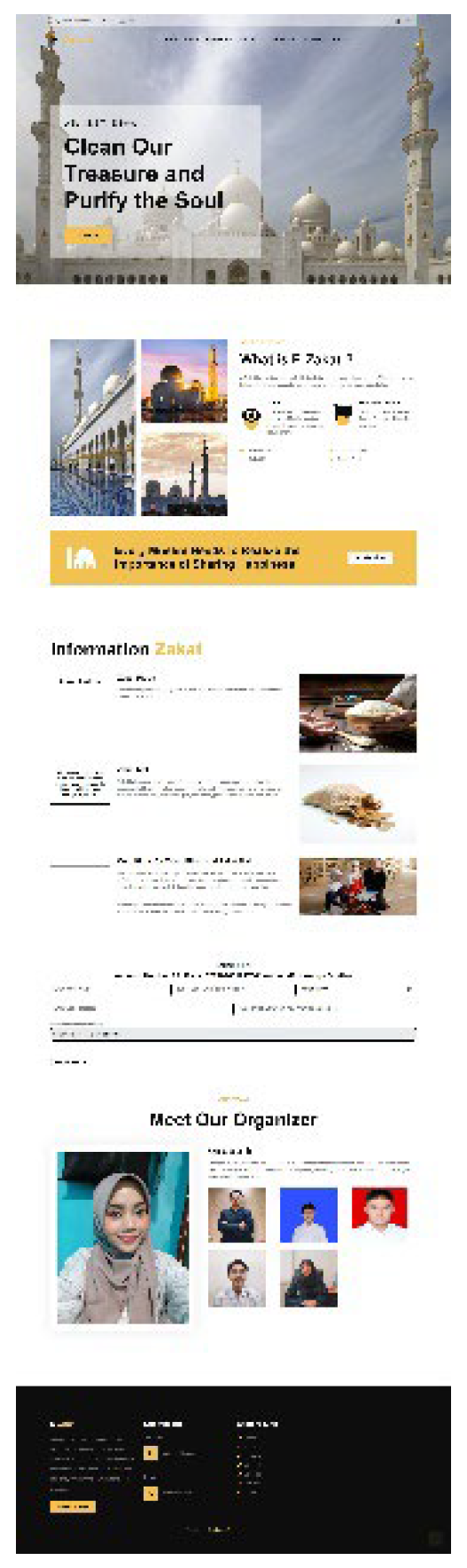
This page is publicly accessible for viewing information, calculating zakat, and making donations.
Figure 4.
Calculator.
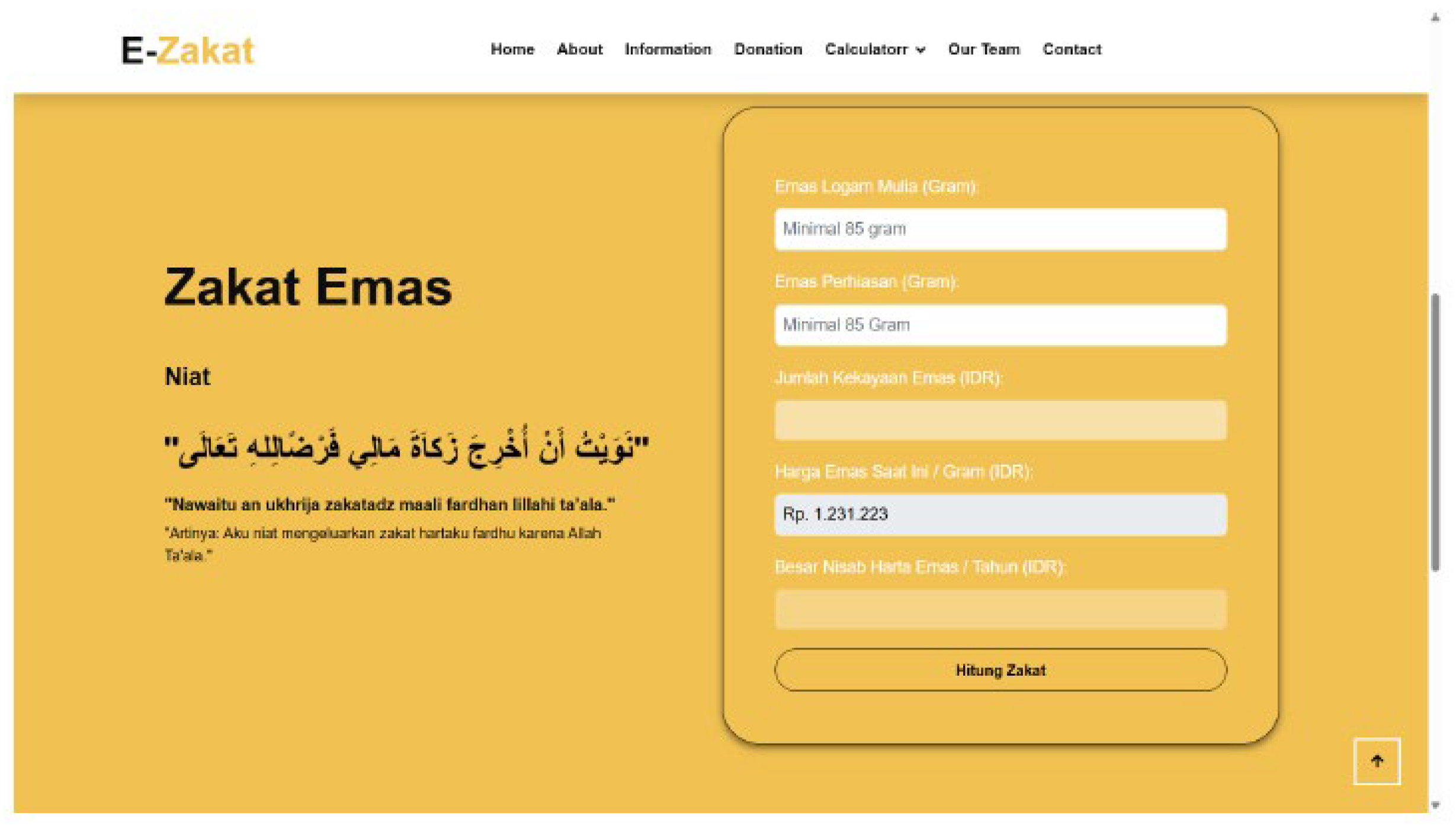
Figure 5.
Login (Admin).
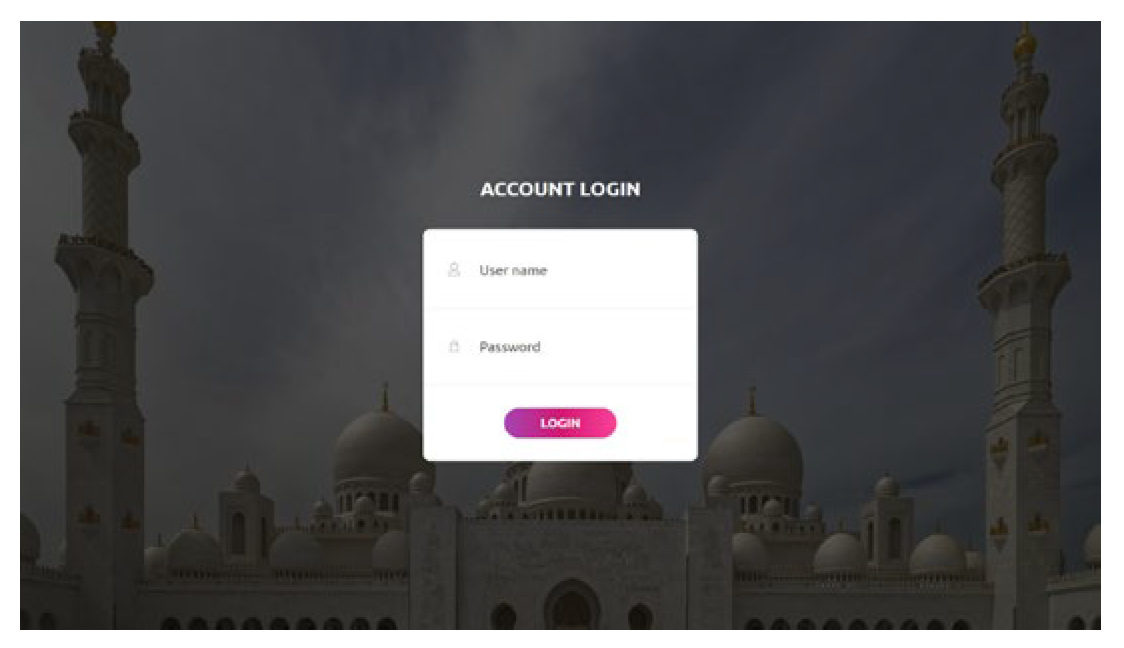
This features is only accessible by the admin, to access the main features of this software
Figure 6.
Dashboard.
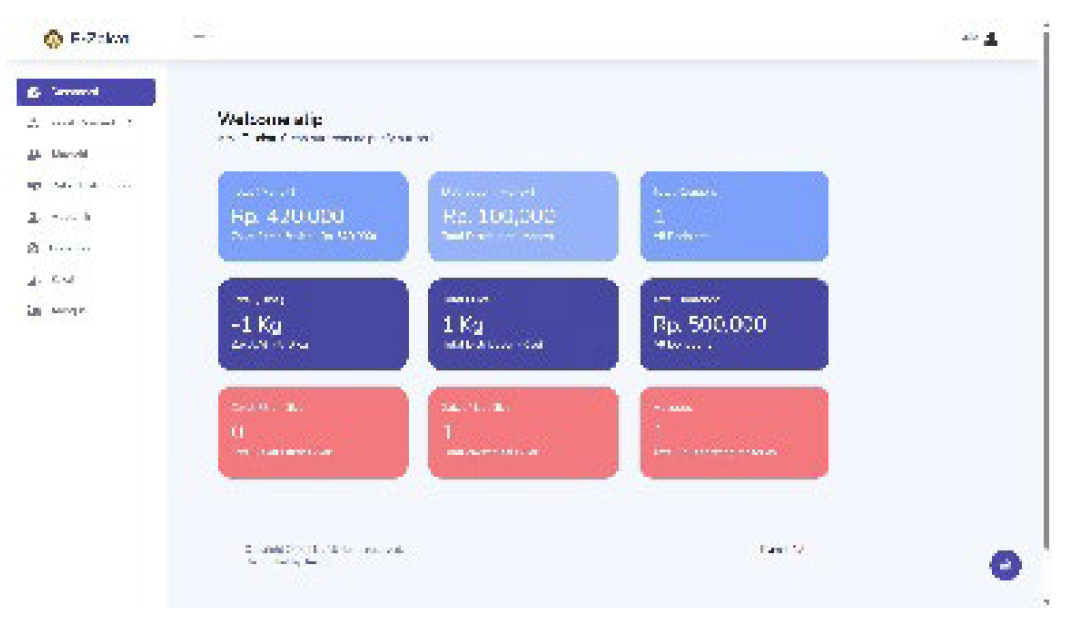
- (2)
- Dashboard:
- (3)
- Zakat Payment: This page is used to record and manage zakat payments made by muzakki.
Figure 7.
Zakat Payment.
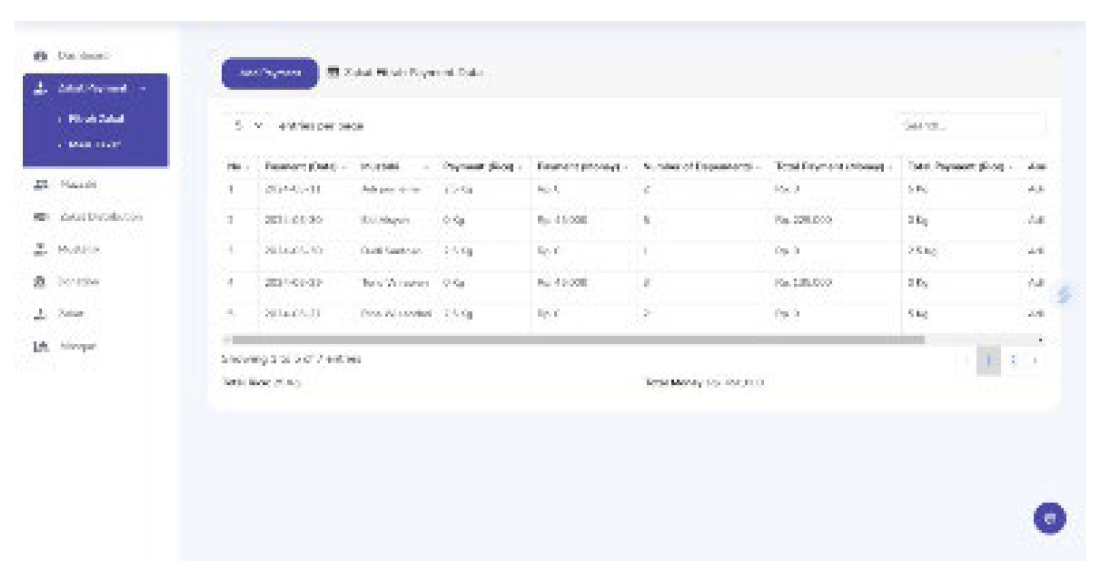
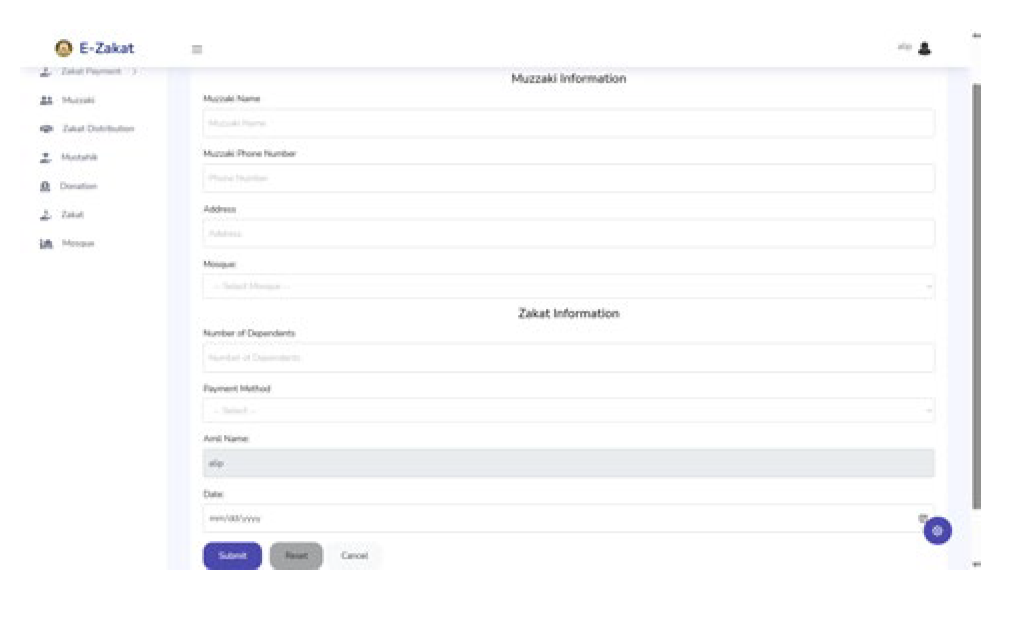
Figure 8.
Add Zakat Payment.
- (4)
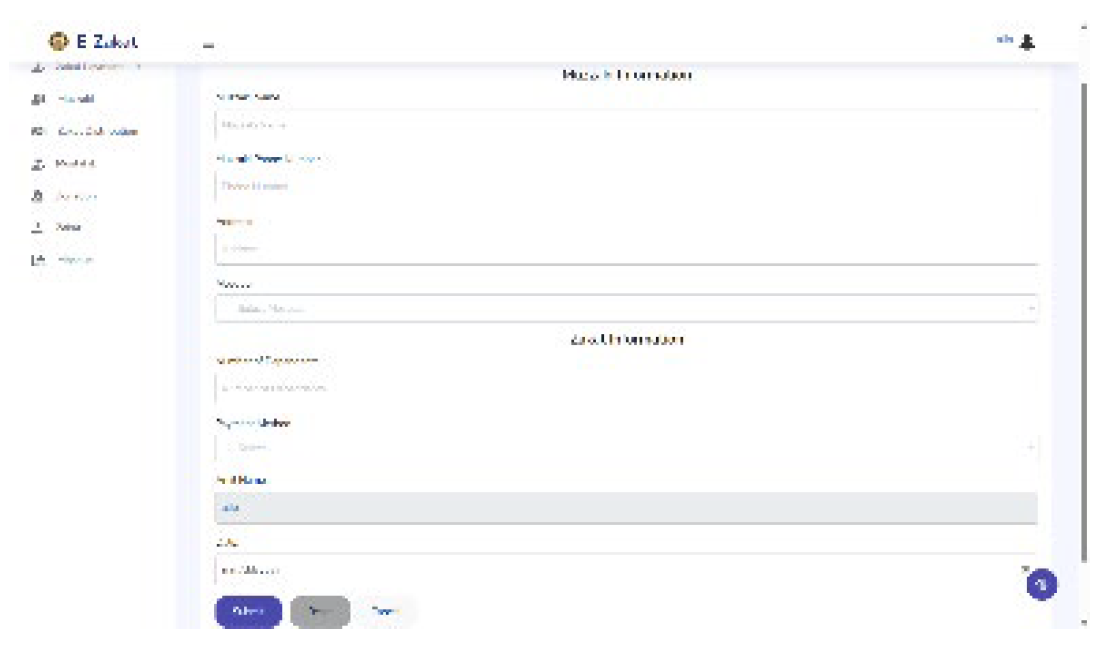
- Muzakki: This page contains a list and detailed infor- mation about muzakki, the individuals who pay zakat.
Figure 9.
Muzakki.
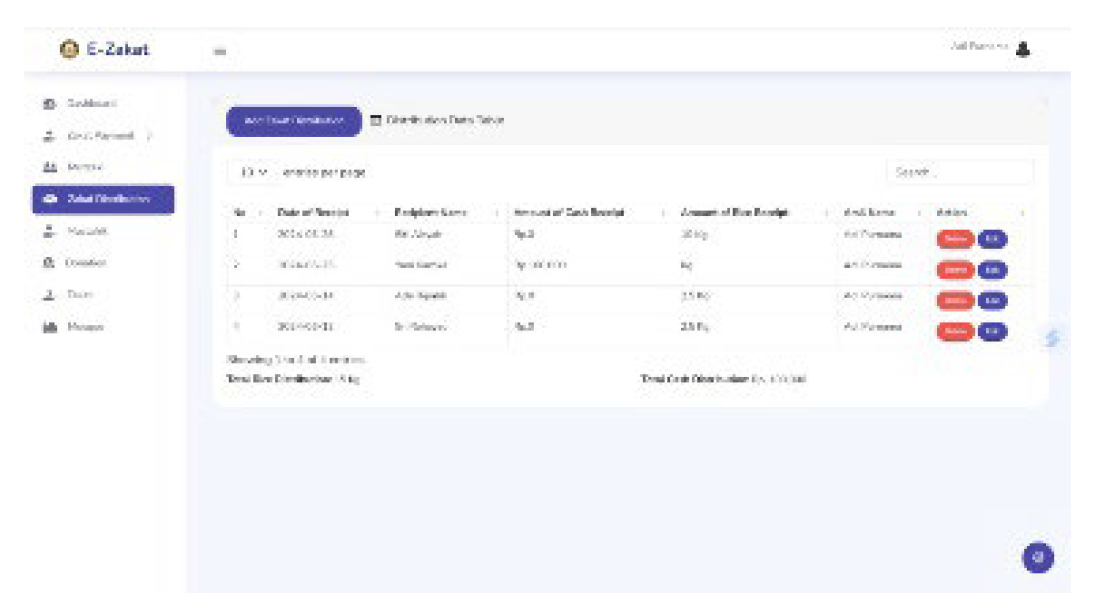
Figure 10.
Add Muzakki.
- (5)
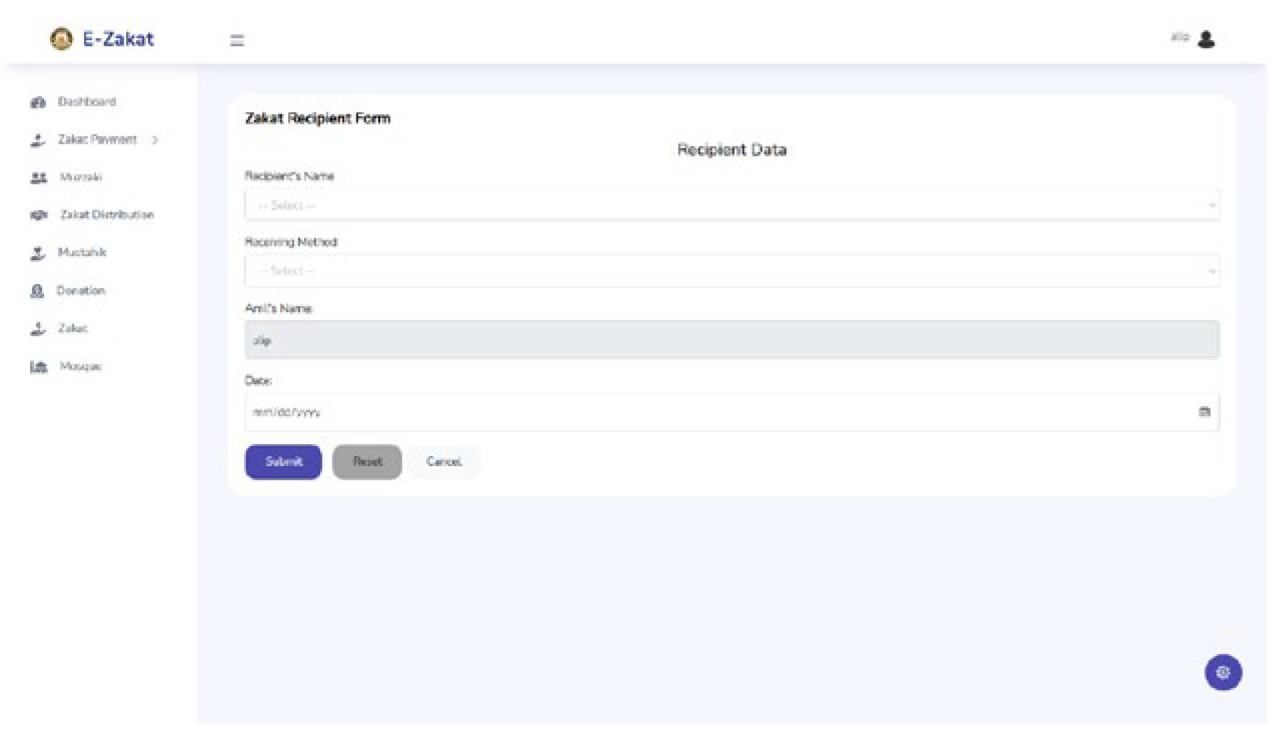
- Zakat Distribution: This page is used to organize and record the distribution of zakat to mustahik.
Figure 11.
Zakat Distribution.
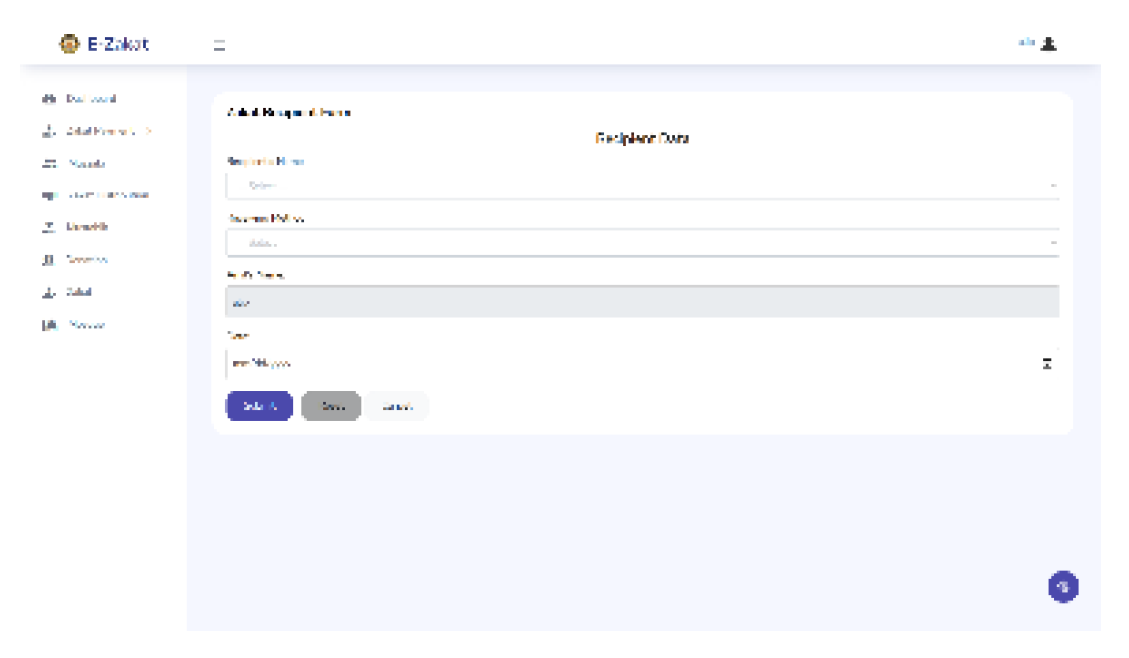
Figure 12.
Add Distribution.
- (6)
- Mustahik: This page displays a list and detailed infor- mation about mustahik, the individuals who receive zakat.
Figure 13.
Mustahik.
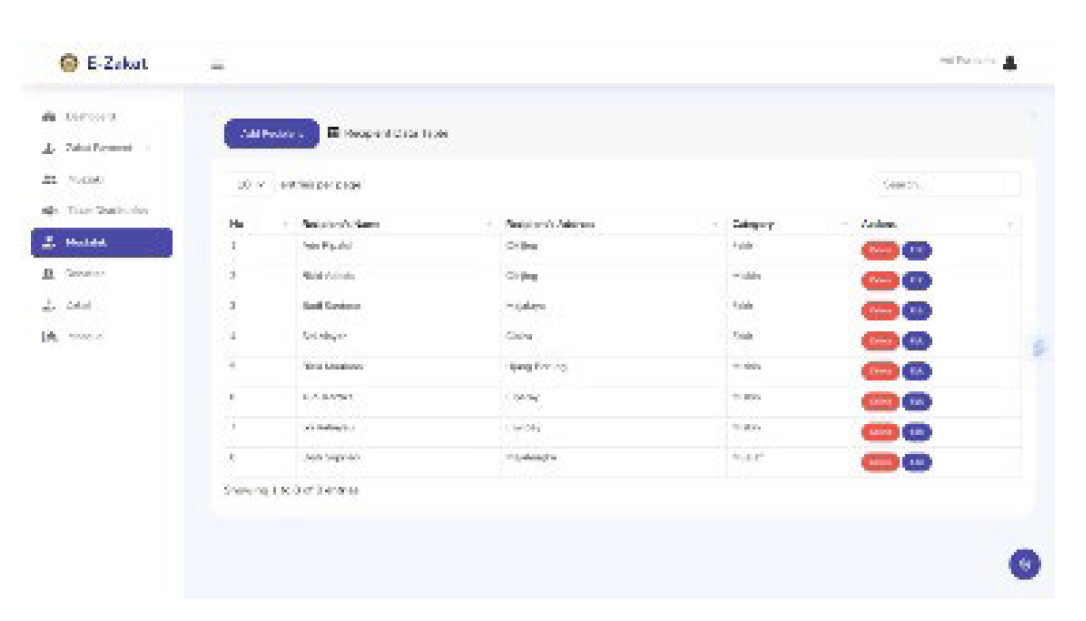
Figure 14.
Add Mustahik.
- (7)
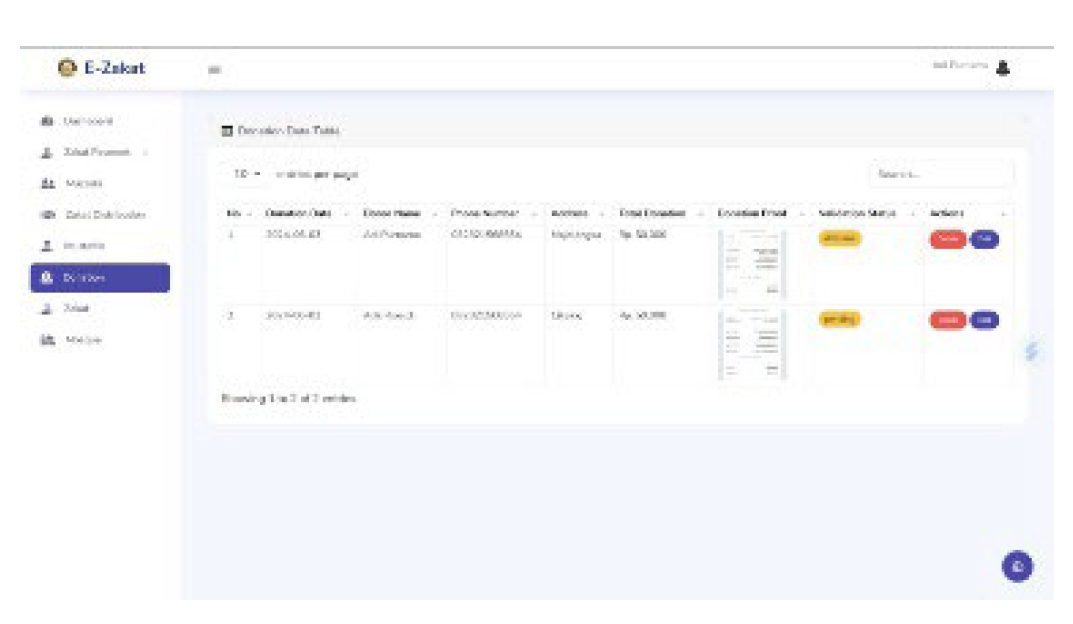
- Donation: This page is used to record and manage donations other than zakat that are received.
Figure 15.
Donation.
- (8)
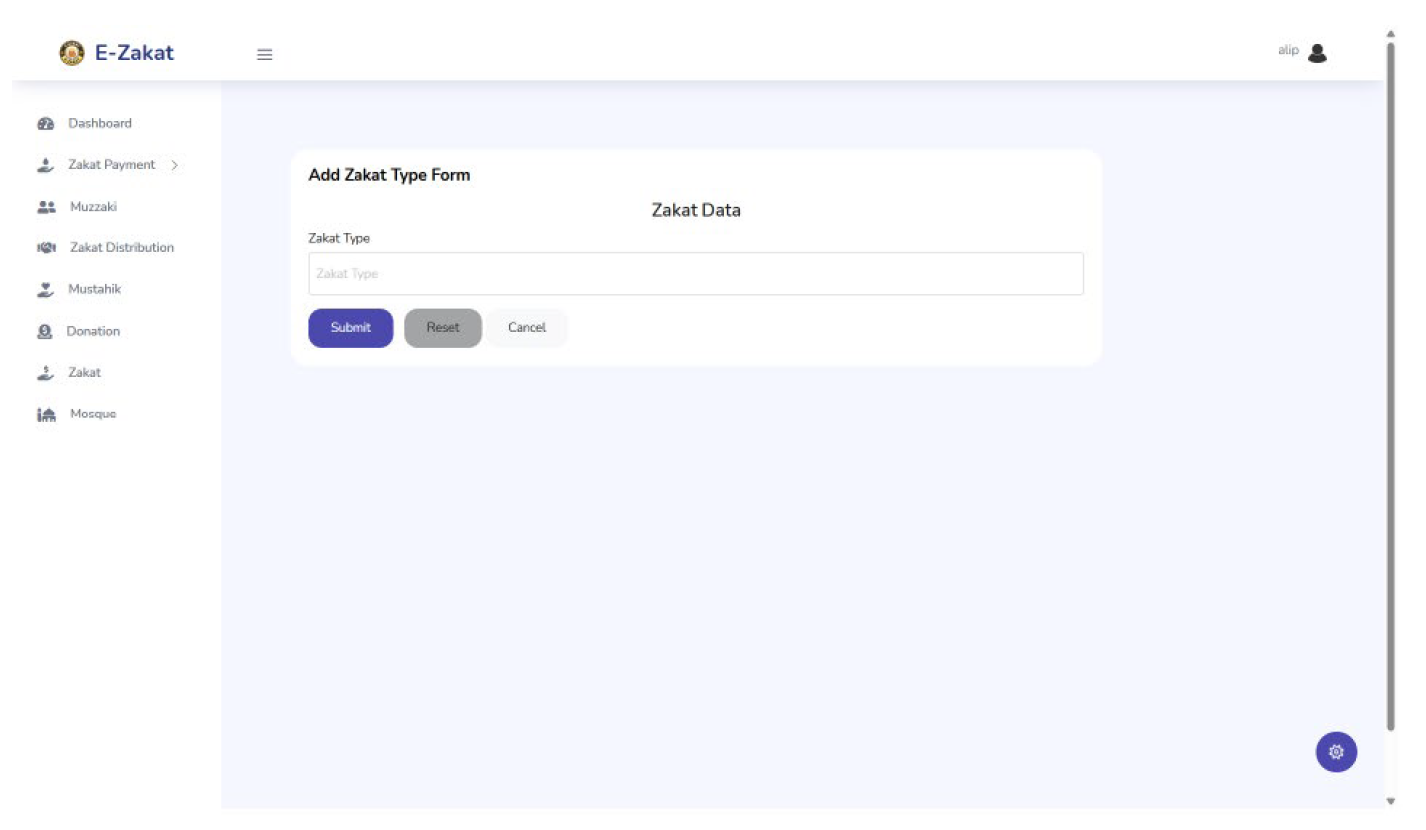
- Zakat Type: This page contains information about vari- ous types of zakat that can be paid by muzakki.
Figure 16.
Zakat Type.
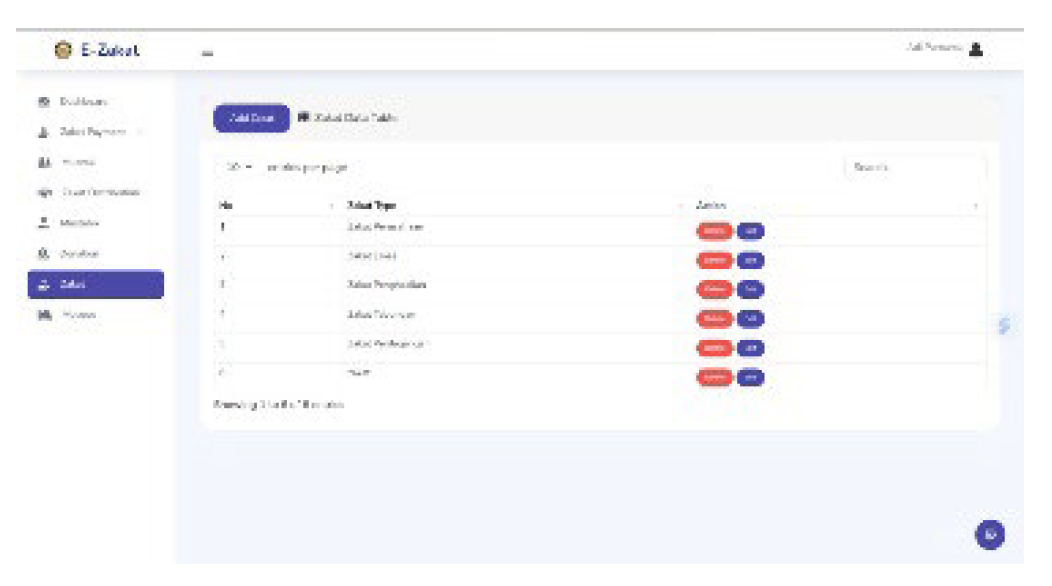
Figure 17.
Add Zakat Type.
- (9)
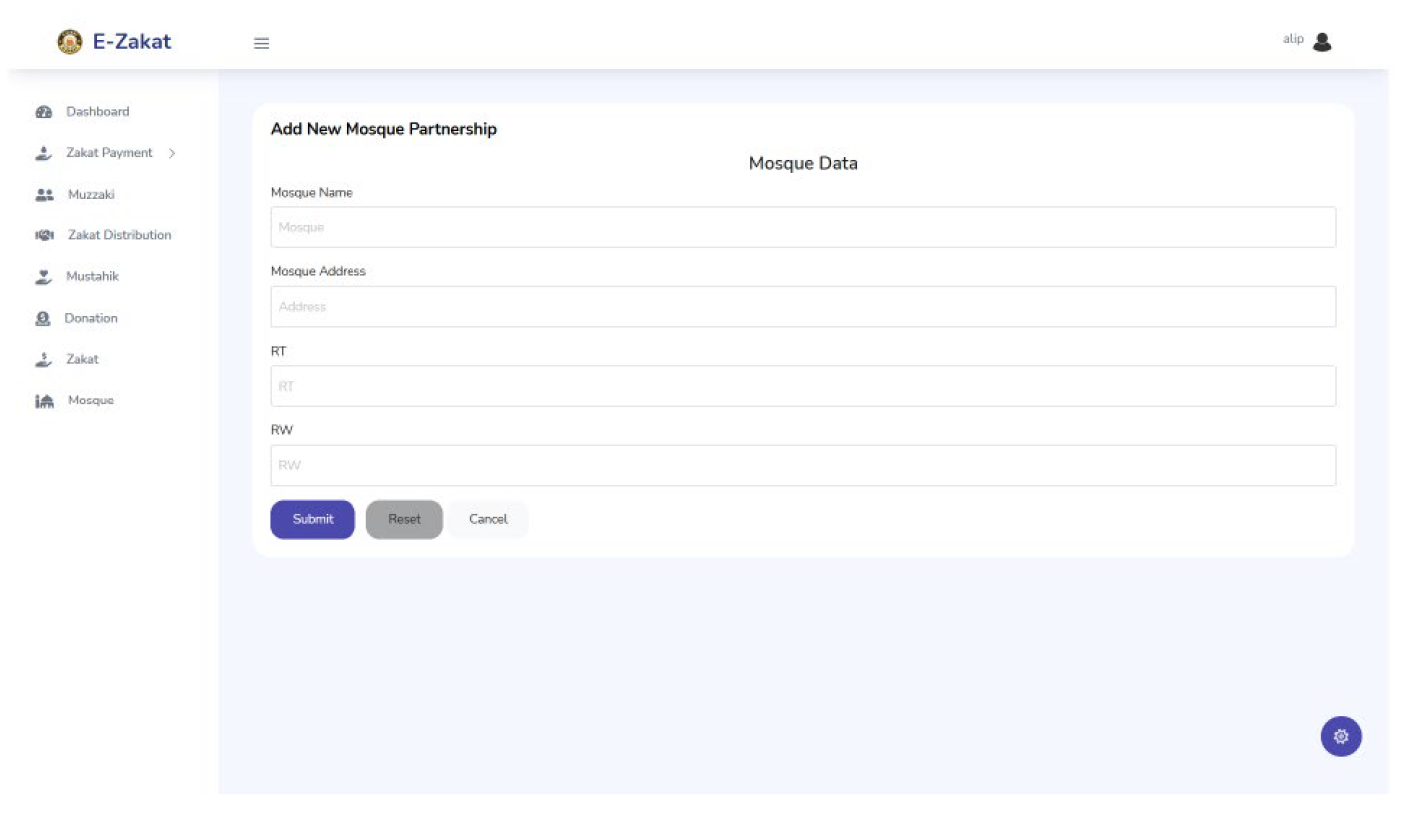
- Mosque: This page displays a list and detailed informa- tion about mosques involved in managing zakat and donations.
Figure 18.
Mosque Partner.
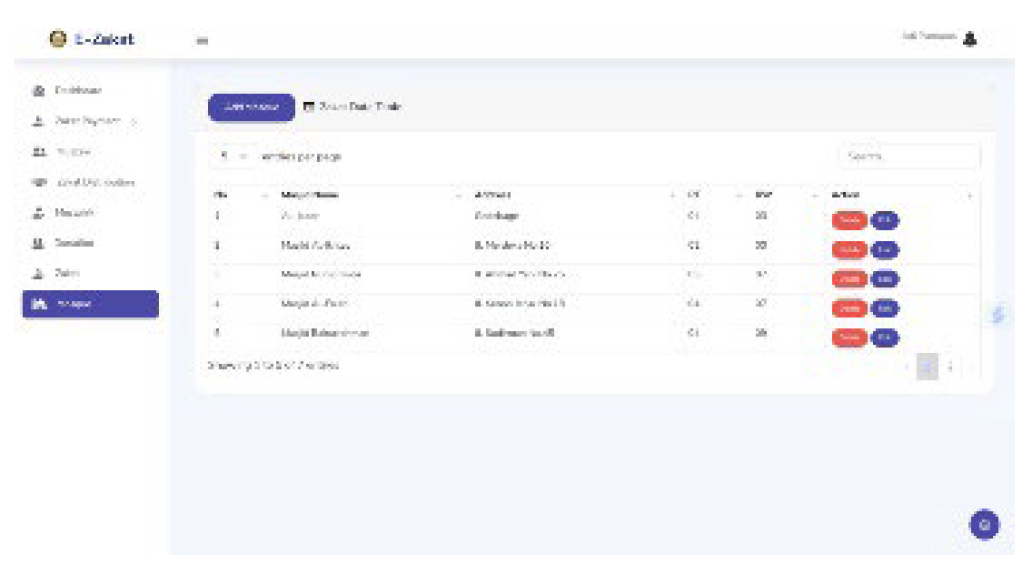
Figure 19.
Add Mosque Partner.
B. Discussion
The web-based management system using the Waterfall method implemented by our team has shown improvements in efficiency and accuracy in managing zakat for mosque administrators (amil masjid). Findings indicate that the system effectively facilitates the collection, calculation, and distribu- tion of zakat, offering a faster and more precise alternative compared to traditional manual methods.
These research findings align with previous studies high- lighting the role of technology in zakat management. For instance, research by Karsan Friyansyah et al. (2022) demon- strated that web-based zakat applications enhance transparency and accountability in the management of zakat al-Fitr. These outcomes strengthen the argument that information technology in zakat management systems significantly impacts improving existing practices.
Practical implications of this research suggest that zakat institutions should adopt web-based management to enhance operational efficiency and improve service delivery to the community. Moreover, the system not only facilitates zakat management but also supports reporting and audit processes, thereby enhancing public trust in zakat institutions.
However, there are limitations in this study, such as its limited scale and lack of trials in various regions with different conditions. The research also did not fully explore factors such as internet connectivity and user technology literacy, which can influence the effectiveness of the system.
V. Conclusions
The research conducted on the E-Zakat system reveals pos- itive outcomes in improving the effectiveness and efficiency of zakat management. This system simplifies the process of recording zakat data, including input, modification, and deletion. Additionally, E-Zakat provides a zakat calculator that facilitates Muzakki (those obligated to pay zakat) in calculating their zakat obligations.
The E-Zakat system significantly streamlines the tasks of za- kat administrators. Muzakki can directly monitor the manage- ment of zakat contributions, thereby enhancing transparency and accountability.
In conclusion, the E-Zakat system has proven to be a valuable tool in enhancing zakat management in Indonesia. The widespread implementation of this system is expected to have a broader positive impact in achieving effective, efficient, transparent, and accountable zakat management goals.
Acknowledgments
The authors wish to acknowledge the Informatics Depart- ment of UIN Sunan Gunung Djati Bandung for the partial support provided for this research work. The support and resources offered by the department were invaluable in the suc- cessful completion of this study. We also extend our gratitude to our colleagues in the research group for their collaborative spirit and continuous encouragement. Finally, we appreciate the technical assistance provided by the department’s staff, which greatly facilitated the experimental aspects of our study.
References
- K. Friyansyah, G. J. Yanris, and R. Muti’ah, “Zakat fitrah application based on web framework using waterfall method,” Sinkron: jurnal dan penelitian teknik informatika, vol. 6, no. 2, pp. 746–752, 2022.
- Zainal et al., “Optimization of zakat management in the digital era: The use of information technology,” Journal of Islamic Finance, vol. 2, no. 1, pp. 45–58, 2016.
- S. Khaerunisa, Y. Yayuli, and N. R. Febriandika, “Analysis of the impact of covid-19 on the collection of zis funds (zakat, infaq and shodaqoh) in lazismu surakarta in 2020.” Proceedings Book The International Conference on Islamic Economics, Islamic..., 2021.
- Rahman and, S. Mohammed, “A web-based system for zakat fund management using the scrum framework,” Journal of Information Tech- nology Software Engineering, vol. 10, no. 2, pp. 102–110, 2020.
- R. Alghamdi and Z. Baizal, “Development of a mobile-based zakat management system using agile methodology,” International Journal of Advanced Computer Science and Applications, vol. 12, no. 3, pp. 65–72, 2021.
- S. Herawati, Y. D. P. Negara, H. F. Febriansyah, and D. A. Fatah, “Application of the waterfall method on a web-based job training management information system at trunojoyo university madura,” in E3S Web of Conferences, vol. 328. EDP Sciences, 2021, p. 04026.
- Maltuf, “Zakat obligations according to baehaqi,” Islamic Studies Journal, vol. 3, no. 2, pp. 33–40, 2017.
- Y. Swara, M. Kom, and Y. Pebriadi, “Rekayasa perangkat lunak pemesanan tiket bioskop berbasis web,” Jurnal Teknoif Teknik Infor- matika Institut Teknologi Padang, vol. 4, no. 2, pp. 27–39, 2016.
- Alshamrani and, A. Bahattab, “A comparison between three sdlc models waterfall model, spiral model, and incremental/iterative model,” International Journal of Computer Science Issues (IJCSI), vol. 12, no. 1, p. 106, 2015.
- Sinha and, P. Das, “Agile methodology vs. traditional waterfall sdlc: A case study on quality assurance process in software industry,” in 2021 5th International Conference on Electronics, Materials Engineering Nano- Technology (IEMENTech), 2021, pp. 1–4.
- M. Kopp, D. L. Orlovskyi, and D. Ersoyleyen, “An approach to analysis of archimate application architecture models using the software coupling metric,” 2021.
- Adenowo and, B. Adenowo, “Software engineering methodologies: A review of the waterfall model and object- oriented approach,” In- ternational Journal of Scientific and Engineering Research, vol. 4, pp. 427–434, 09 2020.
- F. Heriyanti and A. Ishak, “Design of logistics information system in the finished product warehouse with the waterfall method: review literature,” in IOP Conference Series: Materials Science and Engineering, vol. 801, no. 1. IOP Publishing, 2020, p. 012100.
- U. S. Senarath, “Waterfall methodology, prototyping and agile develop- ment,” Tech. Rep., pp. 1–16, 2021.
- Hidayati and, S. Sismadi, “Application of waterfall model in devel- opment of work training acceptance system,” INTENSIF: Jurnal Ilmiah Penelitian Dan Penerapan Teknologi Sistem Informasi, vol. 4, no. 1, pp. 75–89, 2020.
- Y. D. D. Y. Khwuta, M. A. Londa, and Y. A. Wee, “Designing and building a business data collection application using the waterfall method,” Matrix: Jurnal Manajemen Teknologi dan Informatika, vol. 13, no. 1, pp. 42–51, 2023.
- L. Raakavuori, “Software development project overview from manage- ment perspective: case: maintenance management software,” 2023.
Disclaimer/Publisher’s Note: The statements, opinions and data contained in all publications are solely those of the individual author(s) and contributor(s) and not of MDPI and/or the editor(s). MDPI and/or the editor(s) disclaim responsibility for any injury to people or property resulting from any ideas, methods, instructions or products referred to in the content. |
© 2024 by the authors. Licensee MDPI, Basel, Switzerland. This article is an open access article distributed under the terms and conditions of the Creative Commons Attribution (CC BY) license (http://creativecommons.org/licenses/by/4.0/).
Copyright: This open access article is published under a Creative Commons CC BY 4.0 license, which permit the free download, distribution, and reuse, provided that the author and preprint are cited in any reuse.


