

Submitted:
28 May 2025
Posted:
29 May 2025
You are already at the latest version
Abstract
The adoption of e-government services in Small Island Developing Nations (SIDNs) aims to enhance public service efficiency, inclusiveness, and quality. However, SIDNs face significant constraints, including limited resources, geographical isolation, low digital literacy levels, and inadequate technological infrastructure. This study investigates value co-creation approaches in e-government service, aiming to show how established co-creation processes and methods can be adapted to support sustainable e-government initiatives in resource-constrained island settings. The study applies a qualitative approach; based on the thematic analysis of interviews with government stakeholders, it identifies contextual factors and conditions that influence e-government value co-creation processes in SIDNs and proposes strategies for sustainable e-government service value co-creation. That includes participatory design, community-driven initiatives, and inclusive digital solutions. Additionally, the study highlights the relevance of cloud-based platforms, strategic partnerships, and modular, agile development processes to ensure adaptability and sustainability in public service provision. This research contributes an e-government value co-creation framework for SIDNs that integrates participatory design, collaborative governance, sociotechnical systems, and technology adaptation strategies to develop robust and user-friendly e-government services. The framework can be used by policymakers and practitioners to facilitate sustainable digital transformation in SIDNs through collaborative governance, active participation, and civic engagement with innovative technologies.
Keywords:
value co-creation
; e-government services
; methodological innovations
; Small Island Developing Nations
; SIDNs
; collaboration dynamics
; digital public services
1. Introduction
Digital transformation changes the way public services are initiated and provided. As a result, governments have started using electronic platforms to increase efficiency, transparency, and citizen participation. Despite rapid advancements in many parts of the world, adopting digital government services in Small Island Developing Nations (SIDNs) remains inconsistent and poorly understood [1]. Therefore, it is important to reconsider how digital government services are developed and co-created with SIDN citizens, addressing the specific characteristics of the context and, in particular, its limitations and constraints.
Digital government services provide an opportunity to improve government services in SIDNs. The use of digital technologies enables citizens to access government services through electronic platforms, commonly called e-government services [2]. E-government services enhance transparency and access to public information, building citizens' trust and generating public value through efficient service provision [3]. In addition, digital services offer a platform for the government to engage with citizens and other stakeholders in real-time interaction, collaboration, and information management and sharing [4].
1.1. Digital Services in SIDNs
Similar to digital service programs in low- and middle-income countries, challenges such as limited resources and lack of infrastructure affect the successful implementation and sustainability of SIDNs [1,5]. For example, infrastructure constraints such as unreliable Internet connectivity make it challenging to bridge the digital divide [1,2]. In addition, the geographical dispersion and the remoteness of many island communities create logistical difficulties in implementing and maintaining consistent digital services [1]. These challenges are exacerbated by SIDNs’ inherent vulnerabilities to natural disasters. Governments need to develop scalable yet locally adaptive strategies to reach isolated populations [4].
The diverse cultures and the economically and politically unstable environment present additional challenges to the already limited resources and infrastructure [6]. Coupled with the relatively low digital literacy of island citizens, these challenges limit the adoption and effective utilisation of e-government services even further [7,8]. On the other hand, SIDN e-government ecosystems are often fragmented, and frequently, there is a gap between the design and the delivery mode of digital services and the actual needs of the communities they aim to serve [9]. E-government digital platforms need to develop better mechanisms to promote inclusivity, participation, and citizen trust [10].
Finally, many SIDNs rely heavily on donor-funded digital projects, which may have inadequate long-term sustainability plans. When external support ends, the absence of resources and leadership leads to digital initiatives collapsing or stagnating [5]. Donor dependency is a systemic vulnerability that underscores the importance of building local capacity and ensuring digital transformation project continuity [7,11].
The challenges outlined above require realistic, locally grounded and scalable approaches to developing digital platforms and services that consider SIDNs' social, economic, and environmental characteristics and offer participatory, context-specific solutions rooted in collaboration between governments, communities, civil society, and development partners.
1.2. The Shift Towards Value Co-Creation
E-government services have traditionally been developed and implemented through a top-down approach, where governments shape the services and solutions predominantly based on their perspectives. This method often struggles to actively involve citizens in participating in e-government initiatives [12] as it has little room for the input of the citizens and stakeholders who are meant to use these services [13]. The limited user engagement leads to a lack of digital service alignment with citizens' needs, a lack of realisation of the objectives and supposed benefits and ultimately, inefficient service delivery [11,13].
These shortcomings have driven a shift towards a value co-creation approach, emphasising collaboration, interaction, and sharing innovation among government institutions, citizens and other stakeholders to create public value [14]. By incorporating the principles of value co-creation from a service science perspective, e-government services become value-adding and adaptive user-centred platforms that empower service customers to contribute actively to developing essential government services that are both impactful and sustainable [15]. Governments are empowered as well: they can streamline operations to optimise resource allocation and cut costs, foster innovation by promoting citizen empowerment and public engagement, and enhance transparency and accountability [16]
Value co-creation engages citizens as active partners in designing, implementing, and evaluating digital services rather than merely as passive users [17]. The participatory approach improves the relevance and responsiveness of services and legitimises government initiatives by fostering trust and a sense of ownership [18]. However, identifying the most appropriate and effective way of co-creating digital services initiatives remains a significant challenge in the SIDN [2].
1.3. Theoretical Foundation
Prahalad and Ramaswamy [19] defined value co-creation as a joint value creation by the company and its customers; customers actively participate in tailoring services to their needs. The concept of value co-creation aligns with the theoretical framework of service-dominant logic (SDL), which is a service-centred alternative to the more traditional product-dominant. SDL and the co-creation of value are at the core of the service science perspective on complex service systems [20]. Service systems are designed within a collaborative environment that supports resource sharing and teamwork processes; service value is created through collaboration and stakeholder interaction, applying participatory and collaborative methods, and using citizens' input and expertise [16,21,22]. Developing the theoretical foundation of this study, the sections below review prior research to identify service co-value creation processes and methods relevant to value co-creation in e-government service development and the factors influencing collaboration in value co-creation.
1.3.1. Processes Supporting E-Government Service Value Co-Creation
Extant research has identified the role of government as a facilitator and collaborator, the use of advanced technologies for collaboration, training and upskilling participants, and the provision of adequate feedback mechanisms as the three most important supporting processes in e-government development projects.
Facilitation and coordinator
The government facilitates and coordinates the work of the collaborators who contribute their generated ideas, designs, and innovations [2,23]. The aim is to engage public, private, and third-sector organisations in a transparent process of cross-sector collaboration to enhance service comprehensiveness [4] through teamwork and shared vision and objectives [11,24,25]. For example, non-government organisations can serve as intermediaries, helping to bridge the engagement gap between citizens and the government [7] while the inclusion of citizens in decision-making builds trust, creates a sense of shared power and responsibility for developing e-government services that meet citizens’ needs [26,27,28]. However, it is important to provide a governance framework of policies and regulations to ensure that the value co-creation practices are ethical and compliant with legal standards and that the stakeholders interact in a structured and inclusive manner [1,5].
Integrating advanced technologies
Technologies such as big data analytics and artificial intelligence (AI) enable efficient decision-making, improve trust and personalisation of service delivery [22]. Advanced collaborative framework where citizens and the government co-create the service and use data securely and transparently to build stakeholder trust, enhance interaction and support multiple communication and feedback channels [1,3,4,7].
Training and upskilling
Training helps educate stakeholders by improving their knowledge, skills, and engagement [11]. Capacity-building programs, including international and regional collaboration, can be used to transfer knowledge to local actors and communities to encourage and sustain their contribution as participants in e-government service value co-creation [1,15], and overcome resistance [4].
Feedback mechanisms
It is important to establish a transparent and interactive feedback process, along with a traceable feedback channel. This helps build public motivation and confidence in the collaboration [2] and ensures that the service remains relevant, responsive, and adaptive, aligning with customers’ needs and expectations [22,29,30].
1.3.2. Factors Influencing Collaboration
Effective collaboration is central to successful value co-creation in e-government services. It is influenced positively by enablers such as trust, leadership, and resource management, inhibitors such as technology complexity and access to technology, and citizens’ digital literacy and cultural diversity.
Trust
Trust is a key enabler, shaping public confidence in government digital services, and its security significantly impacts citizens' willingness to engage [31]. Trust in the government's intentions and the security of the digital platform will dramatically increase engagement [2]. On the other hand, a lack of trust stemming from concerns about data security, transparency, and governmental accountability can result in disengagement, skepticism, and adaptation [29]. This issue is particularly pronounced in developing contexts, where historical governance challenges may have pushed away public confidence in government-led initiatives [32].
Leadership
The absence of good government leadership, clear policy, and vision [14] results in fragmented strategies and a complex bureaucratic process of government service [29]. Without a proper policy, unclear responsibilities may arise [33], and conflicting objectives can discourage engagement, hinder adaptation, and foster a negative perception of e-government services [12].
Resource management
In environments where resources are limited, it is important to form partnerships that foster resource-sharing [1]. The sharing of experiences, knowledge, and understanding through active engagement bridges the gap between stakeholder priorities and leads to the development of sustainable and context-specific solutions [10,22]. The shared resource ownership creates a sense of shared responsibility, which encourages citizens to participate both in the service design and service implementation phases [11] and enables innovations by integrating local resources [15]. In addition, the shared responsibility approach allows for achieving a balance between stakeholder empowerment and formal governance mechanisms, supporting further sustainable value co-creation and innovation [28,30].
Technological barriers
Technological barriers, such as the complexity of e-government systems, can discourage engagement among citizens who are less digitally literate [2]. The lack of infrastructure needed to support reliable access to online services [15] and the technical human resources required to support the digital services are crucial to consider for developing countries [1]. Access to technology is limited, leading to a divide in technological knowledge among citizens. This situation highlights the need for technological readiness, particularly for those who are less literate [4,29,34].
Citizen involvement
For citizens unfamiliar with technology, designing user-friendly, accessible systems is critical to overcoming engagement barriers [2]. Capacity-building and digital training programmes are crucial to equip both users and civil servants with the skills needed to use e-government tools effectively [11,35]. Additionally, cultural norms and social influences, such as peer encouragement and community-driven initiatives, play a significant role in motivating participation in collaborative governance [36].
1.3.3. Value Co-Creation Methods
Value co-creation is increasingly facilitated through participatory design methods, such as co-design workshops, agile development, and collaborative prototyping. These methods promote interactive feedback loops, user-driven design, and continuous improvement [35].
Participatory design
Participatory design methods ensure that services meet citizens' needs and expectations while reducing resistance and promoting improvement and adoption [17]. For example, co-design workshops unite government representatives, designers, and citizens to identify solutions collaboratively and refine service delivery processes [17]. These workshops help overcome resistance and barriers, such as the design-reality gap [11], and foster innovation based on local resources [15]. They integrate citizens' needs and input into developing suitable service solutions [4] and contribute to optimising the utilisation of digital tools [29].
Agile development
Agile methodologies promote iterative development with rapid feedback and consideration of influential factors [6]. Agile development involves an iterative process for service improvement, responsiveness to feedback, and effective collaboration between stakeholders [11]. Agile development ensures that the services are developed, enhanced, and adjusted according to citizens' feedback and changing needs and expectations [4,10,29].
Collaborative prototyping
Collaborative prototyping facilitates real-time interactions and facilitates citizens' inputs through focus groups, websites and social media platforms, and mobile apps [2,29]. For example, it was used in the Estonian government portal to test and refine digital tools in a controlled environment to ensure their functionality and usability [11]. A transparent feedback system lets participants track their status and take advantage of monetary or motivational incentives for participation [4].
1.4. Research Rationale, Aim and Questions
Although the e-government value co-creation processes reviewed above have been investigated and modelled in the context of both developed and emerging economies, there has been little research on the impact of the specific SIDN challenges on the effectiveness of e-government value co-creation. These include remoteness, limited digital infrastructure, geographically dispersed populations, and dependence on external aid [1,6]. In particular, the factors influencing e-government value co-creation have been examined in different global settings; however, there is a lack of research on how they are manifested in the SIDN context, which is characterised by limited resources [11,35] and lack of financial and technical infrastructure support to keep the services running in all circumstances [15].
Moreover, in regions such as scattered and remote islands [1], the geographic isolation, the cultural diversity [4], and the vulnerability to natural disasters leads to the use of a top-down approach [11]. The resulting imbalance of power impedes effective collaboration [5,22]. In addition, the e-government value co-creation methods that have the potential to strengthen collaboration among government, citizens, and other stakeholders and enhance service delivery and quality have also been examined in developed and resource-abundant settings. Their applicability to resource-limited environments, such as SIDNs, remains largely unexplored [2,6,7,18].
This study addresses the research gaps discussed above. It aims to identify the contextual factors and conditions that influence e-government value co-creation and to propose a value-co-creation framework that adapts established co-creation processes and methods to support sustainable e-government initiatives in resource-constrained island settings. The following research questions guided the study:
- RQ1. What factors enable or hinder effective collaboration in e-governance services in SIDNs?
- RQ2. What are the value co-creation processes in e-government services in SIDNs?
- RQ3. What are the methods of value co-creation in e-government services in SIDNs?
Research questions one and two explore the factors influencing collaboration and key processes that make value co-creation work. Together, they lead to addressing the third research question: identifying the value co-creation methods that can be adapted to facilitate e-government service development in SIDNs and to support inclusivity and sustainable digital service delivery.
Analysing SIDN's challenges and identifying effective cooperative solutions aids in developing sustainable, user-focused e-government services. This research provides actionable insights for policymakers, practitioners, and researchers about how to enhance the design and delivery of sustainable, user-centred digital public services in resource-limited and vulnerable environments.
2. Materials and Methods
This study uses qualitative research techniques to identify the key value co-creation processes in e-government services, specifically in Small Island Developing Nations (SIDN). A case study design was employed to gather comprehensive information from key stakeholders such as government representatives, citizens, and service users. This section discusses the methodological approach, participant selection, data collection methods, and data analysis techniques.
2.1. Research Approach
This study uses a qualitative research design, employing a case study approach to determine suitable methods of value co-creation in e-government services for SIDN. A qualitative approach is well-suited for this research, enabling a rich, contextual understanding of the stakeholders' experiences, interactions, and perceptions [37]. Since value co-creation in e-government services is complex and dynamic, a qualitative approach allows the broad exploration of the factors and processes influencing stakeholders' collaboration [38]and contributing to value co-creation in SIDN [39,40]. Furthermore, the qualitative case study approach supports a trustworthy and rigorous analysis of the data gathered from the participants in e-government services [41].
The study is grounded in social constructivism and interpretivism, which posits that knowledge is constructed and interpreted through social constructs and contextual influences, seeking to understand individuals’ unique viewpoints [42]. Data were collected through semi-structured interviews, allowing participants to share their experiences on the current e-government services and capturing subjective responses while maintaining the core research objectives [40]. The data were analysed using thematic analysis, identifying key patterns and themes that contribute to the understanding of value co-creation processes in e-government services [43].
The case study was carried out in a government department in Vanuatu. The department was chosen because it provides e-government services, and its staff is knowledgeable about the factors and processes in value co-creation. In particular, this department delivers ubiquitous ICT projects and uses technology and digital tools to capture data and provide digital service products to citizens and stakeholders.
2.2. Participant Sample
The study's target population are stakeholders of e-government services, especially those directly involved in the collaboration, designing and development process, delivery and users of the e-government service. The target population includes department managers, policymakers, technological staff, and personnel engaged daily with e-services products for citizens and customers. Purposive sampling was used to recruit participants. This ensures that participants have direct experience with e-government services, are active members and have some knowledge about e-government services [37]. The procedure used is that we first sought permission to undertake research in the selected department.
Potential participants were then sent invitations to participate in the study. Those who responded were screened to identify those who had significant experience in working with e-services and had a role as a policymaker or manager, a technical role, or another type of role that involved interaction with citizens and other stakeholders. Ten departmental participants were selected to participate in the semi-structured interviews. In a related study, a similar-sized group of participants was used to investigate the types of resources and interactions that influenced practical co-creation value [44]. Of the ten participants, three were from a managerial and policy-making background, three had various technical roles, and four had roles that required interacting with citizens and stakeholders about the department's digital service products.
2.3. Data Collection
Semi-structured interviews were employed as the data collection method due to their flexibility and ability to deeply explore participants' experiences while maintaining consistency and highlighting emergent themes related to the research questions [45]. An ethics clearance from the Auckland University of Technology Ethics Committee (AUTEC) was obtained. Participants who agreed to participate were asked to sign the consent form. Each participant was allocated 30 to 60 minutes of interview time. Interviews were audio recorded; one of the authors took notes throughout the interview process.
All participants used a blend of English and Bislama, the national language of Vanuatu, during the interviews. The tool Turbo Scribe was used to transcribe each recording. As a multilingual translator, Turbo Scribe translated interviews that were a mixture of English and Bislama to English. All transcripts were reread while listening to the audio file to ensure that the transcribed data accurately reflected what the participants were stating. The cleaned transcribed interview data were re-imported into NVivo for data processing. In NVivo, an open coding approach was used to develop codes from the cleaned and imported interview data. Each interview transcript was repeatedly read to understand the content, search for patterns that align with the research objectives and develop codes from the identified patterns [46].
2.4. Data Analysis
The data analysis process included two main stages: data coding and thematic analysis. The qualitative data collected from stakeholder interviews were first coded using an open coding approach to identify patterns and recurring ideas. These initial codes were then organised into super codes and examined through thematic analysis to uncover super themes and derive insights aligned with the research questions.
2.4.1. Data Coding
A total of 201 codes were initially developed and defined. Table 1 presents a code and its definition.
Next, super codes were created to merge codes with related concepts into broader and more concentrated groupings, allowing for a more structured and meaningful interpretation of the data. For instance, under the code Interdependent System Design, one participant states, “Develop a system in such a way that they support each other and run side by side” (DeptBInt3, 27:59–30:58). This necessitates a system that integrates data within and between departments. This supports the development of the super code “Data Systems Integration’ (Table 2). This super code highlights the fundamental concepts of creating integrated and interdependent systems. All 57 super codes were similarly identified and defined to show their meaning and provide an accurate description of the underlying codes.
2.4.2. Thematic Analysis
Further analysis and examination of patterns within super codes revealed emerging themes, one of which is Technology-Enabled Services (Table 3). As shown, the theme emerged from super codes related to data and system integration, focusing on how digital platforms can be used for dissemination and customised to meet the specific needs of citizens. Therefore, technology-enabled services align well with this concept.
As defined in Table 4, the theme Technology-Enabled Services shows a pathway for digital solutions that enhance efficiency, accessibility, and effective service delivery. The underlying super codes highlight the importance of integrating data and systems with tailored technology solutions. This approach helps e-government services operate efficiently, even when resources are limited, ensuring user expectations are met. A similar approach was used to analyse the rest of the super codes to ensure a logical progression from raw data to overarching themes and provide a deeper understanding of e-government value co-creation in the context of the case study. A total of 15 themes were identified and defined.
The next step involved reviewing and interpreting the data associated with the themes and grouping them according to recurring patterns and similarities. The conceptual abstraction of the identified patterns shaped the overarching super themes. For example, Table 5 presents a grouping of themes and their underlying super codes that formed a super theme. Data Governance, Digital and Data-driven Decision-making Tools, and Technology-enabled Services evolved from codes around governing data, digital tools that can integrate data, and government systems and tools that are smart enough to make decisions based on collected and analysed data. Hence, progressing from data to codes and then to super codes and themes, these three are grouped into the Digital Transformation and Data-driven Governance super theme.
As defined in Table 6, the super theme of Digital Transformation and Data-driven Governance encapsulates the provision of efficient service delivery. Following a similar approach, all super themes were defined to best describe their meaning and alignment with the underlying themes, super codes, and codes. A total of five super themes were identified and defined.
3. Research Findings
The findings of this empirical study reveal the essential aspects of value co-creation in e-government services for SIDNs. They show that citizen engagement, strategic governance, collaborative communication and partnership, and technology integration are enablers of effective value co-creation in e-government services, as supported by the further analysis of the five super themes defined through interview data coding and analysis (as described in the Materials and Methods section). This section presents and discusses the findings of this research concerning factors influencing and processes involved in value co-creation.
3.1. Super Theme 1: Citizen Engagement and Collaborative Communication in E-Government
This super theme comprises three themes: citizen Awareness and Involvement, Citizen Engagement and Feedback Mechanisms, and Communication and Collaboration. These themes are key to understanding the drivers of citizen engagement and collaboration.
Citizens' engagement is vital for shaping e-government services. However, despite efforts to involve citizens, barriers remain, including the lack of awareness and insufficient participation. The absence of proper engagement and feedback mechanisms has hindered stakeholder collaborative communication.
3.1.1. Citizen Awareness and Involvement
The lack of proper awareness and limited public participation impact the understanding and learning curve of e-service products that require scientific knowledge and interpretation. One participant stressed that the lack of public understanding of the service product is of significant concern, stating, "Many of our products and information are not fully understood by the citizens" (DeptBInt8, 26:08 - 29:47). Farmers, for instance, are not aware of the scientific data and technical details that influence their decisions for planting. This lack of awareness is convincing evidence that climate change will affect the planting period and, consequently, which crops are suitable presents a significant issue. "This information is new to citizens [...] they do not know what weather and climate mean, and they do not realise they can plant using the relevant information" (DeptBInt4, 4:58 - 6:03).
In addition to this, interpreting symbols is still a challenging task since simplification often compromises the meaning. Thus, a participant pointed out that “The symbols are not clear to the common people on the street […] most of them are not able to even identify some of the symbols we use.” (DeptBInt1, 13:19 - 16:46). The public's engagement has shown to be one of the key drivers of quality by applying co-creation through information personalisation and tailoring to meet their needs, as one participant stated, "Many citizens request the way we do our information and what they want to get from it" (DeptBInt8, 38:02 - 39:12).
3.1.2. Citizen Engagement and Feedback Mechanisms
Citizen engagement is vital in making e-government services use-ready and aligns with users' expectations; however, factors such as barriers to engagement, feedback limitations, and communication gaps hinder citizen engagement. Several reasons make it difficult to capture public input and feedback. Most of this happens as a result of the available technical infrastructure and resources, as well as locations, which ends up preventing a considerable portion of the population from being reached, as one participant stated, "We cannot provide the information to everyone [...] when we use Facebook, we only reach Facebook communities, and SMS only reaches a few areas with network coverage" (DeptBInt6, 16:40 - 20:39).
Citizens' feedback mechanisms include a variety of approaches or are used in combination, such as call-in services, surveys, public forum spaces, and social media that improve service responsiveness and bridge communication gaps. One participant had this to say, "There is a voice-free toll number where people call in [...] we analyse the request from people who give their opinion whenever they call in using that number" (DeptBInt1, 29:53 - 32:49). "Forums that we have like national climate outlook forums [...] is a space where people can voice their needs to stakeholders, especially what they want" (DeptBInt1, 46:47 - 51:45). Through social media feedback, users expressed appreciation for timely updates, as noted in "Constructive feedback we get from especially social media [...] most of them are appreciative that we put this information out timely" (DeptBInt1, 44:43 - 45:51).
3.1.3. Communication and Collaboration
Effective collaboration strategies and communication are crucial for engaging various stakeholders. However, some obstacles impede this engagement process. Key issues include the main point of contact challenges, inadequate knowledge sharing, and a lack of alignment in collaboration. Participants noted, “There are some challenges regarding communication, contact and focal points.” (DeptBInt4, 19:57 - 20:07), “Our understanding must be in line them and only then will it work.” (DeptBInt3, 37:35 – 39:58), and "The collaboration between the five sectors [...] is not that good... all the officers allocated to work with us already have a full load of work." (Speaker, 45:25–47:08). Inter-agency collaboration is vital for facilitating knowledge exchange and enhancing governance strategies. One participant remarked, "The officers, too, must have the initiative to come work together with other entities, listen, and collaborate with other experts" (DeptBInt10, 29:25-50:48).
A significant finding emphasises the importance of integrating traditional knowledge with scientific data, as this can enhance service accessibility and provide value to citizens. One participant asked, "How do we best integrate traditional knowledge with scientific ones?" (DeptBInt10, 29:25–50:48).
Communication challenges persist, particularly with focal point contacts, causing delays in information dissemination that can impact emergency responses. As highlighted in one participant's statement, "If I want to send a tsunami message [...] by the time we would have lost 5 to 10 minutes, so that is another hurdle" (DeptBInt1, 25:15 – 26:02). Additionally, delays in communication and information sharing during natural disasters like cyclones and earthquakes have resulted in social backlash and negative feedback regarding services. One participant noted, "When we do not provide timely messages, we get all sorts of negative comments on social media because of not reaching them on time" (DeptBInt1, 26:09 – 27:00).
3.1.4. Summary of Super Theme 1
The findings reveal that citizen engagement is fundamental to the success of e-government services. Yet, it remains hindered by limited public awareness, unclear communication formats, and barriers to participation in service design and feedback. Despite the availability of platforms such as SMS, toll-free call-ins, and social media, challenges related to infrastructure, digital literacy, and outreach continue to restrict inclusive engagement and responsive service delivery. Additionally, weaker communication between agencies, disjointed collaboration, and delays in sharing vital information, particularly during emergencies, highlights the pressing need for unified communication strategies and cooperative methods that prioritise citizen feedback and traditional knowledge in the development and accessibility of services.
3.2. Super Theme 2: Strategic Governance, Collaboration, and Communication for Multi-Stakeholder Engagement
Governance is essential in facilitating stakeholder collaboration and communication to strengthen their engagement. Three themes: governance challenges, obstructions to coordination and communication, and decision-making complexities impact stakeholders' engagement.
3.2.1. Governance Challenges and Stakeholder Engagement
The findings reveal that governance challenges, accountability issues, and gaps in stakeholder engagement significantly impact multi-stakeholder collaboration. Political influences and differing perspectives can cause executive disconnection and a lack of administrative vision, leading to a misalignment of leadership vision. Participants stated, "I think politics must have influenced them. They have reached a level that interfaces with politics, so they deal with politicians. That is why when they go up there, they become different and end up being the same as those who came before them." (DeptBInt6, 29:07–33:43). "In the government, people at the executive level have a different perspective depending on the level of jobs that they are in [...] However, when they do not see what we see, they ignore it" [DeptBInt3] (44:00 – 45:55) resulted in a disconnection, as one participant stated, “Being expert of that area, you know what you are talking about, but if they see it differently, like if you talk about orange and they see it as apple, it is not going to work" [DeptBInt3] (14:45 – 15:41).
The absence of trust in local expertise undermines decision-making and innovation, as one participant noted, "A lot of our superiors, especially the directors, don’t trust officers even though we are in positions that require expert knowledge" (DeptBInt6, 23:55 – 28:51). Additionally, political instability and leadership turnover created uncertainties, disrupting long-term planning and governance continuity, as highlighted in the statement, "Vanuatu is on the top of instability in politics" (DeptBInt4, 42:31-42:56). Systemic barriers in leadership and executive misalignment further hinder institutional progress, with a participant stating, "The challenge now is our argument with the administration... the problem is they don't see that vision" (DeptBInt1, 39:47 – 43:26). Enhancing stakeholder engagement is vital for boosting governance effectiveness, as shown by sector liaison coordination efforts, where one participant emphasised that, “Sector coordinators act as climate liaisons between departments” (DeptBInt4, 25:56-27:22).
3.2.2. Collaborative Resource Sharing and Communication Strategies
The findings highlighted effective communication strategies, collaborative resources and training as critical roles in enhancing multistakeholder governance. The collaborative strategy emphasises training, community outreach, and establishing an effective communication structure. This will enable cross-sector partnership, knowledge integration and strategic alignment to support effective collaborative governance and service delivery.
Collaboration levels and their dynamics among stakeholders are necessary to co-create value as stated, “In all development levels, […] there must be upward or downward collaboration. Both ways must happen.” (DeptBInt3, 46:08 – 48:11). With suitable collaboration strategies implemented, training needs are identified, and costs and data can then be shared and modelled collectively. Participants stated, "We have many collaborations as well with scientific projects and the scientific community [...] Experts that run the training." (DeptBInt5, 25:46 – 29:31), “We did crop modelling in demonstration plots and collected data every day.” (DeptBInt4, 8:06-9:57), "To share the load, a department looks at the operational cost while we look at the data and share it with you." (DeptBInt9, 18:55 – 23:30).
Collaborative training and data modelling enhance the system improvements, as noted in "We have many collaborations with scientific projects and the scientific community... Experts that run the training" (DeptBInt5, 25:46 – 29:31).
Community outreach programs ensure that vital services reach the populations of very remote areas, with one participant stating, "We aimed to reach people to the last mile, reach everyone with what we were producing for them to be updated and prepared" (DeptBInt2, 9:05 - 10:16). However, internal communication challenges such as delays and consultation gaps hinder collaboration, as highlighted in "If I want to send a tsunami message... by the time we would have lost 5 to 10 minutes, so that is another hurdle" (DeptBInt1, 25:15 – 26:02).
Additionally, public outreach communication channels such as radio agreements and social media platforms are used to improve information dissemination, with one participant explaining, "The Facebook page is called Vanuatu Climate and Ocean Services. We use this platform to push out information to the citizens" (DeptBInt8, 7:58 – 10:36).
3.2.3. Decision-Making in Collaborative Governance
Effective decision-making in collaborative governance relies on partnerships across different sectors, the integration of knowledge, and collaboration tailored to specific sectors to promote evidence-based policies and service delivery. Cross-sector collaboration encourages the exchange of knowledge and resources, as illustrated by a participant who mentioned, "We developed the ocean product together with the fisheries department" (DeptBInt8, 40:14 – 41:10).
Additionally, while the integration of traditional and scientific knowledge shows excellent potential, it remains a work in progress, with one participant asking, "How do we best integrate traditional knowledge with scientific ones?" (DeptBInt10, 29:25–50:48). Collaboration specific to each sector further enhances governance strategies by ensuring that specialised expertise informs decision-making. One participant highlighted this by saying, "They have built collaboration with other departments like agriculture [...] to help people, give them the idea of the best state of planting" (DeptBInt2, 20:44 - 23:09).
Moreover, regional scientific collaboration fosters the integration and sharing of data across regions, as noted by a participant: "We have the scientific collaboration of scientific communities including regional, Australia and New Zealand. The advantage is it allows us to share data and allow data to flow between countries." (DeptBInt5, 25:46-29:31). Telecommunication partnerships are also vital for decision-making and emergency response, with one participant stating, "We have an agreement [...] during tropical cyclone […] for warnings messages, we switch that free toll number so people can call and talk to someone directly" (DeptBInt2, 52:47-54:20). However, challenges remain due to governance misalignment and a lack of strategic clarity, as highlighted in the observation, "The driving factors rest solely in the hands of policymakers" (DeptBInt3, 37:35–39:58).
3.2.4. Summary of Super Theme 2
The findings reveal that effective value co-creation in e-government services within SIDNs depends heavily on addressing strategic governance challenges, such as leadership instability, weak accountability structures, and limited stakeholder participation. Successful initiatives thrive on citizen engagement, collaborative communication strategies, and partnerships among multiple stakeholders. These are enhanced by organised communication frameworks, resource-sharing mechanisms, and multilingual dissemination methods that extend to the most remote communities. Furthermore, integrating appropriate digital tools and cross-sector data platforms enhances decision-making, aligns public-private collaboration with long-term governance strategies, and ensures the sustainability and inclusiveness of digital service delivery.
3.3. Super Theme 3: Digital Transformation and Data-Driven Governance
Data and cutting-edge technology are crucial for successful governance in today's fast-changing digital environment. E-government performance and enhancement are realised through tailored, technology-enabled services and digital tools that support informed decision-making. The themes of Data Governance, Digital Tools and Data-Driven Decision-Making, and Technology-Enabled Services exemplify the key drivers of the evolution.
3.3.1. Data Governance
The results show that data sharing, accuracy, and integration difficulties are the significant factors affecting digital governance. Data sharing reluctance is prompted by trust and previous negative experiences, as one participant explained, “They are reluctant to share government properties like data with others because of a negative experience they previously had” (DeptBInt4, 21:22 – 22:15). Furthermore, data transmission failures such as satellite connection failures affect the flow of information and hamper value propagation as one participant pointed out that, “We have transmission issues as well; the satellite is down or some other issues that affect the transmission of data” (DeptBInt4, 14:11-15:00).
The finding also reveals that data accuracy is a problem, especially when the primary data sources are not accurate. They must rely on secondary sources, which are not very accurate and consistent, as one participant stressed, "We depend more on the primary data, but if the station is down, then we use the online, but the accuracy does vary depending on the model in use." (DeptBInt5, 05:55 – 07:21). The lack of climate-specific data, such as climate fishing data and historical records, hampers accurate forecasting, as indicated by “We wanted data […] climate-related in nature […] that data we cannot find” (DeptBInt4, 23:22 – 24:29).
3.3.2. Digital Tools and Data-Driven Decision Making
The significance of digital tools in improving decision-making is seen through the collection and analysis of real-time data and the optimisation of system performance. The necessity of real-time data collection is evident, as one participant mentioned, "We have a network of weather instruments around the country that send minute-to-hourly data that we receive in real-time" (DeptBInt1, 03:20 - 06:49). This real-time data analysis offers practical benefits to citizens, such as for fishermen: “We provided information indicating that during this period, the amount of chlorophyll will be in these areas, and you can find this type of fish there.” (DeptBInt8, 36:08 – 37:36).
Effective data management is crucial, especially ensuring the collected data is stored, analysed, and shared appropriately. ICT teams are vital in this process, as noted in the statement, "We at ICT look after the data coming into the data centre" (DeptBInt9, 08:10 – 10:24). Furthermore, automation plays a key role in enhancing efficiency, with participants advocating for more streamlined dissemination processes, such as using pre-prepared templates for emergency alerts: "We just fill in one or two details and send it to people. Currently, it is slow" (DeptBInt6, 35:42 – 37:56). Thus, emphasise the necessity for strong data analysis tools, real-time monitoring, and automation to support digital transformation and governance.
3.3.3. Technology-Enabled Services
Technology does play a vital role in data integration, accessibility, and service delivery. The findings show that integrated data platforms lead to more efficient operations. One participant shared, "Meteo factory is an integrated system [...] inside Meteo factory, we design templates [...] and it pushes out to all our clients" (DeptBInt1, 10:03 – 12:15). Interdepartmental data integration is also important for effective collaboration, as noted by one participant: "The technician manages the geo-hazard instruments [...] telecommunication aspects we request ICT to do it" (DeptBInt9, 00:36 – 05:50).
Furthermore, utilising social media and informal platforms boosts public engagement and information sharing. A participant emphasised the importance of these platforms, saying, "Facebook is not an official platform, but it is the main one we use for sharing information" (DeptBInt6, 7:08 – 9:25). Additionally, customised technology solutions are crucial to address user-specific needs, as illustrated by the example: "For instance, a pilot would not need what a commoner would want [...] they need wind shear data at the airport" (DeptBInt1, 07:27 – 8:03).
3.3.4. Summary of Super Theme 3
The findings reveal that digital transformation is a critical enabler of value co-creation in e-government services, driven by the integration of real-time data sharing, tailored technology solutions, and digital platforms that support informed governance and user responsiveness. Enhancing decision-making in governance necessitates using robust data analysis tools, improved verification mechanisms, real-time monitoring, and automation to streamline workflows and improve service efficiency. Furthermore, these results emphasis the importance of integrated data platforms, cross-sector digital networks, and inclusive communication channels like social media to enhance citizen engagement, reinforce collaborative governance, and guarantee sustainable, data-driven public service delivery in small island developing nations.
3.4. Super Theme 4: E-Government Resilience and Technology Infrastructure Readiness
Integrating technologies and working together to empower stakeholders and disseminate information, with capacity training, will help tackle issues of outdated systems, network coverage and resource limitations. To provide continuity of e-services, mainly when technology is evolving, and natural disasters are increasing, this section discusses three key themes to enable e-government to be resilient and ready, adapting and optimising the use of technological infrastructure. These themes are Technological and Infrastructure Barriers, Empowerment and Capacity Building for Resilience, and Technological Integration for Preparedness.
3.4.1. Technological and Infrastructure Barriers
Vandalised systems, infrastructural failures, and gaps in technical capabilities greatly hinder the effectiveness of e-government services. Inaccurate systems and insufficient maintenance resources create further inefficiencies. As one of the participants stated, “Some of the problems that we faced were the vandalism on the stations. The stations are cut and broken, even requiring steel parts” (DeptBInt5, 05:55 – 07:21).
Furthermore, as noted by one participant, “We are using an old version of the software that offers minimum features,” which cumulatively with neglected maintenance inflates the inefficiencies (DeptBInt1, 17:00 – 18:34). As noted by a few participants, “Not everyone has access to telecommunications, and in certain areas, the service is not provided. ...it is not possible to reach” (DeptBInt2, 10:57 - 11:33). A significant portion of the regions is lacking IT engineering resources, reducing overall technical skills, thus slowing system maintenance and upgrades. “We lack IT human resources developers… they take time to develop it, or they say they will try but cannot finish it” (DeptBInt3, 23:53 – 26:03), one participant emphasised. Blocking these loopholes is essential for the empowerment of e-government infrastructures and systems, as well as the building of infrastructures and the development of modernised systems.
3.4.2. Empowerment and Capacity Building for Resilience
The result highlights the roles of training, access to information, and multi-organisational collaboration in building resilience. Community training enhances the capacity of people within the area to operate and sustain essential systems, as one participant explained: ``In every station […] there is a station keeper and, so, each station, […] is in a community” (DeptBInt5, 14:38-16:04). In addition, empowering and building trust in graduates improves their innovativeness and responsiveness towards government institutions, with one participant saying, "Young graduates have a different confidence level; they are open and seem to have more confidence" (DeptBInt4, 30:56 - 33:03).
Facilitation of citizens’ preparedness through readily available climate and weather information is critical in disaster resiliency planning, as highlighted in “In that way it will help people to get prepared […] to save their lives, their property, and the people that they are serving” (DeptBInt2, 9:05 - 10:16). In addition, cross-sector collaboration is needed to respond to this need, as explained: “We will have sector coordinators that will act as climate liaison officers between the department” (DeptBInt4, 25:56 – 27:22). These has stressed the importance of community-driven level training, better information distribution, and inter-organisational collaboration to improve the resilience in e-government services.
3.4.3. Technological Integration for Preparedness
Dynamic coping mechanisms are required to utilise real-time data, forecasting, and technology to enable e-government strategies to manage disasters. As one participant pointed out, real-time data capture aids in service delivery. “We have a network of equipment or instruments, they are weather instruments around the country, that send minute to hour data that we receive in real-time” (DeptBInt1, 03:20 - 06:49). Additionally, one of the innovations is using ashes as data for preparedness measures, “We need to collect ash and derive many products from it.” (DeptBInt6, 23:55 – 28:51). Their innovation fosters prompt decision making at critical moments. "[...] daily updates they want to know […] we do two times a day 5 am and 5 pm […] three hours hourly updates during a cyclone." (DeptBInt1, 29:53 – 32:49).
Collaborations with agriculture and other sectors enhance preparedness and make seasonal forecasting on their proposition feasible. Seasonal forecasting is provided to farmers regarding the appropriate time for planting and harvesting. “The application is capturing the seasonal forecasting for people to get the information […] to help people, give them the idea of the best state of planting" (DeptBInt2, 20:44 - 23:09). Real-time data integration, cross-sector collaboration, and innovative solutions will contribute to enhancing technological preparedness in e-government services.
3.4.4. Summary of Super Theme 4
The findings emphasis that building resilience in e-government services requires addressing foundational infrastructure gaps, including outdated systems, poor network coverage, and insufficient technical support, particularly in disaster-prone and resource-constrained environments. Strengthening resilience relies on the integration of technology, such as real-time data systems and forecasting tools, which empowers stakeholders through community-level training, inclusive information dissemination, and multi-agency coordination. These approaches stress the importance of preparing institutions and citizens to sustain service delivery, adapt during crises, and support long-term system continuity through collaborative planning and digital readiness.
3.5. Super Theme 4: Sustaining E-Government Through Strategic Partnerships for Resource, Capacity Building, and Workforce Optimisation
Sustainability in e-government services hinges on forming strategic partnerships that enhance resource sharing, foster capacity building, and strengthen the workforce. By collaborating with government agencies, civil society, and the private sector, resources can be utilised more effectively to improve digital services (themes Strategic partnerships and multi-stakeholder collaboration, Collaborative resource and financial optimisation, and Capacity building and workforce optimisation).
3.5.1. Strategic Partnerships and Multi-Stakeholder Collaboration
Collaboration among government agencies, private sector partners, and regional stakeholders is crucial for maintaining e-government services. Working together in decision-making enhances governance structures, as one participant mentioned, "Every manager, we are a team to make decisions, everyone should work together" (DeptBInt7, 40:01: 42:24). Partnerships across sectors improve service reach and efficiency, demonstrated by the participant stating, "We have that collaboration with telecommunication services... so they could put emergency messages as SMS text through the phones" (DeptBInt2, 20:44 - 23:09).
Furthermore, utilizing resources collaboratively promotes knowledge sharing and capacity-building, with one participant stating, "We have a lot of collaborations as well with scientific projects and the scientific community... Experts that run the training" (DeptBInt5, 25:46 – 29:31). Initiatives that share resources, like joint data collection and modelling, also enhance decision-making processes, as noted in “We did crop modelling in demonstration plots and collected data every day” (DeptBInt4, 8:06-9:57). These insights highlight the significance of multi-stakeholder collaboration, shared resources, and integrated decision-making in fostering sustainable e-government development.
3.5.2. Collaborative Resource and Financial Optimisation
Financial limitations and restricted resource distribution pose significant challenges to the upkeep and growth of e-government services. Budgetary limitations hinder system maintenance and operational capabilities, as illustrated by the statement, "The budget is small to run those very expensive scientific equipment’s" (DeptBInt4, 46:56-51:24). Furthermore, reliance on external funding impacts the sustainability of projects, with one participant mentioning, "We kind of depend on finance or projects to help us in how we could address some of the plans that we have and the ideas that we have" (DeptBInt2, 37:37 - 39:21).
Collaborative maintenance agreements could provide a viable solution for preserving digital infrastructure, as indicated by one participant "I think we will have a contract that will connect us with them to maintain that service" (DeptBInt2, 35:41 - 35:55). Yet, challenges in resource allocation and overwhelmed staff affect efficiency, as one participant noted, "We found out that all the officers that are allocated to work with us already have a full load of work" (DeptBInt8, 45:25 – 47:08). These insights highlight the necessity for sustainable funding models, cost-sharing strategies, and enhanced resource distribution to ensure the durability of e-government initiatives.
3.5.3. Capacity Building and Workforce Optimisation
The findings emphasise the importance of skill development, workforce limitations, and organisational constraints as significant challenges in maintaining e-government services. Gaps in capacity and capability impede technological progress, with one participant expressing, "We want, like, a technology where we advance, but we do not have capacity or capability to advance" (DeptBInt7, 34:29-34:39). Furthermore, workforce shortages and skill gaps restrict service expansion, as noted in the statement, "We plan to expand the observation to marine, but we need more human capacity" (DeptBInt7, 33:22 - 33:50).
Organisational capacity issues, such as insufficient IT development resources and overwhelmed collaborators, worsen these challenges. One participant pointed out, "We lack IT human resource developers [...] they take time to develop it or will try but cannot finish it" (DeptBInt3, 23:53 – 26:03), while another remarked, "We found out that all the officers that are allocated to work with us already have a full load of work" (DeptBInt8, 45:25 – 47:08). Additionally, workforce challenges like educational disparities and staff motivation problems affect overall service delivery. One participant highlighted, "The level of education in each division... forecast division is the only one with bachelor's degree officers" (DeptBInt10, 12:06–12:07), showcasing the skills gap among teams. Another participant pointed out motivation issues, stating, "It is not happening anytime soon, and it is affecting them [...] we are trying to find ways to continue to keep them motivated" (DeptBInt1, 54:43 – 57:26). Training and knowledge development are essential for addressing these obstacles, with participants stressing the need for exposure and confidence-building, stating, "Exposure helps build confidence... compared to this kind of institution where it deals with outside institutions or organisations" (DeptBInt4, 30:56 - 33:03).
Additionally, reforms in salary and human resources are essential for attracting and keeping skilled personnel. One participant pointed out that "Human resources need to change the salary scale [...] When you increase the salary, you would also change the job description to reflect the scale and include some benefits" (DeptBInt4, 46:56 – 51:24). These shows the pressing need for focused training, workforce development, and organisational changes to guarantee the long-term sustainability of e-government services.
3.5.4. Summary of Super Theme 5
The findings indicate that the long-term sustainability of e-government services in small island developing nations depends on strategic partnerships that facilitate resource sharing, collaborative planning, and institutional resilience. Multi-stakeholder collaboration across government, private sector, and civil society enhances service reach, supports shared data infrastructure, and improves decision-making capacity. However, persistent challenges such as limited financial resources, workforce shortages, and organisational constraints reveal the need for improved funding mechanisms, targeted training, and reforms in human resource policies to strengthen institutional capacity, retain skilled staff, and optimise service delivery through coordinated governance and cross-sector support.
4. Discussion
The empirical findings presented in the previous section highlight the persistent challenges and opportunities influencing the value co-creation of e-government services in SIDNs and allow us to address the first research questions guiding the study: to identify the contextual factors (RQ1) and the processes (RQ2) in e-government services in SIDNs.
To address RQ3, this study proposes a multi-modal value co-creation framework enabling collaborative, citizen-centred e-government service development (Figure 1). The framework integrates the research findings and centres on five key value co-creation enablers: citizen engagement, strategic governance, digital transformation, technology readiness, and sustainability, each linked to a corresponding approach that considers the specific challenges and opportunities related to that enabler. These methods support the development of citizen-centred and sustainable digital government services in resource-constrained settings (RQ3).
4.1. Citizen Engagement and the Participatory Design Approach
Starting with engaging citizens, citizens' awareness, communication strategies, and engagement mechanisms are considered critical to co-creating value in e-government services. One participant stated that the lack of citizen awareness and digital literacy emerged as significant barriers: "Many of our products and information are not fully understood by citizens" (DeptBInt8, 26:08 – 29:47). This suggested that when citizens are not made aware of the e-services, and it is doubtful that they will get themselves involved. Precise and timely information increases trust and citizen engagement [29].
According to Capolupo, Piscopo and Annarumma [22], the trust mechanism allows citizens to engage in the design and enhancement of e-government services actively. They use participatory design, where citizens actively design and co-create solutions. As such, the solutions created will meet and reflect the needs of the citizens. Moreover, fragmented feedback mechanisms affect citizens' participation. One participant emphasised, "We cannot provide the information to everyone... When we use Facebook, we only reach Facebook communities, and SMS only reaches a few areas" (DeptBInt6, 16:40 – 20:39). Open innovation, participatory methods, and feedback mechanisms are essential to foster engagement and collaboration in the design and delivery of a service. Studies on participatory design highlight that successful co-creation requires multiple engagement channels, inclusive design, and iterative feedback loops [11]. The discussion suggests a participatory design approach is required for successful value co-creation. This will ensure citizens are co-designers of e-government services, establish inclusive engagement using multiple engagement platforms, and empower citizens with the necessary skills.
4.2. Strategic Governance and the Collaborative Governance Approach
Governance plays a significant role in value co-creation coordination efforts. For proper governance, the findings show a need for multistakeholder engagement, enhancing collaboration and communication to ensure realistic and current data drives decision-making. While governance appears promising, several factors challenge effective governance, including a lack of trust in local leadership due to leadership instability and the implementation of misaligned policies that hinder collaboration. As one participant stated, "Many of our superiors, especially the directors, do not trust officers even though we are in positions that require expert knowledge" (DeptBInt6, 23:55 – 28:51). This highlights the need for a strategic alignment among policymakers, public sector officials, and IT experts to ensure a sound value co-creation strategy is established.
According to Rossi and Tuurnas [28] strategic decisions result from a proper governance structure aligned with systemic goals. Therefore, a proposed method for co-creation will integrate co-design and collaborative decision-making models, thus empowering and ensuring that stakeholders contribute to the service design [27]. Also, collaborative governance approaches are needed to identify key actors in co-creating value, align sectoral strategies with co-creation e-services and foster sustainable e-government initiatives through public-private partnerships (PPPs). Collaboration and communication result from strong leadership, encouraging stakeholders' engagement and being willing to create a culture towards innovation [6].
Furthermore, cross-sector collaboration enhances actors in both the private and public sectors, allowing them to combine their ideas to innovate and share resources. A collaborative governance approach is recommended to map key stakeholders, form actors in value co-creation, and establish a PPP to ensure sustainability for e-government initiatives.
4.3. Digital Transformation and the Agile and Participatory Approach
According to the findings, the way data is governed and its issues, the tools associated with how data is governed, collected, and analysed to provide optimisation, and how technology is integrated and decimated to provide enabled services are critical to digital transformation. Data governance and integrated technology seem to be the way forward; however, there are factors such as data accuracy, reluctance to share data and information, and system inefficiencies that impact digital transformation. One participant stated, "They are reluctant to share government properties like data with others due to a negative experience they previously had" (DeptBInt4, 21:22 - 22:15).
Stakeholders can share data if they are part of the transformation and being part of the participatory practices will avoid resistance and conceptual confusion [17]. According to Al Maazmi, Piya and Araci [6] digital transformation requires participatory and agile methods and strong stakeholder engagement, strengthening data governance and interoperability through standardised data exchange protocols.
4.4. Technology Readiness and the Technology Adaptation Approach
Resilience and readiness are prerequisites for successful co-creation. Technological infrastructure, technical empowerment, capacity building, and technological integration contribute to innovation and readiness. The challenges found in the results indicate that technological infrastructure challenges disrupt digital service delivery. One participant pointed out that "One of the challenges we faced was vandalism on the stations. The stations are cut and broken and demand even steel parts" (DeptBInt5, 05:55 – 07:21). Technical capacity gaps were also found to be a challenge that hinders e-service initiatives and maintenance as noted, "We lack IT human resources developers [...] they take time to develop it or will try but cannot finish it" (DeptBInt3, 23:53 – 26:03).
Real time data integration creating sustainable and resilient service delivery that adds value to citizens can only happen if the infrastructures are addressed with workable and training capacity solutions despite the limited resources [22]. According to Yildiz and Sağsan [1] building a multi-platform technology integration helps build a resilient citizen-centric government system in this vulnerable and dynamic context. Hence, a resilient model would uphold security, build internal expertise, and develop financial programs through PPP, enabling long-term system maintenance and sustainability. A technology adaptation model is recommended, it makes use of agile development for iterative improvements, using cloud-based solutions for scalability and security and service products based on real-time data [9,10].
4.5. Sustainability and the Sociotechnical Systems Approach
Partnership, capacity building, and sustainability are of great importance to participatory and co-design methods. They emphasise strategic partnerships, long-term collaborative resource and financial adjustments, and jointly build capacity and optimise the workforce to support the co-creation of value and e-government services initiatives. Findings did show that limited budget allocations and over-reliance on external funding pose a risk to continuity, as one participant stated, "The budget is small to run those very expensive scientific equipment" (DeptBInt4, 46:56-51:24).
Likewise, the shortages of human resources lead to skills mismatches affecting the expansion of e-government services, as one stated, “We plan to expand the observation to marine, but we need more human capacity" (DeptBInt7, 33:22 - 33:50). Therefore, the recommendation is that a capacity and financial sustainability model be implemented, integrating cost-sharing mechanisms through multi-stakeholder partnerships and engagement [15], long-term capacity and workforce development [7] and training programs to improve levels and bridge technology skill gaps [11], and to ensure financial accountability through a performance-based model [1].
To ensure long-term sustainability, a balanced integration of human and technological investments is needed, and in our case, the human resource investments, sustainable funding streams through public and private contributions, and fostering localised e-government solutions, a sociotechnical system approach to value co-creation is recommended [47]. Through a cyclical process, the sustainability and accessibility of e-government services will be consistently maintained, adding value to stakeholders.
4.6. A Multi-Modal Approach to e-Government Value Co-Creation
As discussed above, at the heart of the proposed Collaborative Framework for Sustainable and Accessible E-Government Services is the recognition that long-term success in e-government initiatives depends on a systemic and inclusive approach, one that mobilises diverse stakeholders through structured collaboration and tailored methodological strategies. The framework integrates five co-enablers, each supported by a specific methodological approach, and together, they provide a coherent and grounded strategy to support digital service delivery in SIDNs. This central proposition captures the study’s primary objective: to ensure that digital public services are not only implemented but also maintained over time and made accessible to all communities.
Here, sustainability signifies the long-term viability of systems despite resource and infrastructure challenges, while accessibility stresses inclusivity, responsiveness, and local relevance. The circular arrows in the framework illustration symbolise the reinforcing dynamics among the five enabler-method pairs discussed in Section 4.1 to 4.5. These enablers collaborate rather than operate in isolation; their continuous interaction and partnership lay the groundwork for co-creation and meaningful impact.
The previously discussed method-enabler pairs are summarised here to illustrate their combined function within the proposed framework and are aligned with propositions formulated in prior research. The Participatory Design Approach fosters citizen involvement by allowing users to collaborate in shaping and customising services through inclusive design and feedback mechanisms [48,49]. The Collaborative Governance Approach strengthens strategic governance by fostering inter-agency coordination, shared accountability, and joint decision-making [8,24] . To support digital transformation, the Agile and Participatory Approach enables flexible, iterative development and user-driven innovation [6,50,51]. The Technology Adaptation Approach addresses infrastructure and capacity limitations by promoting context-aware technological solutions and maintenance readiness [1,34]. Finally, the Sociotechnical Systems Approach underpins sustainability by aligning technical systems with workforce development, strategic partnerships, and long-term institutional resilience [23,47].
The proposed multi-modal framework operationalises the core enablers of value co-creation in e-government service development. Each approach, from participatory design, collaborative governance, agile and participatory development, technology adaptation, and socio-technical systems, responds directly to the challenges and opportunities identified in the study’s empirical findings. Together, they provide a coherent and context-responsive strategy for fostering sustainable and accessible e-government services in SIDNs. Ultimately, the framework translates the dynamics of collaboration, engagement, and institutional readiness into actionable pathways which offer practical insights for researchers, practitioners, and policymakers engaged in digital government transformation.
5. Conclusions
This study aimed to identify the contextual factors and conditions influencing value co-creation in e-government services and to propose a framework that adapts established co-creation processes and methods suitable for supporting sustainable digital service initiatives in SIDNs. Given the resource constraints, technological limitations, and infrastructure challenges common in SIDNs, the findings highlighted the critical importance of collaborative governance and leadership, strategic partnerships, financial and resource optimisation, active stakeholder engagement, and technological enablement. These elements were shown to be essential for addressing challenges and enhancing the delivery and sustainability of e-government initiatives.
5.1. Contributions
The study contributes a multi-modal model that integrates five interlinked approaches, each aligned with a specific enabler of value co-creation in e-government service development. Together, these approaches form a coherent and context-responsive framework for fostering the development of sustainable, inclusive, and accessible e-government services in SIDNs. In addition, this study identifies the specific he factors impacting effective co-creation collaboration and the processes underlying value co-creation in e-government services.
The study suggests that at participatory approaches, capacity building, and strategic partnerships can strengthen the development of inclusive and sustainable e-government services. This is significant as it provides a roadmap for governments, private sector partners, and other stakeholders to co-create impactful, citizen-centred, adaptive, and inclusive e-government services. Furthermore, supporting theoretical insights with actionable strategies add to the understanding of value co-creation in e-government services in SIDNs. By adopting the strategies outlined in the proposed multi-modal framework, stakeholders can facilitate a more inclusive, sustainable, and effective e-government service delivery.
5.2. Limitations
The findings provided valuable information for formulating a proposed methodology for value co-creation in e-government services. However, limitations emphasise the need for further research to validate and refine the proposed framework so that it is applicable across diverse contexts.
First, the findings are specific to SIDNs and provide beneficial knowledge to enable value co-creation in a resource-constrained context. Addressing this will help refine the methods and processes used to implement co-creation projects successfully. They provide in-depth and relevant information for the region but limit their findings to generalisations applicable to larger countries and developed nations with more structured governance systems and technological capacities. Therefore, the framework may not be suitable for non-SIDN contexts and may require adjustments. Second, stakeholder representation for this research is concentrated in only one government department. It may not fully capture the diversity of stakeholders in SIDN, especially those in rural communities and citizens with disability. This could lead to an incomplete understanding of the challenges and opportunities to be included in the proposed framework. Finally, technology will continue to evolve, and resource limitations, the digital divide, and literacy gaps pose a validity issue regarding how long the framework can remain practical and relevant to SIDN.
5.3. Directions for Further Research
While this study has contributed a contextually grounded framework for enabling value co-creation in e-government services within SIDNs, several areas warrant further investigation to extend its relevance and application. Firstly, future research could explore how to operationalise and evaluate the effectiveness of the suggested multi-methodological framework across various government sectors or policy areas. This would help confirm the adaptability of the enabler-method pairs in different institutional and service delivery contexts.
Second, while this study focused on one country, examining multiple island nations or developing regions would enhance our understanding of the similarities and differences in conditions that affect e-government co-creation. Furthermore, a cross-country comparative analysis could illuminate the influence of cultural, governance, and donor contexts on stakeholder engagement and the applicability of methodologies.
Thirdly, further empirical research should concentrate on evaluating how emerging technologies, such as artificial intelligence, blockchain, or mobile-first platforms, can enhance value co-creation initiatives. This would bolster the technology readiness component of the framework and provide evidence for the inclusion of innovative digital tools in low-resource settings.
Lastly, upcoming research could utilise participatory action research or living lab strategies to directly evaluate the application of co-creation techniques alongside public officials and community members. This approach may yield valuable and practical insights that enhance methodological recommendations for governments seeking to create inclusive and sustainable digital services.
Author Contributions
Conceptualisation, W.G.L., K.P. and S.P.; methodology, W.G.L. and K.P.; software, W.G.L.; validation, W.G.L. and KP; investigation, W.G.L.; resources, K.P.; data curation, W.G.L.; writing—original draft preparation, W.G.L., and K.P. writing—review and editing, W.G.L., K.P. and S.P.; visualisation, W.G.L.; supervision, K.P. and S.P.; project administration, K.P. All authors have read and agreed to the published version of the manuscript.
Informed Consent Statement
Ethics clearance and approval from the Auckland University of Technology Ethics Committee (AUTEC) were sought before conducting the research. Following the Auckland University of Technology Ethics Committee approval (AUTEC Reference number 23/314), informed consent was obtained from all participants involved in the study.
Conflicts of Interest
The authors declare no conflict of interest.
References
- Yildiz, M. and M. Sağsan, E-government use in small island states: review of the literature, problems and ways forward. Research Handbook on E-Government, 2021: 299-324. [CrossRef]
- Hu, G., J. Yan, W. Pan, S.R. Chohan, and L. Liu, The influence of public engaging intention on value co-creation of e-government services. IEEE Access, 2019. 7: 111145-111159. [CrossRef]
- Valle-Cruz, D., Public value of e-government services through emerging technologies. International Journal of Public Sector Management, 2019. 32(5): 530-545. [CrossRef]
- Engin, Z. and P. Treleaven, Algorithmic government: Automating public services and supporting civil servants in using data science technologies. The Computer Journal, 2019. 62(3): 448-460. [CrossRef]
- Frost, D. and S. Bashford-Squires, Value co-creation in the delivery of public services: formulating a strategy for low-and middle-income countries. EGOV-CeDEM-ePart 2022, 2022: 215.
- Al Maazmi, A., S. Piya, and Z.C. Araci, Exploring the Critical Success Factors Influencing the Outcome of Digital Transformation Initiatives in Government Organizations. Systems, 2024. 12(12): 524. [CrossRef]
- Toland, J., F. Purcell, and S. Huff, Electronic Government in Small Island States, in Encyclopedia of Developing Regional Communities with Information and Communication Technology, IGI Global.2005. pp. 269-274.
- Nurhasanah, I.S., D. Hudalah, and P. Van den Broeck, Systematic literature review on alternative governance arrangements for resource deficient situations: Small island community-based ecotourism. Island Studies Journal, 2023. [CrossRef]
- Sealy, W.U., Empowering development through e-governance: creating smart communities in small Island States. The International Information & Library Review, 2003. 35(2-4): 335-358. [CrossRef]
- Mariani, I., M. Mortati, F. Rizzo, and A. Deserti, Design Thinking Practices for E-Participation, in Design Thinking as a Strategic Approach to E-Participation: From Current Barriers to Opportunities, I. Mariani, M. Mortati, F. Rizzo, and A. Deserti, Editors, Springer Nature Switzerland: Cham.2025. pp. 75-88.
- Khan, A. and S. Krishnan, Citizen engagement in co-creation of e-government services: a process theory view from a meta-synthesis approach. Internet Research, 2021. 31(4): 1318-1375. [CrossRef]
- Toots, M., Why E-participation systems fail: The case of Estonia's Osale. ee. Government Information Quarterly, 2019. 36(3): 546-559. [CrossRef]
- Kyakulumbye, S., S. Pather, and M. Jantjies, Towards design of citizen centric e-government projects in developing country context: the design-reality gap in Uganda. International Journal of Information Systems and Project Management, 2019. 7(4): 55-73. [CrossRef]
- McBride, K., G. Aavik, M. Toots, T. Kalvet, and R. Krimmer, How does open government data driven co-creation occur? Six factors and a ‘perfect storm’; insights from Chicago's food inspection forecasting model. Government Information Quarterly, 2019. 36(1): 88-97. [CrossRef]
- Permatasari, A., W. Dhewanto, and D. Dellyana, A proposed model of value co-creation through multi-stakeholder collaboration in domestic product development. Business: Theory and Practice, 2021. 22(2): 414-425. [CrossRef]
- Vargo, S.L. and M.A. Akaka, Service-dominant logic as a foundation for service science: clarifications. Service science, 2009. 1(1): 32-41. [CrossRef]
- Sundberg, L. and J. Holmström, Citizen-centricity in digital government research: A literature review and integrative framework. Information Polity, 2023. 29(1): 55-72. [CrossRef]
- Zhang, T., C. Lu, E. Torres, and C. Cobanoglu, Value co-creation and technological progression: a critical review. European Business Review, 2020. 32(4): 687-707. [CrossRef]
- Prahalad, C.K. and V. Ramaswamy, Co-creation experiences: The next practice in value creation. Journal of interactive marketing, 2004. 18(3): 5-14. [CrossRef]
- Spohrer, J., L. Anderson, N. Pass, and T. Ager. Service science and SD logic. in Proceedings of the Otago Forum. 2008.
- Vargo, S.L. and R.F. Lusch, Service-dominant logic: continuing the evolution. Journal of the Academy of marketing Science, 2008. 36: 1-10. [CrossRef]
- Capolupo, N., G. Piscopo, and C. Annarumma, Value co-creation and co-production in the interaction between citizens and public administration: A systematic literature review. Kybernetes, 2020. 49(2): 313-331. [CrossRef]
- Edelmann, N. and S. Virkar, The impact of sustainability on co-creation of digital public services. Administrative Sciences, 2023. 13(2): 43. [CrossRef]
- Peng, M., H. Yan, L. Wang, and S. Liu, Factors influencing cross-departmental collaborative performance: evidence from 452 water governance cases in Guangzhou, China. Journal of Chinese Governance, 2024: 1-36. [CrossRef]
- Kruger, C., R.G.G. Caiado, S.L.B. França, and O.L.G. Quelhas, A holistic model integrating value co-creation methodologies towards the sustainable development. Journal of Cleaner Production, 2018. 191: 400-416. [CrossRef]
- Bentzen, T.Ø., Co-creation: A new pathway for solving dysfunctionalities in Governance Systems? Administration & Society, 2022. 54(6): 1148-1177. [CrossRef]
- Simonofski, A., M. Chantillon, J. Crompvoets, B. Vanderose, and M. Snoeck. The influence of public values on user participation in e-government: An exploratory study. in Proceedings of the 53rd Hawaii International Conference on System Science. 2020.
- Rossi, P. and S. Tuurnas, Conflicts fostering understanding of value co-creation and service systems transformation in complex public service systems. Public Management Review, 2021. 23(2): 254-275.
- Buyannemekh, B., S. Picazo-Vela, D.E. Luna, and L.F. Luna-Reyes, Understanding value of digital service delivery by governments in Mexico. Government Information Quarterly, 2024. 41(2): 101936. [CrossRef]
- Wang, X., Y.D. Wong, C.-C. Teo, and K.F. Yuen, A critical review on value co-creation: towards a contingency framework and research agenda. Journal of Service Theory and Practice, 2019. 29(2): 165-188. [CrossRef]
- Wang, X., M. Tajvidi, X. Lin, and N. Hajli, Towards an ethical and trustworthy social commerce community for brand value co-creation: A trust-commitment perspective. Journal of Business Ethics, 2020. 167: 137-152. [CrossRef]
- Alryalat, M.A.A., Understanding Factors Influencing Citizens' Intentions to Use Electronic Government (e-Gov) Services: A Case of Jordan. International Journal of Electronic Government Research (IJEGR), 2024. 20(1): 1-20.
- Southwick, D., G. Resch, and M. Ratto, Iterative Prototyping and Co-design, in Knowledge, Innovation, and Impact: A Guide for the Engaged Health Researcher: A Guide for the Engaged Health Researcher, A. Sixsmith, J. Sixsmith, A. Mihailidis, and M.L. Fang, Editors, Springer International Publishing: Cham.2021. pp. 231-238.
- Masadeh, R.e., D. Almajali, T.e. Majali, S. Majali, and A. Al-Sherideh, An empirical study into the effect of the digital divide on the intention to adopt e-government. International Journal of Data and Network Science, 2023. 7(4): 1581-1594. [CrossRef]
- Simonofski, A., M. Snoeck, and B. Vanderose, Co-creating e-government services: an empirical analysis of participation methods in Belgium. Setting foundations for the creation of public value in smart cities, 2019: 225-245. [CrossRef]
- Hooda, A., P. Gupta, A. Jeyaraj, M. Giannakis, and Y.K. Dwivedi, The effects of trust on behavioral intention and use behavior within e-government contexts. International Journal of Information Management, 2022. 67: 102553. [CrossRef]
- Busetto, L., W. Wick, and C. Gumbinger, How to use and assess qualitative research methods. Neurological Research and practice, 2020. 2(1): 14. [CrossRef]
- Lim, W.M., What is qualitative research? An overview and guidelines. Australasian Marketing Journal, 2024: 14413582241264619. [CrossRef]
- Rashid, Y., A. Tanveer, Z. Shaukat, and I. Sadiq, Value co-creation features: an empirical case study of B2B collaboration and interactions in New Zealand. Digital Library Perspectives, 2020. 36(3): 219-229. [CrossRef]
- Abdurahman, S. and S. Kabanda, Factors influencing the design and implementation of accessible e-Government services in South Africa. The Electronic Journal of Information Systems in Developing Countries, 2024: e12317. [CrossRef]
- Tomaszewski, L.E., J. Zarestky, and E. Gonzalez, Planning qualitative research: Design and decision making for new researchers. International journal of qualitative methods, 2020. 19: 1609406920967174. [CrossRef]
- Tarnoki, C. and K. Puentes, Something for everyone: A review of qualitative inquiry and research design: Choosing among five approaches. The Qualitative Report, 2019. 24(12): 3122-3124.
- Braun, V. and V. Clarke, Using thematic analysis in psychology. Qualitative research in psychology, 2006. 3(2): 77-101. [CrossRef]
- Saeed, F., N. Jabeen, and Y. Salman, Towards Effective Co-creation of Value: Case Study of a Public University of Pakistan. Journal of Management and Research, 2022. 9(1). [CrossRef]
- Eppich, W.J., G.J. Gormley, and P.W. Teunissen, In-Depth Interviews, in Healthcare Simulation Research: A Practical Guide, D. Nestel, J. Hui, K. Kunkler, M.W. Scerbo, and A.W. Calhoun, Editors, Springer International Publishing: Cham.2019. pp. 85-91.
- Allsop, D.B., J.M. Chelladurai, E.R. Kimball, L.D. Marks, and J.J. Hendricks, Qualitative methods with Nvivo software: A practical guide for analyzing qualitative data. Psych, 2022. 4(2): 142-159. [CrossRef]
- Sawaragi, T., Design of resilient socio-technical systems by human-system co-creation. Artificial Life and Robotics, 2020. 25: 219-232. [CrossRef]
- Mackay, W.E. and M. Beaudouin-Lafon, Participatory Design and Prototyping, in Handbook of Human Computer Interaction, J. Vanderdonckt, P. Palanque, and M. Winckler, Editors, Springer International Publishing: Cham.2020. pp. 1-33.
- Leask, C.F., M. Sandlund, D.A. Skelton, T.M. Altenburg, G. Cardon, M.J. Chinapaw, I. De Bourdeaudhuij, M. Verloigne, S.F. Chastin, S.S. GrandStand, and T.G.o.t.M.R. Groups, Framework, principles and recommendations for utilising participatory methodologies in the co-creation and evaluation of public health interventions. Research involvement and engagement, 2019. 5: 1-16. [CrossRef]
- Adeyinka, F.M. and A.P. Adewumi, Enhancing Public Service Delivery in Nigeria Through Agile Practice. Jurnal Administrasi Publik (Public Administration Journal), 2023. 13(2): 192-206. [CrossRef]
- Neumann, O., P.-C. Kirklies, and S. Hadorn, Does agile improve value creation in government? Information Polity, 2024. 29(2): 235-252. [CrossRef]
Figure 1.
Multi-Methodological Framework for Value Co-Creation in E-Government Services.
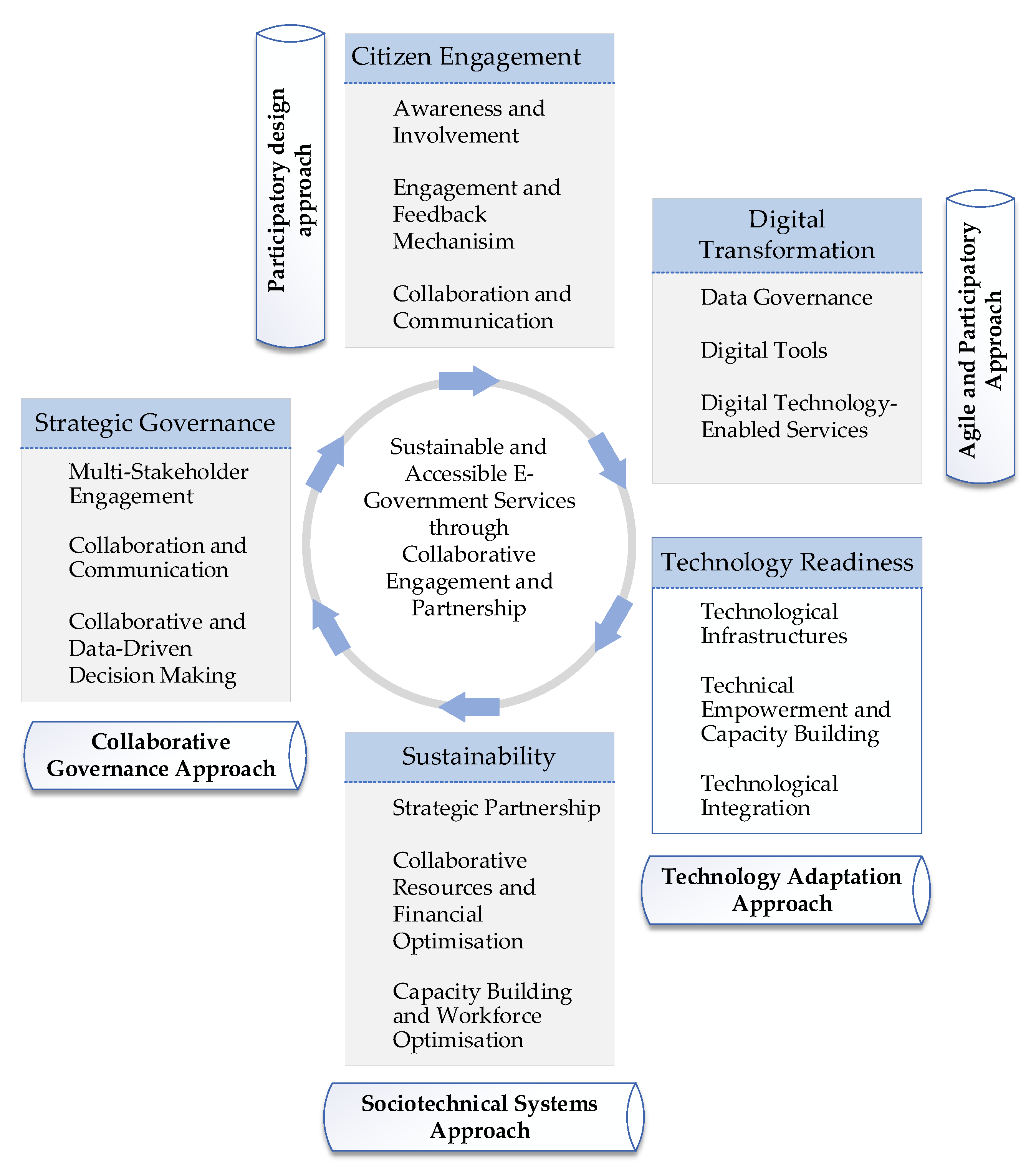

Table 1.
An example of a code.
| Code | Definition |
| Integrated Data Platform | Using a centralised digital platform to enable data sharing and dissemination of data and products to citizens and interested stakeholders. For example, Meteo Factory is a centralised digital platform. |
Table 2.
An example of a super code.
| Codes | Super Code | |
| 1 | Integrated Data Platform | Data and System Integration This software code enables the integration of data and systems, facilitating smoother interactions and a more unified flow of information across various departments or platforms. It emphasises the technical infrastructure that enables data sharing and integration in e-government services. |
| 2 | Inter-department Data Integration | |
| 3 | Interdependent Systems Design | |
Table 3.
An example of deriving themes from related super codes.
| Codes | Super Codes | |
| 1 | Integrated Data Platform | Data and System Integration |
| 2 | Inter-department Data Integration | |
| 3 | Interdependent Systems Design | |
| 4 | Dissemination Platforms | Information Dissemination |
| 5 | Leveraging Existing Networks | Network and Platform Utilisation |
| 6 | Leveraging social media | |
| 7 | Tailored Technology Deployment | Technology Customisation and Deployment |
| 8 | User-Specific Data Needs | |
| Emerging Theme: Technology-Enabled Services | ||
Table 4.
An example of a theme definition.
| Theme | Definition |
| Technology-Enabled Services | This theme encompasses various digital platforms that enable the delivery, accessibility, and efficiency of public services. It includes integrating public data, government systems, and tailored services to meet stakeholders’ needs and expectations. |
Table 5.
From super codes to themes and super themes: An example of an emerging super theme.
| Super Codes | Themes | |
| 1 | Data Challenges | Data Governance |
| 2 | Data Integration | |
| 3 | Data Management | |
| 4 | Data Sharing | |
| 5 | Data Collection and Analysis | Digital Tools and Data-Driven Decision Making |
| 6 | System Performance and Optimisation | |
| 7 | Data and System Integration | Technology-Enabled Services |
| 8 | Information Dissemination | |
| 9 | Network and Platform Utilisation | |
| 10 | Technology Customisation and Deployment | |
| Emerging Super Theme: Digital Transformation and Data-Driven Governance | ||
Table 6.
An example of a super theme definition.
| Super theme | Definition |
| Digital Transformation and Data-Driven Governance | This overarching theme refers to the strategic integration of digital technologies, management of data practices, and intelligent tools to assist in timely decision-making and processing, ultimately enhancing e-government operations and service delivery |
Disclaimer/Publisher’s Note: The statements, opinions and data contained in all publications are solely those of the individual author(s) and contributor(s) and not of MDPI and/or the editor(s). MDPI and/or the editor(s) disclaim responsibility for any injury to people or property resulting from any ideas, methods, instructions or products referred to in the content. |
© 2025 by the authors. Licensee MDPI, Basel, Switzerland. This article is an open access article distributed under the terms and conditions of the Creative Commons Attribution (CC BY) license (http://creativecommons.org/licenses/by/4.0/).
Copyright: This open access article is published under a Creative Commons CC BY 4.0 license, which permit the free download, distribution, and reuse, provided that the author and preprint are cited in any reuse.


