

Submitted:
05 May 2023
Posted:
06 May 2023
You are already at the latest version
Abstract
Phytochemicals are gaining popularity due to their antioxidant effects and potential protection against inflammation, cardiovascular disease, and certain types of cancer. The retention of these phytochemicals during extraction must be maximized. This research focused on extracting bioactive compounds from Psidium guajava Linn leaves using solvent extraction (SE), microwave-assisted extraction (MAE), ultrasound-assisted extraction (UAE) with distilled water (DW) or 60% (v/v) ethanol/water (ET). Phytochemical screening demonstrated that all of the screening showed positive results in all extraction methods, except glycoside. There were no significant (p>0.05) differences in total phenolic (TPC) and flavonoid content (TFC) during MAE, SE, and UAE in case of ET. However, SE shows better (p<0.05) extraction of TPC and TFC than UAE and MAE in case of DW. ET shows better (p<0.05) extraction of TPC and TFC than DW. Antioxidant analysis shows the same trend though both DPPH and FRAP values were higher in MAE and SE for ET and DW, respectively. MAE/ET showed the highest inhibitory activity and dose-dependent response using SW480 cell via MTT assay. HPLC and TLC analysis reveal the fingerprint of morin, might function as an anticancer agent. In conclusion, MAE/ET is the most efficient among the extraction techniques in terms of anticancer activity.
Keywords:
phytochemicals
; extraction
; ethanol/water
; antioxidant
; anticancer
; DPPH
; FRAP
; Morin
1. Introduction
Cancer is one of the major life threatening diseases with a high mortality rate and is now the leading cause of death for people in both developing and developed countries [1]. In 2020, there were 18.1 million cancer cases worldwide. Men accounted for 9.3 million of the cases, while women accounted for 8.8 million. Death due to cancer has reached 9.6 million in the year 2020 [2]. According to the most recent information from the International Agency for Research on Cancer (IARC), 36 types of cancer have been documented in 185 countries around the world. Nearly half of cancer patients live in Asia and the region with the largest incidence of cancer deaths. Colorectal cancer (CRC) is the third most commonly diagnosed cancer after lung and breast cancers, and the fourth leading cause of death [3,4,5], accounting for more than 10% of total cancer incidence and nearly 8% of total cancer deaths [6]. Breast and lung cancers were the most common cancers throughout the world, accounting for 12.5% and 12.2% of all new cases diagnosed in 2020, respectively. CRC was the third most common cancer in 2020 with 1.9 million new cases in 2020, contributing 10.7% of all new cases [2]. The prevalence of CRC has been rapidly increasing in recent years, and it is anticipated that by the year 2035, there will 1.36 million cases of CRC in men and 1.08 million cases in women throughout the world [7]. In Thailand, there were 0.1906 million new cases of cancer in 2020 alone. Men accounted for 0.0934 million of the cases, while women accounted for 0.0972 million, contributing 11.1% CRC for both sexes and ages. However, 11.4% CRC for males and 10.7% CRC for females were diagnosed in 2020. The Global Cancer Observatory estimates that 0.29 million new cases of cancer will be diagnosed by 2040 [8]. This knowledge makes it vital to research any potential treatments or medications for treating patients rather than using general treatments that were burdensome, complicated, and had adverse side effects.
According to epidemiological data, diet and nutrition plays an important role in the prevention and management of CRC [9]. Research suggests that dietary factors are attributed to 90% of CRC mortality [10] and daily intake of >400 g/day of fruits and vegetables is said to reduce the risk of CRC by 40% [11]. Fruits and vegetables are rich sources of bioactive compounds and dietary fiber and the majority of plant bioactive are reported to bind to dietary fiber. These bioactive are released into the colon as a result of colonic fermentation of the dietary fiber by local probiotics. These plant-derived dietary bioactive compounds can be extremely helpful in the fight against cancer by blocking the action of carcinogens from acting on target tissue, thereby suppressing cancer development. By reducing cell proliferation or enhancing differentiation and apoptosis in tumor-initiating cells, these phytochemicals are also said to play a key role in secondary prevention of cancer [12]. Studies have investigated the potential anticancer effects of phytochemicals from a large number of fruit and vegetable extracts [13,14]. Some of the protective components found in fruits and vegetables include selenium, vitamins, and dietary polyphenols, such as flavonoids, phytoalexins, phenolic acids, indoles, carotenoids, etc. [12,15]. The ability of these bioactive substances to exert their anti-cancer properties was discovered through in-depth research [16]. This has led to the emergence of alternate forms of cancer treatment approach called nutrition therapy, to fight against cancer cells through a healthy diet without the side effects that are frequently experienced by patients receiving from conventional medicine. Hence, identifying these bioactive compounds, analyzing their broad range of pharmacological activity, and determining their precise mechanism of action might assist in the treatment of cancer [17].
Several parts of guava plants such as leaves, fruits, seeds, peels, pulp, bark, and oil have phytochemical compounds with therapeutic characteristics. Guava leaf extract has been studied for potential chemotherapeutic use. Guava (P. guajava) has been shown to be antimicrobial [18,19,20], anti-inflammatory [21] antimalarial [22], antitumor [23,24], antiallergic [25] activity. Guava leaves, in particular, have the ability to inhibit different human carcinoma cell lines. Guava leaves contain quercetin and morin, two phenolic compounds with powerful antioxidants. Both of them are a plant-derived aglycone form, which has been used as a nutritional supplement and may be beneficial against a variety of diseases. Cardiovascular protection, anticancer, antitumor, anti-ulcer, anti-allergy, anti-viral, anti-inflammatory activity, anti-diabetic, gastroprotective effects, antihypertensive, immunomodulatory, and anti-infective effects are only a few of the benefits [26]. Previous studies have shown that quercetin and morin have anti-cancer characteristics and may reduce the risk of cancer [27]; specifically, colorectal cancer [28]. Arima and Danno [18] isolated four antibacterial compounds from guava leaves (Psidium guajava L.), and their structures were determined using chemical and spectroscopic evidence. Two new flavonoid glycosides, morin-3-O-α-L-lyxopyranoside and morin-3-O-α-L-arabopyranoside, as well as two recognized flavonoids, guaijavarin and quercetin, were discovered. Rattanachaikunsopon and Phumkhachorn [29] isolated four flavonoids including morin-3-O-lyxoside, morin-3-O-arabinoside, quercetin, and quercetin-3-O-arabinoside from fresh and dried Psidium guajava leaves.
The extraction of bioactive substances is influenced by numerous aspects, including the extraction process, raw materials, and solvent for the extraction process [30]. The extraction process can be classified as either conventional or non-conventional. Conventional techniques require the use of organic solvents, temperature and agitation. Modern techniques, or non-conventional techniques, are green or clean techniques since they use less energy and the implementation of organic solvents, which are helpful to the environment [31]. A few of the solvents that have been used to extract bioactive compounds are water [32], ethanol, hydro-ethanol [33] methanol [19], and hydro-methanol [34]. Nonetheless, there is a scarcity of studies investigating the best solvent for the antioxidant effectiveness of guava leaves. A few studies used green extraction techniques for the extraction of bioactive compounds from guava leaf, including solvent extraction (SE) [35], microwave-assisted extraction (MAE) [36], and ultrasound-assisted extraction (UAE) [37]. However, there hasn’t been any recent research comparing those green extraction techniques for the bioactive chemicals in guava leaf as well as anti-cancer and antioxidant effects of the extracts. In this study, the phenolic component and flavonoid content of water and hydroethanolic extracts of guava leaves using SE, MAE, and UAE were analyzed and the antioxidant properties also evaluated. The best extraction solvent for use with guava leaves for high antioxidant efficacy was selected and the anticancer activity of the extracts also evaluated.
2. Materials and Methods
2.1. Chemicals and reagents
Folin-Ciocalteu reagent, gallic acid (≥99%), trichloroacetic acid (TCA), Na2CO3 methanol, ethanol, Trolox ((±)-6-Hydroxy-2,5,7,8-tetramethylchromane-2-carboxylic acid), DPPH (2,2-diphenyl-1-picryhydrazyl), TPTZ (2,4,6-Tri(2-pyridyl)-s-triazine), and Iron(II) sulfate heptahydrate (FeSO4) were purchased from Merck (Darmstadt, Germany). Ferric chloride (FeCl3) was supplied by Ajax Finechem (Seven Hills, Australia). Dulbecco’s modified eagle’s media (DMEM), MTT (3-(4, 5-dimethylthiazol-2-yl)-2, 5-diphenyl tetrazolium bromide), L-glutamine were purchased from Sigma–Aldrich Chemicals (St Louis, MO, United States). Fetal bovine serum (FBS) was purchased from Gibco-BRL (Auckland, New Zealand). Water (LC-MS grade) was provided by RCI Labscan (Bangkok, Thailand). All the chemicals and solvents that were used in this study were of analytical grade (AR).
2.2. Collection of raw materials
Fresh pink guava leaves were collected from Kaset Natee Farm (Mae Chan, Chiang Rai, Thailand). A young age targeted green leaves; 1-3 leaves on top of each branch were collected for this study. Collected fresh leaves were washed with running tap water, followed by air-drying under light exposure until all water droplets present were totally evaporated. The core of the leaf was removed manually, and the leaves were dried at 40 °C for 12 h using a tray dryer (BP-80, KN Thai TwoOp, BKK, Thailand). The dried leaves were ground to a fine powder by cryogenic grinding using liquid nitrogen and a blender [38]. The ground guava leaves were sieved through a 6.73 mm (3 mesh) sized sieve and stored in the refrigerator (4±1 °C) using a high density polyethylene zipper (Ziploc®) for further study.
2.3. Preparation of sample extract
2.3.1. Solvent extraction (SE)
Fifty (50) g of guava powder was mixed with 500 ml of distilled water (DW) and 60% ethanol (ET). The suspension was heated for 20 min at 100 °C followed by shaking at 240 rpm for 6 h at room temperature (28±2 °C) using an orbital shaker (KS130, Schwerte, Germany) [35]. The extract was centrifuged at 8000 rpm for 10 min and filtered using a vacuum pump with Whatman No. 1 solvent resistant filter paper. The obtained aqueous organic extract was concentrated using a rotary evaporator (RV 3 V, Schwerte, Germany) at 50 °C and a rotation speed of 100 rpm until the extract obtained 50 ml and the organic solvent was completely evaporated. The extract was frozen in a dry ice, and lyophilized in a freeze drier (Labconco, FreeZone8L, MO, USA) until the samples were dry. The dried extract was stored at -40 °C for further use.
2.3.2. Microwave-assisted extraction (MAE)
Fifty (50) g of guava powder was mixed with 500 ml of DW and ET. The suspension was subjected to magnetic stirring at 950 rpm for 45 min at room temperature (28±2 °C) followed by microwave heating at 800 W for 140 sec. Initial heating for 40 sec followed by two subsequent heating cycles of 10 sec. each. A 40 sec intermittent cooling time is maintained between any two heating cycles [36]. The extract was centrifuged at 8000 r.min-1 for 10 min and filtered by Buckner funnel using Whatman No. 4 solvent resistant filter paper. The obtained aqueous organic extract was concentrated using a rotary (RV 3 V, Schwerte, Germany) at 50 °C and a rotation speed of 100 rpm until the extract obtained 50 ml and the organic solvent was completely evaporated. The extract was frozen in a dry ice, and lyophilized freeze drier (Labconco, FreeZone8L, MO, USA) until the samples were dry. The dried extract was stored at -40 °C for further use.
2.3.3. Ultrasound-assisted extraction (UAE)
Fifty (50) g of guava powder was mixed with 500 ml of DW and ET. The suspension was subjected to magnetic stirring at 950 rpm for 45 min at room temperature (28±2 °C) and sonicated (ultrasound frequency 40 KHz at 404 W) at 62OC for 20 min [37]. The extract was centrifuged at 8000 rpm for 10 min and filtered by Buckner funnel using Whatman No. 4 solvent resistant filter paper. The obtained aqueous organic extract was concentrated using a rotary evaporator (RV 3 V, Schwerte, Germany) at 50 °C and a rotation speed of 100 r. min-1 until the extract obtained 50 ml and the organic solvent was completely evaporated. The extract was frozen in a dry ice, and lyophilized in a freeze drier (Labconco, FreeZone8L, MO, USA) until the samples were dry. The dried extract was stored at -40 °C for further use.
2.4. Phytochemical screening
Chemical tests were performed on the aqueous extract and powdered specimens using the standard techniques outlined below.
2.4.1. Test for tannins and phenol
In test tubes, one (1) g of each powdered sample was added individually to 20 ml of DW. The mixture was then heated in a water bath for 10 min and filtered while hot using Whatman filter paper No. 1 into Erlenmeyer flasks. After cooling, 1 ml of the filtrate was diluted to 5 ml with DW and a few drops (2-3) of 10% ferric chloride (FeCl3) were added into the solution. The presence of tannins and phenols was detected by the formation of a bluish-black or brownish green precipitate [39].
2.4.2. Test for alkaloids
Two (2) ml of 2N HCl were added to 5 ml of aqueous extract. Each mixture was heated in a water bath for 10 min while being constantly stirred. After that it was cooled and filtered. The resultant filtrate was tested for the presence of alkaloids using Dragendorff’s as stated by [40]. One (1) ml of the filtrate was mixed with 0.5 ml of Ragendorff’s solution. The presence of alkaloids was revealed by the formation of a reddish-brown precipitate.
2.4.3. Test for saponins
One (1) g of each powdered sample was mixed with 10 ml of DW. The mixture was then boiled in a water bath for 10 min and filtered into an Erlenmeyer flask while still hot. Upon cooling, foam and emulsion were carried out. In a foam test, 2.5 ml of filtrate was added to a test tube, diluted to 10 ml with DW, and violently shaken for 2 min in the foam test. The presence of saponin in the filtrate was verified by the formation of foam. Two (2) drops of olive oil were added to the foaming in the emulsion test, and the mixture was violently agitated for a few minutes. The presence of saponins was suggested by the formation of a rather stable emulsion [41].
2.4.4. Test for terpenoids
Five (5) ml of aqueous extract was mixed with 2 ml of chloroform. Two (2) ml of concentrated H2SO4 were carefully added and gently shaken to form a layer. The presence of terpenoids was verified by radish brown coloration in the inter-phase [42].
2.4.5. Test for glycosides (Keller–Kiliani test)
One (1) ml glacial acetic acid, 2-3 drops of FeCl3, and 2-3 drops of concentrated H2SO4 were added to 2 ml of aqueous extract. The presence of glycosides was revealed by the presence of green/blue precipitate [40].
2.4.6. Test for amino acids (ninhydrin test)
In 2 ml of aqueous extract, 5–6 drops of the ninhydrin reagent were added, and the mixture was heated in a boiling water bath for 5 min. The presence of amino acids was shown by purple coloration of the solution [40].
2.4.7. Test for proteins (Biuret test)
A few (5-6) drops of 5% NaOH and a few (5-7) drops of 1% Cu(SO4)2 were added in 2 ml of aqueous extract. The presence of proteins was indicated by the violet color [40].
2.5. Determination of phenolic compounds
2.5.1. Total phenolic content (TPC)
TPC of the samples was determined using the Folin-Ciocalteu method described by Malik and Ahmad [43] with slight modifications. Sample extracts were diluted (100 fold) with distilled water and 1.0 ml of the diluted sample was transferred into a tube containing 5.0 ml of 10%v/v Folin-Ciocalteu’s reagent. Four (4) ml of sodium carbonate solution (7.5% w/v) was added to the mixer. The mixture was allowed to stand for 1 h at room temperature (28±2 °C) in a dark room. The absorbance was measured at 765 nm with a UV-visible spectrophotometer (Lambda 35 PerkinElmer, Bangkok, Thailand). The concentration of polyphenols in samples was derived from a standard curve of gallic acid ranging from 20-80 μg/mL. The TPC was expressed as mg gallic acid equivalents per gram of dried extract (mg GAE/g).
2.5.2. Total flavonoid content (TPC)
The total flavonoid content (TFC) was determined using the AlCl3 method [44]. For sample preparation, 0.1 g of extract was taken in a 100 ml volumetric flask and volume was made up to the mark by distilled water. 2 ml of solution was mixed with 2 ml of aqueous AlCl3.6H2O (0.1 mol/l). The suspension was allowed to stand at room temperature (28±2 °C) for 40 min in a dark room. The absorbance was measured at 417 nm with a UV-visible spectrophotometer (Lambda 35 PerkinElmer, Bangkok, Thailand). Total flavonoid contents are expressed as mg quercetin equivalents per gram of dried extract (mg QEs/g).
2.6. Antioxidant activity
2.6.1. DPPH (2,2-diphenyl-1-picryl-hydrazyl-hydrate) radical scavenging activity
The DPPH radical functions as a free radical or oxidizing radical that is decreased by antioxidants, as well as a reaction indicator. The free radical scavenging activity was measured utilizing the stable radical 2,2-diphenyl-1-picryl-hydrazyl-hydrate. The radical scavenging activity of DPPH was determined using Brand-Williams’ technique [45] with slight modifications. The 100-fold diluted extract (50 µl) was mixed with an aliquot of 2,000 µl of 60 µM DPPH radical in methanol. The mixture was vortex for 20 sec and allowed to stand at 25 °C in the dark room for 60 min for reaction to occur. Absorbance at 517 nm was measured by UV-visible spectrophotometer (Lambda 35 PerkinElmer, Bangkok, Thailand). using methanol as a control. For the standard 20-80 µg/ml of Trolox was prepared. The calibration curve was plotted between Trolox concentration (µg/ml) and % inhibition. The DPPH radical scavenging activity was expressed as Trolox equivalents antioxidant capacity per grams of dried extract (mg TEAC/g).
2.6.2. Determination of ferric reducing antioxidant power activity (FRAP assay)
Reducing activity was conducted by Ferric Reducing Activity Power (FRAP) assay following Benzie’s method [46] with some modifications. FRAP reagent was prepared by mixing of 300 mM acetate buffer (pH 3.6), 10 mM 2,4,6-Tripyridyl-S-triazine (TPTZ) in 40 mM HCl, and 20 mM FeCl3 at a ratio of 10:1:1 (v/v/v). Ferrous sulfate (Fe (II)) was prepared as standard (62.5-1000 µM). 400 µl of standard and 100-fold diluted extract was mixed in 2,600 µl of FRAP reagent and incubated in a water bath at 37 °C for 30 min. The absorbance was measured at 595 nm using a UV-visible spectrophotometer (Lambda 35 PerkinElmer, Bangkok, Thailand). and ferric reducing antioxidant power activity was expressed in terms of mmol of Fe (II) equivalent per gram of dried extract (mmol Fe(II)/g).
2.7. Cell culture and treatment
Human colon cancer cell (SW480) was obtained from American Type Culture Collection (ATCC, Manassas, USA). The cells were grown in Dulbecco’s Modified Eagle’s Medium (DMEM) supplemented with 10% fetal bovine serum (FBS), 2mN L-glutamine, 100 IU penicillin/streptomycin. The cancer cells were cultivated on tissue culture plates (100 mm in diameter) and kept in a humidified incubator (5% CO2, 95% air atmosphere and 37°C) with media changes every 2-3 days. After reaching >80% confluence, the cells were trypsinized, collected, and transplanted onto a brand-new tissue culture dish.
2.7.1. Cell viability by MTT assay
The anticancer activity was measured percentage of cell viability using 3-[4, 5-dimethylthiazole-2-yl]-2, 5-diphenyltetrazolium bromide (MTT) assay. The viability of SW480 cells was assessed by MTT assay as described previously by Mosmann [47]. The SW480 colon cancer cell line was seeded at 4 ×10⁴ cells/well in 96 well plates and incubated at 5% CO2, 95% air atmosphere and 37°C. The cells were treated with different concentrations of extracts (12.5, 25, 50, 100, and 200 µg/ml) for 24 h. Then 20µl of MTT (5 mg/ml) was added to each well. After 2 h incubation, the supernatant was discarded. The cells were washed with PBS twice and incubated with 0.5 mg/ml resazurin for 4 h. After 4 h, the samples were determined cell viability at 570 nm by micro-plate reader (Multiskan FC, Thermo Fisher Scientific, Waltham, MA). Percentage of cell growth inhibition was calculated using the following formula:
2.8. High-performance liquid chromatography-mass spectrometry (HPLC-MS) analysis and identification of compounds
Using an HPLC Agilent 1260 series (Agilent Technologies, Santa Clara, CA, USA) equipped with a binary pump, an online degasser, an autosampler, a thermostatically controlled column compartment, and a UV-Vis Diode Array Detector, chromatographic studies were carried out (DAD). The column was maintained at 25 °C. Phenolic compounds guava leaf extract were separated at 28±2OC using a modified method of López-Cobo et al. [48]. A Poroshell 120 EC-C18 (4.6 mm × 100 mm, particle size 2.7 µm) (Agilent Technologies) was used to separate compounds. The gradient elution was performed using water containing 1% acetic acid as solvent system A and acetonitrile as solvent system B, and the following procedures were followed: 0 min, 0.8% B; 2.5 min, 0.8% B; 5.5 min, 6.8% B; 11 min, 14.4% B; 17 min, 24% B; 22 min, 40% B; 26 min, 100% B, 30 min, 100% B; 32 min, 0.8% B; 34 min, 0.8% B. The sample volume was 5µl and the flow rate was 0.8 ml/min. MS analysis was carried out using a 6540 Agilent Ultrahigh-Definition Accurate-Mass Q-TOF-MS coupled to the HPLC, equipped with an Agilent Dual Jet Stream electrospray ionization (Dual AJS ESI) interface in negative ionization mode at the following conditions: drying gas flow (N2), 12.0 L/min; nebulizer pressure, 50 psi; gas drying temperature, 370 °C; capillary voltage, 3500 V; fragmentor voltage, 3500 V; and scan range, m/z 50-1500. The following collision energy values were used in automatic MS/MS experiments: m/z 100, 30 eV; m/z 500, 35 eV; m/z 1000, 40 eV; and m/z 1500, 45 eV. MassHunter Workstation software (Agilent Technologies, Santa Clara, CA, USA) was used for integration and data elaboration [49].
2.9. Thin layer chromatography
The extracts were analyzed by thin layer chromatography (TLC) using different eluents and detection solutions [50]. TLC analyses were performed using 5 mg of extract diluted in 1 mL of ethyl acetate (PA, Lot 0804680, Vetec). Samples were applied to silica gels for separation (5 × 20 cm, Silica gel 60 com UV254, Lot 711331, Macherey-Nagel). Essential oils, flavonoids and antioxidants were separated using 80:20 hexane (PA, Lot K3828037 Merck; Lot 0722.03/08 CRQ): ethyl acetate (Lot K38466423, Merck) as the eluent. Essential oils were detected using an anisaldehide solution. Flavonoids were detected using a solution of NP/PEG or boric acid (PA, Lot 0805119, Vetec) and oxalic acid in ethanol (PA, Lot 0801084, Vetec). Thin layer chromatography (TLC) was used to evaluate the extracts using various eluents and detection solutions. TLC analysis was carried out with 5 mg of extract diluted in 1 mL of ethyl acetate (PA, Lot 0804680, Vetec). Samples were separated on silica gels (5 × 20 cm, Silica gel 60 com UV254, Lot 711331, Macherey-Nagel). Flavonoids were separated using ethyl acetate (Lot K38466423 Merck) as the eluent. Flavonoids were identified using an NP/PEG or boric acid (PA, Lot 0805119, Vetec) and oxalic acid solution in ethanol (PA, Lot 0801084, Vetec). The plates were heated to 100◦C, and spots were detected with a UV 366 nm light. After that, the plates were immediately heated for detection.
3. Results and Discussion
3.1. Phytochemical screening
In this study, a preliminary qualitative phytochemical analysis was conducted to identify the major secondary metabolites including tannin, phenols, saponins, flavonoids, steroids, terpenoids, and alkaloids present in the leaves of Psidium guajava Linn. The phytochemical screening indicated that tannins, phenols, flavonoids, alkaloids, saponins, and terpenoids were detected in the leaf extracts. However, glycosides were not detected in leaf extract as shown in Table 1. Proteins and amino acids were also found in the guava leaf extract. Research revealed that protein content of guava leaves is 9.73% on a dry weight basis [51]. Thomas et al. [52] found 16.8 mg protein/100g and 8 mg amino acids/100g in guava leaves as estimated according to Lowry’s and ninhydrin techniques. Guava leaves can be utilized as a novel and sustainable nutritional source since they are a rich source of proteins, carbohydrates, and dietary fibers [53].
Several researchers conducted qualitative phytochemical analysis of guava leaf extracts obtained by macerating leaf powder in ethanol. Biswas et al. [42] detected phenols, tannins, terpenoids, flavonoids, and glycosides but no saponins in the leaf extracts of Psidium guajava L. The Psidium guajava leaf powder extracts show the presence of terpenoids, quinones, fats, and phenol and the absence of alkaloids, flavonoids, sterols, and anthocyanin [54]. The presence of alkaloids, flavonoids, phenols, and tannins and the absence of saponins, steroids, terpenoids, and cardiac glycosides were detected by Geoffrey et al. [55] in the Psidium guajava leaf extracts from Kericho and Baringo Counties, Kenya. The presence of alkaloids, glycosides, saponins, and tannins was detected but no flavonoids or steroids were detected in the Psidium guajava leaf extract prepared by ethanol percolation at 30 °C [56]. The Psidium guajava leaf contains phlobatannins, saponin, flavonoids, steroids, terpenoids, polyphenols, and glycosides, but not triterpenoids, alkaloids, or anthraquinone, suggested by Thenmozhi and Rajan [57]. The results demonstrated that all of the screenings give a positive result in all extraction methods, except glycoside which that gave the negative result for all three extraction methods. Phytochemical screening analysis suggested that there a difference in the level of result between extraction methods and solvent used for the extraction (Table 1). The preliminary phytochemical screening of P. guajava Linn leaf extracts revealed varying degrees of presence of secondary metabolites. The solvent extraction process shows a strong presence of total flavonoids, total phenolic, alkaloids, and terpenoids in both DW and ET. However, only saponins, tannins and phenols are less presence in DW and ET, respectively for the solvent extraction method. The UAE process shows a strong presence of total flavonoids, alkaloids, saponins, and terpenoids in ET and total phenolic, tannins and phenols was less presence in case of DW. However, total phenolic, tannins, phenols, and terpenoids were strong presence in solvent extraction (ET) process, for MAE method. Most of the phytochemicals were less presence shown in the MAE method for DW except tannins and phenols. The presence of secondary metabolites in aqueous extracts was almost similar, although the intensity of color was less, which might be attributable to the fact that some compounds may not be properly soluble in aqueous solvents [58]. The ethanol leaf extracts of P. guajava Linn had better presence of secondary metabolites than water extracts except tannins and phenols (Table 1).
Several studies on plant parts show that flavonoids are probably responsible for the pharmacological and biochemical functions, viz., antioxidant, anti-allergic, anti-inflammatory, hepatoprotective, anti-carcinogenic, anti-viral, and anti-thrombotic properties [59]. Tannins are utilized for anti-hemorrhoidal, hemostatic, and anti-diarrheal preparations. Saponins function as anti-inflammatory and antioxidant substances that help to decrease cholesterol [59]. Terpenoids have a significant impact on wound healing, strengthen the skin, and increase the concentration of antioxidants in wounds, and the ability to repair inflamed tissues by increasing blood supply [60]. Phenolic compounds have biological effects such as inhibition of angiogenesis and cell proliferation, cardiovascular protection, anti-apoptosis, anti-inflammation, anti-aging, anti-atherosclerosis, anti-carcinogen, and improvement of endothelial function. Steroids show anti-bacterial properties and very important compounds due to their interactions with other substances like sex hormones [61].
3.2. Percent yield
The results showed that the highest yield was associated with UAE/ET (10.37%) followed by SE/ET (9.45%), SE/DW (7.95%), MAE/ET (7.11%), MAE/DW (6.85%), and UAE/ET (6%), respectively. The ET gave the highest extraction yield for all three extraction processes. Research revealed that extraction yield increases alongside the increasing polarity of solvent utilized in the extraction process [62]. Water is a pretty good solvent, although this is due to the fact that water is primarily a polar solvent and will only dissolve polar molecules. Since ethanol is polar but also includes a significant non-polar component, it may frequently dissolve both polar and non-polar molecules, not simply polar ones. As a result, the higher percentage yield shown by the ET may be attributable to the ability to dissolve both polar and non-polar molecules, which may extract a wide range of compounds. According to the foregoing findings, the effective extraction of biologically active compounds from plants such as Psidium guajava is highly dependent on the type of solvent used during extraction. Different types of solvent with various polarities extract specific phytochemicals from plants [63]. In this study, polar solvents such as water and ethanol yielded the highest amount of crude extract with the highest presence of phytochemicals. As a result, this investigation supports the concept that differences in solvents used will affect the presence of bioactive chemicals in an extract [64]. It also denotes that the selection of a solvent is affected by several aspects, such as the class of phytochemicals, diversity and polarity of the compounds to be extracted [65].
The results showed that the highest yield (p<0.05) was associated with UAE/ET (10.37%) followed by SE/ET (9.45%) and MAE/ET (7.11%). Chuyen et al. [66] found that the maximum carotenoid and antioxidant capacity yields of UAE were significantly higher than those of the MAE. The antioxidant capacity of extract obtained by the UAE was also significantly higher than that of the conventional extraction using the same ratio of solvent to material. The results showed that both MAE and UAE could be used to reduce the extraction time significantly in comparison with conventional extraction of Gac peel while still obtaining good extraction efficiencies. Ultrasounds have the ability to accelerate heat and mass transfer by disrupting plant cell walls, resulting in better release of target substances from a variety of natural sources [67]. The maximum extraction yield was 3.13%, demonstrating the effectiveness of the ultrasonic technique for extracting antioxidants from black mulberry fruits in water: material ratio of 40:25, a temperature of 69 °C, time of 75 min., and ultrasound power of 190 W. Wang et al. [68] found that at 70 °C, with a power of 230 W and a water ratio of 13:1 ml/g, the highest extraction (5.16%) for ultrasound-assisted antioxidant activity of pears (Pyrus sinkiangensis, Maloideae). This technique was very effective, and this fruit has potential for food industry applications. Corbin et al. [69] used ultrasonic to extract phenolic compounds from pine seeds. The approach has been shown to be very effective for reducing the trapping of phenolic compounds. The best conditions were using supplemented water as solvent with 0.2 N sodium hydroxide, a 60-min extraction period, a temperature of 25 °C, and an ultrasonic frequency of 30 KHz. This approach increased the quantity of phenolic compounds by 30% as compared to conventional maceration.
3.3. Effect of solvent on the extraction of phytochemicals
Extraction is one of the most important steps in obtaining extracts high in phenolic compounds. Type of solvent, extraction temperature, and time are all factors that impact phytochemical extraction. Phytochemicals are frequently extracted using ethanol, methanol, acetone, and water. Nevertheless, no suitable solvent is used for the isolation of whole components. Ethanol and water are the most commonly used extraction solvents in food systems because of hygiene, low cost, and abundance, as well as their compatibility with health [70]. Ethanol is utilized for phytochemical extraction, according to the laws regarding the use of food-grade solvents [71]. Water and low concentration of ethanol may easily enter cells, while high concentrations of ethanol might promote protein denaturation, inhibiting polyphenol dissolution and then influencing extraction rate [72]. Ethanol is a low-polar solvent, whereas water is a strong polar solvent, and it can be mixed in any proportion [73]. The polarity of the complex solvent will gradually rise when water is added to ethanol. Since phenolic compound molecules are also polar, the yield of TPC increased as the water concentration rose according to the “like dissolves like” principle [74].
Table 2 demonstrated that ET produced the highest values in all test results. TPC and TFC concentrations were higher in ET than DW. This finding is consistent with the findings of Qian and Nihorimbere [33], who found water extract of guava leaves contained less phenolic compounds than the 50% hydroethanolic extract. This is due to the fact that both polar and less polar molecules are co-extracted [75]. Another investigation found that the 40% hydroethanolic extract had the greatest phenolic component level [76]. Similarly, Taha et al. [77] investigated several ethanol concentrations (80, 70, 60, and 50%) and found that 60% was the most efficient solvent for extracting total phenolic chemicals from sunflower meal. Overall, ethanol-water combinations, particularly those containing 40 to 80% ethanol, had better extraction efficiency of phenolic compounds compared to only water or pure ethanol or methanol [78]. According to Seo et al. [79], the hydrophenolic extracts had greater phenolic component contents than water extracts, with the 50% hydroethanolic extract having the greatest phenolic compound contents. According to Nyirenda et al. [80], polar molecules like flavonoids and phenolic compounds are more soluble in aqueous solvents than they are in organic solvents. Diaz-de-Cerio et al. [49] discovered that the phenolic content of the pure ethanol extract was lower than the content of the extracts obtained with the hydro-alcoholic mixes, due to the less solubility of polar compounds in pure organic solvents. The presence of water (40% v/v water and 60% v/v ethanol) enhances phytochemical extraction since the target chemicals are more soluble in the solvent systems [79]. TPC value rose from 100 to 80% ethanol, when the maximum level was achieved, as observed with palm kernel cake [81].
3.3. Phenolic compounds
The TPC of the extracted solution from three extraction methods determined by theFolin-Ciocalteu method were reported as gallic acid equivalents (GE). The TPC extracted by DW and ET through different extraction methods is shown in Table 2. Calibration curve from gallic acid showed maximum absorbance at 765 nm wavelength (y = 0.00886 + 0.127, R2 = 0.996). The TPC content was significantly (p<0.05) higher in ET than DW for all MAE, UAE and SE. Among the three extraction methods, SE/ET demonstrates the highest (66 GAE mg/g) amount of TPC followed by MAE/ET (65.29 GAE mg/g), and UAE/ET (63.23 GAE mg/g). Though there was no significant difference (p>0.05) between the TPC of extract obtained using these three methods. The lowest TPC values were obtained from the UAE/ET method. The reason for this could be the lower penetration of the solvent into the solute matrix, resulting in lower yield as well as lower phenols in the extract. SE/DW (58.89 GAE mg/g) had a higher (p<0.05) TPC value, followed by UAE/DW (54.47 GAE mg/g), and MAE/DW (46.70 GAE mg/g). The reason for this could be the higher penetration of the solvent into the solute matrix, resulting in higher yield as well as higher phenols in the extract during SE/DW. The results of TFC in the extracted solution from three extraction methods are given in Table 2. The equation of the calibration curve of the quercetin standard was y = 0.00192 + 0.0881, R2 = 0.999. Similar to TPC, TFC content was significantly (p<0.05) higher in ET than only DW for all MAE, UAE and SE. Among the extracted solutions from three extraction methods, SE/ET contained the highest (129.01 QE mg/g) amount of TFC followed by UAE/ET (125.13 QE mg/g), and MAE/ET (123.69 QE mg/g). Though there was no significant difference (p>0.05) between the TFC of the extract obtained using these three methods. SE/DW (96.18 QE mg/g) had the highest TFC followed by UAE/DW (86.54 QE mg/g), and MAE/DW (75.35 QE mg/g). Though, UAE/DW and MAE/DW did not significantly differ (p>0.05) from each other in terms of TFC. The reason for this could be the coupled effect of SE that provides better penetration of solvent into the solid matrix. For TPC and TFC, ET extraction shows better results than only DW. The best reason behind this was described in Section 3.2.
Free radicals and reactive oxygen species can be trapped by flavonoids and other plant phenolic substances, which have potent antioxidant properties [82]. The extraction process is one of the most crucial factors in obtaining high-quality natural antioxidants. Quick, easy, and environmentally friendly approaches should be used for the extraction of phytochemicals. Yet the chosen extraction method should be highly capable of removing the most active compounds without destroying them. The ideal technique has the advantages of shortening extraction time, increasing extraction yield, using less solvent, and improving the quality of extracts [83]. This research shows that the leaves of P. guajava are a rich source of antioxidant phyto-compounds. Several extraction techniques have been used in this study to assess their effect on the phytochemical and antioxidant profile. The SE technique has shown to be the best of all extraction methods given its great effectiveness for the extraction of plant bioactive, followed by MAE and UAE. The UAE used as based green extraction techniques, which provide better efficiency and yields due to the occurrence of a phenomenon known as “cavitation,” in which high shear forces and free radicals work together to disrupt the cell wall, resulting in a high extraction yield when coupled with electromagnetic microwaves for uniform heating [84]. The extremely high frequency of ultra-sonication was thought to break the structure of the plant cell wall, resulting in more contact between the solvent and the plant material. As a result, the dissolution of active principles was accelerated in this procedure [83]. In the instance of ET, the findings showed that MAE had a similar extraction capability to TPC and TFC to SE and UAE (p>0.05). However, when TPC and TFC were extracted using DW, the SE was significantly (p>0.05) higher than in the UAE and MAE. Though the extraction of TPC and TFC by MAE is similar (p>0.05) to that of UAE and SE in the case of ET, the treatment time for MAE was shorter. The increased extraction of TPC and TFC with a shorter extraction time might be attributed to ionic conduction and water dipole rotation effects, which are the main mechanisms of microwave heating. As pressure builds up within the cells of a sample, plant materials are efficiently delivered through molecular interactions with the electromagnetic field, and energy is quickly transferred to the extraction solvent and raw plant materials [85]. The knowledge gained from this research is expected to be valuable for extracting natural antioxidants from guava leaves on a micro and commercial scale.
3.4. Antioxidant activity
The DPPH radical scavenging and FRAP antioxidant power assays were performed to assess the antioxidant activity of the extracted solution from guava leaves (Psidium guajava Linn) using three extraction procedures (MAE, UAE, and SE) (Table 2). The DPPH assay is aimed at measuring the capacity of plant extracts to scavenge purple-colored DPPH (by contributing a hydrogen atom or electron) and converting it to yellow-colored diphenylpicrylhydrazine [86]. It is demonstrated that MAE/ET had the higher scavenging ability on DPPH free radicals (43.44 mg TE/g) followed by SE/ET (43.06 mg TE/g), and UAE/ET (41.50 mg TE/g). However, there was no significant difference (p>0.05) between the three methods. According to DPPH and FRAP antioxidant analysis, ET extraction exhibited considerably higher antioxidant activity than only DW (Table 2). The DPPH scavenging activity of SE/DW (39.85 mg TE/g) was significantly (p<0.05) higher than that of UAE/DW (35.79 mg TE/g) and MAE (33.08±1.13 mg TE/g). The FRAP assay is based on the principle that electron donation from an antioxidant substance reduces Fe+3 to Fe+2 [46]. Since the antioxidant activity of an extract is directly related to reducing capacity, the FRAP assay is a reliable approach for assessing antioxidant activity in extracts. The FRAP radical scavenge results are shown in Table 2. The FRAP followed the same pattern as the ability to scavenging radicals using DPPH free radical assay. The result suggested that MAE/ET shows better scavenging ability (45.14 mM Fe(II)/mg), followed by SE/ET (45.10 mM Fe(II)/mg), and UAE/ET (44.37 mM Fe(II)/mg). However, there was no significant difference (p>0.05) between the three methods. Similar to DPPH antioxidant activity, the FRAP scavenging activity of SE/DW (41.50 mM Fe(II)/mg) shows higher antioxidant activity (p<0.05) than UAE/DW (38.45 mM Fe(II)/mg), and MAE-DW (34.79 mM Fe(II)/mg).
In all measures, the antioxidant capacity was found to be considerably higher in the ET. The highest phenolic concentration indicates a positive relationship between antioxidant capacity and the quantity of phenolic compound. The antioxidant activity increased as the extract concentration was increased (Table 2).

Table 2.
Yield, total phenolic, total flavonoids, and antioxidant activities of the guava leaves extract.
Table 2.
Yield, total phenolic, total flavonoids, and antioxidant activities of the guava leaves extract.
| Extraction method |
Solvent | % Yield | TPC (GAE mg/g) |
TFC (QE mg/g) |
DPPH (mg TE/g) |
FRAP (mM Fe(II)/mg) |
|---|---|---|---|---|---|---|
| MAE | Distilled water | 6.85±0.06e | 46.70±3.75d | 75.35±3.12e | 33.08±1.13d | 34.79±1.56d |
| 60% ethanol | 7.11±0.08d | 65.29±1.62a | 123.69±11.77ab | 43.44±0.61a | 45.14±1.24a | |
| UAE | Distilled water | 6.00±0.06f | 54.47±2.21c | 86.54±7.81d | 35.79±0.12c | 38.45±0.87c |
| 60% ethanol | 10.37±0.06a | 63.23±2.91ab | 125.13±4.95a | 41.50±1.21ab | 44.37±1.06a | |
| SE | Distilled water | 7.95±0.04c | 58.89±3.07b | 96.18±1.17c | 39.85±0.58b | 41.50±0.92b |
| 60% ethanol | 9.45±0.13b | 66.00±1.21a | 129.01±9.52a | 43.06±1.04a | 45.10±0.32a |
Values are expressed as means ± SD (n = 3). Different letters in the same column indicate significant difference at p<0.05. MAE = Microwave-assisted extraction; UAE = Ultrasound-assisted extraction; SE = Solvent extraction; DPPH = 2,2-diphenyl-1-picryl-hydrazyl-hydrate; FRAP = Ferric reducing activity power; TPC = Total phenolic content; TFC = Total flavonoid content; GAE = Gallic acid equivalent; QE = Quercetin equivalent.
The antioxidant content of ethanol extract was higher than water, so it can dissolve more polar compounds contained in the sample than water solvent. The findings revealed that the total antioxidant activity of sample extracts followed the same order (ET > DW) as was for determining the total phenolic and total flavonoid contents. This finding is consistent with research by Jagadish et al. [87], which demonstrated a strong correlation between bioactive components and antioxidant activity. The result of this study is consistent with those of other research that examined the relationship between phenolic compounds and antioxidant capability. An earlier study discovered that antioxidant capability varied according to the phenolic compound profile [889]. Kim et al. [89] reported that there is a positive correlation between phenolic concentration and antioxidant activity. Additionally, Seo et al. [79] found that the antioxidant activity of the hydro-ethanolic extracts was higher than water extracts, and 50% hydro-ethanolic extract having the maximum antioxidant activity. Qian and Nihorimbere [33] also found that the antioxidant activity of 50% hydro-ethanolic extract was higher than water extract. It was suggested that DPPH- and ABTS+ scavenging activities were significantly correlated with the abundance of phenolic compounds [90]. However, Huang et al. [91] noted that the activity started to decrease with increasing concentration after a critical point and attributed it to interfering substances. Our results clearly suggest that the antioxidant abilities of guava leave, such as DPPH and FRAP scavenging activity and reducing power, are closely dependent on the contents of the phenolic compounds. In the case of ET, the antioxidant activity (DPPH and FRAP) was higher in extracts using MAE compared to SE and UAE. However, there were no significant (p>0.05) differences in the antioxidant activity. The quick breakdown of plant cells by electromagnetic waves after exposure to microwave heating may be the cause of the higher TPC in MAE. When compared to traditional extraction methods, MAE provides a number of noticeable benefits, including a shorter extraction time, higher extraction yield, and less solvent consumption [92].
3.5. The correlation analysis
Phenolic and flavonoid molecules are key antioxidant components that are responsible for deactivating free radicals based on their propensity to donate hydrogen atoms to free radicals. They are also structurally ideal for free radical scavenging [92]. Some studies have found a linear relationship between total phenolic and flavonoid concentration and antioxidant capacity [93]. Figure 1 illustrates the correlation between total phenolic and flavonoid content with antioxidant capability. There were strong correlations between antioxidant capacity and total phenols (DPPH, R2 = 0.9756; FRAP, R2 = 0.9925) and moderate correlation with total flavonoids (DPPH, R2 = 0.4093; FRAP, R2 = 0.4723) was observed at a 95% confidence level. By analyzing the correlation coefficients (R-values), it is feasible to conclude that the phenolic and flavonoid groups have a significant role in the antioxidant activity of the selected plant extracts.
TPC was shown to have a linear relationship with the antioxidant activity of all extracts. Meanwhile, TFC was shown to have a non-linear relationship with the antioxidant activity of all extracts, with an increase in TPC and/or TFC in guava leaves increasing antioxidant activity measured by DPPH and FRAP techniques. A previous study suggested that condensed tannin in guava leaves may have contributed to antioxidant activity [94]. This finding is also in agreement because condensed tannin is a phenolic substance. Research revealed that guava leaves contain essential oils that are rich in cineol, triterpenes, tannins, eugenol, kaempferol, and other compounds including flavonoids, malic acid, gallic acid, chlorophyll, and mineral salts [95]. However, other research suggests that guava leaves mostly constitute rutin, naringenin, gallic acid, catechin, epicatechin, kaempferol, isofavonoids, and favonoids such as quercetin and guaijaverin [96,97]. Based on the current research, it is possible to suggest that determining TPC and TFC in guava leaf extracts may be used to predict, indirectly, its antioxidant capabilities using DPPH and FRAP methodologies. Several researches used IC50 or EC50 in their results, thus higher TPC and/or TFC are associated with higher antioxidant capabilities, as evidenced by lower IC50 or EC50 when the correlation is negative and significant [98]. Different structures of flavonoid and phenolic in samples may result in different antioxidant activity. A phenolic molecule with additional hydroxyl groups or conjugated double bonds demonstrates higher antioxidant ability. High antioxidant activity in flavonoids shows when a flavonoid has a hydroxyl group at C-3′-C-4′, OH at C-3, oxo function at C-4, double bond at C-2 and C-3 [99]. The highest effect on the antioxidant capacity of a flavonoid was possessed by ortho position of hydroxyl group in C-3′-C-4′ [100]. The TFC in ET was higher than TFC in distilled water for all three extraction methods (SE, UAE, and MAE), and a similar pattern was seen for DPPH and FRAP antioxidant activity. As a result, the majority of flavonoids in ET were predicted to have a hydroxyl group in C-3′-C-4′, OH at C-3, oxo function at C-4, and double bond at C-2 and C-3, whereas the majority of flavonoids in DW with other positions had limited antioxidant activity. For all three extraction procedures (SE, UAE, and MAE), the TPC in ET was higher than the TPC in DW, with higher DPPH and FRAP values. This indicates that many phenolic compounds in ET can transfer hydrogen more efficiently than DW.
3.6. Anticancer activity
Cell viability, MTT assay was used to evaluate the viability of colon cancer cell SW480 culture in Dulbecco’s Modified Eagle’s Medium (DMEM) supplemented with 10% fetal bovine serum (FBS), 2 mN L-glutamine 100U/ml penicillin and 100 U/ml streptomycin (Pen/Strep). According to the MTT assay, the survival rate of the SW480 cells exposed to morin (12.5-200 µg/ml) was reduced in a time and dose-dependent manner, which revealed that morin exhibits anticancer properties (Figure 2). Analysis of variance suggested that the effects of dose and time on the viability of cells are statistically significant (p<0.05). The inhibitory effects of morin on the SW480 cancer cell are shown in Table 3. Furthermore, MTT assay revealed that the inhibitory effect of each extracted solution from different extraction methods were significantly different from each other’s (p<0.05). Higher antioxidant activity was shown by a lower IC50 value, which also suggested a greater capacity to donate hydrogen. When compared to DW, all ET extraction of guava leaves had a higher capacity to scavenge DPPH and FRAP radicals. In this investigation, MAE extracts showed stronger antioxidant activity compared to UAE and SE. The best antioxidant activity was shown by MAE (16.67 µg/ml) followed by UAE (98.68 µg/ml) and then SE (144.59 µg/ml) (Table 3). However, % inhibition increased with increasing the concentration of extracts (Figure 2). The results indicated that guava leaf extract shows dose-dependent activity. A few researchers also found the dose-dependent activity of guava leaf extracts. The cytotoxicity of the extract against liver carcinoma cells was assessed using the MTT assay, which revealed that the extract had a dose-dependent inhibitory activity against HepG2 cell growth, with cell viability of 81.85%, 70.65%, 53.19%, and 31.09% after exposure to 5, 20, 50, and 100 g/mL, respectively [101]. Another aqueous extract of P. guajava budding leaves was studied for its antiangiogenic and antimetastatic activity on DU145 cells by Peng et al. [102]. The extract inhibited DU145 cell survival in a dose-dependent manner, with an IC50 value of 0.57 mg/mL. Furthermore, the extract inhibited DU145 cell migration in a dose-dependent manner [102]. These findings support the hypothesis that aqueous extracts of P. guajava budding leaves have a potent anti-prostate cancer action.
The result also suggested that % inhibition was significantly higher (p<0.05) in MAE extract followed by UAE and SE, except 200 µg/ml. At the highest concentration, MAE and UAE extracts % inhibition is similar. MAE extracts indicated better % inhibition and IC50 might be due to purity of the extract [103]. Leadbeater [103] claims that the use of the microwave is a flourishing technology due to access to higher temperatures easily, safely, and in a reproducible manner, as well as reduces reaction times, increase yields, and improve purity in comparison to conventional heating methods. To retain the maximum amount of phenolic compounds, however, optimization of the extraction process parameters is necessary due to the numerous variables that might affect MAE [104]. As a matter of fact, in microwave-assisted extraction, microwave power is one of the crucial factors impacting the release of polyphenols from various matrices by rupturing cell walls, which also has the ability to modify equilibrium and mass transfer conditions during extraction. Increasing microwave power accelerated the polyphenol extraction.
3.7. Extract analysis
3.7.1. HPLC-MS
The HPLC profile analysis of Psidium guajava Linn. leaves extract showed the comparative profile of three different extracted methods, including MAE (A), UAE (B) and SE (C) (Figure 3). Morin is a flavonoid primarily identified in the extract of guava leaves. The pro-oxidative impact of morin in SW480 cells causes a disruption in mitochondrial activity, which activates the intrinsic and extrinsic apoptotic pathways [105]. Morin also causes significant reduction of glucose transporter-1 expression, which lowers cellular glucose absorption and impairs mitochondrial activity, which sensitizes cells to undergo apoptosis in the intrinsic apoptosis pathway [105]. According to Figure 3, the peek that UAE (B) and SE (C) were absent may be morin that most present in MAE (A) related to the anticancer MTT assay. This can demonstrate that MAE had the highest anticancer activity.
Rattanachaikunsopon and Phumkhachorn [29] isolated four flavonoids including morin-3-O-lyxoside, morin-3-O-arabinoside, quercetin, and quercetin-3-O-arabinoside from fresh and dried Psidium guajava leaves. Quercetin and morin-3-O-arabinoside were the most and least abundant, respectively. Morin and its glycosides (morin-3-O-α-L-lyxopyranoside, morin-3-O-α-L-arabopyranoside), quercetin and its glycoside, guaijaverin (quercetin-3-O arabinoside) were isolated from gauava leaves by Arima and Danno [18]. Díaz-de-Cerio et al. [49] identified 72 phenolic chemicals, and morin being one of them, from commercial guava leaves using an ethanol:water combination (70:30, v/v) and analysed by HPLC-DAD-QTOF-MS. Similarly, Díaz -de-Cerio et al. [106] discovered 48 phenolic compounds, morin being one of them. Morin is a bioactive molecule with a wide range of biological/pharmacological activities and has very low cytotoxicity [107]. Morin is a polyphenolic compound that belongs to the flavonol class of flavonoids. One of the major sources of morin are Psidium guajava (guava) and Psidium guajava L. (guava leaves) [108]. Morin hydrate is distinct among polyphenols due to its strong antioxidant activity. By scavenging free radicals, it protects cell components from oxidation. The antioxidant potential of morin is mostly attributable to the presence of a double bond between C2-C3 atoms as well as the presence of a hydroxyl group (-OH), which activates the double bond at the C-3 position [109].
Morin, a prominent flavonoid present in Moraceae family members, was studied in SW480 colon cancer cells to determine its anticancer activity. Cell viability assay showed that morin revealed a chemo-preventive impact on SW480 cells in a time and dosage -dependent manner, with concomitant morphological changes. Apoptosis is a key process that causes cell death in order to control cell proliferation. Interference with innate apoptotic activity is thought to be a defining feature of neoplastic transition and tumor development [105]. Compounds that induce apoptosis have been thought to have therapeutic potential in anticancer treatment [1110,111]. Morin therapy inhibits the dimethylhydrazine (DMH) -induced NF-κB pathway and its downstream inflammatory cytokines (COX-2, IL-6, TNF-α, and PGE-2). Morin also drastically reversed the Bax and Bcl-2 ratio generated by DMH, indicating a pro-apoptotic effect of morin [111]. Moreover, morin expressibly decreased the formation of aberrant crypt foci (ACF) and drepressed the activity of mucosal and fecal bio transforming enzymes in DMH-treated rats [112]. Research revealed that morin inhibits the formation of colorectal cancers in vivo and the proliferation of human colorectal cells in vitro [113]. Morin considerably inhibited colon carcinogenesis, as demonstrated by markedly decreased colon cancer rate and reduced size of colon neoplasms, further highlighting the anticarcinogenic potential of morin [114]. Lori et al. [115] found that long-term morin treatment resulted in a considerable reduction in colon precancerous lesions, as well as a significant decrease in the expression of low molecular weight protein tyrosine phosphatase (LMW-PTP). Morin therapy might be envisioned to improve chemotherapy sensitivity and prevent carcinogenesis [115]. Finally, it can be suggested that morin has a great potential to trackle colorectal cancer via numerous pathways.
3.7.2. Thin layer chromatography
TLC was performed to determine the presence and estimate the relative abundance of different classes of compounds in the extracts (Figure 4). TLC plates were subjected to UV light soon after elution to determine compounds that are active under UV light. Compounds containing aromatic rings absorb UV light at 254nm, while dyed with para-anisaldehyde was used for tested aldehydes, ketones, and alcohols containing compounds. Morin was detected in all of the extraction techniques used in this investigation. The highest amount of anti-oxidants was found in MAE extracts, which also included significant quantities of morin. Furthermore, the higher amount of flavonoids in the MAE extracts may have contributed to the higher level of anti-oxidant compounds. After the TLC plate was developed under visible-light, UV-light, and covered with para-anisaldehyde, the peak was clearly observed on the TLC plate. Figure 4 indicates that the peaks of MAE (M) are absent; maybe the compounds in this extraction method are higher or nearby the mobile phase. While the peak compounds in UAE (U) and SE (S) were present, maybe the polar in both methods were nearby polar with mobile phase.
4. Conclusions
Phytochemical screening indicated that guava leaf gave positive for a certain class of secondary metabolites, whereas glycoside tested negative. This study found that UAE/ET yielded the maximum extraction yield (10.37%). Furthermore, hydro-ethanolic extracts had a higher phenolic compounds concentration than water extracts. The antioxidant activity of hydro-ethanolic extracts was higher than of the water extracts. However, TPC and TFC did not significantly different (p>0.05) in the case of SE/ET, UAE/ET and MAE/ET. The results of antioxidant activity indicated that the highest DPPH (43.44 mg TE/g), and FRAP (45.14 mM Fe(II)/mg) radical scavenging activity was observed in MAE/ET method. The phenolic components in guava leaves mostly contribute to their antioxidant activity through DPPH and FRAP techniques. HPLC-MS and TLC analysis suggests that morin, an aglycone phenolic compound has been extracted successfully from the leaves of Psidium guajava Linn. The MTT assay analysis shows that MAE (IC50 = 16.67 µg/ml) is the best method to extract morin from guava leaves. Dose-dependent manner was observed for the % inhibition of colon cancer cells (SW480) via MTT assy. In conclusion, microwave-assisted-hydro-ethanol extraction might be suggested for the extraction of cancer preventive bioactive compounds. The anti-cancer activity of guava leaf extracts found in in vitro studies should be replicated by in vivo studies for confirmation and underlying molecular pathways. Furthermore, in vivo animal research with higher dosages and clinical trials with human participants are required to determine its safety in humans.
Author Contributions
Conceptualization, S.R.; methodology, M.A.R.M., A.T., P.C., S.K., S.R.; formal analysis, M.A.R.M., A.T., P.C.; resources, S.R.; data curation, M.A.R.M., A.T., P.C.; writing—original draft preparation, M.A.R.M., A.T., P.C.; writing—review and editing, M.A.R.M., S.R.; supervision, S.R.; project administration, S.R.; funding acquisition, S.R. All authors have read and agreed to the published version of the manuscript.
Funding
The authors gratefully acknowledge the financial support from Mae Fah Luang University via the postdoctoral fellowship by Mae Fah Luang University, Chiang Rai, Thailand (Grant No.: 09/2023).
Data Availability Statement
Data is contained within the article.
Acknowledgments
The authors also warmly thank the staffs of the Food Science and Technology Laboratory and Scientific and Technological Instruments Center (STIC), Natural Products Research Laboratory, School of Science, and Medicinal Plants Innovation Center, Mae Fah Luang University, for the facilities support and technical support regarding using any advanced instrument.
Conflicts of Interest
The authors declare no conflict of interest. The funders had no role in the design of the study; in the collection, analyses, or interpretation of data; in the writing of the manuscript; or in the decision to publish the result.
References
- Jemal, A.; Bray, F.; Center, M.M.; Ferlay, J.; Ward, E.; Forman, D. Global cancer statistics. CA Cancer J. Clin. 2011, 61, 69–90. [Google Scholar] [CrossRef] [PubMed]
- Worldwide Cancer Data. Available online: https://www.wcrf.org/cancer-trends/worldwide-cancer-data/ (accessed on 19 April 2023).
- Spanos, C.P.; Mamopoulos, A.; Tsapas, A.; Syrakos, T.; Kiskinis, D. Female fertility and colorectal cancer. Int. J. Colorectal Dis. 2008, 23, 735–743. [Google Scholar] [CrossRef] [PubMed]
- World Cancer Research Fund and American Institute for Cancer Research. Food, Nutrition, Physical Activity, and the Prevention of Cancer: A Global Perspective; World Cancer Research Fund and American Institute for Cancer Research: Washington DC, USA, 2007. [Google Scholar]
- Parkin, D.; Whelan, S.; Ferlay, J.; Teppo, L.; Thomas, D. Cancer Incidence in Five Continents, 8th ed.; The World Health Organization and The International Agency for Research on Cancer: Lyon, France, 2002; pp. 1–771. [Google Scholar]
- Center, M.; Siegel, R.; Jemal, A. Global Cancer Facts and Figures, 2nd ed.; American Cancer Society: Atlanta, USA, 2008; pp. 1–52. [Google Scholar]
- Stewart, B.; Wild, C.P. World Cancer Report 2014; International Agency for Research on Cancer: Lyon, France, 2014. [Google Scholar]
- The Global Cancer Observatory, Cancer Observe in Thailand 2021. Available online: http://gco.iarc.fr/today/data/factsheets/populations/764-thailand-fact-sheets.pdf (accessed on 20 April 2023).
- Bishehsari, F.; Mahdavinia, M.; Vacca, M.; Malekzadeh, R.; Mariani Costantini, R. Epidemiological transition of colorectal cancer in developing countries: environmental factors, molecular pathways, and opportunities for prevention. World J. Gastroenterol. 2014, 20, 6055–6072. [Google Scholar] [CrossRef] [PubMed]
- Doll, R.; Peto, R. The causes of cancer: quantitative estimates of avoidable risks of cancer in the United States today. J. Natl. Cancer Inst. 1981, 66, 1191–1308. [Google Scholar] [CrossRef]
- Willett, W.C. Diet, nutrition, and avoidable cancer. Environ. Health Perspect. 1995, 103, 165–170. [Google Scholar]
- Surh, Y.J. Cancer chemoprevention with dietary phytochemicals. Nat. Rev. Cancer 2003, 3, 768–780. [Google Scholar] [CrossRef]
- Karikas, G.A. Anticancer and chemopreventing natural products: some biochemical and therapeutic aspects. J. Buon. 2010, 15, 627–638. [Google Scholar]
- Saunders, F.R.; Wallace, H.M. On the natural chemoprevention of cancer. Plant Physiol. Biochem. 2010, 48, 621–626. [Google Scholar] [CrossRef]
- Russo, G.L. Ins and outs of dietary phytochemicals in cancer chemoprevention. Biochem. Pharmacol. 2007, 74, 533–544. [Google Scholar] [CrossRef]
- Tarapore, R.S.; Siddiqui, I.A.; Mukhtar, H. Modulation of Wnt/betacatenin signaling pathway by bioactive food components. Carcinogenesis 2012, 33, 483–491. [Google Scholar] [CrossRef]
- Sithara, T.; Arun, K.B.; Syama, H.P.; Reshmitha, T.R.; Nisha, P. Morin inhibits proliferation of SW480 colorectal cancer cells by inducing apoptosis mediated by reactive oxygen species formation and uncoupling of Warburg effect. Front. Pharmacol. 2017, 8, 640. [Google Scholar] [CrossRef] [PubMed]
- Arima, H.; Danno, G. Isolation of antimicrobial compounds from guava (Psidium guajava L.) and their structural elucidation. Biosci. Biotechnol. Biochem. 2002, 66, 1727–1730. [Google Scholar] [CrossRef] [PubMed]
- Chah, K.F.; Eze, C.A.; Emuelosi, C.E.; Esimone, C.O. Antibacterial and wound healing properties of methanolic extracts of some Nigerian medicinal plants. J. Ethnopharmacol. 2006, 140, 164–167. [Google Scholar] [CrossRef] [PubMed]
- Prabu, G.R.; Gnanamani, A.; Sadulla, S. Guaijaverin a plants flavonoid as potential antiplaque agent against Streptococcus mutans. J. Appl. Microbiol. 2006, 101, 487–495. [Google Scholar] [CrossRef] [PubMed]
- Ojewole, J.A. Antiinflamatory and analgesic effects of Psidium guajava Linn (Myrtaceae) leaf aqueous extract in rat and mice. Methods Findings Exp. Clin. Pharmacol. 2006, 28, 441–446. [Google Scholar] [CrossRef] [PubMed]
- Tona, L.; Kambu, K.; Ngimbi, N.; Cimanga, K.; Vlietinck, A.J. Antiamoebic and phytochemical screening of some Congolese medicinal plants. J. Ethnopharmacol. 1998, 61, 57–65. [Google Scholar] [CrossRef] [PubMed]
- Manosroi, J.; Dhumtanom, P.; Manosroi, A. Anti-proliferative activity of essential oil extracted from Thai medicinal plants on KB and P388 cell lines. Cancer Lett. 2006, 235, 114–120. [Google Scholar] [CrossRef] [PubMed]
- Chen, K.C.; Hsieh, C.L.; Peng, C.C.; Hsieh-Li, H.M.; Chiang, K.D.; Peng, R.Y. Brain derived prostate cancer DU-145 cells are effectively inhibited in vitro by guava leaf extracts. Nutr. Cancer 2007, 58, 93–106. [Google Scholar] [CrossRef]
- Grover, I.S.; Bala, S. Studies on antimutagenic effect of guava (Psidium guajava) in Salmonella typhimurium. Mut. Res. 1993, 300, 1–3. [Google Scholar] [CrossRef]
- Lakhanpal, P.; Rai, D.K. Quercetin: a versatile flavonoid. Int. J. Med. Update 2007, 2, 22–37. [Google Scholar] [CrossRef]
- Hashemzaei, M.; Delarami, Far. ; A., Yari, A.; Heravi, R.E.; Tabrizian, K.; Taghdisi, S.M.; Sadegh, S.E.; Tsarouhas, K.; Kouretas, D.; Tzanakakis, G.; Nikitovic, D.; Anisimov, N.Y.; Spandidos, D.A.; Tsatsakis, A.M.; Rezaee, R. Anticancer and apoptosis-inducing effects of quercetin in vitro and in vivo. Oncolog. Reports 2017, 38, 819–828. [Google Scholar]
- Ahmed, K.; Zaidi, S.F.; Cui, Z.G.; Zhou, D.; Saeed, S.A.; Inadera, H. Potential proapoptotic phytochemical agents for the treatment and prevention of colorectal cancer. Oncolog. Letters 2019, 18, 487–498. [Google Scholar] [CrossRef] [PubMed]
- Rattanachaikunsopon, P.; Phumkhachorn, P. Contents and antibacterial activity of flavonoids extracted from leaves of Psidium guajava. J. Med. Plants Res. 2010, 4, 393–396. [Google Scholar]
- Tiwari, B.K. Ultrasound: A clean, green extraction technology. TrAC Trends Anal. Chem. 2015, 71, 100–109. [Google Scholar] [CrossRef]
- Rodríguez-Pérez, C.; Quirantes-Piné, R.; Fernández-Gutiérrez, A.; Segura-Carretero, A. Optimization of extraction method to obtain a phenolic compounds-rich extract from Moringa oleifera Lam leaves. Ind. Crops Prod. 2015, 66, 246–254. [Google Scholar] [CrossRef]
- Moreno, M.I.N.; Isla, M.I.; Sampietro, A.R.; Vattuone, M.A. Comparison of the free radical scavenging activity of propolis from several regions of Argentina. J. Ethnopharmacol. 2000, 71, 109–114. [Google Scholar] [CrossRef]
- Qian, H.; Nihorimbere, V. Antioxidant power of phytochemicals from Psidium guajava. J. Zhejiang Univ. Sci. 2004, 5, 676–683. [Google Scholar] [CrossRef]
- Bushra, S.; Zaib, H.; Muhammad, A.; Adil, M. Investigation on the antioxidant activity of leaves, peels, stem bark, and kernel of mango (Mangifera indica L. ) J. Food Sci. 2012, 77, 849–852. [Google Scholar]
- Laily, N.; Kusumaningtyas, R.W.; Sukarti, I.; Rini, M.R.D.K. The potency of guava Psidium guajava (L.) leaves as a functional immunostimulatory ingredient. Procedia Chem. 2015, 14, 301–307. [Google Scholar] [CrossRef]
- Patel, P.; Joshi, C.; Birdi, T.; Kothari, V. Anti-infective efficacy of Psidium guajava L. leaves against certain pathogenic bacteria. F1000Res. 2019, 8, 12. [Google Scholar] [CrossRef]
- Luo, Y.; Peng, B.; Liu, Y.; Wu, Y.; Wu, Z. Ultrasound extraction of polysaccharides from guava leaves and their antioxidant and antiglycation activity. Process Biochem. 2018, 73, 228–234. [Google Scholar] [CrossRef]
- Nyström, L.; Lampi, A.-M.; Rita, H.; Aura, A.-M.; Oksman-Caldentey, K.-M.; Piironen, V. Effects of processing on availability of total plant sterols, steryl ferulates and steryl glycosides from wheat and rye bran. J. Agric. Food Chem. 2007, 55, 9059–9065. [Google Scholar] [CrossRef] [PubMed]
- Ajayi, I.A.; Ajibade, O.; Oderinde, R.A. Preliminary phytochemical analysis of some plant seeds. Res. J. Chem. Sci. 2011, 1, 58–62. [Google Scholar]
- Samejo, M.Q.; Sumbul, A.; Shah, S.; Memon, S.B.; Chundrigar, S. Phytochemical screening of Tamarix dioica Roxb. ex Roch. J. Pharm. Res. 2013, 7, 181–183. [Google Scholar] [CrossRef]
- Shaik, S.; Nisha, S.; Ashley, N. Comparison of the selected secondary metabolite content present in the cancer-bush Lessertia frutescens (Sutherlandia) L. extracts. African J. Trad. Comple. Alt. Med. 2011, 8, 429–34. [Google Scholar]
- Biswas, B.; Rogers, K.; Mclaughlin, F.; Daniels, D.; Yadav, A. Antimicrobial activities of leaf extracts of guava (Psidium guajava L.) on two Gram-Negative and Gram-Positive bacteria. Int. J. Microbiol. 2013, 1–7. [Google Scholar] [CrossRef]
- Malik, A.; Ahmad, A.R. Determination of phenolic and flavonoid contents of ethanolic extract of kanunang leaves (Cordia myxa L.). Int. J. Pharm. Tech. 2015, 7, 243–246. [Google Scholar]
- Ashraf, A.; Sarfraz, R.A.; Rashid, M.A.; Mahmood, A.; Shahid, M.; Noor, N. Chemical composition, antioxidant, antitumor, anticancer and cytotoxic effects of Psidium guajava leaf extracts. Pharm. Biol. 2016, 54, 1971–1981. [Google Scholar] [CrossRef]
- Brand-Williams, W.; Cuvelier, M.E.; Berset, C. Use of a free radical method to evaluate antioxidant activity. Food Sci. Tech. 1995, 28, 25–30. [Google Scholar] [CrossRef]
- Benzie, I.F.; Strain, J.J. The ferric reducing ability of plasma (FRAP) as a measure of antioxidant power: the FRAP assay. Anal. Biochem. 1996, 239, 70–6. [Google Scholar] [CrossRef]
- Mosmann, T. Rapid colorimetric assay for cellular growth and survival: application to proliferation and cytotoxicity assays. J. Immunol. Methods 1983, 65, 55–63. [Google Scholar] [CrossRef] [PubMed]
- López-Cobo, A.; Gómez-Caravaca, A.M.; Cerretani, L.; Segura-Carretero, A.; Fernández-Gutiérrez, A. Distribution of phenolic compounds and other polar compounds in the tuber of Solanum tuberosum L. by HPLC-DAD-q-TOF and study of their antioxidant activity. J. Food Compos. Anal. 2014, 36, 1–11. [Google Scholar] [CrossRef]
- Díaz-de-Cerio, E.; Gómez-Caravaca, A.M.; Verardo, V.; Fernández-Gutiérrez, A.; Segura-Carreter, A. Determination of guava (Psidium guajava L.) leaf phenolic compounds using HPLC-DAD-QTOF-MS. J. Funct. Foods 2016, 22, 376–388. [Google Scholar] [CrossRef]
- Mouraa, P.M.; Prado, G.H.C.; Meireles, M.A.A.; Pereiraa, C.G. Supercritical fluid extraction from guava (Psidium guajava) leaves: Global yield, composition and kinetic data. J. Supercritic. Fluids 2012, 62, 116–122. [Google Scholar] [CrossRef]
- Rahman, Z.; Siddiqui, M.N.; Khatun, M.A.; Kamruzzaman, M. Effect of guava (Psidium guajava) leaf meal on production performances and antimicrobial sensitivity in commercial broiler. J. Nat. Prod. 2013, 6, 177–187. [Google Scholar]
- Thomas, L.A.T.; Anitha, T.; Lasyaja, A.B.; Suganya, M.; Gayathri, P.; Chithra, S. Biochemical and mineral analysis of the undervalued leaves—Psidium guajava L. Int. J. Adv. Sci. Res. 2017, 2, 16–21. [Google Scholar]
- Jassal, K.; Kaushal, S. Phytochemical and antioxidant screening of guava (Psidium guajava) leaf essential oil. Agric. Res. J. 2019, 56, 528. [Google Scholar] [CrossRef]
- Gayathri, V.; Kiruba, D. Preliminary phytochemical analysis of leaf powder extracts of Psidium guajava L. Int J. Pharmacogn. Phytochem. Res. 2014, 6, 332–334. [Google Scholar]
- Geoffrey, K.K.; John, K.M.; Naomi, M.; Simon, K.M. Qualitative phytochemical screening of Camellia sinensis and Psidium guajava leave extracts from Kericho and Baringo Counties. Int J. Adv. Biotechnol. Res. 2014, 5, 506–514. [Google Scholar]
- Taura, D.W.; Yusháu, M.; Bello, U.A; Hassan, A.; Saidu, J.P.T. Antibacterial activity of Psidium guajava in clinical isolates. Acad. J. Microbiol. Res. 2014, 2, 79–83. [Google Scholar]
- Thenmozhi, S.; Rajan, S. GC-MS analysis of bioactive compounds in Psidium guajava leaves. J. Pharmacogn. Phytochem. 2015, 3, 162–166. [Google Scholar]
- Philip, D.; Kaleena, P.K.; Valivittan, K. Phytochemical screening and antimicrobial activity of Sansevieria roxburghiana Schult. & Schult. F. Middle-East J. Sci. Res. 2011, 10, 512–518. [Google Scholar]
- Najafi, S.; Sanadgol, N.; Nejad, B.S.; Beiragi, M.A.; Sanadgo, E. Phytochemical screening and antibacterial activity of Citrullus colocynthis (Linn.) Schrad against Staphylococcus aureus. J. Med. Plants Res. 2010, 4, 2321–2325. [Google Scholar]
- Krishnaiah, D.; Devi, T.; Bono, A.; Sarbatly, R. Studies on phytochemical constituents of six Malaysian medicinal plants. J. Med. Plants Res. 2009, 3, 67–72. [Google Scholar]
- Yadav, R.N.S.; Agarwala, M. Phytochemical analysis of some medicinal plants. J. Phytology. 2011, 3, 10–14. [Google Scholar]
- Markom, M.; Hasan, M.; Wan Daud, W.R.; Singh, H.; Jahim, J.M. Extraction of hydrolysable tannins from Phyllanthus niruri linn.: Effects of solvents and extraction methods. Sep. Purif. Technol. 2007, 52, 487–496. [Google Scholar] [CrossRef]
- Tiwari, P.; Kumar, B.; Kaur, M.; Kaur, G. Kaur, H. Phytochemical screening and extraction: A review. Int. Pharm. Sciencia 2011, 1, 98–106. [Google Scholar]
- Ncube, N.S.; Afolayan, A.J.; Okoh, A.I. Assessment techniques of antimicrobial properties of natural compounds of plant origin: current methods and future trends. African J. Biotechnol. 2008, 7, 1797–1806. [Google Scholar] [CrossRef]
- Eloff, J.N. Which extractant should be used for the screening and isolation of antimicrobial components from plants. J. Ethnopharmacol. 1998, 60, 1–8. [Google Scholar] [CrossRef]
- Chuyen, H.V.; Nguyen, M.H.; Roach, P.D.; Golding, J.B.; Parks, S.E. Microwave-assisted extraction and ultrasound-assisted extraction for recovering carotenoids from Gac peel and their effects on antioxidant capacity of the extracts. Food Sci. Nutr. 2018, 6, 189–196. [Google Scholar] [CrossRef]
- Roselló-Soto, E.; Galanakis, C.M.; Brnčić, M.; Orlien, V.; Trujillo, F.J.; Mawson, R.; Barba, F.J. Clean recovery of antioxidant compounds from plant foods, by-products and algae assisted by ultrasounds processing. Modeling approaches to optimize processing conditions. Trends Food Sci. Technol. 2015, 2, 134–149. [Google Scholar] [CrossRef]
- Wang, Y.; Wang, F.; Ma, X. , Sun, S.; Leng, F.; Zhang, W.; Wang, X. Extraction, purification, characterization and antioxidant activity of polysaccharides from Piteguo fruit. Ind. Crops and Prod. 2015, 77, 467–475. [Google Scholar] [CrossRef]
- Corbin, C.; Fidel, T.; Leclerc, E.A.; Barakzoy, E.; Sagot, N.; Falguiéres, A.; Renouard, S.; Blondeau, J.P.; Ferroud, C.; Doussot, J.; Lainé, E.; Hano, C. Development and validation of an efficient ultrasound assisted extraction of phenolic compounds from flax (Linum usitatissimum L.) seeds. Ultrason. Sonochem. 2015, 26, 176–185. [Google Scholar] [CrossRef] [PubMed]
- Moure, A.; Cruz, J.M.; Franco, D.; Domínguez, J.M.; Sineiro, J.; Domínguez, H.; Parajó, J.C. Natural antioxidants from residual sources. Food Chem. 2001, 72, 145–171. [Google Scholar] [CrossRef]
- Mazumder, M.A.R.; Ranganathan, T.V. Encapsulation of isoflavone with milk, maltodextrin and gum acacia improves its stability. Curr. Res. Food Sci. 2020, 2, 77–83. [Google Scholar] [CrossRef] [PubMed]
- Yang, Y.; Li, J.; Zu, Y.; Fu, Y.; Luo, M.; Wu, N. , Liu, X.-L. Optimisation of microwave assisted enzymatic extraction of corilagin and geraniin from Geranium sibiricum Linne and evaluation of antioxidant activity. Food Chem. 2010, 122, 373–380. [Google Scholar] [CrossRef]
- Zhang, Z.-S.; Li, D.; Wang, L.-J.; Ozkan, N.; Chen, X.D.; Mao, Z.-H.; Yang, H.-Z. Optimization of ethanol–water extraction of lignans from flaxseed. Sep. Purif. Technol. 2007, 57, 17–24. [Google Scholar] [CrossRef]
- Zhang, B.; Yang, R.; Liu, C. Microwave-assisted extraction of chlorogenic acid from flower buds of Lonicera japonica Thunb. Sep. Purif. Technol. 2008, 62, 480–483. [Google Scholar] [CrossRef]
- Wu, J.-W.; Hsieh, C.-L.; Wang, H.-Y.; Chen, H.-Y. Inhibitory effects of guava (Psidium guajava L.) leaf extracts and its active compounds on the glycation process of protein. Food Chem. 2009, 113, 78–84. [Google Scholar] [CrossRef]
- Ito, T.; Kakino, M.; Tazawa, S.; Watarai, T.; Oyama, M.; Maruyama, H.; Araki, Y.; Hara, H.; Iinuma, M. Quantification of polyphenols and pharmacological analysis of water and ethanol-based extracts of cultivated agarwood leaves. J. Nutr. Sci. Vitaminol. 2012, 58, 136–142. [Google Scholar] [CrossRef]
- Taha, F.S.; Mohamed, G.F.; Mohamed, S.H.; Mohamed, S.S.; Kamil, M.M. Optimization of the extraction of total phenolic compounds from sunflower meal and evaluation of the bioactivities of chosen extracts. Am. J. Food Tech. 2011, 6, 1002–1020. [Google Scholar] [CrossRef]
- Fatiha, B.; Khodir, M.; Farid, D.; Tiziri, R.; Karima, B.; Sonia, O.; Mohamed, C. Optimisation of solvent extraction of antioxidants (phenolic compounds) from Algerian Mint (Mentha spicata L.). Pharmacog. Commun. 2012, 2, 72–86. [Google Scholar]
- Seo, J.; Lee, S.; Elam, M.L.; Johnson, S.A.; Kang, J.; Arjmandi, B.H. Study to find the best extraction solvent for use with guava leaves (Psidium guajava L.) for high antioxidant efficacy. Food Sci. Nutr. 2014, 2, 174–180. [Google Scholar] [CrossRef] [PubMed]
- Nyirenda, K. K.; Saka, J.D.K.; Naidoo, D.; Maharaj, V.J.; Muller, C.J.F. Antidiabetic, anti-oxidant and antimicrobial activities of Fadogia ancylantha extracts from Malawi. J. Ethnopharmacol. 2012, 143, 372–376. [Google Scholar] [CrossRef] [PubMed]
- Kua, S.F.; Ibrahim, J.; Ooi, C K. W.; Nan, K.I.; Hashim, N.; Mohd Yusof, H. Optimisation of phenolic extraction and quantification of phenolics in palm kernel cake. Renew. Bioresour. 2015, 3, 1–7. [Google Scholar] [CrossRef]
- Kıran, T.R.; Otlu, Ö.; Karabulut, E.; Pakdemirli, A.; Özcan, N. Antioxidant effect of grape molasses in rat heart tissues. Medicine Sci. 2019, 8, 814–819. [Google Scholar] [CrossRef]
- Nantitanon, W.; Yotsawimonwat, S.; Okonogi, S. Factors influencing antioxidant activities and total phenolic content of guava leaf extract. LWT - Food Sci. Tech. 2010, 43, 1095–1103. [Google Scholar] [CrossRef]
- Russo, D.; Faraone, I.; Labanca, F.; Sinisgalli, C.; Bartolo, M.; Andrade, P.B.; Valentao, P.; Milella, L. Comparison of different green-extraction techniques and determination of the phytochemical profile and antioxidant activity of Echinacea angustifolia L. extracts. Phytochem. Anal. 2019, 30, 547–555. [Google Scholar] [CrossRef]
- Chan, C.; Yusoff, R.; Ngoh, G.; Kung, F.W. Microwave-assisted extractions of active ingredients from plants. J. Chromatogr. A. 2011, 1218, 6213–6225. [Google Scholar] [CrossRef]
- Saha, M.R.; Hasan, S.M.R.; Akter, R.; Hossain, M.M.; Alam, M.S.; Alam, M.A.; Mazumder, M.E.H. In vitro free radical scavenging activity of methanol extract of leaves of Mimusops elengi Linn. Bangladesh J. Vet. Med. 2008, 6, 197–202. [Google Scholar] [CrossRef]
- Jagadish, L.K.; Krishnan, V.V.; Shenbhagaraman, R.; Kaviyarasan, V. Comparative study on the antioxidant, anticancer and antimicrobial property of Agaricus bisporus Imbach before and after boiling. Afr. J. Biotechnol. 2009, 8, 654–661. [Google Scholar]
- Kosińska, A.; Magdalena, K.; Estrella, I.; Hernandez, I.; Bartolome, B.; Dykes. G.A. Phenolic compound profiles and antioxidant capacity of Persea americana Mill. Peels and seeds of two varieties. J. Agric. Food Chem. 2012, 60, 4613–4619. [Google Scholar] [CrossRef] [PubMed]
- Kim, K.M.; Seguin, P.; Ahn, J.K.; Kim, J.J.; Chun, S.C.; Kim, E.H. Seo, S.H.; Kang, E.Y.; Kim, S.L.; Park, Y.J.; Ro, H.M.; Chung, III.M. Phenolic compound concentration and antioxidant activities of edible and medicinal mushrooms from Korea. J. Agric. Food Chem. 2008, 56, 7265–7270. [Google Scholar] [CrossRef] [PubMed]
- Tayade, A.B.; Dhar, P.; Sharma, M.; Chauhan, R.S.; Chaurasia, O.P.; Srivastava, R.B. Antioxidant capacities, phenolic contents, and GC/MS analysis of Rhodiola imbricate edgew. root extracts from trans-himalaya. J. Food Sci. 2013, 78, 402–410. [Google Scholar] [CrossRef] [PubMed]
- Huang, D.-J.; Chun-Der, L.; Hsien-Jung, C.; Yaw-Huei, L. Antioxidant and antiproliferative activities of sweet potato (Ipomoea baatas [L.] LamTainong 57’) constituents. Bot. Bull. Acad. Sinica 2004, 45, 179–186. [Google Scholar]
- Dahmoune, F.; Boulekbache, L.; Moussi, K.; Aoun, O.; Spigno, G.; Madani, K. Valorization of citrus limon residues for the recovery of antioxidants: evaluation and optimization of microwave and ultrasound application to solvent extraction. Ind. Crops Prod. 2013, 50, 77–87. [Google Scholar] [CrossRef]
- Amarowicz, R.; Pegg, R.; Rahimi-Moghaddam, P.; Barl, B.; Weil, J. Free-radical scavenging capacity and antioxidant activity of selected plant species from the Canadian prairies. Food Chem. 2004, 84, 551–562. [Google Scholar] [CrossRef]
- Cedric, Y.; Payne, V.K.; Nadia, N.A.C.; Kodjio, N.; Kollins, E.; Megwi,L. ; Kuiate, J.-R.; Mbida, M. In vitro anticoccidial, antioxidant activities and cytotoxity of Psidium guajava extracts. Res. J. Parasitol. 2018, 13, 1–13. [Google Scholar]
- Kumar, A.; Agarwal, D.K.; Kumar, S.; Reddy, Y.M.; Chintagunta, A.D.; Saritha, K.V.; Pal, G.; Jeevan Kumar, S.P. Nutraceuticals derived from seed storage proteins: implications for health wellness. Biocatal. Agric. Biotechnol. 2019, 17, 710–719. [Google Scholar] [CrossRef]
- Gutiérrez-Grijalva, E.; Picos, S.M.; Leyva, L.N.; Criollo, M.M.; Vazquez, O.G.; Heredia, J. Flavonoids and phenolic acids from Oregano: occurrence, biological activity and health benefits. Plants 2018, 7, 2. [Google Scholar] [CrossRef]
- Shaheena, S.; Chintagunta, A.D.; Dirisala, V.R.; Kumar, N.S.S. Extraction of bioactive compounds from Psidium guajava and their application in dentistry. AMB Express 2019, 9, 208. [Google Scholar] [CrossRef] [PubMed]
- Fidrianny, I.; Sefiany, E.; Ruslan, K. In vitro antioxidant activities from three organs of white ambon banana (musa AAA group) and flavonoid, phenolic carotenoid content. Int. J. Pharmacog. Phytochem. Res. 2015, 7, 590–596. [Google Scholar]
- Rice-Evans, C.A.; Miller, N.J.; Paganga, G. Structure antioxidant activity relationships of flavonoids and phenolic acids. Free Radic. Biol. Med. 1996, 20, 933–956. [Google Scholar] [CrossRef] [PubMed]
- Heim, K.E.; Tagliaferro, A.R.; Bobilya, D.J. Flavonoid antioxidants: chemistry, metabolism and structure-activity relationships. J. Nutr. Biochem. 2002, 13, 572–584. [Google Scholar] [CrossRef] [PubMed]
- Nguyen, V.-T.; Ko, S.-C.; Oh, G.-W.; Heo, S.-Y.; Jung, W.-K. Effects of Psidium guajava leaf extract on apoptosis induction through mitochondrial dysfunction in HepG2 cells. Microbiol. Biotechnol. Lett. 2019, 47, 43–53. [Google Scholar] [CrossRef]
- Peng, C.-C.; Peng, C.-H.; Chen, K.-C.; Hsieh, C.-L.; Peng, R.Y. The aqueous soluble polyphenolic fraction of Psidium guajava leaves exhibits potent anti-angiogenesis and anti-migration actions on DU145 cells. Evid.-Based Complement. Altern. Med. 2011, 2011, 2190069. [Google Scholar] [CrossRef] [PubMed]
- Leadbeater, N.E. Organic synthesis using microwave heating. In Comprehensive Organic Synthesis, 2nd ed.; Knochel, P., Ed.; Elsevier: Amsterdam, Netherlands, 2014; Volume 9, pp. 234–286. [Google Scholar]
- Spigno, G.; De Faveri, D. Microwave-assisted extraction of tea phenols: A phenomenological study. J. Food Eng. 2009, 93, 210–217. [Google Scholar] [CrossRef]
- Sithara, T.; Arun, K.B.; Syama, H.P.; Reshmitha, T.R.; Nisha, P. Morin inhibits proliferation of sw480 colorectal cancer cells by inducing apoptosis mediated by reactive oxygen species formation and uncoupling of Warburg effect. Front. Pharmacol. 2017, 8, 640. [Google Scholar] [CrossRef]
- Díaz-de-Cerio, E.; Verardo, V.; Gómez-Caravaca, A.M.; FernándezGutiérrez, A.; Segura-Carretero, A. Determination of polar compounds in guava leaves infusions and ultrasound aqueous extract by HPLC-ESI-MS. J. Chem. 2015, 1–9. [Google Scholar] [CrossRef]
- Caselli, A.; Cirri, P.; Santi, A.; Paoli, P. Morin: a promising natural drug. Curr. Med. Chem. 2016, 23, 774–791. [Google Scholar] [CrossRef]
- Rajput, S.A.; Wang, X.-q.; Yan, H.-C. Morin hydrate: A comprehensive review on novel natural dietary bioactive compound with versatile biological and pharmacological potential. Biomed. Pharmacother. 2021, 138, 111511. [Google Scholar] [CrossRef] [PubMed]
- Kelly, P.N.; Strasser, A. The role of Bcl-2 and its pro-survival relatives in tumourigenesis and cancer therapy. Cell Death Differ. 2011, 18, 1414–1424. [Google Scholar] [CrossRef] [PubMed]
- Strasser, A.; Cory, S.; Adams, J.M. Deciphering the rules of programmed cell death to improve therapy of cancer and other diseases. EMBO J. 2011, 30, 3667–3683. [Google Scholar] [CrossRef] [PubMed]
- Sharma, S.H.; Kumar, J.S.; Chellappan, D.R.; Nagarajan, S. Molecular chemoprevention by morin–a plant flavonoid that targets nuclear factor kappa B in experimental colon cancer. Biomed. Pharmacother. 2018, 100, 367–373. [Google Scholar] [CrossRef] [PubMed]
- Vennila, S.; Nalini, N. Modifying effects of morin on the development of aberrant crypt foci and bacterial enzymes in experimental colon cancer. Food Chem. Toxicol. 2009, 47, 309–315. [Google Scholar]
- Chen, R.; Zhang, L. Morin inhibits colorectal tumor growth through inhibition of NF-κB signaling pathway, Immunopharmacol. Immunotoxicol. 2019, 41, 622–629. [Google Scholar] [CrossRef]
- Sreedharan, V.; Venkatachalam, K.K.; Namasivayam, N. Effect of morin on tissue lipid peroxidation and antioxidant status in 1, 2-dimethylhydrazine induced experimental colon carcinogenesis. Invest. N. Drugs 2009, 27, 21–30. [Google Scholar] [CrossRef]
- Lori, G.; Paoli, P.; Femia, A.P.; Pranzini, E.; Caselli, A.; Tortora, K.; Romagnoli, A.; Raugei, G.; Caderni, G. Morin-dependent inhibition of low molecular weight protein tyrosine phosphatase (LMW-PTP) restores sensitivity to apoptosis during colon carcinogenesis: studies in vitro and in vivo, in an Apc-driven model of colon cancer. Mol. Carcinog. 2019, 58, 686–698. [Google Scholar] [CrossRef]
Figure 1.
The correlation between total phenolic content with FRAP (A), total phenolic content with DPPH (B), total flavonoid content with FRAP (C) and total flavonoid content with DPPH (D). DPPH = 2,2-diphenyl-1-picryl-hydrazyl-hydrate; FRAP = Ferric reducing activity power; GAE = Gallic acid equivalent; QE = Quercetin equivalent.
Figure 1.
The correlation between total phenolic content with FRAP (A), total phenolic content with DPPH (B), total flavonoid content with FRAP (C) and total flavonoid content with DPPH (D). DPPH = 2,2-diphenyl-1-picryl-hydrazyl-hydrate; FRAP = Ferric reducing activity power; GAE = Gallic acid equivalent; QE = Quercetin equivalent.
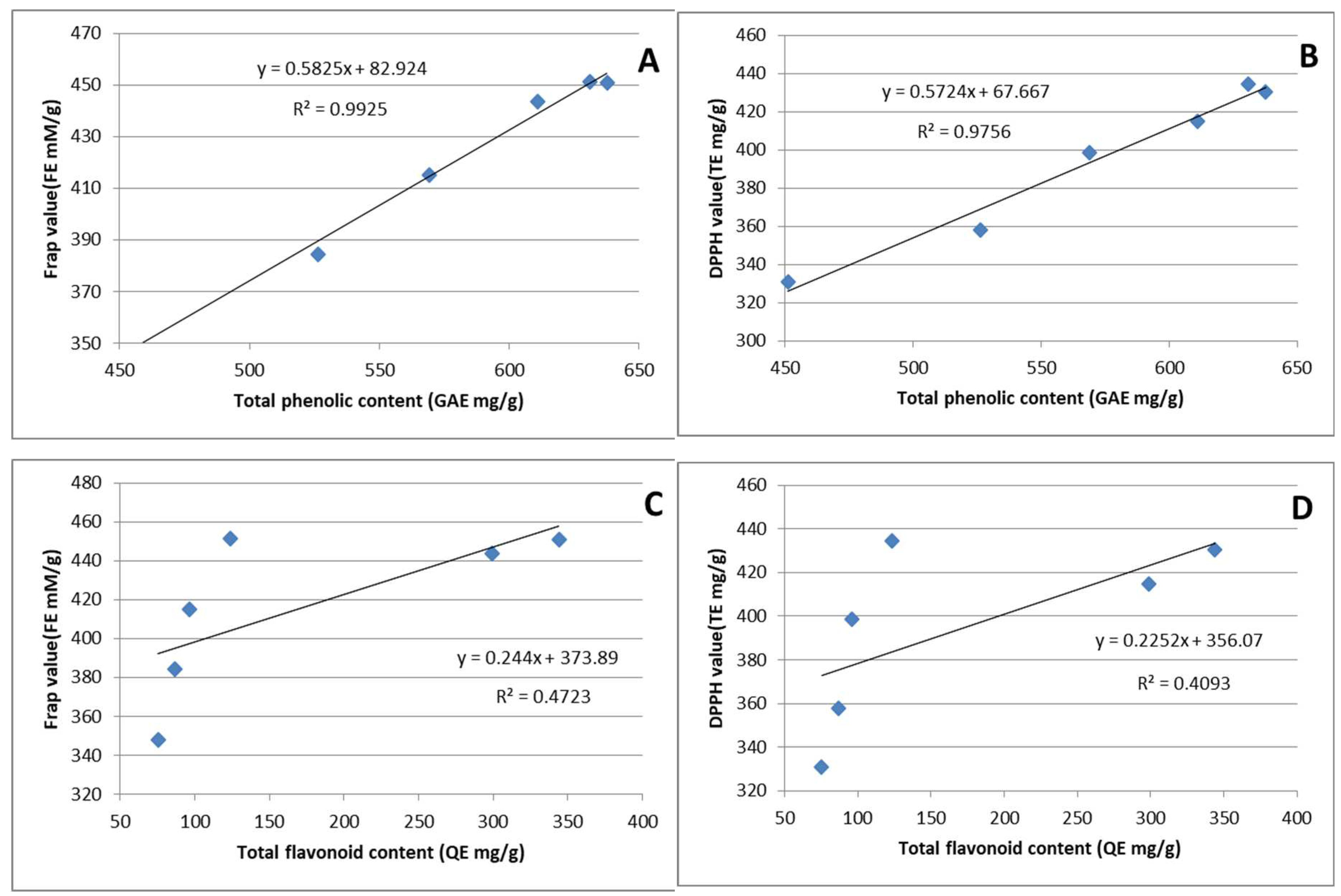
Figure 2.
Percent inhibition of colon cancer cells via MTT assay of Psidium guajava Linn. leaves extract. MAE = Microwave-assisted extraction, UAE = Ultrasound-assisted extraction, SE = Solvent extraction, and ET = 60% ethanol.
Figure 2.
Percent inhibition of colon cancer cells via MTT assay of Psidium guajava Linn. leaves extract. MAE = Microwave-assisted extraction, UAE = Ultrasound-assisted extraction, SE = Solvent extraction, and ET = 60% ethanol.
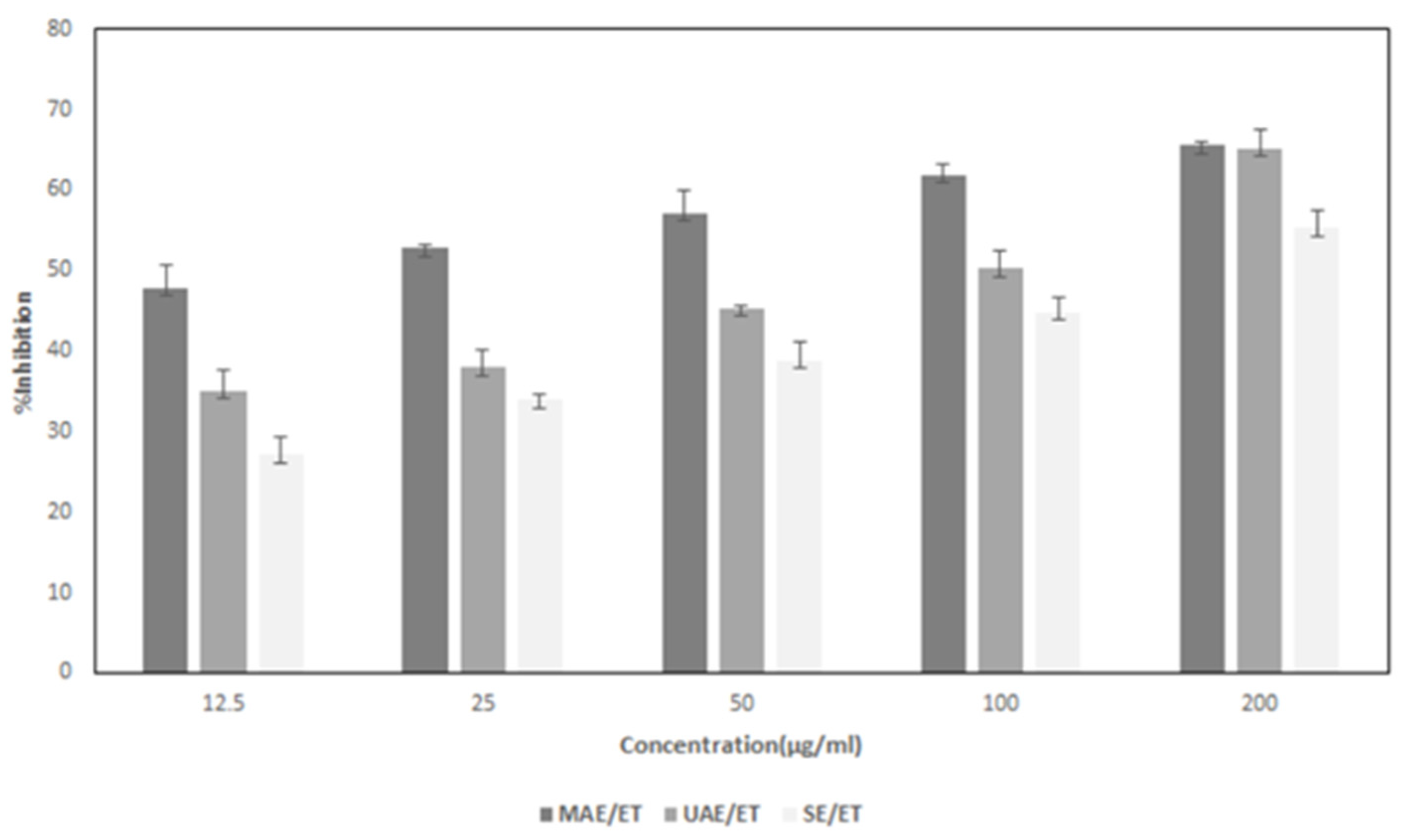
Figure 3.
HPLC-MS chromatogram of microwave-assisted extraction (Top), ultrasound-assisted extraction (Middle) and solvent extraction (Bottom).
Figure 3.
HPLC-MS chromatogram of microwave-assisted extraction (Top), ultrasound-assisted extraction (Middle) and solvent extraction (Bottom).
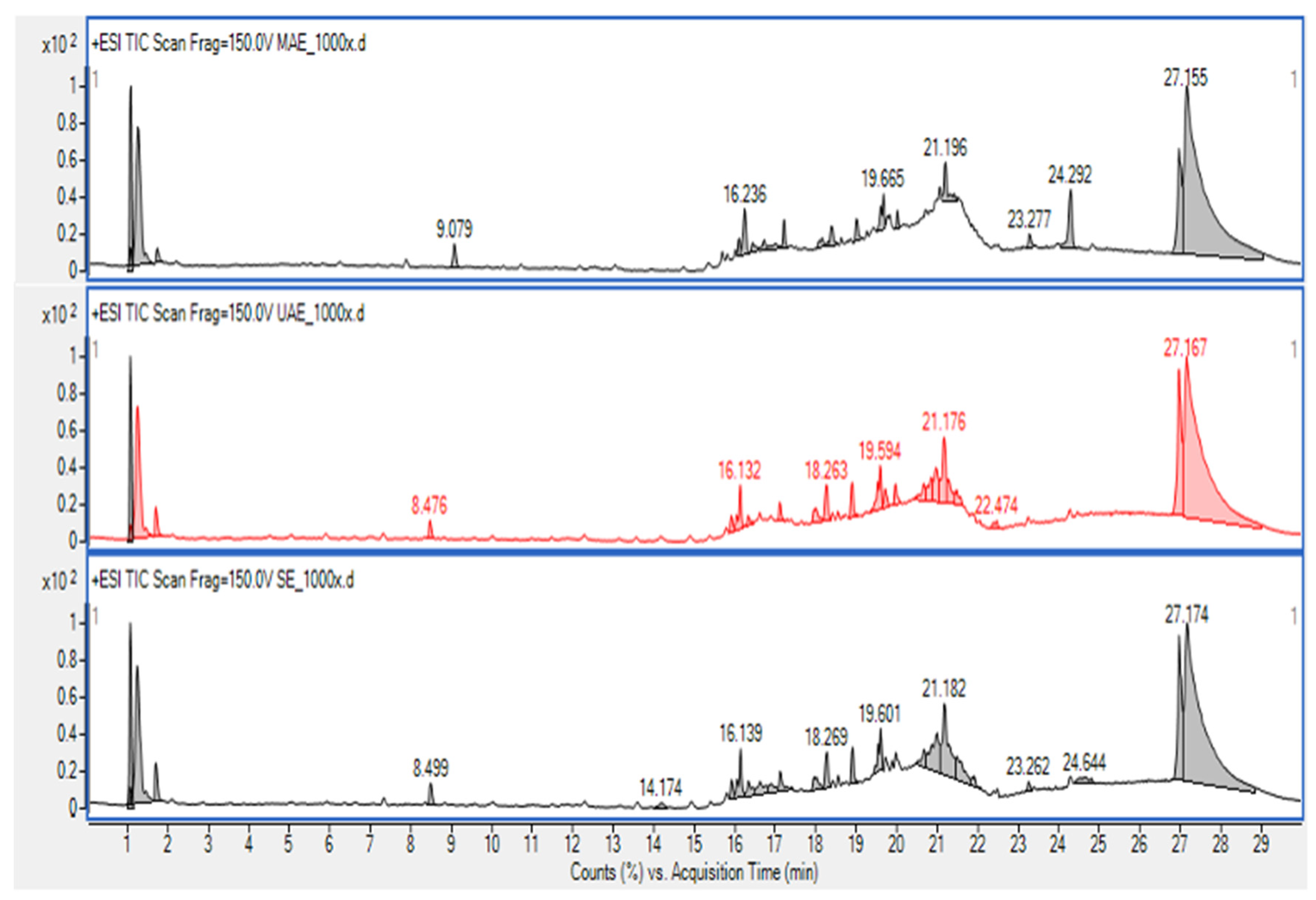
Figure 4.
TLC chromatogram under Visible-light (370 nm), UV-light (254 nm), and dyed with Para-anisaldehyde, respectively from left to right. M = Microwave-assisted extraction; U = Ultrasound-assisted extraction; S = Solvent extraction.
Figure 4.
TLC chromatogram under Visible-light (370 nm), UV-light (254 nm), and dyed with Para-anisaldehyde, respectively from left to right. M = Microwave-assisted extraction; U = Ultrasound-assisted extraction; S = Solvent extraction.
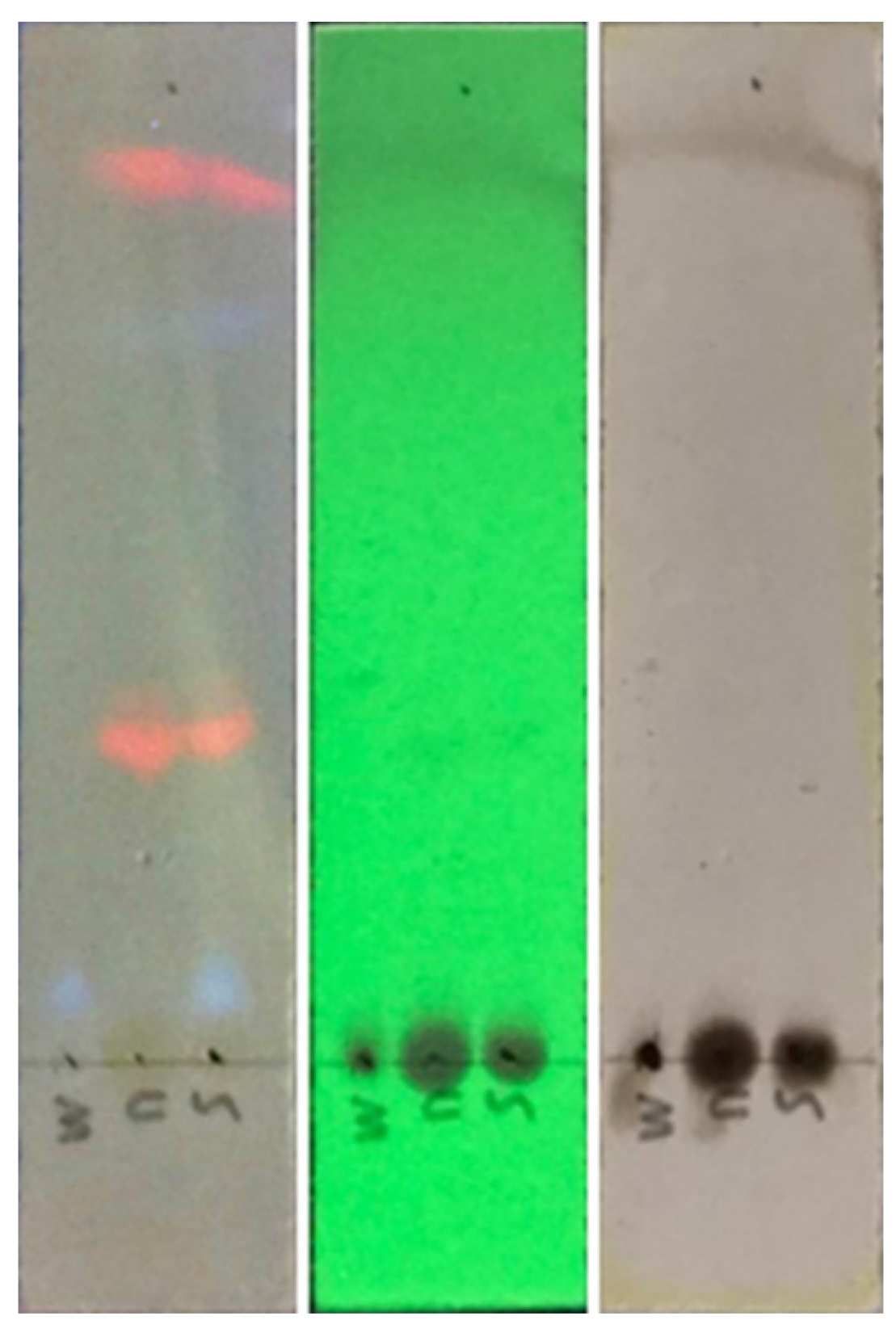
Table 1.
Qualitative preliminary phytochemical screening of extracted solution of Psidium guajava Linn. leaves.
Table 1.
Qualitative preliminary phytochemical screening of extracted solution of Psidium guajava Linn. leaves.
| Class of compounds | MAE | UAE | SE | |||
|---|---|---|---|---|---|---|
| Solvent | Distilled water | 60% ethanol | Distilled water | 60% ethanol | Distilled water | 60% ethanol |
| Total flavonoid | + | ++ | ++ | +++ | +++ | ++++ |
| Total phenolic | + | +++ | +++ | ++ | ++++ | ++++ |
| Tannins and Phenols | ++++ | +++ | +++ | ++ | +++ | + |
| Alkaloids | + | ++ | ++ | ++++ | +++ | ++++ |
| Saponins | + | ++ | + | +++ | + | +++ |
| Terpenoids | + | ++++ | ++ | ++++ | +++ | ++++ |
| Glycosides | - | - | - | - | - | - |
| Protein | + | ++ | + | ++ | + | ++ |
| Amino acids | + | ++ | + | ++ | + | ++ |
MAE = Microwave-assisted extraction; UAE = Ultrasound-assisted extraction; SE = solvent extraction; + = positive result; - = negative result; and the number of + and - signal showed the level of result.
Table 3.
Effect of extraction techniques on the growth inhibition and IC50 of colon cancer cells via MTT assay.
Table 3.
Effect of extraction techniques on the growth inhibition and IC50 of colon cancer cells via MTT assay.
| Extraction method | Concentration (µg/ml) | Growth inhibition (%) | IC50 (µg/ml) |
|---|---|---|---|
| MAE | 12.5 | 47.83±2.94 | 16.67±3.65c |
| 25 | 52.73±0.47 | ||
| 50 | 57.12±2.74 | ||
| 100 | 61.59±1.24 | ||
| 200 | 65.51±0.35 | ||
| UAE | 12.5 | 35.05±2.65 | 98.68±0.8b |
| 25 | 37.91±2.13 | ||
| 50 | 45.31±0.33 | ||
| 100 | 50.20±2.11 | ||
| 200 | 65.10±2.41 | ||
| SE | 12.5 | 27.11±2.33 | 144.59±22.30a |
| 25 | 33.89±0.72 | ||
| 50 | 38.78±2.26 | ||
| 100 | 44.83±1.89 | ||
| 200 | 55.19±2.26 |
Values are expressed as means ± SD (n = 3). Different letters in the same column indicate significant difference at p<0.05. MAE = Microwave-assisted extraction; UAE = Ultrasound-assisted extraction; SE = Solvent extraction.
Disclaimer/Publisher’s Note: The statements, opinions and data contained in all publications are solely those of the individual author(s) and contributor(s) and not of MDPI and/or the editor(s). MDPI and/or the editor(s) disclaim responsibility for any injury to people or property resulting from any ideas, methods, instructions or products referred to in the content. |
© 2023 by the authors. Licensee MDPI, Basel, Switzerland. This article is an open access article distributed under the terms and conditions of the Creative Commons Attribution (CC BY) license (http://creativecommons.org/licenses/by/4.0/).
Copyright: This open access article is published under a Creative Commons CC BY 4.0 license, which permit the free download, distribution, and reuse, provided that the author and preprint are cited in any reuse.


