

Submitted:
28 April 2023
Posted:
04 May 2023
You are already at the latest version
Abstract
The study addresses the management of kitchen waste by transforming it into biofertilizer formulations utilizing an effective in-house developed multi-enzyme preparation. A separate hydrolysis and fermentation bioprocessing approach which in particular relates to the application of a separate enzyme preparation from Aspergillus niger P-19 to separately hydrolyze kitchen waste, followed by the growth of Klebsiella pneumoniae AP-407 in the liquid hydrolysate as well with simultaneous production of carrier-based biofertilizer. In liquid and carrier-based biofertilizers, the viable cell count reaches 3.00 × 10¹² CFU/ml and 3.00 × 10¹² CFU/g, respectively. The current study adopts a novel process technique for the manufacturing of both carrier and liquid biofertilizers, adopting a zero-waste approach to the management of kitchen waste.
Keywords:
Kitchen waste
; Enzyme
; Enzymatic hydrolysis
; Biofertilizer
1. Introduction
Biodegradable waste, particularly food waste, is a growing global concern due to population growth, changes in consumer behavior, and increased industrial and agricultural activities. The accumulation of organic waste not only poses significant environmental challenges but also contributes to pollution, soil erosion, and greenhouse gas emissions [1]. The challenges associated with the management of biodegradable solid waste, particularly food and agricultural waste, have gained widespread recognition. As a result, there has been growing interest in researching the development of biopolymers, biofuels, and other value-added products from these waste streams. However, there has been comparatively little attention paid to the potential for producing biofertilizers from biodegradable solid waste. This oversight is in contrast to the focus on producing other value-added products, despite the potential for biofertilizers to provide significant benefits for sustainable agriculture and soil health. Therefore, exploring the potential for producing biofertilizers from biodegradable solid waste is a crucial area for future research and development [2].
To address this issue, transitioning towards a circular economy has become a top priority. The "zero waste approach" promotes sustainable long-term socio-economic and environmental benefits, and seeks to minimize the generation of waste by reusing, repairing, refurbishing, and recycling materials [3]. Such an approach can help reduce the negative impacts of biodegradable waste on the environment and support the development of a more sustainable society. Over the past few years, there has been a substantial increase in the number of identified plant growth-promoting bacteria (PGPB). Various species of bacteria, including Alcaligenes, Arthrobacter, Azospirillum, Azotobacter, Bacillus, Burkholderia, Enterobacter, Klebsiella, Pseudomonas, and Serratia, have been reported to significantly enhance plant growth [4,5]. By using biodegradable solid waste to make biofertilizers, we can reduce the quantity of the garbage that ends up in landfills and develop a more sustainable and effective method of fertilizing crops.
Building on our recent work by Sharma et al. [6], where a consolidated bioprocessing approach for developing biofertilizer formulations was developed, the present study aims to address potential constraints that may arise during the production and isolation of biocompatible organisms during consolidated bioprocessing. The focus is on exploring the potential of the organic fraction of solid waste as a feedstock for producing liquid biofertilizers through separate depolymerization of the organic residue to release sugars. Additionally, we propose using the remaining solid residue from enzymatic hydrolysis as an efficient support for the preparation of carrier-based biofertilizer. This approach provides a sustainable solution for managing solid waste residues and producing valuable biofertilizers, thereby reducing the environmental impact of current waste disposal practices and supporting the development of a circular economy.
Consolidated bioprocessing (CBP) is a promising strategy for biofertilizer production as it combines enzyme production, saccharification, and fermentation into a single process as disclosed by Sharma et al. [6]. However, the need for two biocompatible microorganisms can limit its industrial viability. To develop a more sustainable and industrially viable process present study provides an alternative to finding much better microorganisms where one is capable of producing multiple carbohydrases and the other can use the released sugars with various plant growth-promoting traits separately. To achieve this, a separate hydrolysis and fermentation (SHF) approach is employed, as simultaneous saccharification and fermentation (SSF) may not provide optimal conditions for both enzymes and microorganisms. This is due to differences in temperature and pH optima between enzymes and microorganisms, which can decrease efficiency and lower product yield. Additionally, the production of enzyme inhibitors by the cultivated microorganism can decrease enzyme efficiency [7,8,9]. Therefore, SHF is preferred for the development of sustainable and industrially viable biofertilizer formulations.
A rapid and efficient separate hydrolysis and fermentation bioprocess has been developed for the separate disintegration of various polymeric organic compounds in the waste by in-house produced multi-enzyme preparation from Aspergillus niger P-19 for the release of simple sugars and amino acids to support the growth of the natural variants of Klebsiella pneumoniae AP-407 capable of atmospheric N-fixation, mobilizing P and K besides producing plant growth promoting hormones. This yielded a liquid supernatant and a solid residue, where liquid biofertilizer is developed by cultivating Klebsiella pneumoniae AP-407 in liquid hydrolysate and carrier biofertilizer is developed by separating solid left residue having Klebsiella pneumoniae AP-407. The process, when used at an industrial scale, will not only reduce the burden of the cost of nutrients for the preparation of different types of biofertilizer formulations but will also provide a scientific solution for the management of biodegradable municipal solid waste residues in addition to reducing the dependency on synthetic chemical fertilizers.
Based on the aforementioned, the current research demonstrates a novel method of transforming biodegradable solid waste in its natural condition into biofertilizer formulations using a natural variant of bacterial and fungal strains. Complex polysaccharides found in biodegradable solid waste are converted by a fungal strain with the ability to produce several carbohydrases into simple sugars which are utilized by a bacterial strain with attributes that promote plant development.
2. Materials and Methods
2.1. Microorganisms
The fungal strain Aspergillus niger P-19 was selected by assessing its multiple carbohydrase producing potential comprising of cellulase, hemicellulase, pectinase, and amylase by solid-state fermentation on composite kitchen waste with temperature and pH optima 50 °C, pH 4.5, respectively [10]. The non-pathogenic bacterial strain Klebsiella pneumoniae AP-407 was selected for its ability of nitrogen fixation, HCN production, phosphate solubilization, potassium mobilization, siderophore production, ammonia, and IAA production [6].
2.2. In-house production of multi-enzyme preparation
Composite kitchen waste, used in the study, was procured from the hostel and messes of Panjab University, Chandigarh, India. The multi-enzyme preparation comprising cellulases, hemicellulases, amylases, and pectinase was produced from the solid-state culture of a wild isolate of Aspergillus niger P-19. The production was carried out in metallic trays with dimensions of 70 cm (Length) × 40 cm (Breadth) × 6.5 cm (Height) using composite kitchen waste, the substrate for solid-state fermentation (SSF). 3 kg of waste was crushed in a blender and squeezed through a muslin cloth to extract the extra water, and the 1 kg of the resulting waste was dispensed in the tray, autoclaved, and inoculated with 200 ml of spore suspension of Aspergillus niger P-19 (1 × 10⁸ spores/ml) and incubated at 25 °C for 4 days under a stationary state condition. The moldy waste was then dispensed in 10 L of distilled water and the enzymes were extracted by blending the contents followed by filtration through a nylon sieve and the mycelial-free supernatant was obtained after centrifugation at 5000 rpm, for 20 min, The mycelial-free supernatant was assayed at 50 °C, pH 4.5 for cellulases (Carboxymethyl cellulose hydrolyzing activity (CMCase), Filter paper hydrolyzing activity (FPase), and β-glucosidase), hemicellulases (xylanase, mannanase), pectinase and amylases (α-amylase, glucoamylase). The activity of enzymes has been expressed as International Units (IU/ml) where one unit of the CMCase, FPase, β-glucosidase, xylanase, mannanase, pectinase, and glucoamylase is equivalent to the enzyme that releases one µmole of end product per min. On the other hand, one unit of α-amylase has been expressed as equivalent to the amount of enzyme that reduces the color of the starch-iodine complex by 10% in 10 min.
2.3. Partial purification of the multi-enzyme preparation after extraction from solid state culture of Aspergillus niger P-19
The crude enzyme preparation was subjected to two-stage filtration for partial purification. It was initially passed through a 5-micron polypropylene filter to remove the remaining sediments, dust, and followed by another filtration through a 20 kDa membrane.
2.4. Enzymatic hydrolysis of composite kitchen waste using inhouse produced multi-enzyme preparation from Aspergillus niger P-19
250g of kitchen waste was crushed in a blender and dispensed in a 2000 ml flask containing 1000 ml of distilled water. This was then steam pretreated by autoclaving at 121°C for 30 min. The contents were then allowed to cool followed by the addition of 25 ml of crude multi-enzyme preparation from Aspergillus niger P-19 having 6.35 IU/ml of CMCase, 2.15 IU/ml of FPase, 5.80 IU/ml of β-glucosidase, 40.85 IU/ml of xylanase, 8.25 IU/ml of mannanase, 520.16 IU/ml of α-amylase, 9.00 IU/ml of glucoamylase and 8.50 IU/ml of pectinase and the enzymatic hydrolysis was carried out by keeping the flasks in a water bath shaker at 50 °C and 150 rpm for 48 h.
2.5. Fermentation of enzymatic hydrolysate of composite kitchen waste for transformation into biofertilizer formulations
The flask containing filtered enzymatic hydrolysate, with pH adjusted to 7.00±0.5, was inoculated with a 10% v/v of an overnight grown broth culture of Klebsiella pneumoniae AP-407 made in nutrient broth with a viable cell count of 1.00 × 10⁶ CFU/ml having a broad range of plant growth promoting traits including N-fixation, P solubilization and K mobilization in addition to the production of plant growth promoting hormones. The contents were incubated in a shaker incubator at 37oC, 200 rpm for 72 h. The samples were withdrawn at a regular interval of 24 h, centrifuged at 10,000 rpm for 10 min and the supernatant was analyzed for residual reducing sugars by the DNSA method [11] and glucose by glucose oxidase–peroxidase method [12]. The change in viable cell count of biofertilizer microorganisms was analyzed by the standard method described by James [13].
2.6. Separation of Carrier and Liquid Biofertilizer
After 72 h of incubation the contents were filtered through a 200-micron double mashed sieve and the same yielded liquid biofertilizer in the form of the filtrate and a carrier-based biofertilizer after squeezing the solid residue. The final count of the biofertilizer organism in the two formulations was also determined and expressed in terms of CFU/ml and CFU/g for liquid and carrier-based formulations and the same was stored in polypropylene bottles and the air-tight polythene bags respectively till further use and the shelf life of the same was studied upto 1 year by observing the residual cell counts at regular intervals of 2 months. The current optimized process technology for transforming kitchen waste into liquid and carrier-based biofertilizer formulations is depicted in Figure 1.
2.8. Seed germination test for the evaluation of biofertilizer formulations
The present study assessed seed germination (SG) and relative seed germination (RSG) using equations (1) and (2), as described by Luo et al. [14]. In addition, the in-vitro seed germination test, or vigor index, was analyzed using equation (3) according to Jagadeesan et al. [15]. To experiment, 20 marigold seeds were homogenously soaked in 10% (w/v and v/v) liquid and carrier biofertilizer, respectively, and triplicate sets were prepared. After soaking for 1 hour, the seeds were transferred to sterile petri plates containing pre-wetted cotton with sterile double distilled water and incubated at 30 ◦C for 6 days. The resulting seedlings were analyzed for vigor index, seed germination (SG), and relative seed germination (RSG), using the following equations.
SG(%)= Number of germinated seeds × 100
Number of total seeds
Number of total seeds
RSG(%)= Number of germinated seeds (Treated) × 100
Number of germinated seeds (control)
Number of germinated seeds (control)
Vigor Index = Seed germination (%) × Seedling length (Root length + Shoot length)
2.9. Plant growth experiment for evaluation of biofertilizer formulations
A plant growth system experiment was conducted for assessing the effect of the carrier and liquid biofertilizer formulations on the development of plants from January 2023 till mid of March 2023. The entire experiment was carried out at the Department of Microbiology, South Campus, Panjab University, Chandigarh. The 20 seeds of plants Tagetes erecta (Marigold) for each set were surface sterilized using 70% ethanol and rinsed three times using sterile distilled water. Further, the seeds were shade dried for 30 min, and later all the respective seeds were sowed in separate pots having a diameter of 28 cm and depth of 20 cm filled with 2500 g of soil sterilized by autoclaving at 15 psi for 1 h. The soil treatment method involved blending 2g of carrier-based biofertilizer and 2ml of liquid-based biofertilizer (initially suspended in 100 ml of water) with the soil. The pots were then left for 2 h before the seeds were inoculated. The same treatment was repeated on the 25th day after taking soil and plant samples. For each treatment, three replicate pots were maintained with a natural photoperiod (12 h) and watered with tap water for 45 days. After 25, 50, and 75 days of sowing and on maturity, the three replicates of each treatment were harvested and various factors were assessed. Morphometric analysis of the host plant for the different treatments were assessed after fifteen, thirty, and forty-five days of sowing and on maturity which includes plant height (cm), shoot height (cm), root length (cm), number of flowers, flower diameter (cm) and flower weight (g).
The relative increase yield in each morphometric character is described in the following equation (4).
Relative yield increase (%) = Yield of treated plant × 100
Yield of control plant
Yield of control plant
2.10. Determination of chlorophyll
The chlorophyll content of leaves was analyzed for 45 days. One gram of finely chopped fresh leaves was suspended in 20 ml of 80% acetone. The supernatant was separated after the centrifugation for 5 min at 10000rpm. The process was repeated until the residue was colorless. The absorbance of the solution was taken at 645nm and 663nm against acetone. The concentrations of total chlorophyll, chlorophyll a, and chlorophyll b were calculated using the equation as described by Arnon [16] :
Total Chlorophyll: 20.2(A645) + 8.02(A663)
Chlorophyll a: 12.7(A663) – 2.69(A645)
Chlorophyll b: 22.9(A645) – 4.68(A663)
2.11. Quantitative Analysis of Soil
The soil was tested for macro and micro-nutrients testing kit procured from Himedia, India for determining organic carbon in the soil in terms of available phosphate (P2O5), available potassium (K2O), ammonical nitrogen (NH3-N) and nitrate nitrogen (NO3-N) in the soil in terms of kg per hectare (kg/ha).
3. Results and Discussion
Biodegradable waste from kitchens, vegetable and fruit markets, schools, institutions, and society is typically disposed of by open dumping, burning, or landfilling in underdeveloped or developing nations. Esteban-Lustres et al. [17] stressed the need to enhance the management of these continuously generated and widely accessible resources, as well as their commodification into innovative and enticing product lines that would support the bioeconomy. The current process method, therefore, made employing a potent cocktail of enzymes to efficiently convert the composite kitchen waste into a sugary hydrolysate which was subsequently transformed into novel biofertilizer formulations. In the current scenario, most of the studies involving separate hydrolysis and fermentation are concentrated around biofuel and bio-hydrogen production which are still yet to be under scrutiny for industrial viability. In this context, our current studies provide a much more sustainable process for the management of biodegradable solid waste by separate hydrolysis and fermentation.
3.1. In-house production of multi-enzyme preparation from Aspergillus niger P-19
The potential of the fungal strain Aspergillus niger P-19 to be used for the production of multiple carbohydrases on a cheap substrate like de-oiled rice bran was already disclosed by Chugh et al. [10]. In continuation to the previous work present process involves the separate hydrolysis of kitchen waste to maximize the hydrolysis of kitchen waste so that maximum sugars could be released. The enzyme activity is presented in terms of IU/ ml which is defined as the amount of enzyme required to catalyze the conversion of 1µmole of substrate per minute under specified enzyme assay conditions. The enzyme activities in the crude multi-enzyme preparation of 10 L obtained from 1000 g of fermented composite kitchen waste followed by partial purification from a two-stage filtration, were found to be 12 IU/ml of CMCase, 3.15 IU/ml of FPase, 12.80 IU/ml of β-glucosidase, 70.85 IU/ml of xylanase, 20.25 IU/ml of mannanase, 956.16 IU/ml of α-amylase, 26.00 IU/ml of glucoamylase and 19.50 IU/ml of pectinase, respectively. Aspergillus spp. is known for its potential of producing multiple carbohydrases on various biodegradable solid wastes and lignocellulosic biomass comprising of kitchen waste, deoiled rice bran on solid state, surface, and submerged fermentation processes [6,10,18,19]. The focus is largely on fungi because of their ability to produce a large amount of hemicellulases and cellulases. Also, the in-house formulation used in this study comprises a unique combination of enzymes that includes the entire cellulase system as well as xylanases, mannanases, pectinases, and amylases.
3.2. Enzymatic hydrolysis of composite kitchen waste using inhouse produced multi-enzyme preparation from Aspergillus niger P-19
The composite kitchen waste was hydrolyzed by the in-house produced multi-enzyme preparation. The enzymatic hydrolysis released 31.1 g/L of total reducing sugars and 15.0±0.13 g/L of glucose. The hydrolysate was filtered through a 200-micron double-mashed sieve. The 24±1.4 g solid left residue was obtained which was air dried overnight followed by sterilization by autoclaving and stored in a cold storage facility till further use. The resultant liquid hydrolysate was further sterilized before being employed as a nutrient medium for the growth of microorganisms that create biofertilizers. The enzyme cocktail from A. niger P-19 proved to be the source of an effective enzyme cocktail. The enzyme cocktail hydrolyzed the composite kitchen waste, which is then utilized to produce biofertilizer. In our earlier effort to convert kitchen waste into biofertilizers by consolidated bioprocessing, two biocompatible organisms were always needed, one of which could hydrolyze the waste and another of which could utilize the sugars generated in the hydrolysate concurrently. To address this issue, we hydrolyzed the kitchen waste separately and obtained the greatest possible amount of sugar which was more than obtained in consolidated bioprocessing in Sharma et al. [6] with 24±1.4 g solid left residue.
3.3. Fermentation of sugars released after enzymatic hydrolysis of composite kitchen waste into biofertilizer formulations
The Klebsiella pneumoniae AP-407 was isolated from the rhizospheric soil of healthy plants on the Panjab University campus. The biofertilizer formulation demonstrated positive results for its nitrogen-fixing ability, HCN production, phosphate (P) solubilization, siderophore production, potassium (K) mobilization, ammonia production, and IAA production. These results were already deposited in the International depository at MTCC, Chandigarh, India [6,20].
The present process technology produces 920±23 ml of liquid biofertilizer within 3 days of fermentation. A positive correlation could be drawn between the utilization of sugars and the cell count of Klebsiella pneumoniae AP-407. After 72 h of fermentation, the total reducing sugar reduced from 3.10 % to 0.08 % and the glucose level reduced from 1.5 % to nil. Furthermore, the cell count of Klebsiella pneumoniae AP-407 increased from 1.00 × 10⁶ cells/ml to 3.00 ×10¹² cells/ml depicted in Table 1.
The liquid hydrolysate was effectively converted into liquid biofertilizer using the current method. In our prior study [6], the final viable count of Klebsiella pneumoniae AP-407 was found to be 1.03 × 10¹² CFU/ml. In contrast, in this process, the viable count of Klebsiella pneumoniae AP-407 was found to be 3.00 ×10¹² CFU/ml. The higher sugar release from hydrolysis compared to the sugar release through consolidated bioprocessing is the likely cause of Klebsiella pneumoniae AP-407’s higher cell count.
3.4. Separation of Carrier and Liquid Biofertilizer
Enzymatic hydrolysis was found to be the better hydrolyzing method for the composite kitchen waste as only 24±1.4 g of solid left residue was obtained from 250 g of composite kitchen waste which is 9.6 % of total solid mass. The solid left residue obtained was further used as the carrier biofertilzier having healthy viable cell count thus employing the “zero waste approach”. The prepared formulation was air-dried aseptically followed by packing in air-tight poly bags. The liquid biofertilizer preparation was packed in sterilized bottles till further use. To the best of our knowledge, there are no studies other than the one reported earlier from our laboratory where bioferilizer formulation was prepared by consolidated bioprocessing [6]. Most of the studies concentrate on the production of biofertilizers by traditional method where biofertilizer organisms are ususally cultivated on their specific growth medium. Even after much exploitation of biodegrdable solid waste to be used as the production medium for biofertilzier preparation the shortest and cheapest method is from our labortatory including present study.
3.5. Physico-chemical and biological characterization of developed biofertilizer formulations
The developed carrier and liquid biofertilizers from the present process technology were analyzed further by assessing various physico-chemical and biological characteristics. The prepared biofertilizer formulations carried a healthy amount of microbial count which has plant growth-promoting traits. Overall, the nutrients from kitchen waste hydrolysate and plant growth-promoting traits of biofertilizer microorganisms make a better substitute in comparison to traditional fertilizers and biofertilizers. The characteristics of kitchen waste hydrolysate and biofertilizer formulations developed from kitchen waste hydrolysate using present process technology are depicted in Table 2. The kitchen waste hydrolysate itself is enriched with various micronutrients released from hydrolysis. Furthermore, the inclusion of Klebsiella pneumoniae AP-407 significantly enhanced the chemical and biological characteristics of kitchen waste hydrolysate.
Biofertilizers with a long shelf life, feasible use, and controlled dispersion of the researched microorganisms are urgently needed in the agro-industrial sector. The potential for natural, affordable protein and carbohydrate recovery from agricultural biomass is enormous [21]. The liquid biofertilizer formulation from the aforementioned process was used in the current approach, together with solid left residue from kitchen waste hydrolysis as a carrier for inoculum adsorption. Because it contains a lot of carbon and other micronutrients, kitchen waste solid left residue serves as a stabilizing supply of these elements. The CFU/ml and CFU/g of biofertilizer were even better compared to the biofertilizer developed by Xu et al. [22], who observed a maximum of 9.7 × 10⁹ CFU/ml when prepared from wastewater from sweet potato starch and complies with the rules and requirements of FCO (India), which state that the minimum CFU should be 1 × 10⁸ cells per ml of liquid biofertilizer or 5 × 10⁷ cells/g of powder, granules, or carrier material after six months [23].
The liquid and carrier biofertilizer were prepared after separate hydrolysis and fermentation which were packed, sealed, and stored later on in a cold room facility available in the Department of Microbiology, Panjab University, Chandigarh. The final cell count of both liquid biofertilizer and carrier biofertilizer was observed to be 3.00 ×10¹² CFU/ml and 3.00 × 10¹² CFU/g before storage. The cell count of liquid biofertilizer reduces to 2.20 ×10⁷ CFU/ml while the cell count of carrier biofertilizer reduces to 1.10 × 10⁵ CFU/g after 10 months of storage which complies with the requirements of FCO (India) [23]. The better shelf life of liquid biofertilizer in the present study is corroborated with the studies of Allouzi et al. and Raimi et al.[24,25]. Liquid biofertilizers have gained increasing attention in recent years due to several advantages over solid inoculants. Liquid inoculants exhibit superior shelf life of 1.5–2 years, offer increased resistance to contamination, eliminate the need for sticky materials, facilitate application via modern machinery, are capable of withstanding high temperatures up to 45 °C, and are user-friendly in terms of handling and application, including the addition of ingredients that enhance the growth of microbial strains [24,26,27,28].
Altogether, the concept of hydrolyzing kitchen waste separately to enhance hydrolysis for improved sugar production led to an increase in the number of viable cells in liquid biofertilizer formulations along with the creation of carrier-based biofertilizer.
3.6. Influence of biofertilizer formulations on seed germination
The prepared carrier-based and liquid biofertilizer significantly enhanced the seed germination and relative seed germination of marigold seeds. The liquid-based biofertilizer showed 90.0±3.75 % seed germination in comparison to the control set which showed 60.0±2.25 % seed germination depicted in Table 3. The fastest vigor index was observed in liquid biofertilizer-treated seeds which were followed by carrier biofertilizer depicted in Table 3. The vigor index in the case of carrier biofertilizer was 275.90 and 620.00 in liquid biofertilizer in contrast to control having 185.25. Jagadeesan et al. [15] recently prepared the biofertilizer using chicken feather waste which was enriched with a biofertilizer strain of Bacillus pumilus. The present study results overlie with the results of Jagadeesan et al. [15], in terms of enhancement in vigor index and seed germination of Tagetes erecta (Marigold) as biofertilizer formulations shorten the growth span of seeds.
3.7. Influence of biofertilizer formulations plant development assay
The liquid and carrier biofertilizer showed a significant positive response in enhancing various morphometric characteristics and yield of Tagetes erecta (Marigold). In the present experiment as depicted in Table 4 the plant height in carrier-treated biofertilizer was +12.5 cm more than in control and plant height was +29.0 cm more in liquid biofertilizer treated Tagetes erecta (Marigold) after 75 days. The shoot height in both liquid and carrier biofertilizer-treated Tagetes erecta (Marigold) was +23.1 and +10.1 cm compared to control, respectively after 75 days. Both liquid-based and carrier-based biofertilizers had a positive impact on all morphometric traits of Tagetes erecta (Marigold), including plant height (cm), shoot height (cm), root length (cm), number of flowers, flower diameter (cm), and flower weight (g). The relative yield was used to determine the actual increase in yield in each morphometric trait of the plant, whereby after 25 days, two plants from each pot were taken to observe the average increase in yield of the trait. The percentage relative increase in yield in carrier-based biofertilizer after 75 days was 133.7 %, 137.2%, 123.0%, 140.0 %, 109.4 %, and 120.3% for plant height (cm), shoot height (cm), root length (cm), number of flowers, flower diameter (cm) and flower weight (g), respectively. The liquid biofertilizer improved the growth of plants more significantly. The percentage relative increase in yield in liquid biofertilizer after 75 days was 178.3 %, 185.2%, 158.0%, 162.5 %, 119.6 %, and 138.2% for plant height (cm), shoot height (cm), root length (cm), number of flowers, flower diameter (cm) and flower weight (g), respectively as depicted in Table 5.
The objective of the present effort is to economically monetize biodegradable solid waste by converting it into a carrier and liquid biofertilizer. The carrier and liquid biofertilizer's effects on plant development and soil were consistent with the underlying concept. The plant yield and soil fertility were significantly increased by the carrier and liquid biofertilizer made from composite kitchen waste. The plant height, root height, plant fresh weight, number of flowers, flower diameter (cm), and flower weight (g) all considerably increased over 75 days with both carrier and liquid biofertilizer. The enhanced growth and yield of plants can be attributed to several factors, including the presence of indoleacetic acid (IAA), which has been shown to improve plant growth yield in studies by Xu et al., Bhardwaj et al. and Kumar et al. [22,29,30]. Phosphate solubilization and ammonia excretion have also been associated with improved growth [22,31,32]. Additionally, the production of hydrogen cyanide (HCN) and siderophore by plant growth-promoting rhizobacteria (PGPR) can act as protecting agents for plants in stress conditions and contribute to improved yield [33]. A combination of Azotobacter, Azospirillum, and Klebsiella strains was used in a trial by El Komy et al. [34] to improve the management of the root-rot disease complex, increase sunflower growth due to N2 fixation, phosphate solubilization, produce indoleacetic acid (IAA), siderophore, and hydrogen cyanide (HCN). In conclusion, it can be inferred that improved absorption of nitrogen, phosphorus, and potassium as well as IAA biosynthesis, ammonia production, siderophore production, and HCN production all contribute to increased Tagetes erecta (Marigold) development in the current study. The present results are also supported by our recent study on Brassica juncea for 45 days trial and disclose the efficacy of Klebsiella pneumoniae AP-407 on plant growth and improving soil quality. Another study in which biofertilizer mediated improvement of plant mineral nutrients was observed in the study by Badawy et al. [35] where biofertilizer strain was observed to be reducing Cd and Ni in the soil environment in addition to improved plant height and higher chlorophyll content.
3.8. Influence of biofertilizer formulations on chlorophyll content
The highest chlorophyll content (a+b) of 83.5 µg/ml was observed in liquid biofertilizer-treated Tagetes erecta (Marigold), followed by carrier-based biofertilizer 65.25 µg/ml and control set of Tagetes erecta (Marigold) 46.8 µg/ml depicted in Table 6. The improved level of chlorophyll in liquid and carrier biofertilizers treated plants also emphasizes the potential of prepared formulations from present process technology. The two essential ingredients for the production of chlorophyll are nitrogen and potassium [36] which attributes to better chlorophyll content in healthy plants. The higher chlorophyll content is also attributed to the bio-stimulatory impact of the microorganisms present [37]. The carrier and liquid biofertilizer also significantly improved the chlorophyll content of Tagetes erecta (Marigold) which can be attributed to better nitrogen and phosphorus availability. The findings of Zafar-ul-Hye et al. [38] support our findings who also found similar kind of results while working with cadmium-resistant rhizobacteria for nitrogen and phosphorus availability. The ability of Klebsiella sp. GR9 to increase rice output was also highlighted by Govindarajan et al. [39], who attributed it to the GR9 strain's effectiveness in fixing nitrogen.
3.9. Quantitative Analysis of Soil
The available phosphate (P2O5), available potassium (K2O), ammonical nitrogen (NH3-N), and nitrate nitrogen (NO3-N) in soil were determined in terms of kg per hectare (kg /ha) depicted in Figure 2. The available phosphate (P2O5) was 22 to 56 kg /ha, available potassium (K2O) was 112 to 280 kg /ha, ammonical nitrogen (NH3-N) was low about 15 kg /ha, nitrate nitrogen (NO3-N) was nil on 0th day of sowing of Tagetes erecta (Marigold) in soil.
The level of available phosphate (P2O5), available potassium (K2O), ammonical nitrogen (NH3-N), and nitrate nitrogen (NO3-N) was significantly enhanced in both liquid and carrier biofertilizer as compared to the control set of plants. The synergistic effect of kitchen waste hydrolysate obtained from enzymatic hydrolysis and bacterial biofertilizer strain enhance the macro and micronutrient level in the soil. The available phosphate in liquid biofertilizer was highest on the 25th day with a level between 70 to 80 kg /ha, and highest on the 25th day in the carrier with the same level. In contrast, in the control group, it peaked on day 25 below 50 kg /ha. A similar trend was observed in the case of other nutrients as in the case of potassium it peaked on the 25th and 50th day with a level between 350 to 400 kg /ha, and was highest on the 25th day in the carrier with the same level. In contrast, the control reached its peak on day 25 with just 110 to 120 kg /ha. The most important nutrient in plant growth is nitrogen. Nitrate nitrogen only produces during the presence of such strains of microbes that are capable of fixing nitrogen for plants. The nitrate nitrogen was not observed in the control set of plants, whereas in liquid biofertilizer it peaked on the 25th and 50th day with a level of around 50 kg /ha and in the case of carrier biofertilizer it peaked on the 25th day with the same level after which it gradually drops which could be attributed to utilization by the plant in case of all nutrients.
Overall, the control set had low levels of phosphorus and potassium, whereas the plant sets treated with biofertilizer not only used phosphorus and potassium but also solubilized the phosphate and potassium that was already present in the soil. Figure 2 suggests that even after 25 and 50 days in the soil, the levels of phosphate and potassium were noticeably higher. The minerals in kitchen waste and the characteristics of Klebsiella pneumoniae AP-407 that encourage plant development are responsible for the elevated amounts of phosphorus, potassium, and nitrogen in the biofertilizer-treated plant sets. The higher available phosphorus is also attributed to the presence of microorganisms, as of a study by Semerci et al. [40], better phosphorus solubilization was observed from sewage sludge ash in the presence of microorganisms having the capability to dissolve phosphorus. The present study investigated the effect of bacterial inoculation on the growth of bacterial colonies in soil and the subsequent increase in the availability of phosphorus, which is immobilized in the soil as a poorly soluble compounds. Our findings demonstrate that under favorable conditions, bacterial inoculation promotes the further growth of bacterial colonies and enhances the release of phosphorus into the soil solution. In addition, we observed that bacteria facilitate the mineralization of organic matter introduced into the soil, including organic or mineral-organic fertilizers [41]. These results suggest that bacterial inoculation may serve as a promising strategy for improving soil fertility and nutrient availability in agricultural systems.
These findings confirm the biofertilizer's high quality and are corroborated by Xu et al. [22] in which a biofertilizer formulation was made utilizing wastewater from sweet potato starch. According to Tiquia [42], the ammonification (NH4+) process, which turns organic nitrogen into NH3 and NH4+ ions, is the cause of nitrogen loss from the soil. Both the control soil used in the current investigation and the compost made from chicken feathers by Nagarajan et al. [43] showed similar findings. In contrast, as indicated by Muhammad et al. [44] and Sun et al., [45] and the present study the soil treated with liquid and carrier biofertilizer preserved nitrate (NO3-N) nitrogen (NH3-N), which is essential for creating and sustaining a nitrogen pool in the soil. The findings of this study thus provide a method for preserving the soil's nitrogen pool and preventing nitrogen loss from agricultural soil.
Building upon the findings of our previous study [6], where we have implemented an efficient consolidated bioprocessing approach to convert composite kitchen waste into biofertilizers. In the present work, we have further improved the process by adopting a separate hydrolysis and fermentation strategy, which enhances the sustainability of agro-industrial product production. To assess the effectiveness of this approach, we have compared the biofertilizer formulations developed in this study with those reported in previous literature that employed different types of agro-industrial wastes. Table 7 presents a comprehensive comparison of the formulations, including their environmental impact and product quality. Our results demonstrate the significance of this study in advancing the development of sustainable and high-quality soil-nourishing agro-industrial commodities.
We also conducted a comparative analysis with several prominent studies in the field of agro-industrial product production with soil-nourishing properties. Our findings demonstrate that our proposed technology for producing biofertilizer formulations is more sustainable, industrially viable, and environmentally friendly than existing technologies. Moreover, our method offers a shorter production process and effective waste management. Overall, our study provides a promising alternative for the production of biofertilizer formulations that can enhance soil fertility and promote sustainable agriculture.
4. Conclusions
The current study proposes an attractive alternative for managing kitchen waste by converting it into carrier and liquid biofertilizers. The study effectively validated an in-house produced multiple enzyme preparation that efficiently hydrolyzed composite kitchen waste. This was followed by fermentation with a biofertilizer strain of Klebsiella pneumoniae AP-407 to produce biofertilizer formulations with a viable cell count of 3.00 × 10¹² CFU/ml and 3.00 × 10¹² CFU/g for liquid and carrier biofertilizer, respectively. These results exceed the claims of any previous study. The process provides a cost-effective and economical means of solid waste management and biofertilizer formulation with an improved shelf life. If implemented on a commercial scale, the study offers the possibility of sustainable management of municipal solid waste and the low-cost production of biofertilizers, which are currently in high demand in the agricultural market.
Author Contributions
Apurav Sharma: investigation, writing—original draft preparation, writing—review and editing; Sakshi Dogra: investigation, writing—original draft preparation, writing—review and editing; Bishakha Thakur: investigation, writing—review and editing; Jyoti: investigation, writing—review and editing; Raman Soni: investigation, writing—original draft preparation, writing—review and editing, supervision; Sanjeev Kumar Soni: Conceptualization, writing—review and editing, supervision.
Funding
This research received no external funding.
Institutional Review Board Statement
Not applicable.
Informed Consent Statement
Not applicable.
Data Availability Statement
Not applicable.
Conflicts of Interest
The authors declare no conflict of interest.
References
- Ahmed, F.; Hasan, S.; Rana, M.S.; Sharmin, N. A conceptual framework for zero waste management in Bangladesh. Int. J. Environ. Sci. Technol. 2023, 20, 1887–1904. [Google Scholar] [CrossRef]
- Helena de Sousa, M.; Ferreira da Silva, A.S.; Correia, R.C.; Leite, N.P.; Gonçalves Bueno, C.E.; Santos Pinheiro, R.L.D.; Santana, J.S.D.; Luna da Silva, J.; Sales, A.T.; Claudino de Souza C, Silva Aquino KAD, Souza RBD, Pinheiro IO, Henríquez JR, Pereira Schuler, A. R.; et al.; Valorizing municipal organic waste to produce biodiesel, biogas, organic fertilizer, and value-added chemicals: an integrated biorefinery approach. Biomass Conv. Bioref. 2021, 12, 827–841. [Google Scholar] [CrossRef]
- Aghbashlo, M.; Tabatabaei, M.; Soltanian, S.; Ghanavati, H. Biopower and biofertilizer producton from organic municipal solid waste: An exergo enviornmental analysis. Renew. Energ. 2019, 143, 64–76. [Google Scholar] [CrossRef]
- Basu, A.; Prasad, P.; Das, S.N.; Kalam, S.; Sayyed, R.Z.; Reddy, M.S.; El Enshasy, H. Plant Growth Promoting Rhizobacteria (PGPR) as Green Bioinoculants: Recent Developments, Constraints, and Prospects. Sustainability. 2021, 13, 1140. [Google Scholar] [CrossRef]
- Soni, S.K.; Manhas, R.; Jakhar, Y.; Sharma, A.; Soni, R. Biofertilizers for Sustainable Agriculture. Genomic, Proteomics, and Biotechnology. 2022, 331–356. [Google Scholar]
- Sharma, A.; Saini, H.; Thakur, B.; Soni, R.; Soni, S.K. Consolidated bioprocessing of biodegradable municipal solid waste for transformation into biofertilizer formulations. Biomass Conv. Bioref. 2023. [Google Scholar] [CrossRef]
- Peng, L.; Chen, Y. Conversion of paper sludge to ethanol by separate hydrolysis and fermentation (SHF) using Saccharomyces cerevisiae. Biomass Bioenergy. 2011, 35, 1600–1606. [Google Scholar] [CrossRef]
- Méndez, J.; de França Passos, D.; Wischral, D.; Modesto, L.F.; Pereira Jr, N. Second-generation ethanol production by separate hydrolysis and fermentation from sugarcane bagasse with cellulose hydrolysis using a customized enzyme cocktail. Biofuels 2019, 12, 1225–1231. [Google Scholar] [CrossRef]
- Annamalai, N.; Al Battashi, H.; Anu, S.N.; Al Azkawi, A.; Al Bahry, S.; Sivakumar, N. Enhanced bioethanol production from waste paper through separate hydrolysis and fermentation. Waste Biomass Valorization. 2020, 11, 121–131. [Google Scholar] [CrossRef]
- Chugh, P.; Kaur, J.; Soni, R.; Sharma, A.; & Soni, S.K.; & Soni, S. K. A low-cost process for efficient hydrolysis of deoiled rice bran and ethanol production using an inhouse produced multi-enzyme preparation from Aspergillus niger P-19. J Mater Cycles Waste Manag. 2023, 25, 359–375. [Google Scholar] [CrossRef]
- Miller, G.L. Use of DNS reagent for determination of reducing sugars. Anal Chem. 1959, 31, 426–28. [Google Scholar] [CrossRef]
- Morin, L.G.; Prox, J. Single glucose oxidase- peroxidase reagent for two-minute determination of serum glucose. Clin. Chem. 1974, 19, 959–962. [Google Scholar] [CrossRef]
- James, G. Native Sherman Rockland Community College, State University of New York; Benjamin/Cummins Publishing Co, 1978; pp. 75–80. [Google Scholar]
- Luo. Y.; Liang, J.; Zeng, G.; Chen. M.; Mo, D.; Li, G.; Zhang, D. Seed germination test for toxicity evaluation of compost: Its roles, problems and prospects. Waste Manage. 2018, 71, 109–114. [Google Scholar] [CrossRef] [PubMed]
- Jagadeesan, Y. ; Meenakshisundaram. S.; Raja, K.; Balaiah, A. Sustainable and efficient-recycling approach of chicken feather waste into liquid protein hydrolysate with biostimulant efficacy on plant, soil fertility and soil microbial consortium: A perspective to promote the circular economy. Process Saf Environ Prot. 2023, 170, 573–583. [Google Scholar]
- Arnon, D.I. Copper enzymes in isolated chloroplasts. Polyphenoloxidase in Beta vulgaris. Plant physiol. 1949, 24, 1. [Google Scholar]
- Esteban-Lustres, R.; Torres, M.D.; Piñeiro, B.; Enjamio, C.; Domínguez, H. Intensification and biorefinery approaches for the valorization of kitchen wastes–A review. Bioresour Technol. 2022, 127652. [Google Scholar] [CrossRef]
- Blanco-Vargas, A.; Chacón-Buitrago, M.A.; Quintero-Duque, M.C.; Poutou-Piñales, R.A.; Díaz-Ariza, L.A.; Devia-Castillo, C.A.; Pedroza-Rodríguez, A.M. Production of pine sawdust biochar supporting phosphate-solubilizing bacteria as an alternative bioinoculant in Allium cepa L., culture. Sci Rep. 2022, 12, 12815. [Google Scholar] [CrossRef]
- Soni, S.K.; Sharma. A.; Soni, R. Microbial Enzyme Systems in the Production of Second Generation Bioethanol. Sustainability. 2023, 15, 3590. [Google Scholar] [CrossRef]
- Soni, S.K.; Sharma, A.; Soni, R. (2022b) Method for preparation of stable microbial inoculants.Indian patent 202211050475 https://ipindiaservices.gov.in/PublicSearch/PublicationSearch/ApplicationDetails.
- Roslan, M.A.M.; Sobri, Z.M.; Zuan, A.T.K.; Cheak, S.C.; Rahman, N.A.A. Bioprospecting microwave-alkaline hydrolysate cocktail of defatted soybean meal and jackfruit peel biomass as carrier additive of molasses-alginate-bead biofertilizer. Sci Rep. 2022, 12, 254. [Google Scholar] [CrossRef]
- Xu, S.; Bai, Z.; Jin, B.; Xiao, R.; & Zhuang, G.; & Zhuang, G. Bioconversion of wastewater from sweet potato starch production to Paenibacillus polymyxa biofertilizer for tea plants. Sci Rep. 2014, 4, 1–7. [Google Scholar] [CrossRef]
- Khurana A, Kumar V 2020. State of Organic and Natural Farming: Challenges and Possibilities. New Delhi: Centre for Science and Environment. https://www. cseindia. org/state-of-organic-and-natural-farming-in-india-10346.
- Allouzi, M.M.A.; Allouzi, S.M.A.; Keng, Z.X.; Supramaniam, C.V.; Singh, A.; & Chong, S.; & Chong, S. Liquid biofertilizers as a sustainable solution for agriculture. Heliyon. 2022, 2609. [Google Scholar] [CrossRef] [PubMed]
- Raimi, A.; Roopnarain, A.; Adeleke, R. Biofertilizer production in Africa: current status, factors impeding adoption and strategies for success. Sci Afr. 2021, 11, e00694. [Google Scholar] [CrossRef]
- El-Ghamry, A.; Mosa, A.A.; Alshaal, T.; El-Ramady, H. Nanofertilizers vs. biofertilizers: new insights. Env. Biodivers. Soil Secur. 2018, 2, 51–72. [Google Scholar]
- Mącik, M.; Gryta, A.; Frąc, M. Biofertilizers in agriculture: An overview on concepts, strategies and effects on soil microorganisms. Adv. Agron. 2020, 162, 31–87. [Google Scholar]
- Mahanty, T.; Bhattacharjee, S.; Goswami, M.; Bhattacharyya, P.; Das, B.; Ghosh, A.; Tribedi, P. Biofertilizers: a potential approach for sustainable agriculture development. Environ. Sci. Pollut. Res. 2017, 24, 3315–3335. [Google Scholar] [CrossRef] [PubMed]
- Bhardwaj, G.; Shah, R.; Joshi, B.; Patel, P. Klebsiella pneumoniae VRE36 as a PGPR isolated from Saccharum officinarum cultivar Co99004. J. Appl. Biol. Biotechnol, 2017, 5, 47–52. [Google Scholar] [CrossRef]
- Kumar, A.; Kumar, V.; Bruno, L.B.; Rajkumar, M. Synergism of Industrial and Agricultural Waste as a Suitable Carrier Material for Developing Potential Biofertilizer for Sustainable Agricultural Production of Eggplant. Horticulturae. 2022, 8, 444. [Google Scholar]
- Babalola, O.O. Beneficial bacteria of agricultural importance. Biotechnol Lett. 2010, 32, 32,1559–1570. [Google Scholar] [CrossRef]
- Jimtha John, C.; Jishma, P.; Karthika, N.R.; Nidheesh, K.S.; Ray, J.G.; Mathew, J.; Radhakrishnan, E.K. Pseudomonas fluorescens R68 assisted enhancement in growth and fertilizer utilization of Amaranthus tricolor (L.). 3 Biotech. 2017, 7, 1–6. [Google Scholar] [CrossRef]
- Wickramasinghe, W.R.K.D.W.K.V.; Girija, D.; Gopal, K.S.; & Kesevan, S.; & Kesevan, S. Multi-phasic nitrogen fixing plant growth promoting rhizobacteria as biofertilizer for rice cultivation. Res. J. Agric. Sci. 2021, 12, 399–404. [Google Scholar]
- El_Komy, M.H.; Hassouna, M.G.; Abou-Taleb, E.M.; Al-Sarar, A.S.; Abobakr, Y. A mixture of Azotobacter, Azospirillum, and Klebsiella strains improves root-rot disease complex management and promotes growth in sunflowers in calcareous soil. Eur J Plant Pathol. 2020, 156, 713–726. [Google Scholar] [CrossRef]
- Badawy, I.H.; Hmed, A.A.; Sofy, M.R.; Al-Mokadem, A.Z. Alleviation of cadmium and nickel toxicity and phyto-stimulation of tomato plant l. by endophytic Micrococcus luteus and Enterobacter cloacae. Plants. 2022, 11, 2018. [Google Scholar]
- Muniswami, D.M.; Chinnadurai, S.; Sachin, M.; Jithin, H.; Ajithkumar, K.; Narayanan, G.S.; Dineshkumar, R. Comparative study of biofertilizer/biostimulant from seaweeds and seagrass in Abelmoschus esculentus crop. Biomass Convers Biorefin. 2021, 1–18. [Google Scholar] [CrossRef]
- Izydorczyk, G.; Saeid, A.; Mironiuk, M.; Witek-Krowiak, A.; Kozioł, K.; Grzesik, R.; Chojnacka, K. Sustainable method of phosphorus biowaste management to innovative biofertilizers: A solution for circular economy of the future. Sustain Chem Pharm. 2022, 27, 100634. [Google Scholar] [CrossRef]
- Zafar-ul-Hye, M.; Naeem, M.; Danish, S.; Khan, M.J.; Fahad, S.; Datta, R.; Brtnicky, M.; Kintl, A.; Hussain, G.S.; El-Esawi, M.A. Effect of cadmium-tolerant rhizobacteria on growth attributes and chlorophyll contents of bitter gourd under cadmium toxicity. Plants. 2020, 9, 1386. [Google Scholar] [CrossRef] [PubMed]
- Govindarajan, M.; Kwon, S.W.; & Weon, H.Y.; Weon, H.Y. Y. Isolation, molecular characterization and growth-promoting activities of endophytic sugarcane diazotroph Klebsiella sp. GR9. World J Microbiol Biotechnol. 2017, 23, 997–1006. [Google Scholar] [CrossRef]
- Semerci, N.; Kunt, B.; Calli, B. Phosphorus recovery from sewage sludge ash with bioleaching and electrodialysis. Int Biodeterior Biodegradation. 2019, 144, 104739. [Google Scholar] [CrossRef]
- Kalayu, G. Phosphate solubilizing microorganisms: promising approach as biofertilizers. Int. J. Agron. 2019, 1–7. [Google Scholar] [CrossRef]
- Tiquia, S.M. Evaluation of organic matter and nutrient composition of partially decomposed and composed and composted spent pig litter. Environ Technol 2002, 24, 97–107. [Google Scholar] [CrossRef]
- Nagarajan, S.; Eswaran, P.; Masilamani, R.P.; Natarajan, H. Chicken feather compost to promote the plant growth activity by using keratinolytic bacteria. Waste Biomass Valorization. 2018, 9, 531–538. [Google Scholar] [CrossRef]
- Muhammad, I.; Lv, J.Z.; Yang, L.; Ahmad, S.; Farooq, S.; Zeeshan, M.; Zhou, X.B. Low irrigation water minimizes the nitrate nitrogen losses without compromising the soil fertility, enzymatic activities and maize growth. BMC Plant Biol. 2022, 22, 159. [Google Scholar] [CrossRef] [PubMed]
- Sun, R.; Ding, J.; Li, H.; Wang, X.; Li, W.; Li, K.; Sun, S. Mitigating nitrate leaching in cropland by enhancing microbial nitrate transformation through the addition of liquid biogas slurry. Agric. Ecosyst. Environ. 2023, 345, 108324. [Google Scholar] [CrossRef]
- Tsai, S.H.; Liu, C.P.; Yang, S.S. Microbial conversion of food wastes for biofertilizer production with thermophilic lipolytic microbes. Renew. Energ. 2007, 32, 32–904. [Google Scholar] [CrossRef]
- Wang, H.Y.; Shen, L.I.U.; Zhai, L.M.; Zhang, J.Z.; Ren, T.Z.; Fan, B.Q.; LIU, H.B. Preparation and utilization of phosphate biofertilizers using agricultural waste. J. Integr. Agric. 2015, 14, 158–167. [Google Scholar] [CrossRef]
- Devi, V.; Sumathy, V.J.H. Production of biofertilizer from fruit waste. Eur. J. Pharm. Med. Res. 2017, 4, 436–443. [Google Scholar]
- Asadu, C.O.; Aneke, N.G.; Egbuna, S.O.; Agulanna, A.C. Comparative studies on the impact of bio-fertilizer produced from agro-wastes using thermo-tolerant actinomycetes on the growth performance of Maize (Zea-mays) and Okro (Abelmoschus esculentus). Environ Technol. Innov. 2018, 12, 55–71. [Google Scholar] [CrossRef]
- Blanco-Vargas, A.; Chacón-Buitrago, M.A.; Quintero-Duque, M.C.; Poutou-Piñales, R.A.; Díaz-Ariza, L.A.; Devia-Castillo, C.A.; Pedroza-Rodríguez, A.M. Production of pine sawdust biochar supporting phosphate-solubilizing bacteria as an alternative bioinoculant in Allium cepa L., culture. Sci. Rep. 2022, 12, 12815. [Google Scholar] [CrossRef]
Figure 1.
The process technology demonstrates various steps involved in the transformation of composite kitchen waste into both carrier and liquid-biofertilizer formulations.
Figure 1.
The process technology demonstrates various steps involved in the transformation of composite kitchen waste into both carrier and liquid-biofertilizer formulations.
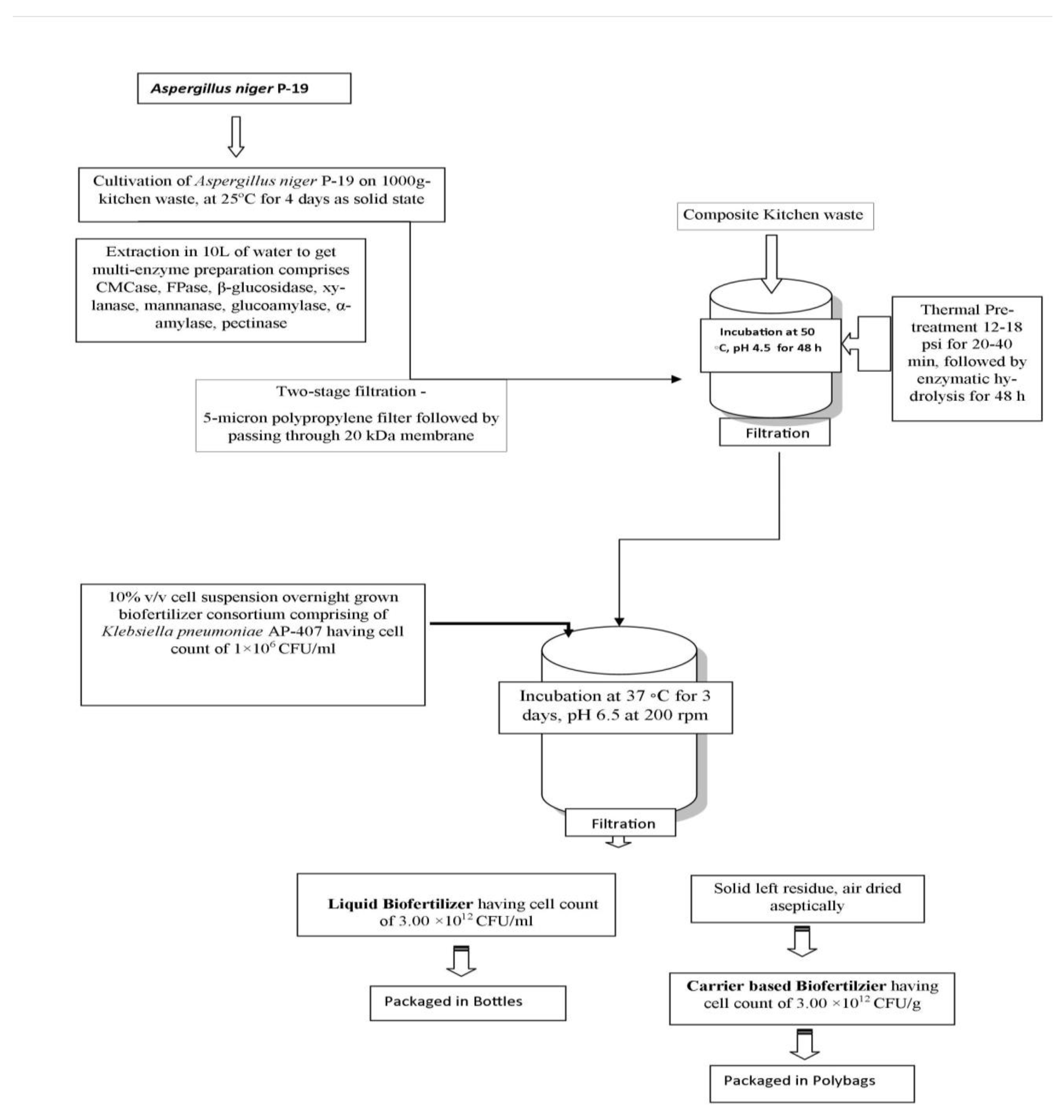
Figure 2.
Quantitative analysis of available phosphate (P2O5), available potassium (K2O), ammonical nitrogen (NH3-N), and nitrate nitrogen (NO3-N) in the soil during the soil growth experiment.
Figure 2.
Quantitative analysis of available phosphate (P2O5), available potassium (K2O), ammonical nitrogen (NH3-N), and nitrate nitrogen (NO3-N) in the soil during the soil growth experiment.
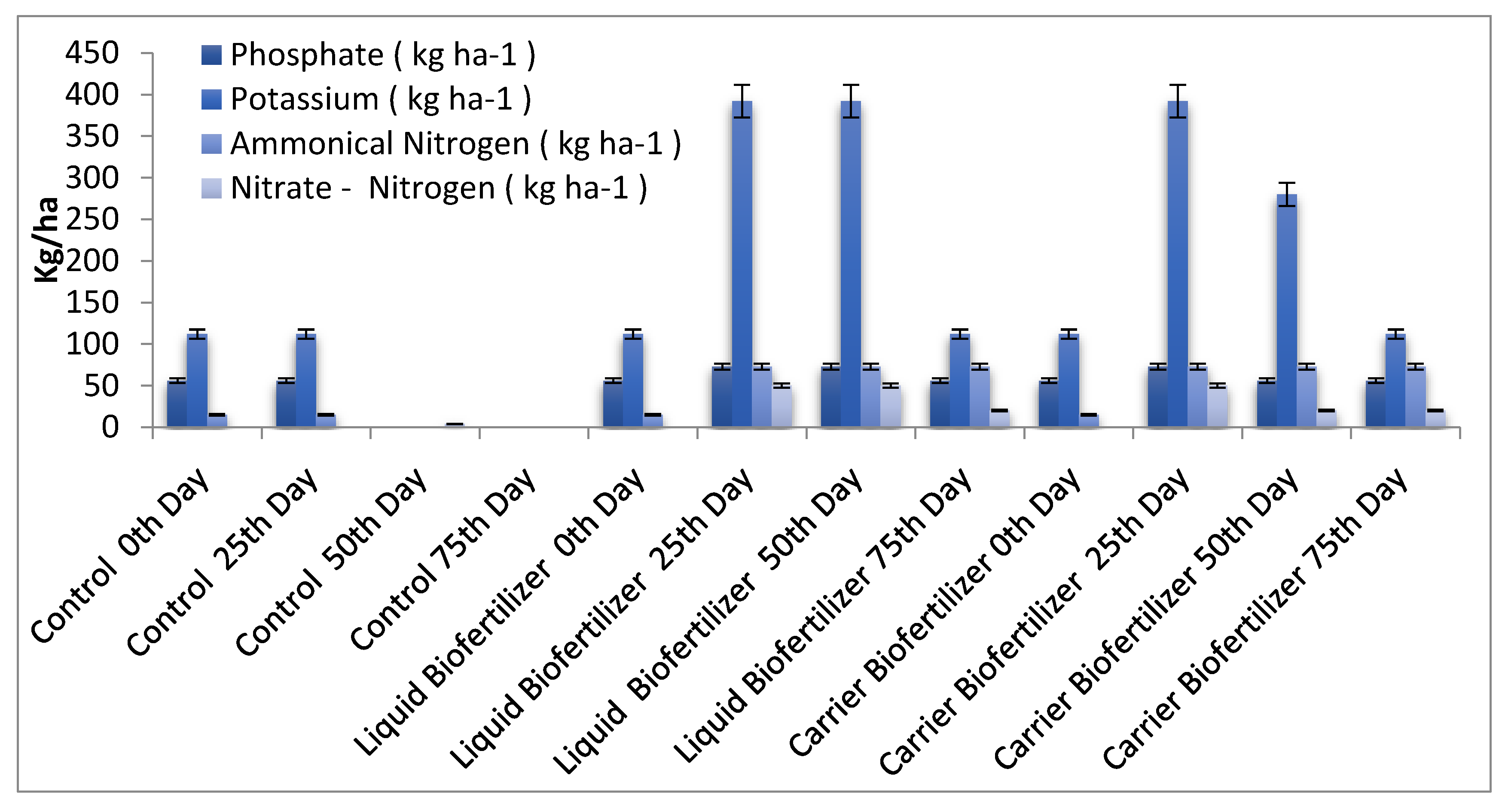

Table 1.
Total reducing sugars, glucose, and microbial cell count obtained during fermentation on kitchen waste hydrolysate.
Table 1.
Total reducing sugars, glucose, and microbial cell count obtained during fermentation on kitchen waste hydrolysate.
| Time (h) | Total reducing sugars (%) |
Glucose (%) |
Klebsiella pneumoniae AP-407 (CFU/ml) |
|---|---|---|---|
| 0 | 3.10 | 1.5 | 1.00 ×10⁶ |
| 24 | 1.80 | 0 | 2.45 ×10⁸ |
| 48 | 0.75 | 0 | 1.10 ×10¹⁰ |
| 72 | 0.08 | 0 | 3.00 ×10¹² |
Columns represent the result of the mean and standard deviation.
Table 2.
Characteristics of the kitchen waste hydrolysate (after enzymatic hydrolysis) and biofertilizer formulations (prepared from hydrolyzed kitchen waste).
Table 2.
Characteristics of the kitchen waste hydrolysate (after enzymatic hydrolysis) and biofertilizer formulations (prepared from hydrolyzed kitchen waste).
| Parameter (s) | Kitchen Waste Hydrolysate | Carrier Biofertilizer | Liquid Biofertilizer |
|---|---|---|---|
| pH | 4.0±0.5 | 6.5±0.5 | 6.5±0.5 |
| Viable Count | - | 1.00 ×10⁸ CFU/g | 3.00 ×10¹² CFU/ml |
| IAA | - | 31.75±1.75 µg/ml | 34.40±1.60 µg/ml |
| HCN | - | + | + |
| Siderophore | - | Hydroxymate(+) | Hydroxymate(+) |
Columns represent the result of the mean and standard deviation.
Table 3.
Effects of liquid and carrier-based biofertilizer on Seed germination (SG) and Relative seed germination (RSG) of Tagetes erecta (Marigold).
Table 3.
Effects of liquid and carrier-based biofertilizer on Seed germination (SG) and Relative seed germination (RSG) of Tagetes erecta (Marigold).
| Treatment | Number of Seed germinated (out of a total of 20) |
Seed germination (SG %) |
Relative seed germination (RSG %) |
Vigor Index |
|---|---|---|---|---|
| Control | 12.0±0.45 | 60.0±2.25 | - | 185.25 |
| Liquid biofertilizer | 18.0±0.75 | 90.0±3.75 | 150.0 | 620.00 |
| Carrier biofertilizer | 14.0±0.50 | 70.0±2.50 | 116.6 | 275.90 |
Columns represent the result of the mean and standard deviation.
Table 4.
Depicting morphometric characteristics (plant height (cm), shoot height (cm), root length (cm)) control, carrier biofertilizer, and liquid biofertilizer treated Tagetes erecta (Marigold) after 25, 50, and 75 days of plant development assay.
Table 4.
Depicting morphometric characteristics (plant height (cm), shoot height (cm), root length (cm)) control, carrier biofertilizer, and liquid biofertilizer treated Tagetes erecta (Marigold) after 25, 50, and 75 days of plant development assay.
| Parameter | Day 25 | Day 50 | Day 75 | Relative yield increase (%) | |||||||
|---|---|---|---|---|---|---|---|---|---|---|---|
| Control | Carrier | Liquid | Control | Carrier | Liquid | Control | Carrier | Liquid | Carrier | Liquid | |
| Plant height cm) | 11.7± 0.280 |
13.0± 0.500 |
15.5± .650 |
28.5±0 .425 |
32.5± 0.625 |
47.5± 0.875 |
37.0± 1.350 |
49.5± 1.475 |
66.0± 1.800 |
133.7 | 178.3 |
| Shoot height (cm) | 9.7±0 .230 |
10.0± 0.350 |
11.5± 0.380 |
21.5± 0.250 |
24.0± 0.400 |
38.0± 0.625 |
27.1± 0.905 |
37.2± 1.010 |
50.2± 1.310 |
137.2 | 185.2 |
| Root height (cm) | 2.0± 0.050 |
3.0± 0.150 |
4.0± 0.410 |
6.5± 0.115 |
8.5± 0.220 |
9.5± 0.325 |
10.0± 0.445 |
12.3± 0.465 |
15.8± 0.490 |
123.0 | 158.0 |
Columns represent the result of the mean and standard deviation.
Table 5.
Depicting morphometric characteristics (number of flowers, flower diameter (cm), and flower weight (g)) in control, carrier biofertilizer and liquid biofertilizer treated Tagetes erecta (Marigold) after 25, 50, and 75 days of plant development assay.
Table 5.
Depicting morphometric characteristics (number of flowers, flower diameter (cm), and flower weight (g)) in control, carrier biofertilizer and liquid biofertilizer treated Tagetes erecta (Marigold) after 25, 50, and 75 days of plant development assay.
| Parameter | Control | Carrier | Liquid | Relative yield increase (%) | |
|---|---|---|---|---|---|
| Carrier | Liquid | ||||
| Number of flowers | 40±2 | 56±3 | 65±3 | 140.0 | 162.5 |
| Flower diameter (cm) | 5.85±0.092 | 6.4±0.150 | 7.0±0.105 | 109.4 | 119.6 |
| Average Flower weight (g) | 6.15±0.236 | 7.4±0.220 | 8.5±0.210 | 120.3 | 138.2 |
Columns represent the result of the mean and standard deviation.
Table 6.
Estimation of Chlorophyll (chl a, chl b, and chl a+b) in Tagetes erecta (Marigold).
| Treatment | Chlorophyll a (µg/ml) | Chlorophyll b (µg/ml) | Total Chlorophyll (µg/ml) |
|---|---|---|---|
| Control | 24.4±1.2 | 22.4±0.98 | 46.8±1.09 |
| Carrier Biofertilizer | 29.5±1.3 | 35.75±1.11 | 65.25±1.20 |
| Liquid Biofertilizer | 42.2±1.2 | 41.3±1.32 | 83.5±1.26 |
Columns represent the result of the mean and standard deviation.
Table 7.
The comparative analysis of present process technology with eminent studies involving different agro-industrial wastes transformed into various agro-industrial commodities having soil nourishment traits.
Table 7.
The comparative analysis of present process technology with eminent studies involving different agro-industrial wastes transformed into various agro-industrial commodities having soil nourishment traits.
| Agro-industrial waste | Process involved | Microorganism involved | Agro-industrial commodity generated | Impact | Reference |
|---|---|---|---|---|---|
| Food waste | Food waste inoculated with microbes in a composter at 50 ◦C for 28 days | Brevibacillus borstelensis SH168 | Biofertilizer 1.82×10⁹ CFU/g | Food waste in addition to biofertilizer production | [46] |
| Wastewater from sweet potato starch | Inoculation in 100 ml of sterilized (121°C, 20 min) SPSW and incubated at 24–32 h incubation at 30°C | Paenibacillus polymyxa | Biofertilizer having 9.7×10⁹ CFU/ml | Biofertilizer which improves the growth of tea plant | [22] |
| Peat, corn cobs with 20% (w/w) perlite (CCP), wheat husks with 20% (w/w) perlite (WHP), and composted cattle manure with 20% (w/w) perlite |
Adsorption of Aspergillus niger 1107 on carrier material developed from waste | Aspergillus niger 1107 | Phosphate Biofertilizer | Higher growth and high content of phosphate in soil | [47] |
| Fruit waste | 30-40 days of the composting process | Bacillus spp. and Aspergillus spp | Carrier-based biofertilizer | Better seed germination, shoot, and root height, and the ability to prevent root diseases | [48] |
| Sawdust and agricultural waste | Biofertilizer was produced from Agro wastes by composting | Actinomyces spp., Streptomyces spp., and Rothia spp. | Biofertilzier (compost) | Better plant height and higher leaf width indicate a higher rate of photosynthesis | [49] |
| Chicken feather waste | 30 days of degradation process by 20–25% inoculum w/w | Bacillus subtilis | Compost | Management of chicken feather Increase in N, P, K content of the soil | [43] |
| Caribbean pine sawdust | 2.0 g Biochar adsorbed with inoculum and shaken at 150 RPM, 24 h at 30 ± 2 °C | Pseudomonas sp., Serratia sp., and Kosakonia sp | Biofertilizer having 1.0 × 10⁷ CFU/ml | Increases seedling growth nutrient in soil and growth of Allium cepa L. | [50] |
| Chicken feather waste | White chicken feathers inoculated with B. pumilus AR57 in 1 % v/v; 1.25 ×10⁸ CFU/ml) and incubated at 150 rpm, 37 ◦C for 28 h | Bacillus pumilus AR57 | Biofertilizer | Enhances total phosphate and potassium solubilizers and nitrifying bacteria in the soil of Zea mays L. | [15] |
| Kitchen waste | Separate hydrolysis and fermentation for 5 days | Aspergillus niger P-19 and Klebsiella pneumoniae AP-407 | Carrier and liquid biofertilizer formulations having 3.00 × 10¹² CFU/g and 3.00 ×10¹² CFU/ml, respectively | Kitchen waste management in addition to biofertilizer production improves both plant growth of Tagetes erecta (Marigold) and soil quality | Present study |
Disclaimer/Publisher’s Note: The statements, opinions and data contained in all publications are solely those of the individual author(s) and contributor(s) and not of MDPI and/or the editor(s). MDPI and/or the editor(s) disclaim responsibility for any injury to people or property resulting from any ideas, methods, instructions or products referred to in the content. |
© 2023 by the authors. Licensee MDPI, Basel, Switzerland. This article is an open access article distributed under the terms and conditions of the Creative Commons Attribution (CC BY) license (http://creativecommons.org/licenses/by/4.0/).
Copyright: This open access article is published under a Creative Commons CC BY 4.0 license, which permit the free download, distribution, and reuse, provided that the author and preprint are cited in any reuse.


