

Submitted:
03 May 2023
Posted:
04 May 2023
You are already at the latest version
Abstract
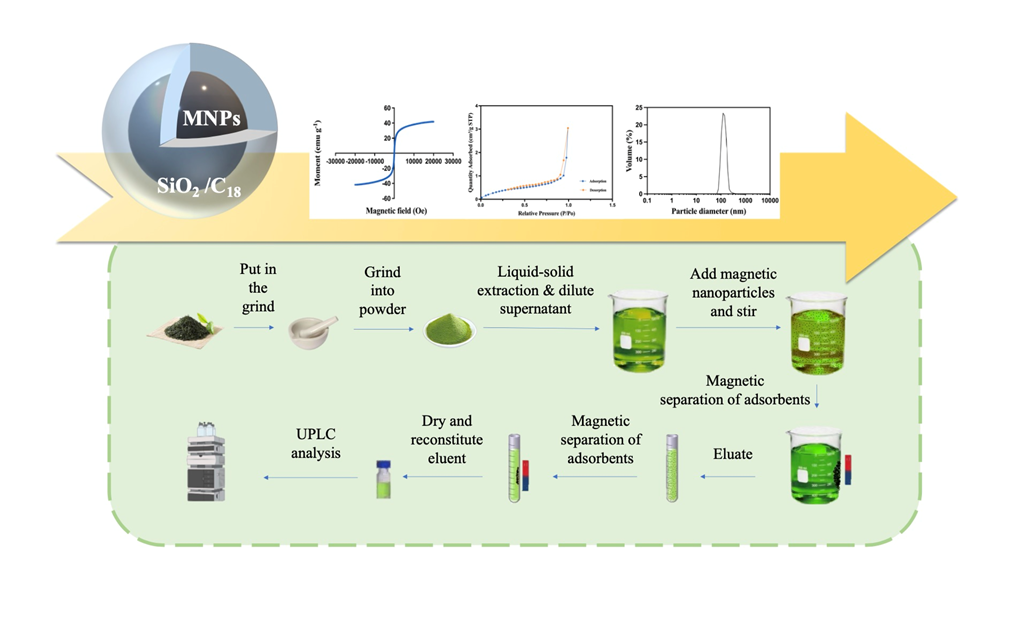
A rapid and efficient method using an alkyl functionalized magnetic nanoparticles-based extraction technique combined with Ultra-High Performance Liquid Chromatography was developed for the detection of trace amounts of polycystic aromatic hydrocarbons in tea leaves. As a popular coating for chromatographic column packing materials, C18-alkyl has been demonstrated to be effective in separating polycystic aromatic hydrocarbons. And the magnetism of the nanomaterials accelerates the extraction process while their high surface ratio enables desirable dispersity in the sample matrix. Meanwhile, the adsorbents can be washed and reused 30 times without compromise on recovery, which greatly reduced the budget. The effects of various parameters were investigated and optimized, and the recoveries for five analytes were in the range of 84.8–103.7%. The reproducibility rate of intra-day and inter-day were below 7.1% and 11.3% respectively. The limits of detection and limits of quantification ranged from 1.69–9.97 ng g-1 and 5.12–30.21 ng g-1, indicating satisfactory sensitivity. Thus, the proposed methodology is rapid, highly efficient, and economical, and it expands the application of magnetic cleanup approaches in complex food matrices.
Keywords:
Polycyclic aromatic hydrocarbons
; Tea
; Magnetic solid phase extraction
; UPLC
; Nanoparticles
1. Introduction
Tea is one of the most widely consumed beverages worldwide, and its status as the national drink of China has been recognized since ancient times. The global spread of Chinese tea leaves during the 16th century, facilitated by increased cultural exchange and trade, firmly cemented tea's place as an important beverage. In particular, tea has had a profound impact on British culture, with many individuals consuming large quantities of it. Numerous scientific studies have identified potential health benefits associated with tea consumption, including cholesterol reduction, anti-microbial and hepatoprotective effects, and prevention of cardiovascular disease and cancer [1]. Residual chemical contaminants present in tea leaves due to air pollution deposition pose potential health hazards for consumers. Heavy metals and pesticide residues are among the primary pollutants that have undergone extensive investigation, and their detection and monitoring are crucial [2]. Based on the correlation between medicine and food, tea has been utilized for medicinal purposes in China for an extended period. Various active components present in tea exhibit antiviral properties, for example, some polyphenols have inhibitor potential by binding to the active site of SARS-CoV-2 RdRp, which means that it might be precaution and treatment as a candidate drug for COVID-19 [3].
Polycyclic Aromatic Hydrocarbons (PAHs) are chemical structures composed of two to seven benzene rings, which can take a linear, angular, or agglomerated form. Mainly due to the carbon-containing compounds, bioaccumulation in the food chain, and industrial food processing. At present, there are more than 100 known PAHs, while 16 PAHs are listed by the US Environmental Protection Agency as regulated. The Council Directive 98/83/EC set the maximum acceptable level for benzo[a]pyrene at 0.010 µg L-1, the sum of four specified PAHs at 0.100 µg L-1. These compounds possess teratogenic, mutagenic, and carcinogenic properties, and their stable structure makes them slow to degrade [4]. The aromatic's stable structure makes it hard for the PAHs to degrade. PAHs have been detected in a variety of food matrices, such as seafood, oil, barbecue, and so on [5,6]. While the content of PAHs are present in low amounts, research has shown a link between their presence and the development of various types of malignant tumors in laboratory animals and humans [7].
Most people drink tea without washing the tea leaves, which makes tea drinks a potential daily exposure source of PAHs. Because of its long growth cycle and complex processing process, tea is susceptible to environmental pollutants. The main source of PAHs contamination in tea stems from the absorption of PAHs from the atmosphere by tea leaves during their growing and drying stages [8]. When the electric heating drying mode replaces the conventional drying mode, PAHs in fresh leaves are one of the main sources of PAHs contamination in tea due to the am-plification effect during the processing [9]. Furthermore, tea plants are subject to PAHs contamination during cultivation, primarily through the presence of these carcinogens in the air and soil. PAHs in the air may be adsorbed onto the surface of fresh tea leaves or directly absorbed into the tissues of the tea plants. Meanwhile, the roots of tea plants absorb PAHs present in the soil, which then migrate to the leaves [10]. Notably, evidence indicates that the contamination levels of PAHs in different teas differed. A survey conducted by Duedahl-Olesen (2015) showed that after detecting four PAHs in 18 tea leaves, the highest four PAHs levels with a maximum of 115 ng g-1 were found in black tea leaves [11]. Li et al. (2011) reported that the mean PAHs of unfermented tea (green tea), semi-fermented tea (oolong tea), and fully fermented tea (black tea and Pu-erh tea) were 206.0 ng g-1, 153.0 ng g-1, and 202.8 ng g-1, obtained by rapid screening of three PAHs in a variety of tea samples [12]. Previous research had established that PAHs were detected in tea leaves sold in different regions. Adisa et al. (2015) analyzed and evaluated a total of 18 PAHs congeners in an evaluation of 28 different dry tea samples sold in the U.S. The sum of the 18 PAHs congeners, recorded as dry mass, ranged between 101 and 1337 ng g-1 [13]. Khiadani et al. (2013) showed that the average total PAHs in eight black teas commonly found in Iran ranged from 139 to 2082 ng g-1. Four rings of PAHs compounds accounted for 46% of the total PAHs compounds, they were the dominant compounds, and no PAHs with five or six rings were found [14]. Sadowska-Rociek et al. (2014) tested 22 different types of tea in Polish, detecting a total of 8 PAHs with a total content ranging from 30.1 to 147.1 ng g-1. Among them, white tea and green tea had lower PAHs content of 11.8 and 10.6 ng g-1, respectively, while black tea and red tea had a higher content of 16.9 and 17.0 ng g-1, respectively [15].
The determination of polycyclic aromatic hydrocarbons (PAHs) in matrices commonly involves sample extraction and preparation prior to chromatography analysis. The efficacy of the extraction methods is critical in developing high-accuracy analyses. To deal with the diversity and complexity of food matrices, many pretreatment techniques have been developed to separate and absorb PAHs, including solid-phase extraction (SPE), solid-phase microextraction (SPME) and stir-bar sorptive extraction (SBSE) [16,17]. However, there are several drawbacks to the methods: SPE is laborious, difficult, expensive, and not environmental-friendly, SPME is expensive, time-consuming, and has small sorption phase volumes, while method automation and memory effects in SBSE are restrictive. Furthermore, the low amounts of PAHs in complex samples make them difficult to detect using current methods.
Recently, a proposed methodology combined with magnetic nanoparticles has been developed [18]. In many fields, magnetic solid-phase extraction (MSPE) has attracted increasing interest with its simplicity, time-saving, and high accuracy in sample preparation [19]. Normally, magnetic nanoparticles(MNPs)are synthesized by grafting inorganic magnetic cores with organic functional groups [20]. Due to their excellent adsorption properties and stability, nano forms of the material are used in various research areas. J. Ding et al.(2010) reported the synthesis of magnetic material Fe3O4@3-(Trimethoxysilyl)propyl methacrylate@ionic liquid nanoparticles (Fe3O4@MPS@IL NPs) and applied as the adsorbent of seven heavy molecular weight PAHs from tea soup samples [21]. Additionally, magnetic nanoparticles coated with other substances, such as diphenyl functionalization Fe3O4 nanoparticles, and carbon-ferromagnetic nanocomposites, have been utilized to absorb PAHs from different matrices [22].
However, the use of MSPE to determinetrace analytes in solid samples is scarce. And there is a need to enhance the technique's adaptation to complex matrix systems so that they can better assist highly demanding modern separation tasks. Alkyl groups with 18 carbons (C18), as a widely-used chromatographic material, are proven by many to be effective in the preconcentration of various organic contaminants due to their high adsorption capacity, outstanding stability, and strong separation power. And octadecylsilyl (ODS) is the most widely used reagent to graft C18 alkyl groups onto inorganic magnetic nanoparticles with the aid of a silica encapsulation layer in between [23,24]. This study aims to develop an extraction technique utilizing self-prepared C18-coated magnetic nanoparticles (C18/MNPs) to detect PAHs in tea samples. The use of MSPE in conjunction with UPLC results in a highly efficient preconcentration process for PAHs in tea, which is cost-effective, environmentally friendly, and highly accurate. The C18/MNPs are a valuable addition to the analytical tools available.
2. Materials and Methods
2.1. Real sample
Tea leaves were purchased from the local supermarket in Macau. The dried tea powder underwent the process of grinding and was subsequently passed through a 24-mesh sieve to ensure that the particle size remained within 0.85 μm. The samples that underwent grinding were stored in a refrigerator to prevent any moisture prior to usage.
2.2. Chemicals and standards
PAHs standards of benzo[b]fluoranthene (99.4%), ben-zo[a]anthracene (99.0%), fluorene, anthracene (99.9%), and pyrene (98.5%), were required from Manhage Bio-technology (Beijing, China). Ultra-High performance liquid chromatography was from Shimadzu. Analytical grade sodium hydroxide (NaOH), Iron (Ⅱ) chloride tetrahydrate, and Iron (III) chloride hexahydrate were obtained from Macklin. Tetraethyl orthosilicate (TEOS), isopropyl alcohol, ammonia, anhydrous toluene, triethylamine, chloro(diethyl)octadecylsilane (ODS, 95% v/v), hydrochloric acid (HCl, 37% v/v), and potassium bromide (KBr) was from Sigma Macau.
2.3. Preparation and characterization of C18/MNPs
2.3.1. Synthesis of C18/MNPs
The C18/MNPs were prepared by chemical co-precipitation, salinization, and alkylation method [25].
Figure 1a shows that under the alkaline environment, using chemical co-precipitation to prepare the MNPs. FeCl2·4H2O (3.25 g) and FeCl3 (5.65 g) were added respectively to DI water with HCl, followed by ultrasonication. The iron salt solution was added to NaOH solution (1.5 M) using a dropping funnel, stirred vigorously and heated to 80 °C in a water bath, and refluxed with nitrogen gas. The synthesis reaction was carried out for 2 h and washed three times with DI water.
Then, the successfully synthesized MNPs were added to a mixture of DI water (6 mL), isopropanol (43 mL), and ammonia (25 wt%, 1.25 mL), and stirred for 15 min. TEOS (125 μL) was put into the solution with nitrogen gas. At room temperature, the solution was stirred for 4 h, washed thrice, and dried in a vacuum oven.
In short, the Magnetic silica nanoparticles’ surface was covered on the surface by organic coatings through the alkyl. Dried magnetic silica microspheres (0.6 g) were added to anhydrous toluene (30 mL) and heated to boiling. Triethylamine (0.6 mL) and ODS (0.9 g) were added to the mixture and refluxed for 5 h. The successfully synthesized C18/MNPs were washed and dried.
2.3.2. Characterization of C18/MNPs
The functional groups, hydrophobicity, roughness, particle size, and magnetic strength of the synthesized C18/MNPs, were analyzed by Fourier transform infrared spectroscopy (FT-IR), Brunauer-Emmett-Teller (BET), static contact angle (SCA), vibrating sample magnetometer (VSM), zeta-potential analysis, and the laser particle size analyzer. For FT-IR, small amounts of the nanoparticles were ground together with KBr at a 1:130 (w/w) ratio, and then they were pressed into flakes. The specific surface area and pore diameter were determined using Brunauer-Emmett-Teller surface area analyzer a Micromeritics ASAP 2460 V3.01. Surface water contact angles of the scaffolds were measured using a contact angle meter (KRUSS DSA100). In-room temperature, using a vibrating sample magnetometer (Lake Shore 7404) to collect the magnetization curves. For the size and surface zeta potential, the Nano-Particle size, and Zeta Potential Analyzer (Malvern, Zetasizer nano ZS) were used. C18/MNPs were dispersed in deionized water, and zeta potential analysis and laser particle size analysis were performed after 30 min of ultrasound due to its easy magnetic aggregation.
2.4. C18/MNPs-based extraction procedure for the preconcentration and detection of five kinds of PAHs in Tea
2.4.1. Configuration of standard solution and preparation of spike samples
Five kinds of PAHs were dissolved in acetonitrile to obtain spiked samples at different concentrations. Spike samples were prepared by adding PAHs standard solution to the tea powder with a vortex to help mix. For example, a spiked sample at 2 μg g-1 was prepared by adding 100 μl of 300 μg g-1 standard solution to 15 g of tea powder.
2.4.2. Preconcentration procedures
Figure 1b displays the protocol for the preconcentration of PAHs in tea samples with the aid of the self-prepared magnetic nanoparticles: First, acetonitrile (30 mL) was used to extract 15 g of tea powder with the aid of a 10 min vortex. After filtration, the supernatant was taken and DI water (70 mL)was diluted. The C18/MNPs (110 mg) were added to adsorb PAHs and the mixture vortexed for 30 min. The C18/MNPs absorbed the targeted analytes with a strong permanent magnet. The acidified acetonitrile (5 mL) was added to the C18/MNPs and vortexed for 90 s. The C18/MNPs were separated and blown dry using a nitrogen-blowing apparatus at 35 °C. Acetonitrile (200 μL) was used to reconstitute the residue for UPLC analysis.
2.5. Recycling of C18/MNPs
The used C18/MNPs were transferred into a beaker with the aid of methanol. After ultrasound treatment for 30 min, the MNPs were precipitated by an external strong permanent magnet. The C18/MNPs were washed thrice with methanol and water, dried overnight in an oven at 60.0 °C, and then stored in sealed centrifuge tubes for subsequent use.
2.6. UPLC analysis
The UPLC analysis used a Luna 5u C18 column (150 mm length, 4.6 mm id, 100 A pore size, Phenomenex, CA, USA) in a UPLC system (Shimadzu, Peservoir tray, Japan). Analysis entailed maintaining the column oven at 30 °C, injecting 10 μL of the sample, and employing a flow rate of 0.3 mL min-1 while detecting at a wavelength of 254 nm. Water and acetonitrile were employed as mobile phase A and B respectively. The elution gradient for UPLC analysis: 0-15 min, 80% B; 15-40 min, 95% B; 40-45 min, 40% B; 45-50 min, 40% B.
2.7. Statistical analysis
To evaluate reliability between sample sets, three parallel optimization experiments and practical sample analyses were conducted, and sample data was analyzed using IBM SPSS Statistics. Under the optimization process, one-way analysis of variance (ANOVA) at P < 0.05 was performed for the individual sample to ensure the reliability of the triplicates.
3. Results and discussion
3.1. Characterizing of C18/MNPs
The FT-IR spectra of the Fe3O4 nanoparticles, Fe3O4-SiO2 nanoparticles, and C18-coated magnetic nanoparticles are shown in Figure 2a. In the spectrum of the C18/MNPs, the absorption band around 590 cm-1 was caused by the stretching vibration of the Fe–O–Fe group, which indicated the existence of ferrite nanocores. The presence of the peaks at around 1095 cm-1 ascertained the existence of the aromatic Si–O–Si group, verifying that the Fe3O4 nanoparticles were covered by a layer of SiO2. The absorption band around 2800-2900 cm-1 was indicative of the presence of the C18 layer due to the CH2 group originating from the silane coupling agent. Therefore, it indicated that C18-coated ferro ferric oxide had been successfully synthesized.
The adsorption capability of C18/MNPs was further characterized through nitrogen adsorption and desorption isotherms under 77 K. As given in Figure 2b, the N2 adsorption and desorption isotherms all displayed typical Type-IV which was consistent with 17.08 nm mesoporous structure of the C18/MNPs in Figure 2c. The calculated BET surface areas and the BJH cumulative pore volumes were 1.52 m2 g−1 and 0.004709 cm³ g−1, respectively [26].
The surface property of C18/MNPs was evaluated by static contact angles. The water contact angle of the as-prepared C18/MNPs shown in Figure 2d is estimated to be 106.5 °, indicating that the C18/MNPs were hydrophobic.
The surface charge state of C18/MNPs were characterized by measuring the zeta-potential of the particles in an aqueous solution. Figure 2e showed that the zeta potential of the C18/MNPs was −10.5 mV. The zeta potential value indicated that the physical stability was good.
The DLS analysis of the particle size distribution displayed that the particle size of MNPs measured 104 nm, whereas the mean diameter of C18/MNPs was 143 nm. Such nano-level size distribution allow for the good disperse of the nanoparticles in the sample matrix and sufficient contact with the sample. Therefore, the nanoparticles are favorable to be used as adsorbents.
The magnetization curve obtained using the VSM in Figure 2g showed that the C18/MNPs were superparamagnetic since the magnetic curve displayed no hysteresis loop. The magnetization values were measured to be 53.2 emu g-1 for C18/MNPs. The result indicated that the magnetism of the C18/MNPs was high enough for the rapid magnetic separation from the sample matrix [27].
3.2. Optimizing MSPE conditions
The effects of various parameters were investigated and optimized to improve the extraction efficiency of MSPE [28]. All the optimization experiments were conducted in triplicates and the averages were used for the bar charts.
3.2.1. Amount of absorbents
In Figure 3a, the higher the amount of adsorbent, the higher the extraction efficiency, However, when the adsorbent content reached 130 mg, the peak height was not significantly different from that when the adsorbent content was 110 mg. Therefore, a plateau was reached when the adsorbent content reached 110 mg. Based on Figure 3a and the principle of reducing reagent waste, this can be accounted for that 110 mg of C18/MNPs was chosen as the optimum use amount of adsorbents.
3.2.2. Extraction time
As Figure 3b showed that the stirring time had a significant influence on the extraction efficiency. So, the extraction time had been increased from 5 to 30 min. The five PAHs' recoveries increased with an extraction time of up to 20 min. PAHs reached their maximum peak area and reached equilibrium after 20 min. Therefore, set 20 min as the optimum extraction time.
3.2.3. Type of the eluent
Another major influencing factor was the type of elution solvent used. Nowadays, we often use methanol and acetonitrile to elute PAHs. According to the results displayed in Figure 3c, the peak areas corresponding to different elution solvents were quite different, this is related to the polarity of the eluent. Methanol, 95% ethanol, acetonitrile, and acidified acetonitrile (3% acetic acid, v/v) were used in the optimization experiment of the elution solvent type. Therefore, acidified acetonitrile was settled as the elution solvent for the analysis.
3.2.4. Elution time
Figure 3d showed that 90 s was sufficient for the thorough elution of the PAHs. The longer elution time is more favorable for the isolation of PAHs from C18/MNPs. Consequently, the 90 s was determined to be the optimum elution time for the following experiments.
3.2.5. Volume of eluent
Next, the volume of eluent had a certain effect. Therefore, the volume of extraction was optimized in the range of 1-6 mL. PAHs could not be completely separated from C18/MNPs when low eluent volume was utilized. Conversely, excessive eluent volume resulted in prolonged nitrogen blowing durations, which in turn led to the unfortunate loss of PAHs during evaporation. As can be seen from Figure 3e, the results showed that 5 mL acidified acetonitrile was sufficient to elute the PAHs.
3.3. Evaluation of the detection method performance
The proposed methodology helped the acquisition of PAHs calibration curves for different concentrations of tea samples. Figure 4 showed PAHs mixed standard solution, marked sample extract, and blank sample extract of the chromatographic results. The calibration curves of five PAHs were obtained using the optimal extraction conditions. Table 1 summarized that the R2 of all calibration curves was greater than 0.997 within the linear range of the analytes, reflecting the result that the method was accurate enough to be suitable for quantitative purposes. The method was further proof of the feasibility of the magnetic nanoparticle enrichment of PAHs in tea samples, which had proven to be more sensitive than traditional methods. When the limits of detection (LODs) and limits of quantification (LOQs) were determined as the lowest concentrations at which the five PAHs can be detected at signal-to-noise ratios above 3 and 10. To draw the proposed method's accurate LOD and LOQ values, each analyte sample took ten times analysis.
3.4. Reproducibility and Reusability of the C18/MNPs
To validate the precision of the C18/MNPs as adsorbents for PAHs in tea, the optimized parameters were used to test the reproducibility of the method that was applied within intra-day and inter-day. To test the reproducibility of the assay, the experiment was conducted three times in one day and on three separate days. The samples of tea powder were spiked at 0.5, 1, and 10 µg mL-1 respectively, to prove that the proposed method does had satisfactory reproducibility over a relatively wide concentration range. The result was shown in Table 2. It revealed that intra- and inter-day relative standard deviation (RSDs) were below 7.1% and 11.3%, respectively. The intra-day RSD values were compromised compared with that of inter-day.
After repeating the experiment, the relationship between the UPLC signal of the spiked tea powder extract and the reuse time was displayed in Figure 5. The results suggested that the extraction effectiveness of nanoparticles had no significant change during the repeating extraction procedure, indicating the nanoparticles had good stability and durability. Peak areas of PAHs had RSDs by 8.4% for Fluorene, 5.8% for Anthracene, 10.8% for Pyrene, 3.0% for Benzo[a]anthracene and 2.7% for Benzo[b]fluoranthene, respectively. Thus, it was proved that the recyclability of C18/MNPs was great. Compared to those traditional methods using disposable adsorbents, recyclable magnetic nanoparticles can reduce environmental pollution and costs [29]. Ultimately, the nanoparticles' high level of recyclability was critical to the proposed pretreatment method's ability to effectively reduce environmental pollution and costs.
3.5. Method comparison
In Table 3, a comprehensive evaluation of the proposed methodology was done by comparing it with other methods. The main factors were listed, including equipment requirements, organic solvent usage, and extraction steps, and the advantages and disadvantages of each method were also analyzed. While traditional methods enable the analysis and detection of PAHs, we have been found to require a significant amount of time, a large volume of solvent, and are likely to cause secondary pollution. The MSPE detection method is capable of preserving the environment by utilizing fewer organic solvents and reusable adsorbents. Additionally, improved sensitivity is also a notable advantage of this technique.
3.6. Real sample analysis
Thirteen different brands of tea samples were procured from the Macau supermarket chain between 2020 and 2022. For each brand, three packages were purchased from three different shops. The tea samples were stored at room temperature prior to analysis, and the analysis was conducted at least a month prior to their expiration date.
The maximum allowable content of benzo(a)pyrene and 4 PAHs in some food was specified by the current EU regulation [35]. However, the maximum residue levels for PAHs in tea were not specified. Here we used the maximum allowable content for PAHs in drinking water to assess the exposure risk of PAHs in tea. Only Benzo(a)anthracene (BaA) was currently regulated among target PAHs of this experiment and was described with high toxic equivalent factors (TEF). The test results of real samples were shown in Table 4. The content of BaA was far below the limit or not detected in both black and green tea, which indicated the low health risk of PAHs exposure associated with tea consumption [36].
4. Conclusion
In general, developed an MSPE platform as a methodological innovation to the current pretreatment approaches for solid food matrices. Currently, the MSPE techniques are mainly confined to liquid matrices, which has hindered its expansion. The proposed methodology improved its application, enabling the pretreatment of a wider variety of samples. In this experiment, self-prepared C18-functionalized ultrafine magnetic silica nanoparticles were used for the detection of PAHs in tea with the extraction efficiency parameters optimized. Under the optimum conditions, the method was assayed and yielded satisfactory linearity, sensitivity, and reproducibility. The fine particle size of the nanoparticles contributed to their high specific surface area and adsorption sites. Additionally, C18/MNPs can be isolated by using permanent magnets after extraction, which means a simple and fast pre-processing method for instrumental analysis. The ability to reuse the nanoparticles considerably reduces costs and pollution, making this approach promising for solid food analysis, including barbecue, coffee, and similar samples. Overall, the developed method of MSPE with magnetic solid phase extraction is expected to serve as a promising platform for monitoring food safety.
Acknowledgments
This work was supported by the Science and Technology Development Fund, Macau SAR (Grant 0024/2022/A), the Science and Technology Planning Project of Guangdong Province (2020B1212030008), Industry-academia-research projects of Zhuhai City (ZH22017002200002PWC) and the Sichuan International Science and Technology Innovation Cooperation Project from Science and Technology Department of Sichuan Province (2022YFH0104).
References
- Sagar, B., et al. Tea and its phytochemicals: Hidden health benefits & modulation of signaling cascade by phytochemicals. Food Chemistry 2022, 371, 131098. [CrossRef]
- Li, X., et al. Determination for major chemical contaminants in tea (Camellia sinensis) matrices: A review. Food Research International 2013, 53, 649-658. [CrossRef]
- Tallei, T.E., et al. A comprehensive review of the potential use of green tea polyphenols in the management of COVID-19. Evidence-based Complementary and Alternative Medicine 2021, 2021. [CrossRef]
- Bansal, V. and K.-H. Kim. Review of PAH contamination in food products and their health hazards. Environment international 2015, 84, 26-38. [CrossRef]
- Tran-Lam, T.-T., et al. Simultaneous Determination of 18 Polycyclic Aromatic Hydrocarbons in Daily Foods (Hanoi Metropolitan Area) by Gas Chromatography–Tandem Mass Spectrometry. Foods 2018, 7, 201. [CrossRef]
- Roudbari, A., et al. Concentration and health risk assessment of polycyclic aromatic hydrocarbons in commercial tea and coffee samples marketed in Iran. Environ Sci Pollut Res Int 2021, 28, 4827-4839. [CrossRef]
- Plaza-Bolaños, P., A.G. Frenich, and J.L.M. Vidal. Polycyclic aromatic hydrocarbons in food and beverages. Analytical methods and trends. Journal of Chromatography A 2010, 1217, 6303-6326. [CrossRef]
- Atirah Mohd Nazir, N., M. Raoov, and S. Mohamad. Spent tea leaves as an adsorbent for micro-solid-phase extraction of polycyclic aromatic hydrocarbons (PAHs) from water and food samples prior to GC-FID analysis. Microchemical Journal 2020, 159, 105581. [CrossRef]
- Zelinkova, Z. and T. Wenzl. The Occurrence of 16 EPA PAHs in Food – A Review. Polycyclic Aromatic Compounds 2015, 35, 248-284. [CrossRef]
- Ziegenhals, K., W. Jira, and K. Speer. Polycyclic aromatic hydrocarbons (PAH) in various types of tea. European Food Research and Technology 2008, 228, 83-91. [CrossRef]
- Duedahl-Olesen, L., et al. PAH in Some Brands of Tea and Coffee. Polycyclic Aromatic Compounds 2015, 35, 74-90. [CrossRef]
- Li, X.-Y., et al. A Novel Synchronous Fluorescence Spectroscopic Approach for the Rapid Determination of Three Polycyclic Aromatic Hydrocarbons in Tea with Simple Microwave-Assisted Pretreatment of Sample. Journal of Agricultural and Food Chemistry 2011, 59, 5899-5905. [CrossRef]
- Adisa, A., et al. Determination of polycyclic aromatic hydrocarbons in dry tea. Journal of Environmental Science and Health, Part B 2015, 50, 552-559. [CrossRef]
- Khiadani , M., et al. Determination of polycyclic aromatic hydrocarbons concentration in eight brands of black tea which are used more in Iran. International Journal of Environmental Health Engineering 2013, 2, 40-40. [CrossRef]
- Sadowska-Rociek, A., M. Surma, and E. Cieślik. Comparison of different modifications on QuEChERS sample preparation method for PAHs determination in black, green, red and white tea. Environmental Science and Pollution Research 2014, 21, 1326-1338. [CrossRef]
- Ren, Z., et al. Effect of heat-treated tea water-insoluble protein nanoparticles on the characteristics of Pickering emulsions. LWT 2021, 149, 111999. [CrossRef]
- Ren, Z., et al. Characteristics and application of fish oil-in-water pickering emulsions structured with tea water-insoluble proteins/κ-carrageenan complexes. Food Hydrocolloids 2021, 114, 106562. [CrossRef]
- Zhou, D.-B., et al. Magnetic solid-phase extraction based on [60]fullerene functionalization of magnetic nanoparticles for the determination of sixteen polycyclic aromatic hydrocarbons in tea samples. Journal of Chromatography A 2018, 1578, 53-60. [CrossRef]
- Yu, X., et al. Design, Preparation, and Application of Magnetic Nanoparticles for Food Safety Analysis: A Review of Recent Advances. Journal of Agricultural and Food Chemistry 2022, 70, 46-62. [CrossRef]
- Baber, O., et al. Amorphous silica coatings on magnetic nanoparticles enhance stability and reduce toxicity to in vitro BEAS-2B cells. Inhalation Toxicology 2011, 23, 532-543. [CrossRef]
- Shi, Y., et al. Determination of polycyclic aromatic hydrocarbons in coffee and tea samples by magnetic solid-phase extraction coupled with HPLC–FLD. Food Chemistry 2016, 199, 75-80. [CrossRef]
- Bianchi, F., et al. Magnetic solid-phase extraction based on diphenyl functionalization of Fe3O4 magnetic nanoparticles for the determination of polycyclic aromatic hydrocarbons in urine samples. Journal of Chromatography A 2012, 1231, 8-15. [CrossRef]
- Ma, J., et al. C18-Functionalized Magnetic Silica Nanoparticles for Solid Phase Extraction of Microcystin-LR in Reservoir Water Samples Followed by HPLC-DAD Determination. Journal of Liquid Chromatography & Related Technologies 2015, 38, 655-661. [CrossRef]
- Guo, B., et al. Preparation of C18-functionalized Fe3O4@SiO2 core–shell magnetic nanoparticles for extraction and determination of phthalic acid esters in Chinese herb preparations. Journal of Pharmaceutical and Biomedical Analysis 2014, 100, 365-368. [CrossRef]
- Jiang, C., et al. Removal of sudan dyes from water with C18-functional ultrafine magnetic silica nanoparticles. Talanta 2012, 89, 38-46. [CrossRef]
- Xiong, X., et al. Magnetic solid-phase extraction modified Quick, Easy, Cheap, Effective, Rugged and Safe method combined with pre-column derivatization and ultra-high performance liquid chromatography-tandem mass spectrometry for determination of estrogens and estrogen mimics in pork and chicken samples. J Chromatogr A 2020, 1622, 461137. [CrossRef]
- Venkateswarlu, S., et al. Biogenic synthesis of Fe3O4 magnetic nanoparticles using plantain peel extract. Materials Letters 2013, 100, 241-244. [CrossRef]
- Yu, X., et al. Quantification of aflatoxin B1 in vegetable oils using low temperature clean-up followed by immuno-magnetic solid phase extraction. Food Chemistry 2019, 275, 390-396. [CrossRef]
- Ma, L., et al. Rapid detection of clenbuterol in milk using microfluidic paper-based ELISA. Food Chemistry 2018, 246, 437-441. [CrossRef]
- Ciemniak, A., et al. Assessing the contamination levels of dried teas and their infusions by polycyclic aromatic hydrocarbons (PAHs). Journal of Consumer Protection and Food Safety 2019, 14, 263-274. [CrossRef]
- Pissinatti, R., et al. Simultaneous analysis of 10 polycyclic aromatic hydrocarbons in roasted coffee by isotope dilution gas chromatography-mass spectrometry: Optimization, in-house method validation and application to an exploratory study. Food Control 2015, 51, 140-148. [CrossRef]
- Drabova, L., et al. Rapid determination of polycyclic aromatic hydrocarbons (PAHs) in tea using two-dimensional gas chromatography coupled with time of flight mass spectrometry. Talanta 2012, 100, 207-216. [CrossRef]
- Benson, N.U., et al. Concentrations, sources and risk characterisation of polycyclic aromatic hydrocarbons (PAHs) in green, herbal and black tea products in Nigeria. Journal of Food Composition and Analysis 2018, 66, 13-22. [CrossRef]
- Luo, Y.-B., et al. Fast microextraction of phthalate acid esters from beverage, environmental water and perfume samples by magnetic multi-walled carbon nanotubes. Talanta 2012, 90, 123-131. [CrossRef]
- Tran-Lam, T.-T., et al. Simultaneous Determination of 18 Polycyclic Aromatic Hydrocarbons in Daily Foods (Hanoi Metropolitan Area) by Gas Chromatography–Tandem Mass Spectrometry. Foods, 2018. 7. [CrossRef]
- Roszko, M., et al. Dietary risk evaluation for 28 polycyclic aromatic hydrocarbons (PAHs) in tea preparations made of teas available on the Polish retail market. Journal of Environmental Science and Health, Part B 2018, 53, 25-34. [CrossRef]
Figure 1.
(a) Synthesis of C18/MNPs; (b) Protocol for the analysis of the tea powder using the proposed method.
Figure 1.
(a) Synthesis of C18/MNPs; (b) Protocol for the analysis of the tea powder using the proposed method.
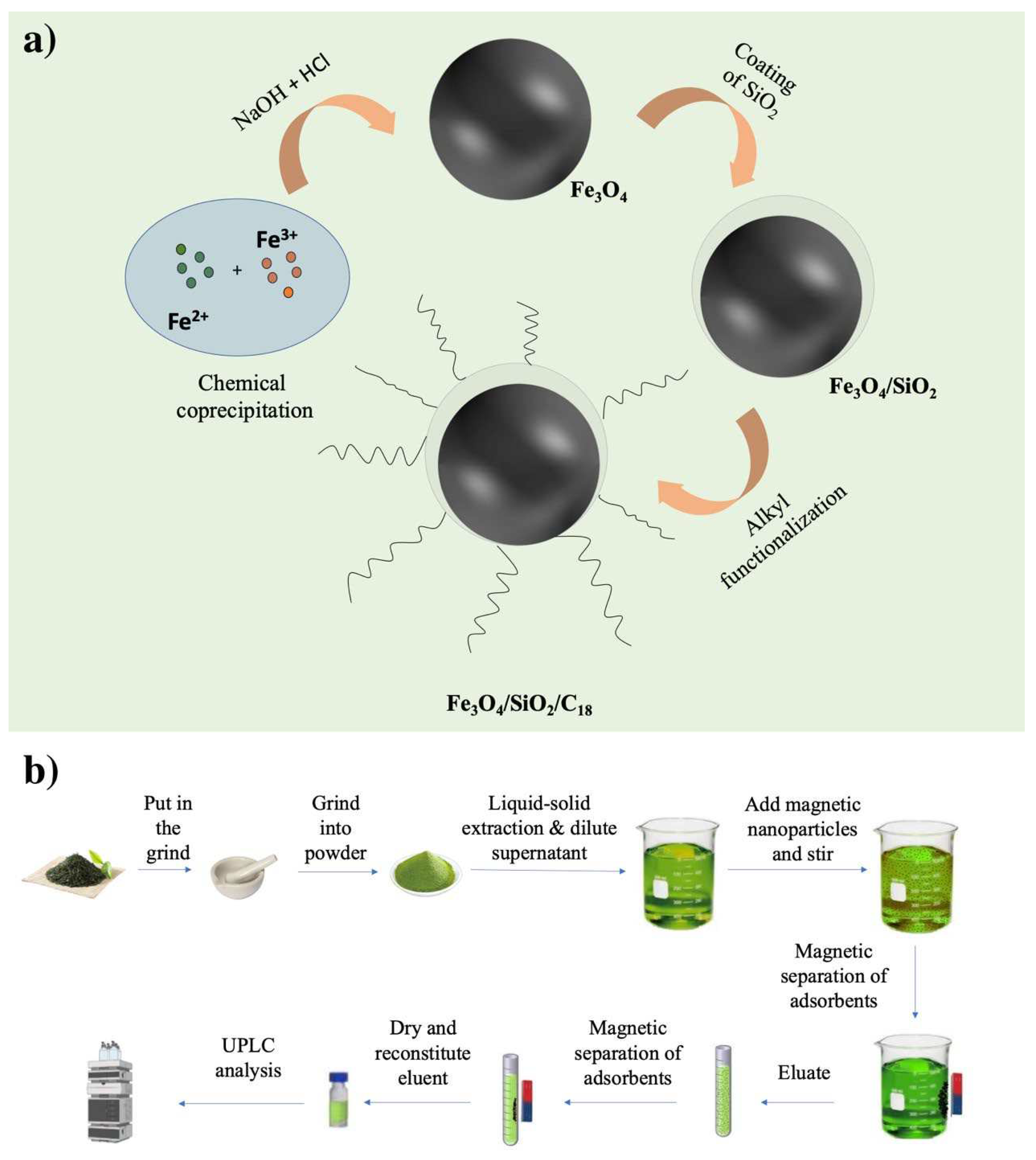
Figure 2.
Characterizations of the magnetic C18/MNPs (a) Fourier transform infrared spectra; (b) Adsorption and desorption of nitrogen isotherms; (c) Pore distribution; (d) Static contact angle image; (e) Zeta-potential; (f) Particle size distribution; (g) Hysteresis loop.
Figure 2.
Characterizations of the magnetic C18/MNPs (a) Fourier transform infrared spectra; (b) Adsorption and desorption of nitrogen isotherms; (c) Pore distribution; (d) Static contact angle image; (e) Zeta-potential; (f) Particle size distribution; (g) Hysteresis loop.
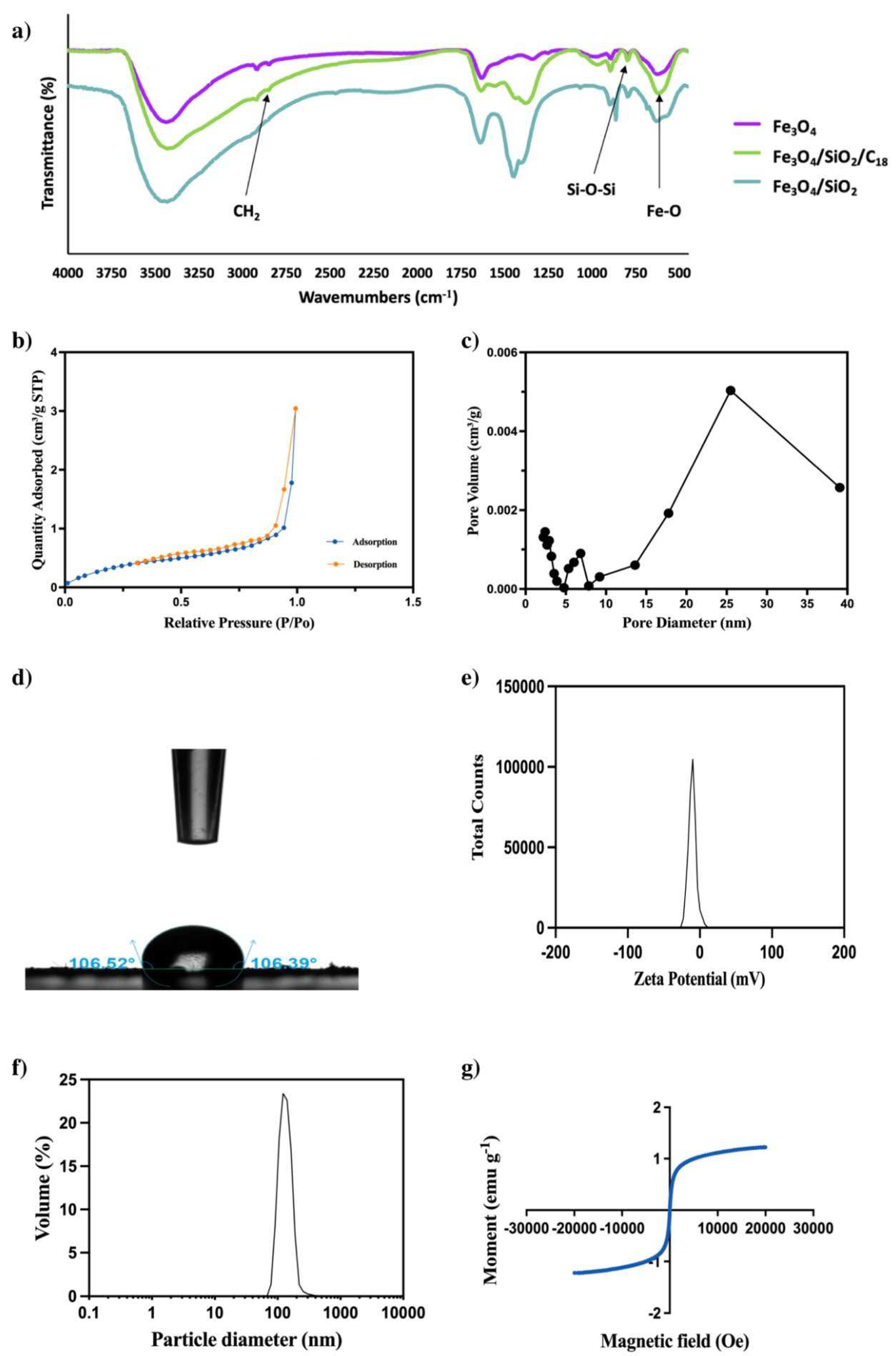
Figure 3.
Optimizing MSPE conditions: (a) Amount of adsorbents; (b) Extraction time; (c) Type of the eluent; (d) Elution time; (e) Volume of eluent. * Note: ND: Identical letters indicate insignificant differences, while different letters indicate significant differences (P = 0.05).
Figure 3.
Optimizing MSPE conditions: (a) Amount of adsorbents; (b) Extraction time; (c) Type of the eluent; (d) Elution time; (e) Volume of eluent. * Note: ND: Identical letters indicate insignificant differences, while different letters indicate significant differences (P = 0.05).
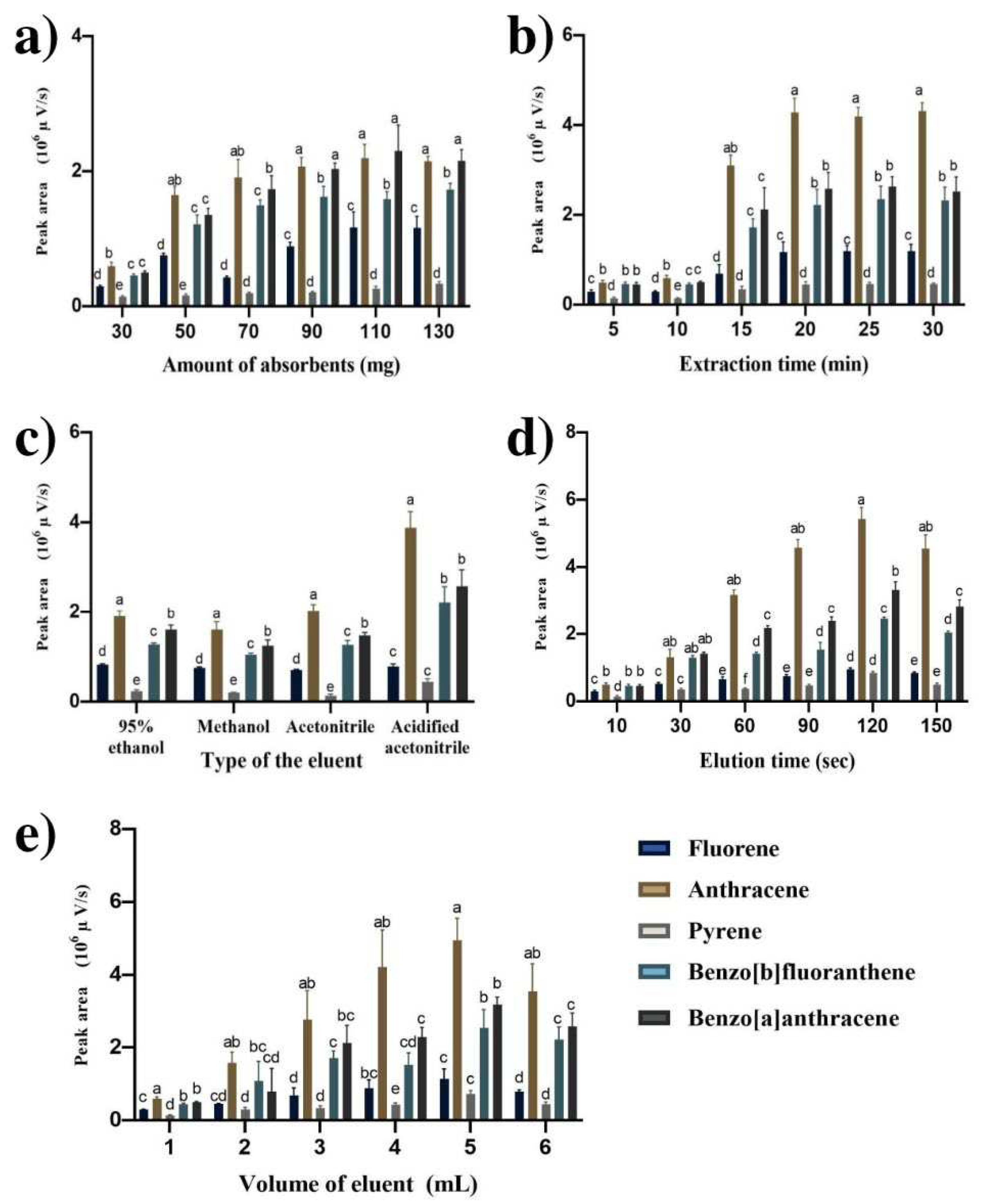
Figure 4.
UPLC chromatograms of the standard solution of 5 PAHs, the spiked sample extract, and the blank extract.
Figure 4.
UPLC chromatograms of the standard solution of 5 PAHs, the spiked sample extract, and the blank extract.
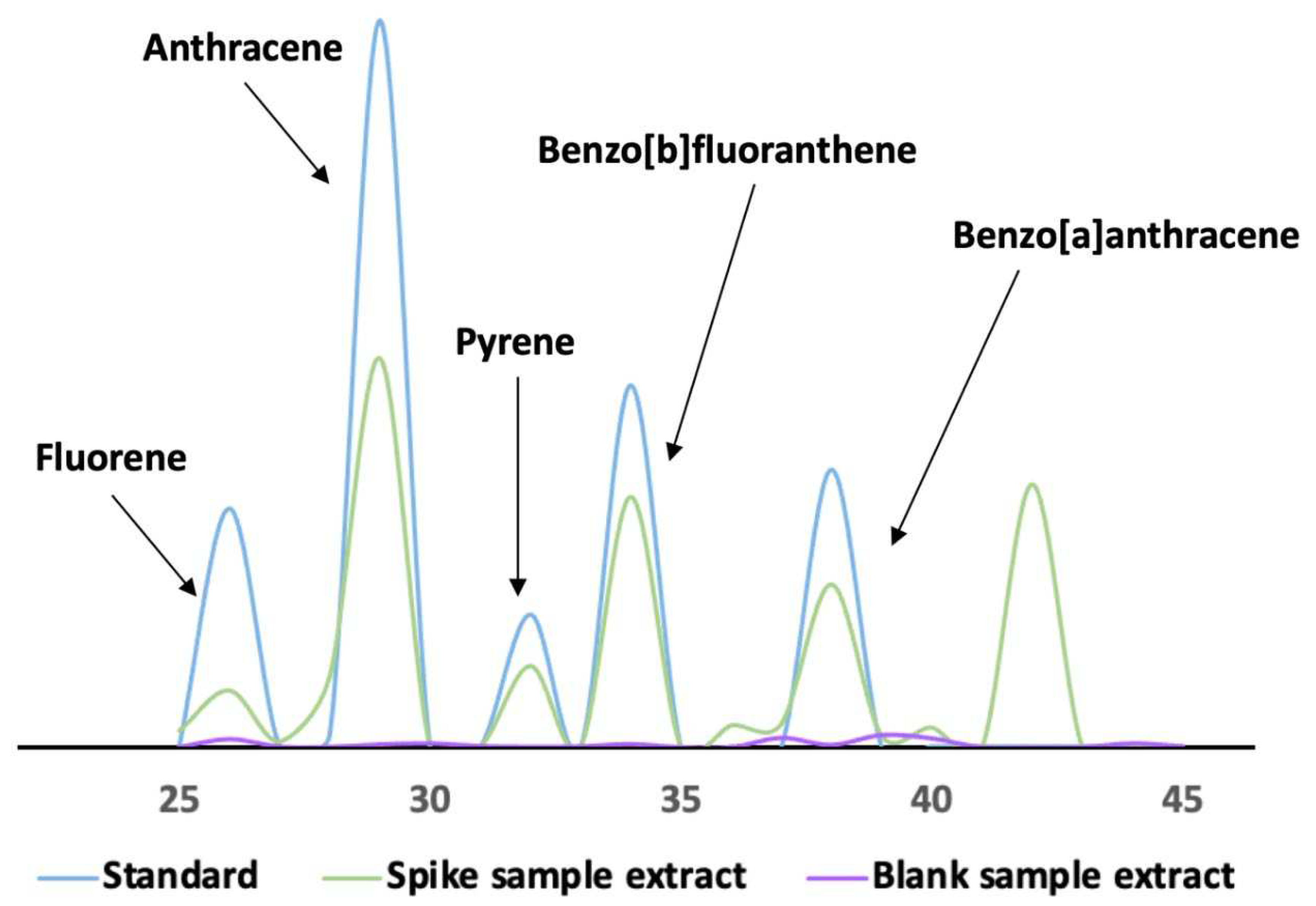
Figure 5.
Effect of recycling times on the peak areas of PAHs.
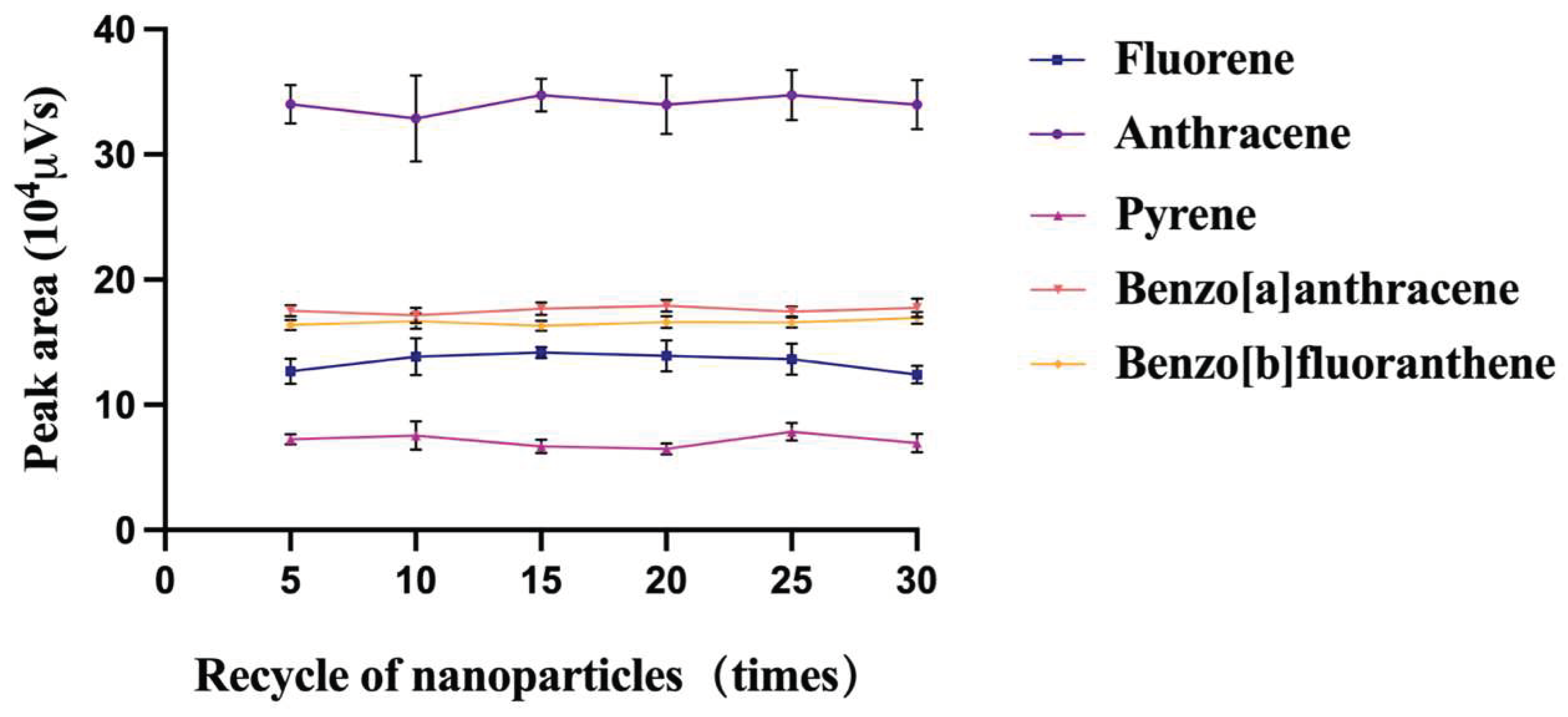

Table 1.
Lnearity, limits of detection (LODs), and limits of quantification (LOQs) of the proposed method for analysing PAHs in tea.
Table 1.
Lnearity, limits of detection (LODs), and limits of quantification (LOQs) of the proposed method for analysing PAHs in tea.
| Analyte | Equation of calibration curve | R2 | LOD (ng g-1) | LOQ (ng g-1) |
|---|---|---|---|---|
| Fluorene | 48627x+71642 | 0.998 | 7.93 | 24.03 |
| Anthracene | 106034x+4318855 | 0.999 | 5.32 | 16.12 |
| Pyrene | 22396x+216848 | 0.997 | 9.97 | 30.21 |
| Benzo[a]anthracene | 56517x+357848 | 0.998 | 1.69 | 5.12 |
| Benzo[b]fluoranthene | 51622x+661315 | 0.998 | 5.43 | 16.45 |
Table 2.
Inter-day and intra-day reproducibility of 5 PAHs.
| Analyte | Concentration (ng g−1) | Intra-day precision | Inter-day precision | ||
|---|---|---|---|---|---|
| Recovery±SD (%) | RSD (%) | Recovery±SD (%) | RSD (%) | ||
| Fluorene | 0.5 | 94.8±2.8 | 3.4 | 84.8±2.9 | 6.8 |
| 1 | 95.2±0.7 | 1.3 | 91.6±0.3 | 3.1 | |
| 10 | 98.1±1.7 | 1.7 | 93.6±1.5 | 4.3 | |
| Anthracene | 0.5 | 91.7±0.8 | 2.9 | 88.1±0.9 | 5.9 |
| 1 | 100.2±1.6 | 1.3 | 94.6±0.7 | 3.7 | |
| 10 | 94.9±1.2 | 3.2 | 93.7±2.3 | 11.3 | |
| Pyrene | 0.5 | 89.9±1.2 | 5.9 | 99.3±0.7 | 2.8 |
| 1 | 95.8±1.4 | 2.3 | 100.5±1.7 | 4.7 | |
| 10 | 103.7±0.2 | 0.6 | 98.4±1.6 | 3.9 | |
| Benzo[a] anthracene |
0.5 | 99.1±1.1 | 2.1 | 93.2±1.8 | 5.1 |
| 1 | 97.4±0.9 | 2.4 | 96.7±0.6 | 6.2 | |
| 10 | 88.2±1.2 | 3.2 | 89.3±1.3 | 7.1 | |
| Benzo[b] fluoranthene |
0.5 | 102.1±3.1 | 7.1 | 96.2±2.1 | 4.9 |
| 1 | 98.2±1.7 | 2.9 | 98.5±5.2 | 5.2 | |
| 10 | 99.2±1.5 | 6.0 | 91.7±1.2 | 2.7 | |
Table 3.
Comparison between the proposed and other methods for the analysis of PAHs in tea/coffee.
| Method | Detection technique | Sample | Linear range (ng g-1) | LOD (ng g-1) |
Recovery (%) | RSD (%) | References |
|---|---|---|---|---|---|---|---|
| SPE |
GC-MS |
Dry tea Tea |
- |
0.09-0.32 |
37.0-96.10 |
- |
Ciemniak (2019) [30] |
| LLE |
GC–MS |
Roasted coffee | 0.25-4 | 0.04-0.18 | 87.08-111.28 | 3.26-23.75 | Pissinatti et al(2015) [31] |
| SPE UAE UAE |
GC×GC–TOFMS HPLC-FLD GC-FID |
Tea Tea infusions Dry tea |
0.05-100 0.2-200 - |
50-200 0.03-0.24 0.3 |
81-103 64.1-99.4 90.24-108.92 |
2.0-9.0 1-10 77.02-100.60 |
Drabova et al. (2012) [32] Iwegbue et al. (2016) [13] Benson et al. (2018) [33] |
| SPME |
GC-MS | Green Tea beverage | 0.1-100 | 0.1-50 | 91.1-101.2 | 0.8-4.5 | Loh et al. (2013) [34] |
| MSPE | UPLC–FLD | Tea | 0.5-300 | 1.69-9.97 | 84.8-100.5 | 2.7-11.3 | This work |
Table 4.
Real sample analysis of tea.
| Tea type | Fluorene (ng g-1) |
Anthracene (ng g-1) | Pyrene (ng g-1) | Benzo[b]fluoranthene (ng g-1) | Benzo[a]anthracene (ng g-1) | |
|---|---|---|---|---|---|---|
| Green (10 tea brands) |
Mean | 132.3 | 41.9 | 109.5 | 8.2 | 3.7 |
| Min | 31.2 | 5.4 | 27.3 | N.D. | N.D. | |
| Max | 364.2 | 196.5 | 284.1 | 16.2 | 8.4 | |
| Black (3 tea brands) |
Mean | 109.8 | 21.7 | 94.6 | 5.7 | 2.6 |
| Min | 81.9 | 15.1 | 70.3 | N.D. | N.D. | |
| Max | 141.5 | 31.2 | 113.4 | 7.2 | 5.3 |
*Note: N.D.: not detected.
Disclaimer/Publisher’s Note: The statements, opinions and data contained in all publications are solely those of the individual author(s) and contributor(s) and not of MDPI and/or the editor(s). MDPI and/or the editor(s) disclaim responsibility for any injury to people or property resulting from any ideas, methods, instructions or products referred to in the content. |
© 2023 by the authors. Licensee MDPI, Basel, Switzerland. This article is an open access article distributed under the terms and conditions of the Creative Commons Attribution (CC BY) license (http://creativecommons.org/licenses/by/4.0/).
Copyright: This open access article is published under a Creative Commons CC BY 4.0 license, which permit the free download, distribution, and reuse, provided that the author and preprint are cited in any reuse.


