
Submitted:
09 October 2023
Posted:
10 October 2023
You are already at the latest version
Abstract
The efficient extraction of phthalate acid esters (PAEs) is challenging due to their extremely low concentration, complicated matrices and hydrophilicity. Herein, hol-low microspheres, as an ideal coating, possesses significant potential for solid-phase microextraction (SPME) due to their fascinating properties. In this study, multi-walled carbon nanotubes hollow microspheres (MWCNTs-HMs) were utilized as a fiber coating for the SPME of PAEs from tea beverages. MWCNTs-HMs were ob-tained by dissolving the polystyrene (PS) cores with organic solvents. Interestingly, MWCNTs-HMs well maintain the morphology of the precursors MWCNTs@PS. The layer-by-layer (LBL) assembly of MWCNTs on PS microsphere templates was ac-quired through electrostatic interactions. Six PAEs, di-ethyl phthalate (DEP), di-iso-butyl phthalate (DIBP), di-n-butyl phthalate (DBP), benzyl butyl phthalate (BBP), di-2-ethylhexyl phthalate (DEHP) and di-n-octyl phthalate (DOP), were se-lected as target analytes for assessing the efficiency of the coating for SPME. The stirring rate, sample solution pH and extraction time were optimized by using the Box-Behnken design. Under optimal working conditions, the proposed MWCNTs-HMs/SPME was coupled with gas chromatography-tandem mass spec-trometry (GC-MS/MS) to achieve high enrichment factors (118–2137), wide linearity (0.0004-10 μg L-1), low limits of detection (0.00011-0.0026 μg L-1) and acceptable recovery (80.2%-108.5%) for the detection of PAEs. Therefore, the MWCNTs-HMs coated fibers are promising alternatives in the SPME method for the sensitive detec-tion of PAEs at trace levels in tea beverages.
Keywords:
solid-phase microextraction
; phthalate acid esters
; gas chromatography-tandem mass spectrometry
; carbon nanotubes hollow microspheres
1. Introduction
Phthalate acid esters (PAEs) with long alkyl chains can improve the machinability and flexibility of polymers, therefore, they are widely applied as plasticizers in rubber and plastic materials [1]. PAEs can be found in food packing materials, coatings, paints, plastic medical devices, and existed in daily-used products. Unfortunately, PAEs can be easily released and migrated into soil, air, environmental water and food products such as tea beverages during their manufacturing, using and processing owing to their weak physical binding interactions with plastics [2,3]. Consequently, PAEs are considered environmental pollutants that create a considerable risk of exposure to humans and other living beings even at low concentration levels [4]. Additionally, some of PAEs have been listed as priority pollutants by international organizations such as the United States Environmental Protection Agency and European Union [5]. Therefore, it is necessary to explore sensitive, rapid and simple analytical methods for the detection and quantification of PAEs in real samples.
In that the extremely low concentration of PAEs were in complex environmental samples matrices, suitable sample pretreatment method prior to instrumental analysis is necessary for the analysis of real samples [6]. To date, PAEs have been mainly detected by the high performance liquid chromatography (HPLC) [7] and gas chromatography (GC) [8]. In addition, some pretreatment techniques including solid-phase extraction [9], dispersive liquid-liquid microextraction [10] and solid-phase microextraction (SPME) [11] have been used to extract PAEs from real samples. As a relatively new and green technology among them, SPME possesses several advantages of high efficiency, simplicity, no solvent consumption and easiness to be coupled with GC determination. Therefore, SPME has been widely applied in the analysis of biological and environmental samples. In that SPME is based on the adsorption balance of analytes between the fiber coating and sample matrix, the vital to improving the SPME extraction performance is the design of new fiber coating materials. In recent years, traditional adsorbents, which include polymers [12], activated carbons [13], clay minerals [14], multiwalled carbon nanotubes (MWCNTs) [15] and novel sorption materials, such as covalent organic frameworks [16], metal organic frameworks [17], have been studied in the field of chemistry.
Several studies have proven that carbon based composite materials, including carbon nanotubes [18], carbon microspheres [19], bamboo charcoal [20], carbon dots [21], graphene oxide [22] and porous carbon materials [23], exhibit high extraction efficiencies towards pollution target molecules. These composite materials include three-dimensional structural materials like carbon microspheres [24], MWCNTs microspheres [25] and graphene oxide microspheres [26]. Compared with solid carbon based microspheres, hollow carbon based microspheres have a large specific surface area, which reduces the density and produce more adsorbing sites at the interfaces [27,28]. At present, the template approach is applied to produce hollow microspheres. For example, Qin et al. utilized polystyrene (PS) as the template and prepared a multishell hollow MWCNTs structure by THF etching and a layer-by-layer (LBL) procedure [29]. Inspired by a pioneering study, which demonstrated that MWCNTs shell on PS cores were used as an SPME coating to enrich PAEs, we found that MWCNTs hemimicrospheres (MWCNTs-HMs) could be designable materials that can be achieved by solvent etching method during the subsequent process.
In this study, interesting MWCNTs-HMs were facilely prepared using PS as templates, along with THF etching. The MWCNTs-HMs are acted as SPME coating materials for enriching trace PAEs in three tea beverages samples by gas chromatography-tandem mass spectrometry (GC-MS/MS) determination. Six PAEs, di-ethyl phthalate (DEP), di-iso-butyl phthalate (DIBP), di-n-butyl phthalate (DBP), benzyl butyl phthalate (BBP), di-2-ethylhexyl phthalate (DEHP) and di-n-octyl phthalate (DOP), were chosen as target analytes and the main factors influencing the enrichment performance were investigated and optimized by response surface methodology. Moreover, the possible adsorption mechanism was explored. Finally, GC-MS/MS coupled with MWCNTs-HMs coated fiber was also applied to determine trace PAEs in tea beverages samples. Thus, the design of MWCNTs-HMs with high efficiency extraction is expected to provide new ideas and methods for PAEs determination. To the best of our knowledge, related studies have not been reported before.
2. Materials and methods
2.1. Chemicals and reagents
Poly(sodium 4-styrenesulfonate) (PSS) and poly(diallyldimethylammonium chloride) (PDDA) was supplied by Aldrich. PS microspheres were synthesized by a dispersion polymerization reaction condition [29]. THF and HF were obtained from Aladdin Industrial Corporation (China). 5 μL injectors and stainless steel needles were acquired from Shanghai Gaoge Industry and Trade Co., Ltd. (China). The six PAEs standard mixture including DEP, DIBP, DBP, BBP, DEHP and DOP was purchased from AccuStandard, Inc. (USA). The mixture stock solution containing six PAEs with a concentration of 10 mg L-1 was prepared in isooctane at 4 °C. Working solutions were diluted with acetone to acquire lower PAEs concentrations.
2.2. Preparation of the MWCNTs-HMs coated fibers
The negatively charged MWCNTs were purchased from Nanjing XFNANO Materials Co., Ltd. (China), and used as received. The modified MWCNTs which negatively charged could be form homogenous dispersion in water, which enabled the following LBL assembly.
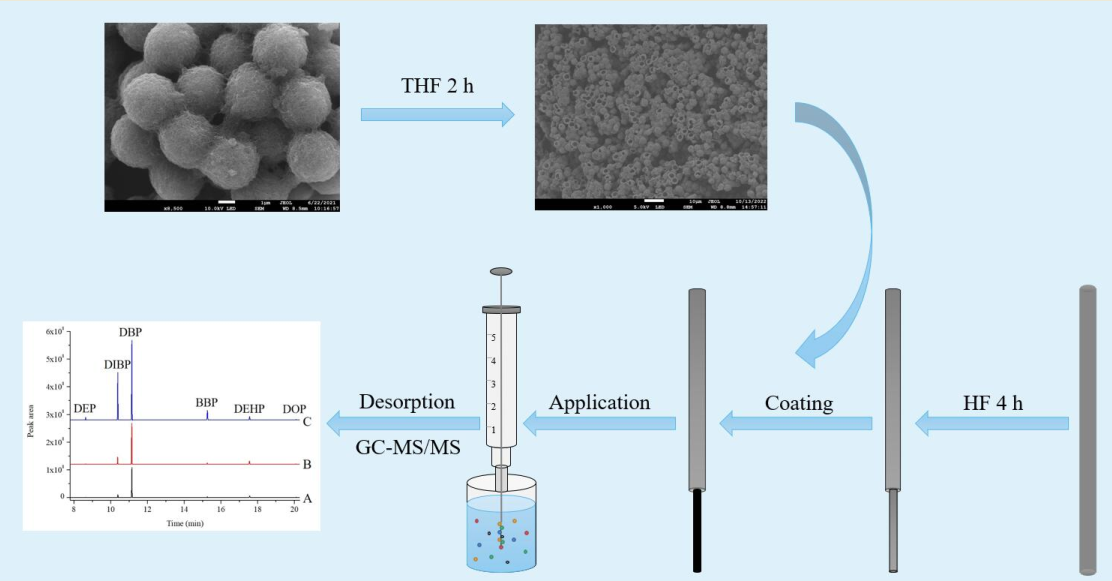
The deposition of MWCNTs/PDDA on the PS templates was prepared as follows: 80 mg of PS microspheres in 60 mL of a positively charged PDDA solution (1.0 mg mL-1) were stirred for 2 h at room temperature before removing excess PDDA by centrifugation. After water rinsing, a PSS layer and another PDDA layer were deposited on PS microspheres by the same fashion. Subsequently, the positively charged microspheres were stirred in 60 mL of MWCNTs suspension (0.5 mg mL-1) for 30 min before collected by centrifugation. By the alternate assembly procedure for PDDA and MWCNTs respectively five times, the product MWCNTs/PDDA multilayers were deposited on composite microspheres. The microspheres covered with MWCNTs/PDDA multilayers were stirred in THF for 2 h to remove the PS templates. The obtained materials were then collected by centrifugation and ethanol wash three times.
The one end of stainless steel wire was treated with 40% hydrofluoric acid for 4 h. Afterwards, the corroded part of the wire was inserted into the silicone glue. The steel wire covered by gummed layer was then immediately inserted into the MWCNTs-HMs powders for 30 s. The MWCNTs-HMs materials on the wire was solidified for 24 h at room temperature. The wire was then fixed on a 5 μL syringe by replacing the plunger.
2.3. Instrumentation
A Thermo Scientific GC system (TRACE 1600 GC, USA) coupled with a triple quadrupole mass spectrometer (TSQ 9610) was applied for PAEs analysis. A TG-5 SILMS capillary column (30 m length ×0.25 mm i.d. ×0.25 μm film thickness) (Thermo Scientific Technologies, USA) was applied for separation. The GC oven temperature program was 60 °C for 1 min, which was increased to 220 °C for 1 min at a rate of 20 °C·min-1, finally raised to 280 °C at 5 °C min-1 and held for 4 min. Helium (99.999%) was supplied as the carried gas at a constant flow rate of 1.0 mL min-1. The mass spectrometer was worked in electron impact ionization (EI) mode and data acquisition was performed in the multi-reaction monitoring (MRM) mode in which m/z was listed in Table S1.
The thermal behaviors of materials were measured with an Netzsch STA409PC thermogravimetric analysis (TGA) at a heating rate of 10 °C min-1 under nitrogen from 30 °C to 600 °C. Morphology analysis was determined on a JEOS scanning electron microscopy (SEM) (JSM7800F, Japan).
2.4. SPME procedure
The syringe needle containing the SPME fiber was inserted into the 10 mL of PAEs working solution or real sample solution in a 20 mL glass vial. The MWCNTs-HMs coated fiber was pushed out and immersed into the solution for extraction. Extraction time of 35 min, pH 6 and stirring rate of 600 rpm were used in the adsorption procedure. After extracting the analytes, the fiber was withdrawn from the vial and inserted into the inlet port for the desorption at 280 °C for 5 min. Before each extraction, the fiber was placed in the GC inlet and aged at 280 °C for 5 min.
2.5. Sample collection
Three kind of plastic packaged tea beverages samples (green tea, red tea and oolong tea) were purchased in local supermarket (Zaozhuang, China).
3. Results and discussion
3.1. Characterization of the MWCNTs-HMs
It is expected that the assembly of MWCNTs will produce stable nanotube shells on spherical template cores. PS microsphere is often used as the spherical colloid template core. In this study, the LBL assembly of MWCNTs/PDDA is carried out on spherical templates. A rough morphology surface on the PS composite microspheres were observed which ascribe to the deposition of carbon nanotubes. Densely stacked MWCNTs material was deposited on the surface of PS microsphere core, indicating the successful LBL assembly on the template and formation of a core-shell architecture. Figure 1A indicates the SEM image of the MWCNTs/PDDA hollow structure after dissolving the PS template cores. Obviously, due to the loss of support of PS, the morphologies of MWCNTs-HMs were present. The dissolution of PS leads to numerous hollow MWCNTs microspheres, originating from the spherical shell structure of the precursors. After etching, novel MWCNTs-HMs were achieved instead of spherical MWCNTs microspheres. The large-scale MWCNTs-HMs showed uniform bowl-like architectures. The formation of the special structures due to evaporation of the solvent in the hollows left by the removal of PS templates.
TGA curve was applied to analyze the thermal property of MWCNTs-HMs powders, MWCNTs-HMs coating and silicone glue (Figure 1B). The decomposition temperature of MWCNTs-HMs powders is about 370 °C. The decomposition temperature of MWCNTs-HMs coating raised to 400 °C with the help of silicone glue. The results confirmed the superior thermal stability of MWCNTs-HMs, which facilitated SPME in the GC injector. Figure 1C and D showed that the MWCNTs-HMs composite material are successfully well-distributed and completely covered on the surface of the corroded part of the fiber.
3.2. Optimization of adsorption and desorption procedures
To understand the enrichment performance and SPME experimental factors, batch experiments were investigated. For this purpose, batch experiments were conducted using distilled water spiked with six PAEs at a concentration of 10 μg L-1 and extraction recovery was applied to evaluate the performance of SPME. The SPME process was divided into adsorption and desorption. The Box-Behnken Design (BBD) coupled with the response surface methodology were utilized for the optimization of the adsorption procedure.
In the adsorption procedure, pH, stirring rate and extraction time three factors were investigated by response surface methodology to acquire their optimal values. The detailed factorial levels and design matrix were listed in Table S2. The response surfaces for extraction time versus pH and stirring rate versus extraction time are exhibited in Figure 2A and B, respectively. The extraction time affects the extraction performance before the extraction reaches equilibrium. As displayed in Figure 2A, the adsorption efficiency reached an equilibrium at approximately 35 min. According to the results, an adsorption time of 35 min was used for the further studies. The sample pH affect the extraction results by changing the existing state of the analytes. For all the investigation of PAEs, pH displayed an obvious influence on the SPME procedure, and the highest extraction performance was acquired at pH=6. At acidic pH, PAEs might be hydrolyzed to phthalic acid, which may lower the hydrophobic interaction. The influence of the stirring rate on the adsorption efficiency was studied by operating experiments at different stirring rates that ranged from 100 to 1000 rpm. Figure 2B showed that the adsorption performance increased with increasing stirring rates from 100 to 600 rpm, and achieved balance at 600 rpm. After comprehensive analysis, an extraction time of 35 min, pH 6 and a stirring rate of 600 rpm were used as the optimized conditions for the following experiments.
Desorption temperature was systematically studied in the desorption step. A high desorption temperature is beneficial to obtain the maximum amounts for extracted PAEs but lead to the thermal degradation of coating materials. The effect of desorption temperature was investigated from 220 °C to 310 °C. The experimental response signal increased from 220 °C to 280 °C and then remained essentially unchanged at temperatures higher than 280 °C. Therefore, the 280 °C was adopted as the optimal desorption temperature in the following studies.
3.3. Extraction mechanism of the MWCNTs-HMs
Adsorption mechanism about interaction between PAEs and MWCNTs-HMs were studied to broaden the potential of MWCNTs-HMs as an adsorbent in sample separation field. The extraction factors (EFs) are calculated as the ratio of chromatographic peak areas toward each analyte after SPME to that before SPME by directly injecting 1.0 μL standard solution at 10 μg L-1. Normally, the EF value is positively correlated with the adsorption capacity. The higher the EF value, the better the PAEs are adsorbed. Under the optimized conditions, EFs of the six PAEs were in the ranges of 118 (DEP)-2137 (DOP). The excellent SPME properties of the developed fiber for PAEs enrichment can be explained as follows. The high adsorption performance was due to the ester group interactions between modified MWCNTs and PAEs. The MWCNTs-HMs coated fiber material showed high performance for the analytes presumably resulted from the π-π stacking interactions between modified MWCNTs and aromatic rings of PAEs, thereby boosting the non-bond interaction and adsorption energy. The hydrogen bonding interactions between the ester group of PAEs and the hydroxyl group in the MWCNTs also play the key role in the capture of PAEs. Three-dimensional hemimicrosphere structure MWCNTs-HMs provided the surface MWCNTs composite materials high surface area and multiple adsorption sites. Furthermore, a high logKow values of target compounds PAEs (2.38-7.73) may enhance their extraction from water onto the MWCNTs-HMs. The hydrophobicity of the six PAEs increases from DEP to DOP, which demonstrating a positive influence of hydrophobicity on the extraction efficiency. The higher the hydrophobic effect, the better will be the adsorption efficiency. Moreover, the high thermal stability of MWCNTs-HMs coating may be beneficial to obtain a high desorption property toward PAEs with the high boiling points.
3.4. Methods validation
To validate the extraction performance of the MWCNTs-HMs SPME fiber, a series of experiments were carried out under the optimum parameters. The results of the analytical performance of the detection of PAEs for the SPME approach by MWCNTs-HMs coated fibers are listed in Table 1. The limits of detection (LODs, signal to noise (S/N) = 3) ranged from 0.00011 to 0.0026 μg L-1. The limits of quantification (LOQs, S/N = 10) ranged between 0.00037 and 0.0087 μg L-1. Furthermore, good correlation coefficient (R2: 0.9958-0.9998) was acquired over a wide linear range. The precision was assessed by calculating the relative standard deviations (RSDs) for six replicate tests of a single fiber. The precision using a sing MWCNTs-HMs coated fiber at 0.1 μg L-1 were in the ranges of 4.93%-12.6%. According to the obtained results compared with other reported methods, the MWCNTs-HMs coating provided lower LODs and wider linear range for the detection of PAEs in Table 2. Furthermore, compared with reported pretreatment procedure of SPME [3,23,25,30,32], the current method showed better performance in terms of linear range and LOD. In addition, the proposed method exhibited superior sensitivity compared with previous approaches for the determination of PAEs in tea beverages [23,31] and using MWCNTs-based adsorbents [25,32]. Moreover, after 70 cycles of reuse, the signals of all compounds decreased by 8.52%-19.4%, confirming the precision and sensitivity of the analytical approach. The fiber to fiber reproducibility acquired by five fibers in the same conditions ranged from 5.9% to 13.7%. The recoveries results of PAEs in tea beverages spiked at 0.05 and 0.5 μg L-1 two different concentration levels ranged from 80.2% to 108.5%, with the RSDs ranging from 2.4% to 8.9%. The results in Table 3 showed that the developed approach could be applied for the detection of PAEs in tea beverage samples. Matrix effects (ME) were investigated to assess the MWCNTs-HMs/SPME method [18]. Matrix standard solutions and reagent standard solutions of 0.02, 0.1 and 0.5 μg L-1 were used to study the ME. The ME ranged from −18.2% to 15.7%, which indicated that there was no apparent ME after the procedure of MWCNTs-HMs/SPME.
3.5. Application in commercial samples
The successfully proposed quantitative approach was then used for the detection of trace PAEs residues in commercial samples. The MWCNTs-HMs coated fiber was utilized to detect six PAEs in green tea, red tea and oolong tea beverages (Table 3). DEP, DIBP, DBP, BBP, DEHP and DOP could be detected from red tea beverage sample by this method. Only DIBP and DBP were found in green tea and oolong tea beverages samples. The extracted chromatograms of the six PAEs in the tea beverages samples are provided in Figure 3. The results exhibited that the proposed approach was reliable and sensitive for the detection of trace PAEs from tea beverages samples. These results in this work displayed that the extraction performance was not influenced by complicated ME. Therefore, acceptable recoveries indicate the potential of the novel MWCNTs-HMs as a promising adsorbent for detecting trace PAEs.

Table 3.
Determination data and spiked recovery of current method for six PAEs in tea beverages samples.
Table 3.
Determination data and spiked recovery of current method for six PAEs in tea beverages samples.
| Samples | DEP | DIBP | DBP | BBP | DEHP | DOP | |
|---|---|---|---|---|---|---|---|
| Green Tea | Found (μg L-1) | N.D.c | 0.035±2.7 | 0.041±3.9 | N.D. | N.D. | N.D. |
| Recoverya (%) | 94.6±5.2 | 81.4±4.7 | 93.8±2.9 | 104.8±4.1 | 101.2±4.5 | 88.4±4.1 | |
| Recoveryb (%) | 103.7±4.9 | 92.3±5.8 | 86.3±8.8 | 94.1±7.6 | 87.1±2.6 | 82.9±7.7 | |
| Red Tea | Found (μg L-1) | 0.029±2.7 | 0.021±1.6 | 0.037±2.9 | 0.027±4.2 | 0.026±1.8 | 0.031±2.6 |
| Recoverya (%) | 82.8±2.4 | 101.9±4.1 | 84.1±4.9 | 87.6±4.6 | 80.2±3.4 | 87.6±5.7 | |
| Recoveryb (%) | 85.9±8.1 | 87.1±7.2 | 81.2±4.3 | 108.5±3.8 | 91.4±2.7 | 90.6±6.2 | |
| Oolong Tea | Found (μg L-1) | N.D. | 0.037±2.8 | 0.040±3.2 | N.D. | N.D. | N.D. |
| Recoverya (%) | 91.2±5.8 | 87.3±8.9 | 105.7±6.2 | 91.7±3.8 | 104.6±5.5 | 84.8±5.8 | |
| Recoveryb (%) | 90.2±6.1 | 89.0±5.6 | 88.1±7.3 | 85.9±4.7 | 89.7±7.2 | 103.4±3.4 |
a Recovery of spiked 0.05 μg L-1 (n=3).b Recovery of spiked 0.5 μg L-1.c Not detected.
4. Conclusion
In this study, MWCNTs-HMs materials were successfully and facilely prepared and applied as adsorbents for the SPME coating of six PAEs in commercial tea beverages samples. The novel MWCNTs-HMs material exhibited high thermal stability, wide linearity, low LODs, high EFs and good repeatability in capturing six PAEs compared with existing enrichment approaches. The excellent PAEs enrichment performance using the MWCNTs-HMs material can be ascribed to multi-interactions such as special structure of the MWCNTs-HMs and analytes, hydrophobicity of six PAEs and hydrogen bonding. Under the optimal conditions, the proposed MWCNTs-HMs/SPME-GC-MS/MS displayed wide linearity, low LODs and good precision. Moreover, the developed approach was successfully utilized to quantify trace PAEs in tea beverages samples with acceptable recovery and good repeatability. The proposed MWCNTs-HMs/SPME-GC-MS/MS method could be further developed to explore their applications in the monitoring and assessment of trace PAEs in environmental samples based on the prominent advantages.
Supplementary Materials
The following supporting information can be downloaded at the website of this paper posted on Preprints.org.
Acknowledgments
This work was supported by the Research Fund of Zaozhuang University (No. 102062002, 1020720), Scientific Technological Plan Projects of Zaozhuang City (No. 2021GX09), and Key Laboratory of Trace Science and Technology of the Ministry of Public Security China Open Research Fund Project (2022FMKFKT04).
Compliance with ethical standards
The author(s) declare that they have no competing interests.
References
- Guo, L.; Ma, X.; Xie, X.; Huang, R.; Zhang, M.; Li, J.; Zeng, G.; Fan, Y. Preparation of dual-dummy-template molecularly imprinted polymers coated magnetic graphene oxide for separation and enrichment of phthalate esters in water. Chem. Eng. J. 2018, 361, 245–255. [CrossRef]
- Giovanoulis, G.; Bui, T.; Xu, F.; Papadopoulou, E.; Padilla-Sanchez, J.A.; Covaci, A.; Haug, L.S.; Cousins, A.P.; Magnér, J.; Cousins, I.T.; et al. Multi-pathway human exposure assessment of phthalate esters and DINCH. Environ. Int. 2017, 112, 115–126. [CrossRef]
- Hou, F.; Chang, Q.; Wan, N.; Li, J.; Zang, X.; Zhang, S.; Wang, C.; Wang, Z. A novel porphyrin-based conjugated microporous nanomaterial for solid-phase microextraction of phthalate esters residues in children's food. Food Chem. 2022, 388, 133015. [CrossRef]
- Hao, Y.; Gao, Y.; Gao, L.; He, Y.; Niu, Y.; Hussain, S.; Gao, R.; Pfefferle, L.D.; Shahid, M.; Wang, S. Amphiphilic core–shell magnetic adsorbents for efficient removal and detection of phthalate esters. Chem. Eng. J. 2021, 423. [CrossRef]
- Zhang, N.; Lei, X.; Huang, T.; Su, L.; Zhang, L.; Xie, Z.; Wu, X. Guanidyl-functionalized polyhedral oligomeric silsesquioxane porous hybrid polymer coating for specific solid phase microextraction of phthalate esters in foodstuff. Chem. Eng. J. 2020, 386, 124003. [CrossRef]
- Ye, H.; Zhao, B.; Zhou, Y.; Du, J.; Huang, M. Recent advances in adsorbents for the removal of phthalate esters from water: Material, modification, and application. Chem. Eng. J. 2020, 409, 128127. [CrossRef]
- Xu, Q.; Yin, X.; Wu, S.; Wang, M.; Wen, Z.; Gu, Z. Determination of phthalate esters in water samples using Nylon6 nanofibers mat-based solid-phase extraction coupled to liquid chromatography. Microchim. Acta 2010, 168, 267–275. [CrossRef]
- Yue, Q.; Huang, Y.-Y.; Shen, X.-F.; Yang, C.; Pang, Y.-H. In situ growth of covalent organic framework on titanium fiber for headspace solid-phase microextraction of 11 phthalate esters in vegetables. Food Chem. 2020, 318, 126507. [CrossRef]
- Yue, N.; Deng, C.; Li, C.; Wang, Q.; Li, M.; Wang, J.; Jin, F. Occurrence and distribution of phthalate esters and their major metabolites in porcine tissues. J. Agric. Food Chem. 2020, 68, 6910–6918. [CrossRef]
- Santana-Mayor, .; Socas-Rodríguez, B.; Rodríguez-Ramos, R.; Rodríguez-Delgado, M.. A green and simple procedure based on deep eutectic solvents for the extraction of phthalates from beverages. Food Chem. 2019, 312, 125798. [CrossRef]
- Mirzajani, R.; Kardani, F.; Ramezani, Z. Fabrication of UMCM-1 based monolithic and hollow fiber – Metal-organic framework deep eutectic solvents/molecularly imprinted polymers and their use in solid phase microextraction of phthalate esters in yogurt, water and edible oil by GC-FID. Food Chem. 2020, 314, 126179. [CrossRef]
- Cortazar E, Zuloaga O, Sanz J, Raposo JC, Etxebarria N, Fernandez LA. MultiSimplex optimisation of the solid-phase microextraction–gas chromatographic–mass spectrometric determination of polycyclic aromatic hydrocarbons , polychlorinated biphenyls and phthalates from water samples. J. Chromatogr. A. 2002; 978: 165–175. [CrossRef]
- Lirio, S.; Fu, C.-W.; Lin, J.-Y.; Hsu, M.-J.; Huang, H.-Y. Solid-phase microextraction of phthalate esters in water sample using different activated carbon-polymer monoliths as adsorbents. Anal. Chim. Acta 2016, 927, 55–63. [CrossRef]
- Willemsen JAR Myneni SCB, Bourg IC. Molecular dynamics simulations of the sdsorption of phthalate esters on smectite clay surfaces. Journal of Physical Chemistry C. 2019; 123: 13624–13636. [CrossRef]
- Song, X.-L.; Lv, H.; Liao, K.-C.; Wang, D.-D.; Li, G.-M.; Wu, Y.-Y.; Chen, Q.-Y.; Chen, Y. Application of magnetic carbon nanotube composite nanospheres in magnetic solid-phase extraction of trace perfluoroalkyl substances from environmental water samples. Talanta 2023, 253, 123930. [CrossRef]
- Liu, L.; Meng, W.-K.; Li, L.; Xu, G.-J.; Wang, X.; Chen, L.-Z.; Wang, M.-L.; Lin, J.-M.; Zhao, R.-S. Facile room-temperature synthesis of a spherical mesoporous covalent organic framework for ultrasensitive solid-phase microextraction of phenols prior to gas chromatography-tandem mass spectrometry. Chem. Eng. J. 2019, 369, 920–927. [CrossRef]
- Jia, Y.; Zhao, Y.; Zhao, M.; Wang, Z.; Chen, X.; Wang, M. Core–shell indium (III) sulfide@metal-organic framework nanocomposite as an adsorbent for the dispersive solid-phase extraction of nitro-polycyclic aromatic hydrocarbons. J. Chromatogr. A 2018, 1551, 21–28. [CrossRef]
- Huang, Y.; Zhang, W.; Bai, M.; Huang, X. One-pot fabrication of magnetic fluorinated carbon nanotubes adsorbent for efficient extraction of perfluoroalkyl carboxylic acids and perfluoroalkyl sulfonic acids in environmental water samples. Chem. Eng. J. 2019, 380, 122392. [CrossRef]
- Gong, S.-X.; Wang, X.; Li, L.; Wang, M.-L.; Zhao, R.-S. Enrichment and determination of octylphenol and nonylphenol in environmental water samples by solid-phase microextraction with carboxylated carbon nano-spheres coating prior to gas chromatography–mass spectrometry. Anal. Bioanal. Chem. 2015, 407, 8673–8679. [CrossRef]
- Zhao R.S, Liu YL, Chen XF, Yuan JP, Bai AY, Zhou JB. Preconcentration and determination of polybrominated diphenyl ethers in environmental water samples by solid-phase microextraction with Fe3O4-coated bamboo charcoal fibers prior to gas chromatography-mass spectrometry. Anal Chim Acta. 2013; 769: 65–71. [CrossRef]
- Wu, D.; Chen, X.; Liu, F.; Wu, J.-F.; Zhao, G.-C. A carbon dots-based coating for the determination of phthalate esters by solid-phase microextraction coupled gas chromatography in water samples. Microchem. J. 2020, 159, 105563. [CrossRef]
- Li, N.; Chen, J.; Shi, Y.-P. Magnetic nitrogen-doped reduced graphene oxide as a novel magnetic solid-phase extraction adsorbent for the separation of bisphenol endocrine disruptors in carbonated beverages. Talanta 2019, 201, 194–203. [CrossRef]
- Liang WQ, Wang JT, Zang XH, Wang C, Wang Z. A porous carbon derived from amino-functionalized material of Institut Lavoisier as a solid-phase microextraction fiber coating for the extraction of phalate esters from tea. J Sep Sci. 2016; 39: 1331-1338. [CrossRef]
- Chen, Q.; Wu, Q. Preparation of carbon microspheres decorated with silver nanoparticles and their ability to remove dyes from aqueous solution. J. Hazard. Mater. 2015, 283, 193–201. [CrossRef]
- Song X.L, Chen Y, Yuan JP, Qin YJ, Zhao RS, Wang X. Carbon nanotube composite microspheres as a highly efficient solid-phase microextraction coating for sensitive determination of phthalate acid esters in water samples. J Chromatogr A. 2016; 1468: 17–22. [CrossRef]
- Song, X.-L.; Lv, H.; Wang, D.-D.; Liao, K.-C.; Wu, Y.-Y.; Li, G.-M.; Chen, Y. Graphene oxide composite microspheres as a novel dispersive solid-phase extraction adsorbent of bisphenols prior to their quantitation by HPLC–mass spectrometry. Microchem. J. 2021, 172, 106920. [CrossRef]
- Dou, Y.; Liu, N.; Zhang, X.; Jiang, W.; Jiang, X.; Yu, L. Synthesis of polymer-derived N,O-doped bowl-like hollow carbon microspheres for improved electromagnetic wave absorption using controlled template pyrolysis. Chem. Eng. J. 2023, 463. [CrossRef]
- Cong, B.; Li, X.; Chen, G. In situ N-doped carbon nanotubes modified NiS2 hierarchical hollow microspheres for boosting sodium storage performance. Chem. Eng. J. 2023, 460. [CrossRef]
- Huang, X.-H.; Zhang, M.-M.; Dou, X.-W.; Lu, X.; Qin, Y.-J.; Zhang, P.; Shi, J.-H.; Guo, Z.-X. Strengthened graphene oxide/diazoresin multilayer composites from layer-by-layer assembly and cross-linking. Chin. Chem. Lett. 2015, 26, 1155–1157. [CrossRef]
- Ye C.W, Gao J, Yang C, Liu XJ, Li XJ, Pan SY. Development and application of an SPME/GC method for the determination of trace phthalates in beer using a calix[6]arene fiber. Anal Chim Acta. 2009; 641: 64–74. [CrossRef]
- Wang, J.; Huang, S.; Wang, P.; Yang, Y. Method development for the analysis of phthalate esters in tea beverages by ionic liquid hollow fibre liquid-phase microextraction and liquid chromatographic detection. Food Control. 2016, 67, 278–284. [CrossRef]
- Asadollahzadeh, H.; Noroozian, E.; Maghsoudi, S. Solid-phase microextraction of phthalate esters from aqueous media by electrochemically deposited carbon nanotube/polypyrrole composite on a stainless steel fiber. Anal. Chim. Acta 2010, 669, 32–38. [CrossRef]
Figure 1.
(A) SEM micrograph of MWCNTs-HMs material. (B) TGA curves of sili-cone glue (a), MWCNTs-HMs coating (b), MWCNTs-HMs powders (c). (C) and (D) SEM micrographs of the MWCNTs-HMs coating fiber.
Figure 1.
(A) SEM micrograph of MWCNTs-HMs material. (B) TGA curves of sili-cone glue (a), MWCNTs-HMs coating (b), MWCNTs-HMs powders (c). (C) and (D) SEM micrographs of the MWCNTs-HMs coating fiber.
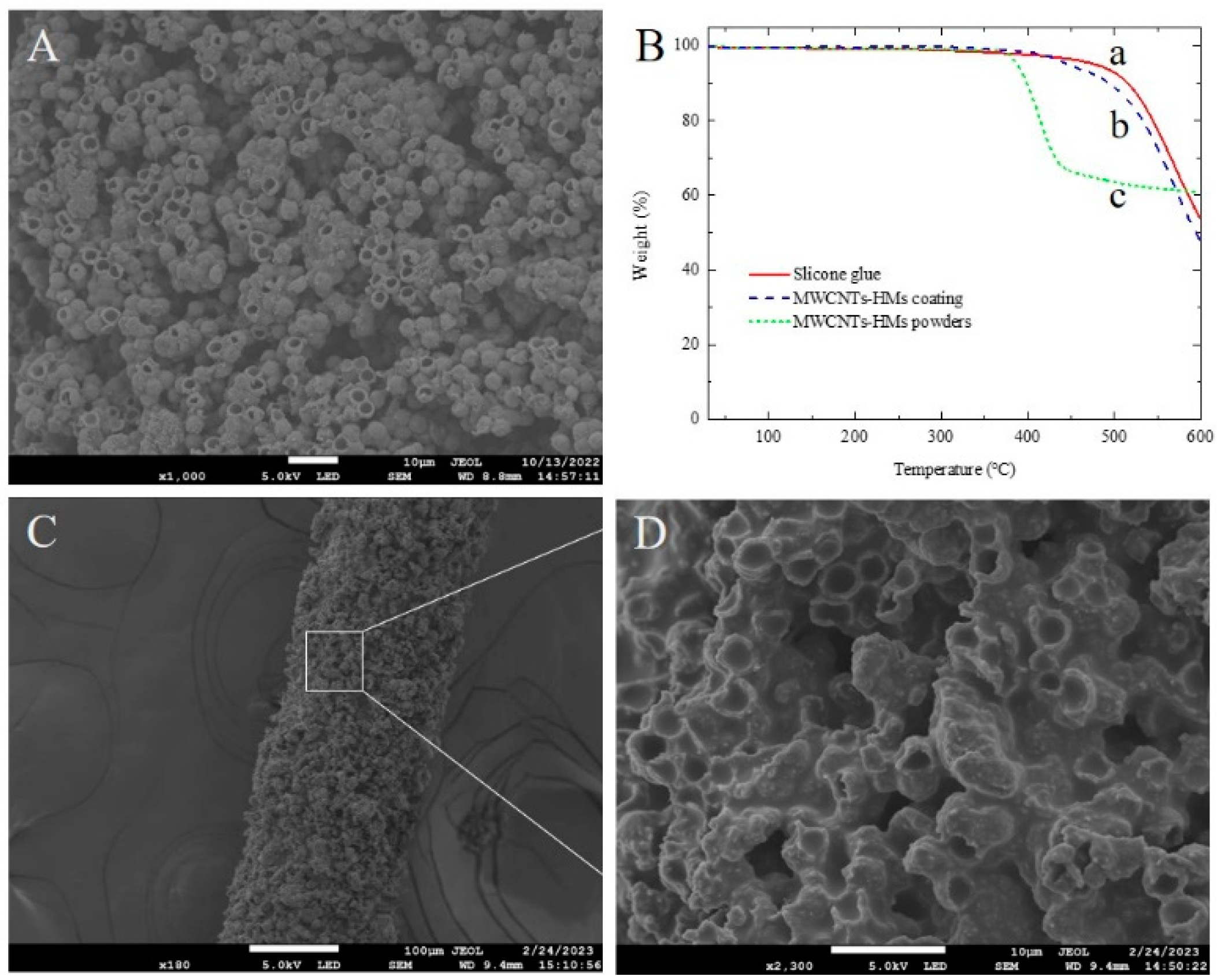
Figure 2.
Response surface graphs from the BBD for the recovery of the analytes ob-tained by plotting pH versus extraction time (A); stirring rate versus extraction time (B).
Figure 2.
Response surface graphs from the BBD for the recovery of the analytes ob-tained by plotting pH versus extraction time (A); stirring rate versus extraction time (B).
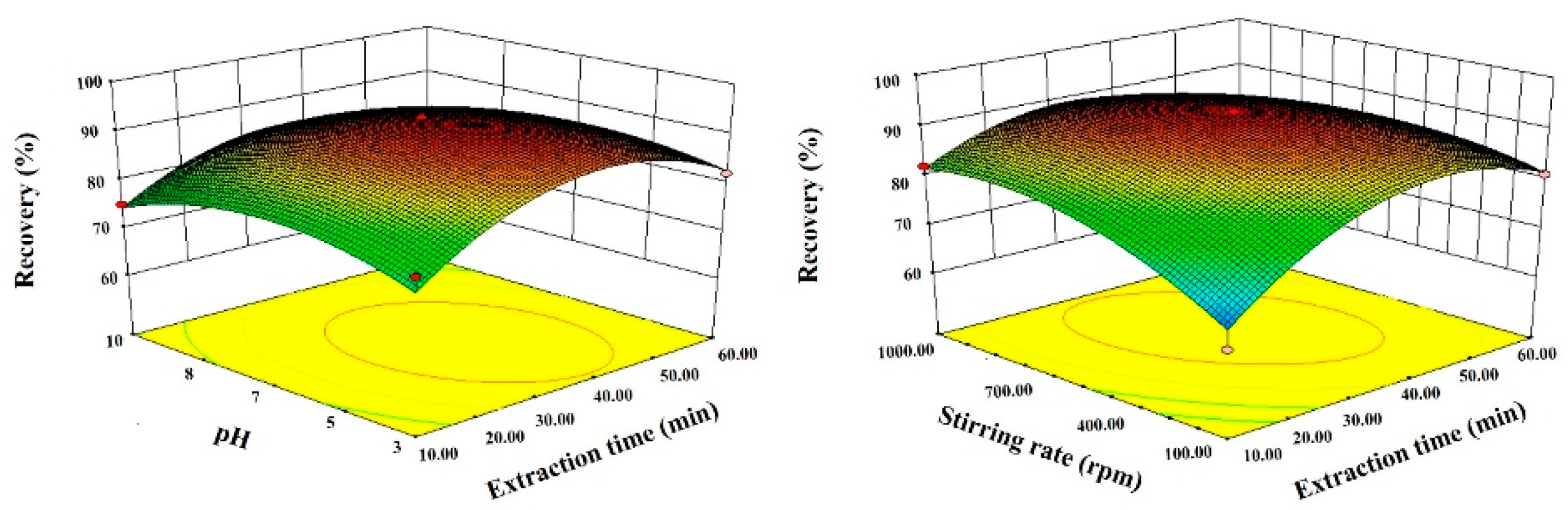
Figure 3.
Extracted chromatograms of PAEs obtained by the tea beverage samples, (A) red tea beverage, (B) red tea beverage spiked with 0.05 μg L-1 PAEs, (C) red tea beverage spiked with 0.5 μg L-1 PAEs.
Figure 3.
Extracted chromatograms of PAEs obtained by the tea beverage samples, (A) red tea beverage, (B) red tea beverage spiked with 0.05 μg L-1 PAEs, (C) red tea beverage spiked with 0.5 μg L-1 PAEs.
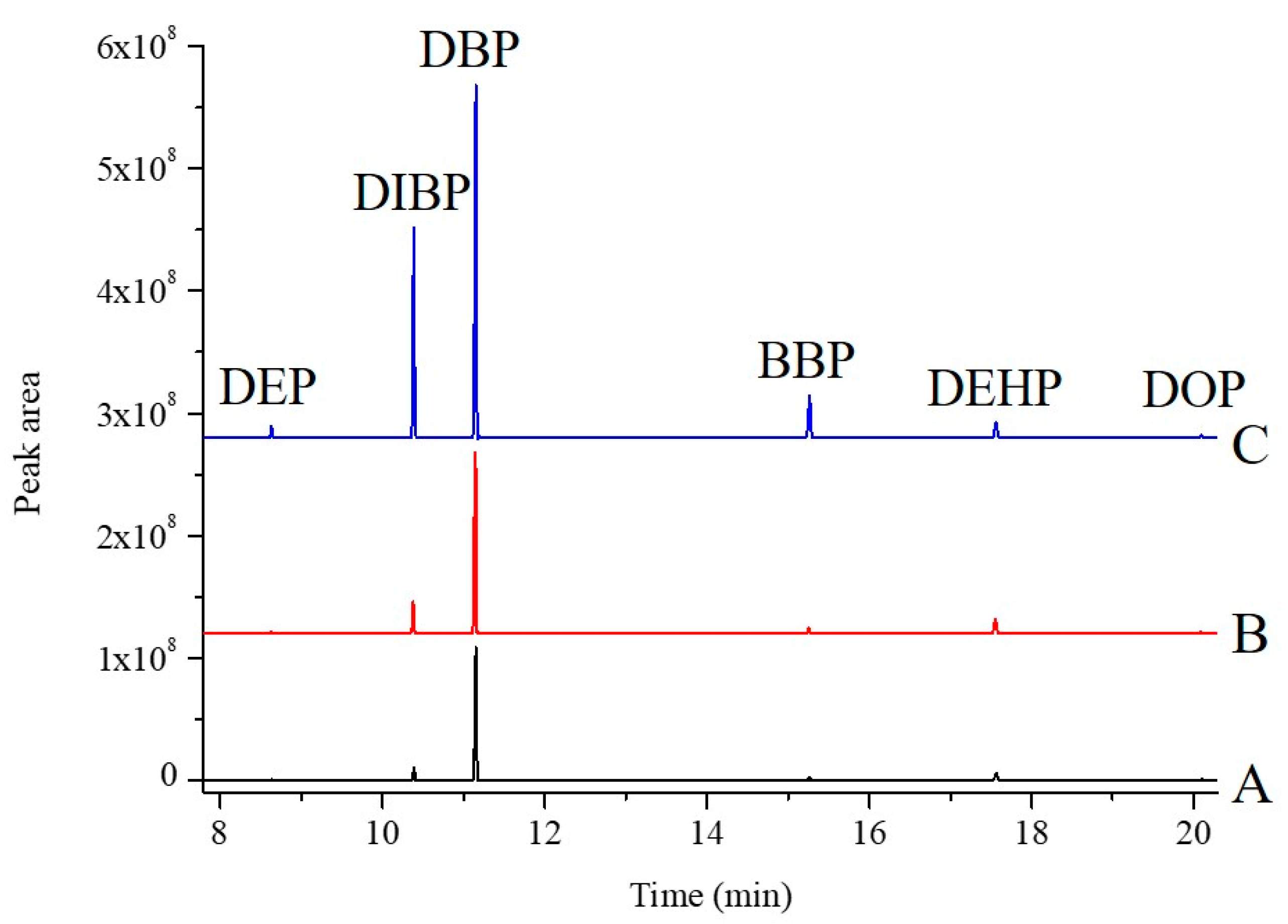
Table 1.
Analytical performance of the established approach for six PAEs.
| Analytes | Linear range (μg L-1) | Correlation coefficient (R) | LOD (μg L-1) | LOQ (μg L-1) | RSD (%, n=5) | Slope | Intercept |
|---|---|---|---|---|---|---|---|
| DEP | 0.002–1 | 0.9972 | 0.00037 | 0.0012 | 6.38 | 4.22E5 | 8.48E3 |
| DIBP | 0.002–1 | 0.9989 | 0.00056 | 0.0019 | 7.41 | 6.02E6 | 1.07E6 |
| DBP | 0.01–10 | 0.9964 | 0.00016 | 0.0053 | 4.93 | 2.22E6 | 1.07E7 |
| BBP | 0.001–10 | 0.9998 | 0.0003 | 0.001 | 6.27 | 1.24E6 | 4.05E4 |
| DEHP | 0.0004–10 | 0.9958 | 0.00011 | 0.00037 | 7.12 | 2.11E6 | 1.69E5 |
| DOP | 0.01–10 | 0.9991 | 0.0026 | 0.0087 | 8.65 | 3.59E5 | 2.46E4 |
Table 2.
Comparison of proposed strategy with reported methods for the analysis of PAEs.
| Coatings | Extraction method | Analytical methods | Linear range (μg L-1) | LOD (μg L-1) | Analytes | Matrices |
|---|---|---|---|---|---|---|
| Calix [6] arene fiber [30] | SPME | GC/FID | 0.8–8000 | 0.008–3.429 | DMP, DEP, DBP, DAP, DOP, DEHP, DNP, DDP | Beer |
| PDMS/C-NH2-MIL-125 [23] | SPME | GC/MS | 0.05-30 | 0.002-0.005 | DAP, DIBP, DBP, BBP, DEHP | Tea beverages |
| IL-HF [31] | PLME | HPLC | 5-1000 | 0.67-1.73 | BBP, DBP, DCHP | Tea beverages |
| MWCNTs-PPy [32] | SPME | GC/FID | 0.5-300 | 0.05-0.1 | DPP, DBP, DIBP, DPEP, BBP | Water |
| PCMP [3] | SPME | GC/MS | 0.03–200 | 0.01–3 | DEP, DIBP, DBP, BBP, DEHP, BBZ, DAP, DPP | Milk |
| MWCNTs@PS [25] | SPME | GC/MS | 0.001–5 | 0.0012–0.018 | DBP, BBP, DEHA, DEHP, DOP | Water |
| MWCNTs-HMs (this work) | SPME | GC/MS | 0.0004–10 | 0.00011–0.0026 | DEP, DIBP, DBP, BBP, DEHP, DOP | Tea beverage |
Disclaimer/Publisher’s Note: The statements, opinions and data contained in all publications are solely those of the individual author(s) and contributor(s) and not of MDPI and/or the editor(s). MDPI and/or the editor(s) disclaim responsibility for any injury to people or property resulting from any ideas, methods, instructions or products referred to in the content. |
© 2023 by the authors. Licensee MDPI, Basel, Switzerland. This article is an open access article distributed under the terms and conditions of the Creative Commons Attribution (CC BY) license (http://creativecommons.org/licenses/by/4.0/).
Copyright: This open access article is published under a Creative Commons CC BY 4.0 license, which permit the free download, distribution, and reuse, provided that the author and preprint are cited in any reuse.


