

Submitted:
01 May 2023
Posted:
02 May 2023
You are already at the latest version
Abstract
This research aimed to determine salient factors affecting the decision to become a beginning organic farmer. New and beginning organic farmers have unique characteristics, showcasing their dedication to environmental justice and social justice at the expense of their own businesses. This research employed a multiple-case case study design. We conducted semi-structured interviews with 40 first-generation farmers who operate organic farms in Arkansas, Florida, or Georgia. We analyzed interview transcripts using the qualitative analysis approach of coding. Our results revealed the reasons that people with little practical knowledge start farms. They are inspired by those around them who succeed and encouraged by influential characters in the field who assure them they can do something they love and be profitable. This research showed that first-generation farmers find inspiration and develop values rooted in food justice. Our findings have implications for developing and implementing current and future programmatic activities that aim to enhance beginning farmer training and workforce development. Identifying sources of inspiration will help researchers and service providers target newer and beginning farmers to support a vibrant food system, including a burgeoning market opportunity, developing strong communities around food, and building grassroots solutions.
Keywords:
farmers
; first-generation
; decision-making
; young farmers
; beginning farmers
1. Introduction
A rapidly growing “food movement” may have imposed a new reality on the so-called “rural” farmer identity [1,2]. First-generation (FG) farmers envision the revolutionization of food systems that pushes public perception of what it means to be a farmer. This new generation of farmers often has no previous background in agriculture, and the factors that drive idealistic FG farmers, like economic and racial justice, challenge traditional farmer identity. This paper investigated the drivers of first-generation farmers’ decision to start a farm.
1.1. The Food Movement
From DDT to Rachel Carson’s 1962 book The Silent Spring to the creation of the Environmental Protection Agency (EPA), the newest wave of the environmental movement has its roots in the social movements of the 1960s and 1970s [2,3,4]. Since the 1990s and on, a new form of environmentalism, called environmental justice, has strengthened [1,5,6]). Environmental justice combines physical environmental concerns with social and economic environments. The environmental justice movement focuses on regenerative environmental practices, specifically for low-income people and people of color. Low-income people and people of color are more likely to experience the adverse environmental effects of pollution due to a lack of economic mobility resulting from systemic racism (i.e., environmental racism) [7,8,9,10]. Negative environmental impacts are not the only unintended consequences of accelerating agricultural innovations.
Agricultural subsidies and crop insurance have changed the way consumers eat. Historically, post-World War I, large-scale grain farmers received subsidies for stockpiling food in case of a famine. As agriculture evolved technologically, these policies did not evolve equally. Now, crop insurance incentivizes growing certain crops, favoring commodity crops that typically have a long shelf-life and are easily transported [11,12]. The opposing, although initially unintended, the consequence is a bias toward agronomic and commodity crops and against horticultural crops, which are higher-risk crops [13]. This drives down prices of commodity crops, while most horticultural crops do not receive that benefit. The result is diet-related diseases and hunger resulting from the long-term effects of diets made up of calorie-dense, long-lasting foods being much cheaper than foods that are not calorie-dense, like fresh fruits and vegetables paired with the inability to afford fresh fruits and vegetables. Diet-related diseases and hunger emerged as unintended consequences [14,15,16,17,18,19]. Like negative environmental outcomes, low-income people and people of color suffer the consequences at a higher rate than those with economic mobility. This plays a critical motivating role in the participation of the food movement, this motivator is called food justice.
1.2. Choosing Farming as a Profession
Public perception of farming is not one of a low-risk, high-reward business that people flock to. Yet, new and beginning farmers are on the rise to the extent that a federal program is now dedicated to offering them resources (Beginning Farmer and Rancher Development Program [BFRDP], established in 2009). Any start-up business has capital risks and market risks. Agricultural enterprises have the added risk of unpredictable weather patterns, pests, or diseases that could decimate their business in a matter of days. Starting a farming business is a high-risk decision, clouded by the idealism of the food movement. Farming is one way to contribute positively to the natural environment and provide nutrient-dense fresh fruits and vegetables to people who want and need them. People who choose to start a farm business to address environmental and social issues likely have no agricultural background. However, the reality of starting a business is that it must provide an income to be financially sustainable and have a lasting business. This research investigated start-up farm businesses' conflicting social, environmental, and financial values through two main research questions: (1) Why are FG farmers starting farms? And (2) Why would individuals with no background in agriculture start a high-risk/low-profit business?
2. Review of Literature
2.1. Environmental Values
The negative impacts of industrial agriculture on the environment are a driving force for new and beginning farmers. New and beginning farmers set out to be an example of a new direction for sustainable agriculture [20,21,22]. For example, showing that farming can be a successful enterprise by working with natural ecological cycles instead of manipulating them with intensive inputs [23,24,25]. Overall, new and beginning farmers value producing food that does not impact the environment negatively. They reject the large-scale, globalized, and industrial agriculture model in favor of small diversified systems using environmentally friendly practices [21,23,24].
New and beginning farmers are deeply concerned about practicing environmentally " good agriculture.” There appears to be a binary in how farmers describe good agriculture versus bad agriculture. New and beginning farmers tend to express their farming practices as interdependent, natural, sustainable, and holistic [22,23,25,26,27]. Contrarily, they describe conventional agriculture as damaged, polluted, and harmful [23,28,29]. However, environmental values often clash with economic and financial interests.
2.2. Social Values
Social responsibility is a significant contributor to the values of new and beginning farmers. Values that aim to improve quality of life are embedded in the food justice aspect of the food movement. Unsurprisingly, providing fresh and healthy food is highly valued among new and beginning farmers. Similar to environmental values, new and beginning farmers view the food produced in conventional and industrial systems as unhealthy, but in a different way. New and beginning farmers cite pesticides as toxic to human health, and they aim to use as few pesticides as possible, if at all, and what pesticides they do use are approved for use in organic systems [21,24,25,30]. Farmers value walking out to the field, picking fresh produce, and eating it from the field. Being able to do this makes the food “healthy.”
Eating fresh food from the field is the basis for farm educational values. Much of the literature discusses new and beginning farmers who incorporate an educational component into their farm business. They value educating their customers and the broader community about their food's origin [20,21,24,31,32]. They inform and educate their customers and communities by showing how many miles their food has traveled, the physical work it takes to grow food, and the nutrients required, and demonstrate farming as a way to connect with nature.
Farmers’ educational goals would logically emerge from a community need that there is a population lacking knowledge about food systems, a gap that educational activities on the farm could fill. However, knowledge alone is unlikely to change eating behavior [33,34,35,36,37]. Farmers are concerned with diet-related diseases like heart disease and Type-II Diabetes, which can be partially managed by a diet including abundant fruits and vegetables. New and beginning farmers with educational aspirations target populations they think could benefit from education about nutritious foods, plus offer them a venue to purchase it. Despite a commitment to improving the health of customers and communities, farmers are underprepared to facilitate actual behavior change if that is their intent. Notably, the literature reviewed about new and beginning farmers does not identify low-income communities as a target community even though they suffer disproportionately from chronic diseases associated with diet quality. There is a disconnect between wanting to provide healthy food to people and acknowledging that those who need it are unlikely to be able to afford it.
Beyond food and education, new and beginning farmers value the benefits of being a farmer. Many farmers left a previous career to start a farming business because they wanted to spend more time with their families [20,21,25,31,38]. Instead of spending the day at an office all day, new and beginning farmers now had the opportunity to see their young children grow up in a “wholesome” environment [20]. In addition to time with loved ones, people entering farming love being outdoors and growing food, which provides meaning that a previous career did not [21,25,30,32,38]. Farmers value a high quality of life for themselves and their communities.
2.3. Financial and Business Values
New and beginning farmers have several strategies to make the finances of their farm work, including using personal wealth, accessing capital, having an off-farm income, and trading, bartering, and sharing as strategies to relieve financial burden [21,25,39].
Many new and beginning farmers have access to the capital they can easily leverage for start-up capital. In the social values section, we noted that some new and beginning farmers left their careers because they value spending time with their families and being outdoors. Often, new farmers coming from a previous career will have personal savings they use for start-up funds [20,28,29]. One unique quality of new and beginning farmers is they are unlikely to inherit a farm. This leads to a higher financial burden on them to afford the infrastructure and all the other overhead associated with starting a farm. However, few new and beginning farmers will have inherited the land from family, even though it was not used for farming [28]. Personal wealth can also come in the form of a monetary inheritance, selling appreciated property, and retirement income [22,29,40]. Although these farmers can leverage start-up capital quickly and easily, there are still distinct groups among those with personal wealth: those who work for their money and those who do not. It is not so simple, as many farmers use a combination of personal savings, family loans, bank loans, and family land to sustain their farms. The deciding factor for who can farm and who cannot is based on who has the capital, no matter its source.
Another strategy for financial sustainability is with an off-farm income. Farm households with off-farm jobs supplement their farm income [20,22,28,31]. Farmers who have second jobs likely grow their farms more slowly than farmers who can dedicate all their work time to the farm. Farmers with partners with off-farm income can use that as a safety net. In either situation, supplementing farm finances indicates that new and beginning farmers are not making a sustainable income. However, for many, financial success is not a goal of their farming operation, and they seek farming as a “way of life” rather than a viable business venture [21,28,40]. Even though we only included literature for commercial farms, new and beginning farmers are finding innovative ways to make their finances work to adhere to their environmental and social values.
The entrepreneurial spirit persists in new and beginning farmers. Many farmers seek outlets based on the potential market, choose a farm design based on profitability, and look for multiple revenue streams through agritourism, value-added products, and workshops [24,25,26,27,28,29,30,31,32,33,34,35,40]. The entrepreneurial types want to demonstrate that farming does not have to be a business with low-profit margins. Instead, researching viable market settings, having a business plan, and selecting cash crops and multiple revenue streams can lead to a financially successful farm business. These farmers are typically in urban settings or sell to urban populations and have customers with expendable income. The bias toward profitable farms located in urban environments with clientele with expendable income points to their role in economic inequalities. While they have developed a model that works for affluent urbanites, it is not a viable farm business model for all new and beginning farmers. As the market becomes saturated, new and beginning farmers may have to develop innovative ways to make an income or use other strategies to reduce their financial burden.
2.4. Conflict and Compromise
Much of the literature describes new and beginning and young farmers who are inexperienced and strive for balance [21,23,30,41,42]. Farmers discuss balance in several capacities, for example, balancing natural ecological systems with the need to consume natural resources to farm [23]. Farmers may come to agriculture as a way to reject what they call “industrial” or “conventional, large-scale” agriculture but soon face the reality of financial sustainability. Farmers must decide between adhering to their commitment to environmental essentialism or compromising and engaging in “destructive” ecological practices. This could be the difference between losing a crop and saving it in some instances. Environmental ideals are not the only balance new, beginning, and young farmers face.
New and beginning farmers may view starting a farm as a way to counteract traditional farming systems contributing to adverse environmental and health outcomes. Many soon find out that adhering to ideals is costly [22,24,25,31,40,43]. Farmers who are highly dedicated and committed to sustainable agricultural systems like regenerative, organic, or permaculture are less likely to be profit-driven. However, farmers are still businesspeople and must provide household security for themselves and their families. Those who choose idealism suffer financially due to a choice between idealism and profit. Farmers in the literature report compromises like paying themselves less, raising prices at market, or relying on personal savings or outside income. While farmers may aim to be environmentally sustainable, it seems unlikely that they could also have an independently financially sustainable business.
Many terms in the literature used to describe new and beginning farmers are passionate, inspired, hopeful, ethical, and motivated [20,21,23,24,44]. They also rely on outside sources of capital for cushion and to fund their internships, refer to themselves as privileged, and rely on affluent clients even if they want to improve food security [20,22,29,40,44]. The relationships between goals and values are complex and conflicting.
Multiple and conflicting values influence decisions a farmer will make to different degrees. Women may make decisions from a caretaker role, a farmworker role, or an entrepreneurial role. Women in a masculine-dominated profession may make decisions differently based on the demographic makeup of their peers [41]. The decision to start a farm and the subsequent decisions to maintain a farm evolve, often shifting from idealism to financial necessity [38].
2.5. Theoretical Framework
Icek Ajzen’s Theory of Planned Behavior (TPB) considers the role of attitudes toward a behavior, subjective norms, perceived behavioral control, intention, and behavior [45]. This theory is prominent in the literature to explain health and social behaviors [46,47,48,49,50]. In this study, we employed TPB to formulate hypotheses and identify salient mechanisms and processes that lead FG farmers to start a farm. Table 1 displays the theoretical constructs we used in this research to explain the decision to start a farm, and Figure 1 shows their hypothesized relationships.
We anticipated three primary relationships occurring in our model. First, we posited that new and beginning farmers had developed specific noneconomic, economic, and environmental goals as a product of experience. Second, we expected that a person’s goals and values contribute to a comprehensive set of goals and values that they subsequently weigh against what they believe are the risks and benefits of starting a farm. Finally, we hypothesized that while this complex weighing of pros, cons, values, and goals occurs, the person experiences or encounters some source of inspiration that facilitate the decision to start a farm.
3. Materials and Methods
3.1. Area of Study
This research took place in the Southeastern US. The Southeastern region was known for a troubled past and a legacy of systemic racism post-Civil War. This is primarily tied to farming because white plantation owners enslaved Black people. Even after the emancipation proclamation, Jim Crow laws ensured that black people in the South were arrested for petty crimes and sent to work on farms instead of jail. The roots of systematic racism are prevalent in the South. Yet, the current literature on farmers focuses on areas known for more progressive laws and policies, like New England and the Pacific Northwest. We focused on the Southeast because of the paucity of scholarly research on new and beginning farmers in the South. We interviewed farmers from Arkansas, Florida, and Georgia
3.2. Research Design
This study used a multiple-case case study design to explain a specific phenomenon, why FG farmers start a farm. The University of Florida Institutional Review Board approved this study (IRB #201602322). Written informed consent has been obtained from each participating farmer. In each case, a farmer was its own comparator, and we established an understanding of the interactions between the farmer and the outcome of starting a farm [56]. This explanatory case allowed us to understand the processes that led to the specific outcome [57]. An explanatory case study best fits this research question because it provides an in-depth understanding of the complexities of decision-making. The benefit of in-depth case studies is a rigorous understanding of the phenomenon under study. Case studies allow for a breadth of constructs to be investigated and, like cross-sectionals, allow the researchers to probe (if necessary) to explore the full range of responses.
3.3. Population and Sampling
The population of interest in this study includes FG farmers in the Southeast who use organic practices. This research focuses on organic farming practices according to the National Organic Program (NOP) standards. However, we did not require that participants have certified organic farms. Not all farmers who practice organic are certified, and there are multiple certification schemes available to farmers. In this study, the target population was FG farmers who use organic practices in the Southeast.
The sampling method we used was referral sampling. In this study, we screened for participants who (1) are first-generation farmers, (2) use organic practices, and (3) were the person who made the decision to start a farm. Referral sampling results in a non-random sample of specific individuals within a community [58]. Referral sampling begins with key informants and their recommendations to build the sample. We identified one key informant per state with whom I had an established relationship. Once we had an initial list of farmers fitting our pre-determined criteria from key informants, we asked farmer participants for recommendations. We asked farmer participants to recommend three farmers who we could contact to participate in this research. Researchers typically use referral sampling for hard-to-reach populations [59]. It is also helpful as a tool to determine how far into a social network the researcher reached. Once the same names of farmer participants emerged from interview after interview, we could establish that our sample penetrated multiple tiers of a farmer's social network. Our final sample was 40 farmers.
Determining sample size is a topic often debated in social sciences because of the lack of uniformity across disciplines and the lack of rigor in methods to determine sample size. Malterud et al. (2016) suggest determining sample size based on information power determined by five criteria: study aim, sample specificity, use of established theory, quality of the dialogue, and analysis strategy [60] (See Malterud et al., 2016, p. 1756 Figure I). We designed our study to have high information power. This paper had a narrow aim, dense specificity, applied theory, case analysis (explanatory), and strong dialogue. We continued sampling through referral methods until the same farmer names re-emerged, which was an indication that we were reaching the broader sample. However, a sample of 40 farmers does not represent the Southeast or individual states, as we only interviewed farmers in six major cities in three states in the Southeast. Our sample was not exhaustive and did not reach all farmers in the networks where we conducted interviews. Future research should build on this study to expand a sample to more first-generation farmers by state or region.
3.4. Instrumentation and data collection
We developed a semi-structured interview protocol to obtain an in-depth understanding of the aspects of FG farmers [61]. We conducted an expert review and a cognitive interview of the interview protocol. An expert review involved consulting an expert in the field of study to determine if the protocol accurately reflected the target community [61,62,63]. Once the protocol was validated and revised based on the expert review, data were collected via semi-structured interviews.
Semi-structured interviews allow more flexibility than other methods, allowing researchers the ability to follow specific lines of inquiry that emerge and allowing participants more freedom to stray from structured questions. Unlike structured interviews, semi-structured interviews allow for deviation from the interview questions to better understand complicated topics [61]. Open-ended interview questions and the ability of the researcher to ask probing questions improves the theoretical rigor and explanatory power of a study’s conclusions. The advantage of interviews is in-depth explanations not otherwise captured by indices or structured interviews. This gives the opportunity for the researcher to ask directed questions to capture a broader range of responses. Comparison groups also increase explanatory power by offering competing explanations for an outcome, building theory. We developed our interview protocol based on theoretical constructs in the existing literature base, environmental, economic, and noneconomic goals (Table 2).
3.5. Data Analysis
We used an inductive and deductive qualitative data analysis approach [64]. First, we transcribed digitally recorded interviews. Next, we conducted three cycles of coding. The first was descriptive and structural coding, followed by theoretical and elaborative coding. Once the data were themed and categorized, we created the theoretical model. This approach used both theoretically based concepts and themes and emergent or unanticipated themes to ensure that the data analysis addressed the theoretical issues central to the study but did not omit other concepts not included in the theoretical framework.
Following the approach of Saldana (2015), we used a combination of descriptive and structural coding for the first coding cycle, building a complete body of codes [65] (p. 70). The next step was structural coding. Unlike descriptive coding, structural coding involves coding discussions based on concepts, not just topics [65] (p. 66). Finally, we concluded coding with theoretical and elaborative procedures. Theoretical coding involves finding the “core categories” [65] (p. 163). Specifically, we understand the “core category” as described by Glaser & Strauss (1967), “a well-developed set of propositions” [66]. Next, we made propositions that connect the categories to each other in an explanatory way, extracting meaning from the relationships in a hypothesis-like way.
We developed a model to compare key themes, processes, and patterns that emerged from the data. These models reveal differences as well as similarities between and among cases. Next, we used conceptual mapping to develop a visual model. In conceptual mapping, the first step was a situational map. Bazeley (2013) described it as “dumping grounds” for all the elements important to the study [67] (p. 311). Next was the “world” map, where we considered how the elements of a social world interact [67]. Finally, a positional map emerged that represented positions rather than individuals. This research developed a model to explain why first-generation farmers started a farm.
4. Results
The following section presents information about the FG farmers we interviewed and results from data analysis of interview transcripts. First, we provide the demographic profile of the sample. Next, we present results from first- and second-level coding procedures. Finally, we offer the theoretical model with its constructs and propositions.
4.1. Demographics
Table 3 displays participant demographics. This includes age, sex, and level of education. The youngest participant was 24, and the oldest was 70. There was nearly an even split in the number of male and female participants. Most (62.5%) had at least a bachelor’s degree, with 77.5% having a Bachelor’s or Master’s degree. A majority of participants were white (85%), with the remaining 15% consisting of Indian, Black, Native American, Hispanic, and Italian.
4.2. Coding
First-level coding led us to look at participant responses for descriptive codes. We identified responses according to seven codes in the literature, as shown in Table 1. Next, our second-level coding was structural in nature, identifying concepts within (or without) our first-level descriptive codes. Structural coding revealed 162 codes. These codes, definitions, and frequencies can be found in Table S1 in the supplementary materials. Following structural coding, we conducted theoretical coding to identify propositions to explain relationships among inductive and deductive theoretical constructs. The following section discusses our theoretical model, its constructs, and propositions.
4.3. Theoretical Model
The theoretical model presented in Figure 2 shows the theoretical constructs we identified and maps out how they relate to one another and their role in starting a farm. Each of these decision-making phases has corresponding theoretical propositions (Table 4). First, we contended that an FG farmer must experience a “spark” that develops from a source of inspiration in tandem with developing their environmental and noneconomic (social) values. Next, we proposed that while this feedback loop is between values and inspiration, an FG farmer transforms their process by confronting the realities of starting a business. In this stage, FG farmers weigh the pros and cons, the perceived benefits, risks, and resource access. We found that FG farmers synthesize their economic, noneconomic, and environmental goals for a business to develop the concrete action of starting a farm.
4.4. The “spark”
Proposition 1: FG farmers experience a spark of inspiration.
Nearly all the farmers we interviewed could pinpoint the moment of inspiration or the time in their life that sparked the inspiration, which would lead to them starting a farm. Whether picking up a book by chance, a friend who recommended a YouTube video, seeing an inspiring speaker, or watching others succeed, the spark of inspiration is the underlying concept of all the proceeding theory and propositions. Inspiration generally fell into two categories, education-related and farmer-related. We then coded these two categories to identify the education-related materials discussed and the terms farmers use to describe other farmers who inspired them (Tables S2 and S3).
Books were one of the most common sources of inspiration for first-generation farmers. FG farmers cited authors like Jane Goodall and Michael Pollan as critical to their awareness of what it means to be a good steward of the land. Farmers discussed feelings of hope for the future of sustainable agriculture and confidence in the principles of environmental stewardship (e.g., supporting biodiversity or building on soil health). Farmers described how they were drawn to farming and believed they could contribute to positive changes in the current US food system. For example, farmers often discussed how they thought current large-scale conventional production systems contribute to greenhouse gas emissions and global warming, pollution, and environmental degradation. If nothing else, authors inspired farmers to “not make [the environment] worse,” in the words of one Atlanta farmer.
Inspirational authors did not always focus on drawing their audience’s attention to threats of environmental degradation. Farmers also cited names such as Jean-Martin Fortier and Curtis Stone as instrumental in starting a farm. Jean-Martin Fortier and Curtis Stone are pioneers in the market farming movement. Fortier’s 2014 book “The Market Gardener” proposes a farming methodology where minimal inputs, the right market, and low labor costs can be lucrative to anyone who follows his plan [68]. Similarly, Stone’s 2015 “The Urban Farmer” guides people looking to make a profit using intensive food production in small spaces [69]. Fortier and Stone are common names within the direct-to-consumer farmer crowd. They propose profitable systems that people who want to start farms could adopt. Some farms inspired by Fortier and Stone developed online courses to teach the methodology. For example, a farmer talks about a farm in New York State:
“Neversink Farm has a course, and [Fortier] has a course. So, we paid for both of them as you know, kind of an education budget. There are many starting farmers who feel like [Fortier and Stone] are kind of exploiting beginning farmers, which I completely disagree with, in a sense they feel like this education should be free. I disagree.”
First-generation farmers also found inspiration from the attractive qualities of other farms and farmers—the primary descriptors of inspirational farmers related to work ethic and personality. FG farmers described inspiring farmers as hardworking, committed, successful, and innovative. They also valued authentic, confident, encouraging, supportive, and knowledgeable peer farmers. One Athens, Georgia, farmer describes inspirational farms:
“There's some, like, just friends that I have where I've looked at it, and like, ‘holy shit you're doing it, and you're making it work, and you're like still able to go on vacation.”
4.5. Values
The environmental and social values held by farmers were closely related to their source of inspiration. Overall, the values encompass environmental justice and social justice. FG farmers valued “good” food. Countless farmers used the word “good” and the term “good food.” Environmental values that make up good food include avoiding chemicals, building healthy soil, and working with natural ecosystems. In general, the literature shows that organic farmers see their practices as an opposition to the negative impacts of the Green Revolution due to reducing biodiversity and intensive pesticide, herbicide, and synthetic fertilizer use [70,71,72,73,74]. The Green Revolution introduced technologies essential to the survival of millions of people at the time but caused unanticipated environmental damage, for example, the persistence of the pesticide dichloro-diphenyl-trichloroethane (DDT) in soils. The responses of FG farmers are consistent with the existing literature on the environmental values of organic farmers [75,76,77,78,79].
“Good food” also means good for communities. FG farmers value a healthy food system to use their farms to educate their communities about healthy and nutritious foods. Following suit with the environmental values, FG farmers equate “good food” with organic practices and feel compelled to educate their audiences about “good food.” FG farmers see other social value in organic practices, too.
The working conditions of employees was a high priority for FG farmers. They described wanting their workers to stay healthy, which means not spraying chemicals, taking regular breaks for food and water, and paying them a living wage. FG farmers value social “goods” beyond what they produce in the field and feed to consumers. Worker well-being was also a way to counter large-scale producers that exploit migrant workers. This finding suggests that values and idealism do not always translate to what is practical and realistic for running a business.
Proposition 2: Inspiration influences values and vice versa. Inspiration and values can be a chicken and egg situation, unsure which came first. In some cases, they function as a feedback loop that builds up over time. The double-sided arrow in Figure 3 refers to the interconnectedness of these two constructs.
4.6. Reality
“Reality” in Figure 2 was the facilitator between a potential farmer’s inspiration, values, and ideals and the risks, resources, and benefits of making starting a farm a reality. Proposition 3 states “inspiration and values are often rooted in idealism,” and Proposition 4 holds that “idealistic farmers confront the reality of starting a business through perceived benefits, access to resources, and perceived risks.” The following sections address this facilitation.
4.7. Perceived benefits
Proposition 5. FG farmers anticipate that the benefits of their work will be meaningful and rewarding.
Proposition 5.1. Meaningful benefits may be focused on themselves or their surroundings.
Proposition 5.2. Rewarding benefits are related to the fruits of their labor in the field or the community.
Farmers anticipated three ways that their inspiration, values, and reality combine to make their farming dream real. Perceived benefits were the most discussed among FG farmers. The primary benefits that emerged were meaningful and rewarding work. As noted in propositions 5.1 and 5.2, meaningful and rewarding have different dimensions based on the individual farmer. The distinguishing factor between meaningful and rewarding work is simply the anticipated benefit. Participants identified what positive things they thought they would get from starting their farm. FG farmers could name the benefits of what they were with the benefit of retrospect. Meaningful work has an impact on the surrounding community. Rewarding work refers to the internal satisfaction that FG farmers experience.
First-generation farmers anticipated that their work would be meaningful. “Meaningful” work takes on several definitions. Some FG farmers define meaningful work as positively impacting their community and customers. FG farmers find meaning in their customers, who return each week to tell them how much they enjoyed their food. One Central Florida farmer said of sustainable agriculture, “it feels good to be part of something that could change the food system. It’s fulfilling work.”
“Meaningful” can also mean watching soil getting darker and seeing the organic matter build up, knowing they are creating something that benefits their physical environment. What farmers define as meaningful builds on the constructs defined earlier. Inspiration, environmental values, and social issues contribute to a farmer’s conception and sense of meaning.
Similarly, rewarding work brought FG farmers a sense of satisfaction. Rewarding work from the field included taking something from seed and seeing it all the way through to a customer’s hands, seeing the first harvest, and eating nutritious and tasty vegetables from the field. FG farmers also found farming rewarding because they enjoyed being outdoors. More often, FG farmers described not being in an office as rewarding and being outdoors as a benefit. FG farmers sought farming because they believed it would bring them meaning and be rewarding. An Arkansas farmer said of satisfaction:
“Farmers are eternal hopers and gamblers, like a slot machine – you’ll have rain for a month, yeah, but when it stops, you’re going to have something so beautiful. Like you hit the jackpot right when you need to.”
4.8. Access to resources
Proposition 6. FG farmers have access to resources through personal wealth, capital, inherited land, and off-farm income.
FG farmers must have access to capital to start their farms. Since we interviewed operating farms, we only captured the range of responses related to successful enterprises. We cannot make statements about operations that failed to get off the ground or operations that failed. The existing literature base cites a lack of access to financial resources as a primary barrier for new and beginning farmers [54,80,81,82]. In this study, successful FG farmers accessed capital through three primary venues. First, some FG farmers relied on their wealth. Personal wealth is broad and refers to savings from a previous job, inherited money (different from inherited land), or gifted money. Next, FG farmers accessed land through inheritance. Inherited land primarily refers to “family land” that has been in a family for generations but has not recently been used for agriculture. Finally, many farmers and their families relied on off-farm income. Some farmers maintained two jobs, and other household members had a job that supplemented the household income. These three forms of resources may serve as a reference to determine who has the opportunity to farm and where.
Consequently, many people are excluded from farming as a for-profit business. If they do not have access to capital in these ways. Alternative scenarios do temper this barrier, for example, leasing land. Many FG farmers in this study also used USDA programs for new and beginning farmers to access available resources.
4.9. Perceived risks
Proposition 7. FG farmers anticipate that they will face financial risks and physical risks.
The final construct of our model was perceived risk. FG farmers accounted for anticipated risk in two primary ways: financial and physical. Financial risks were commonly cited as barriers in the existing literature about entrepreneurs and start-up businesses [83,84,85]. Risks related to finances that FG farmers discussed were primarily not having a market, needing to convince consumers to buy the product, or the crop failing. Naming the market as an anticipated risk indicates that FG farmers might not thoroughly research where they started the farm. It is possible these types of farmers were more ideologically motivated, or the farmer had limited choices about where to farm (e.g., inherited land). Financial risks came with other peripheral risks, too.
With financial risk came the risk of FG farmers losing their pride. Some FG farmers even cited their stubbornness as a risk factor. Other noneconomic risks were the embarrassment of failing, fear of missing out, second-guessing a decision to quit, filling one’s mind with “what-ifs,” the potential that they end up not being good at it, and losing their pride. These mental, emotional, and social risks indicate that FG farmers feel they are putting much at stake by taking the plunge. There is increased pressure on FG farmers inherent of their inexperience, amplifying the fallout of potential failure.
FG farmers in our study anticipated they would encounter barriers with farm-related injury, an aging body, and general health. FG farmers perceived farm injury as a risk because they did not have the training to use farm machinery as multigenerational farmers might have. Many of the FG farmers in this study ran small-scale farming operations. In other words, if they are one of only a few employees, an injury would severely impact their business’s operation.
Interestingly, several FG farmers stated they did not think they faced any risk when starting their farms. Naïve and overconfident, some barreled through the process but would eventually encounter some risks. FG farmers are generally debt-averse, even citing a lack of debt as a motivator to start a farm. This characteristic likely comes into play for farmers who did not perceive any initial risk. These factors and their multiple dimensions contribute to a first-generation farmer’s decision to start a farm.
5. Discussion
5.1. The “Food Movement”
The bigger picture is the “food movement” is a social movement and a so-named revolution in the agricultural sector. FG farmers are a growing minority of the market share. The promise of justice that the food movement sells new and beginning farmers motivates them. New and beginning farmers are passionate and feel responsible for upholding environmental and social ideals that are too often out of reach [20,24,31,40,44,86]. The dominant relationship in our model is at the nexus of inspiration and values. FG farmers must negotiate their commitment to the ideals of good food as a social movement and the practical matter of hard work and hardship. This generation and future generations of FG farmers will be battling the dominant industrial, agricultural model.
5.2. Environmental Justice
Regardless of the source of inspiration, FG farmers have goals motivated by their environmental values. The literature discusses environmental justice as a matter of equality [87,88,89]. People deserve protection from environmental harm regardless of race or income level [89,90]. We anticipated that environmental disasters caused by agriculture would emerge as decision-making factors among FG farmers. FG farmers acknowledged the pollutants and toxins that agriculture contributes to the environment, but their focus was overwhelming on not harming rather than doing good.
FG farmers tend to view environmental values as " not negative outcomes.” This framing effect is a common form of cognitive bias in psychology. Typically, psychologists and political scientists purposely use framing to determine how a participant decides based on morals or political issues [91,92,93,94,95,96]. Usually, people are biased toward an outcome framed positively (“alive”) versus negatively (“not dead”) [97]. FG farmers’ environmental values influence whether they will pursue a particular goal, i.e., having an environmentally sustainable farm. In this study, the majority of farmers (n=36) mentioned a negatively framed environmental goal. FG farmers who start farming because they believe the environment is worth protecting and preserving describe an agricultural sector that needs improving. The lack of positively framed environmental goals makes us question whether pessimistic motivations for sustainable agriculture will lead to long-lasting, enduring businesses. However, environmental values and related goals are not the sole force behind successful businesses.
5.3. Food Justice
Food justice is a multi-dimensional concept that people engage in for four primary reasons: (1) they believe they have a right to grow and sell food, (2) they believe they have a right to nutritious, culturally appropriate, and affordable food, (3) a right to locally grown food, and (4) a right food that was grown with care for the environment and animals [7]. Our literature review revealed that food justice was under-discussed or possibly under-researched as it relates to the values of new and beginning farmers. Our study found that FG farmers continuously addressed dimensions one, three, and four, but dimension two is less clear, particularly affordability.
A significant negative effect of crop insurance going primarily to commodity crops is that less nutritious foods are more affordable than fresh fruits and vegetables. A higher price for fresh fruits and vegetables means that high-risk, low-income populations are less likely to be able to afford them, and a farmer’s goal of improving physical health misses a considerable target population [98,99,100,101]. FG farmers mostly view the fairness of food prices as what the market will bear. Farming was not a high-profit business for any FG farmers we interviewed. The combination of charging a premium for locally produced organic food with a moderate income makes affordable food for low-income people seem unattainable. Some FG farmers (n=4) aim to make their produce affordable to all income levels, and others (n=5) donate extra produce to food banks or other distributors.
Starting a farm to produce fair food for all and make ends meet creates a paradoxical situation for FG farmers. Critics of the food movement cite racism and classism as structural inequalities that exclude people of color and low-income people [102,103,104,105]. Other inequalities, like access to crop insurance, prevent farmers from lowering their prices. Idealistic farmers must compromise by adhering to the integrity of providing an affordable product at their own cost or sacrifice selling an inexpensive product in favor of financial security. This conflict in values challenges a farmer’s commitment. However, as farming is a business, not all farmers have conflicting values when running their operations.
5.4. Farming as a Business
To an outsider, farming is not easy, and it is not lucrative. However, an emerging phenomenon is the market farmer model, which posits that people can net six-figure incomes with the right circumstances. None of the farmers we interviewed were making that kind of net income. If market farming pioneers like Fortier and Stone are selling the idea that farming can be lucrative, that could be the push that potential farmers need to start their farms. As described in our model, inspiration does not occur in isolation. Inspiration from farmers like Fortier and Stone feeds environmental, social, and business values and vice versa. These ideas are not well-supported in the literature and merit further investigation.
FG farmers motivated by Fortier and Stone did not consider finances a primary risk. The market farmer movement encourages low-stakes investments to achieve high net income successfully. Framing farming as an entrepreneurial endeavor shifts motivations from providing fresh and nutritious food to local communities to growing high-value cash crops intensively for short periods to take the rest of the year off work. Other values like environmental sustainability and healthy communities may take a back seat to financial motivations. As evidenced in the previous section, fewer farmers focus on food affordability because they must earn an income. We may see unintended consequences of seeing farming as a business venture instead of a way to feed people. Ultimately, the current generation of FG farmers has balanced values and goals encompassing the environment, society, and business.
5.5. Making Dreams Reality
The role of “reality” is individually concrete yet theoretically abstract. People share sources of inspiration and have values in common, but “reality” is individual, and it is what facilitates a farmer’s movement from feeling inspired to weighing the pros and cons of their potential decision. Perceived benefits and barriers emerge from a theoretical reality to make it more concrete. Farmers name precisely what they are anticipating. Researchers or policymakers who want to recruit newer and beginning or FG farmers should consider focusing on these relationships to understand better a decision to start a farm and so better aid this emerging generation of farms.
FG farmers in this study have several traits in common. They are tenacious, driven, and hard workers and do not shy from unpredictability. They aim to do work they are passionate about, are good at, and enjoy. These qualities may differ among groups of farmers. Certain personalities may be more apt to start a farm than others. As stated previously, not all farmers who find inspiration are successful in their ventures. Comparing successful and unsuccessful farm businesses could elucidate personality differences that play a role in success versus failure.
5.6. Limitations
Our model does not explain all pathways to deciding to start a farm. We developed a model based on the responses of FG farmers who were overall small in scale, market direct-to-consumer, young, and white. A case study research design is rigorous in explanatory power but suffers in generalizations [56]. We can only generalize these results and conclusions to the confines of the population our model encompassed. There are invariably different pathways among diverse racial groups, gender identities, geographical locations, and socio-economic environments. Our model helps explain why FG farmers in the Southeast started a farm, given they had no background in agriculture. Departing from multigenerational family farming, FG farmers faced an uphill battle.
6. Conclusions
First-generation farmers may seem idealistic and spurned on by the food movement, but in the end, they are part of a capitalist system that discourages them from achieving social goals in favor of financial ones. Ideals soon give way to the need to make money. It is hard to target food insecure groups because they are not shopping at farmers' markets, and that is where these direct-to-consumer farmers are. They may sell at a market that doubles up the Supplemental Nutrition Assistance Program (SNAP) dollars, but it is a false sense of pride as they still miss a critical at-risk population. Even farmers making a modest income might use their profits to retain their workers and keep another person in agriculture.
First-generation farmers will shape the future and direction of US food systems. The percentage of new and beginning farmers is increasing from census to census. As older, multigenerational farmers age out of agriculture, we need to support this new generation of farmers. This research showed that first-generation farmers would find inspiration and develop values rooted in food justice. Identifying sources of inspiration will help researchers and service providers target newer and beginning farmers to support a vibrant food system, including a burgeoning market opportunity, developing strong communities around food, and building grassroots solutions.
Gender did not emerge as a perceived risk among women FG farmers, even though it is pervasive throughout the literature. Gender appeared in other ways. Men are more likely to describe perceived benefits as rewarding. Women are more likely to ascribe meaningful benefits using terms relating to caring and pleasing others. Men describe rewarding benefits as a day’s work well done, falling asleep physically exhausted from demanding work, or seeing a freshly weeded bed. These gender differences emerge in the literature about women farmers. Women feel like they hold an equal position to men on-farm, more so than in previous decades, but still endure discrimination in a male-dominated profession, often relegated to “women’s work” (Braiser, 2014; 30; 43; 21).
Only six farmers of color participated in this research, and two discussed racial discrimination. The majority-white sample reflects other literature that names affluent college towns as areas with white farmer populations (24; 21; 44; 22; 40; 29; 41). The pervasive whiteness of new and beginning organic farmers relegates farmers of color to “outliers” in this research. If there are genuinely few FG farmers of color, alternative explanations could be that (1) systemic and institutional racism prevents participation in this market sector or (2) there is a sampling bias in the body of literature. Both are viable explanations. We would argue that farmers of color are, in part, systematically excluded from participating in start-up businesses due to historical denial of access to resources. Additionally, people of color are a statistical racial minority in the US, and researchers should plan to sample accordingly to capture the full range of responses.
In closing, we highlight the need for better solutions for farmers. The recent COVID-19 pandemic has shown weaknesses in the US food system that it will try to recover from for years to come. Born from this crisis is the opportunity for innovation, and farmers are at its center. Farmers will always be “essential,” and they deserve the attention that responsibility comes with. Consumers, formerly blissfully ignorant of where their food comes from, are now confronted with the realities of a global food supply chain that is not as resilient as we would have liked. Yet we see the small farmers emerging resilient, though with a small effect to be sure. A food-secure future needs a solution – now.
Supplementary Materials
The following supporting information can be downloaded at the website of this paper posted on Preprints.org. Table S1: Qualitative data analysis first and second level codes; Table S2: Educational-related sources of inspiration; Table S3: Farmer-related sources of inspiration.
Author Contributions
Conceptualization, A.D. and M.E.S.; methodology, A.D. and M.E.S..; formal analysis, A.D..; investigation, A.D..; data curation, A.D.; writing—original draft preparation, A.D.; writing—review and editing, M.E.S., C.A.C., J.R.M., and T.I.; visualization, A.D.; supervision, M.E.S., C.A.C., J.R.M., and T.I.; funding acquisition, M.E.S., C.A.C. and J.R.M. All authors have read and agreed to the published version of the manuscript.
Funding
This work is supported by Organic Agriculture Research and Extension Initiative grant no. 2015-51300-24134 from the USDA National Institute of Food and Agriculture.
Data Availability Statement
The data presented in this study are available on request from the corresponding author. The data are not publicly available due to human subject participant confidentiality.
Acknowledgments
We acknowledge the dozens of farmers who participated in this research to help us better understand their decision-making. We thank the generous partners we have worked with across the Southeast to make this research possible and enrich it.
Conflicts of Interest
The authors declare no conflict of interest.
References
- Agyeman, J. Introducing Just Sustainabilities: Policy, Planning, and Practice; Zed Books Ltd.: London, UK, 2013. [Google Scholar]
- Khondker, H.H. From" The Silent Spring" to the globalization of the environmental movement. J. Int. Glob. Stud. 2015, 6. [Google Scholar]
- Carson, R. Silent Spring; Houghton Mifflin Harcourt, 2002.
- Lewis, J. The Birth of EPA. Available online: https://www.epa.gov/archive/epa/aboutepa/birth-epa.html (accessed on 16 July 2020).
- Alkon, A.H. Cultivating Food Justice: Race, Class, and Sustainability; Agyeman, J., Ed.; MIT press, 2011.
- Purdy, J. The long environmental justice movement. Ecology LQ 2017, 44, 809. [Google Scholar] [CrossRef]
- Alkon, A.H. Black, White, and Green: Farmers Markets, Race, and the Green Economy; University of Georgia Press: Athens, GA, USA, 2012; Volume 13. [Google Scholar]
- Benz, T.A. Toxic Cities: Neoliberalism and environmental racism in Flint and Detroit Michigan. Crit. Sociol. 2019, 45, 49–62. [Google Scholar] [CrossRef]
- Kern, L.; Kovesi, C. Environmental justice meets the right to stay put: Mobilising against environmental racism, gentrification, and xenophobia in Chicago’s little village. Local Environ. 2018, 23, 952–966. [Google Scholar] [CrossRef]
- Nunez, M.F. Environmental racism and Latino farmworker health in the San Joaquin Valley, California. Harv. J. Hisp. Policy 2019, 31, 9–14. [Google Scholar]
- Jaworski, A. Encouraging climate adaptation through reform of federal crop insurance subsidies. NYUL Rev 2016, 91, 1684. [Google Scholar]
- Yu, J.; Sumner, D.A. Effects of subsidized crop insurance on crop choices. Agric. Econ. 2018, 49, 533–545. [Google Scholar] [CrossRef]
- Bekkerman, A.; Belasco, E.J.; Smith, V.H. Does farm size matter? Distribution of crop insurance subsidies and government program payments across US farms. Appl. Econ. Perspect. Policy 2019, 41, 498–518. [Google Scholar] [CrossRef]
- Franck, C.; Grandi, S.M.; Eisenberg, M.J. Agricultural subsidies and the American obesity epidemic. Am. J. Prev. Med. 2013, 45, 327–333. [Google Scholar] [CrossRef]
- Grandi, S.M.; Franck, C. Agricultural subsidies: Are they a contributing factor to the American obesity epidemic? Arch. Intern. Med. 2012, 172, 1754–1755. [Google Scholar] [CrossRef]
- Pearson-Stuttard, J.; Bandosz, P.; Rehm, C.D.; Penalvo, J.; Whitsel, L.; Gaziano, T.; Conrad, Z.; Wilde, P.; Micha, R.; Lloyd-Williams, F.; et al. Reducing US cardiovascular disease burden and disparities through national and targeted dietary policies: A modelling study. PLoS Medicine 2017, 14, 1002311. [Google Scholar] [CrossRef] [PubMed]
- Otero, G.; Pechlaner, G.; Liberman, G.; Gürcan, E. The neoliberal diet and inequality in the United States. Soc. Sci. Med. 2015, 142, 47–55. [Google Scholar] [CrossRef]
- Siegel, K.R.; Bullard, K.M.; Ali, M.K.; Stein, A.D.; Kahn, H.S.; Mehta, N.K.; Imperatore, G. The contribution of subsidized food commodities to total energy intake among US adults. Public Health Nutr. 2016, 19, 1348–1357. [Google Scholar] [CrossRef] [PubMed]
- Simon, P.W. Progress toward increasing intake of dietary nutrients from vegetables and fruits: The case for a greater role for the horticultural sciences. HortScience 2014, 49, 112–115. [Google Scholar] [CrossRef]
- Bruce, A.B. Farm entry and persistence: Three pathways into alternative agriculture in southern Ohio. J. Rural. Stud. 2019, 69, 30–40. [Google Scholar] [CrossRef]
- Jarosz, L. Nourishing Women: Toward a feminist political ecology of community supported agriculture in the United States. Gend. Place Cult. 2011, 18, 307–326. [Google Scholar] [CrossRef]
- Pilgeram, R. The only thing that isn’t sustainable... Is the farmer”: Social sustainability and the politics of class among pacific northwest farmers engaged in sustainable farming. Rural. Sociol. 2011, 76, 375–393. [Google Scholar] [CrossRef]
- Abatemarco, T. Women’s sense of farming: Ecofeminism in sustainable farming and local food in Vermont, USA. Gend. Place Cult. 2018, 25, 1601–1621. [Google Scholar] [CrossRef]
- Ferguson, R.S.; Lovell, S.T. Livelihoods and production diversity on us permaculture farms. Agroecol. Sustain. Food Syst. 2017, 41, 588–613. [Google Scholar] [CrossRef]
- Rissing, A. Alternative economic strategies and the technology treadmill: Beginning vegetable farmers in Iowa. Econ. Anthropol. 2016, 3, 304–314. [Google Scholar] [CrossRef]
- Han, G.; Arbuckle, J.G.; Grudens-Schuk, N. Motivations, goals, and benefits associated with organic grain farming by producers in Iowa, US. Agric. Syst. 2021, 191, 103175. [Google Scholar] [CrossRef]
- Upadhaya, S.; Arbuckle, J.G.; Schulte, L.A. Developing farmer typologies to inform conservation outreach in agricultural landscapes. Land Use Policy 2021, 101, 105157. [Google Scholar] [CrossRef]
- Leslie, I.S. Queer Farmers: Sexuality and the Transition to Sustainable Agriculture. Rural. Sociol. 2017, 82, 747–771. [Google Scholar] [CrossRef]
- Pilgeram, R.; Amos, B. Beyond “inherit it or marry it”: Exploring how women engaged in sustainable agriculture access farmland. Rural. Sociol. 2015, 80, 16–38. [Google Scholar] [CrossRef]
- Trauger, A.; Sachs, C.; Barbercheck, M.; Brasier, K.; Kiernan, N.E. “Our market is our community”: Women farmers and civic agriculture in Pennsylvania, USA. Agric. Hum. Values 2010, 27, 43–55. [Google Scholar] [CrossRef]
- Dmitri, C.; Oberholtzer, L.; Pressman, A. Urban agriculture: Connecting producers with consumers. Br. Food J. 2016, 118, 603–617. [Google Scholar] [CrossRef]
- Warsaw, P.; Archambault, S.; He, A.; Miller, S. The economic, social, and environmental impacts of farmers markets: Recent evidence from the US. Sustainability 2021, 13, 3423. [Google Scholar] [CrossRef]
- Ivens, B.J.; Edge, M.S. Translating the dietary guidelines to promote behavior change: Perspectives from the food and nutrition science solutions joint task force. Journal of the Academy of Nutrition and Dietetics 2016, 116, 1697–1702. [Google Scholar] [CrossRef]
- John, K.A.; Cogswell, M.E.; Zhao, L.; Tong, X.; Odom, E.C.; Ayala, C.; Merritt, R. Change in US adult consumer knowledge, attitudes, and behaviors related to sodium intake and reduction: SummerStyles 2012 and 2015. American Journal of Health Promotion 2018, 32, 1357–1364. [Google Scholar] [CrossRef]
- Smith, L.P.; Ng, S.W.; Popkin, B.M. Resistant to the recession: Low-income adults’ maintenance of cooking and away-from-home eating behaviors during times of economic turbulence. American Journal of Public Health 2014, 104, 840–846. [Google Scholar] [CrossRef]
- Thomson, J.L.; Goodman, M.H.; Landry, A.S.; Donoghue, A.; Chandler, A.; Bilderback, R. Feasibility of online nutrition education in the workplace: Working toward healthy lifestyles. Journal of Nutrition Education and Behavior 2018, 50, 868–875. [Google Scholar] [CrossRef] [PubMed]
- Vizireanu, M.; Hruschka, D. Lay perceptions of healthy eating styles and their health impacts. Journal of Nutrition Education and Behavior 2018, 50, 365–371. [Google Scholar] [CrossRef] [PubMed]
- Inwood, S.; Clark, J.K.; Bean, M. The differing values of multigeneration and first-generation farmers: Their influence on the structure of agriculture at the rural-urban interface. Rural Sociology 2013, 78, 346–370. [Google Scholar] [CrossRef]
- Schmidt, S.; Goetz, S.J.; Tian, Z. Female farmers in the Unites States: Research needs and policy questions. Food Policy 2021, 101, 102039. [Google Scholar] [CrossRef]
- Pilgeram, R. “how much does property cost up there?”: Exploring the relationship between women, sustainable farming, and rural gentrification in the US. Society & Natural Resources 2019, 32, 911–927. [Google Scholar] [CrossRef]
- Shisler, R.C.; Sbicca, J. Agriculture as carework: The contradictions of performing femininity in a male-dominated occupation. Society & Natural Resources 2019, 32, 875–892. [Google Scholar] [CrossRef]
- Suryanata, K.; Mostafanezhad, M.; Milne, N. Becoming a new farmer: Agrarianism and the contradictions of diverse economies. Rural Sociology 2020, 86, 139–164. [Google Scholar] [CrossRef]
- Tutor-Marcom, R.; Bruce, J.; Greer, A. North carolina farm women: Opportunities for support and farm-related education. Journal of Agromedicine 2014, 19, 191–200. [Google Scholar] [CrossRef]
- MacAuley, L.E.; Niewolny, K.L. Situating on-farm apprenticeships within the alternative agrifood movement: Labor and social justice implications. Journal of Agriculture, Food Systems, and Community Development 2015, 6, 195–223. [Google Scholar] [CrossRef]
- Ajzen, I. The Theory of Planned Behavior. Organ. Behav. Hum. Decis. Process. 1991, 50, 179–211. [Google Scholar] [CrossRef]
- Bohon, L.M.; Cotter, K.A.; Kravitz, R.L.; Cello, P.C.; Garcia, E.F. The theory of planned behavior as it predicts potential intention to seek mental health services for depression among college students. Journal of American College Health 2016, 64, 593–603. [Google Scholar] [CrossRef] [PubMed]
- Emanuel, A.S.; McNully, S.N.; Gallagher, K.M.; Updegraff, J.A. Theory of planned behavior explains gender difference in fruit and vegetable consumption. Appetite 2012, 59, 693–697. [Google Scholar] [CrossRef]
- Gerend, M.A.; Shepherd, J.E. Predicting human papillomavirus vaccine uptake in young adult women: Comparing the health belief model and theory of planned behavior. Annals of Behavioral Medicine 2012, 44, 171–180. [Google Scholar] [CrossRef] [PubMed]
- Montanaro, E.A.; Bryan, A.D. Comparing theory-based condom interventions: Health belief model versus theory of planned behavior. Health Psychology 2014, 33, 1251. [Google Scholar] [CrossRef] [PubMed]
- Siyuki, H.A.; Peyman, N.; Vahedian-Shahroodi, M.; Gholian-Aval, M.; Tehrani, H. Health education intervention on HIV/AIDS prevention behaviors among health volunteers in healthcare centers: An applying the theory of planned behavior. Journal of Social Service Research 2019, 45, 582–588. [Google Scholar] [CrossRef]
- Brasier, K.J.; Sachs, C.E.; Kiernan, N.E.; Trauger, A.; Barbercheck, M.E. Capturing the multiple and shifting identities of farm women in the northeastern United States. Rural Sociology 2014, 79, 283–309. [Google Scholar] [CrossRef]
- Sulemana, I.; James, H.S. Farmer identity, ethical attitudes and environmental practices. Ecological Economics 2014, 98, 49–61. [Google Scholar] [CrossRef]
- Rudolphi, J.M.; Berg, R.L.; Parsaik, A. Depression, anxiety and stress among young farmers and ranchers: A pilot study. Community Mental Health Journal 2020, 56, 126–134. [Google Scholar] [CrossRef]
- Plotkin, S.E.; Hassanein, N. Cultivating opportunity: Do land transfer tools improve land access for beginning farmers? Renewable Agriculture and Food Systems 2019, 34, 271–279. [Google Scholar] [CrossRef]
- Wypler, J. Lesbian and queer sustainable farmer networks in the Midwest. Society & Natural Resources 2019, 32, 947–964. [Google Scholar] [CrossRef]
- Yin, R.K. Validity and generalization in future case study evaluations. Evaluation 2014, 19, 321–332. [Google Scholar] [CrossRef]
- Yin, R.K. Case Study Research: Design and Methods; SAGE, 2009.
- Etikan, I.; Musa, S.A.; Alkassim, R.S. Comparison of convenience sampling and purposive sampling. American Journal of Theoretical and Applied Statistics 2016, 5, 1–4. [Google Scholar] [CrossRef]
- Sharma, G. Pros and cons of different sampling techniques. International journal of applied research 2017, 3, 749–752. [Google Scholar]
- Malterud, K.; Siersma, V.D.; Guassora, A.D. Sample size in qualitative interview studies: Guided by information power. Qualitative Health Research 2016, 26, 1753–1760. [Google Scholar] [CrossRef] [PubMed]
- Bryman, A. Social Research Methods; Oxford University Press, 2012.
- Krueger, R.A.; Casey, M.A. Focus Groups, 5th ed.; Sage, 2014.
- Warren, C.A.B. Qualitative Interviewing. In Handbook of interview research. Context and method; Gubrium, J.F., Holstein, J.A., Eds.; Sage Publications: London, 2001; pp. 83–102. [Google Scholar] [CrossRef]
- Northcutt, N.; McCoy, D. Interactive Qualitative Analysis: A Systems Method for Qualitative Research; Sage, 2004. [CrossRef]
- Saldana, J. The Coding Manual for Qualitative Researchers; Sage, 2015.
- Glaser, B.; Strauss, A. The Discovery of Grounded Theory: Strategies for Qualitative Research; Adline de Gruyter: New York, 1967. [Google Scholar]
- Bazeley, P. Qualitative data analysis: Practical strategies; SAGE, 2013.
- Fortier, J.M. The Market Gardener; New Society Publishers, 2014.
- Stone, C. The Urban Farmer: Growing Food for Profit on Leased and Borrowed Land; New Society Publishers, 2015.
- Dich, J.; Zahm, S.H.; Hanberg, A.; Adami, H.O. Pesticides and cancer. Cancer Causes & Control 1997, 8, 420–443. [Google Scholar] [CrossRef]
- Gray, J.M.; Frolking, S.; Kort, E.A.; Ray, D.K.; Kucharik, C.J.; Ramankutty, N.; Friedl, M.A. Direct human influence on atmospheric CO2 seasonality from increased cropland productivity. Nature 2014, 515, 398–401. [Google Scholar] [CrossRef] [PubMed]
- San Martin, W. Nitrogen, science, and environmental change: The politics of the green revolution in Chile and the global nitrogen challenge. Journal of Political Ecology 2017, 24, 777–796. [Google Scholar] [CrossRef]
- Zahm, S.H.; Ward, M.H. Pesticides and childhood cancer. Environmental Health Perspectives 1998, 106 (suppl. S3), 893–908. [Google Scholar] [CrossRef]
- Zeng, N.; Zhao, F.; Collatz, G.J.; Kalnay, E.; Salawitch, R.J.; West, T.O.; Guanter, L. Agricultural Green Revolution as a driver of increasing atmospheric CO 2 seasonal amplitude. Nature 2014, 515, 394–397. [Google Scholar] [CrossRef]
- Best, H. Environmental concern and the adoption of organic agriculture. Society and Natural Resources 2010, 23, 451–468. [Google Scholar] [CrossRef]
- Clark, S. Organic farming and climate change: The need for innovation. Sustainability 2020, 12, 7012. [Google Scholar] [CrossRef]
- Kaiser, M.; Ryan-Simkins, K.; Dionne, J.; Pence, E. Connecting small-scale producers and consumers. Journal of Agriculture, Food Systems, and Community Development 2020, 9, 1–18. [Google Scholar] [CrossRef]
- Schoolman, E.D. Do direct market farms use fewer agricultural chemicals? Evidence from the US census of agriculture. Renewable Agriculture and Food Systems 2019, 34, 415–429. [Google Scholar] [CrossRef]
- Stofferahn, C.W. Personal, farm and value orientations in conversion to organic farming. Journal of Sustainable Agriculture 2009, 33, 862–884. [Google Scholar] [CrossRef]
- Griffin, B.; Valentina, H.; Nadolnyak, D. Credit constraints and beginning farmers’ production in the US: Evidence from propensity score matching with principal component clustering. Sustainability 2020, 12, 5537. [Google Scholar] [CrossRef]
- Rissing, A. Profitability” vs.“Making It:” causes and consequences of disembedding beginning farms’ finances. Culture, Agriculture, Food and Environment 2019, 41, 149–157. [Google Scholar] [CrossRef]
- Valliant, J.; Freedgood, J. Land access policy incentives. Journal of Agriculture, Food Systems, and Community Development 2020, 9, 1–8. [Google Scholar] [CrossRef]
- Atolia, M.; Prasad, K. Relative wealth concerns and entrepreneurship. Economica 2011, 78, 294–316. [Google Scholar] [CrossRef]
- Hincapie, A. Entrepreneurship over the life cycle: Where are the young entrepreneurs? International Economic Review 2020, 61, 617–681. [Google Scholar] [CrossRef]
- Petrova, K. Part-time entrepreneurship and financial constraints: Evidence from the panel study of entrepreneurial dynamics. Small Business Economics 2012, 39, 473–493. [Google Scholar] [CrossRef]
- Smith, B.J. Food Justice, Intersectional Agriculture, and the Triple Food Movement. In Rethinking Food System Transformation; Bezner Kerr, R., Pendergrast, T.L., Smith II, B.J., Liebert, J., Eds.; Springer: Cham, 2022; Volume 36, pp. 825–835. [Google Scholar] [CrossRef]
- Cannon, C. Examining rural environmental injustice: An analysis of ruralness, class, race, and gender on the presence of landfills across the United States. J. Rural. Community Dev. 2020, 15. https://escholarship.org/uc/item/4sh504td.
- Konisky, D.M. Environmental justice delayed: Failed promises, hope for the future. Environ. Sci. Policy Sustain. Dev. 2016, 58, 4–15. [Google Scholar] [CrossRef]
- Mersha, S. Black lives and climate justice: Courage and power in defending communities and mother earth. Third World Quarterly 2018, 39, 1421–1434. [Google Scholar] [CrossRef]
- Hall, J.; Galarraga, J.; Berman, I.; Edwards, I.; Khanjar, N.; Kavi, L.; Murray, R.; Burwell-Naney, K.; Jiang, C.; Wilson, S. Environmental injustice and industrial chicken farming in Maryland. International Journal of Environmental Research and Public Health 2021, 18, 11039. [Google Scholar] [CrossRef]
- Schaider, L.A.; Swetschinski, L.; Campbell, C.; Rudel, R.A. Environmental justice and drinking water quality: Are there socioeconomic disparities in nitrate levels in us drinking water? Environmental Health 2019, 18, 3. [Google Scholar] [CrossRef]
- Falkowski, A.; Jabłońska, M. Moderators and mediators of framing effects in political marketing: Implications for political brand management. Journal of Political Marketing 2020, 19, 34–53. [Google Scholar] [CrossRef]
- Forney, J.; Sutherland, L.A. Identities on the family farm: Agrarianism, materiality and the good farmer. In Handbook on the Human Impact of Agriculture; James, H.S., Ed.; Edward Elgar Publishing: Cheltenham, United Kingdom, 2021; pp. 65–84. [Google Scholar]
- Gal, P. Marketing implications of framing in the decision making. Acta Universitatis Agriculturae et Silviculturae Mendelianae Brunensis 2018, 66, 1267–1273. [Google Scholar] [CrossRef]
- Lecheler, S.; Vreese, C.H. News framing and public opinion: A mediation analysis of framing effects on political attitudes. Journalism & Mass Communication Quarterly 2012, 89, 185–204. [Google Scholar]
- Palmiotti, G.P.; Del Popolo Cristaldi, F.; Cellini, N.; Lotto, L.; Sarlo, M. Framing the outcome of moral dilemmas: Effects of emotional information. Ethics & Behavior 2020, 30, 213–229. [Google Scholar] [CrossRef]
- Kreiner, H.; Gamliel, E. “Alive" or “not dead”: The contribution of descriptors to attribute-framing bias. Quarterly journal of experimental psychology 2019, 72, 2776–2787. [Google Scholar] [CrossRef]
- Aune, D.; Giovannucci, E.; Boffetta, P.; Fadnes, L.T.; Keum, N.; Norat, T.; Tonstad, S. Fruit and vegetable intake and the risk of cardiovascular disease, total cancer and all-cause mortality—A systematic review and dose-response meta-analysis of prospective studies. International Journal of Epidemiology 2017, 46, 1029–1056. [Google Scholar] [CrossRef]
- Huet, C.; Rosol, R.; Egeland, G.M. The prevalence of food insecurity is high and the diet quality poor in Inuit communities. The Journal of nutrition 2012, 142, 541–547. [Google Scholar] [CrossRef]
- Hunter-Adams, J.; Battersby, J.; Oni, T. Food insecurity in relation to obesity in peri-urban Cape Town, South Africa: Implications for diet-related non-communicable disease. Appetite 2019, 137, 244–249. [Google Scholar] [CrossRef]
- Parks, C.A.; Stern, K.L.; Fricke, H.E.; Clausen, W.; Yaroch, A.L. Healthy food incentive programs: Findings from food insecurity nutrition incentive programs across the united states. Health Promotion Practice 2020, 21, 421–429. [Google Scholar] [CrossRef]
- Alkon, A.H.; Mares, T.M. Food sovereignty in us food movements: Radical visions and neoliberal constraints. Agriculture and Human Values 2012, 29, 347–359. [Google Scholar] [CrossRef]
- Bradley, K.; Herrera, H. Decolonizing food justice: Naming, resisting, and researching colonizing forces in the movement. Antipode 2016, 48, 97–114. [Google Scholar] [CrossRef]
- Burke, M.P.; Jones, S.J.; Frongillo, E.A.; Fram, M.S.; Blake, C.E.; Freedman, D.A. Severity of household food insecurity and lifetime racial discrimination among African American households in South Carolina. Ethnicity & Health 2018, 23, 276–292. [Google Scholar] [CrossRef]
- Raskind, I.G. Hunger does discriminate: Addressing structural racism and economic inequality in food insecurity research. American Journal of Public Health 2020, 110, 1264–1265. [Google Scholar] [CrossRef] [PubMed]
Figure 1.
Theory of planned behavior adapted to this study.
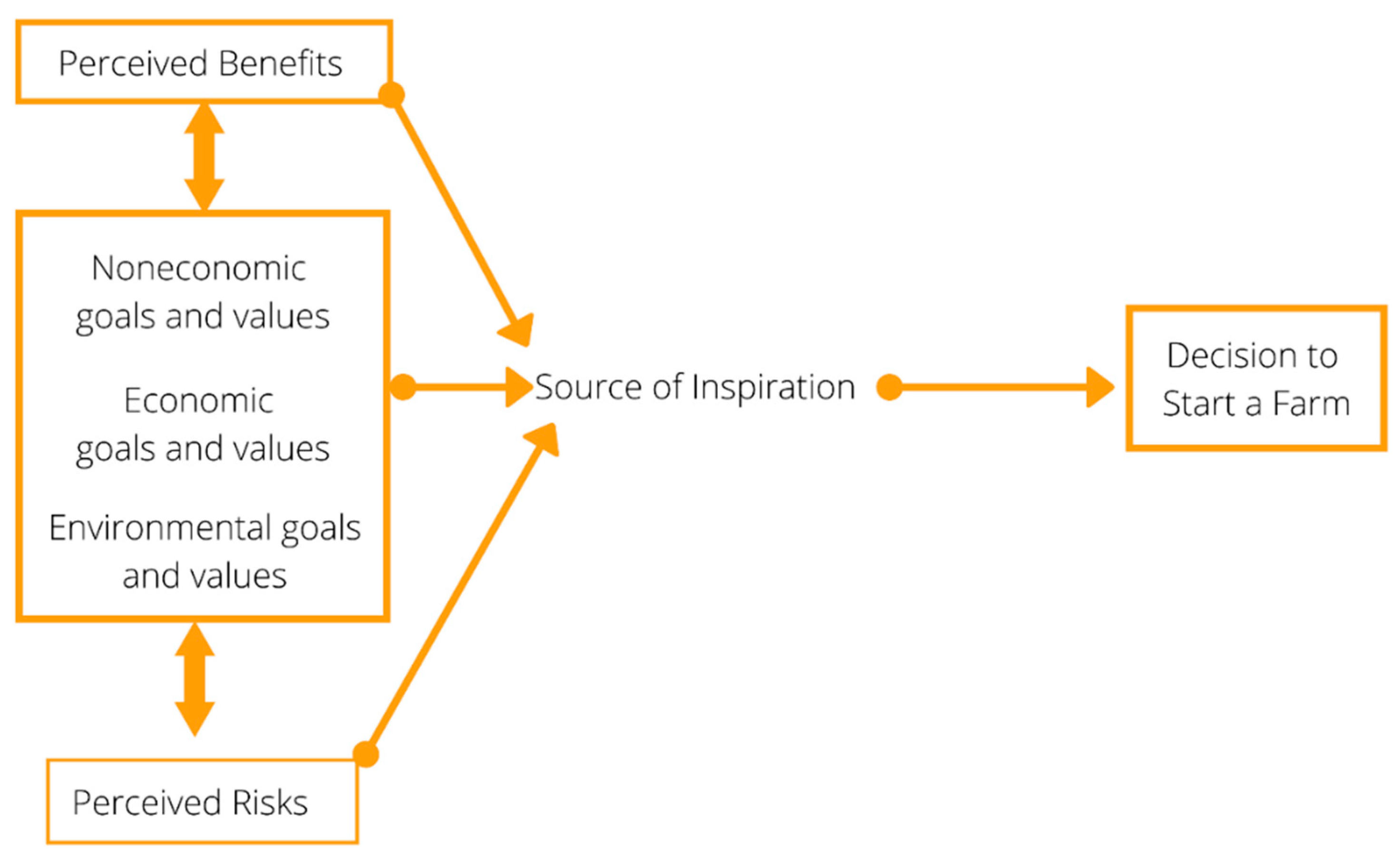
Figure 2.
Theoretical model explaining why first-generation farmers start a farm.
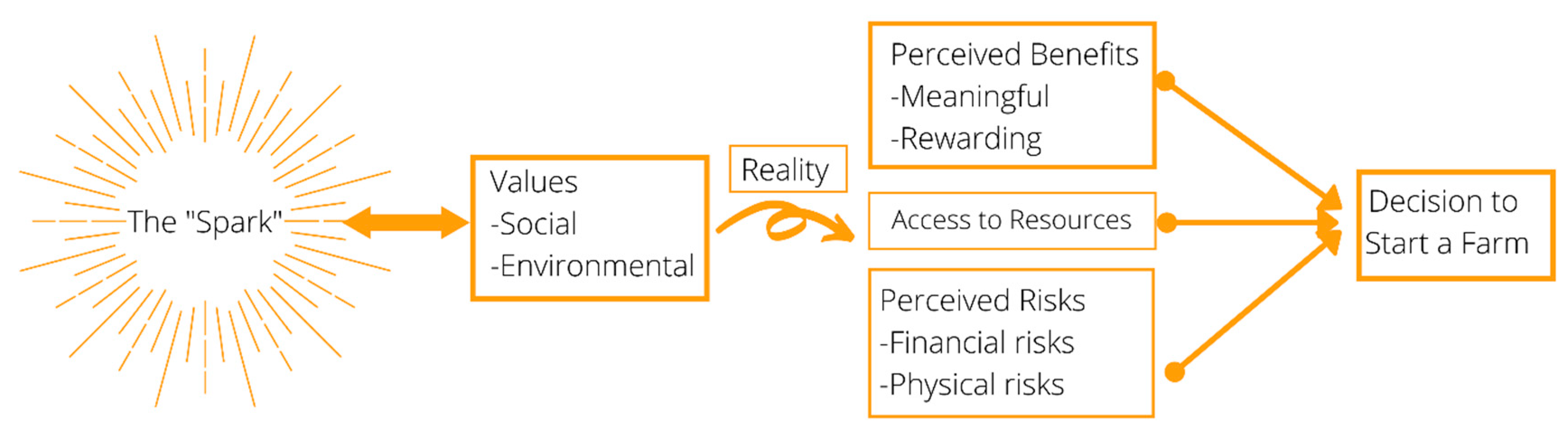

Table 1.
Theoretical constructs, derivative theory, and corresponding citations.
| Theoretical Constructs | Derivative Theory | Citations |
| Outcome: Why did you start a farm? | Identity theory | Braiser et al., 2014; Inwood, 2013 [38,51] |
| Perceived benefits | Economic sociology; feminist political ecology; feminist theory; rural sociology theory | Inwood, 2013; Jarosz, 2011; Shisler & Sbicca, 2019 [21,38,41] |
| Environmental goals and values | Ecofeminism; Ethical Decision-Making | Abatemarco, 2018; Pilgeram, 2019; Sulemana, 2014; |
| Inspiration | Economic sociology | Inwood, 2013 [23,38,40,52] |
| Risk | Farm Family Stress and Injury Model; Occupational Stress | Dmitri et al., 2015; MacAuley et al., 2016; Rudolphi, 2020; Tutor-Marcom et al., 2014 [31,43,44,53] |
| Economic goals and values | Gender; Affordability gap (deductive); Theory of Treadmill; Civic agriculture; Social Capital Theory | Pilgeram & Amos, 2015; Plotkin & Hossanein, 2017; Rissing, 2016; Trauger et al., 2010; Wypler, 2019. [25,29,54,55] |
| Noneconomic goals and values | Rural Sociological Theory | Shisler & Sbicca, 2019; Jarosz, 2011 [21,41] |
Table 2.
Interview items according to theoretical constructs.
| Theoretical Constructs | Interview item(s) |
| Outcome: Why did you start a farm? | What were you doing before you started a farm? Why the transition from your previous career to farming? |
| Perceived benefits | What specifically attracted you to farming to prompt the switch? |
| Environmental goals and values | Did you have any environmental goals for your land when you started out? Why did you decide to grow organically? Who and what do you think benefit from organic practices? What do you do to maintain a biodiverse farm? |
| Inspiration | Was there anyone in particular who inspired your vision for your farm? Probe: For example, a role model. Follow-up: What are the qualities that inspired you? |
| Risk | What did you perceive as the main risks you were facing when started your farm? |
| Economic goals and values | How did you make [your farm] happen financially? How do you balance what is sustainable for a customer to pay versus your financial security? |
| Noneconomic goals and values | What are the personal benefits you get out of farming that keep you coming back? |
Table 3.
Sample demographics.
| Gender | Age (years) | Race | Education level | |
| Male | Female | |||
| 21 | 19 | Average: 41.275 | White: 34 (85%) | High school graduate: 2 (5%) |
| 52.5% | 47.5% | Min: 26 | Indian: 2 (5%) | Trade/Technical/Vocational: 3 (7.5%) |
| Max: 70 | Black: 1 (2.5%) | Some college, no degree: 4 (10%) | ||
| Native American: 1 (2.5%) | Bachelor's degree: 25 (62.5%) | |||
| Hispanic (Cuban): 1 (2.5%) | Master's degree: 6 (15%) | |||
| Other (Italian): 1 (2.5% | ||||
Table 4.
Theoretical propositions.
| Number | Proposition |
| 1 | FG farmers experience a spark of inspiration. |
| 2 | FG farmers' spark of inspiration influences their values and vice versa. |
| 3 | Inspiration and values are often rooted in idealism |
| 4 | Idealistic farmers confront the reality of starting a business through perceived benefits, access to resources, and perceived risks. |
| 5 | FG farmers anticipate the benefits of their work will be meaningful and rewarding |
| 5.1 | Meaningful benefits may be focused on themselves and/or their surroundings |
| 5.2 | Rewarding benefits are related to the fruits of their labor, in the field or in the community. |
| 6 | FG farmers have access to resources through personal wealth, inherited land, and off-farm income. |
| 7 | FG farmers anticipate they will face financial risk and physical risk |
Disclaimer/Publisher’s Note: The statements, opinions and data contained in all publications are solely those of the individual author(s) and contributor(s) and not of MDPI and/or the editor(s). MDPI and/or the editor(s) disclaim responsibility for any injury to people or property resulting from any ideas, methods, instructions or products referred to in the content. |
© 2023 by the authors. Licensee MDPI, Basel, Switzerland. This article is an open access article distributed under the terms and conditions of the Creative Commons Attribution (CC BY) license (http://creativecommons.org/licenses/by/4.0/).
Copyright: This open access article is published under a Creative Commons CC BY 4.0 license, which permit the free download, distribution, and reuse, provided that the author and preprint are cited in any reuse.


