

Submitted:
27 April 2023
Posted:
28 April 2023
You are already at the latest version
Abstract
The Atlantic Goliath Grouper Epinephelus itajara (Lichtenstein, 1822) is thought to occur on both sides of the Atlantic, from the Carolinas (USA) to Brazil in the western Atlantic, and from North Senegal to North Angola off West Africa in the eastern Atlantic. While there are fairly good data on their distribution in the western Atlantic, genetic verification of species status, confirmed occurrences, population status, fishing reports, and trade data are almost non-existent off West Africa. Part of the problem is that tropical West African countries lack a network of marine reserves that might protect this species. Add to this destruction of mangrove forests and other coastal habitats on which the species depends when in the post-larval and juvenile stages coupled heavy pollution and intense overfishing and it becomes clear that their survival is deeply threatened. The focus of this paper is to describe all of the known historical data and examine all current data to better evaluate their present status.
Keywords:
Atlantic Goliath Grouper
; Epinephelus itajara
; extinction
; overfishing
; marine protected areas
; monitoring
1. Introduction
The Atlantic Goliath Grouper Epinephelus itajara (Lichtenstein, 1822) -- hereafter referred to as “Goliath Grouper” – presumably occurs from the Carolinas (USA) to Brazil in the western Atlantic and from North Senegal to North Angola off West Africa in the eastern Atlantic [1,2]. A single sighting was reported from Ascension Island midway across the south Atlantic in 1985 [3].
While the data are fairly robust on their distribution in the western Atlantic, confirmed occurrences, population status, fishing reports, and trade data are almost non-existent off the coast of West Africa. Genetic verification of the West African population, if it still exists, is necessary to verify whether it is a distinct species, as occurred to distinguish Western Atlantic from Eastern Pacific populations [4].
Goliath Groupers have been consistently considered to have a continuous distribution in the eastern tropical Atlantic, from Senegal southwards to north Angola, as noted in the last International Union for Conservation of Nature (IUCN) assessment giving the species’ global population status as vulnerable (VU) [5]. However, only a few confirmed records from catches, underwater images, or trusted personal communications together with anecdotical sightings, report the occurrence of the species and only for a few of the countries where it is assumed to still exist.
Other than a few isolates known from Cabo Verde and the Canary Islands, Goliath Grouper has only been consistently found, captured and observed by videos and photos dating back to the early 1980’s. It has also been documented further south in Angola limited to the southern part of the Zaire river mouth. In the Islands of the Gulf of Guinea (including the countries of Equatorial Guinea and São Tomé & Príncipe), the species is known by local fishermen but rarely seen either alive or in fish markets. It is clear that at the very least Goliath Groupers of West African countries are severely depleted, with Gabon and possibly the short shoreline of the Republic of Congo as exceptions for their continued existence.
Literature confirms its occurrence in Guinea-Bissau [6] in the early 2000s (based on its synonym E. esonue (Ehrenbaum, 1914) rather than E. itajara) and as a rare vagrant to the Canary Islands -- two captures and one observation in Tenerife of very large individuals [7]. However, lack of references is the norm and almost nothing has been published regarding Goliath Groupers between Senegal and Cameroon (including Equatorial Guinea) which could give us further information on the presence or not in this vast stretch of the W African coastline.
The only recent confirmations of an apparently stable population come from Gabon with sporadic anecdotical reports from the Republic of Congo, São Tomé e Príncipe and, perhaps unexpectedly, S Angola. Nevertheless, Goliaths may well be overlooked or even not detected in several parts of W Africa. Throughout this area, several mangrove habitats still exist and these are indeed relevant since constitute an essential nursery for this species [8]. Lack of consistent monitoring of landings, political turmoil and humanitarian crisis in most of the countries from W Africa are also a factor to consider when trying to assess the occurrence of any given species.
2. Material and Methods
Due to the above-mentioned fact that literature is non-existent for most of the countries in West Africa where Goliath Grouper is possibly occurring, I searched for photographs from fish markets (some of these personally visited) and conducted interviews with fishermen and traders. No colleagues ever mentioned this species, with the exception of Brito [7] and sport fishers (mostly spearfishing). My personal observations were made to better understand possible occurrences to meet the objective of this note. The time span for the data collected ranges from 1989 to 2016. The most visited locations were São Tomé & Príncipe (1991, 1992, 1993, 2009 and 2015) and Gabon (1990, 1993 and 2016).
3. Results
As stated by Bertoncini et al. [1], the Goliath Grouper is probably common in shallow waters along mangrove swamps and near the mouths of the rivers of Zaire, Ogooué, Cameroon, and tributaries. It also can be found near offshore oil platforms off Cabinda and Gabon (Port Gentil) where it is captured by local artisanal fishers. It is apparently rare in the Gulf of Guinea islands; one specimen was speared in Sao Tomé in 2009 and two juveniles were observed in 2015 (author’s pers. obs.).
Two specimens also were taken via spear in Benguela, southern Angola in 2011 (J. de Sousa, personal communication 2016, Figure 1). One roughly 250 kg specimen was observed in a fish market in Libreville, Gabon (author’s pers. obs. 2016). Besides the above-mentioned locations, trustworthy personal communications to the author are plausible for occurrences, albeit of apparent rarity, from Ghana, Togo, Nigeria and, Republic of the Congo. During some of the author’s visits to these countries, namely to fish markets and during dives (scuba and freediving), no further cases were ever detected. Interviews with local fishers almost never gave any type of secure information regarding recent sightings of this fish. Confirmed occurrences (pers. observ., photographs and communications from trusted sources) are shown in Figure 2. The only well-documented set of regular Goliath Grouper catches from West Africa comes from Gabon. Several articles in spearfishing magazines and books from the late 1980’s and early 1990’s, all describing spearfishing by Mr. Marc-Antoine Berry, present several very big specimens always associated with offshore oil platforms where Mr. Berry regularly fished [9].
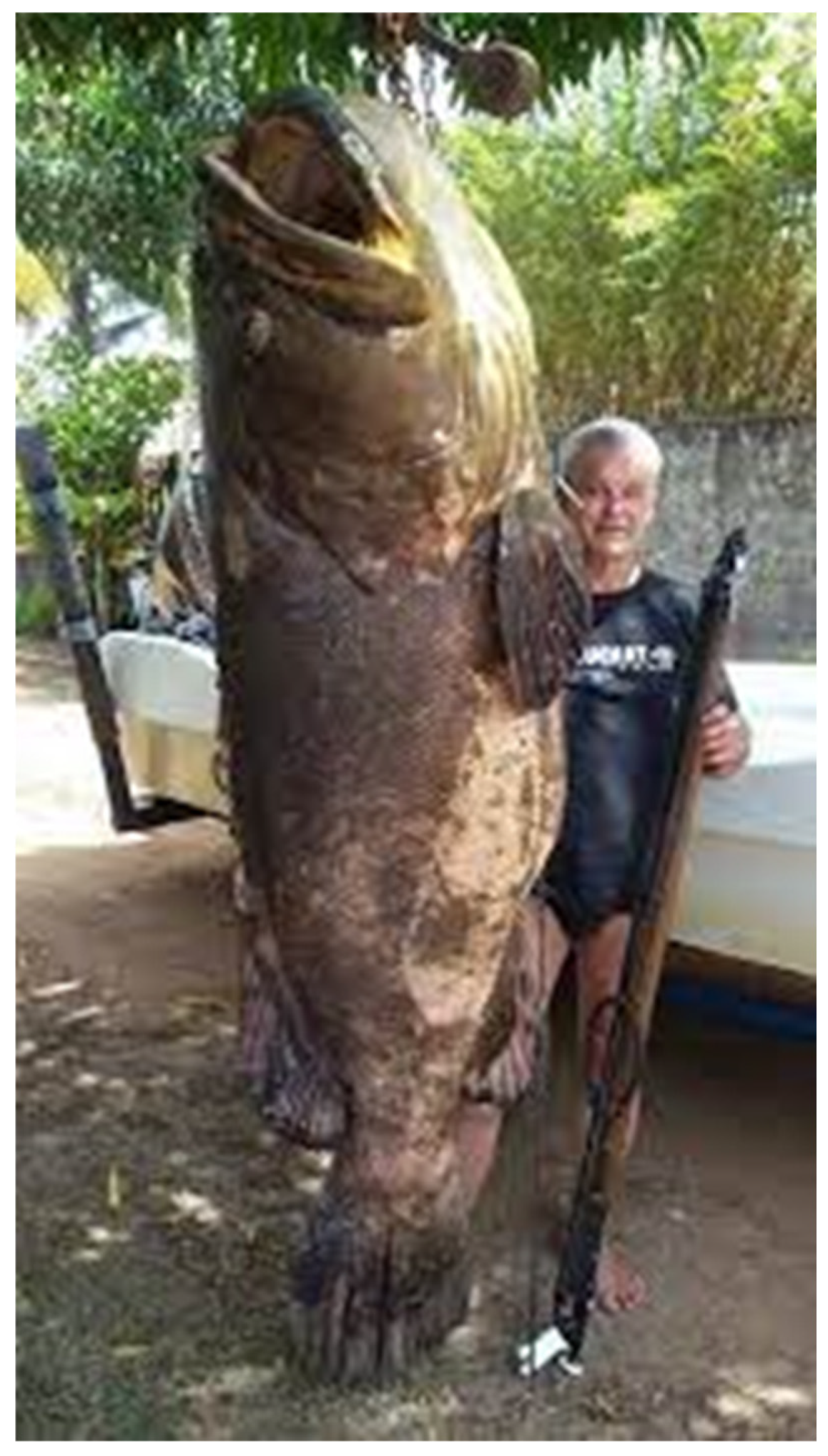
Off the Ogooué River, several islets, small islands, in muddy to sandy bottoms filled with wrecks and around oilrig structures attract a vast and diverse array of predatory fish including Goliath groupers. Although the present-day situation is probably different from what it was back then, Mr. Berry still catches Goliath Grouper, as demonstrated in a recent photo of him (Figure 3). A similar situation, again associated with offshore oil rigs/platforms, is reported from the Ivory Coast (off Abidjan) [10], although encounters with Goliaths here were apparently less common.
4. Discussion
The distribution of Goliath Grouper throughout the West African coast is certainly poorly known and probably decreasing with possible local extinctions at least of healthy or viable populations [5]. Further, this species is not protected in any way in this vast region. There are no Marine Protected Areas (MPAs) nor are there laws against their capture. Yet there is clearly a stigma attached to their capture and removal from the ecosystem. That said, fishing is not the only impediment to their survival. The lack of a continuous network of MPAs together with overfishing, pollution, and coastline urbanization that results in the destruction of essential mangrove habitat for juveniles [8] are certainly major factors negatively affecting the presence of Goliaths. Poor underwater visibility only hampers visual censuses even for fish as big as Goliaths can be.
It is plausible that some populations might still exist in remote areas, such as river mouths, warranting an increased monitoring effort at such sites, as well as on oil rigs/platforms, shipwrecks, artificial reefs, and other human-made structures where Goliath Grouper are known to aggregate [11,12,13]. These areas could be protected by the development of MPAs (which would also help preserve their habitat) and by shifting the pressure from lethal fishing to non-consumptive ecotourism, in which divers are attracted to these areas to observe these fish underwater in their natural habitat [14].
Acknowledgments
Many thanks to José de Sousa for providing Figure 1 and to Luís M.D. Barcelos (University of the Azores, Faculty of Agrarian and Environmental Sciences) for developing the map appearing in Figure 2. I am indebted to the fishermen, sports/trophy spear fishers, and traders from Senegal to Angola that provided first-hand information about Goliath Grouper in their areas of activity. Felicia Coleman, Ph. D. (Florida State University) and to Christopher Koenig, Ph. D. (Florida State University) provided comments on the manuscript.
References
- P.C. Heemstra, A taxonomic revision of the eastern Atlantic groupers (Pisces: Serranidae), Boletim do Museu Municipal do Funchal 43(226)(1991)5-71. Available from: https://publications.cm-funchal.pt/jspui/bitstream/100/1105/1/Bolmmf-1991-art226.pdf.
- P.C. Heemstra, J.E. Randall, FAO Species Catalogue: Groupers of the World (family Serranidae, subfamily Epinephelinae): An annotated and illustrated catalogue of the grouper, rockcod, hind, coral grouper and lyretail species known to date, FAO, UN, Rome, 1993.
- P. Wirtz, J. Bingeman, J. Bingeman, R. Fricke, T.J. Hook, J. Young, The fishes of Ascension Island, Central Atlantic Ocean–new records and an annotated checklist, Journal of the Marine Biological Association of the United Kingdom 97(2017)783-798. [CrossRef]
- M.T. Craig, R.T. Graham, R.A. Torres, J.R. Hyde, M.O. Freitas, B.P. Ferreira, M. Hostim-Silva, L.C. Gerhardinger, A.A. Bertoncini, D.R. Robertson, How many species of goliath grouper are there? Cryptic genetic divergence in a threatened marine fish and the resurrection of a geopolitical species, Endang. Sp. Res. 7(3)(2009)167-174. [CrossRef]
- A.A. Bertoncini, A. Aguilar-Perera, J. Barreiros, M.T. Craig, B. Ferreira, C. Koenig, Epinephelus itajara Atlantic Goliath Grouper: IUCN Red List of Threatened Species, International Union for Conservation of Nature, 2018, pp. 1-18. Available from: https://www.iucnredlist.org/species/195409/145206345#assessment-information.
- F. Reiner, Peixes da Guiné-Bissau. Centro Português de Estudo dos Mamíferos Marinhos, Portugal, 2002. Available from: Available from ISBN 972-98180-1-0.
- A. Brito, P.J. Pascual, J.M. Falcón, A. Sancho, G. González, Peces de las Islas Canarias: catálogo comentado e ilustrado. ISBN 84-87973-16-7, La Laguna (Santa Cruz de Tenerife)2002.
- C. Koenig, F.C. Coleman, A.M. Eklund, J. Schull, J.S. Ueland, Mangroves as essential nursery habitat for goliath grouper (Epinephelus itajara), Bull. Mar. Sci. 80(3)(2007)567-586. Available from: https://www.reef.org/news/publications/mangroves-essential-nursery-habitat-goliath-grouper-epinephelus-itajara.
- M.-A. Berry, Grand chelem à Port-Gentil. , Chasse Sous-Marine nº1, Attard, J.; Mauriés, R. , France, 1989, pp. 43-57. Available from: Available from ISBN 2-9504175-0-7.
- J.-L. Rampal, Fabuleuses rencontres au large d’Abidjan, Chasse Sous-Marine nº1 Attard, J.; Mauriés, R. , France, 1989, pp. 8-14. Available from: Available From ISBN 2-9504175-0-7.
- A.B. Collins, L.R. Barbieri, R.S. McBride, E.D. McCoy, P.J. Motta, Reef relief and volume are predictors of Atlantic goliath grouper presence and abundance in the eastern Gulf of Mexico, Bull. Mar. Sci. 91(4)(2015)399-418. [CrossRef]
- C. Malinowski, F. Coleman, C. Koenig, J.V. Locascio, D.J. Murie, Are Atlantic goliath grouper, Epinephelus itajara, establishing more northerly spawning sites? Evidence from the northeast Gulf of Mexico., Bull. Mar. Sci. (2019). [CrossRef]
- A. Bravo-Calderon, A. Saenz-Arroyo, S. Fulton, A. Espinoza-Tenorio, E. Sosa-Cordero, Goliath grouper Epinephelus itajara oral history, use, and conservation status in the Mexican Caribbean and Campeche Bank, Endang. Sp. Res. 45(2021)283-300. [CrossRef]
- C.C. Koenig, F.C. Coleman, C.R. Malinowski, Atlantic Goliath Grouper of Florida: To Fish or Not to Fish, Fisheries 45(1)(2020)20-32.
Figure 1.
A 62 kg Atlantic Goliath grouper Epinephelus itajara captured in 2011 from Benguela, S Angola 12°34.5756′ S, 13°24.3282′ E. Photo courtesy of J. de Sousa.
Figure 1.
A 62 kg Atlantic Goliath grouper Epinephelus itajara captured in 2011 from Benguela, S Angola 12°34.5756′ S, 13°24.3282′ E. Photo courtesy of J. de Sousa.
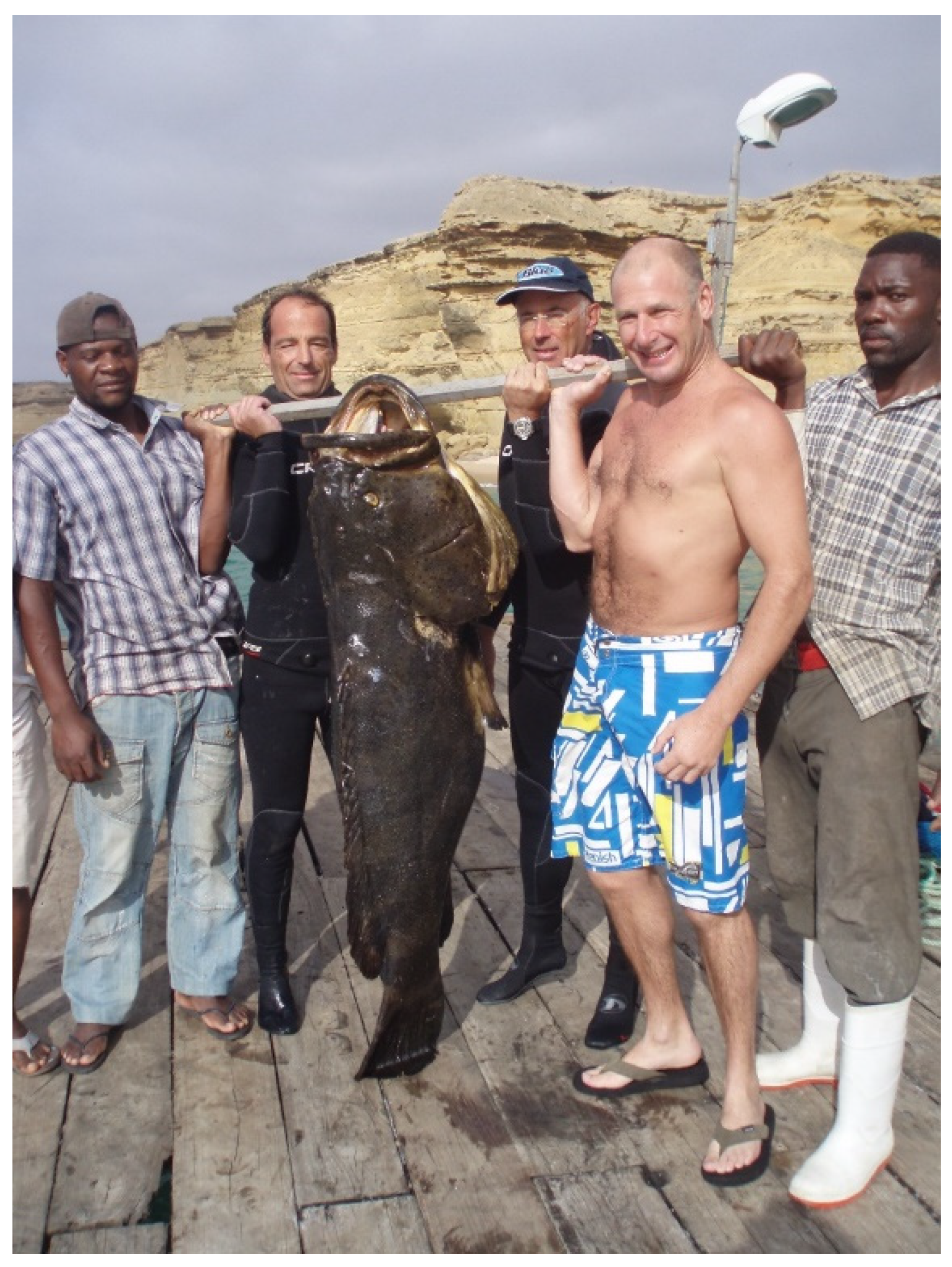
Figure 2.
Confirmed occurrences of the Atlantic Goliath Grouper Epinephelus itajara in West Africa based on personal communications, photographs, and trustworthy personal communications provided to the author (time frame 1989 to 2016). Map kindly provided and edited by Luís M.D. Barcelos (University of the Azores).
Figure 2.
Confirmed occurrences of the Atlantic Goliath Grouper Epinephelus itajara in West Africa based on personal communications, photographs, and trustworthy personal communications provided to the author (time frame 1989 to 2016). Map kindly provided and edited by Luís M.D. Barcelos (University of the Azores).
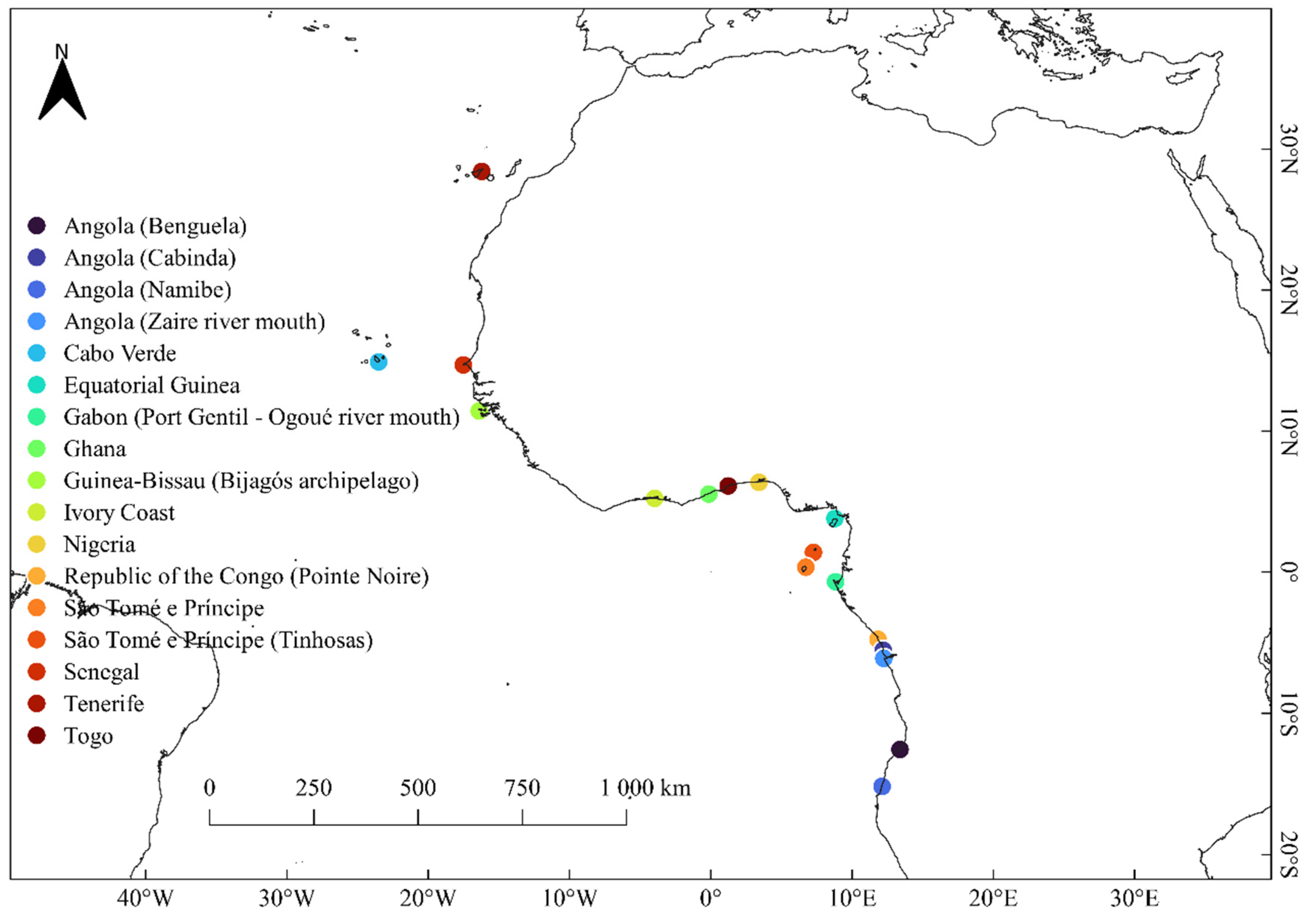
Figure 3.
Marc-Antoine Berry in 2017 in Port Gentil, Gabon (0º40’S, 8º45’E), West Africa, with a ca. 250 kg Atlantic Goliath Grouper Epinephelus itajara. Public domain.
Figure 3.
Marc-Antoine Berry in 2017 in Port Gentil, Gabon (0º40’S, 8º45’E), West Africa, with a ca. 250 kg Atlantic Goliath Grouper Epinephelus itajara. Public domain.
Disclaimer/Publisher’s Note: The statements, opinions and data contained in all publications are solely those of the individual author(s) and contributor(s) and not of MDPI and/or the editor(s). MDPI and/or the editor(s) disclaim responsibility for any injury to people or property resulting from any ideas, methods, instructions or products referred to in the content. |
© 2023 by the authors. Licensee MDPI, Basel, Switzerland. This article is an open access article distributed under the terms and conditions of the Creative Commons Attribution (CC BY) license (http://creativecommons.org/licenses/by/4.0/).
Copyright: This open access article is published under a Creative Commons CC BY 4.0 license, which permit the free download, distribution, and reuse, provided that the author and preprint are cited in any reuse.


