

Submitted:
24 April 2023
Posted:
25 April 2023
You are already at the latest version
Abstract
Symmetrical and dissymmetrical bolaforms were prepared with good to high yields from unsaturated L-rhamnosides and phenolic esters (ferulic, phloretic, coumaric, sinapic and caffeic) using two eco-compatible synthetic strategies involving glycosylation, enzymatic synthesis and cross-metathesis under microwaves activation. Furthermore, some of these new compounds present good eliciting properties depending on the carbon chain length and on the nature of the hydrophilic head. Their respective antioxidant activities have been also evaluated as well as their cytotoxic properties on dermal cells for cosmetic uses.
Keywords:
amphiphilic
; monocatenar
; bolaform
; phenolic acids
; rhamnosides
; antioxidant
; microwaves
; eliciting properties
; dermal cytotoxicity
1. Introduction
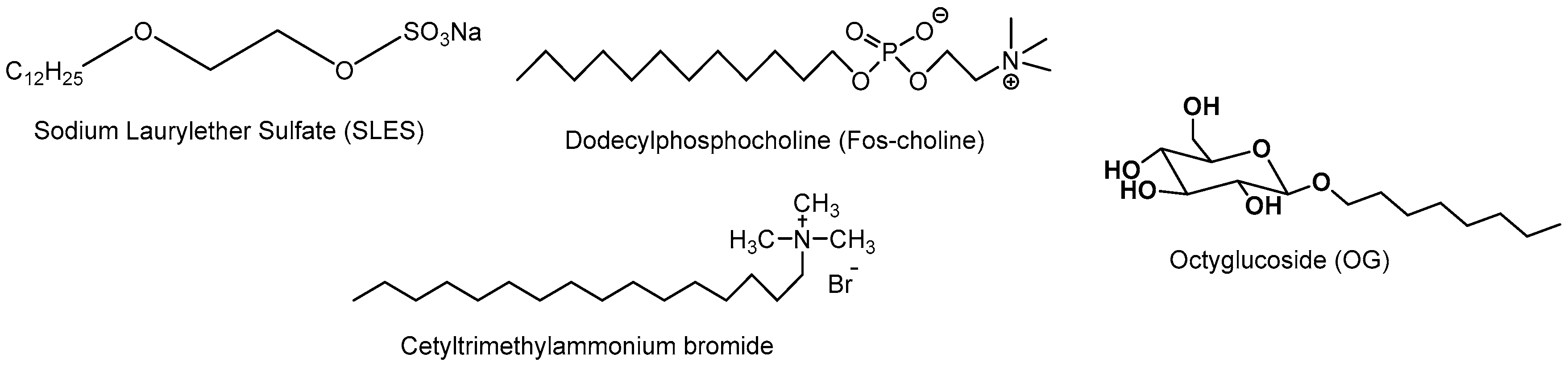
The surfactants are natural or synthetic amphiphilic compounds presenting specific polar and non-polar domains with typical solubility in water. They are able to reduce the interfacial tension of mixtures (oil and water) by adsorbing at interfaces. Surfactants are classified according to the nature of their hydrophilic part into three large families [1]: ionic (cationic or anionic), zwitterionic (or amphoteric) and neutral (Figure 1) [2]. Indeed, the ambivalence of their structure and the diversity of their properties are used in many everyday products, particularly in household and industrial detergents, in cosmetic formulations and in agronomy as eliciting agents [3]. Anionic surfactants (low molecular weight cation associated to sulphates, sulfonates or carboxylates) are the most widely used industrially, particularly in the field of detergents thanks to their foaming properties [4]; cationic surfactants (trimethylated quaternary ammonium salts or pyridinium salts) [5] are active products in softeners (used to reduce static electricity) or shampoos.
Figure 1.
Few examples of surfactants.
Surfactants can also be classified into several categories according to their structure (number and arrangement of hydrophilic and hydrophobic poles within the molecule). The most common structure (in derivatives called monocatenar surfactants) is that comprising a hydrophilic head and a hydrophobic chain. There are surfactants with several hydrophobic chains grafted onto the same hydrophilic head (double-stranded and three-stranded surfactants), but also several hydrophilic heads linked to one or more hydrophobic chains (called bolaform or twinned surfactants) [9].
In a current context linked to sustainable development, to the availability of raw materials of petrochemical origin and to the naturalness desired by consumers, the term "biosourced surfactant" appears more and more. Indeed, amphiphilic molecules from agro-resources are an innovative and interesting alternative for the substitution of petroleum-derived surfactants because they could present relative good biodegradability and low toxicity [5]. However, their production cost remains a limiting factor for their development [6]. Among the bio-based surfactants recently developed with these criteria, we find surfactants with for example, a sugar head such as alkyl polyglycosides (APG) [7,8].
Partially or totally bio-based surfactants are often anionic or non-ionic and include surfactants of the glycolipid, lipopeptide, phospholipid or even fatty acid type [11]. The hydrophilic head of the molecule can be a sugar, a carboxylic acid, an amino acid, an alcohol or peptides, while the lipophilic part is often a fatty acid or a fatty alcohol [12,13,14]. Agro-surfactants or bio-based surfactants are compounds having in general one of the two hydrophilic or hydrophobic moities of plant origin; they are not necessarily 100% plant-based.
The synthesis of biosourced surfactants based on sugars has previously been described in the literature, in particular xylosides or rhamnosides [7,15,16]. Indeed, in 1993, 1,12-digluconamidododecane was synthetized from D-gluconolactone [17] and Satgé and al. in 2004 prepared a bolaform surfactant from D-galactose by a microwave-assisted glycosylation of a D-galactose protected with an unsaturated long-chain alcohol followed by metathesis in the presence of the Grubbs I catalyst ; hydrogenation in the presence of (Rh/Al2O3, H2) also led to the saturated bolaform [18]. In 2010, K. Dzulkefly et al. synthesized symmetrical bolaform amphiphiles from an acid chloride and D-Glucose as hydrophilic head [19].
For our part, we wanted to orientate our research to the field of cosmetics and agronomy (eliciting agent) with the synthesis of sugar or phenolic ester based-bolaamphiphiles, and dissymmetric bolaamphiphiles with two different polar heads, a sugar and a phenolic derivative.
The synthesis of sugar based-bolaamphiphiles has been previously described in the literature, for example D-xyloside or L-rhamnosides based bolaamphiphiles [7]. In a previous work [20], we described fatty ester-based bolaamphiphiles derived from phloretic acid and dissymmetric bolaamphiphiles with rhamnose and phloretic moieties as polar heads. The first step consisted into the glycosylation of the sugar used as solvent and the second one in the enzymatic esterification of the phloretic acid with lipase B from Candida antarctica (CALB). Finally classical cross metathesis reaction using Grubbs I catalyst led to bolaform compounds. However, the kinetics of these reactions was low for an industrial application and the purification requires several chromatographies on a silica column, which are time- and solvent-intensive chromatographies.
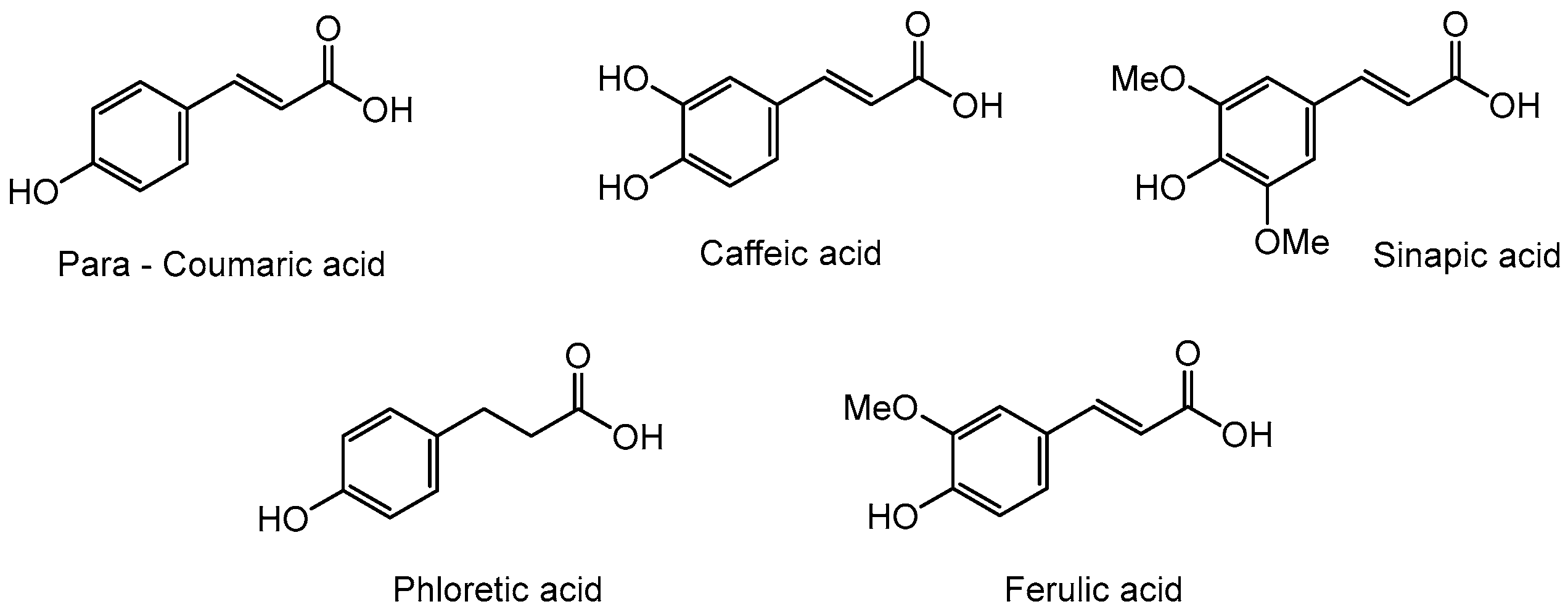
Herein, in this paper we developed new processes to obtain these bio-based compounds using two eco-compatible and fast synthetic methods coupling either glycosylation or enzymatic synthesis and activation by microwaves. For processing and purification of compounds, automated flash chromatography was employed to considerably reduce the purifications times. The comparison between earlier and new processes has been realized. Subsequently, the objective is to design a panel of bio-based bolaform surfactants from L-rhamnose (sugar from pectin) and other phenolic acids derivatives of lignin besides phloretic acid as para-coumaric, ferulic, caffeic and sinapic acids, which present furthermore good antioxidant properties (Figure 2). The originality of the process is the activation of these reactions through microwaves [21], which can reduce the reaction times and enhance the selectivities (few degradation products and appropriate quantities (no excess in one or the other substrates).
So in this context, rhamnose-based bolaforms that can be classified as rhamnolipid mimetics, well known for their antifungal properties and biological properties, have also been studied by triggering an innate immune response in Arabidopsis thaliana [22]. Dissymmetrical bolaforms, respectively with phenolic esters and rhamnose as heads, have also been prepared, their antioxidant properties and their low resistance on dermal fibroblasts also studied.
Figure 2.
Structures of derivatives of hydroxycinnamic acids.
2. Synthesis
Glycosylation of L-rhamnose (Scheme 1) was initially performed with para-toluene sulfonic acid (PTSA) as catalyst under conventional heating conditions with or without solvent (Table 1). Low yields were obtained at 80°C for 48h (Table 1, entries 1 and 2). Times and temperatures were decreased to limit sugar degradation but without better results (Table 1, entries 3-6). Indeed, yields increased in the absence of solvent, as the alcohol used could itself be used as a solvent [2].
Scheme 1.
Glycosylation of L-rhamnose.
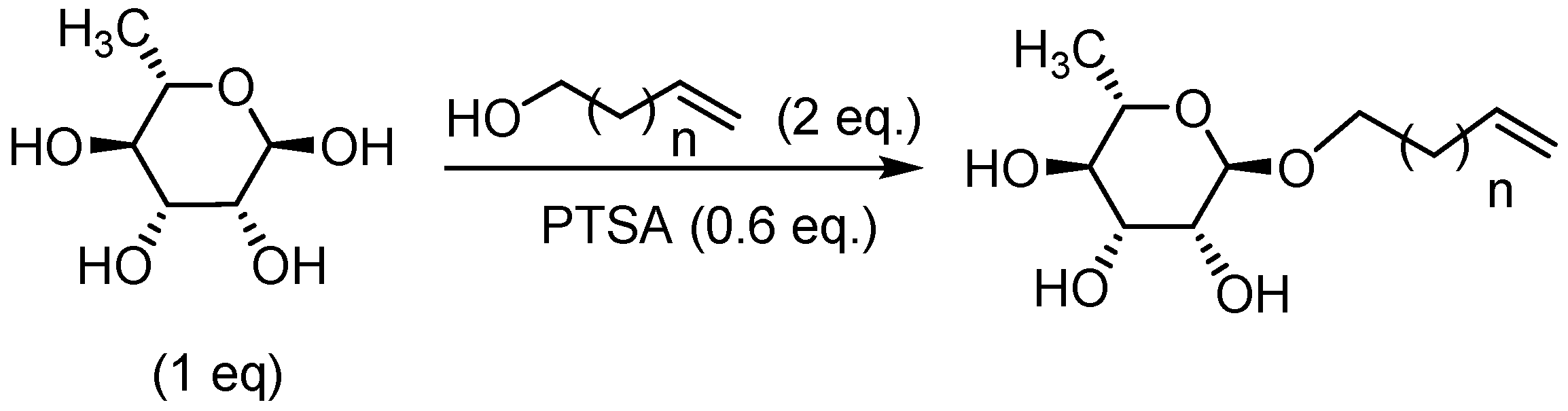

Table 1.
Preliminary results for L-Rhamnose glycosylation under classic thermic conditions.
| Entry | Alcohol | Conditions | Isolated yields in corresponding rhamnoside (%) after flash chromatography (CH2Cl2/MeOH : 9/1 ) |
|---|---|---|---|
| 1 | Hex-5-enol | THF, 80°C, 48h | 19 |
| 2 | Dec-9-enol | THF, 80°C, 48h | 10 |
| 3 | Hex-5-enol | THF, 60°C, 48h |
5 |
| 4 | Dec-9-enol | THF, 60°C, 48h |
5 |
| 5 | Hex-5-enol | THF, 60°C, 48h Addition of the catalyst in 3 times |
7 |
| 6 | Dec-9-enol | THF, 60°C, 48h Addition of the catalyst in 3 times |
7 |
| 7 | Hex-5-enol | Neat, 60°C, 5h |
38 |
| 8 | Dec-9-enol | Neat, 60°C, 5h | 40 |
L-Rhamnose (1 eq.), alcohol (2 eq.), PTSA (0.6 eq.).
In order to increase the yields while avoiding the degradation of the starting reagents, we naturally used the activation of the reaction by microwaves [18,23]. First, the reaction conditions have been optimized with the combination L-rhamnose/Hex-5-enol using various conditions of time, temperature and power (Table 2).
Table 2.
Glycosylation of L-rhamnose with hex-5-enol in THF (5 mL) under microwaves conditions.
| Entry | Ratio L-rhamnose / Hex-5-enol / PTSA | Conditions | Isolated yields in corresponding rhamnoside (%) (combiflash) |
|---|---|---|---|
| 1 | 1/2/0.6 | 35°C, 5 min, 80 W | - |
| 2 | 1/2/0.6 | 35°C, 10 min, 80 W | 17 |
| 3 | 1/2/0.6 | 80°C, 35 min, 60 W | 40 |
| 4 | 1/2/0.6 | 60°C, 60 min, 60 W | 48 |
| 5 | 1/2/0.6 | 80°C, 60 min, 60 W | 50 |
| 6 | 1/4/0.6 | 60°C, 60 min, 60 W | 58 |
| 7 | 1/4/0.6 | 80°C, 60 min, 60 W | 55 |
| 8 | 1/4/0.6 | 60°C, 120 min, 60 W | 64 |
| 9 | 1/6/0.6 | 60°C, 120 min, 60 W | 62 |
| 10 | 1/6/0.6 | 80°C, 60 min, 60 W | 60 |
The best results were obtained with an excess of 4 equivalents of 5-hexen-1-ol at a temperature of 60°C, during 2 hours with a power of 60 W (Table 2, entry 8). The more homogeneous heating by microwaves improved the yield from 19% by conventional heating in 48 hours to nearly 64% in only 2 hours. It should also be noted that under these conditions, no degradation of rhamnose was observed. These same conditions were then used for the synthesis of L-rhamnosides of different chain lengths, the results obtained are summarized in the table below.
Table 3.
Glycosylation of L-rhamnose under microwaves (60°C, 120 min, 60 W).
| Entry | Alcohol | Solvent (5 mL) | Rhamnoside | Isolated yields (%) (combiflash) |
|---|---|---|---|---|
| 1 | Hex-5-enol | THF | 1a | 64 |
| 2 | Hex-5-enol | γ-valerolactone | 1a | 66 |
| 3 | Hex-5-enol | 2-methyltetrahydrofuran | 1a | 63 |
| 4 | Hept-6-enol | THF | 2a | 60 |
| 5 | Oct-7-enol | THF | 3a | 50 |
| 6 | Non-8-enol | THF | 4a | 53 |
| 7 | Dec-9-enol | THF | 5a | 48 |
| 8 | Dec-9-enol | γ-valerolactone | 5a | 73 |
| 9 | Dec-9-enol | 2-methyltetrahydrofuran | 5a | 55 |
| 10 | Undec-10-enol | THF | 6a | 47 |
We obtained rhamnosides with yields between 47 and 64%, yields inversely proportional to the chain length of the alkyle groups, as observed in the literature with oses such as D-glucose, D-galactose and D-mannose [24]. The use of microwaves considerably reduces the reaction time and also improves the selectivity (few degradation products). Moreover, we used 2-methyltetrahydrofuran and γ-valerolactone as greener solvents [25] and obtained better yields especially with γ-valerolactone (Table 2, entries 2 and 8 vs entries 1 and 7 respectively). This can be explained by the more polar and less viscous character of these solvents, favorable to the activation of the reagents under microwaves [26]. The formation of the rhamnosides are confirmed by IR (bands at 2926 cm-1 and 1640 cm-1 respectively for the OH functions of the rhamnose and the terminal alkene function on the unsaturated alcohols) and 1H NMR, with a shift at 1.25 ppm relative to the CH3 in C6 position of rhamnose, signals between 4.52 - 4.72 ppm and 3.17 - 3.58 ppm for all the protons of rhamnose and at 4.98 ppm and 5.80 ppm for the terminal alkene function. The 13C NMR confirmed also the formation of rhamnosides with a terminal insaturation.
In order to obtain bolaform compounds from these monocatenars, a cross-metathesis reaction was performed from rhamnosides using two types of Grubbs catalyst (Grubbs I and Grubbs II).
Scheme 2.
Metathesis of L-rhamnoside.
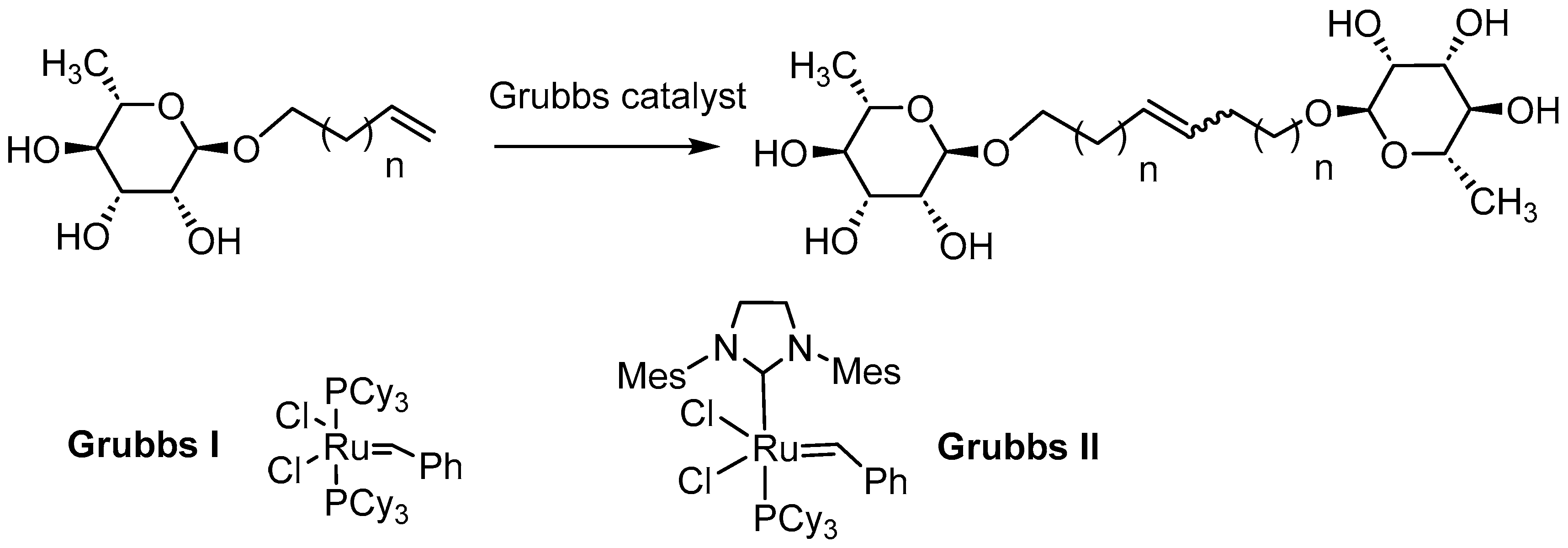
In a first step, we used classical conditions in the presence of Grubbs I with a thermal activation. After several purification steps by silica chromatography, addition of activated carbon and filtration on celite, we obtained very low yields lower than 20% (Table 4) whatever the carbon chain length (Table 4, entries 1-3). These low yields could be explained by the purification steps, by the nature of Grubbs I catalyst which is less reactive compared to other generations, but also by the solvent used, the dichloromethane in which rhamnosides are not very soluble. The activation through microwaves induced however higher yields (37 and 52% respectively for carbon chains of 12 or 10 carbons) with a Z/E ratio of 20/80 as confirmed by NMR. These yields were again improved to 60 and 77% by using Grubbs II catalyst and a mixture CH2Cl2/MeOH (9/1) (Table 4, entries 7 and 8). Similar results have been also observed concerning C18 chain (Table 4, entries 3, 6 and 9) and optimal conditions were used to prepared the compound 10a involving a C20 chain (Table 4, entry 10).
Table 4.
Cross metathesis of rhamnosides.
| Entry | Monocatenar Rhamnoside | Conditions | Grubbs Catalyst (0.1 eq.) | Purification | Bolaform rhamonisde Isolated yields (%) |
|---|---|---|---|---|---|
| 1 | 1a | CH2Cl2 | Grubbs I | Silica Chromatography |
7a 19 |
| 2 | 2a | CH2Cl2 | Grubbs I | Silica Chromatography |
8a 13 |
| 3 | 5a | CH2Cl2 | Grubbs I | Silica Chromatography | 9a 10 |
| 4 | 1a | CH2Cl2/MeOH (9/1) | Grubbs I | Combi Flash |
7a 52 |
| 5 | 2a | CH2Cl2/MeOH (9/1) | Grubbs I | Combi Flash |
8a 37 |
| 6 | 5a | CH2Cl2/MeOH (9/1) | Grubbs I | Combi Flash |
9a 31 |
| 7 | 1a | CH2Cl2/MeOH (9/1) | Grubbs II | Combi Flash |
7a 77 |
| 8 | 2a | CH2Cl2/MeOH (9/1) | Grubbs II | Combi Flash |
8a 60 |
| 9 | 5a | CH2Cl2/MeOH (9/1) | Grubbs II | Combi Flash |
9a 56 |
| 10 | 6a | CH2Cl2/MeOH (9/1) | Grubbs II | Combi Flash |
10a 32 |
This synthetic methodology was extended for the preparation of bolaforms derived from hydroxycinnamic acids which are widely used in cosmetics and known for their anti-oxidant properties [27]. We used a method previously described in the literature [20] but improved again the yields by using the combiflash technic for the purification. Indeed, these bolaforms derived from cinnamic acids were prepared in two steps; the first step consists in synthesizing monocatenar esters from hydroxycinnamic acids and unsaturated fatty alcohols of different chain lengths. These monocatenar compounds were synthesized by chemoenzymatic way in the presence of a lipase (lipase Novozym 435, lipase B from Candida antarctica "CAL-B"). According to the results of the literature [20], we chose 2-methyl-2-butanol as solvent because of the stability and reactivity of the "CAL-B" enzyme. This hindered and polar alcohol allows a better chemical and thermal stability of the enzyme but also avoids the possibility of having a competitive esterification with the starting phenolic acids.
Initial experiments with phloretic acid and alcohols of different unsaturated chain lengths (5-hexen-1-ol, 6-hepten-1-ol, 9-decen-1-ol 10-undecen-1-ol respectively) under the conditions described by Obounou et al. [20] showed low yields of phloretic acid esters despite good conversion (Table 5). We modified therefore the purification method by using a semiautomatic method with a Combiflash coupled to a UV detector at the output (UV1 = 280 nm and UV2 = 360 nm). After several trials, the elution program retained for all the products was as following: a flow of 15 ml/min, 3 minutes eluting with 92% petroleum ether and 8% ethyl acetate, 27 minutes with 80% petroleum ether and 20% ethyl acetate and 32 minutes with 60% petroleum ether and 40% ethyl acetate (the purification chromatogram on Combiflash of hex-5’-enyl-3-(4-hydroxyphenyl)propionic acid is given in the experimental part). This eluting program allowed the recovery of the different pure monocatenars in a single step as opposed to a classical purification by flash chromatography which required actually several purification steps. This new purification method was very efficient by reducing product losses because the yields in esters were closed to the conversions (Table 5).
After purification, these esters were characterized by infrared spectroscopy (IR), nuclear magnetic resonance (NMR) and mass spectrometry.
Thus, in FTIR, we observed an elongation band at 1215 cm-1 characteristic of the phenol function, a band at 1640 cm-1 characteristic of the alkene function and a band at 1704 cm-1 corresponding to the ester (C=O) function. The 1H NMR shows two doublets between 7.01 and 6.72 ppm (integrating for 8 H) corresponding to the aromatic protons, a multiplet for the protons of the alkene function between 5.82 and 4.95 ppm and a triplet at 4.02 ppm which corresponds to the protons in alpha position of the ester function. The 13C NMR also confirms the presence of the aromatic ring (between 130 and 115 ppm), the carbonyl (173 ppm) and the alkene (131 ppm).

Table 5.
Enzymatic catalyzed esterification of phloretic acids.
| Compounds | Conversion of acid (% GC) | Isolated yields (Combiflash) % |
Isolated yields (Flash chromatography) % |
|---|---|---|---|
| 1b | 97 | 95 | 12 |
| 2b | 90 | 88 | 28 |
| 3b | 97 | 96 | 46 |
| 4b | 85 | 79 | 31 |
This methodology was extended to other phenolic acids (paracoumaric, ferulic, caffeic and sinapic). The first experiments carried out with these different acids in 2-methyl-2-butanol (2M2B) did not give any result for some of them (ferulic and sinapic acids) because of their very low solubility in 2M2B. Therefore, we used as solvents, a mixture of 2M2B/THF (1/2) for caffeic acid and acetone for sinapic acid respectively. However, the yields obtained from these acids are lower compared to those obtained with phloretic acid (Table 6). This result can be explained by the presence of an unsaturation in α-position of the acid function thus reducing their reactivity towards enzymatic transformations [28], which is not the case with phloretic acid.
Table 6.
Esterification of paracoumaric, ferulic, caffeic and sinapic acids (conditions: acid (6 eq.), alcohol (1 eq., lipase 2.5 g per 100g of reaction mixture, molecular sieves (50 g.L-1), 60°C, 48h).
Table 6.
Esterification of paracoumaric, ferulic, caffeic and sinapic acids (conditions: acid (6 eq.), alcohol (1 eq., lipase 2.5 g per 100g of reaction mixture, molecular sieves (50 g.L-1), 60°C, 48h).
| Compounds | solvent | Isolated yields (%) |
|---|---|---|
| 5b | 2M2B (40 mL) | 70 |
| 6b | 2M2B (40 mL) | 74 |
| 7b | 2M2B/THF (1/2) (30 mL) | 52 |
| 8b | 2M2B/THF (1/2) (30 mL) | 45 |
| 10b | 2M2B (60 mL) | 52 |
| 11b | 2M2B (60 mL) | 52 |
| 9b | Acetone (30 mL) | 40 |
The structures of 5-11b have been confirmed by NMR, IR and elemental analysis.
In a second step, the synthesis of phloretic ester bolaforms was first performed by a metathesis in the presence of a Grubbs I catalyst added in 6 portions for 40 minutes at 45 °C and under microwaves activation. These conditions led to low yields of C10 (20%), C12 (16%) and C18 (24%) bolaforms (respectively compounds. We subsequently used the more reactive Grubbs II catalyst; after 40 minutes under microwave, the yields were improved (Table 7). The same experiment was extended using the para-coumaric esters 5 and 6b; good yields were obtained with short carbon chain while yields remained relatively low with longer chain (Table 7).

Table 7.
Metathesis of phenolic esters.
| Compound | Isolated Yields | |
|---|---|---|
| Grubbs I catalyst | Grubbs II catalyst | |
| 12b | 20 | 56 |
| 13b | 16 | 48 |
| 14b | 18 | 60 |
| 15b | 11 | 42 |
The compounds were classically characterized by IR, NMR, UV and elemental analysis. In IR was identified the band at 1704 cm-1 of the carbonyl group, the band between 1640 - 1690 cm-1 corresponding to the double bond and the elongation band at 1215 cm-1 characteristic of the phenol function. In NMR, the singlet at 5.37 ppm integrating for the two protons was also significant for the alkene function.
In order to obtain a system with both a good hydrophilic character (necessary for example for a good interaction with phospholipid membranes) and a good anti-oxidant activity, we considered dissymmetric bolaform surfactants with a glycosylated head (L-rhamnose) and the other based on a hydoxycinnamic acid derivative. These dissymmetric bolaform surfactants were prepared by cross metathesis. Different methods were tested according to the protocols described in the literature using different Ru-based catalysts, different ratios rhamnosides / fatty acid esters or reaction conditions (time or temperature) [29] The complete analysis of these different protocols showed that the mixed (or dissymmetric) bolaamphiphiles were always obtained in a minority compared to the symmetric compounds. However, inspired by the work done by Blechert or Obounou et al. [20,30], three dissymmetric bolaamphiphiles were obtained under classical heating conditions and in the presence of Grubbs II (Scheme 3).
Scheme 3.
Cross metathesis between rhamnosides and phenolic esters.
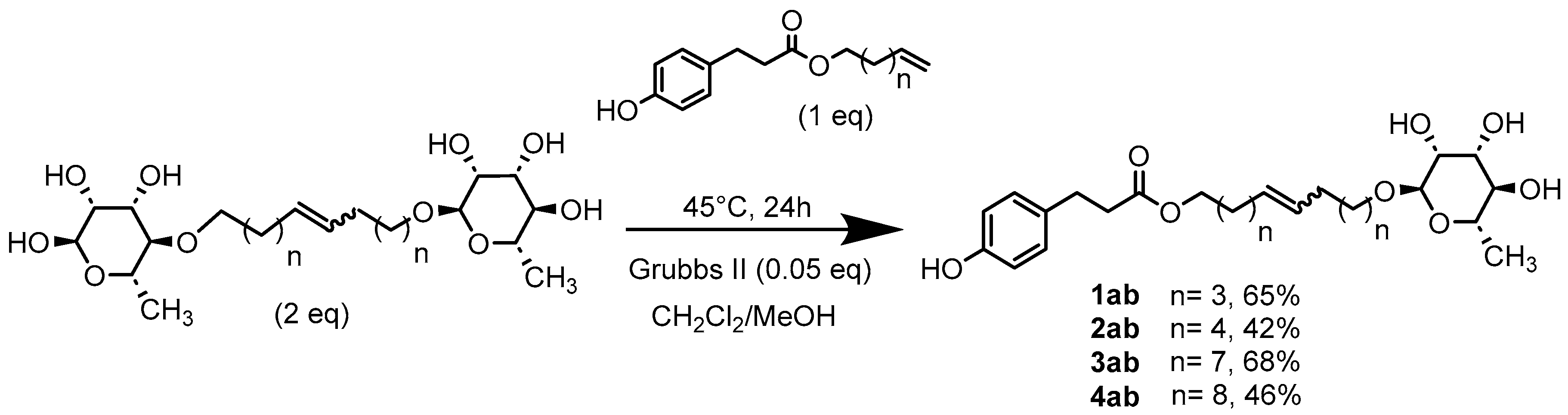
These dissymmetrical bolaforms were thus prepared by cross-metathesis of the symmetrical L-Rhamnose-based bolaform and the unsaturated phloretic esters derived. The use of a CH2Cl2/MeOH solvent mixture significantly improves the solubility of the reactants in contrast to CH2Cl2. TLC monitoring shows that the predominant compound formed is the dissymmetrical bolaform with a small amount of symmetrical bolaform derived from unsaturated phloretic esters. After rapid purification (35 min) by automated flash chromatography, bolaforms 1-4ab were obtained in yields up to 70% in 24 h.
These dissymmetric bolaforms were characterized by classical spectroscopic and spectrometric methods: IR (1615, 1732 and 3353 cm-1 respectively for the C=C, C=O and OH bonds), NMR (5.80 ppm for the protons of the C=C, 2 doublets between 6.99 and 6.65 ppm for the aromatic protons and signals between 3.12 and 3.54 ppm for the hydrogens of the rhamnose except the methyl group), UV and elemental analysis.
Anti-Oxidant Properties
To evaluate the antioxidant activity, several methods [31] exist in the literature using respectively the 2,2’-azinobis-3-ethylbenzothiazoline-6-sulfonic acid (ABTS) [32], the β-carotene [33], the trolox (ORAC method) [34] and the 2,2-diphenyl-1-picrylhydrazyl DPPH [35] (Scheme 4). This last one is based on the reduction of DPPH● which is accompanied by a significant color change from purple to yellow, monitored by UV - Visible spectroscopy at an absorption wavelength of 517 nm. This is the method we used to determine the antioxidant activity of our surfactants.
Scheme 4.
Reaction of an antioxidant with the DPPH● radical.
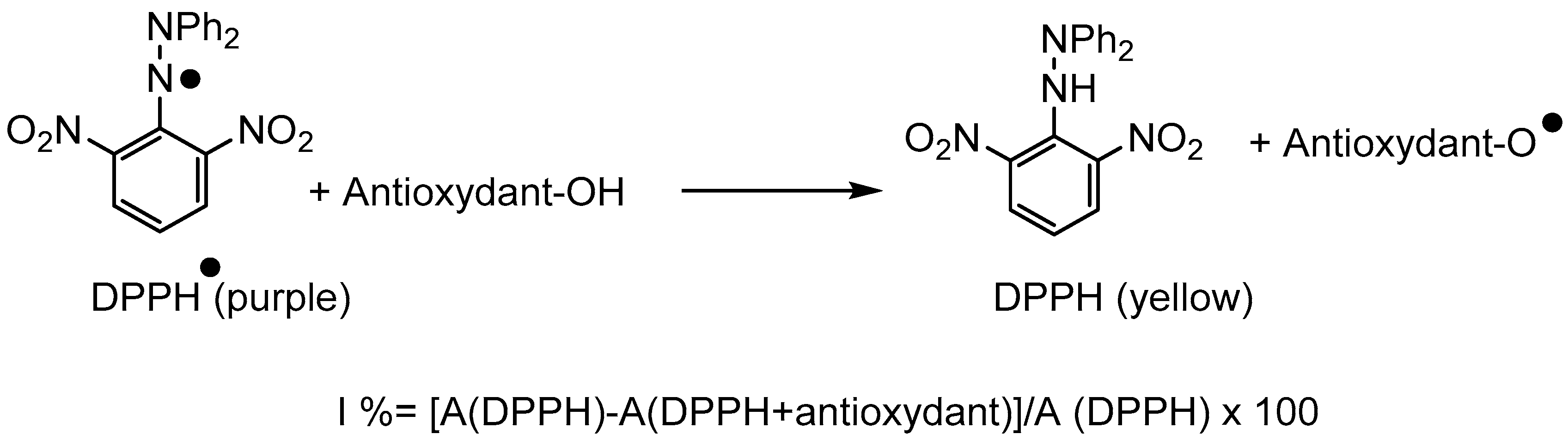
Indeed, surfactants synthesized by trapping DPPH● by H-transfer leads to a color change from purple to yellow. This color change results in a decrease in the absorbance of the DPPH●.
The antioxidant activity of phenolic ester and derived bolaforms were evaluated in methanol by measuring their ability to reduce the DPPH● at a concentration 10-4 mol.L-1. These activities were expressed as percent inhibition according to the formula given on Scheme 4 and vitamin C was used as a positive control. Antioxidant tests were performed at 45 minutes and in triplicate to confirm the repeatability of results.
Preliminary observations showed that the monocatenar phloretic esters 1b and 3b have no anti-oxidant activity but corresponding bolaforms 12b and 14b present a rather interesting antioxidant activity (Table 8, entries 8 and 9). As well, the anti-oxidant activity of ferulic ester is greater than the one of the phloretic ester containing the same carbon chain (Table 8, entries 5 and 7). This difference could be explained by the low stability of the phenoxy radical resulting from phloretic ester compared to the radical coming from ferulic ester, which could be more stabilized through the methoxy function in ortho position. These results show that the antioxidant activity depends both, on the stability of the resulting radical and the number of phenolic moieties.
In order to better understand the structure/anti-oxidant activity relationship of monocatenar esters, we have extended our measurements to para-coumaric, caffeic and sinapic esters; the values of IC50 are summarized in the Table 8.
Table 8.
Antioxidant properties of phenolic (di)esters.
| Entry | Compounds | IC50 (μmol/L) |
|---|---|---|
| 1 | Vitamin C | 34 |
| 2 |  |
45 |
| 3 |  |
29 |
| 4 |  |
31 |
| 5 |  |
47 |
| 6 |  |
32 |
| 7 |  |
32 |
| 8 |  |
36 |
| 9 |  |
35 |
| 10 |  |
27 |
With the same carbon chain length, we observed that the monocatenar ester of caffeic acid presents the best antioxidant activity before respectively the sinapic, the coumaric and then the ferulic esters (Table 8, entries 2-5). We can therefore deduce that the number of OH groups on the aromatic ring has a great influence on the antioxidant power, as well as the double bond in the α position of the ester (compared to the phloretic ester which shows no antioxidant activity). This ranking of antioxidant activities corresponds fairly well to the one of the acids alone except for the derivatives of sinapic acid because the latter alone has higher antioxidant activities than all the other acids [36]. The length of the carbon chain also seems to play an important role because we can note that the antioxidant powers are higher for a chain in 10 than for a chain in C6 (Table 8, entries 6 and 7 vs respectively 2 and 5), which could be explained by a more important inductive effect with a chain in C10 which stabilizes the radical.
Moreover, the anti-oxidant activity of dissymmetric bolaforms 1ab and 3ab was evaluated but the study revealed no antioxidant activity, which is not very surprising considering that the phenolic part of the bolaform is constituted of phoretic acid. The solubility on the other hand is enhanced by the presence of the rhamnoside entity. Thus, what would be interesting to realize in a near future, are dissymmetrical bolaforms based on caffeic or sinapic esters and rhamnosides.
In conclusion, we found have five compounds (7b, 6b, 9b, 11b and 15b) which presented an antioxidant activity superior to that of ascorbic acid (Table 8, entry 1). Furthermore, some of these compounds (7b and 15b) have a very interesting hydrophilic character which may be good candidates for cosmetic applications.
Eliciting Properties
To complete the study on these compounds, we evaluated their eliciting properties towards Arabidopsis thaliana. Indeed, some years ago, we demonstrated the ability of Synthetic Rhamnolipid or Xylolipids Bolaforms (SRB or SXB) to trigger an innate immune response in Arabidopsis thaliana. Rhamnolipids bolaforms [24] depending on the carbon chain length, differentially activated early and late immunity-related plant defense responses and provided local increase in resistance to plant pathogenic bacteria. The 1’,14’-bis-tetradec-7’-enyl-L-rhamnopyranoside was the best candidate of this previous study, thus combining the right chain length, unsaturation and rhamnose as sugar. This observation was confirmed by biophysical data which suggest that synthetic rhamnolipid bolaforms can interact with plant biomimetic plasma membrane and open the possibility of a lipid driven process for plant-triggered immunity by these surfactants.
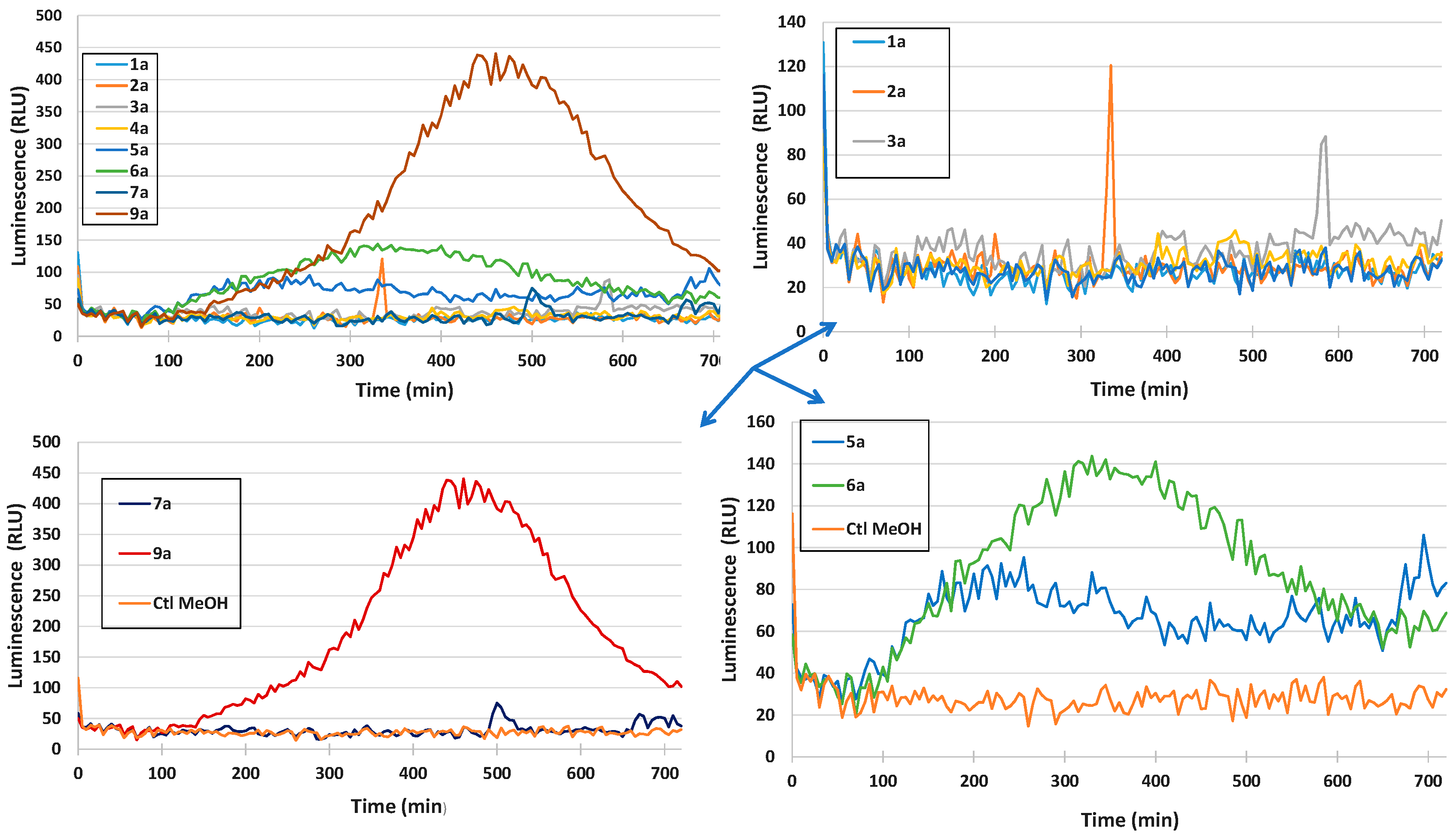
In this work we have completed the previous study and compared the eliciting activities of all monocatenar and bolaform rhamnoside (1-10a) but also evaluate the eliciting properties of the dissymmetric bolaform 4ab to observe a potential synergy between phenolic and rhamnose moieties. To prove an immune response in Arabidopsis thaliana by compounds 1-10a and 4ab, plant discs were contacted with them and extracellular reactive oxygen species (ROS) production was measured by chemiluminescence of luminol, a marker of plant immunity [24].
Our results show that only rhamnosides with carbon chains containing 10, 11 or 18 carbon atoms, are active on Arabidopsis thaliana (Figure 3). Indeed, compounds 5a and 6a as well as 9a seem to produce ROS. The kinetics of ROS production showed that compounds 5a, 6a and 9a induced a sustained and long-lasting production of ROS similar to that observed with natural rhamnolipids or 1’,14’-bis-tetradec-7’-enyl-L-rhamnopyranoside [22] (Figure 3).
Figure 3.
Eliciting tests with rhamnosides at 100 µM.
Moreover, we observe that the dissymmetrical bolaform 4ab produces more ROS than the bolaform 10a but also its monocatenar analogue 6a (Figure 4). This robust immune response obtained with the dissymmetric bolaform may be explained by a greater activation of defense genes in Arabidopsis thaliana caused by phloretic acid as with salicylic acid [37].
Finally, we compared the activity of unsatured and satured compounds, respectively 5a and 6a towards 5a’ and 6a’ obtained from 5a and 6a through classical Pd-catalyzed hydrogenation [38]. Here again, the manipulations were repeated twice with similar results (Figure 5).
Figure 4.
Eliciting tests at 100 µM: comparison between monocatenar and bolaform rhamosides and the dissymmetrical bolaform.
Figure 4.
Eliciting tests at 100 µM: comparison between monocatenar and bolaform rhamosides and the dissymmetrical bolaform.
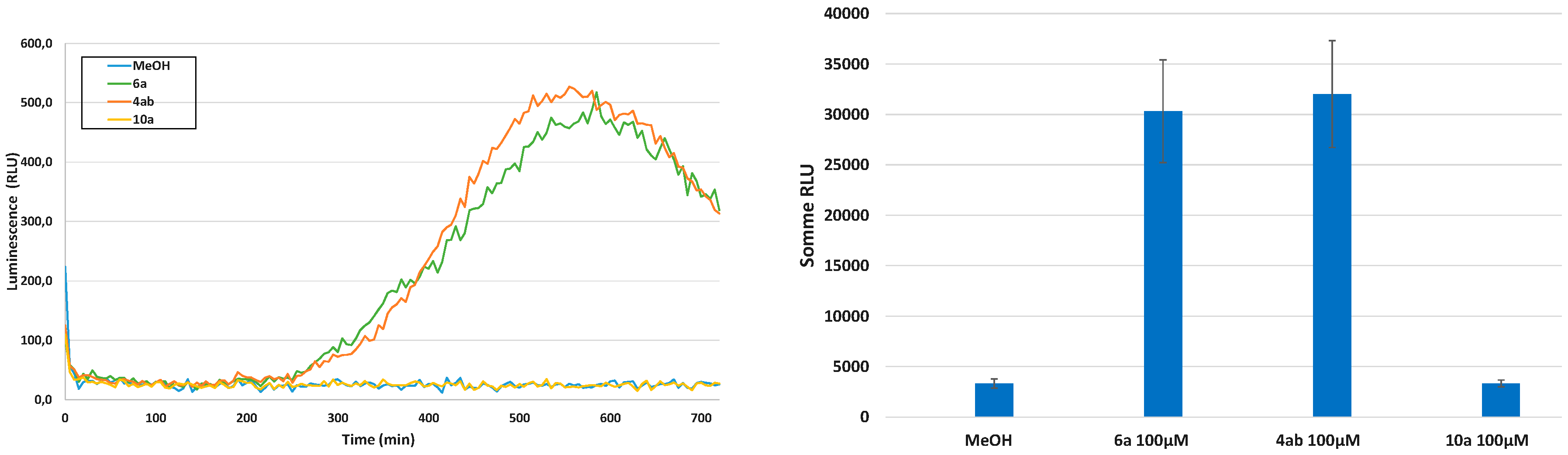
Figure 5.
Comparative eliciting tests between saturated and unsaturated compounds.
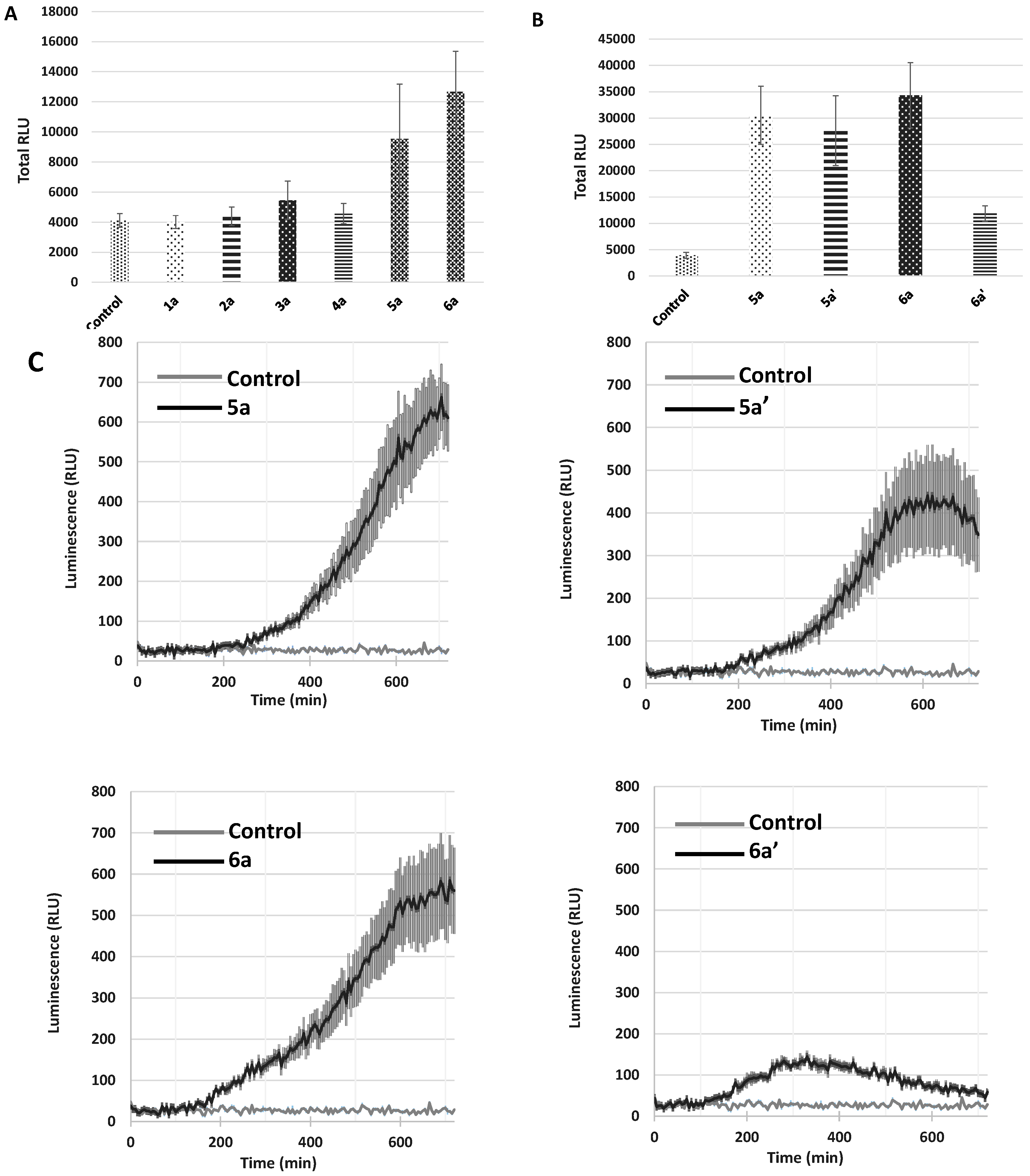
The study showed that the unsaturation of lipid chains can lead to a stronger ROS response (Figure 5B,C). Therefore, these data highlighted the importance of combined long chains and unsaturation to the MRP-triggered immune response in Arabidopsis.
To conclude this study, monocatenar rhamnosides 5a and 6a, bolaform rhamnoside 9a and dissymmetrical bolaform 4ab trigger innate immunity in Arabidopsis and can induce plant protection against pathogens without being directly toxic to the microorganism.
Cytotoxicity Evaluation
As surfactants can be used in cosmetics, we completed our study with cytotoxicity tests on dermal fibroblasts. The toxicity of monocatenar and bolaform rhamnosides was evaluated on human dermal fibroblasts according to the protocol described in the experimental section and then compared to that obtained with 1% phenol, used as a positive reference in our study. Indeed, this fibroblast is the best suited to the desired applications in cosmetics, specifically in the field of dermatology. We used the WST1 assay [39] to measure cell viability.
Therefore, we incubated dermal fibroblast cells for 48 hours in the presence of our rhamnose-based compounds at increasing concentrations (1 to 1000 µg/mL). A dose-response presented by the residual dehydrogenase activity as a function of the surfactant concentration represented in mg/mL allowed to determine the cytotoxic effect for each compound tested.
In the concentration range tested, we observed a slight cytotoxicity of monocatenar rhamnosides 1-4a, but in contrast, 5a (chain length of 10 carbons) showed a lower cell growth of about 46% starting from from 50 µg/mL (Figure 6). This cytotoxicity can be due to the hydrophobic character of 5a, able to form micelles in the intracellular medium what can induce a disruption of the cell cycle causing cell death either by apoptosis or necrosis [40].
Figure 6.
Cytotoxicity of monocatenar unsaturated rhamnosides.
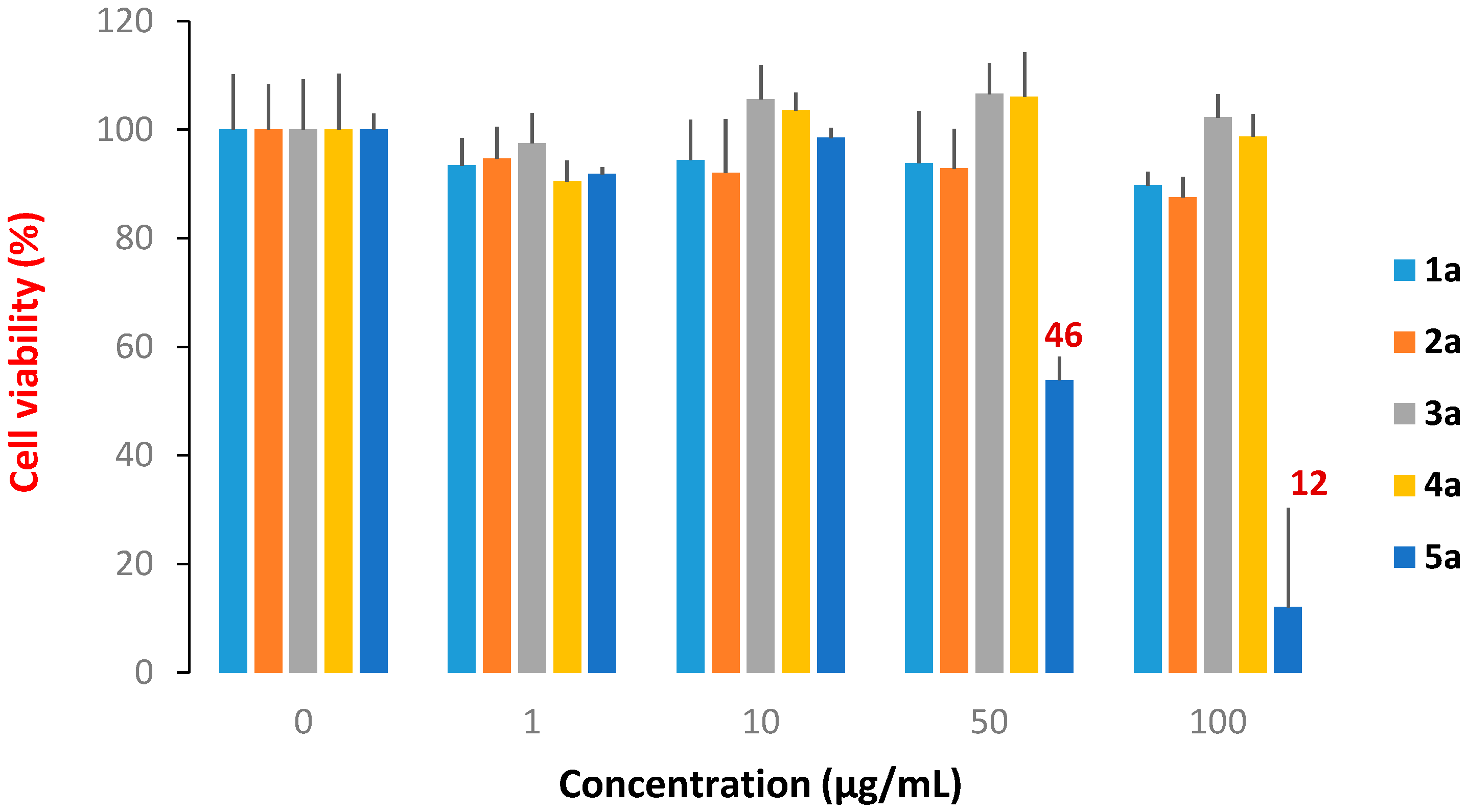
This low toxicity of rhamnosides is in accordance with the use of rhamnose or rhamnose derivatives known as promising biocompatible molecules for biomedical applications, i.e. for example in the internalization of nanoparticles with a therapeutic aim [41].
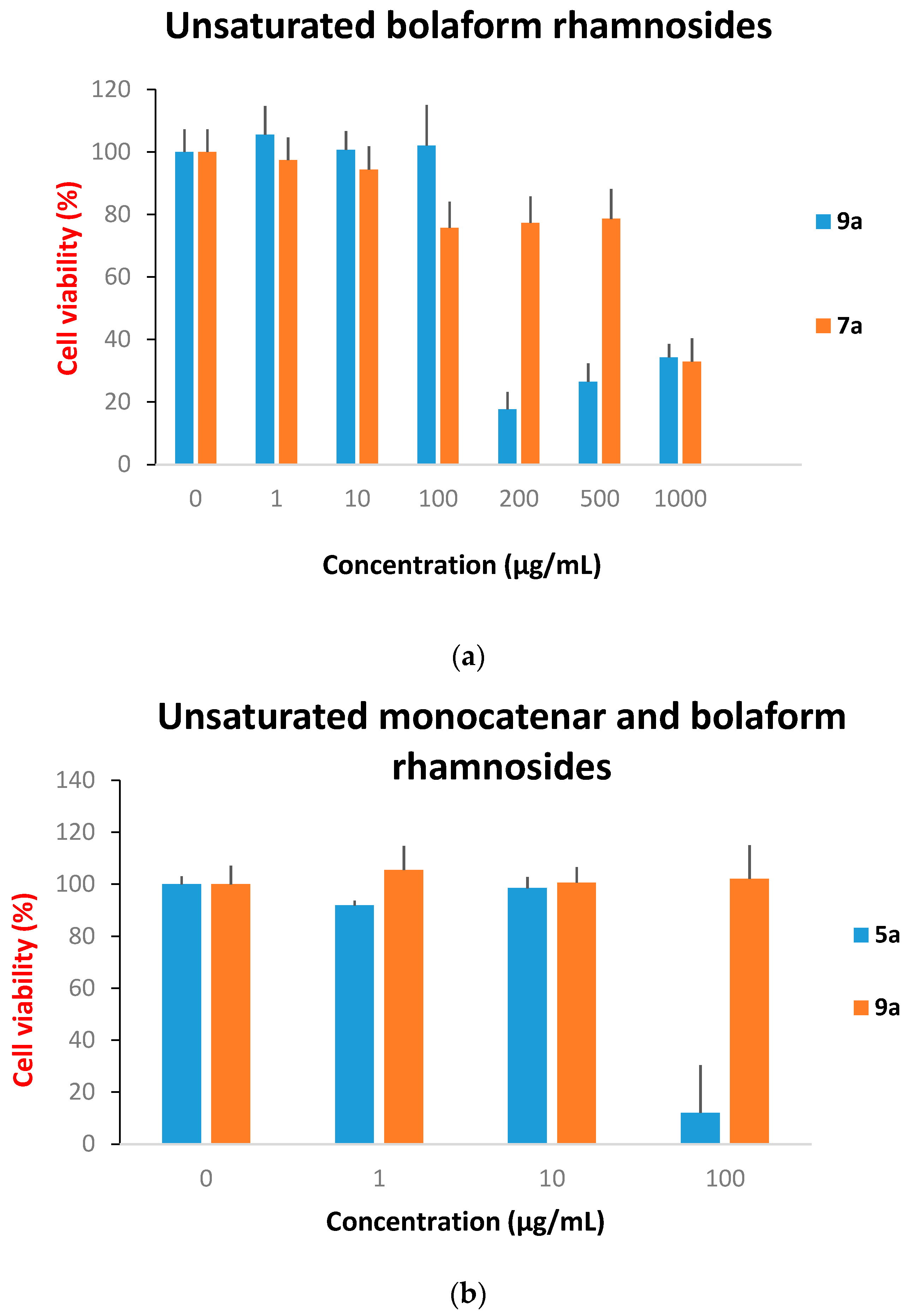
We subsequently studied the cytotoxicity of the unsaturated bolaform rhamnosides 7a and 9a (Figure 7a). As previously, the length of the carbon chain has a strong influence on the cytotoxic character; indeed, the results showed that 9a is five times more cytotoxic than 7a (respectively cytotoxicity at 200 µg/mL and 1000 µg/mL). Nevertheless, when we compared monocatenar rhamnosides and bolaform rhamnosides, i.e. 5a and 9a, the bolaamphiphilic structures clearly decreases the cytotoxicity of the amphiphiles (Figure 7b).
Figure 7.
Cytotoxicity of (a) unsaturated bolaform rhamnosides and (b) monocatenar and bolaform rhamnosides.
Figure 7.
Cytotoxicity of (a) unsaturated bolaform rhamnosides and (b) monocatenar and bolaform rhamnosides.
Next, the cytotoxicity of unsaturated phloretic esters was evaluated under the same conditions as previously at concentrations between 1 and 1000 µg/mL. In contrast to monocatenar rhamnosides, all the unsaturated phloretic esters present a cytoxicity starting from 50 µg/mL (Figure 8a). This result can be explained by the intrinsic cytoxicity of phloretic acid on specific cells as previously described in the literature [42].
Regarding boloform compounds, only the cytoxicity of dissymmetrical Rhamnose/phloretic ester bolaforms could be evaluated because of the low solubility of phloretic ester bolaforms in the culture medium. We also observed a decrease of the cytotoxicity when the phloretic esters are coupled to a monocatenar rhamnoside through a cross metathesis step; indeed, on Figure 8b we observed low cytotoxicity for compounds 1ab, 2ab under 100 μg/mL but high cytotoxicity for higher concentrations or for compound 3ab from 100 μg/mL. This cytotoxicity decrease is probably due to the presence of rhamnose which is biocompatible with dermal cells and more hydrophilic, improving the solubility of the bolaform.
Figure 8.
Cytotoxicity of (a) unsaturated monocatenar phloretic esters and (b) dissymmetric bolaforms.
Figure 8.
Cytotoxicity of (a) unsaturated monocatenar phloretic esters and (b) dissymmetric bolaforms.
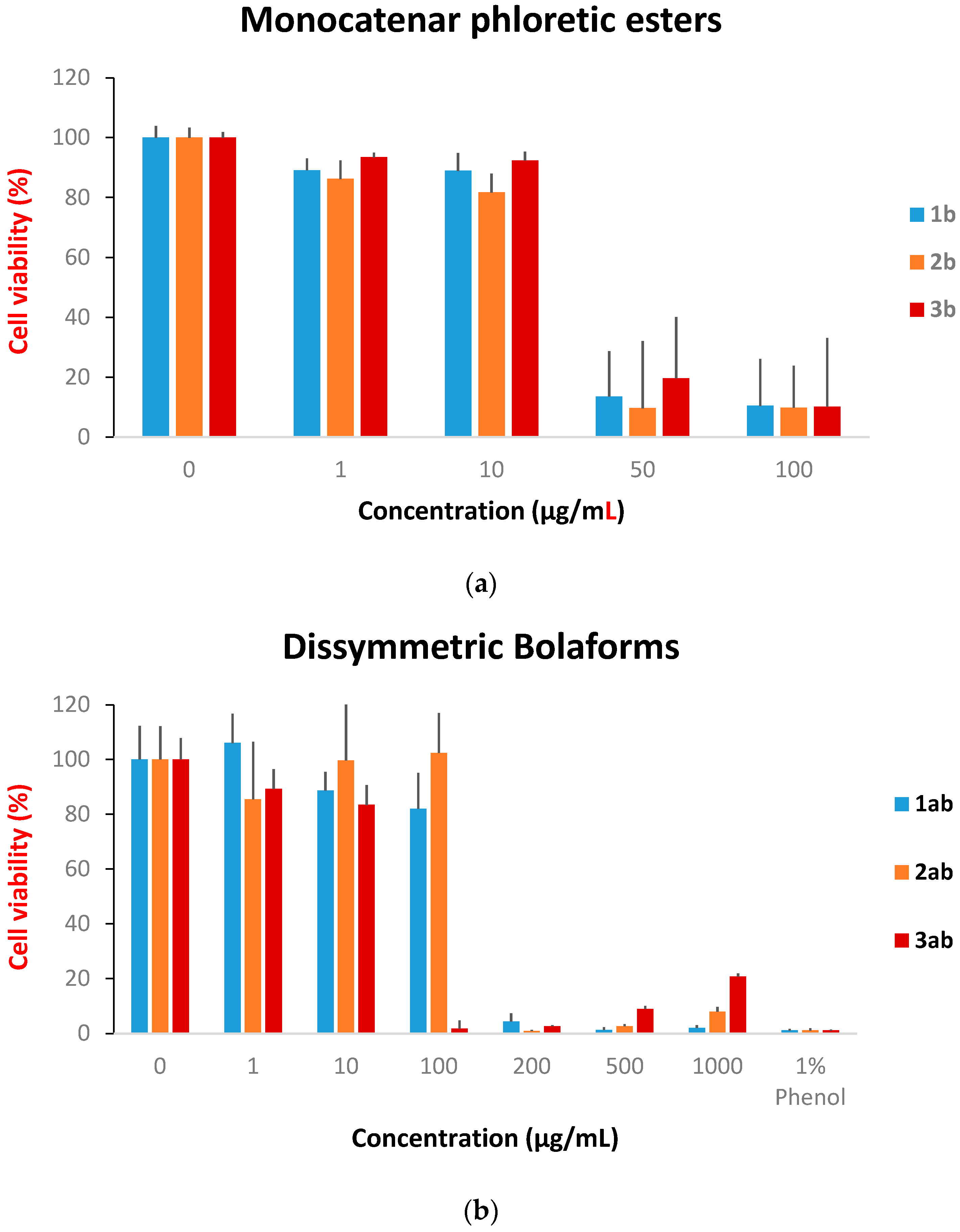
The preliminary in vitro study on dermal cells showed first, a large difference concerning the cytotoxicity between the monocatenar compounds derived from L-rhamnose and those derived from phloretic acid and secondly, the importance of the carbon chain length. Moreover, the boloform structures (always depending on the carbon chain length) seem to contribute to a reduction of the cytotoxic effect on dermal cells, even with bolaforms phloretic esters. Further tests on other cells will be carried out to confirm these results and the study will be extended to other phenolic esters.
3. Experimental
All reagents were commercially available and used as received. Solvents were dried and distilled under argon before use (CH2Cl2 over CaCl2 and THF over sodium/benzophenone) and stored over molecular sieves. The NMR spectra are recorded on a spectroscopic apparatus of the Bruker Avance Neo AC type (500 MHz for 1H, 126 MHz for 13C). The multiplicity of signals is cited according to: s: singlet; sl: large singlet; d: doublet; t: triplet; q: quadruplet; m: byte; dt: doublet of triplets; dd: doublet of doublets; ddd: doublet of doublets of doublets; td: triplet of doublets. The coupling constants (J) are expressed in Hertz (Hz). Chemical shifts (in ppm) for 1H and 13C NMR spectra were referenced to residual protic solvent peaks. Elemental analyses (C, H and N) were carried out on a PerkinElmer 2400 C, H and N element analyzer. IR spectra of liquid and solid compounds were recorded on a Bruker Alpha-T FTIR spectrometer at room temperature. 1H and 13C NMR spectra were recorded at room temperature with a Bruker AC 500 spectrometer (500 MHz for 1H, 62.5 MHz for 13C). The specific optical rotation ([α]20D) of rhamnosides and rhamnoside-based boloamphiphiles or fatty ester and rhamnoside-based asymmetric bolaamphiphiles were measured using polarimeter Anton Paar MCP 5100 at room temperature. Chromatography was carried out on SDS Silica 60 (40-63 nm), Art 2050044 (flash-chromatography) and using the Reveleris® X2 Flash Chromatography System from BUCHI. The microwaves oven is a monomode CEM DISCOVERS-CLASS.
Cytotoxicity Assays
Normal human dermal fibroblasts were purchased from Promocell (Heidelberg, Germany). They were grown in DMEM, supplemented with 10% fetal bovine serum (FBS) according to the manufacturer’s specifications, in Nunclon® 75 cm2 flasks (Dutscher Brumath, France) at 37 °C in a humid atmosphere containing 5% CO2.
For WST-1 assay, cells were seeded in sterile 96-well microtiter plates (1 × 10,000 cells/well) and were allowed to settle for 24 h. Effectors were added to the cells at final concentrations ranging from 0 to 1000 µg/mL in DMEM supplemented with 0,5% FBS. The cells were incubated for 48 h and the medium was replaced by fresh medium containing 10% Wst-1 reagent. Absorbance was measured at 450 nm using a microplate spectrophotometer (SPECTROstar® Nano, BMG Labtech, Champigny-sur-Marne, France) and cell viability was calculated. Results are expressed as the mean ± standard deviation (n=4).
General Procedure for the Preparation of Rhamnosides under Microwave Activation with Tetrahydrofuran (THF) or 2-methyltetrahydrofuran (2-MeTHF) as Solvent
In a microwave tube, a solution of L-rhamnose and unsaturated alcohol in THF or 2-MeTHF (5 mL) were added at 60 °C with paratoluene sulfonic acid (PTSA). The mixture was stirred (600 rpm) under microwave irradiation for 2 hours at a power of 60 W and a temperature of 60°C. After 2 hours of reaction; the reaction medium was neutralized with addition of a 0.5 M MeONa solution (≈ 26 mL). After evaporation under reduced pressure, the purification of rhamnosides was realized through Reveleris® X2 Flash Chromatography System by gradient elution of CH2Cl2 / MeOH mixture (8/2).
|
Hex-5’-enyl-α-L-rhamnopyranoside (1a) General Procedure for the preparation of the rhamnosides under microwave activation with L-rhamnose (2 g; 10.35 mmol; 1 eq), 5-Hexen-1-ol (5.27 ml; 41.4 mmol; 4 eq) and PTSA (1.25 g; 6.21 mmol; 0.6 eq). Compound 1a is obtained as a thick yellow liquid with a yield of 64 % (with THF) and 63 % (with 2-MeTHF). |
 |
| νmax (ATR) cm-1 : 3363 (OH), 2926-2856 (C-H), 1641 (C=C), 1384 (CH3), 1265-1231 (C-OHTert.). [α]20D (589 nm, MeOH) = -52.501 1H NMR (500 MHz; DMSO-d6, ppm) δ 1.25 (3H, d, J 7.5 Hz, H6’), 1.50 (2H, m, H3), 1.63 (2H, m, H2), 2.13 (2H, m, H4), 3.17 - 3.58 (5H, m, H1, H2’, H3’, H4’, H5’), 4.52-4.72 (3H, s, 3 OH), 4.98 (2H, d, J 7.2 Hz, H6), 5.80 (1H, m, H5). 13C NMR (125 MHz; DMSO-d6, ppm) δ 18.4 (C6’), 25.4 (C3), 29.1, 33.4 (C2, C4), 66.6 (C1), 68.9-73.9 (C2’, C3’, C4’, C5’), 100.6 (C1’), 115.3 (C6), 139.1 (C5). Analysis (%): calculated for: C12H22O5: C 58.52, H 9.02. Found: C 58.97, H 8.88. | |
|
Hept-6’-enyl-α-L-rhamnopyranoside (2a) General Procedure for the preparation of the rhamnosides under microwave activation with L-rhamnose (0.76 g; 3.93 mmol; 1 eq), 6-hepten-1-ol (3 ml; 15.72 mmol; 4 eq) and PTSA (1.25 g; 6.21 mmol; 0.6 eq). Compound 2a is obtained as a thick yellow liquid with a yield of 60 %. |
 |
| νmax (ATR) cm-1 : 3368 (OH), 2926-2856 (C-H), 1641 (C=C), 1382 (CH3),1227 (C-OHTert.). [α]20D (589 nm, MeOH) = -49.101 1H NMR (500 MHz; DMSO-d6, ppm) δ 1.13 (3H, d, J 7.5 Hz, H6’), 1.36 (4H, m, H3, H4), 1.50 (2H, m, H2), 2.02 (2H, m, H5), 3.17–3.56 (5H, m, H1, H2’, H3’, H4’, H5’), 4.52-4.73 (3H, s, 3 OH), 4.98 (2H, d, J 7.2 Hz, H7), 5.80 (1H, m, H6). 13C NMR (125 MHz; DMSO-d6, ppm) δ 18.38 (C6’), 25.7 (C4), 28.5, 29.3, 33.6 (C3, C2, C5), 66.8 (C1), 68.9-72.5 (C2’, C3’, C4’, C5’), 100.4 (C1’), 115.2 (C7), 139.2 (C6). Analysis (%): calculated for: C13H24O5: C 59.98, H 9.29. Found: C 59.71, H 9.14. | |
|
Oct-7’-enyl-α-L-rhamnopyranoside (3a) General Procedure for the preparation of the rhamnosides under microwave activation with L-rhamnose (0.6 g; 3.11 mmol; 1 eq), 7-octen-1-ol (2.52 ml; 12.4 mmol; 4 eq) and PTSA (1.25 g; 6.21 mmol; 0.6 eq). Compound 3a is obtained as a thick yellow liquid with a yield of 50 %. |
 |
| νmax (ATR) cm-1 : 3371 (OH), 2926-2856 (C-H), 1641 (C=C), 1381 (CH3),1231 (C-OHTert.). [α]20D (589 nm, MeOH) = -46.501 1H NMR (500 MHz; DMSO-d6, ppm) δ 1.13 (3H, d, J 7.5 Hz, H6’), 1.30 (6H, m, (H4, H3, H5), 2.02 (2H, m, H2), 3.18 (2H, m, H6), 3.36 - 3.58 (5H, m, H1, H2’, H3’, H4’, H5’), 4.53 - 5.02 (3H, s, 3 OH), 5.18 (2H, d, J 7.2 Hz, H8), 5.80 (1H, m, H7). 13C NMR (125 MHz; DMSO-d6) 18.4 (C6’), 26.0 (C4), 28.7, 28.8 29.5, 33.6 (C3, C5, C2, C6), 66.78 (C1), 68.9-72.5 (C2’, C3’, C4’, C5’), 100.4 (C1), 115.2 (C8), 139.3 (C7). Analysis (%): calculated for: C14H26O5: C 61.29, H 9.55. Found: C 60.83, H 9.41. | |
|
Non-8’-enyl-α-L-rhamnopyranoside (4a) General Procedure for the preparation of the rhamnosides under microwave activation with L-rhamnose (0.57 g; 2.95 mmol; 1 eq) and 8-nonen-1-ol (2.5 ml; 11.80 mmol; 4 eq), and PTSA (1.25 g; 6.21 mmol; 0.6 eq). Compound 4a is obtained as a thick yellow liquid with a yield of 53 %. |
 |
| νmax (ATR) cm-1 : 3367 (OH), 2926-2856 (C-H), 1641 (C=C), 1382 (CH3),1230 (C-OHTert.). [α]20D (589 nm, MeOH) = -45.001 1H NMR (500,1MHz; CD3OD) δ 1.13 (3H, d, J 7.5 Hz, H6’), 1.32 (8H, m, H5, H6, H4, H3), 1.50 (2H, m, H2), 2.02 (2H, m, H7), 3.15-3.54 (5H, m, H1, H2’, H3’, H4’, H5’), 4.51 - 5.06 (3H, s, 3 OH), 5.27 (2H, d, J 7.2 Hz, H9), 5.80 (1H, m, H8). 13C NMR (125 MHz; DMSO-d6) δ 18.4 (C6’), 26.0 (C5), 26.1, 28.8, 29.1, 29.6, 33.6 (C6, C4, C3, C2, C7), 66.8 (C1), 68.8-73.2 (C2’, C3’, C4’, C5’), 100.5 (C1), 115.1 (C9), 139.3 (C8). Analysis (%): calculated for: C15H28O5: C 62.47, H 9.79. Found: C 62.35, H 9.65. | |
|
Dec-9’-enyl-α-L-rhamno-pyranoside (5a) General Procedure for the preparation of the rhamnosides under microwave activation with L-rhamnose (0.53 g; 2.74 mmol; 1 eq), 9-decen-1-ol (2.5 ml; 10.96 mmol; 4 eq) and PTSA (1.25 g; 6.21 mmol; 0.6 eq). Compound 5a is obtained as a thick yellow liquid with a yield of 48 % (with THF) and 55 % (with 2-MeTHF). |
 |
| νmax (ATR) cm-1 : 3374 (OH), 2926-2856 (C-H), 1641 (C=C), 1382 (CH3),1229 (C-OHTert.). [α]20D (589 nm, MeOH) = -43.701 1H NMR (500,1MHz; CD3OD) δ 1.13 (3H, d, J 7.5 Hz, H6’), 1.32 (10H, m, H5, H6, H4, H7, H3), 1.50 (2H, m, H2), 2.02 (2H, m, H8), 3.15-3.54 (5H, m, H1, H2’, H3’, H4’, H5’), 4.15 - 4.54 (3H, s, 3 OH), 4.97 (2H, d, J 7.2 Hz, H10), 5.80 (1H, m, H9). 13C NMR (125 MHz; DMSO-d6) δ 18.4 (C6’), 26.1 (C5), 28.7, 28.9, 29.2, 29.3, 29.5, 33.6 (C6, C4, C7, C3, C2, C8), 66.8 (C1), 68.9-73.5 (C2’, C3’, C4’, C5’), 100.4 (C1’), 115.1 (C10), 139.3 (C9). Analysis (%): calculated for: C16H30O5: C 63.55, H 10.03. Found: C 63.16, H 9.82. | |
|
Undec-10’-enyl-α-L-rhamnopyranoside (6a) General Procedure for the preparation of the rhamnosides under microwave activation with L-rhamnose (0.5 g; 2.59 mmol; 1 eq), 10-undecen-1-ol (2.5 ml; 10.36 mmol; 4 eq) and PTSA (1.25 g; 6.21 mmol; 0.6 eq). Compound 6a is obtained as a thick yellow liquid with a yield of 47 %. |
 |
| νmax (ATR) cm-1 : 3366 (OH), 2926-2856 (C-H), 1641 (C=C), 1382 (CH3),1229 (C-OHTert.). [α]20D (589 nm, MeOH) = -37.001 1H NMR (500,1MHz; CD3OD) δ 1.13 (3H, d, J 7.5 Hz, H6’), 1.31 (12H, H6, H7, H5, H4, H8, H3), 1.50 (2H, m, H2), 2.01 (2H, m,H9), 3.08 - 3.54 (5H, m, H1, H2’, H3’, H4’, H5’), 4.52 - 4.72 (3H, s, 3 OH), 4.97 (2H, d, J 7.2 Hz, H11), 5.80 (1H, m, H10). 13C NMR (125 MHz; DMSO-d6) δ 18.4 (C6’), 26.1 (C6), 28.7, 28.9, 29.2, 29.3, 29.4, 29.5, 33.6 (C5, C7, C4, C8, C3, C2, C9), 66.80 (C1), 68.9-72.5 (C2’, C3’, C4’, C5’),100.6 (C1’),115.1 (C11), 139.3 (C10). Analysis (%): calculated for C17H32O5: C 64.53, H 10.19. Found: C 63.91, H 10.14. | |
General Procedure for the Preparation of Rhamnosides under Microwave Activation with Gamma-Valerolactone as Solvent
The solution of L-rhamnose and unsaturated alcohol (5-Hexen-1-ol or 9-decen-1-ol) in γ-valerolactone was stirred at 60 °C with PTSA (paratoluene sulfonic acid) in a microwave tube. The mixture was irradiated under microwave for 2 hours at a power of 60 W and a temperature of 60°C. After 2 hours, the crude was extracted with diethylether (60 mL) after the addition of a NaCl saturated solution (50 mL). The organic phase was dried over MgSO4 and evaporated under reduced pressure. The purification of rhamnosides was then realized through Reveleris® X2 Flash Chromatography System by gradient elution of a CH2Cl2 / MeOH mixture.
Compound 1a was obtained as a thick yellow liquid with a yield of 66 % from L-rhamnose (2 g; 10.35 mmol; 1 eq), 5-Hexen-1-ol (5.27 ml; 41.4 mmol; 4 eq), 1.25 g of PTSA (6.21 mmol; 0.6 eq) and γ-valerolactone (5 ml).
Compound 5a was obtained as a thick yellow liquid with a yield of 73 % from L-rhamnose (1 g; 5.18 mmol; 1 eq), 9-decen-1-ol (3.75 ml; 20.7 mmol; 4 eq), 0.62 g of PTSA (3.11 mmol; 0.6 eq) and γ-valerolactone (2.5 ml).
General Procedure for the Preparation of Rhamnoside-Based Boloamphiphiles under Microwave Activation
The rhamnoside was dissolved in a mixture CH2Cl2 / MeOH (8/2 mL) in a microwave tube under argon and the Grubbs II catalyst was added in three portions over the whole reaction time. The mixture was irradiated under microwave for 40 minutes at a power of 60 W and a temperature of 60°C. After 40 minutes of reaction, the reaction medium was treated with activated charcoal to remove the residual Grubbs catalyst or derivatives and filtered through celite. After evaporation, the residue was purified by Reveleris® X2 Flash Chromatography System with an elution mixture CH2Cl2 / MeOH (9/1) during 45 minutes.
|
1’,10’-bis-dec-5’-eny-L-rhamnopyranoside (7a) General Procedure for the preparation of the rhamnoside-based bolaamphiphiles with compound 1a (1.5 g, 6.09 mmol, 1eq.) under microwave activation with Grubbs II catalyst (0.5 g, 0.6 mmol; 0.1 eq.) dissolved in 10 ml CH2Cl2/MeOH. Compound 7a is obtained as a brown paste with a yield of 77 %. |
 |
| νmax (ATR) cm-1 : 3347 (OH), 2971-2901 (C-H), 1634 (C=C), 1384 (CH3),1128-1048 (C-O-C). [α]20D (589 nm, MeOH) = -34.801 1H NMR (500 MHz; DMSO-d6, ppm) δ 1.24 (6H, d, J 7.5 Hz, H6’), 1.48 (4H, m, H3), 1.61 (4H, m, H2), 2.17(4H, m, H4), 3.56-3.12 (10H, m, H1, H2’, H3’, H4’, H5’), 4.70-4.48 (6H, s, 6 OH), 5.78 (2H, d, J 7.2 Hz, H5). 13C NMR (125 MHz; DMSO-d6, ppm) δ 18.3 (2 C6’), 23.6 (2C3), 30.1, 33.2 (2 C2, 2 C4), 64.3 (2 C1), 67.6-71.9 (2 C2’, 2 C3’, 2 C4’, 2 C5’), 102.1 (2 C1’), 130.1 (CH2CH(Z)=CH(Z)CH2), 130.6 (CH2CH(E)=CH(E)CH2). Analysis (%): calculated for C22H40O10: C 56.88, H 8.68. Found: C 56.47, H 8.96. | |
|
1’,12’-bis-dodec-6’-enyl-L-rhamnopyranoside (8a) General Procedure for the preparation of the rhamnoside-based bolaamphiphiles with compound 2a (0.7 g, 2.69 mmol, 1eq.) under microwave activation with Grubbs II catalyst (0.2 g, 0.27 mmol; 0.1 eq.) dissolved in 10 ml CH2Cl2/MeOH. Compound 8a is obtained as a brown paste with a yield of 60 %. |
 |
| νmax (ATR) cm-1 : 3342 (OH), 2970-2913 (C-H), 1632 (C=C), 1386 (CH3), 1124-1051 (C-O-C). [α]20D (589 nm, MeOH) = -41.301 1H NMR (500 MHz; DMSO-d6, ppm) δ 1.14 (6H, d, J 7.5 Hz, H6’), 1.38 (8H, m, H3, H4), 1.51 (4H, m, H2), 2.07(4H, m, H5), 3.36-3.18(10H, m, H1, H2’, H3’, H4’, H5’), 4.71-4.58 (6H, s, 6 OH), 5.78 (2H, d, J 7.2 Hz, H5). 13C NMR (125 MHz; DMSO-d6, ppm) δ 17.3 (2 C6’), 25.6 (2 C3), 29.0, 29.4, 33.6 (2 C3, 2 C2, 2 C5), 65.1 (2 C1), 68.6-72.6 (2 C2’, 2 C3’, 2 C4’, 2 C5’), 100.2 (2 C1’), 138.0 (CH2CH(Z)=CH(Z)CH2), 138.1 (CH2CH(E)=CH(E)CH2). Analysis (%): calculated for: C24H44O10: C 58.52, H 9.00. Found: C 58.87, H 9.19. | |
|
1’, 18’-bis-octadec-9’-enyl -L-rhamnopyranoside (9a) General Procedure for the preparation of the rhamnoside-based bolaamphiphiles with compound 5a (1.45 g, 4.80 mmol, 1eq.) under microwave activation with Grubbs II catalyst (0.4 g, 0.48 mmol; 0.1 eq.) dissolved in 10 ml CH2Cl2/MeOH. Compound 9a is obtained as a brown paste with a yield of 56 %. |
 |
| νmax (ATR) cm-1 : 3345 (OH), 2971-2922 (C-H), 1634 (C=C), 1382 (CH3), 1127-1051 (C-O-C). [α]20D (589 nm, MeOH) = -32.601 1H NMR (500 MHz; DMSO-d6, ppm) δ 1.13 (6H, d, J 7.5 Hz, H6’), 1.34 (20H, m, H3, H4, H5, H6, H7), 1.51 (4H, m, H2), 2.09 (4H, m, H8), 3.16-3.58 (10H, m, H1, H2’, H3’, H4’, H5’), 4.31-4.58 (6H, s, 6 OH), 5.70 (2H, d, J 7.2 Hz, H9). 13C NMR (125 MHz; DMSO-d6, ppm) δ 18.3 (2 C6’), 26.2 (2 C5), 28.6, 28.9, 29.4, 29.7, 33.8 (2 C3, 2 C2, 2 C4, 2 C5, 2 C6, 2 C7, 2 C8), 66.8 (2 C1), 68.7 - 72.9 (2 C2’, 2 C3’, 2 C4’, 2 C5’), 100.4 (2 C1’), 130.1 (CH2CH(Z)=CH(Z)CH2), 130.5 (CH2CH(E)=CH(E)CH2). Analysis (%): calculated for C30H56O10: C 62.47, H 9.79. Found: C 62.11, H 9.29. | |
|
1’, 20’-bis-eicosa-10’-enyl- L-rhamnopyranoside (10a) General Procedure for the preparation of the rhamnoside-based bolaamphiphiles with compound 6a (1.09 g, 3.60 mmol, 1eq.) under microwave activation with Grubbs II catalyst (0.3 g, 0.36 mmol; 0.1 eq.) dissolved in 10 ml CH2Cl2/MeOH. Compound 10a is obtained as a brown paste with a yield of 32 %. |
 |
| νmax (ATR) cm-1 : 3338 (OH), 2968-2919 (C-H), 1632 (C=C), 1381 (CH3), 1124-1053 (C-O-C). [α]20D (589 nm, MeOH) = -35.001 1H NMR (500 MHz; DMSO-d6, ppm) δ 1.18 (6H, d, J 7.5 Hz, H6’), 1.39 (24H, m, H3, H4, H5, H6, H7, H8), 1.57 (4H, m, H2), 2.15 (4H, m, H9), 3.19-3.61 (10H, m, H1, H2’, H3’, H4’, H5’), 4.28-4.47 (6H, s, 6 OH), 5.74 (2H, d, J 7.2 Hz, H10). 13C NMR (125 MHz; DMSO-d6, ppm) δ 17.5 (2 C6’), 24.9 (2 C5), 27.4, 28.8, 29.1, 29.8, 32.5, 35.0 (2 C3, 2 C2, 2 C4, 2 C5, 2 C6, 2 C7, 2 C8, 2 C9), 66.5 (2 C1), 70.1 - 73.0 (2 C2’, 2 C3’, 2 C4’, 2 C5’), 107.3 (2 C1’), 131.3 (CH2CH(Z)=CH(Z)CH2), 133.1 (CH2CH(E)=CH(E)CH2). Analysis (%): calculated for C32H60O10: C 63.55, H 10.00. Found: C 63.41, H 9.89. | |
General Procedure for the Hydrogenation of Monocatenar Unsaturated Rhamnosides
The unsaturated rhamnoside (1 eq) were dissolved in 4 mL of ethanol under Argon atmosphere. After 10 min stirring, palladium on activated charcoal (Pd/C, 10% w/w, 0.02 eq.) were added and the solution was stirred 10 min again under argon atmosphere before being submitted to a H2 flow until completion (24 hours at room temperature). Once the reaction was completed, the reaction mixture was filtered through Celite. The obtained solution was then evaporated under reduced pressure. Saturated rhamnoside were obtained with quantitative yields.
|
Decyl-α-L-rhamno-pyranoside (5a’) General Procedure for hydrogenation of monocatenar unsaturated rhamnosides with unsaturated L-rhamnoside 5a (0.4 g; 2.04 mmol; 1 eq), palladium on activated charcoal (4.6 mg ; 0.02 eq) and 4 ml ethanol. Compound 5a’ is obtained as a thick yellow liquid with a quantitative yield. |
 |
| νmax (ATR) cm-1 : 3373 (OH), 2928-2854 (C-H), 1381 (CH3), 1227 (C-OHTert.). [α]20D (589 nm, MeOH) = -43.501 1H NMR (500,1MHz; CD3OD) δ 0.86 (3H, t, J = 7.5 Hz, H10);1.14 (3H, d, J 7.5 Hz, H6’), 1.32 (10H, m, H3, H4, H5, H6, H7, H8, H9), 1.51 (2H, m, H2), 3.14-3.56 (5H, m, H1, H2’, H3’, H4’, H5’), 4.12 - 4.57 (3H, s, 3 OH). 13C NMR (125 MHz; DMSO-d6) δ 14.1 (C10), 18.4 (C6’), 28.7, 28.9, 29.2, 29.3, 29.5, 33.6 (C9, C8, C7, C6, C5, C4, C3), 46.2 (C2), 66.8 (C1), 68.9-73.5 (C2’, C3’, C4’, C5’), 100.4 (C1’). Analysis (%): calculated for: C16H32O5: C 63.13, H 10.60. Found: C 63.32, H 10.72. | |
|
Undecyl-α-L-rhamnopyranoside (6a’) General Procedure for the hydrogenation of monocatenar unsaturated rhamnosides with unsaturated L-rhamnoside 6a (4 g; 2.34 mmol; 1eq), palladium on activated charcoal (4.4 mg; Pd/C 10 % w/w; 0.02 eq) Compound 6a’ was obtained as a thick yellow liquid with a quantitative yield. |
 |
| νmax (ATR) cm-1: 3375 (OH), 2927-2854 (C-H), 1383 (CH3),1228 (C-OHTert.). [α]20D (589 nm, MeOH) = -37.03 1H NMR (500,1MHz; CD3OD) δ 0.85 (3H, t, J = 7.5 Hz, H11); 1.17 (3H, d, J 7.5 Hz, H6’), 1.34 (10H, m, H3, H4, H5, H6, H7, H8, H9, H10), 1.54 (2H, m, H2), 3.16-3.67 (5H, m, H1, H2’, H3’, H4’, H5’), 4.14 - 4.55 (3H, s, 3 OH). 13C NMR (125 MHz; DMSO-d6) δ 13.6 (C11), 18.3 (C6’), 27.5, 28.6, 28.9, 29.7, 30.5, 33.9 (C10, C9, C8, C7, C6, C5, C4, C3), 48.1 (C2), 67.1 (C1), 69.8-75.5 (C2’, C3’, C4’, C5’), 103.4 (C1’). Analysis (%): calculated for: C17H34O5: C 64.12, H 10.76. Found: C 64.25, H 10.64. | |
General Procedure for the Preparation of Monocatenar Esters Derived from Phenolic Acids
In a 250 mL flask bicol were dissolved phenolic acid (6 eq.) and unsaturated alcohol (1 eq.) in a solvent (2-methyl-2-butanol, or 2-methyl-2-butanol/THF or acetone depending on the nature of the phenolic acid) under magnetic stirring. The resulting mixture was heated at 60°C in presence of 3Ǻ molecular sieves (50 g.L-1). After adding appropriate amount of enzyme (2.5 g per 100 g of reaction mixture), the mixture was stirred for 48 hours. Once the reaction was completed, the reaction mixture was filtered through celite to remove the enzyme; the resulting solution was evaporated under reduced pressure and the residue purified on silica gel by Reveleris® X2 Flash Chromatography System with eluting a gradient petroleum ether / ethyl acetate.
|
Hex-5’-enyl-3-(4-hydroxyphenyl)propionic (1b) General Procedure for the preparation of the monocatenar ester with 5-hexen-1-ol (0.7 ml; 6.53 mmol; 1 eq) and 3-(4-hydroxyphenyl)propionic acid (6.50 g; 39.18 mmol; 6 eq) in 60 ml of 2-methyl-2-butanol. Compound 1b was obtained as a clear oil with a yield of 95%. |
 |
| νmax (ATR) cm-1 : 3397 (OH), 2932 (C-H), 1732 (C=O), 1614 (C=C) 1H NMR (500 MHz; CD3OD, ppm) δ 1.36 (2H, broad, H3), 1.55 (2H, broad, H4), 2.03 (2H, broad, H2), 2.54 (2H, t, J 7.2 Hz, H2’), 2.77 (2H, t, J 7.2 Hz, H1’), 4.01 (2H, t, J 7.2 Hz, H1), 4.98 (2H, broad, H6), 5.78 (1H, broad, H5), 6.73 (2H, d, J 10 Hz, H4’, H8’), 7.00 (2H, d, J 10 Hz, H5’, H7’). 13C NMR (125 MHz; DMSO-d6, ppm) δ 25.0 (C3), 28.1 (C4), 30.0 (C2), 33.2 (C2’), 36.0 (C1’), 64.0 (C1),115.4 (C4’, C8’), 115.5 (C5’, C7’), 129.5 (C6), 131.0 (C5), 138.9 (C3’), 156.1 (C6’), 172.8 (C=O). Analysis (%): calculated for C15H20O3: C 72.55, H 8.12. Found: C 72.93, H 8.46. | |
|
Hept-6’-enyl-3-(4-hydroxyphenyl)propionic (2b) General Procedure for the preparation of the monocatenar ester with 5-hepten-1-ol (0.47 ml; 3.01 mmol; 1 eq) and 3-(4-hydroxyphenyl)propionic acid (3 g; 18.05 mmol; 6 eq) in 60 ml of 2-methyl-2-butanol. Compound 2b was obtained as a clear oil with a yield of 88%. |
 |
| νmax (ATR) cm-1 : 3392 (OH), 2930 (C-H), 1732 (C=O), 1614 (C=C) 1H NMR (500 MHz; CD3OD, ppm) δ 1.29 (2H, m, H4), 1.38 (2H, m, H3), 1.56 (2H, m, H5), 2.03 (2H, m, H2), 2.55 (2H, t, J 7.2 Hz, H2’), 2.74 (2H, t, J 7.2 Hz, H1’), 3.98 (2H, t, J 7.2 Hz, H1), 5.03 (2H, m, H7), 5.83 (1H, m, H6), 6.66 (2H, d, J 10 Hz, H5’, H7’), 7.02 (2H, d, J 10 Hz, H4’, H8’) 13C NMR (125 MHz; DMSO-d6, ppm) δ 25.3 (C4), 28.3 (C3), 28.4 (C5), 30.0 (C2), 33.5 (C2’), 36.0 (C1’), 64.1 (C1),115.2 (C7), 115.5 (C4’, C8’), 129.5 (C5’, C7’), 131.0 (C3’), 139.1 (C6), 156.1 (C6’), 172.8 (C=O). Analysis (%): calculated for C16 H22O3: C 73.25, H 8.45. Found: C 72.93, H 8.24. | |
|
Dec-9’-enyl-3-(4-hydroxyphenyl)propionic (3b) General Procedure for the preparation of the monocatenar ester with 9-decen-1-ol (1.2 ml; 3.01 mmol; 1 eq) and 3-(4-hydroxyphenyl)propionic acid (6,51 g; 18.06 mmol; 6 eq) in 60 ml of 2-methyl-2-butanol. Compound 3b was obtained as a clear oil with a yield of 96%. |
 |
| νmax (ATR) cm-1 : 3397 (OH), 2925 (C-H), 1733 (C=O), 1614 (C=C) 1H NMR (500 MHz; CD3OD, ppm) δ 1.26 (8H, m, H4, H5, H6, H7), 1.36 (2H, m, H3), 1.55 (2H, m, H8), 2.04 (2H, m, H2), 2.54 (2H, t, J 7.2 Hz, H2’), 2.77 (2H, t, J 7.2 Hz, H1’), 4.00 (2H, t,J 7.2 Hz, H1), 5.00 (2H, m, H10), 5.83 (1H, m, H9), 6.71 (2H, d, J 10 Hz, H5’, H7’), 6.99 (2H, d, J 10 Hz, H4’, H8’). 13C NMR (125 MHz; DMSO-d6, ppm) δ 25.8 (C5), 28.6 (C6), 28.8 (C4), 28.9 (C7), 29.1 (C3), 29.2 (C8), 30.1 (C2), 33.7 (C2’), 36.1 (C1’), 64.2 (C1), 115.0 (C10), 115.5 (C4’, C8’), 129.5 (C5’, C7’), 130.9 (C3’), 139.2 (C9), 156.1 (C6’), 172.7 (C=O). Analysis (%): calculated for C19 H28O3: C 74.96, H 9.27. Found: C 75.13, H 9.03. | |
|
Undec-10′-enyl-3-(4-hydroxyphenyl)propionic (4b) General procedure for the preparation of the fatty esters with 36.83 mmol of 3-(4-hydroxyphenyl)propionic acid (6.12 g; 6 eq.) and 6.14 mmol of 10-undecen-1-ol (1.045 g; 1 eq.). Compound 4b was obtained as a bright oil with a yield of 79%. |
 |
| νmax (ATR) cm-1 : 3387 (OH), 2931 (C-H), 1732 (C=O), 1613 (C=C) 1H NMR (500 MHz; CD3OD, ppm) δ 1.24 (8H, m, H4, H5, H6, H7, H8), 1.34 (2H, m, H3), 1.58 (2H, m, H9), 2.07 (2H, m, H2), 2.51 (2H, t, J 7.2 Hz, H2’), 2.74 (2H, t, J 7.2 Hz, C1’), 3.97 (2H, t,J 7.2 Hz, H1), 5.21 (2H, m, C11), 5.81 (1H, m, H10), 6.65 (2H, d, J 10 Hz, H5’, H7’), 7.09 (2H, d, J 10 Hz, H4’, H8’). 13C NMR (125 MHz; DMSO-d6, ppm) δ 24.8 (C5), 28.1 (C6), 28.5 (C4), 28.8 (C7), 29.1 (C3), 29.2 (C8), 30.0 (C9), 30.1 (C2), 33.5 (C2’), 35.3 (C1’), 65.1 (C1), 114.0 (C11), 115.6 (C4’, C8’), 130.0 (C5’, C7’), 130.7 (C3’), 140.0 (C10), 154.6 (C6’), 172.1 (C=O). Analysis (%): calculated for C20 H30O3: C 75.43, H 9.50. Found: C 75.37, H 9.49. | |
|
Hex-5’-enyl-3-(4-hydroxyphenyl)prop-2-enoic (5b) General Procedure for the preparation of the monocatenar ester with 5-hexen-1-ol (0.36 ml; 3.04 mmol; 1 eq) and p-coumaric acid (3.28 g; 18.21 mmol; 6 eq) in 40 ml of 2-methyl-2-butanol. Compound 5b was obtained as a pale yellow oil with a yield of 70 %. |
 |
| νmax (ATR) cm-1 : 3397 (OH), 2932 (C-H), 1732 (C=O), 1614 (-CH=CH2-), 1668 (Phenyl-CH=CH-COO) 1H NMR (500 MHz; CD3OD, ppm) δ 1.51 (2H, m, H3), 1.75 (2H, m, H4), 2.15 (2H, m, H2), 4.25 (2H, t, J 7.2 Hz, H1), 5.01 (2H, m, H6), 5.80 (1H, m, H5), 6.35 (1H, d, J 7.2 Hz, H1’), 6.80 (2H, d, J 7.2 Hz, H7’, H5’), 7.40 (1H, d, J 7.2 Hz, H1’), 7.65 (2H, d, J 7.2 Hz, H4’, H8’). 13C NMR (125 MHz; DMSO-d6, ppm) δ 23.2 (C3), 25.2 (C4), 34.2 (C2), 68.3 (C1), 114.2 (C6), 115.0 (C1’), 127.3 (C5), 130.1 (C7’, C5’), 140.1 (C8’, C4’), 145.0 (C3’), 158.0 (C6’), 168.4 (C=O). Analysis (%): calculated for C15H18O3: C 73.15, H 7.37. Found: C 72.77, H 7.66. | |
|
Dec-9’-enyl-3-(4-hydroxyphenyl)prop-2-enoïc (6b) General Procedure for the preparation of the monocatenar ester with 9-decen-1-ol (0.57 ml; 3.2 mmol; 1 eq) and para-coumaric acid (3.15 g; 19.2 mmol; 6 eq) in 40 ml of 2-methyl-2-butanol. Compound 6b was obtained a yellow oil with a yield of 74 %. |
 |
| νmax (ATR) cm-1 : 3397 (OH), 2932 (C-H), 1732 (C=O), 1612 (-CH=CH2-), 1665 (Phenyl-CH=CH-COO) 1H NMR (500 MHz; CD3OD, ppm) δ 11.22 (8H, m, H4, H5, H6, H7), 1.70 (2H, m, H3), 2.10 (2H, m, H8), 3.75 (2H, m, H2), 4.20 (2H, t, J 7.2 Hz, H1), 5.01 (2H, d, J 7.2 Hz, H10), 5.81 (1H, m, H9), 6.32 (1H, d, J 7.2 Hz, H1’), 6.80 (2H, d, J 10 Hz, H7’, H5’), 7.43 (1H, d, J 7.2 Hz, H2’), 7.65 (2H, d, J 10 Hz, H4’, H8’). 13C NMR (125 MHz; DMSO-d6, ppm) δ 25.1 (C5), 27.5 (C6), 28.4 (C4), 28.9 (C7), 29.1 (C3), 29.5 (C8), 34.0 (C2), 77.2 (C1), 114.1 (C10), 115.2 (C1’), 116.0 (C9), 127.1 (C5’, C7’), 130.3 (C4’, C8’), 140.2 (C9), 145.1 (C2’), 158.7 (C6’), 168.9 (C=O). Analysis (%): calculated for C19 H26O3: C 75.46, H 8.67. Found: C 75.67, H 9.21. | |
|
Hex-5’-enyl-3-(3,5-dihydroxyphenyl)prop-2-enoic (7b) General Procedure for the preparation of the monocatenar ester with 5-hexen-1-ol (0.36 ml; 3.04 mmol; 1 eq) and para-coumaric acid (3.28 g; 18.24 mmol; 6 eq) in 30 ml of 2-methyl-2-butanol/THF (10/20). Compound 7b was obtained a pale yellow oil with a yield of 52 %. |
 |
| νmax (ATR) cm-1 : 3390 (OH), 2930 (C-H), 1734 (C=O), 1615 (-CH=CH2-), 1664 (Phenyl-CH=CH-COO)1H NMR (500 MHz; CD3OD, ppm) δ 1.59 (2H, m, H3), 1.61 (2H, m, H2), 2.21 (2H, m, H4), 4.22 (2H, t, J 7.2 Hz, H1), 5.05 (2H, d, J 7.2 Hz, H6), 5.12 (1H, d, J 7.2 Hz, H1’), 5.85 (1H, m, H5), 6.36 (2H, d, J 7.2 Hz, H2’), 6.79 (1H, d, J 7.2 Hz, H8’), 6.94 (1H, d, J 7.2 Hz, H7’), 7.18 (1H, s, C4’), 7.50 (1H, d, J 7.2 Hz, C2’). 13C NMR (125 MHz; DMSO-d6, ppm) δ 24.9 (C3), 25.4 (C4), 33.9 (C2), 65.1 (C1), 115.2 (C6), 116.4 (C1’), 117.1 (C7’), 122.2 (C8’), 128.1 (C3’), 139.0 (C5), 144.2 (C4’), 147.2 (C5’, C6’), 167.4 (C=O). Analysis (%): calculated for C15H18O4: C 68.69, H 6.92. Found: C 68.24, H 7.98. | |
|
Dec-9’-enyl-3-(4-hydroxyphenyl)prop-2-enoic (8b) General Procedure for the preparation of the monocatenar ester with 9-decen-1-ol (0.74 ml; 3.7 mmol; 1 eq) and para-coumaric acid (4 g; 19.20 mmol; 6 eq) in 30 ml of 2-methyl-2-butanol/THF (10/20). Compound 8b was obtained a pale yellow oil with a yield of 45 %. |
 |
| νmax (ATR) cm-1 : 3375(OH), 2926 (C-H), 1731 (C=O), 1614 (-CH=CH2-), 1661 (Phenyl-CH=CH-COO) 1H NMR (500 MHz; CD3OD, ppm) δ 1.28 (8H, m, H4, H5, H6, H7), 1.44 (2H, m, H3), 1.62 (2H, m, H2), 2.18 (2H, m, H8), 3.99 (2H, t, J 7.2 Hz, H1), 5.02 (2H, d, J 7.2 Hz, H10), 5.17 (1H, d, J 7.2 Hz, H1’), 5.83 (1H, m, H9), 6.30 (1H, d, J 10 Hz, H8’), 6.79 (1H, d, J 7.2 Hz, H7’), 6.95 (1H, d, J 7.2 Hz, H4’), 7.49 (1H, d, J 7.2 Hz, H2’). 13C NMR (125 MHz; DMSO-d6, ppm) δ 25.52 (C5), 29.32, 29.57, 31.16, 32.48 (C6, C4, C7, C3), 32.97 (C2), 33.93 (C8), 65.31 (C1), 115.25 (C10), 116.48 (C1’), 117.16 (C3’), 122.12 (C8’), 128.17 (C7’), 129.18 (C4’), 139.13 (C9), 144.95 (C1’), 147.23 (C5’, C6’), 167.13 (C=O). Analysis (%): calculated for C19H26O4: C 71.67, H 8.23. Found: C 71.91, H 8.66. | |
|
Hex-5’-enyl-3-(3,5-dimethoxy-4-hydroxyphenyl)prop-2-enoic (9b) General Procedure for the preparation of the monocatenar ester with 5-hexen-1-ol (1 ml; 0.74 mmol; 1 eq) and sinapic acid (1 g; 4.44 mmol; 6 eq) in 30 ml of acetone. Compound 9b was obtained an orange-yellow oil with a yield of 40 %. |
 |
| νmax (ATR) cm-1 : 3392 (OH), 2934 (C-H), 1732 (C=O), 1612 (-CH=CH2-), 1665 (Phenyl-CH=CH-COO). 1H NMR (500 MHz; CD3OD, ppm) δ .58 (2H, m, H3), 1.62 (2H, m, H2), 2.19 (2H, m, H4), 3.83 (6H, t, J 7.2 Hz, (CH3-O)2-Phenyl), 3.99 (2H, d, J 7.2 Hz, H1), 5.12 (1 H, d, J 7.2 Hz, H6), 5.82 (1H, m, H1’), 6.32 (1H, d, J 7.2 Hz, H5), 6.72 (2H, s, H4’, H8’), 7.48 (1H, d, J 7.2 Hz, H2’). 13C NMR (125 MHz; DMSO-d6, ppm) δ 25.2 (C3), 25.6 (C2), 33.7 (C4), 56.3 ((CH3-O)2-Phenyl), 65.1 (C1), 108.2 (C6), 115.2 (C1’), 116.1 (C3’), 126.1 (C4’, C8’), 136.0 (C6’),139.2 (C5), 146.3 (C2’), 148.1 (C5’, C7’), 167.9 (C=O). Analysis (%): calculated for C17H22O5: C 66.65, H 7.24. Found: C 66.39, H 7.62. | |
|
Hex-5’-enyl-3-(4-hydroxy-3-méthoxyphényl)prop-2-enoïc (10b) General Procedure for the preparation of the monocatenar ester with 5-hexen-1-ol (0.7 ml; 6.53 mmol; 1 eq) and ferulic acid or 3-(4-hydroxy-3-methoxyphenyl)prop-2-enoic (7.61 mg; 39.2 mmol; 6 eq) in 60 ml of 2-methyl-2-butanol. Compound 10b was obtained as a clear oil with a yield of 52%. |
 |
| νmax (ATR) cm-1 : 3392(OH), 2927 (C-H), 1713 (C=O), 1659-1640 (CH=CH2), 1688-1664 (Phenyl-CH=CH-COO) 1H NMR (500 MHz; CD3OD, ppm) δ 1.48 (2H, m, H3), 1.67 (2H, m, H4), 2.09 (2H, m, H2), 3.82 (3H, s, CH3-O-Phenyl), 4.14 (2H, t, J 7.2 Hz, H1), 5.05 (2H, m, H6), 5.86 (1H, m, H5), 6.49 (1H, d, J 7.2 Hz, H7’), 6.80 (1H, d, J 7.2 Hz, H1’), 7.13 (1H, d, J 7.2 Hz, H2’), 7.33 (1H, s, H4’), 7.56 (1H, d, J 7.2, H8’). 13C NMR (125 MHz; DMSO-d6, ppm) δ 25.2 (C3), 28.3 (C4), 33.2 (C2), 56.2 (CH3-O-Phenyl), 64.0 (C1), 111.6 (C7’), 114.9 (C1’), 115.5 (C6), 115.9 (C4’), 123.6 (C2’), 126.0 (C3’), 138.9 (C5), 145.4 (C8’), 149.8 (C6’), 148.4 (C5’), 167.2 (C=O). Analysis (%): calculated for C16H20O4: C 69.55, H 7.30. Found: C 69.73, H 7.52. | |
|
Dec-9’-enyl-3-enyl-3-(4-hydroxy-3-méthoxyphényl)prop-2-enoïc (11b) General Procedure for the preparation of the monocatenar ester with 9-decen-1-ol (1.2 ml; 3.01 mmol; 1 eq) and 3-(4-hydroxy-3-methoxyphenyl)prop-2-enoic acid (3,51 mg; 18.06 mmol; 6 eq) in 60 ml of 2-methyl-2-butanol. Compound 11b was obtained as a clear oil with a yield of 52%. |
 |
| νmax (ATR) cm-1 : 3394 (OH), 2926 (C-H), 1724 (C=O), 1660-1640 (CH=CH2), 1690-1664 (Phenyl-CH=CH-COO). 1H NMR (500 MHz; CD3OD, ppm) δ 1.33 (8H, m, H4, H5, H6, H7), 1.55 (2H, m, H3), 1.63 (2H, m, H8), 2.02 (2H, m, H2), 3.82 (3H, s, CH3-O-Phenyl), 4.12 (2H, t, J 7.2 Hz, H1), 4.99 (2H, m, H10), 5.82 (1H, m, H9), 6.47 (1H, d, J 7.2 Hz, H7’), 6.80 (1H, d, J 7.2 Hz, H1’), 7.11 (1H, d, J 7.2 Hz, H2’), 7.31 (1H, s, H4’), 7.56 (1H, d, J 7.2, H8’). 13C NMR (125 MHz; DMSO-d6, ppm) δ 28.9 (C5), 28.9 (C6), 29.0 (C4), 29.1 (C7), 29.2 (C3), 29.3 (C8), 33.6 (C2), 56.1 (CH3-O-Phenyl), 64.2 (C1), 111.5 (C7’), 114.9 (C1’), 115.0 (C6), 115.9 (C4’), 123.5 (C2’), 126.0 (C3’), 139.2 (C5), 145.4 (C8’), 148.4 (C6’), 149.8 (C5’), 167.1 (C=O). Analysis (%): calculated for C20H28O4: C 72.26, H 8.49. Found: C 71.92, H 8.64. | |
General Procedure for the Preparation of the Fatty Ester-Based Bolaamphiphiles under Microwave Activation
In a microwave tube was dissolved the fatty ester in CH2Cl2 (10 ml) under argon and the Grubbs II catalyst was then added in three portions over the whole reaction time. The mixture was irradiated for 40 minutes at a power of 60 W and a temperature of 60°C. After 40 minutes of reaction, the reaction medium was treated with activated charcoal to remove the Grubbs catalyst and filtered through celite. After evaporation of the solvent under reduced pressure, the residue was purified by Flash Chromatography System coupled to a UV detector with elution mixture CH2Cl2 / MeOH (9/1) during 35 minutes.
|
1’, 10’-bis-dec-5’-enyl-3-(4-hydroxyphenyl)propionic ester (12b) General Procedure for the preparation of the fatty ester-based bolaamphiphiles with compound 1b (1 g, 4.03 mmol, 1 eq.) under microwave activation with Grubbs II catalyst (0.34 g, 0.403 mmol; 0.1 eq.) dissolved in 10 ml CH2Cl2. Compound 12b is obtained as a brown paste with a yield of 56 %. |
 |
| νmax (ATR) cm-1 : 3385 (OH), 2927 - 2855 (C-H), 1730 (C=O), 1614 (C=C) 1H NMR (500 MHz; CD3OD, ppm) δ 1.27-1.36 (12H, m, 2C3, 2C4, 2C2), 2.51 (4H, t, J 7.2 Hz, 2C2’), 2.74 (4H, t, J 7.2 Hz, 2C1’), 3.98 (4H, t, J 7.2 Hz, 2C1), 5.74 (2H, d, J 7.2 Hz, 2C5), 6.71 (4H, d, J 10 Hz, 2C4’, 2C8’), 6.96 (4H, d, J 10 Hz, 2C5’, 2C7’). 13C NMR (125 MHz; DMSO-d6, ppm) δ 25.9 (2 C3), 28.2 (2 C4), 30.1 (2 C2), 33.4 (2 C2’), 36.4 (2 C1’), 64.2 (2 C1),116.2 (2 C4’, 2 C8’), 129.5 (2 C5’, 2 C7’), 130.1 (2 C3’), 130.5 (CH2CH(Z)=CH(Z)CH2), 130.9 (CH2CH(E)=CH(E)CH2), 156.1 (2 C6’), 172.8 (C=O). Analysis (%): calculated for: C28H36O6: C 71.77, H 7.74. Found: C 72.04, H 7.44 %. | |
|
1’, 12’-bis-dodec-6’-enyl-3-(4-hydroxyphenyl)propionic ester (13b) General Procedure for the preparation of the fatty ester-based bolaamphiphiles with compound 2b (0.45 g, 1.72 mmol, 1 eq.) under microwave activation with Grubbs II catalyst (0.15 g, 0.172 mmol; 0.1 eq.) dissolved in 10 ml CH2Cl2. Compound 13b is obtained as a brown paste with a yield of 48 %. |
 |
| νmax (ATR) cm-1 : 3374 (OH), 2923 - 2835 (C-H), 1732 (C=O), 1621 (C=C). 1H NMR (500 MHz; CD3OD, ppm) δ 1.28-1.32 (12H, m, H3, H4, H5, H2), 2.53 (4H, t, J 7.2 Hz, H2’), 2.72 (4H, t, J 7.2 Hz, H1’), 4.08 (4H, t, J 7.2 Hz, H1), 5.84 (2H, d, J 7.2 Hz, H6), 6.73 (4H, d, J 10 Hz, H4’, H8’), 6.92 (4H, d, J 10 Hz, H5’, H7’). 13C NMR (125 MHz; DMSO-d6, ppm) δ 25.9 (2C3), 28.3 (2 C4), 28.6 (2 C5), 32.2 (2 C2), 33.58 (2 C2’), 36.04 (2 C1’), 64.25 (2 C1),115.18 (2 C4’, 2 C8’), 129.4 (2 C5’, 2 C7’), 130.2 (2C3’), 130.5 (CH2CH(Z)=CH(Z)CH2), 130.9 (CH2CH(E)=CH(E)CH2), 156.2 (2 C6’), 173.0 (C=O). Analysis (%): calculated for C30H40O6: C 72.55, H 8.12. Found: C 72.06, H 7.93. | |
|
1’, 18’-bis-octadec-9’-enyl-3-(4-hydroxyphenyl)propionic ester (14b) General Procedure for the preparation of the fatty ester-based bolaamphiphiles with compound 3b (1 g, 3.29 mmol, 1 eq.) under microwave activation with Grubbs II catalyst (0.28 g, 0.329 mmol; 0.1 eq.) dissolved in 10 ml CH2Cl2. Compound 14b is obtained as a brown paste with a yield of 60 %. |
 |
| νmax (ATR) cm-1 : 3383 (OH), 2927 - 2854 (C-H), 1731 (C=O), 1614 (C=C). 1H NMR (500 MHz; CD3OD, ppm) δ 1.29 (20H, m, H3, H4, H5, H6, H7), 1.51 (4H, m, J 7.2 Hz, H2), 1.94 (4H, t, J 7.2 Hz, H8), 2.53 (4H, t, J 7.2 Hz, H1’), 2.72 (4H, t, J 7.2 Hz, H2’), 3.97 (4H, t, J 10 Hz, H1), 5.36 (2H, t, J 7.2 Hz, H9), 6.65 (4H, d, J 10 Hz, H5’, H7’), 6.90 (4H, d, J 10 Hz, H4’, H8’). 13C NMR (125 MHz; DMSO-d6, ppm) δ 28.9 (2 C5), 29.1 (2 C6), 29.2 (2 C4), 29.4 (2 C7), 29.4 (2 C3), 30.0 (2 C8), 32.4 (2 C2), 32.4 (2 C2’), 36.0 (2 C1’), 64.2 (2 C1), 115.5 (2 C4’, 2 C8’), 129.5 (2 C5’, 2 C7’), 130.1 (2 C3’), 130.5 (CH2CH(Z)=CH(Z)CH2), 130.9 (CH2CH(E)=CH(E)CH2), 156.1 (C6’), 172.8 (C=O). Analysis (%): calculated for C36H52O6: C 74.45, H 9.02. Found: C 74.07, H 8.78. | |
|
1’, 10’-bis-dec-5’-enyl-3-(4-hydroxyphenyl)prop-2-enoic (15b) General Procedure for the preparation of the fatty ester-based bolaamphiphiles with compound 4b (0.1 g, 4.06 mmol, 1eq.) under microwave activation with Grubbs II catalyst (0.35 g, 0.406 mmol; 0.1 eq.) dissolved in 10 ml CH2Cl2. Compound 14b is obtained as a brown paste with a yield of 42 %. |
 |
| νmax (ATR) cm-1 : 3395 (OH), 2937 (C-H), 1731 (C=O), 1614 (C=C), 1668 (Phenyl-CH=CH-COO). 1H NMR (500 MHz; CD3OD, ppm) δ 1.25-1.51 (12H, m, H3, H4, H2), 4.25 (4H, t, J 7.2 Hz, H1), 5.48 (2H, t, J 7.2 Hz, H5), 6.30 (2H, d, J 7.2 Hz, H2’), 6.81 (4H, d, J 10 Hz, H5’, H7’), 7.30 (2H, d, J 7.2 Hz, H1’), 7.74 (4, d, 10 Hz, H4’, H8’). 13C NMR (125 MHz; DMSO-d6, ppm) δ 24.1 (2 C3), 25.1 (2 C4), 31.3 (2 C2), 32.2 (2 C2’), 65.3 (2 C1), 114.1 (2 C2’), 1115.0 (2 C5’, 2 C7’), 127.2 (2 C3’), 129.6 (2 C4’, 2 C8’), 130.1 (CH2CH(Z)=CH(Z)CH2), 130.3 (CH2CH(E)=CH(E)CH2), 145.4 (2 C6’), 158.2 (2 C1’), 170.5 (C=O). Analysis (%): calculated for C28H32O6: C 72.39, H 6.94. Found: C 72.82, H 7.21. | |
General Procedure for the Preparation of the Unsymmetrical Fatty Ester- and Rhamnoside-Based Bolaamphiphiles by Classic Heating
The rhamnoside-based bolaamphiphile and the fatty ester were dissolved in CH2Cl2 (35 ml) / MeOH (5 ml) in a Schlenk tube under argon and the Grubbs II catalyst was added in three portions over the whole reaction time. The mixture was irradiated at a temperature of 45 °C. After 24 h of reaction, the reaction medium was treated with activated charcoal to remove the Grubbs catalyst and filtered through celite. After evaporation, the residue was purified by Flash Chromatography System coupled to a UV detector with elution mixture CH2Cl2 / MeOH (9/1) during 45 minutes.
|
1’,10’-bis-dec-5’-enyl-3-(4-hydroxyphenyl)propionicacid–α–L-rhamnopyranoside (1ab) General Procedure for the preparation of the unsymmetrical fatty ester- and rhamnoside-based bolaamphiphiles with compound 6a (1 g, 2.15 mmol, 2 eq.) and compound 1b (0.267 g, 1.080 mmol) under argon with Grubbs II catalyst (0.09 g, 0.108 mmol; 0.05 eq.) dissolved in 40 ml CH2Cl2/MeOH (35/5). Compound 1ab is obtained as a brown paste with a yield of 65 %. |
 |
| νmax (ATR) cm-1 : 3353 (OH), 2928(C-H), 1732 (C=O), 1615 (C=C). [α]20D (589 nm, MeOH) = -26.601. 1H NMR (500 MHz; DMSO-d6, ppm) δ 1.27 (3H, d, J 7.5 Hz, H6’-ose), 1.41 (4H, m, H3), 1.83 (4H, m, H2), 2.15 (4H, m, H4), 2.53 (2H, t, J 7.2 Hz, H2’-acid), 2.72 (2H, t, J 7.2 Hz, H1’-acid), 3.12 – 3.54 (5H, m, H1’-ose, C2’-ose, C3’-ose, C4’-ose, C5’-ose), 4.01 (2H, t, J 7.2 Hz, H1-acid), 4.52-4.72 (3H, s, 3 OH-ose), 5.76 (2H, t, J 7.2 Hz, 2 H5-C=C-), 6.71 (2H, d, J 10 Hz, H4’, H8’), 6.98 (2H, d, J 10 Hz, H5’, H7’). 13C NMR (125 MHz; DMSO-d6, ppm) δ 17.7 (C6’-ose), 25.8 (2 C3), 28.6, 31.7 (2 C2, 2 C4), 32.9 (C2’-acid), 36.1 (C1’-acid), 63.9 (C1-acid), 66.3 (C1-ose), 68.7-74.1 (C2’-ose, C3’-ose, C4’-ose, C5’-ose), 100.4 (C1’-ose), 115.4 (C4’-acid, C8’-acid), 115.5 (C5’-acid, C7’-acid), 131.0 (CH2CH(Z)=CH(Z)CH2), 131.5 (CH2CH(E)=CH(E)CH2), 136.3 (C3’), 156.1 (C6’), 172.8 (C=O). Analysis (%): calculated for C25H38O8: C 64.36, H 8.21. Found: C 64.09, H 8.57. | |
|
1’,12’-bis-dodec-6’-enyl-3-(4-hydroxyphenyl)propionicacid–α–L-rhamnopyranoside (2ab) General Procedure for the preparation of the unsymmetrical fatty ester- and rhamnoside-based bolaamphiphiles with compound 7a (0.20 g, 0.4 mmol, 2 eq.) and compound 2b (0.053 g, 0.2 mmol) under argon with Grubbs II catalyst (0.017 g, 0.02 mmol; 0.05 eq.) dissolved in 40 ml CH2Cl2/MeOH (35/5). Compound 2ab is obtained as a brown paste with a yield of 42 %. |
 |
| νmax (ATR) cm-1 : 3351 (OH), 2923(C-H), 1731 (C=O), 1614 (C=C). [α]20D (589 nm, MeOH) = -16.900. 1H NMR (500 MHz; DMSO-d6, ppm) δ 11.16 (3H, d, J 7.5 Hz, H6’-ose), 1.28 (4H, m, H4) 1.43 (4H, m, H3), 1.80 (4H, m, H2), 2.12 (4H, m, H4), 2.56 (2H, t, J 7.2 Hz, H2’-acid), 2.70 (2H, t, J 7.2 Hz, H1’-acid), 3.14 - 3.52 (5H, m, H1-ose, H2’-ose, H3’-ose, H4’-ose, H5’-ose), 4.13 (2H, t, J 7.2 Hz, H1-acid), 4.42-4.82 (3H, s, 3 OH-ose), 5.74 (2H, t, J 7.2 Hz, H5-C=C-), 6.67 (2H, d, J 10 Hz, H4’, H8’), 7.08 (2H, d, J 10 Hz, H5’, H7’). 13C NMR (125 MHz; DMSO-d6, ppm) δ 17.3 (C6’-ose), 25.4 (2 C4), 25.7 (2 C3), 28.6, 31.7 (2 C2, 2 C4), 32.8 (C2’-acid), 36.2 (C1’-acid), 63.9 (C1-acid), 66.1 (C1-ose), 68.5-74.1 (C2’-ose, C3’-ose, C4’-ose, C5’-ose), 100.6 (C1’-ose), 115.1 (C4’-acid, C8’-acid), 114.3 (C5’-acid, C7’-acid), 130.9 (CH2CH(Z)=CH(Z)CH2), 131.6 (CH2CH(E)=CH(E)CH2), 136.3 (C3’), 156.4 (C6’), 172.8 (C=O). Analysis (%): calculated for C27H42O8: C 65.56, H 8.56. Found: C 65.80, H 8.74. | |
|
1’,18’-bis-dodec-9’-enyl-3-(4-hydroxyphenyl)propionicacid–α–L-rhamnopyranoside (3ab) General Procedure for the preparation of the unsymmetrical fatty ester- and rhamnoside-based bolaamphiphiles with compound 8a (1 g, 1.73 mmol, 2 eq.) and compound 3b (0.264 g, 0.867 mmol) under argon with Grubbs II catalyst (0.074 g, 0.086 mmol; 0.05 eq.) dissolved in 40 ml CH2Cl2/MeOH (35/5). Compound 3ab is obtained as a brown paste with a yield of 68 %. |
 |
| νmax (ATR) cm-1 : 3353 (OH), 2925(C-H), 1732 (C=O), 1614 (C=C). [α]20D (589 nm, MeOH) = -32.601. 1H NMR (500 MHz; DMSO-d6, ppm) δ 1.12 (3H, d, J 7.5 Hz, H6’-ose), 1.34 (20H, m, H3, H4, H5, H6, H7), 1.52 (4H, m, H2), 2.03 (4H, m, H8), 2.51 (2H, t, J 7.2 Hz, H2’-acid), 2.74 (2H, t, J 7.2 Hz, H1’-acid), 3.18-3.47 (5H, m, H1-ose, H2’-ose, H3’-ose, H4’-ose, H5’-ose), 4.06 (2H, t, J 7.2 Hz, H1-acide), 4.13 - 4.51 (3H, s, 3 OH-ose), 5.81 (2H, t, J 7.2 Hz, H9-C=C-), 6.72 (2H, d, J 10 Hz, H4’, H8’), 7.02 (2H, d, J 10 Hz, H5’, H7’). 13C NMR (125 MHz; DMSO-d6, ppm) δ 18.3 (C6’-ose), 26.1, 28.7, 28.9, 29.2, 29.4 (2 C3, 2 C4, 2 C5, 2 C6, 2 C7), 29.4 (2 C2), 31.8 (2 C8), 33.4 (C2’-acid), 36.2 (C1’-acid), 64.2 (C1-acid), 66.8 (C1-ose), 68.8-73.5 (C2’-ose, C3’-ose, C4’-ose, C5’-ose), 100.7 (C1’-ose), 115.5 (C4’-acid, C8’-acid), 128.3 (C5’-acid, C7’-acid), 130.7 (CH2CH(Z)=CH(Z)CH2), 131.1 (CH2CH(E)=CH(E)CH2), 138.5 (C3’-acid),156.2 (C6’), 171.8 (C=O). Analysis (%): calculated for: C33 H54O8: C 68.48, H 9.40. Found: C 67.98, H 9.78. | |
|
1’,20’-bis-eicosa-10’-enyl-3-(4-hydroxyphenyl)propionicacid–α–L-rhamnopyranoside (4ab) General Procedure for the preparation of the unsymmetrical fatty ester- and rhamnoside-based bolaamphiphiles with compound 10a (0.5 g, 0.872 mmol, 2 eq.) and compound 4b (0.132 g, 0.437 mmol, 1 eq.) under argon with Grubbs II catalyst (0.017 g, 0.019 mmol; 0.05 eq.) dissolved in 40 ml CH2Cl2/MeOH (35/5). Compound 4ab is obtained as a brown paste with a yield of 46%. |
 |
| νmax (ATR) cm-1 : 3350 (OH), 2921(C-H), 1729 (C=O), 1612 (C=C). [α]20D (589 nm, MeOH) = - 20,300 1H NMR (500 MHz; DMSO-d6, ppm) δ 1.15 (3H, d, J 7.5 Hz, H6’-ose), 1.32 (24H, m, H3, H4, H5, H6, H7, H8), 1.50 (4H, m, H2), 2.31 (4H, m, H9), 2.58 (2H, t, J 7.2 Hz, H2’-acid), 2.73 (2H, t, J 7.2 Hz, H1’-acid), 3.14-3.52 (5H, m, H1-ose, H2’-ose, H3’-ose, H4’-ose, H5’-ose), 4.09 (2H, t, J 7.2 Hz, H1-acide), 4.15 - 4.73 (3H, s, 3 OH-ose), 5.95 (2H, t, J 7.2 Hz, H10-C=C-), 6.74 (2H, d, J 10 Hz, H4’, H8’), 7.08 (2H, d, J 10 Hz, H5’, H7’). 13C NMR (125 MHz; DMSO-d6, ppm) δ 17.5 (C6’-ose), 24.8, 27.6, 28.1, 28.9, 29.2, 29.3 (2 C3, 2 C4, 2 C5, 2 C6, 2 C7, 2 C8), 29.7 (2 C2), 32.1 (2 C9), 34.8 (C2’-acid), 36.1 (C1’-acid), 64.5 (C1-acid), 67.0 (C1-ose), 68.1-74.0 (C2’-ose, C3’-ose, C4’-ose, C5’-ose), 105.7 (C1’-ose), 115.0 (C4’-acid, C8’-acid), 129.2 (C5’-acid, C7’-acid), 130.6 (CH2CH(Z)=CH(Z)CH2), 131.1 (CH2CH(E)=CH(E)CH2), 137.7 (C3’-acid),154.5 (C6’), 171.8 (C=O). Analysis (%): calculated for: C35 H58O8: C 69.27, H 9.63. Found: C 69.38, H 9.71. | |
4. Conclusions
In this study, we have developed easy syntheses of 6 monocatenar and 4 bolaform rhamnosides, in respect with fundamental principles of green chemistry, which coupled with a Combiflash purification technique, allow to obtain compounds with good or very good yields. We have also prepared 10 phenolic acid esters by an esterification reaction and also 4 corresponding bolaforms via a cross-metathesis reaction, here again with good yields. 4 mixed bolaforms derived from phloretic esters and rhamnosides have been also easily prepared. Two monocatenar and one bolaform rhamnosides as well as a dissymmetrical bolaform (phloretic ester/rhamnoside) trigger innate immunity in Arabidopsis without being directly toxic to the microorganism.
Phenolic acid esters have also shown good antioxidant activities and cytotoxicities depending on the carbon chains used. The transformation into corresponding bolaforms or into mixed bolaforms associated with rhamnosides decreases their toxicity while keeping their antioxidant power. These aspects can therefore augur a potential use of these compounds in the field of cosmetics.
Subsequently to the eliciting properties observed, an in-depth study of the modes of action of these compounds on each plant of interest, prior to their use, will be interesting to manage in order to optimize their use in integrated pest management programs, as well as biophysical studies to better understand their interaction with the biomimetic plasma membrane of plants. Similar biophysical study on biomimetic membranes of skins have to be performed to induce a use in the cosmetics field. All these complementary studies are in progress.
References
- Ash, I.; Ash, M. in Encyclopedia of surfactants, Chemical Pub. Co. 1983.
- Damez, C.; Bouquillon, S.; Harakat, D.; Hénin, F.; Muzart, J.; Pezron, I.; Komunjer. L. Alkenyl and alkenoyl amphiphilic derivatives of D-xylose and their surfactant properties. Carbohydr. Res. 2007, 342, 154–163. [CrossRef]
- a) Montesinos, E.; Badosa, E.; Pla, M.; Montesinos, L.; Bonaterra, A. Biocontrol of Plant Disease: Recent Advances and Prospects in Plant Protection 2022, 121-147. b) Kumar, A.; Kumar Singh, S.; Kant, C.; Verma, H.; Kumar, D.; Pratap Singh, P.; Modi, A.; Droby, S.; Singh Kesawat, M.; Alavilli, H.; Kant Bhatia, S.; Dattatraya Saratale, G.; Ganesh Saratale, R.; Chung, S.M.; Kumar, M. Antioxidants 2021, 10, 1472–1498.
- a) Andree, H.; Hessel, J.F.; Meine, G.; Middelhauve, B.; Schmid, K. Alkyl Polyglycosides, technology, properties and applications, (Eds. K. Hill, W. Von Rybinski, G. Stoll,), VCH Publishers Inc., New York, 1996, 99-130. b) Naveen; K.; Rashmi. T.; "Characteristic and Application of Anionic Dimeric Surfactants: A Review" Tenside Surfactants Detergents 2019, 56, 172–179. c) Abe, M.; Schechter, D.; Schechter, R.S.; Wade, H.; Weerasooriya, U.; Yiv, S. Microemulsion formation with branched tail polyoxyethylene sulfonate surfactants J. Colloid Interface Sci.1986, 114, 342-356. d) Sunwoo, C.K.; Wade, W.H. Optimal Surfactant Structures for Cosurfactant-Free Microemulston Systems I. C16 and C14 Guerbet Alcohol Hydrophobes. J. Dispersion Sci. Technol.1992, 13, 491-514. e) Sanchez, J.; del Valle, M. Determination of Anionic Surfactants Employing Potentiometric Sensors-A Review. Crit. Rev. Anal.Chem. 2005, 35, 15–29.
- a) Gonçalves, R. A..; Holmberg, K.; Lindman, B. Cationic surfactants: A review. J. Mol. Liq. 2023, 375, 121335–121364. b) Kaler, E.W.; Herrington, K.L.; Murthy, A.K.; Zasadzinski, J.A. Phase Behavior and Structures of Mixtures of Anionic and Cationic Surfactants. J. Phys. Chem. 1992, 96, 6698–6707. c) Ahmady, A.R.; Hosseinzadeh, P.; Solouk, A.; Akbari, S.; Szulc, A.M.; Brycki, B.E. Cationic gemini surfactant properties, its potential as a promising bioapplication candidate, and strategies for improving its biocompatibility: A review. Adv. Colloid Interface Sci. 2022, 299, 102581–102609. d) Jesus, C.F.; Alves, A.A.S.; Fiuza, S.M.; Murtinho, D.; Antunes, F.E. Mini-review: Synthetic methods for the production of cationic sugar-based surfactants, J. Mol. Liq. 2021, 342, 117389–117398.
- Holmberg, K. in Handbook of applied surface and colloid chemistry, 2002.
- Benvegnu, T.; Sassi, J. F. Oligomannuronates from Seaweeds as Renewable Sources for the Development of Green Surfactants. Top. Curr. Chem. 2010, 294, 143–164.
- Farn R.J. in Chemistry and technology of surfactants, Wiley - blackwell, 2008.
- Gatard, S.; Nasir, M.N.; Deleu, M.; Klai, N.; Legrand, V.; Bouquillon, S. Bolaamphiphiles Derived from Alkenyl L-Rhamnosides and Alkenyl D-Xylosides: Importance of the Hydrophilic Head. Molecules, 2013, 18, 6101–6112. [CrossRef]
- Nasir, M.N.; Lins, L.; Crowet, J.M.; Ongena, M.; Dorey, S.; Dhondt-Cordelier, S.; Clément, C.; Bouquillon, S.; Haudrechy, A.; Sarazin, C.; Fauconnier, M.L.; Nott, K.; Deleu, M. Interactions of sugar-based bolaamphiphiles with biomimetic systems of plasma membranes Biochimie 2016, 130, 23–32.
- Mulligan, C.N. Recent advances in the environmental applications of biosurfactants. Curr. Opin. Colloid Interface Sci. 2009, 14, 372–378. [CrossRef]
- Deleu, M.; Paquot, M. From renewable vegetables resources to microorganisms: New trends in surfactants. C. R. Chim. 2004, 7, 641– 646. [CrossRef]
- Lin, S.C. Biosurfactants: Recent advances. J. Chem. Technol. Biotechnol. 1996, 66, 109–120. [CrossRef]
- Lang, S. Biological amphiphiles (microbial biosurfactants). Curr. Opin. Colloid Interface Sci. 2002, 7, 12–20. [CrossRef]
- Corma, A.; Hamid, S.B.A.; Iborra, S.; Velty, A. Surfactants from Biomass: A Two-Step Cascade Reaction for the Synthesis of Sorbitol Fatty Acid Esters Using Solid Acid Catalysts. ChemSusChem 2008, 1, 85–90. [CrossRef]
- Angyal, S. J. Complexes of Metal Cations with Carbohydrates in Solution Adv. Carbohydr. Chem. Biochem. 1989, 47, 1–43.
- Garelli-Calvet, R.; Brisset, F.; Godefroy, L.; Lattes, A. Alkyldiamides à double tête de sucre ou dérivé de sucre comme composés amphiphiles. Brevet Européen N° 0 541 467 A2, 1993, FR 9113851.
- Satgé, C.; Granet, R.; Verneuil, B.; Champavier, Y.; Krausz, P. Synthesis and properties of new bolaform and macrocyclic galactose-based surfactants obtained by olefin metathesis. Carbohydr. Res. 2004, 339, 1243–1254. [CrossRef]
- Dzulkefly, K.; Khoh, H.F.; Ahmad, F.B.H.; Adlie Ahmad, S.; Lim, W.H. Solvent-free esterification process for the synthesis of glucose bolaform surfactants. Orient. J. Chem. 2010, 26, 747–752.
- Obounou Akong, F.; Bouquillon, S. Efficient syntheses of bolaform surfactants from l-rhamnose and/or 3-(4-hydroxyphenyl)propionic acid. Green Chem. 2015, 17, 3290–3300.
- Stuerga, D. Microwave-material interaction and dielectric properties, key ingredients for mastery of chemical microwave process in Microwave in organic synthesis, second edition, Ed. A. Loupy, 2006, 1-61.
- Luzuriaga-Loaiza, W.P.; Schellenberger, R.; De Gaetano, Y.; Obounou Akong, F.; Villaume, S.; Crouzet, J.; Haudrechy, A.; Baillieul, F.; Clément, C.; Lins, L.; Allais, F.; Ongena, M.; Bouquillon, S.; Deleu, M.; Dorey, S. Synthetic Rhamnolipid Bolaforms trigger an innate immune response in Arabidopsis thaliana. Sci. Rep. 2018, 8, 8534–8547. [CrossRef]
- Perreux, L.; Loupy, A. A tentative rationalisation of microwave effects in organic synthesis according to the reaction medium, and mechanistic considerations. Tetrahedron, 2001, 57, 9199–9223.
- Bornaghi, F.L.; Poulsen, S.A. Microwave-accelerated Fischer glycosylation. Tetrahedron Lett. 2005, 46, 3485–3488.
- Kerkel, F.; Markiewicz, M.; Stolte, S.; Müller, C.; Kunz, W. The green platform molecule gamma-valerolactone - ecotoxicity, biodegradability, solvent properties, and potential applications. Green Chem. 2021, 23, 2962–2976.
- Dutta, S.; Yu, I.K.M.; Tsang, D.C.W.; Hau Ng, Y.; Sik Ok, Y.; Sherwood, J.; Clark, J.H. Green synthesis of gamma-valerolactone (GVL) through hydrogenation of biomass-derived levulinic acid using non-noble metal catalysts. Chem. Eng. J. 2019, 372, 992–1006. [CrossRef]
- a) Snoussi, M.; Trabelsi, N.; Dehmeni, A.; Benzekri, R.; Bouslama, L.; Hajlaoui, B.; Al-sieni, A.; Papetti, A. Phytochemical analysis, antimicrobial and antioxidant activities of Allium roseum var. odoratissimum (Desf.) Coss extracts. Ind. Crops Prod. 2016, 89, 533–542. b) Selka, A.; Moutombi, F.J.; N.; Jean-François, J.; Touaibia, M. Hydroxycinnamic Acids and Their Related Synthetic Analogs: An Update of Pharmacological Activities. Mini Rev. Med. Chem. 2022, 22, 1516–1544. c) Abazari, M.F.; Nasiri, N.; Karizi, S.Z.; Nejati, F.; Haghiaminjan, H.; Norouzi, S.; Piri, P.; Estakhr, L.; Faradonbeh, D.R.; Kohandani, M.; Daliri, K.; Sanadgol, N. An updated review of various medicinal applications of p-coumaric acid: From antioxidative and anti-inflammatory properties to effects on cell cycle and proliferation. Mini Rev. Med. Chem. 2021, 21, 2187–2201. d) Kaur, J.; Kaur, R. p-Coumaric Acid: A Naturally Occurring Chemical with Potential Therapeutic Applications. Curr. Org. Chem. 2022, 26, 1333–1349. e) Antonopoulou I.; Sapountzaki, E.; Rova, U.; Christakopoulos, P. Ferulic Acid from Plant Biomass: A Phytochemical With Promising Antiviral Properties. Front. Nutr. 2022, 8, Article 777576.
- a) Suárez-Escobedo, L.; Gotor-Fernández, V. Solvent role in the lipase-catalysed esterification of cinnamic acid and derivatives. Optimisation of the biotransformation conditions. Tetrahedron 2021, 8112, 131873–131879. b) Chen, H.C.; Twu, Y.K.; Chang, C.M.J.; Liu, Y.C.; Shieh, C.J. Optimized synthesis of lipase-catalyzed octyl caffeate by Novozym® 435. Industrial Crops and Products 2010, 32, 522–526.
- Kotha, S.; Dipak, M.K. Strategies and tactics in olefin metathesis Tetrahedron 2012, 68, 397–421.
- Connon S.J.; Blechert, S. Angew. Chem. Int. Ed. 2003, 42, 1900–1923.
- a) López-Alarcón, C.; Denicola, A. Evaluating the antioxidant capacity of natural products: A review on chemical and cellular-based assays. Anal. Chim. Acta 2013, 763, 1–10. b) Munteanu, I.G.; Apetrei, C. Analytical Methods Used in Determining Antioxidant Activity: A Review. Int. J. Mol. Sci. 2021, 22, 3380–3410.
- Ilyasov I.R.; Beloborodov, V.L.; Selivanova, I.A.; Terekhov, R.P. ABTS/PP Decolorization Assay of Antioxidant Capacity Reaction Pathways. Int. J. Mol. Sci. 2020, 21, 1131-1158. [CrossRef]
- Moussaoui, A.L.; Jawhari, F.Z.; Almehdi, A.M.; Elmsellem, H.; Benbrahim, K.F.; Bousta, D.; Bari, A. Antibacterial, antifungal and antioxidant activity of total polyphenols of Withania frutescens.L. Bioorg. Chem. 2019, 93, 103337–103346. [CrossRef]
- Sakurai, S.; Kawakami, Y.; Kuroki, M.; Gotoh, H. Structure/antioxidant activity (oxygen radical absorbance capacity) relationships of phenolic compounds. Struct. Chem. 2022, 33, 1055–1062. [CrossRef]
- Zheng, Y.; Karimi-Maleh, H.; Fu, L. Evaluation of Antioxidants Using Electrochemical Sensors: A Bibliometric Analysis. Sensors 2022, 22, 3238–3263. [CrossRef]
- Chaillou, L.L.; Nazareno, M.A. New Method to Determine Antioxidant Activity of Polyphenols. J. Agric. Food Chem. 2006, 54, 8397–8402. [CrossRef]
- a) Aziz, A.; Kapoor, D. Salicylic Acid: It’s Physiological Role and Interactions. Research J. Pharm. and Tech. 2018, 11, 3171-3177. b) Ullah, C.; Chen, Y.H.; Ortega, M.A.; Tsai, C.J. The diversity of salicylic acid biosynthesis and defense signaling in plants: Knowledge gaps and future opportunities. Curr. Opin. Plant Biol. 2023, 72, 102349.
- Blaser, H.U.; Malan, C.; Pugin, B.; Spindler, F.; Steiner, H.; Studer, M. Selective Hydrogenation for Fine Chemicals: Recent Trends and New Developments. Adv. Synth. Catal. 2003, 345, 103–151. [CrossRef]
- Ishiyama, I.; Shiga, M.; Sasamoto, K. A new sulfonated tetrazolium salt that produces a highly water-soluble formazan dye. Chem. Pharm. Bull. 1993, 41, 1118-1122. [CrossRef]
- Fink, S.L.; Cookson, B.T. Apoptosis, pyroptosis, and necrosis: Mechanistic description of dead and dying eukaryotic cells. Infect Immun. 2005, 73, 1907-1916. [CrossRef]
- Paolinia,A.; Porredon Guarch, C.; Ramos-López, D.; de Lapuente, J.; Lascialfari, A.; Guari, Y.; Larionova, J.; Long, J.; Nano, J. Rhamnose-coated superparamagnetic iron-oxide nanoparticles: An evaluation of their in vitro cytotoxicity, genotoxicity and carcinogenicity. J. Appl. Toxicol. 2016, 36, 510–520.
- Chen, Y.; Wang, G.; Wang, H.; Cheng, C.; Zang, G.; Guo, X.; Liu, R.H. Phytochemical Profiles and Antioxidant Activities in Six Species of Ramie Leaves. PLoS ONE 2014, 9, e108140. [CrossRef]
Disclaimer/Publisher’s Note: The statements, opinions and data contained in all publications are solely those of the individual author(s) and contributor(s) and not of MDPI and/or the editor(s). MDPI and/or the editor(s) disclaim responsibility for any injury to people or property resulting from any ideas, methods, instructions or products referred to in the content. |
© 2023 by the authors. Licensee MDPI, Basel, Switzerland. This article is an open access article distributed under the terms and conditions of the Creative Commons Attribution (CC BY) license (http://creativecommons.org/licenses/by/4.0/).
Copyright: This open access article is published under a Creative Commons CC BY 4.0 license, which permit the free download, distribution, and reuse, provided that the author and preprint are cited in any reuse.


