

Submitted:
17 August 2023
Posted:
18 August 2023
You are already at the latest version
Abstract
Background: ChatGPT is becoming a new reality. Where do we go from here? Objective: to show how we can distinguish ChatGPT-generated publications from counterparts produced by scientist. Methods:By means of a new algorithm, called xFakeBibs, we show the significant difference between ChatGPT-generated fake publications and real publications. Specifically, we triggered ChatGPT to generate 100 publications that were related to Alzheimer’s disease and comorbidity. Using TF-IDF, using the real publications, we constructed a training network of bigrams comprised of 100 publications. Using 10-folds of 100 publications each, we also 10 calibrating networks to derive lower/upper bounds for classifying articles as real or fake. The final step was to test xFakeBibs against each of the ChatGPT-generated articles and predict its class. The algorithm successfully assigned the POSITIVE label for real ones and NEGATIVE for fake ones. Results: When comparing the bigrams of the training set against all the other 10 calibrating folds, we found that the similarities fluctuated between (19%-21%). On the other hand, the mere bigram similarity from the ChatGPT was only (8%). Additionally, when testing how the various bigrams generated from the calibrating 10-folds against ChatGPT we found that all 10 calibrating folds contributed (51%-70%) of new bigrams, while ChatGPT contributed only 23%, which is less than 50% of any of the other 10 calibrating folds. The final classification results using the xFakeBibs set a lower/upper bound of (21.96-24.93) number of new edges to the training mode without contributing new nodes. Using this calibration range, the algorithm predicted 98 of the 100 publications as fake, while 2 articles failed the test and were classified as real publications. Conclusions: This work provided clear evidence of how to distinguish, in bulk ChatGPT-generated fake publications from real publications. Also, we also introduced an algorithmic approach that detected fake articles with a high degree of accuracy. However, it remains challenging to detect all fake records. ChatGPT may seem to be a useful tool, but it certainly presents a threat to our authentic knowledge and real science. This work is indeed a step in the right direction to counter fake science and misinformation.
Keywords:
ChatGPT
; Generative AI
; Fake Publications
; Human-Generated Publications
; Supervised Learning
; ML Algorithm
; Fake Science
; NeoNet Algorithm
Introduction
With ChatGPT [1] being a new reality, our world is in a controversial state. On the one hand, there is a camp of optimists that sees potential and seeks to utilize it. On the other hand, there are doubters who remain skeptical and search for validation and further assessments to decide how this new paradigm affects our lives. This split provided a strong motivation for this work and triggered the effort of providing an assessment tool for fake publications generated by ChatGPT. Without any doubt, real science (and publications) is one of the most sacred sources of knowledge. That is because it is an invaluable source for any future discovery [2,3,4]. The spread of various predatory journals has contributed to fake science and caused it to be on the rise [5,6,7,8]. With the influence of social media, the impact is far-reaching [9,10]. Particularly, during the Coronavirus global pandemic, the propagation of misinformation that surrounded the significance of vaccination had led people to reject it, putting others at harm [11,12,13]. Another disturbing example that occurred also during the pandemic was the propagation of an article that reported fake results about how the deficiency of vitamin D had led to the death of 99 percent of the population studied. Though the article was eventually withdrawn, the damage of misinformation was magnified by a DailyMail news article and made it reach globally [14,15]. It is crucial to protect the authenticity of the scientific work recorded in publications from fraud or any influential factors that make it an untrusted source of knowledge.
Here, we demonstrate how the emergence of ChatGPT (and many other Generative AI tools) has, in many ways, impacted our society today: (1) the launch of many special issues and themes to study, assess, analyze, and test the impact and the potential of ChatGPT [16,17,18,19,20], (2) the adoption of new policies by journals regarding ChatGPT authorship [21,22,23,24,25], (3) the development of ChatGPT plugins, and inclusion in professional services such as Expedia and Slack [26], (4) the development of educational tools (e.g., Wolfram); and the potential of developing learning and educational support tools (e.g., Medical Licensing Examination [27].)
Contribution
The main contribution of this article two items: (1) the introduction of a bigram network analysis approach that distinguishes between contents of real science coming from real publications and simulated publications created by ChatGPT, (2) The introduction of a network-based supervised machine learning algorithm to detect fake articles from real articles conducted by real scientists.
Results
The results of this paper were derived from two distinct types of experiments: (1) Analyzing the dataset of ChatGPT-generated publications in bulk, and (2) classifying the articles to detect each individual one using the xFakeBibs algorithm and confirming it as fake. In the first type of experiments, we examined both the content and the network structures generated from the article bigrams.
The Outcome of ChatGPT Bigram Analysis
Table 1 presents a comprehensive overview of summary statistics obtained from comparing the quantities of bigrams produced by the 10-folds dataset against ChatGPT-generated bigrams. The "Data Source" column specifies which of the 10-folds from the ChatGPT data is being referred to. The subsequent column records the count of overlapping bigrams in comparison with the training dataset. The subsequent column gauges the overlap’s percentage relative to the size of the dataset it pertains to. The final column compiles the overlap percentage, offering a depiction of similarity between all 10-folds and ChatGPT.
The count of overlapping bigrams across all 10-folds varied from 178 to 202 bigrams, whereas ChatGPT exhibited 81 bigram overlaps against the training data. This is succinctly expressed as a similarity percentage of 19% to 22% for all 10 folds, while ChatGPT’s similarity amounted to only 9%.
These statistics are visually represented in the barplot depicted in Figure 1. The X-axis denotes the data source (10-Folds and ChatGPT), while the Y-axis signifies the actual number of nodes contributed by each source. The barplot distinctly illustrates a significant disparity between the 10-folds of genuine publications and the fake publications generated by ChatGPT.
The Structural Analysis of ChatGPT Bigram Network
The bigrams of each source offer a network model which can be further analyzed for their structure. In Table 2, we present the result of this analysis. The columns capture the Data Source of the bigrams that made up the networks (training, calibrating folds, and ChatGPT), The Number of Nodes of each network, Number of Edges of each source, size of the Largest Connected Components (s-LLC), and Percentage of new edges that contributed to the LLC without adding new nodes. The results indicate that the connected component percentages that were generated from the 10-folds lie between (51%-70%), and ChatGPT scored only 23%. Clearly, there is a serious deficit of the ChatGPT contribution to the structure of the training model by at least approximately 50%.
In Figure 2 we summarized the full statistics represented by the number of nodes, the number of edges, and the size of connected components. This figure shows an interesting behavior of how the sizes of the connected components were very closely clustered together, while the size of ChatGPT connected components (represented by a blue dot at the bottom left of each plot) looked isolated and appeared to be an insignificant anomaly. Figure 3 shows a piechart that demonstrates the different sizes of the LLC of each data source. The ChatGPT contributes a much smaller slice when it is compared with all other 10-folds.
Classification of ChatGPT Fake Articles
On average, each article from the calibrating folds introduced around 21.96 to 25.12 new bigrams that impacted the training model. This established a threshold range for identifying genuine articles, with the lower bound set at 21.96 and the upper bound at 25.12. The scores for each of the calibrating folds are displayed in Table 3, offering insight into the computation of these lower and upper bounds for the classification process.
The xFakeBibs algorithm successfully identified 98 ChatGPT-generated articles that exceeded these bounds, indicating they were likely fake. Interestingly, 2 ChatGPT articles managed to remain within the acceptable of being real range and went undetected. In Figure 4, we visually represent the number of bigrams contributed by each article, which in turn influenced the training model for every fold. The figure also highlights the consistency of the calibrated folds, showing their similar behavior and alignment, while ChatGPT’s contributions appear as an anomaly.
Methods
Data Collection
We utilized two distinct datasets: (1) for training and calibrating the algorithm, we queried PubMed for "Alzheimer’s Disease and comorbidities" and gathered 1000 abstracts of publications that are human-produced; (2) for detecting ChatGPT articles, we instructed ChatGPT (version GPT-3.5) to generate 100 abstracts also related to “Alzheimer’s disease and comorbidities.” Both datasets underwent preprocessing using the same mechanism to handle data noise and stop words.
Code Availability
Both the datasets and the code required for executing the algorithm have been included as part of the supplementary material. The algorithms are fully implemented using the Python programming language, and we have provided a detailed step-by-step guide for execution using Jupyter Notebook.
Exploratory Analysis of ChatGPT Articles
To distinguish ChatGPT-generated content from real publications, we conducted two different types of analyses: (1) using an equal number of records, we compared the Term Frequency-Inverse Document Frequency (TFIDF) [28,29,30,31,32,33] of bigrams generated from the two sources (ChatGPT records, PubMed records), and (2) since bigrams provide a natural mechanism to form networks (where the words in the bigrams act as nodes and the edge represents the bigram relationship), we analyzed these networks from a structural point of view.
ChatGPT Bigram-Similarity Analysis
Bigrams are any two consecutive words that may prove significant in any given text-based dataset [34,35]. Using the Term Frequency-Inverse Term Frequency (TF-IDF) approach, we generated bigrams from three different types of resources: (1) a training dataset, which comprises 100 real publications, (2) a calibration using 10 folds, each containing 100 publications, and (3) the classification of 100 publications generated using ChatGPT. We compared the TF-IDF scores of the training dataset with all the calibrating 10 folds to establish lower/upper bounds for testing against the ChatGPT-generated fake articles. We computed the bigram similarities that overlapped between the training dataset and the calibrations. This process was repeated to test the bigram similarities generated from ChatGPT content against the 10-fold calibrations. The similarity ratios from the two comparisons revealed significant differences between the bigrams of real publications and the bigrams of ChatGPT-generated publications. Figure 5 presents a side-by-side WordCloud comparison of TF-IDF bigrams, where the left side represents real publications, while the right side displays bigrams generated from ChatGPT-generated fake records. Although phrases like "Alzheimer’s disease" and "cognitive impairment" appear in both real publications and ChatGPT records, they are assigned different weights and rankings. Table 4 displays the scoring of the top 4 color-coded bigrams with their similarities.
ChatGPT Network Structural Analysis
In addition to the bigram similarity analysis mentioned above, we also leveraged the natural mechanism for constructing networks using connected pairs of words [15,36]. When all the bigrams are linked together, each word can be connected to multiple other words. This forms a network where the nodes are words, and the edge semantics is the bigram predicate. The purpose of this analysis is to study a specific structural property of the ChatGPT bigram network and compare it with bigram networks generated from real publications. The main idea is to measure the largest connected components (LCC) of each type of network and observe whether there is a significant difference between the networks generated from ChatGPT contents when compared against the networks of real publications. The LCC presents an admissible characteristic that represents the bigram networks. This is due to the availability of large degree nodes, which ensures the stability and robustness of the networks [37].
Here, we computed the LCC of the training model to establish a baseline of comparison. We then proceeded by computing the LCCs of all the 10-folds, one-fold at a time, to establish calibration. The final step was to compute the LCC of the ChatGPT network of bigrams to test against the calibration. The calibration process is outlined in a step-by-step manner in Algorithm 1 as follows:
| Algorithm 1 The calibration steps involve computing using 10 individual folds for comparison against the training baseline. |
|
Classification of ChatGPT Fake Articles
The above analysis demonstrated how fake ChatGPT publications are fundamentally different in content and structure when compared to real publications. Although the analysis succeeded in discriminating against those 100 generated publications, it does not solve the problem of detecting a single fake article. In this section, we address this issue by introducing our newly designed algorithm, which we call xFakeBibs. Previous work has attempted to address the problem of detecting fake science and news, especially during the Coronavirus pandemic and the associated infodemic. However, we believe it suffered from the unavailability of comprehensive fake publication datasets [15]. Another subsequent issue was the lack of model calibration and a proper data-driven mechanism to identify a lower-upper bound for classifying individual publication instances. Here, we present the xFakeBibs algorithm that is specialized in classifying fake publications, particularly those generated using ChatGPT. We train the algorithm using a partition of 100 publications selected from the Alzheimer’s dataset based on the TF-IDF bigrams generated earlier. This step is followed by a calibration process to compute the lower-upper bound scores. Algorithm provides the is a detailed steps involved in this process:
| Algorithm 2 A detailed description of the xFakeBibs algorithm |
|
In Figure 6, we present a screenshot showcasing the Python code responsible for executing the classification process on each of the ChatGPT-generated articles. This step involves utilizing the predefined lower and upper bounds to assess the count of bigrams that introduce new connections to the LCC model without introducing additional nodes. If this count falls within the established bounds, the article is classified as POSITIVE; conversely, if it lies outside the bounds, it is categorized as NEGATIVE. This approach effectively identifies each generated article based on its alignment with the structural properties of real publications.
Limitations
We trained and calibrated our xFakeBibs algorithm using PubMed abstracts, not full text. The dataset was derived from a query related to "Alzheimer’s Disease and Co-morbidities." The current ChatGPT portal was unable to generate a substantial dataset of full-text articles. As a result, we resorted to simplifying the use of abstracts as a workaround.
Discussion
In our study, we used two methods to analyze fake articles created by ChatGPT: (1) examining the content, and (2) studying the structure of networks formed by words. Both approaches revealed significant differences between articles from ChatGPT and those created by actual experts in the field. Although there were some common terms like "Alzheimer’s Disease" or "AD disease," the way the topics were discussed in the ChatGPT articles was less scientific. As a result, the content of these articles, measured in pairs of words (bigrams), was much smaller compared to the real articles.
We also introduced a new algorithm called xFakeBibs, which includes a calibration step. To establish a benchmark for comparison, we used real article abstracts as they’re trusted by the scientific community. We divided these abstracts into 10 sets, each with 100 abstracts, to ensure fair analysis. This gave us a range of values that real articles should fall within. The algorithm successfully identified 98 out of 100 ChatGPT-generated articles as NOT REAL (fake). While this result is promising, it’s concerning that ChatGPT can still produce fake articles that pass these tests. Fake science is a serious issue that threatens our knowledge and safety.
The most significant results of this research are as follows: (1) the medical publications generated by ChatGPT exhibit significant behavior, whether considered individually or in bulk, when analyzed for content and network model structure. When dealing with a dataset of fake publications, such behavior can be identified using appropriate computational methods and machine learning algorithms, as presented in this study. (2) Despite the unusual behavior observed in ChatGPT-generated content, detecting a single publication as being generated by ChatGPT remains a challenging problem.
Conclusions
When we asked a high school student about their knowledge of ChatGPT, their response was, “Do you mean that thing that does your homework for you?” Indeed, ChatGPT is an incredibly intelligent tool with a wide range of impressive capabilities. It has introduced a valuable dataset for experimentation, which was previously missing. However, there’s also a concerning aspect associated with it that could pose a threat to the future of science. If younger generations, who are the future pioneers, use ChatGPT to plagiarize, it could undermine the integrity of research and learning.
Although machine learning algorithms can help detect fake science, there’s an ethical responsibility to use such tools responsibly and regulate their usage. It’s noteworthy that certain countries like Italy have taken the extreme step of banning ChatGPT. While the authors believe that such measures might be too drastic, addressing ethical concerns is still not entirely clear. As ChatGPT itself states, “It is up to individuals and organizations to use technology like mine in ways that promote positive outcomes and to minimize any potential negative impacts.”
Looking ahead, there are several avenues for future research based on our current work:
- Utilizing ChatGPT APIs to generate complete publications and comparing them with archived full-text articles.
- Testing the xFakeBibs algorithm with publications in various subject areas.
- Fact-checking ChatGPT’s responses for well-known questions that require reasoning (ongoing) [38].
- Training ChatGPT to provide answers specific to certain domains, such as clinical, medical, chemical, and biological applications.
Author contributions statement
A.H. conceived the idea(s), A.A. and X.U. designed the experiment(s), A.A. and X.W. analyzed the results. All authors written reviewed the manuscript.
Acknowledgments
This research is supported by the European Union’s Horizon 2020 research and innovation programme under grant agreement Sano No 857533 and carried out within the International Research Agendas programme of the Foundation for Polish Science, co-financed by the European Union under the European Regional Development Fund, and the National Natural Science Foundation of China (NSFC) under grant 62120106008. The authors would like to thank Dr. Marian Bubak for inspiring and supporting the assessment of ChatGPT and its impact on our knowledge. The authors also acknowledge Laila Hamed for her valuable perspective on ChatGPT.
Conflicts of Interest
The authors declare no conflict of interest.
References
- ChatGPT, 2023. Accessed August 15, 2023.
- Synnestvedt, M.B.; Chen, C.; Holmes, J.H. CiteSpace II: visualization and knowledge discovery in bibliographic databases. AMIA annual symposium proceedings. American Medical Informatics Association, 2005, Vol. 2005, p. 724.
- Holzinger, A.; Ofner, B.; Stocker, C.; Calero Valdez, A.; Schaar, A.K.; Ziefle, M.; Dehmer, M. On graph entropy measures for knowledge discovery from publication network data. Availability, Reliability, and Security in Information Systems and HCI: IFIP WG 8.4, 8.9, TC 5 International Cross-Domain Conference, CD-ARES 2013, Regensburg, Germany, September 2-6, 2013. Proceedings 8. Springer, 2013, pp. 354–362.
- Usai, A.; Pironti, M.; Mital, M.; Aouina Mejri, C. Knowledge discovery out of text data: a systematic review via text mining. Journal of knowledge management 2018, 22, 1471–1488. [Google Scholar] [CrossRef]
- Thaler, A.D.; Shiffman, D. Fish tales: Combating fake science in popular media. Ocean & Coastal Management 2015, 115, 88–91. [Google Scholar]
- Hopf, H.; Krief, A.; Mehta, G.; Matlin, S.A. Fake science and the knowledge crisis: ignorance can be fatal. Royal Society open science 2019, 6, 190161. [Google Scholar] [CrossRef] [PubMed]
- Ho, S.S.; Goh, T.J.; Leung, Y.W. Let’s nab fake science news: Predicting scientists’ support for interventions using the influence of presumed media influence model. Journalism 2022, 23, 910–928. [Google Scholar] [CrossRef]
- Frederickson, R.M.; Herzog, R.W. Addressing the big business of fake science. Molecular Therapy 2022, 30, 2390. [Google Scholar] [CrossRef]
- Rocha, Y.M.; de Moura, G.A.; Desidério, G.A.; de Oliveira, C.H.; Lourenço, F.D.; de Figueiredo Nicolete, L.D. The impact of fake news on social media and its influence on health during the COVID-19 pandemic: A systematic review. Journal of Public Health 2021, 1–10. [Google Scholar] [CrossRef]
- Walter, N.; Brooks, J.J.; Saucier, C.J.; Suresh, S. Evaluating the impact of attempts to correct health misinformation on social media: A meta-analysis. Health communication 2021, 36, 1776–1784. [Google Scholar] [CrossRef] [PubMed]
- Loomba, S.; de Figueiredo, A.; Piatek, S.J.; de Graaf, K.; Larson, H.J. Measuring the impact of COVID-19 vaccine misinformation on vaccination intent in the UK and USA. Nature human behaviour 2021, 5, 337–348. [Google Scholar] [CrossRef]
- Lewandowsky, S.; Ecker, U.K.; Seifert, C.M.; Schwarz, N.; Cook, J. Misinformation and its correction: Continued influence and successful debiasing. Psychological science in the public interest 2012, 13, 106–131. [Google Scholar] [CrossRef] [PubMed]
- Myers, M.; Pineda, D. Misinformation about vaccines. Vaccines for biodefense and emerging and neglected diseases 2009, 225–270. [Google Scholar]
- Matthews, S.; Spencer, B. Government orders review into vitamin D’s role in Covid-19, 2020.
- Abdeen, M.A.; Hamed, A.A.; Wu, X. Fighting the COVID-19 Infodemic in News Articles and False Publications: The NeoNet Text Classifier, a Supervised Machine Learning Algorithm. Applied Sciences 2021, 11, 7265. [Google Scholar] [CrossRef]
- Eysenbach, G.; others. The role of ChatGPT, generative language models, and artificial intelligence in medical education: a conversation with ChatGPT and a call for papers. JMIR Medical Education 2023, 9, e46885. [Google Scholar] [CrossRef]
- IEEE Special Issue on Education in the World of ChatGPT and other Generative AI, 2023. Accessed April 13, 2023.
- Financial Innovation. Accessed April 13, 2023.
- Special Issue "Language Generation with Pretrained Models", Year. Accessed April 13, 2023.
- Call for Papers for the Special Focus Issue on ChatGPT and Large Language Models (LLMs) in Biomedicine and Health, Year. Accessed July 4, 2023.
- Do you allow the use of ChatGPT or other generative language models and how should this be reported?, Year. Published March 16, 2023. Accessed April 13, 2023.
- Null, N. The PNAS Journals Outline Their Policies for ChatGPT and Generative AI. PNAS Updates 2023. Published online.
- As scientists explore AI-written text, journals hammer out policies, Year. Accessed April 13, 2023.
- Fuster, V.; Bozkurt, B.; Chandrashekhar, Y.; Grapsa, J.; Ky, B.; Mann, D.L.; Moliterno, D.J.; Shivkumar, K.; Silversides, C.K.; Turco, J.V. ; others. JACC Journals’ Pathway Forward With AI Tools: The Future Is Now, 2023.
- Flanagin, A.; Bibbins-Domingo, K.; Berkwits, M.; Christiansen, S.L. Nonhuman “authors” and implications for the integrity of scientific publication and medical knowledge. Jama 2023, 329, 637–639. [Google Scholar] [CrossRef]
- ChatGPT plugins, Year. Accessed April 13, 2023.
- Gilson, A.; Safranek, C.W.; Huang, T.; Socrates, V.; Chi, L.; Taylor, R.A.; Chartash, D.; others. How does ChatGPT perform on the United States medical licensing examination? The implications of large language models for medical education and knowledge assessment. JMIR Medical Education 2023, 9, e45312. [Google Scholar] [CrossRef] [PubMed]
- Aizawa, A. An information-theoretic perspective of tf–idf measures. Information Processing & Management 2003, 39, 45–65. [Google Scholar]
- Qaiser, S.; Ali, R. Text mining: use of TF-IDF to examine the relevance of words to documents. International Journal of Computer Applications 2018, 181, 25–29. [Google Scholar] [CrossRef]
- Ramos, J. ; others. Using tf-idf to determine word relevance in document queries. Proceedings of the first instructional conference on machine learning. Citeseer, 2003, Vol. 242,1, pp. 29–48.
- Trstenjak, B.; Mikac, S.; Donko, D. KNN with TF-IDF based framework for text categorization. Procedia Engineering 2014, 69, 1356–1364. [Google Scholar] [CrossRef]
- Wu, H.C.; Luk, R.W.P.; Wong, K.F.; Kwok, K.L. Interpreting TF-IDF term weights as making relevance decisions. ACM Transactions on Information Systems (TOIS) 2008, 26, 1–37. [Google Scholar] [CrossRef]
- Zhang, W.; Yoshida, T.; Tang, X. A comparative study of TF* IDF, LSI and multi-words for text classification. Expert systems with applications 2011, 38, 2758–2765. [Google Scholar] [CrossRef]
- Tan, C.M.; Wang, Y.F.; Lee, C.D. The use of bigrams to enhance text categorization. Information processing & management 2002, 38, 529–546. [Google Scholar]
- Hirst, G.; Feiguina, O. Bigrams of syntactic labels for authorship discrimination of short texts. Literary and Linguistic Computing 2007, 22, 405–417. [Google Scholar] [CrossRef]
- Hamed, A.A.; Ayer, A.A.; Clark, E.M.; Irons, E.A.; Taylor, G.T.; Zia, A. Measuring climate change on Twitter using Google’s algorithm: Perception and events. International Journal of Web Information Systems 2015, 11, 527–544. [Google Scholar] [CrossRef]
- Kitsak, M.; Ganin, A.A.; Eisenberg, D.A.; Krapivsky, P.L.; Krioukov, D.; Alderson, D.L.; Linkov, I. Stability of a giant connected component in a complex network. Physical Review E 2018, 97, 012309. [Google Scholar] [CrossRef]
- Hamed, A.A.; Crimi, A.; Misiak, M.M.; Lee, B.S. Establishing Trust in ChatGPT BioMedical Generated Text: An Ontology-Based Knowledge Graph to Validate Disease-Symptom Links, 2023. arXiv:cs.AI/2308.03929.
Figure 1.
The number of overlapping bigrams between 10-folds of real publications and ChatGPT-generated publications, in comparison with a training dataset from real publications.
Figure 1.
The number of overlapping bigrams between 10-folds of real publications and ChatGPT-generated publications, in comparison with a training dataset from real publications.
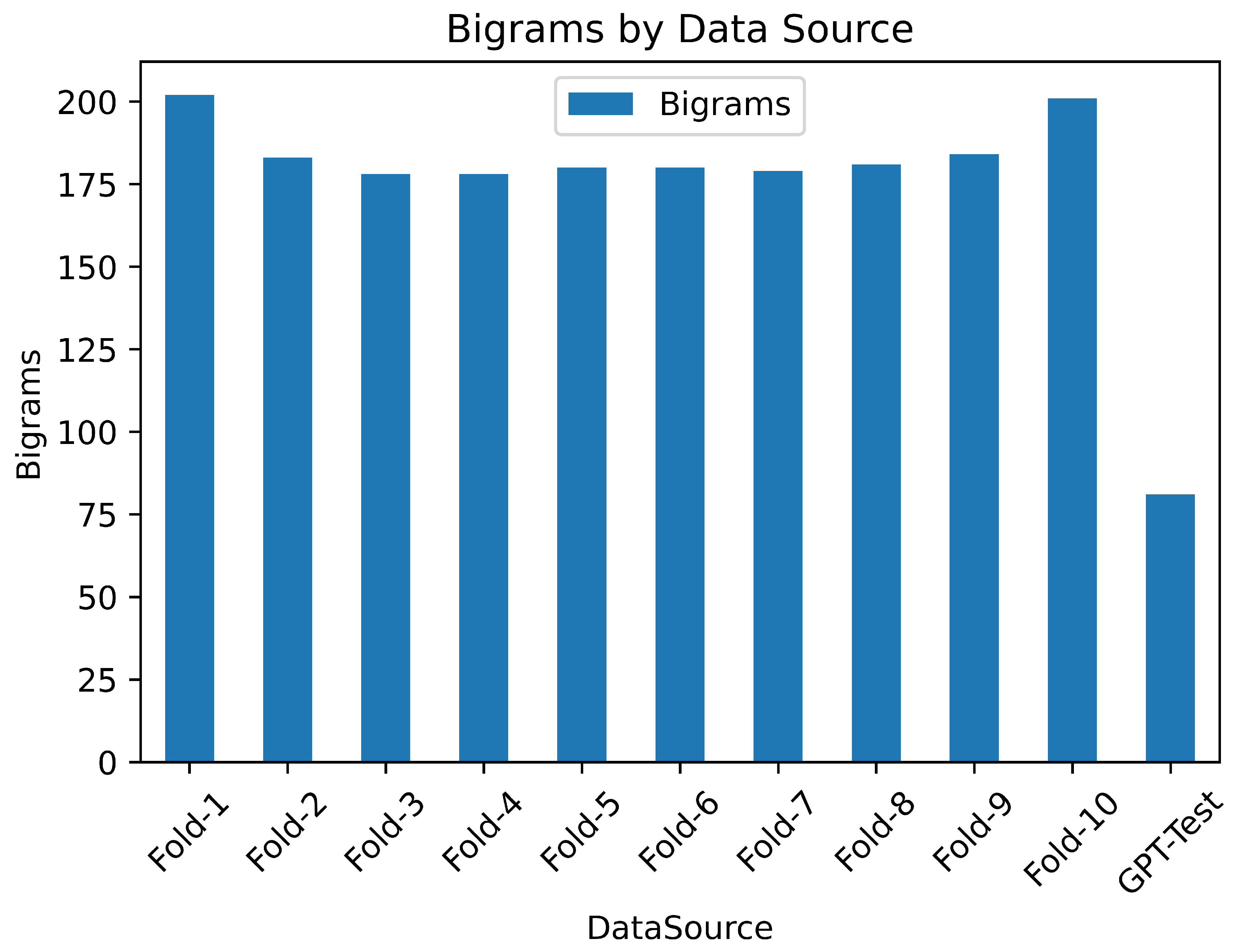
Figure 2.
The summary statistics are generated from a pairplot that displays the relationships among any pair of variables in the plot, including Nodes, Edges, and Connected Components.
Figure 2.
The summary statistics are generated from a pairplot that displays the relationships among any pair of variables in the plot, including Nodes, Edges, and Connected Components.
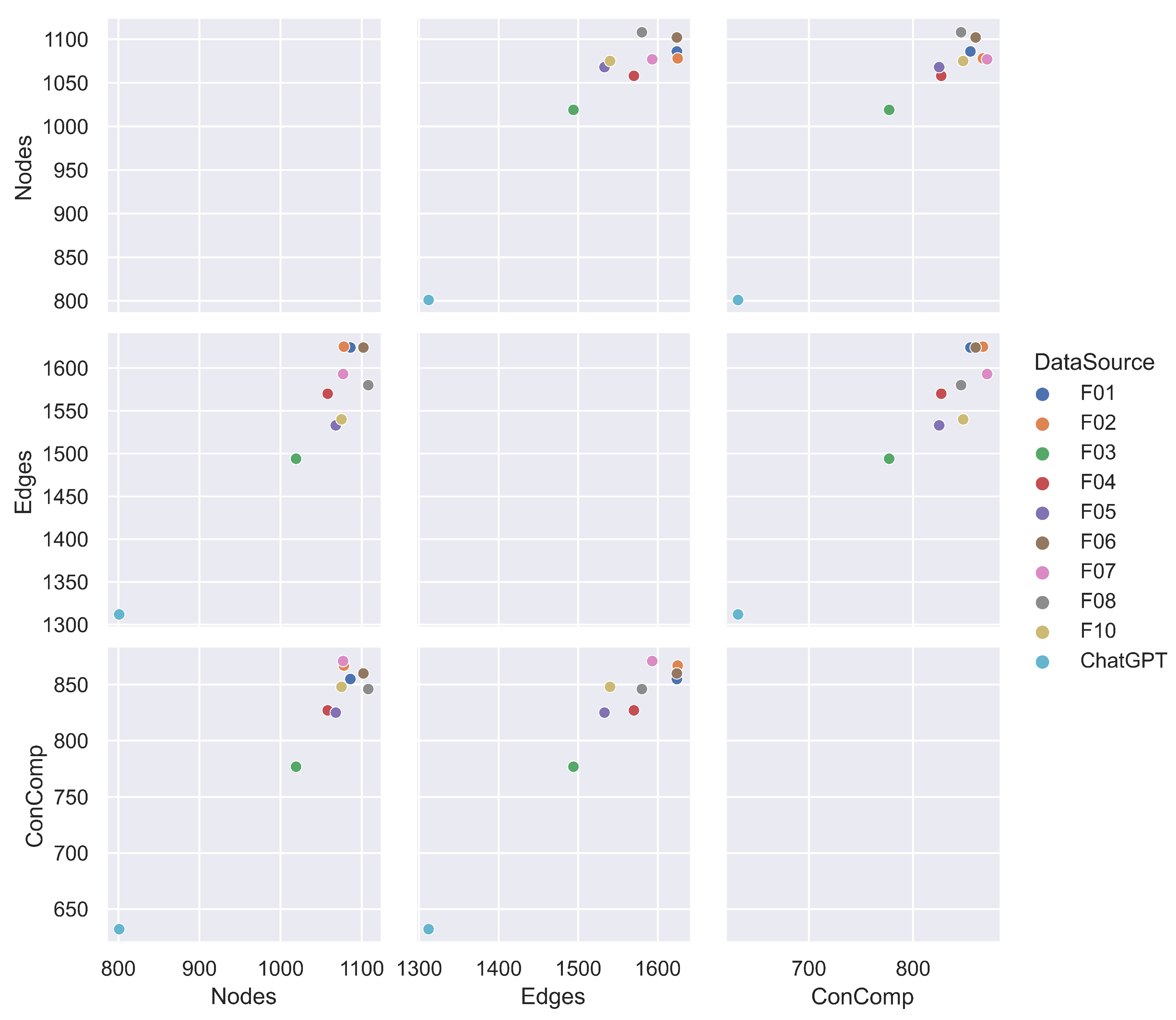
Figure 3.
The size of the largest connected component in a network generated from ChatGPT fake articles is compared with the 10-folds. It is evident that ChatGPT has the smallest size among all the other slices, and the least contributions.
Figure 3.
The size of the largest connected component in a network generated from ChatGPT fake articles is compared with the 10-folds. It is evident that ChatGPT has the smallest size among all the other slices, and the least contributions.
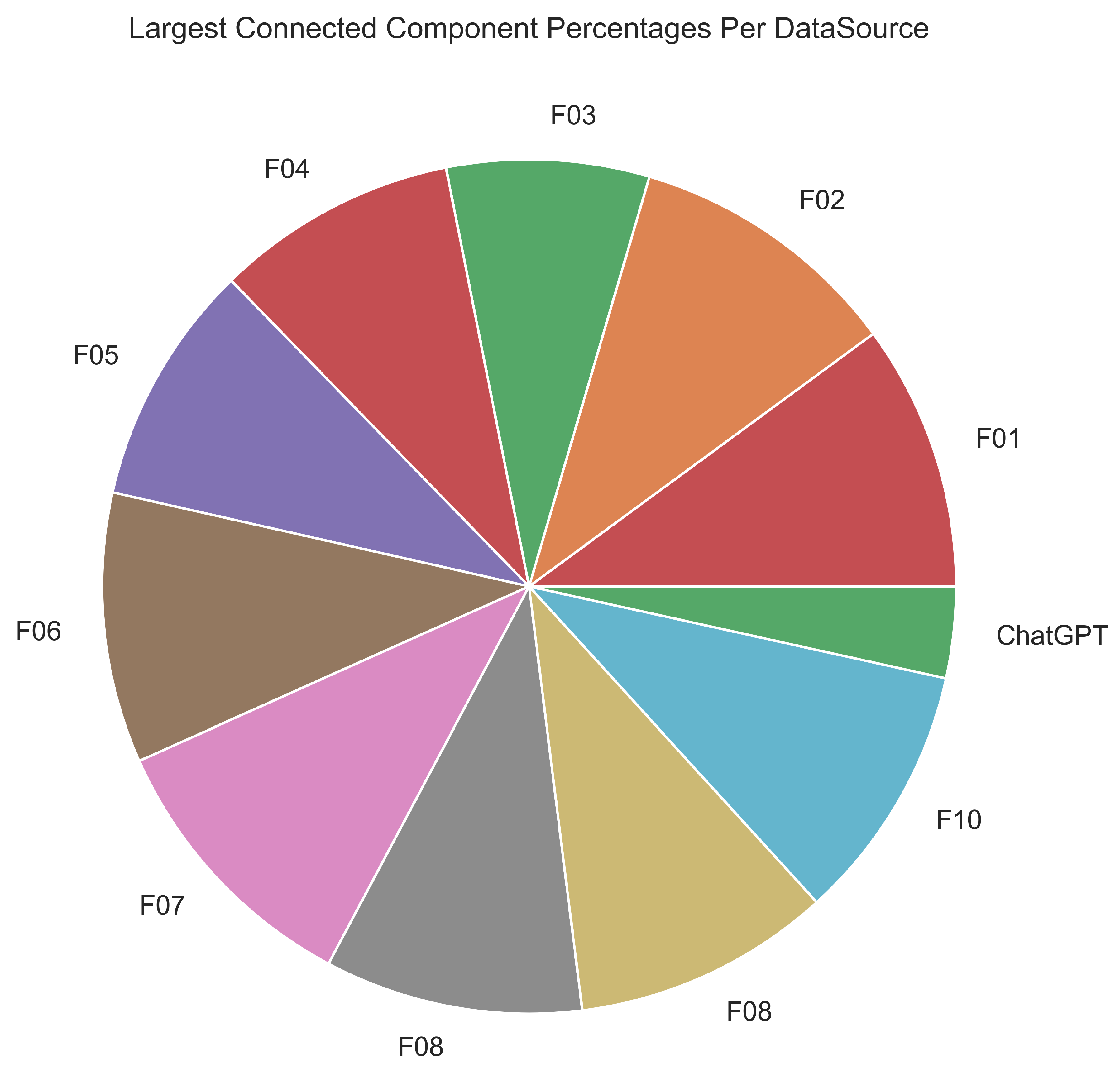
Figure 4.
The bigram scoring behavior of the 10-folds of real publications shows a high degree of similarity, whereas ChatGPT exhibits a distinctly different behavior compared to all other folds, except for a few points that display similar behavior.
Figure 4.
The bigram scoring behavior of the 10-folds of real publications shows a high degree of similarity, whereas ChatGPT exhibits a distinctly different behavior compared to all other folds, except for a few points that display similar behavior.
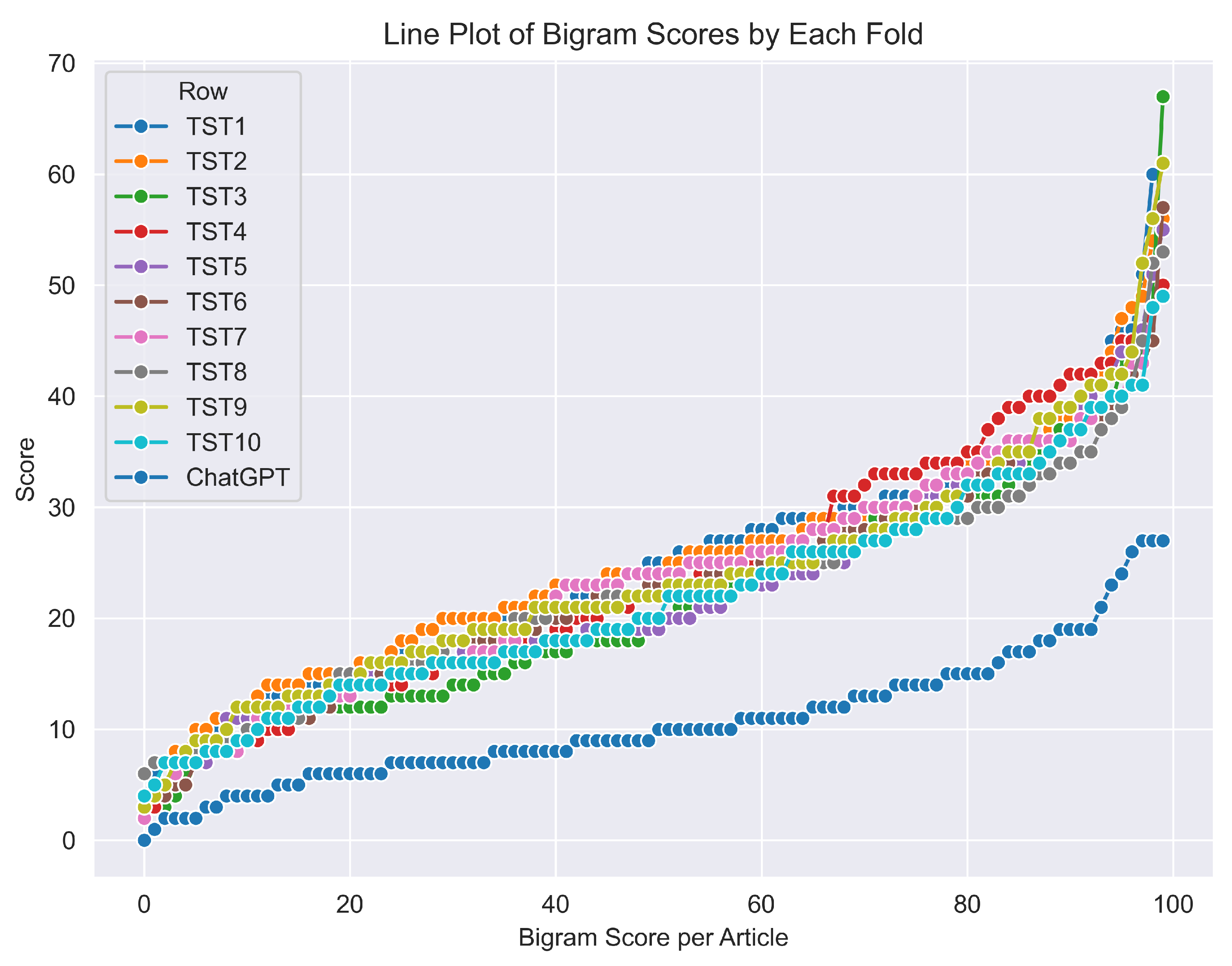
Figure 5.
A side-by-side WordCloud comparison depicting the top-20 bigrams from real publications versus ChatGPT-generated content.
Figure 5.
A side-by-side WordCloud comparison depicting the top-20 bigrams from real publications versus ChatGPT-generated content.
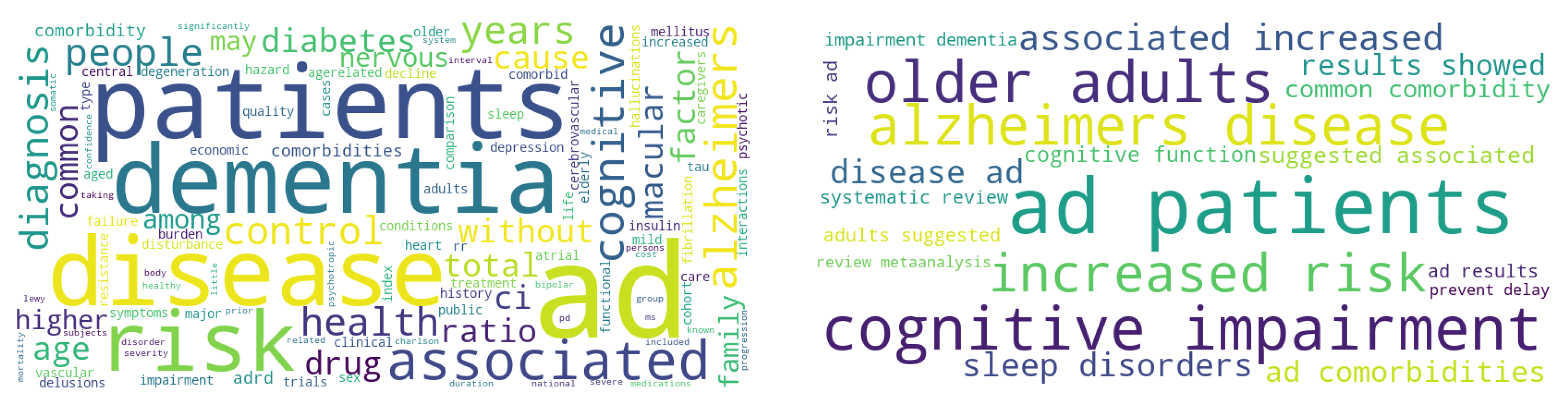
Figure 6.
provides a detailed insight into the implementation of the classification step within the algorithm. This screenshot illustrates how each individual article was assessed and categorized as either fake or real based on the algorithm’s analysis. The process involves measuring the number of bigrams that contribute new edges to the largest connected component (LCC) model, without introducing new nodes. By applying the lower and upper bounds derived from the calibration process, articles that fall within the specified range are classified as POSITIVE (real publications), while those outside the bounds are classified as NEGATIVE (fake publications). This visualization offers a comprehensive view of the algorithm’s decision-making process in distinguishing between real and generated content.
Figure 6.
provides a detailed insight into the implementation of the classification step within the algorithm. This screenshot illustrates how each individual article was assessed and categorized as either fake or real based on the algorithm’s analysis. The process involves measuring the number of bigrams that contribute new edges to the largest connected component (LCC) model, without introducing new nodes. By applying the lower and upper bounds derived from the calibration process, articles that fall within the specified range are classified as POSITIVE (real publications), while those outside the bounds are classified as NEGATIVE (fake publications). This visualization offers a comprehensive view of the algorithm’s decision-making process in distinguishing between real and generated content.
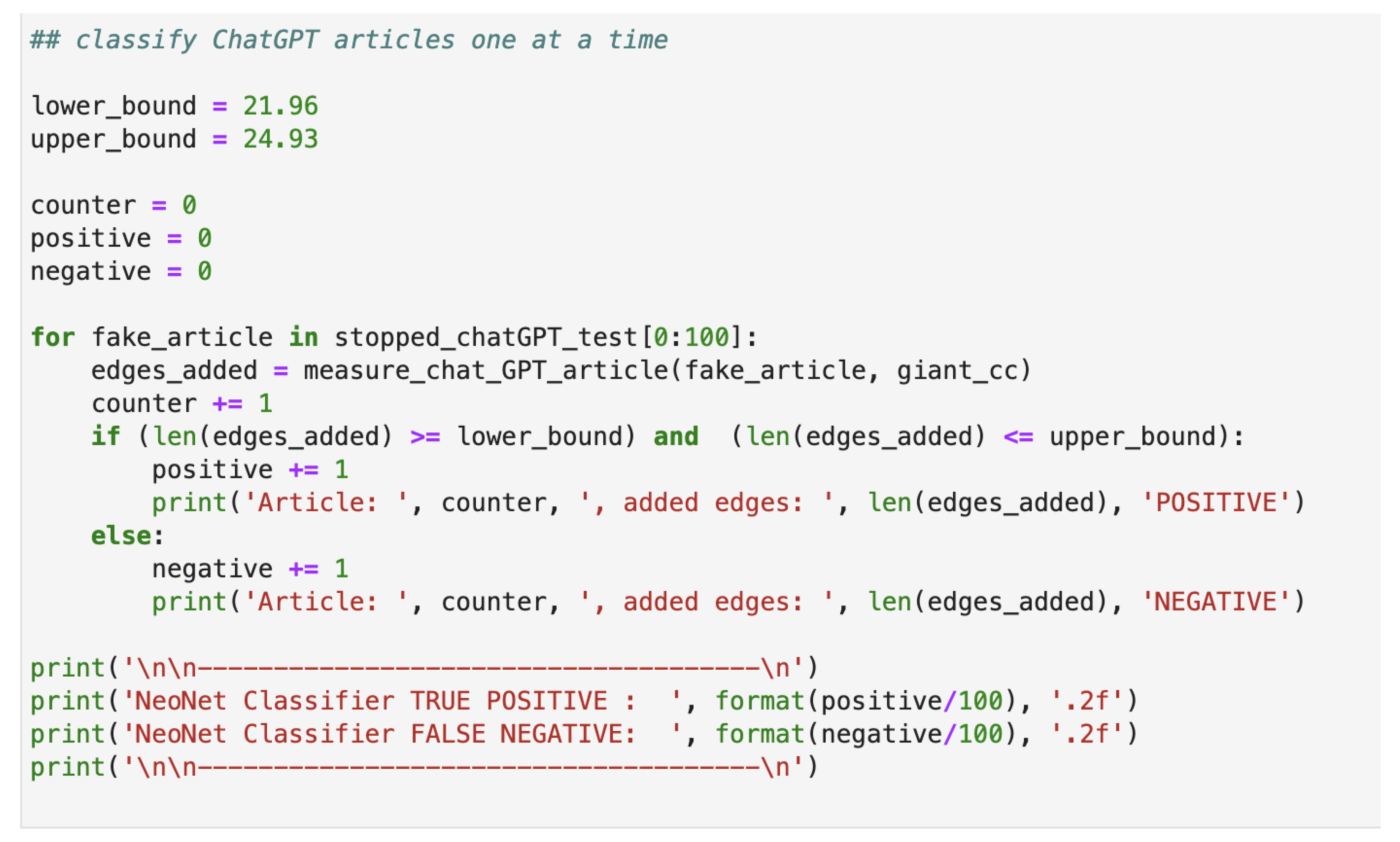

Table 1.
Comparison of bigram overlaps and similarity to training dataset.
| Data Source | Number of Bigram Overlaps | Percent to Self % | Similarity to Training% |
|---|---|---|---|
| Fold-1 | 202 | 0.21 | 0.22 |
| Fold-2 | 183 | 0.19 | 0.20 |
| Fold-3 | 178 | 0.22 | 0.19 |
| Fold-4 | 178 | 0.20 | 0.19 |
| Fold-5 | 180 | 0.21 | 0.20 |
| Fold-6 | 180 | 0.19 | 0.20 |
| Fold-7 | 179 | 0.19 | 0.19 |
| Fold-8 | 181 | 0.20 | 0.20 |
| Fold-9 | 184 | 0.20 | 0.20 |
| Fold-10 | 201 | 0.23 | 0.22 |
| GPT-Test | 81 | 0.16 | 0.09 |
Table 2.
Summary statistics of the network analysis.
| Index | Data Source | No. Nodes | No. Edges | No. Connected Components | Connected Components Percent |
|---|---|---|---|---|---|
| 0 | F-1 | 1086 | 1624 | 855 | 0.67 |
| 1 | F-2 | 1078 | 1625 | 867 | 0.69 |
| 2 | F-3 | 1019 | 1494 | 777 | 0.51 |
| 3 | F-4 | 1058 | 1570 | 827 | 0.61 |
| 4 | F-5 | 1068 | 1533 | 825 | 0.61 |
| 5 | F-6 | 1102 | 1624 | 860 | 0.68 |
| 6 | F-7 | 1077 | 1593 | 871 | 0.70 |
| 7 | F-8 | 1108 | 1580 | 846 | 0.65 |
| 8 | F-9 | 1108 | 1580 | 846 | 0.65 |
| 9 | F-10 | 1075 | 1540 | 848 | 0.65 |
| 10 | ChatGPT | 801 | 1312 | 632 | 0.23 |
Table 3.
Average number of bigrams contributing edges to the LCC model for each fold.
| Fold | F-1 | F-2 | F-3 | F-4 | F-5 | F-6 | F-7 | F-8 | F-9 | F-10 |
|---|---|---|---|---|---|---|---|---|---|---|
| Avg. Bigrams | 24.93 | 25.12 | 21.57 | 23.80 | 22.49 | 22.91 | 23.52 | 22.65 | 23.73 | 21.96 |
Table 4.
Comparison of Top-5 Bigrams in ChatGPT Publications and Real Publications, Color-Coded for Overlapping
Table 4.
Comparison of Top-5 Bigrams in ChatGPT Publications and Real Publications, Color-Coded for Overlapping
| Source | Bigram-1 | Bigram-2 | Bigram-3 | Bigram-4 | Bigram-5 |
|---|---|---|---|---|---|
| ChatGPT | AD patients | Cognitive impairment | older adults | Alzheimer’s disease | Risk factors |
| Real Bibs | Alzheimer’s disease | Disease AD | AD patients | Cognitive impairment | Increased risk |
Disclaimer/Publisher’s Note: The statements, opinions and data contained in all publications are solely those of the individual author(s) and contributor(s) and not of MDPI and/or the editor(s). MDPI and/or the editor(s) disclaim responsibility for any injury to people or property resulting from any ideas, methods, instructions or products referred to in the content. |
© 2023 by the authors. Licensee MDPI, Basel, Switzerland. This article is an open access article distributed under the terms and conditions of the Creative Commons Attribution (CC BY) license (http://creativecommons.org/licenses/by/4.0/).
Copyright: This open access article is published under a Creative Commons CC BY 4.0 license, which permit the free download, distribution, and reuse, provided that the author and preprint are cited in any reuse.


