

Submitted:
30 March 2023
Posted:
31 March 2023
Read the latest preprint version here
Abstract
A bijective analysis is confirming, the expansion of universal space has never been directly observed, and this assumption is unproven thus far. The measurement of the gravitational redshift, which was confirmed using the Mossbauer experiment, proves only the gravitational redshift and nothing more because there is no causality between the gravitational redshift and hypothetical expansion. Thus, even if the universal space is assumed to expand, the gravitational redshift cannot be assumed to be proof of the expansion. In addition, the Doppler effect was never observed in an expanding space; thus, the claim that the cosmological redshift is partially caused by the Doppler effect, which is caused by the expansion of space, is an unproven assumption. Furthermore, the discovery of cosmic microwave background (CMB) radiation simply proves that the radiation is emitted by the entire universal space, but does not prove the existence of a recombination period. In evidence-based cosmology, every element in the model has a corresponding element in physical reality that is observed and measured. The evidence-based cosmology model is related to the real universe by a bijective function of set theory. Supermassive black holes in the centre of galaxies are rejuvenating systems of the universe. They rotate their local superfluid space which is the physical origin of galactic rotation curves.
Keywords:
evidence-based cosmology
; rotating superfluid space
; galactic rotation curves
1. Introduction
A bijective cosmological model is one in which all elements in the model of the universe have their bijective element in the physical reality, see Figure 1 below:
All elements in the bijective model are observed and measured.
The geocentric system is based on the belief that the Earth is the centre of the universe and the Sun and all other planets orbit around it. This system was functioning well, the calculations appeared to be accurate, and the system was not doubted until the Greek astronomer and mathematician, Aristarchus of Samos (310–230 BC), developed the heliocentric model that was later accepted as the accurate system [1]. Similarly, the Big Bang model is assumed to be correct despite the lack of scientific proof. In the Big Bang model, the initial explosion was not observed and has no bijective correspondence with the universe. Expansion of space was not observed and has no bijective correspondence with the real universe. The recombination period was not observed and has no bijective correspondence with the real universe.
In the case of the Big Bang model, thinking strays away from the bijective research methodology which suggests that the existence of a given physical phenomenon should be accepted as true only after it has been observed and measured.
observation of phenomenon → measurement → acceptance that phenomenon is real
The expansion of universal space has never been observed or measured. The claim that the cosmological redshift is proof of universal expansion is a cognitive simplification outside the realm of scientific thought. An unbridgeable cognitive abyss exists between cosmological redshift and hypothetical expansion, and these two phenomena are not related by physical means. This is a classic example of “forced theory”, wherein something serves as proof of something else that was never observed or measured:
no observation → no measurement → acceptance of phenomenon as a fact
In addition, whether the expansion of space would cause the cosmological redshift as a kind of Doppler effect is questionable. There is no physics model that describes how the expansion of space could cause the Doppler effect, which is a phenomenon that occurs when the light source moves closer to or away from the observer in a stationary space. The Doppler effect on Earth was performed in stationary space. The manner in which the Doppler effect works in an expanding space has not been tested. Thus, there is no phenomenological relationship between the Doppler effect and universe expansion. Thus, the claim: “Gravitational redshift is proof of universal space expansion” is an unfalsifiable one, and thus, cannot be considered scientific fact.
1.1. Gravitational redshift is measured and real
It has been observed that light from distant galaxies undergo a loss of energy. We call this loss of energy the “gravitational redshift”:
A strong cognitive bond exists between “gravitational redshift” and the observation of the loss of energy. However, the loss of photon energy, and therefore, the gravitational redshift, has no phenomenological relationship with the theoretical expansion of space. Even if the expansion of space were real, it would not cause a gravitational redshift. Loss of energy from distant galaxies was proposed by Swiss astronomer Zwicky. He name it the “Tired light effect” [2].
Another observation that leads us to conclude that the expansion of universal space is the CMB radiation. The CMB exhibits a thermal black-body spectrum at a temperature of 2.72548 ± 0.00057 K. This is the result of the measurement, which allows us to conclude that the universal space radiates CMB, which is highly uniform throughout space. However, the interpretation of CMB as the relict radiation of the recombination period is only an unproven hypothesis; it is not a scientific fact. Again, the aforementioned incorrect methodology was adopted for building this hypothesis.
CMB measurement → the entire space emanates this radiation → CMB is the relict radiation of the recombination period.
Although there is a strong phenomenological bond between the CMB measurement and the statement that the entire space radiates it, there is no phenomenological bond between the CMB measurement and the existence of the recombination period. The only proof of CMB radiation is the measured radiation; the entire space emanates this radiation. Traunmüller published his research back in 2020 where he proves the CMB is not proof of the Big Bang model [3].
In general, a given source of electromagnetic radiation can only exist at a spatial distance from the receiver, never at some fictitious temporal distance. Temporal physical distance in physics is a myth, temporal distance exists only in the human mind. A given electromagnetic signal can only move through space, never through time. The time when measured is its duration of motion in space from the source to the receiver. The idea, that CMB is radiation that has an origin in the physical past is flawed, it does not respect the fundamental discoveries of today’s science, namely, that time has no physical existence. This was explained and proved by scientific means by Rovelli, Barbour, and Fiscaletti [4,5,6].
We experience the universal changes that are running in time-invariant space in a frame of psychological time, i.e., “past-present-future”, while the universe itself is timeless. Therefore, the assumption that the universe began in some remote physical past is incorrect because time has no physical existence. Thus, a hypothetical “beginning in time” can be excluded because the universe develops in a time-invariant space, where there is no past, present, or future [7], implying that the universe is non-created and eternal. Time is an emergent physical reality created by the observer in the process of measurement. No measurement means no time. The universe is timeless in the sense that it does not exist in some physical time, the universe exists in time-invariant space [8]. Cosmologists need to get accustomed and fully accept that the universe does not run in some physical time, it runs in time-invariant non-created space. The idea that the universe had some beginning when time and space started is a religious idea that has no place in 21st-century science.
The third proof that the Big Bang model is erroneous is mathematical. The FLRW metric is not valid for Euclidean space, however, NASA has only measured universal space by considering a Euclidean shape. The metric of Euclidean space should be such that it can neither expand nor shrink [9]: “In the FLRW metric, the density parameter, Ω, ultimately governs whether the curvature is: negative (), positive (Ω > 0), or flat (Ω = 0).” When the density parameter Ω is 1 in the FLRW metric, the universal space has a Euclidean shape, and the FLRW metrics predict that such a space can expand. This is contrary to the metrics of Euclidean geometry, wherein the distance between two points is always constant. In a 4-dimensional Euclidean space, the distance between points and is calculated as follows:
In the frame of Euclidean geometry, there is no possibility of distance being changed.
2. The Big Bang model does not conform to the requirements of the bijective research methodology
In the Big Bang model, the initial explosion was not observed and has no bijective correspondence with the universe. Expansion of space was not observed and has no bijective correspondence with the real universe. The recombination period was not observed and has no bijective correspondence with the real universe. The Big Bang model has a huge methodological and phenomenological weakness because the main elements of this model were not observed and were not measured.
The theory of Big Bang cosmology demonstrates how science should not work. The idea of a beginning occurring after a massive explosion is a myth, and all astronomical data have been interpreted in a way that agrees well with this myth. The first step to demystification is to raise awareness of one’s inner image of the Big Bang cosmology. Figure 2 shows the first picture that one sees in their inner vision whenever cosmology is mentioned.
Only a five-year-old child could have such a magical, irrational imagination of the universe exploding from nothing. This indoctrination is the reason that the word “CMB” leads one to imagine a recombination period, and the term “cosmological redshift” leads one to imagine that galaxies are moving away from each other and that the universe is expanding. An adult person, who is completely free of imposed ideas from childhood, will be able to deduce that the Big Bang cosmology is a childish idea.
Questions thus arise apropos of why we disregard the fact that the redshift of light was never observed in an expanding space. We have only observed light in a space that is stationary; we do not have a theoretical model that describes how light moves in an expanding space and experiences energy loss. The lack of investigation into these aspects can be largely attributed to the human mindset. These facts are disregarded because the Big Bang cosmology is the most widely accepted model, and thus, people are unwilling to doubt it. Since early childhood, the Big Bang model has been taught to everyone, especially if one’s parents are scientists, and people rarely doubt what they perceive and experience during their first six years of life. Thus, the idea of the Big Bang model becomes embedded within the mind to a degree that is comparable to those of the ideas of nationality and faith.
Hawking and Hartle suggested back in 1983 that the universe started from an infinitely small point that is expanding. With regard to the issue of energy creation, the authors have found a mathematical solution: “In the quantum mechanics of closed universes we do not expect to find a notion of ground state as a state of lowest energy. There is no natural definition of energy for a closed universe just as there is no independent standard of time. Indeed, in a certain sense, the total energy for a closed universe is always zero the gravitational energy cancelling the matter-energy” [10]. Their proposal can be written in mathematical form as follows:
where is the energy of matter and is the gravitational energy, . Assigning the energy of matter a positive mathematical sign and the energy of gravity a negative mathematical sign still does not solve the increase of both energies in a growing universe. Hartle and Hawking avoided the problem of energy creation in the hypothetical inflation of the universe by covering it with a mathematical band-aid that does not fix the problem. Even in his later works, Hawking maintained his view of the universe, which seems more religious than scientific. In 2010 he believed that the universe appeared out of nothing:” If the total energy of the universe must always remain zero, and it costs energy to create a body, how can a whole universe be created from nothing? That is why there must be a law like gravity. Because gravity is attractive, gravitational energy is negative: One has to do work to separate a gravitationally bound system, such as the earth and moon. This negative energy can balance the positive energy needed to create matter, but it’s not quite that simple. The negative gravitational energy of the earth, for example, is less than a billionth of the positive energy of the matter particles the earth is made of. A body such as a star will have more negative gravitational energy, and the smaller it is (the closer the different parts of it are to each other), the greater this negative gravitational energy will be. But before it can become greater than the positive energy of the matter, the star will collapse to a black hole, and black holes have positive energy. That’s why empty space is stable. Bodies such as stars or black holes cannot just appear out of nothing. But a whole universe can” [11]. Stationary cosmology has no such insoluble problems, nor does it create a single unanswered question.
3. Evidence-based cosmology based on bijective research methodology
Evidence-based cosmology is using the “bijective research methodology”, wherein all elements of the model are observable and measurable. In stationary cosmology (SC), the universe is a set X, and the model of the universe is a set Y, the sets are related by the bijective function. In the SC, supermassive black holes (SMBHs) have been considered the rejuvenating systems of the universe. At the centre of SMBHs, the energy density of space is low enough to cause atoms to become unstable and fall apart into elementary particles that form jets [12,13]. Jets emerging out of SMBHs have been well-documented [14]. The variable energy density of space that governs gravity has been precisely measured by the rate of clocks at a one-meter distance [15].
In the SC, the Milky Way moves towards the Great attractor area of supercluster Laniakea. This motion has a bijective correspondence to real motion in the physical universe and is well documented [16,17]. The motion of the Milky Way in the Big Bang model because of hypothetical space expansion was never observed and is a working hypothesis, it is not a scientific fact.
In the SC, the supercluster Laniakea is moving in the direction of the Shapley supercluster that is moving in the direction of the Vela supercluster. The motions of these superclusters are well documented [18,19] and are well integrated into the bijective stationary cosmology, where universal space is stationary. In the Big Bang model, there is no observed motion of the galaxy or galaxy cluster that would be a result of universal space expansion. The motion of stellar objects as a consequence of space expansion is an unproven hypothesis. In chapter (1) we have seen that gravitational redshift does not prove the motion of galaxies.
Eminent physicists have examined the weak points of Big Bang cosmology [20,21,22,23] and yet today, in 2023, this model is still taught in universities. Although stationary cosmology explains all astronomical data well and has no unbridgeable problems with explaining the beginning of the universe, it is still not as prevalent. The problem with today's progress in cosmology is that dozens of peer-reviewed papers have misinterpreted astronomical data and supposedly proved Big Bang cosmology right. The application of bijective research methodology has shown that the unsolvable problems of big bang cosmology can be solved with the comeback of stationary cosmology [24].
4. Paradigm shift of black holes physics: superfluid space is rotating together with rotating black holes
The idea that universal space is empty and curved has led to the geometrization of gravity and the introduction of gravitational singularities in the centre of black holes. From a physical point of view, gravitational singularities are problematic because infinite gravity plus concrete final gravity force still is infinite gravity [12]. With the introduction of the variable energy density of superfluid space (ether) gravitational singularities are avoided. Black holes are represented as the rejuvenating systems of the universe [24].
The Michelson-Morley (MM) experiment was based on the assumption that the Earth moves through a stationary ether. Today we know that the local ether around the Earth moves and rotates with the Earth (the ether was given the new name “superfluid space”), so the Michelson-Morley experiment got a negative result. Because the local ether moves and rotates with the Earth, the light in both arms of the interferometer have the same speed. Since both light beams are in constructive interference (there is no lag between them), no destructive interference pattern occurs in the MM experiment.
In 1913, French physicist Georges Sagnac designed an experiment that would verify the existence of the ether. His interferometer also had the ability to rotate. When his interferometer is at rest, the two light beams that run in the opposite direction are in constructive interference, the same thing happens as in the MM experiment. The ether moves and rotates with the earth, so the MM interferometer is in the locally stationary ether. When Signac’s interferometer rotates, the ether begins to move, thus increasing the speed of that ray of light that moves in the direction of rotation of the ether (ray 1). The velocity of the other ray of light (ray 2), which moves in the opposite direction of rotation of the interferometer, decreases.
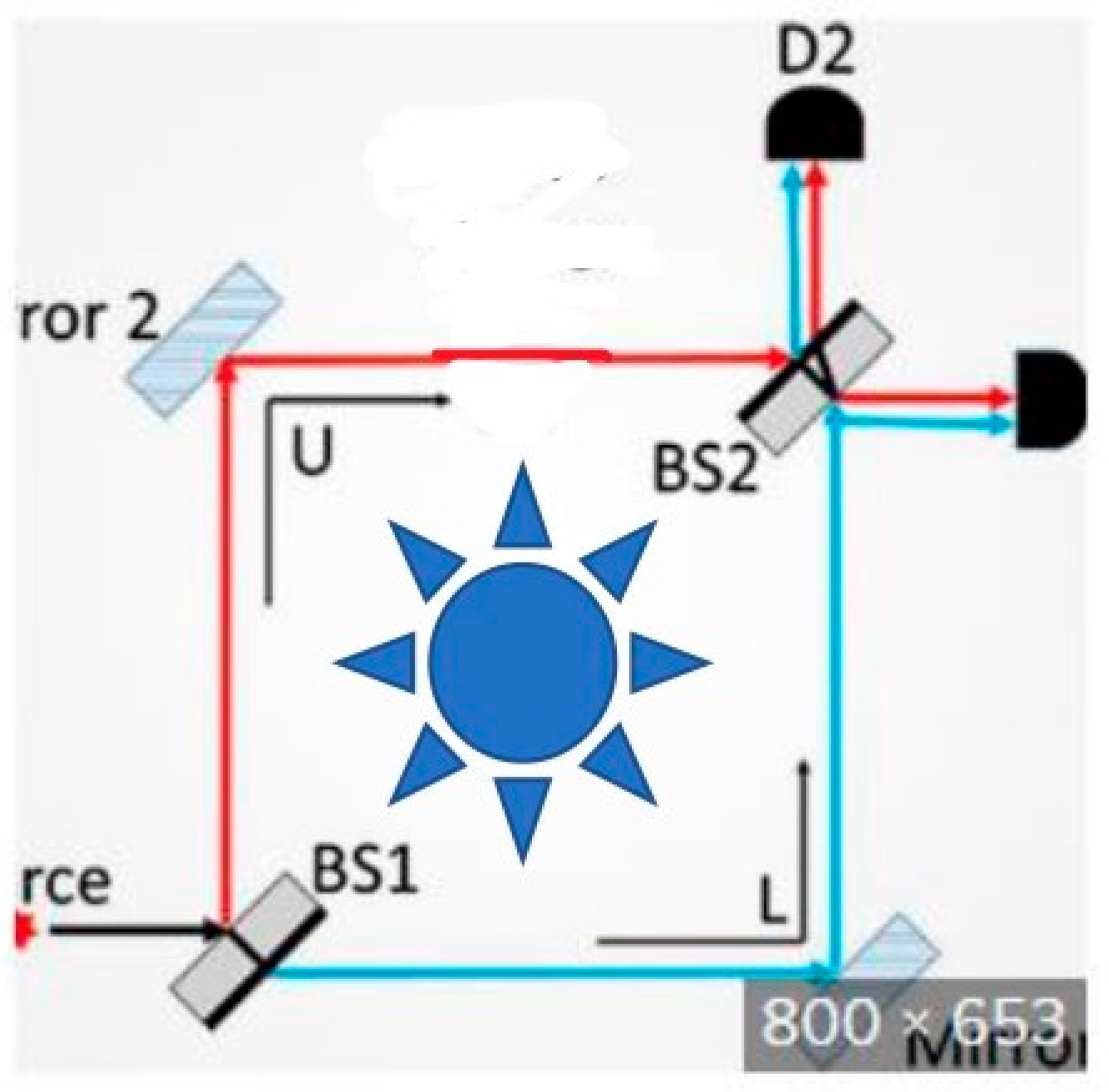
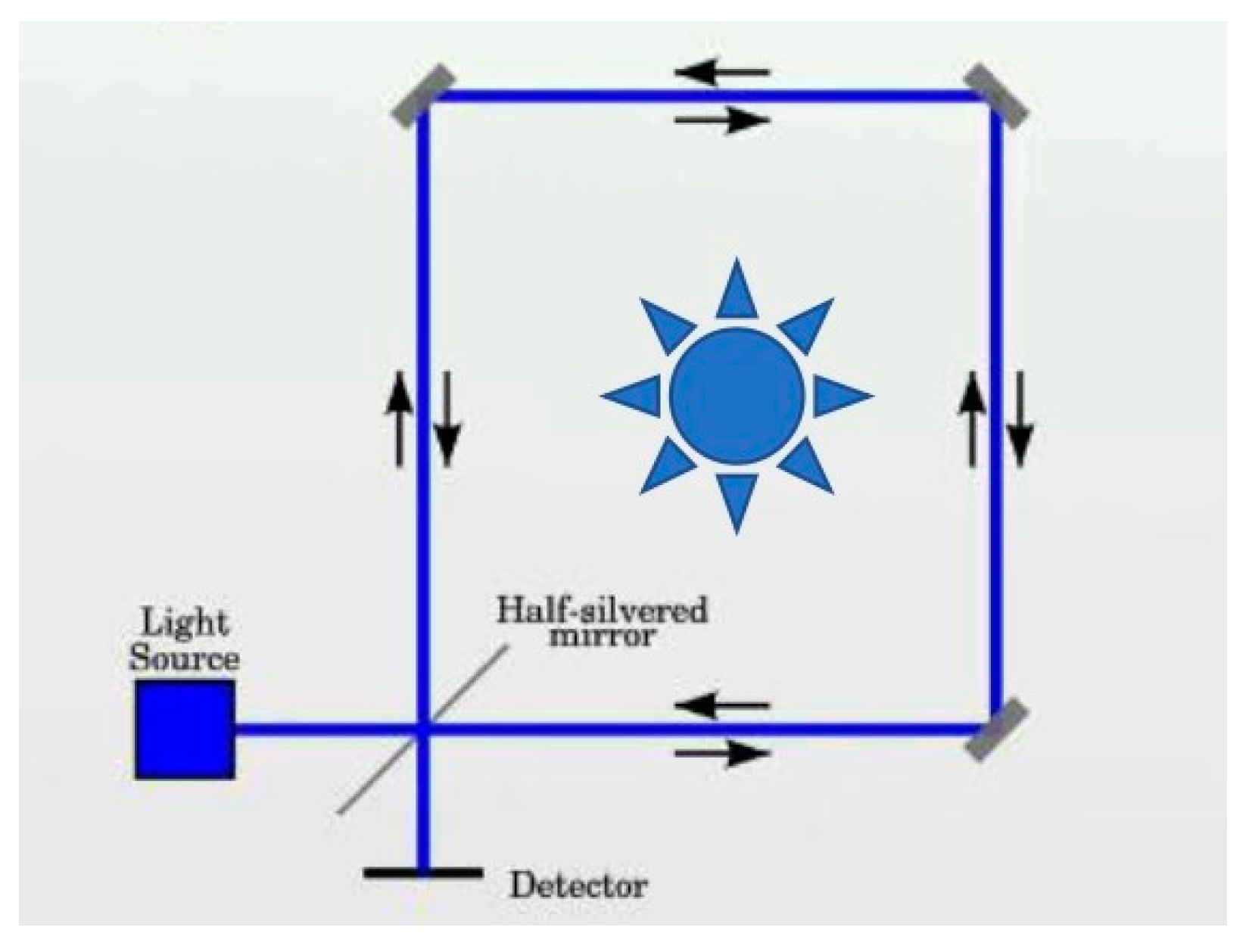
where is light speed and is the velocity of ether. The proper velocity of light in the moving ether remains the same. Only its “relativistic” velocity increases. Due to the different speeds of the rays, constructive interference is destroyed and a destructive interference pattern is formed. The author is planning an experiment that will directly prove that in Sagnac's experiment, the rotating ether changes the speed of light, which causes a destructive interference pattern. In the planned experiment, we will not rotate the Sagnac interferometer. We will install an electric motor in the middle of the interferometer, see Figure 3 below:
We will perform the experiment when the electric motor is not rotating and when it is rotating. When the motor will rotate, the ether will also start rotating and will have the same effect as a rotating Sagnac interferometer. The experiment will be direct evidence that the rotor of the electric motor also rotates the local ether. The rotating ether is the physical cause of planetary precession in our solar system. Rotating ether is also the physical cause of galactic rotation curves; the black holes at the center of the galaxy rotate the ether, which then adds to the velocity of the star at the outer edge of the galaxy [13].
4.1. Experiment: The phase shift of light is caused by moving superfluid space
We will also use a Mach-Zender interferometer in the center we will place a rotating device. We predict from the results of the Sagnac experiment that rotating devices will rotate the superfluid space and that this rotation will cause the phase shift of the light beam. Sagnac has rotated his interferometer 2rps (two radians per second) as reported in the article published in Physical Reviews back in 1967 [25].
We will rotate the device in the centre of the interferometer in the anticlockwise direction. Light beam U will diminish speed, and light beam L will increase speed. We will see if there will be an expected change in interference pattern when the rotating device will be still and when the device will rotate.
Figure 4.
Mack-Zender interferometer with a rotating device.
Special relativity postulate that the speed of light is constant in all inertial systems and remains valid. In the moving superfluid space, the light keeps the same speed as in the superfluid space at rest.
Imagine you are in a sailboat and you move with a velocity of 30km/h. You measure the velocity of the wind which is 50km/h. Then you enter the see-stream that has a velocity of 10km/h. Your basic velocity did not change but because you move in the moving medium your velocity has increased and is 40km/h. You are in the stream and you measure the velocity of the wind which is now 60km/h. When you pass the stream and you are again in the sea at rest your velocity is as it was before entering the stream and the velocity of the wind is as it was before entering the stream.
Figure 5.
Proper and relative velocity of light.
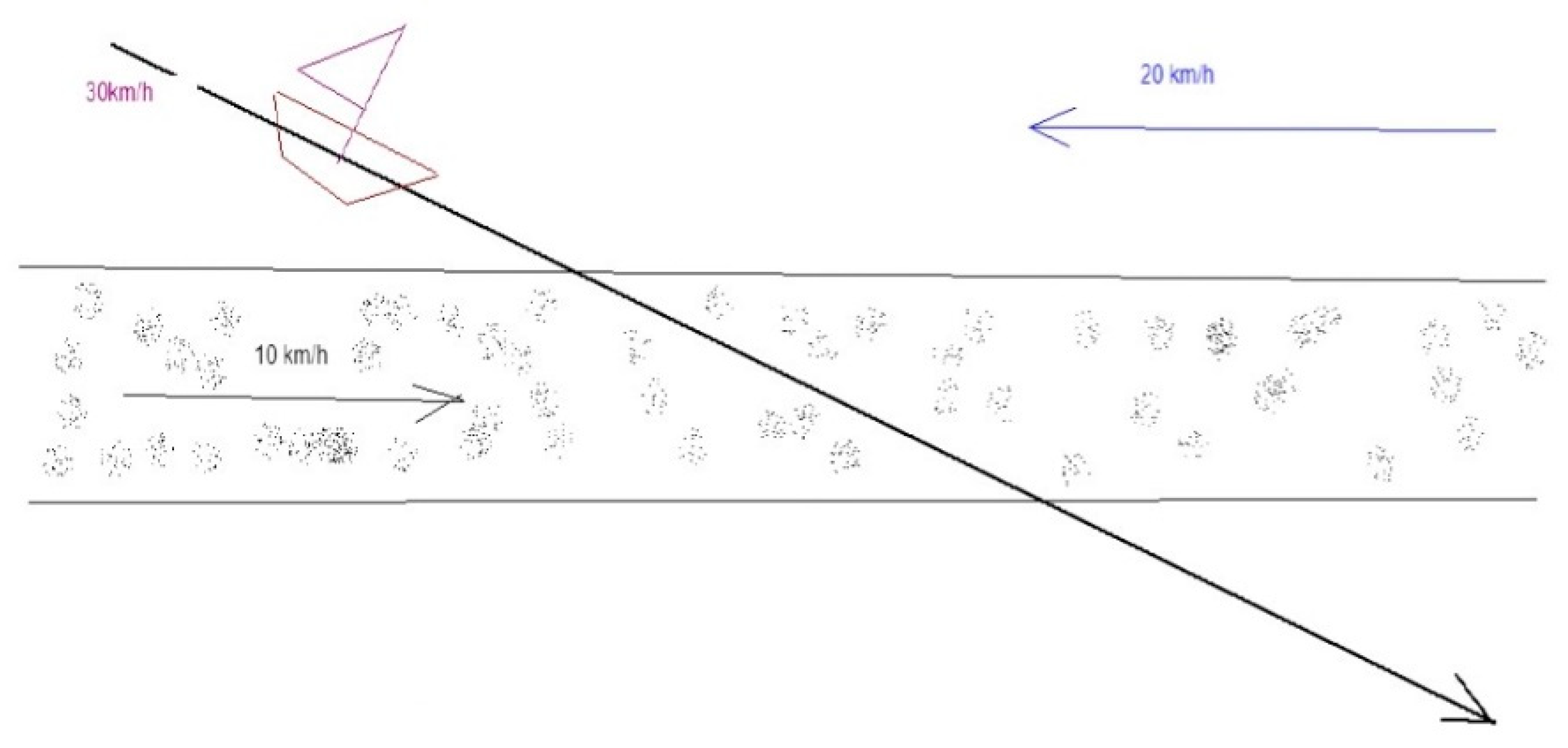
Similarly, light when moving in rotating superfluid space does not change proper velocity . But the relativistic velocity of the light has increased because also the medium of light (superfluid space) is moving. This then results in a phase shift of the light. By the Doppler effect, we have another situation. We have a still source of light in superfluid space at rest and the observer that is coming closer or going away. The motion of the observer will cause the Doppler effect.
The idea that rotating physical objects could also rotate local “space-time” was also developed in a Ph.D. thesis of Hugo R. C. Ferreira [26]. In the model presented in this article, space-time is replaced with superfluid space, physical objects rotate superfluid space. The rotation of superfluid space is the physical cause of Mercury’s precession and of the galaxies’ rotational curves. The orbital velocity of dark energy on the Mercury orbit is 3.81 millimeters per second. The “dark matter” effect can be explained by the rotation of local superfluid space around central black holes of spiral galaxies. In this model superfluid space is dark energy itself [13].
5. Conclusions
Our scientific mind is the prism through which we experience the universe, society, and ourselves. We must, therefore, clear this prism of all learned ideas and start thinking with fresh minds. We must respect the three pillars of physics: 1) perception, 2) creation of the model (mathematization of the phenomena we study), and 3) experimentation that will prove or disprove our model. This bijective research methodology is the most reliable methodology available for the development of physics and cosmology. Expansion of the universal space is an unproved preposition that is not passing the bijective analysis. Big explosion as the beginning of the universe also does not pass bijective analysis. In general, bijective models are falsifiable, they can be tested with observations and experiments. The big explosion and expansion of the universal space cannot be directly observed and tested by an experiment. This is the weakest point of Big Bang cosmology that will never be solved. Central black holes in the centre of galaxies are rejuvenating systems of the universe. The physical origins of galactic rotation curves are rotating central black holes that rotate local superfluid space.
References
- Draper, John William (2007) [1874]. "History of the Conflict Between Religion and Science". In Joshi, S. T. (ed.). The Agnostic Reader. Prometheus. pp. 172–173. ISBN 978-1-59102-533-7.
- Zwicky, F. "On the Redshift of Spectral Lines Through Interstellar Space". Proceedings of the National Academy of Sciences. 1929, 15, 773–779. [Google Scholar] [CrossRef] [PubMed]
- Traunmüller, H. Does standard cosmology really predict the cosmic microwave background? [version 3; peer review: 1 approved, 2 not approved]. F1000Research 2020, 9, 261. [Google Scholar] [CrossRef] [PubMed]
- Rovelli, C. Relational quantum mechanics. Int J Theor Phys 1996, 35, 1637–1678. [Google Scholar] [CrossRef]
- Barbour, J. The Nature of Time (2009). [CrossRef]
- Fiscaletti, D.; Sorli, A. Searching for an adequate relation between time and entanglement. Quantum Stud.: Math. Found. 2017, 4, 357–374. [Google Scholar] [CrossRef]
- Šorli, A.; Čelan, Š. , Time as the result of the observer measurement. Physics Essays, 2021, 34, 4. [Google Scholar] [CrossRef]
- Šorli, A.S.; Čelan, Š. Time-Invariant Superfluid Quantum Space as the Unified Field Theory. RAPS 2020, 4, 2050007. [Google Scholar] [CrossRef]
- Šorli, S.; Čelan, Š.; Jafari, S.; Fiscaletti, D.; Bahroz Brzo, A. Eternal universe in dynamic equilibrium, Physics Essays. 2022, 35, 1. [Google Scholar] [CrossRef]
- J. B. Hartle and S. W. Hawking, Wave function of the Universe, Phys. Rev. D 28, 2960 – Published 15 December 1983. [CrossRef]
- Stephen Hawking, Leonard Mlodinow, The Great Design, Bantam Books (2010) ISBN 978-0-553-80537-6.
- Šorli, A. Irrefutable Proof of The Non-Existence of a Gravitational Singularity at The Centre of a Black Hole: Gravity and Black holes. International Journal of Fundamental Physical Sciences, 2023, 13, 1–4. [Google Scholar] [CrossRef]
- Amrit Sorli, Niko Gorjup, Rado Gorjup. Dark energy, superfluid space, ether, and missing dark matter, Advanced Studies in Theoretical Physics, Vol. 17, 2023, no. 1, 31-42. [CrossRef]
- Gustavo Soares, Rodrigo Nemmen, Jet efficiencies and black hole spins in jetted quasars, Monthly Notices of the Royal Astronomical Society, Volume 495, Issue 1, June 2020, Pages 981–991. [CrossRef]
- Amrit Sorli, Stefan Celan, Niko Gorjup, Physical origin of the relative rate of clocks in GPS and errors of relative motion concept, Advanced Studies in Theoretical Physics, Vol. 16, 2022, no. 4, 191-200. [CrossRef]
- Tully, R., Courtois, H., Hoffman, Y. et al. The Laniakea supercluster of galaxies. Nature 513, 71–73 (2014). [CrossRef]
- NATURE, Laniakea, our home supercluster (video) (2014) https://www.nature.com/articles/d41586-019-00384-7.
- P. Merluzzi, G. Busarello, C. P. Haines, A. Mercurio, N. Okabe, K. J. Pimbblet, M. A. Dopita, A. Grado, L. Limatola, H. Bourdin, P. Mazzotta, M. Capaccioli, N. R. Napolitano, P. Schipani, Shapley Supercluster Survey: Galaxy evolution from filaments to cluster cores, Monthly Notices of the Royal Astronomical Society, Volume 446, Issue 1, January 2015, Pages 803–822. [CrossRef]
- Renée C. Kraan-Korteweg, Michelle E. Cluver, Maciej Bilicki, Thomas H. Jarrett, Matthew Colless, Ahmed Elagali, Hans Böhringer, Gayoung Chon, Discovery of a supercluster in the Zone of Avoidance in Vela, Monthly Notices of the Royal Astronomical Society: Letters, Volume 466, Issue 1, March 2017, Pages L29–L33. [CrossRef]
- Steinhardt, P. J. 2011. The Inflation Debate. Scientific American. 304 (4): 36-43.
- Ijjas, A., P. J. Steinhardt, and A. Loeb. Cosmic Inflation Theory Faces Challenges. Scientific American. Posted on scientificamerican.com February 1, 2017, accessed on May 15, 2017.
- Yves-Henri sanejouand, A framework for the next generation of stationary cosmological models, International Journal of Modern Physics D, Vol. 31, No. 10, 2250084 (2022). [CrossRef]
- Martín López-Corredoira and Louis Marmet, Alternative ideas in cosmology, International Journal of Modern Physics D, Vol. 31, No. 08, 2230014 (2022). [CrossRef]
- Amrit Sorli, Niko Gorjup, Back to the stationary cosmology, Advanced Studies in Theoretical Physics, Vol. 16, 2022, no. 4, 259-264. [CrossRef]
- E. J. POST, Sagnac Effect, Rev. Mod. Phys. 39, 475 – Published 1 April 1967 https://journals.aps.org/rmp/abstract/10.1103/RevModPhys.39.475.
- Hugo R. C. Ferreira, Quantum field theory on rotating black hole spacetimes (2015). [CrossRef]
Figure 1.
The bijective function is relating the model of the universe Y with the real universe X.
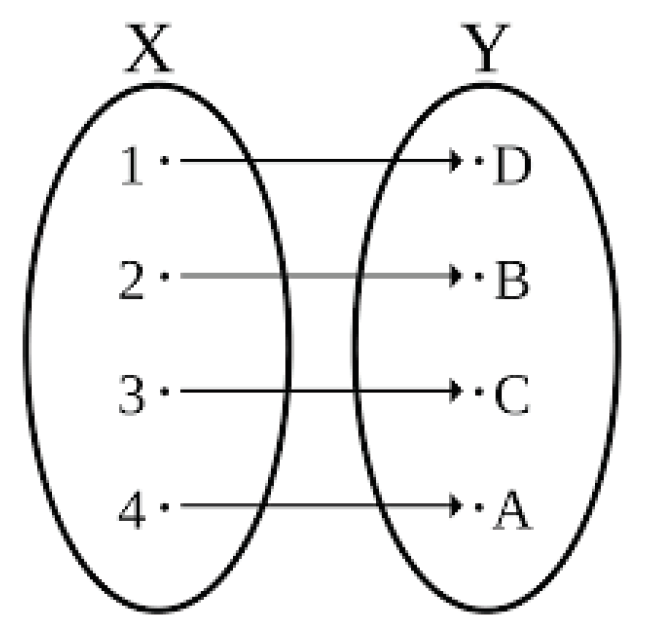
Figure 2.
One’s inner vision of cosmology.
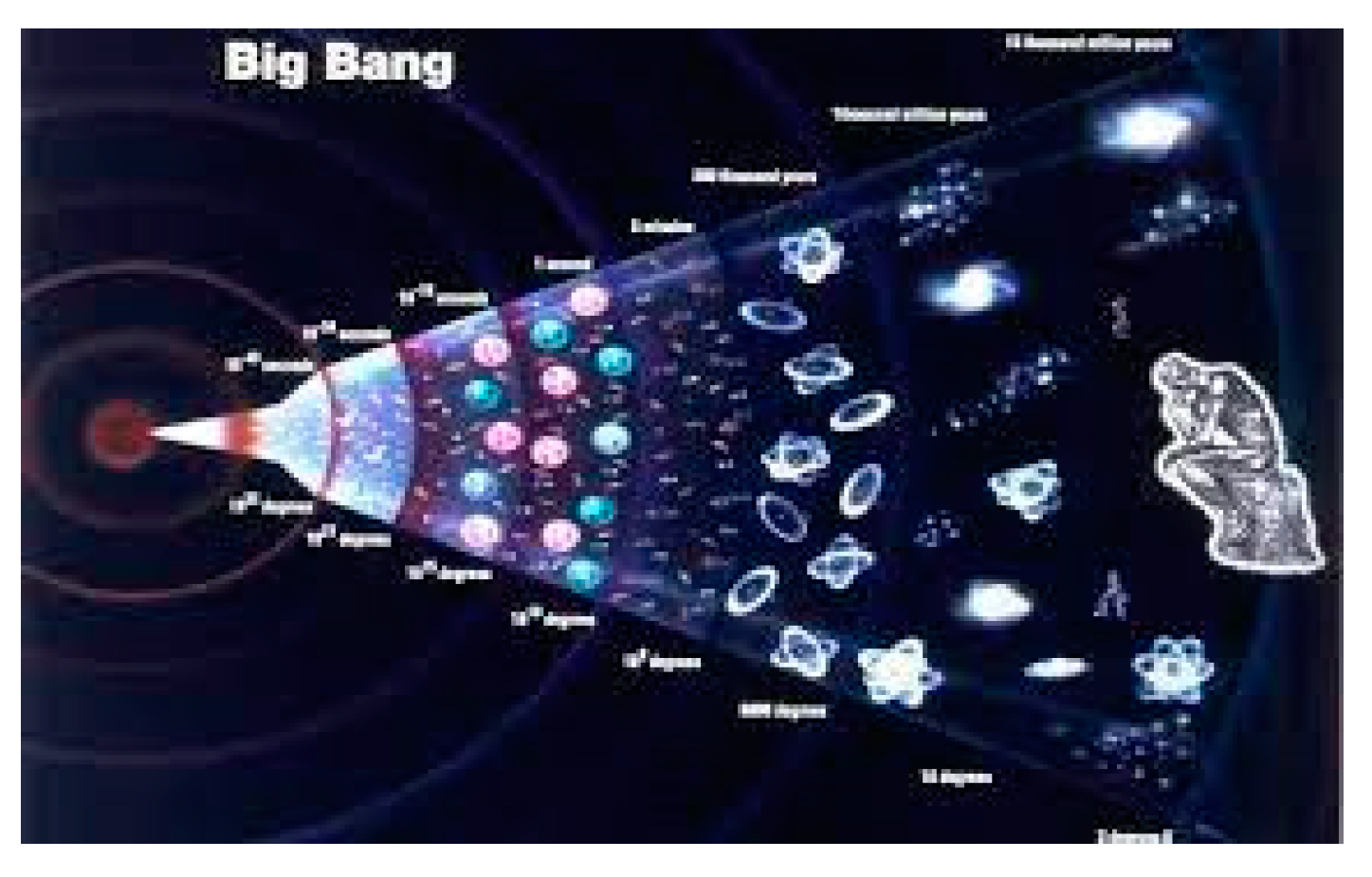
Figure 3.
Sagnac interferometer with rotating electromotor in the centre.
Disclaimer/Publisher’s Note: The statements, opinions and data contained in all publications are solely those of the individual author(s) and contributor(s) and not of MDPI and/or the editor(s). MDPI and/or the editor(s) disclaim responsibility for any injury to people or property resulting from any ideas, methods, instructions or products referred to in the content. |
© 2023 by the authors. Licensee MDPI, Basel, Switzerland. This article is an open access article distributed under the terms and conditions of the Creative Commons Attribution (CC BY) license (http://creativecommons.org/licenses/by/4.0/).
Copyright: This open access article is published under a Creative Commons CC BY 4.0 license, which permit the free download, distribution, and reuse, provided that the author and preprint are cited in any reuse.