

Submitted:
04 January 2023
Posted:
06 January 2023
You are already at the latest version
Abstract
Work-related thoughts in off-job time have been studied extensively in occupational health psychology and related fields. We provide a focused review of research on overcommitment – a component within the effort-reward imbalance model – and aim to connect this line of research to the most commonly studied aspects of work-related rumination. Drawing on this integrative review, we analyze survey data on ten facets of work-related rumination, namely (1) overcommitment, (2) psychological detachment, (3) affective rumination, (4) problem-solving pondering, (5) positive work reflection, (6) negative work reflection, (7) distraction, (8) cognitive irritation, (9) emotional irritation, and (10) inability to recover. First, we leverage exploratory factor analysis to self-report survey data from 357 employees to calibrate overcommitment items and to position overcommitment within the nomological net of work-related rumination constructs. Second, we leverage confirmatory factor analysis to self-report survey data from 388 employees to provide a more specific test of uniqueness vs. overlap among these constructs. Third, we apply relative weight analysis to quantify the unique criterion-related validity of each work-related rumination facet regarding (1) physical fatigue, (2) cognitive fatigue, (3) emotional fatigue, (4) burnout, (5) psychosomatic complaints, and (6) satisfaction with life. Our results suggest that several measures of work-related rumination (e.g., overcommitment and cognitive irritation) can be used interchangeably. Emotional irritation and affective rumination emerge as the strongest unique predictors of fatigue, burnout, psychosomatic complaints, and satisfaction with life. Our study assists researchers in making informed decisions on selecting scales for their research and paves the way for integrating research on effort-reward imbalance and work-related rumination.
Keywords:
work-related rumination
; overcommitment
; psychological detachment
; burnout
; irritation
; problem-solving pondering
; positive work reflection
; negative work reflection
; affective rumination
; satisfaction with life
1. Introduction
Work-related thinking in off-job time has been theorized as a variable that prolongs occupational stress into periods of rest [1,2,3]. The perseverative cognition hypothesis states that stressor-related thinking may be as stressful as experiencing the stressors themselves [3]. Applying the perseverative cognition hypothesis to occupational stress, work-related thinking may be the critical factor in explaining prolonged stress experiences and that it should be associated with risks for employee well-being [4,5]. According to the allostatic load model [6] prolonged stress responses will find expression in states of fear, tension, or anxiety in the short run (primary allostatic load, initial adaptation) [7]. These processes at the psychological level pave the way to ill-health at the physiological level as reflected in elevated hormonal setpoints (secondary allostatic load, set-point adjustment) and the onset of diseases like cardiovascular diseases (tertiary allostatic load, health outcomes) in the long run [7]. Given the pivotal role or work-related thinking in off-job time in explaining the health-impairing effects of work, it is no surprise that there is a large volume of research that has considered aspects of work-related rumination [8,9].
There are numerous conceptualizations of work-related rumination in the literature [8,9]. Drawing on Martin and Tesser’s broad definition of rumination [10], Weigelt and colleagues [9] have suggested the term work-related rumination as a broad umbrella term for any kind of recurrent work-related thoughts during off-job time. Consistent with this rationale and slightly specifying Martin and Tesser’s generic definition of rumination to work-related thinking, we refer to work-related rumination as conscious thoughts during off-job time (e.g., work breaks, evenings, weekends, or vacations) that revolve around work and that recur in the absence of immediate environmental demands requiring the thoughts.
Research in occupational health psychology has focused primarily on five facets of work-related rumination in a broad sense, namely (1) psychological detachment [11], (2) affective rumination [1], (3) problem-solving pondering [1], (4) positive work reflection [12], and (5) negative work reflection [13]. There is empirical evidence that these five facets are distinct factors and relate differentially to specific indicators of employee well-being, such as burnout and satisfaction with life [8,9]. However, there are additional constructs tapping into work-related rumination that have evolved independently. For instance, overcommitment is frequently studied in public health research [e.g., 14,15], but rarely considered in occupational health psychology [16]. Overcommitment is a focal variable in the effort-reward imbalance model [17,18] conceptualized in medical sociology as “a set of attitudes, behaviors and emotions that reflect excessive striving in combination with a strong desire of being approved and esteemed”[19] (p. 55).
A closer look at the content of focal questionnaire items suggests that there may be a considerable overlap in what work-related rumination facets and overcommitment capture. There is empirical evidence that some aspects of work-related rumination may be considered largely redundant (e.g., psychological detachment and cognitive irritation) [9]. However, research efforts on work-related rumination in a broad sense [9] have been largely fragmented. Work-related rumination is studied along disparate lines of research within and across disciplines. This state of affairs makes construct clean-up or more integrated and consistent research efforts within occupational health psychology and across disciplines challenging to impossible. To advance this state of affairs, we provide an integrative literature review of work-related rumination. We focus on overcommitment and its links to work-related rumination. Building on the overlap between overcommitment and work-related rumination, we conducted two consecutive studies aiming to integrate research on overcommitment on the one hand and the dominant facets of work-related rumination in occupational health psychology on the other hand.
We contribute to the literature on work-related rumination in at least three ways: First, we study overcommitment – a construct commonly used in medical sociology research – simultaneously with the facets of work-related rumination that dominate research in occupational health psychology. By doing so, We aim to integrate the literatures on overcommitment and constructs like psychological detachment, affective rumination, problem-solving pondering, and work reflection. More specifically, we aim to position overcommitment more precisely in the nomological net of work-related rumination constructs by factor analyzing overcommitment items vis-à-vis items from the dominant scales in occupational health psychology. Second, we include four less extensively studied and partially earlier developed constructs like cognitive irritation and emotional irritation [20], distraction [21], and inability to recover from the Faulty Attitudes and Behaviors Analysis (FABA) [22,23,24], to capture the full range of frequently studied work-related rumination constructs and to work towards an integrative framework of work-related rumination. We examine convergence (vs. distinctiveness) of constructs applying confirmatory factor analysis. Covering this broad set of facets contributes to quantify the overlap vs. uniqueness of all these constructs and assists researchers upon selecting scales. Third, we scrutinize the relevance of each facet of work-related rumination by examining the criterion-related validity with regard to key aspects of employee well-being and health, namely regarding (1) physical fatigue, (2) cognitive fatigue, (3) emotional fatigue, (4) burnout, (5) psychosomatic complaints, and (6) satisfaction with life. We employ relative-weight analysis to quantify the unique explanatory power of each facet of work-related rumination vis-à-vis one another. In other words, we provide precise estimates of which facets of work-related rumination are the most toxic or protective variables with regard to these outcomes and eventually (ill-)health in the long run.
After introducing the construct of overcommitment and the five major facets and four additional measures of work-related rumination, we provide a review of research exploring links between overcommitment and these facets as a background for the focal analyses.
1.1. Overcommitment
The construct of overcommitment originates from the effort-reward imbalance model (ERI) [17]. According to the ERI, an imbalance between effort exerted by the employee and rewards provided by the employer poses a risk for individual health. ERI distinguishes between extrinsic (aspects of the job context) and intrinsic (aspects of the individual) effort. Overcommitment reflects the intrinsic side of effort and is conceptualized as a disposition to cope with demanding situations by excessive engagement and urge of being in control [16,25].
A recent systematic review of ERI found that overcommitment is linked to impaired self-reported (e.g., fatigue, insomnia) and physiological health outcomes (e.g., blood pressure, atherogenic lipids) [25]. More specifically, there is empirical evidence that overcommitment is positively linked to indicators of impaired energetic well-being, such as fatigue [26], burnout [27,28,29,30,31,32,33,34], emotional exhaustion [15,35,36,37,38,39,40,41], vital exhaustion (a compound of strain indicators including exhaustion) [42,43], and need for recovery [26,44]. Systematic reviews of ERI [45] and more specifically of overcommitment [25] found that overcommitment is associated with higher levels of (psycho)somatic complaints. More recent research is consistent with these findings [46,47,48]. Although links between overcommitment and satisfaction with life have not been studied extensively, one study with students found that overcommitment to one’s studies was moderately negatively related to satisfaction with life [49].
Prototypical overcommitment items explicitly tap into personal inability to withdraw from work obligations (see also [17] for the broader concept of “immersion”) and being pre-occupied with work-related issues in off-job time. Due to the focus of overcommitment measures on inability to withdraw from work, the terms overcommitment and inability to withdraw are sometimes used interchangeably [26]. As we will show below, overcommitment has rarely been studied side by side with any facet of work-related rumination. However, a closer look at the item content reveals considerable similarities between overcommitment, and facets of work-related rumination conceptualized in occupational health psychology, such as psychological detachment. Consistent with this idea, we briefly define the most commonly applied facets of work-related rumination and review the empirical evidence on links between overcommitment and work-related rumination.
1.2. The “Famous Five” Facets of Work-Related Rumination
The most commonly used facets of work-related rumination in occupational health psychology are (1) psychological detachment, (2) affective rumination, (3) problem-solving pondering, (4) positive work reflection, and (5) negative work reflection [8,9] and there is evidence that these “famous five” constructs capture related, yet unique aspects of work-related rumination in off-job time [9]. Psychological detachment has been studied extensively in occupational health psychology and related fields. However, less research has studied psychological detachment in concert with other facets of work-related rumination. In this study, we follow up on research efforts taking a integrative perspective on work-related rumination constructs [8,9].
Psychological detachment – “the sense of being away from the work situation” [11] (p. 579) – has been studied extensively particularly in occupational health psychology. There are numerous literature reviews [2] and meta-analyses on psychological detachment [50,51,52,53] finding that psychological detachment relates to higher levels of employee well-being and health. In their meta-analysis of work-related thoughts, Jimenez et al. [8] described psychological detachment as the construct that captures work-related thinking during off-job time in the purest form, because psychological detachment does neither explicitly capture the content and valence of thoughts about work nor does it tap into affective experiences associated with these thoughts. In other words, detachment primarily captures the extent to which employees spend their off-job time without any thoughts about work – irrespective of the quality of these thoughts.
Cropley and Zijlstra [1] have argued that being “switched on” in off-job time per se may not be problematic, but that the quality of work-related thinking makes a difference. Accordingly they have suggested a tripartite conceptualization of work-related rumination. More specifically, they distinguish between detachment, affective rumination, and problem-solving pondering. Cropley and Zijlstra describe affective rumination as intrusive, pervasive, recurring thoughts about work, which are experienced as negative in affective terms [1]. Jimenez et al. [8] have argued that affective rumination explicitly captures affective experiences accompanying work-related rumination in off-job time (and at least implicitly thought content and valence) and hence should be considered a prototypical “contaminated” work-related rumination construct (i.e., a construct that captures aspects beyond the core of work-related thinking per se, e.g., concomitants of rumination). Empirically, detachment and affective rumination are distinct, but correlate highly negatively (see [8,54] for meta-analyses and [9] for a review).
Problem-solving pondering is the third facet of work-related rumination in the tripartite conceptualization of work-related rumination. It is characterized as “prolonged mental scrutiny of a particular problem or an evaluation of previous work in order to see how it can be improved, but it does not involve the emotional process that sustains arousal as in affective rumination.” [1]. According to Jimenez et al. [8] problem-solving pondering is located in the middle position of the continuum ranging from pure to contaminated. Problem-solving pondering is to some extent contaminated, because typical items are explicit about the content of thoughts, but they do not directly capture affect experienced while thinking about work.
Recently, Weigelt et al. [9] have argued that research on work reflection should be included under the work-related rumination umbrella to move towards a more coherent and integrated nomological network of work-related rumination. In a similar vein, Jimenez et al. have conceptually integrated work and included positive and negative work reflection in their meta-analysis on work-related rumination. Positive work reflection refers to thinking about the positive sides of one’s job [12]. Positive work reflection has originated from research on recovery from the job and has been studied either as a standalone construct [55] or in concert with psychological detachment [56] or negative work reflection [13]. According to Jimenez et al. [8] positive work reflection is to some degree contaminated, because typical items are explicit about the content and valence of thoughts. Empirically, positive work reflection correlates moderately with problem-solving pondering but has negligible associations with the other facets of work-related rumination [9]. Positive work reflection unambiguously captures unique aspects of work-related rumination and has unique associations with indicators of employee well-being (see [57] for experimental evidence).
Negative work reflection refers to thinking about the negative aspects of one’s job and realizing what one does not like about it [13]. Conceptually, negative work reflection is similar to affective rumination in that it refers to negative ways of thinking about work in off-job time. Unlike psychological detachment negative work reflection is explicit about the content and valence of thoughts and is to some degree contaminated [8]. However, unlike affective rumination negative work reflection emphasizes cognition rather than affect and does not explicitly capture affective experiences that may accompany thoughts about the negative sides of one’s job [see 8,9 for an in-depth elaboration]. Empirically, negative work reflection correlates moderately negatively with psychological detachment (r = .40), moderately positively with problem-solving pondering (r = .40) and highly positively with affective rumination (r = .64) [9]. Hence, negative work reflection can be considered a distinct facet of work-related rumination with strong links to affective rumination.
In sum, albeit some pairs of constructs tend to correlate quite highly, the five facets of work-related rumination just reviewed capture unique aspects of thinking about work in off-job time and relate differentially to several aspects of employee well-being.
1.3. Less Extensively Studied Facets of Work-Related Rumination
In this section we briefly introduce additional aspects of work-related rumination that have been conceptualized in parallel to the famous five facets of work-related rumination, namely cognitive irritation, emotional irritation, distraction, and inability to recover. Even though these aspects may appear redundant with the already mentioned constructs and with one another, we may only speculate about the degree of redundancy across these constructs. Therefore, it seems important to address this issue empirically.
Irritation refers to subjectively perceived cognitive and emotional strain in work context. Akin to OVC, irritation is conceptualized as a mediator between job characteristics and long-term strain. Mohr and colleagues distinguish between two aspects, namely cognitive and emotional irritation. Cognitive irritation refers to the inability to switch off mentally and it has been defined in terms of rumination in some publications [20,58,59]. Applying confirmatory factor analysis to cross-sectional self-report data from 474 employees from Germany, Weigelt et al. [9] found that cognitive irritation is emerges as a factor empirically distinct from the “famous five”. However, cognitive irritation correlated at r = -.77 with psychological detachment and hence can be considered largely redundant with psychological detachment. Emotional irritation describes to level of irritability and taps into tense activation as a reaction to goal discrepancies [20]. Hence, there is large similarity to affective rumination as conceptualized in the work-related rumination questionnaire (WRRQ). Consistent with this rationale, Weigelt et al. [9] found that emotional irritation is distinct from the “famous five”. However, emotional irritation correlated at r = .67 with affective rumination. Hence, although there seems to be a high degree of overlap between irritation and the famous five facets of work-related rumination, inclusion of both cognitive and emotional irritation when studying the full range of work-related rumination is warranted.
Distraction originates from the tripartite conceptualization of work-related rumination and there is sub-scale of the WRRQ that was labeled either distraction or detachment in the original paper. Cropley et al. have used the terms distraction and psychological detachment interchangeably, because the overlap in content between detachment as measured in the recovery experience questionnaire (the standard measure of psychological detachment) and the respective items of the WRRQ-sub-scale is considerable. Prototypical distraction-items refer to ease of unwinding from work and the proactive use of boundary management strategies (e.g., “I make myself switch off from work as soon as I leave.”). Hence, distraction is slightly more behavioral and agentic than the detachment-items of the recovery experience questionnaire (e.g., “I get a break from the demands of work.”). Whenever we refer to the WRRQ-subscale, we consistently use the label “distraction” to avoid confusion between detachment as operationalized in the WRRQ vs. as operationalized in the recovery experience questionnaire. We expect that distraction will converge strongly with psychological detachment and might emerge as redundant with psychological detachment. However, including distraction besides psychological detachment provides the opportunity to scrutinize whether the practice of using measures of distraction and psychological detachment interchangeably [9] is warranted.
A final facet of work-related rumination we will consider is this study is inability to recover, which is one of four sub-scales of the faulty attitudes and behaviors analysis (FABA) [23]. The FABA originates from an integration of Type A-behavior research [60] and Action Regulation Theory [61] in the work-context starting at the end of the 1980s. In this sense, faulty attitudes and behaviors refer to inefficient action regulation strategies under disadvantageous working conditions, thus, an impairment of goal setting and planning, action execution, feedback, and organization and cooperation. More specifically, inability to recovery (sometimes called ‘work obsession/inability to recover’) refers to general attitudes towards the job, which conceptually unfold in problems with action execution and action control (e.g., inefficient goal hierarchy, multi-acting and task repetitions, disturbances with finishing tasks). Symptoms are a chronic preoccupation with the job, high work-related effort investment, disturbed relaxation and recovery (e.g., work-related thoughts during recovery periods, sleep problems), blurred boundaries between the work and private domain, and strong feelings of work-related responsibility. Accordingly, there is a high degree of conceptual similarity and overlap between overcommitment and inability to recover (see also [62]). Empirically, Richter and colleagues [63] found that inability to recover as conceptualized in the FABA correlates at r = -.75 with psychological detachment from the recovery experience questionnaire. Hence, according to conventions for determining convergent and discriminant validity of constructs ([64] suggest a cut-off of .70), inability to recover is largely redundant with psychological detachment. Including inability to recover in this study is conducive to integrate research on the FABA (mainly used in German research) to overcommitment and the famous five facets of work-related rumination.
1.4. Links Between Overcommitment and other Facets of Work-Related Rumination
In the previous sections, we have outlined that there may be considerable overlap of content between overcommitment and facets of work-related rumination. Hence, integration of research on overcommitment, the famous five facets, and the four less extensively studied facets of work-related rumination may be worthwhile to arrive at a more coherent, consistent, and conceptually parsimonious body of research. We conducted a literature search to identify studies explicitly capturing overcommitment and one or several of the facets of work-related rumination introduced above. We searched for the term “overcommitment” and combined it with a second keyword, e.g., detachment. We included all studies published until December 2022. In Table 1 we present the number of relevant studies available across “Web of Science”, “PubMed”, “ScienceDirect”, and “Business Source Complete” after removing studies that did not explicitly capture overcommitment and at least one other facet of work-related rumination.
As evident from Table 1, less than a dozen published empirical studies have considered overcommitment jointly with one of the other facets of work-related rumination. In other words, empirical evidence linking overcommitment to work-related rumination is almost non-existent. Among the studies identified not all reported correlations between overcommitment and the facets of work-related rumination considered [30,40,65], leaving us with a very small set of studies. Below, we summarize and review the empirical evidence available.
Across two cross-sectional survey studies Gillet and colleagues [44] explored recovery profiles and reported correlations of overcommitment, psychological detachment, and rumination. They applied a prototypical measure of psychological detachment and a measure of work-related rumination that does not align unambiguously with one of the famous five facets of work-related rumination, albeit it is most similar to cognitive irritation. The authors report that overcommitment correlates strongly with psychological detachment and rumination (Psi > .70). This initial piece of empirical evidence is consistent with the idea that overcommitment is very close conceptually to specific facets of work-related rumination. In a multi-source survey study by Potok and Littman-Ovadia [66] overcommitment correlated strongly negatively with both self- and spouse-rated psychological detachment.
Drawing on theoretical considerations on the content overlap across scales and on the evidence reviewed above, we expect that overcommitment will converge strongly with psychological detachment. Given that correlations in published research covered a broad range from r = -.52 [66] to -.83 [44] and given that factor analyses in prior research supported the distinction between overcommitment and psychological detachment [44], we expect that overcommitment will emerge as a factor distinct from but highly correlated with psychological detachment. Given the nascent state of research on the convergence vs. distinctiveness across work-related rumination facets, we formulate an open research question:
- Research question 1: Is overcommitment empirically distinct from the other facets of work-related rumination? How strongly does (1) overcommitment correlate with (2) psychological detachment, (3) affective rumination, (4) problem-solving pondering, (5) positive work reflection, (6) negative work reflection, (7) distraction, (8) cognitive irritation, (9) emotional irritation, and (10) inability to recover?
Providing a more precise description of overcommitment within the nomological network of work-related rumination constructs is particularly fruitful from a theoretical perspective, because it paves the way towards a more parsimonious conceptual landscape. From a practical perspective it seems particularly important to identify the most “toxic” or “salubrious” facets of work-related rumination. Hence, we consider how overcommitment and the other facets of work-related rumination relate to and differentially predict major well-being and health outcomes. We focus on aspects of employee well-being and health that have been studied frequently jointly with overcommitment, the famous five facets, and other facets of work-related rumination. As evident from our review on overcommitment correlates, overcommitment is consistently linked to indicators of reduced energetic well-being, such as fatigue, emotional exhaustion, and burnout. Meta-analyses on psychological detachment [8,50,51,52,53] have consistently found links to indicators of energetic well-being, as well. We therefore focus on three aspects of work fatigue as suggested in the tripartite conceptualization of fatigue, namely (1) physical, (2) cognitive, and (3) emotional fatigue [67]. We supplement this by including (4) burnout as an alternative reflection of suboptimal energetic resource status [68,69]. We consider links to (5) psychosomatic complaints, because psychosomatic complaints are prototypical indicators of primary allostatic load [7] – a precursor of impaired health at the physiological level (e.g., hypertension). Psychosomatic complaints have frequently been studied as correlates or consequences of overcommitment finding positive links [25]. Finally, we explore the relative predictive power regarding (6) satisfaction with life – a major aspect of generic (rather than job-context specific) well-being – because it is frequently studied as a correlate of work-related rumination [e.g., 51]. Rather than merely comparing bivariate correlations between overcommitment and other facets of work-related rumination to these well-being and health outcomes, we explicitly provide a comparison of the unique variance explained by each facet of work-related rumination when tested concurrently with the other facets. This comparison provides a more precise understanding of the relative importance of each facet when taking into account overlap with similar constructs. Given that there is almost no empirical research comparing more than two or three facets of work-related rumination and how they are linked to well-being and health outcomes, we do not state a hypothesis, but formulate a research question:
- Research question 2: Which facets of work-related rumination explain the largest portion of unique variance in (1) physical fatigue, (2) cognitive fatigue, (3) emotional fatigue, (4) burnout, (5) psychosomatic complaints, and (6) satisfaction with life.
2. Materials and Methods
2.1. Procedure
We conducted a cross-sectional self-report survey study online that took place between June 2021 and April 2022.
2.2. Samples
The data for Sample 1 and Sample 2 were collected within larger data collection effort. After data collection was completed, we split up the total sample into two subsamples. We refer to these two subsamples as Sample 1 and Sample 2. We formed two subsamples to run the exploratory (Sample 1) and the confirmatory (Sample 2) analyses with distinct non-overlapping set of participants. After splitting the sample, sample sizes were N = 628 (Sample 1) and N = 665 (Sample 2). We cleaned the data by excluding participants who:
- (1)
- screened out early in the survey (N Sample 1 = 453, N Sample 2 = 505)
- (2)
- indicated that they did not participate conscientiously in the seriousness check (N Sample 1 = 420, N Sample 2 = 460)
- (3)
- did not give consent for data analysis (N Sample 1 = 418, N Sample 2 = 451)
- (4)
- completed the survey in less than 1.5 seconds per item (N Sample 1 = 375, N Sample 2 = 403)
- (5)
- did not have a job (remaining: N Sample 1 = 357, N Sample 2 = 388)
After removing these participants Sample 1 consisted of 357 participants and Sample 2 consisted of 388 participants. In Sample 1, 270 participants identified themselves as female, 85 as male, and two as non-binary. Average age was 32.32 years (SD = 9.64) ranging from 19 to 62 years. Participants came from diverse industries. Their average tenure with the current organization was 5.17 years ranging from less than 1 to 36 years. In Sample 1, 278 individuals did not have a leadership position.
In Sample 2, 299 participants identified themselves as female, 88 as male, and one as non-binary. Average age was 32.13 years (SD = 9.54) ranging from 18 to 64 years. Participants came from diverse sectors. Their average tenure with the current organization was 5.48 years ranging from less than 1 to 45 years. In Sample 2, 301 individuals did not hold a management position. We provide a more detailed description of the two samples in the Tables A4a, and A4b in the supplemental materials. In general, the two samples were very similar regarding demographic composition.
2.3. Measures
2.3.1. Overcommitment
We applied all six items of the Overcommitment subscale (OVC) of the Effort-Reward Imbalance Questionnaire (ERIQ) from Siegrist et al. [70] to measure overcommitment. The ERIQ contains twenty-two validated items across five subscales, namely Effort, Reward (includes the components Esteem, Job Promotion and Job Security) and Overcommitment. The measure has been developed in German. Responses in our study ranged from 1 (strongly disagree) to 5 (strongly agree). A sample item for overcommitment is “As soon as I get up in the morning I start thinking about work-related problems.”
2.3.2. Psychological Detachment
We applied all four items of the of the Psychological Detachment subscale of the Recovery Experience Questionnaire (REQ) from Sonnentag and Fritz [71] to measure psychological detachment. The REQ contains sixteen validated items across four subscales, namely Relaxation, Mastery, Control and Psychological Detachment. The measure has been developed in German. Responses ranged from 1 (strongly disagree) to 5 (strongly agree). A sample item is “During time after work, I forget about work.”
2.3.3. Affective Rumination
We applied all five items of the Affective Rumination subscale of the Work-Related Rumination Scale (WRRQ) from Cropley et al. [21] to measure affective rumination. The WRRQ contains fifteen validated items across three subscales, namely Affective Rumination, Problem-Solving Pondering, and Distraction. The WRRQ has been adapted to German [9]. Responses ranged from 1 (very seldom or never) to 5 (very often or always). A sample item is “I become tense when I think about work-related issues during my free time.”
2.3.4. Problem-Solving Pondering
We applied all five items of the Problem-Solving Pondering subscale of the German adaptation [9] of the Work-Related Rumination Questionnaire (WRRQ) from Cropley et al. [21] to measure problem-solving pondering. Responses ranged from 1 (very seldom or never) to 5 (very often or always). A sample item is “I find solutions to work-related problems in my free time.”
2.3.5. Positive Work Reflection
We applied all items of the validated 4-item questionnaire Positive Work Reflection from Binnewies et al. [13] to measure positive work reflection during leisure time. The measure has been developed in German. Responses ranged from 1 (strongly disagree) to 5 (strongly agree). A sample item is “During leisure time, I think about the good sides of my work.”
2.3.6. Negative Work Reflection
We applied all items of the validated 4-item questionnaire Negative Work Reflection from Binnewies et al. [13] to measure negative work reflection during leisure time. The measure has been developed in German. Responses ranged from 1 (strongly disagree) to 5 (strongly agree). A sample item is “During leisure time, I consider the negative aspects of my job.”
2.3.7. Cognitive Irritation
We applied all three items of the Cognitive Irritation (“rumination”) subscale of the Irritation Scale from Mohr et al. [62] to measure cognitive irritation. The Irritation Scale consists of eight validated items across two subscales, namely Emotional Irritation and Cognitive Irritation. The measure has been developed in German. Responses ranged from 1 (never/rarely) to 5 (very often/always). A sample item is “Even at home I often think of my problems at work.”
2.3.8. Emotional Irritation
We applied all five items of the Emotional Irritation (“irritability”) subscale of the Irritation Scale from Mohr et al. [62] to measure cognitive irritation. Responses ranged from 1 (never/rarely) to 5 (very often/always). A sample item is “I get grumpy when others approach me.”
2.3.9. Distraction
We applied all five items of the Distraction subscale of the German adaptation [9] of the Work-Related Rumination Scale (WRRQ) from Cropley et al. [21] to measure distraction. Responses ranged from 1 (very seldom or never) to 5 (very often or always). A sample item is “I find it easy to unwind after work”
2.3.10. Inability to Recover
We applied all six items of the Work Obsession/Inability to Recover subscale of the Faulty Attitudes and Behavior Analysis (FABA) [22] to measure the inability to recover. The FABA contains twenty validated items across four subscales, namely Planning Needs, Reactive Uncontrol, Dominance/Competition and Work Obsession/Inability to Recover. The measure has been developed in German. Responses ranged from 1 (strongly disagree) to 5 (strongly agree). A sample item is “I find it difficult to switch off after work.”
2.3.11. Physical Fatigue
We applied all six items of the physical fatigue subscale of the work fatigue inventory (WFI-3D) from Frone and Tidwell [67]. The WFI-3D consists of 18 items across three subscales, namely physical fatigue, mental fatigue, and emotional fatigue. The scale has been adapted to and validated in German by Frone et al. [72]. Responses ranged from 1 (never) to 5 (always). We asked participants to refer to the past three months. A sample item is “How often did you feel physically exhausted at the end of the workday?”
2.3.12. Mental Fatigue
We applied all six items of the mental fatigue subscale of the work fatigue inventory (WFI-3D) from Frone and Tidwell [67]. Instructions, time frame and response options were the same as for physical fatigue. A sample item is “How often did you feel mentally exhausted at the end of the workday?”
2.3.13. Emotional Fatigue
We applied all six items of the emotional fatigue subscale of the work fatigue inventory (WFI-3D) from Frone and Tidwell [67]. Instructions, time frame, and response options were the same as for physical and mental fatigue. A sample item is “How often did you feel mentally exhausted at the end of the workday?”
2.3.14. Burnout
We applied all six items of the Personal Burnout subscale of the Copenhagen Burnout Inventory (CBI) from Kristensen et al. [68] to measure burnout. The CBI contains nineteen validated items across three subscales, namely Work-Related Burnout, Client-Related Burnout, and Personal Burnout. The CBI has been adapted to German by Nübling et al. [73]. We applied all items of the personal burnout facet. Responses ranged from 1 (less than once a month) to 5 (several times a day). A sample item is “How oft did you feel emotionally exhausted?”
2.3.15. Psychosomatic Complaints
We applied eight out of 12 items of the somatic complaints sub-scale of the Symptom Checklist 90 (SCL-90) from Derogatis (1977). The SCL-90 has been adapted to German by Franke (1995). We asked participants to rate to what extent the following health issues impaired them within the last 3 months. Responses ranged from 1 (not at all) to 5 (very severe). Sample items are “headaches”, “faintness or dizziness”, “pains in heart or chest”. We confined to eight out of 12 items because four items overlapped with aspects or concomitants of fatigue, such as “heavy feelings in your arm or legs”.
2.3.16. Satisfaction with Life
We applied all five items of the validated Satisfaction with Life Scale (SWLS) from Diener et al. [74]. The SWLS has been adapted to German by Glaesmer et al. [75]. Responses ranged from 1 (strongly disagree) to 7 (strongly agree). A sample item is “In most ways my life is close to my ideal.”
In Table A1 in the Supplementary Materials, we provide a detailed summary of the measures applied.
2.4. Analytic steps for Sample 1
We first examined the bivariate correlations between each of the six OVC items and the composite scores of all aspects of work-related rumination to explore their overlap with one another. Drawing on these initial analyses, we conducted a set of exploratory factor analyses with a selection of items. We focused on the aspects of work-related rumination that correlated at .70 or higher with at least one of the six OVC items. We set .70 as the relevant cut-off value, because – as a recommended rule of thumb – correlations of .70 or above are considered as evidence for convergent validity and against discriminant validity [64]. We applied the EFA.dimensions-package version 0.1.7.3 [76] and the psych-package version 2.1.3 [77] in the R statistics environment. In the factor analyses, we applied principal axis factoring (PAF) due to its robustness independent of the underlying variables’ distribution [78]. Bartlett-test(χ2=7098.41, df=276, p<.01), Kaiser-Meyer-Olkin-coefficient (.96) and the measure of sample adequacy coefficients (ranging from .91 to .97) indicated the data as suitable for the analysis. As the parallel analysis and the minimum-average-partial-test yielded divergent results, we ran the analysis for a 2-factor-model and a 3-factor-model and selected the preferred model based on the amount of variance explained as well on considerations in terms of content. Because the first factor solution was well interpretable no rotation was applied.
3. Results
3.1. Convergence of OVC with other work-related rumination aspects (Sample 1)
In Table 2, we present the descriptive statistics and correlations among all variables considered in Sample 1. In Table 3, we present the correlations between each OVC item and the aspects of work-related rumination introduced above. As can be seen in Table 3, items of OVC correlated the highest with (1) psychological detachment (REQ), (2) distraction (WRRQ), (3) cognitive irritation, and (4) inability to recover (FABA). Hence, we included the items from theses scales in the factor analyses besides the OVC items.
3.2. Factors underlying OVC and selection of work-related rumination aspects (Sample 1)
We factor-analyzed the 24 items selected from the OVC, psychological detachment, distraction, cognitive irritation, and inability to recover-scales. We selected this set of items, because at least one of the OVC-items correlated above .70 with these scales.
We found that a three-factor solution fitted best. However, for the sake of transparency, we also report the coefficients of a two-factor solution in Table A2 of the supplemental materials that fitted the data slightly worse. In Table 4, we report the loadings, communalities, and proportion of variance of the focal items derived from the three-factor model. The three extracted factors explained 63% of variance. The focal items loaded unambiguously on one of the three factors and did not yield sizeable cross-loadings. The three factors can be interpreted as
- (1)
- inability to unwind from work,
- (2)
- psychological detachment, and
- (3)
- distraction.
The first factor (inability to unwind) is sourced primarily from the six inability to recover items from the FABA, the three cognitive irritation items, and four of the six OVC items. The first OVC item yields a small loading on the first factor, too. The second factor (psychological detachment) is sourced from the four psychological detachment items of the REQ and the third OVC item tapping into ease of switching off after work. The third factor (distraction) is sourced exclusively from the five distraction items from the WRRQ.
The first OVC item that explicitly captures time pressure turns out to be an unreliable indicator of the inability to unwind-factor, apparently due to its focus on job stressors rather than problems switching off. The reverse-scored third OVC-item that captures ease of switching off turns out to be an indicator of the second factor capturing (ease of) psychological detachment. The sixth OVC-item loads unambiguously, but only moderately on the first factor capturing inability to unwind. We suggest that the rather poor reliability of this item stems from its focus on unfinished tasks as a cause of sleep impairment – which is a very specific symptom of inability to unwind from work. The second, the fourth, and the fifth OVC-items emerge as the most reliable indicators of the inability to unwind from work-factor. Accordingly, we present different versions of the OVC-composite in the correlation tables to report links of more pure or more contaminated variants of OVC and how they relate to outcome variables.
3.3. Implications of the exploratory factor analyses (Sample 1)
Item-level analyses of OVC suggest that at least some of the six OVC items are suboptimal from a psychometric perspective due to too low loadings and cross-loadings. Hence, we recommend removing the first and the sixth item tapping into workload and sleep impairment due to workload to make the scale more internally consistent (i.e., to improve reliability). The proposed 4-item version of the OVC scale avoids confounding distinct aspects in a unidimensional scale. The results reported above suggest that OVC items correlate highly with several aspects of work-related rumination. The core of the scale (3 or 4 out of 6 items) connotes content overlap with inability to unwind from work in off-job time. Our factor analyses provide evidence that overcommitment essentially captures inability to unwind from work as conceptualized and captured in the FABA subscale inability to recover. In the remainder of this paper, we will focus on the 4-item version of the OVC scale throughout all analyses. However, we report bivariate correlations for the 4-item version, the 5-item version and the 6-item version for the sake of transparency.
Besides the specific evidence on the OVC items, the results of the exploratory factor analyses have implications for the structure of work-related rumination. The results suggest that inability to recover as measured with the respective FABA-subscale, cognitive irritation, and OVC might be considered largely redundant constructs or alternative ways of measuring the same underlying construct. Hence, inability to recover, cognitive irritation, and OVC might be applied largely interchangeably to capture inability to unwind from work. Our results support the distinction between inability to unwind and psychological detachment as the potential antipode of inability to unwind. Hence, inability to unwind is distinct empirically from psychological detachment. On a related note, psychological detachment and distraction emerge as distinct constructs, as well. Psychological detachment and distraction, both refer to ease of unwinding from work in off-job time. However, the emphasis of these scales differs considerably. Whereas distraction items have a more proactive and agentic wording (i.e., making sure one can detach from work), psychological detachment items tend to be more experiential and are not explicitly and unambiguously agentic (i.e., detachment happens to employees no matter, why). Our finding challenges the practice of treating distraction as an alternative measure and an interchangeable scale of psychological detachment. Besides the slightly different content of the items from these two scales, the different response formats (agreement vs. frequency) may have contributed to finding distinct factors. We will revisit the link between psychological detachment and distraction in factor analyses with Sample 2.
3.4. Theoretical Rationale for the Confirmatory Analyses (Sample 2)
Whereas the analyses with Sample 1 were primarily exploratory in nature, our aim with Sample 2 was to conduct a more theory-driven examination of the structure underlying the ten work-related rumination constructs introduced above. Drawing on the results obtained in Sample 1, we set out to locate overcommitment more precisely in the nomological net of work-related rumination constructs applying a confirmatory approach. Hence, we apply confirmatory factor analysis to Sample 2 to determine overlap and distinctiveness among overcommitment and the other work-related rumination constructs. That is, we conducted an a-priori specification of factors and related item-loadings in advance and compared different models with a more nuanced versus a more parsimonious factor structure. Of note, our analytical approach does not only help integrate overcommitment into research on work-related rumination. It is also conducive to understand the full range of constructs in this domain and provides a precise description of which measures can be considered more or less unique or redundant with other constructs. Drawing on this more precise description of the structure underlying the ten work-related rumination constructs, we leverage the data of Sample 2 to examine differential links of each construct to a set of outcomes. More specifically, we study the unique relevance of each work-related rumination construct in explaining variance in major health and well-being outcomes, namely (1) physical fatigue, (2) mental fatigue, (3) emotional fatigue, (4) burnout, (5) psychosomatic complaints, and (6) satisfaction with life. Applying relative weight analysis, we can determine the unique predictive power of each of the ten work-related rumination constructs introduced above with regard to these outcome variables. Quantifying the unique predictive power of each work-related rumination construct is conducive to prioritize across the full range of work-related rumination when having to confine to a selection from the full range of constructs. In other words, we provide insights into which construct or set of constructs is the most relevant from a pragmatic and (research) practical point of view.
3.5. Factorial Structure Underlying the Ten Work-Related Rumination Constructs (Sample 2)
In Table 5 we present the correlations among the focal variables in Sample 2. We applied confirmatory factor analysis to specify competing factorial structures. We specified a measurement model with all items loading on their respective factors. We tested a 10-factor model consisting of (1) overcommitment, (2) psychological detachment (REQ), (3) affective rumination (WRRQ), (4) problem-solving pondering (WRRQ), (5) positive work reflection, (6) negative work reflection, (7) cognitive irritation, (8) emotional irritation, (9) distraction (WRRQ), and (10) inability to recover (FABA). We freely estimated covariances among all factors across all confirmatory factor analyses. We compared this focal model with a set of competing models. More specifically, we tested a single-factor model with all items loading on a common factor. Furthermore, we specified models combining two or more work-related rumination factors in case these factors correlated very highly. For instance, cognitive irritation correlated above .80 with OVC, psychological detachment, distraction, and inability to recover. In Figure 1, Figure 2 and Figure 3 we illustrate the set of competing factorial structures examined.
We tested these models applying the lavaan-package version 0.6-11 [79] for the R statistics environment. We applied the robust maximum likelihood estimator (MLR) to handle non-normally distributed data. We refer to standardized coefficients (loadings, covariances) when reporting results. In Table 5, we report the fit indices of the focal model and the plausible alternatives. We report robust estimates of Comparative Fit Index (CFI), Tucker Lewis Index (TLI), Root Mean Square Error of Approximation (RMSEA) and Standardized Root Mean Square Residual (SRMR). According to Schumacker and Lomax [80] CFI- and TLI-values above .90, RMSEA-values below .08, and SRMR-values below .10 signal acceptable fit. We compared nested models by means of the χ²-difference test to identify the structure that fitted the data best.
In Table 6 we report the fit indices and comparisons across models. As evident from Table 6, the preferred 10-factor model achieved an acceptable fit to the data as reflected in CFI = .920, TLI = .911, RMSEA = .059, and SRMR = .058. The 10-factor model fit the data better than any of the competing models combining either OVC-items or cognitive irritation-items with the most highly correlated variables. More specifically, combining OVC and psychological detachment to a common factor (Model 9a) did not improve model fit. Combining cognitive irritation and overcommitment (Model 9b), detachment (Model 9e), distraction (Model 9f), and inability to recover (Model 9g) to load on a common factor did not improve model fit. However, the 10-factor model and Model 9b combining OVC and cognitive irritation fit the data equally well. Hence, distinguishing between OVC and cognitive irritation is barely warranted.
In Table 7, we report the estimated correlations among the factors from the 10-factor model. These results help to qualify and extend the model comparisons reported above. From Table 7 it is obvious that several of the ten work-related rumination constructs studied are very highly correlated. For instance, OVC correlates at Ψ = .96 with cognitive irritation, at Ψ = -.75 with psychological detachment, and at Ψ = .74 with inability to recover. Estimated correlations clearly exceed the threshold of |r| < .70 for supporting discriminant validity [64]. Albeit less pronounced, the same applies to correlations between OVC and distraction at Ψ = -.70. Hence, although OVC emerges as a factor technically distinct from the other constructs, the high degree of overlap may render the distinction between OVC and e.g., cognitive irritation practically less useful and relevant.
Besides the high correlation between OVC and psychological detachment just reported, psychological detachment correlates at Ψ = .92 with cognitive irritation and at Ψ = .74 with distraction. The correlation between psychological detachment and inability to recover at Ψ = -.68 is very high, too. Hence, psychological detachment and cognitive irritation appear to be barely distinguishable. The overlap with inability to recover is considerable, as well. Psychological detachment and distraction are empirically distinct and tap into slightly different aspects of “switching off” from work. However, from a practical point of view, using psychological detachment and distraction more or less interchangeably is probably reasonable.
Affective rumination correlates moderately with most aspects of work-related rumination. However, correlations to cognitive irritation and inability to recover are Ψ = .67 and Ψ = .64, respectively, pointing to a considerable portion of shared variance among constructs. Problem-solving pondering correlates moderately with most aspects of work-related rumination. The highest correlation emerges to cognitive irritation at Ψ = .61.
Positive work reflection is only weakly or not at all related to any of the other work-related rumination constructs with estimated correlations ranging from |Ψ| = .07 to |Ψ| = .24. Negative work reflection shows weak to moderate links to the other work-related rumination constructs with correlations ranging from |Ψ| = .07 to |Ψ| = .41.
Besides the almost perfect correlation between cognitive irritation, OVC, and psychological detachment, estimated correlations of cognitive irritation with distraction and inability to recover range from Ψ = .86 to Ψ = .88. These findings suggest that cognitive irritation captures almost no unique aspects beyond four of the ten work-related rumination constructs. By contrast, emotional irritation yields weak to moderate links to the other work-related rumination constructs as reflected in estimated correlations ranging from |Ψ| = .21 to |Ψ| = .48.
Inability to recover as conceptualized in the FABA converges particularly strongly with cognitive irritation and OVC as reflected in correlations of Ψ = .88 and Ψ = .74, respectively. The overlap with psychological detachment and affective rumination is considerable, too, as reflected in correlations of Ψ = -.68 and Ψ = .64.
In sum, our analysis of the structure underlying the ten work-related rumination constructs suggests that all ten aspects emerge as empirically distinct factors. Collapsing two or three or these constructs to common factors does not improve model fit. Although this finding suggests that distinguishing these ten aspects is warranted from a psychometric perspective, a closer look at the estimated correlations from a pragmatic perspective reveals that some aspects of work-related rumination are barely distinguishable. Some constructs like positive and negative work reflection have negligible overlap with other constructs. The “famous five” facets (detachment, affective rumination, problem-solving pondering, positive work reflection, and negative work reflection) emerge as unambiguously unique factors. However, the less intensively studied measures – namely cognitive irritation, distraction, and inability to recover – tend to share a large portion of variance with one another or with one or several of the famous five facets. Of note, as obvious from the extremely high correlations, OVC tends to tap into the same content as psychological detachment, cognitive irritation, distraction as conceptualized in the WRRQ, and inability to recover as conceptualized in the FABA. Our results suggest that several of the less extensively studied constructs, such as cognitive irritation, distraction, and inability to recover essentially measure the same aspects of work-related rumination as the psychological detachment scale does. Drawing on these findings, we explore to what extent distinguishing the ten work-related rumination constructs improves the prediction of key aspects of employee well-being and health outcomes.
3.6. Relative Predictive Power of the Ten Work-Related Rumination Constructs (Sample 2)
The redundancies across the work-related rumination constructs reported above suggests that a more parsimonious structure may suffice to capture the full range of work-related rumination. Above, we have argued that the famous five facets are unambiguously unique and that OVC and several less extensively studied constructs like cognitive irritation may be considered more or less alternative operationalizations of psychological detachment. However, these specific measures capture unique aspects of work-related rumination that may contribute to improve the prediction of key indicators of employee well-being and health. Therefore, we set out to compare the predictive validity of the ten work-related rumination constructs vis-à-vis one another. We performed relative weight analysis [81,82,83] to quantify the unique predictive power of each construct regarding six indicators of employee well-being and health, namely (1) physical fatigue, (2) mental fatigue, (3) emotional fatigue, (4) burnout, (5) psychosomatic complaints, and (6) satisfaction with life. Unlike traditional multiple regression models, relative weight analysis explicitly takes into account that predictors may correlate highly among one another (i.e., multicollinearity) [82] and provides the opportunity to partition variance explained across multiple predictors in a more accurate way [84].
In Tables 8 to 13, we report the results separately for each outcome variable. As evident from Table 8, combining the ten work-related rumination constructs as predictor results in explaining roughly 30 percent of variance in physical fatigue. A closer look at the relative weights (RW) and the rescaled relative weights (RS-RW%) suggests that each facet explains some variance in physical fatigue. However, only a few constructs explain large portions of the variance explainable by all constructs. Emotional irritation, affective rumination, and negative work reflection each explain approximately 6 percent of the variance in physical fatigue. Positive work reflection and inability to recover each explain about 3 percent of the variance in physical fatigue. In other words, five of the ten work-related rumination constructs explain more than 80 percent of the variance explainable by the whole set of predictors. The other five aspects of work-related rumination explain small portions of unique variance. For instance, psychological detachment uniquely explains only about 1,5 percent of variance in physical fatigue.
A similar pattern of results is evident in Table 9 focusing on mental fatigue. In total, the ten work-related rumination constructs explain 36 percent of variance in mental fatigue. Again, emotional irritation, affective rumination, inability to recover, and negative work-reflection are among the strongest predictors. Emotional irritation alone explains approximately 10 percent of variance (a fourth of the variance explained by all predictors). Affective rumination, inability to recover each, negative work reflection, and cognitive irritation each explain approximately 5 percent of variance. The other predictors explain about 2 percent of unique variance in mental fatigue.
In Table 10, we present the results of the relative weight analysis predicting emotional fatigue. In total the ten work-related rumination constructs explain 31 percent of variance in emotional fatigue. Emotional irritation, affective rumination, inability to recover, and negative work-reflection are the strongest predictors. Emotional irritation alone explains approximately 8 percent of variance (a fourth of the variance explained by all predictors). Inability to recover, affective rumination and negative work reflection explain 5, 4, and 3 percent of unique variance, respectively. Positive work reflection and cognitive irritation explain roughly 2 percent of variance in emotional fatigue. Overcommitment, psychological detachment, problem-solving pondering, and distraction explain 1 percent of variance only.
In Table 11, we present results of the relative weight analysis predicting burnout. In total the ten work-related rumination constructs explain 45 percent of variance in burnout. Like the results for emotional fatigue emotional irritation, affective rumination, inability to recover, and negative work-reflection are among the strongest predictors. Emotional irritation alone explains approximately 12 percent of variance (a fourth of the variance explained by all predictors). Affective rumination uniquely explains 7 percent of variance in burnout. Inability to recover, negative work reflection, and positive work reflection each explain 5 percent of unique variance. Psychological detachment and distraction each explain 2 percent of unique variance in burnout. Overcommitment, problem-solving pondering, and distraction explain 1 percent of variance only.
In Table 12, we present results of the relative weight analysis predicting psychosomatic complaints. In total the ten work-related rumination constructs explain 26 percent of variance in psychosomatic complaints. Emotional irritation, affective rumination, inability to recover are the strongest predictors. Emotional irritation alone explains approximately 9 percent of variance (a third of the variance explained by all predictors). Affective rumination uniquely explains 6 percent of variance in psychosomatic complaints. Inability to recover and overcommitment explain 3 and 2 percent of unique variance in psychosomatic complaints, respectively. Negative work reflection, cognitive irritation, and distraction explain less than 2 percent of unique variance in psychosomatic complaints. Psychological detachment, problem-solving pondering, and positive work reflection explain less than 1 percent of unique variance in psychosomatic complaints. Overcommitment, problem-solving pondering, and distraction explain 1 percent of variance only.
In Table 13, we present results of the relative weight analysis predicting satisfaction with life. In total the ten work-related rumination constructs explain 18 percent of variance in satisfaction with life. Positive work reflection and emotional irritation emerge as the strongest predictors. Positive work reflection alone explains approximately 6 percent of variance (a third of the variance explained by all predictors). Emotional irritation explains 5 percent of unique variance in satisfaction with life. Overcommitment, affective rumination, and inability to recover explain approximately 1 percent of unique variance in satisfaction with life. Psychological detachment, problem-solving pondering, negative work reflection, cognitive irritation, and distraction explain less than 1 percent of unique variance in satisfaction with life.
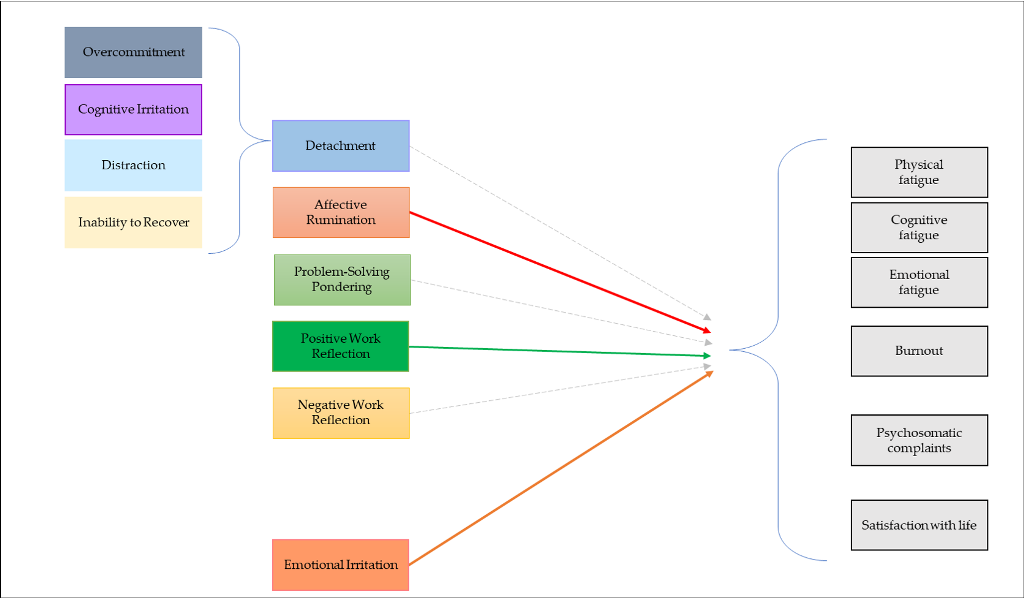
In Figure 4 provide a graphical summary of the RWA across outcomes. The relative weight analyses for indicators of well-being as criteria provide a precise description of the relative relevance of each work-related rumination construct studied here and help prioritize and select constructs from a pragmatic perspective with predictive validity as the core criterion. Although the specific results across the six outcomes vary considerably, there are several findings that replicate consistently across outcomes. First, emotional irritation is consistently among the strongest unique predictors across outcomes explaining one fourth to one third of the variance explainable by the ten work-related rumination constructs. Albeit effects are less pronounced and less consistent, the same applies to affective rumination and inability to recover. Both constructs emerge as the second or third best predictor of the six outcomes. Negative work reflection and positive work reflection tend to contribute uniquely to the prediction of outcomes, supporting these constructs as valuable aspects within the famous five facets of work-related rumination. Of note, when it comes to predicting positively connoted aspects of employee well-being positive work reflection plays a vital role. OVC explains less than 2 percent of unique variance and hence does not add considerably to the prediction of the six outcomes considered when considering other constructs tapping into inability to unwind from work. A similar pattern emerges for psychological detachment and distraction. This finding is notable when keeping in mind that psychological detachment has been studied more extensively than any of the other constructs. We suggest that the common theme of inability to unwind from work (as captured in psychological detachment, cognitive irritation, distraction as conceptualized in the WRRQ, and inability to recover as conceptualized in the FABA) is relevant for predicting fatigue, burnout, psychosomatic complaints, and satisfaction with life. However, inability to recover as a specific operationalization of this underlying theme captures large portions of variance relevant to predicting key indicators of employee well-being and health. A closer look at the bivariate correlations of psychological detachment versus inability to recover with the outcome variables in Table 4 is consistent with the findings from the relative weight analyses: Inability to recover yields considerably stronger links to all indicators of employee well-being and health.
5. Discussion
In the present study we set out to integrate research from disparate lines of research on work-related rumination with an emphasis on OVC as a construct that may overlap considerably with one or several of the major work-related rumination constructs studied in occupational health psychology. To date only a handful of studies have considered more than two or three facets of work-related rumination simultaneously. Hence, providing empirical evidence on the relative position of work-related rumination constructs vis-à-vis one another addressed an important conceptual issue. Across two samples, we ran factor analyses for OVC items along with items from nine work-related rumination constructs. We compared criterion-related validity regarding well-being and health outcomes across the ten constructs applying multiple regression analyses and relative weight analyses.
5.1. Theoretical Implications
Our study provides empirical evidence on the position of OVC within the nomological network of work-related rumination constructs. Although OVC emerges as a distinct factor in the confirmatory factor analyses, the conceptual overlap with psychological detachment, cognitive irritation, distraction as conceptualized in the WRRQ, and inability to recover as conceptualized in the FABA, is very high as reflected in correlations above .80 or even .90. The estimated correlations suggest that these measures can probably be used largely interchangeably.
Our results confirm the distinction of the famous five facets of work-related rumination (psychological detachment, affective rumination, problem-solving pondering, positive work reflection, and negative work reflection) as unique and unambiguously non-redundant constructs with moderate correlations among these five facets. Our findings are consistent with recent integrative research [9]. However, several less extensively studied work-related rumination constructs converge strongly with psychological detachment, especially when considering latent factors (removing measurement error) in the confirmatory factor analyses. The exploratory factor analyses results with Sample 1 suggest that distinguishing between psychological detachment vs. inability to unwind is warranted and meaningful. However, the correlations between psychological detachment and the facets tapping into the lack of detachment in the confirmatory factor analyses of Sample 2 tends to be very high. Of note, psychological detachment correlates as strongly with cognitive irritation (inability to unwind) as with distraction (ability to unwind) consistently across the two samples (see Table 1 and Table 4). Hence, our analyses suggest that it may not make a big difference whether ease of unwinding or inability to unwind is focal in the questionnaire items when capturing aspects of work-related rumination.
In their recent meta-analysis on work-related rumination facets, Jimenez et al. [8] have proposed a continuum of work-related rumination constructs ranging from pure to contaminated constructs. According to this taxonomy, psychological detachment is a prototypically pure construct, because it is merely about switching off from work or not, irrespective of the content of thoughts [51]. By contrast, affective rumination is a prototypically contaminated construct, because it has a strong focus on the valence of thoughts and (negative) affect while thinking about work. A closer look at the bivariate correlations in our study, and especially the relative weight analyses, reveals that the contaminated constructs, such as affective rumination or positive work reflection contribute uniquely and considerably to the prediction of well-being outcomes. Hence, studying the valence and affective quality of work-related rumination alongside detachment may not only improve prediction of well-being. It may contribute to capture meaningful aspects of work-related rumination. These findings are consistent with conceptual arguments that being “switched on” during off-job time per se may not be detrimental to well-being and health [1]. Our findings are also consistent with meta-analytic evidence that distinguishing between negative, positive, and neutral forms of thinking about work is meaningful [8].
The evidence reported on positive work reflection suggests that it is vital to extend the scope of research beyond neutral or negative facets of work-related rumination, because positive work reflection contributes considerably to explaining variance in positive aspects of well-being, such as satisfaction with life. This finding is consistent with prior evidence on the unique benefits of problem-solving pondering and positive work reflection for satisfaction with life, flourishing, and thriving [9].
Our relative weight analyses suggest that emotional irritation and affective rumination are the most important predictors consistently across the outcomes considered. This might imply that focusing on these aspects of work-related rumination is warranted when trying to optimize prediction of employee well-being and health. At this point, we would like to caution against this shortcut. As already introduced, Jimenez et al. [8] have argued that affective rumination is a contaminated facet of work-related rumination capturing strain or impaired affective well-being (e.g., anxiety, tense activation) due to work-related rumination. A closer look at the specific affective rumination items confirms this perspective. A similar rationale applies to emotional irritation. Irritation has been conceptualized explicitly as an indicator of strain or impaired well-being rather than a measure of work-related rumination. However, the high correlation between emotional irritation and affective rumination made us consider emotional irritation as an aspect of work-related rumination. Weigelt et al. [9] reported that emotional irritation (but not affective rumination) correlates highly with neuroticism (remotional irritation = .63 vs. r affective rumination = .40) and therefore, may be conceptually less precise and more ambiguous than desired. From a conceptual point of view, the famous five facets, namely psychological detachment, affective rumination, problem-solving pondering, positive work reflection, and negative work reflection are probably less ambiguous and clearer than the less extensively studied four facets (cognitive irritation, emotional irritation, distraction, and inability to recover) as reflected in the moderate intercorrelations and differential links with outcomes [9].
In sum, we suggest that researchers studying aspects of work-related rumination should prioritize between conceptual clarity and pragmatic consideration. They may prefer a combination of pure and contaminated facets to capture the full range of work-related rumination and to optimize the prediction of outcomes. Our study provides detailed information and aids upon weighing the pros and cons of specific measures or facets vis-à-vis one another. More importantly, we pave the way towards connecting research on OVC with other facets of work-related rumination.
5.2. Practical Implications
Clarifying the structure underlying a broad range of work-related rumination constructs and adding precision to where OVC as a specific construct is located within the nomological network are primarily a theoretical issues. However, our research has some practical implications, as well. We provide three practical implications relevant for researchers and one additional practice-oriented implication here.
First, our study provides evidence-based guidance on navigating through the landscape of work-related rumination constructs and measures. In this sense, our study aids researchers as they select scales for research on work-related rumination, its antecedents, its outcomes, and contingencies underlying health-impairing effects of work as conceptualized in the perseverative cognition hypothesis [4]. Researcher no longer need to speculate whether measures can be applied interchangeably. They can consult the correlation tables provided here. They can pick the measures that provides the best fit for the aims of their research. For instance, they can select a set of aspects with minimal redundancy.
Second, upon selecting measures an important criterion for decision-making might be optimizing predictive validity regarding well-being and health outcomes [85]. Our results suggest that it may not be necessary to capture the full range of work-related rumination in a study to achieve an optimal level of accuracy in the prediction of a given outcome. Our analyses provide evidence that there is a considerably overlap across constructs and therefore a selection of two, three or four measures might capture most of the variance relevant for predicting outcomes.
Third, we have argued above that it may not matter whether a scale captures ease of psychological detachment or inability to unwind from a psychometric perspective. However, we would like to qualify this recommendation from a practical point of view. Research on work-related rumination in occupational health psychology tends to draw on experience sampling studies and therefore asks participants to assess levels of work-related rumination aspects across 5, 10 or more days repeatedly. Measures that explicitly refer to ruminative thoughts or inability to unwind may therefore be more reactive (they may provoke rumination). Hence, although measures such as inability to recovery may optimize predictive validity, focusing on psychological detachment rather than inability to recover may be a sensible option.
Fourth, our results provide evidence that large portions of variance in well-being outcomes are attributable to aspects of work-related rumination. For instance, work-related rumination explains 30 percent or even more in energetic well-being outcomes, namely fatigue and burnout. Hence, interventions aimed at modifying work-related rumination [86,87] are likely to alleviate issues of fatigue and exhaustion, as well.
5.4. Strengths and Limitations
Our research features several strengths, such as considering a large set of variables concurrently, leveraging the advantages of structural equation modeling, and providing an opportunity for replication across two samples. However, the results should be interpreted in the light of a few limitations.
We have examined the structure underlying ten work-related rumination constructs drawing on cross-sectional survey data. Accordingly, our research applies only to the between-person level (i.e., habitual differences between persons assumed to be largely stable over time). This perspective is consistent with research on OVC. However, a large volume of research on work-related rumination has applied experience sampling methodology and has focused on effects at the within-person level (i.e., transient differences in work-related rumination within-person from day to day). We cannot claim that our findings will generalize to the within-person level. However, a cross-sectional survey study is a sensible starting point. For instance, OVC and several other work-related rumination measures have been developed with an eye towards between-person differences and traditional survey research. For some of these scales, adaptation to the day-level (as is common in experience sampling research) would either change the meaning of the construct or would not work at all (e.g., Today, I am a nervous wreck, [62]). Doing a cross-sectional survey as a first step allows us to draw conclusions regarding the original chronic or trait-framed constructs. Moreover, our focus was not on examining causal links as rigorously as possible, but on assessing convergence vs. uniqueness across the ten work-related rumination constructs and comparing the relative predictive validity across constructs (rather than establishing it for a single predictor). Cross-sectional survey studies are a good fit for these aims [88] and our approach provides the opportunity to include and concurrently study a large set of constructs and comprehensive sets of items.
However, we had to confine to a probably non-exhaustive selection of constructs and scales here. For instance, recently different aspects of thinking about work in positive ways have been proposed, such as basking (positive affect while thinking about work) [89] and wallowing (i.e., looking back at successes at work) [90]. However, positive work reflection may overlap considerably with these constructs as reflected in correlations between positive work reflection and positive affect [91].
In a similar vein, we have captured a selection of six well-being and health outcomes. We relied exclusively on self-reports, because the focal work-related rumination measures are self-report scales. In this case, method bias may inflate correlations among variables [92,93,94]. However, we suggest that inflated correlations among variables may render our examination of the structure underlying work-related rumination constructs more conservative, because it may be harder to find evidence that factors are distinct. Although, we have taken care to minimize the number of different response formats to improve the user experience, the specific wording of the focal scales required different response formats, namely a frequency-based response format (ranging from never to always) or an agreement-based format (ranging from fully disagree to fully agree). OVC, psychological detachment, positive work reflection, and negative work reflection refer to agreement ratings. By contrast, affective rumination, problem-solving pondering, cognitive irritation, emotional irritation, distraction, and inability to recover refer to frequency ratings. These differences in response formats may have contributed to amplify differences between factors due to a method factor. Different response formats might contribute to making some highly redundant constructs emerge as distinct factors in the factor analyses [92,93]. Upon weighing the pros and cons of applying a consistent response format across all work-related rumination constructs, we decided to stick to the original response format to make sure our findings apply to the prototypical format of the scales applied in previous research.
5.4. Avenues for Future Research
Above, we have argued that contaminated work-related rumination constructs may provide a more holistic description of work-related rumination than focusing on psychological detachment alone. Accordingly, we strongly encourage research that studies the role of psychological detachment in concert with the other aspects of the famous five (affective rumination, problem-solving pondering, positive work reflection, negative work reflection). Research efforts taking an integrative perspective across work-related rumination constructs would not only provide insights into the unique relevance of each aspect regarding specific outcomes. Drawing on the taxonomy by Jimenez et al. [8], it would also be conducive to disentangle the relevant components (e.g., perseverative cognition, negative affect) of work-related rumination that contribute to impaired well-being and health. We have taken a first step into this direction, but experience sampling research on work-related rumination has just begun to study more than one aspect of rumination as it relates to next day well-being and performance [95].
Although our study approach fits very well with prior theoretical developments on work-related rumination concepts and related scale developments, a conceptual caveat is still the integration of time framing and valence regarding work-related thoughts [96]. Rutten and colleagues [97] recently developed an instrument tailored to capture anticipatory work-related thoughts (work prospection). They showed that cognitive, positive affective and negative affective work prospection (i.e., work-related thought about the next working day) each explain unique and incremental variance in important wellbeing and recovery outcomes beyond other related constructs (i.e., work-related rumination, psychological detachment, workload anticipation, and positive and negative affect). In a similar vein, Noja et al. [98] proposed a measure of work-home integration tapping into past vs. future-oriented thoughts about work during off-job time.
Exploring the structure of work-related rumination further might be worthwhile. Although, we have emphasized the distinctiveness of at least five facets of work-related rumination, there may be a general factor underlying the range of scales (R-factor, cf. [99]). There may also be higher-order valence (positive thought content, negative thought content) or mode factors (emphasis on cognition, emphasis on affect) (see [100] for an illustration). In recent years researchers have utilized bi-factor models to capture a general factor of constructs like basic need satisfaction – a higher-order factor sourced from autonomy need satisfaction, relatedness need satisfaction, and competence need satisfaction [101]. Such bi-factor models would allow describing configurations of work-related rumination in an analytically very elegant and parsimonious way.
Finally, detachment has originally been described in terms of being away from the work situation [11]. This description implicitly conveys that there is a spatial, temporal or social – psychological – distance to work. Given that psychological distance is at the heart of construal level theory [102,103], future research might capitalize on the basic research on psychological distance and construal level and apply this knowledge to provide a more precise understanding of how and when perseverative cognition and work-related rumination actually affect employee well-being and health.
6. Conclusions
In this manuscript we have reviewed the literature on work-related rumination during off-job time with an emphasis on OVC as a construct that is highly similar to aspects of work-related rumination, but that has rarely been linked to this stream of research empirically. Drawing on self-report survey data, we have performed factor analysis to determine the position of OVC in the nomological network of work-related rumination constructs. Our analyses suggest that although OVC is technically distinct from the other facets of work-related rumination, the overlap with psychological detachment is very high. Hence, distinguishing OVC from psychological detachment may not add much value from a practical perspective. We suggest treating OVC, psychological detachment, cognitive irritation, distraction, and inability to recover as alternative reflections of the same underlying construct. Our study replicates evidence that favors basically five unambiguously distinct facets of work-related rumination, namely (1) psychological detachment, (2) affective rumination, (3) problem-solving pondering, (4) positive work reflection, and (5) negative work reflection. Applying relative weight analyses to compare the unique predictive power of each work-related rumination facet regarding major well-being and health outcomes, we found that facets that explicitly tap into the content and valence of thoughts, and the affective experiences accompanying these thoughts, such as affective rumination, emotional irritation, and positive work reflection explained the largest proportions of variance in well-being and health. Our study draws a precise and nuanced picture of the work-related rumination construct landscape and especially the connections among constructs and the unique features of specific facets. Our research paves the way towards more integrated and coherent research on the full range work-related rumination from OVC to psychological detachment.
Supplementary Materials
The following supporting information can be downloaded at: https://osf.io/5tq6r/
- Table A1. Details of the Measures Applied
- Table A2. Results of the Exploratory Factor Analyses in Sample 1 with 2 factors
- Table A3. Item by item loading from the CFA in Sample 2
- Table A4a. Descriptive Statistics of Continuous Demographic Variables by Samples
- Table A4b. Descriptive Statistics of Categorial Demographic Variables by Samples
- Table A5. Means, standard deviations, and correlations with confidence intervals (Sample 1)
- Table A6. Means, standard deviations, and correlations with confidence intervals (Sample 2)
Author Contributions
Conceptualization, O.W. and J.C.S.; methodology, O.W. and C. S.; software, C.S.; validation, C.S. and O.W.; formal analysis, O.W. and J.C.S.; investigation, O.W., C.S., and J.C.S.; resources, O.W. and C. S.; data curation, C.S., J.C.S. and L.E.; writing—original draft preparation, O.W., L.E., and J.C.S.; writing—review and editing, J.W., C.J.S., G.M.W., Y.Z.V., L.E., P.G., R.J.; visualization, L.E. and P.G.; supervision, O.W.; project administration, O.W.; funding acquisition, O.W. All authors have read and agreed to the published version of the manuscript.”
Funding
This research was funded by Volkswagen Foundation (Az. 96 849, “The role of work in the development of civilization diseases”). We acknowledge financial support from Leipzig University within the funding program Open Access Publishing.
Institutional Review Board Statement
The procedure and materials of this study have not undergone examination by an ethics committee, as the measures and procedures of our study followed the protocols of standard self-report survey research in applied psychology, and we did not touch sensitive topics (e.g., sexual orientation). Such studies are typically exempt from being formally examined by an ethics committee. The study did not involve any intervention. Our study fully complied with the standards of the Department of Psychology at the University of Hagen, which included strict guidelines to guarantee anonymity of the self-reported data.
Informed Consent Statement
Individuals interested in participating in our study were informed about the general aims and the protocol of the study before their participation. We obtained informed consent from all participants. Our protocol did not include any form of deception of participants. Participation was voluntary and participants had the opportunity to quit whenever they wanted. Participants provided informed consent at the beginning of the online study by confirming that they had understood the protocol and agreed with the terms of the study. Participants were included in the analysis if they agreed that their data - stored in an anonymous way – would be used for scientific research and publications based on this research.
Data Availability Statement
Correlation matrices are reported in the manuscript and the supplemental materials. Raw and processed data supporting reported results can be accessed at https://osf.io/5tq6r/
Acknowledgments
We thank Max Dormann for assisting us in structuring the codebook and filing some cleaning and analysis scripts of this study.
Conflicts of Interest
The authors declare no conflict of interest. The funders had no role in the design of the study; in the collection, analyses, or interpretation of data; in the writing of the manuscript; or in the decision to publish the results.
References
- Cropley, M.; Zijlstra, F.R.H. Work and Rumination. In Handbook of stress in the occupations.; Langan-Fox, J., Cooper, C.L., Eds.; New horizons in management; Edward Elgar Publishing: Northampton, MA, US, 2011; pp. 487–501. ISBN 978-0-85793-114-6. [Google Scholar]
- Sonnentag, S.; Fritz, C. Recovery from Job Stress: The Stressor-Detachment Model as an Integrative Framework. J. Organ. Behav. 2015, 36, S72–S103. [Google Scholar] [CrossRef]
- Meurs, J.A.; Perrewé, P.L. Cognitive Activation Theory of Stress: An Integrative Theoretical Approach to Work Stress. J. Manag. 2011, 37, 1043–1068. [Google Scholar] [CrossRef]
- Brosschot, J.F.; Gerin, W.; Thayer, J.F. The Perseverative Cognition Hypothesis: A Review of Worry, Prolonged Stress-Related Physiological Activation, and Health. J. Psychosom. Res. 2006, 60, 113–124. [Google Scholar] [CrossRef] [PubMed]
- Brosschot, J.F.; Verkuil, B.; Thayer, J.F. Conscious and Unconscious Perseverative Cognition: Is a Large Part of Prolonged Physiological Activity Due to Unconscious Stress? J. Psychosom. Res. 2010, 69, 407–416. [Google Scholar] [CrossRef] [PubMed]
- McEwen, B.S. Physiology and Neurobiology of Stress and Adaptation: Central Role of the Brain. Physiol. Rev. 2007, 87, 873–904. [Google Scholar] [CrossRef] [PubMed]
- Ganster, D.C.; Rosen, C.C. Work Stress and Employee Health: A Multidisciplinary Review. J. Manag. 2013, 39, 1085–1122. [Google Scholar] [CrossRef]
- Jimenez, W.P.; Hu, X.; Xu, X.V. Thinking about Thinking about Work: A Meta-Analysis of off-Job Positive and Negative Work-Related Thoughts. J. Bus. Psychol. 2022, 37, 237–262. [Google Scholar] [CrossRef]
- Weigelt, O.; Gierer, P.; Syrek, C.J. My Mind Is Working Overtime—towards an Integrative Perspective of Psychological Detachment, Work-Related Rumination, and Work Reflection. Int. J. Environ. Res. Public. Health 2019, 16, 2987. [Google Scholar] [CrossRef]
- Martin, L.L.; Tesser, A. Some Ruminative Thoughts. In Ruminative thoughts.; Wyer, R.S.Jr., Ed.; Advances in social cognition; Lawrence Erlbaum Associates, Inc: Hillsdale, NJ, England, 1996; pp. 1–47. ISBN 0898-2007 (Print). [Google Scholar]
- Etzion, D.; Eden, D.; Lapidot, Y. Relief from Job Stressors and Burnout: Reserve Service as a Respite. J. Appl. Psychol. 1998, 83, 577–585. [Google Scholar] [CrossRef]
- Fritz, C.; Sonnentag, S. Recovery, Health, and Job Performance: Effects of Weekend Experiences. J. Occup. Health Psychol. 2005, 10, 187–199. [Google Scholar] [CrossRef]
- Binnewies, C.; Sonnentag, S.; Mojza, E.J. Feeling Recovered and Thinking about the Good Sides of One’s Work. J. Occup. Health Psychol. 2009, 14, 243–256. [Google Scholar] [CrossRef] [PubMed]
- de Jonge, J.; Bosma, H.; Peter, R.; Siegrist, J. Job Strain, Effort–Reward Imbalance and Employee Well-Being: A Large-Scale Cross-Sectional Study. Soc. Sci. Med. 2000, 50, 1317–1327. [Google Scholar] [CrossRef] [PubMed]
- Schulz, M.; Damkröger, A.; Heins, C.; Wehlitz, L.; Löhr, M.; Driessen, M.; Behrens, J.; Wingenfeld, K. Effort–Reward Imbalance and Burnout among German Nurses in Medical Compared with Psychiatric Hospital Settings. J. Psychiatr. Ment. Health Nurs. 2009, 16, 225–233. [Google Scholar] [CrossRef] [PubMed]
- Lang, J.W.B.; Van Hoeck, S.; Runge, J.M. Methodological and Conceptual Issues in Studying Effort-Reward Fit. J. Manag. Psychol. 2020, 37, 498–512. [Google Scholar] [CrossRef]
- Siegrist, J. Adverse Health Effects of High-Effort/Low-Reward Conditions. J. Occup. Health Psychol. 1996, 1, 27–41. [Google Scholar] [CrossRef] [PubMed]
- Steptoe, A.; Siegrist, J.; Kirschbaum, C.; Marmot, M. Effort—Reward Imbalance, Overcommitment, and Measures of Cortisol and Blood Pressure Over the Working Day. Psychosom. Med. 2004, 66, 323–329. [Google Scholar] [CrossRef] [PubMed]
- Siegrist, J. A Theory of Occupational Stress. In Stress in the workplace: Past, present and future.; Dunham, J., Ed.; Whurr Publishers: Philadelphia, PA, 2001; pp. 52–66. ISBN 978-1-86156-181-7. [Google Scholar]
- Mohr, G.; Müller, A.; Rigotti, T.; Aycan, Z.; Tschan, F. The Assessment of Psychological Strain in Work Contexts: Concerning the Structural Equivalency of Nine Language Adaptations of the Irritation Scale. Eur. J. Psychol. Assess. 2006, 22, 198–206. [Google Scholar] [CrossRef]
- Cropley, M.; Michalianou, G.; Pravettoni, G.; Millward, L.J. The Relation of Post-Work Ruminative Thinking with Eating Behaviour. Stress Health 2012, 28, 23–30. [Google Scholar] [CrossRef]
- Rotheiler, E.; Richter, P.; Rudolf, M. Faulty Attitudes and Behaviour Analysis Relevant to Coping with Work Demands. An Action-Oriented Questionnaire for Type A Behaviour; TUDpress: Dresden, 2009. [Google Scholar]
- Richter, P.; Rudolf, M.; Schmidt, C.F. FABA – Fragebogen Zur Analyse Belastungsrelevanter Anforderungsbewältigung [FABA - The Faulty Attitudes and Behavior Ana-Lysis Questionnaire]; Swets: Frankfurt/M., 1996. [Google Scholar]
- Richter, P.; Hille, B.; Rudolf, M. Gesundheitsrelevante Bewältigung von Arbeitsanforderungen. Z. Für Differ. Diagn. Psychol. 1999, 20, 25–38. [Google Scholar] [CrossRef]
- Siegrist, J.; Li, J. Associations of Extrinsic and Intrinsic Components of Work Stress with Health: A Systematic Review of Evidence on the Effort-Reward Imbalance Model. Int. J. Environ. Res. Public. Health 2016, 13, 432. [Google Scholar] [CrossRef]
- von Thiele Schwarz, U. Inability to Withdraw from Work as Related to Poor Next-Day Recovery and Fatigue among Women. Appl. Psychol. 2011, 60, 377–396. [Google Scholar] [CrossRef]
- Avanzi, L.; Perinelli, E.; Vignoli, M.; Junker, N.M.; Balducci, C. Unravelling Work Drive: A Comparison between Workaholism and Overcommitment. Int. J. Environ. Res. Public. Health 2020, 17, 5755. [Google Scholar] [CrossRef]
- Bakker, A.B.; Killmer, C.H.; Siegrist, J.; Schaufeli, W.B. Effort-Reward Imbalance and Burnout among Nurses. J. Adv. Nurs. 2000, 31, 884–891. [Google Scholar] [CrossRef] [PubMed]
- Lau, B. Effort-Reward Imbalance and Overcommitment in Employees in a Norwegian Municipality: A Cross Sectional Study. J. Occup. Med. Toxicol. Lond. Engl. 2008, 3, 9. [Google Scholar] [CrossRef] [PubMed]
- Seibt, R.; Kreuzfeld, S. Influence of Work-Related and Personal Characteristics on the Burnout Risk among Full- and Part-Time Teachers. Int. J. Environ. Res. Public. Health 2021, 18, 1535. [Google Scholar] [CrossRef]
- Avanzi, L.; Savadori, L.; Fraccaroli, F.; Ciampa, V.; van Dick, R. Too-Much-of-a-Good-Thing? The Curvilinear Relation between Identification, Overcommitment, and Employee Well-Being. Curr. Psychol. 2022, 41, 1256–1266. [Google Scholar] [CrossRef]
- Hodge, B.; Wright, B.; Bennett, P. Balancing Effort and Rewards at University: Implications for Physical Health, Mental Health, and Academic Outcomes. Psychol. Rep. 2020, 123, 1240–1259. [Google Scholar] [CrossRef]
- Li, N.; Zhang, L.; Li, X.; Lu, Q. The Influence of Operating Room Nurses’ Job Stress on Burnout and Organizational Commitment: The Moderating Effect of over-Commitment. J. Adv. Nurs. 2021, 77, 1772–1782. [Google Scholar] [CrossRef]
- Hong Thai, B.T.; Nhu Trang, N.T.; Cam, V.T.; Thu Trang, L.; Huyen Trang, P.T. Effort–Reward Ratio, over-Commitment and Burnout: A Cross-Sectional Study among Vietnamese Healthcare Professionals. Cogent Psychol. 2022, 9, 2075614. [Google Scholar] [CrossRef]
- Feuerhahn, N.; Kühnel, J.; Kudielka, B.M. Interaction Effects of Effort–Reward Imbalance and Overcommitment on Emotional Exhaustion and Job Performance. Int. J. Stress Manag. 2012, 19, 105–131. [Google Scholar] [CrossRef]
- Huyghebaert, T.; Gillet, N.; Beltou, N.; Tellier, F.; Fouquereau, E. Effects of Workload on Teachers’ Functioning: A Moderated Mediation Model Including Sleeping Problems and Overcommitment. Stress Health J. Int. Soc. Investig. Stress 2018, 34, 601–611. [Google Scholar] [CrossRef] [PubMed]
- Oren, L.; Littman-Ovadia, H. Does Equity Sensitivity Moderate the Relationship between Effort–Reward Imbalance and Burnout. Anxiety Stress Coping Int. J. 2013, 26, 643–658. [Google Scholar] [CrossRef] [PubMed]
- Salmela-Aro, K.; Rantanen, J.; Hyvönen, K.; Tilleman, K.; Feldt, T. Bergen Burnout Inventory: Reliability and Validity among Finnish and Estonian Managers. Int. Arch. Occup. Environ. Health 2011, 84, 635–645. [Google Scholar] [CrossRef] [PubMed]
- Hu, S.; Wang, J.-N.; Liu, L.; Wu, H.; Yang, X.; Wang, Y.; Wang, L. The Association between Work-Related Characteristic and Job Burnout among Chinese Correctional Officers: A Cross-Sectional Survey. Public Health 2015, 129, 1172–1178. [Google Scholar] [CrossRef] [PubMed]
- Kreuzfeld, S.; Seibt, R. Gender-Specific Aspects of Teachers Regarding Working Behavior and Early Retirement. Front. Psychol. 2022, 13, 829333. [Google Scholar] [CrossRef] [PubMed]
- Darius, S.; Hohmann, C.B.; Siegel, L.; Böckelmann, I. Beurteilung psychischer Beanspruchung bei Kindergartenerzieherinnen mit unterschiedlichem Overcommitment. Psychiatr. Prax. 2022, 49, 89–98. [Google Scholar] [CrossRef] [PubMed]
- Preckel, D.; Meinel, M.; Kudielka, B.M.; Haug, H.-J.; Fischer, J.E. Effort-Reward-Imbalance, Overcommitment and Self-Reported Health: Is It the Interaction That Matters? J. Occup. Organ. Psychol. 2007, 80, 91–107. [Google Scholar] [CrossRef]
- Hanebuth, D.; Meinel, M.; Fischer, J.E. Health-Related Quality of Life, Psychosocial Work Conditions, and Absenteeism in an Industrial Sample of Blue- and White-Collar Employees: A Comparison of Potential Predictors. J. Occup. Environ. Med. 2006, 48, 28–37. [Google Scholar] [CrossRef]
- Gillet, N.; Morin, A.J.S.; Mokounkolo, R.; Réveillère, C.; Fouquereau, E. A Person-Centered Perspective on the Factors Associated with the Work Recovery Process. Anxiety Stress Coping 2021, 34, 571–596. [Google Scholar] [CrossRef]
- van Vegchel, N.; de Jonge, J.; Bosma, H.; Schaufeli, W. Reviewing the Effort-Reward Imbalance Model: Drawing up the Balance of 45 Empirical Studies. Soc. Sci. Med. 1982 2005, 60, 1117–1131. [Google Scholar] [CrossRef]
- Kinman, G. Effort-Reward Imbalance in Academic Employees: Examining Different Reward Systems. Int. J. Stress Manag. 2019, 26, 184–192. [Google Scholar] [CrossRef]
- Kunz, C. The Influence of Working Conditions on Health Satisfaction, Physical and Mental Health: Testing the Effort-Reward Imbalance (ERI) Model and Its Moderation with over-Commitment Using a Representative Sample of German Employees (GSOEP). BMC Public Health 2019, 19, 1009. [Google Scholar] [CrossRef] [PubMed]
- Montano, D.; Peter, R. The Causal Structure of the Effort-Reward Imbalance Model and Absenteeism in a Cohort Study of German Employees. Occup. Health Sci. 2021. [Google Scholar] [CrossRef]
- Smedbøl, T.; Saksvik-Lehouillier, I.; Skaug, S. Overcommitment in Students a Purely Negative Trait? An Exploratory Approach towards a More Comprehensive Understanding. Coll. Stud. J. 2016, 50, 378–392. [Google Scholar]
- Steed, L.B.; Swider, B.W.; Keem, S.; Liu, J.T. Leaving Work at Work: A Meta-Analysis on Employee Recovery from Work. J. Manag. 2021, 47, 867–897. [Google Scholar] [CrossRef]
- Wendsche, J.; Lohmann-Haislah, A. A Meta-Analysis on Antecedents and Outcomes of Detachment from Work. Front. Psychol. 2017, 7. [Google Scholar] [CrossRef] [PubMed]
- Bennett, A.A.; Bakker, A.B.; Field, J.G. Recovery from Work-Related Effort: A Meta-Analysis. J. Organ. Behav. 2018, 39, 262–275. [Google Scholar] [CrossRef]
- Headrick, L.; Newman, D.A.; Park, Y.A.; Liang, Y. Recovery Experiences for Work and Health Outcomes: A Meta-Analysis and Recovery-Engagement-Exhaustion Model. J. Bus. Psychol. 2022. [Google Scholar] [CrossRef]
- Blanco-Encomienda, F.; García-Cantero, R.; Latorre-Medina, M.J. Association between Work-Related Rumination, Work Environment and Employee Well-Being: A Meta-Analytic Study of Main and Moderator Effects 2020. [CrossRef]
- Fritz, C.; Sonnentag, S. Recovery, Well-Being, and Performance-Related Outcomes: The Role of Workload and Vacation Experiences. J. Appl. Psychol. 2006, 91, 936–945. [Google Scholar] [CrossRef]
- Meier, L.L.; Cho, E.; Dumani, S. The Effect of Positive Work Reflection during Leisure Time on Affective Well-Being: Results from Three Diary Studies. J. Organ. Behav. 2016, 37, 255–278. [Google Scholar] [CrossRef]
- Sonnentag, S.; Niessen, C. To Detach or Not to Detach? Two Experimental Studies on the Affective Consequences of Detaching From Work During Non-Work Time. Front. Psychol. 2020, 11. [Google Scholar] [CrossRef]
- Berset, M.; Elfering, A.; Luethy, S.; Luethi, S.; Semmer, N.K. Work Stressors and Impaired Sleep: Rumination as a Mediator. Stress Health 2011, 27, E71–E82. [Google Scholar] [CrossRef] [PubMed]
- Vahle-Hinz, T.; Bamberg, E.; Dettmers, J.; Friedrich, N.; Keller, M. Effects of Work Stress on Work-Related Rumination, Restful Sleep, and Nocturnal Heart Rate Variability Experienced on Workdays and Weekends. J. Occup. Health Psychol. 2014, 19, 217–230. [Google Scholar] [CrossRef]
- Friedman, H.S.; Booth-Kewley, S. Personality, Type A Behavior, and Coronary Heart Disease: The Role of Emotional Expression. J. Pers. Soc. Psychol. 1987, 53, 783–792. [Google Scholar] [CrossRef]
- Hacker, W. Action Regulation Theory: A Practical Tool for the Design of Modern Work Processes? Eur. J. Work Organ. Psychol. 2003, 12, 105–130. [Google Scholar] [CrossRef]
- Mohr, G.; Rigotti, T.; Müller, A. Irritation - Ein Instrument Zur Erfassung Psychischer Beanspruchung Im Arbeitskontext. Skalen- Und Itemparameter Aus 15 Studien. Z. Für Arb.- Organ. AO 2005, 49, 44–48. [Google Scholar] [CrossRef]
- Richter, P.; Funke, C.; Mittmann, S.; Rudolf, M.; Zwingmann, I. Gesundheitsrelevante Beeinflussung Der Handlungsregulation Unter Psychischer Belastung - Entwicklung von Paral-Lelskalen Zum FABA-Fragebogen [Health-Related Effects of Action Regulation under Mental Stress – Development of FABA-Quationnaire Parallel Scales]. Psychol. Alltagshandelns 2017, 10, 5–18. [Google Scholar]
- Cheung, G.W.; Wang, C. Current Approaches for Assessing Convergent and Discriminant Validity with SEM: Issues and Solutions. Acad. Manag. Proc. 2017, 2017, 12706. [Google Scholar] [CrossRef]
- Feldt, T.; Huhtala, M.; Kinnunen, U.; Hyvönen, K.; Mäkikangas, A.; Sonnentag, S. Long-Term Patterns of Effort-Reward Imbalance and over-Commitment: Investigating Occupational Well-Being and Recovery Experiences as Outcomes. Work Stress 2013, 27, 64–87. [Google Scholar] [CrossRef]
- Potok, Y.; Littman-Ovadia, H. Does Personality Regulate the Work Stressor–Psychological Detachment Relationship? J. Career Assess. 2014, 22, 43–58. [Google Scholar] [CrossRef]
- Frone, M.R.; Tidwell, M.-C.O. The Meaning and Measurement of Work Fatigue: Development and Evaluation of the Three-Dimensional Work Fatigue Inventory (3D-WFI). J. Occup. Health Psychol. 2015, 20, 273–288. [Google Scholar] [CrossRef]
- Kristensen, T.S.; Borritz, M.; Villadsen, E.; Christensen, K.B. The Copenhagen Burnout Inventory: A New Tool for the Assessment of Burnout. Work Stress 2005, 19, 192–207. [Google Scholar] [CrossRef]
- Quinn, R.W.; Spreitzer, G.M.; Lam, C.F. Building a Sustainable Model of Human Energy in Organizations: Exploring the Critical Role of Resources. Acad. Manag. Ann. 2012, 6, 337–396. [Google Scholar] [CrossRef]
- Siegrist, J.; Starke, D.; Chandola, T.; Godin, I.; Marmot, M.; Niedhammer, I.; Peter, R.; :; :; :; et al. The Measurement of Effort-Reward Imbalance at Work: European Comparisons. Soc. Sci. Med. 2004, 58; Jg. Apr, 2004, 1483–1499. [CrossRef]
- Sonnentag, S.; Fritz, C. The Recovery Experience Questionnaire: Development and Validation of a Measure for Assessing Recuperation and Unwinding from Work. J. Occup. Health Psychol. 2007, 12, 204–221. [Google Scholar] [CrossRef] [PubMed]
- Frone, M.R.; Reis, D.; Ottenstein, C. A German Version of the Three-dimensional Work Fatigue Inventory (3d-wfi): Factor Structure, Internal Consistency, and Correlates. Stress Health J. Int. Soc. Investig. Stress 2018. [Google Scholar] [CrossRef]
- Nübling, M.; Stößel, U.; Hasselhorn, H.-M.; Michaelis, M.; Hofmann, F. Measuring Psychological Stress and Strain at Work - Evaluation of the COPSOQ Questionnaire in Germany. GMS Psycho-Soc. Med. 2006, 3. [Google Scholar]
- Diener, E.; Emmons, R.A.; Larsen, R.J.; Griffin, S. The Satisfaction With Life Scale. J. Pers. Assess. 1985, 49, 71–75. [Google Scholar] [CrossRef] [PubMed]
- Glaesmer, H.; Grande, G.; Braehler, E.; Roth, M. The German Version of the Satisfaction with Life Scale (SWLS): Psychometric Properties, Validity, and Population-Based Norms. Eur. J. Psychol. Assess. 2011, 27, 127–132. [Google Scholar] [CrossRef]
- O’Connor, B.P. EFA.Dimensions: Exploratory Factor Analysis Functions for Assessing Dimensionality 2022.
- Revelle, W. Psych: Procedures for Psychological, Psychometric, and Personality Research 2022.
- Fabrigar, L.R.; Wegener, D.T.; MacCallum, R.C.; Strahan, E.J. Evaluating the Use of Exploratory Factor Analysis in Psychological Research. Psychol. Methods 1999, 4, 272–299. [Google Scholar] [CrossRef]
- Rosseel, Y. Lavaan: An R Package for Structural Equation Modeling. J. Stat. Softw. 2012, 48, 1–36. [Google Scholar] [CrossRef]
- Schumacker, R.; Lomax, R. A Beginner’s Guide to Structural Equation Modeling; 2016; Vol. 288; ISBN 978-1-4106-1090-4.
- Tonidandel, S.; LeBreton, J.M.; Johnson, J.W. Determining the Statistical Significance of Relative Weights. Psychol. Methods 2009, 14, 387–399. [Google Scholar] [CrossRef] [PubMed]
- LeBreton, J.M.; Tonidandel, S.; Krasikova, D.V. Residualized Relative Importance Analysis: A Technique for the Comprehensive Decomposition of Variance in Higher Order Regression Models. Organ. Res. Methods 2013. [Google Scholar] [CrossRef]
- Johnson, J.W. A Heuristic Method for Estimating the Relative Weight of Predictor Variables in Multiple Regression. Multivar. Behav. Res. 2000, 35, 1–19. [Google Scholar] [CrossRef] [PubMed]
- Tonidandel, S.; LeBreton, J.M. Rwa Web: A Free, Comprehensive, Web-Based, and User-Friendly Tool for Relative Weight Analyses. J. Bus. Psychol. 2015, 30, 207–216. [Google Scholar] [CrossRef]
- Heggestad, E.D.; Scheaf, D.J.; Banks, G.C.; Monroe Hausfeld, M.; Tonidandel, S.; Williams, E.B. Scale Adaptation in Organizational Science Research: A Review and Best-Practice Recommendations. J. Manag. 2019, 45, 2596–2627. [Google Scholar] [CrossRef]
- Karabinski, T.; Haun, V.C.; Nübold, A.; Wendsche, J.; Wegge, J. Interventions for Improving Psychological Detachment from Work: A Meta-Analysis. J. Occup. Health Psychol. 2021, 26, 224–242. [Google Scholar] [CrossRef] [PubMed]
- Querstret, D.; Cropley, M.; Kruger, P.; Heron, R. Assessing the Effect of a Cognitive Behaviour Therapy (CBT)-Based Workshop on Work-Related Rumination, Fatigue, and Sleep. Eur. J. Work Organ. Psychol. 2016, 25, 50–67. [Google Scholar] [CrossRef]
- Spector, P.E. Do Not Cross Me: Optimizing the Use of Cross-Sectional Designs. J. Bus. Psychol. 2019, 34, 125–137. [Google Scholar] [CrossRef]
- Weigelt, O.; Gierer, P.; Siestrup, K.; Raschmann, J. From Positive Work-Reflection to Positive Affect – Validation of a Measure of Work-Related Basking in Off-Job Time. 2022. [CrossRef]
- Decius, J. Job Wallowing: When Employees Look Back on Their Work Successes.; Bordeaux, France, July 2022; Vol. Poster presented at the15th European Academy of Occupational Health Psychology Conference.
- Sonnentag, S.; Grant, A.M. Doing Good at Work Feels Good at Home, but Not Right Away: When and Why Perceived Prosocial Impact Predicts Positive Affect. Pers. Psychol. 2012, 65, 495–530. [Google Scholar] [CrossRef]
- Podsakoff, P.M.; MacKenzie, S.B.; Lee, J.-Y.; Podsakoff, N.P. Common Method Biases in Behavioral Research: A Critical Review of the Literature and Recommended Remedies. J. Appl. Psychol. 2003, 88, 879–903. [Google Scholar] [CrossRef]
- Podsakoff, P.M.; MacKenzie, S.B.; Podsakoff, N.P. Sources of Method Bias in Social Science Research and Recommendations on How to Control It. Annu. Rev. Psychol. 2012, 63, 539–569. [Google Scholar] [CrossRef] [PubMed]
- Spector, P.E. Method Variance in Organizational Research Truth or Urban Legend? Organ. Res. Methods 2006, 9, 221–232. [Google Scholar] [CrossRef]
- Weigelt, O. Differential Links Between Facets of Work-Related Rumination and Energetic Well-Being. 2022. [CrossRef]
- Wendsche, J.; de Bloom, J.; Syrek, C.; Vahle-Hinz, T. Always on, Never Done? How the Mind Recovers after a Stressful Workday? Ger. J. Hum. Resour. Manag. 2021, 35, 117–151. [Google Scholar] [CrossRef]
- Rutten, R.L.J.; Hülsheger, U.R.; Zijlstra, F.R.H. Does Looking Forward Set You Back? Development and Validation of the Work Prospection Scale. Eur. J. Work Organ. Psychol. 2022, 31, 922–939. [Google Scholar] [CrossRef]
- Noja, A.; Kubicek, B.; Plohl, N.; Tement, S. Development and Validation of the Work-Home-Integration Questionnaire (WHIQ). Appl. Psychol. 2022. Advance online publication. [Google Scholar] [CrossRef] [PubMed]
- Newman, D.A.; Joseph, D.L.; Hulin, C.L. Job Attitudes and Employee Engagement: Considering the Attitude “A-Factor.”. In Handbook of employee engagement: Perspectives, issues, research and practice.; Albrecht, S.L., Ed.; New horizons in management; Edward Elgar Publishing: Northampton, MA US, 2010; pp. 43–61. ISBN 978-1-84844-821-6. [Google Scholar] [CrossRef]
- Marcus, B.; Taylor, O.A.; Hastings, S.E.; Sturm, A.; Weigelt, O. The Structure of Counterproductive Work Behavior: A Review, a Structural Meta-Analysis, and a Primary Study. J. Manag. 2016, 42, 203–233. [Google Scholar] [CrossRef]
- Garn, A.C.; Morin, A.J.S.; Lonsdale, C. Basic Psychological Need Satisfaction toward Learning: A Longitudinal Test of Mediation Using Bifactor Exploratory Structural Equation Modeling. J. Educ. Psychol. 2019, 111, 354–372. [Google Scholar] [CrossRef]
- Trope, Y.; Liberman, N. Construal-Level Theory of Psychological Distance. Psychol. Rev. 2010, 117, 440–463. [Google Scholar] [CrossRef]
- Maglio, S.J.; Trope, Y.; Liberman, N. The Common Currency of Psychological Distance. Curr. Dir. Psychol. Sci. 2013, 22, 278–282. [Google Scholar] [CrossRef]
Figure 1.
Focal 10-factor model and alternative 9-factor models included in model comparisons.
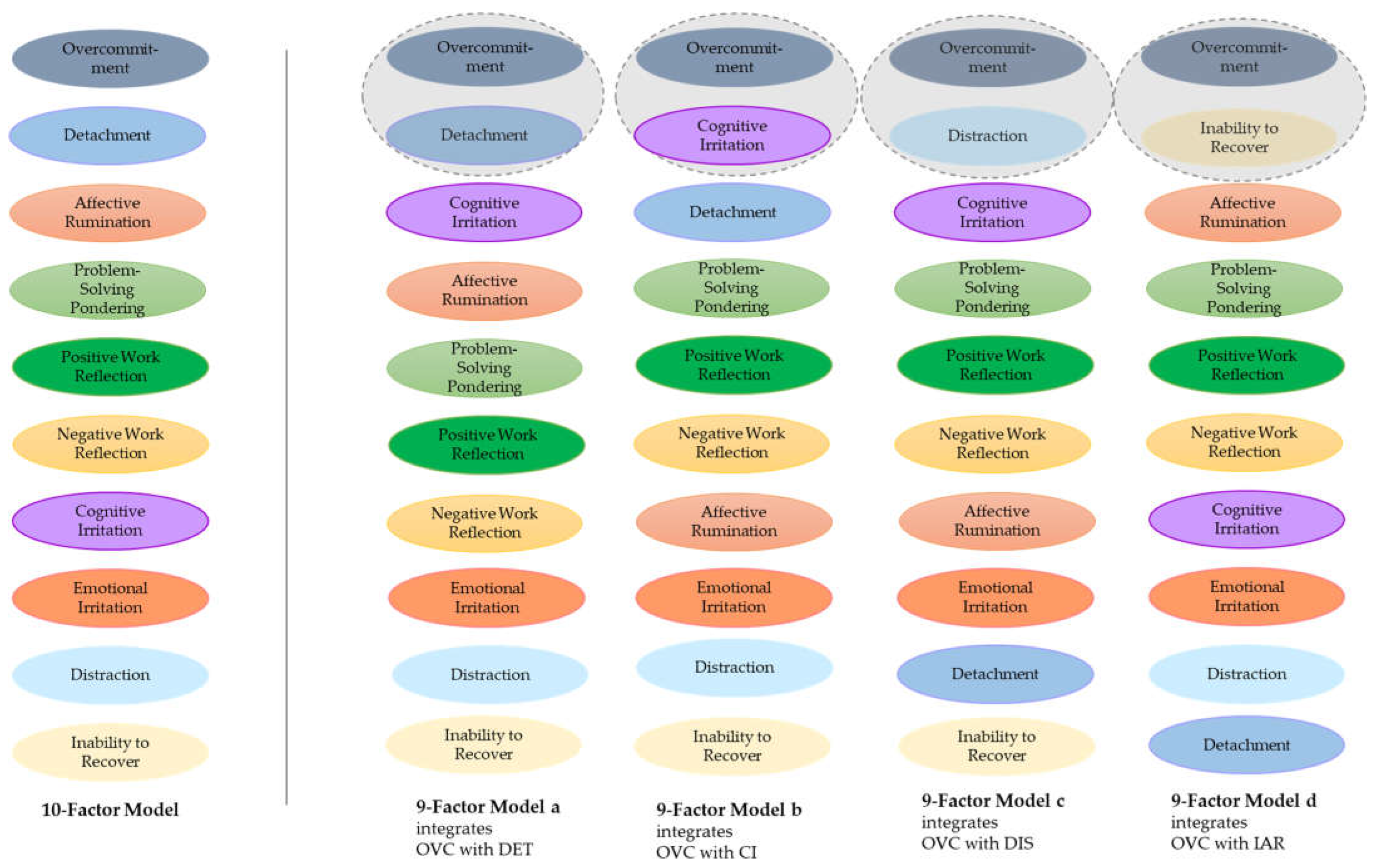
Figure 2.
Additional alternative 9-factor models considered in model comparisons.
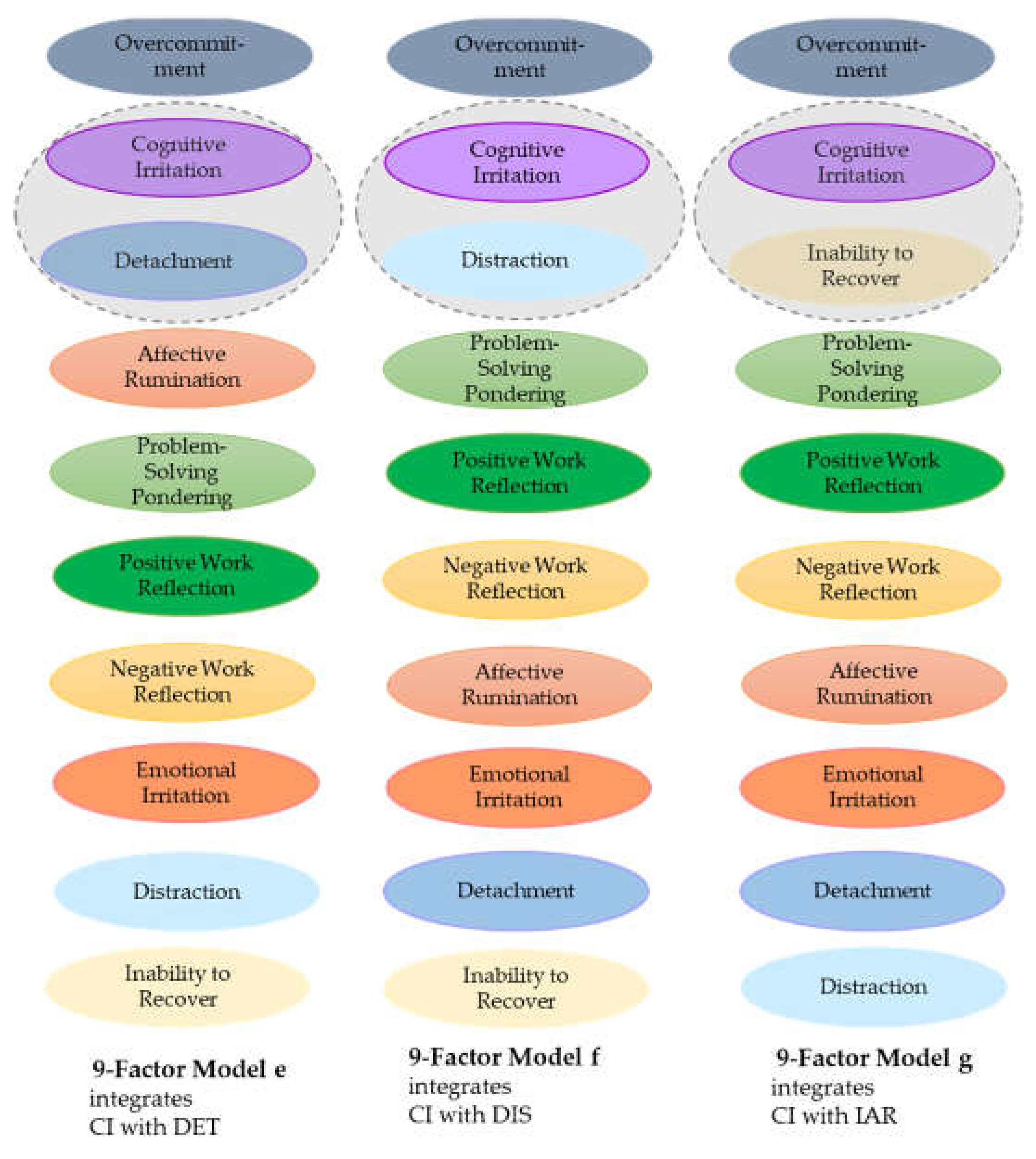
Figure 3.
Additional alternative models with less than 9 factors considered in model comparisons.
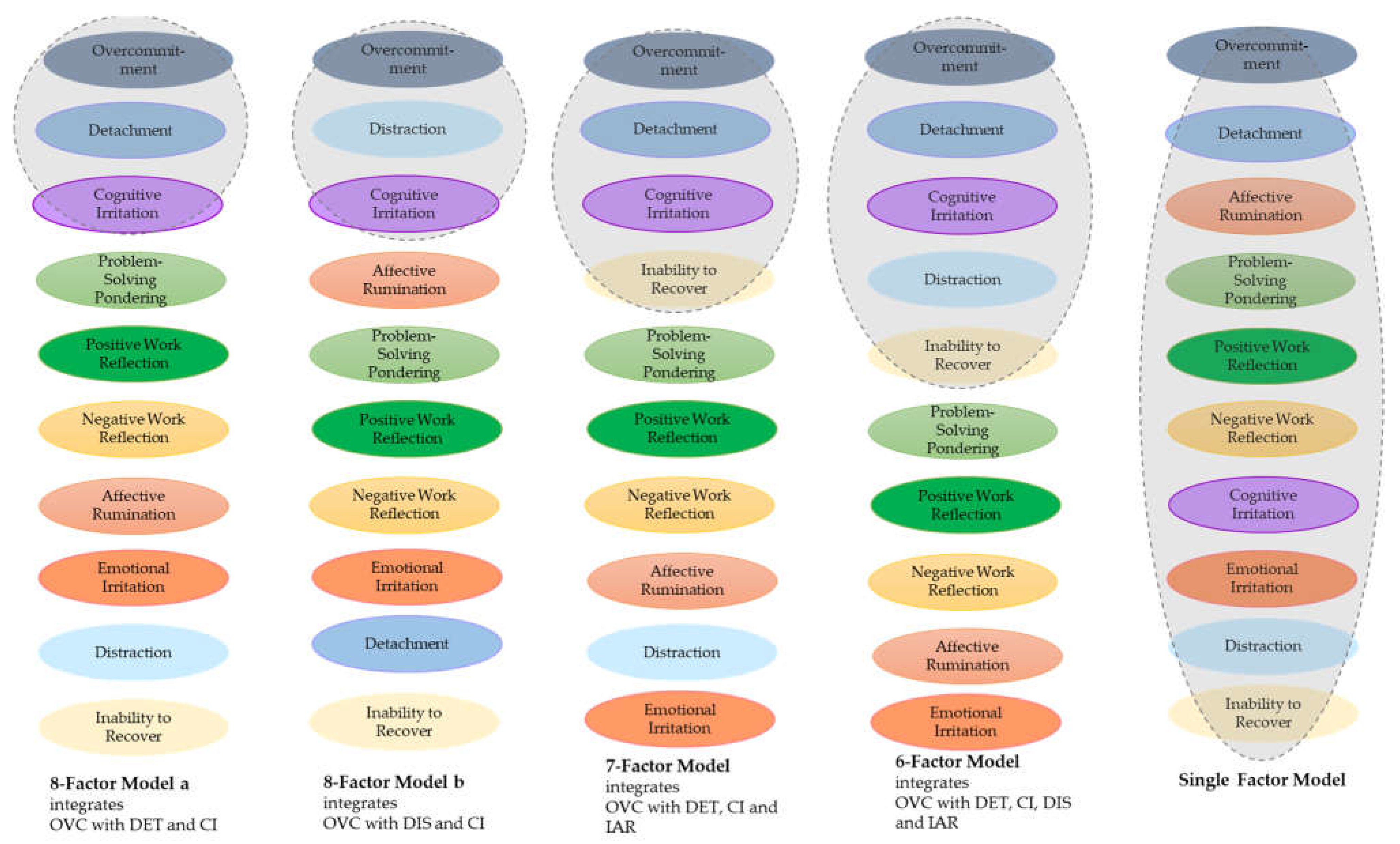
Figure 4.
WRR Constructs and Relative Explained Variance in Wellbeing and Health Outcomes.
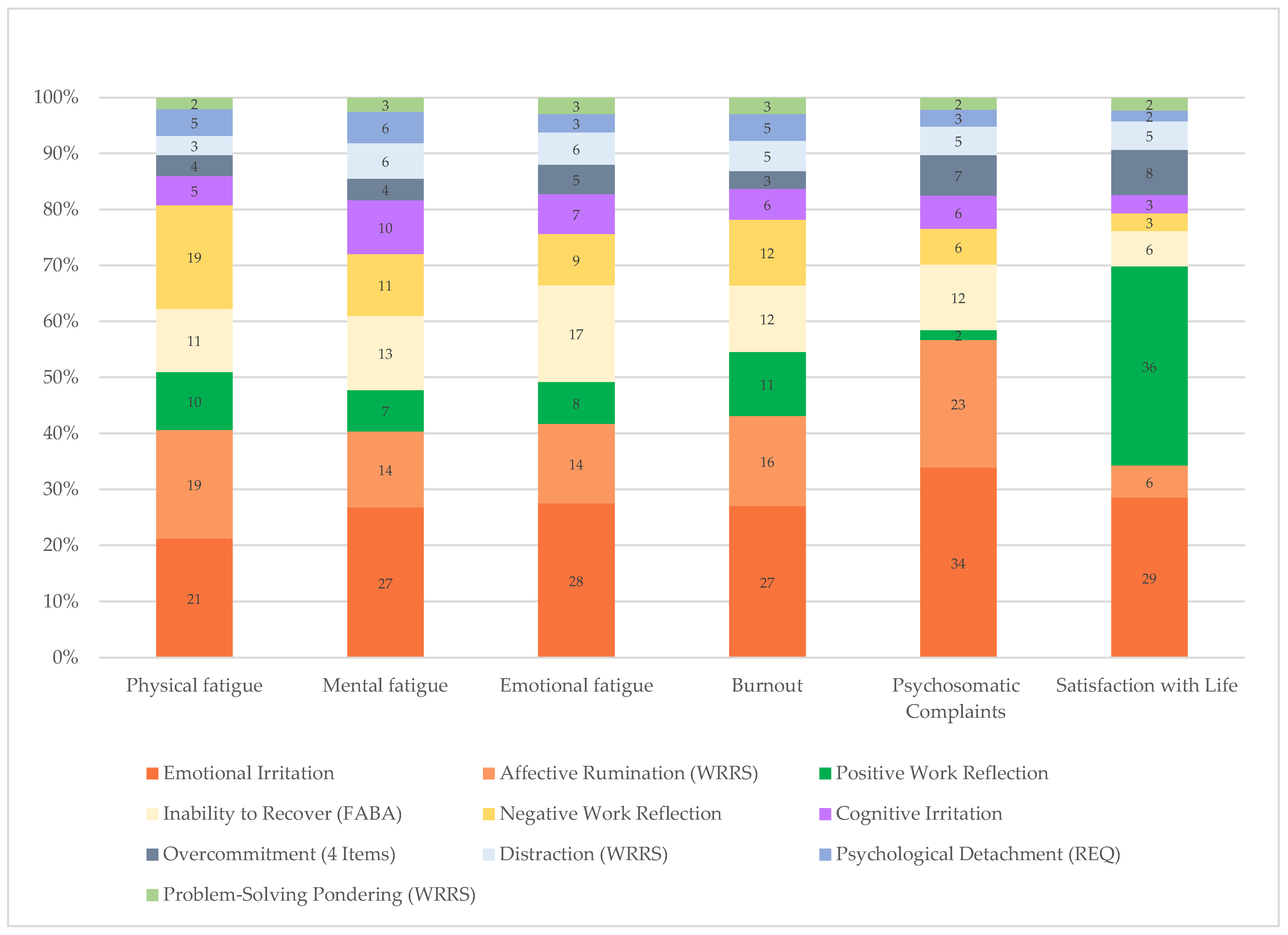

Table 1.
Number of studies on overcommitment and other facets of work-related rumination across different databases.
Table 1.
Number of studies on overcommitment and other facets of work-related rumination across different databases.
| Keyword 1 | Keyword 2 | Web of Science | PubMed | ScienceDirect | Business Source Complete |
| Overcommitment | Detachment (REQ) | 3 | 1 | 1 | 0 |
| Overcommitment | Affective Rumination (WRRQ) | 0 | 0 | 0 | 0 |
| Overcommitment | Problem-Solving Pondering (WRRQ) | 0 | 0 | 0 | 0 |
| Overcommitment | Positive Work Reflection | 0 | 0 | 0 | 0 |
| Overcommitment | Negative Work Reflection | 0 | 0 | 0 | 0 |
| Overcommitment | Cognitive Irritation | 0 | 0 | 0 | 0 |
| Overcommitment | Emotional Irritation | 0 | 0 | 0 | 0 |
| Overcommitment | Distraction (WRRQ) | 0 | 0 | 0 | 0 |
| Overcommitment | Work Obsession/ Inability to Recover (FABA) | 2 | 2 | 1 | 0 |
Table 2.
Means, Standard Deviations, and Zero-Order Correlations Among Study Variables (Sample 1).
| Variable | M | SD | 1 | 2 | 3 | 4 | 5 | 6 | 7 | 8 | |||||||||||
| 1 | Age | 32.31 | 9.64 | ||||||||||||||||||
| 2 | Gender | - | - | -0.02 | |||||||||||||||||
| 3 | Working hours per week | 27.89 | 10.78 | 0.22** | -0.02 | ||||||||||||||||
| 4 | Leadership position | - | - | 0.15** | -0.09 | 0.22** | |||||||||||||||
| 5 | Overcommitment (4 Items) | 2.80 | 0.59 | 0.11* | 0.10 | 0.20** | 0.12* | (0.83) | |||||||||||||
| 6 | Overcommitment (5 Items) | 2.80 | 0.60 | 0.07 | 0.14* | 0.19** | 0.11* | 0.92** | (0.80) | ||||||||||||
| 7 | Overcommitment (6 items) | 2.81 | 0.59 | 0.10 | 0.17*** | 0.19** | 0.11* | 0.89** | 0.96** | (0.80) | |||||||||||
| 8 | Psychological Detachment (REQ) | 3.28 | 1.00 | -0.09 | -0.08 | -0.24** | -0.14** | -0.44** | -0.45** | -0.45** | (0.92) | ||||||||||
| 9 | Affective Rumination (WRRQ) | 2.48 | 0.94 | -0.02 | 0.14* | 0.11* | 0.07 | 0.48** | 0.52** | 0.54** | -0.48** | ||||||||||
| 10 | Problem-Solving Pondering (WRRQ) | 2.64 | 0.85 | 0.19** | 0.04 | 0.15** | 0.12* | 0.52** | 0.54** | 0.52** | -0.59** | ||||||||||
| 11 | Positive Work Reflection | 2.70 | 0.91 | 0.06 | -0.08 | -0.09 | 0.04 | -0.03 | -0.01 | -0.03 | -0.07 | ||||||||||
| 12 | Negative Work Reflection | 2.79 | 0.94 | -0.07 | 0.07 | 0.07 | -0.04 | 0.33** | 0.33** | 0.35** | -0.36** | ||||||||||
| 13 | Cognitive Irritation | 2.56 | 1.03 | 0.11* | 0.11* | 0.22** | 0.15** | 0.64** | 0.67** | 0.67** | -0.79** | ||||||||||
| 14 | Emotional Irritation | 2.30 | 0.93 | -0.03 | 0.10 | 0.09 | 0.02 | 0.31** | 0.36** | 0.39** | -0.30** | ||||||||||
| 15 | Distraction (WRRQ) | 3.26 | 1.00 | -0.07 | -0.14** | -0.17** | -0.04 | -0.49** | -0.52** | -0.53** | 0.76** | ||||||||||
| 16 | Inability to Recover (FABA) | 2.30 | 0.97 | 0.10 | 0.10 | 0.19** | 0.14** | 0.59** | 0.63** | 0.65** | -0.66** | ||||||||||
| Note. n = 357. Cronbach’s α reliabilities on the diagonal in parentheses.* p < 0.05. ** p < 0.01. *** p < 0.001. We provide confidence intervals for all correlations in Table A4 in the Supplementary Materials. | |||||||||||||||||||||
| Table 2 continued | |||||||||||||||||||||
| Variable | 9 | 10 | 11 | 12 | 13 | 14 | 15 | 16 | |||||||||||||
| 9 | Affective Rumination (WRRQ) | (0.91) | |||||||||||||||||||
| 10 | Problem-Solving Pondering (WRRQ) | 0.42** | (0.93) | ||||||||||||||||||
| 11 | Positive Work Reflection | -0.22** | 0.25** | (0.91) | |||||||||||||||||
| 12 | Negative Work Reflection | 0.53** | 0.35** | -0.01 | (0.84) | ||||||||||||||||
| 13 | Cognitive Irritation | 0.63** | 0.65** | -0.00 | 0.46** | (0.91) | |||||||||||||||
| 14 | Emotional Irritation | 0.62** | 0.24** | -0.23** | 0.37** | 0.45** | (0.91) | ||||||||||||||
| 15 | Distraction (WRRQ) | -0.55** | -0.55** | 0.03 | -0.38** | -0.76** | -0.36** | (0.90) | |||||||||||||
| 16 | Inability to Recover (FABA) | 0.65** | 0.60** | -0.07 | 0.53** | 0.80** | 0.46** | -0.71** | (0.90) | ||||||||||||
Table 3.
Correlations of each OVC-item with the Scores of the other Variables (Sample 1).
| Variable | M | SD | 1 | 2 | 3 | 4 | 5 | 6 | |
| 1 | OVC Item 1 | 2.83 | 1.02 | ||||||
| 2 | OVC Item 2 | 2.75 | 1.14 | 0.39** | |||||
| 3 | OVC Item 3 (inverted) | 2.77 | 1.16 | 0.23** | 0.54** | ||||
| 4 | OVC Item 4 | 2.68 | 1.18 | 0.27** | 0.40** | 0.36** | |||
| 5 | OVC Item 5 | 2.57 | 1.15 | 0.28** | 0.76** | 0.67** | 0.53** | ||
| 6 | OVC Item 6 | 2.81 | 1.22 | 0.25** | 0.37** | 0.26** | 0.21** | 0.39** | |
| 7 | Psychological Detachment (REQ) | 3.28 | 1.00 | -0.21** | -0.61** | -0.75** | -0.38** | -0.71** | -0.26** |
| 8 | Affective Rumination (WRRQ) | 2.48 | 0.94 | 0.32** | 0.55** | 0.41** | 0.31** | 0.56** | 0.35** |
| 9 | Problem-Solving Pondering (WRRQ) | 2.64 | 0.85 | 0.18** | 0.56** | 0.48** | 0.43** | 0.59** | 0.33** |
| 10 | Positive Work Reflection | 2.70 | 0.91 | -0.06 | -0.07 | 0.04 | 0.03 | 0.01 | 0.02 |
| 11 | Negative Work Reflection | 2.79 | 0.94 | 0.23** | 0.46** | 0.35** | 0.23** | 0.37** | 0.17** |
| 12 | Cognitive Irritation | 2.56 | 1.03 | 0.31** | 0.74** | 0.72** | 0.48** | 0.85** | 0.41** |
| 13 | Emotional Irritation | 2.30 | 0.93 | 0.27** | 0.35** | 0.33** | 0.26** | 0.38** | 0.28** |
| 14 | Distraction (WRRQ) | 3.26 | 1.00 | -0.28** | -0.62** | -0.66** | -0.38** | -0.71** | -0.33** |
| 15 | Inability to Recover (FABA) | 2.30 | 0.97 | 0.39** | 0.66** | 0.62** | 0.50** | 0.70** | 0.41** |
Note. n = 357. M and SD are used to represent mean and standard deviation, respectively. * indicates p < .05. ** indicates p < .01.
Table 4.
Results of the Exploratory Factor Analyses in Sample 1.
| Origin | Item | PA1 | PA2 | PA3 | h2 | |
| Overcommitment | 1 | I get easily overwhelmed by time pressures at work. | 0.49 | 0.15 | -0.06 | 0.20 |
| 2 | As soon as I get up in the morning I start thinking about work problems. | 0.54 | -0.27 | -0.03 | 0.59 | |
| 3 | When I get home, I can easily relax and ‘switch off’ work. | 0.19 | -0.55 | -0.13 | 0.62 | |
| 4 | People close to me say I sacrifice too much for my job. | 0.56 | -0.10 | 0.11 | 0.31 | |
| 5 | Work rarely lets me go, it is still on my mind when I go to bed. | 0.50 | -0.42 | -0.04 | 0.74 | |
| 6 | If I postpone something that I was supposed to do today I’ll have trouble sleeping at night. | 0.48 | 0.09 | -0.08 | 0.23 | |
| Psychological Detachment (REQ) | 1 | During time after work, I forget about work. | 0.05 | 0.80 | 0.12 | 0.74 |
| 2 | During time after work, I don’t think about work at all. | 0.00 | 0.83 | 0.03 | 0.72 | |
| 3 | During time after work, I distance myself from my work. | -0.09 | 0.72 | 0.15 | 0.81 | |
| 4 | During time after work, I get a break from the demands of work. | 0.04 | 0.64 | 0.23 | 0.64 | |
| Distraction (WRRQ) | 1 | I am able to stop thinking about work-related matters in my free time. | 0.01 | 0.01 | 0.76 | 0.59 |
| 2 | I find it easy to unwind after work. | -0.17 | -0.09 | 0.74 | 0.62 | |
| 3 | As soon as I leave work, I make myself switch off from work. | 0.07 | 0.08 | 0.87 | 0.79 | |
| 4 | I leave work issues behind when I leave work. | -0.05 | 0.08 | 0.81 | 0.80 | |
| 5 | I do not feel able to switch off from work. | -0.45 | 0.21 | 0.32 | 0.74 | |
| Cognitive Irritation | 1 | I have difficulties relaxing after work. | 0.50 | -0.41 | -0.10 | 0.82 |
| 2 | Even at home I often think of my problems at work. | 0.53 | -0.45 | 0.03 | 0.75 | |
| 3 | Even on my vacations I think about my problems at work. | 0.41 | -0.51 | 0.00 | 0.69 | |
| Iability to Recover (FABA) | 1 | Hard to relax because of work | 0.74 | 0.06 | -0.13 | 0.62 |
| 2 | Sleep impaired due to work-related rumination | 0.79 | 0.13 | -0.13 | 0.64 | |
| 3 | Hard to find time for personal issues | 0.59 | 0.02 | 0.01 | 0.33 | |
| 4 | Thinking about work during vacations | 0.56 | -0.24 | -0.12 | 0.68 | |
| 5 | Striving harder than feasible on the long run | 0.78 | 0.04 | 0.04 | 0.53 | |
| 6 | Hard to switch off | 0.59 | -0.24 | -0.19 | 0.83 | |
| % of variance | 26 | 21 | 16 | |||
Note. Items noted in italicized were reverse coded in advance of the analysis. h2 = communality coefficient.
Table 5.
Means, Standard Deviations, and Zero-Order Correlations Among Study Variables.
| Variable | M | SD | 1 | 2 | 3 | 4 | 5 | 6 | 7 | 8 | 9 | ||||||||||||||||
| 1 | Age | 32.13 | 9.54 | ||||||||||||||||||||||||
| 2 | Gender | - | - | -0.11** | |||||||||||||||||||||||
| 3 | Working hours per week | 26.95 | 11.67 | 0.39** | -0.11** | ||||||||||||||||||||||
| 4 | Leadership position | - | - | 0.34** | -0.12** | 0.20** | |||||||||||||||||||||
| 5 | Overcommitment (4 Items) | 2.80 | 0.66 | 0.10* | 0.17*** | 0.17** | 0.20** | (0.81) | |||||||||||||||||||
| 6 | Overcommitment (5 Items) | 2.78 | 0.66 | 0.05 | 0.20*** | 0.13** | 0.18** | 0.94** | (0.80) | ||||||||||||||||||
| 7 | Overcommitment (6 items) | 2.78 | 0.65 | 0.03 | 0.21*** | 0.13** | 0.17** | 0.92** | 0.97** | (0.81) | |||||||||||||||||
| 8 | Psychological Detachment (REQ) | 3.26 | 1.02 | -0.06 | -0.07 | -0.16** | -0.20** | -0.49** | -0.50** | -0.52** | (0.91) | ||||||||||||||||
| 9 | Affective Rumination (WRRQ) | 2.52 | 0.97 | -0.02 | 0.17*** | 0.07 | 0.07 | 0.48** | 0.53** | 0.57** | -0.47** | (0.93) | |||||||||||||||
| 10 | Problem-Solving Pondering (WRRQ) | 2.66 | 0.87 | 0.11* | 0.09 | 0.12* | 0.22** | 0.54** | 0.56** | 0.58** | -0.54** | 0.48** | |||||||||||||||
| 11 | Positive Work Reflection | 2.69 | 0.96 | 0.00 | 0.03 | -0.13** | -0.02 | -0.11* | -0.11* | -0.13* | 0.10* | -0.29** | |||||||||||||||
| 12 | Negative Work Reflection | 2.93 | 0.98 | -0.06 | 0.12* | 0.09 | 0.03 | 0.30** | 0.31** | 0.35** | -0.33** | 0.46** | |||||||||||||||
| 13 | Cognitive Irritation | 2.58 | 1.09 | 0.07 | 0.12* | 0.19** | 0.19** | 0.65** | 0.67** | 0.70** | -0.80** | 0.62** | |||||||||||||||
| 14 | Emotional Irritation | 2.35 | 0.97 | -0.12* | 0.12* | 0.03 | 0.01 | 0.34** | 0.39** | 0.43** | -0.39** | 0.62** | |||||||||||||||
| 15 | Distraction (WRRQ) | 3.24 | 1.04 | -0.07 | -0.08 | -0.10* | -0.19** | -0.48** | -0.50** | -0.52** | 0.73** | -0.56** | |||||||||||||||
| 16 | Inability to Recover (FABA) | 2.38 | 0.96 | 0.05 | 0.20*** | 0.16** | 0.20** | 0.62** | 0.66** | 0.70** | -0.69** | 0.73** | |||||||||||||||
| 17 | Physical Fatigue (WFI) | 3.19 | 0.89 | -0.05 | 0.27*** | 0.03 | -0.02 | 0.26** | 0.26** | 0.32** | -0.29** | 0.46** | |||||||||||||||
| 18 | Mental Fatigue (WFI) | 3.26 | 0.94 | -0.10* | 0.22*** | 0.05 | -0.01 | 0.30** | 0.33** | 0.39** | -0.36** | 0.48** | |||||||||||||||
| 19 | Emotional Fatigue (WFI) | 2.81 | 1.09 | -0.01 | 0.22*** | 0.08 | -0.02 | 0.29** | 0.31** | 0.34** | -0.27** | 0.45** | |||||||||||||||
| 20 | Personal Burnout (CBI) | 2.78 | 1.06 | -0.09 | 0.18*** | 0.03 | -0.04 | 0.31** | 0.34** | 0.39** | -0.37** | 0.55** | |||||||||||||||
| 21 | Psychosomatic Complaints (SCL-90) | 1.89 | 0.68 | -0.16** | 0.26*** | -0.08 | -0.07 | 0.28** | 0.30** | 0.33** | -0.24** | 0.44** | |||||||||||||||
| 22 | Satisfaction with Life (SWLS) | 4.60 | 1.24 | 0.01 | 0.03 | 0.01 | 0.10 | 0.04 | 0.03 | 0.01 | 0.09 | -0.18** | |||||||||||||||
| Note. n = 388. M and SD are used to represent mean and standard deviation, respectively. Cronbach’s α reliabilities on the diagonal in parentheses.* indicates p < 0.05. ** indicates p < 0.01. *** indicates p < 0.001. We provide confidence intervals for all correlations in Table A5 in the Supplementary Materials. | |||||||||||||||||||||||||||
| Table 5 continued | |||||||||||||||||||||||||||
| Variable | 10 | 11 | 12 | 13 | 14 | 15 | 16 | 17 | 18 | 19 | 20 | 21 | 22 | ||||||||||||||
| 10 | Problem-Solving Pondering (WRRQ) | (0.93) | |||||||||||||||||||||||||
| 11 | Positive Work Reflection | 0.09 | (0.91) | ||||||||||||||||||||||||
| 12 | Negative Work Reflection | 0.37** | -0.09 | (0.83) | |||||||||||||||||||||||
| 13 | Cognitive Irritation | 0.67** | -0.11* | 0.43** | (0.90) | ||||||||||||||||||||||
| 14 | Emotional Irritation | 0.31** | -0.28** | 0.39** | 0.51** | (0.90) | |||||||||||||||||||||
| 15 | Distraction (WRRQ) | -0.59** | 0.09 | -0.40** | -0.79** | -0.41** | (0.90) | ||||||||||||||||||||
| 16 | Inability to Recover (FABA) | 0.63** | -0.17** | 0.48** | 0.84** | 0.55** | -0.76** | (0.88) | |||||||||||||||||||
| 17 | Physical Fatigue (WFI) | 0.19** | -0.27** | 0.38** | 0.33** | 0.44** | -0.28** | 0.41** | (0.94) | ||||||||||||||||||
| 18 | Mental Fatigue (WFI) | 0.25** | -0.26** | 0.37** | 0.45** | 0.52** | -0.38** | 0.50** | 0.63** | (0.95) | |||||||||||||||||
| 19 | Emotional Fatigue (WFI) | 0.24** | -0.24** | 0.32** | 0.37** | 0.48** | -0.33** | 0.47** | 0.51** | 0.71** | (0.96) | ||||||||||||||||
| 20 | Personal Burnout (CBI) | 0.29** | -0.33** | 0.42** | 0.43** | 0.57** | -0.40** | 0.53** | 0.67** | 0.68** | 0.61** | (0.93) | |||||||||||||||
| 21 | Psychosomatic Complaints (SCL-90) | 0.19** | -0.14** | 0.27** | 0.32** | 0.46** | -0.28** | 0.39** | 0.52** | 0.47** | 0.46** | 0.56** | (0.80) | ||||||||||||||
| 22 | Satisfaction with Life (SWLS) | 0.00 | 0.29** | -0.13* | -0.09 | -0.29** | 0.14** | -0.16** | -0.24** | -0.28** | -0.28** | -0.37** | -0.20** | (0.88) | |||||||||||||
Table 6.
Fit Indices of the Multilevel Confirmatory Factor Analysis Models in Sample 2
| ꭓ2 | df | CFI | TLI | RMSEA | SRMR | Δꭓ2 | Δdf | sig. | |
| 10-factor-model | 1810.039 | 815 | 0.920 | 0.911 | 0.059 | 0.058 | |||
| 9-factor model a | 1993.529 | 824 | 0.905 | 0.896 | 0.063 | 0.061 | 148.730 | 9 | *** |
| 9-factor model b | 1821.130 | 824 | 0.919 | 0.912 | 0.059 | 0.058 | 11.938 | 9 | |
| 9-factor model c | 1939.316 | 824 | 0.910 | 0.901 | 0.062 | 0.058 | 99.615 | 9 | *** |
| 9-factor model d | 1858.037 | 824 | 0.916 | 0.908 | 0.060 | 0.059 | 42.727 | 9 | *** |
| 9-factor model e | 2005.771 | 824 | 0.904 | 0.895 | 0.064 | 0.060 | 155.510 | 9 | *** |
| 9-factor model f | 1950.915 | 824 | 0.909 | 0.900 | 0.062 | 0.058 | 112.740 | 9 | *** |
| 9-factor model g | 1889.501 | 824 | 0.914 | 0.906 | 0.061 | 0.060 | 71,526 | 9 | *** |
| 8-factor model a | 2036.493 | 832 | 0.902 | 0.894 | 0.064 | 0.061 | 197.010 | 17 | *** |
| 8-factor model b | 1961.296 | 832 | 0.908 | 0.901 | 0.062 | 0.058 | 130.460 | 17 | *** |
| 7-factor model | 2174.829 | 839 | 0.892 | 0.883 | 0.067 | 0.061 | 309.390 | 24 | *** |
| 6-factor model | 2295.495 | 845 | 0.882 | 0.874 | 0.070 | 0.064 | 412.530 | 30 | *** |
| Single-factor-model | 5606.921 | 860 | 0.606 | 0.586 | 0.127 | 0.110 | 2526.500 | 45 | *** |
Note. ꭓ2 represents the results of the Chi^2-test (scaled). df represents the degrees of freedom (scaled). CFI represents the Comparative Fit index (robust). TLI represents the Tucker-Lewis-Index (robust). RMSEA represents the Root Mean Square Error of Approximation (robust). SRMR represents the Standardized Root Mean Square Residual. Δꭓ2 and Δdf represent respektive changes of Chi^2-test results and degrees of freedom relative to the 10-factor model. sig. represents p-values, whereby * p < .05, ** p < .01 *** p < .001.
Table 7.
Estimated Covariances Among Factor in the Confirmatory Factor Analysis (Sample 2).
| Variable | 1 | 2 | 3 | 4 | 5 | 6 | 7 | 8 | 9 | 10 | |
| 1 | Overcommitment (4 Items) | ||||||||||
| 2 | Psychological Detachment (REQ) | -0.75 | |||||||||
| 3 | Affective Rumination (WRRQ) | 0.58 | -0.47 | ||||||||
| 4 | Problem-Solving Pondering (WRRQ) | 0.51 | -0.45 | 0.38 | |||||||
| 5 | Positive Work Reflection | -0.11 | 0.10 | -0.24 | 0.05 | ||||||
| 6 | Negative Work Reflection | 0.39 | -0.33 | 0.41 | 0.28 | -0.07 | |||||
| 7 | Cognitive Irritation | 0.96 | -0.92 | 0.67 | 0.61 | -0.11 | 0.46 | ||||
| 8 | Emotional Irritation | 0.35 | -0.33 | 0.48 | 0.21 | -0.21 | 0.30 | 0.45 | |||
| 9 | Distraction (WRRQ) | -0.70 | 0.74 | -0.51 | -0.47 | 0.07 | -0.37 | -0.86 | -0.32 | ||
| 10 | Inability to Recover (FABA) | 0.74 | -0.68 | 0.64 | 0.49 | -0.13 | 0.42 | 0.88 | 0.40 | -0.70 | |
| Note. n = 388. In Table A3 in the Supplementary Materials we also report the factor loadings across all items. | |||||||||||
Table 8.
Coefficients of the Relative Weight Analyses Predicting Physical Fatigue (Sample 2).
| Criterion | Physical Fatigue | ||||||||||
| Predictor | b | SE | T | p | RW | CI-L | CI-U | RS-RW (%) | |||
| Intercept | 2.05 | 0.46 | 4.41 | 0.00 | *** | ||||||
| Overcommitment (4 Items) | 0.03 | 0.08 | 0.39 | 0.70 | 0.0115 | 0.0043 | 0.0261 | 3.72 | |||
| Psychological Detachment (REQ) | -0.08 | 0.06 | -1.22 | 0.22 | 0.0147 | 0.0052 | 0.0307 | 4.76 | |||
| Affective Rumination (WRRQ) | 0.17 | 0.06 | 2.71 | 0.01 | ** | 0.0599 | * | 0.031 | 0.0974 | 19.39 | |
| Problem-Solving Pondering (WRRQ) | -0.09 | 0.06 | -1.48 | 0.14 | 0.0064 | 0.0029 | 0.0082 | 2.08 | |||
| Positive Work Reflection | -0.10 | 0.04 | -2.35 | 0.02 | * | 0.0321 | * | 0.0086 | 0.0703 | 10.38 | |
| Negative Work Reflection | 0.18 | 0.05 | 3.82 | 0.00 | *** | 0.0571 | * | 0.0242 | 0.1015 | 18.50 | |
| Cognitive Irritation | -0.05 | 0.09 | -0.63 | 0.53 | 0.0161 | * | 0.0083 | 0.0243 | 5.23 | ||
| Emotional Irritation | 0.17 | 0.05 | 3.19 | 0.00 | ** | 0.0655 | * | 0.0333 | 0.1067 | 21.21 | |
| Distraction (WRRQ) | 0.08 | 0.07 | 1.19 | 0.24 | 0.0107 | 0.0053 | 0.016 | 3.45 | |||
| Inability to Recover (FABA) | 0.16 | 0.09 | 1.82 | 0.07 | † | 0.0349 | * | 0.0184 | 0.0545 | 11.28 | |
| Adjusted R-squared | 0.3089 | ||||||||||
| F[10, 377] | 16.85 | ||||||||||
| p | <.001 | ||||||||||
Note. n = 388. SE standard error. RW raw relative weight (within rounding error raw weights will sum to R-squared). CI-L lower bound of confidence interval used to test the statistical significance of raw weight. CI-U upper bound of confidence interval used to test the statistical significance of raw weight. RS-RW relative weight rescaled as a percentage of predicted variance in the criterion variable attributed to each predictor (within rounding error rescaled weights sum to 100 %) † p < .10. * p < .05. ** p < .01. *** p < .001.
Table 9.
Coefficients of the Relative Weight Analyses Predicting Mental Fatigue (Sample 2).
| Criterion | Mental Fatigue | ||||||||||
| Predictor | b | SE | T | p | RW | CI-L | CI-U | RS-RW (%) | |||
| Intercept | 1.96 | 0.47 | 4.20 | 0.00 | *** | ||||||
| Overcommitment (4 Items) | -0.02 | 0.08 | -0.24 | 0.81 | 0.0143 | 0.0067 | 0.0281 | 3.88 | |||
| Psychological Detachment (REQ) | 0.00 | 0.07 | 0.00 | 1.00 | 0.0207 | 0.0104 | 0.0353 | 5.63 | |||
| Affective Rumination (WRRQ) | 0.07 | 0.06 | 1.12 | 0.26 | 0.05 | * | 0.0282 | 0.0776 | 13.57 | ||
| Problem-Solving Pondering (WRRQ) | -0.11 | 0.06 | -1.75 | 0.08 | † | 0.0093 | 0.0046 | 0.0121 | 2.54 | ||
| Positive Work Reflection | -0.09 | 0.04 | -2.12 | 0.03 | * | 0.0273 | 0.0068 | 0.059 | 7.40 | ||
| Negative Work Reflection | 0.12 | 0.05 | 2.50 | 0.01 | * | 0.0406 | * | 0.0169 | 0.0766 | 11.00 | |
| Cognitive Irritation | 0.11 | 0.09 | 1.27 | 0.21 | 0.0354 | * | 0.021 | 0.0534 | 9.62 | ||
| Emotional Irritation | 0.26 | 0.05 | 4.90 | 0.00 | *** | 0.0987 | * | 0.0601 | 0.1425 | 26.77 | |
| Distraction (WRRQ) | 0.01 | 0.07 | 0.12 | 0.91 | 0.0233 | 0.0119 | 0.0397 | 6.31 | |||
| Inability to Recover (FABA) | 0.19 | 0.09 | 2.19 | 0.03 | * | 0.049 | * | 0.0312 | 0.0676 | 13.29 | |
| Adjusted R-squared | 0.3687 | ||||||||||
| F[10, 377] | 22.01 | ||||||||||
| p | <.001 | ||||||||||
Note. n = 388. SE standard error. RW raw relative weight (within rounding error raw weights will sum to R-squared). CI-L lower bound of confidence interval used to test the statistical significance of raw weight. CI-U upper bound of confidence interval used to test the statistical significance of raw weight. RS-RW relative weight rescaled as a percentage of predicted variance in the criterion variable attributed to each predictor (within rounding error rescaled weights sum to 100 %) † p < .10. * p < .05. ** p < .01. *** p < .001.
Table 10.
Coefficients of the Relative Weight Analyses Predicting Emotional Fatigue (Sample 2).
| Criterion | Emotional Fatigue | ||||||||||
| Predictor | b | SE | T | p | RW | CI-L | CI-U | RS-RW (%) | |||
| Intercept | 0.94 | 0.57 | 1.66 | 0.10 | † | ||||||
| Overcommitment (4 Items) | 0.05 | 0.10 | 0.56 | 0.58 | 0.0164 | 0.0066 | 0.0349 | 5.28 | |||
| Psychological Detachment (REQ) | 0.09 | 0.08 | 1.12 | 0.26 | 0.0103 | 0.0053 | 0.0159 | 3.30 | |||
| Affective Rumination (WRRQ) | 0.06 | 0.08 | 0.71 | 0.48 | 0.0441 | * | 0.0228 | 0.0732 | 14.16 | ||
| Problem-Solving Pondering (WRRQ) | -0.05 | 0.07 | -0.75 | 0.45 | 0.0091 | 0.0047 | 0.0152 | 2.94 | |||
| Positive Work Reflection | -0.10 | 0.05 | -1.92 | 0.06 | † | 0.0234 | 0.0051 | 0.0536 | 7.52 | ||
| Negative Work Reflection | 0.09 | 0.06 | 1.59 | 0.11 | 0.0285 | 0.0097 | 0.0602 | 9.16 | |||
| Cognitive Irritation | -0.04 | 0.10 | -0.34 | 0.73 | 0.0222 | 0.0128 | 0.0339 | 7.12 | |||
| Emotional Irritation | 0.29 | 0.06 | 4.53 | 0.00 | *** | 0.0857 | * | 0.0477 | 0.1351 | 27.52 | |
| Distraction (WRRQ) | 0.00 | 0.08 | -0.04 | 0.97 | 0.0179 | 0.0085 | 0.0321 | 5.76 | |||
| Inability to Recover (FABA) | 0.37 | 0.11 | 3.50 | 0.00 | *** | 0.0537 | * | 0.0328 | 0.0767 | 17.24 | |
| Adjusted R-squared | 0.3114 | ||||||||||
| F[10, 377] | 17.05 | ||||||||||
| p | <.001 | ||||||||||
Note. n = 388. SE standard error, RW raw relative weight (within rounding error raw weights will sum to R-squared), CI-L lower bound of confidence interval used to test the statistical significance of raw weight, CI-U upper bound of confidence interval used to test the statistical significance of raw weight, RS-RW relative weight rescaled as a percentage of predicted variance in the criterion variable attributed to each predictor (within rounding error rescaled weights sum to 100 %) † p < .10. * p < .05. ** p < .01. *** p < .001.
Table 11.
Coefficients of the Relative Weight Analyses Predicting Burnout (Sample 2).
| Criterion | Burnout | ||||||||||||||||||||||||||||||||
| Predictor | b | SE | T | p | RW | CI-L | CI-U | RS-RW (%) | |||||||||||||||||||||||||
| Intercept | 1.70 | 0.49 | 3.43 | 0.00 | *** | ||||||||||||||||||||||||||||
| Overcommitment (4 Items) | -0.01 | 0.09 | -0.06 | 0.95 | 0.0142 | * | 0.0065 | 0.0289 | 3.17 | ||||||||||||||||||||||||
| Psychological Detachment (REQ) | -0.07 | 0.07 | -0.96 | 0.34 | 0.0215 | * | 0.0096 | 0.0371 | 4.79 | ||||||||||||||||||||||||
| Affective Rumination (WRRQ) | 0.15 | 0.07 | 2.20 | 0.03 | * | 0.0719 | 0.0419 | 0.1053 | 16.05 | ||||||||||||||||||||||||
| Problem-Solving Pondering (WRRQ) | 0.00 | 0.06 | -0.06 | 0.95 | 0.0132 | * | 0.0069 | 0.0247 | 2.95 | ||||||||||||||||||||||||
| Positive Work Reflection | -0.17 | 0.05 | -3.76 | 0.00 | *** | 0.0514 | * | 0.0213 | 0.0901 | 11.47 | |||||||||||||||||||||||
| Negative Work Reflection | 0.15 | 0.05 | 3.17 | 0.00 | ** | 0.0527 | * | 0.0254 | 0.0921 | 11.76 | |||||||||||||||||||||||
| Cognitive Irritation | -0.12 | 0.09 | -1.34 | 0.18 | 0.0247 | * | 0.015 | 0.0363 | 5.52 | ||||||||||||||||||||||||
| Emotional Irritation | 0.33 | 0.06 | 5.93 | 0.00 | *** | 0.1213 | * | 0.0767 | 0.1756 | 27.05 | |||||||||||||||||||||||
| Distraction (WRRQ) | -0.02 | 0.07 | -0.26 | 0.80 | 0.0242 | * | 0.0116 | 0.0433 | 5.41 | ||||||||||||||||||||||||
| Inability to Recover (FABA) | 0.24 | 0.09 | 2.57 | 0.01 | * | 0.0531 | 0.034 | 0.0741 | 11.84 | ||||||||||||||||||||||||
| Adjusted R-squared | 0.4483 | ||||||||||||||||||||||||||||||||
| F[10, 377] | 33.63 | ||||||||||||||||||||||||||||||||
| p | <.001 | ||||||||||||||||||||||||||||||||
Note. n = 388. SE standard error, RW raw relative weight (within rounding error raw weights will sum to R-squared), CI-L lower bound of confidence interval used to test the statistical significance of raw weight, CI-U upper bound of confidence interval used to test the statistical significance of raw weight, RS-RW relative weight rescaled as a percentage of predicted variance in the criterion variable attributed to each predictor (within rounding error rescaled weights sum to 100 %) † p < .10. * p < .05. ** p < .01. *** p < .001.
Table 12.
Coefficients of the Relative Weight Analyses Predicting Psychosom. Complaints (Sample 2)
| Criterion | Psychosomatic Complaints | ||||||||||||||||||||||||||||||||
| Predictor | b | SE | T | p | RW | CI-L | CI-U | RS-RW (%) | |||||||||||||||||||||||||
| Intercept | 0.75 | 0.36 | 2.06 | 0.04 | * | ||||||||||||||||||||||||||||
| Overcommitment (4 Items) | 0.10 | 0.06 | 1.63 | 0.10 | 0.0192 | 0.0064 | 0.0400 | 7.26 | |||||||||||||||||||||||||
| Psychological Detachment (REQ) | 0.02 | 0.05 | 0.38 | 0.70 | 0.0079 | 0.0032 | 0.0151 | 2.99 | |||||||||||||||||||||||||
| Affective Rumination (WRRQ) | 0.14 | 0.05 | 2.88 | 0.00 | ** | 0.0601 | * | 0.0331 | 0.0946 | 22.75 | |||||||||||||||||||||||
| Problem-Solving Pondering (WRRQ) | -0.08 | 0.05 | -1.73 | 0.08 | † | 0.0058 | 0.0023 | 0.0079 | 2.19 | ||||||||||||||||||||||||
| Positive Work Reflection | 0.03 | 0.03 | 0.76 | 0.45 | 0.0047 | 0.0015 | 0.0153 | 1.78 | |||||||||||||||||||||||||
| Negative Work Reflection | 0.02 | 0.04 | 0.66 | 0.51 | 0.0168 | 0.0057 | 0.0379 | 6.37 | |||||||||||||||||||||||||
| Cognitive Irritation | -0.04 | 0.07 | -0.54 | 0.59 | 0.0157 | 0.0082 | 0.0263 | 5.94 | |||||||||||||||||||||||||
| Emotional Irritation | 0.20 | 0.04 | 4.80 | 0.00 | *** | 0.0896 | * | 0.0497 | 0.142 | 33.91 | |||||||||||||||||||||||
| Distraction (WRRQ) | -0.02 | 0.05 | -0.39 | 0.70 | 0.0135 | 0.0055 | 0.0266 | 5.09 | |||||||||||||||||||||||||
| Inability to Recover (FABA) | 0.09 | 0.07 | 1.32 | 0.19 | 0.0309 | * | 0.0163 | 0.0516 | 11.71 | ||||||||||||||||||||||||
| R-squared | 0.2642 | ||||||||||||||||||||||||||||||||
| F[10, 377] | 13.53 | ||||||||||||||||||||||||||||||||
| p | <.001 | ||||||||||||||||||||||||||||||||
Note. n = 388. SE standard error, RW raw relative weight (within rounding error raw weights will sum to R-squared), CI-L lower bound of confidence interval used to test the statistical significance of raw weight, CI-U upper bound of confidence interval used to test the statistical significance of raw weight, RS-RW relative weight rescaled as a percentage of predicted variance in the criterion variable attributed to each predictor (within rounding error rescaled weights sum to 100 %) † p < .10. * p < .05. ** p < .01. *** p < .001.
Table 13.
Coefficients of the Relative Weight Analyses Predicting Satisfaction with Life (Sample 2)
| Criterion | Satisfaction with Life | ||||||||||||||||||||||||||||||||
| Predictor | b | SE | T | p | RW | CI-L | CI-U | RS-RW (%) | |||||||||||||||||||||||||
| Intercept | 2.96 | 0.70 | 4.203 | 0.00 | *** | ||||||||||||||||||||||||||||
| Overcommitment (4 Items) | 0.34 | 0.12 | 2.834 | 0.00 | ** | 0.0141 | 0.0031 | 0.0362 | 8.06 | ||||||||||||||||||||||||
| Psychological Detachment (REQ) | 0.00 | 0.10 | 0.04 | 0.97 | 0.0033 | 0.0008 | 0.0049 | 1.90 | |||||||||||||||||||||||||
| Affective Rumination (WRRQ) | 0.06 | 0.10 | 0.569 | 0.57 | 0.01 | 0.0045 | 0.0212 | 5.71 | |||||||||||||||||||||||||
| Problem-Solving Pondering (WRRQ) | 0.04 | 0.09 | 0.487 | 0.63 | 0.0041 | 0.0014 | 0.0092 | 2.33 | |||||||||||||||||||||||||
| Positive Work Reflection | 0.29 | 0.07 | 4.445 | 0.00 | *** | 0.0623 | * | 0.0266 | 0.1088 | 35.57 | |||||||||||||||||||||||
| Negative Work Reflection | -0.03 | 0.07 | -0.497 | 0.62 | 0.0056 | 0.0015 | 0.0211 | 3.18 | |||||||||||||||||||||||||
| Cognitive Irritation | 0.17 | 0.13 | 1.345 | 0.18 | 0.0057 | 0.0018 | 0.0078 | 3.26 | |||||||||||||||||||||||||
| Emotional Irritation | -0.32 | 0.08 | -3.994 | 0.00 | *** | 0.0499 | 0.0205 | 0.0921 | 28.53 | ||||||||||||||||||||||||
| Distraction (WRRQ) | 0.16 | 0.10 | 1.559 | 0.12 | 0.009 | 0.0024 | 0.0291 | 5.12 | |||||||||||||||||||||||||
| Inability to Recover (FABA) | -0.21 | 0.13 | -1.578 | 0.12 | 0.0111 | 0.0042 | 0.0221 | 6.33 | |||||||||||||||||||||||||
| R-squared | 0.175 | ||||||||||||||||||||||||||||||||
| F[10, 377] | 8.00 | ||||||||||||||||||||||||||||||||
| p | <.001 | ||||||||||||||||||||||||||||||||
Note. n = 388. SE standard error, RW raw relative weight (within rounding error raw weights will sum to R-squared), CI-L lower bound of confidence interval used to test the statistical significance of raw weight, CI-U upper bound of confidence interval used to test the statistical significance of raw weight, RS-RW relative weight rescaled as a percentage of predicted variance in the criterion variable attributed to each predictor (within rounding error rescaled weights sum to 100 %) † p < .10. * p < .05. ** p < .01. *** p < .001.
Disclaimer/Publisher’s Note: The statements, opinions and data contained in all publications are solely those of the individual author(s) and contributor(s) and not of MDPI and/or the editor(s). MDPI and/or the editor(s) disclaim responsibility for any injury to people or property resulting from any ideas, methods, instructions or products referred to in the content. |
© 2023 by the authors. Licensee MDPI, Basel, Switzerland. This article is an open access article distributed under the terms and conditions of the Creative Commons Attribution (CC BY) license (http://creativecommons.org/licenses/by/4.0/).
Copyright: This open access article is published under a Creative Commons CC BY 4.0 license, which permit the free download, distribution, and reuse, provided that the author and preprint are cited in any reuse.


