

Submitted:
26 April 2022
Posted:
27 April 2022
You are already at the latest version
Abstract
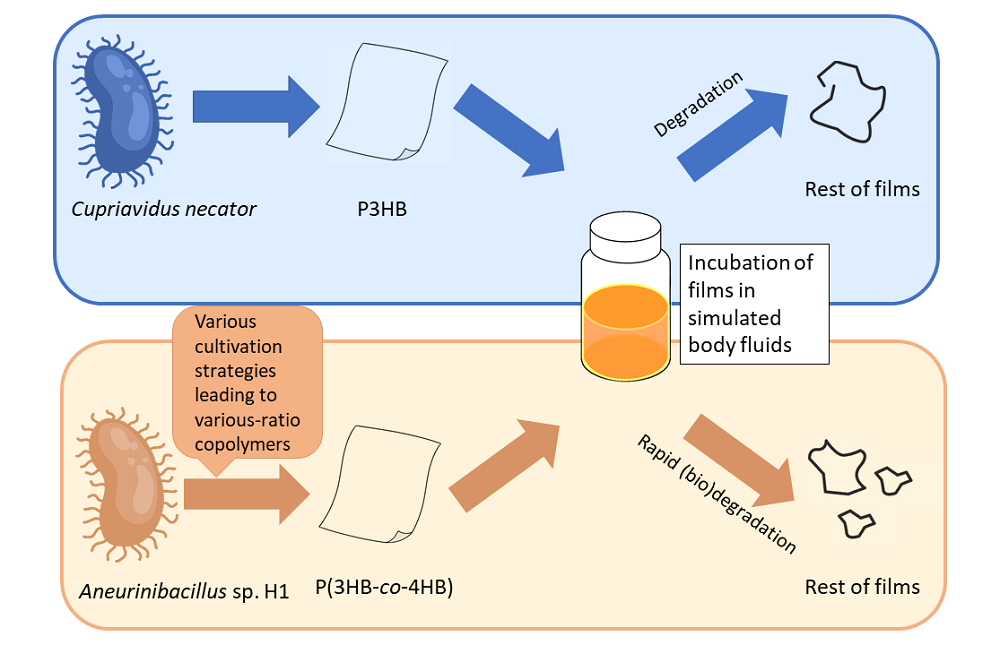
Novel model of biodegradable PHA copolymer films preparation was applied to evaluate biodegradability of various PHA copolymers and discuss its biomedical applicability. In this study, we illustrate the potential biomaterial degradation rate affectability by manipulation of monomer composition via controlling biosynthetic strategies. Within the experimental investigation, we have prepared two different copolymers of 3-hydroxybutyrate and 4-hydroxybutyrate – P(3HB-co-36 mol.% 4HB) and P(3HB-co-66 mol.% 4HB), by cultivating thermophilic bacterial strain Aneurinibacillus sp. H1 and further investigated its degradability in simulated body fluids (SBFs). Both copolymers revealed faster weight reduction in synthetic gastric juice (SGJ) and artificial colonic fluid (ACF) than simple homopolymer P3HB. In addition, degradation mechanisms differed across tested polymers, according to SEM micrographs. While incubated in SGJ, samples were fragmented due to fast hydrolysis sourcing from substantially low pH, which suggest abiotic degradation as the major degradation mechanism. On the contrary, ACF incubation indicated obvious enzymatic hydrolysis. Further, no cytotoxicity of the waste fluids was observed on CaCO-2 cell line. Based on these results in combination with high production flexibility, we suggest P(3HB-co-4HB) copolymers produced by Aneurinibacillus sp. H1 as very auspicious polymers for intestinal in vivo treatments.
Keywords:
Polyhydroxyalkanoates (PHA)
; Aneurinibacillus sp. H1
; PHA copolymers
; biodegradation
; simulated body fluids
Copyright: This open access article is published under a Creative Commons CC BY 4.0 license, which permit the free download, distribution, and reuse, provided that the author and preprint are cited in any reuse.


