
Submitted:
09 December 2021
Posted:
10 December 2021
You are already at the latest version
Abstract
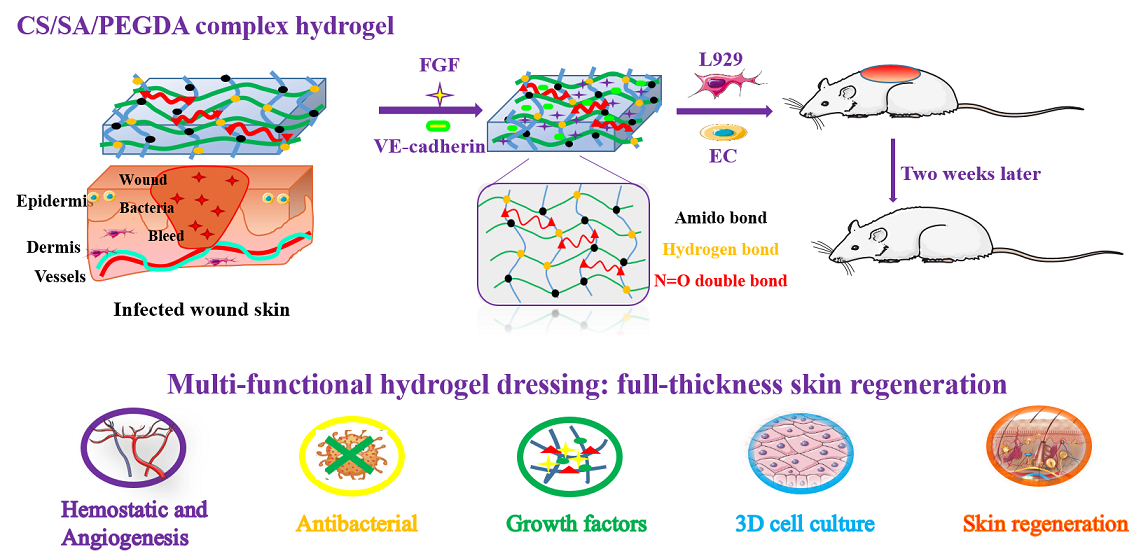
The process of full-thickness skin regeneration is complex and has many parameters involved, which makes it difficult to use a single dressing to meet the various requirements of the complete regeneration at the same time. Therefore, developing hydrogel dressings with multifunction, including tunable rheological properties and aperture, hemostatic, antibacterial and super cytocompatibility, is a desirable candidate in wound healing. In this study, a series of complex hydrogels were developed via the hydrogen bond and covalent bond between chitosan (CS) and alginate (SA). These hydrogels exhibited suitable pore size and tunable rheological properties for cell adhesion. Chitosan endowed hemostatic, antibacterial properties and great cytocompatibility and thus solved two primary problems in the early stage of the wound healing process. Moreover, the sustained cytocompatibility of the hydrogels was further investigated after adding FGF and VE-cadherin via the co-culture of L929 and EC for 12 days. The confocal 3D fluorescent images showed that the cells were spherical and tended to form multicellular spheroids, which distributed in about 40-60μm thick hydrogels. Furthermore, the hydrogel dressings significantly accelerate defected skin turn to normal skin with proper epithelial thickness and new blood vessels and hair follicles through the histological analysis of in vivo wound healing. The findings mentioned above demonstrated that the CS/SA hydrogels with growth factors have tremendous potential as multifunctional hydrogel dressings for full-thickness skin regeneration incorporated with hemostatic, antibacterial, sustained cytocompatibility for 3D cell culture and normal skin repairing.
Keywords:
hydrogel dressing
; full-thickness skin regeneration
; 3D cell culture
; VE-cadherin
; FGF
Copyright: This open access article is published under a Creative Commons CC BY 4.0 license, which permit the free download, distribution, and reuse, provided that the author and preprint are cited in any reuse.


