
Submitted:
02 December 2021
Posted:
03 December 2021
You are already at the latest version
Abstract
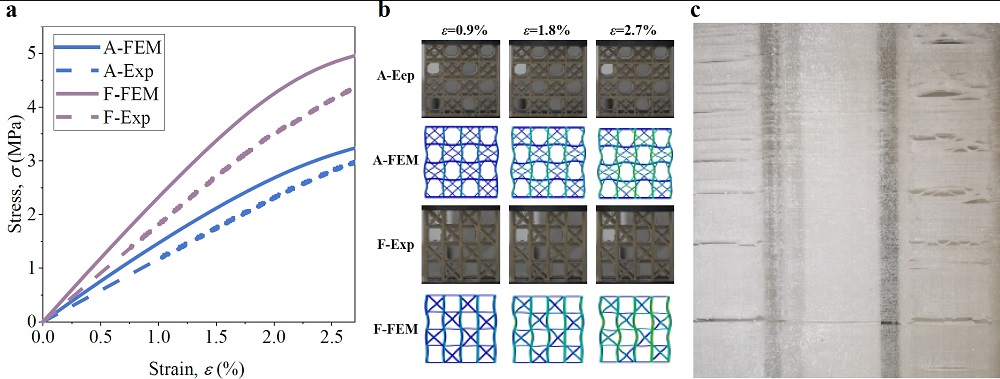
The biomimetic design of engineering structures is based on biological structures with excellent mechanical properties, which are the result of billions of years of evolution. However, current biomimetic structures, such as ordered lattice materials, are still inferior to many biological materials in terms of structural complexity and mechanical properties. For example, the structure of \textit{Euplectella aspergillum}, a type of deep-sea glass sponge, is an eye-catching source of inspiration for biomimetic design; however, guided by scientific theory, how to engineer structures surpassing the mechanical properties of \textit{E. aspergillum} remains an unsolved problem. The lattice structure of the skeleton of \textit{E. aspergillum} consists of vertically, horizontally, and diagonally oriented struts, which provide superior strength and flexural resistance compared with the conventional square lattice structure. Herein, the structure of \textit{E. aspergillum} was investigated in detail, and by using the theory of elasticity, a lattice structure inspired by the bionic structure was proposed. The mechanical properties of the sponge-inspired lattice structure surpassed the sponge structure under a variety of loading conditions, and the excellent performance of this configuration was verified experimentally. The proposed lattice structure can greatly improve the mechanical properties of engineering structures, and it improves strength without much redundancy of material. This study achieved the first surpassing of the mechanical properties of an existing sponge-mimicking design. This design can be applied to lattice structures, truss systems, and metamaterial cells.
Keywords:
Bioinspired materials
; Lattice structure
; Euplectella aspergillum
; Buckling
; Optimization
Copyright: This open access article is published under a Creative Commons CC BY 4.0 license, which permit the free download, distribution, and reuse, provided that the author and preprint are cited in any reuse.


