

Submitted:
12 January 2026
Posted:
13 January 2026
You are already at the latest version
Abstract
Considerable efforts have been devoted to modifying gravity in order to elucidate the possible existence or nature of dark matter and dark energy, describe observational data effectively, and advance toward a theory of quantum gravity. In addition, despite its immense success, quantum field theory requires renormalization techniques and breaks down at high energies. Notably, the Planck 2018 legacy release confirmed the existence of an enhanced lensing amplitude in the cosmic microwave background power spectra, which suggests a positively curved early Universe with a confidence level more than 99%. In this study, we model the global curvature of the Universe as the curvature of a ‘4D conformal bulk’ — a geometric manifestation of vacuum energy, and regard celestial objects that induce localized curvature within the bulk as ‘4D relativistic cloud-worlds’. Employing a dual-action variational principle that incorporates both local and global curvatures, we derive interaction field equations that generalize general relativity and recover quantum behavior in the flat-bulk limit. Within this framework, gravity emerges as the local curvature of the bulk — an indicator of the field strength of vacuum energy acting on embedded quantum fields, which are described as localized geometric excitations embedded in a structured vacuum background. A visualization of the evolution of the 4D relativistic cloud-world over the conformal spacetime of the 4D bulk is presented. We apply the derived interaction field equations to model active galactic nuclei and outline testable predictions that could directly provide confirmations or falsify the framework.
Keywords:
brane-world modified gravity
; geometrization of quantum mechanics
; conformal geometry
; quantum gravity
1. Introduction
After the formulation of Einstein’s theory of General Relativity (GR) by utilizing 4D spacetime, Kaluza proposed in 1919 a potential field unification of electromagnetism and gravitation by extending the theory into 5D spacetime. To address the physical interpretation of the fifth dimension, Klein later suggested that it could be compactified. Nonetheless, these approaches and their extensions to higher dimensions have not culminated in testable predictions nor in the competence to elucidate observations yet. As an alternative to compactification, Randall, Sundrum and Gogberashvili demonstrated in 1999 that the weak field of gravity could be explained by using a model of 4D spacetime that is embedded in a negatively curved and large fifth dimension; nevertheless, such models typically require the existence of massive gravitons [1,2,3].
On the other hand, to achieve an effective action for quantum corrections, several theories were formulated based on alterations of curvature terms and Lagrangian fields, which included high-order curvature terms and non-minimally coupled scalar fields [4,5,6]. Furthermore, although quantum anomalies could necessitate the use of a non-local Lagrangian, one of the major differences between GR and the Quantum Field Theory (QFT) is that GR is background-independent, meaning it does not rely on the global structure, whereas QFT involves a background metric that in turn influences its predictions [7].
Notably, the Planck legacy 2018 (PL18) release confirmed the presence of an enhanced lensing amplitude in cosmic microwave background (CMB) power spectra, which prefers a positively curved early Universe with a confidence level higher than 99% [8,9]. In addition, the validity of combining CMB lensing and baryon acoustic oscillation data to recover the spatial flatness has been challenged because the curvature parameter tension between these sets of data is 2.5 to 3σ [10]. Conversely, the closed early Universe provides a physical justification for the anomalous lensing amplitude and is consistent with the low CMB anisotropy observations [8,11,12]. Based on this sign of a primordial global curvature and its feasible evolution over the conformal time into the present Universe spatial flatness, it is obvious that the background-independent theories, such as GR, do not consider the evolution in the global (including the background) curvature and regard celestial objects in the early Universe with a preferred curvature on equal footing with their counterparts in the present Universe of a spatially flat background; this shortcoming can be the cause of the dark matter problem.
A desirable gravity theory should consider metrics of both the celestial object (local) and the bulk (global including the background), and reduce to GR in a flat spacetime background. Moreover, concerning the wave-particle duality and quantum interactions, a mutually harmonious geometrical formalism of quantum mechanics should be deemed to maintain the equivalence principle and count for the influence of gravity on the quantum systems. This is because gravity appears to emerge owing to spacetime curvature, imparting it with a geometric nature. This study aims to derive interaction field equations that consider the global curvature, signified as the 4D conformal bulk curvature, and its impact on celestial objects that are modeled as 4D relativistic cloud-worlds. It also aims to incorporate the impact of gravity, expressed by 4D conformal bulk curvature, on quantum fields, modeled as localized geometric excitations embedded in a structured vacuum background.
2. Electromagnetic and Gravitational Interaction Field Equations
According to GR, the Sun resides in a nearly flat spacetime, where its induced curvature is proportional to its energy density and flux. In contrast, the Earth propagates within a curved background—interpreted here as a curved bulk—due to the gravitational influence of the Sun. The Earth’s own curvature is therefore influenced not only by its intrinsic energy-momentum density but also by the background curvature of the bulk. Notably, the PL18 release has preferred a primordial global curvature, which in this study is interpreted as a curved conformal bulk whose evolving curvature is associated to the scale factor of the Universe (see Appendix A). To incorporate the effects of the bulk curvature and its evolution through conformal time toward the present-day spatial flatness, we introduce a modulus of spacetime deformation, , in terms of energy density via an analogy with elasticity theory [13]. can be expressed in terms of the resistance of the bulk to localized curvature that is induced by celestial objects or in terms of the bulk’s field strength, , by using Lagrangian formalism of energy density existing in the bulk as vacuum energy density as
where the stress is signified by the stress-energy tensor of trace , while the strain is signified by the Ricci curvature tensor as the change in the curvature divided by the existing curvature as the bulk conformal curvature. Consequently, an extended Einstein–Hilbert action is expressed as
where is the Ricci scalar denoting a localized curvature, which is induced in the bulk by a celestial object that is considered as a 4D relativistic cloud-world of metric and Lagrangian density while is the scalar curvature of the 4D conformal bulk of metric and Lagrangian density as its internal stresses and momenta due to its curvature.
Given that the modulus of the bulk, , is constant with regards to the cloud-world action under the constant vacuum energy density condition at macroscopic scales; and by considering the expansion of the bulk over the conformal time owing to the expansion of the Universe and its implication on the field strength of the bulk—we introduce a multiplicative dual-action principle. This principle accounts for the conservation of energy across both global (bulk) and local (cloud-world) scales, and is formulated as follows:
This action can be interpreted as describing an interactive flow of a 4D relativistic cloud-world through vacuum energy of field strength that is manifested by the 4D conformal bulk curvature. It implies eight-dimensional degrees of freedom because, where is the standard four-dimension of Einstein–Hilbert action concerning a celestial object (conventional energy), is the four-dimension of the conformal bulk (vacuum energy) regarding the global curvature, and is a dimension-hierarchy factor. The bulk metric, , and the cloud-world metric, , are correlated by Weyl’s conformal transformation as , where is a conformal function [14]. The global-local action should hold for any variation, where the whole variation is , i.e., , which shows a balance between the bulk and cloud-world actions, and both action variations are
where [15]. By considering the boundary term of the cloud-world, , the variation in the Ricci curvature tensor, , can be expressed in terms of the covariant derivative of the difference between two Levi-Civita connections, the Palatini identity, ; this variation with respect to the inverse metric, , can be obtained by using the metric compatibility of the covariant derivative, [15], as . Therefore, the boundary term as a total derivative for any tensor density can be transformed based on the Stokes’ theorem as
where the bulk scalar curvature, , is left outside the integral transformation as it only acts as a scalar. Besides, a second approach can be applied to the boundary term of the bulk as
where while resembles the Ricci flow in a normalized form, reflecting the conformal evolution in the boundary, which can be expressed as a function
based on Weyl’s transformation as .
By using the first approach of the boundary term’s transformations given in Equation (5), the transformed boundary action, , is
where and are the traces of the cloud-world and the bulk extrinsic curvatures, respectively; and are the extrinsic traces of the Lagrangian density on the cloud-world and the bulk boundaries, respectively; and are the determinants of their induced metrics, respectively; and equals 1 when the normal is a spacelike entity and equals -1 when it is a timelike entity. is the 4D Lorentz force density. The boundary action should hold for any variation and, by considering the transformed boundary term of the cloud-world, , the variation in the transformed boundary term is
where . By utilizing the Jacobi’s formula for the determinant differentiation, and the variation in the metric times the inverse metric, , the variation in the boundary term of the cloud-world is
Equation (9) can be simplified to
where also resembles the Ricci flow in a normalized form, reflecting the conformal distortion in the boundary over conformal time, which can be expressed as a function, according to Weyl’s conformal transformation [16], while the term . Thus, the boundary term is , where is the conformally transformed induced metric on the boundary of the cloud-world. The same approach can be applied to the bulk and Lagrangian boundary terms. Accordingly, the variation in the whole action with renaming the dummy indices, is
where the variation in the global action resembles the electromagnetic stress-energy tensor, , while (top row). By comparing Einstein field equations with Equations (1), (2) and (11); it reveals that , which is proportional to the fourth power of the speed of light that in turn is directly proportional to the frequency; this in line with the frequency cut-off predictions of vacuum energy density in QFT [17,18]. The whole action shows a balance between the bulk and cloud-world actions as; but by disregarding the contribution of the changes in the bulk action assuming the constant vacuum energy density condition at macroscopic scales and applying the principle of stationary action for Equation (11), the interaction field equations are
These interaction field equations can be interpreted as indicating that the induced curvature, , by the cloud-world over the bulk (background) curvature, , equals the ratio of the imposed energy density of the cloud-world to the vacuum energy density of the bulk through the expanding/contracting Universe. The interaction field equations feature the following:
- ; is the Brown-York stress-energy tensor as the surface tension and is vacuum penetration depth or the background curvature radius.
- is the electromagnetic stress-energy scalar representing vacuum energy density.
- The boundary term given by the extrinsic curvatures of the cloud-world, , and the bulk, , is only significant at high energies when the difference between the induced, , and global, , curvatures is significant.
The interaction field equations include four contributions that come from the cloud-world’s intrinsic and extrinsic curvatures and bulk’s intrinsic and extrinsic curvatures. The field equations can be expressed in different forms depending on which contribution is required to be implicit or explicit. By applying the second approach in Equation (6) to the bulk boundary terms, the variation in the action, with renaming the dummy indices, is
By transforming intrinsic curvature of the bulk, , where the bulk’s metrics can be incorporated with cloud-world metric into a conformal metric. By applying the principle of stationary action, the simplified interaction field equations are
where , describe the spacetime background softening and it is the conformally transformed metric counting for contributions of cloud-world metric, , and bulk’s intrinsic curvature based on metric, whereas Einstein spaces are a subclass of the conformal space [14]. Similarly, the conformally transformed induced metric on the cloud-world’s boundary is . The simplified interaction field equations feature:
- The term is the background conformal curvature term, which reflects the cosmological ‘constant’ (parameter).
- is an effective Newtonian gravitational parameter that relies on the background curvature, which can accommodate the bulk curvature evolution over the conformal time against constant G for a special flat spacetime case.
These interaction field equations can remove the singularities by the geometric mismatch slip.
3. Application of the Interaction Field Equations: Morphology of the Active Galactic Nucleus
In this section, we utilize the interaction field equations to model the core of a galaxy as a 4D relativistic cloud-world traveling in a curved 4D conformal bulk, as preferred by the PL18 release. The entire contribution comes from the boundary term when calculating the black hole entropy using the semiclassical approach [19,20]. This concept can be applied to the interaction field equations in Equation (14) as
These interaction field equations can describe the interaction between a 4D relativistic cloud-world of intrinsic and extrinsic curvatures with a stress-energy and the 4D bulk of intrinsic and extrinsic curvatures with a stress-energy density . The field equations in Equation (15) yield the following:
where , represents the intrinsic metric of the bulk reflecting the intrinsic curvature of the bulk. The conformally transformed metric, , can be expressed as
where and are functions of the cloud-world curvature radius , while the conformal function is a function of the bulk curvature radius , which can be influenced by the cloud-world curvature radius. is a dimensionless conformal scale factor. By performing the coordinate transformation as follows
The derivations of these functions in Ref. [21] are
where the conformal function relies on the gravitational potential of the bulk, while its influence is inversely proportional to the cloud-world potential.
In the case of PI18′s preferred early Universe positive curvature, the gravitational potential of the bulk can be expressed in terms of the early Universe plasma of mass, , while denotes the radius of the curvature of the bulk, where the bulk’s potential decreases with the Universe expansion and vanishes in the flat spacetime background (. The minus sign of reveals a spatial shrinking through evolving in the conformal time, which agrees with the vortex model, the positive and negative solutions of Equation (19) indicate that the evolution is in opposite directions. This means that the central event horizon leads to opposite vortices (traversable wormholes). Consequently, the conformally transformed metric tensor, , is
This metric reduces to the Schwarzschild metric in a flat background (. The potential of this metric has been discussed in Ref. [21]. The conformally transformed metric can be visualized by evolving in the conformal time by using the Flamm’s approach as
where is a constant, and denotes less significant terms. The visualization of Equation (20) as the scenario of the galaxy formation and evolution as a 4D relativistic cloud-world in a curved background is shown in Figure 1, the evolution of the 4D cloud-world of metric through its travel and spin in the conformal space-time of the 4D bulk background of metric .
4. Gravitational, Electromagnetic, and Quantum Interaction Field Equations
Regarding the wave-particle duality and analogous to the constant modulus of the bulk, , the curvature of the bulk, including both that which is conformal, , and induced by a celestial object, , can be considered constant regarding quantum fields, . Thus, the dual action in Equation (3) can be extended in terms of the quantum waves, as
This action can be interpreted as conceptualizing that a 4D conformal bulk, as a manifestation of vacuum energy of a conformal time flow, embeds a 4D relativistic cloud-world representing a celestial object of a conventional time flow that in turns encapsulates 4D relativistic quantum clouds of a quantum time flow and so forth, where are Lagrangian densities of two entangled quantum fields of a metric tensor and four-momentum respectively, while, are the four-momentum of vacuum energy of a Lagrangian densities , lastly, is a proportionality constant. By considering the induced curvature by the cloud-world in the bulk, the conceptual picture can be simplified into an interactive flow of 4D relativistic quantum clouds with vacuum energy of a field strength that relies on the bulk curvature, which harmonizes the dual-action concept. The action should hold for any variation: , as follows
By considering the boundary term of the quantum cloud, the variation in the four-momentum , i.e., the change in the total energy of the charged fields enclosed within the quantum cloud , can represent the flow of the four-current through the cloud boundary , where multiplying this current by the four-potential that is generated by the current itself, , and that which is externally applied, , gives the following scalar: . This deduction is based on the gauge theory. However, the cloud’s volume and its boundary surface should be considered. The boundary term signifies two entangled quantum clouds
The variation in this transformed boundary term with relabeling as , gives
Equation (25) yields
here , and resemble the Ricci flow in a normalized
form, reflecting the conformal distortion in the boundary, which can be expressed as a conformal function , while is the induced metric on the quantum cloud’s boundary. The last three terms in Equation (26) can be treated as
On the other hand, the cloud-world’s boundary term can be transformed as
where represents the metric of the bulk regarding its extrinsic curvature. Accordingly, the variation in the whole action with renaming the dummy indices is
By applying the principle of stationary action with choosing ϵ as a time-like entity, the whole action gives
where represents the stress energy tensors originated from the Lagrangian densities of two entangled quantum fields that are considered as 4D relativistic quantum clouds, whereas is the overall stress-energy scalar of the cloud-world and the bulk. The third term in the left hand side in Equation (30) can be transformed as ; where is the metric tensor of the parent cloud-world regarding the intrinsic curvature.
Consequently, the transformed term can be incorporated with the second term in a conformally transformed metric tensor counting for the contribution of the metric of the quantum cloud, and the contributions from the metric tensor of the cloud-world, , regarding its intrinsic curvature.
By decoupling the entangled quantum fields in Equation (30) and using dimensional analysis,
where in units of ( represents the momentum density flux, is a dimensionless four-velocity, is the four-momentum in () units, and the coupling parameter is in units. The proper acceleration controls the strength of vacuum–object coupling. For confined systems such as hadrons, an invariant confinement acceleration characterizes the extreme causal forcing required to localize color degrees of freedom. An effective gravitational-like coupling emerges, . In addition, by applying the transformation approach of the bulk boundary term, the equations can be simplified to
where represents the metric mismatch between the quantum cloud’s metric and the bulk metric giving rise to virtual mass drag. The simplified equations in terms of operators are
where is the momentum operator and is the stress-energy (gravitational) operator. A plane wavefunction, , can be expressed by utilizing Equation (31) as , where is the 4-momentum vector and is the spacetime position; thus:
where is the radial distance from the parent cloud-world center. Figure 2 shows the quantum cloud where is the stress energy flux on the inner surface and is the unit normal.
5. Reproducing Concepts in Quantum Electrodynamics
The quantum field equations can be utilized to reproduce concepts in quantum electrodynamics by using an undeformed configuration of the quantum cloud given by the Minkowski metric, , of metric signature and using as the present gravitational parameter as
where the conformal metric is . From Equation (36), the expected value of the quantum cloud’s volume is . This reveals that the quantum cloud’s volume is quantized and is reliant on gravitational strength. Therefore, for a single electron of mass (deemed as having the same properties from all directions), the stress-energy vector of the quantum cloud is then . Accordingly, the field equations are
By applying the same approach for the boundary term and choosing the quantum metric signature as , where the four-current density is , then
where the four-current density is , and is the charge of a single electron, thus, Equation (38) can be reformatted along with the normalization condition as
This resembles the Dirac equation and the interaction with the electromagnetic field, which is the principal of quantum electrodynamics.
6. Experimental Tests of the Interaction Field Equations
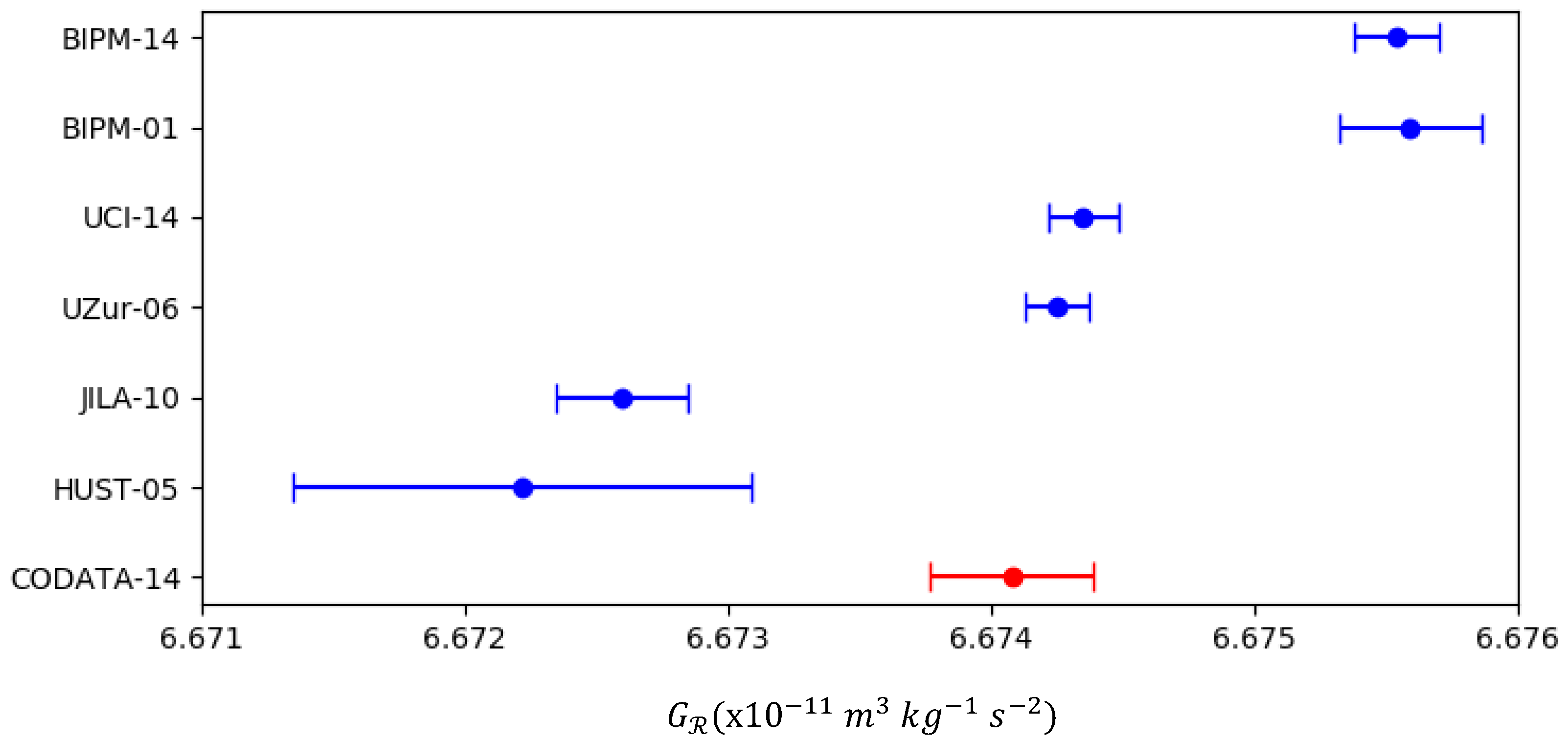
The Newtonian gravitational ‘constant’ plays a crucial role in theoretical physics, astronomy, geophysics, and engineering. About three hundred experiments attempted to ascertain the value of up to date. However, the significant inconsistencies in their results have made it unfeasible to reach a consensus on an exact value. Many of them are precision measurements with a relative uncertainty of only 12 to 19 parts per million [22,23,24,25,26]. The achievement of such a low level of uncertainty can indicate that the margin of systematic errors in experiments is narrower than generally anticipated. At the same time, the significant inconsistencies among measurements’ outcomes imply that there could be phenomena that are not yet accounted for in the current framework of physics. From Equations (1) and (14), the Newtonian gravitational parameter is
where is the scalar curvature of the conformal bulk. According to Equation (40), is proportional to and reflects the field strength of vacuum energy because any changes in the bulk’s metric, , changes the field strength of the bulk, , because of the constant modulus, .
In addition, although the ground state of at the local present Universe appears to be spatially flat, it could have a small temporal curvature reflecting the present value of . The dependency of on the curvature of the bulk is discussed and visualized as in the following.
Regarding the Earth, Figure 3 shows the curvature of its background, the curved bulk owing to the Sun presence. In this curved background (curved bulk), both Earth and Moon are further inducing different curvature configurations depending on their positions. For instance, at Point A, the Earth’s background curvature is influenced by Moon’s position as shown by the blue and red-dotted curves.
Figure 4 shows six of values by measurements: BIPM-14 [27], BIPM-01 [28], UCI-14 [29], UZur-06 [30], JILA-10 [31] and HUST-05 [32]. These values were among those adopted in the CODATA (Committee on Data for Science and Technology) 2014 of the recommended value of [33].
A one-way ANOVA test was performed on these precision measurements, resulting in an F-statistic of 302.089 and a p-value of 0.000, which indicates strong evidence against the null hypothesis. This signifies that there is a significant difference in the variances of these measurements.
Despite the small relative uncertainty in the measurements, the significant differences in their outcomes that puzzled scientists [23] can be attributed to the differences in the curvature of the bulk at the time that the measurements were conducted, as stated in Equation (40), owing to varied positions of the Moon and other nearby planets. One simple approach could be to conduct measurements twice, with one set taken when the Moon is on the horizon and another set taken when it is on the opposite side of the Earth.
7. Conclusions and Future Works
This study presented interaction field equations in terms of the brane-world modified gravity and the perspective of geometrization of quantum mechanics. This study considered the global curvature of the Universe as the curvature of a 4D conformal bulk and distinguished it from the localized curvature that is induced in the bulk by the presence of celestial objects that are modeled as relativistic 4D cloud-worlds. The derived interaction field equations are
These interaction field equations indicate that the induced curvature, , by the cloud-world over the bulk (background) curvature, , equals the ratio of the imposed energy density of the cloud-world to the vacuum energy density of the bulk through the expanding/contracting Universe. Similarly, quantum clouds are modeled as localized geometric excitations embedded in a structured vacuum background or 4D relativistic quantum clouds that are embedded in vacuum energy. The quantum field equations:
where represents the metric mismatch between the quantum cloud’s metric and the bulk metric giving rise to virtual mass drag. These equations can be interpreted as conceptualizing that a 4D conformal bulk, as a manifestation of vacuum energy of conformal time flow, embeds a 4D relativistic cloud-world representing a celestial object of conventional time flow that in turns encapsulates 4D relativistic quantum clouds of quantum time flow and so forth. By considering the induced curvature by the cloud-world in the bulk, the conceptual picture can be simplified to an interactive flow of the 4D relativistic clouds with vacuum energy of field strength that relies on the bulk curvature. A plane wavefunction, , can be expressed by utilizing the Equation (42) as , thus:
Finally, in order to test or falsify the derived interaction field equations, a relationship between the Newtonian gravitational ‘constant’, ,and the background curvature has been found as
where is the scalar curvature of the conformal bulk. According to Equation (45), is proportional to and reflects the field strength of vacuum energy because any changes in the bulk’s metric, , changes the field strength of the bulk, . However, the bulk modulus, , may change as well, which reduces the change in . To achieve precision measurements of , it is necessary to consider the positions of the Moon and other nearby planets, as they can influence the curvature of the background. Variations in background curvature can significantly contribute to the observed differences in the precision measurements of according to the interaction field equations. Future precision experiments should aim to address this issue of inconsistent measurements by accounting for the influence of these celestial bodies.
Conflicts of Interest
The author declares no conflicts of interest.
Appendix A
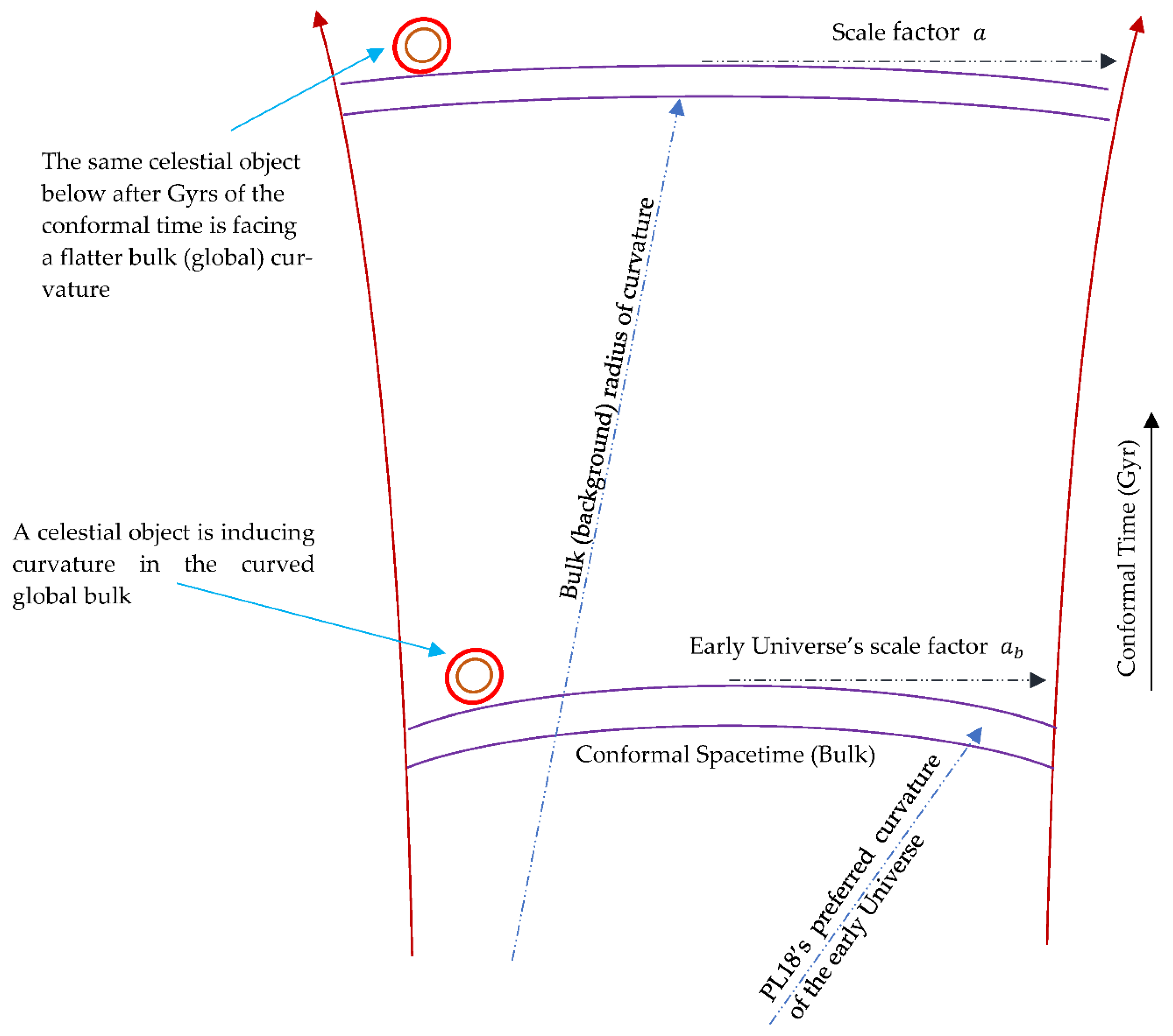
The conformal time is associated with the scale factor, , according to the conformal time formula . As shown in Figure A1, both the radius of curvature and the scale factor increase through the conformal time, where this curvature can be expressed as the global curvature or the curvature of the 4D conformal bulk.
Figure A1.
The evolution of the conformal curvature based on the scale factor.
References
- Randall, L; Sundrum, R. 1999 An alternative to compactification. Phys. Rev. Lett. 83, 4690–3. [CrossRef]
- Gogberashvili M 1999 Four Dimensionality in Non-compact Kaluza-Klein Model Mod. Phys. Lett. A 14 2025.
- Randall L and Sundrum R 1999 Large Mass Hierarchy from a Small Extra Dimension. Phys. Rev. Lett. 83, 3370.
- Vilkovisky, G. Effective action in quantum gravity Class. In Quantum Gravity; 1992; Volume 9, pp. 895–903. [Google Scholar]
- Capozziello, S; Lambiase, G. Higher-order corrections to the effective gravitational action from Noether symmetry approach. Gen. Relativ. Gravit. 2000, 32, 295–311. [Google Scholar] [CrossRef]
- Garattini, R. Distorting general relativity: Gravity’s rainbow and f(R) theories at work J. Cosmol. Astropart. Phys. 2013. [Google Scholar] [CrossRef]
- Rickles D 2008 Chapter 7 Who’s Afraid of Background Independence? Philos. Found. Phys. 4, 133–52.
- Di Valentino, E; Melchiorri, A. Silk J 2020 Planck evidence for a closed Universe and a possible crisis for cosmology. Nat. Astron. 4, 196–203. [CrossRef]
- Mokeddem, R; Hipólito-Ricaldi, W S; Bernui, A. 2022 Excess of lensing amplitude in the Planck CMB power spectrum. MNRAS.
- Handley, W. Curvature tension: Evidence for a closed universe. Phys. Rev. D 2021, 103, L041301. [Google Scholar] [CrossRef]
- Linde A 2003 Can we have inflation with. J. Cosmol. Astropart. Phys. 2003, 002–002.
- Efstathiou, G. 2003 Is the Low CMB Quadrupole a Signature of Spatial Curvature? Mon. Not. R. Astron. Soc. 343, 0–000.
- Landau, L D. Theory of Elasticity; Elsevier, 1986. [Google Scholar]
- Kozameh, C; Newman. E and TOD K P 1985 Conformal Einstein spaces. In Springer.
- Carroll, S. M. 2003 Spacetime and Geometry: An Introduction to General Relativity.
- Straub, W. 2006 Simple Derivation of the Weyl Conformal Tensor.
- Rugh, S E; Zinkernagel, H. The Quantum Vacuum and the Cosmological Constant Problem. Stud. Hist. Philos. Sci. Part B - Stud. Hist. Philos. Mod. Phys. 2000, 33, 663–705. [Google Scholar] [CrossRef]
- Gómez-Valent A 2017 VACUUM ENERGY IN QUANTUM FIELD THEORY AND COSMOLOGY.
- Dyer, E; Hinterbichler, K. Boundary terms, variational principles, and higher derivative modified gravity. Phys. Rev. D - Part. Fields, Gravit. Cosmol. 2009, 79. [Google Scholar] [CrossRef]
- Brown, J D; York, J W. Microcanonical functional integral for the gravitational field. Phys. Rev. D 1993, 47, 1420–31. [Google Scholar] [CrossRef] [PubMed]
- Al-Fadhli, M.B. The Morphology of the Active Galactic Nucleus and its Impact on Accretion Flows and Relativistic Jets. Phys. Sci. Forum 2023, 7, 52. [Google Scholar] [CrossRef]
- Li Q, Xue C, Liu J P, Wu J F, Yang S Q, Shao C G, Quan L D, Tan W H, Tu L C, Liu Q, Xu H, Liu L X, Wang Q L, Hu Z K, Zhou Z B, Luo P S, Wu S C, Milyukov V and Luo J 2018 Measurements of the gravitational constant using two independent methods Nature 560 582–8.
- Xue, C; Liu, J P; Li, Q; Wu, J F; Yang, S Q; Liu, Q; Shao, C G; Tu, L C; Hu, Z K; Luo, J. 2020 Precision measurement of the Newtonian gravitational constant. Natl. Sci. Rev. 7, 1803–17. [CrossRef]
- Schlamminger S 2018 Gravity measured with record precision Nat. 2021 5607720 560 562–3.
- Gibney, E. Rivals join forces to nail down Big G. Metrologists meet to design the ultimate gravitational-constant experiment. Nature 2014, 514, 150–1. [Google Scholar]
- Schlamminger, S. Fundamental constants: a cool way to measure big. Nature 2014, 510, 478–80. [Google Scholar]
- Quinn, T; Parks, H; Speake, C; Davis, R. 2013 Improved determination of G using two methods. Phys. Rev. Lett. 111, 101102.
- Quinn, T J; Speake, C C; Richman, S J; Davis, R S; Picard. A 2001 A New Determination of G Using Two Methods. Phys. Rev. Lett. 87, 111101.
- Newman, R; Bantel, M; Berg, E; Cross, W. A measurement of G with a cryogenic torsion pendulum Philos. Trans. R. Soc. A Math. Phys. Eng. Sci. 2014, 372. [Google Scholar]
- Schlamminger, S; Holzschuh, E; Kündig, W; Nolting, F; Pixley, R E; Schurr, J; Straumann. U 2006 Measurement of Newton’s gravitational constant Phys. Rev. D - Part. Fields, Gravit. Cosmol. 74, 082001.
- Parks, H V.; Faller, J E. 2010 Simple pendulum determination of the gravitational constant. Phys. Rev. Lett. 105, 110801.
- Hu, Z K; Guo, J Q; Luo. J 2005 Correction of source mass effects in the HUST-99 measurement of G Phys. Rev. D - Part. Fields, Gravit. Cosmol. 71, 127505.
- Mohr, P J; Newell, D B. Taylor B N 2016 CODATA recommended values of the fundamental physical constants. Rev. Mod. Phys. 2014, 88, 035009. [Google Scholar]
Figure 1.
The hypersphere of a compact core of a galaxy (the red–orange 4D cloud-world) along with its flow and spin through the conformal spacetime (the blue–purple 4D bulk) representing the bulk of distinctive curvature evolving over the conformal time.
Figure 1.
The hypersphere of a compact core of a galaxy (the red–orange 4D cloud-world) along with its flow and spin through the conformal spacetime (the blue–purple 4D bulk) representing the bulk of distinctive curvature evolving over the conformal time.
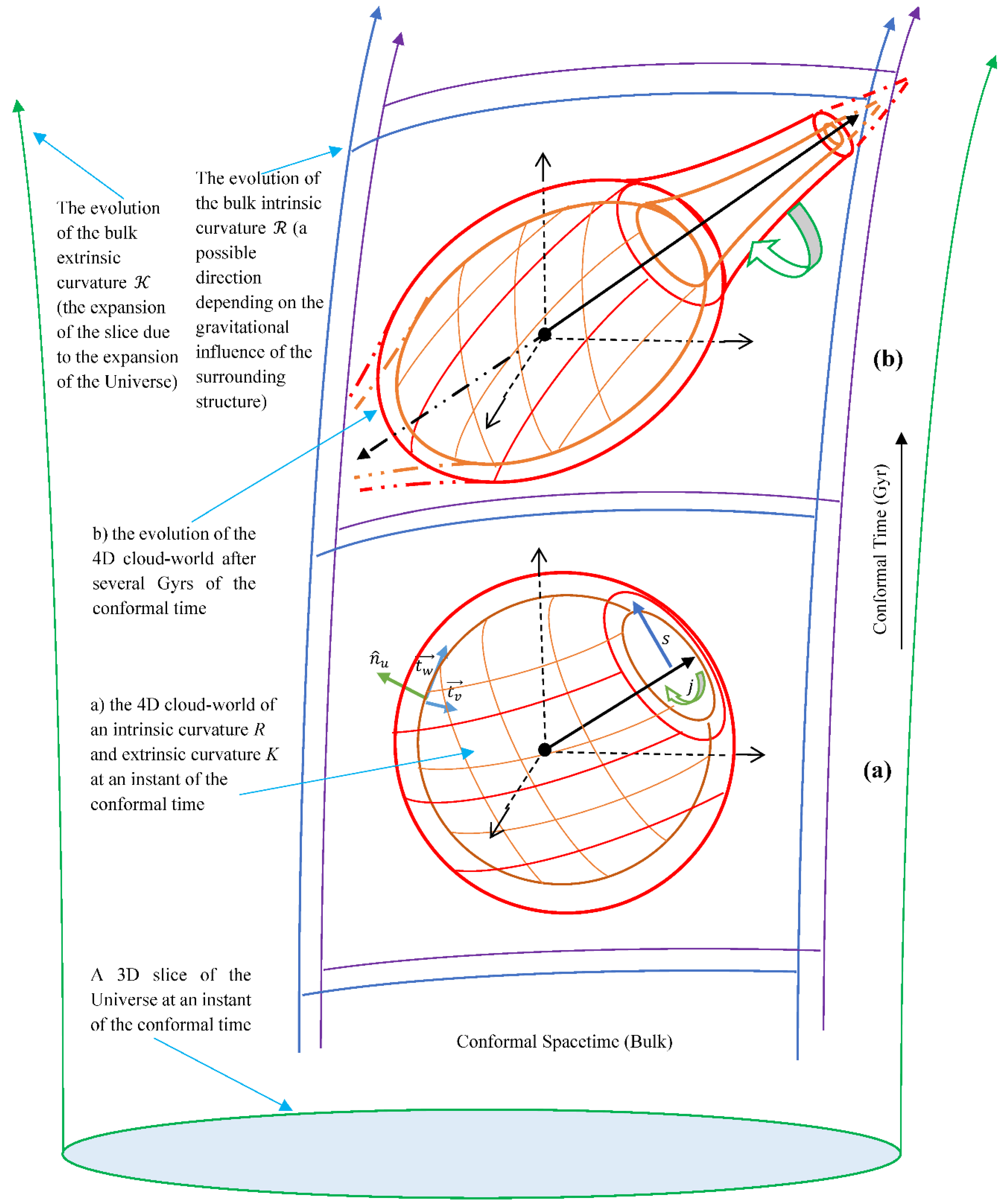
Figure 2.
The deformed configuration of the 4D relativistic quantum cloud of metric along its travel and spin though the curved background (bulk) of metric . The configuration is given by, , the inner surface of the quantum cloud that separates its continuum into two portions and encloses an arbitrary inner volume while is the outer surface of the cloud’s boundary.
Figure 2.
The deformed configuration of the 4D relativistic quantum cloud of metric along its travel and spin though the curved background (bulk) of metric . The configuration is given by, , the inner surface of the quantum cloud that separates its continuum into two portions and encloses an arbitrary inner volume while is the outer surface of the cloud’s boundary.
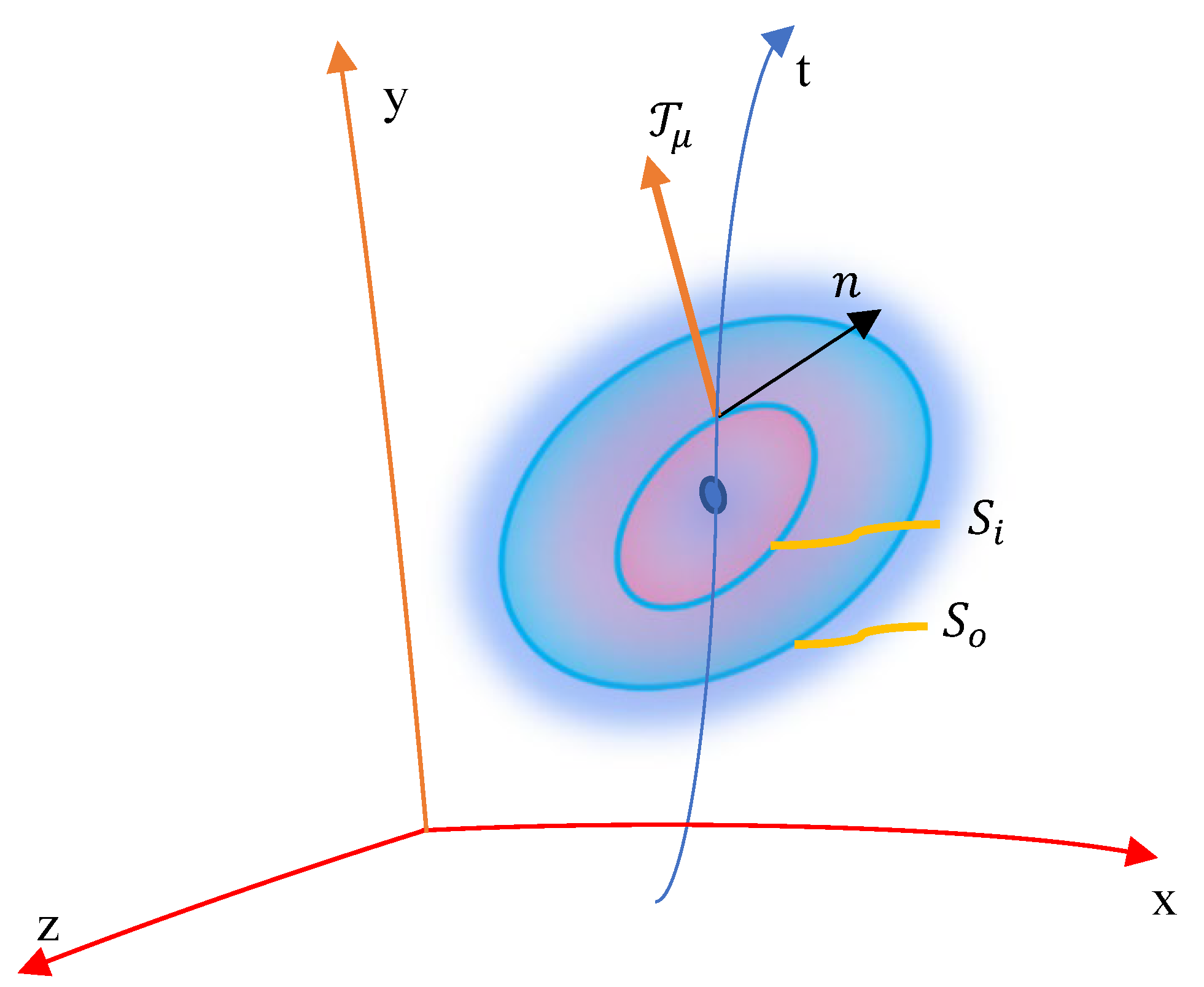
Figure 3.
The blue curve represents the induced curvature by the Sun, which signifies the curvature of the background with respect to the Earth and Moon. Concerning both planets, they in turn are inducing further curvature in their background as visualized beneath them by the blue curve. On the other hand, when the Moon is at the away position (dotted circles), an altered background (bulk) curvature configuration is shown by the red dotted curve.
Figure 3.
The blue curve represents the induced curvature by the Sun, which signifies the curvature of the background with respect to the Earth and Moon. Concerning both planets, they in turn are inducing further curvature in their background as visualized beneath them by the blue curve. On the other hand, when the Moon is at the away position (dotted circles), an altered background (bulk) curvature configuration is shown by the red dotted curve.
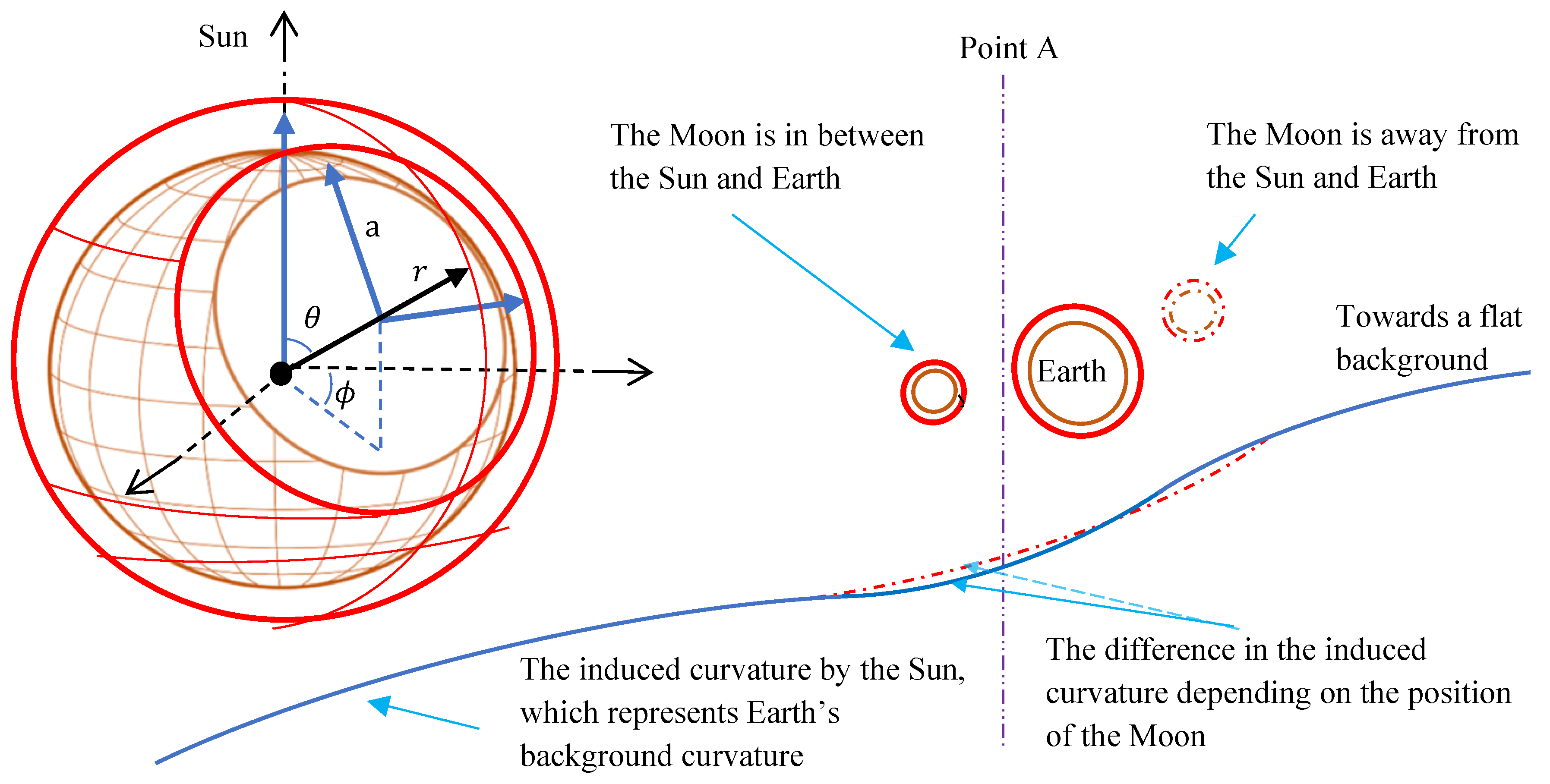
Figure 4.
Six of values among those that were adopted in the CODATA 2014 recommended value.
Disclaimer/Publisher’s Note: The statements, opinions and data contained in all publications are solely those of the individual author(s) and contributor(s) and not of MDPI and/or the editor(s). MDPI and/or the editor(s) disclaim responsibility for any injury to people or property resulting from any ideas, methods, instructions or products referred to in the content. |
© 2026 by the authors. Licensee MDPI, Basel, Switzerland. This article is an open access article distributed under the terms and conditions of the Creative Commons Attribution (CC BY) license (http://creativecommons.org/licenses/by/4.0/).
Copyright: This open access article is published under a Creative Commons CC BY 4.0 license, which permit the free download, distribution, and reuse, provided that the author and preprint are cited in any reuse.


