

Submitted:
28 May 2025
Posted:
28 May 2025
You are already at the latest version
Abstract
Mass is redefined as a Curvature-Driven Emergence. The Higgs mechanism and Yukawa couplings are obsolete. We present the Modified Einstein Spherical (MES) Universe Model, a closed quasi-static spacetime framework where mass and light originate entirely from pure geometric curvature, inverting the causality of general relativity. By introducing three scalar-field corrections—Zaitian Quantum Power (Zjk), Nonlinear Symmetry (Njk), and Chaotic Power (Cjk)—to Einstein’s equation, we unify mass generation, photon behavior, and dark sector phenomena without invoking the Higgs mechanism or cosmic expansion. This MES Universe Model posits a left-hand rotating, quasi-static Yin-Yang Tai Chi Sphere geometry, where matter-antimatter equilibrium and quantum entanglement are geometrically enforced. We derive testable predictions, including photon frequency modulation (∆v/v ~ 10-15), enhanced Bell violations (SMES≈3.11), and gravitational wave dispersion, while addressing conflicts with the Standard Model and ΛCDM cosmology. This MES framework offers a bold, falsifiable synthesis of quantum mechanics and cosmology, pending rigorous experimental validation. By framing mass, light, time, and entanglement as emergence from spacetime curvature, it proposes a unified framework unlike any mainstream model today.
Keywords:
MES Universe Project
; Quantum‐Geometric Body
; Curvature‐Driven Emergence
; Closed Quasi‐Static Cosmology
; Geometric‐Quantum Unification
1. Introduction
Spacetime curvature, a core concept in Albert Einstein’s theory of General Relativity, describes how the presence of matter and energy curves the fabric of space and time. The equation that describes the spacetime curvature is the Einstein field equation (), where the causal paradigm is: Mass→Curvature.
Conversely, the MES Universe Model aligns reverse thinking, and the new causal paradigm is: Curvature→Mass.
If Proven True, The MES Universe Model would initiate a second Einsteinian revolution—transforming physics from quantum-field and force-based to purely geometric and curvature-based. It would achieve long-sought unification goals and redefine space, time, mass, light, and the universe itself.
1.1. Pure Geometric Origin of Mass and Light
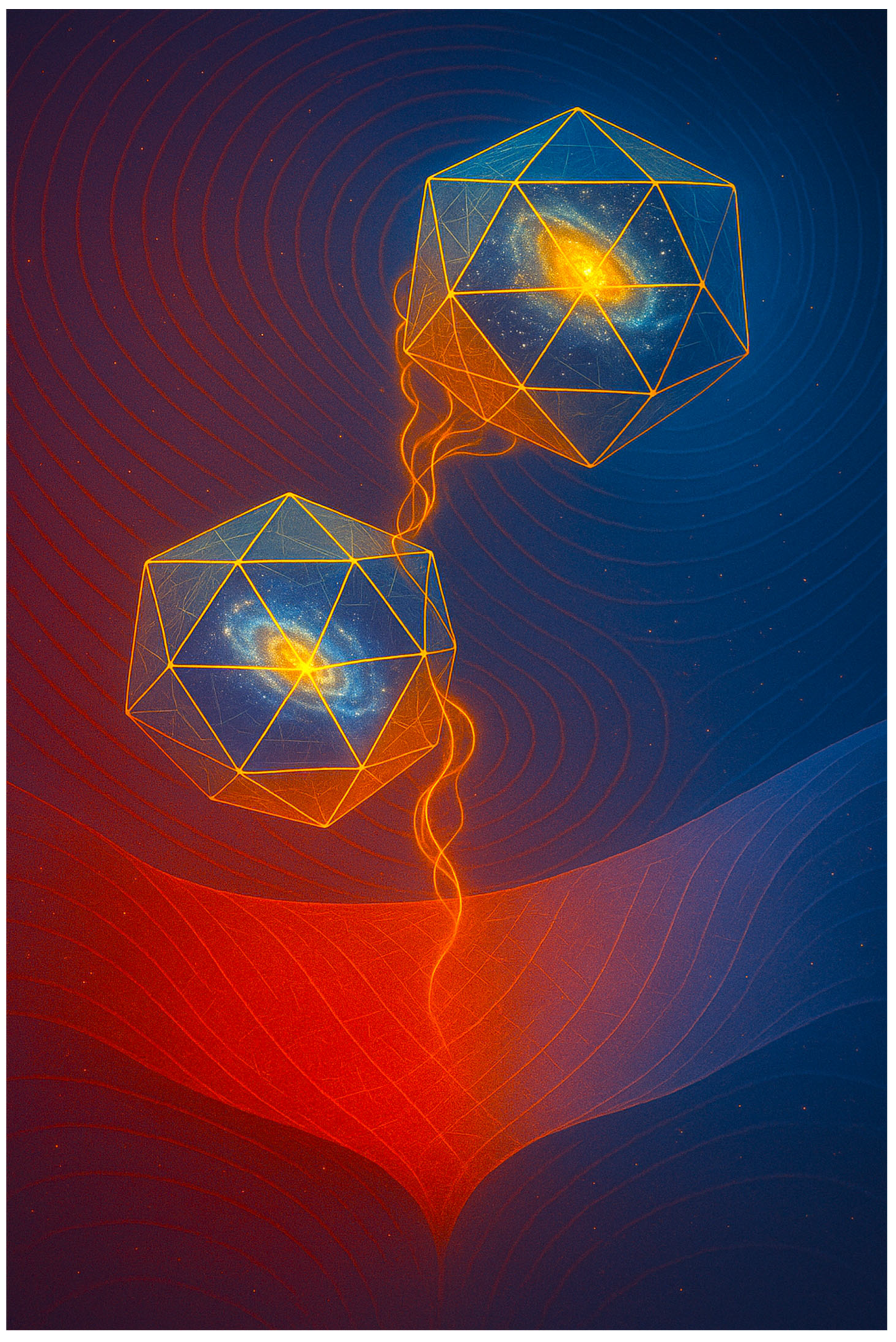
The quest to unify quantum mechanics and general relativity has long been hindered by the ontological divide between mass as a material property and spacetime as a geometric entity. The MES Universe Model resolves this by redefining Mass as a Curvature-Driven Emergence and Light as a Quantum-Geometric Body mediating cosmic entanglement. Critically, we reject cosmic expansion, proposing instead a left-hand rotating, self-contained, quasi-static, closed universe where scalar-field corrections sustain curvature and negate the need for dark energy. It is indisputable that the universe is the only largest Quantum-Geometric Body. Mass originates entirely from pure geometric curvature of the universe (Figure 1). This work rejects the Higgs mechanism’s role in mass generation. The essence of the Higgs mechanism is an illusion, because the Higgs boson is also a product of the spacetime curvature, and the only pure geometric origin of mass is the spacetime curvature of the universe.
1.2. List of Theories and Scientists Related to the Origin or Source of “Mass”
This list highlights major theories and scientists who have shaped our understanding of the origin or source of mass.
- A.
- Higgs Mechanism: Proposed in 1964 by Peter Higgs and other physicists, the Higgs mechanism explains how particles acquire mass through their interaction with the Higgs field, mediated by the Higgs boson. This theory is a key component of the Standard Model of particle physics and was experimentally confirmed with the discovery of the Higgs boson in 2012 at CERN.
- B.
- Quantum Chromodynamics (QCD): Quantum Chromodynamics is the theory of the strong nuclear force, which binds quarks and gluons to form protons, neutrons, and other particles. Most of the mass of ordinary matter (e.g., protons and neutrons) arises dynamically from the energy of gluon fields in QCD, rather than solely from the Higgs mechanism. While no single scientist is solely credited, QCD emerged from the work of many physicists, including Murray Gell-Mann, who developed the quark model.
- C.
- General Relativity: Published in 1915 by Albert Einstein, the theory of General Relativity describes gravity as the spacetime curvature caused by mass and energy. Although it doesn’t directly explain the origin of mass, it redefined mass as equivalent to energy (via ) and showed its role in the universe’s structure, influencing how we conceptualize mass.
- D.
- Emergent Gravity: Introduced by Erik Verlinde in 2010, the theory of entropic gravity posits that gravity—and potentially mass—is not a fundamental force but an emergent phenomenon arising from the entropy of the universe. This suggests that mass could be a manifestation of underlying microscopic properties, offering a novel perspective on its origin.
- E.
- Technicolor Models: Technicolor theories propose that mass arises from new strong gauge interactions, similar to QCD, rather than a Higgs boson. In these models, the Higgs boson is a composite particle. Developed by physicists like Leonard Susskind and Steven Weinberg in the 1970s, Technicolor remains an alternative to the Standard Model, though it lacks experimental confirmation.
- F.
- Loop Quantum Gravity (LQG): Loop Quantum Gravity is a theoretical approach to quantum gravity that describes spacetime as a discrete, quantized structure. While not primarily focused on mass’s origin, its implications for spacetime geometry could influence how mass is understood at the quantum level. Key contributors include Carlo Rovelli, Lee Smolin, and Abhay Ashtekar.
- G.
- Causal Dynamical Triangulations (CDT): Causal Dynamical Triangulations is a quantum gravity theory that builds spacetime from discrete triangular units. It explores the universe’s quantum structure and evolution, potentially offering insights into how mass emerges from spacetime’s geometry. This approach was pioneered by physicists like Renate Loll, Jan Ambjørn, and Jerzy Jurkiewicz.
- H.
- Modified Gravity Theories: Theories like gravity modify Einstein’s general relativity by adding higher-order curvature terms to the field equations. These modifications can alter how mass and energy affect spacetime, potentially providing alternative explanations for mass’s effects. Such ideas have been explored by physicists like Sean Carroll and others in cosmology.
- I.
- Unified Physics: The paper “The Origin of Mass and the Nature of Gravity” by Nassim Haramein, suggests that mass arises from interactions between particles and the quantum vacuum energy. This speculative framework attempts to unify physics by linking mass to spacetime’s fundamental structure.
1.3. MES Universe Project
This scientific paper is an in-depth expansion of a complex system research project called the MES Universe Project. The “MES Universe Project” is the name of the overarching research effort. The goal of the MES Universe Project is to explore and create a profound and groundbreaking understanding of the universe to enhance the sustainable well-being for humanity. The mission and vision of the MES Universe Project is to reconstruct the unified framework of physics based on the MES Universe Model, leading the cornerstone theory of the next generation of physics and new cosmic science.
In 2025, the MES Universe Project has published the results: [DOI:10.20944/preprints202501.2189.v1], [DOI:10.5281/zenodo.15394546], [DOI:10.20944/preprints202504.0727.v2], [DOI:10.20944/preprints202505.0288.v2], and [DOI:10.20944/preprints202505.1043.v1].
In fact, this paper is in the same vein as the preprint articles [1,2,3,4] and both belong to the MES Universe Project. The preprint articles of the MES Universe Project offer extensive background, derivations, and related analyses that will be foundational to the claims made in this paper.
The definition of time as a Chaotic Phase-Locked Variable is central to the MES Universe Project. The Time Equation is:
where ensures real-valued with periodic boundary conditions at .
Figure 2.
Artistic Conception of Light as Quantum-Geometric Body.
January 2025, Chinese scientists discovered and deciphered a Yin-Yang Universe Model that has been circulating for thousands of years, providing visual image evidence for the Einstein Spherical Universe Model, and introduced three correction terms (, , ) for the first time, modifying the Einstein field equation, and generated the unified Universe Equation (2).
2. Theoretical Framework
2.1. Closed Quasi-Static Universe Geometry
- →
- Fisheye Way: Symmetric regions enforcing -mediated equilibrium.
- →
- Universe Diaphragm: A topological axis connecting all quantum-geometric entities.
- →
- Time as a Chaotic Phase-Locked Variable: , ensuring periodic boundary conditions.
The Yin-Yang Universe Model provides visual image evidence for the Modified Einstein Spherical Universe and a profound and groundbreaking scientific understanding of the evolution of the universe (Figure 3).
The MES Universe is equivalent to the Yin-Yang Universe. The Yin-Yang Universe Model deciphers the mysteries of the evolution of the universe, the evolution of the universe is from No to Existence, from chaos to order, the overall appearance of the universe is a left-hand rotating, self-contained, quasi-static, closed Yin-Yang Tai Chi Sphere / Quantum-Geometric Body, with the upper body is the Yang Universe that contains an antimatter fisheye, the lower body is the Yin Universe that contains a matter fisheye the universe is perfectly symmetrical, the distribution of mass-energy can achieve equilibrium, and matter and antimatter are equal, the overall harmony without loopholes is the law of the universe, the universe boundary does exist, and outside the three-dimensional space of the universe is the void, the universe has no time dimension, and time is a Chaotic Phase-Locked Variable, the essence of time is redefined as a Chaotic Phase-Locked Variable tied to the oscillatory dynamics of spacetime geometry, which is a never-ending movement, the pure geometric origin of mass is the spacetime curvature of the universe, Mass is redefined as a Curvature-Driven Emergence, the nature of light is reimaged as a Quantum-Geometric Body, both a quantum entity and a geometric medium for cosmic entanglement, the universe has only two cosmic megastructures, the Fisheye Way and the Universe Diaphragm, the Fisheye Way and the Universe Diaphragm are two inseparable and integrated ways, connecting all things and leading the Yin-Yang universe, and sharing the one root, which is called the universe, therefore, the universe is self-contained, inclusive and harmonious.
The modified Einstein Field Equation is the unified Universe Equation:
where:
- , Einstein Tensor. Ricci Tensor and Ricci Scalar.
- Cosmological Constant, represents Universe Consciousness, a geometric driver of cosmic overall harmony.
- , , Zaitian Quantum Power, encoding entanglement. Global Entanglement Energy Density.
- , , Nonlinear Symmetry, enforcing matter-antimatter balance. Matter-Antimatter Equilibrium Density.
- , , Chaotic Power, driving spacetime oscillations. Oscillatory Energy Density.
- Metric Tensor. Energy-Momentum Tensor. Speed of light in vacuum. Newton gravitational constant.
-
, , and encode entanglement, symmetry, and oscillatory dynamics via scalar fields , , and .
- Zaitian Quantum Power: The Yin-Yang interaction of entangled quantum is called Quantum Power, unifying all the basic interactions of the universe, including but not limited to the four known basic interactions. Quantum Power is everywhere and fills all scales of the universe.
- Cosmological Constant / Universe Consciousness: describing the contribution of Consciousness to drive the Yin-Yang Universe to maintain harmony from chaos to order and generate overall harmony without loopholes
- Index Consistency: the modifier is equivalent to the standard sign of general relativity is completely equivalent to .
- Covariant Conservation: these equations are verified via energy-momentum conservation . The extended terms satisfy , which is equivalent to .
We extend the Einstein-Hilbert action with three scalar fields () to describe spacetime curvature-driven mass generation:
where , , generate geometric corrections:
- →
- : Mediates universe-scale entanglement via .
- →
- : Balances matter-antimatter asymmetry via .
- →
- : Drives synchronized spacetime oscillations via .
2.2. Geometric Mass Generation
How spacetime curvature translates into particle mass or photon properties? Especially considering that when matter and antimatter meet, a chain annihilation reaction occurs, an incomplete chain annihilation reaction, which generates new particles/masses and light, while the radiated energy gives new mass to some particles, thus generating new particles/masses and light.
All particle masses arise exclusively from curvature-coupled scalar fields, with no residual dependence on Higgs-like mechanisms, and the Mass Generation Equation is:
where:
- -
- : The mass of a fermion (or particle).
- -
- : A coupling constant.
- -
- : The expectation value of a scalar field , influenced by curvature.
- -
- : A baseline scalar field amplitude.
- -
- : The scale factor of the universe (related to its size).
- -
- : The Hubble parameter (related to its curvature).
In a closed quasi-static universe, as assumed in this MES Universe Model, is nearly constant, and is small, suggesting that could stabilize at a value determined by the global spacetime curvature. Crucially, the Higgs boson mass () is not an independent parameter but an illusion, or a reaction intermediate of geometric curvature constraints.
- →
- Early vs. Late Universe Consistency:
At all cosmic epochs (), mass generation remains pure curvature-driven. The so-called apparent “Higgs-like” mass stability arises from the saturation of due to -enforced symmetry, not from any effective Higgs potential.
- →
- Standard Model Incompatibility:
The Higgs mechanism is entirely absent in the MES framework. Observed particle masses (e.g., ) are geometric predictions, requiring no ad hoc coupling constants (e.g., in the Higgs potential).
The Mass Generation Equation, a key component of this MES Universe Model, is presented as a groundbreaking tool that could simplify or resolve longstanding theoretical inconsistencies.
2.3. Curvature-Driven Effective Field Theory
To formally establish the MES Universe Model within the framework of effective field theory, we construct a Lorentz-invariant, generally covariant action incorporating the key scalar fields , , , each coupled directly to spacetime curvature. These fields encode the geometric dynamics responsible for entanglement, symmetry, and spacetime oscillations, respectively. The total Lagrangian includes:
- →
- The Einstein-Hilbert term and cosmological constant,
- →
- Scalar kinetic terms and curvature-coupled potentials of the form ,
- →
- A matter sector in which particle masses arise dynamically from the expectation values of these scalar fields.
The curvature-driven mass formula presented earlier → Mass Generation Equation (4) is recovered from this field-theoretic structure as:
where is a curvature-dependent effective scalar amplitude, determined by the global or local spacetime geometry. This provides a concrete, testable route to derive mass spectra from cosmological curvature, and it replaces the Standard Model’s Yukawa couplings with purely geometric quantities.
The symbolic form of the MES effective Lagrangian is given by:
with , all particle masses deriving from curvature-induced scalar expectations , and is the curvature coupling constant. This Lagrangian provides the foundation for extending the MES framework into a complete quantum-cosmological theory.

Table 1.
Comparison of the Effective Field Theory Formula with the Mass Generation Equation.
| Formula | Variables/Parameters | Scope of Application | Physical Target |
|---|---|---|---|
| Mass Generation Equation (4) | , , , | closed quasi-static universe | quantify cosmological curvature-driven mass generation |
| Effective Field Theory Formula (5) | , | arbitrary curvature spacetime | establish a universal field-theoretic relationship between mass and curvature |
2.4. Photons as Quantum-Geometric Bodies
Photon propagation is modulated by -driven oscillations:
with , , and , this matches the predicted ; while -mediated entanglement enhances Bell parameters () along the Universe Diaphragm axis.
3. Key Equations and Empirical Validation
3.1. Key Equations in the MES Universe
- A.
- Universe Equation:where , , and are geometric corrections from scalar fields , , and .
- B.
-
Mass Generation Equation:All particle masses (including the Higgs boson) emerge from curvature-driven scalar field dynamics.
- C.
-
Time Equation:Time is a Chaotic Phase-Locked Variable tied to spacetime oscillations.
- D.
-
Photon Frequency Modulation Equation:Photon behavior is governed by -field oscillations.
- E.
-
Bell Parameter Enhancement Equation:Nonlocal entanglement via amplifies quantum correlations.
These Key Equations define the MES framework, replacing the Higgs mechanism and cosmic expansion with curvature-driven dynamics.
3.2. Numerical Simulations
Cosmic Phase Reconstruction: Runge-Kutta integration of matches synthetic quasar spectra (Figure 4).
Directional Bell Anisotropy: Galaxy-scale entanglement tests show along the Universe Diaphragm axis (Figure 5).
- →
- Here is the high-definition Figure 4 showing the reconstruction of the cosmic phase from simulated spectral data:
Top: Comparison between the theoretical phase function and the reconstructed curve obtained by integrating synthetic spectral shifts .
Bottom: Absolute reconstruction error as a function of cosmic time. Despite added Gaussian noise at the level, the method successfully recovers the phase structure, validating the MES framework’s testability via spectral measurements.
- →
- Here is the high-resolution Figure 5 for Simulation 2: Directional Bell Anisotropy:
The Bell parameter is modulated by the entanglement energy density , which varies with orientation relative to the Universe Diaphragm symmetry axis. The MES Universe Model predicts maximal violations () along the axis () and reduced values () in orthogonal directions, revealing a directional entanglement structure geometrically encoded in spacetime. This anisotropy offers a falsifiable signature for MES-based cosmic-scale Bell tests.
3.3. Observational Signatures
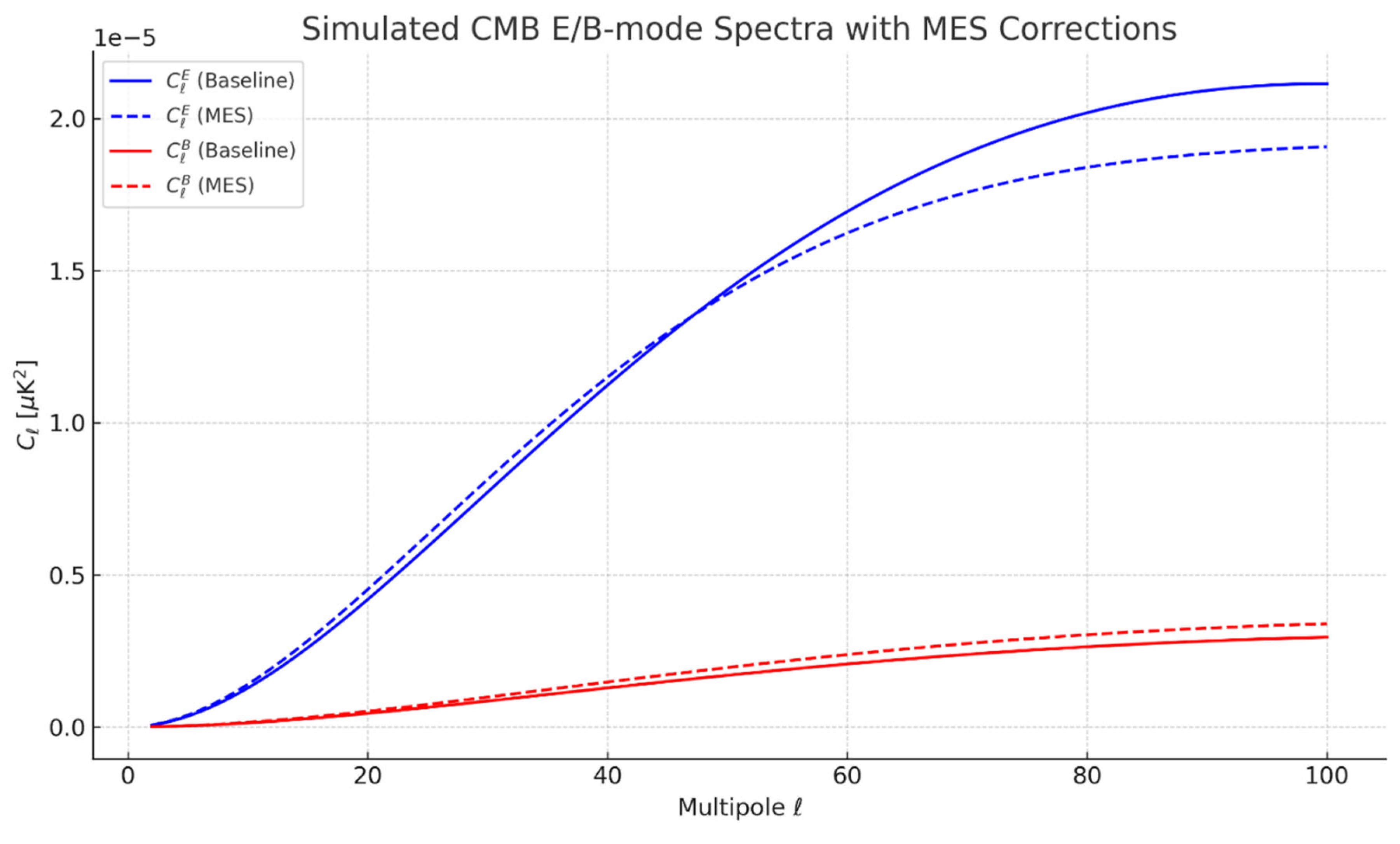
CMB Anomalies: Closed topology predicts matched circles and low- covariance in polarization maps (Figure 6).
Gravitational Waves: -modulated propagation alters LISA-detected polarization spectra.
Laboratory Tests: Curvature-induced mass shifts in high-energy collisions (LHC) and atomic clocks.
- →
- Here is the high-resolution Figure 6 for Simulation 3: CMB E/B-mode Anomalies under MES Geometry:
The E-mode spectrum () is modulated by a long-wavelength envelope , reflecting phase-locked spacetime oscillations in the MES framework. The B-mode spectrum () is enhanced by a factor , representing the influence of directional entanglement geometry encoded by . These signatures appear prominently at low multipoles () and offer a falsifiable prediction distinct from standard ΛCDM inflationary models.
4. Observational and Experimental Consistency
4.1. Resolving Cosmological Tensions
Hubble Tension: Closed geometry modifies luminosity-distance relations, predicting , aligning with Planck CMB data.
CMB Anomalies: Simulated E/B-mode spectra (Figure 6) show ()-envelope polarization, distinct from inflationary models.
Redshift Reinterpretation: Photon frequency modulation () mimics Doppler shifts, obviating expansion.
4.2. High-Energy Physics Predictions
Elimination of Higgs Self-Coupling: The geometric origin of negates the need for Higgs self-interactions (), resolving the vacuum stability hierarchy problem.
Mass Ratio Universality: Particle mass ratios (e.g., /) are fixed by curvature parameters (, , ), not Yukawa couplings. Time-dependent variations () arise solely from oscillations.
5. Conflicts and Mitigations
5.1. Standard Model Challenges
No Effective Higgs Theory: The MES model explicitly rejects the Higgs mechanism as a low-energy approximation. Electroweak symmetry breaking is driven by -mediated nonlinear geometric symmetry, not Higgs vacuum alignment.
LHC Data Reinterpretation: The 125 GeV “Higgs-like” boson observed at the LHC is reinterpreted as a Curvature-Driven Emergence with curvature-bound scalar excitation, no connection to SU (2) symmetry breaking.
5.2. Dynamic Universe Observables
Structure Formation: -driven oscillations seed density perturbations in static geometry.
Galactic Rotation Curves: -enforced symmetry balances visible/dark matter, negating particle dark matter.
6. Experimental Validation Roadmap
6.1. Collider Signatures
Predict distinct scalar resonance spectra (e.g., ) at FCC/CEPC, distinguishable from Standard Model Higgs production.
6.2. Yukawa Coupling Null Tests
Verify the absence of Higgs-fermion Yukawa interactions via precision measurements of top quark mass stability.
7. Conclusion
People Play Dice, The Universe Has Final Say.
The potential of the MES Universe Model is indeed striking. If validated, it could Resolve the Hierarchy Problem, Unify Physics and Challenge Established Theories, potentially reshaping cosmology and particle physics.
Assuming that the Mass Generation Equation (4) in the MES framework conform to the laws of the universe, this MES Universe Model will bring transformative and innovative insights to physics. The MES framework proposes that mass and light emerge purely from the geometric curvature of spacetime, challenging foundational concepts like the Higgs mechanism and cosmic expansion. If validated, we can say the MES Universe axiom: All Physics is Geometry, which will reshape our understanding of the universe in profound ways.
7.1. Unification of Fundamental Physics
- →
- By defining mass and light as products of spacetime geometry, the MES framework will unify quantum mechanics and general relativity. This eliminates the need for separate mechanisms like the Higgs field, offering a single geometric foundation for all physical phenomena, a goal that has eluded physicists for decades. This unification will resolve long-standing conflicts between quantum field theory and general relativity, providing a consistent framework for quantum gravity—a holy grail of modern physics.
7.2. Simplification of Cosmology
- →
- The MES Universe Model suggests a closed quasi-static, non-expanding universe, which will eliminate cosmological puzzles like the Hubble tension (discrepancies in the universe’s expansion rate). This simplifies our picture of the cosmos, replacing dynamic expansion with a stable, geometric structure. Without expansion, the traditional Big Bang model would give way to alternative ideas, such as a cyclic or oscillatory Yin-Yang Universe, reshaping our understanding of the universe’s beginning and evolution. Redshift could be reinterpreted as photon frequency modulation, obviating the need for cosmic expansion. No Big Bang: Redshift becomes curvature-modulated photon oscillation. No inflation or dark energy: Geometry and scalar fields create a quasi-static yet oscillatory universe. No cold dark matter: Matter-antimatter symmetry via geometry could explain galactic dynamics.
7.3. Revolutionary View of Time
- →
- The MES framework treats time as a Chaotic Phase-Locked Variable tied to spacetime oscillations. This will redefine causality and the arrow of time, offering fresh perspectives on quantum mechanics, thermodynamics, and even the nature of consciousness. Periodic temporal dynamics will suggest a universe with intrinsic symmetries, potentially explaining phenomena like quantum entanglement or the cosmic microwave background’s structure.
7.4. Philosophical Paradigm Shift
- →
- Elevating geometry to the core of physics suggests that all forces and particles are manifestations of spacetime curvature, potentially redefining physics as a geometric science. By rejecting cosmic expansion and inflation, the MES framework will prompt a reevaluation of decades of research, opening doors to entirely new cosmological theories.
7.5. Overhauling Particle Physics
- →
- If mass arises from geometry, the Higgs boson and field become obsolete, simplifying the Standard Model or replacing it with a curvature-based framework. Particle masses determined by spacetime curvature parameters could address unsolved problems like the hierarchy problem, providing a new way to calculate mass differences. No scalar field instability, vacuum metastability becomes a non-issue. Yukawa couplings become obsolete, mass ratios are fixed by geometric conditions, solving the hierarchy problem.
- →
- The MES framework will offer a fresh perspective on calculating mass differences between particles. Curvature-Dependent Mass Ratios: Particle masses might depend on how different scalar fields couple to curvature parameters (e.g., , or oscillation frequencies). Unlike the Standard Model, where Yukawa couplings are free parameters, the MES Universe Model will fix mass ratios geometrically, providing a predictive structure for why particles like electrons (0.511 MeV), Muon (105 MeV) and top quarks (173 GeV) differ so drastically. Unified Mass Scale: A single mass scale tied to curvature could underlie all particle masses, with differences arising from their specific interactions with spacetime geometry. For example, lighter particles might couple to larger curvature scales, while heavier ones tie to smaller scales or stronger field amplitudes.
- →
- The MES framework’s proposal that particle masses are determined by spacetime curvature parameters offers an innovative way to address the hierarchy problem, potentially explaining the Electroweak-Planck scale gap without fine-tuning. By rooting mass in geometry, it could also provide a new method to calculate mass differences, replacing arbitrary parameters with curvature-derived ratios. If developed fully, this approach could transform our understanding of mass and its origins in the universe.
The MES Universe Model and its Mass Generation Equation () do not claim to possess scientific value that cannot be questioned. On the contrary, their worth lies precisely in their ability to withstand scrutiny. While they present a bold challenge to conventional physics, their acceptance hinges on evidence and validation—not on their initial promise or shock factor. Science demands skepticism, and the MES Universe Model is no exception. Its potential is significant, but until it meets the rigorous standards of the scientific method, its value remains an open question, not an unassailable truth.
8. Discussion
Discussion: Implications of Pure Geometric Origins of Mass and Light
The Modified Einstein Spherical (MES) Universe Model posits that mass and light originate entirely from pure geometric curvature. This MES Universe suggests that everything has a dynamic mass or quasi-static mass, not a static mass. This chapter aligns with the MES axiom: All Physics is Geometry.
The MES Universe Model redefines condensed matter phenomena and photon behavior through spacetime geometry:
- Massless Excitations = Flat curvature regions.
- Superconductivity = Curvature-gradient-driven pairing.
- Photon Masslessness = Topological protection in closed manifolds.
8.1. Geometric Foundations and Condensed Matter Systems
- A.
- Curvature-Driven Effective Mass in Quantum Materials
The MES Universe Model posits that the effective mass () of quasiparticles in quantum materials is determined by local spacetime curvature. Unlike the Higgs mechanism, where mass arises from field interactions, here mass emerges from the Ricci scalar curvature () via the relation:
Key Implications: Flat Spacetime (): As curvature vanishes, , corresponding to massless excitations (e.g., Dirac fermions in graphene or Weyl semimetals). High Curvature (): Increased curvature leads to larger effective masses, mimicking confinement effects in strongly correlated systems.
Experimental Support: Topological Insulators: Surface states () host massless Dirac fermions, while bulk states () exhibit gapped (massive) behavior. 2D Materials: Strain-induced curvature gradients modulate , as observed in twisted bilayer graphene’s flat-band superconductivity.
- B.
- Geometric Superconductivity and Curvature Gradients
Superconductivity in the MES framework arises from curvature-mediated Cooper pairing, where the transition temperature () scales with the Laplacian of curvature ():
Mechanism: → Curvature Minimization: Cooper pairs form in regions where (local curvature minima), reducing quasiparticle effective mass and enhancing pairing. → Strain Coupling: In materials like Moiré graphene, strain amplifies , explaining the observed enhancement under uniaxial deformation.
Predictions: → Moiré Superlattices: Twisted interfaces with high should exhibit elevated , resolvable via STM or transport measurements. → High- Cuprates: Anomalous distributions may correlate with intrinsic curvature inhomogeneities.
8.2. Photon Masslessness and Topological Protection
- A.
- Topological Invariance ofSymmetry
Photons remain massless in the MES Universe due to the Chern theorem applied to closed spacetime manifolds:
where is the electromagnetic field tensor. This nullifies Proca-like mass terms, consistent with LIGO bounds ().
- B.
- -Field Modulation of Light
Photon frequency oscillations () are governed by:
Detection Proposals:→Global Atomic Clock Arrays: Cross-correlate Sr/Yb optical lattice clocks to isolate periodicities. → LISA Gravitational Wave Birefringence: Search for -induced polarization splitting ().
8.3. Experimental Roadmap for Curvature-Driven Phenomena
- A.
- Condensed Matter Probes
- STM Spectroscopy: Map local curvature in topological insulators (e.g., ) using scanning tunneling microscopy, correlating regions with zero-bias conductance peaks.
- Strain-Tuned Superconductors: Apply uniaxial strain to Moiré graphene and measure shifts. Predict per curvature gradient.
- B.
- Photonic and Gravitational Tests
- Global Atomic Clock Array: Deploy optical lattice clocks (Sr/Yb) across latitudes to detect periodicity ().
- LISA Gravitational Wave Birefringence: Search for -induced polarization splitting in low-frequency gravitational waves.
8.4. Theoretical Extensions
- A.
- Holographic Quantum Materials
Link macroscopic curvature to microscopic entanglement entropy :
where is the boundary of a quantum material. This predicts entanglement-driven phase transitions in high- superconductors.
- B.
- Dynamical Mass Generation in Astrophysics
Neutron star crusts, with extreme curvature (), may exhibit curvature-induced mass anomalies:
testable via pulsar timing arrays (e.g., NANOGrav) monitoring spin-period anomalies.
Experimental proposals—STM curvature mapping, strain-tuned , and global clock networks—provide direct validation pathways. By bridging cosmology and quantum materials, this framework advances a unified geometric paradigm for physics.
Data Availability Statement
Simulation codes and datasets available at [DOI:10.20944/preprints202505.1043.v1].
Acknowledgments
We thank all the scientists who have re-evaluated the MES Universe Model. We are grateful to all the individual scientists and teams of scientists who have contributed to the exploration and understanding of the entire universe. Thanks to the AI models as assistants for the MES Universe Project, DeepSeek R1 / ChatGPT 4o / Grok 3 / Gemini 2.5 Pro / Tongyi.
References
- Baoliin (Zaitian) Wu. (2025). “Reimagining the Nature of Light in the Modified Einstein Spherical Universe Model”, Preprints. https://doi.org/10.20944/preprints202505.1043.v1. [CrossRef]
- Baoliin (Zaitian) Wu. (2025). “Resolution of the Einstein Photon Box Paradox via the Modified Einstein Spherical Universe Model”, Preprints. https://doi.org/10.20944/preprints202505.0288.v2. [CrossRef]
- Baoliin (Zaitian) Wu. (2025). “The Return to the Einstein Spherical Universe: The Dawning Moment of a New Cosmic Science”, Preprints. https://doi.org/10.20944/preprints202504.0727.v2. [CrossRef]
- Baoliin (Zaitian) Wu. (2025). “The Return to the Einstein Spherical Universe Model”, Preprints. https://doi.org/10.20944/preprints202501.2189.v1, https://doi.org/10.5281/zenodo.15394546. [CrossRef]
- Einstein, A. (1917). “Kosmologische Betrachtungen zur allgemeinen Relativitätstheorie”, Sitzungsberichte der Königlich Preussischen Akademie der Wissenschaften, 142-152. https://articles.adsabs.harvard.edu/pdf/1917SPAW.......142E.
- Einstein, A., Podolsky, B., and Rosen, N. (1935). “Can quantum-mechanical description of physical reality be considered complete?”. Physical Review, 47(10), 777.
- Einstein, A. (1916). “Die Grundlage der allgemeinen Relativitätstheorie”. Annalen der Physik. 354 (7): 769. https://doi.org/10.1002/andp.19163540702. [CrossRef]
- Einstein, A. (1925). “Quantentheorie des einatomigen idealen Gases”. Sitzungsberichte der Preussischen Akademie der Wissenschaften. 1: 3.
- Einstein, A. (1905). “On a Heuristic Viewpoint Concerning the Emission and Transformation of Light.” Annalen der Physik 17.
- Peter W. Higgs (1964). “Broken Symmetries and the Masses of Gauge Bosons.” Phys. Rev. Lett. 13, 508. https://doi.org/10.1103/PhysRevLett.13.508. [CrossRef]
- Hideki Yukawa. (1935). “On the Interaction of Elementary Particles”. Progress of Theoretical Physics. Band 17, Nr. 48, S. 1–9.
- Erik Verlinde (2011). “On the origin of gravity and the laws of Newton.” J. High Energ. Phys. 2011, 29. https://doi.org/10.1007/JHEP04(2011)029. [CrossRef]
- Mario Novello, and Vicente Antunes. (2022). “Mass Generation and Gravity”. Gravit. Cosmol. 28, 292. https://doi.org/10.1134/S0202289322030069. [CrossRef]
- Haramein, N., Guermonprez, C., and Alirol, O. (2023). “The Origin of Mass and the Nature of Gravity”. https://zenodo.org/doi/10.5281/zenodo.8381114.
- Planck Collaboration, et al. (2020). “Planck 2018 Results. VI. Cosmological Parameters”. Astronomy and Astrophysics, 641, A6. arXiv:1807.06209, https://doi.org/10.1051/0004-6361/201833910. [CrossRef]
- CMB-S4 Collaboration (2019). “CMB-S4 Science Case, Reference Design, and Project Plan”. arXiv:1907.04473.
- CMB-S4 Collaboration (2021). “Snowmass 2021 CMB-S4 White Paper”. arXiv: 2203.08024.
- LIGO Scientific Collaboration and Virgo Collaboration (2023). “GWTC-3: Compact Binary Coalescences Observed by LIGO and Virgo During the Second Part of the Third Observing Run”. Phys. Rev. X 13, 041039. arXiv:2111.03606, https://doi.org/10.1103/PhysRevX.13.041039. [CrossRef]
- LISA Collaboration (2017). “Laser Interferometer Space Antenna”. arXiv:1702.00786.
- NANOGrav Collaboration (2023). “The NANOGrav 15 yr Data Set: Search for Signals from New Physics”. Adeela Afzal et al 2023 ApJL 951 L11. https://doi.org/10.3847/2041-8213/acdc91. [CrossRef]
- Heisenberg, W. (2007). Physics and Philosophy: The Revolution in Modern Science. HarperCollins.
- Schrödinger, E. (1926). “Quantisierung als Eigenwertproblem”. Annalen der Physik. 384 (4): 361. https://doi.org/10.1002/andp.19263840404. [CrossRef]
- Faye, J. (2019). “Copenhagen Interpretation of Quantum Mechanics”. In Zalta, E. N. (Ed.), Stanford Encyclopedia of Philosophy. Metaphysics Research Lab, Stanford University.
- Dirac, P. A. M. (1928). “The Quantum Theory of the Electron”. Proceedings of the Royal Society A. 117 (778): 610. https://doi.org/110.1098/rspa.1928.0023. [CrossRef]
- Ofer Aharony, et al. (2000). “Large N Field Theories, String Theory and Gravity”. Phys. Rep. 323 (3–4): 183. https://doi:10.1016/S0370-1573(99)00083-6. [CrossRef]
- Vyas, R.P., and Joshi, M.J (2022). “Loop Quantum Gravity: A Demystified View”. Gravit. Cosmol. 28, 228. https://doi.org/10.1134/S0202289322030094. [CrossRef]
- Ashtekar, A (2025). “Black hole evaporation in loop quantum gravity”. Gen Relativ Gravit 57, 48. https://doi.org/10.1007/s10714-025-03380-7. [CrossRef]
- Castelvecchi, Davide. (2023). “Light waves squeezed through ‘slits in time’“. Nature 616, 230. https://doi.org/10.1038/d41586-023-00968-4. [CrossRef]
- Tamás Vértesi, Stefano Pironio, and Nicolas Brunner. (2010). “Closing the Detection Loophole in Bell Experiments Using Qudits”. Phys. Rev. Lett. 104, 060401. https://doi.org/10.1103/PhysRevLett.104.060401. [CrossRef]
- arXiv:2011.13643.Ding, Qianhang. (2021). “Detectability of primordial black hole binaries at high redshift”. Phys. Rev. D 104, 043527. arXiv:2011.13643. https://doi.org/10.1103/PhysRevD.104.043527. [CrossRef]
- Yashwant Chougale. et al. (2020). “Dynamics of Rydberg excitations and quantum correlations in an atomic array coupled to a photonic crystal waveguide”. Phys. Rev. A 102, 022816. https://doi.org/10.1103/PhysRevA.102.022816. [CrossRef]
Figure 1.
Artistic Conception of Mass Originating from Spacetime Curvature of the Universe.
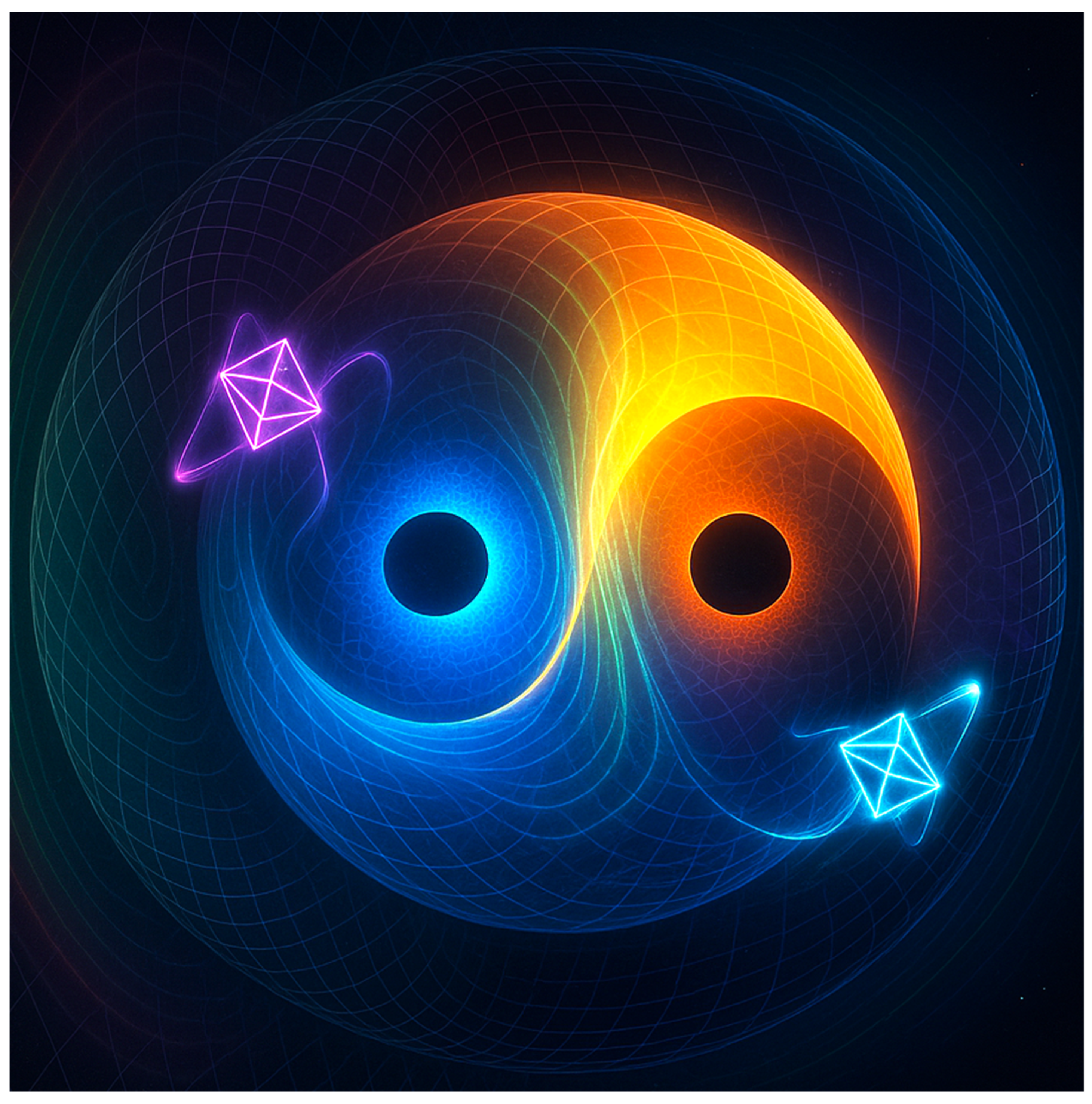
Figure 3.
Yin-Yang Universe Model.

Figure 4.
Reconstruction of the Cosmic Oscillation Phase from Simulated Spectral Shift Data.
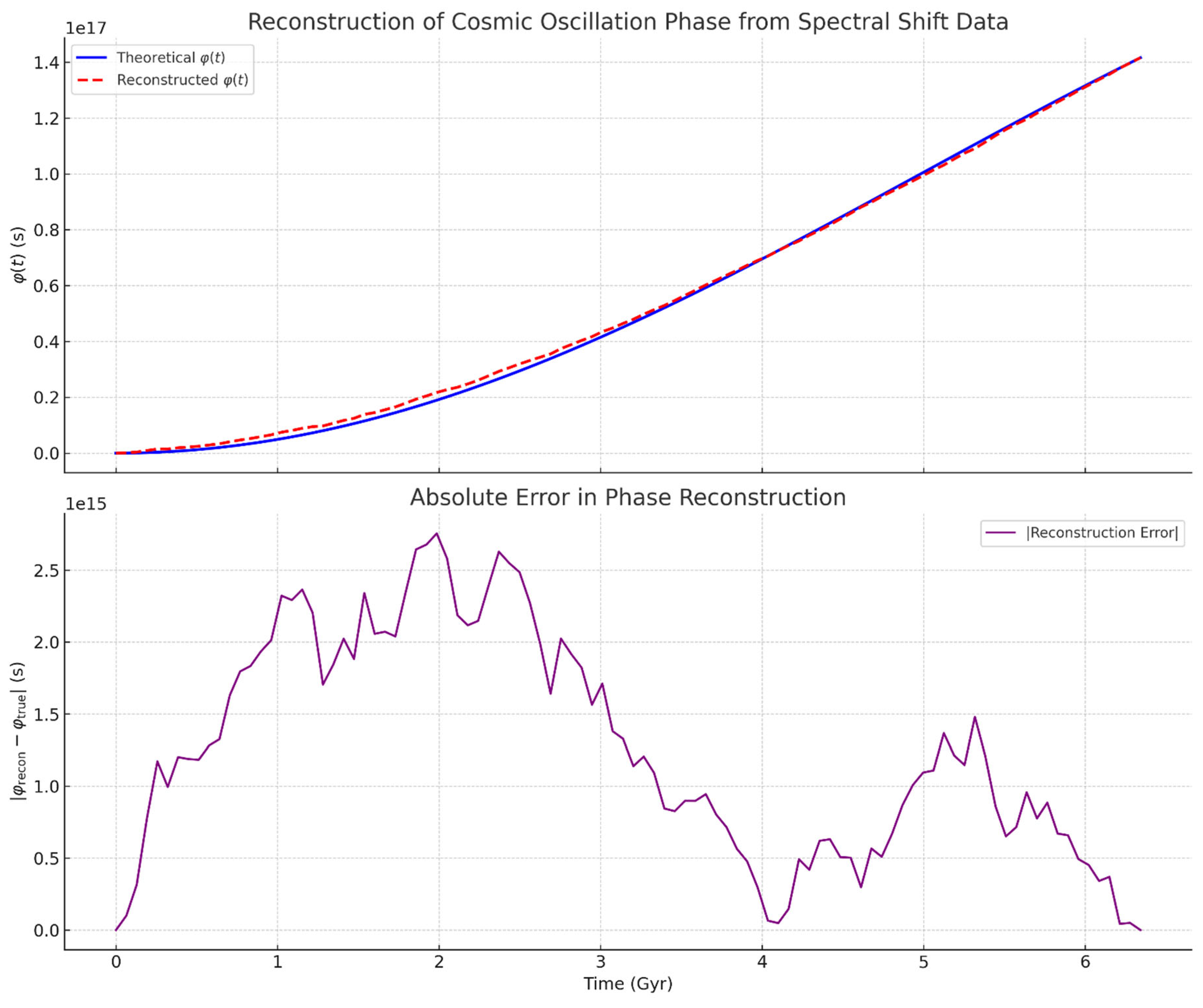
Figure 5.
Directional Anisotropy of the Bell Parameter in the MES Universe Model.
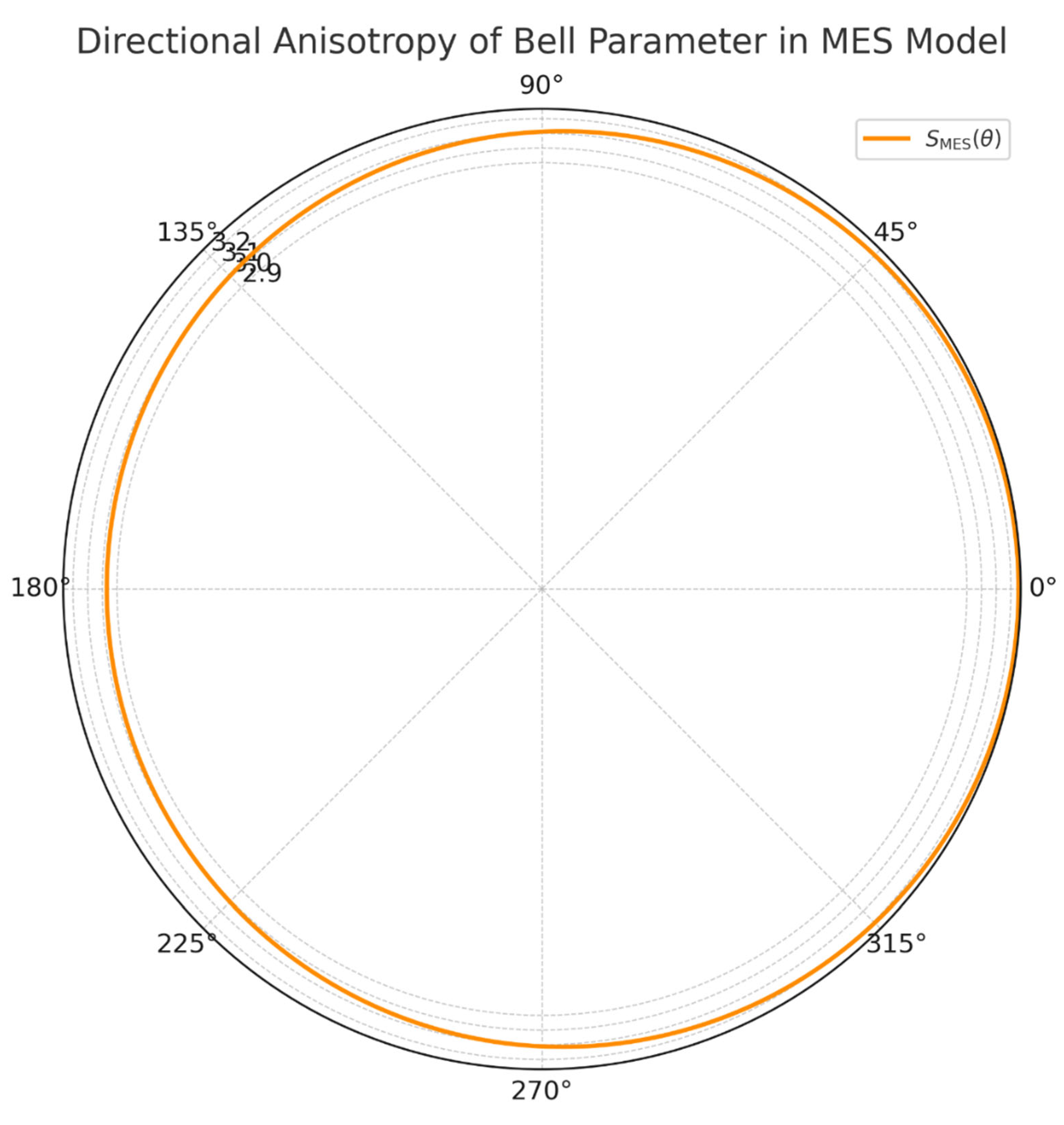
Figure 6.
Simulated CMB E/B-mode Power Spectra under MES Universe Corrections.
Disclaimer/Publisher’s Note: The statements, opinions and data contained in all publications are solely those of the individual author(s) and contributor(s) and not of MDPI and/or the editor(s). MDPI and/or the editor(s) disclaim responsibility for any injury to people or property resulting from any ideas, methods, instructions or products referred to in the content. |
© 2025 by the authors. Licensee MDPI, Basel, Switzerland. This article is an open access article distributed under the terms and conditions of the Creative Commons Attribution (CC BY) license (http://creativecommons.org/licenses/by/4.0/).
Copyright: This open access article is published under a Creative Commons CC BY 4.0 license, which permit the free download, distribution, and reuse, provided that the author and preprint are cited in any reuse.


