
Submitted:
13 December 2018
Posted:
14 December 2018
You are already at the latest version
Abstract
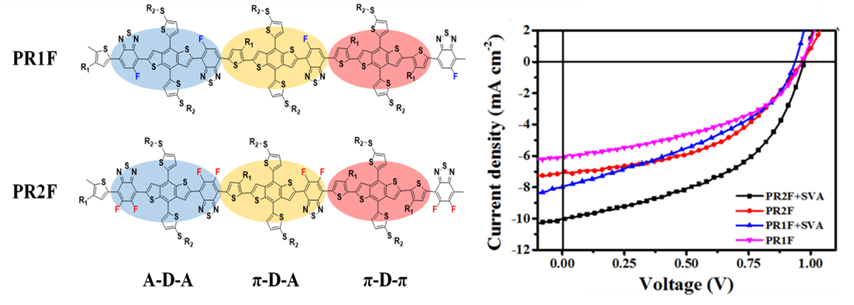
Two region asymmetric polymers PR2F and PR1F with three repeat units of A-D-A, π-D-A, and π-D-π along the polymer backbone were attained by polymerizing different fluorinated benzothiadiazole-thiophene units, FBT-T and 2FBT-T units (A–π), with benzodithiophene unit (D), respectively. Here, the new region asymmetric polymers were in contrast to the traditional polymers featuring a D–A or D–π–A–π backbone. Both the region asymmetric polymers showed a low lying of HOMO energy level in relation to that of the PC61BM acceptor and then obtained the high open-circuit voltage of ~1 V in both PR2F and PR1F devices. Bulk-heterojunction devices based on PR2F with difluorinated BT exhibited an appreciable power conversion efficiency (PCE) of 4.73% due to the relatively high and balanced charge carrier mobilities, while the mono-fluorinated BT polymer PR1F-based devices gave a lower PCE of 2.92%. These results indicate that the region asymmetric conjugated polymer is a promising class of materials for polymer solar cell applications, and it is significant to further understand the influence of polymer structure on optoelectronic properties.
Keywords:
polymer solar cells
; region asymmetric polymers
; fluorinated benzothiadiazole
Copyright: This open access article is published under a Creative Commons CC BY 4.0 license, which permit the free download, distribution, and reuse, provided that the author and preprint are cited in any reuse.


