

Submitted:
07 September 2018
Posted:
10 September 2018
You are already at the latest version
Abstract
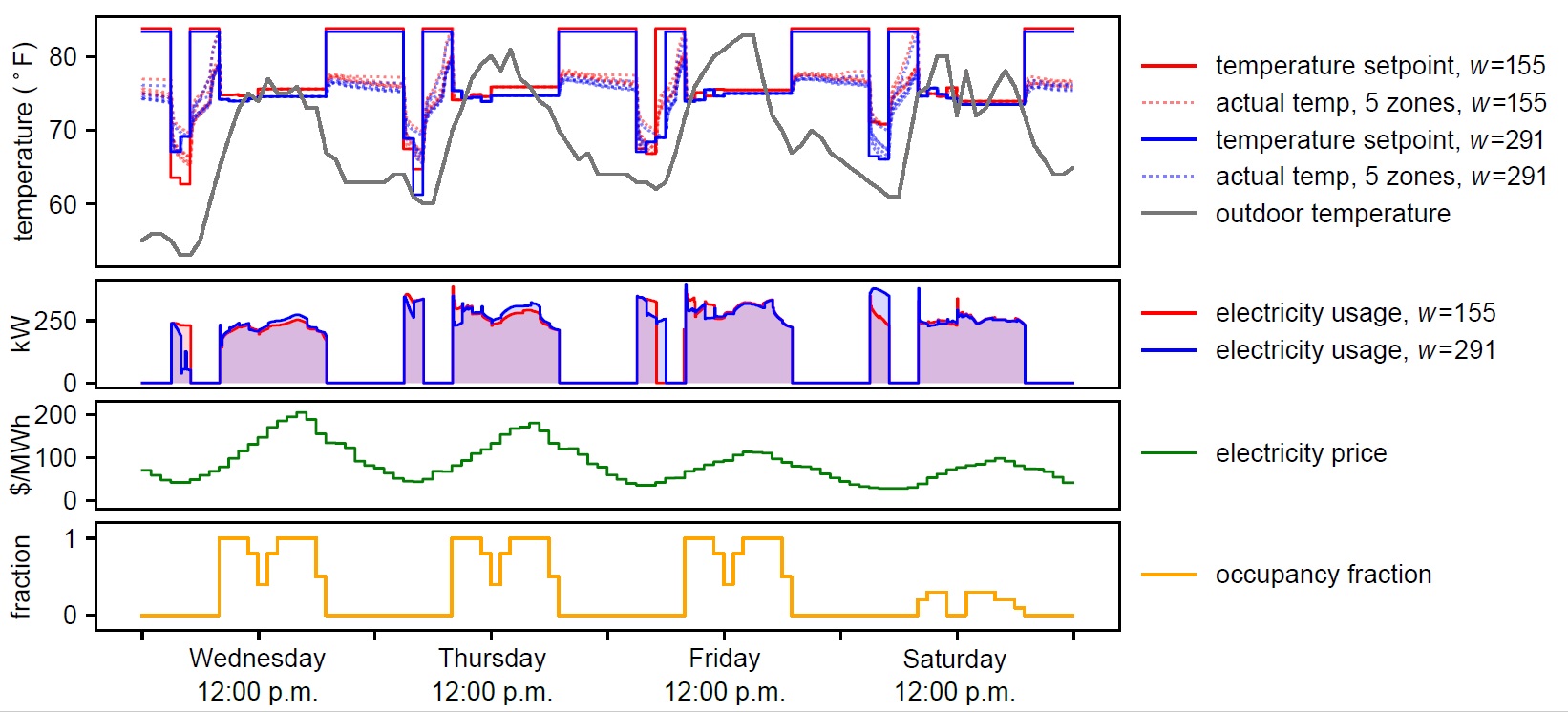
A new model predictive control (MPC) algorithm is used to select optimal air conditioning setpoints for a commercial office building, considering variable electricity prices, weather, occupancy and lighting. This algorithm, Cost-Comfort Particle Swarm Optimization (CCPSO), is the first to combine a realistic, smooth representation of occupants’ willingness to pay for thermal comfort with a bottom-up, non-linear model of the building and air conditioning system under control. We find that using a quadratic preference function for temperature can yield solutions that are both more comfortable and lower-cost than previous work that used a ``brick wall'' preference function with no preference for further cooling within an allowed temperature band and infinite aversion to going outside the allowed band. Using historical pricing data for a summer month in Chicago, CCPSO provided a 3\% reduction in costs vs. a ``brick-wall'' MPC approach with similar comfort and 13\% reduction in costs vs. a standard night setback strategy. CCPSO also reduced peak-hours demand by 3\% vs. the ``brick-wall'' strategy and 15\% vs. standard night-setback. At the same time, the CCPSO strategy increased off-peak energy consumption by 15\% vs. the ``brick-wall'' strategy. This may be valuable for power systems integrating large amounts of renewable power, which can otherwise become uneconomic due to saturation of demand during off-peak hours.
Keywords:
HVAC model predictive control
; demand response
; EnergyPlus
; particle swarm optimization (PSO)
; renewable energy
; smart grids
Copyright: This open access article is published under a Creative Commons CC BY 4.0 license, which permit the free download, distribution, and reuse, provided that the author and preprint are cited in any reuse.


