

Submitted:
23 March 2017
Posted:
24 March 2017
You are already at the latest version
Abstract
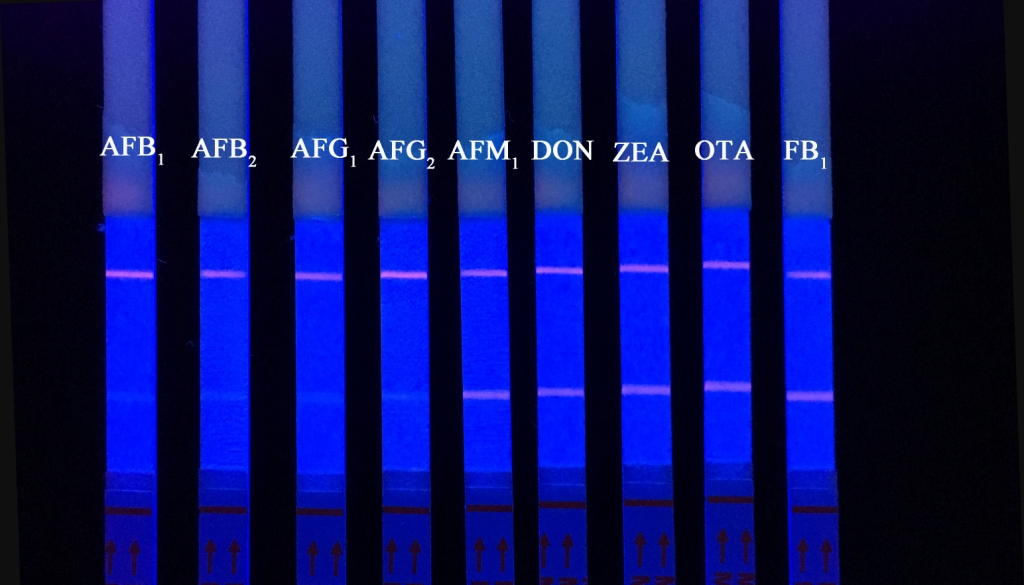
An on-site, ultra-sensitive, and quantitative sensing method was developed based on quantum dot nanobeads (QDNBs) and test strip for the determination of total aflatoxins (AFTs) in rice and peanut. The monoclonal antibody against AFT (mAbAFT) was home-made and labeled with QDNB. After the pre-coating of the AFT antigen on the test line (T line), the competitive immunoreactions were conducted between AFT and AFT antigen on the T line with QDNBs-mAbAFT. Under optimal conditions, this approach allowed a rapid response towards AFT with a considerable sensitivity of 1.4 pg/mL and 2.9 pg/mL in rice and peanut matrices, respectively. The put-in and put-out duration were within 10 min. The recoveries for AFT in rice and peanut samples matrices were recorded from 86.25–118.0% with the relative deviations (RSD) below 12%. The assay was further validated via the comparison between this QDNB strip and the conventional HPLC method using spiked samples. Thus, the design provided a potential alternative for on-site, ultra-sensitive, and quantitative sensing of AFT that could also be expanded to other chemical contaminants for food safety.
Keywords:
total aflatoxin
; quantum dot nanobead
; test strip
; on-site
; peanut and rice
; agro-food safety
Copyright: This open access article is published under a Creative Commons CC BY 4.0 license, which permit the free download, distribution, and reuse, provided that the author and preprint are cited in any reuse.


