Submitted:
15 June 2026
Posted:
16 June 2026
You are already at the latest version
Abstract

Keywords:
1. Introduction
- lower resistance to high pH allows recycling of used membranes by dissolution in strongly alkaline solutions, filtration followed by precipitation in water or aqueous solutions.
- biodegradability gives it increased attractiveness in the case of waste, which is no longer an environmental problem.
2. Materials, Reagents and Methods
2.1. Materials and Reagents
2.2. Methods and Procedures
2.2.1. Obtaining Composite Membranes
2.2.2. Nanofiltration of Phosphate and Sodium Nitrate Solutions
2.3. Equipment
3. Results and Discussion
- Physical-chemical wear of the cellulose acetate substrate during archiving (Figure 4);
- Translating information from motion pictures onto electronic media.
- Obtaining and composition and morphological characterization of the membranes;
- Determination of process characteristics using pure water;
- Determination of retention and fluxes in nanofiltration of phosphate and nitrate solutions.
3.1. Morphological and Compositional Characterization of the Obtained Membranes
- The composite membrane has a superficial layer composed of cellulose acetate and silver nanoparticles;
- The high concentration of silver shows that it is retained and distributed on the membrane surface during preparation;
- The superficial concentration of silver is very high compared to that in the solution obtained from cinematographic films, about 9ppm compared to cellulose acetate;
- The membrane support (polypropylene) also contains cellulose acetate in its pores, highlighted by the presence of oxygen;
- Silver nanoparticles do not penetrate the pores of the polypropylene support;
- The presence of residual sulfur from the cinematographic film processing process was found;
- The presence of trace impurities (sodium and silicon) is related to the sampling of the samples.
3.2. Determination of Nanofiltration Characteristics Through CA–Agnp–PP Membrane Using Deionized Water
3.3. Determination of Permeate Flow and the Retention for CA–Agnp–PP Composite Membranes
- varying the characteristics of the casting solution from which the membranes were prepared;
- changing the feed solution parameters.
- working pressure: 15 atm;
- the concentration of nitrate and phosphate anions is equal to 30ppm;
- pH of the feed solution is 7.0±0.2;
- the feed solution flow rate is 120 L/h;
- the membrane is obtained from a casting solution of 4% cellulose acetate and approx. 11.5ppm Agnp;
- experiments are performed daily, keeping the same membrane;
- the feed solution is refreshed daily (600 L/day).
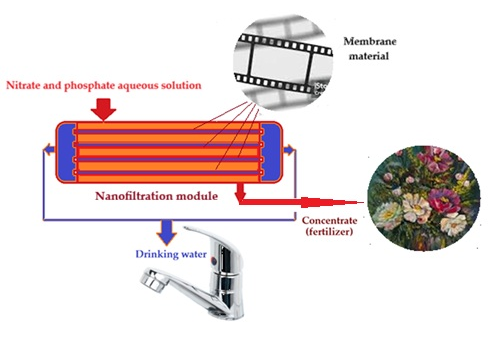
3.4. Application Perspectives of Nanofiltration with CA–Agnp–PP Membranes
4. Conclusions
Author Contributions
Funding
Institutional Review Board Statement
Informed Consent Statement
Data Availability Statement
Acknowledgments
Conflicts of Interest
References
- Wang, Y.; Wei, G. Recent Trends in Polymer Membranes: Fabrication Technique, Characterization, Functionalization, and Applications in Environmental Science (Part I). Polymers 2024, 16, 2889. [Google Scholar] [CrossRef] [PubMed]
- Satchanska, G.; Davidova, S.; Petrov, P.D. Natural and Synthetic Polymers for Biomedical and Environmental Applications. Polymers 2024, 16, 1159. [Google Scholar] [CrossRef] [PubMed]
- Oprea, M.; Voicu, S.I. Cellulose Acetate-Based Materials for Water Treatment in the Context of Circular Economy. Water 2023, 15, 1860. [Google Scholar] [CrossRef]
- Mulder, M. Basic Principles of Membrane Technology; Kluwer Academic Publishers: Dordrecht, The Netherlands, 1996; p. 54. ISBN 0792309782. [Google Scholar]
- Oprea, M.; Voicu, S.I. Recent Advances in Applications of Cellulose Derivatives-Based Composite Membranes with Hydroxyapatite. Materials 2020, 13, 2481. [Google Scholar] [CrossRef] [PubMed]
- An, Y.; Li, F.; Di, Y.; Zhang, X.; Lu, J.; Wang, L.; Yan, Z.; Wang, W.; Liu, M.; Fei, P. Hydrophobic Modification of Cellulose Acetate and Its Application in the Field of Water Treatment: A Review. Molecules 2024, 29, 5127. [Google Scholar] [CrossRef] [PubMed]
- Morsi, R.E.; Corticelli, F.; Morandi, V.; Gentili, D.; Cavallini, M.; Figoli, A.; Russo, F.; Galiano, F.; Aluigi, A.; Ventura, B. Influence of the Fabrication Conditions on the Physical Properties and Water Treatment Efficiency of Cellulose Acetate Porous Membranes. Water 2023, 15, 1061. [Google Scholar] [CrossRef]
- Koriem, O.A.; Kamel, A.M.; Shaaban, W.; Elkady, M.F. Enhancement of Dye Separation Performance of Eco-Friendly Cellulose Acetate-Based Membranes. Sustainability 2022, 14, 14665. [Google Scholar] [CrossRef]
- Aldalbahi, A.; El-Naggar, M.; Khattab, T.; Abdelrahman, M.; Rahaman, M.; Alrehaili, A.; El-Newehy, M. Development of Green and Sustainable Cellulose Acetate/Graphene Oxide Nanocomposite Films as Efficient Adsorbents for Wastewater Treatment. Polymers 2020, 12, 2501. [Google Scholar] [CrossRef] [PubMed]
- Ounifi, I.; Guesmi, Y.; Ursino, C.; Santoro, S.; Mahfoudhi, S.; Figoli, A.; Ferjanie, E.; Hafiane, A. Antifouling Membranes Based on Cellulose Acetate (CA) Blended with Poly(acrylic acid) for Heavy Metal Remediation. Appl. Sci. 2021, 11, 4354. [Google Scholar] [CrossRef]
- Asiri, A.M.; Petrosino, F.; Pugliese, V.; Khan, S.B.; Alamry, K.A.; Alfifi, S.Y.; Marwani, H.M.; Alotaibi, M.M.; Algieri, C.; Chakraborty, S. Synthesis and Characterization of Blended Cellulose Acetate Membranes. Polymers 2022, 14, 4. [Google Scholar] [CrossRef] [PubMed]
- Kuzminova, A.; Dmitrenko, M.; Dubovenko, R.; Puzikova, M.; Mikulan, A.; Korovina, A.; Koroleva, A.; Selyutin, A.; Semenov, K.; Su, R.; et al. Development and Study of Novel Ultrafiltration Membranes Based on Cellulose Acetate. Polymers 2024, 16, 1236. [Google Scholar] [CrossRef] [PubMed]
- Islam, M.D.; Uddin, F.J.; Rashid, T.U.; Shahruzzaman, M. Cellulose acetate-based membrane for wastewater treatment—A state-of-the-art review. Mater. Adv. 2023, 4(18), 4054–4102. [Google Scholar] [CrossRef]
- Elbadawi, N.A.; Ramadan, A.R.; Esawi, A.M.K. Studying the Effect of Shortening Carbon Nanotubes via Ball Milling on Cellulose Acetate Nanocomposite Membranes for Desalination Applications. Membranes 2022, 12, 474. [Google Scholar] [CrossRef] [PubMed]
- Abu-Zurayk, R.; Alnairat, N.; Khalaf, A.; Ibrahim, A.A.; Halaweh, G. Cellulose Acetate Membranes: Fouling Types and Antifouling Strategies—A Brief Review. Processes 2023, 11, 489. [Google Scholar] [CrossRef]
- Li, T.; Wang, Y.; Wang, X.; Cheng, C.; Zhang, K.; Yang, J.; Han, G.; Wang, Z.; Wang, X.; Wang, L. Desalination Characteristics of Cellulose Acetate FO Membrane Incorporated with ZIF-8 Nanoparticles. Membranes 2022, 12, 122. [Google Scholar] [CrossRef] [PubMed]
- Chaithra, K.P.; Varghese, A.; Vinod, T.P.; KR, S.D. Multifunctional electrospun membranes incorporated with metal oxide nanoparticles, cellulose acetate, and polyvinylpyrrolidone for wastewater treatment: Oil/water separation, dye adsorption, and dye degradation. Chem. Eng. J. 2024, 499, 156049. [Google Scholar] [CrossRef]
- Mahmodi, G.; Bafti, R.R.; Boroujeni, N.I.; Pradhan, S.; Dangwal, S.; Sengupta, B.; Vatanpour, V.; Sorci, M.; Fathizadeh, M.; Bikkina, P.; Belfort, G. Improving cellulose acetate mixed matrix membranes by incorporating hydrophilic MIL-101 (Cr)-NH2 nanoparticles for treating dye/salt solution. Chem. Eng. J. 2023, 477, 146736. [Google Scholar] [CrossRef]
- Islam, M.D.; Uddin, F.J.; Rashid, T.U.; Shahruzzaman, M. Cellulose acetate-based membrane for wastewater treatment—A state-of-the-art review. Mater. Adv. 2023, 4(18), 4054–4102. [Google Scholar] [CrossRef]
- Rodrigues Filho, G.; Monteiro, D.S.; da Silva Meireles, C.; de Assunção, R.M.N.; Cerqueira, D.A.; Barud, H.S.; Ribeiro, S.J.; Messadeq, Y. Synthesis and characterization of cellulose acetate produced from recycled newspaper. Carbohydr. Polym. 2008, 73(1), 74–82. [Google Scholar] [CrossRef]
- Nechifor, A.C.; Cotorcea, S.; Bungău, C.; Albu, P.C.; Pașcu, D.; Oprea, O.; Grosu, A.R.; Pîrțac, A.; Nechifor, G. Removing of the Sulfur Compounds by Impregnated Polypropylene Fibers with Silver Nanoparticles-Cellulose Derivatives for Air Odor Correction. Membranes 2021, 11, 256. [Google Scholar] [CrossRef] [PubMed]
- Torkashvand, J.; Saeedi-Jurkuyeh, A.; Rezaei Kalantary, R.; Gholami, M.; Esrafili, A.; Yousefi, M.; Farzadkia, M. Preparation of a cellulose acetate membrane using cigarette butt recycling and investigation of its efficiency in removing heavy metals from aqueous solution. Sci. Rep. 2022, 12(1), 20336. [Google Scholar] [CrossRef] [PubMed]
- Friuli, M.; Grazioli, C.; Sattar, N.; Zia, J.; Del Sole, R.; Mergola, L.; Pal, S.; Licciulli, A.; Demitri, C.; Sannino, A.; Lamanna, L. Eco-friendly recovery of cellulose acetate from combusted cigarette filters and reuse for membrane fabrication. Waste Manag. 2025, 204, 114915. [Google Scholar] [CrossRef] [PubMed]
- Slejko, E.A.; Tuan, A.; Scuor, N. From waste to value: Characterization of recycled cellulose acetate for sustainable waste management. Waste Manag. Bull. 2024, 1(4), 67–73. [Google Scholar] [CrossRef]
- Council Directive 2000/60/EC of the European Parliament and of the Council of 23 October 2000 establishing a framework for Community action in the field of water policy. Available online: https://eur-lex.europa.eu/eli/dir/2000/60/oj (accessed on 10 June 2026).
- Council Directive 98/83/EC of 3 November 1998 on the quality of water intended for human consumption, EUR-Lex - 01998L0083–20151027 - EN. 2015. Available online: http://data.europa.eu/eli/dir/1998/83/2015–10-27 (accessed on 10 June 2026).
- Abdoli, S.; Asgari Lajayer, B.; Dehghanian, Z.; Bagheri, N.; Vafaei, A.H.; Chamani, M.; Rani, S.; Lin, Z.; Shu, W.; Price, G.W. A Review of the Efficiency of Phosphorus Removal and Recovery from Wastewater by Physicochemical and Biological Processes: Challenges and Opportunities. Water 2024, 16, 2507. [Google Scholar] [CrossRef]
- Huang, L.; Lu, Z.; Xie, T.; Wang, L.; Mo, C. Nitrogen and phosphorus removal by coupling Anaerobic ammonia oxidation reaction with algal-bacterial symbiotic system. J. Environ. Chem. Eng. 2022, 10(6), 108905. [Google Scholar] [CrossRef]
- Derco, J.; Žgajnar Gotvajn, A.; Guľašová, P.; Kassai, A.; Šoltýsová, N. Nutrient Removal and Recovery from Municipal Wastewater. Processes 2024, 12, 894. [Google Scholar] [CrossRef]
- Ma, J.; Wei, W.; Qin, G.; Xiao, T.; Tang, W.; Zhao, S.; Jiang, L.; Liu, S. Electrochemical reduction of nitrate in a catalytic carbon membrane nano-reactor. Water Res. 2022, 208, 117862. [Google Scholar] [CrossRef] [PubMed]
- Sun, F.Y.; Wang, X.M.; Li, X.Y. An innovative membrane bioreactor (MBR) system for simultaneous nitrogen and phosphorus removal. Process Biochem. 2013, 48(11), 1749–1756. [Google Scholar] [CrossRef]
- Velusamy, K.; Periyasamy, S.; Kumar, P.S.; Vo, D.V.N.; Sindhu, J.; Sneka, D.; Subhashini, B. Advanced techniques to remove phosphates and nitrates from waters: a review. Environ. Chem. Lett. 2021, 19(4), 3165–3180. [Google Scholar] [CrossRef]
- Nie, J.; Huang, H.; Rao, P.; Chen, H.; Du, X.; Wang, Z.; Zhang, W.; Liang, H. Composite functional particle enhanced gravity driven ceramic membrane bioreactor for simultaneous removal of nitrogen and phosphorus from groundwater. Chem. Eng. J. 2023, 452, 139134. [Google Scholar] [CrossRef]
- Lüdtke, K.; Peinemann, K.V.; Kasche, V.; Behling, R.D. Nitrate removal of drinking water by means of catalytically active membranes. J. Membr. Sci. 1998, 151(1), 3–11. [Google Scholar] [CrossRef]
- Gao, Q.; Wang, C.Z.; Liu, S.; Hanigan, D.; Liu, S.T.; Zhao, H.Z. Ultrafiltration membrane microreactor (MMR) for simultaneous removal of nitrate and phosphate from water. Chem. Eng. J. 2019, 355, 238–246. [Google Scholar] [CrossRef]
- Fang, D.; Huang, L.; Xiao, H.; Wu, G.; Zeng, Z.; Wang, X.; Yang, G.; Shen, F.; Deng, S.; Ji, F. Layered double hydroxide membranes for advanced removal of phosphate from wastewater. Chem. Eng. J. 2023, 451, 138600. [Google Scholar] [CrossRef]
- Ren, L.; Xu, J.; Dai, R.; Wang, Z. Electrochemical removal and recovery of phosphorus from wastewater using cathodic membrane filtration reactor. Chin. Chem. Lett. 2023, 34(4), 107707. [Google Scholar] [CrossRef]
- Popova, A.; Rattanakom, R.; Yu, Z.Q.; Li, Z.; Nakagawa, K.; Fujioka, T. Evaluating the potential of nanofiltration membranes for removing ammonium, nitrate, and nitrite in drinking water sources. Water Res. 2023, 244, 120484. [Google Scholar] [CrossRef] [PubMed]
- Tepuš, B.; Simonič, M.; Petrinić, I. Comparison between nitrate and pesticide removal from ground water using adsorbents and NF and RO membranes. J. Hazard. Mater. 2009, 170(2-3), 1210–1217. [Google Scholar] [CrossRef] [PubMed]
- Mehenktaş, C.; Arar, Ö. Application of membrane processes for nitrate (NO3-) removal. Curr. Chin. Sci. 2023, 3(1), 42–56. [Google Scholar] [CrossRef]
- Ghimpusan, M.; Nechifor, G.; Din, I.S.; Nechifor, A.C.; Passeri, P. Application of Hollow Fibre Membrane Bioreactor Instead of Granular Activated Carbon Filtration for Treatment of Wastewater from Car Dismantler Activity. Mater. Plast. 2016, 53, 578–584. [Google Scholar]
- MAN, Geani Teodor; Albu, Paul Constantin; Popescu, Diana Ionela; Niculescu, Violeta-Carolina; Marinescu, Virgil Emanuel; Nechifor, Aurelia Cristina. Thorium recovery from the Tungsten welding electrodes by electrolysis and nanofiltration. U.P.B. Sci. Bull. Ser. B 2024, 86(2), 81–92. [Google Scholar]
- Albu, P.C.; Pîrțac, A.; Motelica, L.; Nechifor, A.C.; Man, G.T.; Grosu, A.R.; Tanczos, S.-K.; Grosu, V.-A.; Nechifor, G. Reduction in Olfactory Discomfort in Inhabited Premises from Areas with Mofettas through Cellulosic Derivative–Polypropylene Hollow Fiber Composite Membranes. Materials 2024, 17, 4437. [Google Scholar] [CrossRef] [PubMed]
- Nechifor, A.C.; Albu, P.C.; Motelica, L.; Man, G.T.; Grosu, A.R.; Tanczos, S.-K.; Grosu, V.-A.; Marinescu, V.E.; Nechifor, G. Thorium Recovery with Crown Ether–Polymer Composite Membranes. Appl. Sci. 2024, 14, 9937. [Google Scholar] [CrossRef]
- Zamfir, L.-G.; Rotariu, L.; Marinescu, V.E.; Simelane, X.T.; Baker, P.G.L.; Iwuoha, E.I.; Bala, C. Non-enzymatic polyamic acid sensors for hydrogen peroxide detection. Sens. Actuators B Chem. 2016, 226, 525–533. [Google Scholar] [CrossRef]
- Razvan, A.; Man, G. T.; Dumitru, F.; Pandele, M.; Trusca, R.; Motelica, L.; Nechifor, G. Nanocomposite membranes prepared from cellulose acetate or polysulfone with Ag0 nanoparticles and nitron reagent for nitrate ion removal. Desalin. Water Treat. 2024, 318, 100400. [Google Scholar] [CrossRef]
- Dimulescu, I.A.; Nechifor, A.C.; Bǎrdacǎ, C.; Oprea, O.; Paşcu, D.; Totu, E.E.; Albu, P.C.; Nechifor, G.; Bungău, S.G. Accessible Silver-Iron Oxide Nanoparticles as a Nanomaterial for Supported Liquid Membranes. Nanomaterials 2021, 11, 1204. [Google Scholar] [CrossRef] [PubMed]
- Ramezani, R.; Di Felice, L.; Gallucci, F. A Review on Hollow Fiber Membrane Contactors for Carbon Capture: Recent Advances and Future Challenges. Processes 2022, 10, 2103. [Google Scholar] [CrossRef]
- Magnone, E.; Shin, M.C.; Park, J.H. Polymeric Membrane Contactors for CO2 Separation: A Systematic Literature Analysis of the Impact of Absorbent Temperature. Polymers 2025, 17, 1387. [Google Scholar] [CrossRef] [PubMed]
- Nechifor, G.; Păncescu, F.M.; Grosu, A.R.; Albu, P.C.; Oprea, O.; Tanczos, S.-K.; Bungău, C.; Grosu, V.-A.; Pîrțac, A.; Nechifor, A.C. Osmium Nanoparticles-Polypropylene Hollow Fiber Membranes Applied in Redox Processes. Nanomaterials 2021, 11, 2526. [Google Scholar] [CrossRef] [PubMed]
- Van der Bruggen, B.; Kim, J. Nanofiltration of aqueous solutions: recent developments and progresses. Adv. Mater. Membr. Prep. 2012, 228–247. [Google Scholar] [CrossRef]
- Lu, C.; Chen, Z.; Wu, Y.; Zhang, Y.; Wang, F.; Hu, C.; Qu, J. Response of ionic hydration structure and selective transport behavior to aqueous solution chemistry during nanofiltration. Environ. Sci. Technol. 2024, 58(26), 11791–11801. [Google Scholar] [CrossRef] [PubMed]
- Suhalim, N.S.; Kasim, N.; Mahmoudi, E.; Shamsudin, I.J.; Mohammad, A.W.; Mohamed Zuki, F.; Jamari, N.L.-A. Rejection Mechanism of Ionic Solute Removal by Nanofiltration Membranes: An Overview. Nanomaterials 2022, 12, 437. [Google Scholar] [CrossRef] [PubMed]
- Giacobbo, A.; Pasqualotto, I.F.; Machado Filho, R.C.d.C.; Minhalma, M.; Bernardes, A.M.; Pinho, M.N.d. Ultrafiltration and Nanofiltration for the Removal of Pharmaceutically Active Compounds from Water: The Effect of Operating Pressure on Electrostatic Solute—Membrane Interactions. Membranes 2023, 13, 743. [Google Scholar] [CrossRef] [PubMed]
- Rojewska, M.; Jakubowska, E.; Szelejewska, K.; Nowaczyk, M.; Froelich, A.; Prochaska, K.; Osmałek, T. Cellulose-Based Polymer Blends for Oral Mucoadhesion: Impact of Hydration and Surface Interactions. Polymers 2026, 18(10), 1227. [Google Scholar] [CrossRef] [PubMed]


| Atom | Silver (%) | Carbon (%) | Oxygen (%) | Sulfur (%) | Natrium (%) | Silicium (%) | |
|---|---|---|---|---|---|---|---|
| Surface | A | 38.2 ± 0.3 | 47.2 ± 0.4 | 13.4 ± 0.1 | 1.0 ± 0.1 | 0.3 ± 0.0 | - |
| B | - | 83.4 ± 0.1 | 16.3 ± 0.1 | - | - | - | |
| C | 43.6 ± 0.5 | 39.4 ± 0.4 | 15.2 ± 0.2 | 1.5 ± 0.1 | - | 0.3 ± 0.1 |
| Parameter | CCA (%) | CAgnp (ppm) | ||||
|---|---|---|---|---|---|---|
| 2 | 4 | 6 | 7.3 | 11.5 | 16.1 | |
| Flux(L/m2·h) | 15.2 ± 0.4 | 10.7 ± 0.4 | 4.4 ± 0.4 | 11.3 ± 0.4 | 10.7 ± 0.4 | 9.7 ± 0.4 |
| Retention nitrate (%) | 63.7 ± 0.2 | 95.0 ± 0.2 | 96.5 ± 0.2 | 92.5 ± 0.2 | 95.0 ± 0.2 | 96.1 ± 0.2 |
| Retention phosphate (%) | 75.2 ± 0.3 | 98.1 ± 0.3 | 99.0 ± 0.3 | 95.2 ± 0.3 | 98.1 ± 0.3 | 99.2 ± 0.3 |
| Parameter | pH | CFS (ppm) 1 | ||||
|---|---|---|---|---|---|---|
| 4 | 7 | 11 | 10 | 30 | 50 | |
| Flux(L/m2·h) | 11.2±0.4 | 10.7±0.4 | 10.4±0.4 | 11.3±0.4 | 10.7±0.4 | 9.9±0.4 |
| Retention nitrate (%) | 90.7±0.2 | 95.0±0.2 | 95.8±0.2 | 96.5±0.2 | 95.0±0.2 | 93.2±0.2 |
| Retention phosphate (%) | 95.2±0.3 | 98.1±0.3 | 99.1±0.3 | 99.2±0.3 | 98.1±0.3 | 96.2±0.3 |
Disclaimer/Publisher’s Note: The statements, opinions and data contained in all publications are solely those of the individual author(s) and contributor(s) and not of MDPI and/or the editor(s). MDPI and/or the editor(s) disclaim responsibility for any injury to people or property resulting from any ideas, methods, instructions or products referred to in the content. |
© 2026 by the authors. Licensee MDPI, Basel, Switzerland. This article is an open access article distributed under the terms and conditions of the Creative Commons Attribution (CC BY) license (http://creativecommons.org/licenses/by/4.0/).