

Submitted:
15 June 2026
Posted:
16 June 2026
You are already at the latest version
Abstract
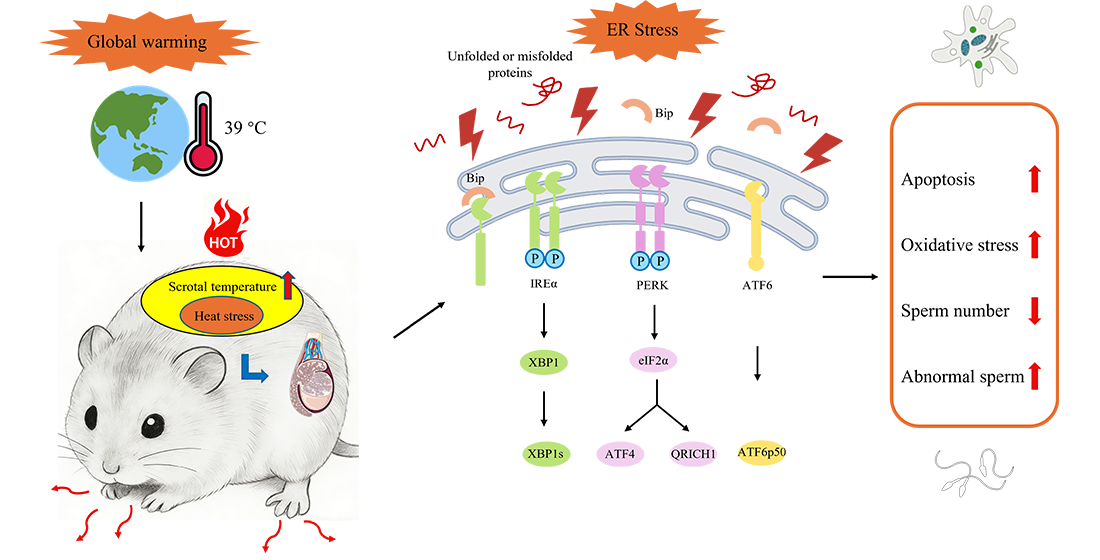
Rising global temperatures pose a serious threat to wild small mammal’s population persistence. In this study, we investigated the molecular mechanisms underlying heat-induced testicular impairment in Brandt’s vole (Lasiopodomys brandtii), a dominant small mammal species of the Eurasian temperate steppe. Adult males were subjected to short term heat exposure at 37°C, 39°C, and 41°C. Heat stress at temperatures ≥39°C significantly reduced the testicular index and caused histopathological damage. Integrated transcriptomic and data-independent acquisition proteomic analyses revealed significant enrichment of pathways related to endoplasmic reticulum protein processing and barrier function. Further molecular validation demonstrated robust activation of the unfolded protein response, indicated by increased expression of ATF4, ATF6B, phosphorylated eIF2α, and XBP1. Together, these results identify endoplasmic reticulum stress as a key mediator of heat-induced testicular injury and highlight that 39°C represents a critical reproductive threshold for Brandt’s voles, even following short-term exposure.
Keywords:
Brandt’s vole
; climate warming
; ER stress
; reproductive dysfunction
Copyright: This open access article is published under a Creative Commons CC BY 4.0 license, which permit the free download, distribution, and reuse, provided that the author and preprint are cited in any reuse.


