

Submitted:
13 June 2026
Posted:
15 June 2026
You are already at the latest version
Abstract
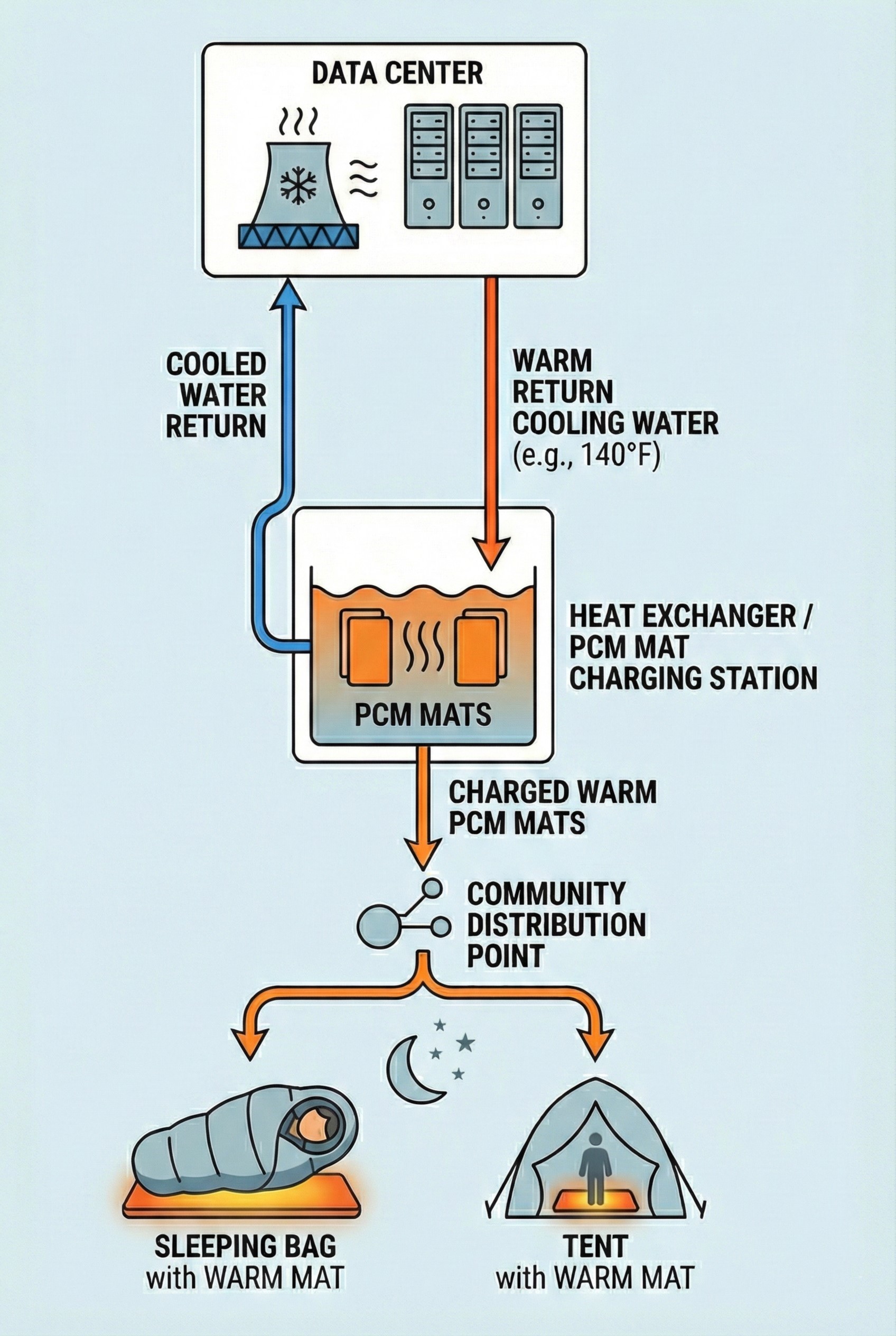
This study examines the technical feasibility of using phase-change materials (PCMs) to provide overnight heat to individuals sleeping outdoors or in tents. Thermal batteries made with PCMs absorb heat at a certain time and place and change phase at a defined temperature, usually from a solid to a liquid or melt. At a later time or different place where the surrounding temperature is below the transition temperature, the phase change reverses and the material releases heat. There is ample wasted heat in our society from residential, commercial, and municipal facilities, data centers, industrial processes, and internal combustion vehicles. Solar radiation could also be used to warm PCM mats during the daytime. We conducted scaled-down tests with a paraffin wax PCM, a standard sleeping bag, and a 3-probe digital thermometer. We heated a PCM with a transition temperature of 72 °F with ~160 °F water to approximate warmed process cooling water, and with a heat lamp to mimic solar heating. The pad, placed in a standard sleeping bag outdoors at an ambient temperature of ~50 °F, maintained the bag’s internal air temperature at ~70 °F or >15 °F above ambient for well over 12 hours. Scaling calculations reveal that each full-size pad would only cost about $3 USD. This concept thus appears to have excellent technical and economic viability.
Keywords:
phase change material
; latent heat
; overnight heat source
; paraffin wax
; waste heat usage
Copyright: This open access article is published under a Creative Commons CC BY 4.0 license, which permit the free download, distribution, and reuse, provided that the author and preprint are cited in any reuse.


